EP0328423B1 - Aufzugsverteilung durch Sektoren von benachbarten Stockwerken - Google Patents
Aufzugsverteilung durch Sektoren von benachbarten Stockwerken Download PDFInfo
- Publication number
- EP0328423B1 EP0328423B1 EP19890301358 EP89301358A EP0328423B1 EP 0328423 B1 EP0328423 B1 EP 0328423B1 EP 19890301358 EP19890301358 EP 19890301358 EP 89301358 A EP89301358 A EP 89301358A EP 0328423 B1 EP0328423 B1 EP 0328423B1
- Authority
- EP
- European Patent Office
- Prior art keywords
- car
- sector
- cars
- call
- floors
- Prior art date
- Legal status (The legal status is an assumption and is not a legal conclusion. Google has not performed a legal analysis and makes no representation as to the accuracy of the status listed.)
- Expired - Lifetime
Links
- 230000005465 channeling Effects 0.000 title description 7
- 238000013459 approach Methods 0.000 claims description 8
- 238000012545 processing Methods 0.000 claims description 8
- 238000000034 method Methods 0.000 claims description 7
- 125000004122 cyclic group Chemical group 0.000 claims 2
- 238000012360 testing method Methods 0.000 description 9
- 230000000694 effects Effects 0.000 description 5
- 230000002349 favourable effect Effects 0.000 description 5
- 241001246312 Otis Species 0.000 description 4
- 230000004941 influx Effects 0.000 description 2
- 238000012986 modification Methods 0.000 description 2
- 230000004048 modification Effects 0.000 description 2
- SAZUGELZHZOXHB-UHFFFAOYSA-N acecarbromal Chemical compound CCC(Br)(CC)C(=O)NC(=O)NC(C)=O SAZUGELZHZOXHB-UHFFFAOYSA-N 0.000 description 1
- 230000003044 adaptive effect Effects 0.000 description 1
- 230000003466 anti-cipated effect Effects 0.000 description 1
- 230000000052 comparative effect Effects 0.000 description 1
- 230000001276 controlling effect Effects 0.000 description 1
- 230000002596 correlated effect Effects 0.000 description 1
- 230000001351 cycling effect Effects 0.000 description 1
- 238000010586 diagram Methods 0.000 description 1
- 230000001105 regulatory effect Effects 0.000 description 1
Images


Classifications
-
- B—PERFORMING OPERATIONS; TRANSPORTING
- B66—HOISTING; LIFTING; HAULING
- B66B—ELEVATORS; ESCALATORS OR MOVING WALKWAYS
- B66B1/00—Control systems of elevators in general
- B66B1/24—Control systems with regulation, i.e. with retroactive action, for influencing travelling speed, acceleration, or deceleration
- B66B1/2408—Control systems with regulation, i.e. with retroactive action, for influencing travelling speed, acceleration, or deceleration where the allocation of a call to an elevator car is of importance, i.e. by means of a supervisory or group controller
- B66B1/2458—For elevator systems with multiple shafts and a single car per shaft
-
- B—PERFORMING OPERATIONS; TRANSPORTING
- B66—HOISTING; LIFTING; HAULING
- B66B—ELEVATORS; ESCALATORS OR MOVING WALKWAYS
- B66B2201/00—Aspects of control systems of elevators
- B66B2201/10—Details with respect to the type of call input
- B66B2201/102—Up or down call input
-
- B—PERFORMING OPERATIONS; TRANSPORTING
- B66—HOISTING; LIFTING; HAULING
- B66B—ELEVATORS; ESCALATORS OR MOVING WALKWAYS
- B66B2201/00—Aspects of control systems of elevators
- B66B2201/20—Details of the evaluation method for the allocation of a call to an elevator car
- B66B2201/211—Waiting time, i.e. response time
-
- B—PERFORMING OPERATIONS; TRANSPORTING
- B66—HOISTING; LIFTING; HAULING
- B66B—ELEVATORS; ESCALATORS OR MOVING WALKWAYS
- B66B2201/00—Aspects of control systems of elevators
- B66B2201/20—Details of the evaluation method for the allocation of a call to an elevator car
- B66B2201/215—Transportation capacity
-
- B—PERFORMING OPERATIONS; TRANSPORTING
- B66—HOISTING; LIFTING; HAULING
- B66B—ELEVATORS; ESCALATORS OR MOVING WALKWAYS
- B66B2201/00—Aspects of control systems of elevators
- B66B2201/20—Details of the evaluation method for the allocation of a call to an elevator car
- B66B2201/222—Taking into account the number of passengers present in the elevator car to be allocated
-
- B—PERFORMING OPERATIONS; TRANSPORTING
- B66—HOISTING; LIFTING; HAULING
- B66B—ELEVATORS; ESCALATORS OR MOVING WALKWAYS
- B66B2201/00—Aspects of control systems of elevators
- B66B2201/30—Details of the elevator system configuration
- B66B2201/301—Shafts divided into zones
- B66B2201/302—Shafts divided into zones with variable boundaries
-
- B—PERFORMING OPERATIONS; TRANSPORTING
- B66—HOISTING; LIFTING; HAULING
- B66B—ELEVATORS; ESCALATORS OR MOVING WALKWAYS
- B66B2201/00—Aspects of control systems of elevators
- B66B2201/40—Details of the change of control mode
- B66B2201/402—Details of the change of control mode by historical, statistical or predicted traffic data, e.g. by learning
-
- B—PERFORMING OPERATIONS; TRANSPORTING
- B66—HOISTING; LIFTING; HAULING
- B66B—ELEVATORS; ESCALATORS OR MOVING WALKWAYS
- B66B2201/00—Aspects of control systems of elevators
- B66B2201/40—Details of the change of control mode
- B66B2201/403—Details of the change of control mode by real-time traffic data
Definitions
- This invention pertains to dispatching elevator cars in an elevator system containing a plurality of cars providing group service to a plurality of floors in a building during up-peak conditions and to dispatching cars to answer hall calls for interfloor traffic during up-peak conditions.
- elevator interfloor traffic and traffic from the lobby or main floor (e.g. lobby) to upper floors varies throughout the day.
- Traffic demand from the main lobby is manifested by the floor destinations entered by passengers (car calls) on the car call buttons.
- Traffic from the lobby is usually highest in the morning in an office building. This is known as the "up-peak" period, the time of day when passengers entering the building at the lobby mostly go to certain floors and when there is little if any "interfloor” traffic (few hall calls).
- traffic demand from the lobby may be time related.
- Groups of workers for the same business occupying adjacent floors may have the same starting time but different from other workers in the building. A large influx of workers may congregate in the lobby awaiting elevator service to a few adjacent or contiguous floors. Some time later, a new influx of people will enter the lobby to go to different floors.
- the number of stops that a car can make may be limited to certain floors.
- Cars often arranged in banks, may form a small group of cars that together serve only certain floors.
- a passenger enters any one of the cars and is permitted to enter a car call (e.g., pressing a button on the car operating panel) only to the floors served by the group of cars.
- "Grouping" increases car loading, improving system efficiency, but does not minimize round trip time back to the lobby. The main reason is that it does not force the car to service the lowest possible floor with the minimum number of stops before reaching that floor.
- the dispatching sequence follows a scheme by which the floors are arranged in N contiguous sectors (N being an integer less than X). N or more cars are used to serve the sectors, but each sector is assigned (served) at any one time by only one of the cars.
- the floors in the sector assigned to (served by) a car are displayed on an indicator at the lobby. Once a car responds to the car calls for floors in the sector it is typically returned to the lobby for assignment once again to a sector.
- Selection of a sector for assignment is made according to a preset sequence, as is the selection of the next car for assignment. Cars are selected by that sequence as they approach a committable position for stopping at the lobby and when they are at the lobby. According to one feature of the invention, sectors and cars are selected according to numerical order, in effect a "round-robin" selection. If car calls are not made to floors in the sector after the car doors are closed, the doors then reopen and the car is again assigned to the next sector that is selected according to the numerical sequence.
- down hall calls are assigned to cars that are at or above the hall call and free to pick up additional call assignments (as they return to the lobby from the sector).
- Up hall calls are assigned based upon the location of the hall call in the building, the car calls made to each car at the lobby when it is being dispatched from the lobby to its exclusive sector, from which it would normally return in the absence of hall calls and a car ability - relative to other cars - to answer the up hall call. When there is a coincident call for a car and an up hall call, the car answers the call.
- the car assigned to the hall call will be that car that would normally be assigned to the hall call under a non up-peak condition provided that the car is assigned to serve a sector in an "upper" portion of the building (for example in the upper 2/3) and that sector is either the sector that contains the hall call or is a sector above that sector. If, however, the up hall call is in the remaining (lower) portion of the building, the hall call is assigned to the next car that is dispatched from the main floor to just those sectors above the lower portion.
- This restriction means that cars serving those sectors in the lower portion cannot answer the up hall call, unless it is coincident with a car call. In effect, cars with the longest round trip time to their assigned sector answer hall calls by going up. Hence, the overall percentage increase in round trip time from the main floor to all the floors in the group is minimized when answering up hall calls.
- FIG. 1 In Fig. 1, four elevator cars 1-4, which are part of a group elevator system, serve a building having a plurality of floors. For the purpose of this discussion, the building has twelve floors above a lobby.
- Each car 1-4 contains a car operating panel 12 through which a passenger makes a car call to a floor by pressing a button, producing a signal CC, identifying the floor to which the passenger intends to travel.
- a hall call fixture 16 At the lobby L, there is also a hall call fixture 16, through which a passenger calls the car to the lobby.
- FIG. 1 is intended to illustrate the selection of cars during an up-peak period, at which time the floors 2-13, above the main (lobby) floor, are divided into three sectors SN, each containing four floors.
- Each of the sectors, which are contiguous, is served by only one of the four cars 1-4 at any time, an operation explained in more detail below in context with the flow charts forming Fig. 2A-2C and leaving one car free, which is contemplated to be a preferred application of the invention.
- the building may be divided into four sectors, in which case all the cars can be used to serve the sectors.
- a service indicator SI for a car, which shows the temporary selection of floors exclusively reachable from the lobby by a car based on the sector assigned to the car. That assignment changes throughout the up-peak period, as explained below, where it is also said that each sector is given a number SN and each car is given a number CN.
- Car 1, CN 1, is momentarily not assigned to a sector.
- the service indicator SI for car 2 displays floors 2-5, the floors in sector 1, to which that car exclusively provides service from the lobby - but for one trip from the lobby.
- Car 3 similarly provides exclusive service to sector 2 consisting of floors 6-9, and the indicator for car 3 shows those floors.
- the indicator for car 4 indicates floors 10-13, the floors in sector 3.
- the service indicator for the car 1 is not illuminated, showing that it is not serving any sector at this particular instant of time during the up-peak channeling sequence reflected in Fig. 1.
- Car 1, however, may have one of the sectors assigned to it as it approaches the lobby at a subsequent time, depending on the position of the other cars at that time and the current assignment of sectors to cars.
- the assignment of sectors to cars follows a sequence that follows the numerical order of the cars and sectors, as a result of which, sectors are assigned and cars are selected for assignment as they reach the committable position for the lobby in a cyclical pattern, producing a "round-robin" assignment over time.
- Each car 1-4 will only respond to car calls that are made in the car from the lobby to floors that coincide with the floors in the sector assigned to the car.
- the car 4 for instance, will only respond to car calls made at the lobby to floors 10-13. It will take passengers from the lobby to those floors (provided car calls are made to those floors) and then return to the lobby empty, unless it is assigned, using the sequences described below, to answer an up or down hall call that has been made on one of the floors. When that happens, the car will not be assigned to a sector until it returns to the lobby. As noted, this mode of dispatching is used during an up-peak period.
- each car 1-4 is connected to a drive and motion control 30.
- Each of these drive and motion controls 30 is connected to a group controller 32.
- the controls 30, 32 each contain a CPU (central processing unit or signal processor) for processing data from the system.
- the group controller 32 using signals from the drive and motion controls 30, sets the sectors that will be served by each of the cars.
- Each drive and motion control 30 receives the HC and CC signals and provides a drive signal to the service indicator SI.
- Each drive and motion control also receives data from the car that it controls on the car load LW.
- the drive and motion controls are shown in a very simplified manner herein because numerous patents and technical publications showing details of drive and motion controls for elevators are available. It is assumed therefore that the CPUs in the controls 30,32 are programmable to carry out the routine described herein to effect the dispatching operation of this invention at a certain time of day or under selected building conditions, and it is also assumed that at other times the controls (30,32) are capable of resorting to a different dispatching routine, for instance, the routines shown in the aforementioned Bittar patents.
- this system can collect data on individual and group demands throughout the day to arrive at a historical record of traffic demands for each day of the week and compare it to actual demand to adjust the overall dispatching sequences to achieve a prescribed level of system and individual car performance.
- car loading and lobby traffic may also be analyzed through signals LW, from each car, that indicate the car load.
- Actual lobby traffic may also be sensed by using a people sensor (not shown) in the lobby.
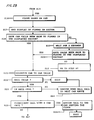
- this "up-peak" channeling dispatching routine begins at step S1 and then at step S2 a test is made to determine whether an up-peak condition exists, for instance, it is the morning on a business day.
- step S3 proceeds in which the sectors are formed of contiguous floors above the lobby.
- N is equal to the number of cars (NC) minus one.
- the number of sectors can equal the number of cars, but having more cars than sectors reduces the interval between cars that successively serve the same sector. Hall call assignments may be made according to the description below.
- step S4 a test is made that determines whether the up-peak channeling routine has been previously entered, which would have resulted in the performance of step S5, in which each sector is given a number SN (an integer), and in the performance of step S6, in which a sector register, in the group controller, is set to 1, presumably the lowest SN, and in the performance of step S7, in which a similar car register is set to the lowest CN, presumably 1.
- SN an integer
- Car 1 would have a CN of 1, car C2 a CN of 2, car C3 a CN of 3 and car C4 a CN of 4.
- CN and SN can be assumed to be initialized at one.
- the sequences illustrated by the flow chart attempt to assign a sector to car 1, starting with sector 1. In a preferred embodiment, one using a modern CPU, the selection process takes place many times per second.
- step S8 is entered.
- Step S8 is also entered after the registers are initialized.
- the test is whether the car with the number (CN) then under consideration is at the predetermined floor or at the committable position, a position at which the car is ready to initiate stopping at the lobby. If the answer to this test is negative (in Fig. 1 it would be negative because car 1 is moving away), CN is increased by one unit in step S12, meaning that the assignment attempt now shifts to car 2. If CN reaches its maximum value it is reset to its initial value. For the purpose of illustration, assume that car 2 is decending at the indicated position.
- step S10 both SN and CN are incremented by one, unless SN or CN have reached their respective maxima something that would happen after each car and each sector are assigned. When that happens, SN and CN are set to one once again (on an individual basis). This sequence of operations has the effect of causing the sectors to be assigned to the cars in a numerically cycling pattern.
- step S11 the floors in the sector assigned to a car in the previous sequence are displayed on the lobby or main floor on the "service indicator" SI.
- Step S13 commands the opening of the car doors when the car reaches the lobby and holding the doors in the open position to receive passengers, who presumably enter the car intending to enter car calls on the car call buttons (on the car operating panel) to go to the floors appearing on the service indicator. Car calls only to those floors are limited by step S14.
- step S15 it is determined if the dispatching interval has elapsed. If not (a negative answer) the routine cycles back to S13, keeping the doors open. Once the dispatching interval passes (producing an affirmative answer at S15), the doors are closed at step S16.
- Step S18 determines if "permissible" car calls (car calls to floors in the sector) have been made. Since a sector is assigned to a car without regard to the entry of car calls, there may be no demand for the sector at the particular time that the car is at the lobby ready to receive passengers (when the sector is assigned to the car at the main floor or lobby). Hence, if permissible car calls have not been made, the routine goes through step S19, where it waits for a short interval (e.g. 2 seconds) and repeats the test of S18 (at step S20). If permissible car calls have been made, the car is dispatched to service the car calls at step S21.
- a short interval e.g. 2 seconds
- step S20 If the answer at step S20 is still negative, the routine moves back to step S8 on the instruction at step S20. The routine then considers the assignment of the next numerical sector to the next numerical car at the committable position. The previous sector will be assigned again in another cycle to another car, by which time the call requests may materialize allowing the car to be dispatched to the requested floors. Since a numerical sequence is followed, conflicts between cars at the committable position at the same time do not encumber the assignment process.
- the size of the sectors is fixed in the foregoing description, but the invention may be applied to a system in a way that adjusts the size of the sectors.
- the size may be changed based on actual or anticipated traffic patterns in the building. For instance, the number of floors in a sector may be enlarged so that each sector has roughly equal passenger load from the lobby or main floor.
- the number of floors in the sectors does not have to be the same, although that has been shown, but only for convenience in explaining the invention. Changes in sector size can be made based on measured passenger density in the lobby correlated with expected car call requests at the particular time that the assignment of sectors are made in a subroutine cycle.
- step S21 in which a car is dispatched to the car calls made for the car to floors in the sector to which the car is assigned, the routine moves on to consider up and down hall calls (signals HC in FIG. 1), which are requests for service made at one of the floors. These requests give rise to interfloor traffic, which is usually light during the up-peak period. Consequently, assignment of hall calls is given a comparatively low priority when the up-peak channeling routine is in effect. Hall call assignments, at that time, are made in a way that brings cars back to the lobby as fast as possible for assignment to a sector, to minimize waiting time.
- step S22 a simple test is made to determine whether any hall calls have been made during the assignment cycle. If not, the routine is exited.
- step S23 determines whether it is a request to go down (down hall call) or up hall call in the building. If it is a down hall call, in step S24, the hall call will be answered by the next available car traveling down from a location at or above the location of the hall call. Presumably, that assignment can be made according to the normal criteria, for instance, using the techniques described in the Bittar patents for selecting a car for hall call assignment on a comparative basis. If it is found that there is an up hall call, step S25 determines whether there is a coincident car call in one of the cars at the lobby (assigned to a sector). If the answer is yes, the up hall call will be assigned to that car at step S26.
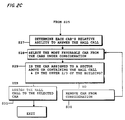
- step S27 determines each car's ability to answer the up hall call under traditional criteria, preferably using sequences described in the previous patents to Bittar et al, by which a car is selected from all the other cars for final assignment by considering the impact of the assignment on overall system response.
- the sequence in Fig. 2A-C overlays on to the "normal selection" scheme an additional standard that enhances the up-peak channeling discussed before.
- step S28 the sequence selects, using a normal selection routine, the most favorable car to answer the hall call and tests, at step S29, whether the car is serving a sector in the upper 2/3 of the building and whether that sector is the sector that contains the floor on which the hall call was made or is a higher sector (i.e., above the sector containing the floor on which the hall call is placed). If the most favorable car cannot meet that test, using step S30 which increments the selection to the next most favorable car, the program cycles through from the most favorable to the least favorable until an affirmative answer is obtained to step S29, causing the assignment of the up hall call to the car meeting the test, this taking place in step S31.
Landscapes
- Engineering & Computer Science (AREA)
- Automation & Control Theory (AREA)
- Elevator Control (AREA)
- Indicating And Signalling Devices For Elevators (AREA)
Claims (11)
- Aufzugssystem mit einer Vielzahl von Kabinen zum Transportieren von Fahrgästen von einem Haupstockwerk zu einer Vielzahl von anderen Stockwerken über oder unter dem Hauptstockwerk; Kabinenrufeinrichtung (14,16) zum Eingeben von Kabinenrufen für jede Kabine; Anzeigeeinrichtung (SI) auf dem Hauptstockwerk zum Anzeigen der beabsichtigten Stockwerkstopps für eine Kabine (1, 2, 3, 4); Kabinenbewegungssteuereinrichtung (30) zum Bewegen jeder Kabine; Kabinenpositionseinrichtung für jede Kabine zum Bereitstellen eines Positionssignals, das die Lage der Kabine angibt; Türsteuereinrichtung zum Steuern des Öffnens und Schließens der Türen (18) an jeder Kabine; und einer Steuerung (32) zum Bereitstellen von Signalen, die den Betrieb der Bewegungssteuereinrichtung, der Türsteuereinrichtung und der Anzeigeeinrichtung (SI) als Reaktion auf die Positionssignale und Kabinenrufe steuern; dadurch gekennzeichnet, daß
die Steuerung eine Signalverarbeitungseinrichtung (32) aufweist, die Signale bereitstellt zum
Aufteilen der Stockwerke in dem Gebäude in eine Vielzahl von Sektoren (SN), kleiner oder gleich in der Anzahl der Anzahl der Kabinen, wobei jeder Sektor ein oder mehr benachbarte Stockwerke umfaßt, wobei die Sektoren miteinander benachbart sind;
Anzeigen der Stockwerke in einem Sektor, der einer Kabine zugewiesen ist, auf der Anzeigeeinrichtung; und
ausschließlichen Zuweisen eines Sektors (SN) zu einer der Kabinen während eines Zyklus einer zyklischen Zuweisungsfolge, die Sektoren gemäß einer voreingestellten Sektorenreihenfolge und einer voreingestellten Kabinenreihenfolge zuweist, wenn sich eine Kabine einer bestimmten Position relativ zu dem Hauptstockwerk nähert. - Aufzugssystem nach Anspruch 1, in dem die Signalverarbeitungseinrichtung (32) ferner Signale bereitstellt zum Erlauben, daß eine Kabine (1, 2, 3, 4) sich als Reaktion auf einen Kabinenruf vom Hauptstockwerk nur dann wegbewegt, wenn der Kabinenruf zu einem Stockwerk in dem Sektor erfolgt, der der Kabine zugewiesen ist; und zum Zuweisen eines anderen Sektors (SN) zu der einen Kabine, wenn ein Kabinenruf, der ein voreingestelltes Kriterium erfüllt, nicht zu einem Stockwerk in dem Sektor erfolgt, nachdem der Sektor der Kabine zugewiesen wird.
- Aufzugssystem nach Anspruch 1 oder 2, dadurch gekennzeichnet, daß die Folge darin besteht, jeder Kabine (1, 2, 3, 4) und jedem Sektor (SN) eine Nummer zuzuweisen und der numerischen Reihenfolge der Nummern zu folgen, wenn Sektoren zu Kabinen zugewiesen werden und die Kabinen für die Zuweisung ausgewählt werden, wenn jede Kabine eine übergebbare Position relativ zur Haupttür erreicht.
- Aufzugssystem nach Anspruch 1, 2 oder 3, dadurch gekennzeichnet, daß die Verarbeitungseinrichtung eine Einrichtung zum Bereitstellen von Signalen zum Veranlassen der Türen (18) der Kabine, sich zu öffnen, nachdem sie am Hauptstockwerk angehalten hat, und sich zu schließen, nachdem eine voreingestellte Zeit verstrichen ist, beinhaltet.
- Aufzugssystem nach einem vorhergehenden Anspruch, dadurch gekennzeichnet, daß das Kriterium eine Ermittlung aufweist, daß der Kabinenruf innerhalb einer bestimmten Zeit erfolgt ist, nachdem die Türen (18) an der Kabine geschlossen sind.
- Aufzugssystem nach einem vorhergehenden Anspruch, dadurch gekennzeichnet, daß die Signalverarbeitungseinrichtung eine Einrichtung zum Bereitstellen von Signalen beinhaltet zum
Zuweisen eines Aufwärts-Hallenrufs zu einer Kabine (1, 2, 3, 4), die einen zusammenfallenden bzw. einhergehenden Kabinenruf von dem Hauptstockwerk hat;
Zuweisen eines Aufwärts-Hallenrufs, der in einem niedrigeren Teilbereich des Gebäudes gemacht wird und nicht mit einem Kabinenruf einhergeht, der auf dem Hauptstockwerk nur zu einer Kabine gemacht wird, die zu einem Sektor in dem restlichen Teilbereich des Gebäudes weggeschickt bzw. verteilt wird oder dabei ist, dorthin verteilt zu werden;
Zuweisen eines Aufwärts-Hallenrufs in der restlichen Position des Gebäudes, der nicht mit einem Kabinenruf zusammenfällt, der auf dem Hauptstockwerk zu einer Kabine erfolgt, die nach dem Kriterium gewählt wird, daß die Kabine verteilt wird oder dabei ist, verteilt zu werden zu dem Sektor, der das Stockwerk enthält, auf dem der Aufwärts-Hallenruf gemacht wurde, oder zu einem Sektor über dem Sektor; und
Wählen der Kabine aus allen anderen Kabinen (1, 2, 3, 4), die das Kriterium erfüllen, auf der Grundlage, daß relativ zu den anderen Kabinen die Kabine zu dem Aufwärts-Hallenruf zugewiesen würde, wenn keine der anderen Kabinen zu Sektoren zugewiesen würden. - Verfahren zum Verteilen von Aufzügen von dem Hauptstockwerk zu anderen Stockwerken in einem Gebäude als Reaktion auf Kabinenrufe, die auf dem Hauptstockwerk erfolgen und als Reaktion auf die Lagen der Kabinen (1, 2, 3, 4), gekennzeichnet durch:
Aufteilung der Stockwerke in dem Gebäude in eine Vielzahl von Sektoren (SN), in der Anzahl weniger oder gleich der Anzahl von Kabinen, wobei jeder Sektor ein oder mehrere benachbarte Stockwerke aufweist und die Sektoren (SN) miteinander benachbart sind;
ausschließlichen Zuweisen eines Sektors zu einer der Kabinen während eines Zyklus einer zyklischen Zuweisungsfolge, die Sektoren gemäß einer voreingestellten Sektorreihenfolge und einer voreingestellten Kabinenreihenfolge zuweist, wenn sich eine Kabine einer bestimmten Position relativ zu dem Hauptstockwerk nähert;
Anzeigen der Stockwerke in einem Sektor, die einer Kabine zugewiesen sind, auf dem Hauptstockwerk;
Erlauben einer Kabine, daß sie sich von dem Hauptstockwerk als Reaktion auf einen Kabinenruf nur dann wegbewegt, wenn der Kabinenruf zu einem Stockwerk in dem Sektor ist, der der Kabine zugewiesen ist; und
Zuweisen eines anderen Sektors zu der einen Kabine, wenn ein Kabinenruf, der ein voreingestelltes Kriterium erfüllt, nicht zu einem Stockwerk in dem Sektor erfolgt, nachdem der Sektor der Kabine zugewiesen wird. - Verfahren nach Anspruch 7, dadurch gekennzeichnet, daß die Folge darin besteht, jeder Kabine (1, 2, 3, 4) und jedem Sektor (SN) eine Nummer zuzuweisen und der numerischen Reihenfolge der Nummern zu folgen, wenn Sektoren zu Kabinen zugewiesen werden und Kabinen für die Zuweisung ausgewählt werden, wenn jede Kabine eine übergebbare Position relativ zum Hauptstockwerk erreicht.
- Verfahren nach Anspruch 7 oder 8, dadurch gekennzeichnet, daß das Kriterium die Bedingung aufweist, daß der Kabinenruf innerhalb eines bestimmten Zeitintervalls gemacht worden ist, nachdem die Türen (18) an der Kabine geschlossen sind, daß die Türen der Kabine sich schließen, nachdem eine voreingstellte Zeit ab der Zeit, zu der die Türen auf dem Hauptstockwerk geöffnet wurden, verstrichen ist, und daß die Anzeigeeinrichtung bis zur nachfolgenden Wiederzuweisung eines Sektors zu der Kabine gemäß der Folge deaktiviert wird.
- Verfahren nach Anspruch 7, 8 oder 9, gekennzeichnet durch
Zuweisen eines Aufwärts-Hallenrufs zu einer Kabine, die einen einhergehenden Kabinenruf von dem Hauptstockwerk hat;
Zuweisen eines Aufwärts-Hallenrufs, der in einem niedrigeren Teilbereich des Gebäudes gemacht wird und nicht mit einem Kabinenruf einhergeht, der bei der Eingangshalle zu einer Kabine gemacht wird, die zu einem Sektor in dem restlichen Teilbereich des Gebäudes verteilt wird oder dabei ist, dorthin verteilt zu werden;
Zuweisen eines Aufwärts-Hallenrufs in dem restlichen Teilbereich des Gebäudes, der nicht mit einem Kabinenruf einhergeht, der auf dem Hauptstockwerk an eine Kabine (1, 2, 3, 4) gemacht wird, die nach dem Kriterium gewählt wird, daß die Kabine zu dem Sektor, der das Stockwerk enthält, auf dem der Aufwärts-Hallenruf gemacht wurde, oder zu einem Sektor über dem Sektor verteilt wurde oder dabei ist, dorthin verteilt zu werden; und
zum Auswählen dieser Kabine aus allen anderen Kabinen, die das Kriterium erfüllen, auf der Grundlage, daß relativ zu den anderen Kabinen die Kabine zu dem Aufwärts-Hallenruf zugewiesen würde, wenn keine der anderen Kabinen zu Sektoren (SN) zugewiesen wäre. - Aufzugssteuerung für ein Aufzugssystem, wobei das System eine Vielzahl von Kabinen zum Transportieren von Fahrgästen von einem Haupstockwerk zu einer Vielzahl von anderen Stockwerken über oder unter dem Hauptstockwerk, eine Kabinenrufeinrichtung (14,16) zum Eingeben von Kabinenrufen für jede Kabine, eine Anzeigeeinrichtung (SI) auf dem Hauptstockwerk zum Anzeigen der beabsichtigten Stockwerkstopps für eine Kabine, eine Kabinenbewegungssteuereinrichtung (30) zum Bewegen jeder Kabine, eine Kabinenpositionseinrichtung für jede Kabine (1, 2, 3, 4) zum Bereitstellen eines Positionssignals, das die Lage der Kabine angibt, und eine Türsteuereinrichtung zum Steuern des Öffnens und Schließens der Türen (18) an jeder Kabine aufweist, wobei die Steuerung Signale bereitstellt, die den Betrieb der Bewegungssteuerungseinrichtung, der Türsteuerungseinrichtung und der Anzeigeeinrichtung (SI) als Reaktion auf die Positionssignale und Kabinenrufe steuern; dadurch gekennzeichnet, daß die Steuerung eine Signalverarbeitungseinrichtung aufweist, die Signale bereitstellt zum
Aufteilen der Stockwerke in dem Gebäude in eine Vielzahl von Sektoren (SN), kleiner oder gleich in der Anzahl der Anzahl von Kabinen, wobei jeder Sektor ein oder mehr benachbarte Stockwerke umfaßt, wobei die Sektoren miteinander benachbart sind;
Anzeigen der Stockwerke in einem Sektor, der einer Kabine zugewiesen ist, auf der Anzeigeeinrichtung; und ausschließlichen Zuweisen eines Sektors (SN) zu einer der Kabinen während eines Zyklus einer zyklischen Zuweisungsfolge, die Sektoren gemäß einer voreingestellten Sektorenreihenfolge und einer voreingestellten Kabinenreihenfolge zuweist, wenn sich eine Kabine einer bestimmten Position relativ zu dem Hauptstockwerk nähert.
Applications Claiming Priority (4)
| Application Number | Priority Date | Filing Date | Title |
|---|---|---|---|
| US07/157,543 US4792019A (en) | 1988-02-12 | 1988-02-12 | Contiguous floor channeling with up hall call elevator dispatching |
| US157542 | 1988-02-12 | ||
| US07/157,542 US4804069A (en) | 1988-02-12 | 1988-02-12 | Contiguous floor channeling elevator dispatching |
| US157543 | 1993-11-26 |
Publications (2)
| Publication Number | Publication Date |
|---|---|
| EP0328423A1 EP0328423A1 (de) | 1989-08-16 |
| EP0328423B1 true EP0328423B1 (de) | 1993-12-15 |
Family
ID=26854225
Family Applications (1)
| Application Number | Title | Priority Date | Filing Date |
|---|---|---|---|
| EP19890301358 Expired - Lifetime EP0328423B1 (de) | 1988-02-12 | 1989-02-13 | Aufzugsverteilung durch Sektoren von benachbarten Stockwerken |
Country Status (3)
| Country | Link |
|---|---|
| EP (1) | EP0328423B1 (de) |
| DE (1) | DE68911332T2 (de) |
| ES (1) | ES2052900T3 (de) |
Families Citing this family (4)
| Publication number | Priority date | Publication date | Assignee | Title |
|---|---|---|---|---|
| US5317114A (en) * | 1991-11-27 | 1994-05-31 | Otis Elevator Company | Elevator system having dynamic sector assignments |
| JP2009215045A (ja) * | 2008-03-12 | 2009-09-24 | Toshiba Elevator Co Ltd | エレベータ |
| CN107187966B (zh) * | 2017-07-04 | 2019-05-10 | 武汉理工大学 | 一种基于人数检测结果的多部电梯控制方法及系统 |
| US11027943B2 (en) * | 2018-03-29 | 2021-06-08 | Otis Elevator Company | Destination dispatch sectoring |
Family Cites Families (4)
| Publication number | Priority date | Publication date | Assignee | Title |
|---|---|---|---|---|
| US3536164A (en) * | 1966-10-18 | 1970-10-27 | Elevators Pty Ltd | Elevator control supervisory system |
| US3614995A (en) * | 1969-04-24 | 1971-10-26 | Otis Elevator Co | Zoned elevator control system including an arrangement for increasing the number of cars which can respond to landing calls in any of the zones |
| US4007812A (en) * | 1975-07-07 | 1977-02-15 | Westinghouse Electric Corporation | Elevator system |
| US4691808A (en) * | 1986-11-17 | 1987-09-08 | Otis Elevator Company | Adaptive assignment of elevator car calls |
-
1989
- 1989-02-13 DE DE1989611332 patent/DE68911332T2/de not_active Expired - Fee Related
- 1989-02-13 EP EP19890301358 patent/EP0328423B1/de not_active Expired - Lifetime
- 1989-02-13 ES ES89301358T patent/ES2052900T3/es not_active Expired - Lifetime
Also Published As
| Publication number | Publication date |
|---|---|
| EP0328423A1 (de) | 1989-08-16 |
| ES2052900T3 (es) | 1994-07-16 |
| DE68911332D1 (de) | 1994-01-27 |
| DE68911332T2 (de) | 1994-04-07 |
Similar Documents
| Publication | Publication Date | Title |
|---|---|---|
| US4792019A (en) | Contiguous floor channeling with up hall call elevator dispatching | |
| US4804069A (en) | Contiguous floor channeling elevator dispatching | |
| EP0348151B1 (de) | Optimiertes System für die Rufzuteilung von Aufzügen für aufsteigenden Spitzenverkehr | |
| US5035302A (en) | "Artificial Intelligence" based learning system predicting "Peak-Period" times for elevator dispatching | |
| US5183981A (en) | "Up-peak" elevator channeling system with optimized preferential service to high intensity traffic floors | |
| US4323142A (en) | Dynamically reevaluated elevator call assignments | |
| JP2935854B2 (ja) | エレベーター制御装置及びエレベーター制御方法 | |
| EP0030163B1 (de) | Verstellbare Absendungszwischenzeit für Aufzugskabinen während eines aufsteigenden Spitzenverkehrs | |
| EP0385811A1 (de) | Auf "künstlicher Intelligenz" basierte Vorrichtung zum Abtasten des Menschenstromes für Aufzugskabinenzuteilung | |
| US5511634A (en) | Instantaneous elevator up-peak sector assignment | |
| JPS63218484A (ja) | エレベータカーコールの最適割当て装置 | |
| US5317114A (en) | Elevator system having dynamic sector assignments | |
| US5168133A (en) | Automated selection of high traffic intensity algorithms for up-peak period | |
| AU637892B2 (en) | Elevator dynamic channeling dispatching for up-peak period | |
| US5241142A (en) | "Artificial intelligence", based learning system predicting "peak-period" ti | |
| US5644110A (en) | Elevator service for dual lobby during up-peak | |
| JPH07252033A (ja) | 層間ホール呼びシステム | |
| US4401190A (en) | Cars/floors and calls/cars elevator assignments | |
| EP0328423A1 (de) | Aufzugsverteilung durch Sektoren von benachbarten Stockwerken | |
| US5480006A (en) | Elevator downpeak sectoring | |
| JPH05132246A (ja) | エレベータの群管理制御方法および装置 | |
| HK1006252A (en) | Elevator service for dual lobby during up-peak |
Legal Events
| Date | Code | Title | Description |
|---|---|---|---|
| PUAI | Public reference made under article 153(3) epc to a published international application that has entered the european phase |
Free format text: ORIGINAL CODE: 0009012 |
|
| AK | Designated contracting states |
Kind code of ref document: A1 Designated state(s): CH DE ES FR GB IT LI |
|
| 17P | Request for examination filed |
Effective date: 19900207 |
|
| 17Q | First examination report despatched |
Effective date: 19910430 |
|
| ITF | It: translation for a ep patent filed | ||
| GRAA | (expected) grant |
Free format text: ORIGINAL CODE: 0009210 |
|
| AK | Designated contracting states |
Kind code of ref document: B1 Designated state(s): CH DE ES FR GB IT LI |
|
| REF | Corresponds to: |
Ref document number: 68911332 Country of ref document: DE Date of ref document: 19940127 |
|
| ET | Fr: translation filed | ||
| REG | Reference to a national code |
Ref country code: ES Ref legal event code: FG2A Ref document number: 2052900 Country of ref document: ES Kind code of ref document: T3 |
|
| PLBE | No opposition filed within time limit |
Free format text: ORIGINAL CODE: 0009261 |
|
| STAA | Information on the status of an ep patent application or granted ep patent |
Free format text: STATUS: NO OPPOSITION FILED WITHIN TIME LIMIT |
|
| 26N | No opposition filed | ||
| ITPR | It: changes in ownership of a european patent |
Owner name: ATTO DI LICENZA;OTIS S.P.A. - CALZOLARI ASCENSORE |
|
| PGFP | Annual fee paid to national office [announced via postgrant information from national office to epo] |
Ref country code: CH Payment date: 19980127 Year of fee payment: 10 |
|
| PGFP | Annual fee paid to national office [announced via postgrant information from national office to epo] |
Ref country code: ES Payment date: 19980212 Year of fee payment: 10 |
|
| PG25 | Lapsed in a contracting state [announced via postgrant information from national office to epo] |
Ref country code: ES Free format text: LAPSE BECAUSE OF NON-PAYMENT OF DUE FEES Effective date: 19990215 |
|
| PG25 | Lapsed in a contracting state [announced via postgrant information from national office to epo] |
Ref country code: LI Free format text: LAPSE BECAUSE OF NON-PAYMENT OF DUE FEES Effective date: 19990228 Ref country code: CH Free format text: LAPSE BECAUSE OF NON-PAYMENT OF DUE FEES Effective date: 19990228 |
|
| REG | Reference to a national code |
Ref country code: CH Ref legal event code: PL |
|
| PGFP | Annual fee paid to national office [announced via postgrant information from national office to epo] |
Ref country code: DE Payment date: 20000127 Year of fee payment: 12 |
|
| PGFP | Annual fee paid to national office [announced via postgrant information from national office to epo] |
Ref country code: FR Payment date: 20010111 Year of fee payment: 13 |
|
| PGFP | Annual fee paid to national office [announced via postgrant information from national office to epo] |
Ref country code: GB Payment date: 20010118 Year of fee payment: 13 |
|
| REG | Reference to a national code |
Ref country code: ES Ref legal event code: FD2A Effective date: 20010503 |
|
| PG25 | Lapsed in a contracting state [announced via postgrant information from national office to epo] |
Ref country code: DE Free format text: LAPSE BECAUSE OF NON-PAYMENT OF DUE FEES Effective date: 20011201 |
|
| REG | Reference to a national code |
Ref country code: GB Ref legal event code: IF02 |
|
| PG25 | Lapsed in a contracting state [announced via postgrant information from national office to epo] |
Ref country code: GB Free format text: LAPSE BECAUSE OF NON-PAYMENT OF DUE FEES Effective date: 20020213 |
|
| GBPC | Gb: european patent ceased through non-payment of renewal fee |
Effective date: 20020213 |
|
| PG25 | Lapsed in a contracting state [announced via postgrant information from national office to epo] |
Ref country code: FR Free format text: LAPSE BECAUSE OF NON-PAYMENT OF DUE FEES Effective date: 20021031 |
|
| REG | Reference to a national code |
Ref country code: FR Ref legal event code: ST |
|
| PG25 | Lapsed in a contracting state [announced via postgrant information from national office to epo] |
Ref country code: IT Free format text: LAPSE BECAUSE OF NON-PAYMENT OF DUE FEES;WARNING: LAPSES OF ITALIAN PATENTS WITH EFFECTIVE DATE BEFORE 2007 MAY HAVE OCCURRED AT ANY TIME BEFORE 2007. THE CORRECT EFFECTIVE DATE MAY BE DIFFERENT FROM THE ONE RECORDED. Effective date: 20050213 |