EP0330384B1 - Téléphone mains libres - Google Patents
Téléphone mains libres Download PDFInfo
- Publication number
- EP0330384B1 EP0330384B1 EP89301554A EP89301554A EP0330384B1 EP 0330384 B1 EP0330384 B1 EP 0330384B1 EP 89301554 A EP89301554 A EP 89301554A EP 89301554 A EP89301554 A EP 89301554A EP 0330384 B1 EP0330384 B1 EP 0330384B1
- Authority
- EP
- European Patent Office
- Prior art keywords
- signal
- transmit
- receive
- control
- hands
- Prior art date
- Legal status (The legal status is an assumption and is not a legal conclusion. Google has not performed a legal analysis and makes no representation as to the accuracy of the status listed.)
- Expired - Lifetime
Links
- 230000001052 transient effect Effects 0.000 claims description 13
- 238000012790 confirmation Methods 0.000 claims description 4
- 230000005540 biological transmission Effects 0.000 claims description 2
- 238000000034 method Methods 0.000 claims 11
- 230000008878 coupling Effects 0.000 description 8
- 238000010168 coupling process Methods 0.000 description 8
- 238000005859 coupling reaction Methods 0.000 description 8
- 238000010586 diagram Methods 0.000 description 6
- 238000006243 chemical reaction Methods 0.000 description 1
- 238000001514 detection method Methods 0.000 description 1
Images

Classifications
-
- H—ELECTRICITY
- H04—ELECTRIC COMMUNICATION TECHNIQUE
- H04M—TELEPHONIC COMMUNICATION
- H04M9/00—Arrangements for interconnection not involving centralised switching
- H04M9/08—Two-way loud-speaking telephone systems with means for conditioning the signal, e.g. for suppressing echoes for one or both directions of traffic
-
- H—ELECTRICITY
- H04—ELECTRIC COMMUNICATION TECHNIQUE
- H04M—TELEPHONIC COMMUNICATION
- H04M9/00—Arrangements for interconnection not involving centralised switching
- H04M9/08—Two-way loud-speaking telephone systems with means for conditioning the signal, e.g. for suppressing echoes for one or both directions of traffic
- H04M9/10—Two-way loud-speaking telephone systems with means for conditioning the signal, e.g. for suppressing echoes for one or both directions of traffic with switching of direction of transmission by voice frequency
Definitions
- the present invention relates to a hands-free telephone and, more particularly, to a voice-switched type hands-free telephone which may be used for a mobile telephone system.
- a hands-free telephone has a howling or singing problem.
- a voice-switched speakerphone is an answer to the singing problem.
- the voice-switched speakerphone which will later be described referring to Fig. 1 of the accompanying drawings, includes a receive variable attenuator, or variolosser, inserted into a receive path and a transmit variable attenuator, or variolosser, inserted into a transmit path.
- the voice-switched speakerphone also includes an attenuation control circuit which controls the attenuation of the receive and transmit variolossers in response to the signal levels of the receive and transmit paths.
- the attenuation control circuit causes the receive variolosser to decrease its attenuation while causing the transmit variolosser to increase its attenuation.
- the attenuation control circuit causes the receive variolosser to increase its attenuation while causing the transmit variolosser to decrease its attenuation.
- the voice-switched speakerphone still has the singing problem during a transient period from the origination of a call to the beginning of the conversation. This may be caused by unbalance of a hybrid transformer of a telephone exchanger. The unbalance increases coupling between a transmit signal and a receive signal. The increasing of the coupling induces the singing at the speakerphone.
- a mobile base station to be connected to a mobile subscriber station is almost always changed when a call is placed from the mobile subscriber station. That is, a communications line to be connected to the mobile subscriber station is changed, resulting in changes in the coupling between the receive and transmit signals. This aggravates the singing problem during the transient period mentioned above.
- a hands-free telephone comprising a speaker, a microphone, a receive variable attenuator (R-ATT), a transmit variable attenuator (T-ATT), a receive signal detector, a transmit signal detector and an attenuation control circuit in order to perform voice-switched telephoning.
- the telephone also comprises an auxiliary control circuit which prevents the output of the transmit signal detector from reaching the attenuation control circuit during a transient period between a call origination and the conversation. During this period, only the speaker is enabled to output a ringback tone therethrough.
- the auxiliary control circuit When the output level of the transmit signal detector exceeds a predetermined level, the auxiliary control circuit passes the output of the transmit signal detector to the attenuation control circuit to start the voice-switched telephoning. Once the auxiliary control circuit passes the output of the transmit signal detector, the auxiliary control circuit holds this state until the conversation finishes.
- a hands-free mobile subscriber station used for a mobile telephone system which comprises at least one mobile base station (MBS) connected to MSS over a radio channel and to an exchanger of a public telephone switching network (PTSN).
- the MSS comprises a radio transmitter/receiver section, a logic section connected to the radio transmitter/receiver section, a speaker and a microphone.
- the MSS further comprises a hands-free circuit connected to the logic section, the speaker and the microphone.
- the hands-free circuit performs voice-switched telephoning during the conversation and provides a receive signal from the logic section to the speaker and no transmit signal from the microphone to the logic section during a transient period from a call origination to the beginning of the conversation.
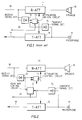
- the conventional hands-free telephone includes a speaker 16 and a microphone 17 which may be connected to a public telephone switching network (PTSN) or to a logic circuit of a mobile subscriber station through a voice receive path 18 and a voice transmit path 19.
- PTSN public telephone switching network
- a transmit variolosser (T-ATT) 15 is inserted into the transmit path 19.
- the R-ATT 11 and T-ATT 15 are under control of an attenuation control circuit 13.
- the attenuation control circuit 13 receives two signals indicating a receive voice level and a transmit voice level which are detected by detectors 12 and 14, respectively.
- the control circuit 13 also receives through a line 20 an enable or disable signal indicating whether a communications line between the hands-free telephone and PTSN is established. When the communications line is established, the control circuit 13 is enabled with the enable signal. Otherwise, the control circuit 13 is disabled with the disable signal.
- the control circuit 13 When the receive signal detector 12 detects a receive voice signal and the transmit signal detector 14 detects no transmit voice signal, the control circuit 13 causes R-ATT 11 to decrease its attenuation while causing T-ATT 15 to increase its attenuation. On the contrary, when the detector 14 detects a transmit voice signal and the detector 12 detects no receive voice signal, the control circuit 13 causes T-ATT 15 to decrease its attenuation while causing R-ATT 11 to increase its attenuation.
- voice-switched telephoning can be performed, resulting in alleviating the singing during the conversation. (Since the detailed description of the voice-switched speakerphone is given in the Busala paper, it will be omitted herein.)
- the voice-switched speakerphone still has the singing problem during the transient period from a call origination to the beginning of the conversation.
- This singing problem can be solved by the present invention which will now be described.
- Fig. 2 a first embodiment of the present invention is shown in which the same reference numerals as in Fig. 1 denote the same elements as those in Fig. 1, respectively.
- the operation of the hands-free telephone of Fig. 2 is the same as that of the telephone of Fig. 1.
- the Busala paper is therefore incorporated in this application.
- the hands-free telephone of Fig. 2 comprises an auxiliary control circuit 21 to which the outputs of the detectors 12 and 14 and the enable/disable signal on line 20 are applied.
- the auxiliary control circuit 21 Through the auxiliary control circuit 21, the output of transmit signal detector 14 is applied to the attenuation control circuit 13.
- the auxiliary control circuit 21 receives the output of receive signal detector 12 and the enable/disable signal. Based on these signals and on the output of transmit signal detector 14, the circuit 21 determines whether or not the output of transmit signal detector 14 is to be passed to the attenuation control circuit 13.
- the auxiliary control circuit 21 passes the output of detector 14 to the control circuit 13 and then holds this state until the circuit 21 receives the disable signal. In other words, the auxiliary control circuit 21 detects that a voice signal is applied to the microphone 17 to start the conversation. Thereafter, the attenuation control circuit 13 performs the voice-switched operation like the prior art telephone does. Since the transmit signal is not transmitted during the transient period, no singing occurs during this period.
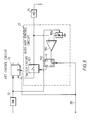
- the auxiliary control circuit 21 comprises an analog switch 101 connected between the signal detector 14 and the attenuation control circuit 13.
- the circuit 21 also comprises a comparator 103 whose non-inverting and inverting terminals are supplied with the output of signal detector 14 and the output of a reference signal generator 104, respectively.
- the reference signal generator 104 sets its output voltage to the predetermined reference level in accordance with the output level of receive signal detector 12.
- the output of comparator 103 is applied to a clock terminal CK of a flip-flop (F/F) 102.
- the data terminal D and the reset terminal R of F/F 102 are applied with a positive voltage +V and the enable/disable signal, respectively.
- the Q output of F/F 102 controls the analog switch 101.
- the analog switch 101 When the enable signal is applied to the reset terminal R of F/F 102, i.e., the communications line is established, the analog switch 101 is made open by the Q output of F/F 102. As long as the output of signal detector 14 is below the predetermined reference level, the analog switch 101 is open. If the output level of signal detector 14 exceeds the predetermined reference level, i.e., a voice signal is applied to the microphone 17 (Fig. 2) to start the conversation, the comparator 103 triggers the F/F 102 which in turn latches the positive voltage +V at the D terminal thereof to provide a high level signal at the Q terminal. This high level signal causes the analog switch 101 to be closed to thereby pass the output of signal detector 14 to the attenuation control circuit 13. Thereafter, the F/F 102 maintains this status until the disable signal is applied to the R terminal. When the analog switch 101 is closed, the voice-switched telephoning operates like the prior art speakerphone.
- the F/F 102 makes the analog switch 101 open to stop the output of signal detector 14 from reaching the attenuation control circuit 13.
- the hands-free telephone returns to the waiting state.
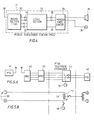
- FIG. 4 is a block diagram showing a second embodiment of the present invention which is applicable to a mobile telephone system.
- a mobile subscriber station (MSS) 31 comprises a radio transmitter/receiver (TRX) section 32, a logic section 33, a hands-free circuit 34, a speaker 35 and a microphone 36.
- Voice lines 40 and data lines 37 connect the radio section 32 and the logic section 33.
- Voice lines 38 and a data line 39 connect the logic section 33 and the hands-free circuit 34.
- the hands-free circuit 34 passes a receive signal to the speaker 35 but not a transmit signal to the logic section 33. If a call is placed by MSS 31 and the called party responds to the call, the conversation begins therebetween.
- the logic section 33 detects the beginning of the conversation by detecting a charge signal which is transmitted from a telephone exchanger and will be described later in detail. Upon detection of the beginning of the conversation, logic section 33 provides a hands-free enable signal to the hands-free circuit 34. In response to the hands-free enable signal, the circuit 34 starts the voice-switched operation and continues this operation until the conversation ends. When the conversation ends, the logic section 33 provides a hands-free disable signal to the hands-free circuit 34 to return the circuit 34 to the waiting state.
- a mobile telephone system includes a plurality of MSSs 41, a plurality of mobile base stations (MBSs) 42 and at least one mobile telephone control center (MTCC) 43. Only one of each of the MBS, MSS and MTCC are illustrated in Fig. 5A.
- MSS 41 and MBS 42 are to be connected with each other over a radio channel.
- MBS 42 and MTCC 43 are connected with each other through wired lines.
- MTCC 43 is also connected to an exchanger of PTSN through wired lines.
- PTSN includes a plurality of fixed subscriber station (FSSs) 45 which are connected to the exchanger through wired lines.
- the exchanger 44 comprises a tone oscillator 46 generating a ringback tone.
- MSS 41 If a call is originated by MSS 41 to FSS 45, MSS 41 is first connected to the exchanger through MBS 42 and MTCC 43. In this condition, the exchanger 44 sends a ringing signal to FSS 45 and a ringback tone to MSS 41. When FSS 45 goes off-hook, the exchanger 44 connects MSS 41 and FSS 45 for conversation. When either FSS 45 or MSS 41 goes on-hook, the exchanger 44 disconnects MSS 41 from FSS 45 and restores the used lines for other communications.
- the exchanger 44 Since FSS 45 is connected to the exchanger 44 through a two-wire subscriber line while MTCC 43 is connected to the same through a four-wire line, the exchanger 44 has a hybrid transformer 441 for a four-wire to two-wire conversion or vis-a-vis, as shown in Fig. 5B.
- the hybrid transformer 441 is designed so that it has minimum coupling 171 between the speaker and microphone of the MSS when MSS 41 and FSS 45 are connected with each other. In other words, during a transient period from the call origination to the beginning of the conversation, the transformer 441 is unbalanced, causing the coupling 171 to be increased. This coupling increase leads to the singing at the MSS side.
- MSS 41 also has acoustic coupling 161 between the speaker and the microphone, which coupling worsens the singing problem. This singing problem can be eliminated with the MSS of Fig. 4.
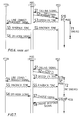
- Fig. 6 shows the operation flow of the prior art MTS for comparison with the present invention.
- MBS receives a calling signal from an MSS (see step S1)
- MBS transmits a speech or voice channel designate signal to MSS (step S2).
- MSS changes its channel to the designated speech channel and makes the receive and transmit voice gates (not shown) open to enter the hands-free (HF) operation or mode (step S10).
- HF hands-free
- the MSS transmits a channel-switch confirmation tone to the MBS/MTCC over the switched speech channel (step S3).
- the MBS/MTCC sends a line connect reguest signal to the exchanger to thereby call a called party (step S4).
- the exchanger By receiving the line connect request signal, the exchanger sends a ringing signal to the called party and at the same time sends a ringback tone to MSS through the MBS/MTCC (step S5). If the called party goes off-hook, the exchanger sends an off-hook signal to the MBS/MTCC (step S6) to start the conversation. Since the MSS is in the HF mode when the ringback tone is being sent, i.e., the hybrid transformer is unbalanced, singing may occur at the MSS side. This situation continues for a period of time T1 until the ringback tone stops, i.e., the conversation starts.
- Fig. 7 shows the operation flow of the present invention.
- steps S1 through S6 are the same operations as those of Fig. 6, except that the MSS makes only the receive voice gate open to enter a speaker (SP) operation or mode (step S13).
- the MBS/MTCC Upon reception of the off-hook signal at step S6, the MBS/MTCC transmits a telephone charge signal to the MSS (step S7).
- the MSS makes the transmit voice gate open to enter the HF mode and perform the voice-switched telephoning (step S10).
- the MSS starts a charge operation and transmits a charge response signal to the MBS/MTCC (step S8).
- the MSS When the ringback tone is being sent to the MSS, i.e., the hybrid transformer is unbalanced, the MSS is in the SP mode (see step S13). Thus, no singing will occur during this period of time T2.
- the MSS enters the HF mode only after the ringback tone stops, i.e., the hybrid transformer recovers to a well-balanced condition.
- Fig. 8 shows the operation flow of the MSS of Fig. 4.
- the MSS transmits a calling or call-up signal to the MBS/MTCC (step H1)
- the MSS waits for a channel designate signal at step H2. If the MSS receives no channel designate signal for a predetermined period of time, the MSS returns to the waiting state (steps H2, H10 and H11). If the MSS receives the channel designate signal at step H2, the MSS changes its channel to the designated speech channel (step H3). Then, the MSS sends a channel-switch confirmation signal over the switched speech channel (step H4) and enters the speaker (HP) mode (step H5).
- step H5 the MSS waits for a charge signal and if no charge signal is received for a predetermined period of time, the MSS returns to the waiting state (steps H6, H12 and H13). If the MSS receives the charge signal at step H6, the MSS proceeds to steps H7 and H8 to execute the transmission of charge response signal and the setting of hands-free (HF) mode. Thereafter, MSS starts the conversation (step H9).
- a hands-free telephone comprises an auxiliary control circuit which stops the output of a transmit voice signal detector from reaching the attenuation control circuit during a transient period between the call origination and the beginning of the conversation.
- the auxiliary control circuit stops the output of a transmit voice signal detector from reaching the attenuation control circuit during a transient period between the call origination and the beginning of the conversation.
- the singing can be prevented during the transient period.
- a hands-free mobile subscriber telephone enables only a receive voice line during the transient period during which a ringback tone is being generated from a telephone exchanger, i.e., a hybrid transformer of the exchanger is unbalanced. The mobile subscriber telephone enters the hands-free operation only after the ringback tone stops or immediately before the conversation begins.
- the singing can also be prevented during the transient period.
Landscapes
- Engineering & Computer Science (AREA)
- Signal Processing (AREA)
- Mobile Radio Communication Systems (AREA)
Claims (15)
- Téléphone à libération des mains comprenant un haut-parleur (16), un microphone (17), un atténuateur variable de réception (11) relié à l'entrée du haut-parleur (16) pour changer le niveau d'entrée du haut-parleur (16) en conformité avec un premier signal de commande, un atténuateur variable de transmission (15) relié à la sortie du microphone (17) pour changer le niveau de sortie du microphone (17) en conformité avec un second signal de commande, un détecteur (12) de signal de réception relié à l'entrée de l'atténuateur variable de réception (11) afin de détecter le niveau d'entrée de l'atténuateur variable de réception (11) et produire un signal de détection de réception, un détecteur de signal de transmission (14) relié à la sortie du microphone (17) pour détecter le niveau de sortie du microphone (17) et produire un signal de détection de transmission, et une commande d'atténuation (13) répondant aux signaux de détection de réception et de transmission pour fournir les premier et second signaux de commande aux atténuateurs variables de réception et de transmission (11, 15) respectivement, caractérisé en ce qu'une commande auxiliaire (21) est montée entre le détecteur de signal de transmission (14) et la commande d'atténuation (13), et en ce que la commande auxiliaire (21) répond à un signal de validation/invalidation indiquant l'état d'une ligne connectée au téléphone à libération des mains pour faire passer le signal de détection de transmission à la commande d'atténuation (13) seulement lorsque le signal de détection de transmission dépasse un niveau de référence prédéterminé et que le signal de validation/invalidation indique que la ligne est établie.
- Téléphone à libération des mains selon la revendication 1, dans lequel la commande auxiliaire (21) comporte un générateur de niveau de référence (104) répondant au signal de détection de réception pour produire un signal ayant le niveau de référence prédéterminé.
- Téléphone à libération des mains selon la revendication 1, dans lequel la commande auxiliaire (21) comprend un comparateur (103) pour comparer le niveau du signal de détection de transmission au niveau de référence prédéterminé et pour fournir un signal de comparaison lorsque le niveau du signal de détection de transmission dépasse le signal de référence prédéterminé, une bascule 102 ayant des bornes Q et
Q et ayant aussi des bornes de données, d'horloge et de remise à zéro qui reçoivent une tension positive, le signal de comparaison et le signal de validation/invalidation, respectivement, et un commutateur analogique (101) pour faire passer sélectivement le signal de détection de transmission à la commande d'atténuation (13) sur la base d'un signal présent à l'une des bornes Q etQ . - Téléphone à libération des mains, comprenant un haut-parleur (16) pour recevoir un signal de réception, un microphone (17) pour transmettre un signal de transmission, un atténuateur de réception (11) pour changer le niveau du signal de réception en conformité avec un premier signal de commande, un atténuateur de transmission (15) pour changer le niveau du signal de transmission en conformité avec un second signal de commande, un détecteur de signal de réception (12) pour de détecter le niveau du signal de réception et produire un signal de détection de réception, et un détecteur de signal de transmission (14) pour détecter le niveau du signal de transmission et produire un signal de détection de transmission, caractérisé en ce qu'il y a en outre une première commande (21) pour faire passer le signal de détection de transmission lorsque le niveau du signal de détection de transmission dépasse un niveau de référence et pour maintenir l'état de passage jusqu'à ce que la première commande (21) reçoive un signal de remise à zéro, et une seconde commande (13) répondant au signal de détection de réception et à la sortie de la première commande (21) pour fournir les premier et second signaux de commande aux atténuateurs de réception et de transmission (11, 15), respectivement.
- Téléphone à libération des mains selon la revendication 4, dans lequel la première commande (21) comporte un moyen (104) répondant au signal de détection de réception pour produire un signal ayant le niveau de référence.
- Téléphone à libération des mains selon la revendication 4, dans lequel la première commande (21) comprend un commutateur analogique (101) pour faire passer le signal de détection de transmission à la seconde commande (13) en réponse à un troisième signal de commande, un comparateur (103) pour produire un signal de comparaison lorsque le niveau du signal de détection de transmission dépasse le niveau de référence, et un moyen de maintien (102) répondant au signal de comparaison pour fournir le troisième signal de commande au commutateur analogique (101) et maintenir la fourniture du troisième signal de commande au commutateur analogique (101) jusqu'à ce que le moyen de maintien (102) soit remis à zéro.
- Téléphone à libération des mains selon la revendication 6, dans lequel le moyen de maintien (102) comprend une bascule (102) ayant des bornes de données et d'horloge qui reçoivent une tension positive et le signal de comparaison, respectivement, et une borne de sortie à laquelle est fourni le troisième signal de commande.
- Poste d'abonné mobile à libération des mains (MSS) (31, 41) pour emploi dans un système de téléphone mobile qui comporte au moins une station de base mobile (MBS) (42) connectée au MSS (31, 41) par un canal radio et à un central (44) d'un réseau de commutation téléphonique public, le MSS (31, 41) comprenant un émetteur de radio et un récepteur de radio (32), une section logique (33) reliée à l'émetteur et au récepteur de radio (32), un haut-parleur (35), un microphone (36), et un circuit à libération des mains (34) relié à la section logique (33), au haut-parleur (35) et au microphone (36) pour permettre la production d'une commutation par la voix pendant les conversations entre le MSS (31, 41) et un autre tiers (45), caractérisé en ce que le circuit libérant les mains (34) permet à un signal de réception de passer de la section logique (33) au haut-parleur (35) et inhibe un signal de transmission passant du microphone (36) à la section logique (33) pendant une période transitoire entre la création d'un appel et le commencement d'une conversation.
- MSS à libération des mains selon la revendication 8, caractérisé en ce que le MBS (42) comprend un moyen pour envoyer au MSS (31, 41) un signal de désignation de canal de la parole en réponse à la création d'un appel provenant du MSS (31, 41), en ce que le MSS (31, 41) change, en réponse au signal de désignation du canal de la parole, son canal en canal de la parole qui est désigné par le signal de désignation de canal de la parole et envoie au MBS (42) une tonalité de confirmation de la commutation de canal, en ce que le circuit libérant les mains (34) fournit, en réponse au signal de désignation du canal de la parole, un signal de réception entre le moyen de section logique (33) et le moyen de haut-parleur (35), en ce que le MBS (42) comprend un moyen pour renvoyer au central (44), en réponse au signal de confirmation de la commutation du canal, un signal de commande de connexion de ligne, en ce que le central (44) comprend un moyen pour envoyer au MSS (31, 41), en réponse au signal de demande de connexion de ligne, une tonalité de rappel afin d'envoyer, en réponse à un état de décrochage par un autre tiers (45), un signal de décrochage au MBS (42), en ce que le MBS (42) comprend un moyen pour envoyer au MSS (31, 41), en réponse au signal de décrochage, un signal de charge, et en ce que le MSS (31, 41) comprend un moyen pour envoyer au MBS (42), en réponse au signal de charge, un signal de réponse de charge pour commencer une opération téléphonique commutée par la voix.
- Moyen de commande à libération des mains pour emploi dans un téléphone du type commutation par la voix, comprenant un atténuateur de réception (11), un détecteur de signal de réception (12), un atténuateur de transmission (15), et un détecteur de signal de transmission (14), caractérisé en ce qu'il y a en outre une commande auxiliaire (21) comportant un générateur de tension de comparaison (104) répondant à la sortie du détecteur de signal de réception (12) pour produire une tension de référence de comparaison, un comparateur (103) pour comparer les sorties du générateur de tension de comparaison (104) et du détecteur de signal de transmission (14), une bascule (102) ayant une borne d'horloge et recevant la sortie du comparateur (103) à la borne d'horloge, et un commutateur analogique (101) répondant à une sortie de la bascule (102), et en ce que, lorsque la sortie du détecteur de signal de transmission (14) dépasse la tension de référence de comparaison, la sortie de la bascule (102) indique un commutateur analogique (101) dans son état fermé de fournir la sortie du détecteur de signal de transmission (14) au moyen de commande à libération des mains.
- Procédé pour commander un téléphone libérant les mains destiné à être utilisé dans un système de téléphone mobile dans lequel, lorsqu'une station d'abonné mobile MSS (41) place un appel, une station de base mobile MBS (42) relie ensemble le MSS (31, 41) et un tiers appelé (45) et, lorsque le tiers appelé (45) répond à l'appel, le MBS (42) transmet au MSS (31, 41) un signal de départ de la conversation, le procédé comprenant l'étape consistant à transmettre un signal de désignation de canal de la parole entre le MBS (42) et le MSS (31, 41),
caractérisé en ce que, en réponse au signal de désignation du canal de la parole, le procédé comprend en outre les étapes consistant à permettre à un haut-parleur (35) du MSS (31, 41) de sortie une tonalité de rappel par son intermédiaire tout en invalidant un microphone (36) du MSS (31, 41) et en ce que, en réponse au signal de départ de la conversation, le microphone (36) est validé pour commencer la conversation téléphonique à libération des mains. - Procédé pour commander un téléphone à libération des mains du type commuté par la voix, qui comprend un haut-parleur (16) et un microphone (17), le procédé comprenant les étapes consistant à changer le niveau d'un signal de réception en conformité avec un premier signal de commande, le signal de réception étant appliqué au haut-parleur (16), à changer le niveau d'un signal de transmission en conformité avec un second signal de commande, le signal de transmission étant fourni par le microphone (17), à détecter le niveau du signal de réception pour fournir un signal de détection de réception, à détecter le niveau du signal de transmission afin de fournir un signal de détection de transmission, et à fournir le signal de réception au haut-parleur (16) lorsqu'une ligne est établie entre le téléphone et un tiers auquel est lancé un appel par le téléphone, caractérisé en ce que le procédé comprend en outre les étapes consistant à faire passer le signal de détection de transmission lorsque le niveau du signal de détection de transmission dépasse un niveau prédéterminé et à poursuivre le passage du signal de détection de transmission jusqu'à libération de la ligne établie et, en réponse au signal de détection de réception et au signal de détection de transmission passé, à produire les premier et second signaux de commande de façon que le téléphone exécute une opération commutée par la voix.
- Procédé selon la revendication 12, comprenant en outre l'étape consistant à produire un signal ayant le niveau prédéterminé en réponse au signal de détection de réception.
- Procédé selon la revendication 12, dans lequel l'étape consistant à laisser passer le signal de détection de transmission comprend les étapes consistant à laisser passer le signal de détection de transmission en réponse à un troisième signal de commande, à produire un signal de comparaison lorsque le niveau du signal de détection de transmission dépasse le niveau prédéterminé, à produire le troisième signal de commande en réponse au signal de comparaison, et à maintenir la production du troisième signal de commande jusqu'à la libération de la ligne établie.
- Procédé pour commander un téléphone mobile à libération des mains, qui comprend un haut-parleur (35) et un microphone (36), le procédé comprenant les étapes consistant à transmettre (H1) un signal d'appel, à vérifier (H2) s'il y a réception d'un signal de désignation de canal, à ramener (H10, H11) le téléphone à un état d'attente s'il n'y a pas réception du signal de désignation de canal, à commuter (H3) le canal du téléphone sur un canal qui est désigné par le signal de désignation de canal, s'il y a réception du signal de désignation de canal, et à transmettre (H4) une tonalité par le canal commuté, caractérisé en ce que le procédé comprend en outre les étapes consistant à valider (H5) le haut-parleur (35) en réponse à la transmission de la tonalité, à vérifier (H6) s'il y a réception d'un signal de charge, à ramener (H2, H13) le téléphone à l'état d'attente s'il n'y a pas réception du signal de charge, à transmettre (H7) un signal de réponse de charge et à valider le microphone (36) s'il y a réception du signal de charge, et à exécuter (H8) une opération téléphonique commutée par la voix par rapport au haut-parleur (35) et au microphone (36) en réponse à la validation du microphone (36).
Applications Claiming Priority (4)
| Application Number | Priority Date | Filing Date | Title |
|---|---|---|---|
| JP33902/88 | 1988-02-18 | ||
| JP3390288 | 1988-02-18 | ||
| JP252046/88 | 1988-10-07 | ||
| JP63252046A JP2751244B2 (ja) | 1988-02-18 | 1988-10-07 | ハンズフリー回路及びハンズフリー制御方式 |
Publications (3)
| Publication Number | Publication Date |
|---|---|
| EP0330384A2 EP0330384A2 (fr) | 1989-08-30 |
| EP0330384A3 EP0330384A3 (en) | 1990-06-13 |
| EP0330384B1 true EP0330384B1 (fr) | 1993-11-03 |
Family
ID=26372678
Family Applications (1)
| Application Number | Title | Priority Date | Filing Date |
|---|---|---|---|
| EP89301554A Expired - Lifetime EP0330384B1 (fr) | 1988-02-18 | 1989-02-17 | Téléphone mains libres |
Country Status (6)
| Country | Link |
|---|---|
| US (2) | US4982425A (fr) |
| EP (1) | EP0330384B1 (fr) |
| JP (1) | JP2751244B2 (fr) |
| CA (1) | CA1308441C (fr) |
| DE (1) | DE68910346D1 (fr) |
| HK (1) | HK84597A (fr) |
Families Citing this family (22)
| Publication number | Priority date | Publication date | Assignee | Title |
|---|---|---|---|---|
| US5212722A (en) * | 1989-07-24 | 1993-05-18 | Nec Corporation | Hands-free telephone having a handset volume attenuator for controlling speaker volume in a hands-free adaptor |
| US5172408A (en) * | 1990-08-01 | 1992-12-15 | At&T Bell Laboratories | Speakerphone state-controlled alerting arrangement |
| JP2634946B2 (ja) * | 1990-11-19 | 1997-07-30 | 日本電気株式会社 | ハンズフリー補助回路 |
| JPH04323938A (ja) * | 1991-04-23 | 1992-11-13 | Toshiba Corp | ハンズフリー回路 |
| JPH04363918A (ja) * | 1991-06-11 | 1992-12-16 | Toshiba Corp | 電話装置 |
| US5271057A (en) * | 1991-10-09 | 1993-12-14 | Bell Communications Research, Inc. | Audio processing system for teleconferencing system |
| JP2894881B2 (ja) * | 1991-10-28 | 1999-05-24 | 日本電気株式会社 | 無線拡声電話装置 |
| DE69232463T2 (de) * | 1991-12-31 | 2002-11-28 | Unisys Pulsepoint Communications, Carpinteria | Sprachgesteuertes nachrichtensystem und verarbeitungsverfahren |
| US5230089A (en) * | 1992-02-03 | 1993-07-20 | Motorola | Automated voice operated transmitter control |
| WO1993017750A1 (fr) * | 1992-02-28 | 1993-09-16 | Scimed Life Systems, Inc. | Catheter intravasculaire et procede d'utilisation |
| US5297183A (en) * | 1992-04-13 | 1994-03-22 | Vcs Industries, Inc. | Speech recognition system for electronic switches in a cellular telephone or personal communication network |
| US5365583A (en) * | 1992-07-02 | 1994-11-15 | Polycom, Inc. | Method for fail-safe operation in a speaker phone system |
| JPH06216986A (ja) * | 1993-01-19 | 1994-08-05 | Mitsubishi Electric Corp | ハンズフリー通話回路 |
| JPH06338934A (ja) * | 1993-05-25 | 1994-12-06 | Exar Corp | 事象駆動型制御回路を有するスピーカーホーン |
| US5434912A (en) * | 1993-08-11 | 1995-07-18 | Bell Communications Research, Inc. | Audio processing system for point-to-point and multipoint teleconferencing |
| GB2281680B (en) * | 1993-08-27 | 1998-08-26 | Motorola Inc | A voice activity detector for an echo suppressor and an echo suppressor |
| US5838787A (en) * | 1996-06-27 | 1998-11-17 | Northern Telecom Limited | Method and system for controlling echo return loss using a complementary variolosses in transmit path |
| US5963877A (en) * | 1997-01-30 | 1999-10-05 | Sony Corporation | Telephone call receiver indicator |
| JP3220979B2 (ja) * | 1998-01-09 | 2001-10-22 | 日本電気株式会社 | 音声スイッチ |
| DE10120525A1 (de) * | 2001-04-26 | 2002-11-07 | Harman Audio Electronic Sys | Schaltungsanordnung zur Audiowiedergabe und zum Freisprechen in einem Kraftfahrzeug |
| US20060136201A1 (en) * | 2004-12-22 | 2006-06-22 | Motorola, Inc. | Hands-free push-to-talk radio |
| US7792136B2 (en) * | 2007-01-31 | 2010-09-07 | Harris Corporation | Carrier sense multiple access (CSMA) for non-packetized wireless digital voice networks using intelligent conversation boundary detection |
Family Cites Families (15)
| Publication number | Priority date | Publication date | Assignee | Title |
|---|---|---|---|---|
| GB1029163A (en) * | 1964-05-29 | 1966-05-11 | Standard Telephones Cables Ltd | Improvements in or relating to telephone sets |
| US3894187A (en) * | 1973-10-31 | 1975-07-08 | Tokyo Shibaura Electric Co | Circuit for comparing at least two input signals to generate control signals |
| US3970786A (en) * | 1974-06-27 | 1976-07-20 | Stromberg-Carlson Corporation | Loudspeaking telephone with improved receive sensitivity |
| JPS5229566A (en) * | 1975-08-31 | 1977-03-05 | Showa Electric Wire & Cable Co Ltd | Manufacturing process of elastic clasp |
| US4308427A (en) * | 1979-09-06 | 1981-12-29 | Southwest Utilities, Inc. | Hands-free talk-back intercommunication system |
| JPS5797262A (en) * | 1980-12-09 | 1982-06-16 | Nippon Telegr & Teleph Corp <Ntt> | Loud speaker telephone set system |
| US4400584A (en) * | 1982-04-05 | 1983-08-23 | Motorola, Inc. | Speakerphone for radio and, landline telephones |
| GB2122851B (en) * | 1982-06-10 | 1986-03-19 | Standard Telephones Cables Ltd | Loudspeaking telephones |
| JPS5962259A (ja) * | 1982-10-01 | 1984-04-09 | Matsushita Electric Ind Co Ltd | 音声スイツチ装置 |
| FR2571191B1 (fr) * | 1984-10-02 | 1986-12-26 | Renault | Systeme de radiotelephone, notamment pour vehicule automobile |
| JPH063950B2 (ja) * | 1985-02-28 | 1994-01-12 | 株式会社東芝 | 拡声電話装置 |
| JPS61205029A (ja) * | 1985-03-08 | 1986-09-11 | Nec Corp | 無線電話装置 |
| EP0235127B2 (fr) * | 1985-09-03 | 1993-05-05 | Motorola, Inc. | Systeme de commande non-manuel pour radiotelephones |
| US4724540A (en) * | 1986-09-02 | 1988-02-09 | Motorola, Inc. | Speakerphone with fast idle mode |
| GB2197166A (en) * | 1986-11-07 | 1988-05-11 | Storno As | Controlling gain in speech-controlled telephones |
-
1988
- 1988-10-07 JP JP63252046A patent/JP2751244B2/ja not_active Expired - Fee Related
-
1989
- 1989-02-17 EP EP89301554A patent/EP0330384B1/fr not_active Expired - Lifetime
- 1989-02-17 DE DE89301554T patent/DE68910346D1/de not_active Expired - Lifetime
- 1989-02-17 CA CA000591453A patent/CA1308441C/fr not_active Expired - Lifetime
- 1989-02-21 US US07/313,209 patent/US4982425A/en not_active Expired - Lifetime
- 1989-10-05 US US07/417,617 patent/US5054061A/en not_active Expired - Lifetime
-
1997
- 1997-06-19 HK HK84597A patent/HK84597A/en not_active IP Right Cessation
Also Published As
| Publication number | Publication date |
|---|---|
| JP2751244B2 (ja) | 1998-05-18 |
| EP0330384A2 (fr) | 1989-08-30 |
| EP0330384A3 (en) | 1990-06-13 |
| US5054061A (en) | 1991-10-01 |
| US4982425A (en) | 1991-01-01 |
| DE68910346D1 (de) | 1993-12-09 |
| JPH01295554A (ja) | 1989-11-29 |
| HK84597A (en) | 1997-06-27 |
| CA1308441C (fr) | 1992-10-06 |
Similar Documents
| Publication | Publication Date | Title |
|---|---|---|
| EP0330384B1 (fr) | Téléphone mains libres | |
| JPH01274523A (ja) | セルラーデータ電話及びそのデータ通信方法 | |
| US5259020A (en) | Portable-to-portable call transfer system for cordless telephone | |
| US4574164A (en) | Ringing signal transmission system for radiotelephone system | |
| US5414763A (en) | Apparatus and method for providing echo suppression to a plurality of telephones | |
| JP2806702B2 (ja) | デジタルコードレスボタン電話装置 | |
| JP2515897B2 (ja) | コ―ドレス電話装置 | |
| JP3308067B2 (ja) | コードレス電話機 | |
| JP3141462B2 (ja) | 無線電話装置 | |
| JPS63248271A (ja) | 通信装置 | |
| JPS60204134A (ja) | 無線電話方式 | |
| JPS59229964A (ja) | 音声スイツチ回路 | |
| JP3112752B2 (ja) | コードレス電話の内線接続方法 | |
| JP3088379B2 (ja) | スピーカホン通話機能を備えた通信端末装置 | |
| JP2002084369A (ja) | 電話アダプタ | |
| KR19980074199A (ko) | 유선리모콘을 이용한 휴대용 핸즈프리 기능을 갖는 이동전화기 및 제어방법 | |
| JPH04286259A (ja) | Isdn電話機 | |
| JPH0359633B2 (fr) | ||
| JPH01208948A (ja) | 電話機 | |
| JPH03162143A (ja) | 加入者端末制御回路 | |
| JPH05160920A (ja) | 回線制御装置 | |
| JPH04196664A (ja) | 網付加装置 | |
| JPH04132357A (ja) | 留守番電話装置 | |
| KR19980084186A (ko) | 전화기에서 통화중 걸려온 전화의 자동수신 방법 | |
| JPH0399596A (ja) | ボタン電話装置 |
Legal Events
| Date | Code | Title | Description |
|---|---|---|---|
| PUAI | Public reference made under article 153(3) epc to a published international application that has entered the european phase |
Free format text: ORIGINAL CODE: 0009012 |
|
| 17P | Request for examination filed |
Effective date: 19890314 |
|
| AK | Designated contracting states |
Kind code of ref document: A2 Designated state(s): DE GB NL |
|
| PUAL | Search report despatched |
Free format text: ORIGINAL CODE: 0009013 |
|
| RHK1 | Main classification (correction) |
Ipc: H04M 9/10 |
|
| AK | Designated contracting states |
Kind code of ref document: A3 Designated state(s): DE GB NL |
|
| 17Q | First examination report despatched |
Effective date: 19920702 |
|
| GRAA | (expected) grant |
Free format text: ORIGINAL CODE: 0009210 |
|
| AK | Designated contracting states |
Kind code of ref document: B1 Designated state(s): DE GB NL |
|
| PG25 | Lapsed in a contracting state [announced via postgrant information from national office to epo] |
Ref country code: NL Effective date: 19931103 Ref country code: DE Effective date: 19931103 |
|
| REF | Corresponds to: |
Ref document number: 68910346 Country of ref document: DE Date of ref document: 19931209 |
|
| NLV1 | Nl: lapsed or annulled due to failure to fulfill the requirements of art. 29p and 29m of the patents act | ||
| PLBE | No opposition filed within time limit |
Free format text: ORIGINAL CODE: 0009261 |
|
| STAA | Information on the status of an ep patent application or granted ep patent |
Free format text: STATUS: NO OPPOSITION FILED WITHIN TIME LIMIT |
|
| 26N | No opposition filed | ||
| REG | Reference to a national code |
Ref country code: GB Ref legal event code: IF02 |
|
| PGFP | Annual fee paid to national office [announced via postgrant information from national office to epo] |
Ref country code: GB Payment date: 20060215 Year of fee payment: 18 |
|
| GBPC | Gb: european patent ceased through non-payment of renewal fee |
Effective date: 20070217 |
|
| PG25 | Lapsed in a contracting state [announced via postgrant information from national office to epo] |
Ref country code: GB Free format text: LAPSE BECAUSE OF NON-PAYMENT OF DUE FEES Effective date: 20070217 |