EP0330507A2 - Verfahren zur magneto-optischen Aufnahme und Wiedergabe, Gerät zum Gebrauch des Verfahrens und magneto-optische Scheibe - Google Patents
Verfahren zur magneto-optischen Aufnahme und Wiedergabe, Gerät zum Gebrauch des Verfahrens und magneto-optische Scheibe Download PDFInfo
- Publication number
- EP0330507A2 EP0330507A2 EP89301883A EP89301883A EP0330507A2 EP 0330507 A2 EP0330507 A2 EP 0330507A2 EP 89301883 A EP89301883 A EP 89301883A EP 89301883 A EP89301883 A EP 89301883A EP 0330507 A2 EP0330507 A2 EP 0330507A2
- Authority
- EP
- European Patent Office
- Prior art keywords
- magneto
- optic recording
- magnetized film
- magnetized
- recording medium
- Prior art date
- Legal status (The legal status is an assumption and is not a legal conclusion. Google has not performed a legal analysis and makes no representation as to the accuracy of the status listed.)
- Withdrawn
Links
Images



Classifications
-
- G—PHYSICS
- G11—INFORMATION STORAGE
- G11B—INFORMATION STORAGE BASED ON RELATIVE MOVEMENT BETWEEN RECORD CARRIER AND TRANSDUCER
- G11B11/00—Recording on or reproducing from the same record carrier wherein for these two operations the methods are covered by different main groups of groups G11B3/00 - G11B7/00 or by different subgroups of group G11B9/00; Record carriers therefor
- G11B11/10—Recording on or reproducing from the same record carrier wherein for these two operations the methods are covered by different main groups of groups G11B3/00 - G11B7/00 or by different subgroups of group G11B9/00; Record carriers therefor using recording by magnetic means or other means for magnetisation or demagnetisation of a record carrier, e.g. light induced spin magnetisation; Demagnetisation by thermal or stress means in the presence or not of an orienting magnetic field
- G11B11/105—Recording on or reproducing from the same record carrier wherein for these two operations the methods are covered by different main groups of groups G11B3/00 - G11B7/00 or by different subgroups of group G11B9/00; Record carriers therefor using recording by magnetic means or other means for magnetisation or demagnetisation of a record carrier, e.g. light induced spin magnetisation; Demagnetisation by thermal or stress means in the presence or not of an orienting magnetic field using a beam of light or a magnetic field for recording by change of magnetisation and a beam of light for reproducing, i.e. magneto-optical, e.g. light-induced thermomagnetic recording, spin magnetisation recording, Kerr or Faraday effect reproducing
- G11B11/10502—Recording on or reproducing from the same record carrier wherein for these two operations the methods are covered by different main groups of groups G11B3/00 - G11B7/00 or by different subgroups of group G11B9/00; Record carriers therefor using recording by magnetic means or other means for magnetisation or demagnetisation of a record carrier, e.g. light induced spin magnetisation; Demagnetisation by thermal or stress means in the presence or not of an orienting magnetic field using a beam of light or a magnetic field for recording by change of magnetisation and a beam of light for reproducing, i.e. magneto-optical, e.g. light-induced thermomagnetic recording, spin magnetisation recording, Kerr or Faraday effect reproducing characterised by the transducing operation to be executed
- G11B11/10517—Overwriting or erasing
-
- G—PHYSICS
- G11—INFORMATION STORAGE
- G11B—INFORMATION STORAGE BASED ON RELATIVE MOVEMENT BETWEEN RECORD CARRIER AND TRANSDUCER
- G11B11/00—Recording on or reproducing from the same record carrier wherein for these two operations the methods are covered by different main groups of groups G11B3/00 - G11B7/00 or by different subgroups of group G11B9/00; Record carriers therefor
- G11B11/10—Recording on or reproducing from the same record carrier wherein for these two operations the methods are covered by different main groups of groups G11B3/00 - G11B7/00 or by different subgroups of group G11B9/00; Record carriers therefor using recording by magnetic means or other means for magnetisation or demagnetisation of a record carrier, e.g. light induced spin magnetisation; Demagnetisation by thermal or stress means in the presence or not of an orienting magnetic field
- G11B11/105—Recording on or reproducing from the same record carrier wherein for these two operations the methods are covered by different main groups of groups G11B3/00 - G11B7/00 or by different subgroups of group G11B9/00; Record carriers therefor using recording by magnetic means or other means for magnetisation or demagnetisation of a record carrier, e.g. light induced spin magnetisation; Demagnetisation by thermal or stress means in the presence or not of an orienting magnetic field using a beam of light or a magnetic field for recording by change of magnetisation and a beam of light for reproducing, i.e. magneto-optical, e.g. light-induced thermomagnetic recording, spin magnetisation recording, Kerr or Faraday effect reproducing
- G11B11/10502—Recording on or reproducing from the same record carrier wherein for these two operations the methods are covered by different main groups of groups G11B3/00 - G11B7/00 or by different subgroups of group G11B9/00; Record carriers therefor using recording by magnetic means or other means for magnetisation or demagnetisation of a record carrier, e.g. light induced spin magnetisation; Demagnetisation by thermal or stress means in the presence or not of an orienting magnetic field using a beam of light or a magnetic field for recording by change of magnetisation and a beam of light for reproducing, i.e. magneto-optical, e.g. light-induced thermomagnetic recording, spin magnetisation recording, Kerr or Faraday effect reproducing characterised by the transducing operation to be executed
- G11B11/10504—Recording
- G11B11/10508—Recording by modulating only the magnetic field at the transducer
-
- G—PHYSICS
- G11—INFORMATION STORAGE
- G11B—INFORMATION STORAGE BASED ON RELATIVE MOVEMENT BETWEEN RECORD CARRIER AND TRANSDUCER
- G11B11/00—Recording on or reproducing from the same record carrier wherein for these two operations the methods are covered by different main groups of groups G11B3/00 - G11B7/00 or by different subgroups of group G11B9/00; Record carriers therefor
- G11B11/10—Recording on or reproducing from the same record carrier wherein for these two operations the methods are covered by different main groups of groups G11B3/00 - G11B7/00 or by different subgroups of group G11B9/00; Record carriers therefor using recording by magnetic means or other means for magnetisation or demagnetisation of a record carrier, e.g. light induced spin magnetisation; Demagnetisation by thermal or stress means in the presence or not of an orienting magnetic field
- G11B11/105—Recording on or reproducing from the same record carrier wherein for these two operations the methods are covered by different main groups of groups G11B3/00 - G11B7/00 or by different subgroups of group G11B9/00; Record carriers therefor using recording by magnetic means or other means for magnetisation or demagnetisation of a record carrier, e.g. light induced spin magnetisation; Demagnetisation by thermal or stress means in the presence or not of an orienting magnetic field using a beam of light or a magnetic field for recording by change of magnetisation and a beam of light for reproducing, i.e. magneto-optical, e.g. light-induced thermomagnetic recording, spin magnetisation recording, Kerr or Faraday effect reproducing
- G11B11/10582—Record carriers characterised by the selection of the material or by the structure or form
- G11B11/10586—Record carriers characterised by the selection of the material or by the structure or form characterised by the selection of the material
- G11B11/10589—Details
- G11B11/10591—Details for improving write-in properties, e.g. Curie-point temperature
Definitions
- the present invention relates to a magneto-optic recording and regenerating process for recording and regenerating information by employing the magneto-optic effect, a device using the process, and a magneto-optic disk.
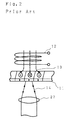
- Fig. 2 is a view schematically showing the magneto-optic recording system in a conventional magneto-optic disk unit, in which laser light beams 14 condensed by an objective lens 27 are applied to a perpendicular magnetized film 11 which has been magnetized normal to the plane of the magnetized film with its surface facing toward one direction, namely upward in Fig. 2, so that the temperature of the irradiated areas will be elevated in the vicinity of the Curie point at least or higher than the compensating temperature to reduce the coercive force of the film 11. Furthermore, the direction of magnetization is reversed by impression of an external magnetic field facing downward in Fig. 2, namely, in the direction opposite to the magnetizing direction of the perpendicular magnetized film 11 in respect of a magnetic field generating source 12 consisting of an electric magnet and the like, thereby storing information in the perpendicular magnetized film 11.
- the external magnetic field in the same direction as the initial magnetizing direction of the perpendicular magnetized film 11 (upwardly in Fig. 2) as well as the condensed laser light beams irradiate the film, which will be then magnetized in the upward direction in accordance with the similar principle to that as in the recording, resulting in the information being erased.
- the polar Kerr effect is used in regenerating the information recorded in the perpendicular magnetized film 11.
- a linear polarized light irradiated the perpendicular magnetized film 11 will turn into a reflected light rotating clockwise or anticlockwise in response to the magnetizing direction, and this rotation will be converted to the change of light volume by such as an analyzer to obtain a regenerated signal.
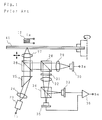
- Fig. 1 is a schematic view showing one embodiment of a substantial part of a conventional magneto-optic disk unit; 41 identifies a magneto-optic disc using a perpendicular magnetized film.
- the magneto-optic disk 41 has information recording tracks formed concentrically or helically and turns at a high speed around its shaft, and a magnetic field generating source 12 such as electromagnet acts to apply a magnetic filed to the magneto-optic disk 41 in a vertical direction.
- a laser light beam produced by a semiconductor laser 23 runs through a condenser lens 24, a shaping prism 25 and a beam splitter 26 to be focused into and irradiate the perpendicular magnetized film of the magneto-optic disk 41 by means of the objective lens 27. If the temperature of the magnetic film is elevated by the laser light in the vicinity of the Curie point at least or up to over the compensating temperature, the perpendicular magnetic film will be magnetized in response to a direction in which the magnetic field generating source 12 impresses a magnetic field, whereby the information will be either recorded or erased.
- a linear polarized light from the semiconductor laser 23 continues to travel through the condenser lens 24, shaping prism 25, beam splitter 26 and objective lens 27 until it irradiates the desired point of area on the perpendicular magnetic film of the magneto-optic disk 41, the polarization plane of a reflected light will revolve depending on the magnetizing direction.
- This particular polarized light is passed through the objective lens 27, beam splitter 26, another beam splitter 28, a 1/2 wavelength plate 31 and the condenser 32 and then separated by a polarizing beam splitter 34 into a component S of polarization and a component P of polarization.
- a differential amplifier 36 produces a signal corresponding to the rotation of the plane of polarization in view of the difference between the two components, thereby the information will be regenerated, accordingly.
- the perpendicular magnetized film 11 needs to have a thickness of less than 1000 ⁇ in general so that a great demagnetizing field will be produced due to its own magnetization resulting from such a thinner quality, thus reducing recorded magnetization.
- the perpendicular magnetized film 11 must be a substance of high coercive force in order to keep the recorded magnetization. What is known as a substance having such a nature at present is only an amorphous film made of rare earths - transition metals which has a great disadvantage in that it has a small Kerr effect and is subjected to oxidation and corrosion. This limits the selection of the magnetized film materials.
- the conventional magneto-optic recording system and the device using the system require the impression of a magnetic field perpendicular to the magnetic film, and the applied magnetic field diverges, whereby the distribution of the magnetic filed is not so limited that it is difficult to construct a compact source of generating magnetic field in which the high frequency modulation is possible.
- a method for regenerating information in accordance with the conventional magneto-optic disk unit employs the Kerr effect, which allows the plane of polarization of a reflected light of laser beam irradiated the magneto-optic disk slightly rotate in response to the direction of magnetization of the magneto-optic disk. Since, however, a slight amount of rotation is converted by an analyzer such as a polarizing beam splitter light into the variation of the intensity of light to obtain a regenerating signal, which is too small to obtain a sufficient signal-to-noise ration for regenerating information.
- the magnetized film is a perpendicular magnetized film, since, magnetization normal to the plane of the thin magnetized film is necessary, a great demagnetizing field will result from the magnetization of the film itself, thereby reducing the recorded magnetization.
- the saturated magnetization is 4 ⁇ Ms, it is necessary to provide a magnetized film having a greater coercive force than the saturated magnetization (4 ⁇ Ms) in order to overcome the demagnetizing field which will have an intensity of substantially 4 ⁇ Ms.
- Fig. 3 is a graph showing the coercive force - temperature characteristic of a magnetized film in an approximate straight line, wherein the vertical axis shows the coercive force and the horizontal axis shows the temperature of the film.
- b which represents the properties of the perpendicular magnetized film wherein a high coercive force Hc2 is required at the room temperature T R .
- the film temperature Tex2 where the magnetization reversal is made possible by the applied magnetic field is seen to be in the vicinity of the Curie temperature Tc, and therefore, when a determined area of the magnetized film is heated to more than Tex2 by lasing so as to record or erase the information, it is inevitable that the film temperature will become higher than the Curie temperature Tc due to the energization. Consequently, during the time when the film temperature which has once become higher than the Curie tem perature Tc goes down to a little lower than the Curie temperature, i.e.
- a temperature at which the magnetized wall in the magnetized region where the magnetization reversal took place can be fixed, since any recording or erasing of information cannot be achieved by the magnetization reversal of the magnetized film, for example, in the magnetic field modulation recording, a deviation from the recording or erasing position is liable to occur.
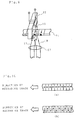
- Figs. 4 and 5 are schematic views showing the configurations of magnetic domains where magnetic walls are fixed.
- the configuration of magnetic domain which is symmetrical with respect to the running direction of the laser beam or the rotating direction the disk is the one which facilitates the processing of a regenerating signal, but the part of the magnetic domain heated to the temperature higher than the Curie temperature as described above has its magnetization which fails to reverse until the temperature is lowered to less than the Curie temperature, so that the formed magnetic domain as shown in Fig. 4 lacks the part heated to the temperature higher than the Curie temperature in the magnetic field modulation recording, thus being unsymmetrical with respect to a direction in which the laser beam runs or the disk rotates. Accordingly, when regenerating the information, a regeneration output will become unsymmmetric in response to the configuration of the magnetic domain, making it difficult to process the regenerating signal.
- the present invention is intended to solve the above problems.
- a first object of the present invention is to provide a process for magneto-optic recording and regenerating and a device using the process wherein a wide range of materials may be selected for use in manufacturing a magnetized film.
- a second object of the present invention is to provide a process for magneto-optic recording and regenerating and a device using the same wherein a compact magnetic field generating source which is high frequency-modulatable can be used.
- a third object of the present invention is to provide a process for magneto-optic recording and regenerating and a compact and light-weight device using the same wherein a large regenerating signal output is generatable and no optical system for polarization is required.
- a fourth object of the present invention is to provide a process for magneto-optic recording and regenerating and a device using the same wherein even a use of a magnetized film having a high Curie temperature may secure a good recording sensitivity and an exact recording or erasing po sitioning is obtained when recording or erasing information.
- a fifth object of the present invention is to provide a process for magneto-optic recording and regenerating and a device using the same wherein a regenerating signal may readily be processed.
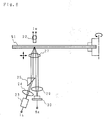
- Fig. 6 is a view schematically showing one example of the structure of the substantials of the magneto-optic disk unit of the present invention, in which drawing 51 designates a magneto-optic disk using a horizontal magnetized film which is to be magnetized parallel to the plane of the magnetized film.
- the magneto-optic disk 51 has tracks formed concentrically and spirally for recording information and rotates around its shaft at high speed.
- a ring type magnetic head 22 has a yoke arranged by its both ends circumferentially of the magneto-optic disk 51 to impress a magnetic field circumferentially of the magneto-optic disk 51.
- a laser light beam emitted from a semiconductor laser 23 is directed through a condenser lens 24 and a shaping prism 25 by an objective lens 27 to the horizontal magnetized film of the magneto-optic disk 51, and when the temperature of the magnetized film increases to about the Curie point or to over compensating temperature, the horizontal magnetized film is magnetized in accordance with the direction of magnetic field impressed by the ring type magnetic head 22 to record or erase information.
- a linear polarized light from the semiconductor laser 23 is directed through the condenser lens 24, shaping prism 25 and objective lens 27 to desired points of the horizontal magnetized film of the magneto-optic disk 51.
- the plane of incidence is substantially normal to the direction of magnetization effected parallel to the plane of the magnetized film longitudinally of the recording tracks of the magneto-optic disk 51.
- the light having a polarization P incident as a principal component on the horizontal magnetized film of the magneto-optic disk 51 will becomes a reflected light having an intensity of light corresponding to the direction and magnitude of magnetization.
- the reflected light irradiates a photodiode 30 through the objective lens 27 and condenser lens 29, so as to convert it into an electric signal associated with the intensity of the reflected light to regenerate information.
- regenerating and erasing information for example, cylindrical lens interposed between the condenser lens 29, quadrantal photodiode 30, are used to detect focusing servo and tracking servo signals by the astigmatism as well as the sample servo techniques.
- the incident light is directed from the outer periphery of the magneto-optic disk 51 to the inner periphery thereof, the similar effect is obtainable even if the light comes from the inner periphery to the outer periphery.
- the constitutional ratio of the polarized lights P and S incident on the surface of the magnetized film of the magneto-optic disk 51 is adjusted by any one of the following methods; the one is to rotate the plane of polarized light urged by allowing the semiconductor laser 23 revolve around the flux of light; the other one is to rotate the plane of polarized light by that the 1/2 wavelength plate inserted between the semiconductor laser 23 and the objective lens 27 is rotated by a desired amount around the flux of light; further one is to provide an incident light with an adequate phase difference by inserting a phase compensating plate such as a 1/4 wavelength plate, a Babinet's compensator and the like.
- a phase compensating plate such as a 1/4 wavelength plate, a Babinet's compensator and the like.
- the direction of magnetization parallel to the plane of the magnetized film is taken longitudinally of the tracks of the recording medium. This, however, may be directed to be normal to the tracks. That is, the ring type magnetic head 22 in Fig. 6 is turned horizontally 90° , the impression of magnetization is performed with the yoke arranged at its both ends in the direction of diameter of the magneto-optic disk 51 and the track is magnetized widthwise thereof. Then, the optical systems are also turned horizontally 90° , and the plane on which the laser beam is incident is directed normal to the magnetization.
- Fig. 7 is a block diagram showing another embodiment of the magneto-optic disk unit in accordance with the present invention.
- symbols are applied to the same parts as in Fig. 6 and further description is omitted.
- 22 designates a ring type magnetic head having a yoke arranged by its both ends diametrically of the magneto-optic disk 51 and enabling the impression of magnetization in the direction of the diameter of the magneto-optic disk 51.
- the optical systems 23 to 27 are arranged so that an incident light may be directed from the outer periphery of the magneto-optic disk 51 to the inner periphery thereof and the plane on which the laser beams are incident follows the direction of magnetization.
- a linear polarized light from the semiconductor laser 23 is directed through the condenser lens 24, shaping prism 25, beam splitter 26, and objective lens 27 to a desired point of the horizontal magnetized film on the magneto-optic disk 51, and then the plane of polarized light of the reflected light will rotate dependent on the direction of magnetization.
- the reflected light is passed through the objective lens 27, beam splitter 26, beam splitter 28, 1/2 wavelength plate 31 and condenser lens 32 until it is separated by a polarizing beam splitter 34 into the constituents P and S.
- the intensity of light of the respective separated constituents are converted by photodiodes 33 and 35 into electric signals, and a differential amplifier 36 acts to generate a signal corresponding to the rotation of the plane of polarized light from the difference between these constituents for subsequent regeneration of the information.
- Fig. 7 is a schematic view showing another embodiment of the present invention, to which the present invention may not be restricted.
- the polarizing beam splitter 34 may be replaced by a wollaston prism, or a savart's plate, and various composition of the optical systems can be useful, and also as for the means for detecting the rotation of the plane of polarized light with the Kerr effect, it is possible to obtain a regenerating signal directly without resorting to the differential process steps.
- Fig. 8 is a schematic conceptional view showing a state of impression of the magnetic field by the ring type magnetic head 22.
- the combination of the ring type magnetic head 22 and the horizontal magnetized film 21 can construct a closed magnetic flux circuit in which a magnetic flux 15 is discharged from one end of the ring type magnetic head 22 to pass through the horizontal magnetized film 21 until it returns home to the other end of the ring type magnetic head 22, thereby ensuring that a leakage of magnetic flux will rarely occur and the efficiency of magnetic flux will represent itself to be at a high level.
- a high efficiency of magnetic flux allows the application of an external magnetic field of a desired intensity to the horizontal magnetized film, therefore, a smaller number of turns of coil winding or the quantity of electricity by which a coil can be energized will do, so that the magnetic field may be high frequency-modulated and reducing the size of the magnetic field generating source is possible.
- the magneto-optic disk since the magneto-optic disk has a magnetized film adapted to be magnetized parallel to the plane of the magnetized film rather than in the direction of thickness of an extremely thin magnetic film, the distance between the magnetic poles N and S occurring on the both ends of the magnetization is long enough to greatly reduce the demagnetizing field.
- the recording information parallel to the plane of the magnetized film may avoid the decrease of magnetization on even a magnetized film having a low coercive force, to ensure that a stable information recording will be effected.
- Figs. 10(a), (b) two typical examples are conceivable as shown by Figs. 10(a), (b).
- Fig. 10(a) when magnetization takes place in the direction of the recording tracks, magnetic poles are magnetized in such a manner that they will be positioned opposite to each other, thus giving rise to magnetic fields of the direction in which the recording magnetizations will mutually erase each other, thereby to reduce the recording the recording magnetization. Consequently, as shown in Fig.
- magnetic poles on the same poles are not positioned opposite to each other, which avoids the necessity of a substantial coercive force and can be said to be a proper example.
- the conventional amorphous film of rare earths - transition metal has a small Kerr effect ( ⁇ k) of the order of 0.2 to 0.4°.
- laser beams are condensed and incident by the objective lens 27 in advance in one direction, e g. on the horizontal magnetized film 21 magnetized in the forward direction of the conceptional view, and the temperature of the irradiated area is elevated nearly to the Curie point or over to the compensating temperature in order to reduce the coercive force, and the external magnetic field 15 in the direction opposite to the direction of magnetization of the horizontal magnetized film 21, i. e. in the innermost portion of Fig. 9 is applied from the horizontal magnetization generating source, e.g. the ring type magnetic head 22 of Fig. 9 to provide a local inversion of the direction of magnetization, thereby recording information on the horizontal magnetized film 21.
- the horizontal magnetization generating source e.g. the ring type magnetic head 22 of Fig. 9
- the both recording and erasing operations may use the magnetic field generating source alone such as the ring type magnetic head capable of producing a large magnetic field, rather than using the raised temperature by irradiating laser beams.
- the use of a linear polarized light having an incident plane substantially parallel to the magnetization enables obtaining a regenerating signal output by virtue of the rotation of the plane of polarized light.
- This method requires the rotation of the plane of polarized light to be converted to the intensity variation of light by using an analyzer and the like, and as described below, the efficiency conversion into intensity of light is inferior to that in a method without converting the rotation of the plane of polarization directly into the intensity variation of light by irradiating the linear polarized light substantially normal to the direction of magnetization.
- the following is a preferable method.
- polarized light P a light having for a main component a light (hereinafter referred to as polarized light P) having a plane of incidence substantially transverse to the direction of the magnetization recorded in the horizontal magnetized film 21, i.e. a plane of incidence parallel to the paper surface in Fig. 9 and an electric vector parallel to the plane of incidence (P polarized light) is emitted
- a light with an intensity corresponding to the direction or magnitude of magnetization of the horizontal magnetized film 21 is reflected by the equatorial Kerr effect, and then the reflected light 18 is converted to an electric signal by a light receiving element to obtain a regenerating signal.
- the method of the invention is not restricted to the case where the direction of magnetization and the incident plane being completely perpendicular to each other.
- the incident light when the incident light has 100% of P polarization component as an electric vector parallel with the plane of incidence upon arrival at the surface of the magnetized film of a recording medium, the variation of the intensity of the reflected light variable with the direction or magnitude of magnetization by the equatorial Kerr effect will become maximum.
- the incident light should have 100% of P polarization component, in view of obtaining a regenerating signal, but there will inevitably occur a phase difference due to the optical parts such as lenses, the substrate materials or the like. It is also difficult to have an incident light 100% consisting of P polarization component because of the limit in industrially enabling adjustment accuracy of the optical system.
- the light emitted for the detection of a positioning servo signal preferably comprises an S polarization component having an electric vector perpendicular to the plane of incidence and an intensity of reflected light which does not vary with the direction or magnitude of magnetization.
- an S polarization component having an electric vector perpendicular to the plane of incidence and an intensity of reflected light which does not vary with the direction or magnitude of magnetization.
- the incidence of a proper amount of S polarization component is preferable in order to secure an output of a servo signal. Consequently, in accordance with the method of the invention, the incidence of the P polarization component as an electric vector parallel to the plane of incidence is indispensable for regenerating information, but 100% composition is not necessary, and all what is required is the P polarization component being as a principal component.
- Table 1 One example of the test results by comparing the magnitudes of regenerating signal outputs by the methods in accordance with the invention and the prior art is shown in Table 1.
- Table 1 the amplification factor of an amplifier is set as 1 for comparison between the two different play-back systems and the intensity variation of the reflected light during magnetization reversal with respect to the intensity of the incident light is shown in percentage of the amplitude intensity.
- the method of this invention has about a 1.5-fold intensity variation of light in the amplitude compared with the conventional method.
- a regenerating signal can have about a 2-fold output which is proportional to the square of the amplitude intensity.
- the diagonal incidence of a light with respect to the magnetized film can eliminate the return of the light to the semiconductor laser, preventing any deterioration in quality of a regenerating signal due to the noise of the returned light, and obtaining an extra effect of improving the SN ratio of the regenerating signal.
- the ring type magnetic head 22 for example, as shown in Fig 8. is used as a magnetic field generating source.
- This ring type magnetic head 22 constitutes a closed magnetic flux circuit wherein a magnetic flux 15 is discharged from one end of the ring type magnetic head 22, passing through the horizontal magnetized film 21, and returning to the other end of the ring type magnetic head 22. This may make a less leakage of magnetic flux with extremely high efficiency of magnetic flux.
- the ring type magnetic head Since the ring type magnetic head has an intensity of magnetic field which is less variable with the fluctuation of the distance from the head, it is effective in the magneto-optic disk unit wherein the distance between the disk and the head is inevitably changeable due to the surface vibration of the disk and the like.
- Fig. 3 shows the coercive force - temperature characteristic of the magnetized film.
- a which corresponds to the present invention, shows the temperature characteristic of the magnetized film, wherein the coercive force Hc1 at room temperature T R is smaller than the saturated magnetization 4 ⁇ Ms
- b corresponding to the prior art, represents the temperature characteristic of the magnetized film, wherein the coercive force Hc2 at room temperature T R is more than the saturated magnetization 4 ⁇ Ms, the both a and b being shown in approximate straight lines in the graph.
- the both a and b have the same Curie temperature Tc and other properties.
- magnetization With the magneto-optic recording medium using the conventional perpendicular magnetized film, magnetization must be provided normal to the plane of a thin magnetized film, and therefore a magnetized film having a high coercive force as shown in Fig. 3b is required so that the recording magnetization should not be reduced by the demagnetizing field substantially equal to the saturated magnetization (4 ⁇ Ms) of the magnetized film itself.
- the coercive force is high at the temperature T R , the lowering of the coercive force is represented in a relatively steep gradient leading to the Curie temperature Tc, and then the temperature Tex2 of the film at which the magnetization reversal can be achieved by the applied magnetic field Hex is comparatively close to the Curie temperature Tc, which means that the recording sensitivity is poor.
- the better the recording sensitivity of the magnetized film, the easier the information recording, and the lower the temperature Tex of the film at which the magnetization reversal can be achieved by the applied magnetization the higher the recording sensitivity.
- Tex in the magnetized film being as high as the Curie temperature should be decreased and the gradient leading to the Curie temperature Tc should be made gentle, in other words, the coercive force at room temperature should be reduced.
- the latter in the attempt of securing a similar degree of the recording sensitivity from a magnetized film having a high coercive force at room temperature and another magnetized film with a low coercive force at room temperature, the latter can be produced from a material having a comparatively high Curie temperature.
- the configuration of the magnetic domain formed by the magnetization reversal is devoid of cutouts at highly heated areas where no magnetization reversal can take place, and the magnetic domain has a configuration essentially symmetrical in the traveling direction of the laser beams or in the rotational direction of the disk, thus producing substantially symmetrical regenerating outputs for easy processing of the regenerating signals.
- the problem in the item (2) may be solved by the following reason.
- the Curie temperature of the PtMnSb magnetized film is remarkably high as compared with that of 100 to 200°C of the rare earths - transition metals alloy magnetized film (100 - 200°C) generally used in conventional magneto-optic recording media.
- a film formed based on the PtMnSb magnetized film by means of sputtering as a horizontal magnetized film with a coercive force of 1000 Oe sufficiently satisfying Hc ⁇ 4 ⁇ Ms have a characteristic that the film temperature Tex at which the magnetization reversal is possible at the applied magnetic field Hex of 300 Oe subjected to external impression is a comparatively low temperature of about 224°C at which a good recording sensitivity may be secured.
- the film temperature Tex enabling the magnetization reversal is lower by 85°C than the Curie temperature Tc (309°C)
- the ultimate temperature of a region with a diameter of 1 ⁇ m heated by irradiation of laser beams is about 284°C, namely failing to go beyond the Curie temperature. Consequently, after heating the recording or erasing position by irradiating laser beams, the magnetization reversal can be performed by the impressed magnetic field from the magnetic field generating source such as the ring type magnetic head in the entire area with the film temperature elevated higher than Tex (about 224°C).
- the magnetic domain after the magnetization reversal is symmetrically shaped in the traveling direction of the laser beams or the rotational direction of the disk, thus obtaining a good symmetrical regenerating output so that it is easy to process the regenerating signals.
- the described embodiments of the present invention are limited to the device using a disk, but it goes without saying that they are applicable to a magneto-optic recording medium having such a form as a card or a tape and so on.
Applications Claiming Priority (6)
| Application Number | Priority Date | Filing Date | Title |
|---|---|---|---|
| JP4485188A JPH01220163A (ja) | 1988-02-26 | 1988-02-26 | 光磁気記録方式及びこれに用いる装置 |
| JP44851/88 | 1988-02-26 | ||
| JP198287/88 | 1988-08-08 | ||
| JP19828788A JPH0246546A (ja) | 1988-08-08 | 1988-08-08 | 光磁気記録再生方式及びこれに用いる装置 |
| JP259837/88 | 1988-10-14 | ||
| JP25983788A JPH02105354A (ja) | 1988-10-14 | 1988-10-14 | 光磁気記録媒体及び光磁気記録方式 |
Publications (2)
| Publication Number | Publication Date |
|---|---|
| EP0330507A2 true EP0330507A2 (de) | 1989-08-30 |
| EP0330507A3 EP0330507A3 (de) | 1990-07-04 |
Family
ID=27292048
Family Applications (1)
| Application Number | Title | Priority Date | Filing Date |
|---|---|---|---|
| EP89301883A Withdrawn EP0330507A3 (de) | 1988-02-26 | 1989-02-24 | Verfahren zur magneto-optischen Aufnahme und Wiedergabe, Gerät zum Gebrauch des Verfahrens und magneto-optische Scheibe |
Country Status (2)
| Country | Link |
|---|---|
| US (1) | US5153868A (de) |
| EP (1) | EP0330507A3 (de) |
Families Citing this family (6)
| Publication number | Priority date | Publication date | Assignee | Title |
|---|---|---|---|---|
| JPH0340252A (ja) * | 1989-04-19 | 1991-02-21 | Olympus Optical Co Ltd | 光磁気記録媒体の位相差測定装置 |
| JP2812817B2 (ja) * | 1991-07-08 | 1998-10-22 | シャープ株式会社 | 光磁気記録媒体 |
| EP0555049B1 (de) * | 1992-02-05 | 1998-10-07 | Canon Kabushiki Kaisha | Magnetooptisches Informationsaufzeichnungs- und -wiedergabegerät |
| JPH07169129A (ja) * | 1993-12-13 | 1995-07-04 | Canon Inc | 光ヘッド |
| JPH08115541A (ja) * | 1994-08-24 | 1996-05-07 | Hitachi Maxell Ltd | 光磁気記録媒体 |
| JP5751328B2 (ja) * | 2011-06-29 | 2015-07-22 | 株式会社ニコン | 構造化照明光学系および構造化照明顕微鏡装置 |
Family Cites Families (8)
| Publication number | Priority date | Publication date | Assignee | Title |
|---|---|---|---|---|
| US3094699A (en) * | 1959-03-03 | 1963-06-18 | Ibm | System for magnetically recording data |
| NL278624A (de) * | 1961-05-19 | |||
| GB1143836A (de) * | 1965-05-26 | |||
| US3521294A (en) * | 1967-03-13 | 1970-07-21 | Ampex | Magneto thermal recording process and apparatus |
| US3781905A (en) * | 1972-09-22 | 1973-12-25 | Honeywell Inc | Optical mass memory |
| US4618901A (en) * | 1982-07-19 | 1986-10-21 | Nippon Telegraph & Telephone Public Corporation | High density magnetic head |
| JPS6145439A (ja) * | 1984-08-08 | 1986-03-05 | Canon Inc | 光信号読取り法および装置 |
| US4694358A (en) * | 1985-10-28 | 1987-09-15 | Kerdix, Inc. | Magneto-optic recording structure and method |
-
1989
- 1989-02-24 US US07/315,166 patent/US5153868A/en not_active Expired - Fee Related
- 1989-02-24 EP EP89301883A patent/EP0330507A3/de not_active Withdrawn
Also Published As
| Publication number | Publication date |
|---|---|
| EP0330507A3 (de) | 1990-07-04 |
| US5153868A (en) | 1992-10-06 |
Similar Documents
| Publication | Publication Date | Title |
|---|---|---|
| US4412264A (en) | Magneto-optic recording medium | |
| Cumpson et al. | A hybrid recording method using thermally assisted writing and flux sensitive detection | |
| JPH11134732A (ja) | 情報記録再生方法 | |
| US6603619B1 (en) | Magnetic storage medium and heat assisted recording and reproduction method | |
| US6249490B1 (en) | Magneto-optical recording/reproducing method and apparatus | |
| US4518657A (en) | Recording medium and recording-reproduction system provided with the recording medium | |
| JPH02263344A (ja) | 情報の熱磁気的記録と蓄積された情報の光学的読出し方法 | |
| EP0330507A2 (de) | Verfahren zur magneto-optischen Aufnahme und Wiedergabe, Gerät zum Gebrauch des Verfahrens und magneto-optische Scheibe | |
| JPH0339321B2 (de) | ||
| US20040017736A1 (en) | Magneto-optical recording/reproducing apparatus capable of setting reproducing/recording laser power | |
| EP0530913B1 (de) | Magnetooptisches Aufzeichnungsmedium | |
| US4805043A (en) | Microgap recording using ferrimagnetic medium for magneto-optic playback | |
| US5282095A (en) | Direct over-write magneto-optical recording medium having multiple recording layers, and method of recording new information by directly overwriting pre-existing recorded information on such medium | |
| Murakami et al. | Magnetic super-resolution | |
| JPS59113507A (ja) | 光磁気記録再生消去方法及びその装置 | |
| Asthana et al. | Rewritable optical disk drive technology | |
| JPH0325854B2 (de) | ||
| JP2591729B2 (ja) | 光磁気記録再生消去方式及び装置 | |
| Cheng et al. | Static tests of TbFe films for magneto-optical recordings | |
| Braat et al. | High Density Magneto-Optical Recording | |
| JPS6113461A (ja) | 光磁気記録再生方法 | |
| JP2604702B2 (ja) | 光磁気記録再生消去方式及びその装置 | |
| JP2636694B2 (ja) | 光磁気記録媒体の記録再生方法および記録再生装置 | |
| JPH0456362B2 (de) | ||
| JP2000021041A (ja) | 浮上型磁気ヘッド装置及びこれを用いた信号再生方法、記録再生方法 |
Legal Events
| Date | Code | Title | Description |
|---|---|---|---|
| PUAI | Public reference made under article 153(3) epc to a published international application that has entered the european phase |
Free format text: ORIGINAL CODE: 0009012 |
|
| AK | Designated contracting states |
Kind code of ref document: A2 Designated state(s): DE FR GB NL |
|
| PUAL | Search report despatched |
Free format text: ORIGINAL CODE: 0009013 |
|
| AK | Designated contracting states |
Kind code of ref document: A3 Designated state(s): DE FR GB NL |
|
| 17P | Request for examination filed |
Effective date: 19900621 |
|
| 17Q | First examination report despatched |
Effective date: 19920814 |
|
| STAA | Information on the status of an ep patent application or granted ep patent |
Free format text: STATUS: THE APPLICATION IS DEEMED TO BE WITHDRAWN |
|
| 18D | Application deemed to be withdrawn |
Effective date: 19921229 |