EP0331261B1 - Appareil et méthode pour déterminer l'azimut, la déclivité et le roulement - Google Patents
Appareil et méthode pour déterminer l'azimut, la déclivité et le roulement Download PDFInfo
- Publication number
- EP0331261B1 EP0331261B1 EP89200482A EP89200482A EP0331261B1 EP 0331261 B1 EP0331261 B1 EP 0331261B1 EP 89200482 A EP89200482 A EP 89200482A EP 89200482 A EP89200482 A EP 89200482A EP 0331261 B1 EP0331261 B1 EP 0331261B1
- Authority
- EP
- European Patent Office
- Prior art keywords
- magnetic field
- block
- roll
- reference frame
- determining
- Prior art date
- Legal status (The legal status is an assumption and is not a legal conclusion. Google has not performed a legal analysis and makes no representation as to the accuracy of the status listed.)
- Expired - Lifetime
Links
- 238000000034 method Methods 0.000 title claims description 15
- 230000004907 flux Effects 0.000 description 4
- 238000010586 diagram Methods 0.000 description 1
- 238000005259 measurement Methods 0.000 description 1
- 230000000737 periodic effect Effects 0.000 description 1
- 230000000717 retained effect Effects 0.000 description 1
Images

Classifications
-
- G—PHYSICS
- G01—MEASURING; TESTING
- G01C—MEASURING DISTANCES, LEVELS OR BEARINGS; SURVEYING; NAVIGATION; GYROSCOPIC INSTRUMENTS; PHOTOGRAMMETRY OR VIDEOGRAMMETRY
- G01C17/00—Compasses; Devices for ascertaining true or magnetic north for navigation or surveying purposes
- G01C17/38—Testing, calibrating, or compensating of compasses
-
- G—PHYSICS
- G01—MEASURING; TESTING
- G01C—MEASURING DISTANCES, LEVELS OR BEARINGS; SURVEYING; NAVIGATION; GYROSCOPIC INSTRUMENTS; PHOTOGRAMMETRY OR VIDEOGRAMMETRY
- G01C17/00—Compasses; Devices for ascertaining true or magnetic north for navigation or surveying purposes
- G01C17/02—Magnetic compasses
- G01C17/28—Electromagnetic compasses
- G01C17/30—Earth-inductor compasses
-
- G—PHYSICS
- G01—MEASURING; TESTING
- G01R—MEASURING ELECTRIC VARIABLES; MEASURING MAGNETIC VARIABLES
- G01R33/00—Arrangements or instruments for measuring magnetic variables
- G01R33/02—Measuring direction or magnitude of magnetic fields or magnetic flux
- G01R33/0206—Three-component magnetometers
Definitions
- the present invention relates to a method of determining the azimuth and pitch relative to a reference frame having first, second and third mutually orthogonal axes, of a structure containing a compass gimballed thereto.
- the heading is calculated by the steps of measuring the ambient magnetic field as three substantially independent components and providing field component signals Xe, Ye, and Ze, respectively along mutually orthogonal X, Y, and Z axes in a reference frame defined by the compass (block 106); applying a first predetermined magnetic field orthogonal to the Y axis of the reference frame (block 112); measuring the independent components of the magnetic field resulting from the superposition of the ambient magnetic field and the first predetermined magnetic field and providing field component signals Xp, Yp, and Zp (block 114); determining the aximuth ( ⁇ ) according to the arctangent of (Ye/Xe) (block 130); determining the pitch (P) according to the arctangent of [(Xp-Xe)/(Zp-Ze)] (block 118,120); and transmitting signals representing ⁇ and P (block 134).
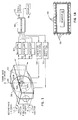
- FIG. 1 A block drawing of one embodiment of the system 50 is shown in Fig. 1 wherein a sensor 52, containing three orthogonal magnetic field sensing elements 52A, 52B and 52C, typically flux gates, are retained within a structure having a pitch coil 54 and a roll coil 56 disposed thereabout to selectively provide a predetermined DC magnetic field for the process described below.
- the particular proportions of the pitch and roll coils 52 and 54 is shown more clearly in Fig. 1A, wherein the coils 52 and 54 comprise solenoidally wound coils which extend beyond the sensor 52 such that the lines of flux produced by the respective coils are substantially parallel and uniform in through the sensor 52.
- the three orthogonal magnetic field sensing elements 52A, 52B and 52C of the sensor 52 define a reference frame for the determination of roll about the Y axis and pitch about the X-axis.
- the signals derived by the individual flux gates in the sensor 52 are measured by elements 60, 62 and 64, and received by and stored in a processor 66.
- the processor sequentially and selectively energizes the pitch and roll coils 54 and 56 according to control signals applied to energization circuits 68 and 70, respectively.
- the resulting calculated pitch, roll and azimuth is provided on output leads 72 and/or selectively displayed on a display 74.
- the embodiment includes a processor 66 which comprises typically a microprocessor such as the MCS 48 Series Microprocessor made by Intel Corp., the Motorola 6800 Series Microprocessor made by Motorola Inc or equivalent thereof and is programmed according to the following process according to the present invention by one of skill in the art.
- a processor 66 which comprises typically a microprocessor such as the MCS 48 Series Microprocessor made by Intel Corp., the Motorola 6800 Series Microprocessor made by Motorola Inc or equivalent thereof and is programmed according to the following process according to the present invention by one of skill in the art.
- the process of the present invention provides a periodic update of the pitch, roll and azimuth signals.
- One embodiment of the process is shown in the flow chart 100 in Fig. 2 wherein the process begins at step 102, and turns the coils off at step 104 so that the X, Y and Z signals provided by the sensor 52 and measured by elements 60, 62 and 64, noted as Xe, Ye and Ze, correspond only to the ambient magnetic field (of the earth) Hx1, Hy1 and Hz1.
- the measurement is provided at step 106.
- the roll coil 56 is energized at step 108 and the three signal orthogonal signals are measured at step 110 for the field components Hx2, Hy2 and Hz2 wherein the signals are noted as Xr, Yr and Zr.
- the roll coil 56 is de-energized and the pitch coil 54, is energized at step 112.
- the signals from the sensors are measured at step 114, providing the Xp, Yp and Zp signals, corresponding to Hx3, Hy3 and Hz3 comprising the ambient earth magnetic field and the field imposed by the pitch coil.
- the above steps of measuring the sensor signals with and without energization of the particular roll and pitch coils is accomplished in a short interval, such as 15 milliseconds, in order to provide a "snapshot" of the ambient field conditions. If an extended period of time between the readings exists so that the platform to which the compass is attached changes its relative position, changes in ambient field conditions will cause erroneous calculations of the desired signals.
- the signals derived when all coils are off (Xe, Ye and Ze) is subtracted from the signals (Xr, Yr and Zr) derived when the roll coil is energized, resulting in difference signals XI, YI and ZI at step 116.
- the signals measured when the coils are not energized are subtracted at step 118 from the signals (Zp, Yp and Zp) derived when the pitch coil is energized providing signals XII, YII and ZII.
- step 120 the pitch (P) is calculated according to the arctangent of XII/ZII (arctangent (Hx2 - Hx1)/(Hz2 - Hz1)).
- step 122 a quadrant correction is applied such that if the value of XII (Hx signal) is less than 0, 180° is added to the value of pitch, and if the value XII (Hx) is greater than 0 and the value of ZII (Hy) is less than 0, a value of 360° is added to the calculated value of pitch.
- step 124 the value of ZI is multiplied by 1 + sin p where P is the calculated pitch angle.
- the roll (R) is calculated at step 126 according to the arctangent of YI/ZI (arctangent (Hy2 - Hy1)/(Hz2 - Hz1)), and is corrected at the optional step 128, which incorporates the quadrant correction according to step 122 as applied to the calculated roll angle.
- the azimuth ( ⁇ ) is calculated at step 130 according to the arctangent of the initially measured values of Ye/Xe (arctangent Hy1/Hx1 ).
- Quadrant correction is applied at the optional step 132, incorporating the procedure of step 122, discussed above, as applied to the calculated azimuth angle.
- the calculated heading, pitch and roll values are transmitted to the external apparatus or to the display 74 at step 134, whereupon the method of determining azimuth, pitch and roll according to the present invention is begun again at step 102.
Landscapes
- Physics & Mathematics (AREA)
- Engineering & Computer Science (AREA)
- Radar, Positioning & Navigation (AREA)
- Remote Sensing (AREA)
- General Physics & Mathematics (AREA)
- Condensed Matter Physics & Semiconductors (AREA)
- Life Sciences & Earth Sciences (AREA)
- Environmental & Geological Engineering (AREA)
- General Life Sciences & Earth Sciences (AREA)
- Geology (AREA)
- Electromagnetism (AREA)
- Measuring Magnetic Variables (AREA)
Claims (6)
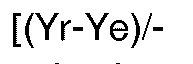
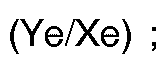
- Procédé de détermination de l'azimut et du tangage, par rapport à un cadre de référence ayant des premier, deuxième et troisième axes perpendiculaires les uns aux autres, d'une structure dans laquelle un compas est suspendu à la cardan, caractérisé par les étapes de mesure du champ magnétique ambiant sous forme de trois composantes sensiblement indépendantes et d'émission de signaux de composante de champ Xe, Ye et Ze, respectivement, le long d'axes X, Y et Z perpendiculaires les uns aux autres dans un cadre de référence déterminé par le compas (bloc 106) ; de production d'un premier champ magnétique prédéterminé qui est perpendiculaire à l'axe Y du cadre de référence (bloc 112) ; de mesure des composantes indépendantes du champ magnétique résultant de la superposition du champ magnétique ambiant et du premier champ magnétique prédéterminé et d'émission de signaux de composante de champ Xp, Yp et Zp (bloc 114) ; de détermination de l'azimut (ϑ) d'après l'arc tangente de


- Procédé selon la revendication 1, caractérisé par les étapes d'élimination dudit premier champ magnétique prédéterminé et de production d'un second champ magnétique prédéterminé qui est perpendiculaire à la direction du premier champ magnétique prédéterminé (bloc 112) ; de mesure des composantes indépendantes du champ magnétique résultant de la superposition du champ ambiant et du second champ magnétique prédéterminé et d'émission de signaux de composante de champ Xr, Yr et Zr (bloc 110) ; de détermination du roulis (R) d'après l'arc tangente de


- Procédé de détermination de l'azimut et du roulis, par rapport à un cadre de référence ayant des premier, deuxième et troisième axes perpendiculaires les uns aux autres, d'une structure dans laquelle un compas est suspendu à la cardan, caractérisé par les étapes de mesure du champ magnétique ambiant sous forme de trois composantes sensiblement indépendantes et d'émission de signaux de composante de champ Xe, Ye et Ze, respectivement, le long d'axes X, Y et Z perpendiculaires les uns aux autres dans ledit cadre de référence déterminé par le compas (bloc 106) ; de production d'un champ magnétique prédéterminé perpendiculaire à l'axe X du cadre de référence (bloc 108) ; de mesure des composantes indépendantes du champ magnétique résultant de la superposition du champ ambiant et du champ magnétique prédéterminé et d'émission de signaux de composante de champ Xr, Yr et Zr (bloc 110) ; de détermination de l'azimut (ϑ) d'après l'arc tangente de


- Appareil de détermination de l'azimut et du tangage d'une structure selon le procédé de la revendication 1, caractérisé par un magnétomètre (52, 60, 62, 64) que comprend la structure et qui comporte trois éléments détecteurs perpendiculaires les uns aux autres et déterminant ledit cadre de référence comprenant lesdits axes X, Y et Z, ledit magnétomètre étant mobile par rapport à la structure en roulis autour de l'axe X et en tangage autour de l'axe Y et émettant des signaux de sortie Xe, Ye et Ze représentant des composantes perpendiculaires du champ magnétique ambiant dans le cadre de référence ; des moyens (54) de production d'un premier champ mangétique sensiblement uniforme autour dudit magnétomètre perpendiculairement à l'axe Y du cadre de référence en fonction d'un premier signal de commande (68), ledit magnétomètre émettant des signaux Xp, Yp et Zp représentant des composantes orthogonales de la superposition du champ magnétique ambiant et du premier champ magnétique uniforme dans le cadre de référence ; des moyens (66) de détermination du tangage de la structure par rapport au magnétomètre d'après l'arc tangente de


- Appareil selon la revendication 4, caractérisé par des moyens (56) de production d'un second champ magnétique sensiblement uniforme autour dudit magnétomètre (52, 60, 62, 64) perpendiculairement au premier champ magnétique sensiblement uniforme en fonction d'un second signal de commande (70), ledit magnétomètre émettant des signaux de sortie de magnétomètre Xr, Yr et Zr représentant des composantes orthogonales de la superposition du champ ambiant et du second champ magnétique uniforme dans le cadre de référence ; et des moyens (66) de détermination du roulis de la structure d'après l'arc tangente de


- Appareil de détermination de l'azimut et du roulis d'une structure dans un champ magnétique ambiant selon le procédé de la revendication 3, caractérisé par un magnétomètre (52, 60, 62, 64) que comprend la structure et qui comporte trois éléments détecteurs perpendiculaires les uns aux autres et déterminant un cadre de référence comprenant lesdits axes X, Y et Z, ledit magnétomètre étant mobile par rapport à la structure en roulis autour de l'axe X et en tangage autour de l'axe Y et émettant des signaux de sortie Xe, Ye et Ze représentant des composantes orthogonales du champ magnétique ambiant dans le cadre de référence ; des moyens (56) de production d'un champ magnétique sensiblement uniforme autour dudit magnétomètre à peu près perpendiculairement à l'axe X du cadre de référence en fonction d'un signal de commande (70), ledit magnétomètre émettant des signaux de sortie Xr, Yr, et Zr représentant des composantes orthogonales de la superposition du champ ambiant et du champ magnétique sensiblement uniforme dans le cadre de référence ; des moyens (66) de détermination du roulis de la structure d'après l'arc tangente de

Applications Claiming Priority (2)
| Application Number | Priority Date | Filing Date | Title |
|---|---|---|---|
| US16200788A | 1988-02-29 | 1988-02-29 | |
| US162007 | 1988-02-29 |
Publications (2)
| Publication Number | Publication Date |
|---|---|
| EP0331261A1 EP0331261A1 (fr) | 1989-09-06 |
| EP0331261B1 true EP0331261B1 (fr) | 1993-04-28 |
Family
ID=22583771
Family Applications (1)
| Application Number | Title | Priority Date | Filing Date |
|---|---|---|---|
| EP89200482A Expired - Lifetime EP0331261B1 (fr) | 1988-02-29 | 1989-02-27 | Appareil et méthode pour déterminer l'azimut, la déclivité et le roulement |
Country Status (4)
| Country | Link |
|---|---|
| EP (1) | EP0331261B1 (fr) |
| JP (1) | JPH0262908A (fr) |
| CA (1) | CA1299859C (fr) |
| DE (1) | DE68906184T2 (fr) |
Families Citing this family (3)
| Publication number | Priority date | Publication date | Assignee | Title |
|---|---|---|---|---|
| US6543146B2 (en) * | 2000-12-06 | 2003-04-08 | Honeywell International, Inc. | Electronic compass and compensation of large magnetic errors for operation over all orientations |
| DE10301304A1 (de) * | 2003-01-15 | 2004-08-12 | Prüftechnik Dieter Busch AG | Verfahren und Messvorrichtung zum Ermitteln der Ausrichtung eines zylindrischen Körpers |
| CN102621595A (zh) * | 2012-03-30 | 2012-08-01 | 中天启明石油技术有限公司 | 一种探管磁通门调试台 |
Family Cites Families (1)
| Publication number | Priority date | Publication date | Assignee | Title |
|---|---|---|---|---|
| DE1252796B (fr) * | 1967-10-26 |
-
1989
- 1989-02-10 CA CA000590728A patent/CA1299859C/fr not_active Expired - Lifetime
- 1989-02-27 EP EP89200482A patent/EP0331261B1/fr not_active Expired - Lifetime
- 1989-02-27 DE DE8989200482T patent/DE68906184T2/de not_active Expired - Lifetime
- 1989-02-28 JP JP1048398A patent/JPH0262908A/ja active Pending
Also Published As
| Publication number | Publication date |
|---|---|
| JPH0262908A (ja) | 1990-03-02 |
| CA1299859C (fr) | 1992-05-05 |
| DE68906184T2 (de) | 1993-08-05 |
| DE68906184D1 (de) | 1993-06-03 |
| EP0331261A1 (fr) | 1989-09-06 |
Similar Documents
| Publication | Publication Date | Title |
|---|---|---|
| US5105548A (en) | Apparatus and method for determining azimuth, pitch and roll | |
| US5255442A (en) | Vehicle compass with electronic sensor | |
| US5802727A (en) | Compensation system for electronic compass | |
| US5404307A (en) | Navigation apparatus with detected angular speed correction | |
| US4870602A (en) | Method for determining route angles | |
| EP0368457B1 (fr) | Système de compas | |
| IL156337A (en) | Electronic compass and compensation of large magnetic errors for operation over all orientations | |
| US4462165A (en) | Three axis orientation sensor for an aircraft or the like | |
| US7421792B2 (en) | Apparatus and method of calibrating azimuth of mobile device | |
| EP0436794B1 (fr) | Compas magnétique | |
| US5010653A (en) | Apparatus and method for determining azimuth, pitch and roll | |
| EP0331262B1 (fr) | Méthode de calibrage d'un compas | |
| US4782453A (en) | Method of determining the location of a navigational magnetic field sensor in a vehicle | |
| JPS61502413A (ja) | 電子式コンパスを用いた運輸体の進行方向検出方法 | |
| US4751783A (en) | Azimuth determination apparatus | |
| EP0541224A1 (fr) | Méthode pour détecter le cap d'un véhicule | |
| US5131155A (en) | Apparatus and method for measuring forward direction of vehicle | |
| EP0331261B1 (fr) | Appareil et méthode pour déterminer l'azimut, la déclivité et le roulement | |
| US8584586B1 (en) | Roll frequency dependency correction to control magnetic ship signatures | |
| GB2130729A (en) | Electronic compasses | |
| JPH03152412A (ja) | 車両方位演算方法 | |
| JP2995852B2 (ja) | 車両用gps航法システム | |
| JPH10153428A (ja) | 車両方位検出装置 | |
| JP2712861B2 (ja) | 飛しょう体の誘導制御装置 | |
| JPH10132568A (ja) | 地磁気センサーによる方位角の高精度測定システム |
Legal Events
| Date | Code | Title | Description |
|---|---|---|---|
| PUAI | Public reference made under article 153(3) epc to a published international application that has entered the european phase |
Free format text: ORIGINAL CODE: 0009012 |
|
| AK | Designated contracting states |
Kind code of ref document: A1 Designated state(s): DE FR GB IT |
|
| 17P | Request for examination filed |
Effective date: 19890912 |
|
| 17Q | First examination report despatched |
Effective date: 19920120 |
|
| GRAA | (expected) grant |
Free format text: ORIGINAL CODE: 0009210 |
|
| AK | Designated contracting states |
Kind code of ref document: B1 Designated state(s): DE FR GB IT |
|
| ITF | It: translation for a ep patent filed | ||
| REF | Corresponds to: |
Ref document number: 68906184 Country of ref document: DE Date of ref document: 19930603 |
|
| ET | Fr: translation filed | ||
| PLBE | No opposition filed within time limit |
Free format text: ORIGINAL CODE: 0009261 |
|
| STAA | Information on the status of an ep patent application or granted ep patent |
Free format text: STATUS: NO OPPOSITION FILED WITHIN TIME LIMIT |
|
| 26N | No opposition filed | ||
| REG | Reference to a national code |
Ref country code: GB Ref legal event code: 732E |
|
| REG | Reference to a national code |
Ref country code: FR Ref legal event code: CD Ref country code: FR Ref legal event code: TP |
|
| REG | Reference to a national code |
Ref country code: GB Ref legal event code: IF02 |
|
| PGFP | Annual fee paid to national office [announced via postgrant information from national office to epo] |
Ref country code: GB Payment date: 20080108 Year of fee payment: 20 Ref country code: IT Payment date: 20080220 Year of fee payment: 20 Ref country code: DE Payment date: 20080229 Year of fee payment: 20 |
|
| PGFP | Annual fee paid to national office [announced via postgrant information from national office to epo] |
Ref country code: FR Payment date: 20080212 Year of fee payment: 20 |
|
| REG | Reference to a national code |
Ref country code: GB Ref legal event code: PE20 Expiry date: 20090226 |
|
| PG25 | Lapsed in a contracting state [announced via postgrant information from national office to epo] |
Ref country code: GB Free format text: LAPSE BECAUSE OF EXPIRATION OF PROTECTION Effective date: 20090226 |