EP0332414A2 - Stufenloses Getriebe - Google Patents
Stufenloses Getriebe Download PDFInfo
- Publication number
- EP0332414A2 EP0332414A2 EP89302293A EP89302293A EP0332414A2 EP 0332414 A2 EP0332414 A2 EP 0332414A2 EP 89302293 A EP89302293 A EP 89302293A EP 89302293 A EP89302293 A EP 89302293A EP 0332414 A2 EP0332414 A2 EP 0332414A2
- Authority
- EP
- European Patent Office
- Prior art keywords
- input shaft
- friction transmission
- intermediate friction
- ring
- shaft
- Prior art date
- Legal status (The legal status is an assumption and is not a legal conclusion. Google has not performed a legal analysis and makes no representation as to the accuracy of the status listed.)
- Ceased
Links
- 230000005540 biological transmission Effects 0.000 claims abstract description 98
- 238000010276 construction Methods 0.000 description 4
- 238000004519 manufacturing process Methods 0.000 description 2
- 230000000717 retained effect Effects 0.000 description 1
- 230000035939 shock Effects 0.000 description 1
Images





Classifications
-
- F—MECHANICAL ENGINEERING; LIGHTING; HEATING; WEAPONS; BLASTING
- F16—ENGINEERING ELEMENTS AND UNITS; GENERAL MEASURES FOR PRODUCING AND MAINTAINING EFFECTIVE FUNCTIONING OF MACHINES OR INSTALLATIONS; THERMAL INSULATION IN GENERAL
- F16H—GEARING
- F16H37/00—Combinations of mechanical gearings, not provided for in groups F16H1/00 - F16H35/00
- F16H37/02—Combinations of mechanical gearings, not provided for in groups F16H1/00 - F16H35/00 comprising essentially only toothed or friction gearings
- F16H37/06—Combinations of mechanical gearings, not provided for in groups F16H1/00 - F16H35/00 comprising essentially only toothed or friction gearings with a plurality of driving or driven shafts; with arrangements for dividing torque between two or more intermediate shafts
- F16H37/08—Combinations of mechanical gearings, not provided for in groups F16H1/00 - F16H35/00 comprising essentially only toothed or friction gearings with a plurality of driving or driven shafts; with arrangements for dividing torque between two or more intermediate shafts with differential gearing
- F16H37/0833—Combinations of mechanical gearings, not provided for in groups F16H1/00 - F16H35/00 comprising essentially only toothed or friction gearings with a plurality of driving or driven shafts; with arrangements for dividing torque between two or more intermediate shafts with differential gearing with arrangements for dividing torque between two or more intermediate shafts, i.e. with two or more internal power paths
- F16H37/084—Combinations of mechanical gearings, not provided for in groups F16H1/00 - F16H35/00 comprising essentially only toothed or friction gearings with a plurality of driving or driven shafts; with arrangements for dividing torque between two or more intermediate shafts with differential gearing with arrangements for dividing torque between two or more intermediate shafts, i.e. with two or more internal power paths at least one power path being a continuously variable transmission, i.e. CVT
- F16H37/086—CVT using two coaxial friction members cooperating with at least one intermediate friction member
-
- F—MECHANICAL ENGINEERING; LIGHTING; HEATING; WEAPONS; BLASTING
- F16—ENGINEERING ELEMENTS AND UNITS; GENERAL MEASURES FOR PRODUCING AND MAINTAINING EFFECTIVE FUNCTIONING OF MACHINES OR INSTALLATIONS; THERMAL INSULATION IN GENERAL
- F16H—GEARING
- F16H15/00—Gearings for conveying rotary motion with variable gear ratio, or for reversing rotary motion, by friction between rotary members
- F16H15/48—Gearings for conveying rotary motion with variable gear ratio, or for reversing rotary motion, by friction between rotary members with members having orbital motion
- F16H15/50—Gearings providing a continuous range of gear ratios
- F16H15/54—Gearings providing a continuous range of gear ratios in which two members co-operate by means of rings or by means of parts of endless flexible members pressed between the first-mentioned members
Definitions
- This invention relates to a stepless speed change device for general purpose suitable for use in industrial machines, transportation facilities and the like.
- stepwise speed change devices have disadvantages in that shocks occur when the speeds are changed stepwise and optimum speeds are often difficult to obtain because only particular speed ratios are available.
- a stepless speed change device eliminates these disadvantages.
- Mechanical stepless speed change devices that have been used are mostly of the friction wheel type.
- One example is that disclosed in Japanese Utility Model Application Publication No. 49-29,168.
- stepless speed change is accomplished by stepless changing of the radii of contacting points between conical wheels which form a friction transmission.
- the surfaces of the conical wheels in contact with each other are wide and belt-like and lie along pitch lines due to Hertz stresses.
- positive and negative slips occur on the larger and smaller diameter sides of the contacting surface, which results in internal friction losses and lower transmission efficiency.
- the transmission efficiency is considerably reduced in the highest and lowest speed ranges.
- a stepless speed change device having an input shaft and an output shaft, said device comprising a planetary gear set comprising carrier provided at an inner end of said input shaft, a sun gear provided at an inner end of said output shaft meshing with planet gears carried on the planetary carrier, and an internal gear meshing with the planet gears, a driven roror rotatable about said input shaft and in the form of a hollow cylinder having flanges at both ends and concentrically connected to said internal gear, a driving rotor enclosing said driven rotor and including two members connected to said input shaft on both sides of said driven rotor, and an intermediate friction transmission ring interposed between said flanges of the driven rotor and between said two members of the driving rotor for transmission rotating power therebetween, the eccentricity of the intermediate friction transmission gear being adjustable to vary the speed of rotation of the driven rotor relative to that of the driving rotor to vary the speed ratio between the input shaft and the output shaft.
- the eccentricity of the intermediate friction transmission ring is adjusted by an eccentric ring which is fitted in a casing of the device and encircling the intermediate friction transmission ring.
- the eccentricity is adjusted by two sets of guide rollers in contact with the intermediate friction transmission ring.
- the intermediate friction transmission is adjustable in its eccentricity relative to the input shaft, is provided between the driving rotor, which is formed by two members, and is rotatable together with the input shaft and the driven rotor rotatably provided on the input shaft without using conical wheels for friction transmission.
- the friction transmission is accomplished by the engagements of these members.
- the driving and driven rotors concentrically contact the intermediate friction transmission ring so that these members are in contact with each other with all circumferences, with the result that very high transmission efficiency approximately 100% can be obtained without slipping.
- the ratios of pitch line diameters of the rotors at friction transmission contacting points are nearer 1 (one) than 1:2 in the prior art. Therefore, the friction transmission contacting lines are fairly long on the pitch lines and the positive and negative slip zones are narrower than those in the prior art, so that much higher transmission efficiency can be obtained in speed ranges other than the fastest ranges.
- the stepless speed change device comprises a casing 1 substantially in the form of a hollow cylinder which is open on an input side and has a boss 1a on an output side for a shaft to pass through.
- the casing 1 has an integrally formed base 2 and is covered by a casing cover 3 which is clamped to the casing 1 by means of bolts 4.
- the casing cover 3 has a boss 3a on an input side for an input shaft to pass through, and a flange 3b for clamping the casing cover 3 to the casing 1.
- a guide ring 5 is also secured to the casing 1 by means of the bolt 4.
- An eccentric control ring 6 having an eccentric inner aperture (Figs. 3 and 4) is rotatable on an inner circumferential surface of the guide ring 5.
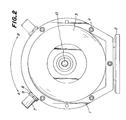
- a handle 7 is threadedly secured to the eccentric ring 6. The handle 7 extends outside the casing 1 and is movable through about 90° as shown by arrows A and B in Fig. 2.
- a notch 5a is formed in the guide ring 5 to allow the rotational movement of the handle 7. Washers 8 and 9 are fitted about the handle 7.
- An input shaft 10 is formed integrally with a planetary carrier 11 and is rotatably supported on its input side by a bearing 12 fitted in the boss 3a of the casing cover 3 and on the planetary carrier side by a bearing 13 fitted in the boss 1a of the casing 1.
- Reference numeral 14 shows an oil seal.
- An output shaft 15 has a sun gear 16 formed integrally on its input side.
- the output shaft 15 is supported at its input end by a bearing 17 in the main part of the planetary carrier 11 and at its output end by a bearing 18 in the casing 1.
- the bearing 18 is retained in the casing by a bearing retainer 19 having an oil seal 21.
- Reference numeral 22 denotes an oil cap.
- a plurality (three in the embodiment as shown in Fig. 6) of planet gears 23 are rotatably supported on the planetary carrier 11 by means of shafts 24 so as to mesh with the sun gear 16.
- An internally toothed gear 25 is rotatably supported by the input shaft 10 through a bearing 26 to mesh with the planet gears 23.
- a driven rotor 27 in the form of a hollow cylinder with flanges at its ends, is connected to the internal gear 25 by rivets 28 and 29 and is supported by bearings 26 and 30 so as to be rotatable about the input shaft 10.
- the driven rotor 27 is formed from two separate members, an input side driven rotating member 27A and an output side driven rotating member 27A. These driven rotating member 27A and 27B are threaded together at 27a and fixed against rotation by means of a key pin 31.
- the driven rotating members are formed with flanges 27Ab and 27Bb, respectively. Friction plates 27Ac and 27Bc are fixed to insides of the flanges 27Ab and 27Bb by means of rivets 32 and 29, respectively.
- a driving rotor 33 is formed by two members 33A and 33B fixed to the input shaft 10 and the planetary carrier 11, respectively, which surround the driven rotor 27 on both sides.
- the input side driving rotating member 33A substantially in the form of a dish, is fixed to the input shaft 10 by means of a washer 34 and a nut 35 and is provided with a friction plate 33Aa fixed to the inside of its outer periphery by means of rivets 36.
- the output side driving rotating member 33B substantially in the form of a cup, is fixed to the planetary carrier 11 by means of a washer 37 and a nut 38 and is provided with a friction plate 33Ba fixed to the inside of its outer periphery by means of rivets 36.
- a ball bearing 39 is fitted in the eccentric ring 6.
- An intermediate friction transmission ring 40 is fitted in the bearing 39 between the friction plates 27Ac and 27Bc, which are provided on the flanges 27Ab and 27Bb of the driven rotor 27, and between the friction plates 33Aa and 33Ba, which are provided on the insides of the outer peripheries of the driving rotor 33, in a manner to transmit rotation between the driving and driven rotors 33 and 27.
- the intermediate friction transmission ring 40 comprises an input side ring 40a and an output side ring 40B having L-shaped cross-sections.
- Outer surfaces 40Aa and 40Ba of the rings 40A and 40B have a section in the form of a gently sloping roof.
- Initially coned disc springs or Belleville springs 41 are interposed between an inner race 39a of the bearing 39 and the rings 40A and 40B.
- Each of the input and output side rings 40A and 40B is L-shaped in section having a portion parallel to the input shaft and a portion extending radially out from the parallel portion.
- the gently sloping roof configuration of the outer surfaces 40Aa and 40Ba has the following advantages; the driving and driven rotors contact the intermediate friction transmission ring in a line so that control of rotation is exact. If they contacted over an area, there would be a variation in speed of the contacting surfaces across the contacting area making the control of rotation difficult; and surface contact would cause slip between the contacting surfaces resulting in internal frictional losses. Further, when the friction plates are in contact with the surfaces of an intermediate friction ring with the form of a gently sloping roof, forces acting upon the friction ring tend to return the friction ring to the original concentric position, the forces being balanced in the concentric position, due to the gently sloping roof to stabilize the friction ring, as can be seen from Fig. 1. Moreover, the configuration of the gentle slope roof serves to maintain the intermediate friction transmission ring perpendicular to the input shaft.
- the intermediate friction transmission ring 40 assumes the position shown in Figs. 1 and 3. In this position, the intermediate friction transmission ring 40 is concentric to the driving and driven rotors 33 and 27 so that the ring 40 contacts these rotors 33 and 37 along a complete circle. Therefore, when the driving rotor 33 is rotated, the driven rotor 27 is rotated in unison through the intermediate friction transmission ring 40 without any sliding therebetween.
- the driven rotor 27 is also rotated together with the input shaft 10 in the direction C through the intermediate friction transmission ring 40 so that the internal gear 25, which is connected to the driven rotor 27, is also rotated in unison.
- the planetary carrier 11, which is connected to the input shaft 10, is rotated in the same manner, so that the respective planet gears 23 rotate in unison with the input shaft 10.
- the sun gear 16, which meshes with the planet gears 23, also rotates with the output shaft 15 in unison with the input shaft 10. In this case, therefore, the rotation ratio between the input and output shafts 10 and 15 is 1:1.
- the stepless speed change device is in its lowest speed ratio.
- R1 is the radius from the center O1 of the input shaft 10 and the driving and driven rotors 33 and 27 to the point D
- R1′ is the radius from the center O2 of the intermediate friction transmission ring 40 to the point D
- R2 is the radius from the center O1 to the point E
- R2′ is a radius from the center O2 to the point E.
- these radii are in the relation R1>R1′, R2>R2′. Therefore, the intermediate friction transmission ring 40 rotates with a higher speed than the driving rotor 33, while the driven rotor 27 rotates with a higher speed than the intermediate friction transmission ring 40. In other words, the rotation of the input shaft 10 is transmitted to the driven rotor 27 through the driving rotor 33 and the intermediate friction transmission ring 40 and the rate of rotation increases at the friction transmission portions.
- each increase in the transmission ratios is approximately 1.18 so that the total increase in the transmission ratio is of the order of 1.392.
- the driven rotor 27 rotates through 1.392 rotations.
- the internal gear 25, which is connected to the driven rotor 27, rotates in a direction shown by arrow F.
- the planetary carrier 11, which is connected to the input shaft 10 rotates in a direction shown by arrow G at the same speed as that of the input shaft 10, which is slower than the rotating speed of the internal gear 25.
- the planet gears 23 revolve in the direction G and at the same time rotate about their axes in the direction shown by arrow H in Fig. 6 to that the sun gear 16, which meshes with the planet gears 23, rotates at a still slower rate.
- the driven rotor 27 is rotated at an increased speed by means of the friction transmission means, and the output shaft 15 is rotated at a speed lower than that of the input shaft 10 by means of the planetary gear.
- the reduction ratio is about 2.5.
- any transmission ratio can be obtained between the highest and lowest speeds.
- the range of transmission ratios can be set as appropriate.
- the stepless speed change device in this embodiment comprises a casing 1 substantially in the form of a hollow cylinder which is opened on an input side and has a boss 51a on an output side for a shaft to pass through.
- the casing 1 has integrally formed guide roller receiving portions 51b in the form of vertically divided cylinders.
- the casing 1 has an integral base 2 and is covered by a casing cover 3 which is clamped to the casing 1 by means of bolts 4.
- the casing cover 3 has a boss 53a on an input side for an input shaft to pass through, cover portions 53b for the guide roller receiving portions 51b and a flange 53c for clamping the casing cover 3 to the casing 1.
- An eccentric shaft 55 is rotatably mounted between the guide roller receiving portions 51b and the cover portion 53b for each of the guide rollers.
- the eccentric shaft 55 is provided with an eccentric portion 55a, and a handle 56 connected to a projection of the eccentric shaft 55 by means of a pin 57.
- a guide roller 58 is rotatably mounted on a bearing 59 fitted on the eccentric portion 55a of the eccentric shaft 55.
- the two guide rollers 58 are used which are arranged so as to contact the intermediate friction transmission ring 40 which is substantially the same in construction as in the first embodiment.
- the construction and operation of the side rings 40A and 40B are substantially the same as in the first embodiment.
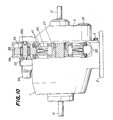
- the intermediate friction transmission ring 40 assumes the position shown in Figs. 10 and 11. In this position, the intermediate friction transmission ring 40 is concentric to the driving and driven rotors 33 and 27 so that the ring 40 contacts these rotors 33 and 27 around a complete circle. Therefore, when the driving rotor 33 is rotated, the driven rotor 27 is rotated in unison via the intermediate friction transmission ring 40 without any slip.
- the driven rotor 27 is also rotated in the direction F together with the input shaft 10 via the intermediate friction transmission ring 40 so that the internal gear 25 connected to the driven rotor 27 is also rotated in unison.
- the planetary carrier 11 which is connected to the input shaft 10 is rotated in the same manner, so that the respective planet gears 23 are revolved in unison with the input shaft 10.
- the sun gear 16 in mesh with these planet gears 23 is also rotated together with the output shaft 15 in unison with the input shaft 10.
- the rotation ratio between the input and output shafts 10 and 15 is 1:1. In this situation the transmission is in its highest speed.
- the intermediate friction transmission ring 40 is also rotated together with the driven rotor 27 in the direction F. In this case, however, there are differences in rotating radius at the contacting points D and E between the intermediate friction transmission ring 40 and the driving and driven rotors 33 and 27.
- O1 be the centre of the input shaft 10 and the driving and driven rotors 33 and 27.
- O2 is the centre of the intermediate friction transmission ring 40.
- R1 be the distance between O1 and D
- R1 be the distance between O2 and D
- R2 the distance between O1 and E
- R2 the distance between O2 and E.
- these distances are in a relation R1 ⁇ R1′, R2>R2′. Therefore, the intermediate friction transmission ring 40 rotates with a higher speed than the driving rotor 33, while the driven rotor 27 rotates with a higher speed than the intermediate friction transmission ring 40.
- the rotation of the input shaft 10 is transmitted to the driven rotor 27 through the driving rotor 33 and the intermediate friction transmission ring 40 at a speed which increases at each friction transmission portions.
- each increase in transmission ratios is a factor of approximately 1.18 so that the total increase in transmission ratio is of the order of 1.392 in the same manner as in the first embodiment.
- the driven rotor 27 is rotated at an increased speed by means of the friction transmission means, and the output shaft 15 is rotated at a speed lower than that of the input shaft 10 by means of the planetary gear.
- the reduction ratio is about 2.5.
- the ultimately increased transmission ratio is about 1.392.
- the rotation of the output shaft 15 is just above zero.
- any transmission ratio can be obtained between the fastest and lowest ratios.
- any range of transmission ratios can be selected.
- the intermediate friction transmission ring 40 By means of the guide rollers 58 will be explained herein.
- the intermediate friction transmission ring 40 tends to rotate in a direction shown by an arrow K about a contacting point J between the intermediate friction transmission ring and the guide roller 58 on the right side.
- the other guide roller 58 is brought into contact with the intermediate friction transmission ring 40 at a point thereby enabling it to rotate about its centre O2.
- the speed change is effected by the operation of the handle 56 on the left side shown in Fig. 9.
- the intermediate friction transmission ring 40 tends to rotate in a direction shown by an arrow O about a contacting point N between the intermediate friction transmission ring and the guide roller 58 on the left side, but the rotation of the intermediate friction transmission ring 40 is made stable be bringing the other guide roller 58 into contact with the intermediate friction transmission ring 40 at a point P.
- the intermediate friction transmission ring capable of adjusting its eccentricity relative to the input shaft by the eccentric ring or two sets of guide rollers is provided between the driving rotor consisting of two members rotating together with the input shaft and the driven rotor provided rotatably relative to the driving rotor without using any conical wheels for friction transmission.
- the friction transmission is accomplished by engagements of these members.
- the driving and driven rotors concentrically contact the intermediate friction transmission ring, the respective rotors contact the ring with all the circumferences thereof, with the result that very high transmission efficiency approximately 100% can be obtained without slipping.
- the ratio of pitch line diameters of the driving and driven rotors is larger than 1:2. Therefore, fairly long friction transmission lines on the pitch lines are accomplished and positive and negative slipping zones on both sides of the pitch lines become narrower. Therefore, fairly high transmission efficiency can be accomplished in the speed ranges other than the fastest speed range.
- the invention has the advantage enabling to improve the transmission efficiency as the stepless speed change device.
- the device according to the invention is simple in construction, easy to manufacture and light and small-sized.
- the device of this invention may also operate in reverse, i.e. the output side may be driven and the output taken from the input, as desired.
Landscapes
- Engineering & Computer Science (AREA)
- General Engineering & Computer Science (AREA)
- Mechanical Engineering (AREA)
- Friction Gearing (AREA)
- Transmission Devices (AREA)
Applications Claiming Priority (4)
| Application Number | Priority Date | Filing Date | Title |
|---|---|---|---|
| JP52505/88 | 1988-03-08 | ||
| JP52506/88 | 1988-03-08 | ||
| JP5250588A JPH01229136A (ja) | 1988-03-08 | 1988-03-08 | 無段変速装置 |
| JP5250688A JPH01229137A (ja) | 1988-03-08 | 1988-03-08 | 無段変速装置 |
Publications (2)
| Publication Number | Publication Date |
|---|---|
| EP0332414A2 true EP0332414A2 (de) | 1989-09-13 |
| EP0332414A3 EP0332414A3 (de) | 1990-06-20 |
Family
ID=26393105
Family Applications (1)
| Application Number | Title | Priority Date | Filing Date |
|---|---|---|---|
| EP89302293A Ceased EP0332414A3 (de) | 1988-03-08 | 1989-03-08 | Stufenloses Getriebe |
Country Status (2)
| Country | Link |
|---|---|
| US (1) | US4920827A (de) |
| EP (1) | EP0332414A3 (de) |
Families Citing this family (3)
| Publication number | Priority date | Publication date | Assignee | Title |
|---|---|---|---|---|
| ATE134425T1 (de) * | 1988-05-31 | 1996-03-15 | Charles Joseph Genovese | Kontinuierlich veränderliches getriebe |
| US6024664A (en) * | 1998-04-22 | 2000-02-15 | Shaffner; Richard F. | Nonvariable or continuously variable friction drive |
| US20060111217A1 (en) * | 2004-11-23 | 2006-05-25 | Shih-Tzou Wen | Moveable gear type automatic stepless speed change device |
Family Cites Families (9)
| Publication number | Priority date | Publication date | Assignee | Title |
|---|---|---|---|---|
| US3190148A (en) * | 1963-07-22 | 1965-06-22 | Metallurg De Saint Urbain Atel | Speed variator and reducer apparatus |
| FR1002532A (fr) * | 1946-10-17 | 1952-03-07 | Boîte de vitesses à changement continu et progressif | |
| US3203278A (en) * | 1963-01-02 | 1965-08-31 | Ford Motor Co | Variable speed friction drive transmission |
| US3420122A (en) * | 1965-11-11 | 1969-01-07 | Kenzo Okabe | Infinitely variable friction drive |
| US3633430A (en) * | 1970-01-26 | 1972-01-11 | Arthur P Bentley | Reduction gear transmission |
| JPS5756028B2 (de) * | 1972-07-06 | 1982-11-27 | ||
| CA1053031A (en) * | 1975-09-18 | 1979-04-24 | Textron Inc. | Traction-drive transmission |
| AT360811B (de) * | 1979-06-01 | 1981-02-10 | Falkner Raimund | Reibradgetriebe |
| US4924730A (en) * | 1987-08-25 | 1990-05-15 | Jaguar Cars Limited | Transmission systems |
-
1989
- 1989-02-28 US US07/317,181 patent/US4920827A/en not_active Expired - Fee Related
- 1989-03-08 EP EP89302293A patent/EP0332414A3/de not_active Ceased
Also Published As
| Publication number | Publication date |
|---|---|
| EP0332414A3 (de) | 1990-06-20 |
| US4920827A (en) | 1990-05-01 |
Similar Documents
| Publication | Publication Date | Title |
|---|---|---|
| JPS6131754A (ja) | 半球コマによる無段変速機 | |
| GB1600646A (en) | Power transmission having a continuously variable gear ratio | |
| US4824419A (en) | Flat belt continuously variable transmission with geared speed ratio control system | |
| JPH08507849A (ja) | 機械的伝動装置 | |
| US4563915A (en) | Wobble type axial speed reducer apparatus | |
| US4524642A (en) | High torque infinitely variable epicyclic transmission | |
| US4920827A (en) | Stepless speed change device | |
| JPS61112854A (ja) | 端面カムを用いた減速装置 | |
| EP0151634B1 (de) | Vorrichtung zur änderung der geschwindigkeit mittels eines differentialbandes | |
| US3094880A (en) | Speed changing mechanism | |
| US4559841A (en) | Gear train having an internal gear mechanism | |
| JPH0415348A (ja) | 摩擦式無段変速装置 | |
| JPS591862A (ja) | 機械式無段変速機 | |
| US4258581A (en) | Counterbalancing system for nutational traction drive transmissions | |
| US5324236A (en) | Control mechanism for toroidal-type transmissions | |
| JPH0323781B2 (de) | ||
| RU2083385C1 (ru) | Механическая автоматическая бесступенчатая коробка передач | |
| JPH0323780B2 (de) | ||
| JPS6332441Y2 (de) | ||
| JPS62150029A (ja) | エンジンの動力回収装置 | |
| JPH0328556A (ja) | 摩擦式無段変速装置 | |
| RU2621U1 (ru) | Планетарный редуктор | |
| JPH0323782B2 (de) | ||
| JPS63285358A (ja) | 無段変速装置 | |
| JP2002031206A (ja) | トロイダル型無段変速機及び無段変速装置 |
Legal Events
| Date | Code | Title | Description |
|---|---|---|---|
| PUAI | Public reference made under article 153(3) epc to a published international application that has entered the european phase |
Free format text: ORIGINAL CODE: 0009012 |
|
| AK | Designated contracting states |
Kind code of ref document: A2 Designated state(s): AT BE DE FR GB IT NL SE |
|
| PUAL | Search report despatched |
Free format text: ORIGINAL CODE: 0009013 |
|
| AK | Designated contracting states |
Kind code of ref document: A3 Designated state(s): AT BE DE FR GB IT NL SE |
|
| 17P | Request for examination filed |
Effective date: 19901025 |
|
| 17Q | First examination report despatched |
Effective date: 19920520 |
|
| STAA | Information on the status of an ep patent application or granted ep patent |
Free format text: STATUS: THE APPLICATION HAS BEEN REFUSED |
|
| 18R | Application refused |
Effective date: 19940228 |