EP0333643A2 - Stabilisierte Zusammensetzungen - Google Patents
Stabilisierte Zusammensetzungen Download PDFInfo
- Publication number
- EP0333643A2 EP0333643A2 EP89810088A EP89810088A EP0333643A2 EP 0333643 A2 EP0333643 A2 EP 0333643A2 EP 89810088 A EP89810088 A EP 89810088A EP 89810088 A EP89810088 A EP 89810088A EP 0333643 A2 EP0333643 A2 EP 0333643A2
- Authority
- EP
- European Patent Office
- Prior art keywords
- alkyl
- formula
- group
- compound
- phenyl
- Prior art date
- Legal status (The legal status is an assumption and is not a legal conclusion. Google has not performed a legal analysis and makes no representation as to the accuracy of the status listed.)
- Withdrawn
Links
- 0 CCC(C(C1C)C1C1CC1)C1*(C)CCC2C1C2 Chemical compound CCC(C(C1C)C1C1CC1)C1*(C)CCC2C1C2 0.000 description 4
Classifications
-
- C—CHEMISTRY; METALLURGY
- C08—ORGANIC MACROMOLECULAR COMPOUNDS; THEIR PREPARATION OR CHEMICAL WORKING-UP; COMPOSITIONS BASED THEREON
- C08F—MACROMOLECULAR COMPOUNDS OBTAINED BY REACTIONS ONLY INVOLVING CARBON-TO-CARBON UNSATURATED BONDS
- C08F212/00—Copolymers of compounds having one or more unsaturated aliphatic radicals, each having only one carbon-to-carbon double bond, and at least one being terminated by an aromatic carbocyclic ring
- C08F212/02—Monomers containing only one unsaturated aliphatic radical
- C08F212/04—Monomers containing only one unsaturated aliphatic radical containing one ring
- C08F212/06—Hydrocarbons
- C08F212/08—Styrene
- C08F212/10—Styrene with nitriles
-
- C—CHEMISTRY; METALLURGY
- C08—ORGANIC MACROMOLECULAR COMPOUNDS; THEIR PREPARATION OR CHEMICAL WORKING-UP; COMPOSITIONS BASED THEREON
- C08K—Use of inorganic or non-macromolecular organic substances as compounding ingredients
- C08K5/00—Use of organic ingredients
- C08K5/16—Nitrogen-containing compounds
- C08K5/22—Compounds containing nitrogen bound to another nitrogen atom
- C08K5/24—Derivatives of hydrazine
- C08K5/25—Carboxylic acid hydrazides
-
- C—CHEMISTRY; METALLURGY
- C08—ORGANIC MACROMOLECULAR COMPOUNDS; THEIR PREPARATION OR CHEMICAL WORKING-UP; COMPOSITIONS BASED THEREON
- C08K—Use of inorganic or non-macromolecular organic substances as compounding ingredients
- C08K5/00—Use of organic ingredients
- C08K5/0008—Organic ingredients according to more than one of the "one dot" groups of C08K5/01 - C08K5/59
- C08K5/005—Stabilisers against oxidation, heat, light, ozone
-
- C—CHEMISTRY; METALLURGY
- C08—ORGANIC MACROMOLECULAR COMPOUNDS; THEIR PREPARATION OR CHEMICAL WORKING-UP; COMPOSITIONS BASED THEREON
- C08K—Use of inorganic or non-macromolecular organic substances as compounding ingredients
- C08K5/00—Use of organic ingredients
- C08K5/16—Nitrogen-containing compounds
- C08K5/34—Heterocyclic compounds having nitrogen in the ring
- C08K5/3467—Heterocyclic compounds having nitrogen in the ring having more than two nitrogen atoms in the ring
- C08K5/3477—Six-membered rings
- C08K5/3492—Triazines
- C08K5/34922—Melamine; Derivatives thereof
-
- C—CHEMISTRY; METALLURGY
- C08—ORGANIC MACROMOLECULAR COMPOUNDS; THEIR PREPARATION OR CHEMICAL WORKING-UP; COMPOSITIONS BASED THEREON
- C08G—MACROMOLECULAR COMPOUNDS OBTAINED OTHERWISE THAN BY REACTIONS ONLY INVOLVING UNSATURATED CARBON-TO-CARBON BONDS
- C08G2261/00—Macromolecular compounds obtained by reactions forming a carbon-to-carbon link in the main chain of the macromolecule
- C08G2261/30—Monomer units or repeat units incorporating structural elements in the main chain
- C08G2261/31—Monomer units or repeat units incorporating structural elements in the main chain incorporating aromatic structural elements in the main chain
- C08G2261/312—Non-condensed aromatic systems, e.g. benzene
Definitions
- the present invention relates to stabilized compositions which contain a mixture of phenolic antioxidants and metal deactivators, in particular hydrazine derivatives.
- DE-A-2 454 124 describes a composition of polyphenylene ether and polystyrene which contains, inter alia, a hydrazide and a phenolic antioxidant.
- thermoplastic polyureas with an aliphatic carboxylic acid hydrazide in combination with a phenol compound and an alkali dihydrogen phosphite is known from DE-A-1 235 577.
- DE-A-2 417 535 describes the stabilization of acrylonitrile-butadiene-styrene with a sterically hindered amine in combination with an oxalanilide, the polymer for the basic stabilization already being 2,6-di-tert-butyl-p-cresol and contains tris [nonylphenyl] phosphite.
- US-A-4 013 618 discloses polyester-polyether block copolymers which are stabilized with a hydrazide and a phenolic antioxidant.
- JP-A-49-112 868, JP-A-49-035 281 and JP-A-57-115 485 disclose polypropylene containing a hydrazine derivative and ®Topanol CA (phenolic antioxidant) and an acrylonitrile-butadiene-styrene Composition containing only zinc stearate, Ti0 2 and a hydrazine derivative.
- ®Topanol CA phenolic antioxidant
- acrylonitrile-butadiene-styrene Composition containing only zinc stearate, Ti0 2 and a hydrazine derivative.
- a denotes an n-valent residue of hexose for n 1-5, this is derived, for example, from allose, old rose, glucose, mannose, gulose, idose, galactose or talose, ie in order to obtain the corresponding compounds of the formula I must have one, two, three, four or five -OH groups through the ester group E-1, wherein R 1 , R 2 and X have the meanings given above, are replaced.
- A represents the n-valent radical of a hexitol
- the corresponding compounds of the formula I are obtained by replacing n -OH groups with the above-mentioned ester group E-1.
- A can, for example, as a hexavalent residue of a hexitol be. This group is derived from the D-sorbitol.
- component b) can, for example, also be a mixture of the one, two, three, four or five-fold esterified hexoses or a mixture of the n-fold esterified hexitols.
- the end groups of the polymeric compounds with the recurring structural units of the formula IX can have different meanings depending on the production process used. If, for example, the polymeric compounds are prepared in a manner known per se by reacting H 2 N-NH 2 with forth, is the end group which is bound to the hydrazine residue and the end group attached to the carbonyl group - R 32 .
- R 32 means, for example, CI, OH or C 1 -C 8 alkoxy, preferably CI.
- compositions according to the invention comprise a combination of at least one compound of the formulas I to IV and at least one compound of the formulas V to VIII or a polymeric compound having the recurring structural unit of the formula IX.
- combinations are: I + V, I + VI, I + VII, I + VIII, II + V, II + VI, II + VII, II + VIII, III + V, III + VI, III + VII, III + VIII, IV + V, IV + VI, IV + VII, IV + VIII and polymeric compounds with the recurring structural unit of the formula IX + I, II, III or IV.
- compositions comprising as component c) at least one compound of the formula V, in which Xs is a direct bond, tetramethylene or phenylene, R 18 and R 19 independently of one another are C 1 -C 18 alkyl, C 1 -C 18 alkyloxy represent phenyl substituted by OH or methoxy or a group of the formula A-2, in which X 12 is ethylene and R 20 and R 21 independently of one another are C 1 -C 4 -alkyl.
- compositions containing as component b) at least one compound of the formula I, II or / and III and as component c) at least one compound of the formula V or / and VI.
- compositions comprising as component b) at least one compound of the formula I or / and II and as component c) at least one compound of the formula V.
- Component a) is preferably an acrylonitrile-butadiene-styrene copolymer (ABS) and in particular an impact-resistant polystyrene.
- ABS acrylonitrile-butadiene-styrene copolymer
- a further preference for compounds of the formula II are the compounds of the formulas II-A, II-B, II-C and II-D, wherein R 7 and R 8 independently of one another are C 1 -C 10 alkyl, C 5 -C 7 cycloalkyl, C 5 -C 7 cycloalkyl substituted by C 1 -C 4 alkyl, phenyl or C 7 -C 10 phenylalkyl mean, R 9 is C 1 -C 4 alkyl and R 10 is C 1 -C 4 alkyl or Represents cyclohexyl, and compounds of the formulas II - E, II-F and II-G, wherein R 7 is C 1 -C 4 alkyl or cyclohexyl and R 8 is methyl or ethyl.
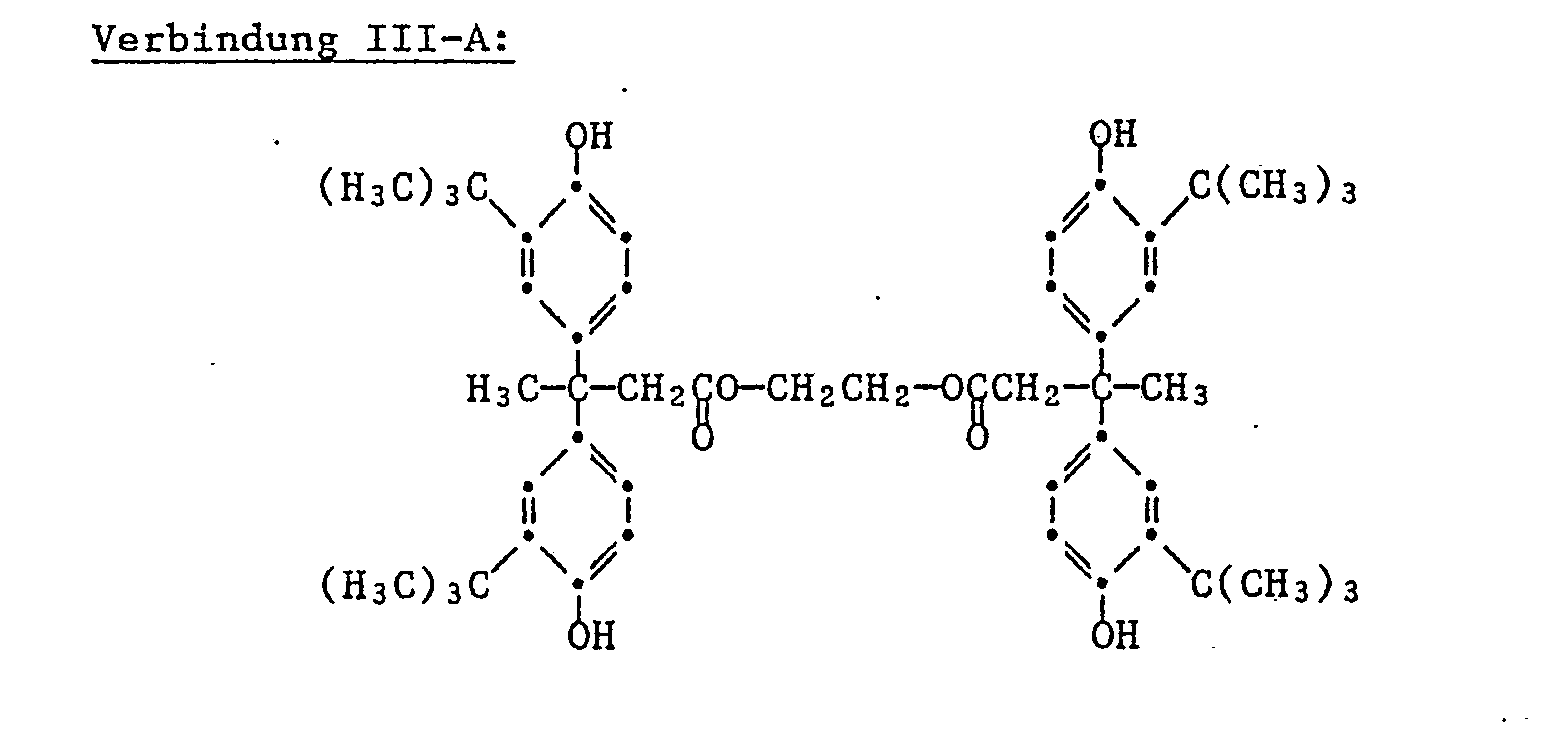
- a preferred example of compounds of formula III is:
- the compounds of the formulas I to VIII and the polymeric compounds having the repeating structural units of the formula IX can, if they are not commercially available, be prepared analogously to known processes. Possible production processes are described, for example, in the publications given in the table below.
- compositions according to the invention advantageously contain 0.005 to 10%, preferably 0.01 to 5%, in particular 0.01 to 2% of a mixture of components b) and c) described above, based on the total weight of the material to be stabilized.
- the weight ratio of component b) / c) is, for example to 1 ⁇ 4, preferred to 1 ⁇ 2, especially to .
- the incorporation of the compounds up to IX into the material to be stabilized is expediently carried out by known methods, for example before or during shaping or also by applying the dissolved or dispersed compounds to the material to be stabilized, optionally with subsequent evaporation of the solvent.
- the compounds 1 to IX can also be added to the materials to be stabilized in the form of a masterbatch, which contains them, for example, in a concentration of 2.5 to 25% by weight.
- the compounds of the formulas I to IX can be added individually or in the form of a mixture of components b) and c) to the material to be stabilized.
- the stabilized materials can be used in various forms, e.g. as films, fibers, tapes, molding compounds, profiles or as binders for paints, adhesives or putties.
- compositions according to the invention can optionally additionally contain those costabilizers which are usually incorporated into the substrates a), such as e.g. Phosphites and phosphonites, especially triphenyl phosphite, diphenylalkyl phosphites, phenyl dialkyl phosphites, tris (nonylphenyl) phosphite, trilauryl phosphite, trioctadecyl phosphite, distearyl pentaerythritol diphosphite, tris (2,4-di-tert-butylphenyl) bisphitophosphite 2,4-di-tert-butylphenyl) pentaerythritol diphosphite, tristearyl sorbitol triphosphite, tetrakis (2,4-di-tert-butylphenyl) -4,4'-biphenylene diphosphonite
- the present invention does not relate to compositions containing polyphenylene resin compositions in combination with polystyrene, i.e. such compositions as described in DE-A-24 54 124.
- the stabilizer combinations according to the invention composed of components b) and c) give the substrates a) excellent stability, in particular against the influence of heat, oxygen or / and light, which is surprisingly much better than that which is achieved by the respective individual components.
- a styrene solution which contains 8% high density polybutadiene, 0.05% di-tert-butyl peroxide, 0.05% zinc stearate and the additives specified below is heated to 90 ° C. under nitrogen for 4 hours.
- the stirring speed is set so that a polybutadiene particle size of 2-4 ⁇ m is achieved.
- the turnover is approx. 30%.
- the polymer is then filled into glass tubes, which are located in an aluminum block. The polymerization is continued for 6.5 hours, the temperature rising from 90 ° C to 200 ° C. The glass tubes are then cooled and broken to obtain the polymer.
- the polymer is pressed into 5 mm thick plates, which are heated in a vacuum at 220 ° C. for 20 minutes in order to remove the monomers from the polymer.
- the plates are then ground in a hammer mill and the ground material obtained is extruded and granulated.
- Platelets of 40 ⁇ 40 ⁇ 2 mm 3 are produced from the granules in a press at 180 ° C. within 5 minutes. These plates are aged in a forced air oven at 80 ° C.
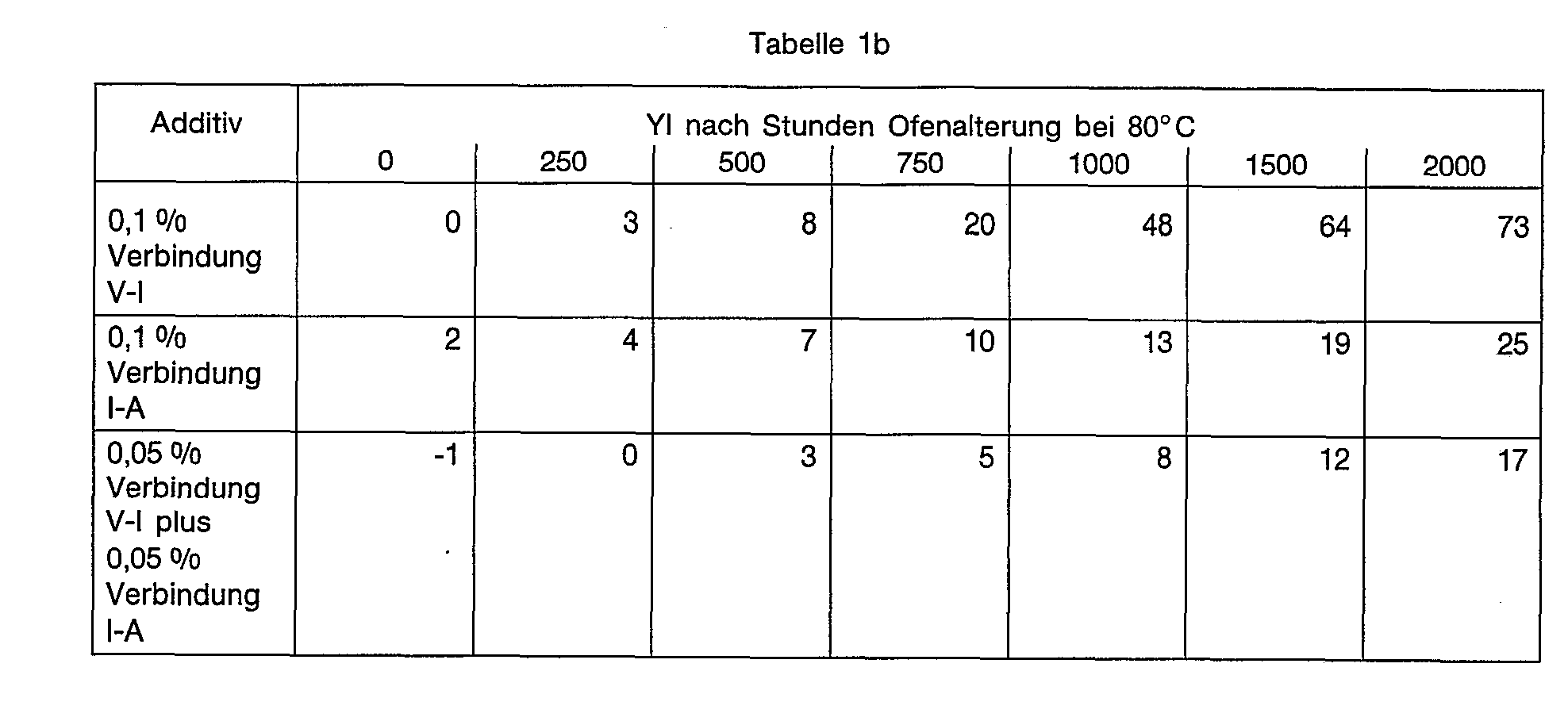
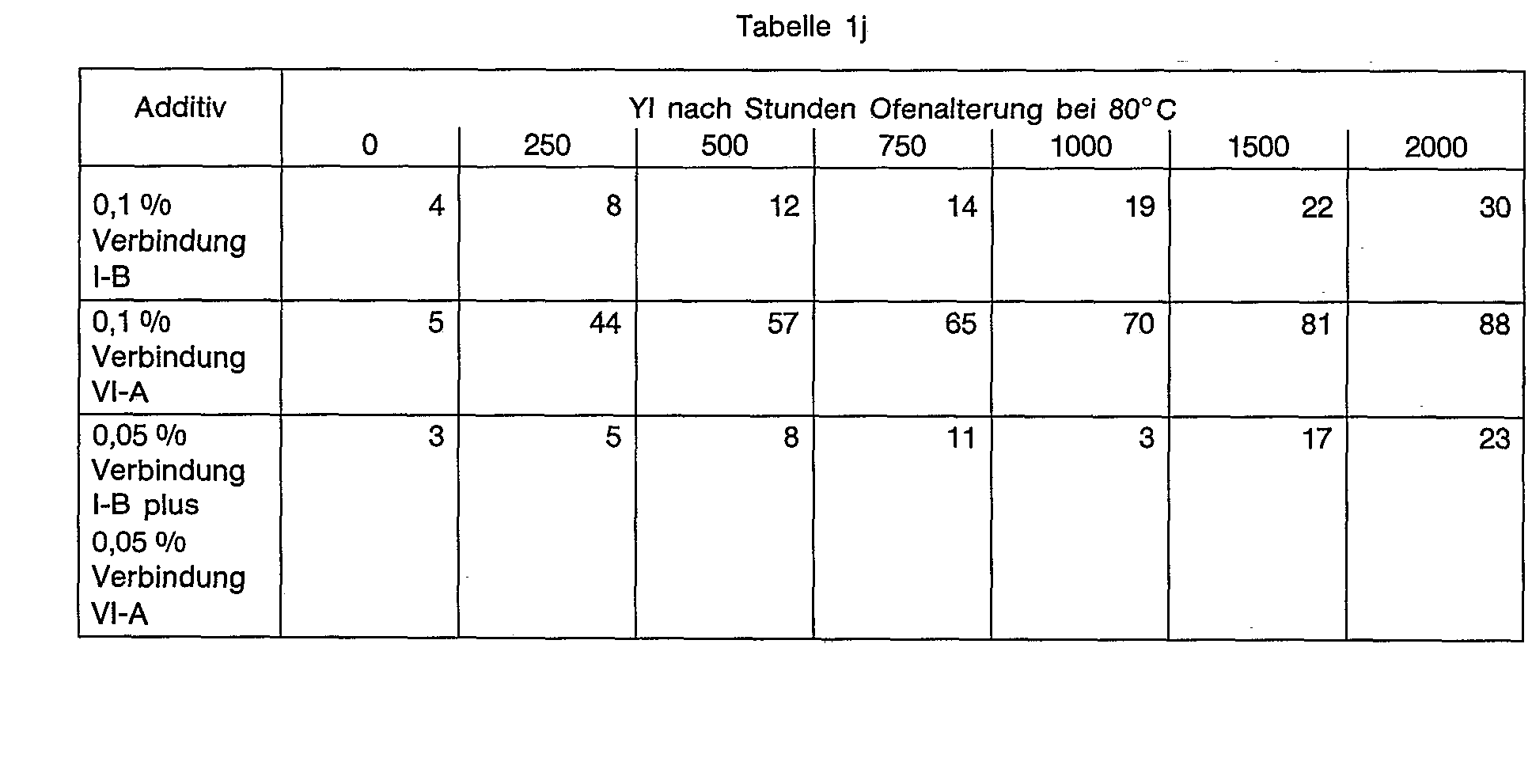
- the yellowing (YI) is determined in accordance with ASTM D 1925 at the intervals specified below. Low YI values mean that the polymer is well stabilized.
Landscapes
- Chemical & Material Sciences (AREA)
- Health & Medical Sciences (AREA)
- Chemical Kinetics & Catalysis (AREA)
- Medicinal Chemistry (AREA)
- Polymers & Plastics (AREA)
- Organic Chemistry (AREA)
- Compositions Of Macromolecular Compounds (AREA)
- Organic Low-Molecular-Weight Compounds And Preparation Thereof (AREA)
Abstract
Description
- Die vorliegende Erfindung betrifft stabilisierte Zusammensetzungen, die ein Gemisch aus phenolischen Antioxidantien und Metalldesaktivatoren, insbesondere Hydrazinderivaten, enthalten.
- Es ist bekannt, Polyolefine gegen Oxidation, welche besonders durch die Anwesenheit von Metallen, wie z.B. Kupfer, begünstigt wird, mit einem Gemisch aus einem phenolischen Antioxidans und einem Hydrazinderivat zu stabilisieren. Als repräsentativer Stand der Technik seien z.B. folgende Veröffentlichungen genannt: Derwent Zitate 22 869Y/13, 30 175A/16, 56 049D/31 und 57 700W/35, Chemical Abstracts Zitate 81: 153 648q, 83: 44 215s, 86: 190 882k, 86: 190 892p, 87: 86 204a, 98: 55 065d und 103: 216 372r; US-A-T9 14009, US-A-T9 45001, US-A-3 110 696, US-A-3 870 680, US-A-3 931 103 und US-A-4 044 200, DE-A-2 124 641, DE-A-2 129 996, DE-A-2 310 800, DE-A-2 360 114, DE-A-2 433 635, DE-A-2 438 406, DE-A-2 438 898, DE-A-2 447 747 und DE-A-2 517 800, FR-A-1 377 097, FR-A-1 481 105 und FR-A-2 238 220, WO-A-82/02 206 sowie A. di Battista et al., Soc. Plast. Eng. Tech. Pap. 1975, 21, 280-282.
- Ferner ist aus US-A-3 978 156 und US-A-3 929 726 bekannt, Polyurethanzusammensetzungen mit einem Gemisch aus einem Hydrazid, einem phenolischen Antioxidans und einem UV-Absorber zu stabilisieren.
- In der DE-A-2 454 124 wird eine Zusammensetzung aus Polyphenylenether und Polystyrol beschrieben, die unter anderem ein Hydrazid und ein phenolisches Antioxidans enthält.
- Die Stabilisierung von thermoplastischen Polyharnstoffen mit einem aliphatischen Carbonsäurehydrazid in Kombination mit einer Phenolverbindung und einem Alkalidihydrogenphosphit ist aus der DE-A-1 235 577 bekannt.
- In der DE-A-2 417 535 wird die Stabilisierung von Acrylnitril-Butadien-Styrol mit einem sterisch gehinderten Amin in Kombination mit einem Oxalanilid beschrieben, wobei das Polymer für die Grundstabilisierung bereits 2,6-Di-tert-butyl-p-kresol und Tris[nonylphenyl]phosphit enthält.
- In der US-A-4 013 618 werden Polyester-Polyether-Blockcopolymere offenbart, die mit einem Hydrazid und einem phenolischen Antioxidans stabilisiert sind.
- In Chemical Abstract 90: 169 654k wird Poly(4-methyl-1-penten) beschrieben, welches u.a. ein Hydrazid und Pentaerythrit-tetrakis[3-(3,5-di-tert-butyl-4-hydroxyphenyl)propionat] enthält.
- In Research Disclosure 1980, 19618, (Seite 321) wird als Stabilisatorsystem für Ethylen-Alkylacrylat-Elastomere die Kombination von Antioxidantien mit Metalldesaktivatoren, wie z.B. N,N'-Bis[3,-(3,5-di-tert-butyl-4-hydroxyphenyl)propionyi]hydrazin, vorgeschlagen.
- Aus den JP-A-49-112 868, JP-A-49-035 281 und JP-A-57-115 485 ist Polypropylen enthaltend ein Hydrazinderivat und ®Topanol CA (phenolisches Antioxidans) bekannt sowie eine Acrylnitril-Butadien-Styrol-Zusammensetzung, die lediglich Zinkstearat, Ti02 und ein Hydrazinderivat enthält.
- J.J. Zeilstra beschreibt in "Die Angewandte Makromolekulare Chemie 137, 83-92 (1985) "einen Copoly(ether-ester), der ®Irganox MD 1024 (Hydrazinderivat) und ®Irganox 1330 (phenolisches Antioxidans) enthält.
- Die Erfindung betrifft Zusammensetzungen enthaltend
- a) schlagfestes Polystyrol, ein Acrylnitril-Butadien-Styrol Copolymer (ABS) oder ein carboxyliertes Styrol-Butadien-Elastomer, wobei Polyphenylenharzmassen, die Polystyrol enthalten, ausgeschlossen sind,
- b) mindestens eine Verbindung der Formel I, 11, III oder/und IV,

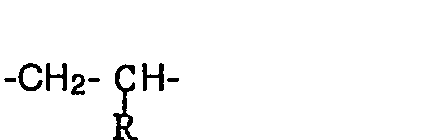




- c) mindestens eine Verbindung der Formel V, VI, VII oder/und VIII,


- R7, R8, R9, Rio, R11, R13 und R14 bedeuten als Ci-Cio-Alkyl z.B. Methyl, Ethyl, Propyl, Isopropyl, Butyl, tert-Butyl, Pentyl, Hexyl, Nonyl oder Decyl. C1-C4-Alkyl, insbesondere Methyl und tert-Butyl, sind bevorzugt. Verzweigte Alkylreste sind von besonderem Interesse.
- R' und Ris können als C1-C12-Alkyl z.B. die für R7 als C1-C10-Alkyl angegebenen spezifischen Bedeutungen besitzen und zusätzlich noch Dodecyl sein.
- R1, R2, R18, R19, R20, R21, R22, R23, R25, R27, R28, R30 und R31 können als C1-C18-Alkyl z.B. die für R7 als Ci-Cio-Alkyl angegebenen spezifischen Bedeutungen besitzen und zusätzlich noch Dodecyl, Tetradecyl, Hexadecyl oder Octadecyl sein. R1, R2, R20, R21, R30 und R31 sind bevorzugt C1-C4-Alkyl, insbesondere Methyl und tert-Butyl.
- R3, R4, R5 und R17 können als C1-C24-Alkyl z.B. die für R18 angegebenen spezifischen Bedeutungen besitzen und zusätzlich noch Icosan, Henicosan, Docosan oder Tetracosan sein. C10-C18-Alkyl ist bevorzugt. R6 bedeutet als C1-C4-Alkyl z.B. Methyl, Ethyl, Propyl, Isopropyl, n-Butyl oder tert-Butyl. Methyl ist bevorzugt.
- R16 bedeutet als C4-C18-Alkyl z.B. Butyl, Isobutyl, Pentyl, Hexyl, Nonyl, Decyl, Undecyl, Dodecyl oder Octadecyl.
- R bedeutet als C1-C8-Alkyl z.B. Methyl, Ethyl, Propyl, Butyl, Hexyl oder Octyl. Methyl ist bevorzugt.
- R1, R2, R3, R4, Rs, R7, Rs, R9, Rio, R11, R13, R14, R20, R21, R27, R28, R30 und R31 bedeuten als C5-C12-Cycloalkyl z.B. Cyclopentyl, Cyclohexyl, Cycloheptyl, Cyclooctyl, Cyclononyl, Cyclodecyl oder Cyclododecyl. C5-C7-Cycloalkyl, insbesondere Cyclohexyl ist bevorzugt.
- R1, R2, R3, R4, Rs, R7, R8, R9, R11, R13, R14, R20, R21, R27, R28, R30 und R31 bedeuten als Cs-C7-Cycloalkyl, welches durch C1-C4-Alkyl, bevorzugt Methyl, substituiert ist, z.B. Methylcyclohexyl.
- Ri, R2, R7, R8, R9, R13, R14, R16, R18, R19, R20, R21, R25, R27, R28, R30 und R31 bedeuten als C7-C10-Phenylalkyl z.B. Benzyl, a-Methylbenzyl oder a,a-Dimethylbenzyl. Benzyl ist bevorzugt.
- R18, R19 und R25 bedeuten als C5-C18-Alkyl, welches durch -S-unterbrochen ist, z.B. 2-Thiapentyl, 2-Thiahexyl, 2-Thiaoctyl, 2-Thiadecyl, 2-Thiadodecyl, 2-Thiaoctadecyl, 3-Thiahexyl, 3-Thiaoctyl, 3-Thiadecyl oder 3-Thiaoctadecyl. Das Schwefelatom befindet sich bevorzugt in 2- oder 3-Stellung.
- R18, R19, R22 und R25 bedeuten als C1-C18-Alkoxy z.B. Methoxy, Ethoxy, Propoxy, Butoxy, Pentyloxy, Hexyloxy, Nonyloxy, Decyloxy, Dodecyloxy, Hexadecyloxy oder Octadecyloxy.
- R18, R19 und R25 bedeuten als Phenyl, welches durch OH und/oder C1-C4-Alkoxy substituiert ist, bevorzugt 2-Hydroxyphenyl oder 2-Methoxyphenyl.
- R24 bedeutet als Di(C1-C12-alkyl)amino z.B. Dimethylamino, Diethylamino, Dibutylamino, Dioctylamino oder Didecylamino. Di(C2-C8-alkyl)amino ist bevorzugt. Besonders bevorzugt ist Di(isooctyl)amino.
- R29 bedeutet als C2-C18-Alkanoyl z.B. Ethanoyl, Propanoyl, Butanoyl, Pentanoyl, 3-Methylbutanoyl, Dodecanoyl, Tetradecanoyl, Hexadecanoyl oder Octadecanoyl. C2-C10-Alkanoyl ist bevorzugt.
- R29 bedeutet als C3-C2o-Alkenoyl z.B. Acryloyl, Methacryloyl, Crotonoyl oder Oleolyl. C10-C20-Alkenoyl, insbesondere Oleolyl, ist bevorzugt.
- R6 bedeutet als (C1-C18-Alkyl)amido z.B. H3C-CO-NH-, H5C2-CO-NH-, H13C6-CO-NH- oder H37C18-CO-NH-.
- X1, X2, X5 und X10 sind als C2-C10-Alkylen z.B. Ethylen, Trimethylen, Tetramethylen, 2,2-Dimethyltrimethylen, Hexamethylen, Octamethylen, Nonamethylen oder Decamethylen.
- X9, X11, X13 und X17 können als C1-C10-Alkylen ausser den für Xi als C2-C10-Alkylen angegebenen Beispielen auch Methylen bedeuten. X1, X2, Xs und X10 bedeuten bevorzugt C2-C6-Alkylen, insbesondere Ethylen.
- X8 kann als C1-C18-Alkylen z.B. ausser den für Xi als C2-C10-Alkylen angegebenen spezifischen Bedeutungen auch Methylen, Dodecamethylen oder Octadecamethylen sein, wobei C2-C6-Alkylen bevorzugt ist.
- X14 bedeutet als C1-C2-Alkylen z.B. Methylen oder Ethylen.
- X8, Xio, X13 und X17 bedeuten als Phenylen bevorzugt 1,4-Phenylen.
- Xio bedeutet als C4-C10-Alkylen, welches durch -S- oder -O- unterbrochen ist, bevorzugt -CH2CH2-S-CH2CH2-, -CH2CH2-0-CH2CH2-, (̵CH2CH2-O)̵2 CH2CH2-, (̵CH2CH2-O)̵3 CH2CH2- oder (̵-CH2CH2-O)̵4 CH2CH2-.
- X13 bedeutet als C2-C4-Alkylen, welches durch -S- unterbrochen ist, z.B. -CH2-S-CH2-, -CH2-S-CH2CH2-, -CH2CH2-S-CH2- oder -CH2CH2-S-CH2CH2-.
- X17 bedeutet als C4-C10-Alkylen, welches durch -S- unterbrochen ist,'bevorzugt -CH2CH2-S-CH2CH2-.
- X3 bedeutet als C3-Cs-Alkyliden, welches in 3-Stellung durch


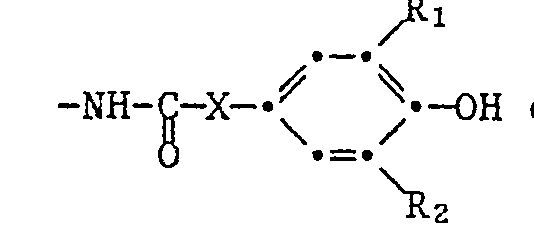
- Bedeutet A für n = 1-5 einen n-wertigen Rest einer Hexose, so leitet sich dieser z.B. von Allose, Altrose, Glucose, Mannose, Gulose, Idose, Galaktose oder Talose ab, d.h. um die entsprechenden Verbindungen der Formel I zu erhalten, müssen eine, zwei, drei, vier oder fünf -OH Gruppen durch die Estergruppe E-1,


- Stellt A den n-wertigen Rest eines Hexitols dar, so erhält man die entsprechenden Verbindungen der Formel I, indem n -OH Gruppen durch die oben angegebene Estergruppe E-1 ersetzt werden. A kann als sechswertiger Rest eines Hexitols z.B.

- In den erfindungsgemässen Zusammensetzungen kann die Komponente b) z.B. auch ein Gemisch aus den ein-, zwei-, drei-, vier- oder fünffach veresterten Hexosen bzw. ein Gemisch aus den n-fach veresterten Hexitolen darstellen.
- Die Endgruppen der polymeren Verbindungen mit den wiederkehrenden Struktureinheiten der Formel IX können in Abhängigkeit von dem verwendeten Herstellungsverfahren unterschiedliche Bedeutungen haben. Stellt man z.B. die polymeren Verbindungen in an sich bekannter Weise durch Umsetzung von H2N-NH2 mit


- Die erfindungsgemässen Zusammensetzungen enthalten neben dem zu stabilisierenden Substrat a) eine Kombination aus mindestens einer Verbindung der Formeln I bis IV und mindestens einer Verbindung der Formeln V bis VIII oder einer polymeren Verbindung mit der wiederkehrenden Struktureinheit der Formel IX. Beispiele für solche Kombinationen sind: I + V, I + VI, I + VII, I + VIII, II + V, II + VI, II + VII, II + VIII, III + V, III + VI, III + VII, III + VIII, IV + V, IV + VI, IV + VII, IV + VIII und polymere Verbindungen mit der wiederkehrenden Struktureinheit der Formel IX + I, II, III oder IV.
- Bevorzugt sind Zusammensetzungen enthaltend als Komponente b) mindestens eine Verbindung der Formel worin R1 und R2 unabhängig voneinander C1-C4-Alkyl, Cyclohexyl, Phenyl oder a,a-Dimethylbenzyl bedeuten, X Ethylen bedeutet und n 1, 2, 3, 4 oder 6 ist und
- wenn n 1 ist, A C1-C18-Alkyloxy oder C1-C8-Alkylamino darstellt,
- wenn n 2 ist, A eine Gruppe -O-X1-O-, -NH-X2-NH- oder-O(̵CH2CH2-O)̵v darstellt, worin X1 C2-C6-Alkylen oder 3-Thiapentan-1,5 diyl bedeutet, X2 C2-C6-Alkylen ist und v 2, 3 oder 4 ist,
- wenn n 3 bedeutet, A die Gruppe (̵O-CH2)̵3C-CH3 darstellt,
- wenn n 4 bedeutet, A die Gruppe (̵O-CH2)̵4 C ist und
- wenn n 6 bedeutet, A die Gruppe (̵O-CH2)̵3 C-CH2-O-CH2-C(̵CH2-O)̵3 darstellt,
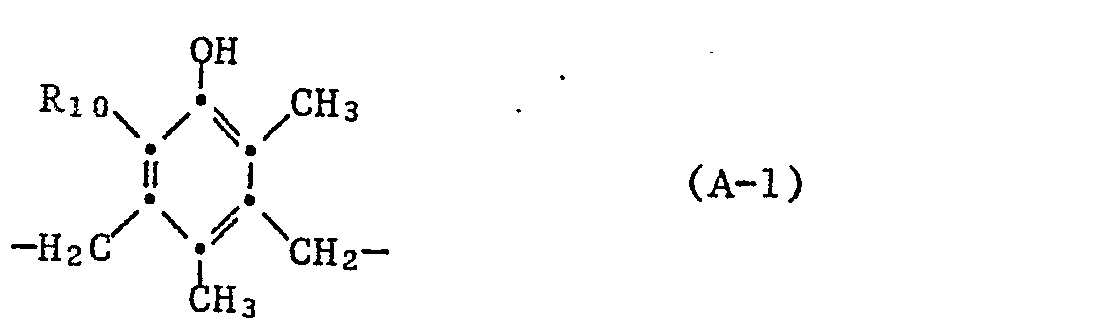
- oder/und eine Verbindung der Formel II, worin X3 Methylen, eine Gruppe der Formel A-1, -S-, Butyliden oder eine Gruppe der Formel A-9

- wenn X3 Methylen ist, R7 und R8 unabhängig voneinander C1-C10-Alkyl, C5-C7-Cycloalkyl, durch C1-C4-Alkyl substituiertes C5-C7-Cycloalkyl, Phenyl oder C7-C10-Phenylalkyl bedeuten, R9 Wasserstoff oder C1-C4-Alkyl ist,
- wenn X3 eine Gruppe der Formel A-1 ist, R7 und R8 unabhängig voneinander C1-C10-Alkyl, C5-C7-Cycloalkyl, durch Ci-C4-Alkyl substituiertes C5-C7-Cycloalkyl, Phenyl oder C7-C10-Phenylalkyl bedeuten, R9 Wasserstoff ist und Rio C1-C4-Alkyl oder Cyclohexyl darstellt, und
- wenn X3 -S-, Butyliden oder eine Gruppe der Formel A-9 bedeutet, R7 C1-C4-Alkyl oder Cyclohexyl ist, R8 Methyl oder Ethyl darstellt und R9 Wasserstoff bedeutet,
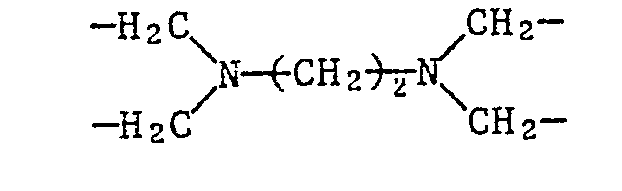
- oder/und eine Verbindung der Formel III, worin R11 C1-C4-Alkyl oder Cyclohexyl bedeutet, R12 Methyl ist, X4 und X6 Methylen sind und Xs Ethylen ist,
- oder/und eine Verbindung der Formel IV, worin R13 C1-C4-Alkyl ist, R14 Wasserstoff, C1-C4-Alkyl oder eine Gruppe -CH2SR16 bedeutet, R15 Methyl, Dodecyl oder -CH2SR16 ist und R16 C4-C18-Alkyl oder (C1-C18-Alkyl)oxycarbonylmethyl darstellt.
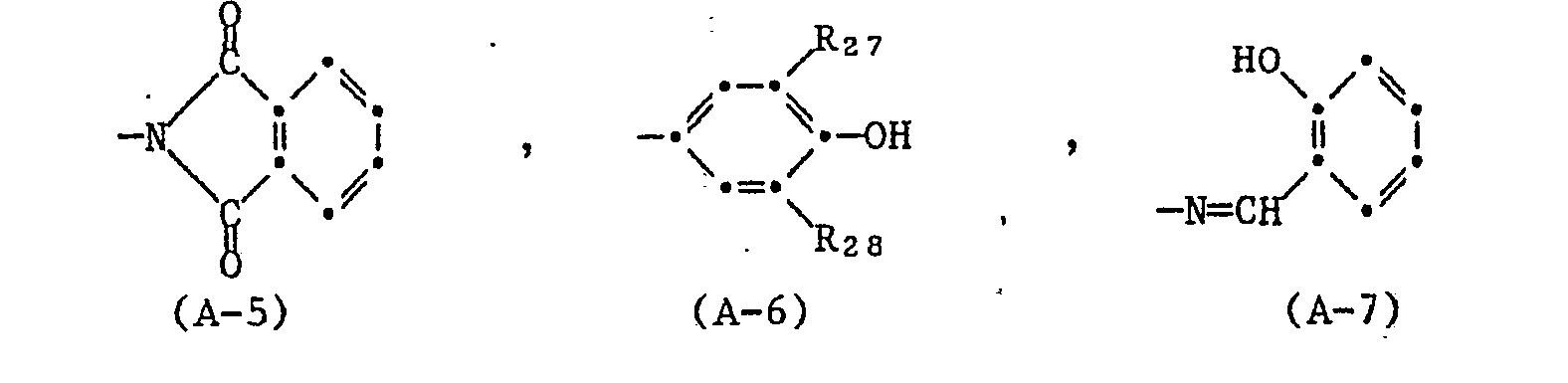
- Ebenfalls bevorzugt sind Zusammensetzungen enthaltend als Komponente c) mindestens eine Verbindung der Formel V, worin X8 eine direkte Bindung, C2-C6-Alkylen oder Phenylen ist, R18 und R19 unabhängig voneinander C1-C18-Alkyl, C1-C18-Alkyloxy, Phenyl, durch -OH under/oder C1-C4-Alkoxy substituiertes Phenyl oder eine Gruppe der Formel A-2 bedeuten, oder/und eine Verbindung der Formel VI, worin R24 Di(C2-C8-alkyl)amino oder eine Gruppe

- Besonders bevorzugt sind Zusammensetzungen enthaltend als Komponente b) mindestens eine Verbindung der Formel I, worin R1 Methyl oder tert-Butyl ist, R2 tert-Butyl darstellt, X Ethylen bedeutet und n 1, 2 oder 4 ist und wenn n 1 ist, A C10-C18-Alkyloxy bedeutet, wenn n 2 ist, A eine Gruppe -O-(CH2)6-O-, -0-CH2CH2-S-CH2CH2-0- oder -O(̵CH2CH2-O)̵3 darstellt und wenn n 4 ist, A (̵O-CH2)̵4 C bedeutet.
- Ebenfalls besonders bevorzugt sind Zusammensetzungen enthaltend als Komponente c) mindestens eine Verbindung der Formel V, worin Xs eine direkte Bindung, Tetramethylen oder Phenylen ist, R18 und R19 unabhängig voneinander C1-C18-Alkyl, C1-C18-Alkyloxy, durch OH oder Methoxy substituiertes Phenyl oder eine Gruppe der Formel A-2 darstellen, worin X12 Ethylen ist und R20 und R21 unabhängig voneinander C1-C4-Alkyl bedeuten.
- Besonders bevorzugt sind auch Zusammensetzungen enthaltend als Komponente c) mindestens eine Verbindung der Formel VI, worin R24 Di(C2-C8-alkyl)amino oder eine Gruppe

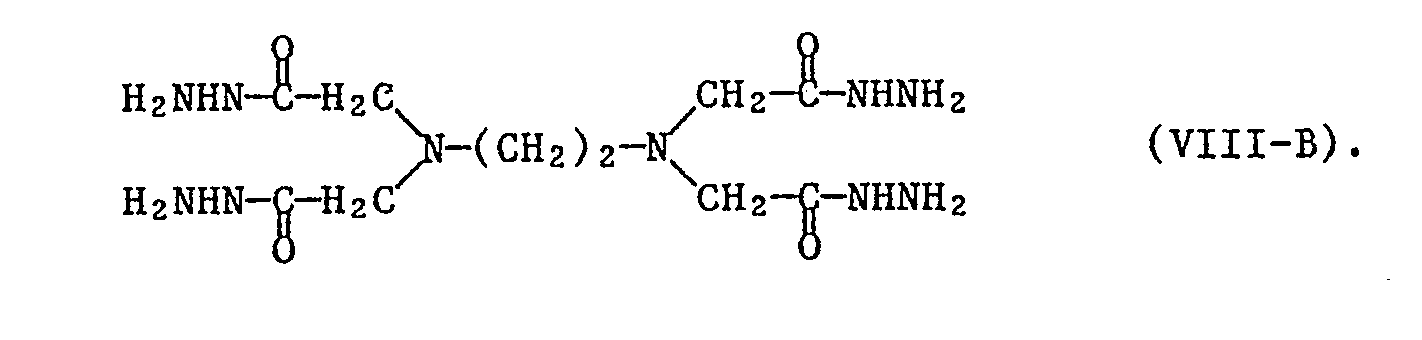
- Von Interesse sind auch Zusammensetzungen enthaltend als Komponente c) mindestens eine Verbindung der Formel VIII, worin R29 Wasserstoff oder Oleolyl bedeutet, x 4 ist und D eine Gruppe

- Ebenfalls von Interesse sind Zusammensetzungen enthaltend als Komponente b) mindestens eine Verbindung der Formel I, II oder/und III und als Komponente c) mindestens eine Verbindung der Formel V oder/und VI.
- Von besonderem Interesse sind Zusammensetzungen enthaltend als Komponente b) mindestens eine Verbindung der Formel I oder/und II und als Komponente c) mindestens eine Verbindung der Formel V.
- Die Komponente a) ist bevorzugt ein Acrylnitril-Butadien-Styrol Copolymer (ABS) und insbesondere ein schlagfestes Polystyrol.
-


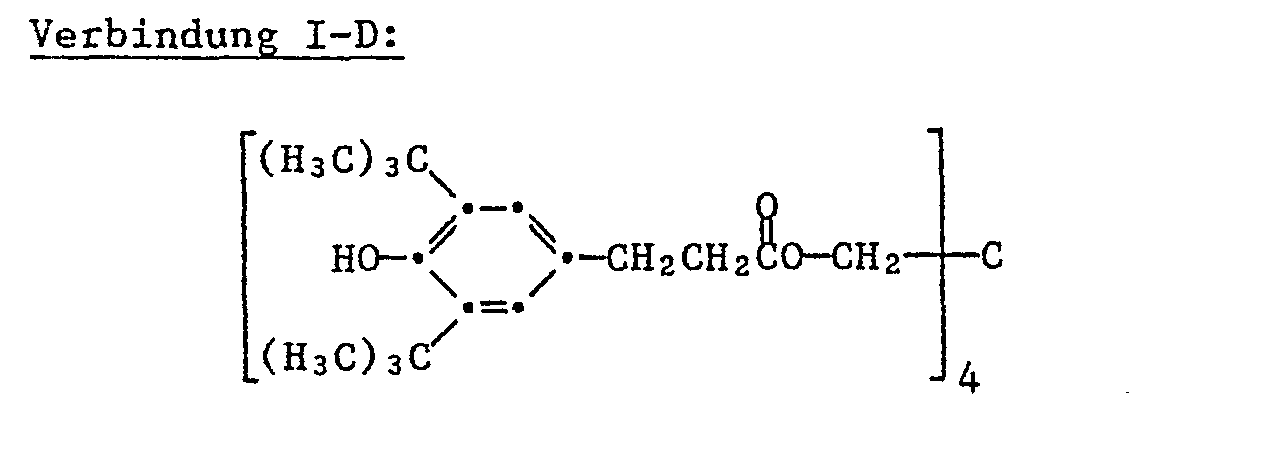
- Die Verbindungen der Formeln I-A, I-B, I-C und I-D sind bevorzugt.
- Eine weitere Bevorzugung für Verbindungen der Formel II sind die Verbindungen der Formeln II-A, II-B, II-C und II-D,





-


- Ein bevorzugtes Beispiel für Verbindungen der Formel III ist:

-


-



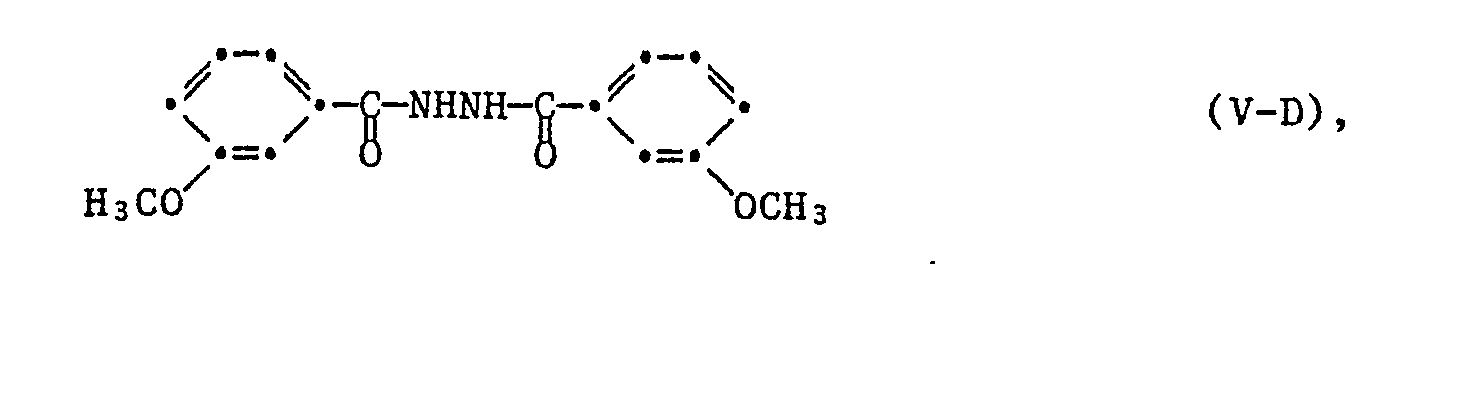
- Die Verbindungen der Formeln (V-G) und (V-I) sind bevorzugt.
-

-

-

-


- Die als Ausgangsprodukte benötigen sterisch
- gehinderten Phenole können in Analogie zu dem
- in US 3 093 587 beschriebenen Verfahren
- hergestellt werden.
- Die erfindungsgemässen Zusammensetzungen enthalten zweckmässigerweise 0,005 bis 10 %, bevorzugt 0,01 bis 5%, insbesondere 0,01 bis 2 % eines Gemisches aus den oben beschriebenen Komponenten b) und c), bezogen auf das Gesamtgewicht des zu stabilisierenden Materials.
- Das Gewichtsverhältnis Komponente b)/c) beträgt zum Beispiel


- Die Einarbeitung der Verbindungen bis IX in das zu stabilisierende Material erfolgt zweckmässigerweise nach bekannten Methoden, beispielsweise vor oder während der Formgebung oder auch durch Aufbringen der gelösten oder dispergierten Verbindungen auf das zu stabilisierende Material, gegebenenfalls unter nachträglichem Verdunsten des Lösungsmittels. Die Verbindungen 1 bis IX können auch in Form eines Masterbatches, der diese beispielsweise in einer Konzentration von 2,5 bis 25 Gew.-% enthält, den zu stabilisierenden Materialien zugegeben werden.
- Die Verbindungen der Formeln I bis IX können einzeln oder auch in Form eines Gemisches aus den Komponenten b) und c) dem zu stabilisierenden Material zugegeben werden.
- Die stabilisierten Materialien können in verschiedenster Form angewendet werden, z.B. als Folien, Fasern, Bändchen, Formmassen, Profile oder als Bindemittel für Lacke, Klebstoffe oder Kitte.
- Der erfindungsgemässen Zusammensetzungen können gegebenenfalls zusätzlich noch solche Costabilisatoren enthalten, die üblicherweise in die Substrate a) eingearbeitet werden, wie z.B. Phosphite und Phosphonite, insbesondere Triphenylphosphit, Diphenylalkylphosphite, Phenyldialkylphosphite, Tris-(nonylphenyl)-phosphit, Trilaurylphosphit, Trioctadecylphosphit, Distearyl-pentaerythritdiphosphit, Tris-(2,4-di-tert-butylphenyl)-phosphit, Diisodecylpentaerythrit-diphosphit, Bis-(2,4-di-tert-butylphenyl)-pentaerythritdiphosphit, Tristearyl-sorbit-triphosphit, Tetrakis-(2,4-di-tert-butylphenyl)-4,4'-biphenylen-diphosphonit, 3,9-Bis-(2,4-di-tert-butyiphenoxy)-2,4,8,10-tetraoxa-3,9-diphosphaspiro[5.5]undecan, oder peroxidzerstörende Verbindungen, insbesondere Ester der ß-Thio-dipropionsäure, beispielsweise der Lauryl-, Stearyl-, Myristyl-oder Tridecylester, Mercaptobenzimidazol, das Zinksalz des 2-Mercaptobenzimidazols, Zink-dibutyldithiocarbamat, Dioctadecyldisulfid, Pentaerythrit-tetrakis-(ß-dodecylmercapto)-propionat. Als Costabilisator ist Dilaurylthiodipropionat besonders bevorzugt.
- Die vorliegende Erfindung bezieht sich nicht auf Zusammensetzungen, die Polyphenylenharzmassen in Kombination mit Polystyrol enthalten, d.h. solche Zusammensetzungen wie sie in der DE-A- 24 54 124 beschrieben werden.
- Die erfindungsgemässen Stabilisatorkombinationen aus den Komponenten b) und c) verleihen den Substraten a) eine ausgezeichnete Stabilität, insbesondere gegen den Einfluss von Wärme, Sauerstoff oder/und Licht, die überraschenderweise wesentlich besser ist als jene, die durch die jeweiligen Einzelkomponenten erreicht wird.
- Die folgenden Beispiele erläutern die Erfindung weiter. Alle Prozentangaben beziehen sich auf das Gewicht, sofern nicht anders angegeben.
- In einem Reaktionsgefäss mit Spiralrührer wird eine Styrollösung, die 8 % Polybutadien hoher Dichte, 0,05 % Di-tert-butylperoxid, 0,05% Zinkstearat und die unten angegebenen Additive enthält, unter Stickstoff 4 Stunden auf 90° C erhitzt. Die Rührgeschwindigkeit ist so eingestellt, dass eine Polybutadienteilchengrösse von 2-4 µm erreicht wird. Der Umsatz beträgt ca. 30 %. Anschliessend wird das Polymerisat in Glasröhrchen gefüllt, die sich in einem Aluminiumblock befinden. Die Polymerisation wird 6,5 Stunden weitergeführt, wobei die Temperatur von 90° C auf 200° C steigt. Dann werden die Glasröhrchen abgekühlt und zerbrochen, um das Polymerisat zu erhalten. Das Polymer wird in 5 mm dicke Platten gepresst, welche im Vakuum 20 Minuten auf 220° C erhitzt werden, um die Monomeren aus dem Polymerisat zu entfernen. Danach werden die Platten in einer Schlagmühle gemahlen und das erhaltene Mahlgut wird extrudiert und granuliert.
- Aus dem Granulat werden in einer Presse bei 180° C innerhalb von 5 Minuten Plättchen von 40 x 40 x 2 mm3 hergestellt. Diese Plättchen werden in einem Umluftofen bei 80°C gealtert. In den unten angegebenen Zeitabständen wird die Vergilbung (YI) gemäss ASTM D 1925 bestimmt. Niedrige YI-Werte bedeuten eine gute Stabilisierung des Polymers.
- Die folgenden Additive werden verwendet:










Claims (17)










Applications Claiming Priority (2)
| Application Number | Priority Date | Filing Date | Title |
|---|---|---|---|
| CH517/88 | 1988-02-12 | ||
| CH51788 | 1988-02-12 |
Publications (2)
| Publication Number | Publication Date |
|---|---|
| EP0333643A2 true EP0333643A2 (de) | 1989-09-20 |
| EP0333643A3 EP0333643A3 (de) | 1990-01-31 |
Family
ID=4188816
Family Applications (1)
| Application Number | Title | Priority Date | Filing Date |
|---|---|---|---|
| EP89810088A Withdrawn EP0333643A3 (de) | 1988-02-12 | 1989-02-02 | Stabilisierte Zusammensetzungen |
Country Status (4)
| Country | Link |
|---|---|
| EP (1) | EP0333643A3 (de) |
| JP (1) | JPH01261452A (de) |
| KR (1) | KR890013071A (de) |
| BR (1) | BR8900587A (de) |
Cited By (3)
| Publication number | Priority date | Publication date | Assignee | Title |
|---|---|---|---|---|
| EP0439427A1 (de) * | 1990-01-24 | 1991-07-31 | Ciba-Geigy Ag | Wässrige Emulsionen, enthaltend Antioxidantien |
| EP0466640A1 (de) * | 1990-06-28 | 1992-01-15 | Ciba-Geigy Ag | Alpha-Carbonylphenylacetonitrilderivate als Stabilisatoren für organische Materialien |
| CN106832744A (zh) * | 2017-02-24 | 2017-06-13 | 合肥卡洛塑业科技有限公司 | 一种耐老化变色的abs复合材料及其制备方法 |
Families Citing this family (1)
| Publication number | Priority date | Publication date | Assignee | Title |
|---|---|---|---|---|
| RU2196790C2 (ru) * | 2000-10-20 | 2003-01-20 | Узловское открытое акционерное общество "Пластик" | Стабилизированная полимерная композиция |
Family Cites Families (7)
| Publication number | Priority date | Publication date | Assignee | Title |
|---|---|---|---|---|
| US3558552A (en) * | 1967-10-02 | 1971-01-26 | Goodyear Tire & Rubber | Amide of diamines as age resisters for polymers |
| CH529803A (de) * | 1970-05-19 | 1972-10-31 | Ciba Geigy Ag | Verwendung von Diacyldihydraziden als Stabilisatoren für Polyolefine |
| US3850918A (en) * | 1970-06-17 | 1974-11-26 | Ciba Geigy Corp | 2-amino-4,6-disalicyloyl-hydrazino-s-triazines |
| US3849492A (en) * | 1970-10-08 | 1974-11-19 | Ciba Geigy Corp | Bis-salicyloyl-hydrazines |
| US4025487A (en) * | 1973-07-09 | 1977-05-24 | Ciba-Geigy Corporation | Compositions stabilized with 4-aroylamido-2-alkyl-6-t-butylphenols |
| CH603784A5 (de) * | 1974-05-16 | 1978-08-31 | Ciba Geigy Ag | |
| DE2523025A1 (de) * | 1975-05-22 | 1976-12-02 | Aeg Telefunken Kabelwerke | Polymere zusammensetzungen |
-
1989
- 1989-02-02 EP EP89810088A patent/EP0333643A3/de not_active Withdrawn
- 1989-02-10 BR BR898900587A patent/BR8900587A/pt not_active Application Discontinuation
- 1989-02-11 KR KR1019890001659A patent/KR890013071A/ko not_active Withdrawn
- 1989-02-13 JP JP1033495A patent/JPH01261452A/ja active Pending
Cited By (5)
| Publication number | Priority date | Publication date | Assignee | Title |
|---|---|---|---|---|
| EP0439427A1 (de) * | 1990-01-24 | 1991-07-31 | Ciba-Geigy Ag | Wässrige Emulsionen, enthaltend Antioxidantien |
| US5116534A (en) * | 1990-01-24 | 1992-05-26 | Ciba-Geigy Corporation | Aqueous emulsions containing antioxidants |
| EP0466640A1 (de) * | 1990-06-28 | 1992-01-15 | Ciba-Geigy Ag | Alpha-Carbonylphenylacetonitrilderivate als Stabilisatoren für organische Materialien |
| US5190999A (en) * | 1990-06-28 | 1993-03-02 | Ciba-Geigy Corporation | α-carbonylphenylacetonitrile derivatives as stabilizers for organic materials |
| CN106832744A (zh) * | 2017-02-24 | 2017-06-13 | 合肥卡洛塑业科技有限公司 | 一种耐老化变色的abs复合材料及其制备方法 |
Also Published As
| Publication number | Publication date |
|---|---|
| EP0333643A3 (de) | 1990-01-31 |
| KR890013071A (ko) | 1989-09-21 |
| JPH01261452A (ja) | 1989-10-18 |
| BR8900587A (pt) | 1989-10-10 |
Similar Documents
| Publication | Publication Date | Title |
|---|---|---|
| DE60009036T2 (de) | Synthetische polymere enthaltend additivmischungen mit erhöhtem effekt | |
| DE3850143T2 (de) | Antioxydante aromatische Fluorophosphite. | |
| DE3031591C2 (de) | ||
| DE3852956T2 (de) | Verfahren zur herstellung von polymergebundenen stabilisatoren aus nicht polymerisierbaren stabilisatoren. | |
| DE68923308T2 (de) | Zusammensetzung und Verwendung. | |
| EP0010518A1 (de) | Seitenständige N-heterocyclische Ringe tragende Copolymere, deren Verwendung und Verfahren zu deren Herstellung | |
| DE3689577T2 (de) | Wärmebeständige Polyolefinzusammensetzung. | |
| EP0053775B1 (de) | Poly-bis-triazinylamine, Verfahren zu ihrer Herstellung, ihre Verwendung zum Stabilisieren von synthetischen Polymeren und die so stabilisierten Polymeren | |
| DE10160602A1 (de) | Flammhemmend ausgerüstetes Polyolefin mit verbesserter Wetterfestigkeit | |
| EP0002005B1 (de) | Verfahren zur Endgruppenblockierung polymerer Polyalkylpiperidinderivate, die so erhaltenen endgruppenblockierten Produkte und ihre Verwendung als Lichtschutzmittel für Kunststoffe | |
| DE4001397A1 (de) | Stabilisatoren fuer polymere materialien | |
| WO2002042368A2 (de) | Verfahren zur stabilisierung von polyolefinen | |
| EP0057885A2 (de) | Substituierte Diazaspirodecane, ihre Herstellung, ihre Verwendung als Stabilisatoren für organische Polymere, sowie die so stabilisierten Polymere | |
| DE69308319T2 (de) | Alpha kristalline modifikation des 2, 2', 2''-nitrilotriethyl-tris-(3, 3', 5 , 5'-tetra-tert-butyl-1, 1-biphenyl-2,2-diyl)phosphite | |
| EP0013443B1 (de) | 2,2,6,6-Tetramethylpiperidin-Derivate, Verfahren zu ihrer Herstellung und mit ihrer Hilfe stabilisierte synthetische Polymere | |
| DE3780350T2 (de) | Stabilisatoren und verfahren zu ihrer herstellung. | |
| DE69518946T2 (de) | Polypentaerythrityldiphosphonat und seine Verwendung in selbstverlöschenden thermoplastischen Zusammensetzungen | |
| EP0374761B1 (de) | Verfahren zur Herstellung von phosphororganischen Derivaten des 2,4-Di-t-butylphenols, der 4,4'-Dihalogenmagnesium-Verbindungen des Biphenyls und die Verwendung der phosphororganischen Derivate zur Stabilisierung von Kunststoffen, insbesondere in Polyolefinformmassen | |
| EP0411418B1 (de) | Stabilisatordispersionen | |
| EP0106618A2 (de) | Stabilisatoren für synthetische Harze | |
| US4373042A (en) | N,N-Di-(hydroxy-phenyl) derivatives of piperazine and use thereof as stabilizers for polymers | |
| DE69116996T2 (de) | Organische Phosphite als Stabilisatoren und sie enthaltende Polymer-Zusammensetzung | |
| EP0060559A1 (de) | Piperidinpolymere und ihre Anwendung als Stabilisatoren | |
| US4309335A (en) | Polyphenylene oxide resin composition stabilizer | |
| CA1108650A (en) | Compositions stabilized with polyalkylthiobenzenes |
Legal Events
| Date | Code | Title | Description |
|---|---|---|---|
| PUAI | Public reference made under article 153(3) epc to a published international application that has entered the european phase |
Free format text: ORIGINAL CODE: 0009012 |
|
| 17P | Request for examination filed |
Effective date: 19890204 |
|
| AK | Designated contracting states |
Kind code of ref document: A2 Designated state(s): BE DE ES FR GB IT NL |
|
| PUAL | Search report despatched |
Free format text: ORIGINAL CODE: 0009013 |
|
| AK | Designated contracting states |
Kind code of ref document: A3 Designated state(s): BE DE ES FR GB IT NL |
|
| 17Q | First examination report despatched |
Effective date: 19920703 |
|
| STAA | Information on the status of an ep patent application or granted ep patent |
Free format text: STATUS: THE APPLICATION IS DEEMED TO BE WITHDRAWN |
|
| 18D | Application deemed to be withdrawn |
Effective date: 19921114 |