EP0333653A2 - Reaktivfarbstoffe, Verfahren zu deren Herstellung und deren Verwendung - Google Patents
Reaktivfarbstoffe, Verfahren zu deren Herstellung und deren Verwendung Download PDFInfo
- Publication number
- EP0333653A2 EP0333653A2 EP89810172A EP89810172A EP0333653A2 EP 0333653 A2 EP0333653 A2 EP 0333653A2 EP 89810172 A EP89810172 A EP 89810172A EP 89810172 A EP89810172 A EP 89810172A EP 0333653 A2 EP0333653 A2 EP 0333653A2
- Authority
- EP
- European Patent Office
- Prior art keywords
- formula
- amino
- dye
- sulfonic acid
- radical
- Prior art date
- Legal status (The legal status is an assumption and is not a legal conclusion. Google has not performed a legal analysis and makes no representation as to the accuracy of the status listed.)
- Granted
Links
- 238000000034 method Methods 0.000 title claims abstract description 50
- 230000008569 process Effects 0.000 title claims abstract description 30
- 239000000985 reactive dye Substances 0.000 title claims description 89
- 238000002360 preparation method Methods 0.000 title claims description 13
- 239000000975 dye Substances 0.000 claims abstract description 142
- 238000004043 dyeing Methods 0.000 claims abstract description 19
- 239000002657 fibrous material Substances 0.000 claims abstract description 7
- -1 polyazo Polymers 0.000 claims description 129
- 150000003254 radicals Chemical class 0.000 claims description 79
- 125000000020 sulfo group Chemical group O=S(=O)([*])O[H] 0.000 claims description 57
- UHOVQNZJYSORNB-UHFFFAOYSA-N Benzene Chemical compound C1=CC=CC=C1 UHOVQNZJYSORNB-UHFFFAOYSA-N 0.000 claims description 45
- 150000001875 compounds Chemical class 0.000 claims description 45
- 125000004432 carbon atom Chemical group C* 0.000 claims description 39
- 125000000664 diazo group Chemical group [N-]=[N+]=[*] 0.000 claims description 36
- 230000008878 coupling Effects 0.000 claims description 33
- 238000010168 coupling process Methods 0.000 claims description 33
- 238000005859 coupling reaction Methods 0.000 claims description 33
- 229910052736 halogen Inorganic materials 0.000 claims description 32
- 150000002367 halogens Chemical class 0.000 claims description 31
- 125000000217 alkyl group Chemical group 0.000 claims description 30
- 125000003178 carboxy group Chemical group [H]OC(*)=O 0.000 claims description 30
- 125000001424 substituent group Chemical group 0.000 claims description 30
- 150000001412 amines Chemical class 0.000 claims description 27
- 229910052739 hydrogen Inorganic materials 0.000 claims description 27
- 239000001257 hydrogen Substances 0.000 claims description 27
- 125000002496 methyl group Chemical group [H]C([H])([H])* 0.000 claims description 24
- 125000003545 alkoxy group Chemical group 0.000 claims description 23
- ZAMOUSCENKQFHK-UHFFFAOYSA-N Chlorine atom Chemical group [Cl] ZAMOUSCENKQFHK-UHFFFAOYSA-N 0.000 claims description 22
- 239000000460 chlorine Chemical group 0.000 claims description 20
- 229910052801 chlorine Inorganic materials 0.000 claims description 20
- 125000001495 ethyl group Chemical group [H]C([H])([H])C([H])([H])* 0.000 claims description 20
- 239000000987 azo dye Substances 0.000 claims description 17
- 125000002887 hydroxy group Chemical group [H]O* 0.000 claims description 17
- 229920000742 Cotton Polymers 0.000 claims description 16
- UFHFLCQGNIYNRP-UHFFFAOYSA-N Hydrogen Chemical compound [H][H] UFHFLCQGNIYNRP-UHFFFAOYSA-N 0.000 claims description 15
- 150000002431 hydrogen Chemical group 0.000 claims description 14
- 125000000391 vinyl group Chemical group [H]C([*])=C([H])[H] 0.000 claims description 12
- JIHQDMXYYFUGFV-UHFFFAOYSA-N 1,3,5-triazine Chemical compound C1=NC=NC=N1 JIHQDMXYYFUGFV-UHFFFAOYSA-N 0.000 claims description 11
- 229910052731 fluorine Inorganic materials 0.000 claims description 11
- 239000011737 fluorine Substances 0.000 claims description 11
- 125000000449 nitro group Chemical group [O-][N+](*)=O 0.000 claims description 11
- 239000002243 precursor Substances 0.000 claims description 11
- 229920002554 vinyl polymer Polymers 0.000 claims description 11
- 239000000543 intermediate Substances 0.000 claims description 10
- NYGZLYXAPMMJTE-UHFFFAOYSA-M metanil yellow Chemical group [Na+].[O-]S(=O)(=O)C1=CC=CC(N=NC=2C=CC(NC=3C=CC=CC=3)=CC=2)=C1 NYGZLYXAPMMJTE-UHFFFAOYSA-M 0.000 claims description 10
- WLFXSECCHULRRO-UHFFFAOYSA-N pyridine-2,6-diol Chemical compound OC1=CC=CC(O)=N1 WLFXSECCHULRRO-UHFFFAOYSA-N 0.000 claims description 10
- UFWIBTONFRDIAS-UHFFFAOYSA-N Naphthalene Chemical compound C1=CC=CC2=CC=CC=C21 UFWIBTONFRDIAS-UHFFFAOYSA-N 0.000 claims description 9
- 150000004056 anthraquinones Chemical class 0.000 claims description 9
- PYKYMHQGRFAEBM-UHFFFAOYSA-N anthraquinone Natural products CCC(=O)c1c(O)c2C(=O)C3C(C=CC=C3O)C(=O)c2cc1CC(=O)OC PYKYMHQGRFAEBM-UHFFFAOYSA-N 0.000 claims description 8
- 125000004093 cyano group Chemical group *C#N 0.000 claims description 8
- UCFFGYASXIPWPD-UHFFFAOYSA-N methyl hypochlorite Chemical compound COCl UCFFGYASXIPWPD-UHFFFAOYSA-N 0.000 claims description 8
- WKBOTKDWSSQWDR-UHFFFAOYSA-N Bromine atom Chemical group [Br] WKBOTKDWSSQWDR-UHFFFAOYSA-N 0.000 claims description 7
- GDTBXPJZTBHREO-UHFFFAOYSA-N bromine Chemical group BrBr GDTBXPJZTBHREO-UHFFFAOYSA-N 0.000 claims description 7
- 229910052794 bromium Inorganic materials 0.000 claims description 7
- 125000001153 fluoro group Chemical group F* 0.000 claims description 7
- 150000002790 naphthalenes Chemical class 0.000 claims description 7
- PXGOKWXKJXAPGV-UHFFFAOYSA-N Fluorine Chemical group FF PXGOKWXKJXAPGV-UHFFFAOYSA-N 0.000 claims description 6
- 125000004453 alkoxycarbonyl group Chemical group 0.000 claims description 6
- 125000004397 aminosulfonyl group Chemical group NS(=O)(=O)* 0.000 claims description 6
- 125000003917 carbamoyl group Chemical group [H]N([H])C(*)=O 0.000 claims description 6
- 150000004699 copper complex Chemical class 0.000 claims description 6
- VMGAPWLDMVPYIA-HIDZBRGKSA-N n'-amino-n-iminomethanimidamide Chemical compound N\N=C\N=N VMGAPWLDMVPYIA-HIDZBRGKSA-N 0.000 claims description 6
- BOLDJAUMGUJJKM-LSDHHAIUSA-N renifolin D Natural products CC(=C)[C@@H]1Cc2c(O)c(O)ccc2[C@H]1CC(=O)c3ccc(O)cc3O BOLDJAUMGUJJKM-LSDHHAIUSA-N 0.000 claims description 6
- 239000001000 anthraquinone dye Substances 0.000 claims description 5
- 150000004696 coordination complex Chemical class 0.000 claims description 5
- 125000005843 halogen group Chemical group 0.000 claims description 5
- 125000001997 phenyl group Chemical group [H]C1=C([H])C([H])=C(*)C([H])=C1[H] 0.000 claims description 5
- 125000002861 (C1-C4) alkanoyl group Chemical group 0.000 claims description 4
- RYGMFSIKBFXOCR-UHFFFAOYSA-N Copper Chemical group [Cu] RYGMFSIKBFXOCR-UHFFFAOYSA-N 0.000 claims description 4
- 125000005236 alkanoylamino group Chemical group 0.000 claims description 4
- 125000004390 alkyl sulfonyl group Chemical group 0.000 claims description 4
- 125000003236 benzoyl group Chemical group [H]C1=C([H])C([H])=C(C([H])=C1[H])C(*)=O 0.000 claims description 4
- CIUQDSCDWFSTQR-UHFFFAOYSA-N [C]1=CC=CC=C1 Chemical compound [C]1=CC=CC=C1 CIUQDSCDWFSTQR-UHFFFAOYSA-N 0.000 claims description 3
- 125000004423 acyloxy group Chemical group 0.000 claims description 3
- 125000000956 methoxy group Chemical group [H]C([H])([H])O* 0.000 claims description 3
- IEQIEDJGQAUEQZ-UHFFFAOYSA-N phthalocyanine Chemical compound N1C(N=C2C3=CC=CC=C3C(N=C3C4=CC=CC=C4C(=N4)N3)=N2)=C(C=CC=C2)C2=C1N=C1C2=CC=CC=C2C4=N1 IEQIEDJGQAUEQZ-UHFFFAOYSA-N 0.000 claims description 3
- 125000002023 trifluoromethyl group Chemical group FC(F)(F)* 0.000 claims description 3
- 125000004769 (C1-C4) alkylsulfonyl group Chemical group 0.000 claims description 2
- VEPOHXYIFQMVHW-XOZOLZJESA-N 2,3-dihydroxybutanedioic acid (2S,3S)-3,4-dimethyl-2-phenylmorpholine Chemical compound OC(C(O)C(O)=O)C(O)=O.C[C@H]1[C@@H](OCCN1C)c1ccccc1 VEPOHXYIFQMVHW-XOZOLZJESA-N 0.000 claims description 2
- GJCOSYZMQJWQCA-UHFFFAOYSA-N 9H-xanthene Chemical compound C1=CC=C2CC3=CC=CC=C3OC2=C1 GJCOSYZMQJWQCA-UHFFFAOYSA-N 0.000 claims description 2
- WDJHALXBUFZDSR-UHFFFAOYSA-N Acetoacetic acid Natural products CC(=O)CC(O)=O WDJHALXBUFZDSR-UHFFFAOYSA-N 0.000 claims description 2
- 229930192627 Naphthoquinone Natural products 0.000 claims description 2
- PCNDJXKNXGMECE-UHFFFAOYSA-N Phenazine Natural products C1=CC=CC2=NC3=CC=CC=C3N=C21 PCNDJXKNXGMECE-UHFFFAOYSA-N 0.000 claims description 2
- YFPSDOXLHBDCOR-UHFFFAOYSA-N Pyrene-1,6-dione Chemical compound C1=CC(C(=O)C=C2)=C3C2=CC=C2C(=O)C=CC1=C32 YFPSDOXLHBDCOR-UHFFFAOYSA-N 0.000 claims description 2
- PJANXHGTPQOBST-VAWYXSNFSA-N Stilbene Natural products C=1C=CC=CC=1/C=C/C1=CC=CC=C1 PJANXHGTPQOBST-VAWYXSNFSA-N 0.000 claims description 2
- 125000000043 benzamido group Chemical group [H]N([*])C(=O)C1=C([H])C([H])=C([H])C([H])=C1[H] 0.000 claims description 2
- WOWBFOBYOAGEEA-UHFFFAOYSA-N diafenthiuron Chemical compound CC(C)C1=C(NC(=S)NC(C)(C)C)C(C(C)C)=CC(OC=2C=CC=CC=2)=C1 WOWBFOBYOAGEEA-UHFFFAOYSA-N 0.000 claims description 2
- PPSZHCXTGRHULJ-UHFFFAOYSA-N dioxazine Chemical compound O1ON=CC=C1 PPSZHCXTGRHULJ-UHFFFAOYSA-N 0.000 claims description 2
- 125000001301 ethoxy group Chemical group [H]C([H])([H])C([H])([H])O* 0.000 claims description 2
- 125000004435 hydrogen atom Chemical group [H]* 0.000 claims description 2
- QWPPOHNGKGFGJK-UHFFFAOYSA-N hypochlorous acid Chemical group ClO QWPPOHNGKGFGJK-UHFFFAOYSA-N 0.000 claims description 2
- QDLAGTHXVHQKRE-UHFFFAOYSA-N lichenxanthone Natural products COC1=CC(O)=C2C(=O)C3=C(C)C=C(OC)C=C3OC2=C1 QDLAGTHXVHQKRE-UHFFFAOYSA-N 0.000 claims description 2
- 150000002791 naphthoquinones Chemical class 0.000 claims description 2
- 125000004999 nitroaryl group Chemical group 0.000 claims description 2
- 125000002080 perylenyl group Chemical group C1(=CC=C2C=CC=C3C4=CC=CC5=CC=CC(C1=C23)=C45)* 0.000 claims description 2
- CSHWQDPOILHKBI-UHFFFAOYSA-N peryrene Natural products C1=CC(C2=CC=CC=3C2=C2C=CC=3)=C3C2=CC=CC3=C1 CSHWQDPOILHKBI-UHFFFAOYSA-N 0.000 claims description 2
- 125000003170 phenylsulfonyl group Chemical group C1(=CC=CC=C1)S(=O)(=O)* 0.000 claims description 2
- JEXVQSWXXUJEMA-UHFFFAOYSA-N pyrazol-3-one Chemical compound O=C1C=CN=N1 JEXVQSWXXUJEMA-UHFFFAOYSA-N 0.000 claims description 2
- FBBHPHRBJLLIFM-UHFFFAOYSA-N pyridin-1-ium-1-carboxylate Chemical group [O-]C(=O)[N+]1=CC=CC=C1 FBBHPHRBJLLIFM-UHFFFAOYSA-N 0.000 claims description 2
- PJANXHGTPQOBST-UHFFFAOYSA-N stilbene Chemical compound C=1C=CC=CC=1C=CC1=CC=CC=C1 PJANXHGTPQOBST-UHFFFAOYSA-N 0.000 claims description 2
- 235000021286 stilbenes Nutrition 0.000 claims description 2
- YRHRIQCWCFGUEQ-UHFFFAOYSA-N thioxanthen-9-one Chemical compound C1=CC=C2C(=O)C3=CC=CC=C3SC2=C1 YRHRIQCWCFGUEQ-UHFFFAOYSA-N 0.000 claims description 2
- CYRMSUTZVYGINF-UHFFFAOYSA-N trichlorofluoromethane Chemical compound FC(Cl)(Cl)Cl CYRMSUTZVYGINF-UHFFFAOYSA-N 0.000 claims description 2
- AAAQKTZKLRYKHR-UHFFFAOYSA-N triphenylmethane Chemical compound C1=CC=CC=C1C(C=1C=CC=CC=1)C1=CC=CC=C1 AAAQKTZKLRYKHR-UHFFFAOYSA-N 0.000 claims description 2
- 238000010924 continuous production Methods 0.000 abstract description 2
- HEMHJVSKTPXQMS-UHFFFAOYSA-M Sodium hydroxide Chemical compound [OH-].[Na+] HEMHJVSKTPXQMS-UHFFFAOYSA-M 0.000 description 114
- 239000000243 solution Substances 0.000 description 80
- 239000002253 acid Substances 0.000 description 66
- XLYOFNOQVPJJNP-UHFFFAOYSA-N water Substances O XLYOFNOQVPJJNP-UHFFFAOYSA-N 0.000 description 51
- VEXZGXHMUGYJMC-UHFFFAOYSA-N Hydrochloric acid Chemical compound Cl VEXZGXHMUGYJMC-UHFFFAOYSA-N 0.000 description 29
- 239000000203 mixture Substances 0.000 description 27
- WCUXLLCKKVVCTQ-UHFFFAOYSA-M Potassium chloride Chemical compound [Cl-].[K+] WCUXLLCKKVVCTQ-UHFFFAOYSA-M 0.000 description 26
- QUSNBJAOOMFDIB-UHFFFAOYSA-N Ethylamine Chemical compound CCN QUSNBJAOOMFDIB-UHFFFAOYSA-N 0.000 description 20
- 229920003043 Cellulose fiber Polymers 0.000 description 19
- 239000004744 fabric Substances 0.000 description 19
- 238000006243 chemical reaction Methods 0.000 description 18
- 238000009833 condensation Methods 0.000 description 18
- 230000005494 condensation Effects 0.000 description 18
- PAYRUJLWNCNPSJ-UHFFFAOYSA-N Aniline Chemical compound NC1=CC=CC=C1 PAYRUJLWNCNPSJ-UHFFFAOYSA-N 0.000 description 17
- MGNCLNQXLYJVJD-UHFFFAOYSA-N cyanuric chloride Chemical compound ClC1=NC(Cl)=NC(Cl)=N1 MGNCLNQXLYJVJD-UHFFFAOYSA-N 0.000 description 17
- 230000007935 neutral effect Effects 0.000 description 17
- WGYKZJWCGVVSQN-UHFFFAOYSA-N propylamine Chemical compound CCCN WGYKZJWCGVVSQN-UHFFFAOYSA-N 0.000 description 16
- CDBYLPFSWZWCQE-UHFFFAOYSA-L sodium carbonate Substances [Na+].[Na+].[O-]C([O-])=O CDBYLPFSWZWCQE-UHFFFAOYSA-L 0.000 description 16
- 238000003756 stirring Methods 0.000 description 15
- CSCPPACGZOOCGX-UHFFFAOYSA-N Acetone Chemical compound CC(C)=O CSCPPACGZOOCGX-UHFFFAOYSA-N 0.000 description 14
- 239000001103 potassium chloride Substances 0.000 description 13
- 235000011164 potassium chloride Nutrition 0.000 description 13
- 0 CN=N*(C(C1)C1=C)=C Chemical compound CN=N*(C(C1)C1=C)=C 0.000 description 12
- 125000003277 amino group Chemical group 0.000 description 12
- 229910052757 nitrogen Inorganic materials 0.000 description 12
- 239000000843 powder Substances 0.000 description 12
- 125000001436 propyl group Chemical group [H]C([*])([H])C([H])([H])C([H])([H])[H] 0.000 description 11
- LTPSRQRIPCVMKQ-UHFFFAOYSA-N 2-amino-5-methylbenzenesulfonic acid Chemical compound CC1=CC=C(N)C(S(O)(=O)=O)=C1 LTPSRQRIPCVMKQ-UHFFFAOYSA-N 0.000 description 10
- KKBQCLVIBFUKGQ-UHFFFAOYSA-N 4-amino-5-methylbenzene-1,3-disulfonic acid Chemical compound CC1=CC(S(O)(=O)=O)=CC(S(O)(=O)=O)=C1N KKBQCLVIBFUKGQ-UHFFFAOYSA-N 0.000 description 10
- FAPWRFPIFSIZLT-UHFFFAOYSA-M Sodium chloride Chemical compound [Na+].[Cl-] FAPWRFPIFSIZLT-UHFFFAOYSA-M 0.000 description 10
- RZXMPPFPUUCRFN-UHFFFAOYSA-N p-toluidine Chemical compound CC1=CC=C(N)C=C1 RZXMPPFPUUCRFN-UHFFFAOYSA-N 0.000 description 10
- WZCQRUWWHSTZEM-UHFFFAOYSA-N 1,3-phenylenediamine Chemical compound NC1=CC=CC(N)=C1 WZCQRUWWHSTZEM-UHFFFAOYSA-N 0.000 description 9
- ZCGVPUAAMCMLTM-UHFFFAOYSA-N 2-amino-5-chlorobenzenesulfonic acid Chemical compound NC1=CC=C(Cl)C=C1S(O)(=O)=O ZCGVPUAAMCMLTM-UHFFFAOYSA-N 0.000 description 9
- ZMCHBSMFKQYNKA-UHFFFAOYSA-N 2-aminobenzenesulfonic acid Chemical compound NC1=CC=CC=C1S(O)(=O)=O ZMCHBSMFKQYNKA-UHFFFAOYSA-N 0.000 description 9
- FLIOATBXVNLPLK-UHFFFAOYSA-N 3-amino-4-methoxybenzenesulfonic acid Chemical compound COC1=CC=C(S(O)(=O)=O)C=C1N FLIOATBXVNLPLK-UHFFFAOYSA-N 0.000 description 9
- ZAJAQTYSTDTMCU-UHFFFAOYSA-N 3-aminobenzenesulfonic acid Chemical compound NC1=CC=CC(S(O)(=O)=O)=C1 ZAJAQTYSTDTMCU-UHFFFAOYSA-N 0.000 description 9
- HVBSAKJJOYLTQU-UHFFFAOYSA-N 4-aminobenzenesulfonic acid Chemical compound NC1=CC=C(S(O)(=O)=O)C=C1 HVBSAKJJOYLTQU-UHFFFAOYSA-N 0.000 description 9
- CMOLPZZVECHXKN-UHFFFAOYSA-N 7-aminonaphthalene-1,3-disulfonic acid Chemical compound C1=C(S(O)(=O)=O)C=C(S(O)(=O)=O)C2=CC(N)=CC=C21 CMOLPZZVECHXKN-UHFFFAOYSA-N 0.000 description 9
- 239000003795 chemical substances by application Substances 0.000 description 9
- VOWZNBNDMFLQGM-UHFFFAOYSA-N 2,5-dimethylaniline Chemical compound CC1=CC=C(C)C(N)=C1 VOWZNBNDMFLQGM-UHFFFAOYSA-N 0.000 description 8
- BVKZGUZCCUSVTD-UHFFFAOYSA-M Bicarbonate Chemical class OC([O-])=O BVKZGUZCCUSVTD-UHFFFAOYSA-M 0.000 description 8
- 229940018564 m-phenylenediamine Drugs 0.000 description 8
- JYEUMXHLPRZUAT-UHFFFAOYSA-N 1,2,3-triazine Chemical compound C1=CN=NN=C1 JYEUMXHLPRZUAT-UHFFFAOYSA-N 0.000 description 7
- VRLPHBSFRWMMPW-UHFFFAOYSA-N 2-amino-4-chloro-5-methylbenzenesulfonic acid Chemical compound CC1=CC(S(O)(=O)=O)=C(N)C=C1Cl VRLPHBSFRWMMPW-UHFFFAOYSA-N 0.000 description 7
- VYZCFAPUHSSYCC-UHFFFAOYSA-N 2-amino-5-chloro-4-methylbenzenesulfonic acid Chemical compound CC1=CC(N)=C(S(O)(=O)=O)C=C1Cl VYZCFAPUHSSYCC-UHFFFAOYSA-N 0.000 description 7
- LDCCBULMAFILCT-UHFFFAOYSA-N 2-aminobenzene-1,4-disulfonic acid Chemical compound NC1=CC(S(O)(=O)=O)=CC=C1S(O)(=O)=O LDCCBULMAFILCT-UHFFFAOYSA-N 0.000 description 7
- YAIKCRUPEVOINQ-UHFFFAOYSA-N 2-aminonaphthalene-1,5-disulfonic acid Chemical compound OS(=O)(=O)C1=CC=CC2=C(S(O)(=O)=O)C(N)=CC=C21 YAIKCRUPEVOINQ-UHFFFAOYSA-N 0.000 description 7
- GWIAAIUASRVOIA-UHFFFAOYSA-N 2-aminonaphthalene-1-sulfonic acid Chemical compound C1=CC=CC2=C(S(O)(=O)=O)C(N)=CC=C21 GWIAAIUASRVOIA-UHFFFAOYSA-N 0.000 description 7
- DTNODBHGOLWROS-UHFFFAOYSA-N 3-amino-4-methylbenzenesulfonic acid Chemical compound CC1=CC=C(S(O)(=O)=O)C=C1N DTNODBHGOLWROS-UHFFFAOYSA-N 0.000 description 7
- MTJGVAJYTOXFJH-UHFFFAOYSA-N 3-aminonaphthalene-1,5-disulfonic acid Chemical compound C1=CC=C(S(O)(=O)=O)C2=CC(N)=CC(S(O)(=O)=O)=C21 MTJGVAJYTOXFJH-UHFFFAOYSA-N 0.000 description 7
- IMUUNYPYNWXUBO-UHFFFAOYSA-N 4-aminobenzene-1,3-disulfonic acid Chemical compound NC1=CC=C(S(O)(=O)=O)C=C1S(O)(=O)=O IMUUNYPYNWXUBO-UHFFFAOYSA-N 0.000 description 7
- KZCSUEYBKAPKNH-UHFFFAOYSA-N 6-aminonaphthalene-1,3-disulfonic acid Chemical compound OS(=O)(=O)C1=CC(S(O)(=O)=O)=CC2=CC(N)=CC=C21 KZCSUEYBKAPKNH-UHFFFAOYSA-N 0.000 description 7
- SEMRCUIXRUXGJX-UHFFFAOYSA-N 6-aminonaphthalene-2-sulfonic acid Chemical compound C1=C(S(O)(=O)=O)C=CC2=CC(N)=CC=C21 SEMRCUIXRUXGJX-UHFFFAOYSA-N 0.000 description 7
- 239000011541 reaction mixture Substances 0.000 description 7
- ZAKYBQTZZHWXOB-UHFFFAOYSA-N 2-amino-3,4-dimethylbenzenesulfonic acid Chemical compound CC1=CC=C(S(O)(=O)=O)C(N)=C1C ZAKYBQTZZHWXOB-UHFFFAOYSA-N 0.000 description 6
- CFCXQQUQLZIZPI-UHFFFAOYSA-N 2-amino-3,5-dimethylbenzenesulfonic acid Chemical compound CC1=CC(C)=C(N)C(S(O)(=O)=O)=C1 CFCXQQUQLZIZPI-UHFFFAOYSA-N 0.000 description 6
- VJHJWHAIOWSVCP-UHFFFAOYSA-N 2-amino-5-chloro-3-methylbenzenesulfonic acid Chemical compound CC1=CC(Cl)=CC(S(O)(=O)=O)=C1N VJHJWHAIOWSVCP-UHFFFAOYSA-N 0.000 description 6
- KTFUNVBAGAPLLC-UHFFFAOYSA-N 2-amino-5-ethoxybenzenesulfonic acid Chemical compound CCOC1=CC=C(N)C(S(O)(=O)=O)=C1 KTFUNVBAGAPLLC-UHFFFAOYSA-N 0.000 description 6
- KZKGEEGADAWJFS-UHFFFAOYSA-N 2-amino-5-methoxybenzenesulfonic acid Chemical compound COC1=CC=C(N)C(S(O)(=O)=O)=C1 KZKGEEGADAWJFS-UHFFFAOYSA-N 0.000 description 6
- ACHUDPKPXIEHAD-UHFFFAOYSA-N 2-amino-6-chlorobenzenesulfonic acid Chemical compound NC1=CC=CC(Cl)=C1S(O)(=O)=O ACHUDPKPXIEHAD-UHFFFAOYSA-N 0.000 description 6
- XIWOCDXCEHPARQ-UHFFFAOYSA-N 3-amino-2-methyl-5-nitrobenzenesulfonic acid Chemical compound CC1=C(N)C=C([N+]([O-])=O)C=C1S(O)(=O)=O XIWOCDXCEHPARQ-UHFFFAOYSA-N 0.000 description 6
- XJQRCFRVWZHIPN-UHFFFAOYSA-N 3-amino-4-chlorobenzenesulfonic acid Chemical compound NC1=CC(S(O)(=O)=O)=CC=C1Cl XJQRCFRVWZHIPN-UHFFFAOYSA-N 0.000 description 6
- MUQWDMCEFASSPA-UHFFFAOYSA-N 3-amino-4-methylbenzene-1,2-disulfonic acid Chemical compound CC1=CC=C(S(O)(=O)=O)C(S(O)(=O)=O)=C1N MUQWDMCEFASSPA-UHFFFAOYSA-N 0.000 description 6
- JJYPMNFTHPTTDI-UHFFFAOYSA-N 3-methylaniline Chemical compound CC1=CC=CC(N)=C1 JJYPMNFTHPTTDI-UHFFFAOYSA-N 0.000 description 6
- LIJDIOORYGRNMC-UHFFFAOYSA-N 4-amino-2-chloro-5-methoxybenzenesulfonic acid Chemical compound COC1=CC(S(O)(=O)=O)=C(Cl)C=C1N LIJDIOORYGRNMC-UHFFFAOYSA-N 0.000 description 6
- ZDIRCGKEOWZBIM-UHFFFAOYSA-N 4-amino-2-methylbenzenesulfonic acid Chemical compound CC1=CC(N)=CC=C1S(O)(=O)=O ZDIRCGKEOWZBIM-UHFFFAOYSA-N 0.000 description 6
- DTQVHBIQMCFTSZ-UHFFFAOYSA-N 4-amino-3-chloro-5-methylbenzenesulfonic acid Chemical compound CC1=CC(S(O)(=O)=O)=CC(Cl)=C1N DTQVHBIQMCFTSZ-UHFFFAOYSA-N 0.000 description 6
- NEECEUZBAHTVIN-UHFFFAOYSA-N 4-amino-3-chlorobenzenesulfonic acid Chemical compound NC1=CC=C(S(O)(=O)=O)C=C1Cl NEECEUZBAHTVIN-UHFFFAOYSA-N 0.000 description 6
- QSNSCYSYFYORTR-UHFFFAOYSA-N 4-chloroaniline Chemical compound NC1=CC=C(Cl)C=C1 QSNSCYSYFYORTR-UHFFFAOYSA-N 0.000 description 6
- NTPCHAXHWPDMEI-UHFFFAOYSA-N 5-amino-2,4-dimethylbenzenesulfonic acid Chemical compound CC1=CC(C)=C(S(O)(=O)=O)C=C1N NTPCHAXHWPDMEI-UHFFFAOYSA-N 0.000 description 6
- VPXCXBHLKDPWQV-UHFFFAOYSA-N 5-amino-2-chlorobenzenesulfonic acid Chemical compound NC1=CC=C(Cl)C(S(O)(=O)=O)=C1 VPXCXBHLKDPWQV-UHFFFAOYSA-N 0.000 description 6
- INESHSIZOSSOEI-UHFFFAOYSA-N 5-amino-2-ethoxybenzenesulfonic acid Chemical compound CCOC1=CC=C(N)C=C1S(O)(=O)=O INESHSIZOSSOEI-UHFFFAOYSA-N 0.000 description 6
- JXZGTFLJFKLVAX-UHFFFAOYSA-N 5-amino-2-methoxybenzenesulfonic acid Chemical compound COC1=CC=C(N)C=C1S(O)(=O)=O JXZGTFLJFKLVAX-UHFFFAOYSA-N 0.000 description 6
- LTYYONSWQIPDTA-UHFFFAOYSA-N 5-amino-2-methyl-3-nitrobenzenesulfonic acid Chemical compound CC1=C([N+]([O-])=O)C=C(N)C=C1S(O)(=O)=O LTYYONSWQIPDTA-UHFFFAOYSA-N 0.000 description 6
- BRKFTWHPLMMNHF-UHFFFAOYSA-N 5-amino-2-methylbenzenesulfonic acid Chemical compound CC1=CC=C(N)C=C1S(O)(=O)=O BRKFTWHPLMMNHF-UHFFFAOYSA-N 0.000 description 6
- JNAFLISQSIEQJI-UHFFFAOYSA-N 5-amino-3-chloro-2-methylbenzenesulfonic acid Chemical compound CC1=C(Cl)C=C(N)C=C1S(O)(=O)=O JNAFLISQSIEQJI-UHFFFAOYSA-N 0.000 description 6
- HKTWHHAJDJCUPC-UHFFFAOYSA-N 7-aminonaphthalene-1,3,5-trisulfonic acid Chemical compound C1=C(S(O)(=O)=O)C=C(S(O)(=O)=O)C2=CC(N)=CC(S(O)(=O)=O)=C21 HKTWHHAJDJCUPC-UHFFFAOYSA-N 0.000 description 6
- 239000007859 condensation product Substances 0.000 description 6
- 239000003599 detergent Substances 0.000 description 6
- 150000004985 diamines Chemical class 0.000 description 6
- 239000000835 fiber Substances 0.000 description 6
- BHAAPTBBJKJZER-UHFFFAOYSA-N p-anisidine Chemical compound COC1=CC=C(N)C=C1 BHAAPTBBJKJZER-UHFFFAOYSA-N 0.000 description 6
- WXWCDTXEKCVRRO-UHFFFAOYSA-N para-Cresidine Chemical compound COC1=CC=C(C)C=C1N WXWCDTXEKCVRRO-UHFFFAOYSA-N 0.000 description 6
- 229910000029 sodium carbonate Inorganic materials 0.000 description 6
- 235000017550 sodium carbonate Nutrition 0.000 description 6
- 229950000244 sulfanilic acid Drugs 0.000 description 6
- LTASFWDWBYFZQQ-UHFFFAOYSA-N 2-amino-5-nitrobenzenesulfonic acid Chemical compound NC1=CC=C([N+]([O-])=O)C=C1S(O)(=O)=O LTASFWDWBYFZQQ-UHFFFAOYSA-N 0.000 description 5
- UYJDHSGEGWMTLJ-UHFFFAOYSA-N 7-[[4-amino-2-(carbamoylamino)phenyl]diazenyl]naphthalene-1,3,6-trisulfonic acid Chemical compound NC(=O)NC1=CC(N)=CC=C1N=NC1=CC2=C(S(O)(=O)=O)C=C(S(O)(=O)=O)C=C2C=C1S(O)(=O)=O UYJDHSGEGWMTLJ-UHFFFAOYSA-N 0.000 description 5
- GLUUGHFHXGJENI-UHFFFAOYSA-N Piperazine Chemical compound C1CNCCN1 GLUUGHFHXGJENI-UHFFFAOYSA-N 0.000 description 5
- 238000005917 acylation reaction Methods 0.000 description 5
- 125000004429 atom Chemical group 0.000 description 5
- 125000000484 butyl group Chemical group [H]C([*])([H])C([H])([H])C([H])([H])C([H])([H])[H] 0.000 description 5
- 125000001449 isopropyl group Chemical group [H]C([H])([H])C([H])(*)C([H])([H])[H] 0.000 description 5
- 125000002924 primary amino group Chemical group [H]N([H])* 0.000 description 5
- 239000011780 sodium chloride Substances 0.000 description 5
- 238000010186 staining Methods 0.000 description 5
- 239000000725 suspension Substances 0.000 description 5
- CYCGXYKRUBKWHT-UHFFFAOYSA-N 1-(2,5-dichlorophenyl)piperazine;dihydrochloride Chemical compound Cl.Cl.ClC1=CC=C(Cl)C(N2CCNCC2)=C1 CYCGXYKRUBKWHT-UHFFFAOYSA-N 0.000 description 4
- AKCRQHGQIJBRMN-UHFFFAOYSA-N 2-chloroaniline Chemical compound NC1=CC=CC=C1Cl AKCRQHGQIJBRMN-UHFFFAOYSA-N 0.000 description 4
- GADKYCGOSLZAKG-UHFFFAOYSA-N 3-amino-4-ethoxybenzenesulfonic acid Chemical compound CCOC1=CC=C(S(O)(=O)=O)C=C1N GADKYCGOSLZAKG-UHFFFAOYSA-N 0.000 description 4
- UCTREIIEJSFTDI-UHFFFAOYSA-N 3-aminonaphthalene-2,7-disulfonic acid Chemical compound C1=C(S(O)(=O)=O)C=C2C=C(S(O)(=O)=O)C(N)=CC2=C1 UCTREIIEJSFTDI-UHFFFAOYSA-N 0.000 description 4
- KRLKXOLFFQWKPZ-UHFFFAOYSA-N 4-(bromomethyl)pyridine Chemical compound BrCC1=CC=NC=C1 KRLKXOLFFQWKPZ-UHFFFAOYSA-N 0.000 description 4
- SJCTXIKOXTUQHC-UHFFFAOYSA-N 4-amino-2,5-dichlorobenzenesulfonic acid Chemical compound NC1=CC(Cl)=C(S(O)(=O)=O)C=C1Cl SJCTXIKOXTUQHC-UHFFFAOYSA-N 0.000 description 4
- DQNAQOYOSRJXFZ-UHFFFAOYSA-N 5-Amino-1-naphthalenesulfonic acid Chemical compound C1=CC=C2C(N)=CC=CC2=C1S(O)(=O)=O DQNAQOYOSRJXFZ-UHFFFAOYSA-N 0.000 description 4
- YUNBHHWDQDGWHC-UHFFFAOYSA-N 6-aminonaphthalene-1-sulfonic acid Chemical compound OS(=O)(=O)C1=CC=CC2=CC(N)=CC=C21 YUNBHHWDQDGWHC-UHFFFAOYSA-N 0.000 description 4
- OKAUOXITMZTUOJ-UHFFFAOYSA-N 7-aminonaphthalene-2-sulfonic acid Chemical compound C1=CC(S(O)(=O)=O)=CC2=CC(N)=CC=C21 OKAUOXITMZTUOJ-UHFFFAOYSA-N 0.000 description 4
- QEZZCWMQXHXAFG-UHFFFAOYSA-N 8-aminonaphthalene-2-sulfonic acid Chemical compound C1=C(S(O)(=O)=O)C=C2C(N)=CC=CC2=C1 QEZZCWMQXHXAFG-UHFFFAOYSA-N 0.000 description 4
- LFQSCWFLJHTTHZ-UHFFFAOYSA-N Ethanol Chemical compound CCO LFQSCWFLJHTTHZ-UHFFFAOYSA-N 0.000 description 4
- AFBPFSWMIHJQDM-UHFFFAOYSA-N N-methylaniline Chemical compound CNC1=CC=CC=C1 AFBPFSWMIHJQDM-UHFFFAOYSA-N 0.000 description 4
- NBIIXXVUZAFLBC-UHFFFAOYSA-N Phosphoric acid Chemical compound OP(O)(O)=O NBIIXXVUZAFLBC-UHFFFAOYSA-N 0.000 description 4
- NQRYJNQNLNOLGT-UHFFFAOYSA-N Piperidine Chemical compound C1CCNCC1 NQRYJNQNLNOLGT-UHFFFAOYSA-N 0.000 description 4
- UIIMBOGNXHQVGW-UHFFFAOYSA-M Sodium bicarbonate Chemical compound [Na+].OC([O-])=O UIIMBOGNXHQVGW-UHFFFAOYSA-M 0.000 description 4
- QAOWNCQODCNURD-UHFFFAOYSA-N Sulfuric acid Chemical compound OS(O)(=O)=O QAOWNCQODCNURD-UHFFFAOYSA-N 0.000 description 4
- 230000002378 acidificating effect Effects 0.000 description 4
- 239000003513 alkali Substances 0.000 description 4
- 150000008044 alkali metal hydroxides Chemical class 0.000 description 4
- 238000001816 cooling Methods 0.000 description 4
- PAFZNILMFXTMIY-UHFFFAOYSA-N cyclohexylamine Chemical compound NC1CCCCC1 PAFZNILMFXTMIY-UHFFFAOYSA-N 0.000 description 4
- 125000006125 ethylsulfonyl group Chemical group 0.000 description 4
- 239000013067 intermediate product Substances 0.000 description 4
- 239000000463 material Substances 0.000 description 4
- LQNUZADURLCDLV-UHFFFAOYSA-N nitrobenzene Chemical compound [O-][N+](=O)C1=CC=CC=C1 LQNUZADURLCDLV-UHFFFAOYSA-N 0.000 description 4
- 239000000047 product Substances 0.000 description 4
- 238000005185 salting out Methods 0.000 description 4
- 125000002914 sec-butyl group Chemical group [H]C([H])([H])C([H])([H])C([H])(*)C([H])([H])[H] 0.000 description 4
- 238000001694 spray drying Methods 0.000 description 4
- DGVVWUTYPXICAM-UHFFFAOYSA-N β‐Mercaptoethanol Chemical compound OCCS DGVVWUTYPXICAM-UHFFFAOYSA-N 0.000 description 4
- ZNXSFVXZQBETRJ-UHFFFAOYSA-N (3-aminophenyl)urea Chemical compound NC(=O)NC1=CC=CC(N)=C1 ZNXSFVXZQBETRJ-UHFFFAOYSA-N 0.000 description 3
- CBCKQZAAMUWICA-UHFFFAOYSA-N 1,4-phenylenediamine Chemical compound NC1=CC=C(N)C=C1 CBCKQZAAMUWICA-UHFFFAOYSA-N 0.000 description 3
- FFRBMBIXVSCUFS-UHFFFAOYSA-N 2,4-dinitro-1-naphthol Chemical compound C1=CC=C2C(O)=C([N+]([O-])=O)C=C([N+]([O-])=O)C2=C1 FFRBMBIXVSCUFS-UHFFFAOYSA-N 0.000 description 3
- PLDDEHCUVORBIV-UHFFFAOYSA-N 2-[(6-amino-1-hydroxy-3-sulfonaphthalen-2-yl)diazenyl]benzene-1,4-disulfonic acid Chemical compound OS(=O)(=O)C1=CC2=CC(N)=CC=C2C(O)=C1N=NC1=CC(S(O)(=O)=O)=CC=C1S(O)(=O)=O PLDDEHCUVORBIV-UHFFFAOYSA-N 0.000 description 3
- KKQBASOGIVQPNZ-UHFFFAOYSA-N 2-amino-5-(3-methyl-5-oxo-4H-pyrazol-1-yl)benzenesulfonic acid Chemical compound NC1=C(C=C(C=C1)N1N=C(CC1=O)C)S(=O)(=O)O KKQBASOGIVQPNZ-UHFFFAOYSA-N 0.000 description 3
- ULUIMLJNTCECJU-UHFFFAOYSA-N 3-amino-4-hydroxybenzenesulfonate;hydron Chemical compound NC1=CC(S(O)(=O)=O)=CC=C1O ULUIMLJNTCECJU-UHFFFAOYSA-N 0.000 description 3
- ROAXWJLEECEOJF-UHFFFAOYSA-N 4-amino-2-(3-methyl-5-oxo-4H-pyrazol-1-yl)benzenesulfonic acid Chemical compound NC=1C=C(C(=CC=1)S(=O)(=O)O)N1N=C(CC1=O)C ROAXWJLEECEOJF-UHFFFAOYSA-N 0.000 description 3
- LRDIEHDJWYRVPT-UHFFFAOYSA-N 4-amino-5-hydroxynaphthalene-1-sulfonic acid Chemical compound C1=CC(O)=C2C(N)=CC=C(S(O)(=O)=O)C2=C1 LRDIEHDJWYRVPT-UHFFFAOYSA-N 0.000 description 3
- NCVJMVPQHKAGHX-UHFFFAOYSA-N 5-amino-2-(3-methyl-5-oxo-4H-pyrazol-1-yl)benzenesulfonic acid Chemical compound NC1=CC(=C(C=C1)N1N=C(CC1=O)C)S(=O)(=O)O NCVJMVPQHKAGHX-UHFFFAOYSA-N 0.000 description 3
- QBAXCCXQGMQZSR-UHFFFAOYSA-N 5-amino-2-methyl-3-(3-methyl-5-oxo-4H-pyrazol-1-yl)benzenesulfonic acid Chemical compound NC=1C=C(C(=C(C=1)S(=O)(=O)O)C)N1N=C(CC1=O)C QBAXCCXQGMQZSR-UHFFFAOYSA-N 0.000 description 3
- HBZVNWNSRNTWPS-UHFFFAOYSA-N 6-amino-4-hydroxynaphthalene-2-sulfonic acid Chemical compound C1=C(S(O)(=O)=O)C=C(O)C2=CC(N)=CC=C21 HBZVNWNSRNTWPS-UHFFFAOYSA-N 0.000 description 3
- GFPQSWFFPRQEHH-UHFFFAOYSA-N 7-aminonaphthalene-1,3,6-trisulfonic acid Chemical compound C1=C(S(O)(=O)=O)C=C2C=C(S(O)(=O)=O)C(N)=CC2=C1S(O)(=O)=O GFPQSWFFPRQEHH-UHFFFAOYSA-N 0.000 description 3
- GGZZISOUXJHYOY-UHFFFAOYSA-N 8-amino-4-hydroxynaphthalene-2-sulfonic acid Chemical compound C1=C(S(O)(=O)=O)C=C2C(N)=CC=CC2=C1O GGZZISOUXJHYOY-UHFFFAOYSA-N 0.000 description 3
- QTBSBXVTEAMEQO-UHFFFAOYSA-N Acetic acid Chemical compound CC(O)=O QTBSBXVTEAMEQO-UHFFFAOYSA-N 0.000 description 3
- XEKOWRVHYACXOJ-UHFFFAOYSA-N Ethyl acetate Chemical compound CCOC(C)=O XEKOWRVHYACXOJ-UHFFFAOYSA-N 0.000 description 3
- PXHVJJICTQNCMI-UHFFFAOYSA-N Nickel Chemical compound [Ni] PXHVJJICTQNCMI-UHFFFAOYSA-N 0.000 description 3
- PMZURENOXWZQFD-UHFFFAOYSA-L Sodium Sulfate Chemical compound [Na+].[Na+].[O-]S([O-])(=O)=O PMZURENOXWZQFD-UHFFFAOYSA-L 0.000 description 3
- 125000000738 acetamido group Chemical group [H]C([H])([H])C(=O)N([H])[*] 0.000 description 3
- 239000007864 aqueous solution Substances 0.000 description 3
- 239000007900 aqueous suspension Substances 0.000 description 3
- 150000004649 carbonic acid derivatives Chemical class 0.000 description 3
- 229910052804 chromium Inorganic materials 0.000 description 3
- 239000011651 chromium Substances 0.000 description 3
- 238000004040 coloring Methods 0.000 description 3
- 239000010949 copper Substances 0.000 description 3
- VMKJWLXVLHBJNK-UHFFFAOYSA-N cyanuric fluoride Chemical compound FC1=NC(F)=NC(F)=N1 VMKJWLXVLHBJNK-UHFFFAOYSA-N 0.000 description 3
- 125000003754 ethoxycarbonyl group Chemical group C(=O)(OCC)* 0.000 description 3
- 229910001385 heavy metal Inorganic materials 0.000 description 3
- 239000012433 hydrogen halide Substances 0.000 description 3
- 229910000039 hydrogen halide Inorganic materials 0.000 description 3
- 125000000959 isobutyl group Chemical group [H]C([H])([H])C([H])(C([H])([H])[H])C([H])([H])* 0.000 description 3
- 229910052751 metal Inorganic materials 0.000 description 3
- 239000002184 metal Substances 0.000 description 3
- 125000001160 methoxycarbonyl group Chemical group [H]C([H])([H])OC(*)=O 0.000 description 3
- 125000004170 methylsulfonyl group Chemical group [H]C([H])([H])S(*)(=O)=O 0.000 description 3
- PEMGGJDINLGTON-UHFFFAOYSA-N n-(3-aminophenyl)acetamide Chemical compound CC(=O)NC1=CC=CC(N)=C1 PEMGGJDINLGTON-UHFFFAOYSA-N 0.000 description 3
- 229920000728 polyester Polymers 0.000 description 3
- 150000003839 salts Chemical class 0.000 description 3
- 239000011734 sodium Substances 0.000 description 3
- 229910052938 sodium sulfate Inorganic materials 0.000 description 3
- 235000011152 sodium sulphate Nutrition 0.000 description 3
- LJRGBERXYNQPJI-UHFFFAOYSA-M sodium;3-nitrobenzenesulfonate Chemical compound [Na+].[O-][N+](=O)C1=CC=CC(S([O-])(=O)=O)=C1 LJRGBERXYNQPJI-UHFFFAOYSA-M 0.000 description 3
- 239000007858 starting material Substances 0.000 description 3
- 230000019635 sulfation Effects 0.000 description 3
- 238000005670 sulfation reaction Methods 0.000 description 3
- 150000003457 sulfones Chemical class 0.000 description 3
- 125000000999 tert-butyl group Chemical group [H]C([H])([H])C(*)(C([H])([H])[H])C([H])([H])[H] 0.000 description 3
- 239000002562 thickening agent Substances 0.000 description 3
- 210000002268 wool Anatomy 0.000 description 3
- KEQGZUUPPQEDPF-UHFFFAOYSA-N 1,3-dichloro-5,5-dimethylimidazolidine-2,4-dione Chemical compound CC1(C)N(Cl)C(=O)N(Cl)C1=O KEQGZUUPPQEDPF-UHFFFAOYSA-N 0.000 description 2
- WJQWESXMUOLCPC-UHFFFAOYSA-N 1-(3-ethenylsulfonylpropyl)piperazine Chemical compound C=CS(=O)(=O)CCCN1CCNCC1 WJQWESXMUOLCPC-UHFFFAOYSA-N 0.000 description 2
- ULHFFAFDSSHFDA-UHFFFAOYSA-N 1-amino-2-ethoxybenzene Chemical compound CCOC1=CC=CC=C1N ULHFFAFDSSHFDA-UHFFFAOYSA-N 0.000 description 2
- IXPNQXFRVYWDDI-UHFFFAOYSA-N 1-methyl-2,4-dioxo-1,3-diazinane-5-carboximidamide Chemical compound CN1CC(C(N)=N)C(=O)NC1=O IXPNQXFRVYWDDI-UHFFFAOYSA-N 0.000 description 2
- KJCVRFUGPWSIIH-UHFFFAOYSA-N 1-naphthol Chemical compound C1=CC=C2C(O)=CC=CC2=C1 KJCVRFUGPWSIIH-UHFFFAOYSA-N 0.000 description 2
- RUFPHBVGCFYCNW-UHFFFAOYSA-N 1-naphthylamine Chemical compound C1=CC=C2C(N)=CC=CC2=C1 RUFPHBVGCFYCNW-UHFFFAOYSA-N 0.000 description 2
- VHYBUUMUUNCHCK-UHFFFAOYSA-N 2,4,6-tribromo-1,3,5-triazine Chemical compound BrC1=NC(Br)=NC(Br)=N1 VHYBUUMUUNCHCK-UHFFFAOYSA-N 0.000 description 2
- JVMSQRAXNZPDHF-UHFFFAOYSA-N 2,4-diaminobenzenesulfonic acid Chemical compound NC1=CC=C(S(O)(=O)=O)C(N)=C1 JVMSQRAXNZPDHF-UHFFFAOYSA-N 0.000 description 2
- NAZDVUBIEPVUKE-UHFFFAOYSA-N 2,5-dimethoxyaniline Chemical compound COC1=CC=C(OC)C(N)=C1 NAZDVUBIEPVUKE-UHFFFAOYSA-N 0.000 description 2
- NGNBDVOYPDDBFK-UHFFFAOYSA-N 2-[2,4-di(pentan-2-yl)phenoxy]acetyl chloride Chemical compound CCCC(C)C1=CC=C(OCC(Cl)=O)C(C(C)CCC)=C1 NGNBDVOYPDDBFK-UHFFFAOYSA-N 0.000 description 2
- RNLJXNUXROETLD-UHFFFAOYSA-N 2-aminobenzene-1,3-disulfonic acid Chemical compound NC1=C(S(O)(=O)=O)C=CC=C1S(O)(=O)=O RNLJXNUXROETLD-UHFFFAOYSA-N 0.000 description 2
- MAWCJRSEGYZXJA-UHFFFAOYSA-N 2-butanoylbenzenesulfonic acid Chemical compound C(CCC)(=O)C1=C(C=CC=C1)S(=O)(=O)O MAWCJRSEGYZXJA-UHFFFAOYSA-N 0.000 description 2
- JWAZRIHNYRIHIV-UHFFFAOYSA-N 2-naphthol Chemical compound C1=CC=CC2=CC(O)=CC=C21 JWAZRIHNYRIHIV-UHFFFAOYSA-N 0.000 description 2
- OSMZXKNDQCNATJ-UHFFFAOYSA-N 3-amino-4-methyl-5-(3-methyl-5-oxo-4H-pyrazol-1-yl)benzenesulfonic acid Chemical compound CC1=C(C=C(C=C1N)S(=O)(=O)O)N1N=C(CC1=O)C OSMZXKNDQCNATJ-UHFFFAOYSA-N 0.000 description 2
- MQGYECBMARZDNO-UHFFFAOYSA-N 3-ethenylsulfonylaniline Chemical compound NC1=CC=CC(S(=O)(=O)C=C)=C1 MQGYECBMARZDNO-UHFFFAOYSA-N 0.000 description 2
- WEZAHYDFZNTGKE-UHFFFAOYSA-N 3-ethoxyaniline Chemical compound CCOC1=CC=CC(N)=C1 WEZAHYDFZNTGKE-UHFFFAOYSA-N 0.000 description 2
- FOINSAWEWXUXPQ-UHFFFAOYSA-N 4-acetamido-2-aminobenzenesulfonic acid Chemical compound CC(=O)NC1=CC=C(S(O)(=O)=O)C(N)=C1 FOINSAWEWXUXPQ-UHFFFAOYSA-N 0.000 description 2
- WQTCZINVPXJNEL-UHFFFAOYSA-N 4-amino-3-methylbenzenesulfonic acid Chemical compound CC1=CC(S(O)(=O)=O)=CC=C1N WQTCZINVPXJNEL-UHFFFAOYSA-N 0.000 description 2
- ZUQOBHTUMCEQBG-UHFFFAOYSA-N 4-amino-5-hydroxynaphthalene-1,7-disulfonic acid Chemical compound OS(=O)(=O)C1=CC(O)=C2C(N)=CC=C(S(O)(=O)=O)C2=C1 ZUQOBHTUMCEQBG-UHFFFAOYSA-N 0.000 description 2
- ALYNCZNDIQEVRV-UHFFFAOYSA-N 4-aminobenzoic acid Chemical compound NC1=CC=C(C(O)=O)C=C1 ALYNCZNDIQEVRV-UHFFFAOYSA-N 0.000 description 2
- PHZVGKMVVKFBCX-UHFFFAOYSA-N 4-aminonaphthalene-1,5-disulfonic acid Chemical compound C1=CC(S(O)(=O)=O)=C2C(N)=CC=C(S(O)(=O)=O)C2=C1 PHZVGKMVVKFBCX-UHFFFAOYSA-N 0.000 description 2
- QUFFRITXLMVPMV-UHFFFAOYSA-N 4-aminonaphthalene-1,6-disulfonic acid Chemical compound C1=C(S(O)(=O)=O)C=C2C(N)=CC=C(S(O)(=O)=O)C2=C1 QUFFRITXLMVPMV-UHFFFAOYSA-N 0.000 description 2
- JSBQMQFABBMNSV-UHFFFAOYSA-N 4-aminonaphthalene-1,7-disulfonic acid Chemical compound OS(=O)(=O)C1=CC=C2C(N)=CC=C(S(O)(=O)=O)C2=C1 JSBQMQFABBMNSV-UHFFFAOYSA-N 0.000 description 2
- XGQWHHCZIMXNHG-UHFFFAOYSA-N 4-aminonaphthalene-2,6-disulfonic acid Chemical compound C1=C(S(O)(=O)=O)C=C2C(N)=CC(S(O)(=O)=O)=CC2=C1 XGQWHHCZIMXNHG-UHFFFAOYSA-N 0.000 description 2
- NDYYJXGERWTRSD-UHFFFAOYSA-N 4-aminonaphthalene-2,7-disulfonic acid Chemical compound OS(=O)(=O)C1=CC=C2C(N)=CC(S(O)(=O)=O)=CC2=C1 NDYYJXGERWTRSD-UHFFFAOYSA-N 0.000 description 2
- VGKWTUBHQXYRGT-UHFFFAOYSA-N 4-ethenylsulfonylpiperidine Chemical compound C=CS(=O)(=O)C1CCNCC1 VGKWTUBHQXYRGT-UHFFFAOYSA-N 0.000 description 2
- PHRVJZNHPVJYOM-UHFFFAOYSA-N 5-acetamido-2-aminobenzenesulfonic acid Chemical compound CC(=O)NC1=CC=C(N)C(S(O)(=O)=O)=C1 PHRVJZNHPVJYOM-UHFFFAOYSA-N 0.000 description 2
- UWPJYQYRSWYIGZ-UHFFFAOYSA-N 5-aminonaphthalene-2-sulfonic acid Chemical compound OS(=O)(=O)C1=CC=C2C(N)=CC=CC2=C1 UWPJYQYRSWYIGZ-UHFFFAOYSA-N 0.000 description 2
- MMNQFZXFYSYVPJ-UHFFFAOYSA-N 6-amino-4-ethenylsulfonylnaphthalene-2-sulfonic acid Chemical compound C1=C(S(O)(=O)=O)C=C(S(=O)(=O)C=C)C2=CC(N)=CC=C21 MMNQFZXFYSYVPJ-UHFFFAOYSA-N 0.000 description 2
- UBDHSURDYAETAL-UHFFFAOYSA-N 8-aminonaphthalene-1,3,6-trisulfonic acid Chemical compound OS(=O)(=O)C1=CC(S(O)(=O)=O)=C2C(N)=CC(S(O)(=O)=O)=CC2=C1 UBDHSURDYAETAL-UHFFFAOYSA-N 0.000 description 2
- YDEOXZHCPCPPJG-UHFFFAOYSA-N 8-aminonaphthalene-1,6-disulfonic acid Chemical compound C1=CC(S(O)(=O)=O)=C2C(N)=CC(S(O)(=O)=O)=CC2=C1 YDEOXZHCPCPPJG-UHFFFAOYSA-N 0.000 description 2
- CYJJLCDCWVZEDZ-UHFFFAOYSA-N 8-aminonaphthalene-1-sulfonic acid Chemical compound C1=CC(S(O)(=O)=O)=C2C(N)=CC=CC2=C1 CYJJLCDCWVZEDZ-UHFFFAOYSA-N 0.000 description 2
- HEDRZPFGACZZDS-UHFFFAOYSA-N Chloroform Chemical compound ClC(Cl)Cl HEDRZPFGACZZDS-UHFFFAOYSA-N 0.000 description 2
- MHAJPDPJQMAIIY-UHFFFAOYSA-N Hydrogen peroxide Chemical compound OO MHAJPDPJQMAIIY-UHFFFAOYSA-N 0.000 description 2
- KFSLWBXXFJQRDL-UHFFFAOYSA-N Peracetic acid Chemical compound CC(=O)OO KFSLWBXXFJQRDL-UHFFFAOYSA-N 0.000 description 2
- 239000004952 Polyamide Substances 0.000 description 2
- WYURNTSHIVDZCO-UHFFFAOYSA-N Tetrahydrofuran Chemical compound C1CCOC1 WYURNTSHIVDZCO-UHFFFAOYSA-N 0.000 description 2
- XSQUKJJJFZCRTK-UHFFFAOYSA-N Urea Chemical compound NC(N)=O XSQUKJJJFZCRTK-UHFFFAOYSA-N 0.000 description 2
- 125000002777 acetyl group Chemical group [H]C([H])([H])C(*)=O 0.000 description 2
- 230000009471 action Effects 0.000 description 2
- 229910000147 aluminium phosphate Inorganic materials 0.000 description 2
- 239000011230 binding agent Substances 0.000 description 2
- DMVOXQPQNTYEKQ-UHFFFAOYSA-N biphenyl-4-amine Chemical group C1=CC(N)=CC=C1C1=CC=CC=C1 DMVOXQPQNTYEKQ-UHFFFAOYSA-N 0.000 description 2
- 238000009835 boiling Methods 0.000 description 2
- HQABUPZFAYXKJW-UHFFFAOYSA-N butan-1-amine Chemical compound CCCCN HQABUPZFAYXKJW-UHFFFAOYSA-N 0.000 description 2
- 239000004202 carbamide Substances 0.000 description 2
- 229910052799 carbon Inorganic materials 0.000 description 2
- 229920002678 cellulose Polymers 0.000 description 2
- 239000001913 cellulose Substances 0.000 description 2
- XTHPWXDJESJLNJ-UHFFFAOYSA-N chlorosulfonic acid Substances OS(Cl)(=O)=O XTHPWXDJESJLNJ-UHFFFAOYSA-N 0.000 description 2
- 229910052802 copper Inorganic materials 0.000 description 2
- 150000001879 copper Chemical class 0.000 description 2
- 239000002270 dispersing agent Substances 0.000 description 2
- 125000000031 ethylamino group Chemical group [H]C([H])([H])C([H])([H])N([H])[*] 0.000 description 2
- 150000004820 halides Chemical class 0.000 description 2
- 230000002140 halogenating effect Effects 0.000 description 2
- NCBZRJODKRCREW-UHFFFAOYSA-N m-anisidine Chemical compound COC1=CC=CC(N)=C1 NCBZRJODKRCREW-UHFFFAOYSA-N 0.000 description 2
- 238000004519 manufacturing process Methods 0.000 description 2
- 238000001465 metallisation Methods 0.000 description 2
- SJWQCBCAGCEWCV-UHFFFAOYSA-N n-(3-amino-4-methoxyphenyl)acetamide Chemical compound COC1=CC=C(NC(C)=O)C=C1N SJWQCBCAGCEWCV-UHFFFAOYSA-N 0.000 description 2
- RBQWGHBZCHFUQU-UHFFFAOYSA-N n-(3-amino-4-methylphenyl)acetamide Chemical compound CC(=O)NC1=CC=C(C)C(N)=C1 RBQWGHBZCHFUQU-UHFFFAOYSA-N 0.000 description 2
- NRZRRZAVMCAKEP-UHFFFAOYSA-N naphthionic acid Chemical compound C1=CC=C2C(N)=CC=C(S(O)(=O)=O)C2=C1 NRZRRZAVMCAKEP-UHFFFAOYSA-N 0.000 description 2
- 125000001624 naphthyl group Chemical group 0.000 description 2
- 229910052759 nickel Inorganic materials 0.000 description 2
- VMPITZXILSNTON-UHFFFAOYSA-N o-anisidine Chemical compound COC1=CC=CC=C1N VMPITZXILSNTON-UHFFFAOYSA-N 0.000 description 2
- XHXFXVLFKHQFAL-UHFFFAOYSA-N phosphoryl trichloride Chemical compound ClP(Cl)(Cl)=O XHXFXVLFKHQFAL-UHFFFAOYSA-N 0.000 description 2
- 230000000865 phosphorylative effect Effects 0.000 description 2
- 229920002647 polyamide Polymers 0.000 description 2
- 229920000137 polyphosphoric acid Polymers 0.000 description 2
- 125000002572 propoxy group Chemical group [*]OC([H])([H])C(C([H])([H])[H])([H])[H] 0.000 description 2
- 125000004742 propyloxycarbonyl group Chemical group 0.000 description 2
- 230000009467 reduction Effects 0.000 description 2
- 238000007127 saponification reaction Methods 0.000 description 2
- 229920006395 saturated elastomer Polymers 0.000 description 2
- 239000000661 sodium alginate Substances 0.000 description 2
- 235000010413 sodium alginate Nutrition 0.000 description 2
- 229940005550 sodium alginate Drugs 0.000 description 2
- 235000017557 sodium bicarbonate Nutrition 0.000 description 2
- 229910000030 sodium bicarbonate Inorganic materials 0.000 description 2
- 230000001180 sulfating effect Effects 0.000 description 2
- AKEJUJNQAAGONA-UHFFFAOYSA-N sulfur trioxide Chemical compound O=S(=O)=O AKEJUJNQAAGONA-UHFFFAOYSA-N 0.000 description 2
- DHCDFWKWKRSZHF-UHFFFAOYSA-N sulfurothioic S-acid Chemical compound OS(O)(=O)=S DHCDFWKWKRSZHF-UHFFFAOYSA-N 0.000 description 2
- 125000000383 tetramethylene group Chemical group [H]C([H])([*:1])C([H])([H])C([H])([H])C([H])([H])[*:2] 0.000 description 2
- 150000003568 thioethers Chemical class 0.000 description 2
- FYSNRJHAOHDILO-UHFFFAOYSA-N thionyl chloride Chemical compound ClS(Cl)=O FYSNRJHAOHDILO-UHFFFAOYSA-N 0.000 description 2
- FFNXJNJCOZGLBM-UHFFFAOYSA-N 1,3,5-triazine-2,4,6-trisulfonic acid Chemical compound OS(=O)(=O)C1=NC(S(O)(=O)=O)=NC(S(O)(=O)=O)=N1 FFNXJNJCOZGLBM-UHFFFAOYSA-N 0.000 description 1
- PAMIQIKDUOTOBW-UHFFFAOYSA-N 1-methylpiperidine Chemical compound CN1CCCCC1 PAMIQIKDUOTOBW-UHFFFAOYSA-N 0.000 description 1
- DVXMQZHDVBYYEQ-UHFFFAOYSA-N 2,4,6-triaminopyridine-3-carbonitrile Chemical compound NC1=CC(N)=C(C#N)C(N)=N1 DVXMQZHDVBYYEQ-UHFFFAOYSA-N 0.000 description 1
- VFIWQBCLEGAHDR-UHFFFAOYSA-N 2,4,6-tris(benzenesulfonyl)-1,3,5-triazine Chemical compound N=1C(S(=O)(=O)C=2C=CC=CC=2)=NC(S(=O)(=O)C=2C=CC=CC=2)=NC=1S(=O)(=O)C1=CC=CC=C1 VFIWQBCLEGAHDR-UHFFFAOYSA-N 0.000 description 1
- RXAURVMWXQUURQ-UHFFFAOYSA-N 2,4,6-tris(methylsulfonyl)-1,3,5-triazine Chemical compound CS(=O)(=O)C1=NC(S(C)(=O)=O)=NC(S(C)(=O)=O)=N1 RXAURVMWXQUURQ-UHFFFAOYSA-N 0.000 description 1
- QGNJPFLIBOTDKU-UHFFFAOYSA-N 2,5-diaminobenzene-1,3-disulfonic acid Chemical compound NC1=CC(S(O)(=O)=O)=C(N)C(S(O)(=O)=O)=C1 QGNJPFLIBOTDKU-UHFFFAOYSA-N 0.000 description 1
- VOPSFYWMOIKYEM-UHFFFAOYSA-N 2,5-diaminobenzene-1,4-disulfonic acid Chemical compound NC1=CC(S(O)(=O)=O)=C(N)C=C1S(O)(=O)=O VOPSFYWMOIKYEM-UHFFFAOYSA-N 0.000 description 1
- HEAHMJLHQCESBZ-UHFFFAOYSA-N 2,5-diaminobenzenesulfonic acid Chemical compound NC1=CC=C(N)C(S(O)(=O)=O)=C1 HEAHMJLHQCESBZ-UHFFFAOYSA-N 0.000 description 1
- LUZXGSRCYGQGQF-UHFFFAOYSA-N 2,5-dichloro-4-(5-methyl-3-oxo-1h-pyrazol-2-yl)benzenesulfonic acid Chemical compound N1C(C)=CC(=O)N1C1=CC(Cl)=C(S(O)(=O)=O)C=C1Cl LUZXGSRCYGQGQF-UHFFFAOYSA-N 0.000 description 1
- AVYGCQXNNJPXSS-UHFFFAOYSA-N 2,5-dichloroaniline Chemical compound NC1=CC(Cl)=CC=C1Cl AVYGCQXNNJPXSS-UHFFFAOYSA-N 0.000 description 1
- POKNWSWQFXJOBG-UHFFFAOYSA-N 2-(3-aminophenyl)-5-methyl-1h-pyrazol-3-one Chemical compound N1C(C)=CC(=O)N1C1=CC=CC(N)=C1 POKNWSWQFXJOBG-UHFFFAOYSA-N 0.000 description 1
- ZGXJVLAIEZQGHY-UHFFFAOYSA-N 2-(3-methyl-5-oxo-4h-pyrazol-1-yl)benzene-1,4-disulfonic acid Chemical compound O=C1CC(C)=NN1C1=CC(S(O)(=O)=O)=CC=C1S(O)(=O)=O ZGXJVLAIEZQGHY-UHFFFAOYSA-N 0.000 description 1
- KGZUHYIHYBDNLC-UHFFFAOYSA-N 2-(4-aminophenyl)-6-methyl-1,3-benzothiazole-7-sulfonic acid Chemical compound S1C2=C(S(O)(=O)=O)C(C)=CC=C2N=C1C1=CC=C(N)C=C1 KGZUHYIHYBDNLC-UHFFFAOYSA-N 0.000 description 1
- HUIFFRHUIIATQH-UHFFFAOYSA-N 2-amino-3,5-dimethoxybenzenesulfonic acid Chemical compound COC1=CC(OC)=C(N)C(S(O)(=O)=O)=C1 HUIFFRHUIIATQH-UHFFFAOYSA-N 0.000 description 1
- MGXGKFVIYYCLPT-UHFFFAOYSA-N 2-amino-3,6-dichlorobenzenesulfonic acid Chemical compound NC1=C(Cl)C=CC(Cl)=C1S(O)(=O)=O MGXGKFVIYYCLPT-UHFFFAOYSA-N 0.000 description 1
- GOJUJUVQIVIZAV-UHFFFAOYSA-N 2-amino-4,6-dichloropyrimidine-5-carbaldehyde Chemical group NC1=NC(Cl)=C(C=O)C(Cl)=N1 GOJUJUVQIVIZAV-UHFFFAOYSA-N 0.000 description 1
- FJHGMUDVUAXUEK-UHFFFAOYSA-N 2-amino-4-methylbenzenesulfonic acid Chemical compound CC1=CC=C(S(O)(=O)=O)C(N)=C1 FJHGMUDVUAXUEK-UHFFFAOYSA-N 0.000 description 1
- SFLMBHYNCSYPOO-UHFFFAOYSA-N 2-amino-4-methylsulfonylphenol Chemical compound CS(=O)(=O)C1=CC=C(O)C(N)=C1 SFLMBHYNCSYPOO-UHFFFAOYSA-N 0.000 description 1
- PRUBFRVIKDZCCS-UHFFFAOYSA-N 2-amino-5-(aminomethyl)naphthalene-1,7-disulfonic acid Chemical compound NC1=CC=C2C(CN)=CC(S(O)(=O)=O)=CC2=C1S(O)(=O)=O PRUBFRVIKDZCCS-UHFFFAOYSA-N 0.000 description 1
- KTVWISLTJPDQQX-UHFFFAOYSA-N 2-amino-5-(aminomethyl)naphthalene-1-sulfonic acid Chemical compound NC1=CC=C2C(CN)=CC=CC2=C1S(O)(=O)=O KTVWISLTJPDQQX-UHFFFAOYSA-N 0.000 description 1
- HIVUAOXLSJITPA-UHFFFAOYSA-N 2-amino-5-hydroxynaphthalene-1,7-disulfonic acid Chemical compound OC1=CC(S(O)(=O)=O)=CC2=C(S(O)(=O)=O)C(N)=CC=C21 HIVUAOXLSJITPA-UHFFFAOYSA-N 0.000 description 1
- GLABVBIYGGDCNO-UHFFFAOYSA-N 2-amino-5-methoxybenzene-1,4-disulfonic acid Chemical compound COC1=CC(S(O)(=O)=O)=C(N)C=C1S(O)(=O)=O GLABVBIYGGDCNO-UHFFFAOYSA-N 0.000 description 1
- MJNYPLCGWXFYPD-UHFFFAOYSA-N 2-amino-5-sulfobenzoic acid Chemical compound NC1=CC=C(S(O)(=O)=O)C=C1C(O)=O MJNYPLCGWXFYPD-UHFFFAOYSA-N 0.000 description 1
- AKLDPNVZTZIVFA-UHFFFAOYSA-N 2-azaniumyl-4,5-dichlorobenzenesulfonate Chemical compound NC1=CC(Cl)=C(Cl)C=C1S(O)(=O)=O AKLDPNVZTZIVFA-UHFFFAOYSA-N 0.000 description 1
- VKHFJWGJEUDKBG-UHFFFAOYSA-N 2-ethenylsulfonylethanamine Chemical compound NCCS(=O)(=O)C=C VKHFJWGJEUDKBG-UHFFFAOYSA-N 0.000 description 1
- GVBHRNIWBGTNQA-UHFFFAOYSA-N 2-methoxy-4-nitroaniline Chemical compound COC1=CC([N+]([O-])=O)=CC=C1N GVBHRNIWBGTNQA-UHFFFAOYSA-N 0.000 description 1
- SZNYTNIULZADHD-UHFFFAOYSA-N 2-methoxy-5-methyl-4-phenyldiazenylaniline Chemical compound C1=C(N)C(OC)=CC(N=NC=2C=CC=CC=2)=C1C SZNYTNIULZADHD-UHFFFAOYSA-N 0.000 description 1
- JBIJLHTVPXGSAM-UHFFFAOYSA-N 2-naphthylamine Chemical compound C1=CC=CC2=CC(N)=CC=C21 JBIJLHTVPXGSAM-UHFFFAOYSA-N 0.000 description 1
- NMFFUUFPJJOWHK-UHFFFAOYSA-N 2-phenoxyaniline Chemical compound NC1=CC=CC=C1OC1=CC=CC=C1 NMFFUUFPJJOWHK-UHFFFAOYSA-N 0.000 description 1
- YOPRSDZTTFFTDQ-UHFFFAOYSA-N 3-(2-chloro-6-fluorophenyl)-n-(2-chloropyridin-3-yl)-5-methyl-1,2-oxazole-4-carboxamide Chemical compound CC=1ON=C(C=2C(=CC=CC=2F)Cl)C=1C(=O)NC1=CC=CN=C1Cl YOPRSDZTTFFTDQ-UHFFFAOYSA-N 0.000 description 1
- IRGXCZQWHGTCIF-UHFFFAOYSA-N 3-[(4,6-diamino-3-cyanopyridin-2-yl)amino]benzenesulfonic acid Chemical compound NC1=CC(N)=C(C#N)C(NC=2C=C(C=CC=2)S(O)(=O)=O)=N1 IRGXCZQWHGTCIF-UHFFFAOYSA-N 0.000 description 1
- SFUJTLIHMWZDTL-UHFFFAOYSA-N 3-acetamido-5-amino-4-hydroxybenzenesulfonic acid Chemical compound CC(=O)NC1=CC(S(O)(=O)=O)=CC(N)=C1O SFUJTLIHMWZDTL-UHFFFAOYSA-N 0.000 description 1
- OBEQWTGDHGJFQR-UHFFFAOYSA-N 3-acetamido-5-hydroxynaphthalene-2,7-disulfonic acid Chemical compound C1=C(S(O)(=O)=O)C=C2C=C(S(O)(=O)=O)C(NC(=O)C)=CC2=C1O OBEQWTGDHGJFQR-UHFFFAOYSA-N 0.000 description 1
- RHPXYZMDLOJTFF-UHFFFAOYSA-N 3-amino-4-hydroxy-5-nitrobenzenesulfonic acid Chemical compound NC1=CC(S(O)(=O)=O)=CC([N+]([O-])=O)=C1O RHPXYZMDLOJTFF-UHFFFAOYSA-N 0.000 description 1
- ZDFCTUISEBJBEQ-UHFFFAOYSA-N 3-amino-4-hydroxynaphthalene-1,5-disulfonic acid Chemical compound C1=CC=C(S(O)(=O)=O)C2=C(O)C(N)=CC(S(O)(=O)=O)=C21 ZDFCTUISEBJBEQ-UHFFFAOYSA-N 0.000 description 1
- VNWVMZDJPMCAKD-UHFFFAOYSA-N 3-amino-5-hydroxynaphthalene-2,7-disulfonic acid Chemical compound C1=C(S(O)(=O)=O)C=C2C=C(S(O)(=O)=O)C(N)=CC2=C1O VNWVMZDJPMCAKD-UHFFFAOYSA-N 0.000 description 1
- MCSXGCZMEPXKIW-UHFFFAOYSA-N 3-hydroxy-4-[(4-methyl-2-nitrophenyl)diazenyl]-N-(3-nitrophenyl)naphthalene-2-carboxamide Chemical compound Cc1ccc(N=Nc2c(O)c(cc3ccccc23)C(=O)Nc2cccc(c2)[N+]([O-])=O)c(c1)[N+]([O-])=O MCSXGCZMEPXKIW-UHFFFAOYSA-N 0.000 description 1
- YADSWTKOIHUSDX-UHFFFAOYSA-N 4,6-diaminobenzene-1,3-disulfonic acid Chemical compound NC1=CC(N)=C(S(O)(=O)=O)C=C1S(O)(=O)=O YADSWTKOIHUSDX-UHFFFAOYSA-N 0.000 description 1
- CWJQQASJVVAXKL-UHFFFAOYSA-N 4-(3-Methyl-5-oxo-4,5-dihydro-1H-pyrazol-1-yl)benzenesulfonic acid Chemical compound O=C1CC(C)=NN1C1=CC=C(S(O)(=O)=O)C=C1 CWJQQASJVVAXKL-UHFFFAOYSA-N 0.000 description 1
- RXNKCIBVUNMMAD-UHFFFAOYSA-N 4-[9-(4-amino-3-fluorophenyl)fluoren-9-yl]-2-fluoroaniline Chemical compound C1=C(F)C(N)=CC=C1C1(C=2C=C(F)C(N)=CC=2)C2=CC=CC=C2C2=CC=CC=C21 RXNKCIBVUNMMAD-UHFFFAOYSA-N 0.000 description 1
- DRVYRUSLNIWBBL-UHFFFAOYSA-N 4-acetamido-2-amino-5-methylbenzenesulfonic acid Chemical compound CC(=O)NC1=CC(N)=C(S(O)(=O)=O)C=C1C DRVYRUSLNIWBBL-UHFFFAOYSA-N 0.000 description 1
- MICDVUDJBHIFHA-UHFFFAOYSA-N 4-amino-2,5-dimethoxybenzenesulfonic acid Chemical compound COC1=CC(S(O)(=O)=O)=C(OC)C=C1N MICDVUDJBHIFHA-UHFFFAOYSA-N 0.000 description 1
- UQKAOPWZAUTFPK-UHFFFAOYSA-N 4-amino-2-chloro-5-hydroxybenzenesulfonic acid Chemical compound NC1=CC(Cl)=C(S(O)(=O)=O)C=C1O UQKAOPWZAUTFPK-UHFFFAOYSA-N 0.000 description 1
- WTTCZWSXMOTFAH-UHFFFAOYSA-N 4-amino-3-[(2,5-disulfophenyl)diazenyl]-5-hydroxynaphthalene-2,7-disulfonic acid Chemical compound OS(=O)(=O)C1=CC2=CC(S(O)(=O)=O)=CC(O)=C2C(N)=C1N=NC1=CC(S(O)(=O)=O)=CC=C1S(O)(=O)=O WTTCZWSXMOTFAH-UHFFFAOYSA-N 0.000 description 1
- DHXPRBHRJQAXHK-UHFFFAOYSA-N 4-amino-3-hydroxy-7-nitronaphthalene-1-sulfonic acid Chemical compound [O-][N+](=O)C1=CC=C2C(N)=C(O)C=C(S(O)(=O)=O)C2=C1 DHXPRBHRJQAXHK-UHFFFAOYSA-N 0.000 description 1
- HCEYSAVOFADVMD-UHFFFAOYSA-N 4-amino-3-hydroxybenzenesulfonic acid Chemical compound NC1=CC=C(S(O)(=O)=O)C=C1O HCEYSAVOFADVMD-UHFFFAOYSA-N 0.000 description 1
- MPRNZGSLMIZZRE-UHFFFAOYSA-N 4-amino-3-sulfobenzoic acid Chemical compound NC1=CC=C(C(O)=O)C=C1S(O)(=O)=O MPRNZGSLMIZZRE-UHFFFAOYSA-N 0.000 description 1
- FDOSTONYMRTLHT-UHFFFAOYSA-N 4-amino-5-hydroxy-3-[(4-sulfophenyl)diazenyl]naphthalene-2,7-disulfonic acid Chemical compound OS(=O)(=O)C1=CC2=CC(S(O)(=O)=O)=CC(O)=C2C(N)=C1N=NC1=CC=C(S(O)(=O)=O)C=C1 FDOSTONYMRTLHT-UHFFFAOYSA-N 0.000 description 1
- NGMCUDNHKBEPEV-UHFFFAOYSA-N 4-amino-5-hydroxy-3-phenyldiazenylnaphthalene-2,7-disulfonic acid Chemical compound OS(=O)(=O)C1=CC2=CC(S(O)(=O)=O)=CC(O)=C2C(N)=C1N=NC1=CC=CC=C1 NGMCUDNHKBEPEV-UHFFFAOYSA-N 0.000 description 1
- FAUBEOOTIMQVFX-UHFFFAOYSA-N 4-amino-5-hydroxynaphthalene-1,3,7-trisulfonic acid Chemical compound OS(=O)(=O)C1=CC(O)=C2C(N)=C(S(O)(=O)=O)C=C(S(O)(=O)=O)C2=C1 FAUBEOOTIMQVFX-UHFFFAOYSA-N 0.000 description 1
- ZFRBZRZEKIOGQI-UHFFFAOYSA-N 4-amino-5-hydroxynaphthalene-1,3-disulfonic acid Chemical compound C1=CC(O)=C2C(N)=C(S(O)(=O)=O)C=C(S(O)(=O)=O)C2=C1 ZFRBZRZEKIOGQI-UHFFFAOYSA-N 0.000 description 1
- APRRQJCCBSJQOQ-UHFFFAOYSA-N 4-amino-5-hydroxynaphthalene-2,7-disulfonic acid Chemical compound OS(=O)(=O)C1=CC(O)=C2C(N)=CC(S(O)(=O)=O)=CC2=C1 APRRQJCCBSJQOQ-UHFFFAOYSA-N 0.000 description 1
- HDHQZCHIXUUSMK-UHFFFAOYSA-N 4-hydroxy-2-quinolone Chemical compound C1=CC=C2C(O)=CC(=O)NC2=C1 HDHQZCHIXUUSMK-UHFFFAOYSA-N 0.000 description 1
- FEPBITJSIHRMRT-UHFFFAOYSA-N 4-hydroxybenzenesulfonic acid Chemical compound OC1=CC=C(S(O)(=O)=O)C=C1 FEPBITJSIHRMRT-UHFFFAOYSA-N 0.000 description 1
- HGWQOFDAUWCQDA-UHFFFAOYSA-N 4-hydroxynaphthalene-1-sulfonic acid Chemical compound C1=CC=C2C(O)=CC=C(S(O)(=O)=O)C2=C1 HGWQOFDAUWCQDA-UHFFFAOYSA-N 0.000 description 1
- ODRQFTFZXVRPDA-UHFFFAOYSA-N 4-methoxy-3-(3-oxobutanoylamino)benzenesulfonic acid Chemical compound COC1=CC=C(S(O)(=O)=O)C=C1NC(=O)CC(C)=O ODRQFTFZXVRPDA-UHFFFAOYSA-N 0.000 description 1
- FVELBSCPKVNJHA-UHFFFAOYSA-N 5-acetamido-3-amino-2-hydroxybenzenesulfonic acid Chemical compound CC(=O)NC1=CC(N)=C(O)C(S(O)(=O)=O)=C1 FVELBSCPKVNJHA-UHFFFAOYSA-N 0.000 description 1
- HJHPHEQBDSUHJO-UHFFFAOYSA-N 5-acetamido-4-hydroxynaphthalene-2-sulfonic acid Chemical compound OS(=O)(=O)C1=CC(O)=C2C(NC(=O)C)=CC=CC2=C1 HJHPHEQBDSUHJO-UHFFFAOYSA-N 0.000 description 1
- HTYRTGGIOAMLRR-UHFFFAOYSA-N 5-amino-4-hydroxybenzene-1,3-disulfonic acid Chemical compound NC1=CC(S(O)(=O)=O)=CC(S(O)(=O)=O)=C1O HTYRTGGIOAMLRR-UHFFFAOYSA-N 0.000 description 1
- CFZAOQASYGKUBO-UHFFFAOYSA-N 5-amino-4-hydroxynaphthalene-2-sulfonic acid Chemical compound OS(=O)(=O)C1=CC(O)=C2C(N)=CC=CC2=C1 CFZAOQASYGKUBO-UHFFFAOYSA-N 0.000 description 1
- SPUFGPMEUWWLNM-UHFFFAOYSA-N 5-amino-5-(anilinomethyl)cyclohexa-1,3-diene-1-sulfonic acid Chemical compound NC1(CNC2=CC=CC=C2)CC(=CC=C1)S(=O)(=O)O SPUFGPMEUWWLNM-UHFFFAOYSA-N 0.000 description 1
- SYWHLDMITWIYIJ-UHFFFAOYSA-N 5-amino-5-[(4-chloroanilino)methyl]cyclohexa-1,3-diene-1-sulfonic acid Chemical compound NC1(CNC2=CC=C(C=C2)Cl)CC(=CC=C1)S(=O)(=O)O SYWHLDMITWIYIJ-UHFFFAOYSA-N 0.000 description 1
- OXQJOAGKNHVOAI-UHFFFAOYSA-N 5-amino-6-methoxynaphthalene-2-sulfonic acid Chemical compound C1=C(S(O)(=O)=O)C=CC2=C(N)C(OC)=CC=C21 OXQJOAGKNHVOAI-UHFFFAOYSA-N 0.000 description 1
- KPYURLAXBKQIAC-UHFFFAOYSA-N 5-aminonaphthalene-1,3,6-trisulfonic acid Chemical compound C1=C(S(O)(=O)=O)C=C2C(N)=C(S(O)(=O)=O)C=CC2=C1S(O)(=O)=O KPYURLAXBKQIAC-UHFFFAOYSA-N 0.000 description 1
- KCBWAFJCKVKYHO-UHFFFAOYSA-N 6-(4-cyclopropyl-6-methoxypyrimidin-5-yl)-1-[[4-[1-propan-2-yl-4-(trifluoromethyl)imidazol-2-yl]phenyl]methyl]pyrazolo[3,4-d]pyrimidine Chemical compound C1(CC1)C1=NC=NC(=C1C1=NC=C2C(=N1)N(N=C2)CC1=CC=C(C=C1)C=1N(C=C(N=1)C(F)(F)F)C(C)C)OC KCBWAFJCKVKYHO-UHFFFAOYSA-N 0.000 description 1
- BHAYFFFYKOBUMW-UHFFFAOYSA-N 6-(butylamino)naphthalen-1-ol Chemical compound C(CCC)NC1=CC=2C=CC=C(C=2C=C1)O BHAYFFFYKOBUMW-UHFFFAOYSA-N 0.000 description 1
- JIVBTUTXPPFXGY-UHFFFAOYSA-N 6-[acetyl(methyl)amino]-4-hydroxynaphthalene-2-sulfonic acid Chemical compound C1=C(S(O)(=O)=O)C=C(O)C2=CC(N(C(C)=O)C)=CC=C21 JIVBTUTXPPFXGY-UHFFFAOYSA-N 0.000 description 1
- YKVBYISUDGOVDM-UHFFFAOYSA-N 6-acetamido-4-hydroxynaphthalene-2-sulfonic acid Chemical compound C1=C(S(O)(=O)=O)C=C(O)C2=CC(NC(=O)C)=CC=C21 YKVBYISUDGOVDM-UHFFFAOYSA-N 0.000 description 1
- PXAKYGVDSAQIRG-UHFFFAOYSA-N 6-amino-2-(aminomethyl)-3-methoxybenzenesulfonic acid Chemical compound COC1=CC=C(N)C(S(O)(=O)=O)=C1CN PXAKYGVDSAQIRG-UHFFFAOYSA-N 0.000 description 1
- OUXLUOBFBNGHCD-UHFFFAOYSA-N 6-amino-6-chlorocyclohexa-2,4-diene-1-sulfonic acid Chemical compound NC1(Cl)C=CC=CC1S(O)(=O)=O OUXLUOBFBNGHCD-UHFFFAOYSA-N 0.000 description 1
- QYFYIOWLBSPSDM-UHFFFAOYSA-N 6-aminonaphthalen-1-ol Chemical compound OC1=CC=CC2=CC(N)=CC=C21 QYFYIOWLBSPSDM-UHFFFAOYSA-N 0.000 description 1
- OAEWJWQHOOSVLC-UHFFFAOYSA-N 7-(4-amino-3-sulfoanilino)-4-hydroxynaphthalene-2-sulfonic acid Chemical compound C1=C(S(O)(=O)=O)C(N)=CC=C1NC1=CC=C(C(O)=CC(=C2)S(O)(=O)=O)C2=C1 OAEWJWQHOOSVLC-UHFFFAOYSA-N 0.000 description 1
- DXQHKRLJFRUIKF-UHFFFAOYSA-N 7-(ethylamino)-4-hydroxynaphthalene-2-sulfonic acid Chemical compound OC1=CC(S(O)(=O)=O)=CC2=CC(NCC)=CC=C21 DXQHKRLJFRUIKF-UHFFFAOYSA-N 0.000 description 1
- YKTXKMBNYJNHAU-UHFFFAOYSA-N 7-[acetyl(methyl)amino]-4-hydroxynaphthalene-2-sulfonic acid Chemical compound OC1=CC(S(O)(=O)=O)=CC2=CC(N(C(C)=O)C)=CC=C21 YKTXKMBNYJNHAU-UHFFFAOYSA-N 0.000 description 1
- KKAMNIDZQVXDJV-UHFFFAOYSA-N 7-acetamido-4-hydroxynaphthalene-2-sulfonic acid Chemical compound OC1=CC(S(O)(=O)=O)=CC2=CC(NC(=O)C)=CC=C21 KKAMNIDZQVXDJV-UHFFFAOYSA-N 0.000 description 1
- KYARBIJYVGJZLB-UHFFFAOYSA-N 7-amino-4-hydroxy-2-naphthalenesulfonic acid Chemical compound OC1=CC(S(O)(=O)=O)=CC2=CC(N)=CC=C21 KYARBIJYVGJZLB-UHFFFAOYSA-N 0.000 description 1
- CUJGROXHJQNORR-UHFFFAOYSA-N 7-amino-6-hydroxynaphthalene-1,3-disulfonic acid Chemical compound C1=C(S(O)(=O)=O)C=C2C=C(O)C(N)=CC2=C1S(O)(=O)=O CUJGROXHJQNORR-UHFFFAOYSA-N 0.000 description 1
- MMNWSHJJPDXKCH-UHFFFAOYSA-N 9,10-dioxoanthracene-2-sulfonic acid Chemical compound C1=CC=C2C(=O)C3=CC(S(=O)(=O)O)=CC=C3C(=O)C2=C1 MMNWSHJJPDXKCH-UHFFFAOYSA-N 0.000 description 1
- GJICEADGMLREEK-UHFFFAOYSA-N CCC(C)N(C)C(C)(I)[I]=C Chemical compound CCC(C)N(C)C(C)(I)[I]=C GJICEADGMLREEK-UHFFFAOYSA-N 0.000 description 1
- OGJIDPFDUNHIDS-UHFFFAOYSA-N CCCCOC(C(C)(C(OCCC)OC(C)C)OF)(OCC(C)C)OC(C)CC Chemical compound CCCCOC(C(C)(C(OCCC)OC(C)C)OF)(OCC(C)C)OC(C)CC OGJIDPFDUNHIDS-UHFFFAOYSA-N 0.000 description 1
- 244000025254 Cannabis sativa Species 0.000 description 1
- 235000012766 Cannabis sativa ssp. sativa var. sativa Nutrition 0.000 description 1
- 235000012765 Cannabis sativa ssp. sativa var. spontanea Nutrition 0.000 description 1
- OKTJSMMVPCPJKN-UHFFFAOYSA-N Carbon Chemical compound [C] OKTJSMMVPCPJKN-UHFFFAOYSA-N 0.000 description 1
- VYZAMTAEIAYCRO-UHFFFAOYSA-N Chromium Chemical compound [Cr] VYZAMTAEIAYCRO-UHFFFAOYSA-N 0.000 description 1
- IAYPIBMASNFSPL-UHFFFAOYSA-N Ethylene oxide Chemical group C1CO1 IAYPIBMASNFSPL-UHFFFAOYSA-N 0.000 description 1
- DGAQECJNVWCQMB-PUAWFVPOSA-M Ilexoside XXIX Chemical compound C[C@@H]1CC[C@@]2(CC[C@@]3(C(=CC[C@H]4[C@]3(CC[C@@H]5[C@@]4(CC[C@@H](C5(C)C)OS(=O)(=O)[O-])C)C)[C@@H]2[C@]1(C)O)C)C(=O)O[C@H]6[C@@H]([C@H]([C@@H]([C@H](O6)CO)O)O)O.[Na+] DGAQECJNVWCQMB-PUAWFVPOSA-M 0.000 description 1
- QGIPHXAEIYNEBP-UHFFFAOYSA-N N-(acetamido-amino-ethoxy-methoxy-lambda5-chloranyl)benzamide Chemical compound COCl(N)(NC(C1=CC=CC=C1)=O)(NC(C)=O)OCC QGIPHXAEIYNEBP-UHFFFAOYSA-N 0.000 description 1
- SECXISVLQFMRJM-UHFFFAOYSA-N N-Methylpyrrolidone Chemical compound CN1CCCC1=O SECXISVLQFMRJM-UHFFFAOYSA-N 0.000 description 1
- 125000005118 N-alkylcarbamoyl group Chemical group 0.000 description 1
- IOVCWXUNBOPUCH-UHFFFAOYSA-N Nitrous acid Chemical compound ON=O IOVCWXUNBOPUCH-UHFFFAOYSA-N 0.000 description 1
- ISWSIDIOOBJBQZ-UHFFFAOYSA-N Phenol Chemical compound OC1=CC=CC=C1 ISWSIDIOOBJBQZ-UHFFFAOYSA-N 0.000 description 1
- NINIDFKCEFEMDL-UHFFFAOYSA-N Sulfur Chemical compound [S] NINIDFKCEFEMDL-UHFFFAOYSA-N 0.000 description 1
- DYRDKSSFIWVSNM-UHFFFAOYSA-N acetoacetanilide Chemical compound CC(=O)CC(=O)NC1=CC=CC=C1 DYRDKSSFIWVSNM-UHFFFAOYSA-N 0.000 description 1
- 150000008065 acid anhydrides Chemical class 0.000 description 1
- 125000004442 acylamino group Chemical group 0.000 description 1
- 230000010933 acylation Effects 0.000 description 1
- 238000007259 addition reaction Methods 0.000 description 1
- 229910000288 alkali metal carbonate Inorganic materials 0.000 description 1
- 150000008041 alkali metal carbonates Chemical class 0.000 description 1
- 125000005907 alkyl ester group Chemical group 0.000 description 1
- 150000001408 amides Chemical class 0.000 description 1
- 229960004050 aminobenzoic acid Drugs 0.000 description 1
- 125000003118 aryl group Chemical group 0.000 description 1
- 238000003287 bathing Methods 0.000 description 1
- 229950011260 betanaphthol Drugs 0.000 description 1
- 230000015572 biosynthetic process Effects 0.000 description 1
- 229910052797 bismuth Inorganic materials 0.000 description 1
- 239000006172 buffering agent Substances 0.000 description 1
- 125000004106 butoxy group Chemical group [*]OC([H])([H])C([H])([H])C(C([H])([H])[H])([H])[H] 0.000 description 1
- 125000004063 butyryl group Chemical group O=C([*])C([H])([H])C([H])([H])C([H])([H])[H] 0.000 description 1
- 235000009120 camo Nutrition 0.000 description 1
- 125000001951 carbamoylamino group Chemical group C(N)(=O)N* 0.000 description 1
- 125000001589 carboacyl group Chemical group 0.000 description 1
- 125000002915 carbonyl group Chemical group [*:2]C([*:1])=O 0.000 description 1
- 150000003857 carboxamides Chemical class 0.000 description 1
- 125000002057 carboxymethyl group Chemical group [H]OC(=O)C([H])([H])[*] 0.000 description 1
- 239000003054 catalyst Substances 0.000 description 1
- 230000003197 catalytic effect Effects 0.000 description 1
- 238000009903 catalytic hydrogenation reaction Methods 0.000 description 1
- 235000005607 chanvre indien Nutrition 0.000 description 1
- 150000001805 chlorine compounds Chemical class 0.000 description 1
- KRVSOGSZCMJSLX-UHFFFAOYSA-L chromic acid Substances O[Cr](O)(=O)=O KRVSOGSZCMJSLX-UHFFFAOYSA-L 0.000 description 1
- 229910017052 cobalt Inorganic materials 0.000 description 1
- 239000010941 cobalt Substances 0.000 description 1
- GUTLYIVDDKVIGB-UHFFFAOYSA-N cobalt atom Chemical compound [Co] GUTLYIVDDKVIGB-UHFFFAOYSA-N 0.000 description 1
- 230000000536 complexating effect Effects 0.000 description 1
- 230000007812 deficiency Effects 0.000 description 1
- 238000000151 deposition Methods 0.000 description 1
- 230000008021 deposition Effects 0.000 description 1
- 238000006193 diazotization reaction Methods 0.000 description 1
- ZBCBWPMODOFKDW-UHFFFAOYSA-N diethanolamine Chemical class OCCNCCO ZBCBWPMODOFKDW-UHFFFAOYSA-N 0.000 description 1
- 238000009792 diffusion process Methods 0.000 description 1
- 150000005125 dioxazines Chemical class 0.000 description 1
- BNIILDVGGAEEIG-UHFFFAOYSA-L disodium hydrogen phosphate Chemical compound [Na+].[Na+].OP([O-])([O-])=O BNIILDVGGAEEIG-UHFFFAOYSA-L 0.000 description 1
- QELUYTUMUWHWMC-UHFFFAOYSA-N edaravone Chemical compound O=C1CC(C)=NN1C1=CC=CC=C1 QELUYTUMUWHWMC-UHFFFAOYSA-N 0.000 description 1
- 239000003792 electrolyte Substances 0.000 description 1
- 238000003379 elimination reaction Methods 0.000 description 1
- 230000032050 esterification Effects 0.000 description 1
- 238000005886 esterification reaction Methods 0.000 description 1
- NVVZQXQBYZPMLJ-UHFFFAOYSA-N formaldehyde;naphthalene-1-sulfonic acid Chemical compound O=C.C1=CC=C2C(S(=O)(=O)O)=CC=CC2=C1 NVVZQXQBYZPMLJ-UHFFFAOYSA-N 0.000 description 1
- AWJWCTOOIBYHON-UHFFFAOYSA-N furo[3,4-b]pyrazine-5,7-dione Chemical compound C1=CN=C2C(=O)OC(=O)C2=N1 AWJWCTOOIBYHON-UHFFFAOYSA-N 0.000 description 1
- 125000005179 haloacetyl group Chemical group 0.000 description 1
- 238000010438 heat treatment Methods 0.000 description 1
- 239000011487 hemp Substances 0.000 description 1
- 125000000623 heterocyclic group Chemical group 0.000 description 1
- 125000004051 hexyl group Chemical group [H]C([H])([H])C([H])([H])C([H])([H])C([H])([H])C([H])([H])C([H])([H])* 0.000 description 1
- 230000007062 hydrolysis Effects 0.000 description 1
- 238000006460 hydrolysis reaction Methods 0.000 description 1
- 150000002440 hydroxy compounds Chemical class 0.000 description 1
- 125000004356 hydroxy functional group Chemical group O* 0.000 description 1
- 229910052500 inorganic mineral Inorganic materials 0.000 description 1
- 238000010409 ironing Methods 0.000 description 1
- 239000010985 leather Substances 0.000 description 1
- 239000003446 ligand Substances 0.000 description 1
- SQYUJKVKVFILNB-UHFFFAOYSA-N methyl 2-amino-4-[(2,5-dichlorophenyl)carbamoyl]benzoate Chemical compound C1=C(N)C(C(=O)OC)=CC=C1C(=O)NC1=CC(Cl)=CC=C1Cl SQYUJKVKVFILNB-UHFFFAOYSA-N 0.000 description 1
- 235000010755 mineral Nutrition 0.000 description 1
- 239000011707 mineral Substances 0.000 description 1
- 230000004048 modification Effects 0.000 description 1
- 238000012986 modification Methods 0.000 description 1
- BIYQLXLSSLKTNE-UHFFFAOYSA-N n-(3-aminophenyl)-2-hydroxyacetamide Chemical compound NC1=CC=CC(NC(=O)CO)=C1 BIYQLXLSSLKTNE-UHFFFAOYSA-N 0.000 description 1
- ZPBSAMLXSQCSOX-UHFFFAOYSA-N naphthalene-1,3,6-trisulfonic acid Chemical compound OS(=O)(=O)C1=CC(S(O)(=O)=O)=CC2=CC(S(=O)(=O)O)=CC=C21 ZPBSAMLXSQCSOX-UHFFFAOYSA-N 0.000 description 1
- 150000002828 nitro derivatives Chemical class 0.000 description 1
- QJGQUHMNIGDVPM-UHFFFAOYSA-N nitrogen group Chemical group [N] QJGQUHMNIGDVPM-UHFFFAOYSA-N 0.000 description 1
- RNVCVTLRINQCPJ-UHFFFAOYSA-N o-toluidine Chemical compound CC1=CC=CC=C1N RNVCVTLRINQCPJ-UHFFFAOYSA-N 0.000 description 1
- 239000003960 organic solvent Substances 0.000 description 1
- FWFGVMYFCODZRD-UHFFFAOYSA-N oxidanium;hydrogen sulfate Chemical compound O.OS(O)(=O)=O FWFGVMYFCODZRD-UHFFFAOYSA-N 0.000 description 1
- 230000001590 oxidative effect Effects 0.000 description 1
- 125000004430 oxygen atom Chemical group O* 0.000 description 1
- 125000001147 pentyl group Chemical group C(CCCC)* 0.000 description 1
- 150000002978 peroxides Chemical class 0.000 description 1
- HKOOXMFOFWEVGF-UHFFFAOYSA-N phenylhydrazine Chemical compound NNC1=CC=CC=C1 HKOOXMFOFWEVGF-UHFFFAOYSA-N 0.000 description 1
- 239000003495 polar organic solvent Substances 0.000 description 1
- 239000004814 polyurethane Substances 0.000 description 1
- 229920002635 polyurethane Polymers 0.000 description 1
- 239000012286 potassium permanganate Substances 0.000 description 1
- 235000019353 potassium silicate Nutrition 0.000 description 1
- 125000001501 propionyl group Chemical group O=C([*])C([H])([H])C([H])([H])[H] 0.000 description 1
- 125000000714 pyrimidinyl group Chemical group 0.000 description 1
- 239000004627 regenerated cellulose Substances 0.000 description 1
- 230000004044 response Effects 0.000 description 1
- 239000013535 sea water Substances 0.000 description 1
- 239000000344 soap Substances 0.000 description 1
- 229910052708 sodium Inorganic materials 0.000 description 1
- 239000001488 sodium phosphate Substances 0.000 description 1
- 159000000000 sodium salts Chemical class 0.000 description 1
- NTHWMYGWWRZVTN-UHFFFAOYSA-N sodium silicate Chemical compound [Na+].[Na+].[O-][Si]([O-])=O NTHWMYGWWRZVTN-UHFFFAOYSA-N 0.000 description 1
- AKHNMLFCWUSKQB-UHFFFAOYSA-L sodium thiosulfate Chemical compound [Na+].[Na+].[O-]S([O-])(=O)=S AKHNMLFCWUSKQB-UHFFFAOYSA-L 0.000 description 1
- 235000019345 sodium thiosulphate Nutrition 0.000 description 1
- OESSQZSTPKCQOE-UHFFFAOYSA-M sodium;2,4-dinitronaphthalen-1-olate Chemical compound [Na+].C1=CC=C2C([O-])=C([N+]([O-])=O)C=C([N+]([O-])=O)C2=C1 OESSQZSTPKCQOE-UHFFFAOYSA-M 0.000 description 1
- IIACRCGMVDHOTQ-UHFFFAOYSA-N sulfamic acid Chemical compound NS(O)(=O)=O IIACRCGMVDHOTQ-UHFFFAOYSA-N 0.000 description 1
- 125000000542 sulfonic acid group Chemical group 0.000 description 1
- 125000000472 sulfonyl group Chemical group *S(*)(=O)=O 0.000 description 1
- 229910052717 sulfur Inorganic materials 0.000 description 1
- 239000011593 sulfur Substances 0.000 description 1
- 238000003786 synthesis reaction Methods 0.000 description 1
- 239000000979 synthetic dye Substances 0.000 description 1
- YLQBMQCUIZJEEH-UHFFFAOYSA-N tetrahydrofuran Natural products C=1C=COC=1 YLQBMQCUIZJEEH-UHFFFAOYSA-N 0.000 description 1
- 239000004753 textile Substances 0.000 description 1
- YODZTKMDCQEPHD-UHFFFAOYSA-N thiodiglycol Chemical class OCCSCCO YODZTKMDCQEPHD-UHFFFAOYSA-N 0.000 description 1
- HFRXJVQOXRXOPP-UHFFFAOYSA-N thionyl bromide Chemical compound BrS(Br)=O HFRXJVQOXRXOPP-UHFFFAOYSA-N 0.000 description 1
- 150000003918 triazines Chemical class 0.000 description 1
- RYFMWSXOAZQYPI-UHFFFAOYSA-K trisodium phosphate Chemical compound [Na+].[Na+].[Na+].[O-]P([O-])([O-])=O RYFMWSXOAZQYPI-UHFFFAOYSA-K 0.000 description 1
- 229910000406 trisodium phosphate Inorganic materials 0.000 description 1
- 235000019801 trisodium phosphate Nutrition 0.000 description 1
- WFKWXMTUELFFGS-UHFFFAOYSA-N tungsten Chemical compound [W] WFKWXMTUELFFGS-UHFFFAOYSA-N 0.000 description 1
- 229910052721 tungsten Inorganic materials 0.000 description 1
- 239000010937 tungsten Substances 0.000 description 1
- 150000003682 vanadium compounds Chemical class 0.000 description 1
- 238000005406 washing Methods 0.000 description 1
- 230000004584 weight gain Effects 0.000 description 1
- 235000019786 weight gain Nutrition 0.000 description 1
Classifications
-
- C—CHEMISTRY; METALLURGY
- C09—DYES; PAINTS; POLISHES; NATURAL RESINS; ADHESIVES; COMPOSITIONS NOT OTHERWISE PROVIDED FOR; APPLICATIONS OF MATERIALS NOT OTHERWISE PROVIDED FOR
- C09B—ORGANIC DYES OR CLOSELY-RELATED COMPOUNDS FOR PRODUCING DYES, e.g. PIGMENTS; MORDANTS; LAKES
- C09B62/00—Reactive dyes, i.e. dyes which form covalent bonds with the substrates or which polymerise with themselves
- C09B62/44—Reactive dyes, i.e. dyes which form covalent bonds with the substrates or which polymerise with themselves with the reactive group not directly attached to a heterocyclic ring
- C09B62/4401—Reactive dyes, i.e. dyes which form covalent bonds with the substrates or which polymerise with themselves with the reactive group not directly attached to a heterocyclic ring with two or more reactive groups at least one of them being directly attached to a heterocyclic system and at least one of them being directly attached to a non-heterocyclic system
- C09B62/4403—Reactive dyes, i.e. dyes which form covalent bonds with the substrates or which polymerise with themselves with the reactive group not directly attached to a heterocyclic ring with two or more reactive groups at least one of them being directly attached to a heterocyclic system and at least one of them being directly attached to a non-heterocyclic system the heterocyclic system being a triazine ring
Definitions
- the present application relates to new improved reactive dyes which are particularly suitable for dyeing cellulose-containing fiber materials by the exhaust process or by the continuous process and which give wet and lightfast dyeings; and processes for the preparation of these dyes, and their use for dyeing or printing textile materials.
- the invention relates to reactive dyes of the formula wherein D 1 and D 2 independently of one another each a residue of a monoazo, polyazo, metal complex azo, anthraquinone, phthalocyanine, formazane, azomethine, dioxazine, phenazine, stilbene, triphenylmethane, xanthene, thioxanthone , Nitroaryl, naphthoquinone, pyrenequinone or perylene tetracarbimide dye; R 1 , R 2 , B 1 and B 2 independently of one another are hydrogen or alkyl having 1 to 4 carbon atoms, which is replaced by halogen, hydroxy, cyano, C i -C 4 alkoxy, C i - 4 alkoxycarbonyl, carboxy, sulfamoyl, sulfo or may be substituted by sulfato; X is fluorine, chlorine, bromine, sulfo,
- R 3 is hydrogen or alkyl having 1 to 4 carbon atoms, by halogen, hydroxy, cyano, C 1 - may be substituted 4 alkoxycarbonyl, carboxyl, sulfamoyl, sulfo or sulfato - 4 alkoxy, C 1;
- R 4 and R 5 independently of one another represent 0 to 3 substituents from the group Ci- 4- alkyl, Ci- 4- alkoxy, halogen, carboxy and sulfo;
- alk is an alkylene radical with 1 to 6 carbon atoms
- V is hydrogen or an alkyl radical having 1 to 4 carbon atoms, which can be substituted by carboxy or sulfo groups or by their derivatives, alkoxy groups having 1 or 2 carbon atoms, halogen or hydroxy; or a rest wherein Z, alk and T have the meanings given;
- the radical D 1 or D 2 in formula (1) may contain the substituents customary in organic dyes bound to its backbone.
- Examples of other substituents in the radical D 1 or D 2 are: alkyl groups with 1 to 4 carbon atoms, such as methyl, ethyl, propyl, isopropyl or butyl, alkoxy groups with 1 to 4 carbon atoms, such as methoxy, ethoxy, propoxy, isopropoxy or Butoxy, acylamino groups with 1 to 8 carbon atoms, especially alkanoylamino groups, such as acetylamino, propionylamino or benzoylamino, phenylamino, NN-di-ß-hydroxyethylamino, N, N-di-ß-sulfatoethylamino, sulfobenzylamino, N, N-disulfoxyzylamylamino with 1 to 4 carbon atoms in the alkoxy radical, such as methoxycarbonyl or ethoxycarbonyl, alkylsulfonyl with 1 to 4 carbon
- the radical D 1 or D 2 preferably contains one or more sulfonic acid groups.
- Reactive dyes of the formula (1), in which D 1 or D 2 is the remainder of an azo dye, contain as substituents especially methyl, ethyl, methoxy, ethoxy, acetylamino, benzoylamino, amino, chlorine, bromine, ureido, hydroxy, carboxy, sulfomethyl or sulfo.
- the radical R 1 , R 2 , B 1 or B 2 if it is an alkyl radical, is straight-chain or branched; it can be further substituted, for example by halogen, hydroxy, cyano, C 1-4 -alkoxy, Ci- 4- alkoxycarbonyl, carboxy, sulfamoyl, sulfo or sulfato.
- R 1 , R 2 , B 1 and B 2 are independently hydrogen, methyl or ethyl.
- X is one of the substituents defined in the first place, it is e.g. a halogen atom such as fluorine, chlorine or bromine, a low molecular weight alkylsulfonyl group such as methylsulfonyl or ethylsulfonyl, the phenylsulfonyl radical or a sulfo group.
- X is preferably fluorine or chlorine.
- R 4 and R 5 are, for example, methyl, ethyl, propyl, isopropyl, butyl, isobutyl, sec-butyl, tert-butyl, methoxy, Aethoxy, propyloxy, isopropyloxy, butyloxy, isobutyloxy, sec-butyloxy, tert-butyloxy, fluorine, chlorine, carboxy or sulfo.
- the radical B contains 1 to 6, preferably 1 to 4, carbon atoms; Examples of B are: methylene, ethylene, propylene, butylene, methyleneoxy, ethyleneoxy, propyleneoxy and butyleneoxy. If B represents a radical -O ( ⁇ CH 2 ) ⁇ , B is bound to the benzene ring by the oxygen atom. B is preferably a direct bond.
- the ⁇ -haloethyl for Z is in particular the ⁇ -chloroethyl radical and the ⁇ -acyloxyethyl in particular the ⁇ -acetoxyethyl radical.
- the alkylene radical alk is preferably methylene, ethylene, methylmethylene, propylene or butylene.
- the substituent T is, in particular, acetyloxy, propionyloxy or butyryloxy as the acyloxy radical (alkanoyloxy), and in particular methoxycarbonyl, ethoxycarbonyl or propyloxycarbonyl as the alkoxycarbonyl radical.
- V is an alkyl radical, this can be methyl, ethyl, propyl, isopropyl, butyl, isobutyl, sec-butyl or tert-butyl.
- Derivatives of the carboxy or sulfo group are e.g.
- the radical R ' is, for example, methyl, ethyl, propyl, isopropyl, butyl, sec-butyl, pentyl or hexyl, or preferably hydrogen.
- the polymethylene residues alk ' are preferably ethylene, propylene or butylene.
- the indices m, p and q are independent of one another and preferably 2, 3 or 4.
- the middle part in formula (1) connecting the two dye residues D 1 and D 2 is a reactive group, in which X optionally represents a fiber-reactive leaving group.
- the radical R has a reactive radical, namely the group -S0 2 -Z; this reactive radical contains a leaving group, for example if Z is ⁇ -chloroethyl, or can act in the manner of fiber-reactive groups, for example if Z is vinyl (for basic information on reactive dyes see Venkataraman, K .: The Chemistry of Synthetic Dyes. New York: Academic Press 1972; Vol VI, Reactive Dyes).
- reactive dyes of the formula (1) in which the radical Di or D 2 also includes a further reactive radical.
- the additional reactive radicals enclosed in D 1 or D 2 can be bound via amino groups or in some other way, for example by a direct bond to D 1 or D 2 .
- An additional reactive radical optionally included in D 1 or D 2 is in particular a low molecular weight alkanoyl or alkylsulfonyl radical which is substituted by a removable atom or a removable group, a low molecular weight alkenoyl or alkenesulfonyl radical which is optionally substituted by a removable atom or a removable group a carbonyl or sulfonyl group, a radical which is substituted by a removable atom or a removable group containing carbo- or heterocyclic 4-, 5- or 6-ring radicals or a triazine or substituted directly via a carbon atom, substituted by a removable atom or a removable group Pyrimidine residue, or contains one.
- reactive radicals are a six-membered heterocyclic radical which is bonded via an amino group and contains halogen atoms, such as a halotriazine or halopyrimidine radical or an aliphatic acyl radical, such as a haloacetyl or halopropionyl radical.
- the additional reactive radical is a vinylsulfonyl, ⁇ -sulfatoethylsulfonyl, ⁇ -thiosulfatoethylsulfonyl, ⁇ -chloroethylsulfonyl, ⁇ -acetoxyethylsulfonyl or ⁇ -chloroethylsulfonylbutyryl radical which is bonded directly or via a bridge member.
- X in formula (1) reactive dyes of the formula wherein Di, D 2 , Ri, R 2 , Bi, B 2 , Z and X have the meanings given under formula (1); Reactive dyes of the formula wherein D 1 , D 2 , R 1 , R 2 , B 1 , B 2 , Z and X have the meanings given under formula (1); and R 5 represents 0 to 1 substituents from the group consisting of methyl, methoxy, chlorine and sulfo; Reactive dyes of the formula wherein D 1 , D 2 , R 1 , R 2 and Z have the meanings given under formula (1); Reactive dyes of the formula wherein D 1 , D 2 , R 1 , R 2 and Z have the meanings given under formula (1); Reactive dyes of the formula wherein D 1 , D 2 , R 1 , R 2 and Z have the meanings given under formula (1); and R 5 represents 0 to 1 substituents from the group methyl, methoxy, chlorine or sulfo.
- D is the residue of a diazo component of the benzene or naphthalene series
- M is the residue of a middle component of the benzene or naphthalene series
- K is the residue of a coupling component of the benzene, naphthalene, pyrazolone, 6-hydroxypyridone (2) or acetoacetic acid arylamide series
- D, M and K may carry substituents customary in azo dyes, in particular hydroxyl, amino, methyl, ethyl, methoxy or ethoxy groups, optionally substituted alkanoylamino groups having 2 to 4 carbon atoms, optionally substituted benzoylamino groups or halogen atoms
- r 0 or 1
- D, M and K together contain at least two sulfo groups, preferably three or four sulfo groups.
- D 1 and D 2 are each a residue of a formazan dye of the formula is, in which the benzene nuclei can further be substituted by alkyl having 1 to 4 carbon atoms, alkoxy having 1 to 4 carbon atoms, alkylsulfonyl having 1 to 4 carbon atoms, halogen or carboxy.
- Reactive dyes according to g) are particularly preferred, in which D 1 and D 2 are each a radical of the following formulas (12) to (24): wherein R 6 represents 0 to 3 substituents from the group C 1-4 alkyl, Ci- 4 alkoxy, halogen, carboxy and sulfo. wherein R 6 is 0 to 3 substituents from the group Ci 4 alkyl, C 1 - 4 alkoxy, halogen, carboxyl and sulfo. wherein R 6 is 0 to 3 substituents from the group C 1-4 alkyl, C 1-4 alkoxy, halogen, carboxyl and sulfo.
- R 7 for 0 to 4 substituents from the group halogen, nitro, cyano, trifluoromethyl, sulfamoyl, carbamoyl, C 1-4 alkyl, C 1-4 alkoxy, amino, acetylamino, ureido, hydroxy, carboxy, sulfomethyl and sulfo independently of each other.
- R 8 is C 1-4 alkanoyl or benzoyl.
- R 8 is C 1-4 alkanoyl or benzoyl.
- R 9 is 0 to 3 substituents from the group C 1-4 alkyl, C 1 - 4 alkoxy, halogen, carboxyl and sulfo.
- R 12 and R 10 are independently hydrogen, Ci- 4 alkyl or phenyl, and R 11 is hydrogen, cyano, carbamoyl or sulfomethyl.
- R 9 is 0 to 3 substituents from the group C 1-4 alkyl, Ci- 4 -alkoxy, halogen, carboxyl and sulfo.
- R 13 is 0 to 2 substituents from the group C 1-4 alkyl, Ci- 4 -alkoxy, halogen, carboxyl and sulfo; and Z is beta-sulfatoethyl, beta-thiosulfatoethyl, beta-phosphatoethyl, beta-acyloxyethyl, beta-halogenoethyl or vinyl.
- R 14 is 0 to 2 substituents from the group C 1-4 alkyl, C 14 alkoxy, halogen, carboxyl and sulfo; and Z is beta-sulfatoethyl, beta-thiosulfatoethyl, beta-phosphatoethyl, beta-acyloxyethyl, beta-halogenoethyl or vinyl.
- R is a radical of the formula or is
- Z means ⁇ -chloroethyl, vinyl or ⁇ -sulfatoethyl.
- Z in the formulas (25a) to (25c) is ⁇ -chloroethyl and in the formulas (25a) to (25f), Z is in particular vinyl.
- Heavy metal complexes of reactive dyes of the formula (1) are also preferred; copper, nickel, cobalt or chromium are particularly suitable as complex-forming heavy metals.
- Reactive dyes of the formula (1) are particularly preferred, in which Z is the ⁇ -sulfatoethyl, ⁇ -chloroethyl or vinyl group; or where X is fluorine or chlorine.
- Reactive dyes according to g) are particularly preferred, in which Di and b 2 are each a monoazo dye radical of the formula or or a copper complex derived therefrom, D is a benzene or naphthalene residue which may be substituted by hydroxy, chlorine, nitro, methyl, methoxy, ethoxy, carboxy, ß-chloroethylsulfonyl, vinylsulfonyl, ß-sulfatoethylsulfonyl and ß-chloroethylsulfonylbutyryl K is a benzene, naphthalene, 3-methyl-1-phenylpyrazolone or 3-carboxy-1-phenylpyrazolone residue which is replaced by amino, N-methylamino, methyl, methoxy, ethoxy, acetylamino, ureido, benzoylamino, hydroxy and Carboxy may be substituted, and D and K together contain
- Reactive dyes according to f) are also particularly preferred, wherein D 1 and D 2 are each the residue of an anthraquinone dye of the formula is; wherein the anthraquinone nucleus can be substituted by a further sulfo group, and the phenyl radical by alkyl having 1 to 4 carbon atoms, alkoxy having 1 to 4 carbon atoms, halogen, carboxy or sulfo, and the dye preferably contains at least 2 sulfo groups.
- the reactive dyes of the formula (1) can be prepared by using dyes of the formulas or dye precursors, two equivalents of an s-triazine of the formula and an equivalent of a diamino compound of the formula and optionally two equivalents of an amine of the formula reacted with one another in any sequence, D 1 , D 2 , R 1 , R 2 , X, B 1 , B 2 , E, R 3 , R 4 , and R having the meanings given under formula (1), or, im If dye precursors are used, the intermediates obtained are converted into the desired end dyes and, if appropriate, a further conversion reaction is carried out.
- the production of the final dyes from intermediate products is primarily about couplings that lead to azo dyes.
- reaction is carried out step by step, the sequence of the simple reactions between the individual reaction components advantageously depending on the particular conditions.
- Another process is characterized in that an s-triazine of the formula (28) is condensed with an amine of the formula (30) and a dye of the formula (31), and the triazine compound obtained is subsequently sent with a diamino compound of the formula (29) in which E is a radical of the formula (3a), (3b), (3c) or (3d) condensed in a molar ratio of 2: 1.
- reactive dyes of the formula (1) can also be prepared by condensing an s-triazine of the formula (28) with a component of this dye and optionally an amine of the formula (30), then with one required for the preparation of the dye second component, and the triazine compound thus obtained with a diamine compound of the formula (29), in which E is a radical of the formula (2) or a radical of the formula (3a), (3b), (3c) or (3d), condensed in a molar ratio of 2: 1.
- a modified embodiment of the method consists in first producing a dye which contains a precursor of the reactive radical and converting it subsequently into the final stage, for example by esterification or an addition reaction.
- the sulfation of the hydroxyl group in a dye of the formula (1) or a suitable preliminary product takes place, for example, by reaction with concentrated sulfuric acid at 0 ° C. to moderately elevated temperature.
- the sulfation can also be carried out by reacting the hydroxy compound with two equivalents of chlorosulfonic acid per hydroxyl group in a polar organic solvents, such as, for example, N-methylpyrrolidone, take place at 10 to 80 ° C.
- the sulfation is preferably carried out by introducing the compound in question into sulfuric acid monohydrate at temperatures between 5 and 15 ° C.
- reactive dyes of the formula (1) which contain sulfatoethylsulfonyl radicals can be treated with agents which release hydrogen halide, such as sodium hydroxide, the sulfatoethylsulfonyl radicals being converted into vinylsulfonyl radicals.
- a process variant can be used which is based on dye precursors.
- This variant is suitable for the preparation of reactive dyes of the formula (1), in which Di or D 2 is the remainder of a dye composed of two or more than two components, for example a monoazo, disazo, trisazo or metal complex azo dye.
- the reactive dyes of the formula (1) of all classes of dyes can be prepared in a manner known per se or analogously to known procedures, starting from precursors or intermediates for dyes which contain fiber-reactive radicals according to formula (1), or these fiber-reactive radicals in introduces suitable intermediate products with a dye character.
- Reactive dyes of the formula (1) are preferred in which D 1 and D 2 are each the radical of a mono- or disazo dye or a metal complex azo dye.
- the middle part of formula (1) is bound to a diazo component or coupling component of D 1 or D 2 , as expressed in formulas (10a) and (10b) above.
- the reactive dyes of the formula (1) are obtained, for example, by using a component of the dye of the formula (26) which contains a group -N (R 1 ) H and a triazine of the formula (28) condensed, before or after condensed with a compound of formula (30), and reacted with the other component of the dye of formula (26).
- a component of the dye of the formula (26) which contains a group -N (R 1 ) H and a triazine of the formula (28) condensed, before or after condensed with a compound of formula (30), and reacted with the other component of the dye of formula (26).
- the diazo components and the coupling components together must have at least one amino group -N (R 1 ) H or -N (R 2 ) H, and may contain further amino groups.
- 1,3-phenylenediamine-4-sulfonic acid, 1,4-phenylenediamine-2-sulfonic acid, 1,4-phenylenediamine-2,5-disulfonic acid or 1,3-phenylenediamine-4 are used as diazo components. 6-disulfonic acid. If appropriate, corresponding acetylamino or nitro compounds are used, in which the acetylamino or. Before condensation with the triazine of the formula (28), the nitro group is converted into the H 2 N group by saponification or reduction.
- the reactive dyes can also be subsequently metallized.
- metal complex azo dyes are obtained by azo compounds obtained according to the invention which, in the ortho-ortho 'position to the azo bridge, form complexing groups, e.g. Hydroxy or carboxy groups contain, before or optionally after the condensation with the triazine of formula (28) treated with heavy metal releasing agents.
- Copper complexes of reactive dyes of the formula (1) are of particular interest.
- metallization and, for the production of copper complexes, oxidative coppering also come into consideration as the method of metallization.
- Cr and Co complexes can contain the azo compound of the formula given above once or twice, ie they can be symmetrical or unsymmetrical with any other ligand.
- Pc stands for the Cu or Ni phthalocyanine residue
- the total number of substituents on the Pc skeleton is 4.
- the radicals R 17 to R 22 denote hydrogen or Ci- 4- alkyl
- the R 15 and R 16 is hydrogen, Ci-4-alkyl, C 1-4 alkoxy, C 1-4 alkanoylamino, ureido or halogen
- the radicals R 15 and R ⁇ ⁇ which, at one and the same formula include are independent of each other.
- the radicals R 17 to R 22 are preferably hydrogen, methyl or ethyl, and the radicals R 15 and R 16 are hydrogen, methyl, ethyl, methoxy, ethoxy, acetylamino, ureido or chlorine.
- the aromatic rings in the above dyes can be further substituted, the benzene rings especially by methyl, ethyl, methoxy, ethoxy, methylsulfonyl, ethylsulfonyl, carboxy, acetylamino or chlorine, and the naphthalene rings in particular by methoxy, carboxy, acetylamino, nitro or chlorine; the same applies to the anthraquinones, dioxazines, etc.
- the benzene rings are preferably not further substituted.
- Aminobenzene 1-amino-2-, -3- or -4-methylbenzene, 1-amino-2-, -3- or -4-methoxybenzene, 1-amino-2-, -3-or -4-chlorobenzene, 1-amino-2,5-dichlorobenzene, 1-amino-2,5-dimethylbenzene, 1-amino-3-methyl-6-methoxybenzene, 1-amino-2-methoxy-4-nitrobenzene, 4-aminobiphenyl, 1- Aminobenzene-2-, -3- or -4-carboxylic acid, 2-aminodiphenyl ether, 1-aminobenzene-2-, -3- or -4-sulfonic acid amide, -N-methylamide, -N-ethylamide, -N, N-di - methylamide or -N, N-diethylamide, dehydrothio-p-toluidine-s
- the diazo component an amino-acetylamino compound is to be used as the diazo component, from which the acetyl group is subsequently split off again by saponification, as described above in the explanations of the process variants
- the monoacetyl compounds of the above-mentioned diazo components can be used, e.g. 1-acetylamino-3-aminobenzene-4-sulfonic acid or 1-acetylamino-4-aminobenzene-3-sulfonic acid.
- 2,4,6-trifluoro-s-triazine cyanuric fluoride
- 2,4,6-trichloro-s-triazine cyanuric chloride
- 2,4,6-tribromo-s-triazine cyanuric bromide
- 2,4,6 -Trisulfo-s-triazine 2,4,6-tris-methylsulfonyl-s-triazine, 2,4,6-trisphenylsulfonyl-s-triazine.
- Such diamines are known or can be prepared by condensing an s-triazine of the formula (28) with 2 moles of the diamines in question and 1 mole of an amine of the formula (30).
- the reaction is preferably carried out in a high boiling organic solvent, e.g. Nitrobenzene.
- a high boiling organic solvent e.g. Nitrobenzene.
- the nitro group is reduced to the amino group in a manner known per se by catalytic hydrogenation with Pd / carbon in ethanol, ethyl acetate or tetrahydrofuran at room temperature to about 40 ° C.
- the reduction can also be carried out with Fe / hydrochloric acid or Fe / acetic acid in aqueous solution.
- the acid chloride can be reacted with an unsaturated aliphatic amine, and to the double bond of the acid amide 2-mercaptoethanol at temperatures between 50 ° C and 180 ° C using catalytic amounts of a radical generator or add sulfur.
- the hydroxyethyl thioether compounds thus obtained can also be prepared by condensing the acid chloride with a haloalkylamine and heating the condensation product with 2-mercaptoethanol and sodium alcoholate in alcohol. The thioether compounds are then oxidized to the corresponding sulfones.
- the thioether compounds can be oxidized to the sulfones by various methods, for example with hydrogen peroxide with or without addition of tungsten or vanadium compounds as catalysts, further with peracetic acid, potassium permanganate or chromic acid, or with chlorine / hydrochloric acid each in aqueous, aqueous-organic or organic Medium.
- the carboxamides thus obtainable in which the group -S0 2 -Z represents a ⁇ -hydroxyethylsulfonyl group, can be converted into the corresponding dye precursors by treatment with sulfating agents, phosphorylating agents, halogenating agents, alkyl or arylsulfonic acid halides, alkyl or arylcarboxylic acid halides or alkyl or arylcarboxylic acid anhydrides in which the grouping -S0 2 -Z e.g.
- the grouping -S0 2 -CH 2 -CH 2 -0-S0 3 H, -S0 2 -CH 2 -CH 2 -O-P0 3 H 2 , -S0 2 - CH 2 -CH 2 -halogen, -S0 2 -CH 2 -CH 2 -O-CO-CH 3 or -S0 2 -CH 2 -CH 2 -0-CO-CeH 5 means.
- the products thus obtained can in turn be converted into compounds in which the group -S0 2 -Z the group -S0 2 -CH 2 -CH 2 -S-S0 3 H by conversion (addition) with salts of thiosulfuric acid, such as sodium thiosulfate means.
- Suitable sulfating agents are, for example, concentrated sulfuric acid and chlorosulfonic acid and amidosulfonic acid or other compounds which give off sulfur trioxide.
- Suitable phosphorylating agents are, for example, concentrated phosphoric acid, pyro-, meta- or polyphosphoric acid, Polyphosphoric acid alkyl ester, phosphorus oxychloride or mixture of phosphoric acid and phosphoric (V) oxide.
- thionyl chloride or thionyl bromide can be used as the halogenating agent.
- R is one of the radicals of the formulas (5a) to (5d)
- R 23 is hydrogen, methyl, ethyl, methoxy, ethoxy or chlorine
- B has the meaning given under formula (1).
- B is preferably a direct bond or methylene, methyleneoxy or ethyleneoxy.
- the preferred process for the preparation of the compounds of formula (39) is characterized in that a compound of formula with an amine of the formula or condensed, and the nitro groups reduced to amino groups.
- compounds of the formula (39) can also be prepared in such a way that a compound of the formula (40) with an amine of the formula or condensed, the condensation product oxidized with elemental chlorine to the corresponding ⁇ -chloroethylsulfonyl compound, and the nitro groups reduced to amino groups.
- yet another process variant is applicable, according to which first a compound of the formula (40) is condensed with one of the amino of the formulas (42a) to (42d), the product obtained is oxidized to the sulfone with a peroxide, then the nitro group is reduced to the amino group, the amino compound obtained is condensed with an s-triazine of the formula (28) or a compound of the formula (29), and finally the hydroxy group in the remainder of one of the amines of the formulas (42a) to (42d) is sulfated.
- the condensation of the compound of formula (40) with the amines of formulas (42a) to (42d) is e.g. in chloroform at room temperature and in the presence of alkaline acid-binding agents, e.g. Alkali metal hydroxides, carbonates or bicarbonates.
- alkaline acid-binding agents e.g. Alkali metal hydroxides, carbonates or bicarbonates.
- the condensation product is then oxidized in a manner known per se with a chlorine / hydrochloric acid mixture.
- the nitro group is reduced to the amino group as described above.
- the amines of the formulas (41a) to (41d) used as starting compounds can be analogous to that Process of Example 1 of DE-OS 26 14 550 are prepared.
- the condensation of the s-triazine of the formula (28), in particular a 2,4,6-trihalogen-s-triazine with the dyes of the formulas (26) and (27) or the one group -N (Ri) H or -N (R 2 ) H-containing diazotizable and / or couplable components are preferably carried out in aqueous solution or suspension, at low temperatures, preferably between 0 ° and 5 ° C. and at a weakly acidic, neutral to weakly alkaline pH.
- the hydrogen halide liberated during the condensation is advantageously continuously neutralized by adding aqueous alkali metal hydroxides, carbonates or bicarbonates.
- the free amines or their salts preferably in the form of the hydrochloride.
- the reaction is carried out at temperatures between about 0 and 40 °, preferably between 5 and 25 ° C., with the addition of acid-binding agents, preferably sodium carbonate, in a pH range from 2 to 8, preferably 5 to 6.5.
- the condensation of the halotriazine with a compound of the formula (29) can take place before or after the condensation of the halotriazine with a dye of the formula (26) or (27).
- the condensation of the halotriazine with a compound of the formula (29) is preferably carried out in aqueous solution or suspension, at low temperature (0 to 40 ° C.) and at a weakly acidic to neutral pH.
- the hydrogen halide liberated during the condensation is advantageously neutralized by the continuous addition of aqueous alkali metal hydroxides, carbonates or bicarbonates.
- the diazotization of the diazo components or the intermediates containing a diazotizable amino group is generally carried out by the action of nitrous acid in aqueous mineral acid solution at low temperature.
- the coupling to the coupling component takes place at strongly acidic, neutral to weakly alkaline pH values.
- the reactive dyes of the formula (1) are suitable for dyeing and printing a wide variety of materials, such as silk, leather, wool, polyamide fibers and polyurethanes, and in particular cellulose-containing fiber materials of all kinds.
- Such fiber materials are, for example, the natural cellulose fibers, such as cotton, linen and hemp, as well as pulp and regenerated cellulose.
- the reactive dyes of formula (1) are also suitable for dyeing or printing fibers containing hydroxyl groups which are contained in blended fabrics, e.g. of mixtures of cotton with polyamide fibers, or in particular polyester fibers.
- the dyes according to the invention can be applied to the fiber material and fixed on the fiber in various ways, in particular in the form of aqueous dye solutions and printing pastes.
- the reactive dyes of the formula (1) are notable for good fixability and very good build-up capacity. They can be used over a very wide temperature range using the pull-out method and are therefore also very suitable for dyeing cotton-polyester blended fabrics under the conditions recommended for such fabrics.
- the degrees of fixation are high and the difference between the degree of extension and the degree of fixation is remarkably small, i.e. the soap loss is very low.
- the reactive dyes of the formula (1) are also suitable for printing, especially on cotton, but also for printing nitrogen-containing fibers, e.g. wool or silk or blended fabrics containing wool or silk.
- the dyeings and prints on cellulose fiber materials produced with the dyes according to the invention have a high color strength and a high fiber-dye bond stability, both in the acidic and in the alkaline range, furthermore good light fastness and very good wet fastness properties, such as washing, water and sea water -, overdyeing and perspiration fastness, as well as good pleating fastness, ironing fastness and rubbing fastness and a very good chlorine bathing fastness.
- the table below contains further examples of dyes which are obtained according to Example 2 if the monoazo dyes of column I are reacted with cyanuric chloride, then with the diamines of column II and with the amino compounds of column 111 in a ratio of 2: 2: 1: 2 .
- 1-amino-8-naphthol-4,6-disulfonic acid 1-amino-8-naphthol-4,6-disulfonic acid, 1-amino-8-naphthol-4-sulfonic acid, 1-amino-8-naphthol-6-sulfonic acid, 1-amino-S-naphthol-3,5- disulfonic acid, 1- (4'-aminobenzoylamino) -8-naphthol-3,6- or -4,6-disulfonic acid, 1- (3'-aminobenzoylamino) -8-naphthol-3,6- or -4,6- disulfonic acid.
- the mixture is heated to 70 ° C. and kept at this temperature for 3 hours, the pH being kept between 4 and 5 by the dropwise addition of sodium hydroxide solution. Now add 10% potassium chloride, allow to cool to 20-55 ° with stirring and filter. About 185 parts of dye paste are obtained, which are dried at 50-55 ° in vacuo.
- the reactive dye produced has the following constitution: and can be isolated by salting out or spray drying. It dyes cellulose fibers in pure greenish, yellow tones.
- the reactive dye produced has the following constitution:
- the mixture is heated to 70 ° C. and kept at this temperature for 3 hours, the pH being kept between 4 and 5 by the dropwise addition of sodium hydroxide solution. Now add 10% potassium chloride, allow to cool to 20-55 ° with stirring and filter. About 185 parts of dye paste are obtained, which are dried at 50-55 ° in vacuo.
- the reactive dye produced has the following constitution: and can be isolated by salting out or spray drying. It dyes cellulose fibers in pure greenish, yellow tones.
- the reaction mixture is neutralized by the gradual addition of a dilute sodium hydroxide solution.
- the pH is then adjusted to 4 using hydrochloric acid. Now there are 29 parts added as a powder.
- the mixture is heated to 70 ° C. and kept at this temperature for 3 hours, the pH being kept between 4 and 5 by the dropwise addition of sodium hydroxide solution. Now add 10% potassium chloride, allow to cool to 20-55 ° with stirring and filter.
- the reactive dye produced has the following constitution: It dyes cellulose fibers in real golden yellow tones after the pull-out process.
- the reaction mixture is neutralized by gradually adding a dilute sodium hydroxide solution.
- the pH is then adjusted to 4 using hydrochloric acid. Now there are 29 parts added as a powder.
- the mixture is heated to 70 ° C. and kept at this temperature for 3 hours, the pH being kept between 4 and 5 by the dropwise addition of sodium hydroxide solution. Now add 10% potassium chloride, allow to cool to 20-55 ° with stirring and filter.
- the reactive dye produced has the following constitution:
- the pH is then adjusted to 4 using hydrochloric acid. Now there are 29 parts added as a powder.
- the mixture is heated to 70 ° C. and kept at this temperature for 3 hours, the pH being kept between 4 and 5 by the dropwise addition of sodium hydroxide solution. Now add 10% potassium chloride, allow to cool to 20-55 ° with stirring and filter. About 200 parts of dye paste are obtained, which are dried at 50-55 ° in vacuo.
- the reactive dye produced has the following constitution: It dyes cellulose fibers after the pull-out process in bright, pure orange tones.
- the pH is then adjusted to 4 using hydrochloric acid. Now there are 29 parts added as a powder.
- the mixture is heated to 70 ° C. and kept at this temperature for 3 hours, the pH being kept between 4 and 5 by the dropwise addition of sodium hydroxide solution. Now add 10% potassium chloride, allow to cool to 20-55 ° with stirring and filter. About 200 parts of dye paste are obtained, which are dried at 50-55 ° in vacuo.
- the reactive dye produced has the following constitution: It dyes cellulose fibers after the pull-out process in bright, pure orange tones.
- the pH is then adjusted to 4 using hydrochloric acid. Now there are 29 parts added as a powder.
- the mixture is heated to 70 ° C. and kept at this temperature for 3 hours, the pH being kept between 4 and 5 by the dropwise addition of sodium hydroxide solution. Now add 10% potassium chloride, allow to cool to 20-55 ° with stirring and filter. About 200 parts of dye paste are obtained, which are dried at 50-55 ° in vacuo.
- the reactive dye produced has the following constitution: It dyes cellulose fibers after the pull-out process in bright, pure orange tones.
- 46.7 parts of the monoazo dye which is obtained by coupling diazotized p-aminobenzoic acid to 1-amino-8-naphthol-3,6-disulfonic acid in an alkaline medium, are dissolved in the form of the sodium salt in 600 parts of water and in an ice-cold suspension added to 18.5 parts of cyanuric chloride.
- the mixture is stirred between 0 and 5 ° and neutralized by gradually adding a dilute sodium hydroxide solution.
- a solution of 40 parts is left flow into 100 parts of water and the mixture is stirred for one hour between 30-40 °, the pH being kept between 5 and 7 by dropwise addition of sodium hydroxide solution.
- the pH is adjusted to 8 with sodium carbonate and the disazo dye is precipitated by adding acetone, filtered off and dried.
- the disazo dye of the formula obtained dyes cellulose fibers after the pull-out process in the presence of electrolytes from an alkaline bath in bright, pure bluish red tones.
- Table 2 below contains further examples of dyes which are obtained according to Example 93 if the monoazo dyes of column I are reacted with cyanuric chloride and then with diamines of column II in a ratio of 2: 2: 1.
- the reaction is complete after about 3 hours, which can be seen from the fact that no further alkali is consumed.
- the dye solution is now adjusted to 7.0 by adding disodium hydrogen phosphate.
- the constitution dye obtained can be isolated by salting out or spray drying. It dyes cellulose fibers in pure greenish, yellow tones.
- 2-acetamino-5-naphthol-7-sulfonic acid used as the coupling component for the preparation of the starting dye is replaced by molar amounts of the acetyl compound of one of the coupling components mentioned below and the procedure is as described above, valuable dyes according to the invention are also obtained: 2- Amino-8-naphthol-6-sulfonic acid, 2-methylamino-8-naphthol-6-sulfonic acid, 2-carboxymethylamino-8-naphthol-6-sulfonic acid, 2-ß-sulfoethylamino-8-naphthol-6-sulfonic acid, 2- isopropylamino-8-naphthol-6-sulfonic acid, 2-methylamino-5-naphthol-7-sulfonic acid, 2-ethylamino-5-naphthol-7-sulfonic acid, 2-n-butylamino-5-naph
- the dyes of numbers 146 to 156 listed in the following table can also be prepared analogously to the processes described in Examples 1 to 145.
- the dyes dye cellulose fibers in the tones shown in the third column.
- Example II 2 parts of the dye obtained in Example I are dissolved in 400 parts of water; 1500 parts of a solution containing 53 g of sodium chloride per liter are added. This dye bath is mixed with 100 parts of a cotton fabric at 40 ° C. After 45 minutes, 100 parts of a solution containing 16 g of sodium hydroxide and 20 g of soda ash per liter are added. The temperature of the dyebath is kept at 40 ° C. for a further 45 minutes. The dyed goods are then rinsed, soaped at the boil with a nonionic detergent for a quarter of an hour, rinsed again and dried.
- Example 2 parts of the reactive dye obtained in Example 1 are dissolved in 400 parts of water; 1500 parts of a solution containing 53 g of sodium chloride per liter are added. This dye bath is mixed with 100 parts of a cotton fabric at 35 ° C. After 20 minutes, 100 parts of a solution containing 16 g of sodium hydroxide and 20 g of soda ash per liter are added. The temperature of the dyebath is kept at 35 ° C. for a further 15 minutes. The temperature is then raised to 60 ° C within 20 minutes. The temperature is kept at 60 ° C. for a further 35 minutes. It is then rinsed, soaped at the boil with a nonionic detergent for a quarter of an hour, rinsed again and dried.
- Example 8 parts of the reactive dye obtained in Example 1 are dissolved in 400 parts of water; 1400 parts of a solution containing 100 g of sodium sulfate per liter are added. This dye bath is mixed with 100 parts of a cotton fabric at 25 ° C. After 10 minutes, 200 parts of a solution containing 150 g of trisodium phosphate per liter are added. The temperature of the dyebath is then raised to 60 ° C. within 10 minutes. The temperature is kept at 60 ° C. for a further 90 minutes. It is then rinsed, soaped at the boil with a nonionic detergent for a quarter of an hour, rinsed again and dried.
- Example 2 4 parts of the reactive dye obtained in Example 1 are dissolved in 50 parts of water. Add 50 parts of a solution containing 5 g of sodium hydroxide and 20 g of soda ash per liter. A cotton fabric is padded with the solution obtained so that it increases by 70% of its weight, and then wound onto a drum. The cotton fabric is stored for 3 hours at room temperature. The dyed goods are then rinsed, soaped at the boil with a nonionic detergent for a quarter of an hour, rinsed again and dried.
- Example 2 6 parts of the reactive dye obtained in Example 1 are dissolved in 50 parts of water. Add 50 parts of a solution containing 16 g sodium hydroxide and 0.04 liter water glass (38 ° Be) per liter. A cotton fabric is padded with the solution obtained so that it increases by 70% of its weight, and then wound onto a drum. The cotton fabric is stored for 10 hours at room temperature. The dyed goods are then rinsed, soaped at the boil with a nonionic detergent for a quarter of an hour, rinsed again and dried.
- Example 2 parts of the reactive dye obtained in Example 1 are dissolved in 100 parts of water with the addition of 0.5 part of sodium m-nitrobenzenesulfonate.
- a cotton fabric is impregnated with the solution obtained so that it increases by 75% of its weight, and then dried. Then the fabric is impregnated with a 20 ° C solution containing 4 g of sodium hydroxide and 300 g of sodium chloride per liter, squeezed to 75% weight gain, the dye is dampened for 30 seconds at 100 to 102 ° C, rinsed, soaped for one Quarter of an hour in a 0.30% boiling solution of a nonionic detergent, rinse and dry.
- 2 parts of the dye from Example 2 2 parts of the known water-insoluble anthraquinone dye of the formula are added to 2000 parts of water 120 parts of sodium sulfate and 4 parts of Na 2 HPO 4 • 12H 2 O and 1 part of KH 2 P0 4 as buffering agent. 100 parts of a polyester / cotton blend (50:50) are immersed in the dyebath thus obtained, and the temperature of the bath is brought to 130 ° C. in the course of 30 minutes, at which point the dyeing is carried out for 60 minutes. Then the dyed fabric is removed from the bath, washed with water, soaped, washed again with water and dried. A tissue of no matter red color is obtained. The dye bath is kept at pH 7 before and during dyeing.
- Example 1 3 parts of the Example 1, the reactive dye obtained are sprinkled into 100 parts of a stock thickener containing 50 parts of 5 0 / o sodium alginate, 27.8 parts of water, 20 parts of urea, 1 part of sodium m-nitrobenzenesulfonate and 1.2 parts of sodium hydrogen carbonate, interspersed.
- a cotton fabric is printed with the printing paste thus obtained, and the printed material obtained is steamed for 2 minutes at 102 ° C. in saturated steam. The printed fabric is then rinsed, if necessary soaped at the boil and rinsed again, and then dried.
- Example 1 5 parts of the reactive dye obtained in Example 1 are sprinkled with rapid stirring into 100 parts of a stock thickener containing 50 parts of 50% sodium alginate thickener, 36.5 parts of water, 10 parts of urea, 1 part of sodium m-nitrobenzenesulfonate and 2.5 parts of sodium hydrogen carbonate .
- a cotton fabric is printed with the printing paste thus obtained, the stability of which corresponds to the technical requirements, and the printed material obtained is dried and steamed for 8 minutes at 102 ° C. in saturated steam. The printed fabric is then rinsed, if necessary soaped at the boil and rinsed again, and then dried.
Landscapes
- Chemical & Material Sciences (AREA)
- Organic Chemistry (AREA)
- Coloring (AREA)
Abstract

Description
- Die vorliegende Anmeldung betrifft neue verbesserte Reaktivfarbstoffe, die sich besonders für das Färben von cellulosehaltigen Fasermaterialien nach dem Ausziehverfahren oder nach Kontinueverfahren eignen, und die nass- und lichtechte Färbungen ergeben; sowie Verfahren zur Herstellung dieser Farbstoffe, und deren Verwendung zum Färben oder Bedrucken von textilen Materialien.
- Gegenstand der Erfindung sind Reaktivfarbstoffe der Formel


- und R3 Wasserstoff oder Alkyl mit 1 bis 4 Kohlenstoffatomen, das durch Halogen, Hydroxy, Cyan, C1-4-Alkoxy, C1-4-Alkoxycarbonyl, Carboxy, Sulfamoyl, Sulfo oder Sulfato substituiert sein kann, ist; R4 und R5 unabhängig voneinander für 0 bis 3 Substituenten aus der Gruppe Ci-4-Alkyl, Ci-4-Alkoxy, Halogen, Carboxy und Sulfo steht; B eine direkte Bindung oder ein Rest (̵-CH2)̵ oder -O(̵CH2)̵n, n = 1 bis 6; R ein Rest der Formel


- V Wasserstoff oder ein Alkylrest mit 1 bis 4 C-Atomen, der durch Carboxy-oder Sulfogruppen oder durch deren Derivate, Alkoxygruppen mit 1 oder 2 C-Atomen, Halogen oder Hydroxy substituiert sein kann; oder ein Rest

- Der Rest D1 bzw. D2 in Formel (1) kann an seinem Grundgerüst die bei organischen Farbstoffen üblichen Substituenten gebunden enthalten.
- Als Beispiele für weitere Substituenten im Rest D1 bzw. D2 seien genannt: Alkylgruppen mit 1 bis 4 Kohlenstoffatomen, wie Methyl, Aethyl, Propyl, Isopropyl oder Butyl, Alkoxygruppen mit 1 bis 4 Kohlenstoffatomen, wie Methoxy, Aethoxy, Propoxy, Isopropoxy oder Butoxy, Acylaminogruppen mit 1 bis 8 Kohlenstoffatomen, insbesondere Alkanoylaminogruppen, wie Acetylamino, Propionylamino oder Benzoylamino, Phenylamino, N-N-Di-ß-hydroxyäthylamino, N,N-Di-ß-sulfatoäthylamino, Sulfobenzylamino, N,N-Disulf- obenzylamino, Alkoxycarbonyl mit 1 bis 4 Kohlenstoffatomen im Alkoxyrest, wie Methoxycarbonyl oder Aethoxycarbonyl, Alkylsulfonyl mit 1 bis 4 Kohlenstoffatomen, wie Methylsulfonyl oder Aethylsulfonyl, Trifluormethyl, Nitro, Cyano, Halogen, wie Fluor, Chlor oder Brom, Carbamoyl, N-Alkylcarbamoyl mit 1 bis 4 Kohlenstoffatomen im Alkyl-rest, wie N-Methylcarbamoyl oder N-Aethylcarbamoyl, Sulfamoyl, N-Alkylsulfamoyl mit 1 bis 4 Kohlenstoffatomen, wie N-Methylsulfamoyl, N-Aethylsulfamoyl, N-Propylsulfamoyl, N-Isopropylsulfamoyl oder N-Butylsulfamoyl, N-(ß-Hydroxyäthyl)-sulfamoyl, N,N-Di-(ß-hydroxy äthyl)-sulfamoyl, N-Phenylsulfamoyl, Ureido, Hydroxy, Carboxy, Sulfomethyl oder Sulfo. Vorzugsweise enthält der Rest D1 bzw. D2 eine oder mehrere Sulfonsäuregruppen. Reaktivfarbstoffe der Formel (1), worin D1 bzw. D2 der Rest eines Azofarbstoffes ist, enthalten als Substituenten vor allem Methyl, Aethyl, Methoxy, Aethoxy, Acetylamino, Benzoylamino, Amino, Chlor, Brom, Ureido, Hydroxy, Carboxy, Sulfomethyl oder Sulfo.
- Der Rest R1, R2, B1 bzw. B2 ist, falls es sich um einen Alkylrest handelt, geradkettig oder verzweigt; er kann weitersubstituiert sein, z.B. durch Halogen, Hydroxy, Cyan, C1-4-Alkoxy, Ci-4-Alkoxycarbonyl, Carboxy, Sulfamoyl, Sulfo oder Sulfato. Als Beispiele für R1, R2, B1 und B2 seien die folgenden Reste genannt: Methyl, Aethyl, Propyl, Isopropyl, Butyl, Isobutyl, sek.-Butyl, tert.-Butyl, Carboxymethyl, β-Carboxyäthyl, β-Carboxypropyl, Methoxycarbonylmethyl, Aethoxycarbonylmethyl, β-Methoxyäthyl, β-Aethoxyäthyl, β-Methoxypropyl, ß-Chloräthyl, γ-Brompropyl, ß-Hydroxyäthyl, ß-Hydroxybutyl, ß-Cyanäthyl, Sulfomethyl, ß-Sulfoäthyl, Aminosulfonylmethyl und β-Sulfatoäthyl. Vorzugsweise sind R1, R2, B1 und B2 unabhängig voneinander Wasserstoff, Methyl oder Aethyl.
- Falls X einer der an erster Stelle definierten Substituenten ist, handelt es sich z.B. um ein Halogenatom, wie Fluor, Chlor oder Brom, eine niedrigmolekulare Alkylsulfonylgruppe, wie Methylsulfonyl oder Aethylsulfonyl, der Phenylsulfonylrest oder eine Sulfogruppe. Vorzugsweise ist X in diesem Falle Fluor oder Chlor.
- Für R3 kommen die gleichen Reste in Betracht, die oben bei der Erläuterung von R1, R2, B1 und B2 genannt sind.
- R4 und R5 sind z.B. Methyl, Aethyl, Propyl, Isopropyl, Butyl, Isobutyl, sek.-Butyl, tert.-Butyl, Methoxy, Aethoxy, Propyloxy, Isopropyloxy, Butyloxy, Isobutyloxy, sek.-Butyloxy, tert.-Butyloxy, Fluor, Chlor, Carboxy oder Sulfo.
- Der Rest B enthält 1 bis 6, vorzugsweise 1 bis 4 Kohlenstoffatome; Beispiele für B sind: Methylen, Aethylen, Propylen, Butylen, Methylenoxy, Aethylenoxy, Propylenoxy und Butylenoxy. Falls B einen Rest -O(̵CH2)̵ dargestellt, ist B durch das Sauerstoffatom an den Benzolring gebunden. Vorzugsweise ist B eine direkte Bindung.
- Als β-Halogenäthyl kommt für Z insbesondere der ß-Chloräthylrest und als β-Acyloxyäthyl insbesondere der ß-Acetoxyäthylrest in Betracht. Der Alkylenrest alk ist vorzugsweise Methylen, Aethylen, Methylmethylen, Propylen oder Butylen. Der Substituent T ist als Acyloxyrest (Alkanoyloxy) insbesondere Acetyloxy, Propionyloxy oder Butyryloxy, und als Alkoxycarbonylrest insbesondere Methoxycarbonyl, Aethoxycarbonyl oder Propyloxycarbonyl. Falls V ein Alkylrest ist, kann dieser Methyl, Aethyl, Propyl, Isopropyl, Butyl, Isobutyl, sec-Butyl oder tert-Butyl sein. Derivate der Carboxy- oder Sulfogruppe sind z.B. Carbamoyl, N-Methyl-, N-Aethyl-, N,N-Dimethyl- und N,N-Diäthylcarbamoyl, Cyan, Acetyl, Propionyl, Butyryl, Methoxycarbonyl, Aethoxycarbonyl, Propyloxycarbonyl, Sulfamoyl, N-Methyl-, N-Aethyl-, N,N-Dimethyl- und N,N-Diäthylsulfa- moyl, Methylsulfonyl, Aethylsulfonyl und Propylsulfonyl. Der Rest R' ist beispielsweise Methyl, Aethyl, Propyl, Isopropyl, Butyl, sec-Butyl, Pentyl oder Hexyl, oder vorzugsweise Wasserstoff. Die Polymethylenreste alk' sind vorzugsweise Aethylen, Propylen oder Butylen. Die Indizes m, p und q sind unabhängig voneinander und vorzugsweise 2, 3 oder 4.
- Der die beiden Farbstoffreste D1 und D2 verbindende Mittelteil in Formel (1) ist eine reaktive Gruppierung, worin X gegebenenfalls eine faserreaktive Abgangsgruppe darstellt. Ausserdem weist der Rest R einen Reaktivrest auf und zwar die Gruppe -S02-Z; dieser Reaktivrest enthält eine Abgangsgruppe, z.B. wenn Z β-Chloräthyl ist, oder kann nach Art von faserreaktiven Gruppen wirksam werden, z.B. wenn Z Vinyl ist (Grundlegendes über Reaktivfarbstoffe siehe Venkataraman, K.: The Chemistry of Synthetic Dyes. New York: Academic Press 1972; Vol VI, Reactive Dyes).
- Ferner sind in Betracht zu ziehen, Reaktivfarbstoffe der Formel (1), worin der Rest Di bzw. D2 noch einen weiteren Reaktivrest einschliesst. Die zusätzlichen, in D1 bzw. D2 eingeschlossenen Reaktivreste können über Aminogruppen oder in anderer Weise, z.B. durch eine direkte Bindung an D1 bzw. D2 gebunden sein. Ein gegebenenfalls in D1 oder D2 eingeschlossener zusätzlicher Reaktivrest ist insbesondere ein niedrigmolekularer, durch ein abspaltbares Atom oder eine abspaltbare Gruppe substituierter Alkanoyl- oder Alkylsulfonylrest, ein niedrigmolekularer, gegebenenfalls durch ein abspaltbares Atom oder eine abspaltbare Gruppe substituierter Alkenoyl-oder Alkensulfonylrest, ein über eine Carbonyl- oder Sulfonylgruppe, durch ein abspaltbares Atom oder eine abspaltbare Gruppe substituierter carbo- oder heterocyclischer 4-, 5- oder 6-Ringe enthaltender Rest oder ein direkt über ein Kohlenstoffatom gebundener, durch ein abspaltbares Atom oder eine abspaltbare Gruppe substituierter Triazin- oder Pyrimidinrest, oder enthält einen solchen. Als Beispiele für derartige Reaktivreste seien genannt, ein über eine Aminogruppe gebundener, Halogenatome enthaltender sechsgliedriger heterocyclischer Rest, wie ein Halogentriazin- oder Halogenpyrimidinrest oder ein aliphatischer Acylrest, wie ein Halogenacetyl-oder Halogenpropionylrest.
- Insbesondere ist der zusätzliche Reaktivrest ein direkt oder über ein Brückenglied gebundender Vinylsulfonyl-, β-Sulfatoäthylsulfonyl-, β-Thiosulfatoäthylsulfonyl-, β-Chloräthylsulfonyl-, β-Acetoxyäthylsulfonyl- oder β-Chloräthylsulfonylbutyryl-Rest.
- Wichtige Strukturvarianten, welche sich aus der alternativen Definition von X in Formel (1) ergeben, sind: Reaktivfarbstoffe der Formel


- Insbesondere bedeutet Z in den Formeln (6) bis (9) β-Chloräthyl, Vinyl oder vorzugsweise β-Sulfatoäthyl. Bevorzugte Ausführungsformen der Reaktivfarbstoffe der Formel (1) sind:
- a) Reaktivfarbstoffe der Formel (1), worin die Reste D1-N(R1)- und -N(R2)-D2 gleich sind.
- b) Reaktivfarbstoffe der Formel (1), worin X Fluor oder Chlor ist.
- c) Reaktivfarbstoffe der Formel (1), worin R1 und R2 Wasserstoff, Methyl, Aethyl oder β-Hydroxyäthyl sind.
- d) Reaktivfarbstoffe der Formel (1), worin B1 und B2 Wasserstoff sind.
- e) Reaktivfarbstoffe gemäss d), worin D1 und D2 je ein Rest eines Mono-oder Disazofarbstoffes ist.
- f) Reaktivfarbstoffe gemäss d), worin D1 und D2 je ein Rest eines Metallkomplexazo-, Anthrachinon-oder Formazanfarbstoffes ist.
- g) Reaktivfarbstoffe gemäss e), worin Di und D2 je ein Mono- oder Disazofarbstoffrest der Formel
- D-N=N-(M-N=N)r-K- (10a),
- oder-D-N=N-(M-N=N)r-K (10b),
- oder eines davon abgeleiteten Metallkomplexes; D der Rest einer Diazokomponente der Benzol- oder Naphthalinreihe, M der Rest einer Mittelkomponente der Benzol- oder Naphthalinreihe, und K der Rest einer Kupplungskomponente der Benzol, Naphthalin-, Pyrazolon-, 6-Hydroxypyridon-(2)-oder Acetessigsäurearylamid-Reihe ist, wobei D, M und K bei Azofarbstoffen übliche Substituenten, insbesondere Hydroxy-, Amino-, Methyl-, Aethyl-, Methoxy- oder Aethoxygruppen, gegebenenfalls substituierte Alkanoylaminogruppen mit 2 bis 4 C-Atomen, gegebenenfalls substituierte Benzoylaminogruppen oder Halogenatome, tragen können; r = 0 oder 1 ist; und D, M und K zusammen mindestens zwei Sulfogruppen, vorzugsweise drei oder vier Sulfogruppen, enthalten.
- h) Reaktivfarbstoffe gemäss f), worin D1 und D2 je ein Rest eines 1:1-Kupferkomplexazofarbstoffes der Benzol- oder Naphthalinreihe ist, und das Kupferatom an je eine metallisierbare Gruppe beidseitig in ortho-Stellung zur Azobrücke gebunden ist.
- i) Reaktivfarbstoffe gemäss f), worin D1 und D2 je ein Rest eines Formazanfarbstoffes der Formel

- Bevorzugt sind insbesondere Reaktivfarbstoffe gemäss g), worin D1 und D2 je ein Rest der folgenden Formeln (12) bis (24) ist:


- Bevorzugt sind ferner Reaktivfarbstoffe gemäss d), worin R ein Rest der Formel


- Bevorzugt sind ausserdem Schwermetallkomplexe von Reaktivfarbstoffen der Formel (1); als komplexbildende Schwermetalle kommen vor allem Kupfer, Nickel, Kobalt oder Chrom in Betracht.
- Bevorzugt sind vor allem Reaktivfarbstoffe der Formel (1), worin Z die β-Sulfatoäthyl-, β-Chloräthyl- oder Vinylgruppe ist; oder worin X Fluor oder Chlor ist. In Betracht zu ziehen sind insbesondere auch Kombinationen von Merkmalen gemäss der vorhergehenden Beschreibung, sofern anwendbar. Besonders bevorzugt sind Reaktivfarbstoffe gemäss g), worin Di und b2 je ein Monoazofarbstoffrest der Formel


- Ebenfalls besonders bevorzugt sind Reaktivfarbstoffe gemäss f), worin D1 und D2 je der Rest eines Anthrachinonfarbstoffes der Formel

- Die Reaktivfarbstoffe der Formel (1) können hergestellt werden, indem man Farbstoffe der Formeln


- Bei der Herstellung der Endfarbstoffe aus Vorprodukten handelt es sich vor allem um Kupplungen, die zu Azofarbstoffen führen.
- Da die einzelnen oben angegebenen Verfahrensschritte in unterschiedlicher Reihenfolge, gegebenenfalls teilweise auch gleichzeitig, ausgeführt werden können, sind verschiedene Verfahrensvarianten möglich. Im allgemeinen führt man die Umsetzung schrittweise nacheinander aus, wobei die Reihenfolge der einfachen Reaktionen zwischen den einzelnen Reaktionskomponenten vorteilhafterweise sich nach den besonderen Bedingungen richtet.
- Ein wichtiges Verfahren ist dadurch gekennzeichnet, dass man einen Farbstoff der Formel


- Ein weiteres Verfahren ist dadurch gekennzeichnet, dass man ein s-Triazin der Formel (28) mit einem Amin der Formel (30) und einem Farbstoff der Formel (31) kondensiert, und die erhaltene Triazinverbindung anschlies send mit einer Diaminoverbindung der Formel (29), worin E ein Rest der Formel (3a), (3b), (3c) oder (3d) ist, im molaren Verhältnis 2:1 kondensiert.
- Nach einem abgeänderten Verfahren können Reaktivfarbstoffe der Formel (1) auch hergestellt werden, indem man ein s-Triazin der Formel (28) mit einer Komponente dieses Farbstoffes und gegebenenfalls einem Amin der Formel (30) kondensiert, dann mit einer zur Herstellung des Farbstoffes benötigten zweiten Komponente umsetzt, und die so erhaltene Triazinverbindung mit einer Diaminverbindung der Formel (29), worin E ein Rest der Formel (2) bzw. ein Rest der Formel (3a), (3b), (3c) oder (3d) ist, im molaren Verhältnis 2:1 kondensiert.
- Dabei hängt es von der Struktur der Ausgangsstoffe ab, welche der möglichen Verfahrensvarianten die besten Resultate ergeben, oder unter welchen speziellen Bedingungen, z.B. bei welcher Kondensationstemperatur, die Reaktion am vorteilhaftesten auszuführen ist.
- Da unter bestimmten Voraussetzungen Hydrolyse eines Halogentriazinrestes eintritt, muss ein Zwischenprodukt, welches Äcetylaminogruppen enthält, zwecks Abspaltung der Acetylgruppen verseift werden, bevor mit einem Halogentriazin kondensiert wird. Welche Reaktion z.B. bei der Herstellung eines sekundären Kondensationsproduktes aus einer Verbindung der Formel (30) dem Triazin der Formel (28) und dem Farbstoff der Formel (31) oder einem Vorprodukt zweckmässigerweise zuerst ausgeführt wird, die des Triazins mit der Verbindung der Formel (30) oder mit dem Farbstoff oder einem Vorprodukt des Farbstoffs, ist von Fall zu Fall verschieden und richtet sich vor allem nach der Löslichkeit der beteiligten Aminoverbindungen und der Basizität der zu acylierenden Aminogruppen.
- Eine abgewandelte Ausführungsform des Verfahrens besteht darin, zunächst einen Farbstoff herzustellen, der eine Vorstufe des Reaktivrestes enthält, und diese nachträglich in die Endstufe umzuwandeln, z.B. durch Veresterung oder eine Additionsreaktion. Beispielsweise kann man einen Farbstoff, worin Z ein Rest HO-CH2CH2- ist, herstellen und das Zwischenprodukt vor oder nach der Acylierung mit Schwefelsäure umsetzen,, so dass die Hydroxygruppe in die Sulfatogruppe übergeführt wird; oder man verwendet einen analogen Farbstoff, worin Z die Gruppe H2C=CH- ist, und lagert an das Zwischenprodukt Thioschwefelsäure an, wobei ein Rest H03SS-CH2CH2- entsteht. Die Sulfatierung der Hydroxygruppe in einem Farbstoff der Formel (1) oder einem geeigneten Vorprodukt, erfolgt z.B. durch Umsetzung mit konzentrierter Schwefelsäure bei 0" C bis mässig erhöhter Temperatur. Die Sulfatierung kann auch durch Reaktion der Hydroxyverbindung mit zwei Aequivalenten Chlorsulfonsäure pro Hydroxygruppe in einem polaren organischen Lösungsmittel, wie beispielsweise N-Methylpyrrolidon, bei 10 bis 80°C erfolgen. Vorzugsweise erfolgt die Sulfatierung durch Eintragen der betreffenden Verbindung in Schwefelsäuremonohydrat bei Temperaturen zwischen 5 und 15° C. Die Einführung eines anderen Restes für Z in eine Verbindung der Formel (1) oder ein Zwischenprodukt anstelle eines Halogenatoms oder der Sulfatogruppe, beispielsweise einer Thiosulfato- oder Phosphatogruppe, erfolgt in an sich bekannter Weise. Der Weg der Herstellung über eine Zwischenstufe des Reaktivrestes geht in vielen Fällen einheitlich und vollständig.
- Ausserdem können Eliminierungsreaktionen an die Synthese angeschlossen werden. Beispielsweise kann man Reaktivfarbstoffe der Formel (1), welche Sulfatoäthylsulfonylreste enthalten, mit halogenwasserstoffabspaltenden Mitteln, wie Natriumhydroxid, behandeln, wobei die Sulfatoäthylsulfonylreste in Vinylsulfonylreste übergehen.
- Gegebenenfalls ist eine Verfahrensvariahte anwendbar, bei welcher man von Farbstoffvorprödukten ausgeht. Diese Variante ist geeignet zur Herstellung von Reaktivfarbstoffen der Formel (1), worin Di oder D2 der Rest eines aus zwei oder mehr als zwei Komponenten zusammengesetzten Farbstoffes ist, beispielsweise eines Monoazo-, Disazo-, Trisazo- oder Metällkönrplexazofarbstoffes.
- Grundsätzlich lassen sich die Reaktivfarbstoffe der Formel (1) sämtlicher Farbstoffklassen in an sich bekannter Weise oder analog zu bekannten Verfahrensweisen herstellen, indem man von Vorprodukten oder Zwischenprodukten für Farbstoffe, die faserreaktive Reste gemäss Formel (1) enthalten, ausgeht, oder diese faserreaktiven Reste in hierfür geeignete Zwischenprodukte mit Farbstoffcharakter einführt.
- Bevorzugt sind Reaktivfarbstoffe der Formel (1), worin D1 und D2 je ein der Rest eines Mono- oder Disazofarbstoffes oder eines Metallkomplexazofarbstoffes ist. In diesem Falle ist der Mittelteil von Formel (1) an eine Diazokomportente oder Kupplungskomponente von D1 bzw. D2 gebunden, wie es in den Formeln (10a) und (10b) oben zum Ausdruck gebracht ist.
- Falls man von Farbstoffvorprodukten ausgeht, gelangt man zu den Reaktivfarbstoffen der Formel (1), indem man z.B. eine Komponente des Farbstoffes der Formel (26), die eine Gruppe -N(R1)H enthält, und ein Triazin der Formel (28) kondensiert, vorher oder nachher mit einer Verbindung der Formel (30) kondensiert, und mit der anderen Komponente des Farbstoffes der Formel (26) umsetzt. Sinngemäss das gleiche gilt für den Farbstoff der Formel (27) und das Triazin der Formel (28). Bei der Herstellung der bevorzugten Azofarbstoffe müssen die Diazokomponenten und die Kupplungskomponenten zusammen mindestens eine Aminogruppe -N(R1)H bzw. -N(R2)H, und können weitere Aminogruppen enthalten. Man verwendet in diesem Falle als Diazokomponenten vor allem die 1,3-Phenylendiamin-4-sulfonsäure, 1,4-Phenylendiamin-2-sulfonsäure, 1,4-Phenylendiämin-2,5-disulfonsäure oder 1,3-Phenylendiamin-4,6-disulfonsäure. Gegebenenfalls verwendet man entsprechende Acetylamino- oder Nitroverbindungen, worin die Acetylamino-bzw. Nitrogruppe vor der Kondensation mit dem Triazin der Formel (28) durch Verseifen bzw. Reduzieren in die H2N-Gruppe übergeführt wird.
- Liegen in den hergestellten Reaktivfarbstoffen zur Metallkomplexbildung befähigte Gruppen, wie Hydroxy, Carboxy, Amino oder Sulfo, vor, können die Reaktivfarbstoffe auch nachträglich metallisiert werden. Beispielsweise erhält man Metallkomplexazofarbstoffe, indem man erfindungsgemäss erhaltene Azoverbindungen, welche in ortho-ortho'-Stellung zur Azobrücke komplexbildende Gruppen, z.B. Hydroxy-oder Carboxygruppen, enthalten, vor oder gegebenenfalls auch nach der Kondensation mit dem Triazin der Formel (28) mit schwermetallabgebenden Mitteln behandelt. Von besonderem Interesse sind Kupferkomplexe von Reaktivfarbstoffen der Formel (1). Als Methode der Metallisierung kommt ausser der oben genannten auch die entalkylierende Metallisierung und, für die Herstellung von Kupferkomplexen, die oxydative Kupferung in Betracht.
- Bevorzugte Ausführungsformen des erfindungsgemässen Verfahrens sind dadurch gekennzeichnet, dass man
- a) eine Diaminoverbindung der Formel

- b) eine DiaminoverbindUng der Formel

- c) als Amin der Formel (30) ein Amin der Formel

- d) als Amin der Formel (30) ein Amin der Formel


- e) gleiche Rest Di-N(R1)- und -N(R2)-D2 verwendet;
- f) Verbindungen der Formel (28) verwendet, worin X Fluor oder Chlor ist;
- g) Verbindungen der Formeln (26) und (27) verwendet, worin R1 und R2 Wasserstoff, Methyl, Aethyl oder β-Hydroxyäthyl sind;
- h) Verbindungen der Formel (29) verwendet, worin Bi und B2 Wasserstoff sind;
- i) Verbindungen der Formeln (26) und (27), worin D1 und D2 je ein Rest eines Mono- oder Disazofarbstoffes sind; oder worin D1 und D2 je ein Rest eines Metallkomplexazo-, Anthrachinon- oder Formazanfarbstoffs sind; Besonders bevorzugte Ausführungsformen des erfindungsgemässen Verfahrens sind dadurch gekennzeichnet, dass man
- j) Verbindungen der Formeln (26) und (27) gemäss i) verwendet, worin D1 und D2 je ein Mono- oder Disazofarbstoff der Formel (10a) oder (10b) sind; oder worin D1 und D2 je ein Rest eines 1:1-Kupferkomplexazofarbstoffes der Benzol- oder Naphthalinreihe ist, und das Kupferatom an je eine metallisierbare Gruppe beidseitig in ortho-Stellung zur Azobrücke gebunden ist; oder worin D1 und D2 je ein Rest eines Formazanfarbstoffes der Formeln (11a) oder (11b) sind. Ganz besonders bevorzugte Ausführungsformen des erfindungsgemässen Verfahrens sind dadurch gekennzeichnet, dass man
- k) Verbindungen der Formeln (26) und (27) verwendet, worin D1 und D2 je ein Rest der Formeln (12) bis (24) sind; oder worin D1 und D2 je der Rest eines Anthrachinonfarbstoffs der Formel

- I) Verbindung der Formel (30) verwendet, worin R ein Rest der Formel (25a) bis (25f) ist; oder
- (m) Verbindungen der Formel (26) und (27) verwendet, worin D1 und D2 je ein Monoazofarbstoffrest der Formel (10c) oder (10d) oder eines davon abgeleiteten Kupferkomplexes sind.
- Die wichtigsten Verfahrensvarianten sind in den Ausführungsbeispielen dargestellt. Im folgenden sollen mögliche Ausgangsstoffe, die zur Herstellung der Reaktivfarbstoffe der Formel (1) rwendet werden können, einzeln genannt werden.
- Farbstoffe der Formeln (26) bzw. (27)


- Metallkomplexe von Farbstoffen der Formeln:


- Als Metallatome sind Cu (1:1-Komplex) oder Cr und Co (1:2-Komplex) bevorzugt. Cr- und Co-Komplexe können die Azoverbindung der oben angegebenen Formel einmal oder zweimal enthalten, d.h. sie können symmetrisch oder mit beliebigen anderen Liganden unsymmetrisch aufgebaut sein.


- In dieser Formel steht Pc für den Cu- oder Ni-Phthalocyaninrest, die Gesamtzahl der Substituenten am Pc-Gerüst ist 4.


- Als Diazo- und Kupplungskomponenten seien einzeln genannt:
- Aminobenzol, 1-Amino-2-, -3- oder -4-methylbenzol, 1-Amino-2-, -3- oder -4-methoxybenzol, 1-Amino-2-, -3-oder -4-chlorbenzol, 1-Amino-2,5-dichlorbenzol, 1-Amirio-2,5-dimethylbenzol, 1-Amino-3-methyl-6-methoxybenzol, 1-Amino-2-methoxy-4-nitrobenzol, 4-Aminobiphenyl, 1-Aminobenzol-2-, -3- oder -4-carbonsäure, 2-Aminodiphenyläther, 1-Aminobenzol-2-, -3- oder -4-sulfonsäureamid, -N-methylamid, -N-äthylamid, -N,N-di- methylamid oder -N,N-diäthylamid, Dehydrothio-p-toluidin-sulfonsäure, 1-Amino-3-trifluormethyl-6-sulfonsäure, 1-Amino-3- oder -4-nitrobenzol, 1-Amino-3- oder -4-acetylaminobenzol, 1-Aminobenzol-2-, -3- oder -4-sulfonsäure, 1-Aminobenzol-2,4- und -2,5-disulfonsäure, 1-Amino-4-methylbenzol-2-sulfonsäure, 1-Amino-3-methylbenzol-6-sulfonsäure, 1-Amino-6-methylbenzol-3- oder -4-sulfonsäure, 1-Amino-2-carboxybenzol-4-sulfonsäure, 1-Amino-4-carboxybenzol-2-sulfonsäure, 1-Amino-4- oder -5-chlorbenzol-2-sulfonsäure, 1-Amino-6-chlorbenzol-3-oder -4-sulfonsäure, 1-Amino-3,4-dichlorbenzol-6-sulfonsäure, 1-Amino- 2,5-dichlorbenzol-6-sulfonsäure, 1-Amino-2,5-dichlorbenzol-4-sulfonsäure, 1-Amino-4-methyl-5-chlorbenzol-2-sulfonsäure, 1-Amino-5-methyl-4-chlorbenzol-2-sulfonsäure, 1-Amino-4- oder -5-methoxybenzol-2-sulfonsäure, 1-Amino-6-methoxybenzol-3- oder -4-sulfonsäure, 1-Amino-6-äthoxybenzol-3- oder -4-sulfonsäure, 1-Amino-2,4-dimethoxybenzol-6-sulfonsäure, 1-Amino-2,5-dimethoxybenzol-4-sulfonsäure, 1-Amino-3-acetylaminobenzol-6-sulfonsäure, 1-Amino-4-acetylaminobenzol-2-sulfonsäure, 1-Amino-3-acetylamino-4-methylbenzol-6-sulfonsäure, 2-Amino-1-methylbenzol-3,5-disulfonsäure, 1-Amino-4-methoxybenzol-2,5-disulfonsäure, 1-Amino-3- oder -4-nitrobenzol-6-sulfonsäure, 1-Aminonaphthalin, 2-Aminonaphthalin, 1-Aminonaphthalin-2-, -4-, -5-, -6-, -7- oder -8-sulfonsäure, 2-Aminonaphthalin-1-, -3-, -4-, -5-, -6-, -7- oder 8-sulfonsäure, 1-Aminonaphthalin-3,6- oder -5,7-disulfonsäure, 2-Aminonaphthalin-1,5-, -1,7-, -3,6-, -5,7-, -4,8- oder -6,8-disulfonsäure, 1-Aminonaphthalin-2,5,7-trisulfonsäure, 2-Aminonaphthalin-1,5,7-, -3,6,8- oder -4,6,8-trisulfonsäure, 1-Hydroxy-2-aminobenzol-4-sulfonsäure, 1-Hydroxy-2-aminobenzol-5-sulfonsäure, 1-Hydroxy-2-aminobenzol-4,6-disulfonsäure, 1-Hydroxy-2-amino-4-acetylaminobenzol-6-sulfonsäure, 1-Hydroxy-2-amino-6-acetylaminobenzol-4-sulfonsäure, 1-Hydroxy-2-amino-4-chlorbenzol-5-sulfonsäure, 1-Hydroxy-2-amino-6-nitrobenzol-4-sulfonsäure, 1-Hydroxy-2-amino-4-methylsulfonylbenzol, 1-Amino-2-hydroxy-6-nitronaphtha- lin-4-sulfonsäure, 2-Amino-1-hydroxynaphthalin-4,8-disulfonsäure, 4-Aminobenzol-3,4'-disulfonsäure, 3-Methoxy-4-amino-6-methylazobenzol-2',4'-disulfonsäure, 3-Methoxy-4-amino-6-methylazobenzol-2',5'-disulfonsäure, 1,4-Diaminobenzol-2,5-disulfonsäure, 1,4-Diaminobenzol-2,6-disulfonsäure, 1,3-Diaminobenzol-4,6-disulfonsäure, 2-Amino-5-aminomethylnaphthalin-1-sulfonsäure, 2-Amino-5-aminomethylnaphthalin-1,7-disulfonsäure, 1-Amino-4-methoxy-5-aminomethylbenzol-6-sulfonsäure.
- Wenn als Diazokomponente statt eines Diamins eine Amino-acetylaminoverbindung eingesetzt werden soll, aus welcher nachträglich die Acetylgruppe durch Verseifen wieder abgespalten wird, wie dies oben in den Erläuterungen der Verfahrensvarianten beschrieben ist, kommen die Monoacetylverbindungen der oben genannten Diazokomponenten in Frage, z.B. 1-Acetylamino-3-aminobenzol-4-sulfonsäure oder 1-Acetylamino-4-aminobenzol-3-sulfonsäure.
- Phenol, 1-Hydroxy-3- oder -4-methylbenzol, 1-Hydroxybenzol-4-sulfonsäure, 1-Hydroxynaphthalin, 2-Hydroxynaphthalin, 2-Hydroxynaphthalin-6-oder -7-sulfonsäure, 2-Hydroxynaphthalin-3,6- oder -6,8-disulfonsäure, 1-Hydroxynaphthalin-4-sulfonsäure, 1-Hydroxynaphthalin-4,6- oder -4,7-disulfonsäure, 1-Amino-3-methylbenzol, 1-Amino-2-methoxy-5-methylbenzol, 1-Amino-2,5-dimethylbenzol, 3-Aminophenylharnstoff, 1-Amino-3-acetylaminobenzol, 1-Amino-3-hydroxyacetylaminobenzol, 1,3-Diaminobenzol-4-sulfonsäure, 1-Amino- naphthalin-6- oder -8-sulfonsäure, 1-Amino-2-methoxynaphthalin-6-sulfonsäure, 2-Aminonaphthalin-5,7-disulfonsäure, 1-Amino-8-hydroxynaphthalin-4-sulfonsäure, 1-Amino-8-hydroxynaphthalin-6-sulfonsäure, 1-Amino-8-hydroxynaphthalin-2,4-disulfonsäure, 2-Hydroxy-3-aminonaphthalin-5,7-disulfonsäure, 1-Amino-8-hydroxynaphthalin-2,4,6-trisulfonsäure, 1-Hydroxy-8-acetylaminonaphthalin-3-sulfonsäure, 1-Benzoylamino-8-hydroxynaphthalin-3,6- oder -4,6-disulfonsäure, 2-Benzoylamino-5-hydroxynaphthalin-7-sulfonsäure, 2-Amino-5-hydroxynaphthalin-7-sulfonsäure, 2-Methyl- bzw. 2-Aethylamino-5-hydroxynaphthalin-7-sulfonsäure, 2-(N-Acetyl-N-methylamino)-5-hydroxynaphthalin-7-sulfonsäure, 2-Acetylamino-5-hydroxynaphthalin-7-sulfonsäure, 2-Amino-5-hydroxynaphthalin-1,7-disulfonsäure, 2-Amino-8-hydroxynaphthalin-6-sulfonsäure, 2-Methyl- bzw. -Aethylamino-8-hydroxynaphthalin-6-sulfonsäure, 2-(N-Acetyl-N-methylamino)-8-hydroxynaphthalin-6-sulfonsäure, 2-Acetylamino-8-hydroxynaphthalin-6-sulfonsäure, 2-Amino-8-hydroxynaphthalin-3,6-disulfonsäure, 2-Acetylamino-8-hydroxynaphthalin-3,6-disulfonsäure, 1-Amino-5-hydroxynaphthalin-7-sulfonsäure, 1-Amino-8-hydroxynaphthalin-3,6-bzw. -4,6-disulfonsäure, 1-Acetylamino-8-hydroxynaphthalin-3,6-bzw. -4,6-disulfonsäure, 1-(4'-Aminobenzoylamino)-8-hydroxynaphthalin-3,6- bzw. -4,6-disulfonsäure, 1-(4'-Nitrobenzoylamino)-8-hydroxynaphthalin-3,6- bzw. -4,6-disulfonsäure, 1-(3'-Aminobenzoylamino)-8-hydroxynaphthalin-3,6- bzw. -4,6-disulfonsäure, 1-(3'-Nitrobenzoylamino)-8-hydroxynaphthalin-3,6- bzw. -4,6-disulfonsäure, 2-(4'-Amino-3'-sulfophenylamino)-5-hydroxynaphthalin-7-sulfonsäure, 3-Methylpyrazolon-(5), 1-Phenyl-3-methyl-5-pyrazolon, 1-(4'-Sulfophenyl)-3-methyl-5-pyrazolon, 1-(4'-Sulfophenyl)-pyrazolon-(5)-3-carbonsäure, 1-(3'-Aminophenyl)-3-methyl-5-pyrazolon, 1-(2',5'-Disulfophenyl)-3-methyl-5-pyrazolon, 1-(2'-Methyl-4'-sulfophenyl)-5-pyrazolon-3-carbon säure, 1-(4',8'-Disulfonaphthyl-[2'])-3-methyl-5-pyrazolon, 1-(5',7'-Disulfonaphthyl-[2'])-3-methyl-5-pyrazolon, 1-(2',5'-Dichlor-4'-sulfophenyl)-3-methyl-5-pyrazolon, 3-Aminocarbonyl-4-methyl-6-hydroxypyridion-(2), 1-Aethyl-3-cyan- oder -3-chlor-4-methyl-6-hydroxypyridon-(2), 1-Aethyl-3-sulfomethyl-4-methyl-6-hydroxypyridon-(2), 2,4,6-Triamino-3-cyanpyridin, 2-(3'-Sulfophenyla- mino)-4,6-diamino-3-cyanpyridin, 2-(2'-Hydroxyäthylamino)-3-cyan-4-methyl-6-aminopyridin, 2,6-Bis-(2'-hydroxyäthylamino)-3-cyan-4-methylpyridin, 1-Aethyl-3-carbamoyl-4-methyl-6-hydroxypyridon-(2), 1-Aethyl-3-sulfomethyl-4-methyl-5-carbamoyl-6-hydroxypyridon-(2), N-Acetoacetylaminobenzol, 1-(N-Acetoacetylami- no)-2-methoxybenzol-5-sulfonsäure, 4-Hydroxychinolon-(2), 1-Amino-8-hydroxy-2-(phenylazo)-naphthalin-3,6-disulfonsäure, 1-Amino-8-hydroxy-2-(4'-sulfophenylazo)-naphthalin-3,6-disulfonsäure, 1-Amino-8-hydroxy-2-(2',5'-disulfophenylazo)-naphthalin-3,6-disulfonsäure, 1-ß-Aminoäthyl-3-cyan-4-methyl-6-hydroxypy- ridon-(2), 1-y-Aminopropyl-3-sulfomethyl-4-methyl-6-hydroxypyridon-(2), 1,3-Diaminobenzol, 1-Amino-3-N,N-di-ß-hydroxyäthylaminobenzol, 1-Amino-3-N,N-di-ß-sulfatoäthylaminobenzol, 1-Amino-3-N,N-di-ß-hydroxyäthylamino-4-methoxybenzol, 1-Amino-3-N,N-di-ß-sulfatoäthylamino-4-methoxybenzol, 1-Amino-3-sulfo-ben- zylamino-benzol, 1-Amino-3-sulfo-benzylamino-4-chlorbenzol, 1-Amino-3-N,N-di-sulfobenzylaminobenzol.
- 2,4,6-Trifluor-s-triazin (Cyanurfluorid), 2,4,6-Trichlor-s-triazin (Cyanurchlorid), 2,4,6-Tribrom-s-triazin (Cyanurbromid), 2,4,6-Trisulfo-s-triazin, 2,4,6-Tris-methylsulfonyl-s-triazin, 2,4,6-Trisphenylsulfonyl-s-triazin.
- Derartige Diamine sind bekannt bzw. können durch Kondensation eines s-Triazins der Formel (28) mit 2 Mol der betreffenden Diamine und 1 Mol eines Amins der Formel (30) hergestellt werden.
- Diese können hergestellt werden, indem man entsprechende Nitrobenzolparbonsäurechloride, Nitrophenylalkansäurechloride oder Nitrophenoxyalkansäurechloride mit Aminen der Formel H-R (38),
- welche den Resten der Formeln (5a) bis (5d) entsprechen, kondensiert, und die Nitrogruppen zu Aminogruppen reduziert.
- Die Umsetzung wird vorzugsweise in einem hochsiedenden organischen Lösungmittel, z.B. Nitrobenzol, durchgeführt. Die Reduktion der Nitrogruppe zur Aminogruppe erfolgt in an sich bekannter Weise durch katalytische Hydrierung mit Pd/Kohlenstoff in Aethanol, Essigester oder Tetrahydrofuran bei Raumtemperatur bis etwa 40°C. Die Reduktion kann auch mit Fe/Salzsäure oder Fe/Essigsäure in wässriger Lösung durchgeführt werden.
- Nach einer anderen, in der DE-OS 20 40 620 beschriebenen Methode kann man das Säurechlorid mit einem ungesättigten aliphatischen Amin umsetzen, und an die Doppelbindung des Säureamids 2-Mercaptoäthanol bei Temperaturen zwischen 50°C und 180°C mit Hilfe katalytischer Mengen eines Radikalbildners oder von Schwefel anlagern. Die dadurch erhaltenen Hydroxyäthylthioäther-Verbindungen können auch hergestellt werden, indem man das Säurechlorid mit einem Halogenalkylamin kondensiert, und das Kondensationsprodukt mit 2-Mercaptoäthanol und Natriumalkoholat in Alkohol erwärmt. Die Thioätherverbindungen werden dann noch zu den entsprechenden Sulfonen oxydiert.
- Die Oxydation der Thioätherverbindungen zu den Sulfonen kann nach verschiedenen Methoden erfolgen, beispielsweise mit Wasserstoffperoxid mit oder ohne Zusatz von Wolfram- oder Vanadinverbindungen als Katalysatoren, ferner mit Peressigsäure, Kaliumpermanganat oder Chromsäure, oder mit Chlor/Salzsäure je in wässrigem, wässrig-organischem oder organischem Medium.
- Die so erhältlichen Carbonsäureamide, in denen die Gruppierung -S02-Z eine β-Hydroxyäthylsulfonylgruppe darstellt, können durch Behandeln mit Sulfatierungsmitteln, Phosphorylierungsmitteln, Halogenierungsmitteln, Alkyl- oder Arylsulfonsäurehalogeniden, Alkyl- oder Arylcarbonsäurehalogeniden oder Alkyl- oder Arylcarbonsäureanhydriden in die entsprechenden Farbstoffvorprodukte übergeführt werden, in denen die Gruppierung -S02-Z z.B. die Gruppierung -S02-CH2-CH2-0-S03H, -S02-CH2-CH2-O-P03H2, -S02-CH2-CH2-Halogen, -S02-CH2-CH2-O-CO-CH3 oder -S02-CH2-CH2-0-CO-CeH5 bedeutet. Die so erhaltenen Produkte können ihrerseits durch Behandeln mit alkalisch wirkenden Mitteln, wie beispielsweise Alkalihydroxid oder Alkalicarbonat, wie Natriumhydroxyd oder Natriumcarbonat, in entsprechende Verbindungen übergeführt werden, in denen die Gruppierung -S02-Z die Gruppierung -S02-CH=CH2 bedeutet. Die so erhaltenen Produkte können wiederum durch Umsetzung (Addition) mit Salzen der Thioschwefelsäure, wie Natriumthiosulfat, in Verbindungen übergeführt werden, in denen die Gruppierung -S02-Z die Gruppierung -S02-CH2-CH2-S-S03H bedeutet.
- Geeignete Sulfatierungsmittel sind hierbei beispielsweise konzentrierte Schwefelsäure sowie Chlorsulfonsäure und Amidosulfonsäure oder andere Schwefeltrioxid abgebende Verbindungen. Geeignete Phosphorylierungsmittel sind hierbei beispielsweise konzentrierte Phosphorsäure, Pyro-, Meta-oder Polyphosphorsäure, Polyphosphorsäurealkylester, Phosphoroxichlorid oder Gemisch aus Phosphorsäure und Phosphor-(V)-oxid. Als Halogenierungsmittel können beispielsweise Thionylchlorid oder Thionylbromid verwendet werden.
- Bevorzugt sind Verbindungen der Formel

- Das bevorzugte Verfahren zur Herstellung der Verbindungen der Formel (39) ist dadurch gekennzeichnet, dass man eine Verbindung der Formel


- Nach einer Abänderung des oben beschriebenen Verfahrens können Verbindungen der Formel (39) auch in der Weise hergestellt werden, dass man eine Verbindung der Formel (40) mit einem Amin der Formel


- Ferner ist noch eine andere Verfahrensvariante anwendbar, wonach man zuerst eine Verbindung der Formel (40) mit einem der Amino der Formeln (42a) bis (42d) kondensiert, das erhaltene Produkt mit einem Peroxid zum Sulfon oxydiert, dann die Nitrogruppe zur Aminogruppe reduziert, die erhaltene Aminoverbindung mit einem s-Triazin der Formel (28) oder einer Verbindung der Formel (29) kondensiert, und zuletzt die Hydroxygruppe in dem Rest von einem der Amine der Formeln (42a) bis (42d) sulfatiert.
- Die Kondensation der Verbindung der Formel (40) mit den Aminen der Formeln (42a) bis (42d) wird z.B. in Chloroform bei Raumtemperatur und in Gegenwart von alkalischen, säurebindenden Mitteln, z.B. Alkalihydroxiden, -carbonaten oder -bicarbonaten, durchgeführt. Anschliessend wird das Kondensationsprodukt in an sich bekannter Weise mit einer Chlor/Salzsäure-Mischung oxydiert. Die Reduktion der Nitrogruppe zur Aminogruppe erfolgt wie oben beschrieben.
- Die als Ausgangsverbindungen verwendeten Amine der Formeln (41a) bis (41d) können analog dem Verfahren des Beispiels 1 der DE-OS 26 14 550 hergestellt werden.
-
- β-(β'-Chloräthylsulfonyl)-äthylamin,
- β-[β'-(β"-Chloräthylsulfonyl)-äthyloxy]-äthylamin,
- y-(ß'-Chloräthylsulfonyl)-propylamin,
- Bis-[ß-(ß'-chloräthylsulfonyl)-äthyl]-amin,
- Bis-[y-(ß'-chloräthylsulfonyl)-propyl]-amin,
- β-(Vinylsulfonyl)-äthylamin,
- Bis-[ß-(vinylsulfonyl)-äthyl]-amin,
- ö-(ß'-chloräthylsulfonyl)-butylamin,
- β-(β'-Sulfatoäthylsulfonyl)-äthylamin,
- Bis-[ß-(ß'-sulfatoäthylsulfonyl)-äthyl]-amin,
- N-(γ-Vinylsulfonyl-propyl) piperazin,
- β-(β'-Vinylsulfonyl-äthylamino)-äthylamin,
- N-(ß-Vinylsulfonyl-äthyl)piperazin,
- ß-(ß'-Vinylsulfonyl-äthyloxy)-äthylamin,
- β-[β'-(β"-Chloräthylsulfonyl)-äthylamino]-äthylamin,
- β-[β'-(β"-Sulfatoäthylsulfonyl)-a'-methyl-äthylamino]-äthylamin,
- β-[β'-(β"-Sulfatoäthylsulfonyl)-a'-methyl-äthylamino]-ß-methyläthylamin,
- y-[ß'-(ß"-Sulfatoäthylsulfonyl)-a'-methyl-äthylamino]-propylamin,
- 8-[ß'-(ß"-Sulfatoäthylsulfonyl)-a'-methyl-äthylamino]-n-butylamin,
- a-Carbonsäure-ß-(ß'-chloräthylsulfonyl)-äthylamin,
- a-Carbonsäureäthylester-ß-(ß'-chloräthylsulfonyl)-äthylamin,
- ß-Hydroxy-y-(ß'-chloräthylsulfonyl)-propylamin,
- β,γ-(Bis-β'-chloräthylsulfonyl)-propylamin,
- β-Acetoxy-γ-(β'-acetoxyäthylsulfonyl)-propylamin,
- β-Chlor-γ-(β'-chloräthylsulfonyl)-propylamin,
- β-Sulfato-γ-(β'-sulfatoäthylsulfonyl)-propylamin,
- Bis-[β-hydroxy-γ-(β'-chloräthylsulfonyl)-propyl]-amin,
- Bis-[β-chlor-β-(β'-chloräthylsulfonyl)-propyl]-amin,
- Bis-[ß-sulfato-y-(ß'-sulfatoäthylsulfonyl)-propyl]-amin,
- β-Hydroxy-γ-(β'-vinylsulfonyl)-propylamin,
- 4-(ß-Chloräthylsulfonyl)-cyclohexylamin,
- 4-(ß-Sulfatoäthylsulfonyl)-cyclohexylamin,
- 4-Vinylsulfonylpiperidin,
- 4-(ß-Chloräthylsulfonyl)-piperidin,
- 2-[ß-(ß'-Chloräthylsulfonyl)-äthyl]-piperidin,
- 2-(ß-Sulfoatoäthylsulfonyl)methylpiperidin,
- N-[y-(ß'-Chloräthylsulfonyl)propyl]-piperazin,
- y-[γ'-(β"-Chloräthylsulfonyl)propyloxy]-pröpylamin,
- ß-[Bis-(ß'-vinylsulfonyl-äthyl)amino]-äthylamin,
- (ß-E-Bis-vinylsulfonyl)-n-pentylamin
- Die Kondensation des s-Triazins der Formel (28), insbesondere eines 2,4,6-Trihalogen-s-triazins mit den Farbstoffen der Formeln (26) und (27) bzw. den eine Gruppe -N(Ri)H bzw. -N(R2)H enthaltenden diazotierbaren und/oder kupplungsfähigen Komponenten erfolgt vorzugsweise in wässriger Lösung oder Suspension, bei niedrigen Temperaturen, vorzugsweise zwischen 0° und 5°C und bei schwach saurem, neutralem bis schwach alkalischem pH-Wert. Vorteilhaft wird der bei der Kondensation freiwerdende Halogenwasserstoff laufend durch Zugabe wässriger Alkalihydroxide, -carbonate oder -bicarbonate neutralisiert. Für die weitere Umsetzung der so erhaltenen Halogentriazinfarbstoffe bzw. für die Umsetzung des 2,4,6-Trihalogen-s-triazins mit den Verbindungen der Formel (29) setzt man die freien Amine oder deren Salze, bevorzugt in Form des Hydrochlorids, ein. Die Umsetzung wird bei Temperaturen etwa zwischen 0 und 40°, bevorzugt zwischen 5 und 25°C, unter Zusatz säurebindender Mittel, bevorzugt Natriumcarbonat, in einem pH-Bereich von 2 bis 8 bevorzugt 5 bis 6,5 durchgeführt.
- Die Kondensation des Halogentriazins mit einer Verbindung der Formel (29) kann vor oder nach der Kondensation des Halogentriazins mit einem Farbstoff der Formel (26) bzw. (27) geschehen. Die Kondensation des Halogentriazins mit einer Verbindung der Formel (29) erfolgt vorzugsweise in wässriger Lösung oder Suspension, bei niedriger Temperatur (0 bis 40°C) und bei schwach saurem bis neutralem pH-Wert. Auch hier wird der bei der Kondensation freiwerdende Halogenwasserstoff vorteilhafterweise durch laufende Zugabe von wässrigen Alkalihydroxiden, -carbonaten oder -bicarbonaten neutralisiert.
- Die Diazotierung der Diazokomponenten bzw. der eine diazotierbare Aminogruppe enthaltenden Zwischenprodukte erfolgt in der Regel durch Einwirkung salpetriger Säure in wässrig-mineralsaurer Lösung bei tiefer Temperatur. Die Kupplung auf die Kupplungskomponente erfolgt bei stark sauren, neutralen bis schwach alkalischen pH-Werten.
- Die Reaktivfarbstoffe der Formel (1) eignen sich zum Färben und Bedrucken der verschiedensten Materialien, wie Seide, Leder, Wolle, Polyamidfasern und Polyurethanen, und insbesondere cellulosehaltiger Fasermaterialien aller Art. Solche Fasermaterialien sind beispielswiese die natürlichen Cellulosefasern, wie Baumwolle, Leinen und Hanf, sowie Zellstoff und regenerierte Cellulose. Die Reaktivfarbstoffe der Formel (1) sind auch zum Färben oder Bedrucken von hydroxylgruppenhaltigen Fasern geeignet, die in Mischgeweben enthalten sind, z.B. von Gemischen aus Baumwolle mit Polyamidfasern, oder insbesondere Polyesterfasern. Die erfindungsgemässen Farbstoffe lassen sich auf verschiedene Weise auf das Fasermaterial applizieren und auf der Faser fixieren, insbesondere in Form von wässrigen Farbstofflösungen und -druckpasten. Sie eignen sich sowohl für das Ausziehverfahren als auch zum Färben nach dem Foulard-Färbeverfahren, wonach die Ware mit wässrigen, gegebenenfalls salzhaltigen Farbstofflösungen imprägniert wird, und die Farbstoffe nach einer Alkalibehandlung oder in Gegenwart von Alkali, gegebenenfalls unter Wärmeeinwirkung fixiert werden. Nach dem Fixieren werden die Färbungen oder Drucke mit kaltem und heissem Wasser, gegebenenfalls unter Zusatz eines dispergierend wirkenden und die Diffusion der nicht fixierten Anteile fördernden Mittels gründlich gespült.
- Falls die Reaktivfarbstoffe der Formel (1), worin D der Rest eines Anthrachinonfarbstoffes ist, eine ungenügende Löslichkeit in der alkalischen Färbeflotte aufweisen, kann dieser Mangel in der aus der Literatur bekannten Weise durch Zusatz von Dispergatoren oder anderen nichtfarbigen Verbindungen z.B. ein Naphthalinsulfonsäure-Formaldehyd-Kondensat oder insbesondere Anthrachinon-2-sulfonsäure, behoben werden.
- Die Reaktivfarbstoffe der Formel (1) zeichnen sich durch ein gutes Fixiervermögen und ein sehr gutes Aufbauvermögen aus. Sie können nach dem Ausziehverfahren über einen sehr grossen Temperaturbereich eingesetzt werden und eignen sich deshalb auch sehr gut zum Färben von Baumwolle-Polyester-Mischgeweben nach den für solche Gewebe empfohlenen Bedingungen. Die Fixiergrade sind hoch, und die Differenz zwischen Ausziehgrad und Fixiergrad ist bemerkenswert klein, d.h. der Seifverlust sehr gering. Die Reaktivfarbstoffe der Formel (1) eignen sich auch zum Druck, vor allem auf Baumwolle, ebenso aber auch zum Bedrucken von stickstoffhaltigen Fasern, z.B. von Wolle oder Seide oder von Mischgeweben, die Wolle oder Seide enthalten.
- Die mit den erfindungsgemässen Farbstoffen hergestellten Färbungen und Drucke auf Cellulosefasermaterialien besitzen eine hohe Farbstärke und eine hohe Faser-Farbstoff-Bindungsstabilität, sowohl in saurem als auch in alkalischem Bereich, weiterhin eine gute Lichtechtheit und sehr gute Nassechtheitseigenschaften, wie Wasch-, Wasser-, Seewasser-, Ueberfärbe-und Schweissechtheiten, sowie eine gute Plissierechtheit, Bügelechtheit und Reibechtheit und eine sehr gute Chlorbadewasserechtheit.
- Die nachfolgenden Beispiele dienen zur Erläuterung der Erfindung. Die Temperaturen sind in Celsiusgraden angegeben, Teile sind Gewichtsteile, die Prozentangaben beziehen sich auf Gewichtsprozente, sofern nicht anders vermerkt. Gewichtsteile stehen zu Volumenteilen im Verhältnis von Kilogramm zu Liter.
- Die Herstellung der Monoazo- oder Disazozwischenverbindungen ist in den nachfolgenden Ausführungsbeispielen nicht in allen Fällen beschrieben, sie ergibt sich jedoch ohne weiteres aus der allgemeinen Beschreibung.
- 18,5 Teile Cyanurchlorid werden in 110 Teilen Aceton gelöst und unter kräftigem Rühren auf 250 Teile Eis gegeben. Dazu lässt man eine Lösung von 63 Teilen des Farbstoffs der folgenden Konstitution

- Nach beendeter Kondensation lässt man eine Lösung von 5,4 Teilen m-Phenylendiamin in 100 Teile Wasser zufliessen und rührt die Mischung eine Stunde zwischen 30-40°, wobei durch Zutropfen von Natriumhydroxydlösung der pH-Wert zwischen 5 und 7 gehalten wird. Anschliessend wird der pH-Wert mit Salzsäure auf 4 gestellt. Nun kommen 29 Teile


- 31,9 Teile 1,8-Aminonaphthol-3,6-disulfonsäure werden unter Zusatz von Natriumhydroxyd neutral gelöst, und die Lösung wird zu einer eiskalten wässrigen Suspension von 18,5 Teilen Cyanurchlorid gegeben. Die Mischung wird 2 Stunden zwischen 0 und 5° gerührt und mit einer verdünnten Natriumhydroxydlösung so neutralisiert, dass die Reaktion stets schwäch kongosauer bleibt. Nach beendeter Kondensation fügt man eine aus 15,7 Teilen Orthanilsäure in üblicher Weise hergestellte Diazolösung hinzu. Im Laufe von 1 bis 2 Stunden werden etwa 50 Vol.-Teile 2n-Natriumhydroxydlösung zugetropft. Nach beendeter Kupplung fügt man eine Lösung von 5,4 Teilen m-Phenylendiamin in 100 Teilen Wasser hinzu, erwärmt auf 35° und hält 2 Stunden bei dieser Temperatur. Durch allmähliche Zugabe einer verdünnten Natriumhydroxydlösung wird das Reaktionsgemisch neutralisiert. Anschliessend wird der pH-Wert mit Salzsäure auf 4 gestellt. Nun kommen 29 Teile


- Die nachfolgende Tabelle enthält weitere Beispiele von Farbstoffen, die gemäss Beispiel 2 erhalten werden, wenn man die Monoazofarbstoffe der Kolonne I mit Cyanurchlorid, dann mit den Diaminen der Kolonne II und mit den Aminoverbindungen der Kolonne 111 im Verhältnis 2:2:1:2 umsetzt.


- Aehnlich wertvolle Reaktivfarbstoffe erhält man auch, wenn man anstelle des oben eingesetzten Ausgangsfarbstoffes 1-Amino-8-hydroxy-2',7-azonaphthalin-1',3,5',6-tetrasulfonsäure die aus den in der nachstehenden Tabelle angegebenen Diazo- und Kupplungskomponenten erhältlichen Azofarbstoffe einsetzt und im übrigen wie vorangehend beschrieben verfährt.
- 2-Aminobenzol-sulfonsäure, 3-Aminobenzol-sulfonsäure, 4-Aminobenzol-sulfonsäure, 5-Chlor-2-aminobenzol-sulfonsäure, 6-Chlor-2-aminobenzol-sulfonsäure, 2-Chlor-2-aminobenzol-sulfonsäure, 4-Chlor-3-aminobenzol-sulfonsäure, 6-Chlor-3-aminobenzol-sulfonsäure, 3-Chlor-4-aminobenzol-sulfonsäure, 2-Aminotoluol-4-sulfonsäure, 2-Aminotoluol-5-sulfonsäure, 3-Aminotoluol-6-sulfonsäure, 4-Aminotoluol-2-sulfonsäure, 4-Aminotoluol-3-sulfonsäure, 5-Chlor-2-aminotoluol-3-sulfonsäure, 3-Chlor-2-aminotoluol-5-sulfonsäure, 6-Chlor-3-aminotoluol-4-sulfonsäure, 2-Chlor-4-aminotoluol-5-sulfonsäure, 2-Chlor-4-aminotoluol-6-sulfonsäure, 4-Nitro-2-aminotoluol-6-sulfonsäure, 6-Nitro-4-aminotoluol-2-sulfonsäure, 3-Amino-1,2-dimethylbenzol-4-sulfonsäure, 4-Amino-1,3-dimethylbenzol-5-sulfonsäure, 4-Amino-1,3-dimethylbenzol-6-sulfonsäure, 2-Amino-anisol-4-sulfonsäure, 4-Amino-anisol-2-sulfonsäure, 4-Amino-anisol-3-sulfonsäure, 4-Chlor-2-amino-anisol-5-sulfonsäure, 4-Amino-phenetol-2-sulfonsäure, 4-Amino-phenetol-3-sulfonsäure, 2-Amino-phene- tol-4-sulfonsäure, 4-Aminobenzol-1,3-disulfonsäure, 2-Aminobenzol-1,4-disulfonsäure, 2-Aminotoluol-3,4-disulfonsäure, 2-Aminotoluol-3,5-disulfonsäure, Anilin, 4-Aminotoluol, 4-Aminoanisol, 4-Aminochlorbenzol, 2-Aminobenzol-sulfonsäure, 2-Naphthylamin-1-sulfonsäure, 2-Naphthylamin-5-sulfonsäure, 2-Naphthylamin-6-sulfonsäure, 2-Naphthylamin-7-sulfonsäure, 2-Naphthylamin-8-sulfonsäure, 2-Naphthylamin-1,7-disulfonsäure, 2-Naphthylamin-3,6-disulfonsäure, 2-Naphthylamin-3,7-disulfonsäure, 2-Naphthylamin-4,7-disulfonsäure, 2-Naphthylamin-4,8-disulfonsäure, 2-Naphthylamin-5,7-disulfonsäure, 2-Naphthylamin-6,8-disulfonsäure, 2-Naphthylamin-1,5,7-trisulfonsäure, 2-Naphthylamin-3,6,8-disulfonsäure, 2-Naphthylamin-4,6,8-trisulfonsäure, 1-Naphthylamin-4-sulfonsäure, 1-Naphthylamin-5-sulfonsäure, 1-Naphthylamin-6-sulfonsäure, 1-Naphthylamin-7-sulfonsäure, 1-Naphthylamin-3,6-disulfonsäure, 1-Naphthylamin-3,7-disulfonsäure, 1-Naphthylamin-3,8-disulfonsäure, 1-Naphthylamin-4,6-disulfonsäure, 1-Naphthylamin-4,7-disulfonsäure, 1-Naphthylamin-4,8-disulfonsäure, 1-Naphthylamin-5,7-disulfonsäure, 1-Naphthylamin-6,8-disulfonsäure, 1-Naphthylamin-2,4,6-trisulfonsäure, 1-Naphthylamin-3,6,8-trisulfonsäure, 1-Naphthylamin-4,6,8-disulfonsäure, 1-Amino-4-ß-chloräthylsulfonylbenzol, 1-Amino-3-vinylsulfonylbenzol, 1-Amino-2-brom-4-ß-sulfatoäthylsulfonylbenzol, 1-Amino-4-ß-sulfatoäthylsulfonylbenzol-2-sulfonsäure, 1-Amino-3-δ-(ß-chloräthylsulfonyl)-butyrylbenzol-6-sulfonsäure, 2-Amino-8-ß-sulfatoäthylsulfonylnaphthalin, 2-Amino-6-ß-sulfatoäthylsulfonylnaphthalin-1-sulfonsäure, 2-Amino-8-vinylsulfonylnaphthalin-6-sulfonsäure.
- 1-Amino-8-naphthol-4,6-disulfonsäure, 1-Amino-8-naphthol-4-sulfonsäure, 1-Amino-8-naphthol-6-sulfonsäure, 1-Amino-S-naphthol-3,5-disulfonsäure, 1-(4'-Aminobenzoylamino)-8-naphthol-3,6- oder -4,6-disulfonsäure, 1-(3'-Aminobenzoylamino)-8-naphthol-3,6- oder -4,6-disulfonsäure.
- 63,1 Teile 1-[2'-Sulfo-4',(4",6"-dichlor-1",3",5"-triazin-2"-yl-amino)-phenyl]-4-(2"'-sulfophenylazo)-pyrazolon-(5)-3-carbonsäure werden in Wasser bei pH 6,8-7,2 gelöst. Nach beendeter Kupplung fügt man eine Lösung von 5,4 Teilen m-Phenylendiamin in 100 Teilen Wasser hinzu, erwärmt auf 35° und hält 2 Stunden bei dieser Temperatur. Durch allmähliche Zugabe einer verdünnten Natriumhydroxydlösung wird das Reaktionsgemisch neutralisiert. Anschliessend wird der pH-Wert mit Salzsäure auf 4 gestellt. Nun kommen 29 Teile


- 63,1 Teile 1-[2'-Sulfo-4'-(4",6"-dichlor-1",3";5"-triazin-2"-yl-amino)-phenyl]-4-(2"'-sulfophenylazo)-pyrazolon-(5)-3-carbonsäure werden in Wasser bei pH 6,8-7,2 gelöst. Nach beendeter Kupplung fügt man eine Lösung von 5,4 Teilen p-Phenylendiamin in 100 Teilen Wasser hinzu, erwärmt auf 35° und hält 2 Stunden bei dieser Temperatur. Durch allmähliche Zugabe einer verdünnten Natriumhydroxydlösung wird das Reaktionsgemisch neutralisiert. Anschliessend wird der pH-Wert mit Salzsäure auf 4 gestellt. Nun kommen 29 Teile


- und kann durch Aussalzen oder Sprühtrocknen isoliert werden. Er färbt Cellulosefasern in reinen grünstichigen, gelben Tönen an.
- 63,1 Teile 1-[2'-Sulfo-4'-(4",6"-dichlor-1",3",5"-triazin-2"-yl-amino)-phenyl]-4-(2"'-sulfophenylazo)-pyrazolon-(5)-3-carbonsäure werden in Wasser bei pH 6,8-7,2 gelöst. Nach beendeter Kupplung fügt man eine Lösung von 5,4 Teilen m-Phenylendiamin in 100 Teilen Wasser hinzu, erwärmt auf 35° und hält 2 Stunden bei dieser Temperatur. Durch allmähliche Zugabe einer verdünnten Natriumhydroxydlösung wird das Reaktionsgemisch neutralisiert. Anschliessend wird der pH-Wert mit Salzsäure auf 4 gestellt. Nun kommen 29 Teile


- Aehnliche wertvolle, erfindungsgemässe Reaktivfarbstoffe erhält man, wenn man anstelle des oben eingesetzten Zwischenfarbstoffes die Kondensationsprodukte der aus den in der nachstehenden Tabelle angegebenen Diazo- und Kupplungskomponenten erhältlichen Azofarbstoffe mit Cyanurchlorid einsetzt und im übrigen wie oben beschrieben verfährt.
- Diazokomponenten:
- 3-Amino-benzol-sulfonsäure
- 4-Amino-benzol-sulfonsäure
- 5-Chlor-2-amino-benzol-sulfonsäure
- 2,5-Dichlor-4-amino-benzol-sulfonsäure
- 2-Amino-toluol-4-sulfonsäure
- 4-Amino-toluol-3-sulfonsäure
- 2-Amino-anisol-4-sulfonsäure
- 4-Amino-benzol-1,3-disulfonsäure
- 2-Amino-benzol-1,4-disulfonsäure
- 2-Amino-toluol-3,5-disulfonsäure
- 2-Amino-naphthalin-1,5-disulfonsäure
- 2-Amino-naphthalin-4,8-disulfonsäure
- 2-Amino-naphthalin-6,8-disulfonsäure
- 2-Amino-naphthalin-1-sulfonsäure
- 2-Amino-naphthalin-6-sulfonsäure
- 4-ß-Aethylsulfonylanilin
- 3-ß-Chloräthylsulfonyl-anilin
- 2-Methoxy-4-ß-sulfatoäthylsulfonyl-anilin
- 2-Methoxy-5-methyl-4-ß-sulfatoäthylsulfonyl-anilin
- 2-Brom-4-ß-sulfatoäthylsulfonyl-anilin
- 2-Sulfo-4-ß-sulfatoäthylsulfonyl-anilin
- 2-Methoxy-5-ß-sulfatoäthylsulfonyl-anilin
- 2-Sulfo-5-8-(ß-chloräthylsulfonylbutyryl)-aminoanilin
- 2-Amino-8-ß-sulfatoäthylsulfonylnaphthalin-5-sulfonsäure
- 2-Amino-8-ß-sulfatoäthylsulfonylnaphthalin
- 2-Amino-6-vinylsulfonyInaphthalin-1-sulfonsäure.
-
- 1-(3'-Amino-6'-sulfo-phenyl)-3-methyl-5-pyrazolon
- 1-(4'-Amino-3'-sulfo-phenyl)-3-methyl-5-pyrazolon
- 1-(4'-Amino-2'-sulfo-phenyl)-3-methyl-5-pyrazolon
- 1-(3'-Amino-6'-sulfo-phenyl)-5-pyrazolon-3-carbonsäure
- 1-(4'-Amino-3'-sulfo-phenyl)-5-pyrazolon-3-carbonsäure
- 1-(3'-Amino-5'-sulfo-6'-methyl-phenyl)-5-pyrazolon-3-carbonsäure
- 1-(2'-Methyl-3'-amino-5'-sulfo-phenyl)-5-pyrazolon-3-carbonsäure
- 1-(2'-Methyl-3'-amino-5'-sulfo-phenyl)-3-methyt-5-pyrazolon
- 1-(3'-Amino-5'-sulfo-6'-methyl-phenyl)-3-methyl-5-pyrazolon
- 1-(4'-Amino-2',5'-disulfo-phenyl)-5-pyrazolon-3-carbonsäure.
- 54,5 Teile des Farbstoffes 2-(4'-Amino-2'-ureido-phenylazo)-naphthalin-3,6,8-trisulfonsäure werden mit 250 Teilen Wasser neutral gelöst. Diese neutrale Lösung gibt man zu einer hergestellten Suspension von 18,5 Teilen Cyanurchlorid in Aceton und Wasser. Durch Kühlung mit Eis hält man die Temperatur bei 0° bis 3°. Im Verlauf der Acylierungsreaktion werden 9 g Bicarbonat so eingetragen, dass der pH zwischen 5,5 und 7 bleibt. Nach beendeter Kupplung fügt man eine Lösung von 5,4 Teilen m-Phenylendiamin in 100 Teilen Wasser hinzu, erwärmt auf 35° und hält 2 Stunden bei dieser Temperatur. Durch ällmähliche Zugabe einer verdünnten Natriumhydroxydlösung wird das Reaktionsgemisch neutralisiert. Anschliessend wird der pH-Wert mit Salzsäure auf 4 gestellt. Nun kommen 29 Teile


- 54,5 Teile des Farbstoffes 2-(4'-Amino-2'-ureido-phenylazo)-naphthalin-3,6,8-trisulfonsäure werden mit 250 Teilen Wasser neutral gelöst. Diese neutrale Lösung gibt man zu einer hergestellten Suspension von 18,5 Teilen Cyanurchlorid in Aceton und Wasser. Durch Kühlung mit Eis hält man die Temperatur bei 0° bis 3°. Im
- Verlauf der Acylierungsreaktion werden 9 g Bicarbonat so eingetragen, dass der pH zwischen 5,5 und 7 bleibt. Nach beendeter Kupplung fügt man eine Lösung von 5,4 Teilen m-Phenylendiamin in 100 Teilen Wasser hinzu, erwärmt auf 35° und hält 2 Stunden bei dieser Temperatur. Durch allmähliche Zugabe einer verdünnten Natriumhydroxydlösung wird das Reaktionsgemisch neutralisiert. Anschliessend wird der pH-Wert mit Salzsäure auf 4 gestellt. Nun kommen 29 Teile


- 54,5 Teile des Farbstoffes 2-(4'-Amino-2'-ureido-phenylazo)-naphthalin-3,6,8-trisulfonsäure werden mit 250 Teilen Wasser neutral gelöst. Diese neutrale Lösung gibt man zu einer hergestellten Suspension von 18,5 Teilen Cyanurchlorid in Aceton und Wasser. Durch Kühlung mit Eis hält man die Temperatur bei 0° bis 3°. Im Verlauf der Acylierungsreaktion werden 9 g Bicarbonat so eingetragen, dass der pH zwischen 5,5 und 7 bleibt. Nach beendeter Kupplung fügt man eine Lösung von 5,4 Teilen p-Phenylendiamin in 100 Teilen Wasser hinzu, erwärmt auf 35° und hält 2 Stunden bei dieser Temperatur. Durch allmähliche Zugabe einer verdünnten Natriumhydroxydlösung wird das Reaktionsgemisch neutralisiert. Anschliessend wird der pH-Wert mit Salzsäure auf 4 gestellt. Nun kommen 29 Teile


- Er färbt Cellulosefasern nach dem Ausziehverfahren in echten goldgelben Tönen.
- Aehnliche wertvolle Reaktivfarbstoffe erhält man auch, wenn man anstelle des oben eingesetzten Ausgangsfarbstoffes 2-(4'-Amino-2'-ureidophenylazo)-.naphthalin 3,6,8-trisulfonsäure die aus den in der nachstehenden Tabelle angegebenen Diazo- und Kupplungskomponenten erhältlichen Azofarbstoffe einsetzt und im übrigen wie oben beschrieben verfährt:
-
- 2-Naphthylamin-1,5-disulfonsäure
- 2-Naphthylamin-4,8-disulfonsäure
- 2-Naphthylamin-5,7-disulfonsäure
- 2-Naphthylamin-6,8-disulfonsäure
- 2-Naphthylamin-1,5,7-trisulfonsäure
- 2-Naphthylamin-4,6,8-trisulfonsäure
- Anilin-2,5-disulfonsäure.
-
- Anilin, N-Methylanilin
- 3-Amino-anisol, 3-Amino-toluol
- 2-Amino-4-acetamino-toluol
- 2-Amino-4-acetamino-anisol
- 3-Amino-acetanilid
- 3-Amino-4-methoxy-toluol
- 3-Toluidin
- 1-Naphthylamin-5-sulfonsäure
- 1 -Naphthylamin-7-sulfonsäure
- 1-Naphthylamin-8-sulfonsäure
- 2-Amino-toluol
- 2-Amino-anisol
- 2,5-Dimethyl-anilin
- 2-Methoxy-5-methyl-anilin
- 2,5-Dimethoxy-anilin
- o-Phenetidin
- m-Phenetidin
- 3-Amino-phenyl-harnstoff
- 50,3 Teile des Farbstoffs 2-Amino-5-hydroxy-6-(2',5'-disulfophenylazo)-naphthalin-7-sulfonsäure werden in 800 ml Wasser neutral gelöst und die Lösung auf 0° bis 5° abgekühlt. Bei dieser Temperatur werden 18,5 Teile Cyanurchlorid zugegeben, wobei der pH der Reaktionslösung durch gleichzeitige Zugabe von 2n Natriumhydroxidlösung bei 6-6,5 gehalten wird. Nach beendeter Kondensation lässt man eine Lösung von 5,4 Teilen p-Phenylendiamin in 100 Teile Wasser zufliessen und rührt die Mischung 1 Stunde zwischen 30-40°, wobei durch Zutropfen von Natriumhydroxydlösung der pH-Wert zwischen 5 und 7 gehalten wird. Anschliessend wird der pH-Wert mit Salzsäure auf 4 gestellt. Nun kommen 29 Teile


- 50,3 Teile des Farbstoffs 2-Amino-5-hydroxy-6-(2',5'-disulfophenylazo)-naphthalin-7-sulfonsäure werden in 800 ml Wasser neutral gelöst und die Lösung auf 0° bis 5° abgekühlt. Bei dieser Temperatur werden 18,5 Teile Cyanurchlorid zugegeben, wobei der pH der Reaktionslösung durch gleichzeitige Zugabe von 2n Natriumhydroxidlösung bei 6-6,5 gehalten wird. Nach beendeter Kondensation lässt man eine Lösung von 5,4 Teilen m-Phenylendiamin in 100 Teile Wasser zufliessen und rührt die Mischung 1 Stunde zwischen 30-40°, wobei durch Zutropfen von Natriumhydroxydlösung der pH-Wert zwischen 5 und 7 gehalten wird. Anschliessend wird der pH-Wert mit Salzsäure auf 4 gestellt. Nun kommen 29 Teile


- 50,3 Teile des Farbstoffs 2-Amino-5-hydroxy-6-(2',5'-disulfophenylazo)-naphthalin-7-sulfonsäure werden in 800 ml Wasser neutral gelöst und die Lösung auf 0° bis 5° abgekühlt. Bei dieser Temperatur werden 18,5 Teile Cyanurchlorid zugegeben, wobei der pH der Reaktionslösung durch gleichzeitige Zugabe von 2n Natriumhydroxidlösung bei 6-6,5 gehalten wird. Nach beendeter Kondensation lässt man eine Lösung von 5,4 Teilen m-Phenylendiamin in 100 Teile Wasser zufliessen und rührt die Mischung 1 Stunde zwischen 30-40°, wobei durch Zutropfen von Natriumhydroxydlösung der pH-Wert zwischen 5 und 7 gehalten wird. Anschliessend wird der pH-Wert mit Salzsäure auf 4 gestellt. Nun kommen 29 Teile


- Ersetzt man die 2-Amino-benzol-1,4-disulfonsäure durch molare Menge einer der im folgenden genannten Diazokomponenten und verfährt im übrigen wie beschrieben, so erhält man ebenfalls wertvolle, erfindungsgemässe Farbstoffe:
- 2-Amino-benzol-sulfonsäure
- 3-Amino-benzol-sulfonsäure
- 4-Amino-benzol-sulfonsäure
- 2-Naphthylamin-1,5-disulfonsäure
- 5-Chlor-2-amino-benzol-sulfonsäure
- 6-Chlor-2-amino-benzol-sulfonsäure
- 5-Nitro-2-amino-benzol-sulfonsäure
- 4-Chlor-3-amino-benzol-sulfonsäure
- 6-Chlor-3-amino-benzol-sulfonsäure
- 3-Chlor-4-amino-benzol-sulfonsäure
- 2-Amino-toluol-4-sulfonsäure
- 2-Amino-toluol-5-sulfonsäure
- 3-Amino-toluol-6-sulfonsäure
- 4-Amino-toluol-2-sulfonsäure
- 4-Amino-toluol-3-sulfonsäure
- 5-Chlor-2-amino-toluol-3-sulfonsäure
- 3-Chlor-2-amino-toluol-5-sulfonsäure
- 6-Chlor-3-amino-toluol-4-sulfonsäure
- 2-Chlor-4-amino-toluol-5-sulfonsäure
- 2-Chlor-4-amino-toluol-6-sulfonsäure
- 4-Nitro-2-amino-toluol-6-sulfonsäure
- 6-Nitro-4-amino-toluol-2-sulfonsäure
- 3-Amino-1,2-dimethyl-benzol-4-sulfonsäure
- 4-Amino-1,3-dimethyl-benzol-5-sulfonsäure
- 4-Amino-1,3-dimethyl-benzol-6-sulfonsäure
- 2-Amino-anisol-4-sulfonsäure
- 4-Amino-anisol-2-sulfonsäure
- 4-Amino-anisol-3-sulfonsäure
- 4-Chlor-2-amino-anisol-5-sulfonsäure
- 4-Amino-phenetol-2-sulfonsäure
- 4-Amino-phenetol-3-sulfonsäure
- 2-Amino-phenetol-4-sulfonsäure
- 4=Amino-benzol-1,3-disulfonsäure
- 2-Amino-toluol-3,4-disulfonsäure
- 2-Amino-toluol-3,5-disulfonsäure
- Anilin
- 4-Amino-toluol
- 4-Amino-anisol
- 4-Amino-chlorbenzol
- 2-Amino-chlorbenzol
- 2-Naphthylamin-1-sulfonsäure
- 2-Naphthylamin-5-sulfonsäure
- 2-Naphthylamin-6-sulfonsäure
- 2-Naphthylamin-7-sulfonsäure
- 2-Naphthylamin-8-sulfonsäure
- 2-Naphthylamin-1,7-disulfonsäure
- 2-Naphthylamin-3,6-disulfonsäure
- 2-Naphthylamin-3,7-disulfonsäure
- 2-Naphthylamin-4,7-disulfonsäure
- 2-Naphthylamin-5,7-disulfonsäure
- 2-Naphthylamin-6,8-disulfonsäure
- 2-Naphthylamin-1,5,7-trisulfonsäure
- 2-Naphthylamin-3,6,8-trisulfonsäure
- 2-Naphthylamin-4,6,8-trisulfonsäure.
- Ersetzt man die als Kupplungskomponente zur Herstellung des Ausgangsfarbstoffs eingesetzte 2-Acetamino-5-naphthol-7-sulfonsäure durch molare Mengen der Acetylverbindung einer der im folgenden genannten Kupplungskomponenten und verfährt im übrigen wie oben beschrieben, so erhält man ebenfalls wertvolle erfindungsgemässe Farbstoffe:
- 2-Amino-8-naphthol-6-sulfonsäure, 2-Methylamino-8-naphthol-6-sulfonsäure, 2-Carboxymethylamino-8-naphthol-6-sulfonsäure, 2-ß-Sulfoäthylamino-8-naphthol-6-sulfonsäure, 2-iso-Propylamino-8-naphthol-6-sulfonsäure, 2-Methylamino-5-naphthol-7-sulfonsäure, 2-Aethylamino-5-naphthol-7-sulfonsäure, 2-n-Buty- lamino-5-naphthol-7-sulfonsäure, 2-Amino-8-naphthol-4-sulfonsäure, 2-Amino-5-naphthol-4,7-disulfonsäure, 1-Amino-5-naphthol-7-sulfonsäure, 2-Amino-5-naphthol-1,7-disulfonsäure.
- 46,7 Teile des Monoazofarbstoffes, den man durch Kuppeln von diazotierter p-Aminobenzoesäure auf 1-Amino-8-naphthol-3,6-disulfonsäure in alkalischem Medium erhält, werden in Form des Natriumsalzes in 600 Teilen Wasser gelöst und in eine eiskalte Suspension in 18,5 Teile Cyanurchlorid gegeben. Das Gemisch wird zwischen 0 und 5° gerührt und durch allmähliche Zugabe einer verdünnten Natriumhydroxydlösung neutralisiert. Nach beendeter Kondensation lässt man eine Lösung von 40 Teilen

- Der erhaltene Disazofarbstoff der Formel

- 18,5 Teile Cyanurchlorid werden in 110 Teilen Aceton gelöst und unter kräftigem Rühren auf 250 Teile Eis gegeben. Dazu lässt man eine Lösung von 63 Teilen des Farbstoffs der folgenden Konstitution


- Die nachfolgende Tabelle 2 enthält weitere Beispiele von Farbstoffen, die gemäss Beispiel 93 erhalten werden, wenn man die Monoazofarbstoffe der Kolonne I mit Cyanurchlorid und dann mit Diaminen der Kolonne II im Verhältnis 2:2:1 umsetzt.
-


- Aehnlich wertvolle Reaktivfarbstoffe erhält man auch, wenn man anstelle des oben eingesetzten Ausgangsfarbstoffes 1-Amino-8-hydroxy-2',7-azo-naphthalin-1',3,5',6-tetrasulfonsäure die aus den in der nachstehenden Tabelle angegebenen Diazo- und Kupplungskomponenten erhältlichen Azofarbstoffe einsetzt und im übrigen wie vorangehend beschrieben verfährt.
-
- 2-Aminobenzol-sulfonsäure, 3-Aminobenzol-sulfonsäure, 4-Aminobenzol-sulfonsäure, 5-Chlor-2-aminobenzol-sulfonsäure, 6-Chlor-2-aminobenzol-sulfonsäure, 5-Nitro-2-aminobenzol-sulfonsäure, 4-Chlor-3-aminobenzol-sulfonsäure, 6-Chlor-3-aminobenzol-sulfonsäure, 3-Chlor-4-aminobenzol-sulfonsäure, 2-Aminotoluol-4-sulfonsäure, 2-Aminotoluol-5-sulfonsäure, 3-Aminotoluol-6-sulfonsäure, 4-Aminotoluol-2-sulfonsäure, 4-Aminotoluol-3-sulfonsäure, 5-Chlor-2-aminotoluol-3-sulfonsäure, 3-Chlor-2-amino-toluol-5-sulfonsäure, 6-Chlor-3-aminotoluol-4-sulfonsäure, 2-Chlor-4-aminotoluol-5-sulfonsäure, 2-Chlor-4-aminotoluol-6-sulfonsäure, 4-Nitro-2-aminotoluol-6-sulfonsäure, 6-Nitro-4-aminotoluol-2-sulfonsäure, 3-Amino-1,2-dimethylbenzol-4-sulfonsäure, 4-Amino-1,3-dimethylbenzol-5-sulfonsäure, 4-Amino-1,3-dimethylbenzol-6-sulfonsäure, 2-Amino-anisol-4-sulfonsäure, 4-Amino-anisol-2-sulfonsäure, 4-Amino-anisol-3-sulfonsäure, 4-Chlor-2-amino-anisol-5-sulfonsäure, 4-Amino-phenetol-2-sulfonsäure, 4-Amino-phenetol-3-sulfonsäure, 2-Amino-phene- tol-4-sulfonsäure, 4-Amino-benzol-1,3-disulfonsäure, 2-Aminobenzol-1,4-disulfonsäure, 2-Aminotoluol-3,4-disulfonsäure, 2-Aminotoluol-3,5-disulfonsäure, Anilin, 4-Amino-toluol, 4-Aminoanisol, 4-Aminochlorbenzol, 2-Aminobenzol-sulfonsäure, 2-Naphthylamin-1-sulfonsäure, 2-Naphthylamin-5-sulfonsäure, 2-Naphthylamin-6-sulfonsäure, 2-Napthylamin-7-sulfonsäure, 2-Napthylamin-8-sulfonsäure, 2-Naphthylamin-1,7-disulfonsäure, 2-Naphthylamin-3,6-disulfonsäure, 2-Naphthylamin-3,7-disulfonsäure, 2-Naphthylamin-4,7-disulfonsäure, 2-Naphthylamin-4,8-disulfonsäure, 2-Naphthylamin-5,7-disulfonsäure, 2-Napthylamin-6,8-disulfonsäure, 2-Naphthylamin-1,5,7-trisulfonsäure, 2-Naphthylamin-3,6,8-trisulfonsäure, 2-Naphthylamin-4,6,8-trisulfonsäure, 1-Naphthylamin-4-sulfonsäure, 1-Naphthylamin-5-sulfonsäure, 1-Naphthylamin-6-sulfonsäure, 1-Naphthylamin-7-sulfonsäure, 1-Naphthylamin-3,6-disulfonsäure, 1-Naphthylamin-3,7-disulfonsäure, 1-Naphthylamin-3,8-disulfonsäure, 1-Naphthylamin-4,6-disulfonsäure, 1-Naphthylamin-4,7-disulfonsäure, 1-Naphthylamin-4,8-disulfonsäure, 1-Naphthylamin-5,7-disulfonsäure, 1-Naphthylamin-6,8-disulfonsäure, 1-Naphthylamin-2,4,6-trisulfonsäure, 1-Naphthylamin-3,6,8-trisulfonsäure, 1-Naphthylamin-4,6,8-trisulfonsäure, 1-Amino-4-ß-chloräthylsulfonylbenzol, 1-Amino-3-vinylsulfonylbenzol, 1-Amino-2-brom-4-ß-sulfatoäthylsulfonylbenzol, 1-Amino-4-ß-sulfatoäthylsulfonylbenzol-2-sulfonsäure, 1-Amino-3-8-(ß-chloräthylsulfonyl)-butyrylbenzol-6-sulfonsäure, 2-Amino-8-ß-sulfatoäthylsulfonylnaphthalin, 2-Amino-6-ß-sulfatoäthylsulfonylnaphthalin-1-sulfonsäure, 2-Amino-8-vinylsulfonylnaphthalin-6-sulfonsäure.
-
- 1-Amino-8-naphthol-4,6-disulfonsäure, 1-Amino-8-naphthol-4-sulfonsäure, 1-Amino-8-naphthol-6-sulfonsäure, 1-Amino-8-naphthol-3,5-disulfonsäure, 1-(4'-Aminobenzoylamino)-8-naphthol-3,6- oder -4,6-disulfonsäure, 1-3(3'-Aminobenzoylamino)-8-naphthol-3,6- oder -4,6-disulfonsäure.
- 63,1 Teile 1-[2'-Sulfo-,V-(4",6"-dichlor-l",3",5"-triazin-2"-yl-amino)-phenyl]-4-(2"-sulfophenylazo)-pyrazolon-(5)-3-carbonsäure, werden in Wasser bei pH 6,8-7,2 gelöst. Zu dieser Lösung gibt man bei etwa 25° 27 Teile der Verbindung der Formel


- Aehnlich wertvolle erfindungsgemässe Reaktivfarbstoffe erhält man, wenn man anstelle des oben eingesetzten Zwischenfarbstoffes die Kondensationsprodukte der aus den in der nachstehenden Tabelle angegebenen Diazo-und Kupplungskomponenten erhältlichen Azofarbstoffe mit Cyanurchlorid einsetzt und im übrigen wie oben beschrieben verfährt.
-
- 3-Amino-benzol-sulfonsäure
- 4-Amino-benzol-sulfonsäure
- 5-Chlor-2-amino-benzol-sulfonsäure
- 2,5-Dichlor-4-amino-benzol-sulfonsäure
- 2-Amino-toluol-4-sulfonsäure
- 4-Amino-toluol-3-sulfonsäure
- 2-Amino-anisol-4-sulfonsäure
- 4-Amino-benzol-1,3-disulfonsäure
- 2-Amino-benzol-1,4-disulfonsäure
- 2-Amino-toluol-3,5-disulfonsäure
- 2-Amino-naphthalin-1,5-disulfonsäure
- 2-Amino-naphthalin-4,8-disulfonsäure
- 2-Amino-naphthalin-6,8-disulfonsäure
- 2-Amino-naphthalin-1 -sulfonsäure
- 2-Amino-naphthalin-6-sulfonsäure
- 4-ß-Aethylsulfonylanilin
- 3-ß-Chloräthylsulfonyl-anilin
- 2-Methoxy-4-ß-sulfatoäthylsulfonyl-anilin
- 2-Methoxy-5-methyl-4-β-sulfatoäthylsulfonyl-anilin
- 2-Brom-4-ß-sulfatoäthylsulfonyl-anilin
- 2-Sulfo-4-ß-sulfatoäthylsulfonyl-anilin
- 2-Methoxy-5-ß-sulfatoäthyisulfonyl-anilin
- 2-Sulfo-5-δ-(β-chloräthylsulfonylbutyryl)-arrfinoanilin
- 2-Amino-8-ß-sulfatoäthylsulfonylnaphthalin-5-sulfonsäure
- 2-Amino-8-β--sulfatoäthylsülfonylnaphthalin
- 2-Amino-6-vinylsulfonylnaphthalin-1-sulfansäure.
- Kupplungskomponenten:
- 1-(3'-Amino-6'-sulfo-phenyl)-3-methyl-5-pyrazolon
- 1-(4'-Amino-3'-sulfo-phenyl)-3-methyl-5-pyrazolon
- 1-(4'-Amino-2'-sulfo-phenyl)-3-methyl-5-pyrazolon
- 1-(3'-Amino-6'-sulfo-phenyl)-5-pyrazolon-3-carbonsäure
- 1-(4'-Amino-3'-sulfo-phenyl)-5-pyrazolon-3-carbonsäure
- 1-(3'-Amino-5'-sulfo-6'-methyl-phenyl)-5-pyrazolon-3-carbonsäure
- 1-(2'-Methyl-3'-amino-5'-sulfo-phenyl)-5-pyrazolon-3-carbonsäure
- 1-(2'-Methyl-3'-amino-5'-sulfo-phenyl)-3-methyl-5-pyrazolon
- 1-(3'-Amino-5'-sulfo-6'-methyl-phenyl)-3-methyl-5-pyrazolon
- 1-(4'-Amino-2',5'-disulfo-phenyl)-5-pyrazolon-3-carbonsäure.
- 54,5 Teile des Farbstoffes 2-(4'-Amino-2'-ureido-phenylazo)-naphthalin-3,6,8-trisulfonsäure werden mit 250 Teilen Wasser neutral gelöst. Diese neutrale Lösung gibt man zu einer hergestellten Suspension von 18,5 Teilen Cyanurchlorid in Aceton und Wasser. Durch Kühlung mit Eis hält man die Tempertur bei 0° bis 3°. Im Verlauf der Acylierungsreaktion werden 9 g Bicarbonat so eingetragen, dass der pH zwischen 5,5 und 7 bleibt. Wenn kein Ausgangsfarbstoff mehr im Chromatogramm nachweisbar ist, gibt man 32,6 Teile der Verbindung der Formel


-
- 2-Naphthylamin-1,5-disulfonsäure
- 2-Naphthylamin-4,8-disulfonsäure
- 2-Naphthylamin-5,7-disulfonsäure
- 2-Naphthylamin-6,8-disulfonsäure
- 2-Naphthylamin-1,5,7-trisulfonsäure
- 2-Naphthylamin-4,6,8-trisulfonsäure
- Anilin-2,5-disulfonsäuren.
-
- Anilin, N-Methylanilin
- 3-Amino-anisol, 3-Amino-toluol
- 2-Amino-4-acetamino-toluol
- 2-Amino-4-acetamino-anisol
- 3-Amino-acetanilid
- 3-Amino-4-methoxy-toluol
- 3-Toluidin
- 1-Naphthylamin-5-sulfonsäure
- 1-Naphthylamin-7-sulfonsäure
- 1-Naphthylamin-8-sulfonsäure
- 2-Amino-toluot
- 2-Amino-anisol
- 2,5-Dimethyl-anilin
- 2-Methoxy-5-methyl-anilin
- 2,5-Dimethoxy-anilin
- o-Phenetidin
- m-Phenetidin
- 3-Amino-phenyl-harnstoff.
- 50,3 Teile des Farbstoffs 2-Amino-5-hydroxy-6-(2'-5'-disulfophenylazo)-naphthalin-7-sulfonsäure werden in 800 ml Wasser neutral gelöst und die Lösung auf 0° bis 5° abgekühlt. Bei dieser Temperatur werden 14 Teile Cyanurfluorid zugegeben, wobei der pH der Reaktionslösung durch gleichzeitige Zugabe von 2n Natriumhydroxydlösung bei 6-6,5 gehalten wird. Nach Zusatz vor 27,0 Teilen der Verbindung der Formel


- Ersetzt man die 2-Amino-benzol=1,4-disulfonsäure durch molare Mengen einer der im folgenden genannten Diazokomponenten und verfährt im übrigen wie beschrieben, so erhält man ebenfalls wertvolle, erfindungsgemässe Farbstoffe:
- 2-Amino-benzol-sulfonsäure
- 3-Amino-benzol-sulfonsäure
- 4-Amino-benzol-sulfonsäure
- 2-Naphthylamin-1,5-disulfonsäure
- 5-Chlor-2-amino-benzol-sulfonsäure
- 6-Chlor-2-amino-benzol-sulfonsäure
- 5-Nitro-2-amino-benzol-sulfonsäure
- 4-Chlor-3-amino-benzol-sulfonsäure
- 6-Chlor-3-amino-benzol-sulfonsäure
- 3-Chlor-4-amino-benzol-sulfonsäure
- 2-Amino-toluol-4-suffonsäure
- 2-Amino-toluol-5-sulfonsäure
- 3-Amino-toluol-6-sulfonsäure
- 4-Amino-toluol-2-sulfonsäure
- 4-Amino-toluol-3-sulfonsäure
- 5-Chlor-2-amino-toluol-3-sulfonsäure
- 3-Chlor-2-amino-toluol-5-sulfonsäure
- 6-Chlor-3-amino-toluol-4-sulfonsäure
- 2-Chlor-4-amino-toluol-5-sulfonsäure
- 2-Chlor-4-amino-toluol-6-sulfonsäure
- 4-Nitro-2-amino-toluol-6-sulfonsäure
- 6-Nitro-4-amino-toluol-2-sulfonsäure
- 3-Amino-1,2-dimethyl-benzol-4-sulfonsäure
- 4-Amino-1,3-dimethyl-benzol-5-sulfonsäure
- 4-Amino-1,3-dimethyl-benzol-6-sulfonsäure
- 2-Amino-anisol-4-sulfonsäure
- 4-Amino-anisol-2-sulfonsäure
- 4-Amino-anisol-3-sulfonsäure
- 4-Chlor-2-amino-anisol-5-sulfonsäure
- 4-Amino-phenetol-2-sulfonsäure
- 4-Amino-phenetol-3-sulfonsäure
- 2-Amino-phenetol-4-sulfonsäure
- 4-Amino-benzol-1,3-disulfonsäure
- 2-Amino-toluol-3,4-disulfonsäure
- 2-Amino-toluol-3,5-disulfonsäure
- Anilin
- 4-Amino-toluol
- 4-Amino-anisol
- 4-Amino-chlorbenzol
- 2-Amino-chlorbenzol
- 2-Naphthylamin-1-sulfonsäure
- 2-Naphthylamin-5-sulfonsäure
- 2-Naphthylamin-6-sulfonsäure
- 2-Naphthylamin-7-sulfonsäure
- 2-Naphthylamin-8-sulfonsäure
- 2-Naphthylamin-1,7-disulfonsäure
- 2-Naphthylamin-3,6-disulfonsäure
- 2-Naphthylamin-3,7-disulfonsäure
- 2-Naphthylamin-4,7-disulfonsäure
- 2-Naphthylamin-5,7-disulfonsäure
- 2-Naphthylamin-6,8-disulfonsäure
- 2-Naphthylamin-1,5,7-trisulfonsäure
- 2-Naphthylamin-3,6,8-trisulfonsäure
- 2-Naphthylamin-4,6,8-trisulfonsäure.
- Ersetzt man die als Kupplungskomponente zur Herstellung des Ausgangsfarbstoffs eingesetzte 2-Acetamino-5-naphthol-7-sulfonsäure durch molare Mengen der Acetylverbindung einer der im folgenden genannten Kupplungskomponenten und verfährt im übrigen wie oben beschrieben, so erhält man ebenfalls wertvolle erfindungsgemässe Farbstoffe: 2-Amino-8-naphthol-6-sulfonsäure, 2-Methylamino-8-naphthol-6-sulfonsäure, 2-Carboxymethylamino-8-naphthol-6-sulfonsäure, 2-ß-Sulfoäthylamino-8-naphthol-6-sulfonsäure, 2-iso-Propylamino-8-naphthol-6-sulfonsäure, 2-Methylamino-5-naphthol-7-sulfonsäure, 2-Aethylamino-5-naphthol-7-sulfonsäure, 2-n-Buty- lamino-5-naphthol-7-sulfonsäure, 2-Amino-8-naphthol-4-sulfonsäure, 2-Amino-5-naphthol-4,7-disulfonsäure, 1-Amino-5-naphthol-7-sulfonsäure, 2-Amino-5-naphthol-1,7-disulfonsäure.
- Analog zu den in den Beispielen 1 bis 145 beschriebenen Verfahren können auch die in der folgenden Tabelle aufgeführten Farbstoffe der Nrn. 146 bis 156 hergestellt werden. Die Farbstoffe färben Cellulosefasern in den in der dritten Spalte angegebenen Tönen.


- 2 Teile des gemäss Beispiel I erhaltenen Farbstoffes werden in 400 Teilen Wasser gelöst; dazu gibt man 1500 Teile einer Lösung, die pro Liter 53 g Natriumchlorid enthält. In dieses Färbebad geht man bei 40°C mit 100 Teilen eines Baumwollgewebes ein. Nach 45 Minuten werden 100 Teile einer Lösung, die pro Liter 16 g Natriumhydroxid und 20 g kalzinierte Soda enthält, zugegeben. Die Temperatur des Färbebades wird weitere 45 Minuten bei 40° C gehalten. Danach wird die gefärbte Ware gespült, während einer Viertelstunde mit einem nichtionogenen Waschmittel kochend geseift, nochmals gespült und getrocknet.
- 2 Teile des gemäss Beispiel 1 erhaltenen Reaktivfarbstoffes werden in 400 Teilen Wasser gelöst; dazu gibt man 1500 Teile einer Lösung, die pro Liter 53 g Natriumchlorid enthält. In dieses Färbebad geht man bei 35°C mit 100 Teilen eines Baumwollgewebes ein. Nach 20 Minuten werden 100 Teile einer Lösung, die pro Liter 16 g Natriumhydroxyd und 20 g kalzinierte Soda enthält, zugegeben. Die Temperatur des Färbebades wird weitere 15 Minuten bei 35°C gehalten. Danach wird die Temperatur innerhalb von 20 Minuten auf 60°C erhöht. Die Tempertur wird weitere 35 Minuten bei 60° C gehalten. Danach wird gespült, während einer Viertelstunde mit einem nichtionogenen Waschmittel kochend geseift, nochmals gespült und getrocknet.
- 8 Teile des gemäss Beispiel 1 erhaltenen Reaktivfarbstoffes werden in 400 Teilen Wasser gelöst; dazu gibt man 1400 Teile einer Lösung, die pro Liter 100 g Natriumsulfat enthält. In dieses Färbebad geht man bei 25° C mit 100 Teilen eines Baumwollgewebes ein. Nach 10 Minuten werden 200 Teile einer Lösung, die pro Liter 150 g Trinatriumphosphat enthält, zugegeben. Danach wird die Temperatur des Färbebades innerhalb 10 Minuten auf 60°C erhöht. Die Temperatur wird weitere 90 Minuten auf 60°C gehalten. Danach wird gespült, während einer Viertelstunde mit einem nichtionogenen Waschmittel kochend geseift, nochmals gespült und getrocknet.
- 4 Teile des gemäss Beispiel 1 erhaltenen Reaktivfarbstoffes werden in 50 Teilen Wasser gelöst. Dazu gibt man 50 Teile einer Lösung, die pro Liter 5 g Natriumhydroxyd und 20 g kalzinierte Soda enthält. Mit der erhaltenen Lösung wird ein Baumwollgewebe foulardiert, so dass es um 70 % seines Gewichtes zunimmt, und dann auf eine Kaule aufgewickelt. Das Baumwollgewebe wird so während 3 Stunden bei Raumtemperatur gelagert. Danach wird die gefärbte Ware gespült, während einer Viertelstunde mit einem nichtionogenen Waschmittel kochend geseift, nochmals gespült und getrocknet.
- 6 Teile des gemäss Beispiel 1 erhaltenen Reaktivfarbstoffes werden in 50 Teilen Wasser gelöst. Dazu gibt man 50 Teile einer Lösung, die pro Liter 16 g Natriumhydroxyd und 0,04 Liter Wasserglas (38°Be) enthält. Mit der erhaltenen Lösung wird ein Baumwollgewebe foulardiert, so dass es um 70 % seines Gewichtes zunimmt, und dann auf eine Kaule aufgewickelt. Das Baumwollgewebe wird so während 10 Stunden bei Raumtemperatur gelagert. Danach wird die gefärbte Ware gespült, während einer Viertelstunde mit einem nichtionogenen Waschmittel kochend geseift, nochmals gespült und getrocknet.
- 2 Teile des gemäss Beispiel 1 erhaltenen Reaktivfarbstoffes werden unter Zusatz von 0,5 Teilen m-nitrobenzolsulfonsaurem Natrium in 100 Teilen Wasser gelöst. Mit der erhaltenen Lösung wird ein Baumwollgewebe imprägniert, so dass es um 75 % seines Gewichtes zunimmt, und dann getrocknet. Dann imprägniert man das Gewebe mit einer 20°C warmen Lösung, die pro Liter 4 g Natriumhydroxyd und 300 g Natriumchlorid enthält, quetscht auf 75 % Gewichtszunahme ab, dämpft die Färbung während 30 Sekunden bei 100 bis 102°C, spült, seift während einer Viertelstunde in einer 0,30/oigen kochenden Lösung eines nichtionogenen Waschmittels, spült und trocknet.
- In 2000 Teile Wasser werden 2 Teile des Farbstoffes von Beispiel 2, 160 Teile Natriumsulfat und als Puffermittel 4 Teile Na2HPO4•12H2O und 1 Teil KH2P04 gegeben, so dass ein Färbebad mit einem pH von 7 erhalten wird. In dieses Bad werden 100 Teile einer Wirkware aus nicht-mercerisierter Baumwolle eingetaucht. Im Laufe von 30 Minuten wird die Temperatur des Bades auf 130°C gebracht, und bei dieser Temperatur wird 60 Minuten lang gefärbt. Danach wird die gefärbte Ware aus dem Bad genommen, mit Wasser gewaschen, geseift, wieder mit Wasser gewaschen und getrocknet. Es wird eine tiefrote Färbung erhalten.
- In 2000 Teile Wasser werden 2 Teile des Farbstoffes von Beispiel 2, 2 Teile des bekannten wasserunlöslichen Anthrachinonfarbstoffes der Formel

- 3 Teile des gemäss Beispiel 1 erhaltenen Reaktivfarbstoffes werden unter schnellem Rühren in 100 Teile einer Stammverdickung, enthaltend 50 Teile 50/oige Natriumalginatverdickung, 27,8 Teile Wasser, 20 Teile Harnstoff, 1 Teil m-nitrobenzolsulfonsaures Natrium sowie 1,2 Teile Natriumhydrogencarbonat, eingestreut. Mit der so erhaltenen Druckpaste bedruckt man ein Baumwollgewebe, trocknet, und dämpft den erhaltenen bedruckten Stoff 2 Minuten bei 102°C in gesättigtem Dampf. Das bedruckte Gewebe wird dann gespült, gegebenenfalls kochend geseift und nochmals gespült, und anschliessend getrocknet.
- 5 Teile des gemäss Beispiel 1 erhaltenen Reaktivfarbstoffes werden unter schnellen Rühren in 100 Teile einer Stammverdickung, enthaltend 50 Teile 50/oige Natriumalginatverdickung, 36,5 Teile Wasser, 10 Teile Harnstoff, 1 Teil m-nitrobenzolsulfonsaures Natrium sowie 2,5 Teile Natriumhydrogencarbonat, eingestreut. Mit der so erhaltenen Druckpaste, deren Stabilität den technischen Anforderungen entspricht, bedruckt man ein Baumwoll gewebe, trocknet und dämpft den erhaltenen bedruckten Stoff 8 Minuten bei 102°C in gesättigtem Dampf. Das bedruckte Gewebe wird dann gespült, gegebenenfalls kochend geseift und nochmals gespült, und anschliessend getrocknet.
sowie gegebenenfalls weitere Verbindungen, worin die ß-Chloräthylsulfonyl-Gruppe durch ß-Sulfatoäthylsulfonyl oder Vinylsulfonyl ersetzt ist, oder worin die ß-Chloräthylsulfonyl-, β-Sulfatoäthylsulfonyl- oder Vinylsulfonyl-Gruppe durch β-Hydroxyäthyl ersetzt ist.
Claims (24)


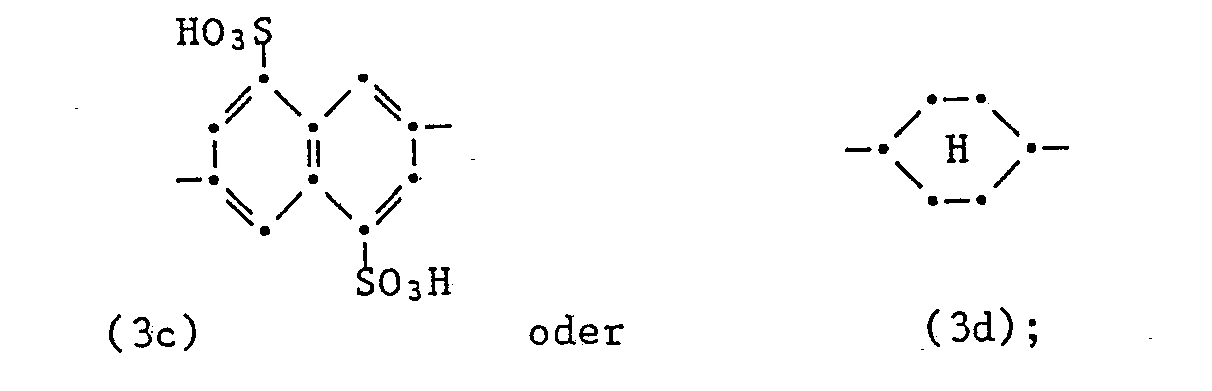


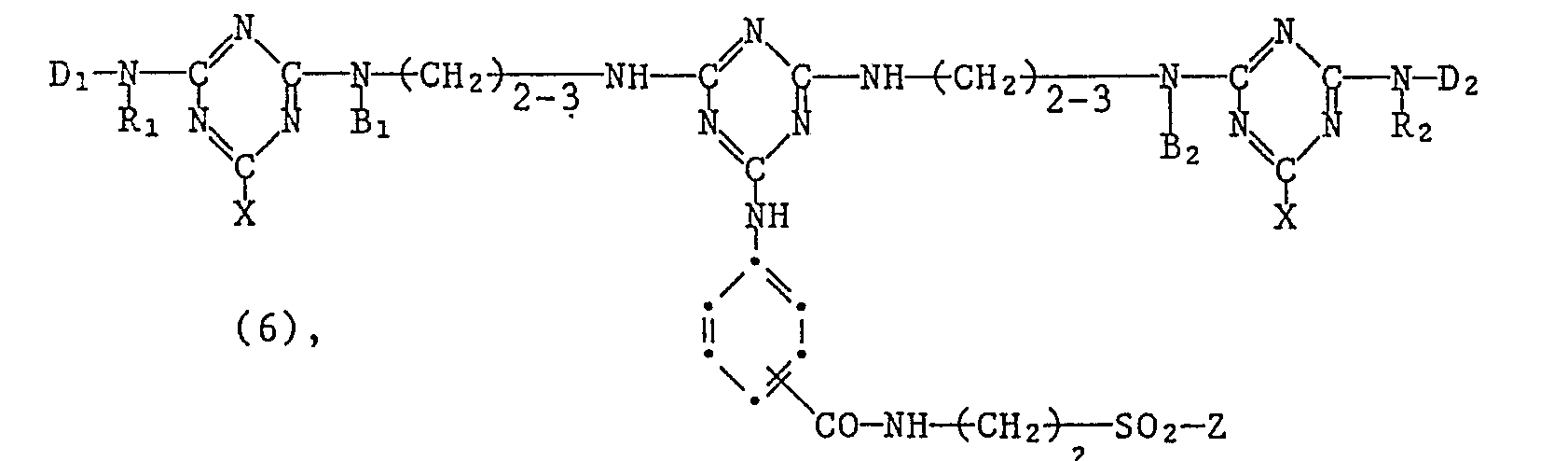
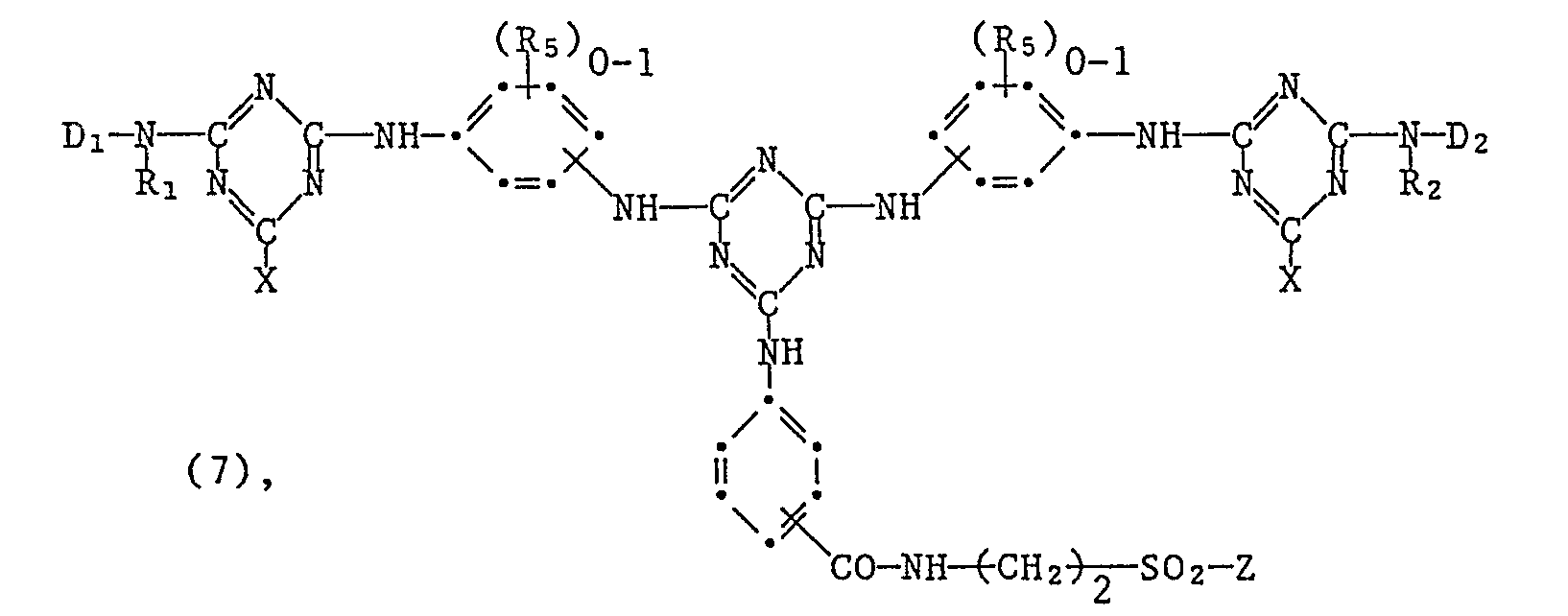


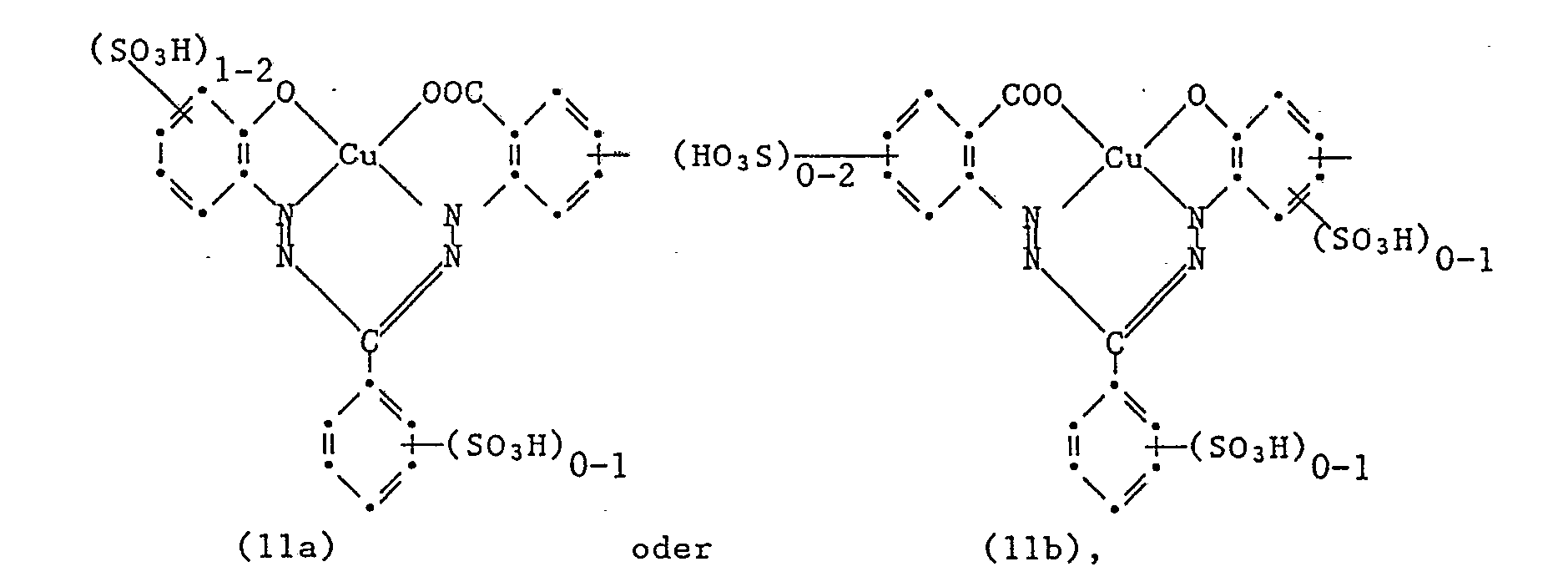


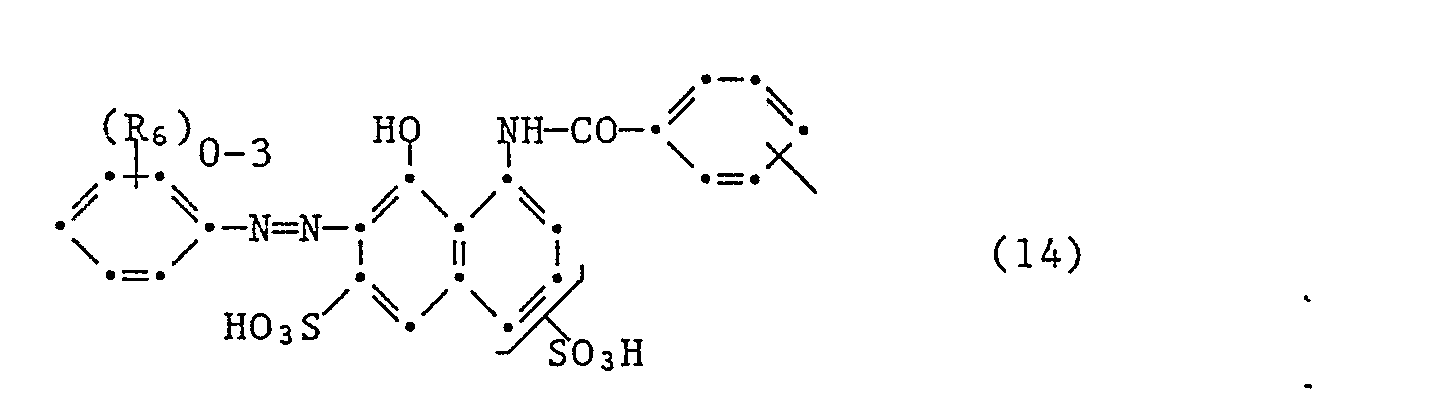







Applications Claiming Priority (2)
| Application Number | Priority Date | Filing Date | Title |
|---|---|---|---|
| CH99988 | 1988-03-16 | ||
| CH999/88 | 1988-03-16 |
Publications (3)
| Publication Number | Publication Date |
|---|---|
| EP0333653A2 true EP0333653A2 (de) | 1989-09-20 |
| EP0333653A3 EP0333653A3 (en) | 1990-05-09 |
| EP0333653B1 EP0333653B1 (de) | 1994-06-08 |
Family
ID=4200090
Family Applications (1)
| Application Number | Title | Priority Date | Filing Date |
|---|---|---|---|
| EP89810172A Expired - Lifetime EP0333653B1 (de) | 1988-03-16 | 1989-03-07 | Reaktivfarbstoffe, Verfahren zu deren Herstellung und deren Verwendung |
Country Status (6)
| Country | Link |
|---|---|
| US (1) | US4963659A (de) |
| EP (1) | EP0333653B1 (de) |
| JP (1) | JPH01278571A (de) |
| BR (1) | BR8901209A (de) |
| DE (1) | DE58907811D1 (de) |
| ES (1) | ES2055151T3 (de) |
Cited By (2)
| Publication number | Priority date | Publication date | Assignee | Title |
|---|---|---|---|---|
| GB2438047A (en) * | 2006-05-08 | 2007-11-14 | Ciba Sc Holding Ag | Triazine derivatives as UV filters for cosmetic compositions |
| CN118956177A (zh) * | 2024-07-26 | 2024-11-15 | 南京晓庄学院 | 印花和轧染用超高固色率和超高沾色牢度活性染料及其制备方法和应用 |
Families Citing this family (7)
| Publication number | Priority date | Publication date | Assignee | Title |
|---|---|---|---|---|
| GB9017869D0 (en) * | 1990-08-15 | 1990-09-26 | Ici Plc | Compounds |
| DE4107692A1 (de) * | 1991-03-09 | 1992-09-17 | Basf Ag | Verdoppelte phenylazo- oder naphthylazobenzole mit mehreren reaktiven gruppen sowie deren zwischenprodukte |
| US5376151A (en) * | 1993-04-16 | 1994-12-27 | North Carolina State University | Environmentally friendly method for producing lightfast black shades on natural and synthetic substrates |
| DE59508806D1 (de) * | 1994-09-14 | 2000-11-30 | Ciba Sc Holding Ag | UV-Absorber, ihre Herstellung und Verwendung |
| CN100514509C (zh) * | 2003-07-25 | 2009-07-15 | 普雷斯曼电缆及系统能源有限公司 | 用于制造电缆的连续方法 |
| AU2004291186B2 (en) * | 2003-11-24 | 2012-01-19 | Prometic Pharma Smt Limited | Triazine dimers for the treatment of autoimmune diseases |
| MX2008014268A (es) * | 2006-05-08 | 2008-11-18 | Ciba Holding Inc | Derivados de triacina. |
Family Cites Families (3)
| Publication number | Priority date | Publication date | Assignee | Title |
|---|---|---|---|---|
| JPH0619047B2 (ja) * | 1985-05-28 | 1994-03-16 | 三菱化成株式会社 | ジスアゾ系色素及びこれを用いる染色方法 |
| DE3873840D1 (de) * | 1987-06-24 | 1992-09-24 | Ciba Geigy Ag | Reaktivfarbstoffe, verfahren zu deren herstellung und deren verwendung. |
| EP0302006B1 (de) * | 1987-07-03 | 1992-02-05 | Ciba-Geigy Ag | Reaktivfarbstoffe, Verfahren zu deren Herstellung und deren Verwendung |
-
1989
- 1989-03-07 ES ES89810172T patent/ES2055151T3/es not_active Expired - Lifetime
- 1989-03-07 DE DE58907811T patent/DE58907811D1/de not_active Expired - Fee Related
- 1989-03-07 EP EP89810172A patent/EP0333653B1/de not_active Expired - Lifetime
- 1989-03-14 US US07/323,455 patent/US4963659A/en not_active Expired - Fee Related
- 1989-03-16 JP JP1062342A patent/JPH01278571A/ja active Pending
- 1989-03-16 BR BR898901209A patent/BR8901209A/pt not_active IP Right Cessation
Cited By (2)
| Publication number | Priority date | Publication date | Assignee | Title |
|---|---|---|---|---|
| GB2438047A (en) * | 2006-05-08 | 2007-11-14 | Ciba Sc Holding Ag | Triazine derivatives as UV filters for cosmetic compositions |
| CN118956177A (zh) * | 2024-07-26 | 2024-11-15 | 南京晓庄学院 | 印花和轧染用超高固色率和超高沾色牢度活性染料及其制备方法和应用 |
Also Published As
| Publication number | Publication date |
|---|---|
| EP0333653B1 (de) | 1994-06-08 |
| BR8901209A (pt) | 1989-10-31 |
| DE58907811D1 (de) | 1994-07-14 |
| EP0333653A3 (en) | 1990-05-09 |
| JPH01278571A (ja) | 1989-11-08 |
| ES2055151T3 (es) | 1994-08-16 |
| US4963659A (en) | 1990-10-16 |
Similar Documents
| Publication | Publication Date | Title |
|---|---|---|
| EP0214093B1 (de) | Reaktivfarbstoffe, deren Herstellung und Verwendung | |
| EP0040806B1 (de) | Wasserlösliche farbige Verbindungen, Verfahren zu deren Herstellung und ihre Verwendung als Farbstoffe | |
| EP0076782B1 (de) | Reaktivfarbstoffe, deren Herstellung und Verwendung | |
| EP0133843B1 (de) | Reaktivfarbstoffe, deren Herstellung und Verwendung | |
| EP0221013B1 (de) | Reaktivfarbstoffe, deren Herstellung und Verwendung | |
| EP0179019B1 (de) | Reaktivfarbstoffe, deren Herstellung und Verwendung | |
| EP0174909B1 (de) | Reaktivfarbstoffe, deren Herstellung und Verwendung | |
| EP0114032B1 (de) | Reaktivfarbstoffe, deren Herstellung und Verwendung | |
| EP0208655B1 (de) | Reaktivfarbstoffe, deren Herstellung und Verwendung | |
| EP0333653B1 (de) | Reaktivfarbstoffe, Verfahren zu deren Herstellung und deren Verwendung | |
| EP0141776B1 (de) | Reaktivfarbstoffe, deren Herstellung und Verwendung | |
| EP0167490A1 (de) | Reaktivfarbstoffe, deren Herstellung und Verwendung | |
| EP0302006B1 (de) | Reaktivfarbstoffe, Verfahren zu deren Herstellung und deren Verwendung | |
| EP0278904B1 (de) | Reaktivfarbstoffe, deren Herstellung und Verwendung | |
| EP0309406B1 (de) | Reaktivfarbstoffe, deren Herstellung und Verwendung | |
| EP0297044B1 (de) | Reaktivfarbstoffe, Verfahren zu deren Herstellung und deren Verwendung | |
| EP0285571B1 (de) | Reaktivfarbstoffe, deren Herstellung und Verwendung | |
| EP0233139B1 (de) | Reaktivfarbstoffe, deren Herstellung und Verwendung | |
| EP0282443B1 (de) | Reaktivfarbstoffe, deren Herstellung und Verwendung | |
| CH676991A5 (de) | ||
| EP0284568B1 (de) | Reaktivfarbstoffe, deren Herstellung und Verwendung | |
| EP0388864B1 (de) | Wasserlösliche faserreaktive Farbstoffe, Verfahren zu ihrer Herstellung und ihre Verwendung | |
| EP0313513B1 (de) | Reaktivfarbstoffe, deren Herstellung und Verwendung | |
| EP0304926A2 (de) | Reaktivfarbstoffe, deren Herstellung und Verwendung | |
| EP0304924A2 (de) | Reaktivfarbstoffe, deren Herstellung und Verwendung |
Legal Events
| Date | Code | Title | Description |
|---|---|---|---|
| PUAI | Public reference made under article 153(3) epc to a published international application that has entered the european phase |
Free format text: ORIGINAL CODE: 0009012 |
|
| 17P | Request for examination filed |
Effective date: 19890309 |
|
| AK | Designated contracting states |
Kind code of ref document: A2 Designated state(s): BE CH DE ES FR GB IT LI |
|
| PUAL | Search report despatched |
Free format text: ORIGINAL CODE: 0009013 |
|
| AK | Designated contracting states |
Kind code of ref document: A3 Designated state(s): BE CH DE ES FR GB IT LI |
|
| 17Q | First examination report despatched |
Effective date: 19930317 |
|
| GRAA | (expected) grant |
Free format text: ORIGINAL CODE: 0009210 |
|
| AK | Designated contracting states |
Kind code of ref document: B1 Designated state(s): BE CH DE ES FR GB IT LI |
|
| PG25 | Lapsed in a contracting state [announced via postgrant information from national office to epo] |
Ref country code: IT Free format text: LAPSE BECAUSE OF FAILURE TO SUBMIT A TRANSLATION OF THE DESCRIPTION OR TO PAY THE FEE WITHIN THE PRE;WARNING: LAPSES OF ITALIAN PATENTS WITH EFFECTIVE DATE BEFORE 2007 MAY HAVE OCCURRED AT ANY TIME BEFORE 2007. THE CORRECT EFFECTIVE DATE MAY BE DIFFERENT FROM THE ONE RECORDED.SCRIBED TIME-LIMIT Effective date: 19940608 |
|
| ET | Fr: translation filed | ||
| REF | Corresponds to: |
Ref document number: 58907811 Country of ref document: DE Date of ref document: 19940714 |
|
| REG | Reference to a national code |
Ref country code: ES Ref legal event code: FG2A Ref document number: 2055151 Country of ref document: ES Kind code of ref document: T3 |
|
| GBT | Gb: translation of ep patent filed (gb section 77(6)(a)/1977) |
Effective date: 19940818 |
|
| PLBE | No opposition filed within time limit |
Free format text: ORIGINAL CODE: 0009261 |
|
| STAA | Information on the status of an ep patent application or granted ep patent |
Free format text: STATUS: NO OPPOSITION FILED WITHIN TIME LIMIT |
|
| 26N | No opposition filed | ||
| REG | Reference to a national code |
Ref country code: CH Ref legal event code: PUE Owner name: CIBA-GEIGY AG TRANSFER- CIBA SC HOLDING AG |
|
| BECN | Be: change of holder's name |
Effective date: 19961129 |
|
| REG | Reference to a national code |
Ref country code: FR Ref legal event code: TP |
|
| REG | Reference to a national code |
Ref country code: CH Ref legal event code: PFA Free format text: CIBA SC HOLDING AG TRANSFER- CIBA SPECIALTY CHEMICALS HOLDING INC. |
|
| REG | Reference to a national code |
Ref country code: GB Ref legal event code: 732E |
|
| REG | Reference to a national code |
Ref country code: FR Ref legal event code: CD |
|
| REG | Reference to a national code |
Ref country code: ES Ref legal event code: PC2A |
|
| PGFP | Annual fee paid to national office [announced via postgrant information from national office to epo] |
Ref country code: FR Payment date: 19990129 Year of fee payment: 11 |
|
| PGFP | Annual fee paid to national office [announced via postgrant information from national office to epo] |
Ref country code: CH Payment date: 19990201 Year of fee payment: 11 |
|
| PGFP | Annual fee paid to national office [announced via postgrant information from national office to epo] |
Ref country code: DE Payment date: 19990208 Year of fee payment: 11 |
|
| PGFP | Annual fee paid to national office [announced via postgrant information from national office to epo] |
Ref country code: GB Payment date: 19990217 Year of fee payment: 11 |
|
| PGFP | Annual fee paid to national office [announced via postgrant information from national office to epo] |
Ref country code: ES Payment date: 19990316 Year of fee payment: 11 |
|
| PGFP | Annual fee paid to national office [announced via postgrant information from national office to epo] |
Ref country code: BE Payment date: 19990517 Year of fee payment: 11 |
|
| PG25 | Lapsed in a contracting state [announced via postgrant information from national office to epo] |
Ref country code: GB Free format text: LAPSE BECAUSE OF NON-PAYMENT OF DUE FEES Effective date: 20000307 |
|
| PG25 | Lapsed in a contracting state [announced via postgrant information from national office to epo] |
Ref country code: ES Free format text: LAPSE BECAUSE OF NON-PAYMENT OF DUE FEES Effective date: 20000308 |
|
| PG25 | Lapsed in a contracting state [announced via postgrant information from national office to epo] |
Ref country code: BE Free format text: LAPSE BECAUSE OF NON-PAYMENT OF DUE FEES Effective date: 20000331 Ref country code: LI Free format text: LAPSE BECAUSE OF NON-PAYMENT OF DUE FEES Effective date: 20000331 Ref country code: CH Free format text: LAPSE BECAUSE OF NON-PAYMENT OF DUE FEES Effective date: 20000331 |
|
| BERE | Be: lapsed |
Owner name: CIBA SPECIALTY CHEMICALS HOLDING INC. Effective date: 20000331 |
|
| GBPC | Gb: european patent ceased through non-payment of renewal fee |
Effective date: 20000307 |
|
| REG | Reference to a national code |
Ref country code: CH Ref legal event code: PL |
|
| PG25 | Lapsed in a contracting state [announced via postgrant information from national office to epo] |
Ref country code: FR Free format text: LAPSE BECAUSE OF NON-PAYMENT OF DUE FEES Effective date: 20001130 |
|
| REG | Reference to a national code |
Ref country code: FR Ref legal event code: ST |
|
| PG25 | Lapsed in a contracting state [announced via postgrant information from national office to epo] |
Ref country code: DE Free format text: LAPSE BECAUSE OF NON-PAYMENT OF DUE FEES Effective date: 20010103 |
|
| REG | Reference to a national code |
Ref country code: ES Ref legal event code: FD2A Effective date: 20010910 |