EP0333760B1 - Esters cyano-alicycliques et des compositions de cristaux liquides - Google Patents
Esters cyano-alicycliques et des compositions de cristaux liquides Download PDFInfo
- Publication number
- EP0333760B1 EP0333760B1 EP88900030A EP88900030A EP0333760B1 EP 0333760 B1 EP0333760 B1 EP 0333760B1 EP 88900030 A EP88900030 A EP 88900030A EP 88900030 A EP88900030 A EP 88900030A EP 0333760 B1 EP0333760 B1 EP 0333760B1
- Authority
- EP
- European Patent Office
- Prior art keywords
- formula
- compound according
- liquid crystal
- compounds
- compound
- Prior art date
- Legal status (The legal status is an assumption and is not a legal conclusion. Google has not performed a legal analysis and makes no representation as to the accuracy of the status listed.)
- Expired - Lifetime
Links
- 239000000203 mixture Substances 0.000 title claims abstract description 63
- 239000004973 liquid crystal related substance Substances 0.000 title claims description 21
- 150000001875 compounds Chemical class 0.000 claims abstract description 82
- 239000004990 Smectic liquid crystal Substances 0.000 claims abstract description 36
- 125000004122 cyclic group Chemical group 0.000 claims abstract description 14
- 125000002723 alicyclic group Chemical group 0.000 claims abstract description 13
- 125000003545 alkoxy group Chemical group 0.000 claims abstract description 13
- 229910052799 carbon Inorganic materials 0.000 claims abstract description 13
- 125000004432 carbon atom Chemical group C* 0.000 claims abstract description 6
- 125000000113 cyclohexyl group Chemical group [H]C1([H])C([H])([H])C([H])([H])C([H])(*)C([H])([H])C1([H])[H] 0.000 claims abstract description 6
- 239000000470 constituent Substances 0.000 claims abstract description 5
- 150000002148 esters Chemical class 0.000 claims abstract description 5
- 125000001997 phenyl group Chemical group [H]C1=C([H])C([H])=C(*)C([H])=C1[H] 0.000 claims abstract description 5
- 125000001153 fluoro group Chemical group F* 0.000 claims abstract description 4
- 125000003118 aryl group Chemical group 0.000 claims abstract description 3
- 125000001183 hydrocarbyl group Chemical group 0.000 claims abstract 4
- 125000000816 ethylene group Chemical group [H]C([H])([*:1])C([H])([H])[*:2] 0.000 claims abstract 2
- 239000000463 material Substances 0.000 claims description 26
- -1 fluoro - substituted phenyl Chemical group 0.000 claims description 10
- 239000007788 liquid Substances 0.000 claims description 4
- 125000002496 methyl group Chemical group [H]C([H])([H])* 0.000 claims description 3
- 238000006467 substitution reaction Methods 0.000 claims description 3
- 125000001931 aliphatic group Chemical group 0.000 claims description 2
- 125000002619 bicyclic group Chemical group 0.000 claims description 2
- 125000005647 linker group Chemical group 0.000 claims description 2
- 125000002950 monocyclic group Chemical group 0.000 claims description 2
- 125000006539 C12 alkyl group Chemical group [H]C([H])([H])C([H])([H])C([H])([H])C([H])([H])C([H])([H])C([H])([H])C([H])([H])C([H])([H])C([H])([H])C([H])([H])C([H])([H])C([H])([H])* 0.000 claims 1
- 125000002298 terpene group Chemical group 0.000 claims 1
- 125000000217 alkyl group Chemical group 0.000 abstract description 4
- 125000001309 chloro group Chemical group Cl* 0.000 abstract description 2
- 150000003505 terpenes Chemical group 0.000 description 21
- YMWUJEATGCHHMB-UHFFFAOYSA-N Dichloromethane Chemical compound ClCCl YMWUJEATGCHHMB-UHFFFAOYSA-N 0.000 description 18
- 239000012071 phase Substances 0.000 description 15
- 0 CC(CC1)C*C1c1ccc(C)cc1 Chemical compound CC(CC1)C*C1c1ccc(C)cc1 0.000 description 14
- 230000007704 transition Effects 0.000 description 9
- WYURNTSHIVDZCO-UHFFFAOYSA-N Tetrahydrofuran Chemical compound C1CCOC1 WYURNTSHIVDZCO-UHFFFAOYSA-N 0.000 description 8
- 230000015572 biosynthetic process Effects 0.000 description 8
- 150000002430 hydrocarbons Chemical group 0.000 description 8
- 239000010410 layer Substances 0.000 description 8
- 238000000034 method Methods 0.000 description 8
- 239000011295 pitch Substances 0.000 description 8
- 239000000243 solution Substances 0.000 description 8
- 239000007787 solid Substances 0.000 description 7
- XLYOFNOQVPJJNP-UHFFFAOYSA-N water Substances O XLYOFNOQVPJJNP-UHFFFAOYSA-N 0.000 description 7
- QTBSBXVTEAMEQO-UHFFFAOYSA-N Acetic acid Chemical compound CC(O)=O QTBSBXVTEAMEQO-UHFFFAOYSA-N 0.000 description 6
- YXFVVABEGXRONW-UHFFFAOYSA-N Toluene Chemical compound CC1=CC=CC=C1 YXFVVABEGXRONW-UHFFFAOYSA-N 0.000 description 6
- 239000002253 acid Substances 0.000 description 6
- 229910052757 nitrogen Inorganic materials 0.000 description 6
- RRHGJUQNOFWUDK-UHFFFAOYSA-N Isoprene Chemical compound CC(=C)C=C RRHGJUQNOFWUDK-UHFFFAOYSA-N 0.000 description 5
- 210000004027 cell Anatomy 0.000 description 5
- 239000000047 product Substances 0.000 description 5
- 229910052717 sulfur Inorganic materials 0.000 description 5
- DSSYKIVIOFKYAU-XCBNKYQSSA-N (R)-camphor Chemical compound C1C[C@@]2(C)C(=O)C[C@@H]1C2(C)C DSSYKIVIOFKYAU-XCBNKYQSSA-N 0.000 description 4
- IJGRMHOSHXDMSA-UHFFFAOYSA-N Atomic nitrogen Chemical compound N#N IJGRMHOSHXDMSA-UHFFFAOYSA-N 0.000 description 4
- 241000723346 Cinnamomum camphora Species 0.000 description 4
- 229930008380 camphor Natural products 0.000 description 4
- JHIVVAPYMSGYDF-UHFFFAOYSA-N cyclohexanone Chemical compound O=C1CCCCC1 JHIVVAPYMSGYDF-UHFFFAOYSA-N 0.000 description 4
- 239000002904 solvent Substances 0.000 description 4
- YLQBMQCUIZJEEH-UHFFFAOYSA-N tetrahydrofuran Natural products C=1C=COC=1 YLQBMQCUIZJEEH-UHFFFAOYSA-N 0.000 description 4
- KWYUFKZDYYNOTN-UHFFFAOYSA-M Potassium hydroxide Chemical compound [OH-].[K+] KWYUFKZDYYNOTN-UHFFFAOYSA-M 0.000 description 3
- 229960000846 camphor Drugs 0.000 description 3
- 238000010276 construction Methods 0.000 description 3
- 239000013078 crystal Substances 0.000 description 3
- 230000032050 esterification Effects 0.000 description 3
- 238000005886 esterification reaction Methods 0.000 description 3
- 239000005262 ferroelectric liquid crystals (FLCs) Substances 0.000 description 3
- 230000003287 optical effect Effects 0.000 description 3
- 239000012044 organic layer Substances 0.000 description 3
- 239000003208 petroleum Substances 0.000 description 3
- 230000009467 reduction Effects 0.000 description 3
- 230000004044 response Effects 0.000 description 3
- 125000006850 spacer group Chemical group 0.000 description 3
- 235000015096 spirit Nutrition 0.000 description 3
- 230000002269 spontaneous effect Effects 0.000 description 3
- 239000000758 substrate Substances 0.000 description 3
- UJBOOUHRTQVGRU-UHFFFAOYSA-N 3-methylcyclohexan-1-one Chemical compound CC1CCCC(=O)C1 UJBOOUHRTQVGRU-UHFFFAOYSA-N 0.000 description 2
- FJKROLUGYXJWQN-UHFFFAOYSA-N 4-hydroxybenzoic acid Chemical compound OC(=O)C1=CC=C(O)C=C1 FJKROLUGYXJWQN-UHFFFAOYSA-N 0.000 description 2
- RTZKZFJDLAIYFH-UHFFFAOYSA-N Diethyl ether Chemical compound CCOCC RTZKZFJDLAIYFH-UHFFFAOYSA-N 0.000 description 2
- VEXZGXHMUGYJMC-UHFFFAOYSA-N Hydrochloric acid Chemical compound Cl VEXZGXHMUGYJMC-UHFFFAOYSA-N 0.000 description 2
- 239000004988 Nematic liquid crystal Substances 0.000 description 2
- CDBYLPFSWZWCQE-UHFFFAOYSA-L Sodium Carbonate Chemical compound [Na+].[Na+].[O-]C([O-])=O CDBYLPFSWZWCQE-UHFFFAOYSA-L 0.000 description 2
- UIIMBOGNXHQVGW-UHFFFAOYSA-M Sodium bicarbonate Chemical compound [Na+].OC([O-])=O UIIMBOGNXHQVGW-UHFFFAOYSA-M 0.000 description 2
- 239000000654 additive Substances 0.000 description 2
- 125000005196 alkyl carbonyloxy group Chemical group 0.000 description 2
- 230000001851 biosynthetic effect Effects 0.000 description 2
- 150000001732 carboxylic acid derivatives Chemical class 0.000 description 2
- 239000003795 chemical substances by application Substances 0.000 description 2
- 238000001816 cooling Methods 0.000 description 2
- 238000002425 crystallisation Methods 0.000 description 2
- 238000004821 distillation Methods 0.000 description 2
- 239000011521 glass Substances 0.000 description 2
- 238000010438 heat treatment Methods 0.000 description 2
- 238000004128 high performance liquid chromatography Methods 0.000 description 2
- LELOWRISYMNNSU-UHFFFAOYSA-N hydrogen cyanide Chemical compound N#C LELOWRISYMNNSU-UHFFFAOYSA-N 0.000 description 2
- 229910052740 iodine Inorganic materials 0.000 description 2
- 150000002576 ketones Chemical class 0.000 description 2
- 229910052943 magnesium sulfate Inorganic materials 0.000 description 2
- 230000010287 polarization Effects 0.000 description 2
- 239000002243 precursor Substances 0.000 description 2
- 238000002360 preparation method Methods 0.000 description 2
- 238000010992 reflux Methods 0.000 description 2
- 229920006395 saturated elastomer Polymers 0.000 description 2
- 230000000707 stereoselective effect Effects 0.000 description 2
- 238000003786 synthesis reaction Methods 0.000 description 2
- 235000007586 terpenes Nutrition 0.000 description 2
- 150000001911 terphenyls Chemical class 0.000 description 2
- UAYWVJHJZHQCIE-UHFFFAOYSA-L zinc iodide Chemical compound I[Zn]I UAYWVJHJZHQCIE-UHFFFAOYSA-L 0.000 description 2
- NOOLISFMXDJSKH-UTLUCORTSA-N (+)-Neomenthol Chemical class CC(C)[C@@H]1CC[C@@H](C)C[C@@H]1O NOOLISFMXDJSKH-UTLUCORTSA-N 0.000 description 1
- ISHHXYOBLOXQCH-UHFFFAOYSA-N (4-bromo-2-fluorooctoxy)benzene Chemical compound CCCCC(Br)CC(F)COC1=CC=CC=C1 ISHHXYOBLOXQCH-UHFFFAOYSA-N 0.000 description 1
- 229930007886 (R)-camphor Natural products 0.000 description 1
- CRJZDLRGWVMCTH-UHFFFAOYSA-N 2-fluorooctoxybenzene Chemical compound CCCCCCC(F)COC1=CC=CC=C1 CRJZDLRGWVMCTH-UHFFFAOYSA-N 0.000 description 1
- PPOCFSJSVCAFQQ-UHFFFAOYSA-N 4,7,7-trimethylbicyclo[2.2.1]heptan-3-one Chemical compound C1CC2(C)C(=O)CC1C2(C)C.C1CC2(C)C(=O)CC1C2(C)C PPOCFSJSVCAFQQ-UHFFFAOYSA-N 0.000 description 1
- WUMDMTNUPWTDAM-UHFFFAOYSA-N 4-(3-fluoro-4-octoxyphenyl)benzoic acid Chemical compound C1=C(F)C(OCCCCCCCC)=CC=C1C1=CC=C(C(O)=O)C=C1 WUMDMTNUPWTDAM-UHFFFAOYSA-N 0.000 description 1
- 229940090248 4-hydroxybenzoic acid Drugs 0.000 description 1
- LTVXCDUXQXYJBA-UHFFFAOYSA-N 4-octoxy-4-phenylcyclohexa-1,5-diene-1-carboxylic acid Chemical compound C(CCCCCCC)OC1(CC=C(C=C1)C(=O)O)C1=CC=CC=C1 LTVXCDUXQXYJBA-UHFFFAOYSA-N 0.000 description 1
- ZCYVEMRRCGMTRW-UHFFFAOYSA-N 7553-56-2 Chemical compound [I] ZCYVEMRRCGMTRW-UHFFFAOYSA-N 0.000 description 1
- CPELXLSAUQHCOX-UHFFFAOYSA-M Bromide Chemical compound [Br-] CPELXLSAUQHCOX-UHFFFAOYSA-M 0.000 description 1
- PYOLJOJPIPCRDP-UHFFFAOYSA-N CC1CC(C)(C)CCC1 Chemical compound CC1CC(C)(C)CCC1 PYOLJOJPIPCRDP-UHFFFAOYSA-N 0.000 description 1
- RZTDESRVPFKCBH-UHFFFAOYSA-N Cc(cc1)ccc1-c1ccc(C)cc1 Chemical compound Cc(cc1)ccc1-c1ccc(C)cc1 RZTDESRVPFKCBH-UHFFFAOYSA-N 0.000 description 1
- LFQSCWFLJHTTHZ-UHFFFAOYSA-N Ethanol Chemical compound CCO LFQSCWFLJHTTHZ-UHFFFAOYSA-N 0.000 description 1
- 238000003747 Grignard reaction Methods 0.000 description 1
- FYYHWMGAXLPEAU-UHFFFAOYSA-N Magnesium Chemical compound [Mg] FYYHWMGAXLPEAU-UHFFFAOYSA-N 0.000 description 1
- 241001136616 Methone Species 0.000 description 1
- 239000004642 Polyimide Substances 0.000 description 1
- WONIGEXYPVIKFS-UHFFFAOYSA-N Verbenol Chemical class CC1=CC(O)C2C(C)(C)C1C2 WONIGEXYPVIKFS-UHFFFAOYSA-N 0.000 description 1
- 150000001298 alcohols Chemical class 0.000 description 1
- PNEYBMLMFCGWSK-UHFFFAOYSA-N aluminium oxide Inorganic materials [O-2].[O-2].[O-2].[Al+3].[Al+3] PNEYBMLMFCGWSK-UHFFFAOYSA-N 0.000 description 1
- 150000001408 amides Chemical class 0.000 description 1
- 125000004429 atom Chemical group 0.000 description 1
- 230000008901 benefit Effects 0.000 description 1
- 230000008033 biological extinction Effects 0.000 description 1
- 150000001637 borneol derivatives Chemical class 0.000 description 1
- 239000012267 brine Substances 0.000 description 1
- 230000031709 bromination Effects 0.000 description 1
- 238000005893 bromination reaction Methods 0.000 description 1
- 229910002091 carbon monoxide Inorganic materials 0.000 description 1
- 150000001735 carboxylic acids Chemical class 0.000 description 1
- 150000001753 carvones Chemical class 0.000 description 1
- 230000008859 change Effects 0.000 description 1
- 238000006243 chemical reaction Methods 0.000 description 1
- 239000003153 chemical reaction reagent Substances 0.000 description 1
- 238000004440 column chromatography Methods 0.000 description 1
- 230000005492 condensed matter physics Effects 0.000 description 1
- 239000012043 crude product Substances 0.000 description 1
- 210000002858 crystal cell Anatomy 0.000 description 1
- 230000008021 deposition Effects 0.000 description 1
- 238000011161 development Methods 0.000 description 1
- 230000018109 developmental process Effects 0.000 description 1
- 239000002027 dichloromethane extract Substances 0.000 description 1
- 238000000113 differential scanning calorimetry Methods 0.000 description 1
- 238000001035 drying Methods 0.000 description 1
- 238000001704 evaporation Methods 0.000 description 1
- 230000008020 evaporation Effects 0.000 description 1
- 230000001747 exhibiting effect Effects 0.000 description 1
- 150000002199 fenchone derivatives Chemical class 0.000 description 1
- 238000011049 filling Methods 0.000 description 1
- 239000000706 filtrate Substances 0.000 description 1
- 238000001914 filtration Methods 0.000 description 1
- 239000012530 fluid Substances 0.000 description 1
- 229910052731 fluorine Inorganic materials 0.000 description 1
- 125000001188 haloalkyl group Chemical group 0.000 description 1
- 229910052736 halogen Inorganic materials 0.000 description 1
- 150000002367 halogens Chemical group 0.000 description 1
- 229910003437 indium oxide Inorganic materials 0.000 description 1
- PJXISJQVUVHSOJ-UHFFFAOYSA-N indium(iii) oxide Chemical compound [O-2].[O-2].[O-2].[In+3].[In+3] PJXISJQVUVHSOJ-UHFFFAOYSA-N 0.000 description 1
- 239000011630 iodine Substances 0.000 description 1
- 239000007791 liquid phase Substances 0.000 description 1
- CZNGTXVOZOWWKM-UHFFFAOYSA-N methyl 4-bromobenzoate Chemical compound COC(=O)C1=CC=C(Br)C=C1 CZNGTXVOZOWWKM-UHFFFAOYSA-N 0.000 description 1
- 230000005012 migration Effects 0.000 description 1
- 238000013508 migration Methods 0.000 description 1
- 125000006608 n-octyloxy group Chemical group 0.000 description 1
- 229930014626 natural product Natural products 0.000 description 1
- 239000012299 nitrogen atmosphere Substances 0.000 description 1
- 230000001151 other effect Effects 0.000 description 1
- 230000003647 oxidation Effects 0.000 description 1
- 238000007254 oxidation reaction Methods 0.000 description 1
- 229910052760 oxygen Inorganic materials 0.000 description 1
- NFHFRUOZVGFOOS-UHFFFAOYSA-N palladium;triphenylphosphane Chemical compound [Pd].C1=CC=CC=C1P(C=1C=CC=CC=1)C1=CC=CC=C1.C1=CC=CC=C1P(C=1C=CC=CC=1)C1=CC=CC=C1.C1=CC=CC=C1P(C=1C=CC=CC=1)C1=CC=CC=C1.C1=CC=CC=C1P(C=1C=CC=CC=1)C1=CC=CC=C1 NFHFRUOZVGFOOS-UHFFFAOYSA-N 0.000 description 1
- 238000001259 photo etching Methods 0.000 description 1
- 229920003229 poly(methyl methacrylate) Polymers 0.000 description 1
- 229920001721 polyimide Polymers 0.000 description 1
- 229920001195 polyisoprene Polymers 0.000 description 1
- 229920000642 polymer Polymers 0.000 description 1
- 239000004926 polymethyl methacrylate Substances 0.000 description 1
- 239000002244 precipitate Substances 0.000 description 1
- 239000011541 reaction mixture Substances 0.000 description 1
- 238000001953 recrystallisation Methods 0.000 description 1
- 238000007789 sealing Methods 0.000 description 1
- 229910000030 sodium bicarbonate Inorganic materials 0.000 description 1
- 235000017557 sodium bicarbonate Nutrition 0.000 description 1
- 229910000029 sodium carbonate Inorganic materials 0.000 description 1
- HPALAKNZSZLMCH-UHFFFAOYSA-M sodium;chloride;hydrate Chemical compound O.[Na+].[Cl-] HPALAKNZSZLMCH-UHFFFAOYSA-M 0.000 description 1
- 210000004872 soft tissue Anatomy 0.000 description 1
- 239000012265 solid product Substances 0.000 description 1
- 125000001424 substituent group Chemical group 0.000 description 1
- 238000004781 supercooling Methods 0.000 description 1
- XOLBLPGZBRYERU-UHFFFAOYSA-N tin dioxide Chemical compound O=[Sn]=O XOLBLPGZBRYERU-UHFFFAOYSA-N 0.000 description 1
- 229910001887 tin oxide Inorganic materials 0.000 description 1
- HTSABYAWKQAHBT-UHFFFAOYSA-N trans 3-methylcyclohexanol Natural products CC1CCCC(O)C1 HTSABYAWKQAHBT-UHFFFAOYSA-N 0.000 description 1
- LEIMLDGFXIOXMT-UHFFFAOYSA-N trimethylsilyl cyanide Chemical compound C[Si](C)(C)C#N LEIMLDGFXIOXMT-UHFFFAOYSA-N 0.000 description 1
- NHDIQVFFNDKAQU-UHFFFAOYSA-N tripropan-2-yl borate Chemical compound CC(C)OB(OC(C)C)OC(C)C NHDIQVFFNDKAQU-UHFFFAOYSA-N 0.000 description 1
Images


Classifications
-
- C—CHEMISTRY; METALLURGY
- C07—ORGANIC CHEMISTRY
- C07C—ACYCLIC OR CARBOCYCLIC COMPOUNDS
- C07C255/00—Carboxylic acid nitriles
-
- C—CHEMISTRY; METALLURGY
- C09—DYES; PAINTS; POLISHES; NATURAL RESINS; ADHESIVES; COMPOSITIONS NOT OTHERWISE PROVIDED FOR; APPLICATIONS OF MATERIALS NOT OTHERWISE PROVIDED FOR
- C09K—MATERIALS FOR MISCELLANEOUS APPLICATIONS, NOT PROVIDED FOR ELSEWHERE
- C09K19/00—Liquid crystal materials
- C09K19/04—Liquid crystal materials characterised by the chemical structure of the liquid crystal components, e.g. by a specific unit
- C09K19/06—Non-steroidal liquid crystal compounds
- C09K19/08—Non-steroidal liquid crystal compounds containing at least two non-condensed rings
- C09K19/30—Non-steroidal liquid crystal compounds containing at least two non-condensed rings containing saturated or unsaturated non-aromatic rings, e.g. cyclohexane rings
- C09K19/3001—Cyclohexane rings
- C09K19/3066—Cyclohexane rings in which the rings are linked by a chain containing carbon and oxygen atoms, e.g. esters or ethers
- C09K19/3068—Cyclohexane rings in which the rings are linked by a chain containing carbon and oxygen atoms, e.g. esters or ethers chain containing -COO- or -OCO- groups
-
- C—CHEMISTRY; METALLURGY
- C09—DYES; PAINTS; POLISHES; NATURAL RESINS; ADHESIVES; COMPOSITIONS NOT OTHERWISE PROVIDED FOR; APPLICATIONS OF MATERIALS NOT OTHERWISE PROVIDED FOR
- C09K—MATERIALS FOR MISCELLANEOUS APPLICATIONS, NOT PROVIDED FOR ELSEWHERE
- C09K19/00—Liquid crystal materials
- C09K19/04—Liquid crystal materials characterised by the chemical structure of the liquid crystal components, e.g. by a specific unit
- C09K19/06—Non-steroidal liquid crystal compounds
- C09K19/32—Non-steroidal liquid crystal compounds containing condensed ring systems, i.e. fused, bridged or spiro ring systems
-
- C—CHEMISTRY; METALLURGY
- C09—DYES; PAINTS; POLISHES; NATURAL RESINS; ADHESIVES; COMPOSITIONS NOT OTHERWISE PROVIDED FOR; APPLICATIONS OF MATERIALS NOT OTHERWISE PROVIDED FOR
- C09K—MATERIALS FOR MISCELLANEOUS APPLICATIONS, NOT PROVIDED FOR ELSEWHERE
- C09K19/00—Liquid crystal materials
- C09K19/04—Liquid crystal materials characterised by the chemical structure of the liquid crystal components, e.g. by a specific unit
- C09K19/06—Non-steroidal liquid crystal compounds
- C09K19/08—Non-steroidal liquid crystal compounds containing at least two non-condensed rings
- C09K19/30—Non-steroidal liquid crystal compounds containing at least two non-condensed rings containing saturated or unsaturated non-aromatic rings, e.g. cyclohexane rings
- C09K19/3001—Cyclohexane rings
- C09K2019/3095—Cyclohexane rings in which the end group is the monoterpene menthyl
Definitions
- This invention relates to novel cyano-alicyclic esters and to liquid crystal materials containing them.
- the invention relates to chiral derivatives and ferroelectric smectic liquid crystal compositions containing them.
- Ferroelectric smectic liquid crystal materials are known, (eg N A Clark et al: Appl Phys Lett (1980) 36 899), and exploit the electro-optical properties of the ferroelectric chiral smectic phase.
- the chiral smectic C (abbreviated S c * the asterisk denoting chiralty) is most used as it is the most fluid, but other chiral smectic phases eg I, F, J, K, G, H or X may also be used.
- ferroelectric smectic liquid crystal materials are single compounds it is more usual for such a material to be a composition.
- a composition contains one or more compounds which either singly or together show an S c phase (termed a smectic "host"), together with one or more chiral (ie optically active) compounds which are generally added to induce the smectic material to show a high spontaneous polarisation, P s .
- the composition may also contain additives. For example to broaden the S c * range, to suppress undesirable phases, or optically active compounds to modify the helical pitch of the S c * phase.
- Optically active compounds used in ferroelectric smectic liquid crystal compositions generally consist of a "core" consisting of a chain of linked cyclic groups, with an optically active group containing an asymmetric carbon atom at or near a terminal position of the chain.
- the core is selected from the reasonably well known combinations of cyclic groups which encourage the compound to be miscible with smectic liquid crystal phases.
- the goal of much research in ferroelectric smectic liquid crystal chemistry is to identify novel optically active groups which may be combined with such cores to form advantageous compounds.
- PCT/GB 87/00441 (Agents Ref P0383) and JPA-61-243055 describe compounds of structure where R is alkyl. These compounds show a high Ps. Both have publication dates later than the priority date of this application.
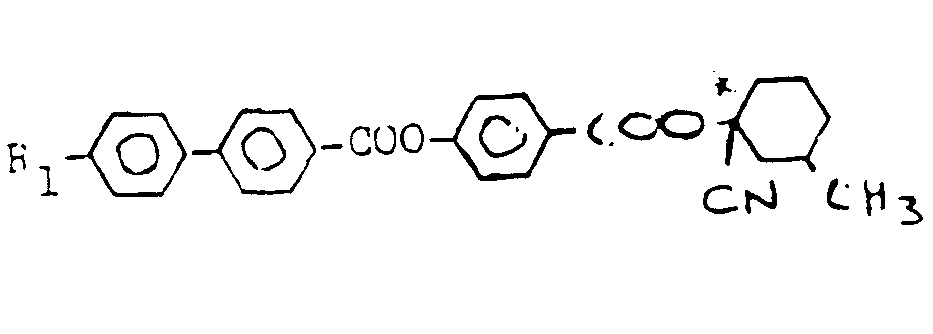
- a compound, suitable for use as a constituent of a ferroelectric smectic liquid crystal composition which is an ester of formula I: wherein R 2 and R 3 together represent the residue of an alicyclic hydrocarbon ring system in which C * is an asymmetrically substituted carbon atom, and X is a core consisting of a chain of up to three independently selected aromatic or aliphatic six-membered organic cyclic groups, which may be laterally and/or terminally substituted, and linked by single bonds or via linking groups, and excluding
- the alicyclic hydrocarbon ring system in formula I is a terpenoid ring system, which may be selected from any terpenoid ring system which has a substitution pattern that allows the atom C * to be asymmetrically substituted.
- the ring sytem may be monocyclic, bicyclic or tricyclic.
- Terpenoids are derivatives of the analogous terpenes, which are isoprene oligomers.
- the term 'terpenoid' as used herein includes not only the saturated or unsaturated isoprene oligomers themselves but also their oxygenated derivatives and partial or complete reduction products.
- the majority of terpenoids contain cyclic polyisoprene chains. Preferred chains are those based on six-membered rings, substituted and/or bridged.
- Terpenoids are obtained from biosynthetic sources and in the course of biosynthesis terpenes are sometimes produced which either lack part of an isoprene unit or have part of an extra one. Sometimes migration of methyl groups occurs during biosynthesis so that the final biosynthetic product may no longer have a skeleton strictly composed of isoprene units. These compounds are nevertheless considered to be members of the terpenoid family.
- Such a ring system may exist in a number of isomeric forms depending upon the conformation of the cyclic system, and in addition to other effects this may confer either (+) or (-) senses of optical activity or R or S absolute configurations on the asymmetric centre C *. All such isomeric forms are included in the invention.
- Some examples of cyclic terpenoid groups of formula encompassed by formula I are the terpenoid-based ring systems listed below in table 1. Conventional line formulae are used. Structure 1.1 is particularly preferred.
- Another type of alicyclic hydrocarbon ring system which may be represented by: in formula I is: where (R 4 ) indicates that the cyclohexane ring system carries one or more (preferably one) C i - C 6 alkyl group (preferably methyl) substituents, which may be the same or different, the substitution pattern being such that the position indicated by * is asymmetrically substituted.
- suitable cores are described in EPA 115693 (combined with optically active alkoxy), EPA 136845 (combined with optically active - COO - alkyl, alkoxy, or alkyl), EPA 152217 (combined with optically active OCOO-alkyl), EPA 153826 (combined with optically active alkoxy), EPA 159872 (combined with optically active OOC-CH(X)-alkyl where X is halogen), EPA 160416 (combined with optically active alkoxy), EPA 164814 (combined with optically active alkyl or alkoxy), EPA 167328 (combined with optically active alkoxy or alkylcarbonyloxy), EPA 168963 (combined with optically active alkylcarbonyloxy), EPA 174191 (combined with optically active -Z-alkyl where Z is a single bond, O, CO, OOC or OCOO), EPA 188222
- a number of cores X have been identified to be particularly suitable to be used in the compound of formula I, based upon the criteria of preference referred to above.
- Preferred compounds of formula I containing these cores are therefore defined by formula IA below: where R 1 represents C i - C 12 alkyl or alkoxy, rings A, B and D independently represents phenyl, fluoro or chloro substituted phenyl, or cyclohexyl, n is 0 or 1, Y may be a single bond or CH 2 CH 2 if n is 0, or may be a single bond, CH 2 CH 2 COO or COO if n is 1.
- R 2 and R 3 are as defined with respect to formula I above.
- R 1 is C 3 - C 10 o n-alkyl or n-alkoxy, especially n-octyloxy.
- Examples of particularly preferred cores in compounds of formula IA are listed in table 2 below: Of these, structures 2.1, 2.3 and 2.4 are especially preferred.
- (F) indicates that one or more fluorine substituents may be present on the ring, preferably one.
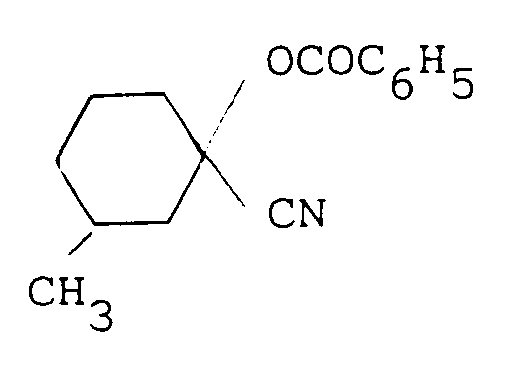
- Compounds of formula I and IA may be prepared by relatively straightforward esterification routes such as: which may be carried out using fairly standard esterification reagents and conditions between an appropriate acid (i) and the cyanohydrin (ii).
- the terpenoid cyanohydrin when the alicyclic hydrocarbon ring system is derived from a terpenoid, the terpenoid cyanohydrin if not commercially available, may be prepared from a suitable terpenoid ketone, many of which are commercially available. If necessary the terpenoid ketone may itself be prepared from a commercially available terpenoid precursor such as from a terpenoid secondary alcohol by oxidation.
- terpenoid ketones examples include: Camphors (1.1), the methones (1.2), carvones (1.3), fenchones (1.5), and verbenones (1.8).
- terpenoid alcohols which may be oxidised eg by Cr (VI) to terpenoid ketones, and the corresponding terpenoid ring systems listed in table 1 which may be prepared from them include: borneols (1.1), menthols (1.2), isopinocampheols (1.6), isopulegols (1.7) and verbenols (1.3 and 1.9)
- unsaturated sites on such structures as 1.3 or 1.7 or 1.8 listed in table 1 may be modified by addition or reduction to produce modified terpenoid systems, eg structures 1.4 and 1.9 may be produced from structures 1.3 and 1.8 respectively by reduction. This can be used to modify the conformation of the cyclic system.
- the terpenoid cyanohydrin may be prepared for example by steps (i) to (iii) of route 1 shown in Fig 1. Other routes will be apparent to those skilled in the field.
- a suitable cyanohydrin may be prepared from the corresponding cyclohexanone by reaction with hydrogen cyanide, ie:
- cyanohydrin When the cyanohydrin is prepared in these ways it may be formed as a mixture of the optical isomers which will need to be resolved if optically pure compounds are required. Known methods may be used for this. Route 1 is generally stereo-specific.
- carboxylic acids are commercially available which contain suitable cores X. When not available they may be synthesised from simple precursors, and acquisition of a suitable acid will therefore present no problem to one skilled in the art.
- a ferroelectric smectic liquid crystal material being a mixture of compounds, at least one of which is a compound of formula I.
- the compound of formula I is preferably in an optically active isomeric form.
- Compounds of formula I may be mixed with a wide range of smectic hosts to form a useful ferroelectric smectic liquid crystal composition. Such compositions containing them frequently have high Ps values, often combined with a long helical pitch in the Sc * phase.
- Preferred hosts include:
- Mixtures containing mixed fluoroterphenyls and cyanocyclohexyls are especially preferred as they can be electrically switched very quickly.
- the mixture may also contain additives, es to broaden the temperature range over which the Sc * phase persists, eg of formula V where Ra and Rb are independently C 1 - C 12 alkyl or alkoxy.
- ferroelectric smectic mixtures containing a compound of formula I often show quite large helical pitches
- the pitch length may be adjusted.
- At least two of these compounds may for example be compounds of formula I.
- Other optically active compounds which may be used in this way include:
- terphenyls disclosed in GBA8703103 which are particularly suitable when the mixture contains terphenyls of formula III, eg VII: where Ra and Rb in formulae VI and VII are independently C i - C 12 n-alkyl or n-alkoxy.
- the mixture according to this aspect of the invention may also contain racemic mixtures of compounds of formula I, and may typically have the following composition, expressed in weight percent.
- a liquid crystal electro-optical display device which uses a ferroelectric smectic liquid crystal material which is a mixture of compounds at least one of which is a compound of formula I.
- the liquid crystal materials of the invention may be used in any of the known types of ferroelectric smectic liquid crystal display device, eg the "Clark-Lagerwall Device” described in Appl. Phys Lett (1980), 36 899 and in Recent Developments in Condensed Matter Physics (1981), 4,309.
- the physics of this type of device and the method of constructing it are well known, and are described for example in PCT/GB85/00512, and PCT/GB86/0040.
- a device usually consists of two substrates, at least one of which is optically transparent, electrodes on the inner surfaces of the substrates by which a voltage may be applied and a layer of the liquid crystal material sandwiched between the substrates.
- the materials of the invention may be used in both the birefringence type display mode and the guest-host type display mode of the Clark-Lagerwall device.
- the device may for example be in the form of a clock, calculator or video screen display, and methods of making the device in this form will be well known to those skilled in the art.
- (+) - Camphor (1.52g 0.01 mol), trimethylsilyl cyanide (1.1g, 0.001 mol) and zinc iodide (30 mg) were refluxed in dichloromethane (40 ml) for 24 hours.
- the solvent was removed by evaporation and the residue purified by distillation under reduced pressure, affording the required 0-trimethyl silylcyanohydrin (II) as an oil. 1.95g (77% yield) was obtained, bp 70°C/0-01 mm Hg.
- the ferroelectric smectic liquid crystal material formed in this example could be used in a Clark-Lagerwall device.
- the carboxylic acid was prepared using the method described in GBA 8615098. This acid was esterified with the cyanohydrin prepared in example 1 to yield the compound: which showed a solid crystal to isotropic liquid transition at 68-70 ° C.
- the compound prepared in this example shows a smectic C phase which demonstrates its miscibility with S C liquid crystal materials.
- the product (19.5g) was stirred and heated under reflux for 2 hours with potassium hydroxide (8.4g), water (30ml) and methylated spirits (100ml). The solution was poured into water (100mls) and acidified with conc. HCL. The solid was filtered off, washed with water and dried in vacuo. The crude product was purified by crystallisation from acetic acid to a purity by HPLC of 99.6%.
- This acid was esterified with the cyanohydrin of example 1 to yield the optically active product, using the esterification conditions of example 1.
- a ferroelectric smectic liquid crystal mixture was prepared having a composition:
- This mixture had the following properties:
- a ferroelectric smectic liquid crystal mixture was prepared having a composition (in weight %): Note: in the formulae above 6.0 represents C 6 H 13 O- , 8 represents c 8 H 17 - etc
- the mixture had the properties:
- a ferroelectric smectic liquid crystal mixture was prepared having a composition:
- liquid crystal mixtures contain compounds of formula I in which -C.CN.R 2 .R 3 is a group of general formula: these compounds were prepared using the method outlined in route 1 shown in Fig 1, starting from the appropriate cyclohexanone in step 1 (ii).
- a 1:1:1 by weight mixture of: was used as the smectic host in each mixture.
- a ferroelectric smectic liquid crystal mixture was prepared which consisted of 10 wt % of the compound prepared in example 1 in solution in HI (see example 1).
- a liquid crystal cell comprises a layer 1 of liquid crystal material exhibiting a chiral smectic phase sandwiched between a glass slide 2 having a transparent conducting layer 3 on its surface, eg of tin oxide or indium oxide, and a glass slide 4 having a transparent conducting layer 5 on its surface.
- the slides 2,4 bearing the layers 3,5 are respectively coated by films 6,7 of a polyimide polymer.
- films 6 and 7 Prior to construction of the cell the films 6 and 7 are rubbed with a soft tissue in a given direction the rubbing directions being arranged parallel upon construction of the cell.
- a spacer 8 eg of polymethyl methacrylate, separates the slides 2, 4 to the required distance, eg 5 microns.
- the liquid crystal material 1 is introduced between the slides 2,4 by filling the space between the slides 2, 4 and spacer 8 and sealing the spacer 8 in a vacuum in a known way.
- the liquid crystal material is in the smectic A, nematic or isotropic liquid phase (obtained by heating the material) when it is introduced between the slides 2,4 to facilitate alignment of the liquid crystal molecules with the rubbing directions on the slides 2,4.
- a polarizer 9 is arranged with its polarization axis parallel to the rubbing direction on the films 6,7 and an analyzer (crossed polarizer) 10 is arranged with its polarization axis perpendicular to that rubbing direction.
- the layers 3 and 5 may be selectively shaped in a known way, eg by photoetching or deposition through a mask, eg to provide one or more display symbols, eg letters, numerals, words or graphics and the like as conventionally seen on displays.
- the electrode portions formed thereby may be addressed in a variety of ways which include multiplexed operation.
- ferroelectric mixture s described in the preceding examples were suitable for use as the material 1.
Landscapes
- Chemical & Material Sciences (AREA)
- Organic Chemistry (AREA)
- Crystallography & Structural Chemistry (AREA)
- Engineering & Computer Science (AREA)
- Materials Engineering (AREA)
- Liquid Crystal Substances (AREA)
- Organic Low-Molecular-Weight Compounds And Preparation Thereof (AREA)
Abstract
Claims (22)





Applications Claiming Priority (2)
| Application Number | Priority Date | Filing Date | Title |
|---|---|---|---|
| GB868629322A GB8629322D0 (en) | 1986-12-08 | 1986-12-08 | Cyano-terpenoid esters |
| GB8629322 | 1986-12-08 |
Publications (2)
| Publication Number | Publication Date |
|---|---|
| EP0333760A1 EP0333760A1 (fr) | 1989-09-27 |
| EP0333760B1 true EP0333760B1 (fr) | 1992-07-01 |
Family
ID=10608652
Family Applications (1)
| Application Number | Title | Priority Date | Filing Date |
|---|---|---|---|
| EP88900030A Expired - Lifetime EP0333760B1 (fr) | 1986-12-08 | 1987-12-08 | Esters cyano-alicycliques et des compositions de cristaux liquides |
Country Status (6)
| Country | Link |
|---|---|
| US (1) | US5147577A (fr) |
| EP (1) | EP0333760B1 (fr) |
| JP (1) | JP2788462B2 (fr) |
| DE (1) | DE3780173T2 (fr) |
| GB (1) | GB8629322D0 (fr) |
| WO (1) | WO1988004290A1 (fr) |
Families Citing this family (8)
| Publication number | Priority date | Publication date | Assignee | Title |
|---|---|---|---|---|
| US5180521A (en) * | 1986-02-17 | 1993-01-19 | Merck Patent Gesellschaft Mit Beschraenkter Haftung | Chiral compounds |
| US5384071A (en) * | 1986-06-23 | 1995-01-24 | Secretary Of State For Defence In Her Britannic Majesty's Government Of The U.K. Of Gt. Britian And Northern Ireland | Chiral liquid crystal compounds |
| JP2610467B2 (ja) * | 1987-11-12 | 1997-05-14 | キヤノン株式会社 | 液晶性化合物、それを含有する液晶組成物およびそれを使用した液晶素子 |
| ATE88462T1 (de) * | 1987-12-18 | 1993-05-15 | Secr Defence Brit | Cyanhydrinderivate und deren verwendung in fluessigkristallmaterialien und vorrichtungen. |
| US5273680A (en) * | 1988-03-10 | 1993-12-28 | Merck Patent Gesellschaft Mit Beschrankter Haftung | Fluorinated oligophenyls and their use in liquid crystal materials |
| GB9325438D0 (en) * | 1993-12-13 | 1994-02-16 | Secr Defence | Ferroelectric liquid crystal devices |
| GB9412709D0 (en) * | 1994-06-29 | 1994-08-17 | Secr Defence | Novel chiral cyclohexyl compounds |
| JP3765182B2 (ja) * | 1998-05-15 | 2006-04-12 | コニカミノルタホールディングス株式会社 | 液晶組成物および液晶表示素子 |
Family Cites Families (10)
| Publication number | Priority date | Publication date | Assignee | Title |
|---|---|---|---|---|
| DE3319781A1 (de) * | 1983-06-01 | 1984-12-13 | Merck Patent Gmbh, 6100 Darmstadt | Dekalincarbonitrile |
| JPS6110544A (ja) * | 1984-06-27 | 1986-01-18 | Ube Ind Ltd | シアノシクロヘキサン誘導体およびその液晶組成物 |
| DE3430482C1 (de) * | 1984-08-18 | 1991-07-18 | Merck Patent Gmbh, 6100 Darmstadt | Fluessigkristalline Phasen aufweisende Polymerzusammensetzungen |
| GB2170214A (en) * | 1985-01-26 | 1986-07-30 | Stc Plc | Ferroelectric smectic liquid crystal mixture |
| DE3443929A1 (de) * | 1984-12-01 | 1986-06-05 | Merck Patent Gmbh, 6100 Darmstadt | Carbonitrile |
| US4659499A (en) * | 1984-12-31 | 1987-04-21 | Crystaloid Electronics Company | Liquid crystal materials |
| JPS61233635A (ja) * | 1985-03-22 | 1986-10-17 | メルク・パテント・ゲゼルシヤフト・ミツト・ベシユレンクテル・ハフツング | ビシクロオクタン誘導体 |
| DE3533333A1 (de) * | 1985-09-18 | 1987-03-26 | Merck Patent Gmbh | Smektische fluessigkristalline phasen |
| US4886620A (en) * | 1985-09-18 | 1989-12-12 | Merck Patent Gesellschaft Mit Beschrankter Haftung | Smectic liquid-crystalline phases |
| DE3788243D1 (de) * | 1986-05-22 | 1994-01-05 | Hoffmann La Roche | Flüssigkristalline Derivate von Phenylbenzoat. |
-
1986
- 1986-12-08 GB GB868629322A patent/GB8629322D0/en active Pending
-
1987
- 1987-12-08 EP EP88900030A patent/EP0333760B1/fr not_active Expired - Lifetime
- 1987-12-08 DE DE8888900030T patent/DE3780173T2/de not_active Expired - Fee Related
- 1987-12-08 WO PCT/GB1987/000888 patent/WO1988004290A1/fr not_active Ceased
- 1987-12-08 JP JP63500395A patent/JP2788462B2/ja not_active Expired - Lifetime
-
1989
- 1989-06-01 US US07/359,790 patent/US5147577A/en not_active Expired - Fee Related
Non-Patent Citations (2)
| Title |
|---|
| C. R. ACAD. SC., Paris, vol. 272, no. 18, 3 May 1971; J.-P. COIC et al, "Chimie organique. - Synthèse d'esters de cyanhydrines en milieu anhydre", pp. 1554-1557, see table II, page 1555, last two compounds * |
| CHEMICAL ABSTRACTS, vol. 105, no. 12, 22 September 1986, Columbus, Ohio, US, pp. 578-579, abstract no. 105909t & JP-A-6 110 544 * |
Also Published As
| Publication number | Publication date |
|---|---|
| DE3780173T2 (de) | 1993-02-04 |
| JP2788462B2 (ja) | 1998-08-20 |
| GB8629322D0 (en) | 1987-01-14 |
| WO1988004290A1 (fr) | 1988-06-16 |
| US5147577A (en) | 1992-09-15 |
| JPH02501571A (ja) | 1990-05-31 |
| DE3780173D1 (de) | 1992-08-06 |
| EP0333760A1 (fr) | 1989-09-27 |
Similar Documents
| Publication | Publication Date | Title |
|---|---|---|
| EP0263843B1 (fr) | Composes et melanges pour cristaux liquides, et dispositifs les contenant | |
| EP0310620B1 (fr) | Composes a base de cristaux liquides chiraux | |
| US4784793A (en) | Terpenoid derivatives and liquid crystal materials and devices containing them | |
| US5061399A (en) | Optically active naphthalene compounds and liquid crystal materials and devices incorporating them | |
| JPS62294644A (ja) | 液晶性エステル | |
| US5147577A (en) | Cyano-alicyclic esters in liquid crystal compositions | |
| US5723069A (en) | Anti-ferroelectric liquid crystal compound and anti-ferroelectric liquid crystal composition | |
| EP0440643A1 (fr) | Terphenyls fluores 4''-cyano substitues. | |
| JPH0416454B2 (fr) | ||
| GB2200912A (en) | Terphenyl derivatives and liquid crystal materials containing them | |
| US5358663A (en) | Laterally cyano- and fluoro-substituted terphenyls | |
| JPS6210045A (ja) | 液晶化合物および液晶組成物 | |
| US5232625A (en) | Cyano-alicyclic esters in liquid crystal compositions | |
| JPS61207359A (ja) | ジフルオロ芳香族化合物 | |
| US5037576A (en) | Liquid crystal compounds, mixtures and devices | |
| JPH0339499B2 (fr) | ||
| JPH0225894B2 (fr) | ||
| JPH07116131B2 (ja) | チオエ−テル化合物及び液晶組成物 | |
| JPS61143350A (ja) | カルボニトリル化合物 | |
| EP0259423A1 (fr) | Composes de cristaux liquides, melanges et dispositifs. | |
| US5230830A (en) | Cyanohydrin derivatives and their use in liquid crystal materials and devices | |
| JP4366737B2 (ja) | フッ素置換4−(3−アルケニル)安息香酸とそのフェニルエステル誘導体及びそれを含有する液晶組成物 | |
| JP2745073B2 (ja) | フェニルアセチレン化合物 | |
| JP3613806B2 (ja) | フェニルビシクロヘキサン誘導体 | |
| JP2742548B2 (ja) | 光学活性化合物およびそれを含む液晶組成物 |
Legal Events
| Date | Code | Title | Description |
|---|---|---|---|
| PUAI | Public reference made under article 153(3) epc to a published international application that has entered the european phase |
Free format text: ORIGINAL CODE: 0009012 |
|
| 17P | Request for examination filed |
Effective date: 19890518 |
|
| AK | Designated contracting states |
Kind code of ref document: A1 Designated state(s): CH DE FR GB LI NL |
|
| 17Q | First examination report despatched |
Effective date: 19910422 |
|
| GRAA | (expected) grant |
Free format text: ORIGINAL CODE: 0009210 |
|
| AK | Designated contracting states |
Kind code of ref document: B1 Designated state(s): CH DE FR GB LI NL |
|
| REF | Corresponds to: |
Ref document number: 3780173 Country of ref document: DE Date of ref document: 19920806 |
|
| ET | Fr: translation filed | ||
| PLBE | No opposition filed within time limit |
Free format text: ORIGINAL CODE: 0009261 |
|
| STAA | Information on the status of an ep patent application or granted ep patent |
Free format text: STATUS: NO OPPOSITION FILED WITHIN TIME LIMIT |
|
| 26N | No opposition filed | ||
| REG | Reference to a national code |
Ref country code: GB Ref legal event code: 732E |
|
| REG | Reference to a national code |
Ref country code: GB Ref legal event code: IF02 |
|
| REG | Reference to a national code |
Ref country code: FR Ref legal event code: TP |
|
| NLS | Nl: assignments of ep-patents |
Owner name: QINETIQ LIMITED |
|
| PGFP | Annual fee paid to national office [announced via postgrant information from national office to epo] |
Ref country code: FR Payment date: 20021111 Year of fee payment: 16 |
|
| PGFP | Annual fee paid to national office [announced via postgrant information from national office to epo] |
Ref country code: GB Payment date: 20021115 Year of fee payment: 16 |
|
| PGFP | Annual fee paid to national office [announced via postgrant information from national office to epo] |
Ref country code: CH Payment date: 20021118 Year of fee payment: 16 |
|
| PGFP | Annual fee paid to national office [announced via postgrant information from national office to epo] |
Ref country code: DE Payment date: 20021119 Year of fee payment: 16 |
|
| PGFP | Annual fee paid to national office [announced via postgrant information from national office to epo] |
Ref country code: NL Payment date: 20021121 Year of fee payment: 16 |
|
| PG25 | Lapsed in a contracting state [announced via postgrant information from national office to epo] |
Ref country code: GB Free format text: LAPSE BECAUSE OF NON-PAYMENT OF DUE FEES Effective date: 20031208 |
|
| PG25 | Lapsed in a contracting state [announced via postgrant information from national office to epo] |
Ref country code: LI Free format text: LAPSE BECAUSE OF NON-PAYMENT OF DUE FEES Effective date: 20031231 Ref country code: CH Free format text: LAPSE BECAUSE OF NON-PAYMENT OF DUE FEES Effective date: 20031231 |
|
| REG | Reference to a national code |
Ref country code: GB Ref legal event code: 732E |
|
| PG25 | Lapsed in a contracting state [announced via postgrant information from national office to epo] |
Ref country code: NL Free format text: LAPSE BECAUSE OF NON-PAYMENT OF DUE FEES Effective date: 20040701 Ref country code: DE Free format text: LAPSE BECAUSE OF NON-PAYMENT OF DUE FEES Effective date: 20040701 |
|
| GBPC | Gb: european patent ceased through non-payment of renewal fee |
Effective date: 20031208 |
|
| REG | Reference to a national code |
Ref country code: CH Ref legal event code: PL |
|
| PG25 | Lapsed in a contracting state [announced via postgrant information from national office to epo] |
Ref country code: FR Free format text: LAPSE BECAUSE OF NON-PAYMENT OF DUE FEES Effective date: 20040831 |
|
| NLV4 | Nl: lapsed or anulled due to non-payment of the annual fee |
Effective date: 20040701 |
|
| REG | Reference to a national code |
Ref country code: FR Ref legal event code: ST |