EP0334307A2 - Dispositif d'étanchéité pour portes - Google Patents
Dispositif d'étanchéité pour portes Download PDFInfo
- Publication number
- EP0334307A2 EP0334307A2 EP19890105081 EP89105081A EP0334307A2 EP 0334307 A2 EP0334307 A2 EP 0334307A2 EP 19890105081 EP19890105081 EP 19890105081 EP 89105081 A EP89105081 A EP 89105081A EP 0334307 A2 EP0334307 A2 EP 0334307A2
- Authority
- EP
- European Patent Office
- Prior art keywords
- sealing
- sealing device
- door
- holder
- sealing body
- Prior art date
- Legal status (The legal status is an assumption and is not a legal conclusion. Google has not performed a legal analysis and makes no representation as to the accuracy of the status listed.)
- Granted
Links
Images
Classifications
-
- E—FIXED CONSTRUCTIONS
- E06—DOORS, WINDOWS, SHUTTERS, OR ROLLER BLINDS IN GENERAL; LADDERS
- E06B—FIXED OR MOVABLE CLOSURES FOR OPENINGS IN BUILDINGS, VEHICLES, FENCES OR LIKE ENCLOSURES IN GENERAL, e.g. DOORS, WINDOWS, BLINDS, GATES
- E06B7/00—Special arrangements or measures in connection with doors or windows
- E06B7/16—Sealing arrangements on wings or parts co-operating with the wings
- E06B7/18—Sealing arrangements on wings or parts co-operating with the wings by means of movable edgings, e.g. draught sealings additionally used for bolting, e.g. by spring force or with operating lever
- E06B7/20—Sealing arrangements on wings or parts co-operating with the wings by means of movable edgings, e.g. draught sealings additionally used for bolting, e.g. by spring force or with operating lever automatically withdrawn when the wing is opened, e.g. by means of magnetic attraction, a pin or an inclined surface, especially for sills
- E06B7/215—Sealing arrangements on wings or parts co-operating with the wings by means of movable edgings, e.g. draught sealings additionally used for bolting, e.g. by spring force or with operating lever automatically withdrawn when the wing is opened, e.g. by means of magnetic attraction, a pin or an inclined surface, especially for sills with sealing strip being moved to a retracted position by elastic means, e.g. springs
-
- E—FIXED CONSTRUCTIONS
- E06—DOORS, WINDOWS, SHUTTERS, OR ROLLER BLINDS IN GENERAL; LADDERS
- E06B—FIXED OR MOVABLE CLOSURES FOR OPENINGS IN BUILDINGS, VEHICLES, FENCES OR LIKE ENCLOSURES IN GENERAL, e.g. DOORS, WINDOWS, BLINDS, GATES
- E06B7/00—Special arrangements or measures in connection with doors or windows
- E06B7/16—Sealing arrangements on wings or parts co-operating with the wings
- E06B7/18—Sealing arrangements on wings or parts co-operating with the wings by means of movable edgings, e.g. draught sealings additionally used for bolting, e.g. by spring force or with operating lever
- E06B7/20—Sealing arrangements on wings or parts co-operating with the wings by means of movable edgings, e.g. draught sealings additionally used for bolting, e.g. by spring force or with operating lever automatically withdrawn when the wing is opened, e.g. by means of magnetic attraction, a pin or an inclined surface, especially for sills
Definitions
- the invention relates to a sealing device for doors according to the preamble of claim 1.
- Such sealing devices are used to seal the gap between the floor and the bottom edge of the door when the door is closed.
- the holder is inserted in a groove in the underside of the door.
- the release link protrudes over one of the long sides of the door and is pressed inwards by the door frame when the door is closed.
- the sealing body is moved downward out of the holder, which then seals the gap between the underside of the door and the floor.
- the groove must be made in the underside of the door in a complex manner.
- the sealing body is pressed out shortly before reaching the closed position, so that it grinds on the floor when the door is finally closed and is therefore exposed to premature wear.
- the mechanical actuation of the sealing body is prone to failure.
- the invention has for its object to design the generic sealing device so that it is exposed to little wear and can be assembled without machining the door.
- the sealing body is adjusted electrically.
- the switch is actuated, which can be arranged so that it is only switched on when the door is closed.
- This excites the electromagnet, which attracts the armature and thereby moves the sealing body out of the holder via the lifting device.
- This ensures that the sealing body is only moved into its sealing position when the door is already completely closed. This avoids unnecessary frictional contact between the door and the sealing body. Since the sealing body is raised, it can be placed directly in the floor, so that the door itself does not have to be processed.
- the sealing device according to the invention is therefore not only suitable for the conventional revolving doors, but also for sliding doors, folding walls and the like, since the sealing device no longer has to be accommodated in the door itself.
- the sealing body can therefore be designed so that its floor plan corresponds to the door to be sealed, folding wall and the like.
- the sealing device according to the invention can be provided not only in the floor, but also, for example, in the ceiling construction or in the vertically running edges of the door or wall opening.
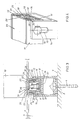
- the sealing device serves for sealing at the lower edge of revolving doors, sliding doors, folding walls and the like. It has a holder 1 (FIG. 3), which is not shown in FIGS. 1 and 2.
- the holder 1 is formed by a U-rail, which extends over the entire length of the sealing device.
- the holder can also consist of individual U-shaped rail sections 1a (FIG. 4), which are arranged at a distance along the sealing device.
- the bracket 1 lies with a crossbar 2 on a raw floor 3 and is fastened to the floor 3 with dowels 4 and the like.
- 4 set screws 5 are screwed into the crossbar 2 in the area on both sides of the dowels. They can be supported on the floor 3 so that the holder 1 can be easily adjusted with respect to the floor 3 by unscrewing or screwing in these adjusting screws 5.
- a floor covering 6 is applied to the floor 3, for example a carpet. Its top is labeled 7. But it is also possible to arrange the holder 1 sunk directly in the floor 3.
- the legs 8, 9 of the bracket 1 are directed upward and end at a distance from the top 7 of the floor covering 6. As a result, the bracket 1 is concealed in the floor covering 6 so that it does not interfere with the door 10 open.
- a guide body 11 is fastened between the legs 8, 9, which is also designed as a U-rail, the upward legs 12, 13 of which are on the inside the legs 8,9 of the holder 1 rest.
- the legs 12, 13 end in the top 7 of the floor covering 6.
- a cross piece 14 of the guide body 11 lies at a distance above the cross piece 2 of the bracket 1. So that the guide body 11 can be aligned exactly with the bracket 1 and the top 7 of the floor covering 6 ,
- the legs 8, 9 of the holder 1 are provided with vertical longitudinal slots 15 (FIG. 4), through which screws 16 project into the legs 12, 13 of the guide body 11. After loosening the screws 16, the guide body 11 can be moved relative to the holder 1, so that it can be precisely aligned in place.
- the longitudinal slots 15 are provided near the free ends of the legs 7, 8 of the holder 1. This has the consequence that when tightening the screws 16, the legs are bent against the guide body 11, whereby the fastening of the guide body 11 is improved.
- a holding body 18 is fastened in the guide body 11 with the interposition of a damping layer 17, which rests on the crossbar 14 of the guide body and can be formed, for example, by a plastic strip, which is also advantageously designed as a U-rail.
- the holding body 18 rests with its transverse web 19 on the damping layer 17.
- the legs 20, 21 of the holding body 18 are directed upward and are spaced apart from the legs 12, 13 of the guide body 11.
- the legs 24.25 of the sealing body 23 end at a distance from the damping layer 17.
- the transverse web 22 of the sealing body 23 is flush with the top 7 of the floor covering 6.
- the top of the floor covering 6 is not interrupted in the area of the sealing device or is not provided with shoulders, so that the sealing device in the Rest position does not bother.
- a cross-sectionally U-shaped sealing element 26 is attached to the underside of the transverse web 22 of the sealing body 23 (FIG. 3), the legs 27, 28 of which diverge in the direction of the transverse web 19 of the holding body 18 and on the inner sides of the legs 20 facing one another , 21 of the holding body 18 bear under slight elastic prestress.
- the sealing element 26 is preferably made of sound-absorbing material, so that when the door is closed, no or only a very small proportion of sound can pass through the sealing device under the door.
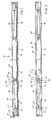
- an actuating device 29, 30 is arranged on the crosspiece 19 of the holding body 18 (FIGS. 1 and 2), by means of which the sealing body 23 is adjusted into its sealing position when the door 10 is closed.
- the two actuating devices 29, 30 are of identical design, but are arranged mirror-symmetrically to one another in the holding body 18. Therefore, only the actuating device 29 is described in detail below.
- It has two levers 31, 32 lying parallel to one another, which are articulated at the ends of two swivel arms 33 and 34 with their end facing away from the end of the holding body 18. They rest on the mutually facing inner sides of the levers 31, 32 (FIG. 2).
- a roller 36 sits on the axis 35 connecting the levers 31, 32 and the swivel arms 33, 34 in a freely rotatable manner.
- a plate 37 On the crosspiece 19 of the holding body 18, a plate 37 is attached, which carries two vertically projecting tabs 38 and 39. An axis 40 is mounted in them, on which the swivel arms 33, 34 sit.
- One of the swivel arms 33, 34 engages one end of a tension spring 41, which can be fastened at its other end to the plate 37 or to the crossbar 19 of the holding body 18.
- the levers 31, 32 are articulated at the other end to a threaded bush 42 into which an adjusting screw 43 of an armature 44 of an electromagnet 45 is screwed.
- the electromagnet 45 is fixed in the holding body 18 near one end thereof.
- the armature 44 is guided between the legs 20, 21 and the crossbars 19 and 22.
- the roller 36 rests on a leaf spring 46 fastened to the underside of the transverse web 22 of the sealing body 23, the end of which directed towards the electromagnet 45 is directed obliquely downwards against the transverse web 19 of the holding body 18 (FIG. 1).
- This deflection of the free spring end 47 is achieved by a set screw 48 screwed into the transverse web 22 of the sealing body 23, which abuts the leaf spring end 47 and, depending on the screwed-in position, bends it more or less downward against the transverse web 19 of the holding body 18.
- the electromagnet 45 is connected via leads 49 to a switch (not shown) which is provided in the door frame and which is actuated when the door 10 is closed.
- Figures 1 to 4 show the sealing device in its rest position, in which the sealing body 23 with its transverse web 22 is flush with the top 7 of the floor covering 6. If the door 10 is closed, then the Closing movement of the switch provided in the door frame for the electromagnet 45 is actuated. As a result, the electromagnets 45 are excited at the two ends of the holding body 18 and attract the armatures 44 against the force of the tension springs 41.
- the pivot arms 33, 34 are pivoted about the axis 40 via the levers 31, 32.
- the rollers 36 of the two actuating devices 29, 30 are taken along and run onto the end 47 of the leaf springs 46 bent obliquely downwards, as a result of which the sealing body 23 is adjusted upwards against the door 10 in accordance with the bending of the leaf spring end 47.
- the cross piece 22 of the sealing body 23 then comes into contact with a sealing strip 50 (FIG. 3) fastened to the underside of the door, which can consist, for example, of foam rubber. This guarantees a perfect seal.
- the stroke of the sealing body 13 can be continuously and precisely adjusted, since the stroke for a given stroke of the lever 31, 32 is determined by the degree of angulation of the free end 47 of the leaf springs 46. In this way, it is possible without difficulty to precisely adjust the stroke of the sealing body 23 on the spot. Even after machining the door 10, the stroke of the sealing body 23 can be easily adjusted with the set screws 48.
- the electromagnets 45 remain energized and thus the sealing body 23 in its sealing position.
- the switch in the door frame is released, causing the electromagnets 45 to drop out.
- the tension springs 41 then pivot the swivel arms 33, 34 back, as a result of which the armatures 44 are pushed back into the starting position shown in FIG. 1 via the levers 31, 32 in the guide body 18.
- the rollers 36 come free from the bent ends 47 of the leaf springs 46, whereby the sealing body 23 falls back down to its rest position (FIG. 3) under its own weight.
- a stop is provided on the tabs 38, 39, which determines the end position of these swivel arms. Such a stop can also be provided for the armature 44, whereby the starting position of the actuating devices 29, 30 can also be determined.
- damping can be provided between the electromagnet and the armature, for example pressure springs or a suitable damping material.
- the actuating devices 29, 30 can also be adapted on the spot to the installation conditions.
- the levers 31, 32 can easily be shortened to the required size.
- the two leaf springs 46 can be bent differently with the adjusting screws 48, so that, for example, even in the case of obliquely installed sealing devices, the sealing body 23 lies perfectly against the sealing strip 50 of the door 10 in its sealing position.
Landscapes
- Engineering & Computer Science (AREA)
- Civil Engineering (AREA)
- Structural Engineering (AREA)
- Specific Sealing Or Ventilating Devices For Doors And Windows (AREA)
- Glass Compositions (AREA)
- Cold Air Circulating Systems And Constructional Details In Refrigerators (AREA)
- Gasket Seals (AREA)
Priority Applications (1)
| Application Number | Priority Date | Filing Date | Title |
|---|---|---|---|
| AT89105081T ATE95881T1 (de) | 1988-03-23 | 1989-03-22 | Dichtungseinrichtung fuer tueren. |
Applications Claiming Priority (2)
| Application Number | Priority Date | Filing Date | Title |
|---|---|---|---|
| DE3809669 | 1988-03-23 | ||
| DE3809669A DE3809669C2 (de) | 1988-03-23 | 1988-03-23 | Dichtungseinrichtung für Türen |
Publications (3)
| Publication Number | Publication Date |
|---|---|
| EP0334307A2 true EP0334307A2 (fr) | 1989-09-27 |
| EP0334307A3 EP0334307A3 (en) | 1990-06-06 |
| EP0334307B1 EP0334307B1 (fr) | 1993-10-13 |
Family
ID=6350407
Family Applications (1)
| Application Number | Title | Priority Date | Filing Date |
|---|---|---|---|
| EP89105081A Expired - Lifetime EP0334307B1 (fr) | 1988-03-23 | 1989-03-22 | Dispositif d'étanchéité pour portes |
Country Status (3)
| Country | Link |
|---|---|
| EP (1) | EP0334307B1 (fr) |
| AT (1) | ATE95881T1 (fr) |
| DE (2) | DE3809669C2 (fr) |
Cited By (9)
| Publication number | Priority date | Publication date | Assignee | Title |
|---|---|---|---|---|
| DE3935790A1 (de) * | 1989-10-27 | 1991-05-02 | Hahn Gmbh & Co Kg Dr | Automatische bodendichtung fuer eine tuer |
| EP0489537A1 (fr) * | 1990-12-05 | 1992-06-10 | Draftex Industries Limited | Dispositif d'etanchéité |
| US5253453A (en) * | 1990-12-12 | 1993-10-19 | Draftex Industries Limited | Sealing arrangements |
| EP0609755A1 (fr) * | 1993-01-29 | 1994-08-10 | Firma F. Athmer | Dispositif d'étanchéité pour des bas de portes |
| US5339488A (en) * | 1990-11-13 | 1994-08-23 | Draftex Industries Limited | Sealing and wiping arrangement including inflatable chamber |
| EP0424708B1 (fr) * | 1989-10-27 | 1996-07-03 | Dr. Hahn GmbH & Co. KG | Dispositif d'étanchéité de sol pour une porte |
| DE20005376U1 (de) * | 2000-03-22 | 2001-07-26 | Kross, Manfred, 58644 Iserlohn | Bodendichtung für ein Türblatt |
| EP1944457A3 (fr) * | 2007-01-09 | 2011-04-13 | F. Athmer OHG | Dispositif de joint doté d'un joint pouvant être enclenché ou déclenché |
| EP2682556A1 (fr) | 2012-07-02 | 2014-01-08 | Planet GDZ AG | Dispositif dýétanchéité pour une porte ou une fenêtre |
Families Citing this family (1)
| Publication number | Priority date | Publication date | Assignee | Title |
|---|---|---|---|---|
| DE10134632A1 (de) * | 2001-07-17 | 2003-07-17 | Micro Mechatronic Technologies | Dichtungseinrichtung, insbesondere für eine Tür oder ein Fenster |
Family Cites Families (7)
| Publication number | Priority date | Publication date | Assignee | Title |
|---|---|---|---|---|
| DE900492C (de) * | 1952-02-02 | 1953-12-28 | Hans Willi | Abschlussvorrichtung an einer Tuer ohne Schwelle |
| US2870495A (en) * | 1954-09-16 | 1959-01-27 | Wayne Iron Works | Closure sealing device |
| FR1434355A (fr) * | 1965-02-25 | 1966-04-08 | Plinthe automatique | |
| CH584831A5 (fr) * | 1974-08-27 | 1977-02-15 | Schweizer Ernst Ag Metallbau Z | |
| DE2509958A1 (de) * | 1975-03-07 | 1976-09-23 | Wagenbrenner Helmut | Abdichtungsvorrichtung fuer fugen zwischen beweglichen bauteilen |
| US4519165A (en) * | 1984-01-05 | 1985-05-28 | F. Athmer | Sealing device for the bottom of a door |
| DE3533782A1 (de) * | 1985-09-21 | 1987-03-26 | Harry Frey | Tuerdichtung vorzugsweise fuer schwellenlose tueren |
-
1988
- 1988-03-23 DE DE3809669A patent/DE3809669C2/de not_active Expired - Fee Related
-
1989
- 1989-03-22 AT AT89105081T patent/ATE95881T1/de active
- 1989-03-22 EP EP89105081A patent/EP0334307B1/fr not_active Expired - Lifetime
- 1989-03-22 DE DE89105081T patent/DE58905866D1/de not_active Expired - Fee Related
Cited By (9)
| Publication number | Priority date | Publication date | Assignee | Title |
|---|---|---|---|---|
| DE3935790A1 (de) * | 1989-10-27 | 1991-05-02 | Hahn Gmbh & Co Kg Dr | Automatische bodendichtung fuer eine tuer |
| EP0424708B1 (fr) * | 1989-10-27 | 1996-07-03 | Dr. Hahn GmbH & Co. KG | Dispositif d'étanchéité de sol pour une porte |
| US5339488A (en) * | 1990-11-13 | 1994-08-23 | Draftex Industries Limited | Sealing and wiping arrangement including inflatable chamber |
| EP0489537A1 (fr) * | 1990-12-05 | 1992-06-10 | Draftex Industries Limited | Dispositif d'etanchéité |
| US5253453A (en) * | 1990-12-12 | 1993-10-19 | Draftex Industries Limited | Sealing arrangements |
| EP0609755A1 (fr) * | 1993-01-29 | 1994-08-10 | Firma F. Athmer | Dispositif d'étanchéité pour des bas de portes |
| DE20005376U1 (de) * | 2000-03-22 | 2001-07-26 | Kross, Manfred, 58644 Iserlohn | Bodendichtung für ein Türblatt |
| EP1944457A3 (fr) * | 2007-01-09 | 2011-04-13 | F. Athmer OHG | Dispositif de joint doté d'un joint pouvant être enclenché ou déclenché |
| EP2682556A1 (fr) | 2012-07-02 | 2014-01-08 | Planet GDZ AG | Dispositif dýétanchéité pour une porte ou une fenêtre |
Also Published As
| Publication number | Publication date |
|---|---|
| DE3809669C2 (de) | 1996-10-24 |
| DE58905866D1 (de) | 1993-11-18 |
| ATE95881T1 (de) | 1993-10-15 |
| DE3809669A1 (de) | 1989-10-12 |
| EP0334307A3 (en) | 1990-06-06 |
| EP0334307B1 (fr) | 1993-10-13 |
Similar Documents
| Publication | Publication Date | Title |
|---|---|---|
| EP0509961B1 (fr) | Dispositif d'étanchéité, particulièrement pour battants de portes | |
| EP3452680B1 (fr) | Dispositif d'étanchéité | |
| EP3452681B1 (fr) | Dispositif d'étanchéité pour une porte couilissante | |
| DE10014760B4 (de) | Heckscheibenrollo mit gefederten Rollen | |
| DE3809669C2 (de) | Dichtungseinrichtung für Türen | |
| EP3667010B1 (fr) | Dispositif de butée pour un joint de porte automatique, en particulier pour une porte pivotante ou battante, agencement d'un joint de porte automatique et d'un dispositif de butée | |
| DE19516588C1 (de) | Feststellvorrichtung für Fenster, Türen od. dgl. | |
| EP1064448B1 (fr) | Porte coulissante dotee d'un dispositif d'ouverture ou de fermeture d'urgence | |
| DE19806405A1 (de) | Einseitig auslösbare Türdichtungsvorrichtung | |
| EP2871312B1 (fr) | Dispositif d'aération par entrebâillement pour porte ou fenêtre coulissante et porte ou fenêtre coulissante | |
| CH627228A5 (en) | Automatic door seal for doors without thresholds | |
| WO2019158439A1 (fr) | Dispositif anti-effraction abaissable | |
| EP0019076B1 (fr) | Dispositif de guidage pour le déplacement linéaire d'au moins un objet fixé sur un support, en particulier pour le déplacement simultané d'éléments de meuble escamotables | |
| DE19533153A1 (de) | Schiebetür mit Notöffnungs- oder Notschließeinrichtung | |
| EP1001126B1 (fr) | Dispositif de fixage | |
| DE69310069T2 (de) | Vorrichtung zum Öffnen eines insbesondere verschieblichen Fensters oder Türe | |
| EP0166811A1 (fr) | Ferrure pour panneaux coulissants | |
| DE3015836A1 (de) | Sicherheitsvorrichtung fuer kraftfahrzeugschiebedaecher u.dgl. | |
| DE19725357A1 (de) | Schiebetürschließeinrichtung | |
| EP3770370B1 (fr) | Dispositif de joint d'étanchéité de porte | |
| DE202004005162U1 (de) | Bodendichtung mit Federband | |
| DE1683060C3 (de) | Dichtungsanordnung für schwellenlose Türen | |
| DE3701300A1 (de) | Tuerschliesser | |
| DE202005011088U1 (de) | Insektenschutzvorrichtung | |
| WO2025124952A1 (fr) | Porte coulissante |
Legal Events
| Date | Code | Title | Description |
|---|---|---|---|
| PUAI | Public reference made under article 153(3) epc to a published international application that has entered the european phase |
Free format text: ORIGINAL CODE: 0009012 |
|
| AK | Designated contracting states |
Kind code of ref document: A2 Designated state(s): AT BE CH DE ES FR GB GR IT LI LU NL SE |
|
| PUAL | Search report despatched |
Free format text: ORIGINAL CODE: 0009013 |
|
| AK | Designated contracting states |
Kind code of ref document: A3 Designated state(s): AT BE CH DE ES FR GB GR IT LI LU NL SE |
|
| 17P | Request for examination filed |
Effective date: 19901206 |
|
| 17Q | First examination report despatched |
Effective date: 19910726 |
|
| RAP1 | Party data changed (applicant data changed or rights of an application transferred) |
Owner name: WEISSSCHAEDEL, HEDWIG |
|
| RIN1 | Information on inventor provided before grant (corrected) |
Inventor name: WEISSSCHAEDEL, HANS |
|
| GRAA | (expected) grant |
Free format text: ORIGINAL CODE: 0009210 |
|
| AK | Designated contracting states |
Kind code of ref document: B1 Designated state(s): AT BE CH DE ES FR GB GR IT LI LU NL SE |
|
| PG25 | Lapsed in a contracting state [announced via postgrant information from national office to epo] |
Ref country code: IT Free format text: LAPSE BECAUSE OF FAILURE TO SUBMIT A TRANSLATION OF THE DESCRIPTION OR TO PAY THE FEE WITHIN THE PRE;WARNING: LAPSES OF ITALIAN PATENTS WITH EFFECTIVE DATE BEFORE 2007 MAY HAVE OCCURRED AT ANY TIME BEFORE 2007. THE CORRECT EFFECTIVE DATE MAY BE DIFFERENT FROM THE ONE RECORDED.SCRIBED TIME-LIMIT Effective date: 19931013 Ref country code: GB Effective date: 19931013 Ref country code: GR Free format text: LAPSE BECAUSE OF FAILURE TO SUBMIT A TRANSLATION OF THE DESCRIPTION OR TO PAY THE FEE WITHIN THE PRESCRIBED TIME-LIMIT Effective date: 19931013 Ref country code: ES Free format text: THE PATENT HAS BEEN ANNULLED BY A DECISION OF A NATIONAL AUTHORITY Effective date: 19931013 Ref country code: SE Effective date: 19931013 |
|
| REF | Corresponds to: |
Ref document number: 95881 Country of ref document: AT Date of ref document: 19931015 Kind code of ref document: T |
|
| ET | Fr: translation filed | ||
| REF | Corresponds to: |
Ref document number: 58905866 Country of ref document: DE Date of ref document: 19931118 |
|
| GBV | Gb: ep patent (uk) treated as always having been void in accordance with gb section 77(7)/1977 [no translation filed] |
Effective date: 19931013 |
|
| EPTA | Lu: last paid annual fee | ||
| PLBE | No opposition filed within time limit |
Free format text: ORIGINAL CODE: 0009261 |
|
| STAA | Information on the status of an ep patent application or granted ep patent |
Free format text: STATUS: NO OPPOSITION FILED WITHIN TIME LIMIT |
|
| 26N | No opposition filed | ||
| PGFP | Annual fee paid to national office [announced via postgrant information from national office to epo] |
Ref country code: FR Payment date: 19970320 Year of fee payment: 9 |
|
| PGFP | Annual fee paid to national office [announced via postgrant information from national office to epo] |
Ref country code: BE Payment date: 19970325 Year of fee payment: 9 |
|
| PGFP | Annual fee paid to national office [announced via postgrant information from national office to epo] |
Ref country code: NL Payment date: 19970331 Year of fee payment: 9 |
|
| PGFP | Annual fee paid to national office [announced via postgrant information from national office to epo] |
Ref country code: CH Payment date: 19970407 Year of fee payment: 9 |
|
| PGFP | Annual fee paid to national office [announced via postgrant information from national office to epo] |
Ref country code: LU Payment date: 19970410 Year of fee payment: 9 |
|
| PG25 | Lapsed in a contracting state [announced via postgrant information from national office to epo] |
Ref country code: LU Free format text: LAPSE BECAUSE OF NON-PAYMENT OF DUE FEES Effective date: 19980322 |
|
| PG25 | Lapsed in a contracting state [announced via postgrant information from national office to epo] |
Ref country code: CH Free format text: LAPSE BECAUSE OF NON-PAYMENT OF DUE FEES Effective date: 19980331 Ref country code: FR Free format text: THE PATENT HAS BEEN ANNULLED BY A DECISION OF A NATIONAL AUTHORITY Effective date: 19980331 Ref country code: LI Free format text: LAPSE BECAUSE OF NON-PAYMENT OF DUE FEES Effective date: 19980331 Ref country code: BE Free format text: LAPSE BECAUSE OF NON-PAYMENT OF DUE FEES Effective date: 19980331 |
|
| PGFP | Annual fee paid to national office [announced via postgrant information from national office to epo] |
Ref country code: AT Payment date: 19980331 Year of fee payment: 10 |
|
| PGFP | Annual fee paid to national office [announced via postgrant information from national office to epo] |
Ref country code: DE Payment date: 19980523 Year of fee payment: 10 |
|
| BERE | Be: lapsed |
Owner name: WEISSSCHADEL HEDWIG Effective date: 19980331 |
|
| PG25 | Lapsed in a contracting state [announced via postgrant information from national office to epo] |
Ref country code: NL Free format text: LAPSE BECAUSE OF NON-PAYMENT OF DUE FEES Effective date: 19981001 |
|
| REG | Reference to a national code |
Ref country code: CH Ref legal event code: PL |
|
| NLV4 | Nl: lapsed or anulled due to non-payment of the annual fee |
Effective date: 19981001 |
|
| REG | Reference to a national code |
Ref country code: FR Ref legal event code: ST |
|
| PG25 | Lapsed in a contracting state [announced via postgrant information from national office to epo] |
Ref country code: AT Free format text: LAPSE BECAUSE OF NON-PAYMENT OF DUE FEES Effective date: 19990322 |
|
| PG25 | Lapsed in a contracting state [announced via postgrant information from national office to epo] |
Ref country code: DE Free format text: LAPSE BECAUSE OF NON-PAYMENT OF DUE FEES Effective date: 20000101 |