EP0335579A2 - Photo-Aufzeichnungsmedien und Photo-Aufzeichnungsmethode - Google Patents
Photo-Aufzeichnungsmedien und Photo-Aufzeichnungsmethode Download PDFInfo
- Publication number
- EP0335579A2 EP0335579A2 EP89302849A EP89302849A EP0335579A2 EP 0335579 A2 EP0335579 A2 EP 0335579A2 EP 89302849 A EP89302849 A EP 89302849A EP 89302849 A EP89302849 A EP 89302849A EP 0335579 A2 EP0335579 A2 EP 0335579A2
- Authority
- EP
- European Patent Office
- Prior art keywords
- photo
- photochromic compound
- recording medium
- stretched film
- liquid crystal
- Prior art date
- Legal status (The legal status is an assumption and is not a legal conclusion. Google has not performed a legal analysis and makes no representation as to the accuracy of the status listed.)
- Granted
Links
Images

Classifications
-
- G—PHYSICS
- G11—INFORMATION STORAGE
- G11B—INFORMATION STORAGE BASED ON RELATIVE MOVEMENT BETWEEN RECORD CARRIER AND TRANSDUCER
- G11B7/00—Recording or reproducing by optical means, e.g. recording using a thermal beam of optical radiation by modifying optical properties or the physical structure, reproducing using an optical beam at lower power by sensing optical properties; Record carriers therefor
- G11B7/24—Record carriers characterised by shape, structure or physical properties, or by the selection of the material
- G11B7/241—Record carriers characterised by shape, structure or physical properties, or by the selection of the material characterised by the selection of the material
-
- G—PHYSICS
- G11—INFORMATION STORAGE
- G11B—INFORMATION STORAGE BASED ON RELATIVE MOVEMENT BETWEEN RECORD CARRIER AND TRANSDUCER
- G11B7/00—Recording or reproducing by optical means, e.g. recording using a thermal beam of optical radiation by modifying optical properties or the physical structure, reproducing using an optical beam at lower power by sensing optical properties; Record carriers therefor
- G11B7/004—Recording, reproducing or erasing methods; Read, write or erase circuits therefor
- G11B7/0055—Erasing
- G11B7/00552—Erasing involving colour change media
-
- G—PHYSICS
- G11—INFORMATION STORAGE
- G11B—INFORMATION STORAGE BASED ON RELATIVE MOVEMENT BETWEEN RECORD CARRIER AND TRANSDUCER
- G11B7/00—Recording or reproducing by optical means, e.g. recording using a thermal beam of optical radiation by modifying optical properties or the physical structure, reproducing using an optical beam at lower power by sensing optical properties; Record carriers therefor
- G11B7/004—Recording, reproducing or erasing methods; Read, write or erase circuits therefor
- G11B7/0045—Recording
-
- G—PHYSICS
- G11—INFORMATION STORAGE
- G11B—INFORMATION STORAGE BASED ON RELATIVE MOVEMENT BETWEEN RECORD CARRIER AND TRANSDUCER
- G11B7/00—Recording or reproducing by optical means, e.g. recording using a thermal beam of optical radiation by modifying optical properties or the physical structure, reproducing using an optical beam at lower power by sensing optical properties; Record carriers therefor
- G11B7/24—Record carriers characterised by shape, structure or physical properties, or by the selection of the material
- G11B7/241—Record carriers characterised by shape, structure or physical properties, or by the selection of the material characterised by the selection of the material
- G11B7/242—Record carriers characterised by shape, structure or physical properties, or by the selection of the material characterised by the selection of the material of recording layers
- G11B7/244—Record carriers characterised by shape, structure or physical properties, or by the selection of the material characterised by the selection of the material of recording layers comprising organic materials only
- G11B7/25—Record carriers characterised by shape, structure or physical properties, or by the selection of the material characterised by the selection of the material of recording layers comprising organic materials only containing liquid crystals
Definitions
- This invention relates to photo-recording media and photo-recording method, and more particularly to stable and highly sensitive photo-recording media containing photochromic compounds and photo-recording method using said photo-recording media.
- photo-recording media utilizing change in absorption spectrum before and after photoreaction of photochromic compounds.
- the readout thereof when recorded information is read-out, the readout thereof must be carried out by means of light falling within the wavelength region at which the photochromic compounds absorb light. Accordingly, it follows that the light used in reading out such records is light for reading out the recorded information and, at the same time, is also light for erasing said recorded information.
- there was such a serious practical problem that to carry out reproduction of the information is essentially to destroy said information, and hence when the information recorded in the photochromic compounds is read out, said information is destroyed and no information can be read out again.
- Japanese Patent L-O-P Publn. No. 209186/1987 in this connection discloses photomemory materials which are said to be those capable of inhibiting disappearance of memories recorded in photochromic compounds, said photomemory materials being prepared by dissolving or dispersing in solid substances having a cholesteric liquid crystal phase such photochromic compounds as capable of changing their molecular structure by irradiation with light different in wavelength.
- this process there is involved such a problem that a procedure for synthesizing the cholesteric liquid crystal which is a medium in which the dye is dissolved or dispersed is much complicated, because said cholesteric liquid crystal must have in the molecule asymmetric carbon atoms and also must be optically resolved.
- the present invention is to solve such problems as mentioned above, and it is an object of the invention to provide stable and highly sensitive photo-recording media containing photochromic compounds, said photo-recording media being capable of recording, reading and rewriting a desired information easily and stably, and a photo-recording method using said photo-recording media.
- a photo-recording medium comprises a photochromic compound having been dispersed or dissolved in a stretched film or nematic liquid crystal or smectic liquid crystal, the transition moment of light absorption of said photochromic compound being orientated in a definito direction.
- an information is written in a photochromic compound with a structure change of the photochromic compound with a light beam irradiation, and a difference between apparent angles of rotation before and after the light beam irradiation is detected by means of light beam having the wavelength region at which said photochromic compound does not absorb light, thereby reading the recorded information.
- photochromic compounds are used as photo-recording media, said photochromic compounds being dispersed in stretched films or dispersed in nematic liquid crystal or smectic liquid crystals, and the transition moment of light absorption of which being orientated in a definite direction.
- a compound, the transition moment of light absorption of which has been orientated in a definite direction apparently exhibits optical activity in the absorption wavelength region and in the neighborhood thereof.
- a photochromic compound the transition moment of light absorption of which has been orientated in a definite direction
- an information can be written in the compound and the recorded information can be changed and, at the same time, its apparent angle of rotation can be changed by irradiating the compound with light of the absorption wavelength region at which the compound absorbs light.
- Photochromic compounds used in the present invention are not always required to have optical activity in the molecule, as mentioned previously. Accordingly, all sorts of photochromic compounds may be used in the present invention, including spiropyran, fulgide, thioindigo, azobenzene and derivatives thereof.
- photochromic compounds of the kind usable in the present invention include those as listed below. 1,3, 3-Trimethylindolino-6′ -nitrobenzospiropyran, 1 ,3 3-trimethylindolino-6′-nitro-8′-methoxybenzospiropyran, 1,3,3,-trimethylindolino-6,8′-dibromobenzospiropyran, 1,3,3-trimethylindolino-5′-nitro-8′-methoxybenzospiropyran, benzothiazolinospiropyran, 1,3,3-trimethylspiro[indolino-2,3-naphtho(2,1-b)(1,4)oxazine], 1,3,3trimethyl-5-chlorospiro[indolino-2,3-naphtho(2,1-b)(1,4)oxazine], 1-(octyl) 3,3-dimethylspiro[indolino-2,3-nap
- the photochromic compound as exemplified above is dispersed in a stretched film or dispersed in a nematic liquid crystal smectic liquid crystal, thereby orientating the transition moment of light absorption of said compound in a definite direction.
- the photo-recording media comprising a stretched film in which a photochromic compound has been dispersed is first illustrated.
- the stretched film itself used in the present invention has an-apparent angle of rotation due to its double refraction and an apparent angle of rotation of the photochromic compound due to its absorption can be observed in the form of apparent angle of rotation which is added to the apparent angle of rotation of the stretched film itself.
- Polymers used in the present invention to constitute such stretched film as mentioned above include amorphous polyolefin resins; polymethacrylic resins such as polymethyl methacrylate; polyacrylic resins such as polymethyl acrylate; polycarbonate resins; diallyl phthalate resins; polyester resins; polyether sulfone; polyethyl ketone; methylpentene polymers; polyarylate resins; polyethylene; polyolefins such as polypropylene and polybutene; polyphenylene sulfide; nylon; fluorine-contained resins; polyvinyl chloride; polystyrene; polyacrylonitrile; polyvinyl acetal; polyurethane; polyether; polyvinyl alcohol; polyvinyl acetate; polyvinyl ether; and cellulose derivatives.
- polymethacrylic resins such as polymethyl methacrylate
- polyacrylic resins such as polymethyl acrylate
- polycarbonate resins diallyl
- polystyrene resins preferably used are polyolefins such as polyethylene and polypropylene, polyvinyl alcohol, polymethacrylic resins such as polymethyl methacrylate, polyester resins and amorphous polyolefin resins.
- the stretched film used in the present invention is preferably stretched in the monoaxial direction, and the drawing ratio of the film, though it may vary depending on the kind of film, is generally desirable to be 1.2-10000 times, preferably 1.2-100 times and more preferably 2-50 times.
- the photo-recording media comprising the nematic or smectic liquid crystal in which the photochromic compound has been dissolved or dispersed is illustrated.
- the nematic or smectic liquid crystal used in the present invention includes p-alkyl-p′-alkoxyazoxybenzene, p-alkoxybenzylidene-p′-alkylaniline, p-alkylbenzylidene-p′-cyanoaniline, p-alkoxybenzylidene-p′-cyanoaniline, phenyl benzoate, p-alkyl-p′-cyanobiphenyl, p-cyano-phenylcyclohexane, cyclohexyl-cyclohexane, p-cyanophenylpyrimidine,
- alkyl represented R or alkoxy represented R′ preferably from 1 -15, in particular, 3 - 9 carbon atoms.
- the photochromic compound is dissolved in the nematic or smectic liquid crystal and thereby to orientate a transition moment of light absorption of said photochromic compound
- the photochromic compound is dissolved or dispersed in the nematic liquid crystal, and the resulting nematic liquid crystal having dissolved or dispersed therein may be injected into a liquid crystal cell.
- the amount of the above-mentioned photochromic compound dispersed or dissolved in the stretched film is preferably 1 x 10 ⁇ 4 - 100 parts by weight, more preferably 1 x 10 ⁇ 3 - 50 parts by weight based on 100 parts by weight of the stretched film, and that of the photochromic compound dissolved or dispersed in the nematic liquid crystal or smectic liquid crystal is preferaly 1 x 10 ⁇ 4 - 100 parts by weight, more preferably 1 x 10 ⁇ 3 - 50 parts by weight based on 100 parts by weight of the nematic liquid crystal.
- a site urging the molecular orientation of photochromic compound may be introduced into the above-mentioned photochromic compound. If the molecule of the photochromic compound is so constituted in this manner, it becomes possible to effect orientation of the transition moment of light absorption of the thus introduced photochromic compound to a higher degree.
- writing or rewriting an information in the above-mentioned photo-recording medium may be carried out in the following manner. That is, a desired spot of the photo-recording medium is irradiated with light beam of the absorption wavelength region of photochromic compound (A). By virtue of the above irradiation, in the spot irradiated with the light beam, a photochromic reaction takes place and the photochromic compound (A) will change reversibly to (B) different in structure. In contrast thereto, in the spot which is not irradiated with said light beam, such a change as above will not occur.
- two states (A) and (B) may be arranged correponding to the information in the photo-recording medium, and accordingly the information can be written in said medium.
- the information once written in the photo-recording medium is intended to rewrite, the whole area to be rewritten is irradiated with light beam of the absorption wavelength region of (B) and thereby to convert all of the photochromic compound present in said area to (A) and to erase the information first recorded, and thereafter a new information may be written in said area.
- readout of the recorded information may be carried out in the following manner. That is, the information written or rewritten in the above-mentioned manner is arranged in the photo-recording medium in order of (A) and (B). Because of (A) and (B) have their respective absorption spectra different from each other and also they are different in apparent angle of rotation, the change in angle of rotation can be used as a readout mode.
- the readout in the wavelength region at which both (A) and (B) do not absorb light becomes possible according to the present invention, differing from the case where the change in absorbance is used as the readout mode.
- the readout of records of information is carried out in the absorption wavelength region of either (A) or (B)
- said records are destroyed by the irradiation with light for reading.
- the change in angle of rotation is used as the readout mode, the information recorded in the photochromic compound can be read out without destroying the same.
- Example 1 was repeated except that a film (film thickness 300 ⁇ m) of polyvinyl alcohol prepared by the addition of 10 ml of ethanol was immersed at room temperature for about 20 minutes in an ethanol solution of furylfulgide (represented by the following structural formula 1), withdrawn therefrom, air dried, vacuum dried and then stretched to 2.4 times while applying heat. Thereafter, a rotation angle on a plane of polarization was measured before and after the reaction of furylfulgide by irradiation with UV rays and visible light in the same manner as in Example 1. As the result, it was found that at the time when a colorless body of fulgide changes to a colored body thereof, the rotation angle changes by +0.5° at 650 nm and 0.05° even at 700 nm. The absorption end of the colored body of fulgide is in the vicinity of 600 nm, and thus it was indicated that even in this system of photochromic compound, a non-destructive readout can be carried out.
- a film thickness 300 ⁇ m of poly
- a stretched polyethylene film (film thickness 100 ⁇ m) was immersed in a toluene solution of furylfulgide (structural formula 1), kept at about 80°C for 2 hours, and withdrawn therefrom, followed by air drying.
- furylfulgide structural formula 1
- a rotation angle on a plane of polarization before and after the reaction of furylfulgide by irradiation with UV rays and visible light was measured.
- the rotation angle on the plane of polarization increased by 0.02° with change in structure from colorless body to colored body by UV irradiation, and the increased rotation angle returned to its original level by irradiation with visible light. This change was detected and confirmed by repeating the above operation more than 10 times.
- nematic liquid crystal ZLI 1132 a product of Merck Co.
- furylfulgide represented by the following structural formula 1
- the photo-recording medium was kept at 35°C and irradiated with light of the absorption wavelength of furylfulgide to measure a change in dispersion of rotation angle.
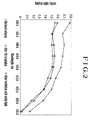
- furylfulgide changes from a ring opening form to a ring closing form, and in that case, photochromic reaction is brought about and a change in dispersion of the rotation angle.
- This rotation angle dispersion takes place over a wide wavelength range and can be read out even by light having a wavelength longer than 600 nm at which no absorption of furylfulgide is observed.
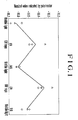
- furylfulgide was irradiated with visible light (400 nm to longer wavelength), whereupon the rotation angle dispersion returned to its original state. Furthermore, while observing a change in rotation angle by irradiating the photo-recording medium with light of 600 nm at which no practical absorption of a ring opening form and a ring closing form of furylfulgide is observed, said photo-recording medium was irradiated alternately with UV rays and visible light (400 nm to longer wavelength), whereupon such reversible changes in rotation angle as shown in Fig. 3 were observed.
- Example 5 The same light irradiation as in Example 5 was effected, whereupon a rotation angle at 600 nm changed by +0.2° by UV irradiation, and the rotation angle returned to its original level by irradiation with visible light. Furthermore, the liquid crystal was transformed into an isotropic phase by raising the temperature, whereupon optical activity was lost.
Landscapes
- Chemical & Material Sciences (AREA)
- Crystallography & Structural Chemistry (AREA)
- Non-Silver Salt Photosensitive Materials And Non-Silver Salt Photography (AREA)
- Optical Record Carriers And Manufacture Thereof (AREA)
- Holo Graphy (AREA)
- Optical Recording Or Reproduction (AREA)
- Liquid Crystal (AREA)
Applications Claiming Priority (6)
| Application Number | Priority Date | Filing Date | Title |
|---|---|---|---|
| JP75366/88 | 1988-03-28 | ||
| JP63075367A JPH01246538A (ja) | 1988-03-28 | 1988-03-28 | 光記録媒体 |
| JP75367/88 | 1988-03-28 | ||
| JP63075366A JP2772345B2 (ja) | 1988-03-28 | 1988-03-28 | 光記録方式 |
| JP64000994A JPH02181746A (ja) | 1989-01-06 | 1989-01-06 | 光記録媒体 |
| JP994/89 | 1989-01-06 |
Publications (3)
| Publication Number | Publication Date |
|---|---|
| EP0335579A2 true EP0335579A2 (de) | 1989-10-04 |
| EP0335579A3 EP0335579A3 (en) | 1990-11-28 |
| EP0335579B1 EP0335579B1 (de) | 1994-06-08 |
Family
ID=27274709
Family Applications (1)
| Application Number | Title | Priority Date | Filing Date |
|---|---|---|---|
| EP89302849A Expired - Lifetime EP0335579B1 (de) | 1988-03-28 | 1989-03-22 | Photo-Aufzeichnungsmedien und Photo-Aufzeichnungsmethode |
Country Status (5)
| Country | Link |
|---|---|
| US (1) | US5118586A (de) |
| EP (1) | EP0335579B1 (de) |
| KR (1) | KR920003783B1 (de) |
| AT (1) | ATE107070T1 (de) |
| DE (1) | DE68915843T2 (de) |
Cited By (3)
| Publication number | Priority date | Publication date | Assignee | Title |
|---|---|---|---|---|
| EP0436228A3 (en) * | 1989-12-28 | 1992-07-29 | Sanyo Electric Co., Ltd. | Recording and reproducing methods and apparatus for an optical recording medium |
| EP0418930A3 (en) * | 1989-09-22 | 1992-07-29 | Sanyo Electric Co., Ltd. | Recording medium and reproducing method therefor |
| EP0925581B1 (de) * | 1996-09-16 | 2006-03-15 | FlexPlay Technologies Inc. | Maschinenlesbare optische Platte mit Mittel zur Leseverhinderung |
Families Citing this family (7)
| Publication number | Priority date | Publication date | Assignee | Title |
|---|---|---|---|---|
| US5234799A (en) * | 1990-02-17 | 1993-08-10 | Mitsubishi Denki Kabushiki Kaisha | Photochromic material and rewritable optical recording medium |
| US5644416A (en) * | 1991-11-26 | 1997-07-01 | Fuji Xerox Co., Ltd. | Light modulation device and method of light modulation using the same |
| US5552915A (en) * | 1994-10-19 | 1996-09-03 | The Penn State Research Foundation | Liquid crystal non-linear, photorefractive electro-optical storage device having a liquid crystal film including dopant species of C60 or C70 |
| US6071618A (en) * | 1996-10-11 | 2000-06-06 | Cryovac, Inc. | Process for increasing the solubility rate of a water soluble film |
| JPH10183117A (ja) * | 1996-12-24 | 1998-07-14 | Dainippon Printing Co Ltd | 記録表示媒体及びその使用方法 |
| US5989451A (en) * | 1997-02-07 | 1999-11-23 | Queen's University At Kingston | Compounds and methods for doping liquid crystal hosts |
| US7177261B2 (en) | 2001-06-05 | 2007-02-13 | Flexplay Technologies, Inc. | Limited play optical devices with interstitial reactive layer and methods of making same |
Family Cites Families (9)
| Publication number | Priority date | Publication date | Assignee | Title |
|---|---|---|---|---|
| US3212898A (en) * | 1962-11-21 | 1965-10-19 | American Cyanamid Co | Photosensitive compositions of matter comprising photochromic materials suspended in polyester binders |
| US3397059A (en) * | 1964-07-01 | 1968-08-13 | American Cyanamid Co | Photochromic polymethylmethacrylate element on contact with polyester resinous material |
| DE3429438A1 (de) * | 1984-08-10 | 1988-06-23 | Basf Ag | Optisches aufzeichnungsmedium |
| US4686169A (en) * | 1984-11-13 | 1987-08-11 | Matsushita Electric Industrial Co., Ltd. | Optical recording medium and production of the same |
| JPS61170737A (ja) * | 1985-01-24 | 1986-08-01 | Sony Corp | 光記録媒体 |
| DE3682583D1 (de) * | 1985-12-20 | 1992-01-02 | Matsushita Electric Industrial Co Ltd | Optisches aufzeichnungsmedium mit stabilisierter aufzeichnungsschicht. |
| JPS62209186A (ja) * | 1986-03-11 | 1987-09-14 | Agency Of Ind Science & Technol | 光メモリ材料 |
| DE3623395A1 (de) * | 1986-07-11 | 1988-01-21 | Roehm Gmbh | Vorrichtung zur reversiblen, optischen datenspeicherung unter verwendung von polymeren fluessigkristallen |
| US4963448A (en) * | 1987-08-31 | 1990-10-16 | Agency Of Industrial Science & Technology | Photorecording element and liquid crystal cell comprising the same |
-
1989
- 1989-03-20 US US07/325,995 patent/US5118586A/en not_active Expired - Lifetime
- 1989-03-22 DE DE68915843T patent/DE68915843T2/de not_active Expired - Fee Related
- 1989-03-22 EP EP89302849A patent/EP0335579B1/de not_active Expired - Lifetime
- 1989-03-22 AT AT89302849T patent/ATE107070T1/de not_active IP Right Cessation
- 1989-03-28 KR KR1019890003854A patent/KR920003783B1/ko not_active Expired
Cited By (3)
| Publication number | Priority date | Publication date | Assignee | Title |
|---|---|---|---|---|
| EP0418930A3 (en) * | 1989-09-22 | 1992-07-29 | Sanyo Electric Co., Ltd. | Recording medium and reproducing method therefor |
| EP0436228A3 (en) * | 1989-12-28 | 1992-07-29 | Sanyo Electric Co., Ltd. | Recording and reproducing methods and apparatus for an optical recording medium |
| EP0925581B1 (de) * | 1996-09-16 | 2006-03-15 | FlexPlay Technologies Inc. | Maschinenlesbare optische Platte mit Mittel zur Leseverhinderung |
Also Published As
| Publication number | Publication date |
|---|---|
| ATE107070T1 (de) | 1994-06-15 |
| US5118586A (en) | 1992-06-02 |
| EP0335579A3 (en) | 1990-11-28 |
| KR920003783B1 (ko) | 1992-05-14 |
| EP0335579B1 (de) | 1994-06-08 |
| KR890015216A (ko) | 1989-10-28 |
| DE68915843D1 (de) | 1994-07-14 |
| DE68915843T2 (de) | 1994-09-22 |
Similar Documents
| Publication | Publication Date | Title |
|---|---|---|
| Bruder et al. | From the surface to volume: concepts for the next generation of optical–holographic data‐storage materials | |
| EP0335579B1 (de) | Photo-Aufzeichnungsmedien und Photo-Aufzeichnungsmethode | |
| KR100514567B1 (ko) | 고감도의광어드레스성측면기중합체 | |
| CA2116106A1 (en) | Azo polymers for reversible optical storage | |
| US5234799A (en) | Photochromic material and rewritable optical recording medium | |
| KR920006312B1 (ko) | 광메모리 소자와 그 기록, 재생 및 소거방법 | |
| DE4208328C2 (de) | Verfahren und Vorrichtung zur löschbaren Speicherung von Information | |
| US5426018A (en) | Photochromic material | |
| JPH06106857A (ja) | 光記録媒体およびそれに記録された情報の再生方法 | |
| US5284691A (en) | Optical recording medium and method of reproducing information record on the optical recording medium | |
| Jones et al. | Angular-dependent photoselection and anisotropy of optical absorption for photochromic molecules in glassy poly (methyl methacrylate) | |
| Kim et al. | Preparation and Holographic Recording of Diarylethene‐Doped Photochromie Films | |
| JPH01246538A (ja) | 光記録媒体 | |
| JP2772345B2 (ja) | 光記録方式 | |
| JPH0232303B2 (de) | ||
| JP2780180B2 (ja) | 光変調素子 | |
| Erben et al. | Ortho‐Nitrostilbenes in Polycarbonate for Holographic Data Storage | |
| JPH04226389A (ja) | 光記録媒体及び情報の書込み、読出し、及び消去方法並びに旋光性有機化合物 | |
| JPH02181746A (ja) | 光記録媒体 | |
| JP2512446B2 (ja) | 光学式情報記録方法 | |
| Shi et al. | Improved sensitivity of dye-doped thermoplastic disks for holographic data storage | |
| JPS63223084A (ja) | フオトクロミツク組成物 | |
| Lessard et al. | Photochromic materials for holographic data storage | |
| JP2678219B2 (ja) | 光記録媒体へのデータ固定方法,光記録媒体,及びデータ記録装置 | |
| CN1038895A (zh) | 光记录介质和光记录法 |
Legal Events
| Date | Code | Title | Description |
|---|---|---|---|
| PUAI | Public reference made under article 153(3) epc to a published international application that has entered the european phase |
Free format text: ORIGINAL CODE: 0009012 |
|
| AK | Designated contracting states |
Kind code of ref document: A2 Designated state(s): AT BE CH DE ES FR GB GR IT LI LU NL SE |
|
| PUAL | Search report despatched |
Free format text: ORIGINAL CODE: 0009013 |
|
| AK | Designated contracting states |
Kind code of ref document: A3 Designated state(s): AT BE CH DE ES FR GB GR IT LI LU NL SE |
|
| 17P | Request for examination filed |
Effective date: 19901228 |
|
| 17Q | First examination report despatched |
Effective date: 19930816 |
|
| GRAA | (expected) grant |
Free format text: ORIGINAL CODE: 0009210 |
|
| AK | Designated contracting states |
Kind code of ref document: B1 Designated state(s): AT BE CH DE ES FR GB GR IT LI LU NL SE |
|
| PG25 | Lapsed in a contracting state [announced via postgrant information from national office to epo] |
Ref country code: LI Effective date: 19940608 Ref country code: GR Free format text: LAPSE BECAUSE OF FAILURE TO SUBMIT A TRANSLATION OF THE DESCRIPTION OR TO PAY THE FEE WITHIN THE PRESCRIBED TIME-LIMIT Effective date: 19940608 Ref country code: ES Free format text: THE PATENT HAS BEEN ANNULLED BY A DECISION OF A NATIONAL AUTHORITY Effective date: 19940608 Ref country code: CH Effective date: 19940608 Ref country code: BE Effective date: 19940608 Ref country code: AT Effective date: 19940608 |
|
| REF | Corresponds to: |
Ref document number: 107070 Country of ref document: AT Date of ref document: 19940615 Kind code of ref document: T |
|
| ITF | It: translation for a ep patent filed | ||
| REF | Corresponds to: |
Ref document number: 68915843 Country of ref document: DE Date of ref document: 19940714 |
|
| ET | Fr: translation filed | ||
| PG25 | Lapsed in a contracting state [announced via postgrant information from national office to epo] |
Ref country code: SE Effective date: 19940908 |
|
| REG | Reference to a national code |
Ref country code: CH Ref legal event code: PL |
|
| PG25 | Lapsed in a contracting state [announced via postgrant information from national office to epo] |
Ref country code: LU Free format text: LAPSE BECAUSE OF NON-PAYMENT OF DUE FEES Effective date: 19950331 |
|
| PLBE | No opposition filed within time limit |
Free format text: ORIGINAL CODE: 0009261 |
|
| STAA | Information on the status of an ep patent application or granted ep patent |
Free format text: STATUS: NO OPPOSITION FILED WITHIN TIME LIMIT |
|
| 26N | No opposition filed | ||
| REG | Reference to a national code |
Ref country code: FR Ref legal event code: CD |
|
| NLT1 | Nl: modifications of names registered in virtue of documents presented to the patent office pursuant to art. 16 a, paragraph 1 |
Owner name: MITSUI CHEMICALS, INC. |
|
| REG | Reference to a national code |
Ref country code: GB Ref legal event code: IF02 |
|
| PGFP | Annual fee paid to national office [announced via postgrant information from national office to epo] |
Ref country code: FR Payment date: 20040309 Year of fee payment: 16 |
|
| PGFP | Annual fee paid to national office [announced via postgrant information from national office to epo] |
Ref country code: NL Payment date: 20040310 Year of fee payment: 16 |
|
| PGFP | Annual fee paid to national office [announced via postgrant information from national office to epo] |
Ref country code: GB Payment date: 20040317 Year of fee payment: 16 |
|
| PGFP | Annual fee paid to national office [announced via postgrant information from national office to epo] |
Ref country code: DE Payment date: 20040401 Year of fee payment: 16 |
|
| PG25 | Lapsed in a contracting state [announced via postgrant information from national office to epo] |
Ref country code: IT Free format text: LAPSE BECAUSE OF NON-PAYMENT OF DUE FEES Effective date: 20050322 Ref country code: GB Free format text: LAPSE BECAUSE OF NON-PAYMENT OF DUE FEES Effective date: 20050322 |
|
| PG25 | Lapsed in a contracting state [announced via postgrant information from national office to epo] |
Ref country code: NL Free format text: LAPSE BECAUSE OF NON-PAYMENT OF DUE FEES Effective date: 20051001 Ref country code: DE Free format text: LAPSE BECAUSE OF NON-PAYMENT OF DUE FEES Effective date: 20051001 |
|
| GBPC | Gb: european patent ceased through non-payment of renewal fee |
Effective date: 20050322 |
|
| PG25 | Lapsed in a contracting state [announced via postgrant information from national office to epo] |
Ref country code: FR Free format text: LAPSE BECAUSE OF NON-PAYMENT OF DUE FEES Effective date: 20051130 |
|
| NLV4 | Nl: lapsed or anulled due to non-payment of the annual fee |
Effective date: 20051001 |
|
| REG | Reference to a national code |
Ref country code: FR Ref legal event code: ST Effective date: 20051130 |