EP0335630A2 - Commutateur et procédé pour sa fabrication - Google Patents
Commutateur et procédé pour sa fabrication Download PDFInfo
- Publication number
- EP0335630A2 EP0335630A2 EP89302997A EP89302997A EP0335630A2 EP 0335630 A2 EP0335630 A2 EP 0335630A2 EP 89302997 A EP89302997 A EP 89302997A EP 89302997 A EP89302997 A EP 89302997A EP 0335630 A2 EP0335630 A2 EP 0335630A2
- Authority
- EP
- European Patent Office
- Prior art keywords
- organic insulating
- switching device
- thin film
- electrodes
- switching
- Prior art date
- Legal status (The legal status is an assumption and is not a legal conclusion. Google has not performed a legal analysis and makes no representation as to the accuracy of the status listed.)
- Granted
Links
Images

Classifications
-
- B—PERFORMING OPERATIONS; TRANSPORTING
- B82—NANOTECHNOLOGY
- B82Y—SPECIFIC USES OR APPLICATIONS OF NANOSTRUCTURES; MEASUREMENT OR ANALYSIS OF NANOSTRUCTURES; MANUFACTURE OR TREATMENT OF NANOSTRUCTURES
- B82Y10/00—Nanotechnology for information processing, storage or transmission, e.g. quantum computing or single electron logic
-
- H—ELECTRICITY
- H10—SEMICONDUCTOR DEVICES; ELECTRIC SOLID-STATE DEVICES NOT OTHERWISE PROVIDED FOR
- H10K—ORGANIC ELECTRIC SOLID-STATE DEVICES
- H10K10/00—Organic devices specially adapted for rectifying, amplifying, oscillating or switching; Organic capacitors or resistors having potential barriers
- H10K10/701—Organic molecular electronic devices
-
- H—ELECTRICITY
- H10—SEMICONDUCTOR DEVICES; ELECTRIC SOLID-STATE DEVICES NOT OTHERWISE PROVIDED FOR
- H10N—ELECTRIC SOLID-STATE DEVICES NOT OTHERWISE PROVIDED FOR
- H10N70/00—Solid-state devices having no potential barriers, and specially adapted for rectifying, amplifying, oscillating or switching
- H10N70/011—Manufacture or treatment of multistable switching devices
- H10N70/021—Formation of switching materials, e.g. deposition of layers
-
- H—ELECTRICITY
- H10—SEMICONDUCTOR DEVICES; ELECTRIC SOLID-STATE DEVICES NOT OTHERWISE PROVIDED FOR
- H10N—ELECTRIC SOLID-STATE DEVICES NOT OTHERWISE PROVIDED FOR
- H10N70/00—Solid-state devices having no potential barriers, and specially adapted for rectifying, amplifying, oscillating or switching
- H10N70/20—Multistable switching devices, e.g. memristors
-
- H—ELECTRICITY
- H10—SEMICONDUCTOR DEVICES; ELECTRIC SOLID-STATE DEVICES NOT OTHERWISE PROVIDED FOR
- H10N—ELECTRIC SOLID-STATE DEVICES NOT OTHERWISE PROVIDED FOR
- H10N70/00—Solid-state devices having no potential barriers, and specially adapted for rectifying, amplifying, oscillating or switching
- H10N70/801—Constructional details of multistable switching devices
- H10N70/821—Device geometry
- H10N70/826—Device geometry adapted for essentially vertical current flow, e.g. sandwich or pillar type devices
-
- H—ELECTRICITY
- H10—SEMICONDUCTOR DEVICES; ELECTRIC SOLID-STATE DEVICES NOT OTHERWISE PROVIDED FOR
- H10N—ELECTRIC SOLID-STATE DEVICES NOT OTHERWISE PROVIDED FOR
- H10N70/00—Solid-state devices having no potential barriers, and specially adapted for rectifying, amplifying, oscillating or switching
- H10N70/801—Constructional details of multistable switching devices
- H10N70/881—Switching materials
Definitions
- the present invention relates to a switching device with an MIM (metal-insulator-metal) structure, comprising an organic insulating layer, and a method of preparing it. More particularly it relates to a switching device greatly improved in the repetition stability of switching characteristics and the switching speed, and a method of preparing it.
- MIM metal-insulator-metal
- LB film Langmuir-Blodgett film
- MIM metal-insulator-metal
- Electrodes used in the studies mentioned above have hitherto been formed by vapor deposition using a mask.
- the areas and shapes of electrodes can not be freely selected, and they are necessarily limited, causing problems, e.g., in preparing integrated circuits.
- an improvement would be expected in device characteristics or device-driving methods.
- an object of the present invention is to provide a novel switching device greatly improved in the repetition stability of switching characteristics and in the storage stability of devices.
- Another object of the present invention is to provide a novel switching device greatly improved in the switching speed, and a method of preparing it.
- the present invention provides a switching device, comprising a pair of electrodes, an organic insulating layer and an inorganic oxide layer which are held between the electrodes.
- the present invention provides a switching device, comprising a pair of electrodes, an organic insulating thin film provided between said electrodes, and an inorganic insulating thin film provided between one of the electrodes and the organic insulating thin film in such a manner that an electrification region between the electrodes may be restricted.
- the present invention also provides a method of preparing a switching device, comprising the steps of forming an organic insulating thin film by the Langmuir-Blodgett process, and forming by lithography on said organic insulating thin film an inorganic insulating thin film in the form of a pattern.
- an organic insulating thin film layer containing an organic compound having at least one ⁇ -electron level, and an inorganic oxide thin film layer comprising a metal oxide or the like are laminated.
- the present invention intends to realize that a nonlinear current-voltage characteristics which are different from those of conventionally known MIM devices are exhibited by supplying an electric current in the direction parallel to the lamination direction of the organic insulating layer and inorganic oxide layer.
- the present invention has also realized a novel MIM device having a switching memory function utilizing such characteristics.
- FIG. 1 A fundamental constitution of the switching device of the present invention is illustrated in Fig. 1.
- the organic insulating layer 3 of the present invention not only insulating organic compounds but also semiconductive organic compounds can be used so long as they are organic compounds having a ⁇ -electron level.
- organic materials having a ⁇ -electron level include a great variety of materials.
- Coloring matter structures of a ⁇ -electron type suited to the present invention include, for example, coloring matters having a porphyrin structure, such as phthalocyanine and tetraphenylporphyrin; azulene dyes having a squalilium group and a croconic methine group as bonding chains; and cyanine-analogus dyes formed by combining two nitrogen-containing heterocyclic rings such as quinoline, benzothiazole and benzoxazole, with each other through a squalilium group and a croconic methine group; or cyanine dyes; condensed polycyclic aromatics such as anthracene and pyrene; derivatives of tetraquinodimethane or tetrathiafulvalene, as well as analogues thereof and charge transfer complexes thereof; and further metal complex compounds such as ferrocene and a trisbipyridine ruthenium complex.
- polymeric compounds having ⁇ -electrons such as polyimide, polystyrene, polydiacetylene and polythiophene.
- polyimide is particularly preferred because of its excellent thermal resistance and solvent resistance.
- the polyimide includes, for example, polyimides obtained by cyclization of polyamic acids, polyamic acid salts or polyamic acid esters, and suitably used are those obtained by cyclization and imidization of a compound having the repeating unit represented by Formula (1) and having a weight-average molecular weight of 20,000 to 3,000,000.
- R1 represents a tetravalent group containing at least 6 carbon atoms, specifically including, for example, the following:
- R2 represents a divalent group containing at least 2 carbon atoms, specifically including, for example, the following:
- R3 represents a monovalent group having at least 6 carbon atoms, or a quaternary ammonium salt having at least 6 carbon atoms, having the structure represented by Formula (2).
- the above organic materials having ⁇ -electrons in combination with other materials.
- the remaining compounds may not necessarily have a ⁇ -electron level, and it is also possible to use low molecular compounds such as simple fatty acids and lipids, polyacrylic acid derivatives such as polymethacrylic acid, and polymeric compounds such as nylon.
- Such combination of compounds is carried out mainly for the purpose of increasing stability of the organic compounds having the ⁇ -electron level, which lack structural stability.
- the both i.e., the organic compound of a ⁇ -electron type and the other mixed compound
- the both may preferably be mixed in the molar ratio ranging from 100:1 to 1:100 (in terms of monomers), and more preferably from 10:1 to 1:10 (in terms of monomers).
- the organic insulating layer can be formed according to, for example, a vapor deposition process or a cluster-ion beam process.
- the organic insulating layer 3 may preferably have a thickness of not less than 3 ⁇ to not more than 1,000 ⁇ and more preferably not less than 50 ⁇ not more than 300 ⁇ , and moreover may preferably be uniform and homogeneous.
- the LB process is very suitable among conventional known techniques, from the viewpoints of the controllability, readiness, and reproducibility.
- the LB process can readily form on a substrate a monomolecular film of the organic compound having a hydrophobic part and a hydrophilic part in its molecule, or a built-up film thereof, and also can stably provide an organic ultra-thin film which has a thickness of the molecular order and is uniform and homogeneous over a large area.
- the LB process is a process of making a monomolecular film or a built-up film thereof by utilizing the mechanism that when the hydrophilic part and hydrophobic part are appropriately balanced (i,e, amphiphatic balance) in a molecule of the structure having the both parts therein, the molecules form a monomolecular layer by utilizing a phenomenon that hydrophilic groups are aligned downward.
- the group that constitutes the hydrophobic part includes all sorts of hydrophobic groups such as saturated or unsaturated hydrocarbon groups, condensed polycyclic aromatic groups and chain polycyclic phenyl groups, which are commonly well known in the art. These constitute the hydrophobic part alone or in combination of plural ones.
- the group most typical as a component for constituting the hydrophilic part may include hydrophilic groups as exemplified by a carboxyl group, an ester group, an acid amido group, an imido group, a hydroxyl group, and further an amino group (primary, secondary, tertiary, and quaternary). These each also constitute the hydrophilic part alone or in combination of plural ones.
- Coloring matter molecules having these hydrophobic part and hydrophilic part in a good balance and also having a ⁇ -electron level with an appropriate magnitude can form a monomolecular film on a water surface, and can serve as materials very suited to the present invention.
- the organic insulating layer 3 of the present invention is formed using the material comprising the mixture of two or more organic compounds, if at least the compound having the main mixing ratio has a sufficient monomolecular film forming ability, the remaining compounds may have a poor or no monomolecular film forming ability, as previously described. However, from the viewpoint of the stability of the devices finally obtained, all the materials mixed should have the monomolecular film forming ability whether they can form films with ease or difficulty.
- An inorganic oxide layer 4 is laminated on the organic insulating film 3 thus formed.
- the above organic insulating layer 3 and inorganic oxide layer 4 are hereinafter paired to be referred to as "the insulating layer" for simplification.
- Inorganic oxides used in the inorganic oxide layer 4 of the present invention may be any of those having insulating or semi-insulating properties, and there can be used, for example, Al2O3, BaO, BeO, MgO, SiO2, CuO, PbO, Fe2O3, Cu2O, V2O5, Ta2O5, TiO2, WO3, Ag2O and PbTiO3.
- the inorganic oxide layer comprising any of these, ordinary vacuum deposition or sputtering can be used.
- a metal film may first be formed by deposition followed by a procedure such as air oxidation or anodic oxidation to give an oxide film.
- the inorganic oxide layer has a thickness of not less than several ⁇ to not more than 200 ⁇ , and preferably not less than several ⁇ to not more than 50 ⁇ , a metal-deposited film may be subjected to air oxidation (or natural oxidation) to obtain the desired inorganic oxide layer with great ease.
- a metal layer may be first provided as mentioned above, followed by oxidation to obtain the desired inorganic oxide layer, but, as another method, active sputtering may be carried out in a rare gas containing oxygen, so that the inorganic oxide layer can be directly obtained with ease.
- Methods other than these can also be utilized so long as they are methods fundamentally capable of forming inorganic oxide layers with a film thickness of not more than 200 ⁇ .
- the inorganic oxide layer is formed on the organic insulating layer previously described, it is preferable to employ methods by which the underlying organic materials may be damaged as little as possible. From such a viewpoint, it is preferable in general to employ the procedure such as air oxidation of the metal-deposited film.
- the insulating layer of the present invention is prepared in the manner as described above, where the electrodes 2 and 5, between which such an insulating layer is held, may be any of those having a high conductivity, which include, for example, a number of materials including metals such as Au, Pt, Ag, Pd, Al, In, Sn and Pb, or alloys of these, also graphite or silicide, and also conductive oxides such as ITO. These are expected to be applicable in the present invention. As methods of forming the electrodes that employs such materials, conventionally known thin film techniques may suffice for the purpose. However, in either electrode, it is preferred to use conductive materials that may not form any oxides having insulating properties, as exemplified by noble metals and oxide conductive materials such as ITO.
- Fig. 2 illustrates another embodiment of the switching device of the present invention, where the inorganic oxide layer is provided at a step portion on the electrode for the purpose of stabilizing and improving the device characteristics.
- the electrodes can be formed using a lithographic technique. Hitherto known techniques such as lift-off process and photoetching process are satisfactory for such a lithographic technique. Also, the electrodes can be formed with a width ranging from 10 ⁇ m to 1 mm. Since it is possible in the present invention to form the electrodes according to the lithographic techniques, the switching speed can be made higher.
- Such lithographic techniques can also be applied to the formation of the inorganic insulating layer.
- Such an inorganic insulating layer may have a film thickness of from 500 ⁇ to 1 ⁇ m, and preferably from 1,000 ⁇ to 3,000 ⁇ .
- Methods of forming the inorganic oxide layer may not be limited to the vacuum deposition or sputtering so long as they are methods which damage with great difficulty the above-described organic insulating layer.
- any film forming methods capable of forming uniform thin films, can be used and the methods may not be limited to the vacuum deposition or sputtering.
- the present invention requires no particular limitations on the materials of substrates or the form thereof.
- a glass substrate 1 (# 7059, produced by Corning Co.,) having been subjected to hydrophobic treatment by allowing it to stand for 24 hours in a saturated vapor of hexamethyldisilazane (HMDS), Cr was deposited as a underlayer by vacuum deposition with a thickness of 30 ⁇ , and Au was further vapor-deposited by the same process (film thickness: 300 ⁇ ), to form a lower electrode 2 in a stripe with a width of 1 mm.
- monomolecular films comprising squalilium bis-6-octylazulene (SOAZ) were built up according to the LB process, the build-up procedures of which are detailed below.
- a benzene solution in which SOAZ was dissolved in a concentration of 0.2 mg/ml was spread on an aqueous phase of 20°C of water temperature to form a monomolecular film on the water surface.
- the surface pressure of the monomolecular film thus formed was raised up to 20 mN/m. While keeping constant the surface pressure, the above substrate was gently put in water at a rate of 5 mm/min in the direction traversing the water surface, and thereafter subsequently gently drawn up at a rate of 5 mm/min, thus building up a two-layer Y-type monomolecular film.
- Such operations were repeated appropriate times to form four kinds of built-up films with 4, 8, 12 or 20 layers on the above substrate, thus providing an organic insulating layer 3.
- Al was vapor-deposited with a thickness of 50 ⁇ in a stripe with a width of 1 mm in such a manner that it may cross at right angle with the lower electrode 2, and thereafter oxygen gas was fed in the vacuum chamber to oxidize the resulting Al-deposited film, thus forming an inorganic oxide layer (Al2O3 film) 4.
- the inside of the chamber was restored again to vacuum (4 x 10 ⁇ 6 Torr or less), and an Au upper electrode 5 (film thickness: 300 ⁇ ) was formed on the above Al2O3 film.
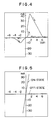
- a voltage was applied to between a pair of the upper and lower electrodes of the samples (MIM devices) thus prepared, having the MIM structure, and the current characteristics (VI characteristics) thereby produced was measured to find that the memory-functional switching characteristics as shown in Fig. 4 were obtained.
- the 4-layer samples showed somewhat unstable switching characteristics, and the 20-layer samples showed that the off-to-on switching occurred with difficulty.
- Triangular waves with a peak value of ⁇ 8 V and a alternating electric field frequency of 2 Hz were continuously applied to the 12-layer samples, which showed best switching characteristics, to measure the repeated switching times to find that the switching was repeated at least 107 times, during which a stable reproducibility was seen in the current-voltage characteristics, and moreover no change, e.g., damage was seen in the samples themselves.
- These 12-layer samples were further maintained for 6 months under conditions of 25°C and 70 % RH and then switching was performed. As a result, no significant difference in the current-voltage characteristics was seen when compared with the samples on which the switching was performed immediately after the preparation of the samples. The repeated switching times were also measured to find that the switching was also repeated 107 times or more with superior stability and reproducibility.
- samples were prepared in which the inorganic oxide layer 4 was also omitted and an Au upper electrode 5 (film thickness: 1,000 ⁇ ) was directly formed on the SOAZ 12-layer LB film, to evaluate their switching characteristics.
- an Au upper electrode 5 film thickness: 1,000 ⁇
- the repeated switching times were about 7 x 10⁵ times, at which the destruction of the devices was observed.
- These samples were further stored under conditions of 25°C and 70 % RH and thereafter the switching characteristics was measured, where a number of samples were observed in which the off-to-on switching had become difficult to occur at the time of about 3 months lapsed.
- MIM devices were fabricated in entirely the same manner as Example 1 except that the compound used in the organic insulating layer 3 was replaced with a mixture of SOAZ and cadmium arachidate (hereinafter "C20"). Samples having SOAZ:C20 mixing ratios of 4:1, 2:1, 1:1, 1:2, and 1:4 were prepared.
- a benzene solution in which SOAZ was dissolved in a concentration of 0.2 mg/ml and a benzene solution in which C20 was dissolved in a concentration of 0.5 mg/ml were appropriately mixed so as to give the desired mixing ratio (molar ratio) of SOAZ to C20, and thereafter the resulting mixed solution was spread on an aqueous phase comprising an aqueous cadmium chloride solution (water temperature: 20°C) with a concentration of 5 x 10 ⁇ 4 mol/l, adjusted to pH 6.7 using KHCO3, to form a SOAZ-C20 mixed monomolecular film on the water surface. After removal of the solvent by evaporation, the surface pressure of the monomolecular film thus formed was raised up to 20 mN/m.
- Such operations were repeated several times to form a 12-layer mixed built-up film, thus providing the organic insulating layer 3.
- Example 2 On the MIM devices thus prepared, the switching characteristics were measured in the same manner as Example 1. As a result, the same switching characteristics as Example 1 were obtained in all the samples. The repeated switching times were 107 times or more for all samples. The samples were further stored for 6 months under conditions of 25°C and 70 % RH, and thereafter after which no changes were seen in the above switching characteristics.
- MIM devices were fabricated in entirely the same manner as Example 1 except that the compound used in the organic insulating layer 3 was replaced with a mixture of SOAZ and polymethyl methacrylate (hereinafter "PMMA"). Samples having SOAZ:PMMA mixing ratios of 1:1, 1:2, 1:4 and 1:10 (molar ratios in terms of monomers) were prepared here.
- PMMA polymethyl methacrylate
- a benzene solution in which SOAZ was dissolved in a concentration of 0.2 mg/ml and a solution obtained by dissolving PMMA (produced by of Polyscience Co.; syndiotactic; molecular weight: 100,000) in a mixed solution of trichloroethane:benzene 1:9 (V/V) in a concentration of 0.2 mg/ml, were appropriately mixed so as to give the desired mixing ratio, and thereafter the resulting mixed solution was spread on pure water of 20°C in water temperature to form an SOAZ-PMMA mixed monomolecular film on the water surface. After removal of the solvent by evaporation, the surface pressure of the monomolecular film thus formed was raised up to 20 mN/m.
- Such operations were repeated several times to form a 12-layer mixed built-up film, thus providing the organic insulating layer 3.
- Example 2 On the MIM devices thus prepared, the switching characteristics were measured in the same manner as Example 1. As a result, the same switching characteristics as Example 1 were obtained in all the samples. The repeated switching times were 107 times or more for all samples. The samples were further stored for 6 months under conditions of 25°C and 70 % RH, and thereafter which no changes were seen in the above switching characteristics.
- MIM devices were fabricated in entirely the same manner as Example 1 except that the compound used in the organic insulating layer 3 was replaced with a mixture of SOAZ and polyisobutyl methacrylate (hereinafter "PIBM"). Samples having SOAZ:PIBM mixing ratios of 1:1, 1:2, 1:4 and 1:10 (molar ratios in terms of monomers) were prepared here.
- PIBM polyisobutyl methacrylate
- a benzene solution in which SOAZ was dissolved in a concentration of 0.2 mg/ml and a solution obtained by dissolving PIBM (Elvacite 2045; produced by Dupont Co.) in a mixed solution of trichloroethane:benzene 1:9 (V/V) in a concentration of 0.2 mg/ml, were appropriately mixed so as to give the desired mixing ratio, and thereafter the resulting mixed solution was spread on pure water of 20°C in water temperature to form an SOAZ-PIBM mixed monomolecular film on the water surface. After removal of the solvent by evaporation, the surface pressure of the monomolecular film thus formed was raised up to 10 mN/m.
- Such operations were repeated several times to form a 16-layer mixed built-up film, thus providing the organic insulating layer 3.
- Example 2 On the MIM devices thus prepared, the switching characteristics were measured in the same manner as Example 1. As a result, the same switching characteristics as Example 1 were obtained in all the samples. The repeated switching times were 107 times or more for all samples. The samples were further stored for 6 months under conditions of 25°C and 70 % RH, and thereafter which no changes were seen in the above switching characteristics.
- MIM devices were fabricated in entirely the same manner as Example 1 except that the organic insulating layer 3 was replaced with a polyimide-LB film. Procedures of forming the polyimide-LB film according to the LB process are detailed below.
- Polyamide acid represented by the formula (1) was dissolved in an N,N′-dimethylacetamide solvent (at a concentration calculated as monomer: 1 x 10 ⁇ 3 M), and thereafter the solution was mixed with a separately prepared 1 x 10 ⁇ 3 M solution of N,N′-dimethyloctadecylamine using the same solvent, in the ratio of 1:2 (V/V), to prepare a solution of a polyamide acid octadecylamine salt represented by the formula (2).
- the solution thus prepared was spread on pure water of 20°C of water temperature, and a 20-layer monomolecular built-up film of the polyamide acid octadecylamine salt was formed on a substrate provided with the lower electrode 2 as described in Example 1.
- the surface pressure was 25 mN/m.
- the substrate was put in and drawn up at a rate of 5 mm/min.
- this substrate was baked at 300°C for 30 minutes to form the polyamide acid octadecylamine salt into an imide [formula (3)], and a 20-layer polyamide monomolecular built-up film was formed, thus providing the organic insulating layer 3.
- Example 2 On the MIM devices thus prepared, the switching characteristics were measured in the same manner as Example 1. As a result, the same switching characteristics as Example 1 were obtained in all the samples. The repeated switching times were 107 times or more for all samples. The samples were further stored for 6 months under conditions of 25°C and 70 % RH, and even no changes were seen in the above switching characteristics.
- Example 5 a polyimide monomolecular built-up film was formed with 20-layer build-up on a substrate provided with the lower electrode (Cr/Au) 2, to form the organic insulating layer 3.
- an Au upper electrode 5 (film thickness: 300 ⁇ ) was formed on the Ag2O layer according to a conventional vacuum deposition method.
- Example 2 On the MIM devices thus prepared, the switching characteristics were measured in the same manner as Example 1. As a result, the same switching characteristics as Example 1 were obtained in all the samples. The repeated switching times were 107 times or more for all samples. The samples were further stored for 6 months under conditions of 25°C and 70 % RH, and even thereafter no changes were seen in the above switching characteristics.
- MIM devices were fabricated in entirely the same manner as Example 1 except that the inorganic oxide layer 4 was formed with MgO.
- the MgO layer was obtained by depositing Mg with a thickness of 40 ⁇ according to a conventional vacuum deposition method, followed by air oxidation.
- the switching characteristics were measured in the same manner as Example 1.
- the repeated switching times were 107 times or more in all samples.
- the samples were further stored for 6 months under conditions of 25°C and 70 % RH, and thereafter which no changes were seen in the above switching characteristics.
- the LB process has been used in forming the insulating layers, but any film formation processes can be used without limitation to the LB process, so long as they can make a very thin, uniform insulating thin film. They specifically include vacuum deposition, electrolytic polymerization, and CVD, thus expanding the range of usable materials.
- Samples having the structure comprising a lower electrode/an insulating thin film/an insulating thin film/an upper electrode were prepared according to the following procedures.
- a cleaned glass substrate 1 is subjected to ultrasonic treatment for 5 minutes a cleaned glass substrate 1 by use of butyl acetate, and N2 is blown thereon, and then the substrate thus treated is put in a 120°C oven to carry out baking for 10 minutes.
- the resulting substrate is spin-coated with hexamethyldisilazane (HMDS) under conditions of 2,500 rpm and 30 seconds, and baking is carried out for 10 minutes in a 200°C oven.
- HMDS hexamethyldisilazane
- a resist material RD-2000N-10 is spin-coated thereon under conditions of 400 rpm and 1 second for the first coating and 3,000 rpm and 40 seconds for the second coating to give a film thickness of 0.7 ⁇ m, and then prebaking is carried out at 80°C for 25 minutes. Subsequently, exposure to light is carried out under conditions of 3.0 counts using a cold mirror (290 nm) of PLA-520F (produced by Canon Inc.) and under hard contact. Thereafter, development is carried out for 100 seconds using a developing solution for its exclusive use, followed by postbaking at 120°C for 20 minutes to make a resist pattern.
- a 4-, 6-, 12-, 20-, 24-, 30-, 42-, 60-, 200- or 300-layer built-up film (film thickness: 80 ⁇ ) of polyimide monomolecular films was formed by the LB process in the same manner as Example 5, thus providing an insulating thin film 3.
- SiO2 is deposited by vacuum deposition with a thickness of 3,000 ⁇ .
- a resist material AZ-1370 is coated thereon using a spinner under conditions of 500 rpm and 5 seconds for the first coating and 3,000 rpm and 30 seconds for the second coating to give a film thickness of 1.2 ⁇ m.
- This is then subjected to prebaking at 90°C for 15 minutes, followed by exposure to light under contact for 10 seconds using MA-10, (produced by Mikasa Co.).
- the resulting substrate is subjected to ultrasonic treatment using acetone for 5 minutes, ultrasonic treatment using DMF, and blowing of N2, and thereafter baking is carried out for 10 minutes in a 120°C oven.
- the resulting substrate is subjected to ultrasonic treatment using acetone for 5 minutes, ultrasonic treatment using DMF for 5 minutes, and washing with pure water for 5 minutes to peel the resist, blowing of N2 is carried out, and thereafter baking is carried out for 10 minutes in a 120°C oven, thus forming an upper electrode 5.
- the electrode thus formed was made to have a width of 40 ⁇ m.
- the threshold voltage was in a tendency to become higher with an increase in the monomolecular film layer number of the insulating layer.
- the 4-layer samples and 6-layer samples showed unstable switching characteristics, and the 300-layer samples showed that switching occurred with difficulty.
- the film thickness per layer of the polyimide monomolecular built-up film measured using ellipsometry was found to be several ⁇ .
- the repetition stability was evaluated based on the number of the switching times repeated until generation of heat caused destruction of electrodes when triangular waves with a peak value of ⁇ 8 V and an alternating electric field frequency of 2 Hz were continuously applied, to find that the repeated switching times were 2 x 10⁷ times.
- a lower electrode is formed on a substrate by the lift-off process in the same manner as Example 8.
- a polyimide monomolecular film is also prepared by the LB process in the same manner as Example 8.
- Al2O3 is deposited by vacuum deposition with a thickness of 400, 1,000, 2,000 or 4,000 ⁇ or 2 ⁇ m.
- a resist material AZ-1370 is coated thereon using a spinner under conditions of 500 rpm and 5 seconds for the first coating and 3,000 rpm and 30 seconds for the second coating to give a film thickness of 1.2 ⁇ m. This is then subjected to prebaking at 90°C for 50 minutes, followed by exposure to light under contact for 10 seconds using MA-10 (produced by Mikasa Co.).
- the desired upper electrode is formed by photoetching in the same manner as Example 8.
- the electrode was made to have a width of 20 ⁇ m.
- Example 8 The current-voltage characteristics of the samples prepared in the above way were measured in the same manner as Example 8 to find that the same memory-functional switching characteristics as Example 8 were observed.
- the switching speed was in the picosecond order.
- the on/off ratio was not less than 5 figures, and the repeated switching times were 1 x 10⁷ times.
- the insulating material at the step portion of the electrode had a film thickness of 400 ⁇ , it was unable to sufficiently ensure the insulating properties of the insulating material, and in the instance of 2 ⁇ m, step breakage was liable to occur at the upper electrode.
- a cleaned glass plate was subjected to hydrophobic treatment by allowing it to stand for 24 hours in a saturated vapor of HMDS.
- Cr was deposited as an underlayer by vacuum deposition with a thickness of 100 ⁇ , and Au was further deposited by the same process (film thickness: 500 ⁇ ).
- a 24-layer built-up film (film thickness: 96 ⁇ ) of polyimide monomolecular films was formed using the LB process to provide an insulating thin film.
- the polyimide monomolecular built-up film was prepared in the same manner as Example 8.
- the resulting substrate is subjected to ultrasonic treatment using acetone for 5 minutes, ultrasonic treatment using DMF for 5 minutes, and washing with pure water for 5 minutes to peel the resist under these conditions, blowing of N2 is carried out, and thereafter baking is carried out for 10 minutes in a 120°C oven, thus forming an upper electrode with an electrode width of 20 ⁇ m.
- SiO2 is deposited by vacuum deposition with a thickness of 1,000 ⁇ . This is subjected to etching of SiO2 in the same manner as Example 8 to form an opening of the upper electrode.
- Al is deposited by vacuum deposition with a film thickness of 3,000 ⁇ , followed by the same photoetching as Example 8 to effect patterning of Al, thus providing the desired lead electrode of the upper electrode.
- Example 8 The voltage-current characteristics of the samples prepared in the above way were measured in the same manner as Example 8 to find that the same memory-functional switching characteristics as Example 8 were obtained.
- the switching speed was in the picosecond order, and the repeated switching times were 1 x 10⁷ times.
- a lower electrode was formed and a 20-layer polyimide monomolecular built-up film was formed in the same manner as Example 8. Thereafter an upper electrode was formed without protecting the step portion of the electrode. A voltage was applied between the upper and lower electrode of the samples thus prepared, and the current characteristics thereby produced were measured to find that the same memory-functional switching characteristics as Example 8 were observed. However, when compared with the above Examples, the samples showed lower repetition stability, which was 2 x 10⁶ times.
- Electrodes were fabricated in the same manner as Example 8. Here, the electrodes were made to be 150 ⁇ m and 1 mm in width. Such electrode widths correspond to the size formed according conventional vapor deposition methods using masks..
- the current-voltage characteristics of the devices thus obtained were measured, to find that the same memory-functional switching characteristics as Example 8 were obtained but the switching speed was 30 nanoseconds and 700 nanoseconds, respectively.
Landscapes
- Engineering & Computer Science (AREA)
- Physics & Mathematics (AREA)
- Chemical & Material Sciences (AREA)
- Nanotechnology (AREA)
- Mathematical Physics (AREA)
- Theoretical Computer Science (AREA)
- Crystallography & Structural Chemistry (AREA)
- Manufacturing & Machinery (AREA)
- Spectroscopy & Molecular Physics (AREA)
- Semiconductor Memories (AREA)
- Liquid Crystal (AREA)
- Liquid Deposition Of Substances Of Which Semiconductor Devices Are Composed (AREA)
Applications Claiming Priority (4)
| Application Number | Priority Date | Filing Date | Title |
|---|---|---|---|
| JP63071760A JPH01245575A (ja) | 1988-03-28 | 1988-03-28 | スイッチング素子 |
| JP71761/88 | 1988-03-28 | ||
| JP63071761A JP2694530B2 (ja) | 1988-03-28 | 1988-03-28 | スイッチング素子及びその製造方法 |
| JP71760/88 | 1988-03-28 |
Publications (3)
| Publication Number | Publication Date |
|---|---|
| EP0335630A2 true EP0335630A2 (fr) | 1989-10-04 |
| EP0335630A3 EP0335630A3 (en) | 1990-03-14 |
| EP0335630B1 EP0335630B1 (fr) | 1994-02-23 |
Family
ID=26412860
Family Applications (1)
| Application Number | Title | Priority Date | Filing Date |
|---|---|---|---|
| EP89302997A Expired - Lifetime EP0335630B1 (fr) | 1988-03-28 | 1989-03-28 | Commutateur et procédé pour sa fabrication |
Country Status (3)
| Country | Link |
|---|---|
| US (1) | US5075738A (fr) |
| EP (1) | EP0335630B1 (fr) |
| DE (1) | DE68913220T2 (fr) |
Cited By (1)
| Publication number | Priority date | Publication date | Assignee | Title |
|---|---|---|---|---|
| WO2002078102A3 (fr) * | 2001-03-21 | 2003-10-16 | Hewlett Packard Co | Fabrication d'un dispositif electronique moleculaire pourvu d'une couche d'arret protectrice |
Families Citing this family (30)
| Publication number | Priority date | Publication date | Assignee | Title |
|---|---|---|---|---|
| CA2022929C (fr) * | 1989-08-10 | 1995-02-07 | Hisaaki Kawade | Support d'enregistrement organique avec electrodes |
| US5264876A (en) * | 1989-08-10 | 1993-11-23 | Canon Kabushiki Kaisha | Recording medium, method for preparing the same, recording and reproducing device, and recording, reproducing and erasing method by use of such recording medium |
| US5329485A (en) * | 1990-11-01 | 1994-07-12 | Olympus Optical Co., Ltd. | Memory device |
| DE69232758T2 (de) * | 1991-03-26 | 2003-02-06 | Fujitsu Ltd | Organische, funktionnelle, dünne Schicht, Herstellung und Verwendung |
| JP3437195B2 (ja) * | 1991-10-01 | 2003-08-18 | キヤノン株式会社 | Mim型電気素子とその製造方法、及びこれを用いた画像表示装置、描画装置 |
| JPH06187675A (ja) * | 1992-09-25 | 1994-07-08 | Canon Inc | 情報処理装置、及びそれを用いる情報処理方法 |
| US5981970A (en) * | 1997-03-25 | 1999-11-09 | International Business Machines Corporation | Thin-film field-effect transistor with organic semiconductor requiring low operating voltages |
| US6324091B1 (en) | 2000-01-14 | 2001-11-27 | The Regents Of The University Of California | Tightly coupled porphyrin macrocycles for molecular memory storage |
| AU764750B2 (en) * | 1999-07-01 | 2003-08-28 | North Carolina State University | High density non-volatile memory device |
| US6381169B1 (en) | 1999-07-01 | 2002-04-30 | The Regents Of The University Of California | High density non-volatile memory device |
| US6572974B1 (en) * | 1999-12-06 | 2003-06-03 | The Regents Of The University Of Michigan | Modification of infrared reflectivity using silicon dioxide thin films derived from silsesquioxane resins |
| WO2002037500A1 (fr) * | 2000-10-31 | 2002-05-10 | The Regents Of The University Of California | Dispositif organique bistable et cellules memoire organiques |
| WO2002077633A1 (fr) | 2001-03-23 | 2002-10-03 | The Regents Of The University Of California | Ampérométrie et voltampérométrie du potentiel d'un circuit ouvert |
| US6728129B2 (en) * | 2002-02-19 | 2004-04-27 | The Regents Of The University Of California | Multistate triple-decker dyads in three distinct architectures for information storage applications |
| WO2004070789A2 (fr) * | 2003-02-03 | 2004-08-19 | The Regent Of The University Of California | Dispositifs bistables electriques organiques a nanosurface inscriptible plusieurs fois |
| US7274035B2 (en) * | 2003-09-03 | 2007-09-25 | The Regents Of The University Of California | Memory devices based on electric field programmable films |
| US7544966B2 (en) * | 2003-12-03 | 2009-06-09 | The Regents Of The University Of California | Three-terminal electrical bistable devices |
| WO2006001923A2 (fr) * | 2004-05-17 | 2006-01-05 | The Regents Of The University Of California | Composite bistable nanoparticules-polymere utilise dans des dispositifs de memoire |
| US7554111B2 (en) * | 2004-05-20 | 2009-06-30 | The Regents Of The University Of California | Nanoparticle-polymer bistable devices |
| GB2437188A (en) * | 2004-10-28 | 2007-10-17 | Univ California | Organic-complex thin film for nonvolatile memory applications |
| US8193606B2 (en) * | 2005-02-28 | 2012-06-05 | Semiconductor Energy Laboratory Co., Ltd. | Semiconductor device including a memory element |
| CN100377868C (zh) * | 2005-03-24 | 2008-04-02 | 中国科学院物理研究所 | 用于磁性/非磁性/磁性多层薄膜的核心复合膜及其用途 |
| US20060238696A1 (en) * | 2005-04-20 | 2006-10-26 | Chien-Hui Wen | Method of aligning negative dielectric anisotropic liquid crystals |
| US7812404B2 (en) * | 2005-05-09 | 2010-10-12 | Sandisk 3D Llc | Nonvolatile memory cell comprising a diode and a resistance-switching material |
| US7875871B2 (en) | 2006-03-31 | 2011-01-25 | Sandisk 3D Llc | Heterojunction device comprising a semiconductor and a resistivity-switching oxide or nitride |
| US8233308B2 (en) | 2007-06-29 | 2012-07-31 | Sandisk 3D Llc | Memory cell that employs a selectively deposited reversible resistance-switching element and methods of forming the same |
| US20090104756A1 (en) * | 2007-06-29 | 2009-04-23 | Tanmay Kumar | Method to form a rewriteable memory cell comprising a diode and a resistivity-switching grown oxide |
| US7824956B2 (en) | 2007-06-29 | 2010-11-02 | Sandisk 3D Llc | Memory cell that employs a selectively grown reversible resistance-switching element and methods of forming the same |
| US7902537B2 (en) | 2007-06-29 | 2011-03-08 | Sandisk 3D Llc | Memory cell that employs a selectively grown reversible resistance-switching element and methods of forming the same |
| US8440467B2 (en) * | 2007-09-28 | 2013-05-14 | William Marsh Rice University | Electronic switching, memory, and sensor devices from a discontinuous graphene and/or graphite carbon layer on dielectric materials |
Family Cites Families (8)
| Publication number | Priority date | Publication date | Assignee | Title |
|---|---|---|---|---|
| US3519999A (en) * | 1964-11-20 | 1970-07-07 | Ibm | Thin polymeric film memory device |
| JPS5012598B1 (fr) * | 1970-04-02 | 1975-05-13 | ||
| US4472296A (en) * | 1982-06-21 | 1984-09-18 | Iowa State University Research Foundation, Inc. | Bulk, polycrystalline switching materials for threshold and/or memory switching |
| JPS59131974A (ja) * | 1983-01-18 | 1984-07-28 | セイコーエプソン株式会社 | 液晶表示装置 |
| US4630081A (en) * | 1984-12-19 | 1986-12-16 | Eaton Corporation | MOMOM tunnel emission transistor |
| JPS6242584A (ja) * | 1985-08-20 | 1987-02-24 | Matsushita Electric Ind Co Ltd | 非線形抵抗素子及びその製造方法 |
| US4780790A (en) * | 1986-05-20 | 1988-10-25 | Canon Kabushiki Kaisha | Electric device |
| US4929524A (en) * | 1986-09-12 | 1990-05-29 | Canon Kabushiki Kaisha | Organic photo conductive medium |
-
1989
- 1989-03-28 DE DE68913220T patent/DE68913220T2/de not_active Expired - Fee Related
- 1989-03-28 US US07/329,813 patent/US5075738A/en not_active Expired - Lifetime
- 1989-03-28 EP EP89302997A patent/EP0335630B1/fr not_active Expired - Lifetime
Cited By (1)
| Publication number | Priority date | Publication date | Assignee | Title |
|---|---|---|---|---|
| WO2002078102A3 (fr) * | 2001-03-21 | 2003-10-16 | Hewlett Packard Co | Fabrication d'un dispositif electronique moleculaire pourvu d'une couche d'arret protectrice |
Also Published As
| Publication number | Publication date |
|---|---|
| US5075738A (en) | 1991-12-24 |
| EP0335630B1 (fr) | 1994-02-23 |
| DE68913220T2 (de) | 1994-07-07 |
| DE68913220D1 (de) | 1994-03-31 |
| EP0335630A3 (en) | 1990-03-14 |
Similar Documents
| Publication | Publication Date | Title |
|---|---|---|
| EP0335630B1 (fr) | Commutateur et procédé pour sa fabrication | |
| US5359204A (en) | Switching device | |
| Liedberg et al. | Self-assembly of α-functionalized terthiophenes on gold | |
| EP0252756A2 (fr) | Dispositif semi-conducteur comportant un matériau organique | |
| US5140398A (en) | Switching device | |
| US5170238A (en) | Switching element with organic insulative region | |
| EP1594176B1 (fr) | Dispositif de commutation | |
| US5432379A (en) | MIM-type electric device production thereof, and electronic apparatus employing the device | |
| JP3450856B2 (ja) | ポリチオフェンを使用するエレクトロルミネッセンス装置および方法 | |
| US4835083A (en) | Method for patterning electroconductive film and patterned electroconductive film | |
| US20050139254A1 (en) | Electronic junction devices featuring redox electrodes | |
| Hann | Molecules for Langmuir—Blodgett film formation | |
| JPS6396956A (ja) | スイッチング素子およびその駆動方法 | |
| EP0334676B1 (fr) | Méthode d'actionnement d'un dispositif à structure mim | |
| US20060237716A1 (en) | Material and cell structure for storage applications | |
| US5270965A (en) | Method of driving device having metal-insulator-metal(mim)structure | |
| JPH01245575A (ja) | スイッチング素子 | |
| JP2694530B2 (ja) | スイッチング素子及びその製造方法 | |
| Noguchi et al. | Current-voltage characteristics with a step structure of metal/polyimide/rhodamine-dendrimer/polyimide/metal junction | |
| JPH02201978A (ja) | スイッチング素子 | |
| JPH0350778A (ja) | 電子放出素子 | |
| JPH0435066A (ja) | 有機化合物半導体電気素子及びその製造方法 | |
| JPS6316071A (ja) | 有機薄膜 | |
| JPS63146464A (ja) | 半導体素子 | |
| JPS63160389A (ja) | スイツチング装置 |
Legal Events
| Date | Code | Title | Description |
|---|---|---|---|
| PUAI | Public reference made under article 153(3) epc to a published international application that has entered the european phase |
Free format text: ORIGINAL CODE: 0009012 |
|
| AK | Designated contracting states |
Kind code of ref document: A2 Designated state(s): BE CH DE FR GB IT LI NL SE |
|
| PUAL | Search report despatched |
Free format text: ORIGINAL CODE: 0009013 |
|
| AK | Designated contracting states |
Kind code of ref document: A3 Designated state(s): BE CH DE FR GB IT LI NL SE |
|
| 17P | Request for examination filed |
Effective date: 19900730 |
|
| 17Q | First examination report despatched |
Effective date: 19921030 |
|
| GRAA | (expected) grant |
Free format text: ORIGINAL CODE: 0009210 |
|
| AK | Designated contracting states |
Kind code of ref document: B1 Designated state(s): BE CH DE FR GB IT LI NL SE |
|
| PG25 | Lapsed in a contracting state [announced via postgrant information from national office to epo] |
Ref country code: SE Effective date: 19940223 Ref country code: LI Effective date: 19940223 Ref country code: CH Effective date: 19940223 Ref country code: BE Effective date: 19940223 |
|
| ITTA | It: last paid annual fee | ||
| REF | Corresponds to: |
Ref document number: 68913220 Country of ref document: DE Date of ref document: 19940331 |
|
| ITF | It: translation for a ep patent filed | ||
| ET | Fr: translation filed | ||
| REG | Reference to a national code |
Ref country code: CH Ref legal event code: PL |
|
| PLBE | No opposition filed within time limit |
Free format text: ORIGINAL CODE: 0009261 |
|
| STAA | Information on the status of an ep patent application or granted ep patent |
Free format text: STATUS: NO OPPOSITION FILED WITHIN TIME LIMIT |
|
| 26N | No opposition filed | ||
| REG | Reference to a national code |
Ref country code: GB Ref legal event code: IF02 |
|
| PGFP | Annual fee paid to national office [announced via postgrant information from national office to epo] |
Ref country code: NL Payment date: 20040315 Year of fee payment: 16 Ref country code: GB Payment date: 20040315 Year of fee payment: 16 |
|
| PGFP | Annual fee paid to national office [announced via postgrant information from national office to epo] |
Ref country code: DE Payment date: 20040319 Year of fee payment: 16 |
|
| PGFP | Annual fee paid to national office [announced via postgrant information from national office to epo] |
Ref country code: FR Payment date: 20040322 Year of fee payment: 16 |
|
| PG25 | Lapsed in a contracting state [announced via postgrant information from national office to epo] |
Ref country code: IT Free format text: LAPSE BECAUSE OF NON-PAYMENT OF DUE FEES;WARNING: LAPSES OF ITALIAN PATENTS WITH EFFECTIVE DATE BEFORE 2007 MAY HAVE OCCURRED AT ANY TIME BEFORE 2007. THE CORRECT EFFECTIVE DATE MAY BE DIFFERENT FROM THE ONE RECORDED. Effective date: 20050328 Ref country code: GB Free format text: LAPSE BECAUSE OF NON-PAYMENT OF DUE FEES Effective date: 20050328 |
|
| PG25 | Lapsed in a contracting state [announced via postgrant information from national office to epo] |
Ref country code: NL Free format text: LAPSE BECAUSE OF NON-PAYMENT OF DUE FEES Effective date: 20051001 Ref country code: DE Free format text: LAPSE BECAUSE OF NON-PAYMENT OF DUE FEES Effective date: 20051001 |
|
| GBPC | Gb: european patent ceased through non-payment of renewal fee |
Effective date: 20050328 |
|
| PG25 | Lapsed in a contracting state [announced via postgrant information from national office to epo] |
Ref country code: FR Free format text: LAPSE BECAUSE OF NON-PAYMENT OF DUE FEES Effective date: 20051130 |
|
| NLV4 | Nl: lapsed or anulled due to non-payment of the annual fee |
Effective date: 20051001 |
|
| REG | Reference to a national code |
Ref country code: FR Ref legal event code: ST Effective date: 20051130 |