EP0336148A2 - Chirurgische Implantate - Google Patents
Chirurgische Implantate Download PDFInfo
- Publication number
- EP0336148A2 EP0336148A2 EP89104505A EP89104505A EP0336148A2 EP 0336148 A2 EP0336148 A2 EP 0336148A2 EP 89104505 A EP89104505 A EP 89104505A EP 89104505 A EP89104505 A EP 89104505A EP 0336148 A2 EP0336148 A2 EP 0336148A2
- Authority
- EP
- European Patent Office
- Prior art keywords
- implant according
- weight
- implant
- resorbable
- copolymer
- Prior art date
- Legal status (The legal status is an assumption and is not a legal conclusion. Google has not performed a legal analysis and makes no representation as to the accuracy of the status listed.)
- Withdrawn
Links
Images

Classifications
-
- A—HUMAN NECESSITIES
- A61—MEDICAL OR VETERINARY SCIENCE; HYGIENE
- A61L—METHODS OR APPARATUS FOR STERILISING MATERIALS OR OBJECTS IN GENERAL; DISINFECTION, STERILISATION OR DEODORISATION OF AIR; CHEMICAL ASPECTS OF BANDAGES, DRESSINGS, ABSORBENT PADS OR SURGICAL ARTICLES; MATERIALS FOR BANDAGES, DRESSINGS, ABSORBENT PADS OR SURGICAL ARTICLES
- A61L27/00—Materials for grafts or prostheses or for coating grafts or prostheses
- A61L27/14—Macromolecular materials
- A61L27/18—Macromolecular materials obtained otherwise than by reactions only involving carbon-to-carbon unsaturated bonds
-
- A—HUMAN NECESSITIES
- A61—MEDICAL OR VETERINARY SCIENCE; HYGIENE
- A61L—METHODS OR APPARATUS FOR STERILISING MATERIALS OR OBJECTS IN GENERAL; DISINFECTION, STERILISATION OR DEODORISATION OF AIR; CHEMICAL ASPECTS OF BANDAGES, DRESSINGS, ABSORBENT PADS OR SURGICAL ARTICLES; MATERIALS FOR BANDAGES, DRESSINGS, ABSORBENT PADS OR SURGICAL ARTICLES
- A61L31/00—Materials for other surgical articles, e.g. stents, stent-grafts, shunts, surgical drapes, guide wires, materials for adhesion prevention, occluding devices, surgical gloves, tissue fixation devices
- A61L31/04—Macromolecular materials
- A61L31/06—Macromolecular materials obtained otherwise than by reactions only involving carbon-to-carbon unsaturated bonds
Definitions
- the invention relates to resorbable surgical implants, in particular to support tissue and organ healing.
- Such aids are preferably used as splint sleeves for vessels and hollow organs that can be degraded by the human and animal organism and as separating films for different types of tissue.
- Another possible application is to dope such aids with physiologically active substances in order to make them an incorporated, controlled active ingredient depot.
- Resorbable materials and their use for the production of surgical and medical aids are known per se. Their advantage is based on the fact that they do not have to be removed from the patient's body in a second risky operation postoperatively, but are gradually reduced by their metabolism.
- the materials used almost exclusively in the surgical field are homopolymers or copolymers of lactic acid or glycolic acid.
- tubular organs e.g. Blood vessels, trachea and esophagus, intestinal tract - are surgically repaired by anastomosis when the situation requires separation of these organs. For example, in some colon cancer operations, an annular, irreparably damaged piece of colon is removed. The connection of the healthy parts of the separated organ is called anastomosis.
- hollow cylindrical bodies for internal splinting of anastomoses is known per se (Dis. Colon Rectum, 28 (1985), 904-7; Br. J. Surg. 71 (1984), 726-729). They provide support for the damaged organ and ensure that the material flow is maintained and is not interrupted by the collapse of the organ at the interface. Furthermore, the seam is sealed and material flow into the environment of the organ is avoided.
- the sleeves can either be removed by a second operation or, as is possible with intestinal anastomoses, can be excreted after resorption of the suture material by the intrinsic peristalsis of the splinted organ.
- the prognosis is generally not optimistic, since complications can arise when the tube passes through the digestive tract. There is a risk of canting, which can cause an ileus. If the tube does not detach from the intestinal wall, it must be removed endoscopically or by surgery.
- Films made of resorbable materials are of great importance in surgery as protection of organs, nerve tracts and tendons against newly formed scar tissue.
- the foils serve as a mechanical barrier between independent tissue types or tissue layers. Is non-absorbable material highly unsuitable for this use, since removal of the surgical film would impair the separated tissue parts to such an extent that there would again be a risk of mutual impairment or even growing together.
- a simple absorbable film is not sufficient.
- a separation of tendons and muscle tissue on bones causes necrosis of the periosteum. This is due to the disruption of the osmotic exchange between the tissue regions involved.
- the object of the present invention was therefore to find a material which is so insensitive to hydrolysis that it can be stored without effort, but is nevertheless degradable in a reasonable time in the human or animal organism.
- the material must be dimensionally stable, but at the same time it must not be so brittle that it bursts under peristaltic influence or causes organ irritation. In particular, it should be able to withstand the aggressive secretions of the intestinal tract for a sufficiently long period of time, but should ultimately be broken down. No material has yet met this requirement.
- surgical aids should be designed that support tissue and organ healing in the organism of the warm-blooded animal, especially as implants such as anastomosis tubes and separating foils.
- processes should be developed which enable the production of such aids in an economical manner.
- copolymers of 3-hydroxyalkyl carboxylic acids as resorbable bone substitute material is described in the ICI company publication "Biopol", 1987.
- the polymers can be according to the scheme symbolize, wherein R represents the radicals CH3, and -C2H5.
- the distribution of the monomers in the copolymers is statistical.
- n is a number from 1,500 to 5,000. It is possible and, depending on the desired resorption rate, advantageous if appropriate, to use polymer mixtures of the inventive polymers or copolymers and other resorbable substances, for example polyglycolide, polylactide, poly (dioxanone).
- the respective average molecular weights can be varied so that the requirements of the field of application are taken into account.
- the special material properties can be controlled via the choice of the degree of polymerization and, if appropriate, the monomer ratio.
- Copolymers of 40-98% by weight of HB and 2-60% by weight of HP have high flexibility with good strength.
- a range of 70-95% by weight of HB and 5-30% by weight of HP is advantageous, particularly advantageously 85-92% by weight of HB and 8-15% by weight of HP.
- the preferred molecular weight is 10,000-500,000 daltons, preferably 100,000-350,000 daltons.
- the flexibility of a material with a given molecular weight can advantageously be influenced by adding a plasticizer.
- a proportion of 2.0-3.5% by weight of these esters is particularly preferred, based on the overall composition.
- polyethylene glycols with an average molecular weight of 5,000-30,000 as plasticizers, preferably in a proportion of 1.0-15.0% by weight, based on the overall composition.
- X-ray contrast media advantageousously ZrO2 or BaSO4 in a content of up to 50% of the total weight
- isotope-labeled additives for example active pharmaceutical ingredients such as relaxants, sedatives, antibiotics, antiviral substances
- dyes e.g. fluorescein
- auxiliaries are preferably incorporated by adding them to the granulated solid, to a solution, a suspension or a melt of the polymer. This presupposes that the selected additives are compatible with the work-up processes, which can be integrated in a molding production step.
- the implants according to the invention offer the advantage that they are broken down in an appropriate time.
- Conventional resorbable material can only withstand the aggressive digestive secretions for a short time, and on the other hand its absorption rate can only be predicted very unreliably.
- Copolymer HB: 95% by weight
- HP 5% by weight
- copolymers are commercially available products produced microbially according to EP-OS 204 442.
- the polymers according to Examples 1 and 2 can be brought into film form by film casting processes. This is based on a solution or suspension of the basic mixture in a solvent, advantageously a readily evaporating solvent (e.g. chloroform), which is poured onto the plate of a commercially available film casting device.
- a readily evaporating solvent e.g. chloroform
- the evaporating solvent leaves a uniform film that is available bubble-free in thicknesses from 0.05 to 2.5 mm.
- the mixtures according to Examples 3 and 4 are melted and applied to the plate of the film casting device and spread. After solidification and cooling of the material, the finished film can be removed. Layer thicknesses of 1 to 5 mm are available. It is particularly preferred to produce such films by extrusion processes.
- the foils can be perforated to avoid the necrosis that can be expected in some indications due to disorders of the osmotic exchange.
- the hole size should be chosen so that the tissue regions on both sides of the film cannot come into contact through the holes.
- An average hole diameter of 50-2000 my has proven to be favorable, preferred hole density is 100-10,000 holes per cm2.
- the perforation is carried out according to methods known per se by punching or compressed air perforation, advantageously by laser perforation.
- Laser perforation creates particularly uniform holes with rounded edges.
- Another possible application is the processing of the polymers or mixtures according to the invention into hollow shaped articles to support hollow organs.
- the application is preferred Esophagus, stomach, duodenum, intestinal tract and urinary hollow organs, but also air and blood transport systems.
- the hollow bodies according to the invention should have at least one opening. They are preferably designed in the form of a ring, a hose or a tube. As implants, they are preferably used for the anastomosis.
- a relief-like outer surface in the simplest case a roughening, increases the contact area with the damaged organ and causes better adhesion.
- Annular elevations and / or depressions surrounding the base body are particularly advantageous. Such elevations are suitable for being sewn to the organ to be shone - preferably using resorbable suture material. They serve as a barrier against slipping of the hollow body in the splinted organ. Particularly preferred is the formation of annular beads, in the spaces between which surgical sutures can be laid. Also advantageous are ring-shaped depressions into which the seams can be embedded, or over which the organ is constricted with the help of twisted loops or staples.
- ring-shaped elevations are their function as sealing the seam.
- conical widening or thickening of the tube ends leads to improved sealing of the seam.
- anastomosis tubes as a surface-structured hollow cylinder is one part of a particularly advantageous embodiment of the surgical implants according to the invention.
- it is not restricted to the use of homo- and copolymers of hydroxypentanoic acid and hydroxybutanoic acid.
- the person skilled in the art can produce anastomosis tubes of the described design from all toxicologically justifiable resorbable materials with suitable physical properties.
- the materials of the prior art do not have the superior properties of the homopolymers and copolymers of HB and HP, in particular not their absorption behavior in the intestinal tract.
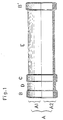
- FIG. 1 shows an advantageous embodiment of an anastomosis sleeve.
- the tubular base body A is shown in a side view, the area A1 being shown in a top view and the area A2 being shown in section.
- A is surrounded by two annular beads B and B 'at the tube openings.
- the tubular base body is surrounded by another annular bead C. The whole body is in one piece.
- the anastomosis of a tubular hollow organ is advantageously carried out by putting its severed ends over the tube and sewing the contact point over the groove D formed by the beads B and C or the depression E formed by the beads C and B '.
- the beads B, C and B 'Seal the organ thus splinted against unwanted material discharge.
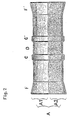
- FIG. 2 Another advantageous embodiment is shown in FIG. 2.
- a tubular base body A is shown in side view, area A1 being shown in a top view and area A2 in section.
- A is surrounded by two annular beads C and C '.
- the tube ends F and F ' are flared.
- the wall thickness of the implant in the conical extension is advantageous, but not mandatory, than on the base body itself.
- the implant is in one piece.
- the anastomosis of a tubular organ is carried out by putting the severed ends over the tube A and sewn over the groove D formed by the beads C and C '. Both the beads C and C 'and the conical tube ends F and F' serve to seal against unwanted material outflow.
- Anastomosis tubes can advantageously be obtained from a melt of the base material by injection molding or extrusion processes.
- the external design of the tubes can be chosen arbitrarily through the injection mold.
- Another method for manufacturing anastomosis tubes is that foils, the manufacture of which has been described above, are bent or wound into tubes.
- a layer of thin foil for example aluminum foil H
- a cylindrical body for example a stainless steel rod G.
- a strip is cut off from the film I according to the invention and wound over the film H in a screw-like arrangement such that adjacent layers overlap one another.
- the film ends are fixed on the cylindrical body, for example with an aluminum film J.
- a layer of Teflon film K is placed over the fixing film J and thus bandaged moderately firmly over the entire length of the rod.
- the cylindrical shape prepared in this way is heated to approx. 250 ° C. for 3 minutes.
- the implants which may be free of solvent residues, must be sterilized for operative use using the usual methods. Irradiation with ionizing radiation, advantageously with wavelengths less than 250 nm, particularly advantageously with gamma radiation or electron radiation, has proven to be advantageous.
- the radiation dose used should be in the range of 5 - 500 kGy. The hard radiation probably creates flaws in the polymer texture that accelerate the breakdown in the body.
Landscapes
- Health & Medical Sciences (AREA)
- Chemical & Material Sciences (AREA)
- Veterinary Medicine (AREA)
- Public Health (AREA)
- Chemical Kinetics & Catalysis (AREA)
- General Health & Medical Sciences (AREA)
- Animal Behavior & Ethology (AREA)
- Epidemiology (AREA)
- Life Sciences & Earth Sciences (AREA)
- Transplantation (AREA)
- Oral & Maxillofacial Surgery (AREA)
- Dermatology (AREA)
- Medicinal Chemistry (AREA)
- Heart & Thoracic Surgery (AREA)
- Surgery (AREA)
- Vascular Medicine (AREA)
- Materials For Medical Uses (AREA)
- Prostheses (AREA)
- Compositions Of Macromolecular Compounds (AREA)
Abstract
- a) ein Homo- oder Copolymerisat aus 3-Hydroxybutansäure (HB) und
3-Hydroxypentansäure (HP, gegebenenfalls im Gemisch mit anderen resorbierbaren polymeren Substanzen, - b) gegebenenfalls chirurgische und/oder medizinische Hilfs- und Zusatzstoffe
Description
- Die Erfindung betrifft resorbierbare chirurgische Implantate, insbesondere zur Unterstützung der Gewebs- und Organheilung.
- Derartige Hilfsmittel finden vorzugsweise Verwendung als vom menschlichen und tierischen Organismus abbaubare Schienungshülsen für Gefäße und Hohlorgane sowie als Trennfolien für unterschiedliche Gewebetypen.
- Eine weitere Anwendungsmöglichkeit besteht darin, derartige Hilfsmittel mit physiologisch wirksamen Substanzen zu dotieren, um sie damit zu einem inkorporierten, kontrolliert wirksamen Wirkstoffdepot zu machen.
- Resorbierbare Materialien und deren Gebrauch zur Herstellung chirurgischer und medizinischer Hilfsmittel sind an sich bekannt. Ihr Vorteil beruht darauf, daß diese nicht postoperativ in einem zweiten riskanten Eingriff aus dem Körper des Patienten entfernt werden müssen, sondern durch dessen Stoffwechsel allmählich abgebaut werden.
- Die im chirurgischen Bereich nahezu ausschließlich verwendeten Materialen sind Homo- oder Copolymerisate aus Milchsäure bzw. Glycolsäure.
- Diese Materialien besitzen eine Reihe von Nachteilen.
- 1) Sie sind stark hydrolyseempfindlich. Daher müssen für ihre Lagerung spezielle Vorkehrungen, also weitgehender Ausschluß von Feuchtigkeit, getroffen werden.
- 2) Wegen ihrer Hydrolyseempfindlichkeit ist die Resorptionsgeschwindigkeit, besonders bei kleinen Wandstärken, zu groß,
- 3) Die Verarbeitung durch thermoplastische Kunststoffverarbeitungsverfahren ist sehr aufwendig.
- Erkrankungen oder Beschädigungen röhrenförmiger Organe - z.B. Blutgefäße, Luft- und Speiseröhre, Darmtrakt - werden operativ durch Anastomose repariert, wenn die Situation Zertrennung dieser Organe erfordert. So wird beispielsweise bei manchen Operationen von Darmkrebs ein ringförmiges, irreparabel geschädigtes Stück Dickdarm entfernt. Die Verbindung der gesunden Teile des zertrennten Organs wird Anastomose genannt.
- Durch den operativen Eingriff wird das betreffende Organ wiederum stark beeinträchtigt. Es besteht ein hohes Risiko, daß eine nicht unterstützte Anastomose von Nahtinsuffizienzen begleitet wird. Problematische Anastomosen im Intestinaltrakt weisen daher Insuffizienzquoten bis zu 40 % auf. Weitere Beispiele sind Notfalleingriffe am Gastrointestinaltrakt und die Operation der chronisch-entzündlichen Darmerkrankung im akuten Schub. Sie weisen etwa 20%ige Insuffizienzraten auf. Höchste Quoten besitzt die chirurgische Intervention beim intestinalen Strahlenspätschaden (bis 40 %). Aber auch bei speziellen Lokalisationen, wie im tiefen Rektum und bei Ösophago-gastralen Anastomosen im Halsbereich finden sich Insuffizienzraten über 20 %.
- Die Verwendung hohlzylindrischer Körper zur inneren Schienung von Anastomosen ist an sich bekannt (Dis. Colon Rectum, 28 (1985), 904-7; Br. J. Surg. 71 (1984), 726-729). Sie bewirken eine Unterstützung des geschädigten Organs und gewährleisten, daß der Materialfluß aufrechterhalten und nicht durch Kollabieren des Organs an der Nahtstelle unterbrochen wird. Weiterhin wird die Nahtstelle abgedichtet und Materialfluß in die Umgebung des Organs vermieden.
- Bei Verwendung nichtresorbierbarer Anastomoseröhren wird erwartet, daß sich die Hülsen nach Heilung der Anastomose entweder durch einen Zweiteingriff entfernen lassen oder, wie es bei Darmanastomosen möglich ist, nach Resorption des Nahtmaterials durch die Eigenperistaltik des geschienten Organs ausgeschieden werden.
- Im letzteren Falle ist die Prognose im allgemeinen nicht optimistisch, da bei der Passage der Röhre durch den Verdauungstrakt Komplikationen auftreten können. So besteht die Gefahr der Verkantung, wodurch ein Ileus verursacht werden kann. Löst sich die Röhre nicht von der Darmwand, muß sie endoskopisch oder operativ entfernt werden.
- Wissenschaftlich fundierte Überprüfungen des Prinzips der inneren Schienung liegen erst seit einigen Jahren aus Amerika und Australien vor. Keine Erfahrungen existieren weltweit mit dem Einsatz resorbierbarer Biomaterialien zur inneren Schienung.
- Folien aus resorbierbaren Materialien haben in der Chirurgie einen hohen Stellenwert als Schutz von Organen, Nervenbahnen und Sehnen gegen sich neu bildendes Narbengewebe. Dabei dienen die Folien als mechanische Barriere zwischen unabhängigen Gewebstypen bzw. Gewebsschichten. Nichtresorbierbares Material ist für diese Verwendung in hohem Maße ungeeignet, da Entfernen der chirurgischen Folie die separierten Gewebsteile so stark beeinträchtigen würde, daß erneut die Gefahr gegenseitiger Beeinträchtigung oder sogar des Zusammenwachsens bestünde.
- Für viele Fälle ist eine einfache resorbierbare Folie nicht ausreichend. So wurde zum Beispiel gefunden, daß eine Einscheidung von Sehnen und Muskulaturgewebe an Knochen Nekrosen der Knochenhaut hervorrufen. Dies beruht auf der Störung des osmotischen Austauschs zwischen den involvierten Gewebsregionen.
- Aufgabe der vorliegenden Erfindung war somit, ein Material zu finden, welches so unempfindlich gegen Hydrolyse ist, daß es ohne Aufwand gelagert werden kann, aber dennoch im menschlichen oder tierischen Organismus in angemessener Zeit abbaubar ist. Dabei muß das Material formstabil sein, darf aber gleichzeitig nicht so spröde -sein, daß es unter peristaltischer Einwirkung zerbirst oder Organreizung hervorruft. Insbesondere sollte es den aggressiven Sekreten des Intestinaltraktes einesteils hinreichend lange widerstehen, letztlich aber doch abgebaut werden. Diese Forderung war bislang von keinem Material erfüllt worden.
- Weiterhin sollten chirurgische Hilfsmittel ausgestaltet werden, die im Organismus des Warmblüters die Gewebs- und Organheilung unterstützen, speziell als Implantate wie Anastomoseröhren und Trennfolien. Schließlich sollten Verfahren entwickelt werden, welche auf ökonomische Weise die Herstellung solcher Hilfsmittel ermöglichen.
- Es hat sich gezeigt - und darin besteht die Lösung der ersten Aufgabe der Erfindung - daß Homo- und Copolymerisate aus 3-Hydroxybutansäure (HB) und 3-Hydroxypentansäure (HP) - gegebenenfalls im Gemisch mit anderen resorbierbaren Polymeren - über die geforderten Materialeigenschaften verfügen und sich in vorteilhafter Weise zu chirurgischen Implantaten verarbeiten lassen. In EP-OS 204 442 und EP-OS 182 378 werden Copolymerisate aus 3-Hydroxybutansäure und 3-Hydroxypentansäure beschrieben, welche durch mikrobiologische Techniken erzeugt werden. Deren Verwendung als Verpackungsmaterial wird vorgeschlagen. In EP-OS 204 931 und WO 8607250 werden biologisch resorbierbare Objekte aus Homo-poly-3-hydroxybutanoat aufgezeigt.
- Die Verwendung von Copolymerisaten von 3-Hydroxyalkylcarbonsäuren als resorbierbares Knochenersatzmaterial wird in der ICI-Firmenschrift "Biopol", 1987 beschrieben.
- Die Polymerisate lassen sich nach dem Schema

n ist eine Zahl von 1500 bis 5000. Es ist möglich und je nach gewünschter Resorptionsgeschwindigkeit gegebenenfalls vorteilhaft, Polymerengemische aus den erfindungsgemäßen Polymerisaten bzw. Copolymerisaten und anderen resorbierbaren Substanzen, z.B. Polyglycolid, Polylactid, Poly(Dioxanon) einzusetzen. Dabei können die jeweiligen mittleren Molekulargewichte so variiert werden, daß den Erfordernissen des Anwendungsbereiches Rechnung getragen wird. - Die speziellen Materialeigenschaften sind über die Wahl des Polymerisationsgrades und gegebenenfalls des Monomerenverhältnisses steuerbar.
- Copolymerisate aus 40 - 98 Gew.-% HB und 2 - 60 Gew.-% HP weisen hohe Flexibilität bei guter Festigkeit auf. Vorteilhaft ist ein Bereich von 70 - 95 Gew.-% HB, und 5 - 30 Gew.-% HP, besonders vorteilhaft 85 - 92 Gew.-% HB und 8 - 15 Gew.-% HP. Das bevorzugte Molekulargewicht ist 10.000 - 500.000 Dalton, bevorzugt 100.000 - 350.000 Dalton.
- Die Flexibilität eines Materials mit gegebenem Molekulargewicht kann vorteilhaft durch Zugabe eines Weichmachers beeinflußt werden.
- Die Mono- Di- und Triethylester der aliphatischen Hydroxy- bzw. Dihydroxymono-, -di- und tricarbonsäuren, insbesondere der Citronensäure haben sich als Weichmacher gut bewährt, insbesondere in einer Menge von 0,5 - 5,0 Gew.-%, bezogen auf die gesamte Zusammensetzung.
- Besonders bevorzugt ist ein Anteil von 2,0 - 3,5 Gew.-% dieser Ester, in Bezug auf die gesamte Zusammensetzung.
- Weiterhin ist vorteilhaft, als Weichmacher Polyethylenglykole mit einem mittleren Molekulargewicht von 5.000 - 30.000 einzusetzen, bevorzugt in einem Anteil von 1,0 - 15,0 Gew.-%, bezogen auf die gesamte Zusammensetzung.
- Es ist günstig, den polymeren Grundstoffen übliche medizinische Hilfs- und/oder Zusatzstoffe beizufügen, beispielsweise Röntgenkontrastmittel (vorteilhaft ZrO₂ oder BaSO₄ in einem Gehalt bis zu 50 % des Gesamtgewichts), isotopenmarkierte Zusatzstoffe, physiologisch wirksame Substanzen (z.B. pharmazeutische Wirkstoffe wie Relaxantien, Sedativa, Antibiotika, antivirale Stoffe), Farbstoffe, (z,B. Fluorescein).
- Die Einarbeitung dieser Hilfsstoffe erfolgt bevorzugt durch Beimengen zum granulierten Festkörper, zu einer Lösung, einer Suspension oder einer Schmelze des Polymerisats. Dies setzt voraus, daß die gewählten Zusatzstoffe mit den Aufarbeitungsverfahren, welche in einen Arbeitsgang der Formkörperherstellung integriert sein können, verträglich sind.
- Bevorzugt in Intestinaltrakt und insbesondere im Verdauungsbereich bieten die erfindungsgemäßen Implantate den Vorteil, daß sie in angemessener Zeit abgebaut werden. Herkömmliches resorbierbares Material vermag den aggressiven Verdauungssekreten zum einen nur kurze Zeit standzuhalten, zum anderen ist seine Resorptionsrate nur sehr unzuverlässig prognostizierbar.
- In den nachfolgenden Beispielen seien die erfindungsgemäßen Materialien beispielhaft erläutert, ohne daß dadurch eine Einschränkung auf diese Beispiele erfolgen soll.
- Copolymerisat:
HB : 95 Gew.-%
HP : 5 Gew.-%
Molekulargewicht 200.000 - Copolymerisat:
HB : 80 Gew.-%
HP : 20 Gew.-%
Molekulargewicht 230.000 - Mischung aus 70 Gewichtsteilen Copolymerisat gemäß Beispiel 1 und 30 Gewichtsteilen ZrO₂.
- Mischung aus 70 Gewichtsteilen Copolymerisat gemäß Beispiel 2 und 30 Gewichtsteilen ZrO₂.
- Die Copolymerisate sind käufliche, mikrobiell nach EP-OS 204 442 hergestellte Produkte.
- Die Polymerisate gemäß den Beispielen 1 und 2 können durch Foliengießverfahren in Folienform gebracht werden. Dazu geht man von einer Lösung oder Suspension der Grundmischung in einem Lösungsmittel, vorteilhaft einem leicht verdunstenden Lösungsmittel (z.B. Chloroform) aus, die auf der Platte eines handelsüblichen Foliengießgerätes ausgegossen wird. Das verdunstende Lösungsmittel hinterläßt eine gleichmäßige Folie, die blasenfrei in Dicken von 0,05 bis 2,5 mm erhältlich ist.
- Die Mischungen gemäß den Beispielen 3 und 4 werden aufgeschmolzen und auf die Platte des Foliengießgerätes aufgetragen und verstrichen. Nach Erstarren und Abkühlen des Materials kann die fertige Folie abgezogen werden. Schichtdicken von 1 bis 5 mm sind so erhältlich. Besonders bevorzugt ist, derartige Folien durch Extrusionsverfahren anzufertigen.
- Um die bei manchen Indikationen zu erwartenden Nekrosen infolge Störungen des osmotischen Austausches zu vermeiden, können die Folien perforiert werden. Die Lochgröße sollte so gewählt werden, daß die Gewebsregionen zu beiden Seiten der Folie nicht durch die Löcher in Kontakt treten können. Als günstig hat sich ein mittlerer Lochdurchmesser von 50 - 2000 my erwiesen, bevorzugte Lochdichte ist 100 - 10.000 Löcher je cm².
- Die Perforation erfolgt nach an sich bekannten Verfahren durch Stanzen oder Druckluftperforation, vorteilhaft durch Laserperforation. Durch Laserperforation werden besonders gleichförmige Löcher mit abgerundeten Kanten erzeugt.
- Eine weitere Anwendungsmöglichkeit ist die Verarbeitung der erfindungsgemäßen Polymerisate oder Mischungen zu hohlen Formkörpern, zur Unterstützung hohler Organe. Bevorzugt dabei ist die Anwendung an Speiseröhre, Magen, Duodenum, Darmtrakt und harnleitenden Hohlorganen, aber auch luft- und bluttransportierenden Systemen.
- Die erfindungsgemäßen Hohlkörper sollten zumindest eine Öffnung aufweisen. Sie werden bevorzugt in Form eines Ringes, eines Schlauches oder einer Röhre ausgestaltet. Als Implantate dienen sie vorzugsweise der Anastomose.
- Eine reliefartige äußere Oberfläche, im einfachsten Falle eine Aufrauhung, vergrößert die Kontaktfläche mit dem geschädigten Organ und bewirkt bessere Haftung. Besonders vorteilhaft sind ringförmige Erhebungen und/oder Vertiefungen, die den Grundkörper umgeben. Derartige Erhebungen sind geeignet, mit dem zu schienenden Organ - vorzugsweise unter Verwendung resorbierbaren Nahtmaterials - vernäht zu werden. Sie dienen als Sperre gegen ein Verrutschen des Hohlkörpers im geschienten Organ. Besonders bevorzugt ist dabei die Ausbildung ringförmiger Wülste, in deren Zwischenräume chirurgische Nähte verlegt werden können. Vorteilhaft sind auch ringförmige Vertiefungen, in die die Nähte gebettet werden können, bzw. über denen das Organ mit Hilfe von Zwirnschlingen oder Klammern eingeschnürt wird.
- Ein weiterer Vorteil ringförmiger Erhebungen ist deren Funktion als Abdichtung der Nahtstelle. Konische Erweiterung beziehungsweise Verdickung der Röhrenenden führen in einer weiteren bevorzugten Ausführungsform zu einer verbesserten Abdichtung der Nahtstelle.
- Die spezielle Ausgestaltung von Anastomoseröhren als oberflächenstrukturierte Hohlzylinder ist einesteils eine besonders vorteilhafte Ausführung der erfindungsgemäßen chirurgischen Implantate. Andererseits ist sie nicht eingeschränkt auf die Verwendung von Homo- und Copolymerisaten von Hydroxypentansäure und Hydroxybutansäure. Vielmehr kann der Fachmann aus allen toxikologisch vertretbaren resorbierbaren Materialien mit geeigneten physikalischen Eigenschaften Anastomoseröhren der geschilderten Ausgestaltung herstellen. Dabei ist allerdings zu berücksichtigen, daß die Materialien des Standes der Technik nicht über die überlegenen Eigenschaften der Homo- und Copolymerisate aus HB und HP verfügen, insbesondere nicht über deren Resorptionsverhalten im Intestinaltrakt.
- In Fig. 1 ist eine vorteilhafte Ausführungsform einer Anastomosehülse dargestellt. Der röhrenförmige Grundkörper A ist in Seitenansicht gezeigt, wobei der Bereich A1 in Aufsicht, der Bereich A2 im Schnitt gezeigt wird. A wird von zwei ringförmigen Wülsten B und B′ an den Röhrenöffnungen umgeben. Der röhrenförmige Grundkörper ist von einem weiteren ringförmigen Wulst C umgeben. Der ganze Körper ist einstückig.
- Die Anastomose eines schlauchförmigen Hohlorgans erfolgt vorteilhaft durch Stülpen dessen zertrennter Enden über die Röhre und Vernähen der Kontaktstelle über der durch die Wülste B und C gebildeten Rinne D oder der durch die Wülste C und B′ gebildeten Vertiefung E. Die Wülste B, C und B′ dichten das so geschiente Organ gegen unerwünschten Materialausfluß ab.
- Eine weitere vorteilhafte Ausführungsform ist in Fig. 2 abgebildet. Ein röhrenförmiger Grundkörper A ist in Seitenansicht gezeigt, wobei der Bereich A1 in Aufsicht, der Bereich A2 im Schnitt gezeigt wird. A wird von zwei ringförmigen Wülsten C und C′ umgeben. Die Röhrenenden F und F′ sind konisch verbreitert. Vorteilhaft, aber nicht zwingend, ist die Wandstärke des Implantates in der konischen Erweiterung größer auszubilden als auf dem Grundkörper selbst. Das Implantat ist einstückig.
- Die Anastomose eines schlauchförmigen Organs erfolgt, indem die zertrennten Enden über die Röhre A gestülpt und über der durch die Wülste C und C′ gebildeten Rinne D vernäht werden. Sowohl die Wülste C und C′ als auch die konischen Röhrenenden F und F′ dienen zur Abdichtung gegen unerwünschten Materialausfluß.
- Anastomoseröhren können vorteilhaft durch Spritzguß- oder Extrusionsverfahren aus einer Schmelze des Grundstoffes erhalten werden. Die äußere Gestaltung der Röhren ist durch die Spritzgußform beliebig zu wählen.
- Eine weitere Methode zur Fertigung von Anastomoseröhren besteht darin, daß Folien, deren Herstellung vorab beschrieben wurde, zu Röhren gebogen oder gewickelt werden.
- Wie in Fig. 3 beispielhaft dargestellt, kann um einen zylindrischen Körper, beispielsweise einen Edelstahlstab G eine Lage dünner Folie, beispielsweise Aluminiumfolie H gewickelt und fixiert werden. Von der erfindungsgemäßen Folie I wird ein Streifen abgeschnitten und in einer schraubenartigen Anordnung so über die Folie H gewickelt, daß benachbarte Lagen einander überlappen. Um ein Abwickeln der Folie zu verhindern, werden die Folienenden auf dem zylindrischen Körper fixiert, beispielsweise mit einer Aluminiumfolie J. Über die fixierende Folie J wird eine Lage Teflonfolie K gelegt und damit über die ganze Länge des Stabes mäßig fest bandagiert.
- Die so vorbereitete zylindrische Form wird 3 Minuten auf ca. 250°C erhitzt.
- Nach dem Abkühlen werden J und K vorsichtig entfernt. Die an den Überlappungsstellen verschmolzene Polymerfolie liegt nun als Röhrchen vor, welches noch auf dem Zylinder zu geeigneter Länge zerschnitten werden kann. Danach werden die einzelnen Hülsen mit der darunterliegenden Aluminiumfolie von dem Metallstab abgezogen. Die Folie wird aus den Hülsen entfernt.
- Die von ggf. vorhandenen Rückständen der Lösungsmittel befreiten Implantate sind für den operativen Gebrauch nach den üblichen Methoden zu sterilisieren. Günstig hat sich die Bestrahlung mit ionisierender Strahlung, vorteilhaft mit Wellenlängen kleiner als 250 nm, besonders vorteilhaft mit Gammastrahlung oder Elektronenstrahlung erwiesen. Die verwendete Strahlungsdosis sollte im Bereich von 5 - 500 kGy liegen. Die harte Strahlung erzeugt vermutlich Fehlstellen in der Polymertextur, die den Abbau im Körper beschleunigen.
Claims (14)
a) ein Homo- oder Copolymerisat aus 3-Hydroxybutansäure (HB) und
3-Hydroxypentansäure (HP) gegebenenfalls im Gemisch mit anderen resorbierbaren polymeren Substanzen,
b) gegebenenfalls chirurgische und/oder medizinische Hilfs- und Zusatzstoffe
enthält.
- physiologisch wirksamen Stoffe
- Kontrastmittel
- Markierungsmittel
- Weichmacher
- Farbstoffe
- antimikrobiell und/oder antiviral wirkenden Stoffe
gewählt werden.
Applications Claiming Priority (4)
| Application Number | Priority Date | Filing Date | Title |
|---|---|---|---|
| DE8804423U DE8804423U1 (de) | 1988-04-02 | 1988-04-02 | Röhrenförmiges Implantat |
| DE8804423U | 1988-04-02 | ||
| DE3811231 | 1988-04-02 | ||
| DE19883811231 DE3811231A1 (de) | 1988-04-02 | 1988-04-02 | Chirurgische implantate |
Publications (2)
| Publication Number | Publication Date |
|---|---|
| EP0336148A2 true EP0336148A2 (de) | 1989-10-11 |
| EP0336148A3 EP0336148A3 (de) | 1991-04-17 |
Family
ID=25866653
Family Applications (1)
| Application Number | Title | Priority Date | Filing Date |
|---|---|---|---|
| EP19890104505 Withdrawn EP0336148A3 (de) | 1988-04-02 | 1989-03-14 | Chirurgische Implantate |
Country Status (3)
| Country | Link |
|---|---|
| EP (1) | EP0336148A3 (de) |
| JP (1) | JPH0221870A (de) |
| AU (1) | AU3221289A (de) |
Families Citing this family (1)
| Publication number | Priority date | Publication date | Assignee | Title |
|---|---|---|---|---|
| CN110522485B (zh) * | 2019-08-27 | 2020-12-11 | 浙江大学 | 一种可降解的肠道完全转流支架 |
Family Cites Families (5)
| Publication number | Priority date | Publication date | Assignee | Title |
|---|---|---|---|---|
| US3620218A (en) * | 1963-10-31 | 1971-11-16 | American Cyanamid Co | Cylindrical prosthetic devices of polyglycolic acid |
| IT8447734A0 (it) * | 1984-02-22 | 1984-02-22 | Di Mezza Antonio | Protesi microvascolare |
| GB2164562A (en) * | 1984-09-21 | 1986-03-26 | Colin Campbell Mackenzie | Device to facilitate reconnection of tubular vessels in a body |
| EP0326583B1 (de) * | 1986-12-17 | 1991-10-23 | AlliedSignal Inc. | Implantierbare gegenstände mit einem hydrophoben bestandteil |
| SE457692B (sv) * | 1987-03-09 | 1989-01-23 | Astra Meditec Ab | Implanterbar protes foer att helt eller delvis ersaetta en sena, ett ligament eller ett korsband |
-
1989
- 1989-03-14 EP EP19890104505 patent/EP0336148A3/de not_active Withdrawn
- 1989-03-29 AU AU32212/89A patent/AU3221289A/en not_active Abandoned
- 1989-03-31 JP JP1078701A patent/JPH0221870A/ja active Pending
Also Published As
| Publication number | Publication date |
|---|---|
| AU3221289A (en) | 1989-10-05 |
| EP0336148A3 (de) | 1991-04-17 |
| JPH0221870A (ja) | 1990-01-24 |
Similar Documents
| Publication | Publication Date | Title |
|---|---|---|
| DE3689650T2 (de) | Bioresorbierbare Polymere von hohem Molekulargewicht und Implantate davon. | |
| DE60018814T2 (de) | Nähbare Membran zur Adhäsionsverhinderung | |
| DE69625822T2 (de) | Implantierbare, bioresorbierbare membran und verfahren zu ihrer herstellung | |
| EP1112095B1 (de) | Biologisch aktive implantate | |
| DE69121587T3 (de) | Implantierbare bioresorbierbare artikel | |
| DE60035403T2 (de) | Biologische materialien | |
| DE68920055T2 (de) | Geformte Kunststoffartikel mit Formgedächtnis. | |
| DE3422160C2 (de) | Verfahren zur Modifizierung eines chirurgischen Strukturelements aus einem bioresorbierbaren Polymeren | |
| DE69822470T2 (de) | Bioabbaubares, absorbierbares Formgedächtnismaterial | |
| DE69629010T2 (de) | Selbsttragende flächengebilde aus vernetztem fibrin zur hemmung von postoperativen adhäsionen | |
| DE68926305T2 (de) | Bioabbaubare chirurgische implantate und anordnungen | |
| DE60111029T2 (de) | Resorbierbare mikromembrane zur verminderung von narbengewebe | |
| EP1519713B1 (de) | Wirkstofffreisetzungssysteme auf basis von bioabbaubaren oder biokompatiblen polymeren mit formgedaechtniseffekt | |
| DE68928817T2 (de) | Chirurgisches Material | |
| DE69729314T2 (de) | Kollagenlaminat material und verfahren zu dessen herstellung | |
| DE69733153T2 (de) | Chirurgisches implantat | |
| DE60209787T2 (de) | Flächiges implantat | |
| DE69626996T2 (de) | Unter gewebebedingungen abbaubares material und verfahren zu seiner herstellung | |
| DE69720769T2 (de) | Künstlicher neuraler kanal | |
| US5011493A (en) | Material for connecting members for inner soft tissues and organs | |
| DE2206144A1 (de) | Von lebenden saeugetiergeweben absorbierbare copolymere | |
| DE2723911A1 (de) | Unter normalbedingungen festes bioresorbierbares hydrolysierbares polymeres reaktionsprodukt | |
| WO2016155847A1 (de) | Modulare occlusionsvorrichtung zum verschluss des linken herzohrs (left atrial appendage, laa) und dessen herstellung | |
| EP0336148A2 (de) | Chirurgische Implantate | |
| DE3811231A1 (de) | Chirurgische implantate |
Legal Events
| Date | Code | Title | Description |
|---|---|---|---|
| PUAI | Public reference made under article 153(3) epc to a published international application that has entered the european phase |
Free format text: ORIGINAL CODE: 0009012 |
|
| 17P | Request for examination filed |
Effective date: 19890314 |
|
| AK | Designated contracting states |
Kind code of ref document: A2 Designated state(s): AT BE CH DE ES FR GB IT LI LU NL SE |
|
| RHK1 | Main classification (correction) |
Ipc: A61L 31/00 |
|
| PUAL | Search report despatched |
Free format text: ORIGINAL CODE: 0009013 |
|
| AK | Designated contracting states |
Kind code of ref document: A3 Designated state(s): AT BE CH DE ES FR GB IT LI LU NL SE |
|
| STAA | Information on the status of an ep patent application or granted ep patent |
Free format text: STATUS: THE APPLICATION HAS BEEN WITHDRAWN |
|
| 18W | Application withdrawn |
Withdrawal date: 19910824 |
|
| R18W | Application withdrawn (corrected) |
Effective date: 19910824 |