EP0336148A2 - Implants chirurgicaux - Google Patents
Implants chirurgicaux Download PDFInfo
- Publication number
- EP0336148A2 EP0336148A2 EP89104505A EP89104505A EP0336148A2 EP 0336148 A2 EP0336148 A2 EP 0336148A2 EP 89104505 A EP89104505 A EP 89104505A EP 89104505 A EP89104505 A EP 89104505A EP 0336148 A2 EP0336148 A2 EP 0336148A2
- Authority
- EP
- European Patent Office
- Prior art keywords
- implant according
- weight
- implant
- resorbable
- copolymer
- Prior art date
- Legal status (The legal status is an assumption and is not a legal conclusion. Google has not performed a legal analysis and makes no representation as to the accuracy of the status listed.)
- Withdrawn
Links
Images

Classifications
-
- A—HUMAN NECESSITIES
- A61—MEDICAL OR VETERINARY SCIENCE; HYGIENE
- A61L—METHODS OR APPARATUS FOR STERILISING MATERIALS OR OBJECTS IN GENERAL; DISINFECTION, STERILISATION OR DEODORISATION OF AIR; CHEMICAL ASPECTS OF BANDAGES, DRESSINGS, ABSORBENT PADS OR SURGICAL ARTICLES; MATERIALS FOR BANDAGES, DRESSINGS, ABSORBENT PADS OR SURGICAL ARTICLES
- A61L27/00—Materials for grafts or prostheses or for coating grafts or prostheses
- A61L27/14—Macromolecular materials
- A61L27/18—Macromolecular materials obtained otherwise than by reactions only involving carbon-to-carbon unsaturated bonds
-
- A—HUMAN NECESSITIES
- A61—MEDICAL OR VETERINARY SCIENCE; HYGIENE
- A61L—METHODS OR APPARATUS FOR STERILISING MATERIALS OR OBJECTS IN GENERAL; DISINFECTION, STERILISATION OR DEODORISATION OF AIR; CHEMICAL ASPECTS OF BANDAGES, DRESSINGS, ABSORBENT PADS OR SURGICAL ARTICLES; MATERIALS FOR BANDAGES, DRESSINGS, ABSORBENT PADS OR SURGICAL ARTICLES
- A61L31/00—Materials for other surgical articles, e.g. stents, stent-grafts, shunts, surgical drapes, guide wires, materials for adhesion prevention, occluding devices, surgical gloves, tissue fixation devices
- A61L31/04—Macromolecular materials
- A61L31/06—Macromolecular materials obtained otherwise than by reactions only involving carbon-to-carbon unsaturated bonds
Definitions
- the invention relates to resorbable surgical implants, in particular to support tissue and organ healing.
- Such aids are preferably used as splint sleeves for vessels and hollow organs that can be degraded by the human and animal organism and as separating films for different types of tissue.
- Another possible application is to dope such aids with physiologically active substances in order to make them an incorporated, controlled active ingredient depot.
- Resorbable materials and their use for the production of surgical and medical aids are known per se. Their advantage is based on the fact that they do not have to be removed from the patient's body in a second risky operation postoperatively, but are gradually reduced by their metabolism.
- the materials used almost exclusively in the surgical field are homopolymers or copolymers of lactic acid or glycolic acid.
- tubular organs e.g. Blood vessels, trachea and esophagus, intestinal tract - are surgically repaired by anastomosis when the situation requires separation of these organs. For example, in some colon cancer operations, an annular, irreparably damaged piece of colon is removed. The connection of the healthy parts of the separated organ is called anastomosis.
- hollow cylindrical bodies for internal splinting of anastomoses is known per se (Dis. Colon Rectum, 28 (1985), 904-7; Br. J. Surg. 71 (1984), 726-729). They provide support for the damaged organ and ensure that the material flow is maintained and is not interrupted by the collapse of the organ at the interface. Furthermore, the seam is sealed and material flow into the environment of the organ is avoided.
- the sleeves can either be removed by a second operation or, as is possible with intestinal anastomoses, can be excreted after resorption of the suture material by the intrinsic peristalsis of the splinted organ.
- the prognosis is generally not optimistic, since complications can arise when the tube passes through the digestive tract. There is a risk of canting, which can cause an ileus. If the tube does not detach from the intestinal wall, it must be removed endoscopically or by surgery.
- Films made of resorbable materials are of great importance in surgery as protection of organs, nerve tracts and tendons against newly formed scar tissue.
- the foils serve as a mechanical barrier between independent tissue types or tissue layers. Is non-absorbable material highly unsuitable for this use, since removal of the surgical film would impair the separated tissue parts to such an extent that there would again be a risk of mutual impairment or even growing together.
- a simple absorbable film is not sufficient.
- a separation of tendons and muscle tissue on bones causes necrosis of the periosteum. This is due to the disruption of the osmotic exchange between the tissue regions involved.
- the object of the present invention was therefore to find a material which is so insensitive to hydrolysis that it can be stored without effort, but is nevertheless degradable in a reasonable time in the human or animal organism.
- the material must be dimensionally stable, but at the same time it must not be so brittle that it bursts under peristaltic influence or causes organ irritation. In particular, it should be able to withstand the aggressive secretions of the intestinal tract for a sufficiently long period of time, but should ultimately be broken down. No material has yet met this requirement.
- surgical aids should be designed that support tissue and organ healing in the organism of the warm-blooded animal, especially as implants such as anastomosis tubes and separating foils.
- processes should be developed which enable the production of such aids in an economical manner.
- copolymers of 3-hydroxyalkyl carboxylic acids as resorbable bone substitute material is described in the ICI company publication "Biopol", 1987.
- the polymers can be according to the scheme symbolize, wherein R represents the radicals CH3, and -C2H5.
- the distribution of the monomers in the copolymers is statistical.
- n is a number from 1,500 to 5,000. It is possible and, depending on the desired resorption rate, advantageous if appropriate, to use polymer mixtures of the inventive polymers or copolymers and other resorbable substances, for example polyglycolide, polylactide, poly (dioxanone).
- the respective average molecular weights can be varied so that the requirements of the field of application are taken into account.
- the special material properties can be controlled via the choice of the degree of polymerization and, if appropriate, the monomer ratio.
- Copolymers of 40-98% by weight of HB and 2-60% by weight of HP have high flexibility with good strength.
- a range of 70-95% by weight of HB and 5-30% by weight of HP is advantageous, particularly advantageously 85-92% by weight of HB and 8-15% by weight of HP.
- the preferred molecular weight is 10,000-500,000 daltons, preferably 100,000-350,000 daltons.
- the flexibility of a material with a given molecular weight can advantageously be influenced by adding a plasticizer.
- a proportion of 2.0-3.5% by weight of these esters is particularly preferred, based on the overall composition.
- polyethylene glycols with an average molecular weight of 5,000-30,000 as plasticizers, preferably in a proportion of 1.0-15.0% by weight, based on the overall composition.
- X-ray contrast media advantageousously ZrO2 or BaSO4 in a content of up to 50% of the total weight
- isotope-labeled additives for example active pharmaceutical ingredients such as relaxants, sedatives, antibiotics, antiviral substances
- dyes e.g. fluorescein
- auxiliaries are preferably incorporated by adding them to the granulated solid, to a solution, a suspension or a melt of the polymer. This presupposes that the selected additives are compatible with the work-up processes, which can be integrated in a molding production step.
- the implants according to the invention offer the advantage that they are broken down in an appropriate time.
- Conventional resorbable material can only withstand the aggressive digestive secretions for a short time, and on the other hand its absorption rate can only be predicted very unreliably.
- Copolymer HB: 95% by weight
- HP 5% by weight
- copolymers are commercially available products produced microbially according to EP-OS 204 442.
- the polymers according to Examples 1 and 2 can be brought into film form by film casting processes. This is based on a solution or suspension of the basic mixture in a solvent, advantageously a readily evaporating solvent (e.g. chloroform), which is poured onto the plate of a commercially available film casting device.
- a readily evaporating solvent e.g. chloroform
- the evaporating solvent leaves a uniform film that is available bubble-free in thicknesses from 0.05 to 2.5 mm.
- the mixtures according to Examples 3 and 4 are melted and applied to the plate of the film casting device and spread. After solidification and cooling of the material, the finished film can be removed. Layer thicknesses of 1 to 5 mm are available. It is particularly preferred to produce such films by extrusion processes.
- the foils can be perforated to avoid the necrosis that can be expected in some indications due to disorders of the osmotic exchange.
- the hole size should be chosen so that the tissue regions on both sides of the film cannot come into contact through the holes.
- An average hole diameter of 50-2000 my has proven to be favorable, preferred hole density is 100-10,000 holes per cm2.
- the perforation is carried out according to methods known per se by punching or compressed air perforation, advantageously by laser perforation.
- Laser perforation creates particularly uniform holes with rounded edges.
- Another possible application is the processing of the polymers or mixtures according to the invention into hollow shaped articles to support hollow organs.
- the application is preferred Esophagus, stomach, duodenum, intestinal tract and urinary hollow organs, but also air and blood transport systems.
- the hollow bodies according to the invention should have at least one opening. They are preferably designed in the form of a ring, a hose or a tube. As implants, they are preferably used for the anastomosis.
- a relief-like outer surface in the simplest case a roughening, increases the contact area with the damaged organ and causes better adhesion.
- Annular elevations and / or depressions surrounding the base body are particularly advantageous. Such elevations are suitable for being sewn to the organ to be shone - preferably using resorbable suture material. They serve as a barrier against slipping of the hollow body in the splinted organ. Particularly preferred is the formation of annular beads, in the spaces between which surgical sutures can be laid. Also advantageous are ring-shaped depressions into which the seams can be embedded, or over which the organ is constricted with the help of twisted loops or staples.
- ring-shaped elevations are their function as sealing the seam.
- conical widening or thickening of the tube ends leads to improved sealing of the seam.
- anastomosis tubes as a surface-structured hollow cylinder is one part of a particularly advantageous embodiment of the surgical implants according to the invention.
- it is not restricted to the use of homo- and copolymers of hydroxypentanoic acid and hydroxybutanoic acid.
- the person skilled in the art can produce anastomosis tubes of the described design from all toxicologically justifiable resorbable materials with suitable physical properties.
- the materials of the prior art do not have the superior properties of the homopolymers and copolymers of HB and HP, in particular not their absorption behavior in the intestinal tract.
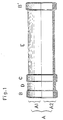
- FIG. 1 shows an advantageous embodiment of an anastomosis sleeve.
- the tubular base body A is shown in a side view, the area A1 being shown in a top view and the area A2 being shown in section.
- A is surrounded by two annular beads B and B 'at the tube openings.
- the tubular base body is surrounded by another annular bead C. The whole body is in one piece.
- the anastomosis of a tubular hollow organ is advantageously carried out by putting its severed ends over the tube and sewing the contact point over the groove D formed by the beads B and C or the depression E formed by the beads C and B '.
- the beads B, C and B 'Seal the organ thus splinted against unwanted material discharge.
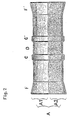
- FIG. 2 Another advantageous embodiment is shown in FIG. 2.
- a tubular base body A is shown in side view, area A1 being shown in a top view and area A2 in section.
- A is surrounded by two annular beads C and C '.
- the tube ends F and F ' are flared.
- the wall thickness of the implant in the conical extension is advantageous, but not mandatory, than on the base body itself.
- the implant is in one piece.
- the anastomosis of a tubular organ is carried out by putting the severed ends over the tube A and sewn over the groove D formed by the beads C and C '. Both the beads C and C 'and the conical tube ends F and F' serve to seal against unwanted material outflow.
- Anastomosis tubes can advantageously be obtained from a melt of the base material by injection molding or extrusion processes.
- the external design of the tubes can be chosen arbitrarily through the injection mold.
- Another method for manufacturing anastomosis tubes is that foils, the manufacture of which has been described above, are bent or wound into tubes.
- a layer of thin foil for example aluminum foil H
- a cylindrical body for example a stainless steel rod G.
- a strip is cut off from the film I according to the invention and wound over the film H in a screw-like arrangement such that adjacent layers overlap one another.
- the film ends are fixed on the cylindrical body, for example with an aluminum film J.
- a layer of Teflon film K is placed over the fixing film J and thus bandaged moderately firmly over the entire length of the rod.
- the cylindrical shape prepared in this way is heated to approx. 250 ° C. for 3 minutes.
- the implants which may be free of solvent residues, must be sterilized for operative use using the usual methods. Irradiation with ionizing radiation, advantageously with wavelengths less than 250 nm, particularly advantageously with gamma radiation or electron radiation, has proven to be advantageous.
- the radiation dose used should be in the range of 5 - 500 kGy. The hard radiation probably creates flaws in the polymer texture that accelerate the breakdown in the body.
Landscapes
- Health & Medical Sciences (AREA)
- Chemical & Material Sciences (AREA)
- Veterinary Medicine (AREA)
- Public Health (AREA)
- Chemical Kinetics & Catalysis (AREA)
- General Health & Medical Sciences (AREA)
- Animal Behavior & Ethology (AREA)
- Epidemiology (AREA)
- Life Sciences & Earth Sciences (AREA)
- Transplantation (AREA)
- Oral & Maxillofacial Surgery (AREA)
- Dermatology (AREA)
- Medicinal Chemistry (AREA)
- Heart & Thoracic Surgery (AREA)
- Surgery (AREA)
- Vascular Medicine (AREA)
- Materials For Medical Uses (AREA)
- Prostheses (AREA)
- Compositions Of Macromolecular Compounds (AREA)
Applications Claiming Priority (4)
| Application Number | Priority Date | Filing Date | Title |
|---|---|---|---|
| DE8804423U DE8804423U1 (de) | 1988-04-02 | 1988-04-02 | Röhrenförmiges Implantat |
| DE8804423U | 1988-04-02 | ||
| DE3811231 | 1988-04-02 | ||
| DE19883811231 DE3811231A1 (de) | 1988-04-02 | 1988-04-02 | Chirurgische implantate |
Publications (2)
| Publication Number | Publication Date |
|---|---|
| EP0336148A2 true EP0336148A2 (fr) | 1989-10-11 |
| EP0336148A3 EP0336148A3 (fr) | 1991-04-17 |
Family
ID=25866653
Family Applications (1)
| Application Number | Title | Priority Date | Filing Date |
|---|---|---|---|
| EP19890104505 Withdrawn EP0336148A3 (fr) | 1988-04-02 | 1989-03-14 | Implants chirurgicaux |
Country Status (3)
| Country | Link |
|---|---|
| EP (1) | EP0336148A3 (fr) |
| JP (1) | JPH0221870A (fr) |
| AU (1) | AU3221289A (fr) |
Families Citing this family (1)
| Publication number | Priority date | Publication date | Assignee | Title |
|---|---|---|---|---|
| CN110522485B (zh) * | 2019-08-27 | 2020-12-11 | 浙江大学 | 一种可降解的肠道完全转流支架 |
Family Cites Families (5)
| Publication number | Priority date | Publication date | Assignee | Title |
|---|---|---|---|---|
| US3620218A (en) * | 1963-10-31 | 1971-11-16 | American Cyanamid Co | Cylindrical prosthetic devices of polyglycolic acid |
| IT8447734A0 (it) * | 1984-02-22 | 1984-02-22 | Di Mezza Antonio | Protesi microvascolare |
| GB2164562A (en) * | 1984-09-21 | 1986-03-26 | Colin Campbell Mackenzie | Device to facilitate reconnection of tubular vessels in a body |
| EP0326583B1 (fr) * | 1986-12-17 | 1991-10-23 | AlliedSignal Inc. | Dispositifs implantables ayant un composant hydrophobe |
| SE457692B (sv) * | 1987-03-09 | 1989-01-23 | Astra Meditec Ab | Implanterbar protes foer att helt eller delvis ersaetta en sena, ett ligament eller ett korsband |
-
1989
- 1989-03-14 EP EP19890104505 patent/EP0336148A3/fr not_active Withdrawn
- 1989-03-29 AU AU32212/89A patent/AU3221289A/en not_active Abandoned
- 1989-03-31 JP JP1078701A patent/JPH0221870A/ja active Pending
Also Published As
| Publication number | Publication date |
|---|---|
| AU3221289A (en) | 1989-10-05 |
| EP0336148A3 (fr) | 1991-04-17 |
| JPH0221870A (ja) | 1990-01-24 |
Similar Documents
| Publication | Publication Date | Title |
|---|---|---|
| DE3689650T2 (de) | Bioresorbierbare Polymere von hohem Molekulargewicht und Implantate davon. | |
| DE60018814T2 (de) | Nähbare Membran zur Adhäsionsverhinderung | |
| DE69625822T2 (de) | Implantierbare, bioresorbierbare membran und verfahren zu ihrer herstellung | |
| EP1112095B1 (fr) | Implants ayant une activite biologique | |
| DE69121587T3 (de) | Implantierbare bioresorbierbare artikel | |
| DE60035403T2 (de) | Biologische materialien | |
| DE68920055T2 (de) | Geformte Kunststoffartikel mit Formgedächtnis. | |
| DE3422160C2 (de) | Verfahren zur Modifizierung eines chirurgischen Strukturelements aus einem bioresorbierbaren Polymeren | |
| DE69822470T2 (de) | Bioabbaubares, absorbierbares Formgedächtnismaterial | |
| DE69629010T2 (de) | Selbsttragende flächengebilde aus vernetztem fibrin zur hemmung von postoperativen adhäsionen | |
| DE68926305T2 (de) | Bioabbaubare chirurgische implantate und anordnungen | |
| DE60111029T2 (de) | Resorbierbare mikromembrane zur verminderung von narbengewebe | |
| EP1519713B1 (fr) | Systemes de liberation de principe actif a base de polymeres biodegradables ou biocompatibles a memoire de forme | |
| DE68928817T2 (de) | Chirurgisches Material | |
| DE69729314T2 (de) | Kollagenlaminat material und verfahren zu dessen herstellung | |
| DE69733153T2 (de) | Chirurgisches implantat | |
| DE60209787T2 (de) | Flächiges implantat | |
| DE69626996T2 (de) | Unter gewebebedingungen abbaubares material und verfahren zu seiner herstellung | |
| DE69720769T2 (de) | Künstlicher neuraler kanal | |
| US5011493A (en) | Material for connecting members for inner soft tissues and organs | |
| DE2206144A1 (de) | Von lebenden saeugetiergeweben absorbierbare copolymere | |
| DE2723911A1 (de) | Unter normalbedingungen festes bioresorbierbares hydrolysierbares polymeres reaktionsprodukt | |
| WO2016155847A1 (fr) | Dispositif d'occlusion modulaire servant à fermer l'auricule gauche (appendice auriculaire gauche) et fabrication de ce dernier | |
| EP0336148A2 (fr) | Implants chirurgicaux | |
| DE3811231A1 (de) | Chirurgische implantate |
Legal Events
| Date | Code | Title | Description |
|---|---|---|---|
| PUAI | Public reference made under article 153(3) epc to a published international application that has entered the european phase |
Free format text: ORIGINAL CODE: 0009012 |
|
| 17P | Request for examination filed |
Effective date: 19890314 |
|
| AK | Designated contracting states |
Kind code of ref document: A2 Designated state(s): AT BE CH DE ES FR GB IT LI LU NL SE |
|
| RHK1 | Main classification (correction) |
Ipc: A61L 31/00 |
|
| PUAL | Search report despatched |
Free format text: ORIGINAL CODE: 0009013 |
|
| AK | Designated contracting states |
Kind code of ref document: A3 Designated state(s): AT BE CH DE ES FR GB IT LI LU NL SE |
|
| STAA | Information on the status of an ep patent application or granted ep patent |
Free format text: STATUS: THE APPLICATION HAS BEEN WITHDRAWN |
|
| 18W | Application withdrawn |
Withdrawal date: 19910824 |
|
| R18W | Application withdrawn (corrected) |
Effective date: 19910824 |