EP0336842A1 - Verfahren zur Herstellung eines Papierstoffes für treuhänderische Verwendung - Google Patents
Verfahren zur Herstellung eines Papierstoffes für treuhänderische Verwendung Download PDFInfo
- Publication number
- EP0336842A1 EP0336842A1 EP89400938A EP89400938A EP0336842A1 EP 0336842 A1 EP0336842 A1 EP 0336842A1 EP 89400938 A EP89400938 A EP 89400938A EP 89400938 A EP89400938 A EP 89400938A EP 0336842 A1 EP0336842 A1 EP 0336842A1
- Authority
- EP
- European Patent Office
- Prior art keywords
- phase
- washing
- bleached
- pulp
- dough
- Prior art date
- Legal status (The legal status is an assumption and is not a legal conclusion. Google has not performed a legal analysis and makes no representation as to the accuracy of the status listed.)
- Granted
Links
- 238000000034 method Methods 0.000 title claims abstract description 38
- 230000008569 process Effects 0.000 title claims abstract description 22
- 229920001131 Pulp (paper) Polymers 0.000 title claims abstract description 13
- XLYOFNOQVPJJNP-UHFFFAOYSA-N water Substances O XLYOFNOQVPJJNP-UHFFFAOYSA-N 0.000 claims abstract description 42
- 238000005406 washing Methods 0.000 claims abstract description 41
- 239000004753 textile Substances 0.000 claims abstract description 27
- 238000012545 processing Methods 0.000 claims abstract description 23
- 238000004061 bleaching Methods 0.000 claims abstract description 21
- 239000002994 raw material Substances 0.000 claims abstract description 17
- 238000002156 mixing Methods 0.000 claims abstract description 16
- 238000004519 manufacturing process Methods 0.000 claims abstract description 15
- 238000010008 shearing Methods 0.000 claims abstract description 14
- 230000006835 compression Effects 0.000 claims abstract description 12
- 238000007906 compression Methods 0.000 claims abstract description 12
- 238000012546 transfer Methods 0.000 claims abstract description 11
- 238000005520 cutting process Methods 0.000 claims abstract description 10
- 239000000835 fiber Substances 0.000 claims description 30
- 239000000463 material Substances 0.000 claims description 19
- 239000003153 chemical reaction reagent Substances 0.000 claims description 17
- 238000002386 leaching Methods 0.000 claims description 17
- MHAJPDPJQMAIIY-UHFFFAOYSA-N Hydrogen peroxide Chemical compound OO MHAJPDPJQMAIIY-UHFFFAOYSA-N 0.000 claims description 10
- 238000011144 upstream manufacturing Methods 0.000 claims description 9
- 230000014759 maintenance of location Effects 0.000 claims description 8
- 229920000742 Cotton Polymers 0.000 claims description 6
- 238000004898 kneading Methods 0.000 claims description 6
- 240000008564 Boehmeria nivea Species 0.000 claims description 5
- 238000007670 refining Methods 0.000 claims description 5
- 238000004064 recycling Methods 0.000 claims description 4
- 238000000926 separation method Methods 0.000 claims description 4
- 239000007864 aqueous solution Substances 0.000 claims description 3
- 239000000203 mixture Substances 0.000 claims description 3
- CDBYLPFSWZWCQE-UHFFFAOYSA-L Sodium Carbonate Chemical compound [Na+].[Na+].[O-]C([O-])=O CDBYLPFSWZWCQE-UHFFFAOYSA-L 0.000 claims description 2
- 210000003666 myelinated nerve fiber Anatomy 0.000 claims description 2
- 238000001125 extrusion Methods 0.000 claims 1
- 239000000376 reactant Substances 0.000 abstract description 2
- 238000004900 laundering Methods 0.000 abstract 2
- HEMHJVSKTPXQMS-UHFFFAOYSA-M Sodium hydroxide Chemical compound [OH-].[Na+] HEMHJVSKTPXQMS-UHFFFAOYSA-M 0.000 description 12
- 238000009434 installation Methods 0.000 description 5
- 230000000694 effects Effects 0.000 description 4
- 238000003801 milling Methods 0.000 description 4
- 230000009471 action Effects 0.000 description 3
- 238000006243 chemical reaction Methods 0.000 description 3
- 238000009826 distribution Methods 0.000 description 3
- 230000009467 reduction Effects 0.000 description 3
- 239000000243 solution Substances 0.000 description 3
- 238000004804 winding Methods 0.000 description 3
- 230000008901 benefit Effects 0.000 description 2
- 230000002950 deficient Effects 0.000 description 2
- 238000007599 discharging Methods 0.000 description 2
- 238000005265 energy consumption Methods 0.000 description 2
- 238000000605 extraction Methods 0.000 description 2
- 239000002657 fibrous material Substances 0.000 description 2
- 238000002347 injection Methods 0.000 description 2
- 239000007924 injection Substances 0.000 description 2
- 238000011068 loading method Methods 0.000 description 2
- 238000005259 measurement Methods 0.000 description 2
- 239000010893 paper waste Substances 0.000 description 2
- 238000002360 preparation method Methods 0.000 description 2
- 239000002699 waste material Substances 0.000 description 2
- 241001415961 Gaviidae Species 0.000 description 1
- 230000004075 alteration Effects 0.000 description 1
- 230000015572 biosynthetic process Effects 0.000 description 1
- 230000003749 cleanliness Effects 0.000 description 1
- 230000001143 conditioned effect Effects 0.000 description 1
- 238000010276 construction Methods 0.000 description 1
- 238000010924 continuous production Methods 0.000 description 1
- 238000013461 design Methods 0.000 description 1
- 238000010438 heat treatment Methods 0.000 description 1
- 238000000265 homogenisation Methods 0.000 description 1
- 238000005470 impregnation Methods 0.000 description 1
- 239000011872 intimate mixture Substances 0.000 description 1
- 230000003287 optical effect Effects 0.000 description 1
- 239000003352 sequestering agent Substances 0.000 description 1
- 239000003381 stabilizer Substances 0.000 description 1
- 230000000087 stabilizing effect Effects 0.000 description 1
- 239000010784 textile waste Substances 0.000 description 1
- 238000009966 trimming Methods 0.000 description 1
Images


Classifications
-
- B—PERFORMING OPERATIONS; TRANSPORTING
- B30—PRESSES
- B30B—PRESSES IN GENERAL
- B30B9/00—Presses specially adapted for particular purposes
- B30B9/02—Presses specially adapted for particular purposes for squeezing-out liquid from liquid-containing material, e.g. juice from fruits, oil from oil-containing material
- B30B9/12—Presses specially adapted for particular purposes for squeezing-out liquid from liquid-containing material, e.g. juice from fruits, oil from oil-containing material using pressing worms or screws co-operating with a permeable casing
- B30B9/121—Screw constructions
-
- B—PERFORMING OPERATIONS; TRANSPORTING
- B30—PRESSES
- B30B—PRESSES IN GENERAL
- B30B9/00—Presses specially adapted for particular purposes
- B30B9/02—Presses specially adapted for particular purposes for squeezing-out liquid from liquid-containing material, e.g. juice from fruits, oil from oil-containing material
- B30B9/12—Presses specially adapted for particular purposes for squeezing-out liquid from liquid-containing material, e.g. juice from fruits, oil from oil-containing material using pressing worms or screws co-operating with a permeable casing
- B30B9/16—Presses specially adapted for particular purposes for squeezing-out liquid from liquid-containing material, e.g. juice from fruits, oil from oil-containing material using pressing worms or screws co-operating with a permeable casing operating with two or more screws or worms
-
- D—TEXTILES; PAPER
- D21—PAPER-MAKING; PRODUCTION OF CELLULOSE
- D21B—FIBROUS RAW MATERIALS OR THEIR MECHANICAL TREATMENT
- D21B1/00—Fibrous raw materials or their mechanical treatment
- D21B1/04—Fibrous raw materials or their mechanical treatment by dividing raw materials into small particles, e.g. fibres
- D21B1/12—Fibrous raw materials or their mechanical treatment by dividing raw materials into small particles, e.g. fibres by wet methods, by the use of steam
- D21B1/30—Defibrating by other means
-
- D—TEXTILES; PAPER
- D21—PAPER-MAKING; PRODUCTION OF CELLULOSE
- D21C—PRODUCTION OF CELLULOSE BY REMOVING NON-CELLULOSE SUBSTANCES FROM CELLULOSE-CONTAINING MATERIALS; REGENERATION OF PULPING LIQUORS; APPARATUS THEREFOR
- D21C9/00—After-treatment of cellulose pulp, e.g. of wood pulp, or cotton linters ; Treatment of dilute or dewatered pulp or process improvement taking place after obtaining the raw cellulosic material and not provided for elsewhere
-
- D—TEXTILES; PAPER
- D21—PAPER-MAKING; PRODUCTION OF CELLULOSE
- D21H—PULP COMPOSITIONS; PREPARATION THEREOF NOT COVERED BY SUBCLASSES D21C OR D21D; IMPREGNATING OR COATING OF PAPER; TREATMENT OF FINISHED PAPER NOT COVERED BY CLASS B31 OR SUBCLASS D21G; PAPER NOT OTHERWISE PROVIDED FOR
- D21H11/00—Pulp or paper, comprising cellulose or lignocellulose fibres of natural origin only
- D21H11/12—Pulp from non-woody plants or crops, e.g. cotton, flax, straw, bagasse
Definitions
- the present invention relates to a process for the manufacture of paper pulp for fiduciary use.
- the invention applies more particularly to the manufacture of a paper pulp obtained from textile fibers such as, for example, cotton, ramie, or linen, intended for the production of very high quality paper such as that used for the production of banknotes.
- this type of paper must in particular have determined mechanical characteristics, that is to say a high breaking load and resistance to folding, as well as a uniformity and a texture suitable for the formation of a watermark.
- this paper must meet very strict criteria, particularly in terms of its dimensional stability, its optical whiteness and its cleanliness.
- the raw material generally consisting of cotton fibers coming either from waste from combing machines, or also in the form of textile waste, or from other textile fibers such as ramie, linen, is first subjected to coarse shredding and, is stored in a silo. The fibers and / or fiber bundles are then compacted using a pestle in a rotating tank, therefore at the outlet of this device the raw material is in the form of annular rings.
- the annular crowns also called “cakes" are then admitted into a digester where the operations of joint are carried out leaching and bleaching using an aqueous solution of sodium hydroxide and hydrogen peroxide. This operation is carried out under a pressure close to atmospheric pressure and at a temperature of the order of 90 ° to 95 ° C.
- the blanched cakes are always placed in the digester, washing is carried out with clear water in order to remove the leaching and bleaching reagents.
- the purpose of the compacting operation using the pestle, before introduction into the digester, is essentially to increase the density of the raw material in order to best use the volume of said digester.
- the cakes, bleached and washed after extraction from the digester, are shredded using a special machine of the milling type.
- the material is then treated in stacking stacks or using another system adapted to this fibrous material.
- This operation carried out in water allows in addition to the separation of the textile fibers, to cut them uniformly to a length of 3 to 4 mm.
- the fibers thus obtained are introduced into a vat and constitute the raw dough or half-dough.
- the raw pulp is then passed through a disc refiner, where the fibers are refined. This operation modifies the physical structure of the fibers and gives the paper the physical and mechanical characteristics required by fiduciary use.
- the refined pulp then arrives in a mixing vat in which is added pulp from the recycling of winder trimmings or trimmers and defective paper waste. This the mixing vat then feeds a vat located at the head of the paper machine proper.
- the traditional manufacture of fiduciary paper corresponds to a discontinuous process, and includes numerous handling operations for loading and unloading of the apparatuses, more particularly for the pounding of the cakes, the leaching and the milling of the bleached cakes .
- the subject of the present invention is a method avoiding the aforementioned drawbacks and making it possible to continuously prepare the paper pulp, without breaking the load in the line for preparing said pulp, from the distribution silo after shredding the raw material to obtaining the semi-dough or raw dough before refining.
- the method according to the invention makes it possible to considerably reduce the energy consumption usually required to produce such a paste.
- the subject of the invention is therefore a process for the preparation of a paper pulp for fiduciary use, in particular banknotes, from a raw material constituted by textile fibers such as, for example, cotton, ramie or linen, comprising successively: - a raw material shredding operation, - a leaching and bleaching operation, - a shredding operation for washed and bleached textile fibers, - a scrolling and washing operation for the separation, cutting and washing of the fibers textiles, - a kneading operation in a vat room to obtain a raw dough or half-dough, and - a refining operation to obtain a refined paste, characterized in that the operations of leaching, bleaching, shredding, defibering, cutting and washing of the textile fibers are carried out continuously in at least one treatment machine of the type with two co-rotating screws.
- the operations which take place continuously in the processing machine include: - at least one phase of feeding and mixing the raw material and water, or recycling water, - at least one compression phase, - at least one shearing phase of the textile fibers, - at least one treatment phase with the introduction of leaching and bleaching reagents, at least one phase of washing the bleached pulp with the introduction of washing water, and - at least one phase of transfer and evacuation of the bleached and washed pulp.
- the operations of leaching, bleaching and shredding of the textile fibers are carried out in a first processing machine of the type with two co-rotating screws for obtaining a bleached pulp, and the scrolling, cutting and washing operations are carried out in a second processing machine of the type with two co-rotating screws for obtaining a bleached and washed pulp, the bleaching operation being continued in a retention tank equipped with means for transporting the pulp and interposed between the two processing machines.
- the raw material consists of cotton fibers originating either from combing waste, or even in the form of rags, but other textile fibers such as, for example, ramie and linen can be used.
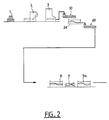
- the raw material in the form of bales 1 of textile fibers is first coarsely shredded in a bale opener 2 and introduced into a distribution silo 3.
- the fibers are then compacted to using a pestle in a rotating tank 4 and therefore leaving this device the raw material is in the form of annular rings.
- the annular rings are then admitted into a digester 5 where the leaching and bleaching operations are carried out jointly using an aqueous solution of sodium hydroxide and hydrogen peroxide.
- the bleached crowns are still placed in the digester 5, washing is carried out with clear water in order to remove the leaching and bleaching reagents.
- Bleached crowns washed after extraction from the digester 5 are shredded using an apparatus of the milling type 6.
- the material is then treated in a runner 7. This operation, carried out in water, makes it possible, in addition to the separation of the textile fibers, to cut them uniformly.
- the fibers thus obtained, always accompanied by water, are introduced into a vat 8 and constitute the raw dough or half-dough.
- the raw pulp then passes through a refiner 9, and the pulp thus refined is then admitted into a mixing vat 9a into which is added pulp originating from the recycling of the trimmers of winders or guillotines and waste paper defective.
- This mixing vat then feeds a vat, not shown, located at the head of the actual paper machine.
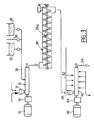
- the textile fibers accompanied by water are then introduced into a first treatment machine 10 of the type to two co-rotating screws.
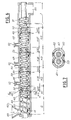
- the first treatment machine 10 comprises at least two screws 11 and 12 driven in rotation around their axes by a motor 13 and a reduction gear 14 (FIG. 3) inside an elongated enclosure forming a sheath 15 which envelops them.
- the screws 11 and 12 are provided with helical threads which mesh with one another and the internal wall of the sheath forms two intersecting cylindrical lobes, with an inside diameter slightly greater than the outside diameter of the threads. These threads are nested one inside the other, and the two screws are driven at the same speed of rotation and in the same direction so that the two screws are identical, the threads being simply offset with respect to each other.
- the screws 11 and 12 are advantageously made up of splined shafts 16 and 17 respectively on which are stacked sections of screws made up of sleeves.
- the internal bore of these sleeves is provided with grooves corresponding to those of the shaft and the external part is provided with helical threads whose pitch differs according to the section considered for the treatment and transport of the material. It is thus possible to have a fairly large number of sections making it possible to vary the pitch, the depth, the number of nets and the length of each zone.
- the first processing machine 10 is made up of several successive zones, each corresponding to a particular function: a first zone A for feeding and mixing the material and the water, - a second compression zone B, - a third shear zone C, - a fourth zone D for conveying and processing, - a fifth shear zone E, - And a sixth zone F for transferring and discharging the bleached pulp.
- the sheath is pierced with a feeding orifice 18 surmounted by a hopper 19, d brought products.
- the screws 11 and 12 are provided with threads 20 with a wide pitch and a reduced section, in order to ensure the transfer of the products introduced through this orifice 18 which opens widely on the two screws 11 and 12 in order to distribute the material in the threads 20.
- the textile fibers and water, or possibly the effluents from the second treatment machine 40, are therefore immediately transported downstream of the treatment machine and mixed by the effect of rotation and meshing of the screws 11 and 12.
- zone B the screws have threads 21 with a tight pitch and a thicker section, so that when the products are mixed, they will be compressed.
- the material then passes through a shear zone C.
- the zone C is provided with helical threads 22 whose winding direction is reversed with respect to that ensuring the transfer of the material in the processing machine 10.
- these threads 22 are formed openings 23 which extend radially from the core of each screw 11 and 12 to the periphery of the threads and which are also regularly distributed around the axis.
- the screws 11 and 12 are fixed so that two openings 23 periodically coincide in the central meshing zone. This controls the passage of the material flow downstream, which determines braking in this zone C, and a compression effect upstream.
- Zone D conveying and processing zone, is provided with threads 24 whose pitch and thickness have characteristics close to those of zone B.
- the sheath is provided with a opening 25, connected to a pipe rie 26 of arrival of the leaching and bleaching reagents consisting, in particular, of an aqueous sodium hydroxide solution, water, and oxygenated water optionally accompanied by sequestering and stabilizing agents.
- These reagents come from a dosing and injection station which includes a tank 27 for storing the aqueous sodium hydroxide solution, pipes 28 for supplying water and a tank 29 for storing hydrogen peroxide (FIG. 2) . Therefore, all along this zone D, the textile material will be stirred and mixed with these reagents in order to ensure this essential leaching and bleaching step in the manufacture of paper pulp.
- the treatment machine of the type with two co-rotating screws is particularly well suited for carrying out this operation. Indeed, due to the rotation of the screws in the same direction, there is a reversal of the material in the interpenetration zone of the threads which is particularly effective as regards its kneading, which allows an intimate mixing of the reagents and textile fibers that have been in the upstream areas impregnated with water. In this way, a better use of the reagents is obtained, which results on the one hand in an economy of these and on the other hand by a reduction, in the subsequent phases, of the clear washing water and therefore effluents from the installation.
- this mixing work is accompanied by an internal heating of the material, and without external heat input, the temperature thereof will be maintained at a value of 90 ° or 95 ° C compatible with good kinetics reactions, without thermal alteration of the paper pulp.
- zone D of conveying and processing is followed by a zone E which is a braking zone constituted, like the zone C of helical threads 30 of winding opposite to that in advance of the material, or counter-threads, and also comprising passage windows 31.
- a zone E which is a braking zone constituted, like the zone C of helical threads 30 of winding opposite to that in advance of the material, or counter-threads, and also comprising passage windows 31.
- Physical and thermal phenomena, as well as the functions carried out in this zone E are similar to what is carried out there in zone C, that is to say significant shearing and mixing , as well as scrolling and cutting the fibers.
- the last section of the treatment machine 10 constituted by zone F comprises threads 32 whose pitch and thickness are similar to those of zone D.
- the leaching and bleaching reactions continue during the flow of the material, in this zone which, moreover, ensures the transfer to the outlet orifice 33 constituted by a simple opening at the downstream end of the sleeve 15.
- this first treatment machine 10 At the outlet of this first treatment machine 10, there is thus a flow at atmospheric pressure at a temperature of the order of 80 ° C. to 100 ° C. of a bleached paste, but which still contains the residual reagents and the products resulting from the action of these reagents on the raw material.
- This paste is admitted by a simple flow chute, not shown, in a retention capacity 34 ( Figures 2 and 3).
- This capacity 34 which has the essential role of completing the bleaching reaction comprises a screw conveyor system 34a, in order to transport the dough to the second treatment machine 40.
- This retention capacity 34 is dimensioned to obtain a relatively long residence time. weak between 10 min and 30 min.
- the second treatment machine 40 (FIGS. 6, 7) is in its general design similar to the first treatment machine 10. It comprises at least two screws 41 and 42 driven in rotation around their axes by a motor 43 and a reduction gear 44 ( Figure 3) inside an elongated enclosure forming a sheath 45 which envelops them.
- the screws 41 and 42 are provided with helical threads which mesh with one another and the inner wall of the sheath forms two intersecting cylindrical lobes, with an inside diameter slightly greater than the outside diameter of the threads.
- the threads are nested inside each other, and the two screws are driven at the same speed of rotation and in the same direction so that the two screws are identical, the threads being simply offset from each other.
- This treatment machine 40 is made up of several successive zones, each corresponding to a particular function: a first zone G for feeding and mixing the bleached pulp and the washing water, a plurality of zones H for compression, shearing and washing of the dough, - And a downstream zone J for transferring and discharging the bleached and washed pulp.
- the sheath is pierced with an introduction orifice 46 surmounted by a hopper 46a for supplying the products.
- the screws 41 and 42 are provided with threads 47 to not wide and of reduced section to ensure the transfer of the products introduced by this orifice 45 which opens widely on the two screws 41 and 42 in order to distribute the material in the threads.
- the bleached pulp and this first fraction of the washing water are therefore immediately transported downstream of the treatment machine 40, and mixed by the effect of rotation and meshing of the screws 41 and 42.
- the dough passes through a succession of zones H1, H2 ... similar in their construction and in their function.
- the processing machine 40 has four H-type zones, which constitutes an interesting compromise as regards the production of the processing machine and the characteristics of the dough obtained. It is obvious that the process which is the subject of the present invention also applies to constructive solutions comprising a greater number of these sections H by modifying the geometrical characteristics of the threads.
- Each zone H for example zone H1, comprises a first element of compression and washing zone H11, and a second element of braking and shearing zone H12.
- the screws have threads 48 with a tight pitch and a cross section thicker than that of the thread 47 of zone G. In this way, to the mixture of products will be added compression of the fibrous material . Therefore, all along the element H11, the bleached pulp is stirred and mixed with the washing water introduced into the feed hopper 46a in order to remove the residual reagents and the products resulting from the action of the reagents on the paste. Downstream of the H11 zone, where the compression is maximum, the washing effluents are discharged by means of filters 53 judiciously placed in the sheath 45.
- the zone element H12 is provided with threads 49 whose winding direction is reversed with respect to that ensuring the transfer of the material in the processing machine 40.
- these threads 49 are provided openings 50 which extend radially from the core of each screw 41 and 42 to the periphery of the threads and are also regularly distributed around the axis.
- the screws 41 and 42 are set so that two openings 50 periodically coincide in the central meshing zone. This controls the passage of the pulp flow downstream, which determines braking in this zone H12 and a compression effect upstream. Furthermore, it follows a significant shearing of the dough, which in addition to the homogenization thereof constitutes a phase of unthreading and cutting the fibers.
- the sleeve 45 is connected to a pipe 52 for supplying clean washing water. Therefore, all along element H21, the bleached pulp is stirred and mixed with the washing water in order to remove the reagents residuals and products from the action of the reactants on the pulp.
- the treatment machine of the type with two co-rotating screws is particularly suitable for carrying out this washing operation efficiently and economically as regards the volume of water used. Indeed due to the rotation of the screws 41 and 42 in the same direction, there is a reversal of the dough in the interpenetration zone of the threads which is particularly effective for achieving an intimate mixture of the dough and the water of washing, which thus translates into a saving thereof.
- the dough thus passes successively into zones H1, H2, H3 and H4 where the washing and unrolling operations for the dough take place in an identical manner.
- the outflows from the washing effluents are produced by means of filters 53 in the downstream parts of the elements of zones H11, H21, H31 and H41.
- Zone J which constitutes the downstream outlet section of the dough, is similar to the elements H11, H21, H31 and H41 and comprises threads 51 similar to the threads 48. It essentially ensures the transfer function of the bleached and washed dough, which leaves the processing machine 40 through an orifice 54 and is then admitted directly into the half-pulp vat 8, upstream from the refiner 9 (FIG. 2) and from the paper machine.
- the method according to the present invention can also be implemented by a single processing machine of the type with two co-rotating screws ensuring in an upstream part all the functions of the first treatment machine and in a downstream part all of the functions of the second processing machine.
- the paper pulp obtained with the method according to the present invention makes it possible to produce a paper entirely in accordance with what is required in traditional manufacture of fiduciary paper.
- the measurements carried out on the residual soda content give an efficiency of 85 to 90% for washing.
- Another advantage of the process according to the present invention lies in the savings in energy consumption and washing water. The results below clearly show the savings made.
- the process according to the present invention makes it possible to obtain a paper pulp for fiduciary use with the same characteristics as the traditional process, with a continuous production line, and lower energy and water consumption.
- the savings in washing water thus produced mean that the volume of effluents generated in the manufacture of this paper is lower and that consequently the treatment of these effluents is less costly and the nuisances are lower.
- the method according to the present invention This eliminates handling operations for loading and unloading of the devices, as well as the pestle, the digester, the milling machine and the stackers which are necessary in the traditional process.
Landscapes
- Engineering & Computer Science (AREA)
- Mechanical Engineering (AREA)
- Life Sciences & Earth Sciences (AREA)
- Wood Science & Technology (AREA)
- Paper (AREA)
Applications Claiming Priority (2)
| Application Number | Priority Date | Filing Date | Title |
|---|---|---|---|
| FR8804548A FR2629844B1 (fr) | 1988-04-06 | 1988-04-06 | Procede pour la fabrication d'une pate a papier a usage fiduciaire |
| FR8804548 | 1988-04-06 |
Publications (2)
| Publication Number | Publication Date |
|---|---|
| EP0336842A1 true EP0336842A1 (de) | 1989-10-11 |
| EP0336842B1 EP0336842B1 (de) | 1992-12-02 |
Family
ID=9365017
Family Applications (1)
| Application Number | Title | Priority Date | Filing Date |
|---|---|---|---|
| EP89400938A Expired - Lifetime EP0336842B1 (de) | 1988-04-06 | 1989-04-05 | Verfahren zur Herstellung eines Papierstoffes für treuhänderische Verwendung |
Country Status (8)
| Country | Link |
|---|---|
| US (1) | US4983256A (de) |
| EP (1) | EP0336842B1 (de) |
| CA (1) | CA1331075C (de) |
| DE (1) | DE68903662T2 (de) |
| DK (1) | DK171829B1 (de) |
| ES (1) | ES2036354T3 (de) |
| FI (1) | FI88186C (de) |
| FR (1) | FR2629844B1 (de) |
Cited By (8)
| Publication number | Priority date | Publication date | Assignee | Title |
|---|---|---|---|---|
| FR2741638A1 (fr) * | 1995-11-29 | 1997-05-30 | Clextral | Procede et installation de preparation en continu d'une pate de cellulose |
| FR2764614A1 (fr) * | 1997-06-16 | 1998-12-18 | Clextral | Procede et installation de preparation en continu d'une pate a papier a partir de fibres textiles lignocellulosiques |
| CN101220565B (zh) * | 2008-01-30 | 2010-09-29 | 晏永祥 | 一种污水可零排放的制浆方法 |
| FR2953531A1 (fr) * | 2009-12-07 | 2011-06-10 | Ahlstroem Oy | Support non tisse pour bande a joint et bande a joint stable dimensionnellement et pliable sans perte de resistance mecanique comprenant ledit support |
| FR3015529A1 (fr) * | 2013-12-19 | 2015-06-26 | Geants De Papier Solidaires | Procede de preparation de pate a papier |
| CN105178083A (zh) * | 2014-06-08 | 2015-12-23 | 蒋寿悟 | 一种污水可零排放的制浆方法 |
| CN107268315A (zh) * | 2017-08-08 | 2017-10-20 | 邓州市华鑫纸业有限公司 | 一种以龙须草为原料的制浆造纸新方法 |
| CN109695170A (zh) * | 2019-03-11 | 2019-04-30 | 樊士英 | 一种活性法制造纸浆的工艺 |
Families Citing this family (27)
| Publication number | Priority date | Publication date | Assignee | Title |
|---|---|---|---|---|
| DE19632865A1 (de) * | 1996-08-14 | 1998-02-19 | Giesecke & Devrient Gmbh | Verfahren zur Herstellung von Papiermasse |
| EP0979895A1 (de) * | 1998-08-12 | 2000-02-16 | Instituut Voor Agrotechnologisch Onderzoek (Ato-Dlo) | Verfahren und Vorrichtung zum Raffinieren von Fasern |
| US6045656A (en) * | 1998-12-21 | 2000-04-04 | Westvaco Corporation | Process for making and detecting anti-counterfeit paper |
| CN2552996Y (zh) * | 2002-05-09 | 2003-05-28 | 朱杰 | 干煸分离草浆机 |
| FI121027B (fi) | 2004-09-24 | 2010-06-15 | Sandvik Mining & Constr Oy | Menetelmä iskevän kallionporauksen ohjaamiseksi, ohjelmistotuote sekä kallionporauslaite |
| AT511982B1 (de) * | 2011-10-11 | 2013-10-15 | Andritz Ag Maschf | Schneckenpresse |
| GB2502955B (en) * | 2012-05-29 | 2016-07-27 | De La Rue Int Ltd | A substrate for security documents |
| US8968517B2 (en) | 2012-08-03 | 2015-03-03 | First Quality Tissue, Llc | Soft through air dried tissue |
| MX2016014887A (es) | 2014-05-16 | 2018-03-01 | First Quality Tissue Llc | Toallita lavable y metodo para formarla. |
| WO2016077594A1 (en) | 2014-11-12 | 2016-05-19 | First Quality Tissue, Llc | Cannabis fiber, absorbent cellulosic structures containing cannabis fiber and methods of making the same |
| US10273635B2 (en) | 2014-11-24 | 2019-04-30 | First Quality Tissue, Llc | Soft tissue produced using a structured fabric and energy efficient pressing |
| CA2967986C (en) | 2014-12-05 | 2023-09-19 | Structured I, Llc | Manufacturing process for papermaking belts using 3d printing technology |
| US10544547B2 (en) | 2015-10-13 | 2020-01-28 | First Quality Tissue, Llc | Disposable towel produced with large volume surface depressions |
| US10538882B2 (en) | 2015-10-13 | 2020-01-21 | Structured I, Llc | Disposable towel produced with large volume surface depressions |
| US11220394B2 (en) | 2015-10-14 | 2022-01-11 | First Quality Tissue, Llc | Bundled product and system |
| WO2017139786A1 (en) | 2016-02-11 | 2017-08-17 | Structured I, Llc | Belt or fabric including polymeric layer for papermaking machine |
| US20170314206A1 (en) | 2016-04-27 | 2017-11-02 | First Quality Tissue, Llc | Soft, low lint, through air dried tissue and method of forming the same |
| CA3168412C (en) | 2016-08-26 | 2024-10-22 | Structured I, Llc | METHOD FOR PRODUCING ABSORBENT STRUCTURES EXHIBITING HIGH RESISTANCE IN THE WET STATE, HIGH ABSORPTION CAPACITY AND FLEXIBILITY |
| WO2018049390A1 (en) | 2016-09-12 | 2018-03-15 | Structured I, Llc | Former of water laid asset that utilizes a structured fabric as the outer wire |
| US11583489B2 (en) | 2016-11-18 | 2023-02-21 | First Quality Tissue, Llc | Flushable wipe and method of forming the same |
| US10619309B2 (en) | 2017-08-23 | 2020-04-14 | Structured I, Llc | Tissue product made using laser engraved structuring belt |
| SE541532C2 (en) * | 2018-03-12 | 2019-10-29 | Valmet Oy | Arrangement and method for transporting pulp from one process stage to a subsequent process stage |
| DE102018114748A1 (de) | 2018-06-20 | 2019-12-24 | Voith Patent Gmbh | Laminierte Papiermaschinenbespannung |
| US11738927B2 (en) | 2018-06-21 | 2023-08-29 | First Quality Tissue, Llc | Bundled product and system and method for forming the same |
| US11697538B2 (en) | 2018-06-21 | 2023-07-11 | First Quality Tissue, Llc | Bundled product and system and method for forming the same |
| EP3748074A1 (de) * | 2019-06-04 | 2020-12-09 | Lenzing Aktiengesellschaft | Verfahren zum herstellen eines cellulosischen papierstoffes aus alttextilien |
| CN110219192B (zh) * | 2019-06-13 | 2020-09-25 | 梅州市环源再生资源开发利用有限公司 | 一种快速提取植物纤维生产纸浆的方法 |
Citations (6)
| Publication number | Priority date | Publication date | Assignee | Title |
|---|---|---|---|---|
| FR1096833A (fr) * | 1952-07-15 | 1955-06-27 | Cie Commerciale Ind & Financie | Procédé d'extraction de fibres végétales filables et de cellulose industrielle, à partir de plantes dont l'écorce contient des fibres cellulosiques, en particulier du coton |
| FR1244319A (fr) * | 1959-06-05 | 1960-10-28 | Procédé de préparation et de dégommage chimique du lin roui, avec ou sans blanchiment terminal, afin de le rendre aisément filable sur les matériels cotonnier, lainier, schappiste et linier au sec | |
| FR1293180A (fr) * | 1961-04-10 | 1962-05-11 | Gen Engineering Company Aktieb | Appareil pour le lavage, le traitement chimique de matières diverses, pour l'extraction de liquides de ces matières |
| FR2043800A1 (en) * | 1969-05-30 | 1971-02-19 | Vanhauwaert Fernand | Flax processing method |
| EP0017544A1 (de) * | 1979-03-22 | 1980-10-15 | Creusot-Loire | Verfahren zur Herstellung einer Papierpulpe |
| DD233281A3 (de) * | 1982-11-22 | 1986-02-26 | Ulrich Huettenrauch | Verfahren zur veredlung von baumwollkaemmlingen und deren einsatz bei der spezialpapiererzeugung |
Family Cites Families (3)
| Publication number | Priority date | Publication date | Assignee | Title |
|---|---|---|---|---|
| FR2319737A1 (fr) * | 1975-07-31 | 1977-02-25 | Creusot Loire | Procede et machine de fabrication de pate a papier |
| JPS5476813A (en) * | 1977-11-30 | 1979-06-19 | Nippon Oils & Fats Co Ltd | Small granular propellant and production thereof |
| GB2144458A (en) * | 1983-06-25 | 1985-03-06 | Berstorff Gmbh Masch Hermann | Apparatus and method for producing wood pulp |
-
1988
- 1988-04-06 FR FR8804548A patent/FR2629844B1/fr not_active Expired - Lifetime
-
1989
- 1989-04-05 DE DE8989400938T patent/DE68903662T2/de not_active Expired - Lifetime
- 1989-04-05 EP EP89400938A patent/EP0336842B1/de not_active Expired - Lifetime
- 1989-04-05 FI FI891626A patent/FI88186C/fi not_active IP Right Cessation
- 1989-04-05 ES ES198989400938T patent/ES2036354T3/es not_active Expired - Lifetime
- 1989-04-05 DK DK163389A patent/DK171829B1/da not_active IP Right Cessation
- 1989-04-06 US US07/333,937 patent/US4983256A/en not_active Expired - Lifetime
- 1989-04-06 CA CA000595879A patent/CA1331075C/fr not_active Expired - Lifetime
Patent Citations (7)
| Publication number | Priority date | Publication date | Assignee | Title |
|---|---|---|---|---|
| FR1096833A (fr) * | 1952-07-15 | 1955-06-27 | Cie Commerciale Ind & Financie | Procédé d'extraction de fibres végétales filables et de cellulose industrielle, à partir de plantes dont l'écorce contient des fibres cellulosiques, en particulier du coton |
| FR1244319A (fr) * | 1959-06-05 | 1960-10-28 | Procédé de préparation et de dégommage chimique du lin roui, avec ou sans blanchiment terminal, afin de le rendre aisément filable sur les matériels cotonnier, lainier, schappiste et linier au sec | |
| FR82847E (fr) * | 1959-06-05 | 1964-04-24 | Procédé de préparation et de dégommage chimique du lin roui, avec ou sans blanchiment terminal, afin de le rendre aisément filable sur les matériels cotonnier, lainier, schappiste et linier au sec | |
| FR1293180A (fr) * | 1961-04-10 | 1962-05-11 | Gen Engineering Company Aktieb | Appareil pour le lavage, le traitement chimique de matières diverses, pour l'extraction de liquides de ces matières |
| FR2043800A1 (en) * | 1969-05-30 | 1971-02-19 | Vanhauwaert Fernand | Flax processing method |
| EP0017544A1 (de) * | 1979-03-22 | 1980-10-15 | Creusot-Loire | Verfahren zur Herstellung einer Papierpulpe |
| DD233281A3 (de) * | 1982-11-22 | 1986-02-26 | Ulrich Huettenrauch | Verfahren zur veredlung von baumwollkaemmlingen und deren einsatz bei der spezialpapiererzeugung |
Non-Patent Citations (1)
| Title |
|---|
| ABSTRACTS BULLETIN, vol. 58, no. 1, juillet 1987, page 78, no. 537, Appleton, Wisconsin, US; C. DE CHOUDENS et al.: "Bleached chemimechanical pulps obtained by the "Bi-Vis" ["Twin-Screw"] process - characteristics and uses" & ATIP REV. 41, no. 2: 58,63-68(FEB. 1987) * |
Cited By (14)
| Publication number | Priority date | Publication date | Assignee | Title |
|---|---|---|---|---|
| FR2741638A1 (fr) * | 1995-11-29 | 1997-05-30 | Clextral | Procede et installation de preparation en continu d'une pate de cellulose |
| WO1997020102A1 (fr) * | 1995-11-29 | 1997-06-05 | Clextral | Procede et installation de preparation en continu d'une pate de cellulose |
| EA000264B1 (ru) * | 1995-11-29 | 1999-02-25 | Клекстраль | Способ и установка для непрерывного приготовления целлюлозной пульпы |
| FR2764614A1 (fr) * | 1997-06-16 | 1998-12-18 | Clextral | Procede et installation de preparation en continu d'une pate a papier a partir de fibres textiles lignocellulosiques |
| WO1998058119A1 (fr) * | 1997-06-16 | 1998-12-23 | Clextral | Procede et installation de preparation en continu d'une pate a papier a partir de fibres textiles lignocellulosiques |
| CN101220565B (zh) * | 2008-01-30 | 2010-09-29 | 晏永祥 | 一种污水可零排放的制浆方法 |
| FR2953531A1 (fr) * | 2009-12-07 | 2011-06-10 | Ahlstroem Oy | Support non tisse pour bande a joint et bande a joint stable dimensionnellement et pliable sans perte de resistance mecanique comprenant ledit support |
| WO2011070233A1 (en) * | 2009-12-07 | 2011-06-16 | Ahlstrom Corporation | Nonwoven substrate for joint tape and joint tape that is dimensionally stable and foldable without losing mechanical strength containing said substrate |
| US8962128B2 (en) | 2009-12-07 | 2015-02-24 | Ahlstrom Corporation | Nonwoven substrate for joint tape and joint tape that is dimensionally stable and foldable without losing mechanical strength containing said substrate |
| FR3015529A1 (fr) * | 2013-12-19 | 2015-06-26 | Geants De Papier Solidaires | Procede de preparation de pate a papier |
| CN105178083A (zh) * | 2014-06-08 | 2015-12-23 | 蒋寿悟 | 一种污水可零排放的制浆方法 |
| CN107268315A (zh) * | 2017-08-08 | 2017-10-20 | 邓州市华鑫纸业有限公司 | 一种以龙须草为原料的制浆造纸新方法 |
| CN107268315B (zh) * | 2017-08-08 | 2019-10-25 | 邓州市华鑫纸业有限公司 | 一种以龙须草为原料的制浆造纸方法 |
| CN109695170A (zh) * | 2019-03-11 | 2019-04-30 | 樊士英 | 一种活性法制造纸浆的工艺 |
Also Published As
| Publication number | Publication date |
|---|---|
| FI88186C (fi) | 1993-04-13 |
| FI891626A0 (fi) | 1989-04-05 |
| FI891626A7 (fi) | 1989-10-07 |
| FI88186B (fi) | 1992-12-31 |
| DK171829B1 (da) | 1997-06-23 |
| FR2629844A1 (fr) | 1989-10-13 |
| DK163389A (da) | 1989-10-07 |
| DE68903662T2 (de) | 1993-05-06 |
| DK163389D0 (da) | 1989-04-05 |
| ES2036354T3 (es) | 1993-05-16 |
| US4983256A (en) | 1991-01-08 |
| EP0336842B1 (de) | 1992-12-02 |
| FR2629844B1 (fr) | 1991-09-27 |
| CA1331075C (fr) | 1994-08-02 |
| DE68903662D1 (de) | 1993-01-14 |
Similar Documents
| Publication | Publication Date | Title |
|---|---|---|
| EP0336842B1 (de) | Verfahren zur Herstellung eines Papierstoffes für treuhänderische Verwendung | |
| CA1055755A (fr) | Procede et dispositif pour la fabrication de pate a papier | |
| EP0864011A1 (de) | Verfahren und vorrichtung zur kontinuierlichen herstellung von cellulosischen zellstoff | |
| US20040154760A1 (en) | Paper plant - method and apparatus for producing pulp from cellulosic fibrous raw materials and recovering chemicals and energy from pulp liquors | |
| EP0039628B1 (de) | Verfahren und Vorrichtung zum Behandeln von Abfall verschiedenartiger Mineralfasern | |
| CN105856455A (zh) | 流速控制多转鼓式薄膜类废旧塑料回收再利用系统 | |
| EP2830775B1 (de) | Verfahren zur behandlung von abfällen, insbesondere hausmüll, und anlage zur durchführung von diesem verfahren | |
| EP0991808A1 (de) | Verfahren und vorrichtung zur kontinuierlichen herstellung eines papierzellstoffs aus lignocellulosischen fasern | |
| CA1193405A (fr) | Procede de fabrication d'une pate de fibres cellulosique pour utilisation non papetiere | |
| FR2529593A1 (fr) | Procede et appareil de traitement de papier de recuperation | |
| FR2476163A1 (fr) | Procede de raffinage d'un materiau contenant de la ligno-cellulose pour fabriquer de la pate a papier | |
| CN1140215A (zh) | 废弃烟杆、梗、叶制造多用途纸浆的方法 | |
| FR2544757A1 (fr) | Procede et appareil de digestion pour la production de pulpe de haute qualite | |
| CN109423900A (zh) | 一种纸浆生产线系统 | |
| CA2867656A1 (fr) | Procede de traitement de dechets,en particulier d'ordures menageres, et installation pour la mise en oeuvre de ce procede | |
| CN210850950U (zh) | 一种造纸废塑料绞绳破碎系统 | |
| CN221797756U (zh) | 一种涤纶dty丝生产用熔融挤压装置 | |
| US3688345A (en) | Method for processing fibrous stalks | |
| FR2988321A1 (fr) | Procede et installation de fabrication en continu d'un composite incluant une matrice polymere et des fibres naturelles | |
| KR100327707B1 (ko) | 파지를 이용한 지관의 제조방법 및 장치 | |
| CN221345086U (zh) | 一种用于生产蛋托的阔叶木浆料制备系统 | |
| EP1001076B1 (de) | Verfahren und Anlage zur Papierzellstoffherstellung | |
| FR2801326A1 (fr) | Pulpeur destine au defibrage de matieres premieres du type papiers, cartons ou celluloses, et installation pour la remise en pate de vieux papiers mettant en oeuvre le pulpeur | |
| FR1465863A (fr) | Procédé pour la fabrication de pâte à papier | |
| FR2546545A1 (fr) | Procede de digestion thermomecanique utilisant des blanchissants |
Legal Events
| Date | Code | Title | Description |
|---|---|---|---|
| PUAI | Public reference made under article 153(3) epc to a published international application that has entered the european phase |
Free format text: ORIGINAL CODE: 0009012 |
|
| AK | Designated contracting states |
Kind code of ref document: A1 Designated state(s): CH DE ES FR GB IT LI NL SE |
|
| 17P | Request for examination filed |
Effective date: 19891009 |
|
| 17Q | First examination report despatched |
Effective date: 19920114 |
|
| GRAA | (expected) grant |
Free format text: ORIGINAL CODE: 0009210 |
|
| AK | Designated contracting states |
Kind code of ref document: B1 Designated state(s): CH DE ES FR GB IT LI NL SE |
|
| ITF | It: translation for a ep patent filed | ||
| REF | Corresponds to: |
Ref document number: 68903662 Country of ref document: DE Date of ref document: 19930114 |
|
| GBT | Gb: translation of ep patent filed (gb section 77(6)(a)/1977) |
Effective date: 19930317 |
|
| REG | Reference to a national code |
Ref country code: ES Ref legal event code: FG2A Ref document number: 2036354 Country of ref document: ES Kind code of ref document: T3 |
|
| PLBE | No opposition filed within time limit |
Free format text: ORIGINAL CODE: 0009261 |
|
| STAA | Information on the status of an ep patent application or granted ep patent |
Free format text: STATUS: NO OPPOSITION FILED WITHIN TIME LIMIT |
|
| 26N | No opposition filed | ||
| EAL | Se: european patent in force in sweden |
Ref document number: 89400938.0 |
|
| REG | Reference to a national code |
Ref country code: GB Ref legal event code: IF02 |
|
| PGFP | Annual fee paid to national office [announced via postgrant information from national office to epo] |
Ref country code: CH Payment date: 20080317 Year of fee payment: 20 |
|
| PGFP | Annual fee paid to national office [announced via postgrant information from national office to epo] |
Ref country code: SE Payment date: 20080318 Year of fee payment: 20 |
|
| PGFP | Annual fee paid to national office [announced via postgrant information from national office to epo] |
Ref country code: ES Payment date: 20080422 Year of fee payment: 20 Ref country code: DE Payment date: 20080411 Year of fee payment: 20 |
|
| PGFP | Annual fee paid to national office [announced via postgrant information from national office to epo] |
Ref country code: IT Payment date: 20080419 Year of fee payment: 20 |
|
| PGFP | Annual fee paid to national office [announced via postgrant information from national office to epo] |
Ref country code: NL Payment date: 20080319 Year of fee payment: 20 |
|
| PGFP | Annual fee paid to national office [announced via postgrant information from national office to epo] |
Ref country code: FR Payment date: 20080416 Year of fee payment: 20 |
|
| PGFP | Annual fee paid to national office [announced via postgrant information from national office to epo] |
Ref country code: GB Payment date: 20080408 Year of fee payment: 20 |
|
| REG | Reference to a national code |
Ref country code: CH Ref legal event code: PL |
|
| REG | Reference to a national code |
Ref country code: GB Ref legal event code: PE20 Expiry date: 20090404 |
|
| PG25 | Lapsed in a contracting state [announced via postgrant information from national office to epo] |
Ref country code: NL Free format text: LAPSE BECAUSE OF EXPIRATION OF PROTECTION Effective date: 20090405 |
|
| NLV7 | Nl: ceased due to reaching the maximum lifetime of a patent |
Effective date: 20090405 |
|
| EUG | Se: european patent has lapsed | ||
| REG | Reference to a national code |
Ref country code: ES Ref legal event code: FD2A Effective date: 20090406 |
|
| PG25 | Lapsed in a contracting state [announced via postgrant information from national office to epo] |
Ref country code: ES Free format text: LAPSE BECAUSE OF EXPIRATION OF PROTECTION Effective date: 20090406 |
|
| PG25 | Lapsed in a contracting state [announced via postgrant information from national office to epo] |
Ref country code: GB Free format text: LAPSE BECAUSE OF EXPIRATION OF PROTECTION Effective date: 20090404 |