EP0340585A2 - Verfahren zur Herstellung von Na-Dichromat - Google Patents
Verfahren zur Herstellung von Na-Dichromat Download PDFInfo
- Publication number
- EP0340585A2 EP0340585A2 EP89107349A EP89107349A EP0340585A2 EP 0340585 A2 EP0340585 A2 EP 0340585A2 EP 89107349 A EP89107349 A EP 89107349A EP 89107349 A EP89107349 A EP 89107349A EP 0340585 A2 EP0340585 A2 EP 0340585A2
- Authority
- EP
- European Patent Office
- Prior art keywords
- solution
- nahso4
- iii
- phosphate
- acid
- Prior art date
- Legal status (The legal status is an assumption and is not a legal conclusion. Google has not performed a legal analysis and makes no representation as to the accuracy of the status listed.)
- Granted
Links
Images
Classifications
-
- C—CHEMISTRY; METALLURGY
- C01—INORGANIC CHEMISTRY
- C01G—COMPOUNDS CONTAINING METALS NOT COVERED BY SUBCLASSES C01D OR C01F
- C01G37/00—Compounds of chromium
- C01G37/14—Chromates; Bichromates
-
- C—CHEMISTRY; METALLURGY
- C01—INORGANIC CHEMISTRY
- C01D—COMPOUNDS OF ALKALI METALS, i.e. LITHIUM, SODIUM, POTASSIUM, RUBIDIUM, CAESIUM, OR FRANCIUM
- C01D5/00—Sulfates or sulfites of sodium, potassium or alkali metals in general
- C01D5/16—Purification
-
- C—CHEMISTRY; METALLURGY
- C01—INORGANIC CHEMISTRY
- C01G—COMPOUNDS CONTAINING METALS NOT COVERED BY SUBCLASSES C01D OR C01F
- C01G37/00—Compounds of chromium
- C01G37/02—Oxides or hydrates thereof
- C01G37/027—Chromium dioxide
-
- Y—GENERAL TAGGING OF NEW TECHNOLOGICAL DEVELOPMENTS; GENERAL TAGGING OF CROSS-SECTIONAL TECHNOLOGIES SPANNING OVER SEVERAL SECTIONS OF THE IPC; TECHNICAL SUBJECTS COVERED BY FORMER USPC CROSS-REFERENCE ART COLLECTIONS [XRACs] AND DIGESTS
- Y10—TECHNICAL SUBJECTS COVERED BY FORMER USPC
- Y10S—TECHNICAL SUBJECTS COVERED BY FORMER USPC CROSS-REFERENCE ART COLLECTIONS [XRACs] AND DIGESTS
- Y10S423/00—Chemistry of inorganic compounds
- Y10S423/01—Waste acid containing iron
- Y10S423/02—Sulfuric acid
Definitions
- the invention relates to a process for the production of Na dichromate using the sodium bisulfate melt obtained in the manufacture of chromic acid from sodium dichromate and sulfuric acid.
- this melt contains free sulfuric acid, chromic acid, chromium sulfate and an insoluble Na-Cr sulfate complex salt.
- the proportions in the melt depend on the reaction conditions in the production of chromic acid.
- the chrome contents are on average 2.5 to 3.5% CrO3 and 0.5 to 1.5% CR2O3. Because of the high H2SO4 content in the form of hydrogen sulfate and free sulfuric acid and the content of hexavalent chromium, attempts have been made several times to use a solution of the hydrogen sulfate for acidifying the monochromate solutions of the dichromate manufacturing. However, the content of trivalent chromium compounds leads to the formation and precipitation of difficult to filter Cr (III) / Cr (VI) compounds, which lead to such great manufacturing difficulties in dichromate production that this use has been discontinued.
- a bisulfate solution which is largely free of trivalent chromium and can be used for the acidification of the monochromate solution is obtained by reacting the bisulfate solution with persulfate anions and heating to 60 to 120 ° C.
- the persulfate anions were produced by anodic oxidation of bisulfate solution on platinum anodes. However, this process is very complex.
- the present invention relates to a process for the production of Na dichromate by reacting Na chromate with acids, which is characterized in that, in addition to sulfuric acid, NaHSO4 is also used as the acid, which is obtained as a waste product in the production of CrO3, and wherein contaminated with Cr compounds NaHSO4 with PO4 ions is added in excess and the Cr (III) contained therein is precipitated as CrPO4 at temperatures of 50 to 100 ° C and pH values of 3 to 6.
- a solution of sodium hydrogen sulfate can be used directly for the acidification of monochromate solutions.
- the trivalent chromium present in the hydrogen sulfate is completely precipitated as chromium phosphate, with a water content of 4 to 6 mol H2O.
- the chromium phosphate is precipitated in the pH range from 3 to 6, preferably from 4.5 to 5.6. With regard to the filterability of the precipitate, the best results are achieved at pH values from 5.3 to 5.6, which corresponds to 80 to 95% acidification of the monochromate.
- the precipitation proceeds particularly advantageously if the excess of phosphate ions is greater than or equal to 10%.
- the filter cake can be treated with NaOH at a pH of 8 to 10 in the presence of phosphate ions to remove the Na-Cr sulfate contained in it. There is complete conversion to Cr phosphate.
- the chromium components of the Cr phosphate obtained can be converted in a known manner in an alkaline oxidizing digestion into monochromate solution.
- sources of phosphate ions are following substances into consideration: H3PO4, Na2HPO4, NaH2PO4.
- Sodium hydrogen sulfate melt from chromic acid production which contains an average of 2.5-3.5% CrO3 and proportions of trivalent chromium (0.5-1.5%, calculated as Cr2O3), is made with water to a density of approx. 1 , 3 kg / dm3 set.
- Cr (III) content at least 10% excess phosphoric acid is added and this solution is used for partial acidification of monchromate solutions.
- the temperature of the process is between 60 and 80 ° C, the pH is suitably about 4.5-5.6.
- the precipitate precipitated in this pH range which essentially consists of chromium phosphate, is filtered while hot and the filtrate, free of Cr (III) ions, is transferred for further use in the dichromate process.
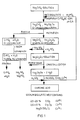
- FIG. 1 A special embodiment of the method according to the invention is shown in the enclosed flow diagram (FIG. 1).
- This solution is used to acidify monochromate solution at a temperature of 60 ° C to pH 5.4.
- the trivalent chromium precipitates out of the initially dark solution as chromium phosphate with 4 to 6 mol of water of crystallization.
- the precipitate is filtered hot.
- the Cr2O3 content is 26%.
- the best filtration times are at pH 5.5 and 5.23, which corresponds to 90 to 95% acidification.
- the rate of NaOH addition is a measure of the course of the reaction.
- PH value Observation time sales achieved g precipitation % Cr2O3 3.0-5.4 9 hours 45% 16.46 g 22.6% 3.3-6.2 6 hours 50% 15.34 g 24.1% 7 -10 2 hours 95% 11.9 g 31.4% 10 -11 1 hour 100% 12.2 g 30.9%
Landscapes
- Chemical & Material Sciences (AREA)
- Organic Chemistry (AREA)
- Inorganic Chemistry (AREA)
- Engineering & Computer Science (AREA)
- Materials Engineering (AREA)
- Inorganic Compounds Of Heavy Metals (AREA)
- Removal Of Specific Substances (AREA)
- Coloring Foods And Improving Nutritive Qualities (AREA)
Abstract
Description
- Die Erfindung betrifft ein Verfahren zur Herstellung von Na-Dichromat unter Verwertung der bei der Chromsäureherstellung aus Natriumdichromat und Schwefelsäure anfallenden Natriumhydrogensulfatschmelze.
- Diese Schmelze enthält neben Na-Hydrogensulfat, freie Schwefelsäure, Chromsäure, Chromsulfat und ein unlösliches Na-Cr- Sulfatkomplexsalz. Die Anteile in der Schmelze hängen von den Reaktionsbedingungen der Chromsäureherstellung ab.
- Die Chromgehalte betragen im Mittel 2,5 bis 3,5 % CrO₃ und 0,5 bis 1,5 % CR₂O₃. Wegen des hohen H₂SO₄-Gehalts in Form von Hydrogensulfat und freier Schwefelsäure und des Gehaltes an 6-wertigem Chrom hat man mehrfach versucht, eine Lösung des Hydrogensulfats für die Absäuerung der Monochromatlösungen der Dichromatfabrikation zu verwenden. Der Gehalt an 3-wertigen Chromverbindungen führt jedoch zur Bildung und Ausfällung von schwer filtrierbaren Cr(III)/Cr(VI)-Verbindungen, die zu so großen Fabrikationsschwierigkeiten in der Dichromatfabrikation führen, daß diese Verwendung wieder aufgebeben wurde.
- Aus der italienischen Patentanmeldung 26 686 A/75 ist es bekannt, daß die Monochromatlösungen zu etwa 80 % mit dem Abfallhydrogensulfat abgesäuert werden und in einem Kochprozeß in 2 Stufen die Cr(III)/Cr(VI)-Verbindungen ausgeschieden werden. Nach dem Abfiltrieren der Cr(III)/Cr(VI)-Verbindungen werden die Filtrate frei von 3-wertigen Chromverbindungen in den Dichromatbetrieb eingeleitet. Die Cr(III)/Cr(VI)-Verbindungen dienen als Rohstoff für die Herstellung von Cr(III)-Salzen.
- Gemäß der DE-A-21 51 323 erhält man eine weitestgehend von 3-wertigem Chrom freie, für die Absäuerung der Monochromatlösung verwendbare Bisulfatlösung, durch Umsetzung der Bisulfatlösung mit Persulfatanionen und Erwärmung auf 60 bis 120°C. Die Persulfatanionen wurden durch anodische Oxidation von Bisulfatlösung an Platinanoden hergestellt. Diese Verfahren ist aber sehr aufwendig.
- Es wurde nun gefunden, daß man auf sehr einfache Weise eine zur Absäuerung von Monochromatlösung einsetzbare Na-Hydrogensulfatlösung erhalten kann, wenn man ihr eine für die Bilding des 3-wertigen Chroms ausreichende Menge Phosphationen zusetzt.
- Gegenstand der vorliegenden Erfindung ist ein Verfahren zur Herstellung von Na-Dichromat durch Umsetzung von Na-Chromat mit Säuren, welches dadurch gekennzeichnet ist, daß man neben Schwefelsäure als Säure zusätzlich NaHSO₄ einsetzt, das als Abfallprodukt bei der CrO₃-Herstellung anfällt, und wobei das mit Cr-Verbindungen verunreinigte NaHSO₄ mit PO₄-Ionen im Überschuß versetzt wird und das darin enthaltene Cr(III) als CrPO₄ bei Temperaturen von 50 bis 100°C und pH-Werten von 3 bis 6 ausgefällt wird.
- Überraschenderweise kann mit diesem Phosphatzusatz eine Lösung von Na-Hydrogensulfat direkt für die Absäurerung von Monochromatlösungen verwendet werden. Das im Hydrogensulfat vorhandene 3-wertige Chrom wird vollständig als Chromphosphat ausgefällt, mit einem Wassergehalt von 4 bis 6 Mol H₂O.
- Eine vorherige Abscheidung des im Na-Hydrogensulfat vorhandenen unlöslichen Na-Cr-Sulfatkomplexsalzes ist nicht notwendig, da die geringen Mengen des 3-wertigen Chroms, die durch Hydrolyse in Lösung gehen, sofort als Chromphosphat gefällt werden. Es tritt eine langsame Umwandlung des Na-Cr-Komplexsalzes in Chromphosphat ein.
- Die Fällung des Chromphosphats erfolgt im pH-Bereich von 3 bis 6, bevorzugt von 4,5 bis 5,6. Hinsichtlich der Filtrierbarkeit des Niederschlags werden die besten Ergebnisse bei pH-Werten von 5,3 bis 5,6 erreicht, was einer 80 bis 95 %igen Absäuerung des Monochromats entspricht. Besonders vorteilhaft verläuft die Fällung, wenn der Überschuß an Phosphationen größer oder gleich 10 % ist.
- Nach Abfiltrieren des Niederschlags, der aus Cr-Phosphat und der Restmenge des Na-Cr-Sulfatkomplexsalzes besteht, erhält man klare zu 80 bis 95 % abgesäuerte Dichromatlösung, frei von 3-wertigen Chromverbindungen. Diese wer den zur weiteren Verarbeitung in den Dichromatbetrieb zurückgeführt.
- Der Filterkuchen kann zur Entfernung des in ihm enthaltenen Na-Cr-Sulfats in Gegenwart von Phosphationen mit NaOH bei einem pH-Wert von 8 bis 10 behandelt werden. Es erfolgt restloser Umsatz zu Cr-Phosphat.
- Die Chromanteile des anfallenden Cr-Phosphats können in bekannter Art und Weise in einem alkalisch oxidierenden Aufschluß in Monochromatlösung umgewandelt werden.
- Als Quelle für Phosphationen kommen z.B. folgende Stoffe in Betracht: H₃PO₄, Na₂HPO₄, NaH₂PO₄.
- Das erfindungsgemäße Verfahren wird in der allgemeinsten Form wie folgt ausgeführt:
- Natriumhydrogensulfatschmelze aus der Chromsäureproduktion, die im Mittel 2,5-3,5 % CrO₃ und Anteile an 3-wertigen Chrom(0,5-1,5 %, gerechnet als Cr₂O₃) enthält, wird mit Wasser auf eine Dichte von ca. 1,3 kg/dm³ eingestellt. Entsprechend dem Cr(III)-Gehalt wird Phosphorsäure im mindestens 10 %igen Überschuß zugesetzt und diese Lösung zur Teilabsäuerung von Monchromatlösungen verwendet. Die Temperatur des Prozesses liegt zwischen 60 und 80°C, der pH-Wert beträgt zweckmäßig etwa 4,5-5,6. Der in diesem ph-Bereich ausgefällte Niederschlag, der im wesentlichen aus Chromphosphat besteht, wird noch heiß filtriert und das Filtrat, frei von Cr(III)-Ionen, der weiteren Verwendung im Dichromatprozeß überstellt.
- Eine spezielle Ausführungsform des erfindungsgemäßen Verfahrens wird im beiliegenden Fließschema (Fig. 1) dargestellt.
- Anhand der folgenden Beispiele soll das erfindungsgemäße Verfahren noch näher erläutert werden (%-Angaben sind - soweit nichts anderes angegeben - Gew.-%).
- 1 kg Na-Hydrogensulfatschmelze wird in 1.500 ml Wasser gelöst (spez. Gew. 1,3). Entsprechend dem CR₂O₃-Gehalt der Na-Hydrogensulfatschmelze von 1 % Cr₂O₃ werden der Lösung 14,3 g H₃PO₄ entsprechend einem 10 %igen Überschuß zugesetzt.
- Mit dieser Lösung wird Monochromatlösung bei einer Temperatur von 60°C bis zum pH-Wert 5,4 abgesäuert.
- Aus der zunächst dunklen Lösung fällt das 3-wertige Chrom als Chromphosphat mit 4 bis 6 Mol Kristallwasser aus.
- Der Niederschlag wird heiß filtriert. Der Cr₂O₃-Gehalt beträgt 26 %. Im Filtrat ist kein 3-wertiges Chrom enthalten.
- Je 500 ml Monochromatlösung werden mit einer Lösung von Na-Hydrogensulfat, spez. Gewicht 1,3, die mit 17 g H₃PO₄ pro kg Hydrogensulfat (10 %iger Überschuß bezogen auf die Cr(III)-Menge) versetzt ist, auf verschiedene pH-Werte abgesäuert.
- Die Lösungen werden auf 80° C erwärmt und die Filtrationszeit gemessen.
Monochromat NaHSO₄ + H₃PO₄ pH Filtrationszeit 500 ml 210 ml 6,5 15 Minuten 500 ml 258 ml 6,0 9,7 Minuten 500 ml 273 ml 5,5 2,1 Minuten 500 ml 283 ml 5,23 3 Minuten 500 ml 286 ml 4,7 8 Minuten - Die günstigsten Filtrationszeiten liegen bei den pH-Werten 5,5 und 5,23, was einer 90 bis 95 %igen Absäuerung entspricht.
- Je 20 g des Na-Cr-Sulfatkomplexsalzes werden in 300 ml Wasser angeschlämmt und mit je 4 ml H₃PO₄ (85 %) versetzt.
Da bei der Umsetzung des Doppelsalzes zu Cr-Phosphat Phosphorsäure als schwache Säure durch Schwefelsäure ersetzt wird, tritt im Verlauf der Reaktion eine Abnahme des pH-Wertes ein, die durch Zugabe von NaOH ausgeglichen werden kann. - Die Zugabegeschwindigkeit von NaOH ist ein Maß für den Verlauf der Reaktion.
pH-Wert Beobachtungszeit erreichter Umsatz g Niederschlag % Cr₂O₃ 3,0-5,4 9 Stunden 45 % 16,46 g 22,6 % 3,3-6,2 6 Stunden 50 % 15,34 g 24,1 % 7 -10 2 Stunden 95 % 11,9 g 31,4 % 10 -11 1 Stunde 100 % 12,2 g 30,9 %
Claims (3)
Applications Claiming Priority (2)
| Application Number | Priority Date | Filing Date | Title |
|---|---|---|---|
| DE3815240A DE3815240A1 (de) | 1988-05-05 | 1988-05-05 | Verfahren zur herstellung von na-dichromat |
| DE3815240 | 1988-05-05 |
Publications (3)
| Publication Number | Publication Date |
|---|---|
| EP0340585A2 true EP0340585A2 (de) | 1989-11-08 |
| EP0340585A3 EP0340585A3 (en) | 1990-03-14 |
| EP0340585B1 EP0340585B1 (de) | 1992-04-08 |
Family
ID=6353652
Family Applications (1)
| Application Number | Title | Priority Date | Filing Date |
|---|---|---|---|
| EP89107349A Expired - Lifetime EP0340585B1 (de) | 1988-05-05 | 1989-04-24 | Verfahren zur Herstellung von Na-Dichromat |
Country Status (11)
| Country | Link |
|---|---|
| US (1) | US4968503A (de) |
| EP (1) | EP0340585B1 (de) |
| JP (1) | JP2648363B2 (de) |
| KR (1) | KR890017175A (de) |
| CN (1) | CN1037495A (de) |
| AR (1) | AR241893A1 (de) |
| BR (1) | BR8902097A (de) |
| DE (2) | DE3815240A1 (de) |
| ES (1) | ES2032071T3 (de) |
| RO (1) | RO102743B1 (de) |
| ZA (1) | ZA893270B (de) |
Families Citing this family (5)
| Publication number | Priority date | Publication date | Assignee | Title |
|---|---|---|---|---|
| US5250274A (en) * | 1990-04-26 | 1993-10-05 | Bayer Aktiengesellschaft | Process for the production of sodium dichromate |
| US6814867B2 (en) * | 2002-09-12 | 2004-11-09 | Inuista North America S.à.r.l. | Process for reducing chromium in nonvolatile residue resulting from air oxidation of cyclohexane |
| PH12013501125A1 (en) * | 2010-11-02 | 2013-07-22 | Qinghai Bohong Chemical Tech Co Ltd | A hydrothermal oxidation method for production of alkali metal dichromate from carbon ferrochrome |
| CN102408131B (zh) * | 2011-09-09 | 2013-09-04 | 甘肃锦世化工有限责任公司 | 提高工业重铬酸钠成品含量的方法 |
| CN112158885A (zh) * | 2020-10-12 | 2021-01-01 | 甘肃锦世化工有限责任公司 | 一种降低重铬酸钠酸化液中三价铬的方法 |
Family Cites Families (7)
| Publication number | Priority date | Publication date | Assignee | Title |
|---|---|---|---|---|
| US3932598A (en) * | 1970-04-24 | 1976-01-13 | Cooper Hugh S | Process for producing alkali metal chromates and dichromates |
| US3715425A (en) * | 1970-10-19 | 1973-02-06 | Allied Chem | Process for the manufacture of chrome chemicals |
| SU394316A1 (ru) * | 1971-07-30 | 1973-08-22 | Способ получения бихромата натрия | |
| US3784672A (en) * | 1972-10-19 | 1974-01-08 | Allied Chem | Process for reducing the trivalent chromium content of alkali metal bisulfate solutions |
| SU497241A1 (ru) * | 1973-03-06 | 1975-12-30 | Предприятие П/Я А-7125 | Способ получени бихромата натри |
| IT1042133B (it) * | 1975-08-28 | 1980-01-30 | Stoppani P & Co | Procedimento per il recupero e la valorizzazione degli scarti della fabbricazione dell anidri de cromica |
| JPS581046B2 (ja) * | 1976-09-27 | 1983-01-10 | 日本化学工業株式会社 | クロムメツキ老化液の処理方法 |
-
1988
- 1988-05-05 DE DE3815240A patent/DE3815240A1/de not_active Withdrawn
-
1989
- 1989-04-24 EP EP89107349A patent/EP0340585B1/de not_active Expired - Lifetime
- 1989-04-24 DE DE8989107349T patent/DE58901110D1/de not_active Expired - Lifetime
- 1989-04-24 ES ES198989107349T patent/ES2032071T3/es not_active Expired - Lifetime
- 1989-04-24 US US07/342,278 patent/US4968503A/en not_active Expired - Lifetime
- 1989-04-24 RO RO1989139407A patent/RO102743B1/ro unknown
- 1989-05-01 JP JP1109252A patent/JP2648363B2/ja not_active Expired - Lifetime
- 1989-05-03 CN CN89103034A patent/CN1037495A/zh active Pending
- 1989-05-03 ZA ZA893270A patent/ZA893270B/xx unknown
- 1989-05-04 KR KR1019890005987A patent/KR890017175A/ko not_active Withdrawn
- 1989-05-04 BR BR898902097A patent/BR8902097A/pt not_active IP Right Cessation
- 1989-05-05 AR AR89313852A patent/AR241893A1/es active
Also Published As
| Publication number | Publication date |
|---|---|
| EP0340585A3 (en) | 1990-03-14 |
| RO102743B1 (en) | 1992-03-30 |
| ES2032071T3 (es) | 1993-01-01 |
| EP0340585B1 (de) | 1992-04-08 |
| AR241893A1 (es) | 1993-01-29 |
| DE58901110D1 (de) | 1992-05-14 |
| JPH01313334A (ja) | 1989-12-18 |
| US4968503A (en) | 1990-11-06 |
| CN1037495A (zh) | 1989-11-29 |
| BR8902097A (pt) | 1989-12-05 |
| ZA893270B (en) | 1990-01-31 |
| JP2648363B2 (ja) | 1997-08-27 |
| KR890017175A (ko) | 1989-12-15 |
| DE3815240A1 (de) | 1989-11-16 |
Similar Documents
| Publication | Publication Date | Title |
|---|---|---|
| DE2633570C3 (de) | Verfahren zur Aufarbeitung von Abfällen der Chromsäureanhydrid-Hersteilung | |
| EP0340585B1 (de) | Verfahren zur Herstellung von Na-Dichromat | |
| EP0120399A2 (de) | Verfahren zur Herstellung saurer, elektrolytarmer Farbstoffe der Triphenylmethan-Reihe | |
| DE721410C (de) | Herstellung technisch reiner Alkaliphosphate | |
| DE3022874A1 (de) | Verfahren zur herstellung von tantal-konzentraten | |
| DE3538746C2 (de) | ||
| DE2726418C3 (de) | Verfahren zur Herstellung von konzentrierten Titanylsulfataufschlußlösungen | |
| DE2857637C2 (de) | Kondensationsprodukt aus 2,6-Pyridindicarbonsäure und Chrom(VI)-oxid | |
| DE69014284T2 (de) | Verfahren zur Herstellung von Kupferformiat. | |
| DE955806C (de) | Verfahren zur Herstellung eines basisches Chromsulfat enthaltenden Gerbsalzgemisches | |
| DE2151323A1 (de) | Verfahren zur Herstellung von Chromverbindungen | |
| CH660590A5 (de) | Verfahren zur herstellung von 2-chinoxalinol. | |
| DE3437685C2 (de) | Verfahren zur Herstellung einer vanadiumarmen Alkaliphosphatlösung | |
| DE2824090C3 (de) | Verfahren zur Herstellung von Titandioxid | |
| EP0376031A2 (de) | Verfahren zur Rückgewinnung von Schwefelsäure bei der Titandioxidprodukten | |
| DE2001904C3 (de) | Verfahren zur Herstellung eines aliphatischen Carbonsäureamide | |
| DE607198C (de) | Reinigen von Dinatriumphosphat | |
| DE2459233C2 (de) | Verfahren zur Herstellung von Hydrochinon | |
| DE901648C (de) | Verfahren zur Gewinnung von Nicotinsaeure aus Reaktionsgemischen | |
| DE1065388B (de) | ||
| AT262285B (de) | Verfahren zur Abtrennung und Isolierung einer 4,4'-Dipyridyliumverbindung und zur Herstellung einer gereinigten Lösung eines 4,4'-Dipyridyliumsalzes aus der 4,4'-Dipyridyliumverbindung | |
| DE703228C (de) | Verfahren zur Darstellung von Abkoemmlingen von 2-Mercaptoarylthiazolen bzw. deren analogen Selenverbindungen | |
| DE2711203C2 (de) | Verfahren zur Herstellung des Monokaliumsalzes von 1,2,5-Thiadiazol-3,4-dicarbonsäure | |
| AT248131B (de) | Verfahren zur kontinuierlichen Herstellung von Chrommetall aus wässerigen Chrom (VI) oxydlösungen | |
| DE2302723A1 (de) | Verfahren zur entfernung von sechswertigem chrom aus chlorat enthaltenden fluessigkeiten |
Legal Events
| Date | Code | Title | Description |
|---|---|---|---|
| PUAI | Public reference made under article 153(3) epc to a published international application that has entered the european phase |
Free format text: ORIGINAL CODE: 0009012 |
|
| 17P | Request for examination filed |
Effective date: 19890424 |
|
| AK | Designated contracting states |
Kind code of ref document: A2 Designated state(s): DE ES FR GB IT |
|
| PUAL | Search report despatched |
Free format text: ORIGINAL CODE: 0009013 |
|
| AK | Designated contracting states |
Kind code of ref document: A3 Designated state(s): DE ES FR GB IT |
|
| 17Q | First examination report despatched |
Effective date: 19910730 |
|
| GRAA | (expected) grant |
Free format text: ORIGINAL CODE: 0009210 |
|
| AK | Designated contracting states |
Kind code of ref document: B1 Designated state(s): DE ES FR GB IT |
|
| PGFP | Annual fee paid to national office [announced via postgrant information from national office to epo] |
Ref country code: ES Payment date: 19920409 Year of fee payment: 4 |
|
| PGFP | Annual fee paid to national office [announced via postgrant information from national office to epo] |
Ref country code: FR Payment date: 19920429 Year of fee payment: 4 |
|
| ET | Fr: translation filed | ||
| ITF | It: translation for a ep patent filed | ||
| REF | Corresponds to: |
Ref document number: 58901110 Country of ref document: DE Date of ref document: 19920514 |
|
| GBT | Gb: translation of ep patent filed (gb section 77(6)(a)/1977) | ||
| REG | Reference to a national code |
Ref country code: ES Ref legal event code: FG2A Ref document number: 2032071 Country of ref document: ES Kind code of ref document: T3 |
|
| PLBE | No opposition filed within time limit |
Free format text: ORIGINAL CODE: 0009261 |
|
| STAA | Information on the status of an ep patent application or granted ep patent |
Free format text: STATUS: NO OPPOSITION FILED WITHIN TIME LIMIT |
|
| 26N | No opposition filed | ||
| PG25 | Lapsed in a contracting state [announced via postgrant information from national office to epo] |
Ref country code: ES Free format text: LAPSE BECAUSE OF NON-PAYMENT OF DUE FEES Effective date: 19930426 |
|
| PG25 | Lapsed in a contracting state [announced via postgrant information from national office to epo] |
Ref country code: FR Effective date: 19931229 |
|
| REG | Reference to a national code |
Ref country code: FR Ref legal event code: ST |
|
| PGFP | Annual fee paid to national office [announced via postgrant information from national office to epo] |
Ref country code: DE Payment date: 19960312 Year of fee payment: 8 |
|
| PG25 | Lapsed in a contracting state [announced via postgrant information from national office to epo] |
Ref country code: DE Free format text: LAPSE BECAUSE OF NON-PAYMENT OF DUE FEES Effective date: 19980101 |
|
| REG | Reference to a national code |
Ref country code: ES Ref legal event code: FD2A Effective date: 19990503 |
|
| REG | Reference to a national code |
Ref country code: GB Ref legal event code: IF02 |
|
| PGFP | Annual fee paid to national office [announced via postgrant information from national office to epo] |
Ref country code: GB Payment date: 20020424 Year of fee payment: 14 |
|
| PG25 | Lapsed in a contracting state [announced via postgrant information from national office to epo] |
Ref country code: GB Free format text: LAPSE BECAUSE OF NON-PAYMENT OF DUE FEES Effective date: 20030424 |
|
| GBPC | Gb: european patent ceased through non-payment of renewal fee | ||
| PG25 | Lapsed in a contracting state [announced via postgrant information from national office to epo] |
Ref country code: IT Free format text: LAPSE BECAUSE OF NON-PAYMENT OF DUE FEES;WARNING: LAPSES OF ITALIAN PATENTS WITH EFFECTIVE DATE BEFORE 2007 MAY HAVE OCCURRED AT ANY TIME BEFORE 2007. THE CORRECT EFFECTIVE DATE MAY BE DIFFERENT FROM THE ONE RECORDED. Effective date: 20050424 |