EP0340617B1 - Appareil et procédé pour la préparation d'un réactif de trioxyde de soufre pour la sulfonation de la surface de résines polymères - Google Patents
Appareil et procédé pour la préparation d'un réactif de trioxyde de soufre pour la sulfonation de la surface de résines polymères Download PDFInfo
- Publication number
- EP0340617B1 EP0340617B1 EP89107557A EP89107557A EP0340617B1 EP 0340617 B1 EP0340617 B1 EP 0340617B1 EP 89107557 A EP89107557 A EP 89107557A EP 89107557 A EP89107557 A EP 89107557A EP 0340617 B1 EP0340617 B1 EP 0340617B1
- Authority
- EP
- European Patent Office
- Prior art keywords
- reagent
- oleum
- sulfur trioxide
- generator
- source
- Prior art date
- Legal status (The legal status is an assumption and is not a legal conclusion. Google has not performed a legal analysis and makes no representation as to the accuracy of the status listed.)
- Expired - Lifetime
Links
- AKEJUJNQAAGONA-UHFFFAOYSA-N sulfur trioxide Chemical compound O=S(=O)=O AKEJUJNQAAGONA-UHFFFAOYSA-N 0.000 title claims description 247
- 239000003153 chemical reaction reagent Substances 0.000 title claims description 161
- 238000000034 method Methods 0.000 title claims description 19
- 238000006277 sulfonation reaction Methods 0.000 title claims description 15
- 239000002952 polymeric resin Substances 0.000 title description 16
- 229920003002 synthetic resin Polymers 0.000 title description 16
- 150000008282 halocarbons Chemical class 0.000 claims description 42
- 239000007788 liquid Substances 0.000 claims description 18
- 239000012530 fluid Substances 0.000 claims description 17
- 238000004891 communication Methods 0.000 claims description 16
- 239000000463 material Substances 0.000 claims description 13
- 238000004064 recycling Methods 0.000 claims description 10
- 238000004381 surface treatment Methods 0.000 claims description 8
- 239000011261 inert gas Substances 0.000 claims description 5
- 239000012260 resinous material Substances 0.000 claims 2
- 230000000740 bleeding effect Effects 0.000 claims 1
- 239000012535 impurity Substances 0.000 description 16
- 229920000642 polymer Polymers 0.000 description 15
- 239000007789 gas Substances 0.000 description 14
- QAOWNCQODCNURD-UHFFFAOYSA-N sulfuric acid Substances OS(O)(=O)=O QAOWNCQODCNURD-UHFFFAOYSA-N 0.000 description 11
- 239000008280 blood Substances 0.000 description 8
- 210000004369 blood Anatomy 0.000 description 8
- 241000894006 Bacteria Species 0.000 description 7
- 239000002699 waste material Substances 0.000 description 7
- 229930195733 hydrocarbon Natural products 0.000 description 6
- 239000002253 acid Substances 0.000 description 5
- 210000001124 body fluid Anatomy 0.000 description 5
- 239000010839 body fluid Substances 0.000 description 5
- 238000010586 diagram Methods 0.000 description 5
- 150000002430 hydrocarbons Chemical class 0.000 description 5
- 239000000203 mixture Substances 0.000 description 5
- -1 polypropylene Polymers 0.000 description 5
- XLYOFNOQVPJJNP-UHFFFAOYSA-N water Substances O XLYOFNOQVPJJNP-UHFFFAOYSA-N 0.000 description 5
- OFBQJSOFQDEBGM-UHFFFAOYSA-N Pentane Chemical compound CCCCC OFBQJSOFQDEBGM-UHFFFAOYSA-N 0.000 description 4
- 239000000428 dust Substances 0.000 description 4
- 239000012634 fragment Substances 0.000 description 4
- 239000004519 grease Substances 0.000 description 4
- VZGDMQKNWNREIO-UHFFFAOYSA-N tetrachloromethane Chemical compound ClC(Cl)(Cl)Cl VZGDMQKNWNREIO-UHFFFAOYSA-N 0.000 description 4
- OKTJSMMVPCPJKN-UHFFFAOYSA-N Carbon Chemical compound [C] OKTJSMMVPCPJKN-UHFFFAOYSA-N 0.000 description 3
- 239000004215 Carbon black (E152) Substances 0.000 description 3
- 229910052799 carbon Inorganic materials 0.000 description 3
- 239000001257 hydrogen Substances 0.000 description 3
- 229910052739 hydrogen Inorganic materials 0.000 description 3
- 238000002156 mixing Methods 0.000 description 3
- 239000000126 substance Substances 0.000 description 3
- 239000000758 substrate Substances 0.000 description 3
- BOSAWIQFTJIYIS-UHFFFAOYSA-N 1,1,1-trichloro-2,2,2-trifluoroethane Chemical compound FC(F)(F)C(Cl)(Cl)Cl BOSAWIQFTJIYIS-UHFFFAOYSA-N 0.000 description 2
- QGZKDVFQNNGYKY-UHFFFAOYSA-N Ammonia Chemical compound N QGZKDVFQNNGYKY-UHFFFAOYSA-N 0.000 description 2
- XKRFYHLGVUSROY-UHFFFAOYSA-N Argon Chemical compound [Ar] XKRFYHLGVUSROY-UHFFFAOYSA-N 0.000 description 2
- IJGRMHOSHXDMSA-UHFFFAOYSA-N Atomic nitrogen Chemical compound N#N IJGRMHOSHXDMSA-UHFFFAOYSA-N 0.000 description 2
- ZOXJGFHDIHLPTG-UHFFFAOYSA-N Boron Chemical compound [B] ZOXJGFHDIHLPTG-UHFFFAOYSA-N 0.000 description 2
- QAOWNCQODCNURD-UHFFFAOYSA-L Sulfate Chemical compound [O-]S([O-])(=O)=O QAOWNCQODCNURD-UHFFFAOYSA-L 0.000 description 2
- 229910052770 Uranium Inorganic materials 0.000 description 2
- 229910052796 boron Inorganic materials 0.000 description 2
- 238000006243 chemical reaction Methods 0.000 description 2
- JKWMSGQKBLHBQQ-UHFFFAOYSA-N diboron trioxide Chemical compound O=BOB=O JKWMSGQKBLHBQQ-UHFFFAOYSA-N 0.000 description 2
- 125000000524 functional group Chemical group 0.000 description 2
- 239000008246 gaseous mixture Substances 0.000 description 2
- 239000003502 gasoline Substances 0.000 description 2
- 230000005484 gravity Effects 0.000 description 2
- 229910001385 heavy metal Inorganic materials 0.000 description 2
- 238000004519 manufacturing process Methods 0.000 description 2
- 229910052751 metal Inorganic materials 0.000 description 2
- 239000002184 metal Substances 0.000 description 2
- 239000000178 monomer Substances 0.000 description 2
- 229920005989 resin Polymers 0.000 description 2
- 239000011347 resin Substances 0.000 description 2
- BDHFUVZGWQCTTF-UHFFFAOYSA-M sulfonate Chemical compound [O-]S(=O)=O BDHFUVZGWQCTTF-UHFFFAOYSA-M 0.000 description 2
- 125000000542 sulfonic acid group Chemical group 0.000 description 2
- GGQQNYXPYWCUHG-RMTFUQJTSA-N (3e,6e)-deca-3,6-diene Chemical compound CCC\C=C\C\C=C\CC GGQQNYXPYWCUHG-RMTFUQJTSA-N 0.000 description 1
- UGCSPKPEHQEOSR-UHFFFAOYSA-N 1,1,2,2-tetrachloro-1,2-difluoroethane Chemical compound FC(Cl)(Cl)C(F)(Cl)Cl UGCSPKPEHQEOSR-UHFFFAOYSA-N 0.000 description 1
- AJDIZQLSFPQPEY-UHFFFAOYSA-N 1,1,2-Trichlorotrifluoroethane Chemical compound FC(F)(Cl)C(F)(Cl)Cl AJDIZQLSFPQPEY-UHFFFAOYSA-N 0.000 description 1
- ZKMFFBJKSALGEO-UHFFFAOYSA-N 1-bromo-1,1-dichloro-2,2,2-trifluoroethane Chemical compound FC(F)(F)C(Cl)(Cl)Br ZKMFFBJKSALGEO-UHFFFAOYSA-N 0.000 description 1
- LSNNMFCWUKXFEE-UHFFFAOYSA-M Bisulfite Chemical compound OS([O-])=O LSNNMFCWUKXFEE-UHFFFAOYSA-M 0.000 description 1
- 239000006057 Non-nutritive feed additive Substances 0.000 description 1
- 229910004727 OSO3H Inorganic materials 0.000 description 1
- 239000004743 Polypropylene Substances 0.000 description 1
- 229910006069 SO3H Inorganic materials 0.000 description 1
- 239000003570 air Substances 0.000 description 1
- 150000001335 aliphatic alkanes Chemical class 0.000 description 1
- 229910021529 ammonia Inorganic materials 0.000 description 1
- 229910052786 argon Inorganic materials 0.000 description 1
- 230000000975 bioactive effect Effects 0.000 description 1
- 230000015572 biosynthetic process Effects 0.000 description 1
- 238000009835 boiling Methods 0.000 description 1
- 229910052810 boron oxide Inorganic materials 0.000 description 1
- ARBYBCHKMDUXNE-UHFFFAOYSA-N bromo-dichloro-fluoromethane Chemical compound FC(Cl)(Cl)Br ARBYBCHKMDUXNE-UHFFFAOYSA-N 0.000 description 1
- 239000003990 capacitor Substances 0.000 description 1
- 125000004432 carbon atom Chemical group C* 0.000 description 1
- UBAZGMLMVVQSCD-UHFFFAOYSA-N carbon dioxide;molecular oxygen Chemical compound O=O.O=C=O UBAZGMLMVVQSCD-UHFFFAOYSA-N 0.000 description 1
- 229950005499 carbon tetrachloride Drugs 0.000 description 1
- 210000004027 cell Anatomy 0.000 description 1
- 210000000170 cell membrane Anatomy 0.000 description 1
- 150000008280 chlorinated hydrocarbons Chemical class 0.000 description 1
- 230000001112 coagulating effect Effects 0.000 description 1
- 238000005345 coagulation Methods 0.000 description 1
- 230000015271 coagulation Effects 0.000 description 1
- 239000011248 coating agent Substances 0.000 description 1
- 238000000576 coating method Methods 0.000 description 1
- 150000001875 compounds Chemical class 0.000 description 1
- 238000010924 continuous production Methods 0.000 description 1
- 230000001276 controlling effect Effects 0.000 description 1
- 238000005260 corrosion Methods 0.000 description 1
- 230000007797 corrosion Effects 0.000 description 1
- 238000003795 desorption Methods 0.000 description 1
- HEDKQVNHJZBFQR-UHFFFAOYSA-N dibromo-chloro-fluoromethane Chemical compound FC(Cl)(Br)Br HEDKQVNHJZBFQR-UHFFFAOYSA-N 0.000 description 1
- KVBKAPANDHPRDG-UHFFFAOYSA-N dibromotetrafluoroethane Chemical compound FC(F)(Br)C(F)(F)Br KVBKAPANDHPRDG-UHFFFAOYSA-N 0.000 description 1
- 238000009826 distribution Methods 0.000 description 1
- 230000009977 dual effect Effects 0.000 description 1
- 239000004744 fabric Substances 0.000 description 1
- 239000000835 fiber Substances 0.000 description 1
- 239000002657 fibrous material Substances 0.000 description 1
- 238000011049 filling Methods 0.000 description 1
- 239000000446 fuel Substances 0.000 description 1
- 239000002828 fuel tank Substances 0.000 description 1
- 239000011491 glass wool Substances 0.000 description 1
- 229910052734 helium Inorganic materials 0.000 description 1
- 239000001307 helium Substances 0.000 description 1
- SWQJXJOGLNCZEY-UHFFFAOYSA-N helium atom Chemical compound [He] SWQJXJOGLNCZEY-UHFFFAOYSA-N 0.000 description 1
- 230000005661 hydrophobic surface Effects 0.000 description 1
- 230000002706 hydrostatic effect Effects 0.000 description 1
- 230000001788 irregular Effects 0.000 description 1
- 230000014759 maintenance of location Effects 0.000 description 1
- 230000003472 neutralizing effect Effects 0.000 description 1
- 229910052757 nitrogen Inorganic materials 0.000 description 1
- LVVFKXHBKKOJTB-UHFFFAOYSA-N oxathiepane 2,2-dioxide Chemical compound O=S1(=O)CCCCCO1 LVVFKXHBKKOJTB-UHFFFAOYSA-N 0.000 description 1
- 238000010422 painting Methods 0.000 description 1
- KQKBWZDTYSQPMD-UHFFFAOYSA-N pentachlorofluoroethane Chemical compound FC(Cl)(Cl)C(Cl)(Cl)Cl KQKBWZDTYSQPMD-UHFFFAOYSA-N 0.000 description 1
- 239000006187 pill Substances 0.000 description 1
- 229920000515 polycarbonate Polymers 0.000 description 1
- 239000004417 polycarbonate Substances 0.000 description 1
- 238000006116 polymerization reaction Methods 0.000 description 1
- 229920000098 polyolefin Polymers 0.000 description 1
- 229920001155 polypropylene Polymers 0.000 description 1
- 229920001296 polysiloxane Polymers 0.000 description 1
- 229920002635 polyurethane Polymers 0.000 description 1
- 239000004814 polyurethane Substances 0.000 description 1
- 230000008929 regeneration Effects 0.000 description 1
- 238000011069 regeneration method Methods 0.000 description 1
- 230000001105 regulatory effect Effects 0.000 description 1
- 239000012508 resin bead Substances 0.000 description 1
- 238000005070 sampling Methods 0.000 description 1
- 238000000926 separation method Methods 0.000 description 1
- 239000007787 solid Substances 0.000 description 1
- 238000001179 sorption measurement Methods 0.000 description 1
- 238000007592 spray painting technique Methods 0.000 description 1
- 238000003860 storage Methods 0.000 description 1
- 125000001273 sulfonato group Chemical class [O-]S(*)(=O)=O 0.000 description 1
- 150000003460 sulfonic acids Chemical class 0.000 description 1
- 238000004448 titration Methods 0.000 description 1
- IHZAEIHJPNTART-UHFFFAOYSA-N tribromofluoromethane Chemical compound FC(Br)(Br)Br IHZAEIHJPNTART-UHFFFAOYSA-N 0.000 description 1
- CYRMSUTZVYGINF-UHFFFAOYSA-N trichlorofluoromethane Chemical compound FC(Cl)(Cl)Cl CYRMSUTZVYGINF-UHFFFAOYSA-N 0.000 description 1
- 229940029284 trichlorofluoromethane Drugs 0.000 description 1
- 229920002554 vinyl polymer Polymers 0.000 description 1
- 238000005406 washing Methods 0.000 description 1
Images


Classifications
-
- C—CHEMISTRY; METALLURGY
- C01—INORGANIC CHEMISTRY
- C01B—NON-METALLIC ELEMENTS; COMPOUNDS THEREOF; METALLOIDS OR COMPOUNDS THEREOF NOT COVERED BY SUBCLASS C01C
- C01B17/00—Sulfur; Compounds thereof
- C01B17/69—Sulfur trioxide; Sulfuric acid
-
- Y—GENERAL TAGGING OF NEW TECHNOLOGICAL DEVELOPMENTS; GENERAL TAGGING OF CROSS-SECTIONAL TECHNOLOGIES SPANNING OVER SEVERAL SECTIONS OF THE IPC; TECHNICAL SUBJECTS COVERED BY FORMER USPC CROSS-REFERENCE ART COLLECTIONS [XRACs] AND DIGESTS
- Y02—TECHNOLOGIES OR APPLICATIONS FOR MITIGATION OR ADAPTATION AGAINST CLIMATE CHANGE
- Y02P—CLIMATE CHANGE MITIGATION TECHNOLOGIES IN THE PRODUCTION OR PROCESSING OF GOODS
- Y02P20/00—Technologies relating to chemical industry
- Y02P20/50—Improvements relating to the production of bulk chemicals
- Y02P20/582—Recycling of unreacted starting or intermediate materials
Definitions
- This invention relates to an apparatus and a process for the generation and recycling of a reagent solution of sulfur trioxide in a carrier and, more particularly, to an apparatus and a process incorporating such reagent solution for the surface treatment and sulfonation of polymeric materials.
- Sulfonation of polymeric resins that is, the introduction of the -SO - 3 or -SO3H functional group onto the surface of polymeric materials is generally known. See, for example, U.S. Patent Nos. 2,832,696; 2,937,066; 3,592,724; 3,613,957; 3,625,751; 3,629,025; 3,770,706; 3,959,561; 4,220,739; and 4,615,914.
- the sulfonation is carried out by using gaseous mixtures of dry air containing from 2 to 8 percent sulfur trioxide which are then reacted with the polymeric material.
- gaseous mixtures of dry air containing from 2 to 8 percent sulfur trioxide which are then reacted with the polymeric material.
- Several known systems may be used to produce the sulfur trioxide.
- oleum concentrated sulfuric acid containing sulfur trioxide
- H2S3O10 oleum (concentrated sulfuric acid containing sulfur trioxide)
- dry air is passed through the oleum to facilitate sulfur trioxide stripping of the oleum by mass transfer.
- GB 1,595,928 describes an apparatus with a multi-station indexing system for sulfonating the interior of resinous containers which process comprises treating said containers with various gases and SO3.
- GB-A-2,060,653 discloses a method for the sulfonation of polypropylene filling bodies ensuring an improved uniformity of the reaction by intermittently contacting said bodies with SO3 gas and a neutralizing substance such as ammonia.
- U.S. Patent No. 4,209,592 is directed to a method for sulfonating resin beads from gel type vinyl polymers by treatment with liquid SO3 being dissolved in a chlorinated hydrocarbon.
- sulfur trioxide has been the surface treatment of a variety of polymeric resins to chemically modify their surfaces by a sulfonation reaction.
- such surface sulfonated polymers are useful as substrates for painting and metal coating and are also useful as enclosure members for containing hydrocarbons such as gasoline, and the like.
- Exemplary uses include containers such as gasoline and other fuel tanks, fuel barrels and drums; oleaginous food containers such as bags, tubs and cartons; fibrous materials for use in carpets, clothing and other fabric; polymeric substrates and metal-clad polymers such as capacitors, auto parts and the like; and polymeric substrates for use in electrostatic spray painting and the like.
- various medical devices are fabricated of or contain a variety of polymeric resins such as polycarbonates, polyurethanes, polysiloxanes and polyolefins. These polymeric resins are used to form housings, tubes, valves, and the like. Many of these medical devices are designed to come into contact with blood or other body fluids, either during removal from the body, during treatment of the fluid, or during the return of the fluid to the body. For example, such devices may include blood filters, blood oxygenators, dialyzers, tubing and the like. One basic requirement for all such medical devices is that the surfaces which contact the blood or other body fluid of a patient be water wettable.
- Wettability is needed to prevent air bubbles from sticking to a surface and ending up in a patient's blood, or causing irregular flow through a tube, or the like. Wettability is also important for preventing blood from sticking to or coagulating on a surface.
- most, if not all, of the polymeric resins utilized in such medical devices have hydrophobic surface properties. Sulfonation of such surfaces becomes necessary to modify the surface properties of such resins to make those surfaces hydrophilic.
- the present invention meets those needs by providing a system for the production of a reagent solution of sulfur trioxide in a carrier and the use of the reagent solution so generated for the surface treatment of polymeric materials.
- the system of the present invention delivers a stream of the reagent solution and maintains the stream within narrow, but adjustable, concentration limits. Further, the system of the present invention receives and upgrades a waste stream of spent reagent solution, and discharges only a very small stream of waste, all in a single integrated generator-reactor-separator.
- the reagent solution consists of sulfur trioxide in a carrier.
- the carrier may be either a liquid halocarbon or a gas that is nonreactive with sulfur trioxide, such as dry air.
- a means for introducing sulfur trioxide into the reagent generator is a means for introducing sulfur trioxide into the reagent generator.
- the sulfur trioxide may be gaseous sulfur trioxide or sulfur trioxide in a liquid vehicle, such as oleum containing from 10 to 90 percent sulfur trioxide.
- the sulfur trioxide is introduced from a source into a separate contact chamber and from there to the reagent generator along with the recycled spent reagent solution.
- the reagent generator also has associated with it a means for introducing the carrier to the reagent generator. That may be either a means for introducing a liquid halocarbon or a nonreactive gas.
- the reagent generator has associated with it a means for introducing oleum therein.
- the sulfur trioxide, carrier and oleum are brought into contact with each other due to the mixing action which occurs by reason of the force of the introduction of these materials into the generator, thus producing the reagent solution.
- a means is provided for removing the reagent solution to a treatment chamber.
- the overall system is thus one which provides for recycling and reuse of the various components.
- Subject-matter of the present invention is an apparatus for generating a stream of SO3 reagent in a carrier in controlled concentration which comprises:
- the invention also resides in a process for generating a stream of SO3 reagent in a carrier comprising the steps of:
- the system of the present invention further includes means for recycling the oleum removed from the reagent generator back to the reagent generator to reduce the amount of waste. Further, a filter for removing residual oleum from the reagent solution is provided to prevent the retention of any sulfuric acid in the reagent feed stream. The oleum removed from the reagent solution may also be recycled to the reagent generator for reuse.
- the system for generating the reagent solution also includes, in conjunction with the reagent generator, a treatment chamber in the parts treatment loop for the surface treatment of polymeric resins.
- a treatment chamber in the parts treatment loop for the surface treatment of polymeric resins.
- medical devices constructed of different polymeric materials which may have polymer fragments and/or unreacted monomers, grease, dust, bacteria and moisture on exposed surfaces thereof, may be treated therein.
- the medical devices treated in the system of the invention in addition to being sulfonated, are substantially free of moisture, dust, grease and bacteria and are therefore clean and sterile.
- the system further includes means for feeding the reagent solution to the treatment chamber, and means for recycling spent reagent solution back to the reagent generator.
- the filter is positioned between the reagent generator and the treatment chamber for removing residual oleum from the reagent solution.
- the source of sulfur trioxide, carrier, and spent reagent solution may be contacted in a separate chamber prior to being sent to the reagent generator.
- the carrier for the sulfur trioxide is a gas that is nonreactive with the sulfur trioxide such as air, nitrogen, oxygen, carbon dioxide, argon, helium or a gas such as a low boiling halocarbon. Dry air and halocarbon is preferred.
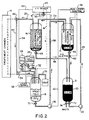
- the system generally identified by reference number 10. includes a reagent generator 12, a parts treatment loop 13, a sulfur trioxide recycle loop 15 and an oleum recycle loop 17. Pumps 22 and 36 are used in the oleum recycle loop 17 and in the sulfur trioxide recycle loop 15, respectively.
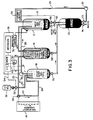
- Exit sensor 19 which senses the concentration of sulfur trioxide in the liquid halocarbon (nonreactive gas) reagent solution, and make-up sensor 21, which senses the concentration of sulfur trioxide in the returning carrier, are provided. More detailed schematic diagrams of the two embodiments of the present invention are shown in Figures 2 and 3, where like reference numerals have been used for like parts.
- the system is generally identified by reference number 10 and includes a treatment chamber 14 for the surface treatment and sulfonation of polymeric materials located in parts treatment loop 13.
- a final filter 16 is positioned between reagent generator 12 and treatment chamber 14.
- a separate contact chamber 18 is provided for contacting spent reagent solution with fresh sulfur trioxide from source 26 and with halocarbon from source 28 prior to being sent to reagent generator 12.
- An oleum source 20, communicating with reagent generator 12 is also provided.
- Oleum is supplied to the reagent generator 12 from the oleum source 20 which may be a suitable storage container or chamber.
- the oleum is pumped by pump 22 through line 24 into reagent generator 12.
- the oleum source utilized contains from 0.05 to 95 percent and preferably from 10 to 60 percent free sulfur trioxide.
- Both sulfur trioxide and the halocarbon may be added directly to reagent generator 12, which in this instance is a reagent solution generator.
- the sulfur trioxide source 26 and the halocarbon source 28 are provided, and both the sulfur trioxide and halocarbon are metered through lines 30 and 32, respectively, into contact chamber 18.
- Spent reagent solution from treatment chamber 14 and/or diverted reagent solution from filter 16 may also be sent to contact chamber 18 via line 34.
- Line 36 is provided to vent vapors formed in contact chamber 18 to the atmosphere.
- the mixture of sulfur trioxide, halocarbon, and spent reagent solution are sent from contact chamber 18 to reagent generator 12 using pump 36 in line 38.
- Sulfur trioxide may be supplied either as a gas or preferably in a liquid vehicle from the source 26.
- the halocarbon is provided as a liquid.
- Suitable halocarbons for use in the present invention include those relatively low molecular weight halocarbons which are liquids at temperatures below about 25°C, have viscosities below about 200 centipoise, have densities which differ from the density of oleum (approximately 1.8 to 1.9), are substantially insoluble in oleum, and do not contain any carbon to hydrogen bonds. With aspect to the latter requirement, any halocarbon containing carbon to hydrogen bonds would itself become sulfonated and soluble in oleum.
- a preferred halocarbon for use in the present invention is FREONTM 113, a trichlorotrifluoroethane available from E.I. du Pont de Nemours.
- Reagent generator 12 functions not only as a mixer-separator, but also as a chemical reactor.
- the sulfur trioxide, halocarbon and oleum components of the mixture are introduced into reagent generator 12 with sufficient force to mix the components and provide contact among them so as to produce a reagent solution having a sulfur trioxide concentration of from 0.001 to 10 percent, and more preferably from 0.4 to 2 percent.
- a mixing means such as a mechanical stirrer may be used to aid in mixing the sulfur trioxide, halocarbon and oleum.
- the oleum in reagent generator 12 does not function solely as a source of sulfur trioxide. Instead, the oleum acts to remove impurities from the system.
- liquid halocarbons contain traces of both water and hydrocarbon impurities, such as pentane and/or partly halogenated lower alkanes. When such hydrocarbon impurities are not removed from the system, the reagent solution takes on a brown color. When moisture is not removed from the system, the reagent solution becomes cloudy.
- hydrocarbon impurities such as pentane and/or partly halogenated lower alkanes.
- the reagent solution takes on a brown color.
- moisture is not removed from the system, the reagent solution becomes cloudy.
- sulfur trioxide often contain boron oxide (B2O3) or its corresponding sulfate as an impurity. Oleum usually contains heavy metal sulfate originating from corrosion of metal surfaces with which it has come in contact.
- impurities include moisture, grease, polymer fragments, dust, bacteria, and the like.
- these impurities, as well as any heavy metal impurities in the oleum itself, are directed to and confined to the oleum portion of the system and do not contaminate the reagent solution.
- some of the sulfur trioxide present reacts with any moisture present to form H2S3O10 which is insoluble in the halocarbon and becomes a part of the oleum solution in reagent generator 12.
- trace hydrocarbon impurities, such as pentane also react with the sulfur trioxide, become sulfonated, to form, for example, pentaneosulfonic acid, and dissolve in the oleum.
- such sulfonated hydrocarbons are not soluble in the halocarbon and are, thus, confined to the oleum portion of the system.
- boron oxide present exists as a boron trisulfonic acid (B(OSO3H)3) which when brought into contact with the oleum in reagent generator 12 dissolves therein.
- B(OSO3H)3 boron trisulfonic acid
- the boron sulfonic acid is not soluble in the halocarbon and, therefore, is not a part of the reagent solution.
- the reagent solution in contacting the polymeric resin to be treated not only sulfonates the polymer, but also reacts with any moisture, grease, polymer fragments (monomer, low molecular weight polymer, etc.), dust, bacteria, and the like to produce various sulfonic acids.
- the spent reagent solution which is recycled to contact chamber 18 from treatment chamber 14 will contain those sulfonated impurities.
- the reagent generator 12 acts as a gravity separator providing an upper level layer of pure reagent solution and a lower level of oleum containing sulfonated impurities. This gravity separation is readily accomplished because of the density differences between the halocarbon and oleum solutions and their immiscibility.
- a halocarbon liquid having a density greater than that of oleum may be selected.
- the reagent solution would form the lower layer in reagent generator 12, and the connections for the output lines from the reagent generator would be changed.
- the concentration of sulfur trioxide in the halocarbon may be closely controlled in the system of the present invention to within a few parts per million. This is accomplished by maintaining a known concentration of oleum in reagent generator 12, controlling the addition of sulfur trioxide to the generator, and measuring the temperature therein. The distribution coefficient for free sulfur trioxide between the halocarbon and oleum solutions can be calculated readily for any given temperature. By adding sufficient make-up sulfur trioxide to the reagent generator, a controllable concentration of free sulfur trioxide will be distributed to the liquid halocarbon phase
- the concentration of sulfur trioxide in the halocarbon can be analytically determined by titration with a base, but preferably it is determined by an in line sensor 48 such as an ultraviolet spectrophotometer. The output signal from sensor 48 can be used to control valves 50 and 52 as explained more fully below.
- Fresh reagent solution leaving reagent generator 12 is first sent through filter 16 to remove any last traces of oleum which may be suspended in the solution.
- Filter 16 contains a filter medium such as glass wool fibers which act to entrap and remove any oleum. As shown, the oleum drained from filter 16 is recycled to oleum source 20. It may alternatively be sent to sulfur trioxide source 26 or contact chamber 18. The reagent solution is sent to treatment chamber 14 via line 25.
- an internal circulating line 44 is provided to connect line 25 carrying the output from filter 16 to line 34 which is the input line for contact chamber 18. This permits the system to fully circulate and balance the sulfur trioxide in the halocarbon solution even when there is no treatment taking place in treatment chamber 14. Changing the system over from recirculation to treatment is accomplished by a valve, such as rotating T-Valve 46.
- the polymeric resins to be treated are placed within treatment chamber 14 .
- the reagent solution may be flowed directly through the part to be treated (i.e. when the part is configured so as to have a substance such as blood or other body fluid flowed through it in use). In that instance the part itself becomes the treatment chamber.
- the polymeric resins form medical devices or parts thereof.
- the system of the present invention can be used to treat and sulfonate the surfaces of a number of polymeric resins for a variety of purposes.
- the reagent solution interacts with the polymeric surface not only to clean and sterilize it, but also to chemically react with it.
- the sulfur trioxide in the reagent solution removes low molecular weight polymer impurities from the surface as well as processing aids which may remain on the surface of the polymer from an earlier polymerization procedure. Further, the sulfur trioxide combines with water in the cells of any bacteria present on the surface of the polymeric resin to produce sulfuric acid which destroys the cell membranes of the bacteria. Some of the polymer fragments and dead bacteria will be removed by the reagent solution as it is circulated through the device. Additional surface impurities will be removed by later washing and rinsing steps.
- the sulfur trioxide in the reagent solution also reacts with carbon to hydrogen bonds at the polymer surface to provide one or a number of monolayers of sulfonic acid functional groups at the polymer surface.
- sulfonic acid functional groups provide a number of desirable properties to the polymer surface. These include water wettability, antistatic, nondust attracting, and nonfogging surface. Further, the resulting surface releases air bubbles more readily and is slippery to blood and other body fluids to prevent coagulation. Finally, the sulfonated surface provides a reactive functional group to which other bio-active compounds can be bonded.
- the system of the present invention may be automatically controlled through the use of sensors and controllers.
- the sensor 48 monitors the concentration of sulfur trioxide in the halocarbon solution at the output of filter 16 and just prior to the entry of sulfur trioxide in the halocarbon solution into reagent generator 12 (illustrated by the dotted line 51).
- Samples of the reagent solution may be drawn from either of lines 25 or 38 and sent through sensor 48 to sense the concentration of sulfur trioxide in the reagent solution directly or indirectly by measuring the density, refractive index, or the adsorption of ultraviolet light at a selected wavelength.
- the T-valve 50 may be actuated and rotated by a suitable controller (not shown) to switch the sampling from line 25 to line 38.
- valve 52 may be actuated, as shown schematically by line 54, to provide additional sulfur trioxide from the source 26 to contact chamber 18, as needed
- Level controller 56 is preferably a dual level control device which can sense the level of both the oleum and halocarbon phases in reagent generator 12. As shown schematically, when additional make-up of reagent solution is needed in reagent generator 12, level controller 56 activates pump 36 via line 60. If the level of oleum in reagent generator 12 rises too high, level controller 56 actuates a valve such as T-valve 62, to rotate it from its position of open to atmosphere to a second position to drain oleum from generator 12 into oleum source 20.
- T-valve 62 a valve such as T-valve 62
- Level controller 58 senses the level of liquid halocarbon in contact chamber 18. As additional liquid is required, level controller 58 actuates valve 64 to supply additional make-up halocarbon to contact chamber 18. Additional valves 66, 68, 70 and 72 are provided at the respective bases of generator 12, filter 16, contact chamber 18 and oleum source 20. While these valves are normally in the open position during operation of the system, they may be closed as needed. Further, valve 74 is provided at the base of oleum source 20 to bleed off a small portion of the oleum for disposal.
- contact chamber 18, sulfur trioxide source 26 and halocarbon source 28 are operated at atmospheric pressure, while reagent generator 12 and filter 16 are maintained at slightly above atmospheric pressure.
- Oleum source 20 contains trapped air 21 under hydrostatic pressure from generator 12.
- sulfur trioxide is mixed with a gas that is nonreactive with the sulfur trioxide, such as dry air, as the reagent solution for treatment.
- the system includes reagent generator 12 (which in this instance is a gaseous reagent generator), treatment chamber 14, filter 16, contact chamber 18 and oleum source 20.
- reagent generator 12 which in this instance is a gaseous reagent generator
- treatment chamber 14 filter 16
- contact chamber 18 contact chamber 18
- oleum source 20 oleum source
- the reagent solution is produced in reagent generator 12 by contacting make-up sulfur trioxide and gas from contact chamber 18 with oleum provided from source 20.
- the reagent solution is then sent to filter 16 for removal of any traces of oleum prior to being sent to treatment chamber 14.
- the reagent solution contacts the surfaces of the polymeric resins contained therein or when the treatment chamber 14 is the part itself, the reagent contacts the internal polymer surfaces of that part.
- the polymeric resins form a part or all of a medical device.
- the reagent solution removes surface impurities, sterilizers the resin surface and reacts with the surface to sulfonate it. Spent reagent solution is then recycled to contact chamber 18 through line 34, which is the input line for contact chamber 18.
- Sensor 48 samples both the reagent solution leaving filter 16 as well as the spent reagent solution in contact chamber 18. Based on the concentrations sensed, a controller (not shown) actuates a valve, such as T-valve 52, to supply additional make-up sulfur trioxide as needed from sulfur trioxide source 26.
- the pressure in reagent generator 12 is sensed by pressure controller 76. If additional reagent solution is required, controller 76 activates pump 36 via line 78 to provide the additional amount of sulfur trioxide in the inert gas.
- Level controller 56 senses the level of oleum in generator 12 and actuates a valve, such as T-valve 62, through line 61 as necessary to drain excess oleum from the reagent generator. A small amount of oleum is bled from the system through valve 74 as required and is disposed of by suitable means.
- sulfur trioxide source 26 and contact chamber 18 are maintained at atmospheric pressure while reagent generator 12 is maintained at slightly above atmospheric pressure.
- Inert gas is also supplied to oleum source 20 at slightly above atmospheric pressure.
- both embodiments to the present invention provide systems for the production of sulfur trioxide reagent solution which may then be used in the surface treatment and sulfonation of polymeric materials.
- the systems of the present invention delivers a stream of reagent solution while maintaining the concentration of sulfur trioxide in the reagent solution within narrow, but adjustable, limits. Further, the system of the present invention minimizes waste acid by receiving and upgrading spent reagent solution all within an integrated reactor-separator chamber.
Landscapes
- Chemical & Material Sciences (AREA)
- Organic Chemistry (AREA)
- Inorganic Chemistry (AREA)
- Treatments Of Macromolecular Shaped Articles (AREA)
- Addition Polymer Or Copolymer, Post-Treatments, Or Chemical Modifications (AREA)
Claims (11)
- Appareil destiné à générer un courant de réactif SO₃ dans un fluide porteur, à une concentration contrôlée, comprenant:(a) une source de trioxyde de soufre (26),(b) une source de fluide porteur (28, 29),(c) une source d'oléum (20),(d) une chambre de contact (18) destinée à la mise en contact de réactif SO₃ épuisé avec du SO₃ frais de ladite source de trioxyde de soufre (26),(e) un générateur de réactif (12) destiné à la mise en contact du réactif SO₃ épuisé avec de l'oléum, pour fournir ledit courant de réactif SO₃,(f) un filtre (16) destiné à éliminer l'oléum résiduel dudit courant de réactif SO₃, et(g) une chambre de traitement (14) destinée au traitement de surfaces d'un matériau polymère par le courant de réactif SO₃,dans lequel la source de trioxyde de soufre (26) est en communication de fluide contrôlée (48, 54, 52) avec ladite chambre de contact (18),
ladite chambre de contact (18) est en communication contrôlée (36, 38) avec ledit générateur de réactif (12) et en communication de fluide (34) avec ladite chambre de traitement (14),
ladite source d'oléum (20) est en communication de circuit de fluide contrôlée (72, 24, 56, 62) avec ladite chambre de contact (18) et en communication de fluide (68, 69) avec ledit filtre (16),
ledit générateur de réactif (12) est une communication de fluide (23) avec ledit filtre (16),
et ledit filtre (16) est pourvu d'un moyen de communication de fluide (25, 46) destiné à introduire ledit courant de réactif SO₃ dans ladite chambre de traitement (14). - Appareil selon la revendication 1, dans lequel ladite source d'oléum (20) est pourvue d'une soupape de purge d'oléum (74).
- Appareil selon la revendication 1 ou 2, dans lequel ladite source de fluide porteur comprend une entrée de gaz inerte (29) dans le circuit de communication de fluide (72, 24, 56, 62) allant du générateur de réactif (12) à la source d'oléum (20).
- Appareil selon l'une quelconque des revendications précédentes, dans lequel ladite source de fluide porteur comprend un moyen (28) pour introduire un hydrocarbure halogéné liquide.
- Appareil selon la revendication 4, dans lequel ledit moyen (28) est en communication de fluide contrôlée (58, 64, 32) avec ladite chambre de contact (18).
- Procédé pour générer un courant de réactif SO₃ dans un fluide porteur, comprenant les étapes consistant à:(a) introduire du trioxyde de soufre, un fluide porteur et de l'oléum dans un générateur de réactif (12),
dans lequel ledit fluide porteur est choisi dans le groupe formé par un gaz inerte et un hydrocarbure halogéné liquide,(b) mettre en contact le trioxyde de soufre, le fluide porteur et l'oléum, pour fournir ledit courant de réactif SO₃,(c) évacuer l'oléum dudit générateur de réactif (12),(d) évacuer le courant de réactif SO₃ dudit générateur de réactif (12),(e) séparer l'oléum résiduel dudit courant de réactif SO₃, dans un filtre (16),(f) utiliser ledit courant de réactif SO₃, et(g) recycler le réactif SO₃ épuisé de l'étape (f) vers ledit générateur de réactif (12). - Procédé selon la revendication 6, comprenant l'étape consistant à recycler l'oléum évacué du générateur de réactif (12) vers le générateur de réactif (12).
- Procédé selon la revendication 6, comprenant l'étape consistant à recycler l'oléum résiduel du filtre (16) vers le générateur de réactif (12).
- Procédé selon l'une quelconque des revendications 6 à 8, dans lequel le trioxyde de soufre est introduit dans une chambre de contact (18) séparée contenant la solution de réactif épuisée avant d'être envoyé vers le générateur de réactif (12) avec la solution de réactif épuisée recyclée.
- Procédé selon la revendication 6, dans lequel l'étape (f) comprend:f1. l'alimentation de la solution de réactif vers une chambre de traitement (14) pour un matériau résineux polymère, etf2. la mise en contact de la surface du matériau résineux polymère avec la solution de réactif.
- Utilisation d'un appareil selon l'une quelconque des revendications 1 à 5 dans un procédé pour le traitement de surfaces et la sulfonation de matériaux polymères.
Applications Claiming Priority (4)
| Application Number | Priority Date | Filing Date | Title |
|---|---|---|---|
| US190313 | 1988-05-04 | ||
| US07/190,313 US4915912A (en) | 1988-05-04 | 1988-05-04 | Apparatus for the generation of sulfur trioxide reagent and sulfonation of the surface of polymeric resins |
| US190312 | 1988-05-04 | ||
| US07/190,312 US4902493A (en) | 1988-05-04 | 1988-05-04 | Process for the generation of sulfur trioxide reagent and sulfonation of the surface of polymeric resins |
Publications (3)
| Publication Number | Publication Date |
|---|---|
| EP0340617A2 EP0340617A2 (fr) | 1989-11-08 |
| EP0340617A3 EP0340617A3 (fr) | 1991-07-03 |
| EP0340617B1 true EP0340617B1 (fr) | 1995-03-29 |
Family
ID=26885976
Family Applications (1)
| Application Number | Title | Priority Date | Filing Date |
|---|---|---|---|
| EP89107557A Expired - Lifetime EP0340617B1 (fr) | 1988-05-04 | 1989-04-26 | Appareil et procédé pour la préparation d'un réactif de trioxyde de soufre pour la sulfonation de la surface de résines polymères |
Country Status (9)
| Country | Link |
|---|---|
| EP (1) | EP0340617B1 (fr) |
| JP (1) | JPH01320207A (fr) |
| AU (1) | AU614833B2 (fr) |
| CA (1) | CA1334277C (fr) |
| DE (1) | DE68921915T2 (fr) |
| ES (1) | ES2070139T3 (fr) |
| FR (1) | FR2631018B1 (fr) |
| MX (1) | MX166205B (fr) |
| NO (1) | NO891833L (fr) |
Families Citing this family (3)
| Publication number | Priority date | Publication date | Assignee | Title |
|---|---|---|---|---|
| US5798078A (en) * | 1996-07-11 | 1998-08-25 | Kimberly-Clark Worldwide, Inc. | Sulfonated polymers and method of sulfonating polymers |
| DE19612112C2 (de) * | 1996-03-27 | 1999-05-20 | Braun Gmbh | Ventilkörper von Dampfbügeleisen und Verfahren zu seiner Herstellung |
| US12116336B2 (en) * | 2018-12-06 | 2024-10-15 | Lts Lohmann Therapie-Systeme Ag | Method for the recycling or disposal of halocarbons |
Family Cites Families (5)
| Publication number | Priority date | Publication date | Assignee | Title |
|---|---|---|---|---|
| GB1595928A (en) * | 1977-12-07 | 1981-08-19 | Kartridg Pak Co | Method and apparatus for sulphonation of resinous articles |
| US4209592A (en) * | 1978-02-02 | 1980-06-24 | Rohm And Haas Company | Sulphonation method for manufacture of a cation exchange resin |
| CS210175B1 (en) * | 1979-10-18 | 1982-01-29 | Zdenek Krivsky | Method of making the surface hydrophilic fillings for the appliance for interchange of material and/or heat between the phases |
| US4615914A (en) * | 1985-10-07 | 1986-10-07 | The Dow Chemical Company | Treatment of the interior surfaces of resinous enclosure members |
| JPH0751608B2 (ja) * | 1987-01-09 | 1995-06-05 | ライオン株式会社 | ポリスチレンの連続スルホン化方法 |
-
1989
- 1989-04-26 DE DE68921915T patent/DE68921915T2/de not_active Expired - Fee Related
- 1989-04-26 ES ES89107557T patent/ES2070139T3/es not_active Expired - Lifetime
- 1989-04-26 EP EP89107557A patent/EP0340617B1/fr not_active Expired - Lifetime
- 1989-05-02 JP JP1113608A patent/JPH01320207A/ja active Pending
- 1989-05-03 CA CA000598575A patent/CA1334277C/fr not_active Expired - Fee Related
- 1989-05-03 FR FR898905908A patent/FR2631018B1/fr not_active Expired - Fee Related
- 1989-05-03 AU AU33982/89A patent/AU614833B2/en not_active Ceased
- 1989-05-03 NO NO89891833A patent/NO891833L/no unknown
- 1989-05-03 MX MX015907A patent/MX166205B/es unknown
Also Published As
| Publication number | Publication date |
|---|---|
| AU614833B2 (en) | 1991-09-12 |
| MX166205B (es) | 1992-12-23 |
| FR2631018A1 (fr) | 1989-11-10 |
| DE68921915T2 (de) | 1995-07-27 |
| ES2070139T3 (es) | 1995-06-01 |
| NO891833L (no) | 1989-11-06 |
| JPH01320207A (ja) | 1989-12-26 |
| AU3398289A (en) | 1989-11-30 |
| CA1334277C (fr) | 1995-02-07 |
| DE68921915D1 (de) | 1995-05-04 |
| EP0340617A3 (fr) | 1991-07-03 |
| EP0340617A2 (fr) | 1989-11-08 |
| NO891833D0 (no) | 1989-05-03 |
| FR2631018B1 (fr) | 1993-01-29 |
Similar Documents
| Publication | Publication Date | Title |
|---|---|---|
| US4915912A (en) | Apparatus for the generation of sulfur trioxide reagent and sulfonation of the surface of polymeric resins | |
| US4902493A (en) | Process for the generation of sulfur trioxide reagent and sulfonation of the surface of polymeric resins | |
| EP0057687B1 (fr) | Procede de chloruration de chlorure de polyvinyle avec du chlore liquide et composition de chlorure de polyvinyle chlore | |
| EP0221591B1 (fr) | Procédé de sulfonation de la surface intérieure d'un récipient en matière plastique | |
| WO2008141179A1 (fr) | Procédé de sulfonation de molécules | |
| WO1982002557A1 (fr) | Chloruration du chlorure de polyvinyle dans le chlore liquide, et composition de chlorure de polvvinyle chlorure | |
| CA1334277C (fr) | Appareillage et procede pour la production de reactif trioxyde de soufre pour la sulfonation des surfaces de resines polymeriques | |
| EP0006288A1 (fr) | Procédé et dispositif d'élimination des monomères oléfiniques des polymères d'oléfines | |
| CA1219995A (fr) | Recuperation du chlorure de polyvinyle chlore | |
| Jeon et al. | Behavior of polyethylene oxide based nonionic surfactants in silicon processing using alkaline solutions | |
| US4308301A (en) | Process for metal-coating plastic surfaces | |
| KR20060121265A (ko) | 브롬화 반응 혼합물로부터의 안티몬 촉매 잔류물의 회수 | |
| SU660591A3 (ru) | Способ очистки лауриллактама | |
| AU572721B2 (en) | Modification by reaction with thiocyano or isothiocyano generating reactants | |
| US5095049A (en) | Process for producing a low-particle-content transparent thermoplastic resin solution | |
| WO1996008211A2 (fr) | Procedes et composes de greffage au plasma | |
| JP2715153B2 (ja) | 連続表面改質処理方法および装置 | |
| JP3431659B2 (ja) | 触媒回収方法および装置 | |
| KR100682346B1 (ko) | 대기압 플라즈마 연속 표면 처리 공정으로 개질한 거대다공성 고분자 이온 교환체, 이의 제조방법 및 용도 | |
| SU1049505A1 (ru) | Способ регенерации вторичного полиэтилена и полипропилена | |
| US2868737A (en) | Cation exchangers containing selenic acid groups | |
| US6818799B2 (en) | Process for removing tar from spent acid | |
| JPS60139719A (ja) | ポリフエニレンオキシドの製法 | |
| EP0093007A2 (fr) | Procédé pour le traitement superficiel d'une matière polymère | |
| KR20250172945A (ko) | 열분해 오일의 정제 방법 |
Legal Events
| Date | Code | Title | Description |
|---|---|---|---|
| PUAI | Public reference made under article 153(3) epc to a published international application that has entered the european phase |
Free format text: ORIGINAL CODE: 0009012 |
|
| AK | Designated contracting states |
Kind code of ref document: A2 Designated state(s): BE CH DE ES GB IT LI NL SE |
|
| 17P | Request for examination filed |
Effective date: 19900725 |
|
| PUAL | Search report despatched |
Free format text: ORIGINAL CODE: 0009013 |
|
| AK | Designated contracting states |
Kind code of ref document: A3 Designated state(s): BE CH DE ES GB IT LI NL SE |
|
| 17Q | First examination report despatched |
Effective date: 19920330 |
|
| GRAA | (expected) grant |
Free format text: ORIGINAL CODE: 0009210 |
|
| AK | Designated contracting states |
Kind code of ref document: B1 Designated state(s): BE CH DE ES GB IT LI NL SE |
|
| ITF | It: translation for a ep patent filed | ||
| REF | Corresponds to: |
Ref document number: 68921915 Country of ref document: DE Date of ref document: 19950504 |
|
| REG | Reference to a national code |
Ref country code: ES Ref legal event code: FG2A Ref document number: 2070139 Country of ref document: ES Kind code of ref document: T3 |
|
| PLBE | No opposition filed within time limit |
Free format text: ORIGINAL CODE: 0009261 |
|
| STAA | Information on the status of an ep patent application or granted ep patent |
Free format text: STATUS: NO OPPOSITION FILED WITHIN TIME LIMIT |
|
| PGFP | Annual fee paid to national office [announced via postgrant information from national office to epo] |
Ref country code: SE Payment date: 19960311 Year of fee payment: 8 Ref country code: DE Payment date: 19960311 Year of fee payment: 8 |
|
| 26N | No opposition filed | ||
| PGFP | Annual fee paid to national office [announced via postgrant information from national office to epo] |
Ref country code: GB Payment date: 19960401 Year of fee payment: 8 |
|
| PGFP | Annual fee paid to national office [announced via postgrant information from national office to epo] |
Ref country code: ES Payment date: 19960409 Year of fee payment: 8 |
|
| PGFP | Annual fee paid to national office [announced via postgrant information from national office to epo] |
Ref country code: BE Payment date: 19960412 Year of fee payment: 8 |
|
| PGFP | Annual fee paid to national office [announced via postgrant information from national office to epo] |
Ref country code: CH Payment date: 19960429 Year of fee payment: 8 |
|
| PGFP | Annual fee paid to national office [announced via postgrant information from national office to epo] |
Ref country code: NL Payment date: 19960430 Year of fee payment: 8 |
|
| PG25 | Lapsed in a contracting state [announced via postgrant information from national office to epo] |
Ref country code: GB Effective date: 19970426 |
|
| PG25 | Lapsed in a contracting state [announced via postgrant information from national office to epo] |
Ref country code: SE Effective date: 19970427 |
|
| PG25 | Lapsed in a contracting state [announced via postgrant information from national office to epo] |
Ref country code: ES Free format text: LAPSE BECAUSE OF NON-PAYMENT OF DUE FEES Effective date: 19970428 |
|
| PG25 | Lapsed in a contracting state [announced via postgrant information from national office to epo] |
Ref country code: LI Free format text: LAPSE BECAUSE OF NON-PAYMENT OF DUE FEES Effective date: 19970430 Ref country code: CH Free format text: LAPSE BECAUSE OF NON-PAYMENT OF DUE FEES Effective date: 19970430 Ref country code: BE Effective date: 19970430 |
|
| BERE | Be: lapsed |
Owner name: THE DOW CHEMICAL CY Effective date: 19970430 |
|
| PG25 | Lapsed in a contracting state [announced via postgrant information from national office to epo] |
Ref country code: NL Effective date: 19971101 |
|
| REG | Reference to a national code |
Ref country code: CH Ref legal event code: PL |
|
| GBPC | Gb: european patent ceased through non-payment of renewal fee |
Effective date: 19970426 |
|
| PG25 | Lapsed in a contracting state [announced via postgrant information from national office to epo] |
Ref country code: DE Free format text: LAPSE BECAUSE OF NON-PAYMENT OF DUE FEES Effective date: 19980101 |
|
| NLV4 | Nl: lapsed or anulled due to non-payment of the annual fee |
Effective date: 19971101 |
|
| EUG | Se: european patent has lapsed |
Ref document number: 89107557.4 |
|
| REG | Reference to a national code |
Ref country code: ES Ref legal event code: FD2A Effective date: 19990301 |
|
| PG25 | Lapsed in a contracting state [announced via postgrant information from national office to epo] |
Ref country code: IT Free format text: LAPSE BECAUSE OF NON-PAYMENT OF DUE FEES;WARNING: LAPSES OF ITALIAN PATENTS WITH EFFECTIVE DATE BEFORE 2007 MAY HAVE OCCURRED AT ANY TIME BEFORE 2007. THE CORRECT EFFECTIVE DATE MAY BE DIFFERENT FROM THE ONE RECORDED. Effective date: 20050426 |