EP0340904A2 - Circuit intégré monolithique, sensible à la pression et son procédé de fabrication - Google Patents
Circuit intégré monolithique, sensible à la pression et son procédé de fabrication Download PDFInfo
- Publication number
- EP0340904A2 EP0340904A2 EP89303134A EP89303134A EP0340904A2 EP 0340904 A2 EP0340904 A2 EP 0340904A2 EP 89303134 A EP89303134 A EP 89303134A EP 89303134 A EP89303134 A EP 89303134A EP 0340904 A2 EP0340904 A2 EP 0340904A2
- Authority
- EP
- European Patent Office
- Prior art keywords
- epitaxial layer
- integrated circuit
- piezoresistors
- transistors
- region
- Prior art date
- Legal status (The legal status is an assumption and is not a legal conclusion. Google has not performed a legal analysis and makes no representation as to the accuracy of the status listed.)
- Granted
Links
Images

Classifications
-
- G—PHYSICS
- G01—MEASURING; TESTING
- G01L—MEASURING FORCE, STRESS, TORQUE, WORK, MECHANICAL POWER, MECHANICAL EFFICIENCY, OR FLUID PRESSURE
- G01L9/00—Measuring steady of quasi-steady pressure of fluid or fluent solid material by electric or magnetic pressure-sensitive elements; Transmitting or indicating the displacement of mechanical pressure-sensitive elements, used to measure the steady or quasi-steady pressure of a fluid or fluent solid material, by electric or magnetic means
- G01L9/0041—Transmitting or indicating the displacement of flexible diaphragms
- G01L9/0042—Constructional details associated with semiconductive diaphragm sensors, e.g. etching, or constructional details of non-semiconductive diaphragms
-
- B—PERFORMING OPERATIONS; TRANSPORTING
- B81—MICROSTRUCTURAL TECHNOLOGY
- B81C—PROCESSES OR APPARATUS SPECIALLY ADAPTED FOR THE MANUFACTURE OR TREATMENT OF MICROSTRUCTURAL DEVICES OR SYSTEMS
- B81C1/00—Manufacture or treatment of devices or systems in or on a substrate
- B81C1/00015—Manufacture or treatment of devices or systems in or on a substrate for manufacturing microsystems
- B81C1/00222—Integrating an electronic processing unit with a micromechanical structure
- B81C1/00246—Monolithic integration, i.e. micromechanical structure and electronic processing unit are integrated on the same substrate
-
- B—PERFORMING OPERATIONS; TRANSPORTING
- B81—MICROSTRUCTURAL TECHNOLOGY
- B81C—PROCESSES OR APPARATUS SPECIALLY ADAPTED FOR THE MANUFACTURE OR TREATMENT OF MICROSTRUCTURAL DEVICES OR SYSTEMS
- B81C2203/00—Forming microstructural systems
- B81C2203/07—Integrating an electronic processing unit with a micromechanical structure
- B81C2203/0707—Monolithic integration, i.e. the electronic processing unit is formed on or in the same substrate as the micromechanical structure
- B81C2203/0735—Post-CMOS, i.e. forming the micromechanical structure after the CMOS circuit
Definitions
- This invention relates to a monolithic pressure sensitive integrated circuit and to a process for its manufacture.
- a monolithic pressure sensitive integrated circuit is a semiconductor chip in which there are combined a pressure sensitive diaphragm, its piezoresistors, and the circuitry used to process or condition the signal developed by the piezoresistors to make it useful for its designed purpose.
- Pressure sensors are of particular use for automotive applications.
- One chip includes the sensitive pressure diaphragm and its associated piezoresistors; the second chip includes electronics for amplifying the signal received from the piezoresistors; and the hybrid substrate includes additional conditioning circuits.
- a monolithic chip to replace such two chips and hybrid substrate has a number of obvious advantages.
- a process for preparing a monolithic pressure sensor which combines both the pressure sensitive elements and conditioning electronics is described in US Patent No. 4,618,397.
- the present invention in one aspect is a process for making a monolithic pressure sensor by a different process believed to be more reliable, manufacturable and to yield an improved pressure sensor.
- a process for manufacturing a monolithic pressure sensitive integrated circuit, and a monolithic pressure sensitive integrated circuit in accordance with the present invention are characterised by the features specified in the characterising portions of claims 1 and 4 respectively.
- the diffusion step used to form base zones of vertical (junction) transistors and emitter and collector zones of lateral transistors included in the conditioning circuitry is also used to form diffused piezoresistors used for sensing.
- a monocrystalline semiconductive wafer that is lightly doped n-type.
- the wafer is cut so that both its major top and bottom surfaces lie along ⁇ 100 ⁇ crystal planes and are appropriately separated to provide a thickness to the wafer sufficient to facilitate handling of the wafer.
- the wafer is large enough in lateral area to accommodate many pressure sensors and ultimately the wafer will be diced to form many chips each including one or more pressure sensors. The description will focus on the preparation of an individual pressure sensor for reasons of simplicity.
- a heavily doped p-type etch-stop layer that will be used to control the degree of localized thinning of the wafer to form the diaphragm of each pressure sensor.
- a first p-type epitaxial layer is grown over the top surface of the wafer, advantageously in two stages, the first with little intentional doping and the second with added p-type doping. This first epitaxial layer serves to isolate the heavily-doped etch-stop layer from a subsequently grown n-type second epitaxial layer in which the integrated circuit is to be formed.
- the circuitry includes at least a hundred transistors.
- these transistors include both lateral p-n-p junction transistors and vertical n-p-n junction transistors.
- This second epitaxial layer is then treated to include four piezoresistors appropriately positioned over the periphery of the etch-stop layer, both vertical and lateral junction transistors in the surrounding regions, diffused resistors, and pairs of vertical p-n junctions for isolating, where necessary, the elements (components) of the circuitry in the second epitaxial layer.
- the piezoresistors, the diffused resistors, the pairs of isolation junctions, the base zones of the vertical junction transistors, and the emitter and collector zones of the lateral junction transistors are formed by a common masked p-type diffusion step.
- a common n-type diffusion step is then used to form the emitter zones of the vertical junction transistors and the base contact areas of the lateral transistors.
- the circuit elements are then interconnected on the top surface by appropriate metallization.
- the back surface of the original substrate is appropriately etched to form a cavity that extends to the p-type etch-stop layer, leaving the chip thinned there to form a diaphragm across which there is developed in operation the pressure differential being sensed.
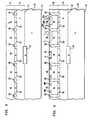
- FIG. 1 there is shown a cross-sectional view of a portion of a wafer 10 of monocrystalline silicon, illustratively of n-type, whose resistivity is not especially critical but is typically of fairly high resistivity, for example, between one and ten ohm-centimeters, so as to be easily etched.
- Its thickness should be no greater than that necessary for good mechanical support, since it will eventually need to be thinned and the thicker it is initially the more the thinning that will need to be done. Typically, it's thickness will be several hundred micrometers, for example, 400 micrometers.
- the lateral surface area of the wafer 10 is selected to be sufficiently large to accommodate at least several hundred sensors.
- the wafer 10 eventually will be diced up to form individual chips including usually only a single pressure sensor.
- the drawing shows only enough of the wafer 10 to accommodate a single pressure sensor for purposes of simplicity.
- the wafer 10 advantageously is prepared so that its top and bottom (major) surfaces 11 and 13, respectively, are oriented parallel to the ⁇ 100 ⁇ plane of the silicon crystal so that the subsequent diaphragm thinning can be done in the usual fashion by anisotropic etching of the bottom surface 13 to form uniform well defined cavities with good control of the diaphragm thickness.
- the bottom surface 13 is provided with a coating (not shown) to protect it during the processing of the top surface 11.
- etch-stop region there is formed in the top surface 11 of the wafer 10 for each pressure sensor a (heavily doped) p-type layer (etch-stop region) 12, localized at the region where the diaphragm of the sensor is to be located. Typically it will be a square of about 1.78 mm (70 mils) on each side and initially about a micrometer thick.
- the p-type doping which may be done either by ion implantation or diffusion, advantageously is of a concentration of at least 1019 atoms per cubic centimeter and is typically 6 x 10¹⁹ atoms per cubic centimeter. Conventional photolithographic techniques can be used to localize p-type layer 12.
- FIG. 2 there is shown wafer 10 after further processing with a (grown p-type) first epitaxial layer 14 over the top surface 11 of the wafer 10 which serves as a substrate.
- first portion of the first epitaxial layer 14 tends to be p-type because of autodoping, (the outdiffusion of the p-type dopant in layer 12 into the epitaxial layer), it is feasible to begin the growth of this first epitaxial layer 14 without intentional doping but then to continue the growth in a p-type ambient in the usual fashion to insure that the growth will continue to be p-type.
- first epitaxial layer 14 is typically about fifteen micrometers thick and largely of a resistivity between 5 and 11 ohms-centimeter although the initially grown material may become more heavily doped because of the autodoping.
- first epitaxial layer 14 serves primarily as an isolation layer to protect a (n-type) second epitaxial layer 16 (see Figure 3) which will be subsequently grown thereover and in which will be formed the elements (circuit components, i.e., piezoresistors, resistors, transistors, capacitors) of the integrated circuit being fabricated.
- this second epitaxial layer 16 before growing this second epitaxial layer 16 by conventional integrated circuit silicon technology, there are formed at the top surface of the first epitaxial layer 14 various (heavily doped) p-type regions 18 which are typically circular or square in shape.
- the outdiffusion (updiffusion) from these p-type regions 18 into the (n-type) second epitaxial layer 16 to be subsequently grown over first epitaxial layer 14 will help form pairs of vertical p-n junctions in such second epitaxial layer to serve as isolation junctions for dividing the second epitaxial layer into separate pockets 30 and 32 (see Figure 3) in a fashion known in integrated circuit technology.
- first epitaxial layer 14 Also formed at the top surface of first epitaxial layer 14 are (heavily doped) n-type regions 20 that similarly will be useful to form low-resistivity n-type buried layers in this second epitaxial layer 16 to improve the lateral conductance in such layer for various purposes, such as insuring a low collector resistance in a vertical junction transistor formed in such second epitaxial layer.
- FIG. 3 there is shown wafer 10 after still further processing with a second epitaxial layer 16 whose bulk is lightly doped n-type grown over first epitaxial layer 14, typically to a thickness of about 8.5 micrometers.
- second epitaxial layer 16 whose bulk is lightly doped n-type grown over first epitaxial layer 14, typically to a thickness of about 8.5 micrometers.
- outdiffusion of acceptors from p-type regions 18 will begin the formation of annular-like p-type pockets or wells 28 that eventually enclose circular n-type pockets, all of which are denoted as 30 except for a central pocket 32 opposite p-type layer 12, and isolate each such individual pocket 30,32 from the rest of the second epitaxial layer 16 by the pair of vertical p-n junctions formed by the inner and outer walls of the (annular) p-type pockets 28 and (n-type) pockets 30, 32.
- junction transistor This permits a junction transistor to be formed in each such pocket 30.
- Each of the thus formed junction transistors (which are shown in Figure 4) is isolated from the others in the manner well known in silicon integrated circuit technology.
- Piezoresistors (which are shown in Figure 4) that will serve as the sensing elements of the sensor being fabricated are to be formed in pocket 32.
- piezoresistors 41, 42, 43 and 44 are formed in pocket 32, lateral transistors 48 are formed in some of pockets 30, and vertical transistors 50 are formed in others of pockets 30.
- Advantageously four separate piezoresistors are formed in pocket 32, suitable for connection together as the four arms of a Wheatstone bridge.
- Each of the piezoresistors 41-44 typically is a diffused p-type region that is provided with the necessary contact areas for its interconnection.
- a typical layout for the piezoresistors is described in the first-mentioned paper by J. A. Oakes.
- the conditioning circuitry there may be as many as a hundred or more elements in the conditioning circuitry depending on the sensitivity desired and the degree of compensation desired for various temperature and aging effects.
- one such transistor is formed in each of the enclosed pockets 30 defined by the (annular) p-type regions 28 formed by extending the earlier p-type regions 18 through the full thickness of second epitaxial layer 16.
- the transistors are of the bipolar junction type. It is usually desirable to have complementary transistors (both n-p-n and p-n-p types) for circuitry that will operate with low current drain. This is achieved by forming the p-n-p types as lateral transistors 48 and the n-p-n types as vertical transistors 50 since this permits the multiple use of some of the diffusion steps of the processing.
- acceptor atoms there are first introduced acceptor atoms, selectively either by a common step of ion implantation or vapour-solid diffusion, to form p-type base zones 50b of the vertical transistors 50, p-type emitter 48a and collector 48c zones of the lateral transistors 48, (p-type) piezoresistors 41, 42, 43 and 44 (only 42 and 44 are shown in Figure 4; 41, 42, 43, and 44 are shown in a top view in Figure 6) in the central region 32, any other resistors (not shown) that may be needed and also the topmost portions of the p-type pockets 28.
- n-type emitter zones 50a of the vertical transistors 50 This can be followed by a common step for the selective introduction of donor atoms to form the n-type emitter zones 50a of the vertical transistors 50, and to form (heavily doped) n-type surface regions 50c to define the collector contact regions in the vertical transistors 50 and the base contact regions (not shown) in the lateral transistor 48.
- N-type pockets 30 serve as the base regions of each of lateral transistors 48.
- the introductions of the donor and acceptor atoms are localized to selected regions in the usual fashion, for example, by appropriate masks on the surface that have been patterned by photolithographic techniques familiar in integrated circuit technology.
- wafer 10 after still further processing.
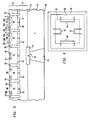
- the bottom surface 13 of wafer 10 is thinned to form the diaphragm properly positioned with respect to the piezoresistors 41, 42, 43 and 44. This is done in conventional fashion, for example as described in the J. A. Oakes paper. Basically, there is employed anisotropic etching, using an etchant which etches different crystallographic planes at different rates.
- the bottom surface 13 is covered with an etch-resistant mask which is patterned to leave a square opening opposite the p-type layer 12, and this surface is then exposed to an etchant, such as potassium hydroxide or ethylene diamine, which is known to etch the ⁇ 100 ⁇ plane about 100 times faster than it etches the ⁇ 111 ⁇ plane.
- an etchant such as potassium hydroxide or ethylene diamine
- This etching is permitted to continue until the p-type layer 12 is reached.
- P-type layer 12 is heavily doped and therefore highly resistant to etching. Accordingly, it serves as an etch-stop.
- a cavity 54 with smooth side walls that are tapered and form the side walls of a frustum of a pyramid of square cross-section whose top surface 56 corresponds essentially to a portion of the bottom surface of the p-type layer 12.
- the preparation of the wafer 10 is essentially complete and it is then diced in the usual manner into individual chips, each of which incorporates one or more sensors, as the particular design calls for.
- the individual chips are usually packaged in a structure that provides a pressure difference on opposite sides of the diaphragm portion of the chip. Usually this involves providing a vacuum on one side and the pressure to be measured on the opposite side. It can also involve providing atmospheric pressure on one side and the pressure to be measured on the opposite side.
- the package typically includes pins or terminals to the enclosed integrated circuit for the application of power supply voltage and the derivation of output signals for utilization.
- FIG. 6 there is shown an exploded top view of pocket 32 and the surrounding p-type pocket 28 which are shown in cross-sectional view in Figures 4 and 5.
- the broken line 36 is the outline of the diaphragm (that is, the exposed portion of a lower surface of p-type layer 12 which is denoted as, typically a square, to be formed by thinning wafer 10, and the four piezoresistors 41, 42, 43 and 44 are seen to be positioned around the outline.
- Each is shown provided at each of its ends with a contact region for connection into a Wheatstone bridge.
- any two adjacent piezoresistors will change their resistance in opposite senses, while any two opposed piezoresistors will change in the same direction.
- a signal voltage will be developed across the other pair of opposite corners of the Wheatstone bridge. This voltage typically is supplied to the terminals of an operational amplifier for providing an output voltage for use in an appropriate load.
- piezoresistors 41-44 can be formed opposite the diaphragm.
- semiconductors other than silicon can be used so long as they are sufficiently piezoresistive and are amenable to the fabrication of monolithic integrated circuits.
- the particular sequence of steps described in the illustrative embodiment may be modified. In particular, the etching of the cavity 54 to form the diaphragm need not be postponed till near the end of the processing.
Landscapes
- Chemical & Material Sciences (AREA)
- Analytical Chemistry (AREA)
- Physics & Mathematics (AREA)
- General Physics & Mathematics (AREA)
- Engineering & Computer Science (AREA)
- Manufacturing & Machinery (AREA)
- Microelectronics & Electronic Packaging (AREA)
- Pressure Sensors (AREA)
- Measuring Fluid Pressure (AREA)
Applications Claiming Priority (2)
| Application Number | Priority Date | Filing Date | Title |
|---|---|---|---|
| US07/189,446 US4885621A (en) | 1988-05-02 | 1988-05-02 | Monolithic pressure sensitive integrated circuit |
| US189446 | 1988-05-02 |
Publications (3)
| Publication Number | Publication Date |
|---|---|
| EP0340904A2 true EP0340904A2 (fr) | 1989-11-08 |
| EP0340904A3 EP0340904A3 (fr) | 1991-02-27 |
| EP0340904B1 EP0340904B1 (fr) | 1992-12-02 |
Family
ID=22697370
Family Applications (1)
| Application Number | Title | Priority Date | Filing Date |
|---|---|---|---|
| EP89303134A Expired - Lifetime EP0340904B1 (fr) | 1988-05-02 | 1989-03-30 | Circuit intégré monolithique, sensible à la pression et son procédé de fabrication |
Country Status (5)
| Country | Link |
|---|---|
| US (1) | US4885621A (fr) |
| EP (1) | EP0340904B1 (fr) |
| JP (1) | JPH01318265A (fr) |
| KR (1) | KR920007827B1 (fr) |
| DE (1) | DE68903674T2 (fr) |
Cited By (3)
| Publication number | Priority date | Publication date | Assignee | Title |
|---|---|---|---|---|
| DE4206174A1 (de) * | 1992-02-28 | 1993-09-02 | Bosch Gmbh Robert | Integrierter sensor aus silizium |
| EP0672899A3 (fr) * | 1994-03-18 | 1996-07-10 | Foxboro Co | Capteur semi-conducteur de pression avec membrane en silicium monocristallin et jauges de contraintes monocristaux et son procédé de fabrication. |
| WO2000037912A1 (fr) * | 1998-12-18 | 2000-06-29 | Maxim Integrated Products, Inc. | Capteur de pression a semi-conducteurs, a compensation |
Families Citing this family (13)
| Publication number | Priority date | Publication date | Assignee | Title |
|---|---|---|---|---|
| US5397911A (en) * | 1991-04-02 | 1995-03-14 | Honda Giken Kogyo Kabushiki Kaisha | Semiconductor sensor with plural gate electrodes |
| JP3009239B2 (ja) * | 1991-04-02 | 2000-02-14 | 本田技研工業株式会社 | 半導体センサ |
| JPH05190872A (ja) * | 1992-01-16 | 1993-07-30 | Oki Electric Ind Co Ltd | 半導体圧力センサおよびその製造方法 |
| US6140143A (en) * | 1992-02-10 | 2000-10-31 | Lucas Novasensor Inc. | Method of producing a buried boss diaphragm structure in silicon |
| US5427975A (en) * | 1993-05-10 | 1995-06-27 | Delco Electronics Corporation | Method of micromachining an integrated sensor on the surface of a silicon wafer |
| JP3624597B2 (ja) * | 1996-12-10 | 2005-03-02 | 株式会社デンソー | 半導体装置及びその製造方法 |
| DE19741428A1 (de) * | 1997-09-19 | 1999-04-01 | Siemens Ag | Halbleitersensor mit einem Grundkörper und wenigstens einem Verformungskörper |
| US6278167B1 (en) | 1998-08-14 | 2001-08-21 | Infineon Technologies Ag | Semiconductor sensor with a base element and at least one deformation element |
| US6142021A (en) * | 1998-08-21 | 2000-11-07 | Motorola, Inc. | Selectable pressure sensor |
| US20020003274A1 (en) * | 1998-08-27 | 2002-01-10 | Janusz Bryzek | Piezoresistive sensor with epi-pocket isolation |
| JP4710147B2 (ja) * | 2000-06-13 | 2011-06-29 | 株式会社デンソー | 半導体圧力センサ |
| DE10057656C1 (de) * | 2000-11-21 | 2002-04-04 | Rossendorf Forschzent | Verfahren zur Herstellung von integrierten Abtastnadeln |
| CN102664161B (zh) * | 2012-05-25 | 2016-11-16 | 杭州士兰集成电路有限公司 | 高压bcd工艺中高压器件的隔离结构及其制造方法 |
Family Cites Families (14)
| Publication number | Priority date | Publication date | Assignee | Title |
|---|---|---|---|---|
| US3994009A (en) * | 1973-02-12 | 1976-11-23 | Honeywell Inc. | Stress sensor diaphragms over recessed substrates |
| US3858150A (en) * | 1973-06-21 | 1974-12-31 | Motorola Inc | Polycrystalline silicon pressure sensor |
| US4003127A (en) * | 1974-11-25 | 1977-01-18 | General Motors Corporation | Polycrystalline silicon pressure transducer |
| CA1047652A (fr) * | 1975-07-31 | 1979-01-30 | National Semiconductor Corporation | Transistor de circuit integre monolithique a resistance de collecteur tres faible |
| US4033787A (en) * | 1975-10-06 | 1977-07-05 | Honeywell Inc. | Fabrication of semiconductor devices utilizing ion implantation |
| JPS5583227A (en) * | 1978-12-20 | 1980-06-23 | Matsushita Electronics Corp | Epitaxial growing |
| US4372803A (en) * | 1980-09-26 | 1983-02-08 | The United States Of America As Represented By The Secretary Of The Navy | Method for etch thinning silicon devices |
| US4332000A (en) * | 1980-10-03 | 1982-05-25 | International Business Machines Corporation | Capacitive pressure transducer |
| US4456901A (en) * | 1981-08-31 | 1984-06-26 | Kulite Semiconductor Products, Inc. | Dielectrically isolated transducer employing single crystal strain gages |
| JPS59117271A (ja) * | 1982-12-24 | 1984-07-06 | Hitachi Ltd | 圧力感知素子を有する半導体装置とその製造法 |
| JPS59136977A (ja) * | 1983-01-26 | 1984-08-06 | Hitachi Ltd | 圧力感知半導体装置とその製造法 |
| JPS60128673A (ja) * | 1983-12-16 | 1985-07-09 | Hitachi Ltd | 半導体感圧装置 |
| JPS6269547A (ja) * | 1985-09-24 | 1987-03-30 | Hitachi Ltd | 半導体装置 |
| JPS62266876A (ja) * | 1986-05-14 | 1987-11-19 | Nippon Denso Co Ltd | 半導体圧力センサ |
-
1988
- 1988-05-02 US US07/189,446 patent/US4885621A/en not_active Expired - Fee Related
-
1989
- 1989-03-30 EP EP89303134A patent/EP0340904B1/fr not_active Expired - Lifetime
- 1989-03-30 DE DE8989303134T patent/DE68903674T2/de not_active Expired - Fee Related
- 1989-05-02 JP JP1113607A patent/JPH01318265A/ja active Pending
- 1989-05-02 KR KR1019890005918A patent/KR920007827B1/ko not_active Expired
Cited By (5)
| Publication number | Priority date | Publication date | Assignee | Title |
|---|---|---|---|---|
| DE4206174A1 (de) * | 1992-02-28 | 1993-09-02 | Bosch Gmbh Robert | Integrierter sensor aus silizium |
| EP0672899A3 (fr) * | 1994-03-18 | 1996-07-10 | Foxboro Co | Capteur semi-conducteur de pression avec membrane en silicium monocristallin et jauges de contraintes monocristaux et son procédé de fabrication. |
| US5672551A (en) * | 1994-03-18 | 1997-09-30 | The Foxboro Company | Method for manufacturing a semiconductor pressure sensor with single-crystal silicon diaphragm and single-crystal gage elements |
| WO2000037912A1 (fr) * | 1998-12-18 | 2000-06-29 | Maxim Integrated Products, Inc. | Capteur de pression a semi-conducteurs, a compensation |
| US6229190B1 (en) | 1998-12-18 | 2001-05-08 | Maxim Integrated Products, Inc. | Compensated semiconductor pressure sensor |
Also Published As
| Publication number | Publication date |
|---|---|
| DE68903674D1 (de) | 1993-01-14 |
| EP0340904B1 (fr) | 1992-12-02 |
| KR920007827B1 (ko) | 1992-09-17 |
| JPH01318265A (ja) | 1989-12-22 |
| DE68903674T2 (de) | 1993-04-01 |
| US4885621A (en) | 1989-12-05 |
| EP0340904A3 (fr) | 1991-02-27 |
| KR900019278A (ko) | 1990-12-24 |
Similar Documents
| Publication | Publication Date | Title |
|---|---|---|
| EP0340904B1 (fr) | Circuit intégré monolithique, sensible à la pression et son procédé de fabrication | |
| US5719069A (en) | One-chip integrated sensor process | |
| US4904978A (en) | Mechanical sensor for high temperature environments | |
| US5552347A (en) | Fabrication process for a semiconductor pressure sensor for sensing pressure applied thereto | |
| US6122975A (en) | CMOS compatible integrated pressure sensor | |
| US4618397A (en) | Method of manufacturing semiconductor device having a pressure sensor | |
| US5178016A (en) | Silicon pressure sensor chip with a shear element on a sculptured diaphragm | |
| US4977101A (en) | Monolithic pressure sensitive integrated circuit | |
| JP2940293B2 (ja) | 半導体加速度センサの製造方法 | |
| US7687298B2 (en) | Microelectromechanical device with integrated conductive shield | |
| US3893228A (en) | Silicon pressure sensor | |
| US4945769A (en) | Semiconductive structure useful as a pressure sensor | |
| US4721938A (en) | Process for forming a silicon pressure transducer | |
| US5589810A (en) | Semiconductor pressure sensor and related methodology with polysilicon diaphragm and single-crystal gage elements | |
| US5672551A (en) | Method for manufacturing a semiconductor pressure sensor with single-crystal silicon diaphragm and single-crystal gage elements | |
| US5172205A (en) | Piezoresistive semiconductor device suitable for use in a pressure sensor | |
| US4706100A (en) | High temperature hetero-epitaxial pressure sensor | |
| JP3503146B2 (ja) | 半導体装置の製造方法 | |
| CN115985851A (zh) | 压力传感器的制作方法及压力传感器 | |
| GB2151398A (en) | A semiconductor pressure sensor and a method of manufacture thereof | |
| JPS60147154A (ja) | 抵抗構造体 | |
| JPS62266875A (ja) | 半導体圧力センサ | |
| EP0434318A2 (fr) | Contacts diffusés à basse résistance de couche pour résistance diffusée enterrée utilisant des rÀ©gions d'isolation et une couche enterrée | |
| JPH05102494A (ja) | シリコンダイアフラム圧力センサの製造方法 | |
| JPH05304304A (ja) | 半導体圧力センサとその製造方法 |
Legal Events
| Date | Code | Title | Description |
|---|---|---|---|
| PUAI | Public reference made under article 153(3) epc to a published international application that has entered the european phase |
Free format text: ORIGINAL CODE: 0009012 |
|
| AK | Designated contracting states |
Kind code of ref document: A2 Designated state(s): DE FR GB |
|
| PUAL | Search report despatched |
Free format text: ORIGINAL CODE: 0009013 |
|
| AK | Designated contracting states |
Kind code of ref document: A3 Designated state(s): DE FR GB |
|
| 17P | Request for examination filed |
Effective date: 19910422 |
|
| 17Q | First examination report despatched |
Effective date: 19920406 |
|
| GRAA | (expected) grant |
Free format text: ORIGINAL CODE: 0009210 |
|
| AK | Designated contracting states |
Kind code of ref document: B1 Designated state(s): DE FR GB |
|
| REF | Corresponds to: |
Ref document number: 68903674 Country of ref document: DE Date of ref document: 19930114 |
|
| ET | Fr: translation filed | ||
| PLBE | No opposition filed within time limit |
Free format text: ORIGINAL CODE: 0009261 |
|
| STAA | Information on the status of an ep patent application or granted ep patent |
Free format text: STATUS: NO OPPOSITION FILED WITHIN TIME LIMIT |
|
| 26N | No opposition filed | ||
| PGFP | Annual fee paid to national office [announced via postgrant information from national office to epo] |
Ref country code: FR Payment date: 19960329 Year of fee payment: 8 |
|
| PGFP | Annual fee paid to national office [announced via postgrant information from national office to epo] |
Ref country code: DE Payment date: 19960509 Year of fee payment: 8 |
|
| PGFP | Annual fee paid to national office [announced via postgrant information from national office to epo] |
Ref country code: GB Payment date: 19970217 Year of fee payment: 9 |
|
| PG25 | Lapsed in a contracting state [announced via postgrant information from national office to epo] |
Ref country code: FR Free format text: LAPSE BECAUSE OF NON-PAYMENT OF DUE FEES Effective date: 19971128 |
|
| PG25 | Lapsed in a contracting state [announced via postgrant information from national office to epo] |
Ref country code: DE Effective date: 19971202 |
|
| REG | Reference to a national code |
Ref country code: FR Ref legal event code: ST |
|
| PG25 | Lapsed in a contracting state [announced via postgrant information from national office to epo] |
Ref country code: GB Free format text: LAPSE BECAUSE OF NON-PAYMENT OF DUE FEES Effective date: 19980330 |
|
| GBPC | Gb: european patent ceased through non-payment of renewal fee |
Effective date: 19980330 |