EP0343246B1 - Materiau polymere absorbant les rayons ultraviolets - Google Patents
Materiau polymere absorbant les rayons ultraviolets Download PDFInfo
- Publication number
- EP0343246B1 EP0343246B1 EP19880900085 EP88900085A EP0343246B1 EP 0343246 B1 EP0343246 B1 EP 0343246B1 EP 19880900085 EP19880900085 EP 19880900085 EP 88900085 A EP88900085 A EP 88900085A EP 0343246 B1 EP0343246 B1 EP 0343246B1
- Authority
- EP
- European Patent Office
- Prior art keywords
- ultraviolet
- macromolecular material
- vinyl
- polymerization
- copolymer
- Prior art date
- Legal status (The legal status is an assumption and is not a legal conclusion. Google has not performed a legal analysis and makes no representation as to the accuracy of the status listed.)
- Expired - Lifetime
Links
- 239000002861 polymer material Substances 0.000 title abstract 3
- 239000000178 monomer Substances 0.000 claims abstract description 60
- 239000000463 material Substances 0.000 claims abstract description 53
- 238000010521 absorption reaction Methods 0.000 claims abstract description 41
- 229920001577 copolymer Polymers 0.000 claims abstract description 34
- JHPBZFOKBAGZBL-UHFFFAOYSA-N (3-hydroxy-2,2,4-trimethylpentyl) 2-methylprop-2-enoate Chemical compound CC(C)C(O)C(C)(C)COC(=O)C(C)=C JHPBZFOKBAGZBL-UHFFFAOYSA-N 0.000 claims abstract description 29
- 125000000391 vinyl group Chemical group [H]C([*])=C([H])[H] 0.000 claims abstract description 22
- 229920002554 vinyl polymer Polymers 0.000 claims abstract description 21
- 238000006116 polymerization reaction Methods 0.000 claims description 62
- 229920000642 polymer Polymers 0.000 claims description 44
- 230000001747 exhibiting effect Effects 0.000 claims description 15
- VVQNEPGJFQJSBK-UHFFFAOYSA-N Methyl methacrylate Chemical group COC(=O)C(C)=C VVQNEPGJFQJSBK-UHFFFAOYSA-N 0.000 claims description 13
- 238000002834 transmittance Methods 0.000 claims description 10
- 229920002120 photoresistant polymer Polymers 0.000 claims description 7
- KGIGUEBEKRSTEW-UHFFFAOYSA-N 2-vinylpyridine Chemical compound C=CC1=CC=CC=N1 KGIGUEBEKRSTEW-UHFFFAOYSA-N 0.000 claims description 6
- 239000000203 mixture Substances 0.000 claims description 6
- KKFHAJHLJHVUDM-UHFFFAOYSA-N n-vinylcarbazole Chemical compound C1=CC=C2N(C=C)C3=CC=CC=C3C2=C1 KKFHAJHLJHVUDM-UHFFFAOYSA-N 0.000 claims description 6
- XIRPMPKSZHNMST-UHFFFAOYSA-N 1-ethenyl-2-phenylbenzene Chemical group C=CC1=CC=CC=C1C1=CC=CC=C1 XIRPMPKSZHNMST-UHFFFAOYSA-N 0.000 claims description 5
- IGGDKDTUCAWDAN-UHFFFAOYSA-N 1-vinylnaphthalene Chemical compound C1=CC=C2C(C=C)=CC=CC2=C1 IGGDKDTUCAWDAN-UHFFFAOYSA-N 0.000 claims description 5
- 125000004432 carbon atom Chemical group C* 0.000 claims description 4
- 125000000217 alkyl group Chemical group 0.000 claims description 3
- 125000004185 ester group Chemical group 0.000 claims description 3
- 239000003505 polymerization initiator Substances 0.000 claims description 2
- 238000005530 etching Methods 0.000 abstract description 10
- 230000000694 effects Effects 0.000 abstract description 5
- 238000000034 method Methods 0.000 description 24
- 239000007792 gaseous phase Substances 0.000 description 17
- UHOVQNZJYSORNB-UHFFFAOYSA-N Benzene Chemical compound C1=CC=CC=C1 UHOVQNZJYSORNB-UHFFFAOYSA-N 0.000 description 15
- 229920003229 poly(methyl methacrylate) Polymers 0.000 description 13
- 239000004926 polymethyl methacrylate Substances 0.000 description 13
- OKKJLVBELUTLKV-UHFFFAOYSA-N Methanol Chemical compound OC OKKJLVBELUTLKV-UHFFFAOYSA-N 0.000 description 12
- 239000007870 radical polymerization initiator Substances 0.000 description 12
- IJGRMHOSHXDMSA-UHFFFAOYSA-N Atomic nitrogen Chemical compound N#N IJGRMHOSHXDMSA-UHFFFAOYSA-N 0.000 description 10
- 239000004342 Benzoyl peroxide Substances 0.000 description 9
- OMPJBNCRMGITSC-UHFFFAOYSA-N Benzoylperoxide Chemical compound C=1C=CC=CC=1C(=O)OOC(=O)C1=CC=CC=C1 OMPJBNCRMGITSC-UHFFFAOYSA-N 0.000 description 9
- 235000019400 benzoyl peroxide Nutrition 0.000 description 9
- 239000011521 glass Substances 0.000 description 9
- 239000012071 phase Substances 0.000 description 8
- 238000000862 absorption spectrum Methods 0.000 description 7
- 238000006243 chemical reaction Methods 0.000 description 7
- 239000011347 resin Substances 0.000 description 7
- 229920005989 resin Polymers 0.000 description 7
- OZAIFHULBGXAKX-UHFFFAOYSA-N 2-(2-cyanopropan-2-yldiazenyl)-2-methylpropanenitrile Chemical compound N#CC(C)(C)N=NC(C)(C)C#N OZAIFHULBGXAKX-UHFFFAOYSA-N 0.000 description 6
- 239000007789 gas Substances 0.000 description 6
- 238000002844 melting Methods 0.000 description 6
- 230000008018 melting Effects 0.000 description 6
- HDBWAWNLGGMZRQ-UHFFFAOYSA-N p-Vinylbiphenyl Chemical group C1=CC(C=C)=CC=C1C1=CC=CC=C1 HDBWAWNLGGMZRQ-UHFFFAOYSA-N 0.000 description 6
- RZVAJINKPMORJF-UHFFFAOYSA-N Acetaminophen Chemical compound CC(=O)NC1=CC=C(O)C=C1 RZVAJINKPMORJF-UHFFFAOYSA-N 0.000 description 5
- LFQSCWFLJHTTHZ-UHFFFAOYSA-N Ethanol Chemical compound CCO LFQSCWFLJHTTHZ-UHFFFAOYSA-N 0.000 description 5
- 229920002521 macromolecule Polymers 0.000 description 5
- 229910052757 nitrogen Inorganic materials 0.000 description 5
- 239000005297 pyrex Substances 0.000 description 5
- KBPLFHHGFOOTCA-UHFFFAOYSA-N 1-Octanol Chemical compound CCCCCCCCO KBPLFHHGFOOTCA-UHFFFAOYSA-N 0.000 description 4
- 150000001298 alcohols Chemical class 0.000 description 4
- 150000001875 compounds Chemical class 0.000 description 4
- 238000000354 decomposition reaction Methods 0.000 description 4
- 230000001965 increasing effect Effects 0.000 description 4
- 238000004519 manufacturing process Methods 0.000 description 4
- VYPSYNLAJGMNEJ-UHFFFAOYSA-N Silicium dioxide Chemical compound O=[Si]=O VYPSYNLAJGMNEJ-UHFFFAOYSA-N 0.000 description 3
- XUIMIQQOPSSXEZ-UHFFFAOYSA-N Silicon Chemical compound [Si] XUIMIQQOPSSXEZ-UHFFFAOYSA-N 0.000 description 3
- 125000006615 aromatic heterocyclic group Chemical group 0.000 description 3
- 238000005227 gel permeation chromatography Methods 0.000 description 3
- 239000003999 initiator Substances 0.000 description 3
- 230000001678 irradiating effect Effects 0.000 description 3
- 238000005192 partition Methods 0.000 description 3
- 150000003254 radicals Chemical class 0.000 description 3
- 229910052710 silicon Inorganic materials 0.000 description 3
- 239000010703 silicon Substances 0.000 description 3
- BBMCTIGTTCKYKF-UHFFFAOYSA-N 1-heptanol Chemical compound CCCCCCCO BBMCTIGTTCKYKF-UHFFFAOYSA-N 0.000 description 2
- KXYAVSFOJVUIHT-UHFFFAOYSA-N 2-vinylnaphthalene Chemical compound C1=CC=CC2=CC(C=C)=CC=C21 KXYAVSFOJVUIHT-UHFFFAOYSA-N 0.000 description 2
- UJOBWOGCFQCDNV-UHFFFAOYSA-N 9H-carbazole Chemical compound C1=CC=C2C3=CC=CC=C3NC2=C1 UJOBWOGCFQCDNV-UHFFFAOYSA-N 0.000 description 2
- XKRFYHLGVUSROY-UHFFFAOYSA-N Argon Chemical compound [Ar] XKRFYHLGVUSROY-UHFFFAOYSA-N 0.000 description 2
- SOGAXMICEFXMKE-UHFFFAOYSA-N Butylmethacrylate Chemical compound CCCCOC(=O)C(C)=C SOGAXMICEFXMKE-UHFFFAOYSA-N 0.000 description 2
- HEDRZPFGACZZDS-UHFFFAOYSA-N Chloroform Chemical compound ClC(Cl)Cl HEDRZPFGACZZDS-UHFFFAOYSA-N 0.000 description 2
- RYGMFSIKBFXOCR-UHFFFAOYSA-N Copper Chemical compound [Cu] RYGMFSIKBFXOCR-UHFFFAOYSA-N 0.000 description 2
- KFZMGEQAYNKOFK-UHFFFAOYSA-N Isopropanol Chemical compound CC(C)O KFZMGEQAYNKOFK-UHFFFAOYSA-N 0.000 description 2
- NTIZESTWPVYFNL-UHFFFAOYSA-N Methyl isobutyl ketone Chemical compound CC(C)CC(C)=O NTIZESTWPVYFNL-UHFFFAOYSA-N 0.000 description 2
- UIHCLUNTQKBZGK-UHFFFAOYSA-N Methyl isobutyl ketone Natural products CCC(C)C(C)=O UIHCLUNTQKBZGK-UHFFFAOYSA-N 0.000 description 2
- LRHPLDYGYMQRHN-UHFFFAOYSA-N N-Butanol Chemical compound CCCCO LRHPLDYGYMQRHN-UHFFFAOYSA-N 0.000 description 2
- AMQJEAYHLZJPGS-UHFFFAOYSA-N N-Pentanol Chemical compound CCCCCO AMQJEAYHLZJPGS-UHFFFAOYSA-N 0.000 description 2
- DZBUGLKDJFMEHC-UHFFFAOYSA-N acridine Chemical compound C1=CC=CC2=CC3=CC=CC=C3N=C21 DZBUGLKDJFMEHC-UHFFFAOYSA-N 0.000 description 2
- 239000012080 ambient air Substances 0.000 description 2
- MWPLVEDNUUSJAV-UHFFFAOYSA-N anthracene Chemical compound C1=CC=CC2=CC3=CC=CC=C3C=C21 MWPLVEDNUUSJAV-UHFFFAOYSA-N 0.000 description 2
- 125000004429 atom Chemical group 0.000 description 2
- QVGXLLKOCUKJST-UHFFFAOYSA-N atomic oxygen Chemical compound [O] QVGXLLKOCUKJST-UHFFFAOYSA-N 0.000 description 2
- 125000000751 azo group Chemical group [*]N=N[*] 0.000 description 2
- ISAOCJYIOMOJEB-UHFFFAOYSA-N benzoin Chemical compound C=1C=CC=CC=1C(O)C(=O)C1=CC=CC=C1 ISAOCJYIOMOJEB-UHFFFAOYSA-N 0.000 description 2
- BTANRVKWQNVYAZ-UHFFFAOYSA-N butan-2-ol Chemical compound CCC(C)O BTANRVKWQNVYAZ-UHFFFAOYSA-N 0.000 description 2
- 239000000919 ceramic Substances 0.000 description 2
- 239000011248 coating agent Substances 0.000 description 2
- 238000000576 coating method Methods 0.000 description 2
- 229910052802 copper Inorganic materials 0.000 description 2
- 239000010949 copper Substances 0.000 description 2
- MWKFXSUHUHTGQN-UHFFFAOYSA-N decan-1-ol Chemical compound CCCCCCCCCCO MWKFXSUHUHTGQN-UHFFFAOYSA-N 0.000 description 2
- 238000010586 diagram Methods 0.000 description 2
- ZUOUZKKEUPVFJK-UHFFFAOYSA-N diphenyl Chemical compound C1=CC=CC=C1C1=CC=CC=C1 ZUOUZKKEUPVFJK-UHFFFAOYSA-N 0.000 description 2
- 238000009826 distribution Methods 0.000 description 2
- 150000002148 esters Chemical class 0.000 description 2
- ZSIAUFGUXNUGDI-UHFFFAOYSA-N hexan-1-ol Chemical compound CCCCCCO ZSIAUFGUXNUGDI-UHFFFAOYSA-N 0.000 description 2
- 230000000977 initiatory effect Effects 0.000 description 2
- PHTQWCKDNZKARW-UHFFFAOYSA-N isoamylol Chemical compound CC(C)CCO PHTQWCKDNZKARW-UHFFFAOYSA-N 0.000 description 2
- VNWKTOKETHGBQD-UHFFFAOYSA-N methane Chemical compound C VNWKTOKETHGBQD-UHFFFAOYSA-N 0.000 description 2
- ZWRUINPWMLAQRD-UHFFFAOYSA-N nonan-1-ol Chemical compound CCCCCCCCCO ZWRUINPWMLAQRD-UHFFFAOYSA-N 0.000 description 2
- 239000001301 oxygen Substances 0.000 description 2
- 229910052760 oxygen Inorganic materials 0.000 description 2
- 150000002978 peroxides Chemical class 0.000 description 2
- 208000017983 photosensitivity disease Diseases 0.000 description 2
- 231100000434 photosensitization Toxicity 0.000 description 2
- 239000003504 photosensitizing agent Substances 0.000 description 2
- 229920001296 polysiloxane Polymers 0.000 description 2
- BDERNNFJNOPAEC-UHFFFAOYSA-N propan-1-ol Chemical compound CCCO BDERNNFJNOPAEC-UHFFFAOYSA-N 0.000 description 2
- 239000010453 quartz Substances 0.000 description 2
- 239000007790 solid phase Substances 0.000 description 2
- 239000000758 substrate Substances 0.000 description 2
- -1 t-butyl-peroxy Chemical group 0.000 description 2
- CIHOLLKRGTVIJN-UHFFFAOYSA-N tert‐butyl hydroperoxide Chemical compound CC(C)(C)OO CIHOLLKRGTVIJN-UHFFFAOYSA-N 0.000 description 2
- FVQMJJQUGGVLEP-UHFFFAOYSA-N (2-methylpropan-2-yl)oxy 2-ethylhexaneperoxoate Chemical compound CCCCC(CC)C(=O)OOOC(C)(C)C FVQMJJQUGGVLEP-UHFFFAOYSA-N 0.000 description 1
- HCXVPNKIBYLBIT-UHFFFAOYSA-N (2-methylpropan-2-yl)oxy 3,5,5-trimethylhexaneperoxoate Chemical compound CC(C)(C)CC(C)CC(=O)OOOC(C)(C)C HCXVPNKIBYLBIT-UHFFFAOYSA-N 0.000 description 1
- QEQBMZQFDDDTPN-UHFFFAOYSA-N (2-methylpropan-2-yl)oxy benzenecarboperoxoate Chemical compound CC(C)(C)OOOC(=O)C1=CC=CC=C1 QEQBMZQFDDDTPN-UHFFFAOYSA-N 0.000 description 1
- KDGNCLDCOVTOCS-UHFFFAOYSA-N (2-methylpropan-2-yl)oxy propan-2-yl carbonate Chemical compound CC(C)OC(=O)OOC(C)(C)C KDGNCLDCOVTOCS-UHFFFAOYSA-N 0.000 description 1
- NLBJAOHLJABDAU-UHFFFAOYSA-N (3-methylbenzoyl) 3-methylbenzenecarboperoxoate Chemical compound CC1=CC=CC(C(=O)OOC(=O)C=2C=C(C)C=CC=2)=C1 NLBJAOHLJABDAU-UHFFFAOYSA-N 0.000 description 1
- RIPYNJLMMFGZSX-UHFFFAOYSA-N (5-benzoylperoxy-2,5-dimethylhexan-2-yl) benzenecarboperoxoate Chemical compound C=1C=CC=CC=1C(=O)OOC(C)(C)CCC(C)(C)OOC(=O)C1=CC=CC=C1 RIPYNJLMMFGZSX-UHFFFAOYSA-N 0.000 description 1
- QHGOASLUYCYUPX-PLNGDYQASA-N (z)-4-[(2-methylpropan-2-yl)oxyperoxy]-4-oxobut-2-enoic acid Chemical compound CC(C)(C)OOOC(=O)\C=C/C(O)=O QHGOASLUYCYUPX-PLNGDYQASA-N 0.000 description 1
- NALFRYPTRXKZPN-UHFFFAOYSA-N 1,1-bis(tert-butylperoxy)-3,3,5-trimethylcyclohexane Chemical compound CC1CC(C)(C)CC(OOC(C)(C)C)(OOC(C)(C)C)C1 NALFRYPTRXKZPN-UHFFFAOYSA-N 0.000 description 1
- HSLFISVKRDQEBY-UHFFFAOYSA-N 1,1-bis(tert-butylperoxy)cyclohexane Chemical compound CC(C)(C)OOC1(OOC(C)(C)C)CCCCC1 HSLFISVKRDQEBY-UHFFFAOYSA-N 0.000 description 1
- UICXTANXZJJIBC-UHFFFAOYSA-N 1-(1-hydroperoxycyclohexyl)peroxycyclohexan-1-ol Chemical compound C1CCCCC1(O)OOC1(OO)CCCCC1 UICXTANXZJJIBC-UHFFFAOYSA-N 0.000 description 1
- AYMDJPGTQFHDSA-UHFFFAOYSA-N 1-(2-ethenoxyethoxy)-2-ethoxyethane Chemical compound CCOCCOCCOC=C AYMDJPGTQFHDSA-UHFFFAOYSA-N 0.000 description 1
- GMLYXPGQZVOYNT-UHFFFAOYSA-N 1-ethoxy-2-(2-ethoxyethylperoxy)ethane Chemical group CCOCCOOCCOCC GMLYXPGQZVOYNT-UHFFFAOYSA-N 0.000 description 1
- HQOVXPHOJANJBR-UHFFFAOYSA-N 2,2-bis(tert-butylperoxy)butane Chemical compound CC(C)(C)OOC(C)(CC)OOC(C)(C)C HQOVXPHOJANJBR-UHFFFAOYSA-N 0.000 description 1
- JPOUDZAPLMMUES-UHFFFAOYSA-N 2,2-bis(tert-butylperoxy)octane Chemical compound CCCCCCC(C)(OOC(C)(C)C)OOC(C)(C)C JPOUDZAPLMMUES-UHFFFAOYSA-N 0.000 description 1
- VEPOHXYIFQMVHW-XOZOLZJESA-N 2,3-dihydroxybutanedioic acid (2S,3S)-3,4-dimethyl-2-phenylmorpholine Chemical compound OC(C(O)C(O)=O)C(O)=O.C[C@H]1[C@@H](OCCN1C)c1ccccc1 VEPOHXYIFQMVHW-XOZOLZJESA-N 0.000 description 1
- DMWVYCCGCQPJEA-UHFFFAOYSA-N 2,5-bis(tert-butylperoxy)-2,5-dimethylhexane Chemical compound CC(C)(C)OOC(C)(C)CCC(C)(C)OOC(C)(C)C DMWVYCCGCQPJEA-UHFFFAOYSA-N 0.000 description 1
- JGBAASVQPMTVHO-UHFFFAOYSA-N 2,5-dihydroperoxy-2,5-dimethylhexane Chemical compound OOC(C)(C)CCC(C)(C)OO JGBAASVQPMTVHO-UHFFFAOYSA-N 0.000 description 1
- XMNIXWIUMCBBBL-UHFFFAOYSA-N 2-(2-phenylpropan-2-ylperoxy)propan-2-ylbenzene Chemical compound C=1C=CC=CC=1C(C)(C)OOC(C)(C)C1=CC=CC=C1 XMNIXWIUMCBBBL-UHFFFAOYSA-N 0.000 description 1
- PFHOSZAOXCYAGJ-UHFFFAOYSA-N 2-[(2-cyano-4-methoxy-4-methylpentan-2-yl)diazenyl]-4-methoxy-2,4-dimethylpentanenitrile Chemical compound COC(C)(C)CC(C)(C#N)N=NC(C)(C#N)CC(C)(C)OC PFHOSZAOXCYAGJ-UHFFFAOYSA-N 0.000 description 1
- XKBHBVFIWWDGQX-UHFFFAOYSA-N 2-bromo-3,3,4,4,5,5,5-heptafluoropent-1-ene Chemical compound FC(F)(F)C(F)(F)C(F)(F)C(Br)=C XKBHBVFIWWDGQX-UHFFFAOYSA-N 0.000 description 1
- ZACVGCNKGYYQHA-UHFFFAOYSA-N 2-ethylhexoxycarbonyloxy 2-ethylhexyl carbonate Chemical compound CCCCC(CC)COC(=O)OOC(=O)OCC(CC)CCCC ZACVGCNKGYYQHA-UHFFFAOYSA-N 0.000 description 1
- MIRQGKQPLPBZQM-UHFFFAOYSA-N 2-hydroperoxy-2,4,4-trimethylpentane Chemical compound CC(C)(C)CC(C)(C)OO MIRQGKQPLPBZQM-UHFFFAOYSA-N 0.000 description 1
- WFUGQJXVXHBTEM-UHFFFAOYSA-N 2-hydroperoxy-2-(2-hydroperoxybutan-2-ylperoxy)butane Chemical compound CCC(C)(OO)OOC(C)(CC)OO WFUGQJXVXHBTEM-UHFFFAOYSA-N 0.000 description 1
- IISCRELTMNKFMH-UHFFFAOYSA-N 2-methoxypropan-2-yl 2-methoxypropan-2-yloxycarbonyloxy carbonate Chemical compound COC(C)(C)OC(=O)OOC(=O)OC(C)(C)OC IISCRELTMNKFMH-UHFFFAOYSA-N 0.000 description 1
- RPBWMJBZQXCSFW-UHFFFAOYSA-N 2-methylpropanoyl 2-methylpropaneperoxoate Chemical compound CC(C)C(=O)OOC(=O)C(C)C RPBWMJBZQXCSFW-UHFFFAOYSA-N 0.000 description 1
- BIISIZOQPWZPPS-UHFFFAOYSA-N 2-tert-butylperoxypropan-2-ylbenzene Chemical compound CC(C)(C)OOC(C)(C)C1=CC=CC=C1 BIISIZOQPWZPPS-UHFFFAOYSA-N 0.000 description 1
- FRIBMENBGGCKPD-UHFFFAOYSA-N 3-(2,3-dimethoxyphenyl)prop-2-enal Chemical compound COC1=CC=CC(C=CC=O)=C1OC FRIBMENBGGCKPD-UHFFFAOYSA-N 0.000 description 1
- VKTGGNKPUDNPQI-UHFFFAOYSA-N 3-methoxy-1-(3-methoxy-3-methylbutyl)peroxy-3-methylbutane Chemical group COC(C)(C)CCOOCCC(C)(C)OC VKTGGNKPUDNPQI-UHFFFAOYSA-N 0.000 description 1
- MKTOIPPVFPJEQO-UHFFFAOYSA-N 4-(3-carboxypropanoylperoxy)-4-oxobutanoic acid Chemical compound OC(=O)CCC(=O)OOC(=O)CCC(O)=O MKTOIPPVFPJEQO-UHFFFAOYSA-N 0.000 description 1
- NOSKGILFKXJBMP-UHFFFAOYSA-N CC(C)(C)CCCCCC(=O)OOOC(C)(C)C1=CC=CC=C1 Chemical compound CC(C)(C)CCCCCC(=O)OOOC(C)(C)C1=CC=CC=C1 NOSKGILFKXJBMP-UHFFFAOYSA-N 0.000 description 1
- VGGSQFUCUMXWEO-UHFFFAOYSA-N Ethene Chemical compound C=C VGGSQFUCUMXWEO-UHFFFAOYSA-N 0.000 description 1
- 239000005977 Ethylene Substances 0.000 description 1
- BSQTWKBVTQXZSE-UHFFFAOYSA-N F.C1=CC(C=C)=CC=C1C1=CC=CC=C1 Chemical compound F.C1=CC(C=C)=CC=C1C1=CC=CC=C1 BSQTWKBVTQXZSE-UHFFFAOYSA-N 0.000 description 1
- MHAJPDPJQMAIIY-UHFFFAOYSA-N Hydrogen peroxide Chemical compound OO MHAJPDPJQMAIIY-UHFFFAOYSA-N 0.000 description 1
- YIVJZNGAASQVEM-UHFFFAOYSA-N Lauroyl peroxide Chemical compound CCCCCCCCCCCC(=O)OOC(=O)CCCCCCCCCCC YIVJZNGAASQVEM-UHFFFAOYSA-N 0.000 description 1
- GRYLNZFGIOXLOG-UHFFFAOYSA-N Nitric acid Chemical compound O[N+]([O-])=O GRYLNZFGIOXLOG-UHFFFAOYSA-N 0.000 description 1
- PCNDJXKNXGMECE-UHFFFAOYSA-N Phenazine Natural products C1=CC=CC2=NC3=CC=CC=C3N=C21 PCNDJXKNXGMECE-UHFFFAOYSA-N 0.000 description 1
- 244000028419 Styrax benzoin Species 0.000 description 1
- 235000000126 Styrax benzoin Nutrition 0.000 description 1
- 235000008411 Sumatra benzointree Nutrition 0.000 description 1
- 239000004809 Teflon Substances 0.000 description 1
- 229920006362 Teflon® Polymers 0.000 description 1
- KYIKRXIYLAGAKQ-UHFFFAOYSA-N abcn Chemical compound C1CCCCC1(C#N)N=NC1(C#N)CCCCC1 KYIKRXIYLAGAKQ-UHFFFAOYSA-N 0.000 description 1
- ROOXNKNUYICQNP-UHFFFAOYSA-N ammonium peroxydisulfate Substances [NH4+].[NH4+].[O-]S(=O)(=O)OOS([O-])(=O)=O ROOXNKNUYICQNP-UHFFFAOYSA-N 0.000 description 1
- VAZSKTXWXKYQJF-UHFFFAOYSA-N ammonium persulfate Chemical compound [NH4+].[NH4+].[O-]S(=O)OOS([O-])=O VAZSKTXWXKYQJF-UHFFFAOYSA-N 0.000 description 1
- 229910001870 ammonium persulfate Inorganic materials 0.000 description 1
- 238000004458 analytical method Methods 0.000 description 1
- 229910052786 argon Inorganic materials 0.000 description 1
- 150000001491 aromatic compounds Chemical class 0.000 description 1
- 125000003118 aryl group Chemical group 0.000 description 1
- 229960002130 benzoin Drugs 0.000 description 1
- 230000015572 biosynthetic process Effects 0.000 description 1
- 235000010290 biphenyl Nutrition 0.000 description 1
- 239000004305 biphenyl Substances 0.000 description 1
- 229910052799 carbon Inorganic materials 0.000 description 1
- 238000007156 chain growth polymerization reaction Methods 0.000 description 1
- 238000007796 conventional method Methods 0.000 description 1
- 238000007334 copolymerization reaction Methods 0.000 description 1
- SPTHWAJJMLCAQF-UHFFFAOYSA-M ctk4f8481 Chemical compound [O-]O.CC(C)C1=CC=CC=C1C(C)C SPTHWAJJMLCAQF-UHFFFAOYSA-M 0.000 description 1
- BLCKNMAZFRMCJJ-UHFFFAOYSA-N cyclohexyl cyclohexyloxycarbonyloxy carbonate Chemical compound C1CCCCC1OC(=O)OOC(=O)OC1CCCCC1 BLCKNMAZFRMCJJ-UHFFFAOYSA-N 0.000 description 1
- BSVQJWUUZCXSOL-UHFFFAOYSA-N cyclohexylsulfonyl ethaneperoxoate Chemical compound CC(=O)OOS(=O)(=O)C1CCCCC1 BSVQJWUUZCXSOL-UHFFFAOYSA-N 0.000 description 1
- XJOBOFWTZOKMOH-UHFFFAOYSA-N decanoyl decaneperoxoate Chemical compound CCCCCCCCCC(=O)OOC(=O)CCCCCCCCC XJOBOFWTZOKMOH-UHFFFAOYSA-N 0.000 description 1
- 230000007423 decrease Effects 0.000 description 1
- 230000003247 decreasing effect Effects 0.000 description 1
- 230000007547 defect Effects 0.000 description 1
- 238000011161 development Methods 0.000 description 1
- LSXWFXONGKSEMY-UHFFFAOYSA-N di-tert-butyl peroxide Chemical compound CC(C)(C)OOC(C)(C)C LSXWFXONGKSEMY-UHFFFAOYSA-N 0.000 description 1
- 239000000539 dimer Substances 0.000 description 1
- 229920001971 elastomer Polymers 0.000 description 1
- 238000010894 electron beam technology Methods 0.000 description 1
- 238000010828 elution Methods 0.000 description 1
- 230000002708 enhancing effect Effects 0.000 description 1
- SUPCQIBBMFXVTL-UHFFFAOYSA-N ethyl 2-methylprop-2-enoate Chemical compound CCOC(=O)C(C)=C SUPCQIBBMFXVTL-UHFFFAOYSA-N 0.000 description 1
- 238000002474 experimental method Methods 0.000 description 1
- 239000000835 fiber Substances 0.000 description 1
- 235000019382 gum benzoic Nutrition 0.000 description 1
- 229910052736 halogen Inorganic materials 0.000 description 1
- 150000002367 halogens Chemical class 0.000 description 1
- 239000001257 hydrogen Substances 0.000 description 1
- 229910052739 hydrogen Inorganic materials 0.000 description 1
- 125000004435 hydrogen atom Chemical class [H]* 0.000 description 1
- 238000010348 incorporation Methods 0.000 description 1
- QQVIHTHCMHWDBS-UHFFFAOYSA-L isophthalate(2-) Chemical compound [O-]C(=O)C1=CC=CC(C([O-])=O)=C1 QQVIHTHCMHWDBS-UHFFFAOYSA-L 0.000 description 1
- 239000011159 matrix material Substances 0.000 description 1
- QSHDDOUJBYECFT-UHFFFAOYSA-N mercury Chemical compound [Hg] QSHDDOUJBYECFT-UHFFFAOYSA-N 0.000 description 1
- 229910052751 metal Inorganic materials 0.000 description 1
- 239000002184 metal Substances 0.000 description 1
- 125000002496 methyl group Chemical group [H]C([H])([H])* 0.000 description 1
- 229910017604 nitric acid Inorganic materials 0.000 description 1
- XNTUJOTWIMFEQS-UHFFFAOYSA-N octadecanoyl octadecaneperoxoate Chemical compound CCCCCCCCCCCCCCCCCC(=O)OOC(=O)CCCCCCCCCCCCCCCCC XNTUJOTWIMFEQS-UHFFFAOYSA-N 0.000 description 1
- SRSFOMHQIATOFV-UHFFFAOYSA-N octanoyl octaneperoxoate Chemical compound CCCCCCCC(=O)OOC(=O)CCCCCCC SRSFOMHQIATOFV-UHFFFAOYSA-N 0.000 description 1
- 238000006552 photochemical reaction Methods 0.000 description 1
- 229920005594 polymer fiber Polymers 0.000 description 1
- 229920000193 polymethacrylate Polymers 0.000 description 1
- USHAGKDGDHPEEY-UHFFFAOYSA-L potassium persulfate Chemical compound [K+].[K+].[O-]S(=O)(=O)OOS([O-])(=O)=O USHAGKDGDHPEEY-UHFFFAOYSA-L 0.000 description 1
- 238000002360 preparation method Methods 0.000 description 1
- 230000002265 prevention Effects 0.000 description 1
- 238000012545 processing Methods 0.000 description 1
- BOQSSGDQNWEFSX-UHFFFAOYSA-N propan-2-yl 2-methylprop-2-enoate Chemical compound CC(C)OC(=O)C(C)=C BOQSSGDQNWEFSX-UHFFFAOYSA-N 0.000 description 1
- BWJUFXUULUEGMA-UHFFFAOYSA-N propan-2-yl propan-2-yloxycarbonyloxy carbonate Chemical compound CC(C)OC(=O)OOC(=O)OC(C)C BWJUFXUULUEGMA-UHFFFAOYSA-N 0.000 description 1
- KOPQZJAYZFAPBC-UHFFFAOYSA-N propanoyl propaneperoxoate Chemical compound CCC(=O)OOC(=O)CC KOPQZJAYZFAPBC-UHFFFAOYSA-N 0.000 description 1
- YPVDWEHVCUBACK-UHFFFAOYSA-N propoxycarbonyloxy propyl carbonate Chemical compound CCCOC(=O)OOC(=O)OCCC YPVDWEHVCUBACK-UHFFFAOYSA-N 0.000 description 1
- NHARPDSAXCBDDR-UHFFFAOYSA-N propyl 2-methylprop-2-enoate Chemical compound CCCOC(=O)C(C)=C NHARPDSAXCBDDR-UHFFFAOYSA-N 0.000 description 1
- 238000010526 radical polymerization reaction Methods 0.000 description 1
- 238000007665 sagging Methods 0.000 description 1
- 238000007789 sealing Methods 0.000 description 1
- 238000004904 shortening Methods 0.000 description 1
- 239000000126 substance Substances 0.000 description 1
- NMOALOSNPWTWRH-UHFFFAOYSA-N tert-butyl 7,7-dimethyloctaneperoxoate Chemical compound CC(C)(C)CCCCCC(=O)OOC(C)(C)C NMOALOSNPWTWRH-UHFFFAOYSA-N 0.000 description 1
- SWAXTRYEYUTSAP-UHFFFAOYSA-N tert-butyl ethaneperoxoate Chemical compound CC(=O)OOC(C)(C)C SWAXTRYEYUTSAP-UHFFFAOYSA-N 0.000 description 1
- 238000012719 thermal polymerization Methods 0.000 description 1
- 238000010792 warming Methods 0.000 description 1
- 229910052724 xenon Inorganic materials 0.000 description 1
- FHNFHKCVQCLJFQ-UHFFFAOYSA-N xenon atom Chemical compound [Xe] FHNFHKCVQCLJFQ-UHFFFAOYSA-N 0.000 description 1
Images




Classifications
-
- G—PHYSICS
- G03—PHOTOGRAPHY; CINEMATOGRAPHY; ANALOGOUS TECHNIQUES USING WAVES OTHER THAN OPTICAL WAVES; ELECTROGRAPHY; HOLOGRAPHY
- G03C—PHOTOSENSITIVE MATERIALS FOR PHOTOGRAPHIC PURPOSES; PHOTOGRAPHIC PROCESSES, e.g. CINE, X-RAY, COLOUR, STEREO-PHOTOGRAPHIC PROCESSES; AUXILIARY PROCESSES IN PHOTOGRAPHY
- G03C1/00—Photosensitive materials
- G03C1/76—Photosensitive materials characterised by the base or auxiliary layers
- G03C1/815—Photosensitive materials characterised by the base or auxiliary layers characterised by means for filtering or absorbing ultraviolet light, e.g. optical bleaching
- G03C1/8155—Organic compounds therefor
-
- C—CHEMISTRY; METALLURGY
- C08—ORGANIC MACROMOLECULAR COMPOUNDS; THEIR PREPARATION OR CHEMICAL WORKING-UP; COMPOSITIONS BASED THEREON
- C08F—MACROMOLECULAR COMPOUNDS OBTAINED BY REACTIONS ONLY INVOLVING CARBON-TO-CARBON UNSATURATED BONDS
- C08F246/00—Copolymers in which the nature of only the monomers in minority is defined
-
- G—PHYSICS
- G03—PHOTOGRAPHY; CINEMATOGRAPHY; ANALOGOUS TECHNIQUES USING WAVES OTHER THAN OPTICAL WAVES; ELECTROGRAPHY; HOLOGRAPHY
- G03C—PHOTOSENSITIVE MATERIALS FOR PHOTOGRAPHIC PURPOSES; PHOTOGRAPHIC PROCESSES, e.g. CINE, X-RAY, COLOUR, STEREO-PHOTOGRAPHIC PROCESSES; AUXILIARY PROCESSES IN PHOTOGRAPHY
- G03C1/00—Photosensitive materials
- G03C1/005—Silver halide emulsions; Preparation thereof; Physical treatment thereof; Incorporation of additives therein
- G03C1/04—Silver halide emulsions; Preparation thereof; Physical treatment thereof; Incorporation of additives therein with macromolecular additives; with layer-forming substances
-
- G—PHYSICS
- G03—PHOTOGRAPHY; CINEMATOGRAPHY; ANALOGOUS TECHNIQUES USING WAVES OTHER THAN OPTICAL WAVES; ELECTROGRAPHY; HOLOGRAPHY
- G03C—PHOTOSENSITIVE MATERIALS FOR PHOTOGRAPHIC PURPOSES; PHOTOGRAPHIC PROCESSES, e.g. CINE, X-RAY, COLOUR, STEREO-PHOTOGRAPHIC PROCESSES; AUXILIARY PROCESSES IN PHOTOGRAPHY
- G03C5/00—Photographic processes or agents therefor; Regeneration of such processing agents
- G03C5/16—X-ray, infrared, or ultraviolet ray processes
-
- G—PHYSICS
- G03—PHOTOGRAPHY; CINEMATOGRAPHY; ANALOGOUS TECHNIQUES USING WAVES OTHER THAN OPTICAL WAVES; ELECTROGRAPHY; HOLOGRAPHY
- G03F—PHOTOMECHANICAL PRODUCTION OF TEXTURED OR PATTERNED SURFACES, e.g. FOR PRINTING, FOR PROCESSING OF SEMICONDUCTOR DEVICES; MATERIALS THEREFOR; ORIGINALS THEREFOR; APPARATUS SPECIALLY ADAPTED THEREFOR
- G03F7/00—Photomechanical, e.g. photolithographic, production of textured or patterned surfaces, e.g. printing surfaces; Materials therefor, e.g. comprising photoresists; Apparatus specially adapted therefor
- G03F7/004—Photosensitive materials
- G03F7/039—Macromolecular compounds which are photodegradable, e.g. positive electron resists
Definitions
- This invention relates to an ultraviolet-absorbing macromolecular material. More particularly, this invention relates to an ultraviolet-absorbing macromolecular material useful as the material for a high-resolution resist capable of exhibiting a high etching effect where an excimer laser is used as ultraviolet light.
- PMMA Polymethyl methacrylate
- excimer laser means a dimer of an exciting atom or molecule and a ground atom or molecule.
- the laser of this excimer is capable of emitting an ultraviolet light of short pulses with a high output. It has been known that the excimer laser is capable of performing the one-photon or two-photon absorption reaction in an unusually short span of time as compared with the conventional photochemical reaction by the use of a mercury vapor lamp or a xenon arc lamp [Shuntaro Watanabe et al.”Applied Physics," 46,978 (1977)].
- Table 1 shows wavelengths generated by excimers which are formed by the combination of a varying rare gas with a varying halogen gas. Table 1 Combination of gases and wavelength (nm) generated F Cl Br Xe 350 308 282 Kr 249 222 Ar 193 175 F 157
- a proper laser for the photosensitization of a resin therefore, can be selected so long as the intermolecular bond energy of the resin desired to be severed and the absorption wavelength required therefore are known.
- the KrF laser or an excimer laser having a shorter wavelength than the KrF laser is available.
- the absorption region of this resin falls on a relatively short wavelength side, ranging between 195 and 230 nm, the resin exhibits high absorption to the ArF laser but low absorption to the KrF laser.
- the KrF laser produces a poor etching effect on this resin.
- any positive type photoresist material like polymethyl methacrylate is generally required to be a high molecular substance for the purpose of acquiring high resolution and to be highly resistant to heat for the purpose of enabling the baking temperature to be heightened enough to ensure prevention of the resist from the phenomenon of sagging. None of the polymethacrylic ester type resist materials heretofore developed satisfies these requirements.
- An object of this invention is to provide an ultraviolet-absorbing macromolecular material.
- Another object of this invention is to provide an ultraviolet-absorbing macromolecular material exhibiting highly desirable absorption characteristics to the ultraviolet light generated by an excimer laser.
- a further object of this invention is to provide an ultraviolet-absorbing macromolecular material useful as a high-resolution resist material exhibiting high etching efficiency.
- Still another object of this invention is to provide a polymethyl methacrylate type ultraviolet-absorbing macromolecular material possessing a high absorption peak near 249 nm.
- Yet another object of this invention is to provide a methyl methacrylate type ultraviolet-absorbing macromolecular material possessing high resistance to heat.
- an ultraviolet-absorbing macromolecular material comprising
- This invention further discloses an ultraviolet-absorbing macromolecular material, wherein the methacrylic ester is methyl methacrylate.
- This invention further discloses an ultraviolet-absorbing macromolecular material, wherein the absorption peak of the aforementioned other vinyl monomer falls near 249 nm.
- This invention further discloses a ultraviolet-absorbing macromolecular material, wherein the transmittance to a light of a wavelength near 249 nm is less than 10%.
- This invention further discloses an ultraviolet-absorbing macromolecular material, wherein the aforementioned copolymer has been synthesized by plasma initiated polymerization under the aid of a polymerization initiator.
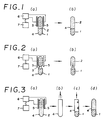
- Fig. 1 a-b, Fig. 2 a-b, and Fig. 3 a-d are diagrams illustrating typical methods for plasma initiated polymerization used for the preparation of an ultraviolet-absorbing macromolecular material of the present invention.
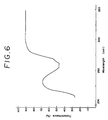
- Figs. 4 through 6 and Fig. 9 are ultraviolet absorption spectra of varying ultraviolet-absorbing macromolecular materials according with the present invention.
- Fig. 7 is an ultraviolet absorption spectrum of polymethyl methacrylate.
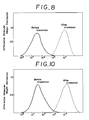
- Fig. 8 and Fig. 10 are charts showing elution patterns of the gel permeation chromatography obtained before and after the irradiation of a ultraviolet-absorbing macromolecular material of the present invention with an excimer laser.
- the ultraviolet-absorbing macromolecular material of the present invention is produced by copolymerizing a methacrylic ester monomer with other vinyl monomer possessing a chromophoric group exhibiting in the ultraviolet light wavelength region thereof an absorption peak different from the absorption peak of the methacrylic ester.
- the ultraviolet-absorbing macromolecular material therefore, enjoys the high resolution inherent in the polymethacrylic ester in combination with the fact that the enhanced ultraviolet absorption characteristic is unusually stable because the action of photosensitization is effected by the other monomer incorporated in the copolymer.
- the copolymer incorporates therein a compound possessing a chromophoric group exhibiting an absorption peak near 249 nm, for example, as the other vinyl monomer
- the copolymer is allowed to have the initial absorbency index thereof to the light of a wavelength near 249 nm shifted to an extremely high level. Consequently, it exhibits a high etching efficiency stably when it is utilized as a photoresist using the KrF laser as the light source.
- the ultraviolet-absorbing macromolecular material of this invention is a copolymer of a methacrylic ester monomer and other vinyl monomer possessing a chromophoric group exhibiting in the ultraviolet light wavelength region an absorption peak different from the absorption peak of the aforementioned methacrylic ester as described above.
- This copolymer possesses a composition such that the content of the aforementioned other monomer by molar ratio relative to the methacrylic ester monomer falls in the range of 10 : 1 to 103 : 1, more desirably 10 : 1 to 102 : 1.
- the content of the aforementioned other monomer by molar ratio is less than 103 : 1, no sufficient enhancement of the absorption characteristic is attained by the produced ultraviolet-absorbing macromolecular material. Conversely if this content in molar ratio exceeds 10 : 1, there is the possibility that the highly desirable properties including resolution and thermal stability possessed by polymethyl methacrylate will be degraded.
- the aforementioned range of the content of the aforementioned other vinyl monomer is important.
- the limiting viscosity number, ⁇ of the aforementioned copolymer is in the range of 1 x 10² to 4 x 10³, preferably 2 x 10² to 4 x 10³.
- the ultraviolet-absorbing macromolecular material of the present invention When the ultraviolet-absorbing macromolecular material of the present invention is made of such a macromolecular substance as described above, it automatically possesses the C-H bond of the main chain in high density. When it is used as a photoresist, for example, it exhibits further enhanced resolution because the severance of the C-H bond by the absorption energy occurs efficiently in the portion exposed to the ultraviolet light. Moreover, since the ultraviolet-absorbing macromolecular material is sufficiently resistant to heat, it can be safely treated at a very high baking temperature.
- the methacrylic ester to be used as one of the components of the copolymer is a methacrylic ester whose ester group is an alkyl group of 1 to 4 carbon atoms.
- the methacrylic ester are methyl methacrylate, ethyl methacrylate, n-propyl methacrylate, isopropyl methacrylate, and n-butyl methacrylate.
- methacrylic ester cited above methyl methacryalte proves to be particularly desirable.
- the other vinyl monomers used in the present invention possess a chromophoric group exhibiting in the ultraviolet light wavelength region an absorption peak different from the absorption peak of the methacrylic ester.
- a compound which has coupled to a vinyl group a chromophoric group possessing an absorption peak near 249 nm can be used.
- the following vinyl monomers are used: vinyl biphenyl, vinyl pyridine, vinyl naphthalene, and N-vinyl carbazole.
- the ultraviolet-absorbing macromolecular material of the present invention can be prepared easily in a high yield by the plasma initiated polymerization method using a radical polymerization initiator, which method comprises preparing a gaseous phase containing the monomers in vaporized form and permitting the presence of a radical polymerization initiator, irradiating the gaseous phase with plasma, inducting the polymerization initiation active seed generated in consequence of the plasma irradiation into the condensate phase of the monomers, thereby effecting the chain-growth polymerization of the monomers.
- a radical polymerization initiator which method comprises preparing a gaseous phase containing the monomers in vaporized form and permitting the presence of a radical polymerization initiator, irradiating the gaseous phase with plasma, inducting the polymerization initiation active seed generated in consequence of the plasma irradiation into the condensate phase of the monomers, thereby effecting the chain-growth polymerization of the monomers.
- the gaseous phase used in the polymerization method described above does not always require presence of all the monomers which are essential components of the copolymer, therefore, for example, only one of the monomers for the copolymer may be present in, so long as all the monomers exsist on the post-polymerization which is performed after the irradiation of the gaseous phase with the plasma.
- the presence of an alcohol in the condensate phase which is undergoing the post-polymerization contributes to shortening the time required for polymerization and further enhancing the yield of polymerization (Japanese Patent Laid-Open SHO 60(1985)-224,892).
- the amount of the aforementioned other vinyl monomer to be used in the copolymerization relative to the methacrylic ester monomer is fixed based on the composition of the copolymer desired to be obtained.
- the content of the other vinyl monomer by molar ratio relative to the methacrylic ester monomer, the methacrylic ester monomer: the other vinyl monomer is in the range of 10 : 1 to 103 : 1.
- the aforementioned other monomer component is not always required to be a sole compound but may be mixture of two or more compounds.
- radical polymerization initiator there can be used any of the conventional radical polymerization initiators which are available for the radical polymerization of monomers.
- the radical polymerization initiator are such low-temperature active radical polymerization initiators as peroxides represented by acetylcyclohexyl sulfonyl peroxide, isobutyryl peroxide, cumyl-peroxy neodecanoate, diisopropyl-peroxy dicarbonate, di-n-propyl-peroxy dicarbonate, dicyclohexyl-peroxy dicarbonate, dimylistyl-peroxy dicarbonate, di-(2-ethoxyethyl)-peroxy dicarbonate, di-(methoxyisopropyl) -peroxy-dicarbonate, di-(2-ethylhexyl)-peroxy dicarbonate, di-(3-methyl-3-methoxybutyl)-per
- the low-temperature active radical polymerizaiton initiators require decomposition temperatures of not more than 50°C in obtaining a half-life of 10 hours, whereas the high-temperature active radical polymerizaiton initiators require decomposition temperatures approximately in the range of 60° to 220°C in obtaining the half-life of 10 hours.
- the amount of the radical polymerization initiator to be added to the monomers depends heavily on the polymerizaiton degree of the polymer to be obtained and on the kinds of the monomers and the radical polymerization initiator to be used. Thus, it cannot be generally defined.
- the addition of the radical polymerization initiator in an unduly large amount proves to be undesirable because the radical polymerization initiator is not completely spent out during the course of the polymerization but suffered to remain in the produced polymer.
- benzoyl peroxide BPO
- AIBN azobis-isobutyronitrile
- the plasma to be used in the aforementioned plasma-initiated polymerization method is nonequilibrium plasma, particularly a low-temperature plasma by glow discharge.
- This low-temperature plasma is obtained by applying a power in the range of 20 to 100 W, preferably 30 to 50 W, upon a gas held under a vacuum as in the range of 0.1 to 10 mmHg.
- the electrodes to be used for the generation of this plasma are externally or internally parallel planar electrodes or coil electrodes for example. Preferably, they are externally parallel planar electrodes.
- Any gas may be used as the source for plasma generation. Examples of the gas include hydrogen, methane, nitrogen, argon, and ethylene.
- the monomers in the gaseous form may be used when desired.
- the condensate phase 1 of monomer and the gaseous phase 2 of monomer are held in an equilibrium state within a container 4 without being separated from each other as with a partition.
- the gaseous phase 2 is irradiated with the plasma, it gives rise to a polymerization active seed.
- this active seed comes into contact with the surface of the solid phase, the post-polymerization is initiated.
- the plasma-initiated polymerization method can be otherwise carried out, as illustrated in Fig.
- the material of the plasma reaction vessel 4 used for the polymerization is desired to be glass such as quartz glass or Pyrex glass to permit the surface thereof to be coated effectively with the aforementioned extremely thin layer of the macromolecular substance.
- Use of Pyrex glass proves to be particularly desirable.
- the reference numeral 5 denots an electrode
- the reference numeral 6 an RF oscillator
- the reference numeral 7 a control unit
- the irradiation of the gaseous phase 2 with the plasma is carried out at a temperature at which the monomers in vaporized form can exist in the gaseous phase 2 held in a vacuum. Generally, this temperature falls in the neighborhood of room temperature.
- the time of irradiation is not specifically limited. For effective formation of the polymerization active seed, however, the irradiation time may be short, generally falling in the range of several seconds to several minutes.
- the post-polymerization in the condensate phase 1 is carried out in the neighborhood of room temperature. This temperature, however, hinges more or less on the kind of the radical polymerization initiator, for example.
- Such a low temperature as described above is desirable because the post-polymerization, when carried out at an unduly high temperature, proceeds after the pattern of thermal polymerization and consequently gives rise to a polymer of low polymerization degree.
- An unduly low temperature proves to be undesirable because the polymerization possibly fails to proceed smoothly.
- the post-polymerization in the solid phase proceeds sufficiently even in such a low temperature range as 0° to -20°C, in which the post-polymerization would be hardly carried out by the conventional plasma-initiated polymerizaiton method.
- the adjustment of the polymerization degree of the polymer obtained by the plasma-initiated polymerization method can be attained by allowing the polymerization active seed which is obtained by the plasma irradiation to be generated in a theoretical amount.
- alcohols of 1 to 10 carbon atoms such as methanol, ethanol, n-propanol, isopropanol, n-butanol, sec-butanol, n-amyl alcohol, isoamyl alcohol, hexanol, heptanol, octanol, capryl alcohol, nonyl alcohol, and decyl alcohol.
- lower alcohols particularly methanol, prove to be desirable.
- this alcohol may or may not be present in the gaseous phase.
- the ultraviolet-absorbing macromolecular material of the present invention obtained as described above possesses highly desirably ultraviolet absorption characteristic, it can be used advantageously as photoresists and various forms of resists in the production of printing plates; shadow masks in color TV cathode ray tubes, printed circuit boards, IC, LSI or ultra LSI's circuits, circuits LP records, master video discs, metal filters, and electronic razor blades in the electronic industry; master discs for nitric acid etching in the glass and ceramic industry; part circuits for watches and cameras in the precision machinery industry; and holographic gratings for laser holograms.
- the source of light for irradiation of the ultraviolet-absorbing macromolecular material of the present invention the light of wavelength of not more than 350 nm, preferably an excimer laser, can be used.
- the excimer laser is desired to be KrF laser (249nm), or KrCl (222 nm), ArF (193 nm), ArCl (175 nm), or F2 (157 nm) laser, being in shorter wavelength resion than KrF.
- the aforementioned other monomer is a vinyl monomer such as vinyl biphenyl, vinyl pyridine, vinyl naphthalene, or N-vinyl carbazole which possesses an aromatic ring or a heterocyclic aromatic ring as a chromophoric group exhibiting an absorption peak near 249 nm
- the excimer laser (KrF) because ultraviolet-absorbing macromolecular material exhibits a low transmittance, preferably a transmittance of not more than 10%, to the light of wavelength near 249 nm.
- the ultraviolet-absorbing macromolecular material can be offered as a resist featuring high resolution and high etching efficiency.
- a high-resolution resist can be advantageously formed by causing the ultraviolet-absorbing macromolecular material to be applied by the spin coat technique in a thickness of not more than 1 ⁇ m, preferably not more than 0.3 ⁇ m, on a substrate such as a wafer of silicone or a mixture using silicone as one component, or a quartz sheet. Even when the ultraviolet-absorbing macromolecular material of this invention is applied in a thickness of not more than 1 ⁇ m, the coating consequently obtained is free from such defects as pinholes because it is made of a macromolecular substance.
- the resist which is obtained as described above can be thoroughly etched by one to several irradiations with the excimer laser.
- a polymerization tube (42 ml in volume) of Pyrex glass having an inside diameter of 15 mm was charged with 5.34 ml (5.00 x 10 ⁇ 2 mol) of methyl methacrylate (MMA), 0.90 g (5.00 x 10 ⁇ 3 mol) of 4-vinyl biphenyl, and 0.005 g (4.13 x 10 ⁇ 3 mol/l) of benzoyl peroxide (BPO), connected to a vacuum line, and then frozen with liquefied nitrogen.
- This polymerization system was evacuated to as level below 10 ⁇ 3 Torr for thorough expulsion of oxygen and heated to remelt the contents thereof. This procedure was repeated three times.
- the monomers in the polymerization tube were thoroughly cooled and frozen again with liquefied nitrogen.
- plasma was generated in the gaseous phase.
- the electrodes used for the plasma generation were parallel planar electrodes 15.0 x 10.0 cm2 in surface area made of copper and separated by a distance of 18 mm.
- a power of 50 W fed out from a radio wave (RF) generator provided with a control unit capable of 13.56 MHz was applied.
- the irradiation with the plasma was continued for 60 seconds.
- the polymerization tube was sealed and left standing at rest at 25°C for 5 days for post-polymerization.
- the polymerization product consequently obtained was purified by being dissolved in 30 ml of benzene and reprecipitated in 1.0 liter of methanol, and then filtered.
- the polymerization product was vacuum dried at 80°C to produced white fibers of polymer.
- the weight of the polymer was 0.88 g and the yield thereof 15.8% by weight.
- the melting point of this polymer was 235.5° to 240.0°C.
- the limiting viscosity number of this polymer measured in benzene at 30°C was 1.65 x 10².
- the polymer was dissolved in a concentration of 1 w/v % in chloroform, the resultant solution was cast on a Teflon plate to produce a film 3 ⁇ m in thickness, and the film was treated to obtain an ultraviolet absorption spectrum.
- the results are shown in Fig. 4.
- the copolymer was dissolved in a concentration of 1% by weight in methyl isobutyl ketone and the resultant solution was applied on a quartz plate (2 cm x 2cm) in such an amount that, after baking at 170°C for 30 minutes, there was formed a film about 1 ⁇ m in thickness.
- a copolymer 0.18 g in amount was obtained in a yield of 15.2% by repeating the procedure of Example 1, except that the molar ratio of methyl methacrylate monomer to 4-vinyl biphenyl was changed to 30 : 1.
- the limiting viscosity number, ⁇ of this polymer was 3.561 x 10² and the viscosity average molecular weight thereof was about 2.305 x 10⁶.
- the transmittance thereof on the short wavelength side below 300 nm was found to be nearly 0%, indicating the copolymer to be a material highly capable of absorbing ultraviolet light.
- the copolymer When at film of this copolymer was irradiated with the same KrF laser as in Example 1, it could be etched with 1 pulse.
- Copolymers were obtained by repeating the procedure of Example 1, except that the molar ratio of methyl methacrylate monomer to 4-vinyl biphenyl was varied as shown in Table 2. When the copolymers were tested for absorption characteristic at 249 nm, the results were as shown in Table 2. When films of the copolymers were irradiated with the same KrF laser as in Example 1, they could not attain non-developed etching unless the irradiation was made with at least 10 pulses (dosage 1,000 mJ/cm2).
- a white polymer was obtained by polymerization following the procedure of Example 1, except that 0.97 g (5.0 x 10 ⁇ 3 mol) of N-vinyl carbazole was used in the place of 4- vinyl biphenyl.
- the polymer was 4.61 g in amount and the yield of this product was 76.2% by weight.
- the melting point of this polymer was 275.5° to 295.5°C and the limiting viscosity number, ⁇ , thereof, measured in the same manner as in Example 1, was 5.28 x 10².
- the ultraviolet absorption spectrum of this polymer was examined in the same way as in Example 1, the transmittance thereof on the short wavelength side below 300 nm was nearly 0 as shown in Fig. 5, indicating the polymer to be a material highly capable of absorbing ultraviolet light.
- a yellow rubbery polymer was obtained by polymerization following the procedure of Example 1, except that 0.54 ml of 2-vinyl pyridine was used in the place of 4-vinyl biphenyl.
- the weight of the polymer was 0.33 g and the yield of the product was 6.0% by weight.
- the melting point of this polymer was 168.5° to 193.5°C and the limiting viscosity number, ⁇ , thereof as measured in the same manner as in Example 1 was 9.95 x 101.
- the ultraviolet absorption spectrum of this polymer was examined in the same way as in Example 1, the transmittance thereof near 249 nm was nearly 0% as shown in Fig. 6.
- a polymerization tube (42 ml in inner volume) of Pyrex glass having an inside diameter of 15 mm was charged with 10.68 ml (1.00 x 10 ⁇ 1 mol) of methyl methacrylate, 0.30 g (1.66 x 10 ⁇ 3 mol) of 4-vinyl biphenyl, and 0.011 g (4.13 x 10 ⁇ 3 mol/ l ) of benzoyl peroxide, connected to a vacuum line, and frozen with liquefied nitrogen.
- This polymerization system was evacuated to a level of not more than 10 ⁇ 3 Torr for thorough expulsion of oxygen and left warming to remelt the contents thereof. This procedure was repeated three the contents thereof. This procedure was repeated three times.
- the monomers in the polymerization tube was thoroughly cooled and frozen again wtih liquefied nitrogen.
- a plasma was generated in the gaseous phase.
- the electrodes used for the plasma generation were parallel planar electrodes 15.0 cm x 10.0 cm in area made of copper and separated by a distance of 18 mm. On these electrodes was applied a power of 50 W fed out from a radio wave generator (RF) provided with a control unit of 13.56 MHz.
- RF radio wave generator
- the polymerization tube was sealed and left standing at rest at 25°C for 5 days to effect post-polymerization of the contents thereof.
- the polymerization product consequently obtained was purified by being dissolved in 1.0 liter of benzene, reprecipitated in 20.0 liters of methanol, and filtered.
- the purified polymerization product was vacuum dried at 80°C to produce white polymer fibers.
- the weight of the produced polymer was 8.02 g and the yield of the product was 78.3 % by weight.
- the melting point of this polymer was 259.5° to 264.8°C.
- the limiting viscosity number, ⁇ of the polymer measured in benzene at 30°C was 9.52 x 10².
- the polymer was found to be a copolymer composed of 99.72 mol% of methyl methacrylate and 0.28 mol% of 4-vinylbiphenyl fluoride.
- the polymer was dissolved in a concentration of 1% by weight in methyl isobutyl ketone.
- the resultant solution was applied with a spin coater (produced by Mikasa Co., Ltd. and marketed under trademark designation of "Spinner Model IH-D2")in a thickness of 300 nm on a silicon wafer 4 inches in diameter and baked at 170°C for 30 minutes.
- a spin coater produced by Mikasa Co., Ltd. and marketed under trademark designation of "Spinner Model IH-D2"
- the entire surface of the silicon wafer coated with a the film of the copolymer was irradiated 11 times with a KrF (249 nm) laser (an interferential KrF laser beam [90 mJ/cm2], with the diverging angle of beam fixed at 0.4 Mrad) generated with a laser system (produced by Tachsto Laser Systems Inc., and marketed under product code of "SOlXR") and projected through a slit (1.0 mm in width).
- SOlXR product code of
- the gel permeation chromatography was carried out by an apparatus combining a chromatogram (produced by Nippon Bunko Co., Ltd. and marketed under trademark designation of "TRIROTAR VI") with columns (produced by Toyo Soda Mfg Co., Ltd. and marketed under product codes of "G700HXL” and "GMH6"). The results are shown in Table 3 and Fig. 8.
- the molecular weight (weight average molecular weight 6.45 x 10⁶) before the irradiation with the excimer laser markedly fell to a weight average molecular weight of 1.50 x 10⁴ in consequence of the irradiation, evincing that the irradiation with the excimer induced decomposition of the polymer and suggesting usefulness of the film as a positive type resist.
- the molecular weight (before the irradiation with the laser) fell in proportion as the baking temperature rose from 90° to 230°C.
- the developing time was not found to vary with the baking temperature. It was consequently confirmed that the desirability of the contrast of developed image increased with the increasing baking temperature.
- Polymerization was carried out by following the procedure of Example 5, except that a polymerization tube (42 ml in inner volume) of Pyrex glass having an inside diameter of 15 mm was charged with 2.67 ml (2.50 x 10 ⁇ 2 mol) of methyl methacrylate (MMA), 0.064 g (4.17 x 10 ⁇ 4 mol) of 2-vinyl naphthalene, and 0.003 g (4.13 x 10 ⁇ 3 mol ) of benzoyl peroxide (BPO). The weight of the produced polymer was 2.05 g and the yield of this product was 79.7% by weight.
- MMA methyl methacrylate
- BPO benzoyl peroxide
- the melting point of this polymer was 259.5° to 265.5°C and the limiting viscosity number, ⁇ , of the polymer measured in benzene at 30°C was 5.97 x 10².
- a resist was produced from the polymer in the same manner as in Example 5.
- the ultraviolet absorption spectrum of this resist is shown in Fig. 9.
- the resist was tested for average molecular weight and molecular weight distribution by the gel permeation chromatography before and after the irradiation with the KrF laser. The results are shown in Table 3 and Fig. 10.
- the resolution was not more than 0.5 ⁇ m of minimum line width.
- the molecular weight (weight average molecualr weight of 4.23 x 10⁶) of the resist before the irradiation with the excimer laser markedly fell to a weight average molecular weight of 1.40 x 10⁴ in consequence of the irradiation, indicating that the irradiation with the excimer laser induced decomposition of the polymer and suggesting usefulness of the polymer as a positive resist similarly to the polymer Example 5.
- this invention is directed to a ultraviolet-absorbing macromolecular material which is made of a copolymer of a methacrylic ester monomer and other vinyl monomer possessing a chromophoric group exhibiting in the ultraviolet light wavelength region an absorption peak different from the absorption peak of the methacrylic ester, and possessing such an extremely large molecular weight that the limiting viscosity number, ⁇ , of the aforementioned copolymer falls in the rane of 1 x 10² to 4 x 10³ (molecular weight 4.33 x 10⁵ to 5.56 x 10⁷).
- the ultraviolet-absorbing macromolecular material therefore, possess highly desirable ultraviolet absorption characteristic, namely extremely low transmittacne to the ultraviolet light, and at the same time enjoys the outstanding resolution inherent in the polymethacrylate. It, therefore, can be utilized advantageously as various forms of resists operable with the light of near-ultraviolet or ultraviolet region and is capable of contributing greatly to a wide variety of industrial activities, represented by the printing plate industry, electronic industry, glass and ceramic industry, and precision machinery industry. Further it acquires desirable resolution and high resistance to heat and, therefore, makes a highly desirable resist.
- the ultraviolet-absorbing macromolecular material of this invention is produced by using as the methacrylic ester component a methacrylic ester whose ester group is an alkyl group of 1 to 4 carbon atoms, preferably methyl methacrylate and the other vinyl monomer component is a vinyl monomer possessing a chromophoric group exhibiting an absorption peak near 249 nm, selected from the group consisting of vinyl biphenyl, vinyl pyridine, vinyl naphthalene, and N-vinyl carbazole, it acquires extremely high absorbency index or extremely low transmittance with respect to the light of wavelength near 249 nm.
- this ultraviolet-absorbing macromolecular material is used as a resist destined to be operated with the KrF laser, an excimer laser, as the light source, it is enabled to acquire highly desirable resolution and exhibit high etching efficiency stably.
Landscapes
- Physics & Mathematics (AREA)
- Chemical & Material Sciences (AREA)
- General Physics & Mathematics (AREA)
- Spectroscopy & Molecular Physics (AREA)
- Chemical Kinetics & Catalysis (AREA)
- Engineering & Computer Science (AREA)
- Materials Engineering (AREA)
- Health & Medical Sciences (AREA)
- Medicinal Chemistry (AREA)
- Polymers & Plastics (AREA)
- Organic Chemistry (AREA)
- Addition Polymer Or Copolymer, Post-Treatments, Or Chemical Modifications (AREA)
Abstract
Claims (7)
- Matériau macromoléculaire absorbant les ultraviolets, comprenant:(a) un copolymère d'un ester méthacrylique du type méthacrylate d'alkyle à 1 à 4 atomes de carbone, et(b) un autre monomère vinylique choisi dans le groupe constitué du vinylbiphényle, de la vinylpyridine, du vinylnaphtalène, du N-vinyl carbazole et de leurs mélanges, possédant un groupe chromophore donnant lieu, dans le domaine des ultraviolets de faible longueur d'onde, à un pic d'absorption différent du pic d'absorption dudit ester méthacrylique, l'indice limite de viscosité dudit copolymère étant dans le domaine compris entre 1.10² et 4.10³ dl/g,dans lequel la quantité dudit autre monomère vinylique en rapport molaire par rapport audit monomère ester méthacrylique, est compris entre 1/10 et 1/10³.
- Matériau macromoléculaire absorbant les ultraviolets selon la revendication 1, où ledit ester méthacrylique est le méthacrylate de méthyle.
- Matériau macromoléculaire absorbant les ultraviolets selon la revendication 1, pour lequel le pic d'absorption du groupe chromophore dudit autre monomère vinylique se situe à proximité de 249 nm.
- Matériau macromoléculaire absorbant les ultraviolets selon la revendication 1, dans lequel la transmittance relative à la lumière de longueur d'onde proche de 249 nm ne dépasse pas 10%.
- Matériau macromoléculaire absorbant les ultraviolets selon la revendication 1, où ledit copolymère est synthétisé par polymérisation amorcée par plasma avec l'aide d'amorceurs de polymérisation.
- Photoresist formé à partir du matériau macromoléculaire absorbant les ultraviolets, selon la revendication 1.
- Photoresist selon la revendication 6, dans lequel un laser à excimère est utilisé comme source d'exposition.
Applications Claiming Priority (6)
| Application Number | Priority Date | Filing Date | Title |
|---|---|---|---|
| JP291475/86 | 1986-12-09 | ||
| JP29147586 | 1986-12-09 | ||
| JP1993887 | 1987-01-30 | ||
| JP19938/87 | 1987-01-30 | ||
| JP211957/87 | 1987-08-26 | ||
| JP21195787A JPS63314218A (ja) | 1986-12-09 | 1987-08-26 | 紫外線吸収高分子材料 |
Publications (3)
| Publication Number | Publication Date |
|---|---|
| EP0343246A1 EP0343246A1 (fr) | 1989-11-29 |
| EP0343246A4 EP0343246A4 (fr) | 1990-05-14 |
| EP0343246B1 true EP0343246B1 (fr) | 1994-02-09 |
Family
ID=27282826
Family Applications (1)
| Application Number | Title | Priority Date | Filing Date |
|---|---|---|---|
| EP19880900085 Expired - Lifetime EP0343246B1 (fr) | 1986-12-09 | 1988-06-21 | Materiau polymere absorbant les rayons ultraviolets |
Country Status (3)
| Country | Link |
|---|---|
| EP (1) | EP0343246B1 (fr) |
| DE (1) | DE3789061T2 (fr) |
| WO (1) | WO1988004306A1 (fr) |
Families Citing this family (4)
| Publication number | Priority date | Publication date | Assignee | Title |
|---|---|---|---|---|
| US4961167A (en) * | 1988-08-26 | 1990-10-02 | Mitsubishi Denki Kabushiki Kaisha | Substrate bias generator in a dynamic random access memory with auto/self refresh functions and a method of generating a substrate bias therein |
| JP2729850B2 (ja) * | 1990-05-15 | 1998-03-18 | 富士写真フイルム株式会社 | 画像形成層 |
| JP5544239B2 (ja) | 2010-07-29 | 2014-07-09 | 富士フイルム株式会社 | 重合性組成物 |
| CN110003377B (zh) * | 2019-03-20 | 2021-01-12 | 深圳大学 | 聚合物及其制备方法及应用 |
Family Cites Families (8)
| Publication number | Priority date | Publication date | Assignee | Title |
|---|---|---|---|---|
| JPS51851B1 (fr) * | 1970-03-09 | 1976-01-12 | ||
| US4380643A (en) * | 1981-08-24 | 1983-04-19 | Asahi Glass Company, Ltd. | Benzotriazole compound and homopolymer or copolymers thereof |
| JPS58111942A (ja) * | 1981-12-25 | 1983-07-04 | Fuji Photo Film Co Ltd | ハロゲン化銀写真感光材料 |
| JPS58163617A (ja) * | 1982-03-24 | 1983-09-28 | Fukui Kikai Kk | 樹脂成形用プレス |
| JPS58178351A (ja) * | 1982-04-14 | 1983-10-19 | Fuji Photo Film Co Ltd | ハロゲン化銀写真感光材料 |
| DE3312611A1 (de) * | 1983-04-08 | 1984-10-11 | Röhm GmbH, 6100 Darmstadt | Verfahren zur herstellung uv-geschuetzter mehrschichtiger kunststoff-formkoerper |
| NZ208751A (en) * | 1983-07-11 | 1987-04-30 | Iolab Corp | 2-hydroxy-5-acrylyloxyalkylphenyl-2h-benzotriazole derivatives and polymers and copolymers thereof and use as uv absorbing additives in polymer compositions |
| GB8501563D0 (en) * | 1985-01-22 | 1985-02-20 | Kodak Ltd | Uv-absorbing polymers |
-
1987
- 1987-12-09 DE DE3789061T patent/DE3789061T2/de not_active Expired - Fee Related
- 1987-12-09 WO PCT/JP1987/000954 patent/WO1988004306A1/fr not_active Ceased
-
1988
- 1988-06-21 EP EP19880900085 patent/EP0343246B1/fr not_active Expired - Lifetime
Also Published As
| Publication number | Publication date |
|---|---|
| DE3789061T2 (de) | 1994-06-09 |
| WO1988004306A1 (fr) | 1988-06-16 |
| EP0343246A4 (fr) | 1990-05-14 |
| EP0343246A1 (fr) | 1989-11-29 |
| DE3789061D1 (de) | 1994-03-24 |
Similar Documents
| Publication | Publication Date | Title |
|---|---|---|
| US4789622A (en) | Production of resist images, and a suitable dry film resist | |
| KR960006164B1 (ko) | 광중합성 혼합물 및 이로부터 제조된 기록재료 | |
| US5157091A (en) | Ultraviolet-absorbing polymer material and photoetching process | |
| US4914004A (en) | Two-layer system | |
| US4604294A (en) | Process for forming an organic thin film | |
| US4267258A (en) | Negative type deep ultraviolet resist | |
| EP0343246A1 (fr) | Materiau polymere absorbant les rayons ultraviolets | |
| JPH0149935B2 (fr) | ||
| JPS63156812A (ja) | o−ニトロカルビノールエステル基を有する共重合体及びその製造方法 | |
| US5017458A (en) | Method for production of graft copolymer, pattern replication method, and base polymer and resist for graft copolymerization | |
| US3429795A (en) | Photopolymerisation of ethylenically unsaturated organic compounds using a carboxylic dithiocarbamic anhydride as a photoinitiator | |
| US4640960A (en) | Degradation of poly(diacetylenes) | |
| JPS58192035A (ja) | ネガテイブ型レジストとして有用な重合体組成物の製造方法 | |
| US4551414A (en) | Positive resist material | |
| US3563741A (en) | Photopolymerisation of ethylenically unsaturated organic compounds | |
| Suyama et al. | Curing systems using photolysis of carbamoyloxyimino groups and thermally regenerated isocyanate groups | |
| JPH0772798B2 (ja) | 基板上のパターン形成方法 | |
| US4243742A (en) | Radiation-sensitive positively acting materials | |
| US4656119A (en) | Method of manufacturing X-ray resist | |
| JPS6076740A (ja) | 可視光感光性樹脂組成物 | |
| JPS60263142A (ja) | 光重合可能な組成物 | |
| JPS59197036A (ja) | パタ−ン形成用材料 | |
| JPS63314218A (ja) | 紫外線吸収高分子材料 | |
| JPS60252348A (ja) | パタ−ン形成方法 | |
| Suyama et al. | Effective utilization of 366 nm-light in photo-generation of pendant amino groups using pendant thioxanthone groups |
Legal Events
| Date | Code | Title | Description |
|---|---|---|---|
| PUAI | Public reference made under article 153(3) epc to a published international application that has entered the european phase |
Free format text: ORIGINAL CODE: 0009012 |
|
| 17P | Request for examination filed |
Effective date: 19890608 |
|
| AK | Designated contracting states |
Kind code of ref document: A1 Designated state(s): BE DE FR GB IT NL SE |
|
| A4 | Supplementary search report drawn up and despatched |
Effective date: 19900514 |
|
| 17Q | First examination report despatched |
Effective date: 19910814 |
|
| RBV | Designated contracting states (corrected) |
Designated state(s): DE FR GB |
|
| GRAA | (expected) grant |
Free format text: ORIGINAL CODE: 0009210 |
|
| AK | Designated contracting states |
Kind code of ref document: B1 Designated state(s): DE FR GB |
|
| ET | Fr: translation filed | ||
| REF | Corresponds to: |
Ref document number: 3789061 Country of ref document: DE Date of ref document: 19940324 |
|
| PLBE | No opposition filed within time limit |
Free format text: ORIGINAL CODE: 0009261 |
|
| STAA | Information on the status of an ep patent application or granted ep patent |
Free format text: STATUS: NO OPPOSITION FILED WITHIN TIME LIMIT |
|
| 26N | No opposition filed | ||
| REG | Reference to a national code |
Ref country code: GB Ref legal event code: IF02 |
|
| PGFP | Annual fee paid to national office [announced via postgrant information from national office to epo] |
Ref country code: GB Payment date: 20021204 Year of fee payment: 16 |
|
| PGFP | Annual fee paid to national office [announced via postgrant information from national office to epo] |
Ref country code: FR Payment date: 20021210 Year of fee payment: 16 |
|
| PGFP | Annual fee paid to national office [announced via postgrant information from national office to epo] |
Ref country code: DE Payment date: 20021212 Year of fee payment: 16 |
|
| PG25 | Lapsed in a contracting state [announced via postgrant information from national office to epo] |
Ref country code: GB Free format text: LAPSE BECAUSE OF NON-PAYMENT OF DUE FEES Effective date: 20031209 |
|
| PG25 | Lapsed in a contracting state [announced via postgrant information from national office to epo] |
Ref country code: DE Free format text: LAPSE BECAUSE OF NON-PAYMENT OF DUE FEES Effective date: 20040701 |
|
| GBPC | Gb: european patent ceased through non-payment of renewal fee |
Effective date: 20031209 |
|
| PG25 | Lapsed in a contracting state [announced via postgrant information from national office to epo] |
Ref country code: FR Free format text: LAPSE BECAUSE OF NON-PAYMENT OF DUE FEES Effective date: 20040831 |
|
| REG | Reference to a national code |
Ref country code: FR Ref legal event code: ST |