EP0343603B1 - Réserve positive pour rayons électroniques hautement sensibles et de pouvoir résolvant élevé - Google Patents
Réserve positive pour rayons électroniques hautement sensibles et de pouvoir résolvant élevé Download PDFInfo
- Publication number
- EP0343603B1 EP0343603B1 EP89109284A EP89109284A EP0343603B1 EP 0343603 B1 EP0343603 B1 EP 0343603B1 EP 89109284 A EP89109284 A EP 89109284A EP 89109284 A EP89109284 A EP 89109284A EP 0343603 B1 EP0343603 B1 EP 0343603B1
- Authority
- EP
- European Patent Office
- Prior art keywords
- resist
- solvent
- positive
- electron
- formula
- Prior art date
- Legal status (The legal status is an assumption and is not a legal conclusion. Google has not performed a legal analysis and makes no representation as to the accuracy of the status listed.)
- Expired - Lifetime
Links
Classifications
-
- G—PHYSICS
- G03—PHOTOGRAPHY; CINEMATOGRAPHY; ANALOGOUS TECHNIQUES USING WAVES OTHER THAN OPTICAL WAVES; ELECTROGRAPHY; HOLOGRAPHY
- G03F—PHOTOMECHANICAL PRODUCTION OF TEXTURED OR PATTERNED SURFACES, e.g. FOR PRINTING, FOR PROCESSING OF SEMICONDUCTOR DEVICES; MATERIALS THEREFOR; ORIGINALS THEREFOR; APPARATUS SPECIALLY ADAPTED THEREFOR
- G03F7/00—Photomechanical, e.g. photolithographic, production of textured or patterned surfaces, e.g. printing surfaces; Materials therefor, e.g. comprising photoresists; Apparatus specially adapted therefor
- G03F7/004—Photosensitive materials
- G03F7/039—Macromolecular compounds which are photodegradable, e.g. positive electron resists
Definitions
- the present invention relates to a high-sensitivity, high-resolution positive-type electron-beam resist and a method of forming a pattern using the same and, more particularly, to formation of a resist pattern for the manufacture of a photomask in the semiconductor industry and for selective etching or selective diffusion in the manufacture of a semiconductor performed by direct drawing on a silicon wafer.
- a negative-type resist is high in sensitivity but low in resolution.
- a positive-type resist is high in resolution but low in sensitivity. Therefore, as a packing density of LSICs (Large Scaled Integrated Circuits) has increased, a positive-type resist has been increasingly used as compared with a negative-type resist.
- a known typical example of the positive-type electron-beam resist is poly(methyl methacrylate) (PMMA).
- PMMA poly(methyl methacrylate)
- the sensitivity of PMMA is as low as about 100 ⁇ C/cm2 at an accelerating voltage of 20 kV. For this reason, throughput of an electron-beam exposure apparatus becomes problematic, and therefore many studies have been made in order to increase the sensitivity.
- Proposed examples are poly(butene-1-sulfone), poly(trifluoroethyl-2-chloromethacrylate), poly(hexafluorobutylmethacrylate), poly(isopropenylketone), and a copolymer of methyl methacrylate and methacrylic acid.
- Sensitivity of some of these electron-beam resists is higher than that of PMMA.
- EP-A-0 007 976 a process for forming pattern on a positive-type electron-beam resist mainly consisting of a copolymer comprising ⁇ substituted acrylonitrile and cyclohexyl-2-cyanoacrylate as comonomers is disclosed.
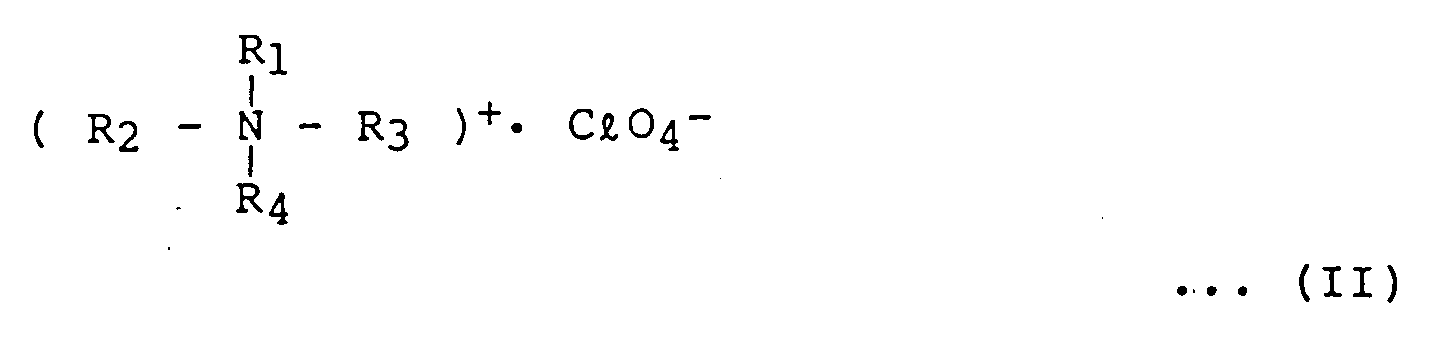
- a pattern formation method using the positive-type electron-beam resist of the present invention is characterized by using a solvent mixture of an organic solvent as a solvent of the resist and an organic solvent as a non-solvent of the resist as a developing solution in a development step in which an electron beam is selectively radiated to the positive-type electron-beam resist mainly consisting of formula (I) or (Ia) and (II), and a portion of the resist which is disintegrated into a compound of low molecular weight is selectively dissolved by a solvent, thereby obtaining a positive-type resist pattern.
- a positive-type electron-beam resist mainly consisting of a monopolymer or copolymer of cyclohexyl-2-cyanoacrylate represented by formula (I) and of 5 to 20 wt% of a quaternary ammonium perchlorate represented by formula (II) will be described below.
- the positive-type electron-beam resist mainly consisting of a cyclohexyl 2-cyanoacrylate polymer represented by: is prepared by anion-polymerizing or radical-polymerizing a cyclohexyl 2-cyanoacrylate monomer obtained by a conventional synthesizing method.
- a weight-average molecular weight of the positive-type electron-beam resist is 100,000 to 1,500,000 in terms of a coating property and sensitivity.
- a molecular weight distribution of the polymer preferably falls within a narrow range. This is a problem of a degree of dispersion of the molecular weight of the polymer.
- the degree of dispersion is defined by: When the value of the degree of dispersion is ideally one, this polymer is called a mono disperse polymer because molecular weights are uniform.
- the degree of dispersion of the polymer is preferably three or less in terms of high resolution and high contrast of a pattern. More preferably, the polymer is a mono disperse polymer having a degree of dispersion of practically two or less, and ideally, close to one.
- the polymer close to a mono disperse polymer is prepared by polymerizing a cyclohexyl 2-cyanoacrylate monomer singly or with a copolymerizable 2-cyanoacrylate by a low-temperature anion polymerization method. More specifically, a monomer to be monopolymerized or copolymerized is polymerized, while it is cooled to 20 to -120°C, in the presence of an anion polymerization initiator consisting of one or more weak anions such as an organic amine, an organic amide, a phosphine, a thiourea, a thiol alcohol, and an ether. Polymerization examples will be described below.
- polymerization may be performed in accordance with a radical polymerization degree.
- a molecular weight distribution of a prepared polymer tends to be widened.
- only a polymer having a molecular weight of a predetermined range can be extracted by classification.
- a monopolymer or copolymer prepared by substituting an ester group of cyanoacrylate with a cyclohexyl group has high storage stability and a high heat resistance. These properties advantageously allow an electron-beam resist to become suitable for long-term storage and to have durability against a heat treatment such as burning.
- the following table shows comparison of properties between monopolymers in which a cyclohexyl group is substituted by a methy group or a propyl group.
- the sensitivity and resolution of the positive-type electron-beam resist are further improved by adding a strong electrolytic substance, the substance being quaternary ammonium perchlorate represented by formula (II): (wherein each of R1, R2, R3, and R4 independently represents an alkyl group having 1 to 20 carbon atoms).
- Quaternary ammonium perchlorate is added within the range of 5 to 20 wt% in consideration of the sensitivity and resolution, based on the amount of the cyclohexyl 2-cyanoacrylate polymer.
- Examples of an organic solvent of the cyclohexyl 2-cyanoacrylate polymer are acetone, methyl ethyl ketone, methyl isobutyl ketone, methyl isoamyl ketone, cyclohexanone, methyl acetate, ethyl acetate, propyl acetate, butyl acetate, amyl acetate, methyl cellosolve(2-methoxyethanol), methyl cellosolve acetate, ethyl cellosolve acetate, propyl cellosolve acetate, butyl cellosolve acetate, dimethyl cellosolve, diethyl cellosolve, methyl carbitol, ethyl carbitol, methyl carbitol acetate, ethyl carbitol acetate, N,N-demethylformamide, N,N-dimethylacetamide, dimethyl s
- a non-solvent of the polymer is mixed to suppress dissolution of an electron-beam non-radiated portion. If, however, a mixing ratio of the non-solvent is too large, the sensitivity is lowered.
- the non-solvent are methanol, ethanol, 2-propanol, butanol, ethyl cellosolve, butyl cellosolve, propyl cellosolve, hexane, cyclohexane, and naphtha.
- a volume ratio of the organic non-solvent generally falls within the range of 0.2 to 4 with respect to one volume of the organic solvent. Mixing of the organic non-solvent reduces dissolving power of a developing solution with respect to the resist. That is, by using a developing solution having properly adjusted dissolving power, a resist pattern can be developed with high precision.
- An example of the proper developing solution is a developing solution containing 2-methoxyethanol(methyl cellosolve) as an organic solvent, at least one of other solvents, and one or more non-solvents.
- 2-methoxyethanol is a developing solution which satisfies both the high sensitivity and resolution. If, however, only 2-methoxyethanol is used as the solvent, a formed resist pattern swells and peels because a developing time is too long. Therefore, in order to shorten the developing time, another solvent may be mixed. However, as a mixing ratio of the solvent other than 2-methoxyethanol is increased, the resolution is lowered. Therefore, it is preferred to minimize the mixing ratio of the additional solvent(s). Examples of the solvent other than 2-methoxyethanol are those enumerated above. In addition, one or more types of non-solvent may be selected from those enumerated above.
- the monopolymer or copolymer of cyclohexyl-2-cyanoacrylate contains a cyano group which is a strong electron attraction group, its straight-chain carbon-to-carbon bond is easily ruptured upon radiation of an electron beam. That is, this polymer can be easily converted to one having a low molecular weight and therefore can be considered to have high sensitivity. A low-molecular-weight portion is dissolved and removed by the developing solution consisting of organic solvents, thereby performing patterning.
- This positive-type electron-beam resist decomposes even when a radiation amount of the electron beam is small.
- the sensitivity of the resist falls within the range of 1 to 4 ⁇ C/cm2 and is high.
- a cyclohexyl group improves the storage stability and heat resistance. This results in improvements in a pot life and durability in a wafer process of the positive-type electron-beam resist.
- the resolution reaches 0.5 ⁇ m so that it can be used for manufacturing a 16-megabit DRAM.
- the durability with respect to the organic solvents (developing solution) is improved. Therefore, a degree of freedom of selection for the organic solvents for use in the developing solution is increased to widen a range of developing conditions.
- the sensitivity of this positive-type electron-beam resist is increased about three times.
- the resolution is increased by setting a molecular weight distribution of the polymer used in the positive-type electron-beam resist of the present invention in a narrow range, i.e., by decreasing the value of the degree of dispersion.
- the sensitivity and resolution of the positive-type electron-beam resist can be increased by arbitrarily selecting the developing conditions, especially, the developing solution.
- a 5-wt% cyclohexanone solution of a cyclohexyl 2-cyanoacrylate polymer having a molecular weight of 510,000 was prepared, and 10 wt% of tetra-n-butylammonium perchlorate were added to the polymer.
- a 4,300- ⁇ thick resist film was formed at 1,500 rpm by a spin coating method on a glass substrate on which chromium was deposited to a thickness of 1,000 ⁇ . After the resist film was heated at 120°C for 30 minutes, an electron beam was radiated with a radiation amount of 1 ⁇ C/cm2 and an acceleration voltage of 10 kV.
Landscapes
- Physics & Mathematics (AREA)
- Spectroscopy & Molecular Physics (AREA)
- General Physics & Mathematics (AREA)
- Electron Beam Exposure (AREA)
- Photosensitive Polymer And Photoresist Processing (AREA)
- Exposure And Positioning Against Photoresist Photosensitive Materials (AREA)
- Materials For Photolithography (AREA)
Claims (5)
- Réserve positive pour rayons électroniques constituée essentiellement d'un monopolymère de cyclohexyle-2-cyanoacrylate, ou d'un copolymère d'alkyle-2-cyanoacrylate et cyclohexyle-2-cyanoacrylate représenté par la formule (I) :

- Réserve selon la revendication 1, caractérisé en ce qu'une valeur d'un degré de dispersion (masse moléculaire en poids (
M w) / masse moléculaire en nombre (M n)) dudit monopolymère ou dudit copolymère n'excède pas trois. - Méthode de formation d'un motif de la réserve positive pour rayons électroniques selon la revendication 1 ou la revendication 2, comprenant les étapes consistant à irradier sélectivement un rayon électronique pour décomposer une portion de la réserve qui est irradiée, à l'aide du rayon électronique, en un composé de faible poids moléculaire, et à dissoudre la portion irradiée en utilisant, comme solution de développement, un solvant mixte comprenant un solvant organique et un non-solvant de ladite réserve positive pour rayons électroniques, pour ainsi obtenir un motif de réserve positive.
- Méthode selon la revendication 3, caractérisée en ce que ladite solution de développement est un mélange solvant d'au moins trois constituants dont le 2-méthoxyéthanole en tant que solvant organique en tant que solvant de la réserve au moins un parmi d'autres solvants organiques en tant que solvants de la réserve, et au moins un solvant organique en tant que non-solvant de la réserve.
- Méthode selon la revendication 3, caractérisée en ce que ladite solution de développement est un mélange solvant comportant le 2-méthoxyéthanole en tant que solvant de la réserve et le 2-alkoxyéthanole représenté par la formule (III) en tant que non-solvant de la réserve
R₅OCH₂CH₂OH
où R₅ représente un groupement alkyle ayant entre 2 et 4 atomes de carbone.
Applications Claiming Priority (8)
| Application Number | Priority Date | Filing Date | Title |
|---|---|---|---|
| JP12616488A JPH0328851A (ja) | 1988-05-24 | 1988-05-24 | 電子ビームレジストのパターン形成方法 |
| JP126164/88 | 1988-05-24 | ||
| JP63267507A JP2598492B2 (ja) | 1988-10-24 | 1988-10-24 | ポジ型電子線レジストパターンの形成方法 |
| JP267507/88 | 1988-10-24 | ||
| JP1085569A JP2525891B2 (ja) | 1989-04-03 | 1989-04-03 | ポジ型電子線レジストの現像方法 |
| JP85569/89 | 1989-04-03 | ||
| JP1087703A JPH0823697B2 (ja) | 1989-04-06 | 1989-04-06 | ポジ型電子線レジスト |
| JP87703/89 | 1989-04-06 |
Publications (3)
| Publication Number | Publication Date |
|---|---|
| EP0343603A2 EP0343603A2 (fr) | 1989-11-29 |
| EP0343603A3 EP0343603A3 (en) | 1990-08-22 |
| EP0343603B1 true EP0343603B1 (fr) | 1994-08-17 |
Family
ID=27467129
Family Applications (1)
| Application Number | Title | Priority Date | Filing Date |
|---|---|---|---|
| EP89109284A Expired - Lifetime EP0343603B1 (fr) | 1988-05-24 | 1989-05-23 | Réserve positive pour rayons électroniques hautement sensibles et de pouvoir résolvant élevé |
Country Status (3)
| Country | Link |
|---|---|
| EP (1) | EP0343603B1 (fr) |
| KR (1) | KR900018743A (fr) |
| DE (1) | DE68917521T2 (fr) |
Families Citing this family (2)
| Publication number | Priority date | Publication date | Assignee | Title |
|---|---|---|---|---|
| US7867688B2 (en) | 2006-05-30 | 2011-01-11 | Eastman Kodak Company | Laser ablation resist |
| US7745101B2 (en) | 2006-06-02 | 2010-06-29 | Eastman Kodak Company | Nanoparticle patterning process |
Family Cites Families (1)
| Publication number | Priority date | Publication date | Assignee | Title |
|---|---|---|---|---|
| AU4719279A (en) * | 1978-05-22 | 1979-11-29 | Western Electric Co. Inc. | Lithographic resist and device processing utilizing same |
-
1989
- 1989-05-22 KR KR1019890006845A patent/KR900018743A/ko not_active Ceased
- 1989-05-23 DE DE68917521T patent/DE68917521T2/de not_active Expired - Fee Related
- 1989-05-23 EP EP89109284A patent/EP0343603B1/fr not_active Expired - Lifetime
Also Published As
| Publication number | Publication date |
|---|---|
| EP0343603A2 (fr) | 1989-11-29 |
| DE68917521D1 (de) | 1994-09-22 |
| DE68917521T2 (de) | 1994-12-22 |
| EP0343603A3 (en) | 1990-08-22 |
| KR900018743A (ko) | 1990-12-22 |
Similar Documents
| Publication | Publication Date | Title |
|---|---|---|
| EP0090089B1 (fr) | Matériau pour photoréserve et procédé pour la formation d'un patron de réserve fin | |
| JP3341466B2 (ja) | ホトレジスト組成物 | |
| US5547812A (en) | Composition for eliminating microbridging in chemically amplified photoresists comprising a polymer blend of a poly(hydroxystyrene) and a copolymer made of hydroxystyrene and an acrylic monomer | |
| EP0240843B1 (fr) | Composition photosensible, son procédé de préparation et emploi | |
| EP0343603B1 (fr) | Réserve positive pour rayons électroniques hautement sensibles et de pouvoir résolvant élevé | |
| US5328973A (en) | Radiation-sensitive mixture with a polymeric binder containing units of α,β-unsaturated carboxamides | |
| KR100198408B1 (ko) | 레지스트 물질 및 그의 사용방법 | |
| KR20170120588A (ko) | 중합체 및 포지티브형 레지스트 조성물 | |
| EP0064864B1 (fr) | Procédé pour la fabrication de résistes positives sensibles aux rayons électroniques | |
| US4415653A (en) | Method of making sensitive positive electron beam resists | |
| US4414313A (en) | Sensitive positive electron beam resists | |
| US6749990B2 (en) | Chemical amplification photoresist monomers, polymers therefrom and photoresist compositions containing the same | |
| US4302529A (en) | Process for developing a positive electron resist | |
| US4614703A (en) | Negative photoresists of α-chlorovinyl methyl ketone copolymers | |
| JPH087443B2 (ja) | 高解像度ポジ型放射線感応性レジスト | |
| JP2600897B2 (ja) | ポジ型レジスト組成物およびパターン形成方法 | |
| US4279986A (en) | Negative resist and radical scavenger composition with capability of preventing post-irradiation polymerization | |
| WO2003098670A1 (fr) | Polymere absorbeur de lumiere pour la formation de couche organique antireflet, composition le comprenant, et procede de formation de configuration de dispositif a semi-conducteur utilisant un tel polymere | |
| US4962171A (en) | Blocked monomer and polymers therefrom for use as photoresists | |
| US5081001A (en) | Blocked monomer and polymers therefrom for use as photoresists | |
| JP2871010B2 (ja) | ポジ型電子線レジスト液 | |
| JPS6279446A (ja) | 架橋性共重合体および該共重合体よりなるポジ型レジスト | |
| US4885344A (en) | Polymeric materials and their use as resists | |
| JPH10307399A (ja) | レジスト用感光性樹脂組成物 | |
| KR100249312B1 (ko) | 반도체장치의 제조를 위한 포토레지스트 조성용 구조제 수지와 그 제조방법 및 그 구조제 수지를 포함하는 포토레지스트 조성물 |
Legal Events
| Date | Code | Title | Description |
|---|---|---|---|
| PUAI | Public reference made under article 153(3) epc to a published international application that has entered the european phase |
Free format text: ORIGINAL CODE: 0009012 |
|
| AK | Designated contracting states |
Kind code of ref document: A2 Designated state(s): DE NL |
|
| PUAL | Search report despatched |
Free format text: ORIGINAL CODE: 0009013 |
|
| AK | Designated contracting states |
Kind code of ref document: A3 Designated state(s): DE NL |
|
| 17P | Request for examination filed |
Effective date: 19901016 |
|
| 17Q | First examination report despatched |
Effective date: 19930108 |
|
| GRAA | (expected) grant |
Free format text: ORIGINAL CODE: 0009210 |
|
| AK | Designated contracting states |
Kind code of ref document: B1 Designated state(s): DE NL |
|
| REF | Corresponds to: |
Ref document number: 68917521 Country of ref document: DE Date of ref document: 19940922 |
|
| PLBE | No opposition filed within time limit |
Free format text: ORIGINAL CODE: 0009261 |
|
| STAA | Information on the status of an ep patent application or granted ep patent |
Free format text: STATUS: NO OPPOSITION FILED WITHIN TIME LIMIT |
|
| 26N | No opposition filed | ||
| PGFP | Annual fee paid to national office [announced via postgrant information from national office to epo] |
Ref country code: NL Payment date: 19970529 Year of fee payment: 9 |
|
| PGFP | Annual fee paid to national office [announced via postgrant information from national office to epo] |
Ref country code: DE Payment date: 19970530 Year of fee payment: 9 |
|
| PG25 | Lapsed in a contracting state [announced via postgrant information from national office to epo] |
Ref country code: NL Free format text: LAPSE BECAUSE OF NON-PAYMENT OF DUE FEES Effective date: 19981201 |
|
| NLV4 | Nl: lapsed or anulled due to non-payment of the annual fee |
Effective date: 19981201 |
|
| PG25 | Lapsed in a contracting state [announced via postgrant information from national office to epo] |
Ref country code: DE Free format text: LAPSE BECAUSE OF NON-PAYMENT OF DUE FEES Effective date: 19990302 |