EP0344113A2 - Substituierte alpha-Pyrone und Naphthochinone - Google Patents
Substituierte alpha-Pyrone und Naphthochinone Download PDFInfo
- Publication number
- EP0344113A2 EP0344113A2 EP89810368A EP89810368A EP0344113A2 EP 0344113 A2 EP0344113 A2 EP 0344113A2 EP 89810368 A EP89810368 A EP 89810368A EP 89810368 A EP89810368 A EP 89810368A EP 0344113 A2 EP0344113 A2 EP 0344113A2
- Authority
- EP
- European Patent Office
- Prior art keywords
- thio
- sulfonyl
- alkyl
- formula
- compounds
- Prior art date
- Legal status (The legal status is an assumption and is not a legal conclusion. Google has not performed a legal analysis and makes no representation as to the accuracy of the status listed.)
- Withdrawn
Links
- IFTRQJLVEBNKJK-UHFFFAOYSA-N CCC1CCCC1 Chemical compound CCC1CCCC1 IFTRQJLVEBNKJK-UHFFFAOYSA-N 0.000 description 1
Classifications
-
- B—PERFORMING OPERATIONS; TRANSPORTING
- B05—SPRAYING OR ATOMISING IN GENERAL; APPLYING FLUENT MATERIALS TO SURFACES, IN GENERAL
- B05D—PROCESSES FOR APPLYING FLUENT MATERIALS TO SURFACES, IN GENERAL
- B05D1/00—Processes for applying liquids or other fluent materials
- B05D1/18—Processes for applying liquids or other fluent materials performed by dipping
- B05D1/20—Processes for applying liquids or other fluent materials performed by dipping substances to be applied floating on a fluid
- B05D1/202—Langmuir Blodgett films (LB films)
-
- B—PERFORMING OPERATIONS; TRANSPORTING
- B82—NANOTECHNOLOGY
- B82Y—SPECIFIC USES OR APPLICATIONS OF NANOSTRUCTURES; MEASUREMENT OR ANALYSIS OF NANOSTRUCTURES; MANUFACTURE OR TREATMENT OF NANOSTRUCTURES
- B82Y30/00—Nanotechnology for materials or surface science, e.g. nanocomposites
-
- B—PERFORMING OPERATIONS; TRANSPORTING
- B82—NANOTECHNOLOGY
- B82Y—SPECIFIC USES OR APPLICATIONS OF NANOSTRUCTURES; MEASUREMENT OR ANALYSIS OF NANOSTRUCTURES; MANUFACTURE OR TREATMENT OF NANOSTRUCTURES
- B82Y40/00—Manufacture or treatment of nanostructures
-
- C—CHEMISTRY; METALLURGY
- C07—ORGANIC CHEMISTRY
- C07D—HETEROCYCLIC COMPOUNDS
- C07D309/00—Heterocyclic compounds containing six-membered rings having one oxygen atom as the only ring hetero atom, not condensed with other rings
- C07D309/34—Heterocyclic compounds containing six-membered rings having one oxygen atom as the only ring hetero atom, not condensed with other rings having three or more double bonds between ring members or between ring members and non-ring members
- C07D309/36—Heterocyclic compounds containing six-membered rings having one oxygen atom as the only ring hetero atom, not condensed with other rings having three or more double bonds between ring members or between ring members and non-ring members with oxygen atoms directly attached to ring carbon atoms
- C07D309/38—Heterocyclic compounds containing six-membered rings having one oxygen atom as the only ring hetero atom, not condensed with other rings having three or more double bonds between ring members or between ring members and non-ring members with oxygen atoms directly attached to ring carbon atoms one oxygen atom in position 2 or 4, e.g. pyrones
-
- C—CHEMISTRY; METALLURGY
- C08—ORGANIC MACROMOLECULAR COMPOUNDS; THEIR PREPARATION OR CHEMICAL WORKING-UP; COMPOSITIONS BASED THEREON
- C08G—MACROMOLECULAR COMPOUNDS OBTAINED OTHERWISE THAN BY REACTIONS ONLY INVOLVING UNSATURATED CARBON-TO-CARBON BONDS
- C08G61/00—Macromolecular compounds obtained by reactions forming a carbon-to-carbon link in the main chain of the macromolecule
- C08G61/12—Macromolecular compounds containing atoms other than carbon in the main chain of the macromolecule
- C08G61/122—Macromolecular compounds containing atoms other than carbon in the main chain of the macromolecule derived from five- or six-membered heterocyclic compounds, other than imides
- C08G61/123—Macromolecular compounds containing atoms other than carbon in the main chain of the macromolecule derived from five- or six-membered heterocyclic compounds, other than imides derived from five-membered heterocyclic compounds
-
- C—CHEMISTRY; METALLURGY
- C09—DYES; PAINTS; POLISHES; NATURAL RESINS; ADHESIVES; COMPOSITIONS NOT OTHERWISE PROVIDED FOR; APPLICATIONS OF MATERIALS NOT OTHERWISE PROVIDED FOR
- C09K—MATERIALS FOR MISCELLANEOUS APPLICATIONS, NOT PROVIDED FOR ELSEWHERE
- C09K9/00—Tenebrescent materials, i.e. materials for which the range of wavelengths for energy absorption is changed as a result of excitation by some form of energy
- C09K9/02—Organic tenebrescent materials
-
- H—ELECTRICITY
- H01—ELECTRIC ELEMENTS
- H01B—CABLES; CONDUCTORS; INSULATORS; SELECTION OF MATERIALS FOR THEIR CONDUCTIVE, INSULATING OR DIELECTRIC PROPERTIES
- H01B1/00—Conductors or conductive bodies characterised by the conductive materials; Selection of materials as conductors
- H01B1/06—Conductors or conductive bodies characterised by the conductive materials; Selection of materials as conductors mainly consisting of other non-metallic substances
- H01B1/12—Conductors or conductive bodies characterised by the conductive materials; Selection of materials as conductors mainly consisting of other non-metallic substances organic substances
- H01B1/121—Charge-transfer complexes
Definitions
- the invention relates to 4-substituted ⁇ -pyrone-5-carboxylic acid esters or 5-trifluoromethyl- ⁇ -pyrone and 7-substituted naphtho-1,4-quinone-6-carboxylic acid esters or 6-trifluoromethyl-naphtho-1,4-quinones and substituted butadiene dicarboxylic acid esters.
- ⁇ -Pyrone-5-carboxylic acid esters are known, see for example H. Gault et al., Cr Akad. Sci, Paris Ser. C, 266 , pp. 131-134 (1968).
- US Pat. No. 4,617,151 ⁇ -pyrone-4,5-dicarboxylic acid diesters are described.
- ⁇ -pyrone-5-carboxylic acid esters which are unsubstituted in the 3,6-position and substituted in the 4-position are not known. It has now been found that such ⁇ -pyrones in a simple manner by reacting allendicarboxylic acid esters with organometallic compounds to propendicarboxylic acid diesters substituted in the 2-position, their reaction with formic acid esters to give 1-alkoxymethylene-butadiene-2,4-dicarboxylic acid esters and whose cyclization to ⁇ -pyrones are available.
- the invention relates to compounds of the formula I. wherein R1 is -CF3 or -COOR3 and R3 is the hydroxyl group-reduced radical of a C1-C18 alcohol, and R2 -F, -Br, -Cl, -CN, -CF3, C1-C18-alkyl, C2-C18 -Alkenyl or -alkynyl, C1-C18-alkoxy, C1-C18-alkylthio, C1-C1s-alkylsulfonyl, C6-C16-aryl, Cary-C24-alkaryl, C7-C12-aralkyl, C8-C24-alkaralkyl, C6- C16 aryloxy or thio or sulfonyl, C7 C24 alkaryloxy or thio or sulfonyl, C7 C12 aralkyloxy or thio or -sulfonyl or C
- R2 is -F, -Br, -Cl, -CF3, C1-C18 alkyl, C2-C18 alkenyl, C1-C18 alkoxy, C1-C18 alkylthio, C1-C18 alkylsulfonyl, C6 -C10 aryl, C7-C24 alkaryl, C7-C12 aralkyl, C6-C10 aryloxy or thio or sulfonyl, C7-C12 aralkyloxy or thio or sulfonyl.
- R3 as the residue of an alcohol preferably contains 1-12, especially 1 to 6, carbon atoms.
- R3 can, for example, linear or branched alkyl, optionally substituted with C1-C6-alkyl C5- or C6-cycloalkyl, or optionally substituted with C1-C6-alkyl C6-C12-aryl or C6-C12-aryl-C x H 2x with x be equal to 1 to 4.
- Aryl is preferably phenyl and x is preferably 1.
- R3 is C1-C18-, especially C1-C12- and especially C1-C6-alkyl.
- Some examples are methyl, ethyl, the isomers of propyl, butyl, pentyl, hexyl, Heptyl, octyl, nonyl, decyl, undecyl, dodecyl, tetradecyl, hexadecyl, octadecyl, cyclopentyl, cyclohexyl, methylcyclohexyl, phenyl, benzyl, methylphenyl, dimethylphenyl, ethylphenyl, methylethylphenyl, t-butylphenyl and methylbenzyl.
- R3 is particularly preferably methyl or ethyl.
- R2 as alkyl, alkoxy, alkylthio and alkylsulfonyl can be linear or branched and preferably contains 1 to 12, particularly 1 to 6 and in particular 1 to 4 carbon atoms. Examples are methyl, ethyl, the isomers of propyl, butyl, pentyl, hexyl, heptyl, octyl, nonyl, decyl, undecyl, dodecyl, tridecyl, tetradecyl, pentadecyl, heptadecyl, octadecyl and corresponding alkoxy, alkylthio and alkylsulfonyl radicals.
- R2 as alkenyl and alkynyl can be linear or branched and preferably contains 2 to 12, especially 2 to 6, carbon atoms.
- Some examples are vinyl, ethynyl, allyl, propargyl, prop-1-en-1-yl, but-1-en- or -2-en-4-yl, pent-2-en-5-yl, hex-3 -en-6-yl, but-2-yn-4-yl, pent-2-yn-4- or -5-yl and hex-3-yn-5- or -6-yl.
- R2 represents aryl or a radical containing aryl
- the aryl is, for example, naphthyl or especially phenyl.
- R2 in the meaning of alkaryl and corresponding oxy, thio and sulfonyl radicals preferably contain 7 to 18 carbon atoms.
- R2 in the meaning of aralkyl and corresponding oxy, thio and sulfonyl radicals preferably contain 7 or 8 carbon atoms.
- R2 in the meaning of alkaralkyl and corresponding oxy, thio and sulfonyl radicals preferably contain 8 to 20 carbon atoms.
- R2 in the meaning of aryl or an aryl-containing radical is phenyl, phenyloxy, phenylthio or phenylsulfonyl, C1-C12-alkylphenyl, -phenyloxy, -phenylthio or -phenylsulfonyl, C1-C12-alkylphenyl-C n H 2n - , -C n H 2n O-, C n H 2n S- or -C n H 2n SO2-, or phenyl-C n H 2n -, -C n H 2n O-, -C n H 2n S- or - C n H 2n SO2-, where n is a number from 1 to 4, especially 1 or 2 and in particular 1.
- Some examples are phenyl, phenyloxy, phenylthio, benzyl, benzyloxy, benzylthio, methylphenyl, methylphenyloxy, methylphenylthio, methylbenzyl, methylbenzyloxy, methylbenzylthio.
- R 2 preferably contains 2 to 18, in particular 2 to 12 and in particular 2 to 8, carbon atoms.
- the secondary amino can correspond to the formula -NR5R6, in which R5 and R6 independently of one another are linear or branched C1-C18-, especially C1-C12- and especially C1-C6-alkyl, cyclopentyl, cyclohexyl, phenyl, benzyl, C1-C6-alkylphenyl, C1-C6-alkylbenzyl or R5 and R6 together mean tetra- or pentamethylene or 3-oxa-1,5-pentylene.
- Some examples are dimethyl, diethyl, ethylmethyl, dibutyl, dioctyl, methyldodecyl, didodecyl, methyloctadecyl, phenylmethyl, benzylmethylamino, pyrrolino, piperidino and morpholino.
- R2 preferably contains 3 to 12, in particular 3 to 8, carbon atoms.
- Alkyl and alkoxy groups have been mentioned previously. Some examples are trimethyl, triethyl, dimethylethyl, tributyl, dimethylbutyl, dimethyl (1,1,2,2-tetramethylethyl), dimethyloctyl, trimethoxy and triethoxysilyl.
- a preferred group of compounds according to the invention are those in which R2 is -F, -CN, -CF3, -Br, -Cl, C1-C18 alkyl or C2-C12 alkenyl, C1-C18 alkoxy, C1-C18 alkylthio , C1-C18-alkylsulfonyl, phenyl, C1-C12-alkylphenyl, phenyl-C n H 2n -, C1-C12-alkylphenyl-C n H 2n -, phenyloxy, phenyl thio or phenylsulfonyl, C1-C12 alkylphenoxy, phenylthio or phenylsulfonyl, phenyl-C n H 2n -O-, phenyl-C n H 2n -S- or phenyl-C n H 2n -SO2-, C1-C12
- R2 is -F, -Cl, -Br, -CF3, C1-C12-alkyl, C1-C12-alkoxy, C1-C12-alkylthio, benzylthio or C1-C12-alkylbenzylthio, or secondary amino with 2 up to 12 carbon atoms.
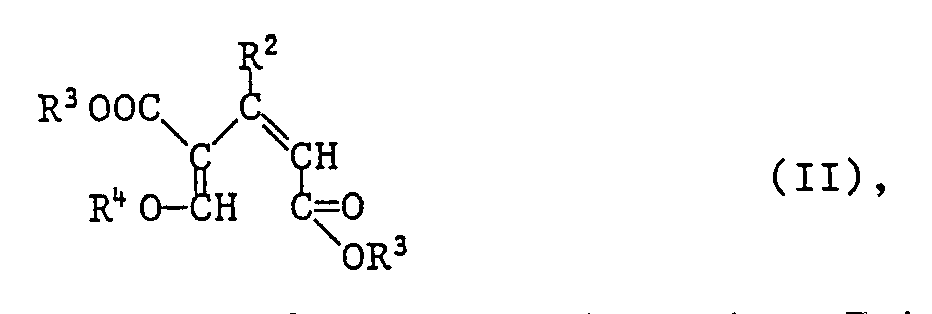
- Another object of the invention is a process for the preparation of compounds of formula I, which is characterized in that a compound of formula II wherein R2 and R3 have the meanings given above, and R4 is C1-C4-alkyl, cyclized in the presence of a strong anhydrous acid to a compound of formula I.
- R4 is especially methyl or ethyl.
- the compounds of formula II are a further subject of the invention. They can be prepared in an analogous manner by the process described in US Pat. No. 4,617,151 by reacting propene-1,3-dicarboxylic acid diesters of the formula III with formic acid esters HCOOR4 in the presence of TiCl4, an alkali metal hydride or alcoholate.
- Suitable alkali metals are, for example, Li, Na and K and examples of alcohols C1-C4 alkanols, for example methanol and ethanol.
- the compounds of formula III can be prepared in different ways.
- the starting compound is, for example, the known ketodicarboxylic acid diester of the formula IV
- alkylating agents for example dialkyl sulfates, orthoformates in the presence of FeCl3, or alkyl halides, compounds of the formula III are obtained in which R2 is an alkoxy radical.
- the reaction with R2Z is advantageously carried out in a polar aprotic solvent.
- ethers particularly (diethyl ether, dibutyl ether, tetrahydrofuran, dioxane, ethylene glycol diethyl ether).
- the reaction temperature is suitably from -20 to -100 ° C.
- the cyclization of compounds of the formula II can also be carried out by the process described in US Pat. No. 4,617,151.
- the cyclization is advantageously carried out with anhydrous formic acid or polyphosphoric acid without a solvent.
- the temperature for this reaction is suitably 50 to 250 ° C.
- R2 in formula VI is -CF3, F, -Cl, -Br, C1-C18 alkyl, alkoxy or alkylthio or alkylsulfonyl, phenyloxy or thio or sulfonyl, C1-C12 alkylphenyloxy or -thio or - sulfonyl, benzyloxy or thio or sulfonyl, or C1-C12 alkylbenzyloxy or thio or sulfonyl.
- R1 is -CF3 or -COOR3 and R2 is -CF3, -F, -Cl, C1-C12-alkyl, alkoxy or -alkylthio or -alkylsulfonyl, or benzylthio and R3 is C1-C4-alkyl.
- the compounds of the formula I and VI are valuable intermediates for the preparation of substituted anthracene-5,12-diones, from which substituted tetrathio- or tetraselenotetracenes can be obtained (cf. US Pat. No. 4,617,151).
- Such chalcogenated tetracenes can be used to produce electrically conductive charge transfer complexes (CT complexes) with electron acceptors. With their functional groups, they can be bound to polymers, for example incorporated as side groups in polymers (cf. US Pat. No. 4,617,151).
- CT complexes are also suitable for producing, for example, antistatic coatings on photographic film elements, magnetic tapes, electrophotographic film elements and electronic components (see US Pat. No.
- the chalcogenated tetracenes also have electrochromic properties; they can be used for electrochromic displays. They are also suitable as laser-optical data storage [Nach. Chem. Techn. Lab. 35, pp. 255 ff (1987)] and as anode material in organic solid-state batteries (EP-A-0 090 598).
- CT complexes of unsubstituted or substituted tetrathio- or tetraselenotetracenes can also be incorporated into thermoplastic, thermosetting or elastomeric polymers to achieve antistatic properties. For this purpose, these tetrathio or.
- Tetraselenotetracenes together with a soluble polymer or a precursor thereof and an electron acceptor for example a halogen-forming agent (organic halogenated compounds such as bromoform, trichlorobromomethane, tetrabromomethane, hexachloropropane, perchlorobutadiene, 1,3-or 1,4-dichloro-2-butene, 1,4-bis (trichloromethyl) benzene, iodoacetonitrile, iodoform, tetrachlorethylene, perchlorocyclobutadiene, N-chloro, bromine or iodosuccinimide) optionally dissolved together with another inert solvent and the excess halogen-forming agent and the solvent at elevated temperature evaporates.
- a halogen-forming agent organic halogenated compounds such as bromoform, trichlorobromomethane, tetrabromomethan
- the composition formed contains a network of needle-shaped crystals of the CT complex in the polymer if the chalcogenated tetracene is unsubstituted or contains small substituents (eg F, CH3, CF3).
- Such compositions have high electrical conductivity. This can be improved further if a substituted tetrathio- or tetraselenotetracene, which does not form such a network and which is produced in the polymer matrix in, is also used fine distribution is present since such substituted tetrathio- or tetraselenotetracenes have no or only a slight tendency to crystallize in the polymer.
- the compounds of the formula I are valuable diene components for Diels-Alder reactions, it being possible to use different dienophiles.
- 1,4-quinones e.g. Benzo-1,4-quinone, naphthalene-1,4-quinone or anthracene-1,4-quinone
- quinones extended by one ring are obtained (see e.g. EP-A-0 195 743).
- Substituted naphthacen-5,12-diones can also be obtained directly by the reaction of optionally substituted naphthalene-1,4-quinones with benzocyclobutenes substituted in the 1- and 2-positions with bromine and / or iodine.
- Anthraquinones and naphthacendiones can e.g. used as photosensitizers (cf. US Pat. No. 3,941,759) or photoinitiators for the polymerization of ethylenically unsaturated compounds, especially naphthacen-5,12-diones substituted at least in the 2-position with a thio radical.
- Naphthacene quinones can also be used in electrochromic display elements (JP-OS 61-43680).
- a red solution is formed, which is further stirred at -20 ° C for 2 hours. After 2 hours the reaction mixture is warmed to room temperature. Then 500 ml of a buffer solution (27 g NH4Cl dissolved in 100 ml concentrated ammonia solution) are added to the reaction mixture. The reaction mixture is stirred for 15 minutes at room temperature, diluted with 500 ml of saturated NaCl solution and twice 400 ml of diethyl ether extracted. The combined extracts are dried with Na2SO4 and the diethyl ether is distilled off on a rotary evaporator. The distillation residue (16.7 g) is chromatographed over 300 g SiO2 (eluent CH2Cl2, 0.3-0.5 bar gauge): yield 12.94 g.
- a buffer solution 27 g NH4Cl dissolved in 100 ml concentrated ammonia solution
- the reaction mixture is stirred for 24 hours at room temperature and then entered in 150 ml of CH2Cl2 and 100 ml of saturated KHCO3 solution. After stirring for 30 minutes, the precipitated titanium salt is filtered off. The CH2Cl2 solution is separated from the water from the filtrate. The CH2Cl2 phase is washed with water, dried with Na2SO4, evaporated and the remaining N-methylmorpholine removed at 100 ° C / 1.3 mbar. The oily residue is filtered over 150 g of SiO2 (eluent CH2Cl2, 0.3 bar gauge pressure). The crude product obtained is chromatographed (silica gel, eluent: CH2Cl2). 1.95 g (43.5%) of a light yellow oil are obtained.
- reaction mixture is then stirred at room temperature overnight and then added to a mixture of 1000 ml of CH2Cl and 2000 ml of saturated NaHCO3 solution. After stirring for 30 minutes, the mixture is filtered. The CH2Cl2 phase of the filtrate is separated from the aqueous phase, washed 2 more times with 300 ml of water, dried with Na2SO4 and concentrated in vacuo. 47.66 g (94%) of an orange oil are obtained.
- the residue is slurried in 200 ml of CH2Cl2, 200 ml of water containing 11 g of NaHCO3, added and filtered after stirring for 1 hour.
- the two phases of the filtrate are separated and the organic solution is concentrated in vacuo using a water jet pump.
- the residue is filtered through a column of 35 g of silica gel (eluent: CH2Cl2). After the eluent has been distilled off, 1.92 g (69.6%) of oily product remain.
- distillation residue (29 g) is crystallized from a mixture of 12 ml of diethyl ether and 10 ml of hexane at -20 ° C. Yield 22.79 g (42%), m.p .: 38 ° -39 ° C.
- a solution of 130.41 g (0.69 mol) TiCl4 in 170 ml CCl4 is added dropwise to 1380 ml THF with stirring. The temperature is kept at 0 ° C. by cooling. Thereafter, 36.72 g (0.17 mol) of 3-ethoxy-glutaconic acid ethyl ester, then 51.06 g (0.69 mol) of ethyl formate are added and finally dropwise within 0.5 hours at 0 ° C 139, 38 g (1.38 mol) of N-methylmorpholine in 241 ml of THF were added.
- the reaction mixture is stirred overnight at room temperature, then added to a solution of 150 g NaHCO3 in 1200 ml H2O and 1200 ml CH2Cl2 and stirred for 2 hours.
- the precipitated titanium oxide is sucked off.
- the filtrate is then extracted with 3 x 300 ml methylene chloride.
- the combined methylene chloride extracts are dried with Na2SO4 and concentrated.
- the remaining crude product is chromatographed on a column filled with 1300 g of silica gel 60 (eluent CH2Cl2-acetone 19: 1, 0.3 bar gauge pressure). After removal of the eluent, 31.9 g (67.6%) of an oily product are obtained.
- a mixture of tetrabutylammonium dihydrogen trifluoride (made from 30 mmol of tetrabutylammonium fluoride, KF and HF), 20 ml of 1,2-dichloroethane and 15 mmol (2.76 g) of diethyl allendicarboxylic acid is heated under reflux for 1 h. Then it is diluted with methylene chloride and slowly washed with ice water, sodium bicarbonate and ammonium chloride solution, dried with Na2SO4 and evaporated. The crude product is flash-filtered with 500 ml of hexane / ethyl acetate (4: 1) over 50 g of silica gel and distilled under a high vacuum. 1.79 g (59% of theory) of the desired product are obtained; Boiling point: 50-55 ° C / 0.06 mbar.
- the reaction mixture is stirred for 17 h at room temperature and then stirred into a mixture of 50 ml of saturated KHCO3 solution and 100ml of CH2Cl2.
- the precipitated titanium salt is filtered off and the organic phase is separated from the aqueous phase.
- the aqueous phase is extracted once more with 100 ml of CH2Cl2 and the combined organic phases are dried with Na2SO4 and concentrated.
- the distillation residue is freed from excess N-methylmorpholine at 85 ° C / 1.3 mbar and the rest is chromatographed over 150 g of SiO2 (mobile solvent CH2Cl2-acetone 19: 1). 1 g (77% of theory) of the product (orange oil) is obtained.
- a mixture of 0.44 g (0.002 mol) of diethyl 3-chloropent-2-enedicarboxylate and 0.3 g (0.003 mol) of sodium sulfinate in 1.5 dimethylformamide (DMF) is stirred at 100 ° C. for 1 hour and then distilled off DMF in vacuo at 110 ° C / 1.3 mbar.
- the residue is mixed with 0.5 ml of water.
- the water-insoluble part crystallizes out and is suctioned off and washed with water.
- the crude crystalline material is chromatographed over 12 g of silica gel (solvent CH2Cl2 / acetone 99: 1). 0.43 g (81.44% of theory) of the product are obtained; Melting point: 54-57 ° C.
- the reaction mixture is then stirred at 25 ° C for 20 hours, diluted with 100 ml of CH2Cl2 and poured into 30 ml of saturated KHCO3 solution.
- the titanium salt is filtered off and the organic phase is separated from the filtrate.
- the aqueous phase is extracted with 50 ml of CH2Cl2.
- the combined CH2Cl2 extracts are washed with saturated NaCl solution, with Na2SO4 dried and concentrated.
- the distillation residue is chromatographed (200 g silica gel, eluent CH2Cl2-acetone 19: 1). 1.17 g (60.94%) of the product are obtained.
- 1 mg of 2,3-di (trifluoromethyl) -5,6,11,12-tetrathiotetracene and 100 are placed on the anode side in an electrochromic cell consisting of a Teflon membrane and an anode and cathode made of ITO glass at 0.5 mm intervals mg LiClO4, dissolved in 5 ml acetone, and on the cathode side a solution of 1 mg 2,3-di (trifluoromethyl) -5,6,11,12-tetrathiotetracene perchlorate (CT complex, preparation see US Pat. No. 3,634,336) and 100 mg LiClO4 filled in 5 ml acetone.
- CT complex preparation see US Pat. No. 3,634,336
Landscapes
- Chemical & Material Sciences (AREA)
- Engineering & Computer Science (AREA)
- Organic Chemistry (AREA)
- Nanotechnology (AREA)
- Physics & Mathematics (AREA)
- Condensed Matter Physics & Semiconductors (AREA)
- Materials Engineering (AREA)
- Crystallography & Structural Chemistry (AREA)
- General Physics & Mathematics (AREA)
- Medicinal Chemistry (AREA)
- Health & Medical Sciences (AREA)
- Chemical Kinetics & Catalysis (AREA)
- Composite Materials (AREA)
- Polymers & Plastics (AREA)
- Spectroscopy & Molecular Physics (AREA)
- Manufacturing & Machinery (AREA)
- Organic Low-Molecular-Weight Compounds And Preparation Thereof (AREA)
- Heat Sensitive Colour Forming Recording (AREA)
- Pyrane Compounds (AREA)
Abstract

R¹ für -CF₃ oder -COOR³ steht und R³ den um eine Hydroxylgruppe verminderten Rest eines C₁-C₁₈-Alkohols bedeutet, und R² -F, -Br, -Cl, -CN, -CF₃, C₁-C₁₈-Alkyl, C₂-C₁₈-Alkenyl oder -Alkinyl, C₁-C₁₈-Alkoxy, C₁-C₁₈-Alkylthio, C₁-C₁₈-Alkylsulfonyl, C₆-C₁₆-Aryl, C₇-C₂₄-Alkaryl, C₇-C₁₂-Aralkyl, C₈-C₂₄-Alkaralkyl, C₆-C₁₆-Aryloxy oder -thio oder -sulfonyl, C₇-C₂₄-Alkaryloxy oder -thio oder -sulfonyl, C₇-C₁₂-Aralkyloxy oder -thio oder -sulfonyl oder C₈-C₂₄-Alkaralkyloxy oder -thio oder -sulfonyl, Sekundäramino mit 2 bis 24 C-Atomen, oder Trialkyl- oder Trialkoxysilyl mit 3 bis 18 C-Atomen darstellt. Sie eignen sich zur Herstellung von Naphto-und Anthra-1,4-chinonen, aus denen Tetrathio- oder Tetraselenotetracenen erhältlich sind, die elektrochrome Eigenschaften aufweisen.
Description
- Die Erfindung betrifft 4-substituierte α-Pyron-5-carbonsäureester oder 5-Trifluormethyl-α-pyrone und 7-substituierte Naphtho-1,4-chinon-6-carbonsäureester bzw. 6-Trifluormethyl-naphtho-1,4-chinone sowie substituierte Butadiendicarbonsäureester.
- α-Pyron-5-carbonsäureester sind bekannt, siehe zum Beispiel H. Gault et al., C.r. Akad. Sci, Paris Ser. C, 266, S. 131-134 (1968). In der US-PS 4,617,151 sind α-Pyron-4,5-dicarbonsäurediester beschrieben.
- Andere in 3,6-Stellung unsubstituierte und in 4-Stellung substituierte α-Pyron-5-carbonsäureester sind nicht bekannt. Es wurde nun gefunden, dass solche α-Pyrone in einfacher Weise durch Umsetzung von Allendicarbonsäureestern mit metallorganischen Verbindungen zu in 2-Stellung substituierten Propendicarbonsäurediestern, deren Umsetzung mit Ameisensäureestern zu in 3-Stellung substituierten 1-Alkoxymethylen-butadien-2,4-dicarbonsäureestern und deren Cyclisierung zu α-Pyronen erhältlich sind.
- Ein Gegenstand der Erfindung sind Verbindungen der Formel I

R¹ für -CF₃ oder -COOR³ steht und R³ den um eine Hydroxylgruppe verminderten Rest eines C₁-C₁₈-Alkohols bedeutet, und R² -F, -Br, -Cl, -CN, -CF₃, C₁-C₁₈-Alkyl, C₂-C₁₈-Alkenyl oder -Alkinyl, C₁-C₁₈-Alkoxy, C₁-C₁₈-Alkylthio, C₁-C₁₈-Alkylsulfonyl, C₆-C₁₆-Aryl, C₇-C₂₄-Alkaryl, C₇-C₁₂-Aralkyl, C₈-C₂₄-Alkaralkyl, C₆-C₁₆-Aryloxy oder -thio oder -sulfonyl, C₇-C₂₄-Alkaryloxy oder -thio oder -sulfonyl, C₇-C₁₂-Aralkyloxy oder -thio oder -sulfonyl oder C₈-C₂₄-Alkaralkyloxy oder -thio oder -sulfonyl, Sekundäramino mit 2 bis 24 C-Atomen, oder Trialkyl- oder Trialkoxysilyl mit 3 bis 18 C-Atomen darstellt. - In einer bevorzugten Untergruppe steht R² für -F, -Br, -Cl, -CF₃, C₁-C₁₈-Alkyl, C₂-C₁₈-Alkenyl, C₁-C₁₈-Alkoxy, C₁-C₁₈-Alkylthio, C₁-C₁₈-Alkylsulfonyl, C₆-C₁₀-Aryl, C₇-C₂₄-Alkaryl, C₇-C₁₂-Aralkyl, C₆-C₁₀-Aryloxy oder -thio oder -sulfonyl, C₇-C₁₂-Aralkyloxy oder -thio oder -sulfonyl.
- R³ als Rest eines Alkoholes enthält bevorzugt 1-12, besonders 1 bis 6 C-Atome. R³ kann z.B. lineares oder verzweigtes Alkyl, gegebenenfalls mit C₁-C₆-Alkyl substituiertes C₅- oder C₆-Cycloalkyl, oder gegebenenfalls mit C₁-C₆-Alkyl substituiertes C₆-C₁₂-Aryl oder C₆-C₁₂-Aryl-CxH2x mit x gleich 1 bis 4 sein. Aryl ist bevorzugt Phenyl und x ist bevorzugt 1. Bevorzugt stellt R³ C₁-C₁₈-, besonders C₁-C₁₂- und besonders C₁-C₆-Alkyl dar. Einige Beispiele sind Methyl, Ethyl, die Isomeren von Propyl, Butyl, Pentyl, Hexyl, Heptyl, Octyl, Nonyl, Decyl, Undecyl, Dodecyl, Tetradecyl, Hexadecyl, Octadecyl, Cyclopentyl, Cyclohexyl, Methylcyclohexyl, Phenyl, Benzyl, Methylphenyl, Dimethylphenyl, Ethylphenyl, Methylethylphenyl, t-Butylphenyl und Methylbenzyl. Besonders bevorzugt stellt R³ Methyl oder Ethyl dar.
- R² als Alkyl, Alkoxy, Alkylthio und Alkylsulfonyl kann linear oder verzweigt sein und enthält bevorzugt 1 bis 12, besonders 1 bis 6 und insbesondere 1 bis 4 C-Atome. Beispiele sind Methyl, Ethyl, die Isomeren von Propyl, Butyl, Pentyl, Hexyl, Heptyl, Octyl, Nonyl, Decyl, Undecyl, Dodecyl, Tridecyl, Tetradecyl, Pentadecyl, Heptadecyl, Octadecyl und entsprechende Alkoxy-, Alkylthio- und Alkylsulfonylreste.
- R² als Alkenyl und Alkinyl kann linear oder verzweigt sein und enthält bevorzugt 2 bis 12, besonders 2 bis 6 C-Atome. Einige Beispiele sind Vinyl, Ethinyl, Allyl, Propargyl, Prop-1-en-1-yl, But-1-en- oder -2-en-4-yl, Pent-2-en-5-yl, Hex-3-en-6-yl, But-2-in-4-yl, Pent-2-in-4- oder -5-yl und Hex-3-in-5- oder -6-yl.
- Stellt R² Aryl oder einen Aryl enthaltenden Rest dar, so ist das Aryl z.B. Naphthyl oder besonders Phenyl. R² in der Bedeutung von Alkaryl und entsprechende Oxy-, Thio- und Sulfonylreste enthalten bevorzugt 7 bis 18 C-Atome. R² in der Bedeutung von Aralkyl und entsprechende Oxy-, Thio- und Sulfonylreste enthalten bevorzugt 7 oder 8 C-Atome. R² in der Bedeutung von Alkaralkyl und entsprechende Oxy-, Thio- und Sulfonylreste enthalten bevorzugt 8 bis 20 C-Atome. In einer bevorzugten Untergruppe stellt R² in der Bedeutung von Aryl oder einem Aryl enthaltenden Rest Phenyl, Phenyloxy, Phenylthio oder Phenylsulfonyl, C₁-C₁₂-Alkylphenyl, -phenyloxy, -phenylthio oder -phenylsulfonyl, C₁-C₁₂-Alkylphenyl-CnH2n-, -CnH2nO-, CnH2nS- oder -CnH2nSO₂-, oder Phenyl-CnH2n-, -CnH2nO-, -CnH2nS- oder -CnH2nSO₂- dar, worin n eine Zahl von 1 bis 4, besonders 1 oder 2 und insbesondere 1 ist. Einige Beispiele sind Phenyl, Phenyloxy, Phenylthio, Benzyl, Benzyloxy, Benzylthio, Methylphenyl, Methylphenyloxy, Methylphenylthio, Methylbenzyl, Methylbenzyloxy, Methylbenzylthio.
- R² enthält in der Bedeutung von Sekundäramino bevorzugt 2 bis 18, besonders 2 bis 12 und insbesondere 2 bis 8 C-Atome. Das Sekundäramino kann der Formel -NR⁵R⁶ entsprechen, worin R⁵ und R⁶ unabhängig voneinander lineares oder verzweigtes C₁-C₁₈-, besonders C₁-C₁₂- und insbesondere C₁-C₆-Alkyl, Cyclopentyl, Cyclohexyl, Phenyl, Benzyl, C₁-C₆-Alkylphenyl, C₁-C₆-Alkylbenzyl oder R⁵ und R⁶ zusammen Tetra- oder Pentamethylen oder 3-Oxa-1,5-pentylen bedeuten. Einige Beispiele sind Dimethyl-, Diethyl-, Ethylmethyl-, Dibutyl-, Dioctyl-, Methyldodecyl-, Didodecyl-, Methyloctadecyl-, Phenylmethyl-, Benzylmethylamino, Pyrrolino, Piperidino und Morpholino.
- R² enthält als Trialkylsilyl oder Trialkoxysilyl bevorzugt 3 bis 12, besonders 3 bis 8 C-Atome. Alkyl- und Alkoxygruppen sind zuvor erwähnt worden. Einige Beispiele sind Trimethyl-, Triethyl-, Dimethylethyl-, Tributyl-, Dimethylbutyl-, Dimethyl-(1,1,2,2-tetramethylethyl)-, Dimethyloctyl-, Trimethoxy- und Triethoxysilyl.
- Eine bevorzugte Gruppe von erfindungsgemässen Verbindungen sind solche, worin R² für -F, -CN, -CF₃, -Br, -Cl, C₁-C₁₈-Alkyl oder C₂-C₁₂-Alkenyl, C₁-C₁₈-Alkoxy, C₁-C₁₈-Alkylthio, C₁-C₁₈-Alkylsulfonyl, Phenyl, C₁-C₁₂-Alkylphenyl, Phenyl-CnH2n-, C₁-C₁₂-Alkylphenyl-Cn H2n-, Phenyloxy, Phenyl thio oder Phenylsulfonyl, C₁-C₁₂-Alkylphenoxy, -phenylthio oder -phenylsulfonyl, Phenyl-CnH2n-O-, Phenyl-CnH2n-S- oder Phenyl-CnH2n-SO₂-, C₁-C₁₂-Alkylphenyl-CnH2n-O-, C₁-C₁₂-Alkylphenyl-CnH2n-S- oder C₁-C₁₂-Alkylphenyl-CnH2n-SO₂-, wobei n eine Zahl von 1 bis 4 ist, Sekundäramino mit 2 bis 18 C-Atomen, oder Trialkyl- oder Trialkoxysilyl mit 3 bis 12 C-Atomen steht.
- In einer besonders bevorzugten Ausführungsform steht R² für -F, -Cl, -Br, -CF₃, C₁-C₁₂-Alkyl, C₁-C₁₂-Alkoxy, C₁-C₁₂-Alkylthio, Benzylthio oder C₁-C₁₂-Alkylbenzylthio, oder Sekundäramino mit 2 bis 12 C-Atomen.
- Ein weiterer Gegenstand der Erfindung ist ein Verfahren zur Herstellung von Verbindungen der Formel I, das dadurch gekennzeichnet ist, dass man
eine Verbindung der Formel II
- In Formel II steht R⁴ besonders für Methyl oder Ethyl.
- Die Verbindungen der Formel II sind ein weiterer Gegenstand der Erfindung. Sie können in analoger Weise nach dem in der US-PS 4,617,151 beschriebenen Verfahren hergestellt werden durch Umsetzung von Propen-1,3-dicarbonsäurediestern der Formeln III

- Die Verbindungen der Formel III können auf unterschiedliche Weise hergestellt werden. Ausgangsverbindung ist z.B. der bekannte Ketodicarbonsäurediester der Formel IV

- Die Umsetzung der Verbindung der Formel IV mit z.B. PCl₅ oder Diethylaminoschwefeltrifluorid (DAST) ergibt Verbindungen der Formel III, worin R² Cl oder F bedeutet. Diese können mit Alkalimetallsalzen von organischen Mercaptoverbindungen bzw. Sulfonylverbindungen (Alkalimetall ist z.B. Li, Na, K) zu Verbindungen der Formel III umgesetzt werden, worin R² einen der zuvor definierten Thioreste bzw. Sulfonylresten bedeutet.
- Verbindungen der Formel III mit R² = Cl können in üblicher Weise zu Allendicarbonsäureestern der Formel V

- Die Umsetzung mit R²Z wird vorteilhaft in einem polaren aprotischen Lösungsmittel durchgeführt. Beispiele sind Ether, insbesondere (Diethylether, Dibutylether, Tetrahydrofuran, Dioxan, Ethylenglykoldiethylether). Die Reaktionstemperatur beträgt zweckmässig -20 bis -100°C.
- Verbindungen der Formel I, worin R¹ und/oder R² -CF₃ bedeuten, erhält man durch Fluorierung, z.B. mit SF₄/HF, der entsprechenden Carbonsäurealkylester, besonders der -methyl- oder -ethylester.
- Verbindungen der Formel I, worin R² einen Thio- oder Sulfonylrest bedeuten, können auch durch entsprechende Substitution von α-Pyronen der Formel I mit R² gleich Cl oder Br hergestellt werden.
- Die Cyclisierung von Verbindungen der Formel II kann ebenfalls nach dem in der US-PS 4,617,151 beschriebenen Verfahren erfolgen. Vorteilhaft wird die Cyclisierung mit wasserfreier Ameisensäure oder Polyphosphorsäure ohne Lösungsmittel durchgeführt. Die Temperatur für diese Reaktion beträgt zweckmässig 50 bis 250°C.
- Die Verbindungen der Formel I können mit Benzo-1,4-chinon zu Naphthochinonen der Formel VI

- Vorzugsweise bedeutet R² in Formel VI -CF₃, F, -Cl, -Br, C₁-C₁₈-Alkyl, -Alkoxy oder -Alkylthio oder -Alkylsulfonyl, Phenyloxy oder -thio oder -sulfonyl, C₁-C₁₂-Alkylphenyloxy oder -thio oder -sulfonyl, Benzyloxy oder -thio oder -sulfonyl, oder C₁-C₁₂-Alkylbenzyloxy oder -thio oder -sulfonyl. In einer besonderen Ausführungsform stehen R¹ für -CF₃ oder -COOR³ und R² für -CF₃, -F, -Cl, C₁-C₁₂-Alkyl, -Alkoxy oder -Alkylthio oder -Alkylsulfonyl, oder Benzylthio und R³ für C₁-C₄-Alkyl.
- Die Verbindungen der Formel I und VI sind wertvolle Zwischenprodukte zur Herstellung von substituierten Anthracen-5,12-dionen, aus denen substituierte Tetrathio- bzw. Tetraselenotetracenen erhältlich sind (vgl. US-PS 4 617 151). Aus solchen chalkogenierten Tetracenen können mit Elektronenacceptoren elektrisch leitende Charge-Transferkomplexe (CT-Komplexe) hergestellt werden. Mit deren funktionellen Gruppen kann man sie an Polymere binden, z.B. als Seitengruppen in Polymere einbauen (vgl. US-PS 4,617,151). Die CT-Komplexe eignen sich auch zur Herstellung z.B. von antistatischen Beschichtungen photographischer Filmelemente, Magnetbänder, elektrophotographischer Filmelemente und elektronischer Komponenten (siehe US-PS 3,634,336). Die chalkogenierte Tetracene weisen ferner elektrochrome Eigenschaften auf; sie können für elektrochrome Displays verwendet werden. Sie eignen sich auch als laser-optische Datenspeicher [Nach. Chem. Techn. Lab. 35, S. 255 ff (1987)] und als Anodenmaterial in organischen Solid-State-Batterien (EP-A-0 090 598). CT-Komplexe von unsubstituierten oder substituierten Tetrathio- oder Tetraselenotetracenen können zur Erzielung antistatischer Eigenschaften auch in thermoplastische, duroplastische oder elastomere Polymere eingearbeitet werden. Hierzu werden zweckmässig z.B. diese Tetrathio-bzw. Tetraselenotetracene zusammen mit einem löslichen Polymer oder einer Vorstufe davon und einem Elektronenacceptor, z.B. einem Halogen bildenden Mittel (organische halogenierte Verbindungen wie z.B. Bromoform, Trichlorbrommethan, Tetrabrommethan, Hexachlorpropan, Perchlorbutadien, 1,3-oder 1,4-Dichlor-2-buten, 1,4-Bis(trichloromethyl)-benzol, Iodacetonitril, Iodoform, Tetrachlorethylen, Perchlorcyclobutadien, N-Chlor-, -brom oder -iodsuccinimid) gegebenenfalls zusammen mit einem weiteren inerten Lösungsmittel gelöst und das überschüssige Halogen bildende Mittel und das Lösungsmittel bei höherer Temperatur verdampft. Die gebildete Zusammensetzung enthält im Polymer ein Netzwerk nadelförmiger Kristalle des CT-Komplexes, wenn das chalkogenierte Tetracen unsubstituiert ist oder kleine Substituenten (z.B. F, CH₃, CF₃) enthält. Solche Zusammensetzungen weisen eine hohe elektrische Leitfähigkeit auf. Diese kann noch verbessert werden, wenn man ein aus den Verbindungen der Formel I hergestelltes substituiertes Tetrathio-oder Tetraselenotetracen mitverwendet, das kein solches Netzwerk bildet und das in der Polymermatrix in feiner Verteilung vorliegt, da solche substituierten Tetrathio-oder Tetraselenotetracene keine oder nur eine geringe Kristallisationstendenz im Polymer besitzen.
- Die Verbindungen der Formel I sind wertvolle Dienkomponenten für Diels-Alder-Reaktionen, wobei unterschiedliche Dienophile verwendet werden können. Bei Verwendung von gegebenenfalls substituierten 1,4-Chinonen, z.B. Benzo-1,4-chinon, Naphthalin-1,4-chinon oder Anthracen-1,4-chinon, erhält man um einen Ring erweiterte Chinone (siehe z.B. EP-A-0 195 743). Substituierte Naphthacen-5,12-dione sind auch direkt erhältlich durch die Umsetzung von gegebenenfalls substituierten Naphthalin-1,4-chinonen mit in 1- und 2-Stellung mit Brom und/oder Iod substituierten Benzocyclobutenen. Anthrachinone und Naphthacendione können z.B. als Photosensibilisatoren (vgl. US-PS 3,941,759) oder Photoinitiatoren zur Polymerisation ethylenisch ungesättigter Verbindungen verwendet werden, besonders mindestens in 2-Stellung mit einem Thiorest substituierte Naphthacen-5,12-dione. Naphthacenchinone können auch in elektrochromen Displayelementen verwendet werden (JP-OS 61-43680).
- Die nachfolgenden Beispiele erläutern die Erfindung.
- 10g CuCN werden in 200 ml Toluol aufgeschlämmt und das Toluol bei 35°C am Rotationsverdampfer abdestilliert. Der Vorgang wird nochmals wiederholt. Das Vakuum wird durch Argon ersetzt, 200 ml Tetrahydrofuran (THF) zugefügt und die Suspension auf -70°C abgekühlt. Bei dieser Temperatur werden 125 ml Hexanlösung von 12,8 g n-Butyllithium zugetropft. Es entsteht unter exothermer Reaktion eine gelbe Lösung. Nach 15 Minuten Rühren werden 13,8 g Allendicarbonsäurediethylester in 100 ml THF bei -50°C zugetropft. Es entsteht eine rote Lösung, die bei -20°C 2 Stunden weitergerührt wird. Nach 2 Stunden wird das Reaktionsgemisch auf Zimmertemperatur erwärmt. Anschliessend werden zu dem Reaktionsgemisch 500 ml einer Puffer-Lösung (27 g NH₄Cl gelöst in 100 ml konzentrierter Ammoniaklösung) zugegeben. Das Reaktionsgemisch wird 15 Minuten bei Zimmertemperatur gerührt, mit 500 ml gesättigter NaCl-Lösung verdünnt und mit 2 mal 400 ml Diethylether extrahiert. Die vereinten Extrakte werden mit Na₂SO₄ getrocknet und der Diethylether am Rotationsverdampfer abdestilliert. Der Destillationsrückstand (16,7 g) wird über 300 g SiO₂ chromatographiert (Laufmittel CH₂Cl₂, 0,3-0,5 bar Ueberdruck): Ausbeute 12,94 g.
- Die Destillation des Produkts im Kugelrohrofen bei 120°C/1,3x10⁻² mbar liefert ein farbloses Oel.
- 11,34 g (0,06 mol) TiCl₄ in 15 ml CCl₄ werden unter Rühren bei 0°C zu 120 ml THF getropft. Zu dem entstandenen gelben Komplex werden nach 15 Minuten 4,44 g (0,06 mol) Ameisensäure-ethylester und anschliessend 3,63 g (0,015 mol) 2-Butyl-prop-1-en-1,3-dicarbonsäure-diethylester zugegeben. Nach 15 Minuten Rühren wird das Reaktionsgemisch bei 0°-5°C tropfenweise innerhalb 30 Minuten mit 12,12 g (0,12 mol) N-Methylmorpholin in 21 ml THF versetzt. Das Reaktionsgemisch wird 24 Stunden bei Zimmertemperatur gerührt und darauf in 150 ml CH₂Cl₂ und 100 ml gesättigte KHCO₃-Lösung eingetragen. Nach 30 Minuten Rühren wird das ausgeschiedene Titan-Salz abfiltriert. Aus dem Filtrat wird die CH₂Cl₂-Lösung vom Wasser getrennt. Die CH₂Cl₂-Phase wird mit Wasser gewaschen, mit Na₂SO₄ getrocknet, eingedampft und bei 100°C/1,3 mbar restliches N-Methylmorpholin entfernt. Der ölige Rückstand wird über 150 g SiO₂ (Laufmittel CH₂Cl₂, 0,3 bar Ueberdruck) filtriert. Das erhaltene rohe Produkt wird chromatographiert (Silikagel, Laufmittel: CH₂Cl₂). Man erhält 1,95 g (43,5 %) eines hellgelben Oels.
- 1,4 g (0,0047 mol) 2-Butyl-3-ethoxy-methylenyl-prop-1-en-1,3-dicarbonsäure-diethylester und 14 ml Ameisensäure werden in einem auf 110°C vorerwärmten Bad 20 Minuten erhitzt. Die Ameisensäure wird dann im Wasserstrahlvakuum bei 50°C abdestilliert. Der Rückstand wird in 20 ml CH₂Cl₂ gelöst, die Lösung mit 10 ml gesättigter NaCl-Lösung gewaschen, mit Na₂SO₄ getrocknet und zur Trockene eingeengt. Ausbeute: 0,95 g (90,5 %) öliges Produkt.
- 1,84 g Na werden in 200 ml Methanol gelöst. Dazu werden 10,91 g Benzylmerkaptan zugefügt und das Methanol im Vakuum abdestilliert. Der Destillationsrückstand wird zweimal mit 100 ml Toluol eingedampft. Der Rückstand wird in 120 ml Dimethylsulfoxid (DMSO) gelöst und die Lösung mit 17,64 g β-Chlorglutaconsäure-diethylester versetzt. Das Reaktionsgemisch erwärmt sich auf 53°C. Es wird noch über Nacht bei Zimmertemperatur gerührt. Das DMSO wird im Vakuum bei 80°C/1,3 mbar abdestilliert. Der Rückstand wird in CH₂Cl₂ aufgenommen und die Lösung mit angesäuertem (HCl) Wasser gewaschen. Nach dem Trocknen mit NaSO₄ und Abdestillieren des CH₂Cl₂ erhält man 24,15 g Produkt (97.9 %) als goldgelbes Oel.
- 105,2 g (0,557 mol) TiCl₄ in 140 ml CCl₄ werden unter Rühren bei 0°C zu 1115 ml THF getropft. Anschliessend werden bei gleicher Temperatur zuerst 41,2 g (0,557 mol) Ameisensäure-ethylester und dann 43 g (0,139 mol) 2-Benzylmerkapto-prop-1-en-1,3-dicarbonsäure-diethylester zugefügt. Nach 15 Minuten wird bei gleicher Temperatur eine Lösung von 112,9 g (1,115 mol) N-Methylmorpholin in 195 ml THF während 30 Minuten zugetropft. Das Reaktionsgemisch wird dann bei Zimmertemperatur über Nacht gerührt und dann in ein Gemisch von 1000 ml CH₂Cl und 2000 ml gesättigter NaHCO₃-Lösung eingetragen. Nach 30 Minuten Rühren wird das Gemisch filtriert. Die CH₂Cl₂-Phase des Filtrates wird von der wässrigen Phase getrennt, noch 2 mal mit 300 ml Wasser gewaschen, mit Na₂SO₄ getrocknet und im Vakuum eingeengt. Man erhält 47,66 g (94 %) eines orangen Oels.
- 47,66 g (0,130 mol) 2-Benzylmerkapto-3-ethoxymethylenyl-prop-1-en-1,3-dicarbonsäure-ethylester wird in 481 ml Ameisensäure gelöst und in einem auf 110°C erwärmten Bad 20 Minuten erhitzt. Die Ameisensäure wird anschliessend im Vakuum abdestilliert. Der Rückstand wird in 500 ml CH₂Cl₂ aufgenommen, mit wässriger NaCl-Lösung und anschliessend mit Wasser gewaschen. Nach dem Trocknen der Lösung mit Na₂SO₄ wird im Vakuum das Lösungsmittel abdestilliert. Der Destillationsrest kristallisiert aus [25,9 g (68,7 %)]. Der Schmelzpunkt beträgt (aus Ethanol umkristallisiert) 99-101°C.
- Zu 80 ml THF werden 7,56 g (0,04 mol) TiCl₄, gelöst in 10 ml CCl₄, bei 0°C getropft. Zum entstandenen gelben Komplex werden dann zuerst 2,96 g (0,04 mol) Ameisensäure-ethylester und darauf 2,2 g (0,01 mol) β-Chlorglutaconsäure zugefügt. Nach 15 Minuten wird bei 0°C eine Lösung von 8.08 g (0,08 mol) N-Methylmorpholin in 14 ml THF während 30 Minuten zugetropft. Das Reaktionsgemisch wird noch bei Zimmertemperatur über Nacht gerührt. Dann wird vom Reaktionsgemisch das Lösungsmittel bei 35°C im Vakuum abdestilliert. Der Rückstand wird in 200 ml CH₂Cl₂ aufgeschlämmt, 200 ml Wasser, das 11 g NaHCO₃ enthält, zugefügt und nach 1 Stunde Rühren filtriert. Die zwei Phasen des Filtrats werden getrennt und die organische Lösung im Vakuum einer Wasserstrahlpumpe eingeengt. Der Rückstand wird über eine Kolonne aus 35 g Silicagel (Laufmittel: CH₂Cl₂) filtriert. Nach dem Abdestillieren des Laufmittels bleiben 1,92 g (69,6 %) öliges Produkt.
- 74,12 g (0,268 mol) 1-Ethoxy-3-chlor-butadien-2,4-dicarbonsäure-diethylester, gelöst in 700 ml Ameisensäure, werden in einem auf 110°C vorerwärmten Bad 30 Minuten erhitzt, abgekühlt und im Vakuum bei 50°C zur Trockene eingedampft. Der Rückstand wird in 250 ml CH₂Cl₂ aufgenommen, mit Wasser neutral gewaschen und nach dem Trocknen der Lösung mit Na₂SO₄ eingeengt. Der Destillationsrückstand wird über 1300 g Silikagel (Laufmittel: CH₂Cl₂-Aceton 99:1, 0,3 bar Ueberdruck) chromatographiert. Nach dem Einengen wird der Destillationsrückstand (29 g) aus einem Gemisch von 12 ml Diethylether und 10 ml Hexan bei -20°C kristallisiert. Ausbeute 22,79 g (42 %), Schmp.: 38°-39°C.
- Eine Lösung von 130,41 g (0,69 mol) TiCl₄ in 170 ml CCl₄ wird unter Rühren zu 1380 ml THF getropft. Die Temperatur wird dabei durch Kühlung auf 0°C gehalten. Danach werden zuerst 36,72 g (0,17 mol) 3-Ethoxy-glutaconsäure-ethylester, dann 51,06 g (0,69 mol) Ameisensäure-ethylester eingetragen und schliesslich tropfenweise innerhalb 0,5 Stunden bei 0°C 139,38 g (1,38 mol) N-Methylmorpholin in 241 ml THF zugegeben. Das Reaktionsgemisch wird über Nacht bei Zimmertemperatur gerührt, nachher in eine Lösung von 150 g NaHCO₃ in 1200 ml H₂O und 1200 ml CH₂Cl₂ eingetragen und 2 Stunden gerührt. Das ausgefallene Titanoxid wird abgenutscht. Das Filtrat wird dann mit 3 x 300 ml Methylenchlorid extrahiert. Die vereinigten Methylenchlorid-Extrakte werden mit Na₂SO₄ getrocknet und eingeengt. Das zurückgebliebene Rohprodukt wird über eine Kolonne, gefüllt mit 1300 g Kieselgel 60 (Laufmittel CH₂Cl₂-Aceton 19:1, 0,3 bar Ueberdruck) chromatographiert. Nach Entfernen des Laufmittels erhält man 31,9 g (67,6 %) öliges Produkt.
- 26 g (0,0908 mol) 1,3-Ethoxy-butadien-2,4-dicarbonsäure-diethylester und 156 g Polyphosphorsäure werden 30 Minuten auf 140°C erhitzt, mit 1000 ml Wasser verdünnt und mit zuerst 1000 ml und dann noch 3 mal 200 ml CH₂Cl₂ extrahiert. Die Extrakte werden mit gesättigter NaCl-Lösung bis zum pH 5 gewaschen. Die Lösung wird dann mit Na₂SO₄ getrocknet und eingedampft. Der Destillationsrückstand wird über 160 g Kieselgel 60 chromatographiert (CH₂Cl₂:Aceton 19:1, 0,3 bar Ueberdruck). Nach Entfernen des Laufmittels erhält man 11,3 g (58,7 %) Kristalle vom Schmelzpunkt 86-89°C.
- 50 g (0,208 mol) 2-Oxo-2H-pyran-4,5-dicarbonsäure-diethylester, 170 g (1,57 mol) SF₄ und 300 g (15 mol) HF werden 10 Stunden bei 150°C im Autoklaven erhitzt. Das Reaktionsgemisch wird mit 500 ml CH₂Cl₂ verdünnt und in 1500 ml Wasser gegossen. Der pH-Wert wird unter Rühren durch allmähliche Zugabe von NaHCO₃ auf 7,5 eingestellt. Die organische Phase wird abgetrennt, über Na₂SO₄ getrocknet, abfiltriert und das Lösungsmittel im Vakuum bei 50°C abdestilliert. Der Destillationsrückstand wird fünfmal mit 100 ml n-Pentan extrahiert und die Pentanlösung eingeengt. Nach Destillation bei 68-70°C/13 mbar werden 18,62 g (38,5 %) 4,5-bis-Trifluormethyl-2-oxo-2H-pyran erhalten.
- Eine Mischung aus Tetrabutylammonium-dihydrogentrifluorid (hergestellt aus 30 mmol Tetrabutylammoniumfluorid, KF und HF), 20 ml 1,2-Dichlorethan und 15 mmol (2,76 g) Allendicarbonsäurediethylester wird 1 h unter Rückfluss erhitzt. Danach wird mit Methylenchlorid verdünnt und langsam mit Eiswasser, Natriumbicarbonat und Ammoniumchloridlösung gewaschen, mit Na₂SO₄ getrocknet und eingedampft. Das Rohprodukt wird mit 500 ml Hexan/Essigester (4:1) über 50 g Kieselgel flash-filtriert und am Hochvakuum destilliert. Man erhält 1,79 g (59 % d. Th.) des gewünschten Produkts; Siedepunkt: 50-55°C/0,06 mbar.
- Ein Gemisch von 3,78 g (0,02 mol) TiCl₄ in 5 ml CCl₄ wird in 40 ml Tetrahydrofuran (THF) unter Rühren bei 0°C zugetropft. Nachher werden noch 1,02 g (0,005 mol) 3-Fluor-pent-2(E)-en-dicarbonsäure-diethylester und 1,48 g (0,02 mol) Ameisensäureethylester zugetropft. Nach 15 Minuten wird bei 0-5°C noch eine Lösung von 4,04 g (0,04 mol) N-Methylmorpholin in 7 ml THF zugetropft. Das Reaktionsgemisch wird 17 h bei Raumtemperatur gerührt und dann in ein Gemisch von 50 ml gesättigter KHCO₃-Lösung und 100ml CH₂Cl₂ eingerührt. Das ausgefallene Titansalz wird abgesaugt und die organische Phase von der wässrigen Phase abgetrennt. Die wässrige Phase wird noch einmal mit 100 ml CH₂Cl₂ extrahiert und die vereinten organischen Phasen mit Na₂SO₄ getrocknet und eingeengt. Der Destillationsrückstand wird bei 85°C/1,3 mbar von überschüssigem N-Methylmorpholin befreit und der Rest über 150 g SiO₂ (Laufmittel CH₂Cl₂-Aceton 19:1) chromatographiert. Man erhält 1 g (77 % d. Th.) des Produktes (oranges Oel).
- 1 g (0,0038 mol) 1-Ethoxy-3-fluor-butadien-2,4-dicarbonsäure-diethylester wird mit 6 g PPA (Polyphosphorsäure) versetzt und 30 Minuten bei 80°C gerührt, mit 20 ml Wasser verdünnt und 3 mal mit 20 ml CH₂Cl extrahiert. Die CH₂Cl₂-Phase wird mit H₂O gewaschen, getrocknet (Na₂SO₄) und eingeengt. Der Destillationsrückstand wird über Silicagel chromatographiert (Laufmittel CH₂Cl₂-Aceton 99:1). Nach dem Eindampfen des Lösungsmittels bleibt als Rückstand 0,2 g (28 % d. Th.) des reinen Produktes (oranges Oel).
- Eine Mischung von 0,44 g (0,002 mol) 3-Chlor-pent-2-en-dicarbonsäure-diethylester und 0,3 g (0,003 mol) Natriumsulfinat in 1,5 Dimethylformamid (DMF) wird bei 100°C 1 Stunde gerührt und darauf DMF im Vakuum bei 110°C/1,3 mbar abdestilliert. Der Rückstand wird mit 0,5 ml Wasser vermischt. Der in Wasser unlösliche Anteil kristallisiert aus und wird abgesaugt und mit Wasser nachgewaschen. Das rohe kristalline Material wird über 12 g Silikagel chromatographiert (Laufmittel CH₂Cl₂/Aceton 99:1). Man erhält 0,43 g (81,44 % d. Th.) des Produktes; Schmelzpunkt: 54-57°C.
- In 48 ml THF wird eine Lösung von 4,53 g (0,024 mol) TiCl₄ in 6 ml CCl₄ unter Kühlung mit Eis (0-5°C) zugetropft. Bei der gleichen Temperatur wird dann unter Rühren zuerst 1,77 g (0,024 mol) Ameisensäureester und dann 1,58 g (0,006 mol) 3-Methylsulfonyl-pent-2-endicarbonsäurediethylester zugetropft. Nach 30 Minuten wird während 1 Stunde bei 0-5°C noch 4,86 g (0,048 mol) N-Methylmorpholin in 8,5 ml THF zugefügt. Das Reaktionsgemisch wird dann 20 Stunden bei 25°C gerührt, mit 100 ml CH₂Cl₂ verdünnt und in 30 ml gesättigte KHCO₃-Lösung gegossen. Das Titansalz wird abgenutscht und aus dem Filtrat die organische Phase getrennt. Die wässrige Phase wird noch mit 50 ml CH₂Cl₂ extrahiert. Die vereinten CH₂Cl₂-Extrakte werden mit gesättigter NaCl-Lösung gewaschen, mit Na₂SO₄ getrocknet und eingeengt. Der Destillationsrückstand wird chromatographiert (200 g Silikagel, Laufmittel CH₂Cl₂-Aceton 19:1). Man erhält 1,17 g (60,94 %) des Produktes.
- In eine DMF-Lösung von 2,02 g 4-Chlor-2-oxo-2H-pyran-5-carbonsäure-ethylester wird 1,2 g Methylsulfinsäurenatrium eingetragen und 2 h bei Raumtemperatur gerührt. Das Reaktionsgemisch wird mit CH₂Cl₂ verdünnt und mit gesättigter wässriger NaCl-Lösung extrahiert. Die organische Phase wird mit Na₂SO₄ getrocknet und eingedampft. Der auskristallisierte Destillationsrückstand wird mit Ether vermischt, abgesaugt und mit Ether nachgewaschen. Ausbeute 1,4 g (56,9 % d. Th.); Schmelzpunkt: 95-97°C.
- 23,47 g (0,1011 mol) 4,5-bis-Trifluormethyl-2-oxo-2H-pyran, 54,62 g (0,5053 mol) 1,4-Naphthochinon und 26,30 g (0,3026 mol) MnO₂ werden in 225 ml 1,2-Dichlorbenzol 12 Stunden auf 180°C erhitzt. Das Reaktionsgemisch wird anschliessend mit 200 ml CHCl₃ verdünnt und über Hyflo® filtriert. Nach dem Abdestillieren von Chloroform wird der Destillationsrückstand über eine mit 1300 g SiO₂ gefüllte Kolonne chromatographiert (Laufmittel: Zuerst Cyclohexan, dann CHCl₃; 0,3 bar Ueberdruck). Ausbeute 17,94 g (60,3 %), Schmelzpunkt: 91-94°C.
- 0,42 g (0,002 mol) 4-Ethoxy-2-oxo-2H-pyran-5-carbonsäure-ethylester, 1,08 g (0,01 mol) 1,4-Benzochinon und 0,54 g (0,0062 mol) MnO₂ werden in 4,8 ml Dichlorbenzol 12 Stunden auf 180°C erhitzt. Das erhaltene Reaktionsgemisch wird über eine Kolonne von 30 g Kieselgel 60 (Laufmittel CH₂Cl₂:Aceton 99:1, 0,3 bar Ueberdruck) chromatographiert. Man erhält 0,41 g (75,9 %) Kristalle vom Schmelzpunkt 60-62°C.
- 25 mMol 6,7-Bis-trifluormethyl-1,4-naphthochinon, ca. 37 mMol 1,2-Dibrombenzocyclobuten [siehe J. Am. Chem. Soc., 79, S. 1701 ff (1957)], das etwas 1-Brom-2-iod-benzocyclobuten enthält, und 100 ml Xylol werden während 16 Stunden mit einem Wasserabscheider am Rückfluss gehalten. Das Reaktionsgemisch wird abgekühlt, der Niederschlag abfiltriert und mit Xylol gewaschen. Man erhält das kristalline 2,3-Di(trifluormethyl)naphthacen-5,12-dion in einer Ausbeute von 5,82 g (71 %) mit einem Schmelzpunkt von > 280°C.
- 1,65 mMol 2,3-Di(trifluormethyl)naphthacen-5,12-dion, 5 ml Essigester, 4,96 mMol Kaliumacetat und 3 ml Acetanhydrid werden unter Zugabe von 0,1 g Pd/C (5 %) bei 20-25°C während 35 Minuten hydriert. Das Reaktionsgemisch wird filtriert und der Rückstand dreimal mit CH₂Cl₂ gewaschen. Die Filtrate werden eingedampft und der Rückstand aus CH₂Cl₂/Pentan umkristallisiert. Man erhält 2,3-Di(trifluormethyl)-5,12-diacetoxynaphthacen in einer Ausbeute von 0,45 g (70 %), Schmelzpunkt 149-153°C.
- In einem 100 ml Kolben mit Rückflusskühler und Gaseinleitungsrohr werden unter leichtem Argonfluss 0,61 mMol des Diacetoxynaphthacens, 2,43 mVal S₈ und 0,01 mMol p-Toluolsulfonsäure in 35 ml 1,2,4-Trichlorbenzol 20 Stunden refluxiert. Nach dem Abkühlen wird am Hochvakuum das Lösungsmittel abgedampft, der Rückstand mit Hexan ausgekocht, das schwarze Pulver abfiltriert und am Hochvakuum bei 60°C getrocknet. Man erhält 79 % Rohrprodukt. Dieses wird bei 190°C (1,3x10⁻⁴ mbar) sublimiert, wobei 75,6 mg (30 %) reines 2,3-Di(trifluormethyl)-5,6,11,12-tetrathiotetracen als schwarze Nädelchen erhalten werden. Massenspektrum: M⁺ = 488; λmax (1,2,4-Trichlorbenzol): 755 nm.
- In eine Elektrochromiezelle, bestehend aus einer Teflonmembran und in je 0,5 mm Abstand einer Anode und Kathode aus ITO-Glas, werden zur Anodenseite 1 mg 2,3-Di(trifluormethyl)-5,6,11,12-tetrathiotetracen und 100 mg LiClO₄, gelöst in 5 ml Aceton, und zur Kathodenseite eine Lösung von 1 mg 2,3-Di(trifluormethyl)-5,6,11,12-tetrathiotetracen-perchlorat (CT-Komplex, Herstellung siehe US-PS 3,634,336) und 100 mg LiClO₄ in 5 ml Aceton eingefüllt. Nach Anlegen einer Spannung von 2 Volt wechseln innerhalb weniger Sekunden die Farben von grün nach rotviolett auf der Anodenseite und von rotviolett nach grün auf der Kathodenseite. Durch Umpolung der Spannung werden in beiden Zellenhälften die ursprünglichen Farben erhalten. Der gleiche Effekt wird beobachtet, wenn man Nitrobenzol oder Dimethylformamid als Lösungsmittel verwendet.
Claims (13)

R¹ für -CF₃ oder -COOR³ steht und R³ den um eine Hydroxylgruppe verminderten Rest eines C₁-C₁₈-Alkohols bedeutet, und R² -F, -Br, -Cl, -CN, -CF₃, C₁-C₁₈-Alkyl, C₂-C₁₈-Alkenyl oder -Alkinyl, C₁-C₁₈-Alkoxy, C₁-C₁₈-Alkylthio, C₁-C₁₈-Alkylsulfonyl, C₆-C₁₆-Aryl, C₇-C₂₄-Alkaryl, C₇-C₁₂-Aralkyl, C₈-C₂₄-Alkaralkyl, C₆-C₁₆-Aryloxy oder -thio oder -sulfonyl, C₇-C₂₄-Alkaryloxy oder -thio oder -sulfonyl, C₇-C₁₂-Aralkyloxy oder -thio oder -sulfonyl oder C₈-C₂₄-Alkaralkyloxy oder -thio oder -sulfonyl, Sekundäramino mit 2 bis 24 C-Atomen, oder Trialkyl- oder Trialkoxysilyl mit 3 bis 18 C-Atomen darstellt.
eine Verbindung der Formel II


Applications Claiming Priority (4)
| Application Number | Priority Date | Filing Date | Title |
|---|---|---|---|
| CH200888 | 1988-05-27 | ||
| CH2008/88 | 1988-05-27 | ||
| CH2753/88 | 1988-07-19 | ||
| CH275388 | 1988-07-19 |
Publications (2)
| Publication Number | Publication Date |
|---|---|
| EP0344113A2 true EP0344113A2 (de) | 1989-11-29 |
| EP0344113A3 EP0344113A3 (de) | 1990-10-31 |
Family
ID=25689248
Family Applications (1)
| Application Number | Title | Priority Date | Filing Date |
|---|---|---|---|
| EP19890810368 Withdrawn EP0344113A3 (de) | 1988-05-27 | 1989-05-18 | Substituierte alpha-Pyrone und Naphthochinone |
Country Status (3)
| Country | Link |
|---|---|
| US (1) | US5011944A (de) |
| EP (1) | EP0344113A3 (de) |
| JP (1) | JPH0225480A (de) |
Cited By (1)
| Publication number | Priority date | Publication date | Assignee | Title |
|---|---|---|---|---|
| CN107619447A (zh) * | 2017-09-01 | 2018-01-23 | 谢炳 | 一种合成超高分子量乙烯聚合物的固体催化剂组分及其制备方法与应用 |
Families Citing this family (6)
| Publication number | Priority date | Publication date | Assignee | Title |
|---|---|---|---|---|
| US5818636A (en) * | 1990-02-26 | 1998-10-06 | Molecular Displays, Inc. | Complementary surface confined polmer electrochromic materials, systems, and methods of fabrication therefor |
| JPH05247257A (ja) * | 1992-01-29 | 1993-09-24 | Ciba Geigy Ag | 電荷移動錯体を含む合成高分子組成物、それらの製造方法およびその用途 |
| US5296220A (en) * | 1992-12-07 | 1994-03-22 | Roelofs Wendell L | Cockroach attractant |
| KR100254536B1 (ko) * | 1997-09-29 | 2000-05-01 | 정선종 | 두개의실릴기를갖는용해가능한피피브이유도체의합성방법및이를이용한전기발광소자 |
| CA3016180A1 (en) * | 2016-03-04 | 2017-09-08 | University Of Pittsburgh-Of The Commonwealth System Of Higher Education | Prevention, treatment and reversal of disease using therapeutically effective amounts of dicarboxylic acid compounds |
| CN112210364B (zh) * | 2020-10-13 | 2022-05-24 | 温州大学 | 光致变色材料及其制备方法和应用 |
Family Cites Families (3)
| Publication number | Priority date | Publication date | Assignee | Title |
|---|---|---|---|---|
| US2334180A (en) * | 1941-03-21 | 1943-11-16 | Lilly Co Eli | alpha-pyrone and method of preparing it |
| CH662567A5 (de) * | 1984-03-23 | 1987-10-15 | Ciba Geigy Ag | In 2-stellung substituiertes 5,6,11,12-tetrathio- und 5,6,11,12-tetraselenotetracene, verfahren zu ihrer herstellung und ihre verwendung. |
| DE3673040D1 (de) * | 1985-03-11 | 1990-09-06 | Ciba Geigy Ag | Enolether, verfahren zu deren herstellung, alpha-pyrone, verfahren zu deren herstellung und verwendung der alpha-pyrone. |
-
1989
- 1989-05-18 EP EP19890810368 patent/EP0344113A3/de not_active Withdrawn
- 1989-05-24 US US07/356,825 patent/US5011944A/en not_active Expired - Fee Related
- 1989-05-29 JP JP1132915A patent/JPH0225480A/ja active Pending
Cited By (1)
| Publication number | Priority date | Publication date | Assignee | Title |
|---|---|---|---|---|
| CN107619447A (zh) * | 2017-09-01 | 2018-01-23 | 谢炳 | 一种合成超高分子量乙烯聚合物的固体催化剂组分及其制备方法与应用 |
Also Published As
| Publication number | Publication date |
|---|---|
| EP0344113A3 (de) | 1990-10-31 |
| JPH0225480A (ja) | 1990-01-26 |
| US5011944A (en) | 1991-04-30 |
Similar Documents
| Publication | Publication Date | Title |
|---|---|---|
| DE10229218A1 (de) | Alkylendioxythiophen-Dimere und Trimere | |
| EP0107857A1 (de) | Verfahren zur Herstellung von 8.12-Epoxy-13.14.15.16-tetranorlabdan | |
| EP0344113A2 (de) | Substituierte alpha-Pyrone und Naphthochinone | |
| DE69708062T2 (de) | Zyklische phenolsulfide, die eine sulfinyl- oder sulfonylgruppe enthalten und ein verfahren zu ihrer herstellung | |
| EP0567429A1 (de) | Substituierte Tetracyanochinodimethane, Verfahren zu deren Herstellung und deren Verwendung als pi-akzeptoren und elektrische Halbleiter | |
| DE2521594A1 (de) | Fluorhaltige ketone | |
| EP0158138B1 (de) | 1-Alkylsubstituierte 1,4-Dihydropyridinlactone, Verfahren zu ihrer Herstellung und ihre Verwendung in Arzneimitteln | |
| EP0344111A2 (de) | Substituierte Tetrathio- und Tetraselenotetracene | |
| DE2729816C2 (de) | 2-Oxy-5-isopropyliden-7-hydroxy-9-substituierte-2,6-methano-3,4,5,6-tetrahydro-2H-1-benzoxocine und Verfahren zu ihrer Herstellung | |
| US4249013A (en) | Conjugatively linked tetrathiafulvalenes and method for preparation thereof | |
| DE2224606C3 (de) | Verfahren zur Herstellung von beta-Carotin | |
| DE2929760C2 (de) | ||
| DE3302814C2 (de) | ||
| EP0350451A2 (de) | Verfahren zur Herstellung von elektroaktiven Langmuir-Blodgett Schichtsystemen | |
| EP0588759A1 (de) | Dithiopentacenderivate, deren Herstellung und deren Verwendung als Elektronenakzeptoren in Charge-Transfer Komplexen | |
| EP0205124A1 (de) | Verfahren zur Herstellung phosphorhaltiger Polyarylenäther | |
| DE3025804C2 (de) | 1-S-Alkyl-2-0-acyl-3-phosphocholin-1-mercapto-2,3-propandiole, Verfahren zu deren Herstellung und diese enthaltende Arzneimittel | |
| DE1768399C3 (de) | O-Alkyl-O-aryl-thiolphosphorsäureester, Verfahren zu deren Herstellung und diese Verbindungen enthaltende insektizide und akarizide Mittel | |
| DE1908496A1 (de) | Neue Thiophenderivate und Verfahren zu ihrer Herstellung | |
| EP0344112B1 (de) | Substituierte Bisacyloxynaphtacene und Verfahren zur Herstellung von Tetrathiotetracenen | |
| DE1921842A1 (de) | Verfahren zur Herstellung von cycloaliphatischen Halogeniden | |
| EP0346276B1 (de) | Substituierte Benzocyclobutene, Verfahren zu deren Herstellung und deren Verwendung | |
| DE2534601A1 (de) | Verfahren zur herstellung von camptothecin-aehnlichen verbindungen | |
| DE2759137B2 (de) | Tetrathiopentalen-Verbindungen | |
| EP0238569B1 (de) | Verfahren zur herstellung von cycloalkancarbonsäuren |
Legal Events
| Date | Code | Title | Description |
|---|---|---|---|
| PUAI | Public reference made under article 153(3) epc to a published international application that has entered the european phase |
Free format text: ORIGINAL CODE: 0009012 |
|
| 17P | Request for examination filed |
Effective date: 19890520 |
|
| AK | Designated contracting states |
Kind code of ref document: A2 Designated state(s): CH DE FR GB IT LI NL |
|
| PUAL | Search report despatched |
Free format text: ORIGINAL CODE: 0009013 |
|
| AK | Designated contracting states |
Kind code of ref document: A3 Designated state(s): CH DE FR GB IT LI NL |
|
| 17Q | First examination report despatched |
Effective date: 19930507 |
|
| STAA | Information on the status of an ep patent application or granted ep patent |
Free format text: STATUS: THE APPLICATION IS DEEMED TO BE WITHDRAWN |
|
| 18D | Application deemed to be withdrawn |
Effective date: 19950214 |