EP0345649B1 - Procédé de préparation de masses à mouler réticulées en polyamide - Google Patents
Procédé de préparation de masses à mouler réticulées en polyamide Download PDFInfo
- Publication number
- EP0345649B1 EP0345649B1 EP89109959A EP89109959A EP0345649B1 EP 0345649 B1 EP0345649 B1 EP 0345649B1 EP 89109959 A EP89109959 A EP 89109959A EP 89109959 A EP89109959 A EP 89109959A EP 0345649 B1 EP0345649 B1 EP 0345649B1
- Authority
- EP
- European Patent Office
- Prior art keywords
- polyamide
- process according
- silane
- nhr
- groups
- Prior art date
- Legal status (The legal status is an assumption and is not a legal conclusion. Google has not performed a legal analysis and makes no representation as to the accuracy of the status listed.)
- Expired - Lifetime
Links
- 229920002647 polyamide Polymers 0.000 title claims description 111
- 239000004952 Polyamide Substances 0.000 title claims description 109
- 238000000034 method Methods 0.000 title claims description 49
- 230000008569 process Effects 0.000 title claims description 40
- 238000000465 moulding Methods 0.000 title claims description 11
- 238000002360 preparation method Methods 0.000 title claims description 3
- BLRPTPMANUNPDV-UHFFFAOYSA-N Silane Chemical compound [SiH4] BLRPTPMANUNPDV-UHFFFAOYSA-N 0.000 claims description 43
- 229910000077 silane Inorganic materials 0.000 claims description 40
- 229920000642 polymer Polymers 0.000 claims description 30
- 125000004432 carbon atom Chemical group C* 0.000 claims description 16
- -1 aromatic alcohols Chemical class 0.000 claims description 11
- XLYOFNOQVPJJNP-UHFFFAOYSA-N water Substances O XLYOFNOQVPJJNP-UHFFFAOYSA-N 0.000 claims description 11
- 125000003277 amino group Chemical group 0.000 claims description 10
- 238000006243 chemical reaction Methods 0.000 claims description 10
- 239000000203 mixture Substances 0.000 claims description 10
- 239000000155 melt Substances 0.000 claims description 9
- 239000004594 Masterbatch (MB) Substances 0.000 claims description 8
- 125000003118 aryl group Chemical group 0.000 claims description 7
- 125000003178 carboxy group Chemical group [H]OC(*)=O 0.000 claims description 7
- 239000007795 chemical reaction product Substances 0.000 claims description 7
- 125000000524 functional group Chemical group 0.000 claims description 7
- 150000003951 lactams Chemical class 0.000 claims description 7
- 125000000217 alkyl group Chemical group 0.000 claims description 6
- 238000001746 injection moulding Methods 0.000 claims description 6
- 239000004593 Epoxy Substances 0.000 claims description 5
- 230000009471 action Effects 0.000 claims description 5
- RTZKZFJDLAIYFH-UHFFFAOYSA-N ether Substances CCOCC RTZKZFJDLAIYFH-UHFFFAOYSA-N 0.000 claims description 5
- 125000001495 ethyl group Chemical group [H]C([H])([H])C([H])([H])* 0.000 claims description 5
- 238000002156 mixing Methods 0.000 claims description 5
- 150000008065 acid anhydrides Chemical class 0.000 claims description 4
- 125000000113 cyclohexyl group Chemical group [H]C1([H])C([H])([H])C([H])([H])C([H])(*)C([H])([H])C1([H])[H] 0.000 claims description 4
- 239000012948 isocyanate Substances 0.000 claims description 4
- 150000002513 isocyanates Chemical class 0.000 claims description 4
- 125000002496 methyl group Chemical group [H]C([H])([H])* 0.000 claims description 4
- 125000002924 primary amino group Chemical group [H]N([H])* 0.000 claims description 4
- XUIMIQQOPSSXEZ-UHFFFAOYSA-N Silicon Chemical group [Si] XUIMIQQOPSSXEZ-UHFFFAOYSA-N 0.000 claims description 3
- 239000002253 acid Substances 0.000 claims description 3
- 150000007513 acids Chemical class 0.000 claims description 3
- 125000003710 aryl alkyl group Chemical group 0.000 claims description 3
- 229910052710 silicon Inorganic materials 0.000 claims description 3
- 125000003368 amide group Chemical group 0.000 claims description 2
- 239000008187 granular material Substances 0.000 claims description 2
- 230000003301 hydrolyzing effect Effects 0.000 claims description 2
- 239000007788 liquid Substances 0.000 claims description 2
- 230000003287 optical effect Effects 0.000 claims description 2
- 239000000047 product Substances 0.000 claims description 2
- 239000000126 substance Substances 0.000 claims description 2
- 229910009257 Y—Si Inorganic materials 0.000 claims 1
- 125000003262 carboxylic acid ester group Chemical class [H]C([H])([*:2])OC(=O)C([H])([H])[*:1] 0.000 claims 1
- 238000005253 cladding Methods 0.000 claims 1
- 125000000962 organic group Chemical group 0.000 claims 1
- 238000003756 stirring Methods 0.000 claims 1
- 238000004132 cross linking Methods 0.000 description 12
- 150000003254 radicals Chemical class 0.000 description 11
- 150000004756 silanes Chemical class 0.000 description 9
- 239000000178 monomer Substances 0.000 description 8
- 238000012360 testing method Methods 0.000 description 8
- 238000004519 manufacturing process Methods 0.000 description 7
- 229920000299 Nylon 12 Polymers 0.000 description 5
- 150000001412 amines Chemical class 0.000 description 5
- 150000001413 amino acids Chemical class 0.000 description 4
- 150000001732 carboxylic acid derivatives Chemical class 0.000 description 4
- 238000010586 diagram Methods 0.000 description 4
- 238000006116 polymerization reaction Methods 0.000 description 4
- 230000001588 bifunctional effect Effects 0.000 description 3
- 230000015572 biosynthetic process Effects 0.000 description 3
- 150000001733 carboxylic acid esters Chemical class 0.000 description 3
- 229920006037 cross link polymer Polymers 0.000 description 3
- 125000003700 epoxy group Chemical group 0.000 description 3
- 125000000956 methoxy group Chemical group [H]C([H])([H])O* 0.000 description 3
- 238000007493 shaping process Methods 0.000 description 3
- 239000004711 α-olefin Substances 0.000 description 3
- PBLZLIFKVPJDCO-UHFFFAOYSA-N 12-aminododecanoic acid Chemical compound NCCCCCCCCCCCC(O)=O PBLZLIFKVPJDCO-UHFFFAOYSA-N 0.000 description 2
- IJGRMHOSHXDMSA-UHFFFAOYSA-N Atomic nitrogen Chemical compound N#N IJGRMHOSHXDMSA-UHFFFAOYSA-N 0.000 description 2
- KAKZBPTYRLMSJV-UHFFFAOYSA-N Butadiene Chemical compound C=CC=C KAKZBPTYRLMSJV-UHFFFAOYSA-N 0.000 description 2
- VGGSQFUCUMXWEO-UHFFFAOYSA-N Ethene Chemical compound C=C VGGSQFUCUMXWEO-UHFFFAOYSA-N 0.000 description 2
- 239000005977 Ethylene Substances 0.000 description 2
- XEEYBQQBJWHFJM-UHFFFAOYSA-N Iron Chemical compound [Fe] XEEYBQQBJWHFJM-UHFFFAOYSA-N 0.000 description 2
- 230000002411 adverse Effects 0.000 description 2
- 238000010923 batch production Methods 0.000 description 2
- 230000008901 benefit Effects 0.000 description 2
- QMKYBPDZANOJGF-UHFFFAOYSA-N benzene-1,3,5-tricarboxylic acid Chemical compound OC(=O)C1=CC(C(O)=O)=CC(C(O)=O)=C1 QMKYBPDZANOJGF-UHFFFAOYSA-N 0.000 description 2
- 239000000969 carrier Substances 0.000 description 2
- 230000001143 conditioned effect Effects 0.000 description 2
- 229920001577 copolymer Polymers 0.000 description 2
- 238000009826 distribution Methods 0.000 description 2
- JBKVHLHDHHXQEQ-UHFFFAOYSA-N epsilon-caprolactam Chemical compound O=C1CCCCCN1 JBKVHLHDHHXQEQ-UHFFFAOYSA-N 0.000 description 2
- 230000007717 exclusion Effects 0.000 description 2
- 239000003365 glass fiber Substances 0.000 description 2
- 230000007062 hydrolysis Effects 0.000 description 2
- 238000006460 hydrolysis reaction Methods 0.000 description 2
- 239000007924 injection Substances 0.000 description 2
- 238000002347 injection Methods 0.000 description 2
- 238000002844 melting Methods 0.000 description 2
- 230000008018 melting Effects 0.000 description 2
- 239000012764 mineral filler Substances 0.000 description 2
- 239000012778 molding material Substances 0.000 description 2
- 238000006068 polycondensation reaction Methods 0.000 description 2
- 238000012545 processing Methods 0.000 description 2
- 239000002994 raw material Substances 0.000 description 2
- 238000007086 side reaction Methods 0.000 description 2
- 239000012899 standard injection Substances 0.000 description 2
- VXNZUUAINFGPBY-UHFFFAOYSA-N 1-Butene Chemical compound CCC=C VXNZUUAINFGPBY-UHFFFAOYSA-N 0.000 description 1
- LIKMAJRDDDTEIG-UHFFFAOYSA-N 1-hexene Chemical compound CCCCC=C LIKMAJRDDDTEIG-UHFFFAOYSA-N 0.000 description 1
- 125000004200 2-methoxyethyl group Chemical group [H]C([H])([H])OC([H])([H])C([H])([H])* 0.000 description 1
- OWIKHYCFFJSOEH-UHFFFAOYSA-N Isocyanic acid Chemical compound N=C=O OWIKHYCFFJSOEH-UHFFFAOYSA-N 0.000 description 1
- JHWNWJKBPDFINM-UHFFFAOYSA-N Laurolactam Chemical compound O=C1CCCCCCCCCCCN1 JHWNWJKBPDFINM-UHFFFAOYSA-N 0.000 description 1
- 239000005062 Polybutadiene Substances 0.000 description 1
- 239000004721 Polyphenylene oxide Substances 0.000 description 1
- 229910002808 Si–O–Si Inorganic materials 0.000 description 1
- 229910000831 Steel Inorganic materials 0.000 description 1
- 238000005299 abrasion Methods 0.000 description 1
- 125000004018 acid anhydride group Chemical group 0.000 description 1
- 238000007259 addition reaction Methods 0.000 description 1
- 239000000654 additive Substances 0.000 description 1
- 125000001931 aliphatic group Chemical group 0.000 description 1
- QCTBMLYLENLHLA-UHFFFAOYSA-N aminomethylbenzoic acid Chemical compound NCC1=CC=C(C(O)=O)C=C1 QCTBMLYLENLHLA-UHFFFAOYSA-N 0.000 description 1
- 229960003375 aminomethylbenzoic acid Drugs 0.000 description 1
- 150000005840 aryl radicals Chemical class 0.000 description 1
- QVGXLLKOCUKJST-UHFFFAOYSA-N atomic oxygen Chemical compound [O] QVGXLLKOCUKJST-UHFFFAOYSA-N 0.000 description 1
- CJYXCQLOZNIMFP-UHFFFAOYSA-N azocan-2-one Chemical compound O=C1CCCCCCN1 CJYXCQLOZNIMFP-UHFFFAOYSA-N 0.000 description 1
- IAQRGUVFOMOMEM-UHFFFAOYSA-N butene Natural products CC=CC IAQRGUVFOMOMEM-UHFFFAOYSA-N 0.000 description 1
- 125000000484 butyl group Chemical group [H]C([*])([H])C([H])([H])C([H])([H])C([H])([H])[H] 0.000 description 1
- 239000006229 carbon black Substances 0.000 description 1
- 238000009833 condensation Methods 0.000 description 1
- 230000005494 condensation Effects 0.000 description 1
- 238000010276 construction Methods 0.000 description 1
- 238000005859 coupling reaction Methods 0.000 description 1
- 239000011243 crosslinked material Substances 0.000 description 1
- 230000003111 delayed effect Effects 0.000 description 1
- 238000002845 discoloration Methods 0.000 description 1
- 239000000975 dye Substances 0.000 description 1
- 230000000694 effects Effects 0.000 description 1
- 238000005516 engineering process Methods 0.000 description 1
- 150000002118 epoxides Chemical class 0.000 description 1
- 150000002148 esters Chemical class 0.000 description 1
- HQQADJVZYDDRJT-UHFFFAOYSA-N ethene;prop-1-ene Chemical group C=C.CC=C HQQADJVZYDDRJT-UHFFFAOYSA-N 0.000 description 1
- QHZOMAXECYYXGP-UHFFFAOYSA-N ethene;prop-2-enoic acid Chemical compound C=C.OC(=O)C=C QHZOMAXECYYXGP-UHFFFAOYSA-N 0.000 description 1
- 238000001125 extrusion Methods 0.000 description 1
- 230000002349 favourable effect Effects 0.000 description 1
- 238000007706 flame test Methods 0.000 description 1
- 238000009472 formulation Methods 0.000 description 1
- 230000006872 improvement Effects 0.000 description 1
- 238000010348 incorporation Methods 0.000 description 1
- 229910052742 iron Inorganic materials 0.000 description 1
- 238000011068 loading method Methods 0.000 description 1
- FPYJFEHAWHCUMM-UHFFFAOYSA-N maleic anhydride Chemical compound O=C1OC(=O)C=C1 FPYJFEHAWHCUMM-UHFFFAOYSA-N 0.000 description 1
- 239000000463 material Substances 0.000 description 1
- 238000005259 measurement Methods 0.000 description 1
- 229910052757 nitrogen Inorganic materials 0.000 description 1
- 239000003921 oil Substances 0.000 description 1
- 230000003647 oxidation Effects 0.000 description 1
- 238000007254 oxidation reaction Methods 0.000 description 1
- 229910052760 oxygen Inorganic materials 0.000 description 1
- 239000001301 oxygen Substances 0.000 description 1
- 150000002989 phenols Chemical class 0.000 description 1
- 239000000049 pigment Substances 0.000 description 1
- 239000004014 plasticizer Substances 0.000 description 1
- 229920002857 polybutadiene Polymers 0.000 description 1
- 229920000570 polyether Polymers 0.000 description 1
- 238000003672 processing method Methods 0.000 description 1
- 239000012779 reinforcing material Substances 0.000 description 1
- FZHAPNGMFPVSLP-UHFFFAOYSA-N silanamine Chemical class [SiH3]N FZHAPNGMFPVSLP-UHFFFAOYSA-N 0.000 description 1
- 239000010703 silicon Substances 0.000 description 1
- 239000002904 solvent Substances 0.000 description 1
- 239000003381 stabilizer Substances 0.000 description 1
- 239000007858 starting material Substances 0.000 description 1
- 239000010959 steel Substances 0.000 description 1
- 230000008961 swelling Effects 0.000 description 1
- 238000009757 thermoplastic moulding Methods 0.000 description 1
- 238000012546 transfer Methods 0.000 description 1
- BPSIOYPQMFLKFR-UHFFFAOYSA-N trimethoxy-[3-(oxiran-2-ylmethoxy)propyl]silane Chemical compound CO[Si](OC)(OC)CCCOCC1CO1 BPSIOYPQMFLKFR-UHFFFAOYSA-N 0.000 description 1
- MBYLVOKEDDQJDY-UHFFFAOYSA-N tris(2-aminoethyl)amine Chemical compound NCCN(CCN)CCN MBYLVOKEDDQJDY-UHFFFAOYSA-N 0.000 description 1
Images



Classifications
-
- C—CHEMISTRY; METALLURGY
- C08—ORGANIC MACROMOLECULAR COMPOUNDS; THEIR PREPARATION OR CHEMICAL WORKING-UP; COMPOSITIONS BASED THEREON
- C08G—MACROMOLECULAR COMPOUNDS OBTAINED OTHERWISE THAN BY REACTIONS ONLY INVOLVING UNSATURATED CARBON-TO-CARBON BONDS
- C08G69/00—Macromolecular compounds obtained by reactions forming a carboxylic amide link in the main chain of the macromolecule
- C08G69/48—Polymers modified by chemical after-treatment
-
- C—CHEMISTRY; METALLURGY
- C08—ORGANIC MACROMOLECULAR COMPOUNDS; THEIR PREPARATION OR CHEMICAL WORKING-UP; COMPOSITIONS BASED THEREON
- C08K—Use of inorganic or non-macromolecular organic substances as compounding ingredients
- C08K5/00—Use of organic ingredients
- C08K5/54—Silicon-containing compounds
Definitions
- the invention relates to a method for producing crosslinked polyamide molded articles.
- DE-PS 3545032 describes a specific process for the production of such polyamide moldings, in the implementation of which masterbatches are used as carriers for the reactive silane in order to enable the difficult metering and homogeneous incorporation of the silanes into the polyamides, in particular by the injection molding process.
- the invention Since the properties of these new polyamide types do not yet meet all requirements, such as those used for the manufacture of construction parts, in tool making, for the production of particularly abrasion-resistant molded parts such as For example, cable sheaths or those with very high flow strengths and toughness must be met, the invention has set itself the task of creating polyamide moldings with even more improved properties.
- Another advantage of the process according to the invention is that the polyamides from which molded articles are produced can be deformed in a simple manner by thermoplastic molding processes, since the crosslinked structure, which causes a loss in meltability or solubility, only after the Deformation caused by intermolecular formation of ⁇ Si-O-Si bridges from hydrolyzable ⁇ Si-OR groups of the polyamide molecules under the influence of water or moisture.
- the concentration (number) of branching points formed, the type of functional groups of the silane and the type and concentration of the functional groups of the polyamides which are decisive for the reaction with the silane enable the properties of the moldings produced from the polyamide molding compositions obtained to be predetermined by the process according to the invention.
- Polyamides which are particularly suitable for carrying out the process according to the invention are single-branched polyamides and polyamides, as described in EP-A-0345648 (patent application which was filed with the EPO on the same day as the present application under the internal processing code I 2407 EU) ) to be discribed.
- caprolactam, enantholactam, laurolactam, 12-aminolauric acid and p-aminomethylbenzoic acid or a mixture of iron monomers are preferred for the preparation of the polyamides.
- Polyamides with at least 30% by weight of branched chains are used to carry out the process.
- a branching component in a predetermined molar fraction can be added to the basic monomer (amino acid and / or lactam or mixtures thereof) according to the prior art.
- Such components are, for example, trimesic acid or nitrilotriethanamine.
- EP-A-0345648 also teaches how to set the desired molecular weight. It shows how to get to the desired und groups, for example ⁇ NHR, in the desired concentration.
- component C if it corresponds to A with regard to its condensation-active group, in particular a weakly branched or a linear chain portion can be generated.
- C corresponds in functionality to B and C carries a sterically shielded ⁇ NHR group in addition to the condensation-active group, this component serves to form chain ends with ⁇ NHR groups.
- the molar ratio of A to B and the functionality of A and B can be used to directly determine the concentration in which this type of C must be used in order to obtain as many ⁇ NHR chain ends as possible.
- the silanes of the formula I with the polyamides are preferably used in an equivalent ratio to the sum of the monofunctional ⁇ NHR ⁇ and bifunctional ⁇ NH2 end groups of 0.3 to 1.2.
- the inert organic radical Z according to formula I is to be understood as a radical which is inert under the reaction conditions and in particular has 1 to 12 carbon atoms.
- Such organic radicals are alkyl radicals with 1 to 12 carbon atoms, aryl radicals with 6 to 10 carbon atoms and cycloalkyl radicals.
- silanes in which the divalent organic radical Y connected to the silicon contains as functional group epoxy, isocyanate, acid anhydride, amino groups or carboxylic acid esters of aromatic alcohols having 6 to 14 carbon atoms.
- the divalent organic radical as such preferably consists of straight or branched chains with 1 to 6 carbon atoms, which may also contain ether oxygen.
- the hydrolyzable radical A of the silane compounds of the formula I preferably consists of the group ⁇ OR, in which R is a (cyclo) (ar) aliphatic radical or an aliphatic radical containing ether oxygen atoms with in particular 1 to 4 carbon atoms in the aliphatic part, particularly preferably a methyl -, Ethyl and / or 2-methoxyethyl group means.
- the amino end groups are particularly preferred because of the wide variety of reaction options, for example with epoxide, isocyanate, acid anhydride and carboxylic acid esters with phenols. If the rapid addition reaction of epoxy is preferred for silane addition, a chain end formed by ⁇ NHR in the polyamide is particularly suitable.
- the best possible distribution of the silane in the polyamide melt is essential so that the coupling reaction to the polyamide, for example to the NHR group, can proceed as completely as possible.
- the mixing of the silane and the reaction with the polyamide must take place with the exclusion of moisture, so that the crosslinking reaction to ⁇ Si-O-Si ⁇ does not take place before the deformation due to hydrolysis of the Si-OR groups.
- the method of continuously injecting a predetermined proportion by weight of the silane is suitable directly into the polymer melt.
- the extruder must be designed in such a way that a good distribution of the silane in the melt and a flow of the polymer melt that is as uniform as possible is ensured. Dead spots with no or little melt flow lead to faults caused by cross-linked material in continuous operation.
- the masterbatch method which is described in DE-PS 3545032, has proven particularly useful for carrying out the method in injection molding.
- This new process is based on the use of polyamide-compatible polymer components which absorb so large amounts of silane at room temperature or at a temperature at which no side reactions occur that this results in the process.
- suitable masterbatches can be produced.
- Suitable masterbatch carriers are therefore microporous polyamides, for example polyamide-12 or polymers which have sequences with double bonds, for example made of polybutadiene, such as the di- or triblock polymers referred to as SB or SBS, or crosslinked butadiene-containing polymers, for example of the core Coat type.
- SB or SBS di- or triblock polymers
- crosslinked butadiene-containing polymers for example of the core Coat type.
- These products can also be functionalized to achieve better compatibility with the polyamide, for example the group ⁇ COOH or an acid anhydride group.
- copolyolefins in particular copolyolefins with a low degree of crystallinity, such as, for example, ethylene / propylene or ethylene / ⁇ -olefin copolyolefins, where butene, hexene or octets are possible as ⁇ -olefins, furthermore ethylene / acrylic acid ester copolymers, or else Copolyolefins from more than two co-components in question, such as ethylene / ⁇ -olefin / acrylic acid ester copolymers, ethyl or butyl esters being used as esters.
- Such copolyolefins can also be additionally grafted, for example with maleic anhydride.
- the process according to the invention for producing articles of daily use from lactam / amino acid polyamide differs in particular from the prior art in that a network with two types of network points is formed via the silane crosslinking.
- a network with two types of network points is formed via the silane crosslinking.
- it is the original branching points that are already present in the polyamide starting material due to the branching polyfunctional components, and on the other hand the network points that bring the silane crosslinking process over the chain ends.
- the number of chain ends that are newly linked depends, of course, on the equivalent proportion of silane, based on the concentration of the linking-active sites in the polyamide. This depends again on the degree of branching, the molecular weight and the proportion of the chain ends which carry a crosslinking active center, for example in the case of crosslinking with epoxysilane on the concentration of ⁇ NHR ⁇ or ⁇ NH2 groups.
- Another advantage of the method according to the invention is that a large number of thermally stable crosslinking points can be generated in a targeted manner. Thereby the essential properties, such as flow resistance, creep under load and temperature, solvent swelling and dripping when exposed to heat and flame, can also be specifically improved.
- the polyamide moldings produced by the process according to the invention can also be modified in a variety of ways, for example by adding stabilizers to counter the adverse effects of heat, light or oxidation and discoloration, pigments, carbon black, reinforcing materials such as glass fibers or mineral fillers, dyes, plasticizers and Polymer components, wherein these additives do not enter into undesirable side reactions or must not significantly impair the crosslinking reaction.
- stabilizers to counter the adverse effects of heat, light or oxidation and discoloration, pigments, carbon black, reinforcing materials such as glass fibers or mineral fillers, dyes, plasticizers and Polymer components, wherein these additives do not enter into undesirable side reactions or must not significantly impair the crosslinking reaction.
- Mineral fillers and / or glass fibers coated with aminosilanes are particularly preferred.
- the polyamides A to K used in the following tests were produced on an industrial scale in a batch process. Steel autoclaves heated to excess pressure and heated with heat transfer oil were used and the polycondensation was carried out in a known manner under a nitrogen / water vapor atmosphere. The production of polyamide from amino acids and lactams is a well known process.
- the polymerization formulations (basic monomers and branching components) are summarized in Table 1a.
- Table 1b contains the polymerization conditions and in particular the analytically determined concentration of amine functions, the major part of which has the functionality ⁇ NHR.
- the polyamides according to Table 1 were then injection molded into test specimens in accordance with DIN 53453 and DIN 53455.
- the master batch process described in DE-PS 3545032 was used.
- a particularly preferred embodiment of this process was selected, namely using microporous polyamide as masterbatch carrier for the silane and loading 30% by weight of this carrier with 70% by weight of silane.
- the same type of reactive centers namely ,NHR
- the same silane with a reactive one is used in all examples Epoxy group, the same master batch carrier, namely microporous PA-12, and injection molding processing as the processing method.
- the polymers A to K described in Table 1 are used for Examples 1 to 28.
- the tests are numbered 1 to 28, the comparison tests are each marked with V.
- the tests are also supplemented by identically numbered force-strain diagrams. ( Figures 3 to 5, the diagrams being recorded at room temperature and an expansion rate of 50 mm per minute).
- a denotes the residue of the silane added to the polyamide and bears the epoxy group
- b denotes the methoxy group and the methoxy group hydrolyzed to OH. It should be noted that these groups can continue to condense with themselves, making the network only denser than shown.
- a dense network generally arises with the usual silane crosslinking. If one starts from the silane crosslinking via the chain ends, which is generally the case for polyamide, the shorter the polyamide chains provided with a reactive center, the denser the network. If one uses the silanes customary in technology with a group reactive towards PA and used polyamide raw material and thus the denser the network. Only through the use of branched polyamide, which results in structures with two types of network points, has it surprisingly been possible to produce shaped articles with very greatly improved properties, such as strength, toughness, dimensional stability under the influence of heat, reduced dripping under flame and reduced creep under load .
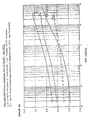
- the time expansion lines (ZDL) a) and b) correspond to the uncrosslinked polymer A and the ZDL c and d) correspond to the 100% crosslinked polymer A, the ZDL e) and f) an uncrosslinked, single-branched polyamide-12 with 85 ⁇ E / g amine functions (Polymer L), and the ZDL g) and h) the 100% crosslinked polymer L.
- FIG. 2 shows the time expansion lines of a polyamide-12 type M with three chain branches and 170 ⁇ E / g amine functions.
- the ZDL i) and k) correspond to the uncrosslinked starting polyamide, the lines l) and m) to the 100% crosslinked polyamide M.
- the polyamide L is manufactured similarly to polyamide C and the polyamide M similarly to polyamide G and each have the same Basic structure.
Landscapes
- Chemical & Material Sciences (AREA)
- Health & Medical Sciences (AREA)
- Chemical Kinetics & Catalysis (AREA)
- Medicinal Chemistry (AREA)
- Polymers & Plastics (AREA)
- Organic Chemistry (AREA)
- General Chemical & Material Sciences (AREA)
- Polyamides (AREA)
- Compositions Of Macromolecular Compounds (AREA)
- Processes Of Treating Macromolecular Substances (AREA)
- Injection Moulding Of Plastics Or The Like (AREA)
Claims (16)

et on fait réagir ce mélange, on soumet les produits réactionnels obtenus à un procédé de façonnage et finalement, on met les corps moulés obtenus en contact avec de l'eau ou de l'humidité.
Applications Claiming Priority (2)
| Application Number | Priority Date | Filing Date | Title |
|---|---|---|---|
| DE3819428 | 1988-06-07 | ||
| DE3819428 | 1988-06-07 |
Publications (2)
| Publication Number | Publication Date |
|---|---|
| EP0345649A1 EP0345649A1 (fr) | 1989-12-13 |
| EP0345649B1 true EP0345649B1 (fr) | 1991-10-23 |
Family
ID=6356072
Family Applications (1)
| Application Number | Title | Priority Date | Filing Date |
|---|---|---|---|
| EP89109959A Expired - Lifetime EP0345649B1 (fr) | 1988-06-07 | 1989-06-01 | Procédé de préparation de masses à mouler réticulées en polyamide |
Country Status (5)
| Country | Link |
|---|---|
| US (1) | US5055249A (fr) |
| EP (1) | EP0345649B1 (fr) |
| JP (1) | JPH0264151A (fr) |
| DE (1) | DE58900397D1 (fr) |
| ES (1) | ES2026716T3 (fr) |
Families Citing this family (11)
| Publication number | Priority date | Publication date | Assignee | Title |
|---|---|---|---|---|
| US5519109A (en) * | 1990-10-17 | 1996-05-21 | Henkel Kommanditgesellschaft Auf Aktien | Moisture-curing polyamides |
| US5589119A (en) * | 1994-12-22 | 1996-12-31 | New Southland, Inc. | Silicone elastomer seals for molded plastic parts |
| US6191252B1 (en) * | 1996-03-05 | 2001-02-20 | Brian J. Jensen | Method of preparing polymers with low melt viscosity |
| US5998551A (en) * | 1997-06-02 | 1999-12-07 | Lawrence A. Acquarulo | Crosslinked nylon block copolymers |
| US6946174B1 (en) * | 2000-10-12 | 2005-09-20 | Boston Scientific Scimed, Inc. | Moisture curable balloon materials |
| DE102005029169A1 (de) * | 2005-06-23 | 2006-12-28 | Wacker Chemie Ag | Kontinuierliche polymeranaloge Umsetzung von reaktiven Silanmonomeren mit funktionalisierten Polymeren |
| US8114515B2 (en) * | 2007-02-05 | 2012-02-14 | Sabic Innovative Plastics Ip B.V. | Crosslinked polyester compositions, method of manufacture, and uses thereof |
| US9771498B2 (en) * | 2009-11-20 | 2017-09-26 | Henkel IP & Holding GmbH | Moisture curable polyamides and methods for using the same |
| WO2011117344A1 (fr) | 2010-03-24 | 2011-09-29 | Basf Se | Polyamides à postréticulation et procédé de production correspondant |
| CN104804424B (zh) * | 2015-05-12 | 2017-02-01 | 华东理工大学 | 用于尼龙/玻璃纤维增强复合材料的界面增容剂及其制备方法 |
| CN106497044A (zh) * | 2016-11-18 | 2017-03-15 | 南京立汉化学有限公司 | 一种适用于免喷涂电焊面罩用增韧尼龙66材料及其制备方法 |
Family Cites Families (7)
| Publication number | Priority date | Publication date | Assignee | Title |
|---|---|---|---|---|
| JPS5314750A (en) * | 1976-07-28 | 1978-02-09 | Furukawa Electric Co Ltd:The | Process of preparing silane-bridged polyolefin moldings |
| CH660744A5 (de) * | 1982-11-05 | 1987-06-15 | Inventa Ag | Verfahren zur herstellung hochviskoser bzw. thermisch formstabiler, mindestens teilvernetzter polyamide. |
| US4857250A (en) * | 1984-04-13 | 1989-08-15 | Union Carbide Corporation | One-extrusion method of making a shaped crosslinkable extruded polymeric product |
| JPS60233132A (ja) * | 1984-05-02 | 1985-11-19 | Kao Corp | 架橋性重合体組成物 |
| CH663621A5 (en) * | 1984-10-29 | 1987-12-31 | Inventa Ag | Process for the production of mouldings from modified thermoplastic polyamides |
| US4783511A (en) * | 1984-10-29 | 1988-11-08 | Ems-Inventa Ag | Process for preparing moulded bodies from modified thermoplastic polyamides |
| DE3545032C1 (de) * | 1985-12-19 | 1990-01-25 | Inventa Ag | Verfahren zur Herstellung von Formkoerpern aus thermoplastischen Polyamiden |
-
1989
- 1989-06-01 ES ES198989109959T patent/ES2026716T3/es not_active Expired - Lifetime
- 1989-06-01 EP EP89109959A patent/EP0345649B1/fr not_active Expired - Lifetime
- 1989-06-01 DE DE8989109959T patent/DE58900397D1/de not_active Expired - Lifetime
- 1989-06-05 US US07/361,262 patent/US5055249A/en not_active Expired - Fee Related
- 1989-06-07 JP JP1143212A patent/JPH0264151A/ja active Pending
Also Published As
| Publication number | Publication date |
|---|---|
| DE58900397D1 (de) | 1991-11-28 |
| EP0345649A1 (fr) | 1989-12-13 |
| US5055249A (en) | 1991-10-08 |
| JPH0264151A (ja) | 1990-03-05 |
| ES2026716T3 (es) | 1992-05-01 |
Similar Documents
| Publication | Publication Date | Title |
|---|---|---|
| DE69915741T2 (de) | Verfahren zur Herstellung von Polyamiden | |
| DE69622749T3 (de) | Polyamid enthaltende zusammensetzung und verfahren zu ihrer herstellung | |
| EP1329481B1 (fr) | Masse à mouler à base de polyétheramide | |
| DE69817361T2 (de) | Thermoplastisches copolyamid, formmasse aus diesem | |
| EP0850974B1 (fr) | Polymides ramifiés en forme de H | |
| DE69225946T3 (de) | Transparente Polyamid-Mischungen mit hoher Beständigkeit gegenüber chemischen Mitteln | |
| DE69215201T2 (de) | Polyamiden und daraus hergestellter Gegenstände | |
| DE3339981C2 (fr) | ||
| EP0345649B1 (fr) | Procédé de préparation de masses à mouler réticulées en polyamide | |
| DE69904767T2 (de) | Nylon 12, Nylon 12-Zusammensetzungen, Verfahren zur Herstellung von Nylon 12 und röhrenförmiges Formteil aus Nylon 12 | |
| EP0345648A2 (fr) | Polyamides thermoplastiques façonnables | |
| EP3320024B1 (fr) | Fabrication d'un polyamide contenant 2,5-bis(aminomethyle)furane | |
| DE2426671A1 (de) | Schlagzaehe polymermischungen | |
| EP0327700B1 (fr) | Masses à mouler formées d'un polyamide aromatique thermoplastique façonnable | |
| DE3717928A1 (de) | Transparente copolyamide und ihre verwendung | |
| DE3728334C2 (fr) | ||
| DE102005023419A1 (de) | Polyamid-Oligomere und deren Verwendung | |
| EP0212478A2 (fr) | Masses à base de poly(sulfure de phénylène) cristallisant rapidement | |
| DE19859929A1 (de) | Verfahren zur Herstellung von verzweigten Polyamiden | |
| DE2330452A1 (de) | Polybenzoxazole und verfahren zu ihrer herstellung | |
| DE4421704A1 (de) | Verfahren zur Herstellung von hochmolekularem Polyamid 6 | |
| DE4208005C2 (de) | Aromatische Polyamide und Verfahren zu deren Herstellung | |
| DE3917926C2 (fr) | ||
| DE60112308T2 (de) | Copolyamide und zusammensetzungen auf basis dieser copolyamide | |
| DE69113177T2 (de) | Verfahren zur Herstellung von Polyätheramideblockpolymere für Spritzguss. |
Legal Events
| Date | Code | Title | Description |
|---|---|---|---|
| PUAI | Public reference made under article 153(3) epc to a published international application that has entered the european phase |
Free format text: ORIGINAL CODE: 0009012 |
|
| AK | Designated contracting states |
Kind code of ref document: A1 Designated state(s): CH DE ES FR GB IT LI |
|
| 17P | Request for examination filed |
Effective date: 19900323 |
|
| 17Q | First examination report despatched |
Effective date: 19900912 |
|
| ITF | It: translation for a ep patent filed | ||
| GRAA | (expected) grant |
Free format text: ORIGINAL CODE: 0009210 |
|
| AK | Designated contracting states |
Kind code of ref document: B1 Designated state(s): CH DE ES FR GB IT LI |
|
| ET | Fr: translation filed | ||
| REF | Corresponds to: |
Ref document number: 58900397 Country of ref document: DE Date of ref document: 19911128 |
|
| GBT | Gb: translation of ep patent filed (gb section 77(6)(a)/1977) | ||
| REG | Reference to a national code |
Ref country code: ES Ref legal event code: FG2A Ref document number: 2026716 Country of ref document: ES Kind code of ref document: T3 |
|
| PLBE | No opposition filed within time limit |
Free format text: ORIGINAL CODE: 0009261 |
|
| STAA | Information on the status of an ep patent application or granted ep patent |
Free format text: STATUS: NO OPPOSITION FILED WITHIN TIME LIMIT |
|
| 26N | No opposition filed | ||
| PGFP | Annual fee paid to national office [announced via postgrant information from national office to epo] |
Ref country code: GB Payment date: 19950524 Year of fee payment: 7 |
|
| PGFP | Annual fee paid to national office [announced via postgrant information from national office to epo] |
Ref country code: ES Payment date: 19950608 Year of fee payment: 7 |
|
| PGFP | Annual fee paid to national office [announced via postgrant information from national office to epo] |
Ref country code: CH Payment date: 19950609 Year of fee payment: 7 |
|
| PGFP | Annual fee paid to national office [announced via postgrant information from national office to epo] |
Ref country code: FR Payment date: 19950614 Year of fee payment: 7 |
|
| PGFP | Annual fee paid to national office [announced via postgrant information from national office to epo] |
Ref country code: DE Payment date: 19950830 Year of fee payment: 7 |
|
| PG25 | Lapsed in a contracting state [announced via postgrant information from national office to epo] |
Ref country code: GB Effective date: 19960601 |
|
| PG25 | Lapsed in a contracting state [announced via postgrant information from national office to epo] |
Ref country code: ES Free format text: LAPSE BECAUSE OF NON-PAYMENT OF DUE FEES Effective date: 19960603 |
|
| PG25 | Lapsed in a contracting state [announced via postgrant information from national office to epo] |
Ref country code: LI Effective date: 19960630 Ref country code: CH Effective date: 19960630 |
|
| GBPC | Gb: european patent ceased through non-payment of renewal fee |
Effective date: 19960601 |
|
| REG | Reference to a national code |
Ref country code: CH Ref legal event code: PL |
|
| PG25 | Lapsed in a contracting state [announced via postgrant information from national office to epo] |
Ref country code: FR Effective date: 19970228 |
|
| PG25 | Lapsed in a contracting state [announced via postgrant information from national office to epo] |
Ref country code: DE Effective date: 19970301 |
|
| REG | Reference to a national code |
Ref country code: FR Ref legal event code: ST |
|
| REG | Reference to a national code |
Ref country code: ES Ref legal event code: FD2A Effective date: 19990503 |
|
| PG25 | Lapsed in a contracting state [announced via postgrant information from national office to epo] |
Ref country code: IT Free format text: LAPSE BECAUSE OF NON-PAYMENT OF DUE FEES Effective date: 20050601 |