EP0346384B1 - System und verfahren zur bestimmung der organischen verbindungen in einer wässrigen lösung - Google Patents
System und verfahren zur bestimmung der organischen verbindungen in einer wässrigen lösung Download PDFInfo
- Publication number
- EP0346384B1 EP0346384B1 EP88902362A EP88902362A EP0346384B1 EP 0346384 B1 EP0346384 B1 EP 0346384B1 EP 88902362 A EP88902362 A EP 88902362A EP 88902362 A EP88902362 A EP 88902362A EP 0346384 B1 EP0346384 B1 EP 0346384B1
- Authority
- EP
- European Patent Office
- Prior art keywords
- solution
- carbon dioxide
- aqueous solution
- product
- organic matter
- Prior art date
- Legal status (The legal status is an assumption and is not a legal conclusion. Google has not performed a legal analysis and makes no representation as to the accuracy of the status listed.)
- Expired - Lifetime
Links
Images



Classifications
-
- G—PHYSICS
- G01—MEASURING; TESTING
- G01N—INVESTIGATING OR ANALYSING MATERIALS BY DETERMINING THEIR CHEMICAL OR PHYSICAL PROPERTIES
- G01N33/00—Investigating or analysing materials by specific methods not covered by groups G01N1/00 - G01N31/00
- G01N33/18—Water
- G01N33/1826—Organic contamination in water
- G01N33/1846—Total carbon analysis
-
- G—PHYSICS
- G01—MEASURING; TESTING
- G01N—INVESTIGATING OR ANALYSING MATERIALS BY DETERMINING THEIR CHEMICAL OR PHYSICAL PROPERTIES
- G01N31/00—Investigating or analysing non-biological materials by the use of the chemical methods specified in the subgroup; Apparatus specially adapted for such methods
- G01N31/005—Investigating or analysing non-biological materials by the use of the chemical methods specified in the subgroup; Apparatus specially adapted for such methods investigating the presence of an element by oxidation
Definitions
- This invention relates to methods systems for qualitatively and quantitatively determining organic matter in an aqueous solution including an oxidizing agent.
- TOC total organic carbon
- the combustion method is capable of rapid analysis on small samples (100 ⁇ L to 200 ⁇ L), however, it is not ideally suited for the accurate measurement of low TOC concentrations (less than 1 ppm).
- the photooxidation method is better suited to the determination of lower TOC concentrations than the combustion method since much larger samples can be used (up to 100 mL).
- ultraviolet light of 180 to 260 nm wavelength or shorter is commonly used.
- Low pressure mercury vapour lamps have a major emission at 184.9 and medium pressure mercury lamps have a major emission at 253.7 nm. Both types of lamp may be used to effect photochemical oxidations (Danny M. Mar U.S. Pat. 4,273,558).
- Persulfate ions are frequently added to promote the oxidation (Janice L. Haverty, Ultrapure Water, Sept/Oct 1984). Regardless of which ultraviolet lamp is used it is essential to use a quartz envelope around the lamp and between the lamp and the solution in order to transmit a maximum amount of ultraviolet light.
- the photo-induced oxidation is believed to involve hydroxyl radicals in the case of the 184.9 nm light and sulfate radicals when persulfate photooxidation is used.
- Sulfate radicals are generally less effective than hydroxyl radicals in the oxidation of organics (P. Neta and R. E. Huie, J. Phys. Chem. 90 , 4644 [1986]) but react with water to give hydroxy radicals (R.W. Matthews, H.A. Mahlman, and T.J. Sworski, J. Phys. Chem. 76 , 1265 [1972]).
- the rate is enhanced by the addition of persulfate presumably because of the greater yield of photolytically generated oxidizing radicals.
- one of the main disadvantages of the photooxidation method is that different organic compounds very often have different rates of photooxidation. Unless the relative ratios and the nature of organic compounds within a given aqueous solution are known, it is difficult to accurately compare the yield of carbon dioxide liberated therefrom as a result of photooxidation, with a calibration curve of the yield of carbon dioxide liberated from an aqueous solution of known organic compounds of different relative ratios and/or which are different from the aforementioned organic compounds.
- formalin solutions are used to disinfect kidney dialysis machines after change of filters. After rinsing with water it must be ensured that no trace of formaldehyde remains in the machine and thus it is necessary to analyse the water used for the final rinse.
- the present inventor has found that photocatalytic oxidation over thin films of titanium dioxide illuminated with near ultraviolet light is a powerful method of oxidizing dissolved organic solutes in aqueous solution.
- the ambient oxygen dissolved in the aqueous solution is the oxidizing agent and the photogenerated holes or hydroxyl radicals are the photocatalytic reactive intermediates.
- the reaction appears to be quite general for all organics in solution.
- a number of organic compounds have been shown to be totally mineralized (that is, converted to inorganic products) and it seems likely that this will occur with most organic compounds. Since photocatalytic oxidation is a fast, simple and inexpensive technique it would be advantageous if the technique could be utilized to detect the presence of an organic compound in water or an aqueous composition.
- the inventor has found that the amount of carbon dioxide liberated by photocatalytically oxidising a wide variety of organic compounds in an aqueous solution is relatively insensitive (rate of formation of CO2 from a wide variety of organic compounds within a factor of 4.6 - see Table 1 in Australian Patent Appl. AU-B-76028/87 to the nature of the organic compound.
- the present inventor has found the absence or presence of photocatalytically oxidized by-products of an organic compound in water or an aqueous composition can be utilised to indicate whether the organic compound was originally present in the liquid.
- the inventor has also found that when the organic compound is present in the water or in the aqueous composition, after photocatalytic oxidation of the organic compound the concentration of resultant oxidized by-products can be utilized to determine the initial concentration of the organic compound in the liquid.
- the aqueous solution is an acidified aqueous solution whereby the by-product comprises carbon dioxide.
- the aqueous solution is acidified after step (b) to convert the by-products comprising inorganic carbonate(s) to carbon dioxide.
- the carbon dioxide can be purged from the aqueous solution with a gas other than carbon dioxide and the purged carbon dioxide can be detected. The amount of the purged carbon dioxide is then determined and the total carbon concentration in the solution is determined from the amount of the purged carbon dioxide.
- the amount of the purged carbon dioxide is determined by dissolving the purged carbon dioxide in water and measuring the change in conductivity of the water caused by the dissolving.
- the by-product(s) is detected by measuring the change in an electrical characteristic of the solution caused by the photocatalytic oxidation, the amount of the by-product is determined from the magnitude of the change and the concentration of the organic matter is determined from the amount. It is preferred that the electrical characteristic is conductivity.
- the solution is agitated during the illuminating.
- the solution can be agitated by bubbling and/or pumping air or oxygen through the solution.
- the oxidizing agent can be ambient oxygen or hydrogen peroxide or other suitable agent.
- the systems of the third and fourth embodiments also include means for purging the carbon dioxide from the aqueous solution with a gas other than carbon dioxide
- the means for detecting is adapted to detect the purged carbon dioxide and the means for purging is operatively associated with or operatively coupled to the reactor.
- the means for detecting is a conductivity cell is operatively associated with or operatively coupled to the reactor.
- systems of the third and fourth embodiments further includes means for agitating the solution, operatively associated with or operatively coupled to the reactor such as a pump.
- any semiconductor which can photocatalytically oxidise organic carbon compounds to carbon dioxide can be used. Titanium dioxide is especially preferred.
- Other preferred photocatalytic metal oxides include niobium pentoxide, strontium titanate, indium trioxide, calcium titanate, tungsten trioxide, barium titanate, iron (III) oxide, zinc oxide, potassium tantalate, tin dioxide and cadmium oxide.
- Other photocatalytic metal oxides include hafmium oxide, zirconium oxide, tantalum pentoxide, chromium trioxide and yttrium trioxide. It is especially preferred that the semiconductor is relatively stable in aqueous solution.
- the metal oxide particles can be loaded with a metal catalyst or metal oxide catalyst such as Pt, Ag, Au, Ru, RuO2, Pd and PdO or mixtures thereof.
- a metal catalyst or metal oxide catalyst such as Pt, Ag, Au, Ru, RuO2, Pd and PdO or mixtures thereof.
- the semiconductor is preferably in the form of fine particles preferably less than 500 ⁇ m, more preferably less than 50 ⁇ m and even more preferably less than 5 ⁇ m. It is especially preferred that the average particle size of the metal oxide particles is about 30nm.
- the semiconductor is coated on a substrate which is preferably selected from the group consisting of silica, teflon, silica gel, soda glass, diatomaceous earth, borosilicate glass, aluminium oxide, mullite, cordierite, sintered porous glass and glass mesh. It is especially preferred that when semiconductor photocatalytic metal oxides are coated onto any of the above substrates that the process of coating is one of the coating processes disclosed in Australian Patent Appl. AU-B-76028/87.
- a preferred form of substrate is bead form of diameters in the range between 0.01mm to 5mm.It is preferred that the substrate is in the form of particles of uniform size such as uniformly-sized beads. With respect to titanium dioxide these substrates have the following advantages:
- titanium dioxide can be attached to borosilicate glass tubing, glass mesh, glass beads, sand, diatomaceous earth, teflon, and silica gel by the process of the invention and still retain its ability to photo-oxidize organic compounds in water (see Australian Application No. 76028/87 the contents of which are incorporated herein). Furthermore, titanium dioxide has been found to be retained by the supporting material after repeated washing with water.
- organic compounds which can be detected using the method of the invention are benzene, phenol, monochlorobenzene, nitrobenzene, aniline, benzoic acid, catechol, resorcinol, hydroquinone, 1,2 dichlorobenzene, 2 bromophenol, 3 iodophenol, thiocresol, sulfosalicylic acid, phosphoserine, 2 chlorophenol, 3 chlorophenol, 4 chlorophenol, 2,4 dichlorophenol, 2,4,6 trichlorophenol, methyl viologen, 2 naphthol, chloroform, salicylic acid, fluorescein, trichloroethylene, ethylene diamine, dichloroethane and formalin.
- Aqueous solutions containing these compounds on photocatalytic oxidation produce ionic species such as HCO - 3 , CO 2- 3 , Cl ⁇ , Br ⁇ , I ⁇ , NO - 3 , PO 3- 4 , SO 2- 4 and consequently there is a concomitant significant increase in the conductivity of such solutions. It is possible to use the method of the invention to determine the increase in conductivity as a sensitive detector of these compounds and obtain a measurement of the concentration which is not easily obtained by other means. Alcohols, for example, have poor optical absorption characteristics in the ultraviolet region of the spectrum but can readily be detected by an increase in conductivity after photocatalytic oxidation.
- photocatalytic oxidation with conductivity detection in HPLC methods to detect other compounds for which sensitive methods of detection are not readily available.
- An example of one application of photocatalytic oxidation over thin films of titanium dioxide to chemical analysis is in the detection of formalin.
- a HPLC detector is used to detect the by-product(s).
- the semiconductor is incorporated into silica gel. It is especially preferred that when semiconductor photocatalytic metal oxides are incorporated into silica gel that the process of incorporation is in accordance with the silica gel incorporation process disclosed in Australian Patent Appl. AU-B-76028/87.
- the photoreactor is a container or tube and at least a portion of the internal walls of the container or tube are coated with the semiconductor. If the photoreactor is constructed from any of the above substrates it is preferred that the process of coating is one of the coating processes disclosed in Australian Patent Appl. AU-B-76028/87. Where the photoreactor is constructed from material that is transparent to light of energy greater than the band gap of the semiconductor it is preferred that the illumination means is disposed external of the reactor so as to illuminate the semiconductor through the photoreactor. For example, where TiO2 is used as the semiconductor the photoreactor can be made of borosilicate glass or quartz since both materials transmit light greater than the band gap of TiO2.
- the photoreactor is constructed of transparent materials but the internal walls of the photoreactor is coated with a semiconductor the thickness of which is of such magnitude that it significantly attenuates illumination from illumination means disposed external of the photoreactor or the photoreactor is constructed from opaque or substantially opaque material the illumination means can be disposed within the photoreactor.
- the illumination means is selected so as to provide light having energy greater than the bandgap of the particular semiconductor chosen.
- the illumination means can be a mercury lamp, a xenon lamp, sunlight, or a near ultraviolet fluorescent tube.
- Total inorganic carbonate can be determined by standard procedures. For example, total inorganic carbonate can be determined by acidification of the aqueous solution with no light and measuring the formed carbon dioxide.
- the methods of the first and second embodiments and the systems of the third and fourth embodiments have advantages over conventional photooxidation methods and systems since if, for example, a TiO2 photocatalyst is used, the illumination means is more readily available and the TiO2 photocatalyst is chemically stable and may be reused.
- borosilicate glass is transparent to near U.V. light it may be used for construction of the photoreactor thus dispensing with the need for using expensive quartz photoreactors. Solutes transparent to UV light are not readily photooxidized but may be photocatalytically oxidized because the semiconductor is photoactivated although the solute may not be. More uniform oxidation rates for different solutes occur with photocatalytic oxidation. Thus total oxidation and reliable results are more regularly received.
- a system 100 for determining total carbon and total organic carbon in an aqueous solution includes a spiral borosilicate glass photoreactor 104 through which the aqueous solution is circulated by peristaltic pump 106 via loading port 102 and Tee junction 105.
- Photoreactor 104 is disposed about 20-12W U.V. fluorescent tube 103.
- Conductivity cell 108 is linked with loading port 102 via tube 101 and with Tee junction 105 via tube 107.
- Cell 108 has associated conductivity meter 109 to measure any conductivity change in cell 108.
- a thin film of titanium dioxide photocatalyst is coated on the inner surface of photoreactor 104. The thin film coating can be formed according to the coating process disclosed in Australian Patent Appl. AU-B-76028/87 or any other suitable coating procedure. Alternatively a small quantity of powdered TiO2 photocatalyst can be added to an aqueous solution recirculated through an uncoated photoreactor 104.
- an aqueous solution is added to loading port 102 and is pumped around loop 102-105-106-104 by pump 106.
- Air in tube 107 mixes with the aqueous solution at Tee junction 105 and is pumped through photoreactor 104 in serried ranks of bubbles.
- the aqueous solution is acidified to liberate carbon dioxide from inorganic carbonates therein.
- Tube 103 is switched on to illuminate the TiO2 coating causing photocatalytic oxidation to CO2 in photoreactor 104. Bubbles separate from the aqueous solution at loading port 102 and are drawn through conductivity cell 108 via tube 101, whilst the aqueous solution is recirculated via Tee junction 105 where it contacts air again.
- the apparatus can be calibrated by injecting measured volumes of carbon dioxide into the apparatus or by adding known volumes of a solution of a primary standard organic compound such as potassium hydrogen phthalate. In the present experiments both techniques were used.
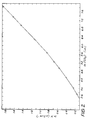
- the specific conductance of cell 108 is related to the carbon dioxide present by a log/log relationship (Fig. 2), approximately linear at higher carbon dioxide concentrations.
- the inorganic carbon and total carbon from a 40 mL sample of Sydney mainswater was determined in system 100 and the results are shown in Fig.4.
- the TOC is below the limit of accurate detection of many combustion TOC analyzers.
- a system 10 for detecting the presence of or determining the concentration of an organic compound in water or an aqueous composition including an oxidising agent includes a photochemical reactor 11 spirally disposed about a UV fluorescent tube 12. A thin film of titanium dioxide is attached to the inner surface of tube 11. The water or aqueous composition is poured into reservoir 17 and recirculated through tube 11 and connecting tubes 15 and 16 by pump 13 via conductivity cell 14.
- the presence of an organic compound in water or an aqueous composition is detected using system 10 by filling reservoir 17 with the water or aqueous composition.
- the water or aqueous composition which has been exposed to ambient oxygen is recirculated through tube 15, photoreactor 11 and tube 16 via conductivity cell 14 by pump 13 and the initial conductivity of the liquid is measured using cell 14 with tube 12 inactivated.
- Tube 12 is then activated so that it illuminates the coating of TiO2 in photoreactor 11 so as to photocatalytically-oxidize any organic compound present in the recirculating liquid.
- the final conductivity of the liquid is measured using cell 14.
- the initial and final conductivities are compared with each other. When there is no organic compound present in the liquid the initial and final conductivities are the same. When an organic compound is present in the liquid the final conductivity is greater than the initial conductivity due to the presence of oxidized by-products of the organic compound in the water or aqueous composition.
- the concentration of an organic compound in water or an aqueous composition is determined using system 10 by filling reservoir 17 with the water or aqueous composition.
- the initial and final conductivities of the water or aqueous composition are determined in an analogous manner to the method described above for determining the presence of an organic compound in water or an aqueous composition.
- the initial and final conductivities are then compared with each other and the concentration of the organic compound is ascertained from the magnitude of the difference between the initial and final conductivities.
- High purity water (40mL) was circulated through the spiral photoreactor coated with a thin film of TiO2 as used in the total organic carbon analyzer in series with a conductivity cell as shown in Fig. 1.
- the conductivity in the cell increased marginally with illumination time as shown by the results in Table 1 column 2.
- 0.10 mL of a 1% formalin solution (giving a 15 ppm solution of HCHO) was added, a significant increase in conductivity was obtained shown by the results in column 3 of Table 1.
- System 10 can be calibrated using known amounts of formaldehyde to enable the quantitative estimation of formaldehyde in the solution from the increase in conductivity. Similar experiments can be run with other organic compounds.
- the methods and systems of the invention are particularly suitable for detection or measurement of low total carbon concentrations (less than 1ppm) in an aqueous solution.
Landscapes
- Life Sciences & Earth Sciences (AREA)
- Health & Medical Sciences (AREA)
- Chemical & Material Sciences (AREA)
- General Physics & Mathematics (AREA)
- Physics & Mathematics (AREA)
- Analytical Chemistry (AREA)
- Biochemistry (AREA)
- General Health & Medical Sciences (AREA)
- Immunology (AREA)
- Pathology (AREA)
- Molecular Biology (AREA)
- Engineering & Computer Science (AREA)
- Food Science & Technology (AREA)
- Medicinal Chemistry (AREA)
- Investigating Or Analyzing Non-Biological Materials By The Use Of Chemical Means (AREA)
- Investigating Or Analyzing Materials By The Use Of Electric Means (AREA)
Claims (21)
- Verfahren zur qualitativen Bestimmung einer organischen Substanz in einer wässrigen Lösung, die ein Oxidationsmittel enthält, bei dem man:(a) die Lösung mit einem Halbleiter in Kontakt bringt, der in der Lage ist, die organische Substanz photokatalytisch zu oxidieren;(b) den Halbleiter mit Licht einer Wellenlänge oder mit einem Spektrum beleuchtet, wodurch der Halbleiter die organische Substanz in der Lösung unter Bildung eines photokatalytischen Nebenproduktes/Nebenprodukten photokatalytisch oxidiert, und(c) das Nebenprodukt/die Nebenprodukte nachweist.
- Verfahren zur quantitativen Bestimmung einer organischen Substanz in einer wässrigen Lösung, umfassend das Verfahren nach Anspruch 1, bei dem man zusätzlich:(d) einen Parameter des Nebenproduktes/der Nebenprodukte, der zur Konzentration oder der Menge davon in Bezug steht, mißt,(e) die Konzentration der organischen Substanz in der Lösung aus dem Parameter des Nebenproduktes/der Nebenprodukte bestimmt.
- Verfahren nach Anspruch 1 oder 2, bei dem die wässrige Lösung eine angesäuerte wässrige Lösung ist, wobei das Nebenprodukt Kohlendioxid enthält.
- Verfahren nach Anspruch 1 oder 2, bei dem die wässrige Lösung nach Stufe (b) angesäuert wird, um die Nebenprodukte, die anorganisches Carbonat/Carbonate enthalten, in Kohlendioxid zu überführen.
- Verfahren nach Anspruch 3 oder 4, bei dem man das Kohlendioxid aus der wässrigen Lösung mit einem von Kohlendioxid verschiedenen Gas ausspült und das ausgespülte Kohlendioxid nachweist.
- Verfahren nach Anspruch 5, bei dem man die Menge des ausgespülten Kohlendioxids bestimmt und die gesamte Kohlenstoffkonzentration in der Lösung aus der Menge des ausgespülten Kohlendioxids bestimmt.
- Verfahren nach Anspruch 6, bei dem man die Menge des ausgespülten Kohlendioxids durch Auflösen des ausgespülten Kohlendioxids in Wasser bestimmt und die Änderung der Leitfähigkeit des Wassers ausgelöst durch das Auflösen mißt.
- Verfahren nach Anspruch 1, bei dem man das Nebenprodukt/die Nebenprodukte durch Messen der Änderung einer elektrischen Eigenschaft der Lösung, hervorgerufen durch die photokatalytische Oxidation, nachweist.
- Verfahren nach Anspruch 2, bei dem man das Nebenprodukt/die Nebenprodukte durch Messen der Änderung einer elektrischen Eigenschaft der Lösung, hervorgerufen durch die photokatalytische Oxidation, nachweist, wobei man die Menge des Nebenproduktes aus der Größe der Änderung bestimmt und die Konzentration der organischen Substanz aus diesem Wert bestimmt.
- Verfahren nach Anspruch 8 oder 9, bei dem die elektrische Eigenschaft die Leitfähigkeit ist.
- Verfahren nach einem der Ansprüche 1 bis 10, bei dem man die Lösung während der Beleuchtung bewegt.
- Verfahren nach Anspruch 11, bei dem man die Lösung durch Durchblasen und/oder Einpumpen von Luft oder Sauerstoff durch die Lösung bewegt und die wässrige Lösung eine angesäuerte wässrige Lösung ist, wobei das Nebenprodukt Kohlendioxid enthält.
- System für die qualitative Bestimmung einer organischen Substanz in einer wässrigen Lösung, die ein Oxidationsmittel enthält, wobei das System umfaßt:(i) einen photokatalytischen Reaktor (104) mit einem Halbleiter, der in der Lage ist, die organische Substanz unter Bildung eines photokatalytischen Nebenproduktes/von Nebenprodukten photokatalytisch zu oxidieren, wobei der Halbleiter im Reaktor so angeordnet ist, daß er mit der Lösung, wenn diese im Reaktor (104) vorhanden ist, in Kontakt tritt;(ii) eine Beleuchtungsquelle (103), die so angebracht ist, daß sie den Halbleiter im Reaktor (104) beleuchtet, wobei die Quelle (103) in der Lage ist, Licht einer Wellenlänge oder mit einem Spektrum auszusenden, wobei bei Beleuchtung des Halbleiters, der in Kontakt mit der Lösung steht, der Halbleiter die organische Substanz in der Lösung photokatalytisch oxidiert, und(iii) Vorrichtungen (108), die mit dem Reaktor (104) operativ verbunden oder gekoppelt sind, zum Nachweis des Nebenproduktes/der Nebenprodukte.
- System zur quantitativen Bestimmung einer organischen Substanz in einer wässrigen Lösung, wobei das System das in Anspruch 13 definierte System umfaßt, und zusätzlich umfasst:(d) Vorrichtungen zur Messung eines Parameters des Nebenproduktes/der Nebenprodukte, der zur Konzentration oder der Menge davon in Bezug steht, die mit den Vorrichtungen zum Nachweis des Nebenproduktes/der Nebenprodukte operativ verbunden oder gekoppelt sind.
- System nach Anspruch 14, das zusätzlich umfaßt:(e) Berechnungsvorrichtungen, die mit den Vorrichtungen zur Messung eines Parameters zur Berechnung der Konzentration der organischen Substanz in der Lösung aus dem Parameter des Nebenproduktes/der Nebenprodukte, operativ verbunden oder gekoppelt sind.
- System nach einem der Ansprüche 13 bis 15, in dem die wässrige Lösung eine angesäuerte wässrige Lösung ist, wobei das Nebenprodukt Kohlendioxid enthält.
- System nach Anspruch 16, das zusätzlich Vorrichtungen zum Ausspülen des Kohlendioxids aus der wässrigen Lösung mit einem von Kohlendioxid verschiedenem Gas enthält, wobei die Vorrichtungen zum Nachweis des ausgespülten Kohlendioxids ausgebildet sind, und die Vorrichtungen zum Ausspülen mit dem Reaktor operativ verbunden oder gekoppelt sind.
- System nach Anspruch 17, in dem die Nachweisvorrichtungen eine Leitfähigkeitszelle ist.
- System nach Anspruch 13, in dem die Nachweisvorrichtungen eine Leitfähgkeitszelle ist, die mit dem Reaktor operativ verbunden oder gekoppelt ist.
- System nach einem der Ansprüche 13 bis 19, das zusätzlich Vorrichtungen zum Bewegen der Lösung enthält, die mit dem Reaktor operativ verbunden oder gekoppelt sind.
- System nach Anspruch 20, in dem die Vorrichtung zum Bewegen eine Pumpe ist.
Applications Claiming Priority (3)
| Application Number | Priority Date | Filing Date | Title |
|---|---|---|---|
| AU601/87 | 1987-03-02 | ||
| AUPI060187 | 1987-03-02 | ||
| PCT/AU1988/000059 WO1988006730A1 (en) | 1987-03-02 | 1988-03-02 | Method and system for determining organic matter in an aqueous solution |
Publications (3)
| Publication Number | Publication Date |
|---|---|
| EP0346384A1 EP0346384A1 (de) | 1989-12-20 |
| EP0346384A4 EP0346384A4 (en) | 1991-04-03 |
| EP0346384B1 true EP0346384B1 (de) | 1994-06-01 |
Family
ID=3772041
Family Applications (1)
| Application Number | Title | Priority Date | Filing Date |
|---|---|---|---|
| EP88902362A Expired - Lifetime EP0346384B1 (de) | 1987-03-02 | 1988-03-02 | System und verfahren zur bestimmung der organischen verbindungen in einer wässrigen lösung |
Country Status (6)
| Country | Link |
|---|---|
| EP (1) | EP0346384B1 (de) |
| JP (1) | JP2706290B2 (de) |
| AT (1) | ATE106564T1 (de) |
| AU (1) | AU597165B2 (de) |
| DE (1) | DE3889908T2 (de) |
| WO (1) | WO1988006730A1 (de) |
Families Citing this family (9)
| Publication number | Priority date | Publication date | Assignee | Title |
|---|---|---|---|---|
| CN1102445C (zh) * | 1993-12-10 | 2003-03-05 | 东陶机器株式会社 | 具有光催化功能的多功能材料及其制造方法 |
| US5531961A (en) * | 1995-02-10 | 1996-07-02 | Isco, Inc. | Water impurity analyzer |
| US5994146A (en) * | 1995-02-10 | 1999-11-30 | Isco, Inc. | Water impurity analysis method |
| JP2001311710A (ja) * | 2000-02-23 | 2001-11-09 | Japan Organo Co Ltd | 多元電気伝導度測定装置 |
| JP2002005880A (ja) * | 2000-06-22 | 2002-01-09 | Koshu Ike | Bod測定装置 |
| JP2002136805A (ja) * | 2000-11-02 | 2002-05-14 | Japan Organo Co Ltd | 濃度測定装置付き高分子凝集剤溶解装置 |
| WO2007139209A1 (en) * | 2006-05-31 | 2007-12-06 | Semiconductor Energy Laboratory Co., Ltd. | Display device and electronic device |
| GB2439099A (en) * | 2006-06-12 | 2007-12-19 | Ugcs | Method and apparatus for determining the biomass activity of a fluid |
| WO2015179871A1 (en) * | 2014-05-23 | 2015-11-26 | Hach Company | Measurement of total organic carbon |
Family Cites Families (5)
| Publication number | Priority date | Publication date | Assignee | Title |
|---|---|---|---|---|
| US3530292A (en) * | 1967-04-26 | 1970-09-22 | Union Carbide Corp | Apparatus and method for determination and measurement of carbon in aqueous solutions |
| JPS51140687A (en) * | 1975-05-29 | 1976-12-03 | Denki Kagaku Keiki Co Ltd | Method for measuring total organic carbo in drinking water |
| US4273558A (en) * | 1980-03-07 | 1981-06-16 | Envirotech Corporation | Determination of total organic carbon in an aqueous sample containing halide ion |
| DE3120021C2 (de) * | 1981-05-20 | 1987-07-09 | Daimler-Benz Ag, 7000 Stuttgart | Anordnung zur Radkühlung an Kraftfahrzeugen |
| AU600289B2 (en) * | 1986-07-22 | 1990-08-09 | Commonwealth Scientific And Industrial Research Organisation | Coating photoactive metal oxides onto substrates |
-
1988
- 1988-03-02 JP JP63502175A patent/JP2706290B2/ja not_active Expired - Lifetime
- 1988-03-02 WO PCT/AU1988/000059 patent/WO1988006730A1/en not_active Ceased
- 1988-03-02 EP EP88902362A patent/EP0346384B1/de not_active Expired - Lifetime
- 1988-03-02 AU AU13985/88A patent/AU597165B2/en not_active Expired
- 1988-03-02 DE DE3889908T patent/DE3889908T2/de not_active Expired - Lifetime
- 1988-03-02 AT AT88902362T patent/ATE106564T1/de not_active IP Right Cessation
Also Published As
| Publication number | Publication date |
|---|---|
| WO1988006730A1 (en) | 1988-09-07 |
| JP2706290B2 (ja) | 1998-01-28 |
| DE3889908D1 (de) | 1994-07-07 |
| EP0346384A4 (en) | 1991-04-03 |
| AU597165B2 (en) | 1990-05-24 |
| EP0346384A1 (de) | 1989-12-20 |
| AU1398588A (en) | 1988-09-26 |
| ATE106564T1 (de) | 1994-06-15 |
| DE3889908T2 (de) | 1995-01-05 |
| JPH02503111A (ja) | 1990-09-27 |
Similar Documents
| Publication | Publication Date | Title |
|---|---|---|
| US5244811A (en) | Method and system for determining organic matter in an aqueous solution | |
| Matthews et al. | Photocatalytic oxidation for total organic carbon analysis | |
| US5902751A (en) | Method and apparatus for the measurement of dissolved carbon | |
| Matthews | Photocatalytic oxidation and adsorption of methylene blue on thin films of near-ultraviolet-illuminated TiO2 | |
| US4277438A (en) | Method and apparatus for measuring the amount of carbon and other organics in an aqueous solution | |
| Braman | Membrane probe-spectral emission type detection system for mercury in water | |
| Donkerbroek et al. | Some aspects of room-temperature phosphorescence in liquid solutions | |
| AU597165B2 (en) | Method and system for determining organic matter in an aqueous solution | |
| Mattsson et al. | Determination of selenium in freshwaters by cathodic stripping voltammetry after UV irradiation | |
| Psarellis et al. | Flow-injection chemiluminometric determination of sodium cyclamate | |
| CN111948303B (zh) | 一种利用探针化合物检测羟基自由基浓度的方法 | |
| JP4243165B2 (ja) | 化学的酸素要求量測定方法及びシステム並びに光反応器 | |
| JPH06148172A (ja) | Codの測定方法 | |
| JPH0727706A (ja) | 水中の窒素化合物及びリン化合物の分析装置 | |
| JPH07243973A (ja) | 酸性ガスまたはアルカリ性ガスの検知材及びその製造方法並びに検知装置 | |
| CN107655844A (zh) | 用于铜离子比色法的显色剂、铜离子比色法传感器及其使用方法和用途 | |
| JP3034640B2 (ja) | 還元性物質及び酸化性物質の検出方法及びその装置 | |
| JPH09127005A (ja) | 水中化合物の分析方法 | |
| US3540849A (en) | Analysis of aldehydes,unsaturated hydrocarbons and ketones | |
| Kobayashi et al. | A continuous method of monitoring water quality by chlorine consumption under ultraviolet radiation | |
| JP4767064B2 (ja) | Cod測定システム及びそれに用いる塩化物イオン除去装置 | |
| CN207779891U (zh) | 铜离子比色法传感器 | |
| De Andrade et al. | A continuous flow cold vapour procedure for mercury determination by atomic emission using the reverse flow injection approach | |
| CN113376149A (zh) | 一种利用超长光纤流通池-分光光度酚红法检测低浓度游离溴的方法及其应用 | |
| JPH0727758A (ja) | 水中の窒素化合物及びリン化合物の分析方法並びに光酸化分解装置 |
Legal Events
| Date | Code | Title | Description |
|---|---|---|---|
| PUAI | Public reference made under article 153(3) epc to a published international application that has entered the european phase |
Free format text: ORIGINAL CODE: 0009012 |
|
| 17P | Request for examination filed |
Effective date: 19890904 |
|
| AK | Designated contracting states |
Kind code of ref document: A1 Designated state(s): AT BE CH DE FR GB IT LI LU NL SE |
|
| A4 | Supplementary search report drawn up and despatched |
Effective date: 19910214 |
|
| AK | Designated contracting states |
Kind code of ref document: A4 Designated state(s): AT BE CH DE FR GB IT LI LU NL SE |
|
| 17Q | First examination report despatched |
Effective date: 19930430 |
|
| GRAA | (expected) grant |
Free format text: ORIGINAL CODE: 0009210 |
|
| AK | Designated contracting states |
Kind code of ref document: B1 Designated state(s): AT BE CH DE FR GB IT LI LU NL SE |
|
| PG25 | Lapsed in a contracting state [announced via postgrant information from national office to epo] |
Ref country code: IT Free format text: LAPSE BECAUSE OF FAILURE TO SUBMIT A TRANSLATION OF THE DESCRIPTION OR TO PAY THE FEE WITHIN THE PRESCRIBED TIME-LIMIT;WARNING: LAPSES OF ITALIAN PATENTS WITH EFFECTIVE DATE BEFORE 2007 MAY HAVE OCCURRED AT ANY TIME BEFORE 2007. THE CORRECT EFFECTIVE DATE MAY BE DIFFERENT FROM THE ONE RECORDED. Effective date: 19940601 Ref country code: LI Effective date: 19940601 Ref country code: CH Effective date: 19940601 Ref country code: FR Effective date: 19940601 Ref country code: AT Effective date: 19940601 Ref country code: BE Effective date: 19940601 Ref country code: NL Effective date: 19940601 |
|
| REF | Corresponds to: |
Ref document number: 106564 Country of ref document: AT Date of ref document: 19940615 Kind code of ref document: T |
|
| REF | Corresponds to: |
Ref document number: 3889908 Country of ref document: DE Date of ref document: 19940707 |
|
| PG25 | Lapsed in a contracting state [announced via postgrant information from national office to epo] |
Ref country code: SE Effective date: 19940901 |
|
| REG | Reference to a national code |
Ref country code: CH Ref legal event code: PL |
|
| EN | Fr: translation not filed | ||
| NLV1 | Nl: lapsed or annulled due to failure to fulfill the requirements of art. 29p and 29m of the patents act | ||
| PG25 | Lapsed in a contracting state [announced via postgrant information from national office to epo] |
Ref country code: LU Free format text: LAPSE BECAUSE OF NON-PAYMENT OF DUE FEES Effective date: 19950331 |
|
| PLBE | No opposition filed within time limit |
Free format text: ORIGINAL CODE: 0009261 |
|
| STAA | Information on the status of an ep patent application or granted ep patent |
Free format text: STATUS: NO OPPOSITION FILED WITHIN TIME LIMIT |
|
| 26N | No opposition filed | ||
| REG | Reference to a national code |
Ref country code: GB Ref legal event code: IF02 |
|
| PGFP | Annual fee paid to national office [announced via postgrant information from national office to epo] |
Ref country code: DE Payment date: 20070316 Year of fee payment: 20 |
|
| PGFP | Annual fee paid to national office [announced via postgrant information from national office to epo] |
Ref country code: GB Payment date: 20070322 Year of fee payment: 20 |
|
| REG | Reference to a national code |
Ref country code: GB Ref legal event code: PE20 |
|
| PG25 | Lapsed in a contracting state [announced via postgrant information from national office to epo] |
Ref country code: GB Free format text: LAPSE BECAUSE OF EXPIRATION OF PROTECTION Effective date: 20080301 |