EP0346962A1 - Verfahren zur Herstellung von Barium- und/oder Strontiumtitanatkristallen - Google Patents
Verfahren zur Herstellung von Barium- und/oder Strontiumtitanatkristallen Download PDFInfo
- Publication number
- EP0346962A1 EP0346962A1 EP89201394A EP89201394A EP0346962A1 EP 0346962 A1 EP0346962 A1 EP 0346962A1 EP 89201394 A EP89201394 A EP 89201394A EP 89201394 A EP89201394 A EP 89201394A EP 0346962 A1 EP0346962 A1 EP 0346962A1
- Authority
- EP
- European Patent Office
- Prior art keywords
- powder
- strontium
- barium
- organic compound
- temperature
- Prior art date
- Legal status (The legal status is an assumption and is not a legal conclusion. Google has not performed a legal analysis and makes no representation as to the accuracy of the status listed.)
- Granted
Links
- DSAJWYNOEDNPEQ-UHFFFAOYSA-N barium atom Chemical compound [Ba] DSAJWYNOEDNPEQ-UHFFFAOYSA-N 0.000 title claims abstract description 28
- 239000013078 crystal Substances 0.000 title claims abstract description 28
- 229910052788 barium Inorganic materials 0.000 title claims abstract description 20
- 238000000034 method Methods 0.000 title claims description 43
- VEALVRVVWBQVSL-UHFFFAOYSA-N strontium titanate Chemical compound [Sr+2].[O-][Ti]([O-])=O VEALVRVVWBQVSL-UHFFFAOYSA-N 0.000 title abstract description 6
- 239000000843 powder Substances 0.000 claims abstract description 86
- XLYOFNOQVPJJNP-UHFFFAOYSA-N water Substances O XLYOFNOQVPJJNP-UHFFFAOYSA-N 0.000 claims abstract description 35
- 150000002894 organic compounds Chemical class 0.000 claims abstract description 29
- QGZKDVFQNNGYKY-UHFFFAOYSA-N Ammonia Chemical compound N QGZKDVFQNNGYKY-UHFFFAOYSA-N 0.000 claims abstract description 28
- RTAQQCXQSZGOHL-UHFFFAOYSA-N Titanium Chemical compound [Ti] RTAQQCXQSZGOHL-UHFFFAOYSA-N 0.000 claims abstract description 24
- 239000010936 titanium Substances 0.000 claims abstract description 22
- 229910052719 titanium Inorganic materials 0.000 claims abstract description 22
- 229910021529 ammonia Inorganic materials 0.000 claims abstract description 14
- QVQLCTNNEUAWMS-UHFFFAOYSA-N barium oxide Inorganic materials [Ba]=O QVQLCTNNEUAWMS-UHFFFAOYSA-N 0.000 claims abstract description 13
- 125000004432 carbon atom Chemical group C* 0.000 claims abstract description 8
- GWEVSGVZZGPLCZ-UHFFFAOYSA-N Titan oxide Chemical compound O=[Ti]=O GWEVSGVZZGPLCZ-UHFFFAOYSA-N 0.000 claims abstract description 6
- OGIDPMRJRNCKJF-UHFFFAOYSA-N titanium oxide Inorganic materials [Ti]=O OGIDPMRJRNCKJF-UHFFFAOYSA-N 0.000 claims abstract description 6
- 230000001788 irregular Effects 0.000 claims abstract description 3
- 239000007789 gas Substances 0.000 claims description 54
- CURLTUGMZLYLDI-UHFFFAOYSA-N Carbon dioxide Chemical compound O=C=O CURLTUGMZLYLDI-UHFFFAOYSA-N 0.000 claims description 30
- CIOAGBVUUVVLOB-UHFFFAOYSA-N strontium atom Chemical compound [Sr] CIOAGBVUUVVLOB-UHFFFAOYSA-N 0.000 claims description 30
- 229910052712 strontium Inorganic materials 0.000 claims description 29
- 230000002378 acidificating effect Effects 0.000 claims description 28
- JRPBQTZRNDNNOP-UHFFFAOYSA-N barium titanate Chemical compound [Ba+2].[Ba+2].[O-][Ti]([O-])([O-])[O-] JRPBQTZRNDNNOP-UHFFFAOYSA-N 0.000 claims description 27
- 229910002113 barium titanate Inorganic materials 0.000 claims description 27
- 238000011282 treatment Methods 0.000 claims description 22
- 239000002245 particle Substances 0.000 claims description 17
- 238000010438 heat treatment Methods 0.000 claims description 16
- 229910002092 carbon dioxide Inorganic materials 0.000 claims description 15
- 230000001590 oxidative effect Effects 0.000 claims description 14
- 239000001569 carbon dioxide Substances 0.000 claims description 12
- 150000003438 strontium compounds Chemical class 0.000 claims description 7
- QVGXLLKOCUKJST-UHFFFAOYSA-N atomic oxygen Chemical compound [O] QVGXLLKOCUKJST-UHFFFAOYSA-N 0.000 claims description 6
- -1 organic acid compound Chemical class 0.000 claims description 6
- 239000001301 oxygen Substances 0.000 claims description 6
- 229910052760 oxygen Inorganic materials 0.000 claims description 6
- 150000001735 carboxylic acids Chemical class 0.000 claims description 5
- 238000000975 co-precipitation Methods 0.000 claims description 5
- 238000004519 manufacturing process Methods 0.000 claims description 5
- 230000008030 elimination Effects 0.000 claims description 3
- 238000003379 elimination reaction Methods 0.000 claims description 3
- 150000004679 hydroxides Chemical class 0.000 claims description 2
- 238000006460 hydrolysis reaction Methods 0.000 abstract description 17
- 230000007062 hydrolysis Effects 0.000 abstract description 15
- IATRAKWUXMZMIY-UHFFFAOYSA-N strontium oxide Chemical compound [O-2].[Sr+2] IATRAKWUXMZMIY-UHFFFAOYSA-N 0.000 abstract description 10
- 239000002253 acid Substances 0.000 abstract description 7
- 229910001863 barium hydroxide Inorganic materials 0.000 abstract description 6
- XLYOFNOQVPJJNP-UHFFFAOYSA-M hydroxide Chemical compound [OH-] XLYOFNOQVPJJNP-UHFFFAOYSA-M 0.000 abstract description 6
- 229910001866 strontium hydroxide Inorganic materials 0.000 abstract description 3
- IJGRMHOSHXDMSA-UHFFFAOYSA-N Atomic nitrogen Chemical compound N#N IJGRMHOSHXDMSA-UHFFFAOYSA-N 0.000 description 33
- 238000012360 testing method Methods 0.000 description 27
- 229910052757 nitrogen Inorganic materials 0.000 description 17
- 239000003570 air Substances 0.000 description 15
- 238000002425 crystallisation Methods 0.000 description 11
- 230000008025 crystallization Effects 0.000 description 11
- 239000003960 organic solvent Substances 0.000 description 10
- 239000000243 solution Substances 0.000 description 10
- OKKJLVBELUTLKV-UHFFFAOYSA-N Methanol Chemical compound OC OKKJLVBELUTLKV-UHFFFAOYSA-N 0.000 description 9
- BDERNNFJNOPAEC-UHFFFAOYSA-N propan-1-ol Chemical compound CCCO BDERNNFJNOPAEC-UHFFFAOYSA-N 0.000 description 9
- 239000000203 mixture Substances 0.000 description 7
- XKRFYHLGVUSROY-UHFFFAOYSA-N Argon Chemical compound [Ar] XKRFYHLGVUSROY-UHFFFAOYSA-N 0.000 description 6
- LFQSCWFLJHTTHZ-UHFFFAOYSA-N Ethanol Chemical compound CCO LFQSCWFLJHTTHZ-UHFFFAOYSA-N 0.000 description 5
- 239000012298 atmosphere Substances 0.000 description 5
- 239000000919 ceramic Substances 0.000 description 5
- 238000013467 fragmentation Methods 0.000 description 5
- 238000006062 fragmentation reaction Methods 0.000 description 5
- 238000005245 sintering Methods 0.000 description 5
- OKTJSMMVPCPJKN-UHFFFAOYSA-N Carbon Chemical group [C] OKTJSMMVPCPJKN-UHFFFAOYSA-N 0.000 description 4
- 150000001553 barium compounds Chemical class 0.000 description 4
- 230000005540 biological transmission Effects 0.000 description 4
- 239000007788 liquid Substances 0.000 description 4
- 150000007524 organic acids Chemical class 0.000 description 4
- 239000012798 spherical particle Substances 0.000 description 4
- 150000007513 acids Chemical class 0.000 description 3
- 125000001931 aliphatic group Chemical group 0.000 description 3
- 229910052786 argon Inorganic materials 0.000 description 3
- 150000001875 compounds Chemical class 0.000 description 3
- 238000001035 drying Methods 0.000 description 3
- 238000005516 engineering process Methods 0.000 description 3
- 229910052751 metal Inorganic materials 0.000 description 3
- 239000002184 metal Substances 0.000 description 3
- 229910003455 mixed metal oxide Inorganic materials 0.000 description 3
- 238000003921 particle size analysis Methods 0.000 description 3
- 239000010453 quartz Substances 0.000 description 3
- 239000011541 reaction mixture Substances 0.000 description 3
- VYPSYNLAJGMNEJ-UHFFFAOYSA-N silicon dioxide Inorganic materials O=[Si]=O VYPSYNLAJGMNEJ-UHFFFAOYSA-N 0.000 description 3
- KFZMGEQAYNKOFK-UHFFFAOYSA-N Isopropanol Chemical compound CC(C)O KFZMGEQAYNKOFK-UHFFFAOYSA-N 0.000 description 2
- LRHPLDYGYMQRHN-UHFFFAOYSA-N N-Butanol Chemical compound CCCCO LRHPLDYGYMQRHN-UHFFFAOYSA-N 0.000 description 2
- 230000015572 biosynthetic process Effects 0.000 description 2
- 229910052799 carbon Inorganic materials 0.000 description 2
- 238000006243 chemical reaction Methods 0.000 description 2
- 238000004891 communication Methods 0.000 description 2
- 238000009826 distribution Methods 0.000 description 2
- 230000000694 effects Effects 0.000 description 2
- 239000012634 fragment Substances 0.000 description 2
- 239000011521 glass Substances 0.000 description 2
- 239000008240 homogeneous mixture Substances 0.000 description 2
- 230000036571 hydration Effects 0.000 description 2
- 238000006703 hydration reaction Methods 0.000 description 2
- ZXEKIIBDNHEJCQ-UHFFFAOYSA-N isobutanol Chemical compound CC(C)CO ZXEKIIBDNHEJCQ-UHFFFAOYSA-N 0.000 description 2
- 230000006911 nucleation Effects 0.000 description 2
- 238000010899 nucleation Methods 0.000 description 2
- 235000021313 oleic acid Nutrition 0.000 description 2
- ZQPPMHVWECSIRJ-KTKRTIGZSA-N oleic acid group Chemical group C(CCCCCCC\C=C/CCCCCCCC)(=O)O ZQPPMHVWECSIRJ-KTKRTIGZSA-N 0.000 description 2
- HKJYVRJHDIPMQB-UHFFFAOYSA-N propan-1-olate;titanium(4+) Chemical compound CCCO[Ti](OCCC)(OCCC)OCCC HKJYVRJHDIPMQB-UHFFFAOYSA-N 0.000 description 2
- 230000005070 ripening Effects 0.000 description 2
- 229920006395 saturated elastomer Polymers 0.000 description 2
- 239000007787 solid Substances 0.000 description 2
- UUCCCPNEFXQJEL-UHFFFAOYSA-L strontium dihydroxide Chemical compound [OH-].[OH-].[Sr+2] UUCCCPNEFXQJEL-UHFFFAOYSA-L 0.000 description 2
- WRIDQFICGBMAFQ-UHFFFAOYSA-N (E)-8-Octadecenoic acid Natural products CCCCCCCCCC=CCCCCCCC(O)=O WRIDQFICGBMAFQ-UHFFFAOYSA-N 0.000 description 1
- LQJBNNIYVWPHFW-UHFFFAOYSA-N 20:1omega9c fatty acid Natural products CCCCCCCCCCC=CCCCCCCCC(O)=O LQJBNNIYVWPHFW-UHFFFAOYSA-N 0.000 description 1
- QSBYPNXLFMSGKH-UHFFFAOYSA-N 9-Heptadecensaeure Natural products CCCCCCCC=CCCCCCCCC(O)=O QSBYPNXLFMSGKH-UHFFFAOYSA-N 0.000 description 1
- 239000005642 Oleic acid Substances 0.000 description 1
- ZQPPMHVWECSIRJ-UHFFFAOYSA-N Oleic acid Natural products CCCCCCCCC=CCCCCCCCC(O)=O ZQPPMHVWECSIRJ-UHFFFAOYSA-N 0.000 description 1
- 235000021355 Stearic acid Nutrition 0.000 description 1
- 238000005054 agglomeration Methods 0.000 description 1
- 230000002776 aggregation Effects 0.000 description 1
- 238000013019 agitation Methods 0.000 description 1
- 230000001476 alcoholic effect Effects 0.000 description 1
- 150000001298 alcohols Chemical class 0.000 description 1
- 239000012080 ambient air Substances 0.000 description 1
- 238000004458 analytical method Methods 0.000 description 1
- 150000008064 anhydrides Chemical class 0.000 description 1
- 239000007864 aqueous solution Substances 0.000 description 1
- 125000003118 aryl group Chemical group 0.000 description 1
- RQPZNWPYLFFXCP-UHFFFAOYSA-L barium dihydroxide Chemical compound [OH-].[OH-].[Ba+2] RQPZNWPYLFFXCP-UHFFFAOYSA-L 0.000 description 1
- CSSYLTMKCUORDA-UHFFFAOYSA-N barium(2+);oxygen(2-) Chemical class [O-2].[Ba+2] CSSYLTMKCUORDA-UHFFFAOYSA-N 0.000 description 1
- 238000009835 boiling Methods 0.000 description 1
- 238000001354 calcination Methods 0.000 description 1
- 238000005119 centrifugation Methods 0.000 description 1
- 229910010293 ceramic material Inorganic materials 0.000 description 1
- 238000012512 characterization method Methods 0.000 description 1
- 239000002131 composite material Substances 0.000 description 1
- 238000004320 controlled atmosphere Methods 0.000 description 1
- 238000004132 cross linking Methods 0.000 description 1
- 125000004122 cyclic group Chemical group 0.000 description 1
- 238000000354 decomposition reaction Methods 0.000 description 1
- 230000000593 degrading effect Effects 0.000 description 1
- 230000001627 detrimental effect Effects 0.000 description 1
- 238000010790 dilution Methods 0.000 description 1
- 239000012895 dilution Substances 0.000 description 1
- 238000004821 distillation Methods 0.000 description 1
- 150000002148 esters Chemical class 0.000 description 1
- 125000001495 ethyl group Chemical group [H]C([H])([H])C([H])([H])* 0.000 description 1
- 239000010419 fine particle Substances 0.000 description 1
- 125000001183 hydrocarbyl group Chemical group 0.000 description 1
- 239000011261 inert gas Substances 0.000 description 1
- 230000002401 inhibitory effect Effects 0.000 description 1
- 229910010272 inorganic material Inorganic materials 0.000 description 1
- 239000011147 inorganic material Substances 0.000 description 1
- 125000000959 isobutyl group Chemical group [H]C([H])([H])C([H])(C([H])([H])[H])C([H])([H])* 0.000 description 1
- QXJSBBXBKPUZAA-UHFFFAOYSA-N isooleic acid Natural products CCCCCCCC=CCCCCCCCCC(O)=O QXJSBBXBKPUZAA-UHFFFAOYSA-N 0.000 description 1
- 239000000463 material Substances 0.000 description 1
- 230000008018 melting Effects 0.000 description 1
- 238000002844 melting Methods 0.000 description 1
- 229910044991 metal oxide Inorganic materials 0.000 description 1
- 150000004706 metal oxides Chemical class 0.000 description 1
- 125000002496 methyl group Chemical group [H]C([H])([H])* 0.000 description 1
- 238000012986 modification Methods 0.000 description 1
- 230000004048 modification Effects 0.000 description 1
- ZLDHYRXZZNDOKU-UHFFFAOYSA-N n,n-diethyl-3-trimethoxysilylpropan-1-amine Chemical compound CCN(CC)CCC[Si](OC)(OC)OC ZLDHYRXZZNDOKU-UHFFFAOYSA-N 0.000 description 1
- 125000004108 n-butyl group Chemical group [H]C([H])([H])C([H])([H])C([H])([H])C([H])([H])* 0.000 description 1
- 230000007935 neutral effect Effects 0.000 description 1
- 239000012299 nitrogen atmosphere Substances 0.000 description 1
- QJGQUHMNIGDVPM-UHFFFAOYSA-N nitrogen group Chemical group [N] QJGQUHMNIGDVPM-UHFFFAOYSA-N 0.000 description 1
- QIQXTHQIDYTFRH-UHFFFAOYSA-N octadecanoic acid Chemical class CCCCCCCCCCCCCCCCCC(O)=O QIQXTHQIDYTFRH-UHFFFAOYSA-N 0.000 description 1
- 238000011017 operating method Methods 0.000 description 1
- 235000005985 organic acids Nutrition 0.000 description 1
- 239000005416 organic matter Substances 0.000 description 1
- 125000004430 oxygen atom Chemical group O* 0.000 description 1
- IPCSVZSSVZVIGE-UHFFFAOYSA-N palmitic acid group Chemical group C(CCCCCCCCCCCCCCC)(=O)O IPCSVZSSVZVIGE-UHFFFAOYSA-N 0.000 description 1
- 239000002244 precipitate Substances 0.000 description 1
- 238000001556 precipitation Methods 0.000 description 1
- 238000012545 processing Methods 0.000 description 1
- 239000000047 product Substances 0.000 description 1
- 238000010926 purge Methods 0.000 description 1
- 238000000197 pyrolysis Methods 0.000 description 1
- 239000000376 reactant Substances 0.000 description 1
- 239000012429 reaction media Substances 0.000 description 1
- 238000011160 research Methods 0.000 description 1
- 150000003839 salts Chemical class 0.000 description 1
- 239000004065 semiconductor Substances 0.000 description 1
- 238000007493 shaping process Methods 0.000 description 1
- 239000006104 solid solution Substances 0.000 description 1
- 238000003756 stirring Methods 0.000 description 1
- WYIXXSYDQFHKFE-UHFFFAOYSA-L strontium;dihydroxide;hydrate Chemical compound O.[OH-].[OH-].[Sr+2] WYIXXSYDQFHKFE-UHFFFAOYSA-L 0.000 description 1
- 239000000126 substance Substances 0.000 description 1
- 238000003786 synthesis reaction Methods 0.000 description 1
- 238000011144 upstream manufacturing Methods 0.000 description 1
Images



Classifications
-
- C—CHEMISTRY; METALLURGY
- C01—INORGANIC CHEMISTRY
- C01G—COMPOUNDS CONTAINING METALS NOT COVERED BY SUBCLASSES C01D OR C01F
- C01G23/00—Compounds of titanium
-
- C—CHEMISTRY; METALLURGY
- C01—INORGANIC CHEMISTRY
- C01G—COMPOUNDS CONTAINING METALS NOT COVERED BY SUBCLASSES C01D OR C01F
- C01G23/00—Compounds of titanium
- C01G23/003—Titanates
- C01G23/006—Alkaline earth titanates
-
- C—CHEMISTRY; METALLURGY
- C01—INORGANIC CHEMISTRY
- C01P—INDEXING SCHEME RELATING TO STRUCTURAL AND PHYSICAL ASPECTS OF SOLID INORGANIC COMPOUNDS
- C01P2002/00—Crystal-structural characteristics
- C01P2002/02—Amorphous compounds
-
- C—CHEMISTRY; METALLURGY
- C01—INORGANIC CHEMISTRY
- C01P—INDEXING SCHEME RELATING TO STRUCTURAL AND PHYSICAL ASPECTS OF SOLID INORGANIC COMPOUNDS
- C01P2004/00—Particle morphology
- C01P2004/01—Particle morphology depicted by an image
- C01P2004/04—Particle morphology depicted by an image obtained by TEM, STEM, STM or AFM
-
- C—CHEMISTRY; METALLURGY
- C01—INORGANIC CHEMISTRY
- C01P—INDEXING SCHEME RELATING TO STRUCTURAL AND PHYSICAL ASPECTS OF SOLID INORGANIC COMPOUNDS
- C01P2004/00—Particle morphology
- C01P2004/60—Particles characterised by their size
- C01P2004/62—Submicrometer sized, i.e. from 0.1-1 micrometer
Definitions
- the invention relates to a process for the production of barium titanate and / or strontium crystals, as well as barium titanate and / or strontium crystals of new morphology.
- the powders formed from crystals of barium titanate or strontium find applications in various fields of technology, in particular in the ceramic industry and for the manufacture of electronic components. In these applications, finely divided powders are generally sought, formed from regular crystals of dimensions less than one micron and which are well suited to shaping and sintering techniques.
- the invention overcomes this drawback by providing a new process which makes it possible to obtain crystals of barium titanate and / or strontium in the form of finely divided powders, practically free of agglomerates.
- the invention relates to a process for the manufacture of crystals of barium titanate and / or strontium, comprising a coprecipitation of titanium oxide and barium oxide and / or strontium in the state of a amorphous powder and heating the amorphous powder to a temperature above 400 ° C; according to the invention, the method is characterized in that, during the coprecipitation, a titanium alcoholate is hydrolyzed in the presence of a barium and / or strontium compound selected from the oxides, hydroxides and alcoholates and a acidic organic compound containing more than 6 carbon atoms in the molecule, and in that, during the heating of the amorphous powder, the particles which constitute it are fragmented by distilling the acidic organic compound in a gaseous current which is circulated in contact with the powder, said gas stream comprising a gas selected from water vapor, ammonia and carbon dioxide and being free of oxygen.
- the coprecipitation consists of a simultaneous precipitation of the titanium oxide and the barium and / or strontium oxide.
- Amorphous powder is a powder formed from non-crystallized solid particles (that is to say a glass having isotropic properties) of mixed metal oxides of titanium and barium and / or strontium.
- Mixed metal oxides are, by definition, a solid solution, that is to say a homogeneous mixture at the molecular or ionic level.
- the heating of the powder has the function of causing crystallization of the mixed oxides of titanium and barium and / or strontium. It must therefore be carried out at a temperature above 400 ° C, under conditions which can be defined by routine laboratory work. The powder temperature should remain below 1000 ° C to avoid sintering.
- a titanium alcoholate is hydrolyzed in the presence of a barium and / or strontium compound which is an oxide , a barium and / or strontium hydroxide or alcoholate.
- a metal alcoholate is any compound in which a metal is linked via an oxygen atom, to a hydrocarbon group such as an aromatic group or a linear or cyclic aliphatic group, saturated or unsaturated, unsubstituted or partially or totally substituted.
- Metal alcoholates with aliphatic groups are especially recommended; those with unsubstituted saturated aliphatic groups are preferred, such as, for example, methyl, ethyl, n-propyl isopropyl, n-butyl and isobutyl groups.
- the hydrolysis of metallic alcoholates is a well known technique for the production of metal oxide powders (Better Ceramics Through Chemistry - Materials Research Society Symposia Proceedings - Vol. 32 - 1984 - Elsevier Science Publishing Co., Inc. - BRUCE FEGLEY and al .: "Synthesis, characterization and processing of monosized ceramic powders", pages 187 to 197; US-A-4543341).
- the function of the hydrolysis is to decompose the titanium alcoholate and, where appropriate, the barium and / or strontium alcoholate. It is operated in the presence of an acidic organic compound containing more than 6 carbon atoms in the molecule.
- the term “acid organic compound” is intended to denote an organic acid or a derivative of an organic acid.
- the organic acid derivative may have an acidic character or be devoid of an acidic character, being then, for example, a neutral body.
- Saturated or unsaturated carboxylic acids and their derivatives are especially recommended. Acids or derivatives of acids containing more than six carbon atoms in their molecule should be selected. Carboxylic acids which have been found to be especially advantageous are those containing at least eight carbon atoms in their molecule, such as octanoic, lauric, palmitic, isopalmitic, oleic and stearic acids. Carboxylic acids having more than ten carbon atoms in their molecule are preferred. Examples of derivatives organic acids which can be used in the process according to the invention are the anhydrides, the esters and the salts of these acids.
- the acidic organic compound acts on the morphology of the amorphous powder of mixed metal oxides obtained at the end of the hydrolysis, by inhibiting the agglomeration of the particles forming the powder and by giving them a profile. spherical. As a general rule, it must be used in sufficient quantity so that its action manifests itself on the morphology of the powder, however avoiding exceeding a threshold beyond which its action on the quality of the powder could be negative. In practice, the optimum amount of organic acid compound that should be used depends on many parameters, among which are in particular the organic acid compound selected (mainly the length of its carbon chain), as well as the operating conditions, and it must be determined in each particular case according to the quality sought for the morphology of the amorphous powder.
- Hydrolysis can be carried out in ambient air. However, to avoid an uncontrolled decomposition of the titanium alcoholate and, if necessary, the barium and / or strontium alcoholate, it is desirable that the hydrolysis is carried out under a gaseous atmosphere free of humidity. It is also recommended to avoid the presence of CO2 in the gaseous atmosphere, in the case where the hydrolysis is carried out in the presence of barium oxide or hydroxide or strontium, to avoid carbonation of this compound. Dry, dehydrated and decarbonated air, nitrogen and argon are examples of atmospheres which can be used in the process according to the invention.
- the hydrolysis is controlled to precipitate the mixed oxides in the form of a powder, without forming a gel.
- the titanium alcoholate, the barium and / or strontium compound and the water are used in the form of organic solutions. If necessary, the organic solvent of the alcoholate should be free of water. In addition, the presence of solid particles in organic solutions should be avoided.
- organic solvents can be used for the titanium alcoholate, the barium and / or strontium compound and the water. In the case of different organic solvents, these should generally be miscible. Alcohols and their derivatives are very suitable, in particular methanol, ethanol, n-propanol, isopropanol, n-butanol and isobutanol.
- the optimum dilution rates of the titanium alcoholate, the barium compound and / or strontium and the water in their respective organic solvents depend on various factors, in particular the titanium alcoholate and the barium compound and / or of the strontium used, of the quantity and of the nature of the organic acid compound selected, of the working temperature and of the quality sought for the amorphous powder; they must be determined in each particular case by routine laboratory work. For example, it is advantageously possible to use alcoholic solutions whose respective contents of titanium alcoholate and of barium and / or strontium compound do not exceed 5 moles per liter and are preferably between 0.02 and 0, 5 moles per liter.
- the acidic organic compound and solutions in an organic solvent, of the titanium alcoholate, of the barium compound and / or of the strontium compound and of the water.
- barium and / or strontium hydroxide or oxide is selected, a homogeneous premix of said hydroxide or oxide is produced with water in a common organic solvent, for example an alcohol, the acidic organic compound is added to the titanium alcoholate, then all of the reactants are combined.
- a common organic solvent for example an alcohol
- a barium and / or strontium hydroxide hydrate is used, in solution in an organic solvent, the water of hydration of the hydroxide constituting a part at least water necessary for the hydrolysis reaction. It is preferred to select a hydrated hydroxide whose hydration rate is sufficient to provide all the water necessary for the hydrolysis of the titanium alcoholate.
- the powder is formed, essentially, of generally spherical particles, having a diameter not exceeding 5 microns, usually between 0.05 and 2 microns.
- the organic residues present in the amorphous powder include the acidic organic compound, which is chemically bonded therein to the mixed oxides and, where appropriate, the organic solvents which have been used for the hydrolysis.
- the powder can optionally be dried to remove the water and the organic solvents it contains. If necessary, the drying must be carried out in a controlled atmosphere, free of oxygen, and at a temperature below the boiling temperature of the acidic organic compound. In practice, it is operated under an inert atmosphere (for example under nitrogen or argon), at a temperature below 200 ° C., preferably not exceeding 100 ° C.
- an inert atmosphere for example under nitrogen or argon
- the amorphous powder is subjected to heating in a crystallization chamber, under conditions adjusted to crystallize barium and / or strontium titanate.
- the particles of the amorphous powder are fragmented, by means of a particular operating process which consists in circulating, in contact with the powder, an appropriate gas stream, to distill and entrain, in that -ci, the acidic organic compound present in the powder.
- the gas stream must include a gas selected from water vapor, ammonia and carbon dioxide and it must be at a temperature sufficient to distill the acidic organic compound, under the pressure conditions set artwork.
- the gas stream does not contain oxygen or any other oxidizing gas. It may optionally contain an inert gas, which does not react with the acidic organic compound and the mixed oxides forming the powder, for example nitrogen or argon. In practice, its water vapor, ammonia and / or carbon dioxide content must be sufficient to obtain the fragmentation of the particles.
- the optimum content will depend on various parameters including the particle size of the amorphous powder, the nature and the amount of the acid compound used in the hydrolysis step, the technology of the crystallization chamber, the temperature and pressure reigning therein, the flow rate, the temperature and the pressure of the gas stream. It must be determined in each particular case by routine laboratory work. In practice, contents of at least 50% by volume, preferably greater than 70% are very suitable. Steam is preferred for reasons of ease of use, and it then preferably constitutes the entire gas stream.
- the temperature of the gas stream is critical. It must be at least sufficient to cause the acidic organic compound to boil. It will also influence the energy of the fragmentation and, consequently, the average size of the fragments of particles formed. It therefore depends on the dimensions sought for the crystals of barium titanate and / or strontium, as well as the dimensions of the spherical particles of the amorphous powder, of the acidic organic compound used, of the composition of the gas stream, in particular its concentration. water vapor, ammonia and / or carbon dioxide and the pressure in the reactor. It can be easily determined by routine laboratory work. It is however advisable to avoid an excessive temperature which would have the effect of degrading and crosslinking the acidic organic compound before its elimination from the powder. The optimum temperature of the gas stream must therefore be determined in each particular case by routine laboratory work. In general, the temperature of the gas stream is fixed between 350 and 700 ° C, the temperatures between 400 and 600 ° C being preferred.
- the treatment of the amorphous powder with the gas stream is carried out from the start of heating and it is continued long enough to obtain a fragmentation of the particles of the powder.
- it can be stopped as soon as a degree of fragmentation compatible with the particle size sought for barium titanate and / or strontium crystals has been obtained. It is therefore not essential to continue treatment with the gas stream until the all of the acidic organic compound was extracted from the powder.
- it is possible, for example, to continue the treatment with the gas stream until more than 80% (preferably at least 90%) of the weight amount of the initially acidic organic compound has been removed from the powder. present.
- the treatment with the gas stream can be easily monitored by measuring the concentration of organic matter in the gas stream collected downstream from the crystallization chamber.
- the particles forming the amorphous powder break up into fragments and simultaneously crystallize barium titanate and / or strontium.
- the heating phase which follows the treatment with the gas stream must be carried out below the sintering temperature of the powder. In practice, it is therefore recommended to carry out this heating phase at a temperature below 1000 ° C, for example between 600 and 800 ° C. It is also recommended to work in the absence of humidity. Said heating phase is preferably continued until all of the barium and / or strontium titanate of the powder has crystallized.
- the aforementioned heating phase which follows the treatment with the gas stream is carried out by means of an oxidizing gas, free of moisture, which is circulated in contact with the powder.
- the oxidizing gas is an oxygen-containing gas which has the function of burning any carbon residues present in the powder and resulting from partial pyrolysis of the acidic organic compound during treatment with the gas stream containing water vapor, ammonia and / or carbon dioxide. Dry air is fine.
- the duration of the treatment of the powder with the oxidizing gas is determined in particular as a function of the flow rate of the oxidizing gas, of its oxygen content, of its temperature, of the quantity of residues carbon present in the powder after treatment with the gas stream containing water vapor, ammonia and / or carbon dioxide, as well as the accepted residual content of carbon residues among the crystals to be produced . It is therefore not essential to continue the treatment with the oxidizing gas until the powder is completely free of carbonaceous residues. In general, it is possible, for example, to stop the treatment with the oxidizing gas as soon as more than 80% (preferably at least 90%) of the powder quantity of carbonaceous residues present therein have been extracted.
- the treatment with the oxidizing gas can be easily monitored by measuring the concentrations of carbon dioxide in the oxidizing gas, respectively upstream and downstream of the crystallization chamber.
- the treatment of the powder with the gas stream containing water vapor, ammonia and / or carbon dioxide and, if necessary, the treatment with the oxidizing gas can be performed in all crystallization chambers suitable for bringing a gas into contact with a powder. They can for example be carried out in a fixed bed or fluidized bed reactor, or in a horizontal or oblique tubular chamber, subjected to a rotation about its axis.
- a finely divided powder of barium titanate and / or strontium crystals is collected, of dimensions generally less than one micron and having an angular profile.
- the invention therefore also relates, as a new product, to crystals of barium titanate and / or strontium of the type of those obtained by means of the process according to the invention, which are characterized by dimensions of less than one micron and a angular, irregular morphology.
- the crystals of barium titanate and / or strontium according to the invention find application in the use of ceramic materials which, by definition, are non-metallic inorganic materials, the use of which starting from a powder requires high temperature treatments, such as melting or sintering treatments (P. William Lee - "Ceramics” - 1961 - Reinhold Publishing Corp. - page 1; Kirk Othmer Encyclopedia of Chemical Technology - Third edition - Volume 5 - 1979, John Wiley & Sons, USA - pages 234 to 236: “Ceramics, scope”). They also find interesting applications in the use of composites for the electronic industry, in particular semiconductors.
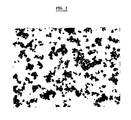
- the amorphous powder obtained after drying was formed of spherical particles. It is shown in Figure 2.
- FIG. 1 the laboratory crystallizer shown diagrammatically in FIG. 1 was used.
- This comprises a vertical cylindrical quartz chamber 1, provided, near the bottom, with a porous sintered glass support 2, intended to receive a sample of the powder.
- a coil 3 also made of quartz, wound around the chamber 1.
- the coil is in communication with two conduits 4 and 5 for the admission of gas or liquids.
- a removable quartz plug 6 is used to close the chamber 1. It is provided with a conduit 7 putting the chamber 1 in communication with the atmosphere, and with a sheath 8 serving as a housing for a thermocouple.
- the crystallizer loaded with the powder sample on the support 2, is placed in an oven which is subjected to a thermal program defined in each example.
- a 10 g sample of the amorphous powder was used in chamber 1 and anhydrous nitrogen was introduced into it at atmospheric pressure, via line 4, at a flow rate of 100 ml / min, to purge room 1 of the air it contained.
- the powder was then subjected to a three-phase heat treatment.
- the oven was heated to gradually reach the temperature of 450 ° C in chamber 1, which was then maintained for 2 hours.
- the heating of the oven was continued in order to gradually raise the temperature in the chamber 1 to 700 ° C. and the latter temperature was then maintained for 4 hours.
- the nitrogen flow rate was permanently maintained and liquid water at a flow rate of 15 ml / hour was mixed there via line 5, as soon as the temperature in the oven had reached 180 ° C.
- the water quickly vaporized, so that the gas stream admitted to the base of the porous support 2 contained about 75% by volume of water vapor.
- the supply of nitrogen and water was stopped and there substituted a stream of dry air at atmospheric pressure, at the rate of 100 ml / min. This air flow was maintained throughout the second phase, then stopped.
- Table 1 The test conditions are reproduced in Table 1 below.
- Table 1 FIRST STAGE SECOND STEP Gaseous current nitrogen + water vapor dry air Temperature (° C) 450 700 Duration (hours) 2 4
- the sample was removed from the crystallization chamber 1. Its mass was equal to 4.9 g and it was found to consist of crystals of barium titanate. Granulometric analysis by laser revealed that 100% of the mass of the powder was formed of individual particles of dimensions less than one micron.
- Example 2 The test of Example 1 was repeated, adopting the operating conditions mentioned in Table 2 below.
- Table 2 FIRST STAGE SECOND STEP Gaseous current nitrogen + water vapor dry air Temperature (° C) 450 800 Duration (hours) 2 4
- the sample removed from the crystallizer at the end of the test had a mass of 4.8 g. It was also formed from a powder of barium titanate crystals, all the particles of which were smaller than one micron in size.
- Example 2 All the operating conditions of the test of Example 2 were repeated, with the only exception that the flow of nitrogen was interrupted at the time of admission of the water vapor. Table 3 below summarizes the operating conditions of the test. Table 3 FIRST STAGE SECOND STEP Gaseous current water vapour dry air Temperature (° C) 450 800 Duration (hours) 2 4
- Example 1 The test of Example 1 was repeated, with the following modifications: - mass of amorphous powder used: 10.4 g; - gas stream in the first phase: a mixture of nitrogen, water vapor and ammonia obtained by introducing nitrogen (50 ml / min) via line 4 and an aqueous solution comprising 1 mole of ammonia per liter, at a rate of 14 ml / h via line 5; - temperature of the first phase: 450 ° C, for 4 hours; - temperature of the second phase: 775 ° C, for 3 hours.
- the powder collected at the end of the test weighed 5 g. It has been found to be crystals of barium titanate with dimensions of less than one micron.
- Example 2 The procedure was as in Example 1, but substituting a stream of dry carbon dioxide (100 ml / min) for nitrogen, from the start of the test until the end of the first phase.
- the gas stream in chamber 1 during the first phase consisted of CO2 alone.
- the powder consisted of crystals of barium titanate which were all of dimensions less than one micron.
- Example 5 The test of Example 5 was repeated, introducing liquid water (9 ml / h) into line 5 throughout the duration of the first step. The following operating conditions have also been adopted: Temperature of the first phase: 500 ° C, for 5 hours; Temperature of the second phase: 650 ° C, for 20 hours.
- Example 1 The test of Example 1 was repeated, adopting the following operating conditions: - gas stream introduced into the coil 3 and the crystallization chamber 1 during the first phase: mixture of nitrogen (50 ml / min) and ammonia (50 ml / min); - temperature during the first phase: 450 ° C, for 2 hours; - temperature during the second phase: 700 ° C, for 4 hours.
- Table 5 The operating conditions are summarized in Table 5.
- Table 5 FIRST PHASE SECOND PHASE Gaseous current nitrogen (100 ml / min) dry air (100 ml / min) Temperature (° C) 450 700 Duration (hours) 2 4
- Example 8 a gas stream consisting of a mixture of air and water vapor was used in the first phase.
- dry air was introduced through line 4 (167 ml / min) and liquid water through line 5 (9 ml / min).
- the second phase was carried out under a stream of dry air, as in Example 8. The following operating conditions were also applied: Temperature during the first phase: 500 ° C, for 4 hours; Temperature during the second phase: 775 ° C, for 3 hours.
Landscapes
- Chemical & Material Sciences (AREA)
- Organic Chemistry (AREA)
- Life Sciences & Earth Sciences (AREA)
- Environmental & Geological Engineering (AREA)
- General Life Sciences & Earth Sciences (AREA)
- Geology (AREA)
- Inorganic Chemistry (AREA)
- Inorganic Compounds Of Heavy Metals (AREA)
- Compositions Of Oxide Ceramics (AREA)
- Crystals, And After-Treatments Of Crystals (AREA)
Priority Applications (1)
| Application Number | Priority Date | Filing Date | Title |
|---|---|---|---|
| AT89201394T ATE89241T1 (de) | 1988-06-13 | 1989-06-01 | Verfahren zur herstellung von barium- und/oder strontiumtitanatkristallen. |
Applications Claiming Priority (2)
| Application Number | Priority Date | Filing Date | Title |
|---|---|---|---|
| BE8800674A BE1001780A4 (fr) | 1988-06-13 | 1988-06-13 | Procede pour la fabrication de cristaux de titanate de baryum et/ou de strontium et cristaux de titanate de baryum et/ou de strontium. |
| BE8800674 | 1988-06-13 |
Publications (2)
| Publication Number | Publication Date |
|---|---|
| EP0346962A1 true EP0346962A1 (de) | 1989-12-20 |
| EP0346962B1 EP0346962B1 (de) | 1993-05-12 |
Family
ID=3883464
Family Applications (1)
| Application Number | Title | Priority Date | Filing Date |
|---|---|---|---|
| EP89201394A Expired - Lifetime EP0346962B1 (de) | 1988-06-13 | 1989-06-01 | Verfahren zur Herstellung von Barium- und/oder Strontiumtitanatkristallen |
Country Status (13)
| Country | Link |
|---|---|
| US (1) | US5032375A (de) |
| EP (1) | EP0346962B1 (de) |
| JP (1) | JPH0280321A (de) |
| KR (1) | KR900000296A (de) |
| CN (1) | CN1039396A (de) |
| AT (1) | ATE89241T1 (de) |
| AU (1) | AU621375B2 (de) |
| BE (1) | BE1001780A4 (de) |
| CA (1) | CA1322099C (de) |
| DE (1) | DE68906463D1 (de) |
| DK (1) | DK285689A (de) |
| NO (1) | NO892396L (de) |
| PT (1) | PT90794B (de) |
Cited By (1)
| Publication number | Priority date | Publication date | Assignee | Title |
|---|---|---|---|---|
| WO2000022628A1 (de) * | 1998-10-13 | 2000-04-20 | Eurotope Entwicklungsgesellschaft für Isotopentechnologien mbh | Hochradioaktive miniaturisierte keramische strontium-90-strahlenquellen und verfahren zu deren herstellung |
Families Citing this family (14)
| Publication number | Priority date | Publication date | Assignee | Title |
|---|---|---|---|---|
| IT1270828B (it) * | 1993-09-03 | 1997-05-13 | Chon Int Co Ltd | Processo per la sintesi di polveri ceramiche cristalline di composti di perovskite |
| CN1063732C (zh) * | 1994-05-06 | 2001-03-28 | 清华大学 | 钛酸锶基晶界层电容器材料制造方法 |
| US5814272A (en) * | 1996-02-21 | 1998-09-29 | Millipore Corporation | Method for forming dendritic metal particles |
| JP3800587B2 (ja) * | 1998-05-20 | 2006-07-26 | 東邦チタニウム株式会社 | チタン酸バリウム粉末 |
| CN1082491C (zh) * | 1998-06-12 | 2002-04-10 | 中国科学院青海盐湖研究所 | 纳米钛酸锶的制备方法 |
| KR100630285B1 (ko) * | 1998-08-19 | 2006-09-29 | 쇼와 덴코 가부시키가이샤 | 미세 티탄함유물질, 이를 함유하는 수성졸 조성물 및 코팅액, 이들의 제조방법 및 그 박막을 갖는 성형품 |
| MXPA02001885A (es) * | 1999-08-23 | 2002-11-04 | Cabot Corp | Metodo y auxiliar de sinterizacion basado en silicato. |
| JP3735686B2 (ja) * | 2001-10-30 | 2006-01-18 | 独立行政法人理化学研究所 | 金属酸化物強誘電体粒子結晶の製造方法 |
| KR100633723B1 (ko) * | 2005-08-04 | 2006-10-13 | 한화석유화학 주식회사 | 티탄산바륨의 제조방법 |
| JP5119008B2 (ja) * | 2008-03-04 | 2013-01-16 | 日本化学工業株式会社 | ペロブスカイト型チタン酸バリウム粉末の製造方法 |
| CN103011807B (zh) * | 2012-12-17 | 2014-04-02 | 内蒙古自治区冶金研究院 | 一种制备钛酸锶粉体的方法 |
| CN103613125B (zh) * | 2013-11-05 | 2015-10-28 | 清华大学 | 一种超细钛酸盐纳米粉体及其制备方法 |
| GB201405258D0 (en) * | 2014-03-24 | 2014-05-07 | Univ Birmingham | Controlled atom source |
| CN113562743B (zh) * | 2021-08-19 | 2022-10-18 | 上海大学(浙江·嘉兴)新兴产业研究院 | 一种氨气的浓缩回收装置及钛酸钡的生产设备和生产方法 |
Citations (6)
| Publication number | Priority date | Publication date | Assignee | Title |
|---|---|---|---|---|
| US3331659A (en) * | 1964-03-31 | 1967-07-18 | Malloy Frank | Process for producing lead titanate powder |
| US3647364A (en) * | 1970-01-06 | 1972-03-07 | Us Air Force | Process for producing high-purity submicron barium and strontium titanate powders |
| EP0177198A2 (de) * | 1984-09-07 | 1986-04-09 | THE STATE OF JAPAN, as Represented by the DIRECTOR GENERAL of the AGENCY of INDUSTRIAL SCIENCE and TECHNOLOGY | Verfahren zur Herstellung eines amorphen zusammengesetzten Metalloxyds und derart hergestellte amorphe zusammengesetzte Metalloxyde einschliesslich Katalysatoren |
| EP0238103A1 (de) * | 1986-01-20 | 1987-09-23 | Solvay | Verfahren zur Herstellung von Metalloxid-Pulver für keramische Materialien |
| EP0286155A1 (de) * | 1987-03-26 | 1988-10-12 | Solvay | Verfahren zur Herstellung eines gemischten Metalloxid-Pulvers und gemischte Metalloxid-Pulver |
| EP0297646A1 (de) * | 1987-06-29 | 1989-01-04 | Solvay | Verfahren zur Herstellung eines Mischmetalloxidpulvers |
Family Cites Families (6)
| Publication number | Priority date | Publication date | Assignee | Title |
|---|---|---|---|---|
| US4061583A (en) * | 1974-03-13 | 1977-12-06 | Murata Manufacturing Co., Ltd. | Preparation of titanates |
| US4487755A (en) * | 1982-07-01 | 1984-12-11 | General Electric Company | Preparation of large crystal sized barium and/or strontium titanate powder |
| JPS5945928A (ja) * | 1982-09-08 | 1984-03-15 | Sony Corp | チタン酸ストロンチウム微粒子の製造方法 |
| US4534956A (en) * | 1983-07-08 | 1985-08-13 | General Electric Company | Molten salt synthesis of barium and/or strontium titanate powder |
| EP0141551B1 (de) * | 1983-10-12 | 1988-02-03 | Asahi Kasei Kogyo Kabushiki Kaisha | Titanatpulver und Verfahren zu seiner Herstellung |
| FR2571713B1 (fr) * | 1984-10-15 | 1990-03-23 | Centre Nat Rech Scient | Procede de preparation de titanates, zirconates et stannates |
-
1988
- 1988-06-13 BE BE8800674A patent/BE1001780A4/fr not_active IP Right Cessation
-
1989
- 1989-05-23 US US07/356,502 patent/US5032375A/en not_active Expired - Fee Related
- 1989-06-01 AT AT89201394T patent/ATE89241T1/de not_active IP Right Cessation
- 1989-06-01 EP EP89201394A patent/EP0346962B1/de not_active Expired - Lifetime
- 1989-06-01 DE DE8989201394T patent/DE68906463D1/de not_active Expired - Lifetime
- 1989-06-02 KR KR1019890007615A patent/KR900000296A/ko not_active Withdrawn
- 1989-06-09 PT PT90794A patent/PT90794B/pt not_active IP Right Cessation
- 1989-06-12 DK DK285689A patent/DK285689A/da not_active Application Discontinuation
- 1989-06-12 CA CA000602427A patent/CA1322099C/fr not_active Expired - Fee Related
- 1989-06-12 NO NO89892396A patent/NO892396L/no unknown
- 1989-06-13 CN CN89104049A patent/CN1039396A/zh active Pending
- 1989-06-13 JP JP1152078A patent/JPH0280321A/ja active Pending
- 1989-06-13 AU AU36339/89A patent/AU621375B2/en not_active Ceased
Patent Citations (6)
| Publication number | Priority date | Publication date | Assignee | Title |
|---|---|---|---|---|
| US3331659A (en) * | 1964-03-31 | 1967-07-18 | Malloy Frank | Process for producing lead titanate powder |
| US3647364A (en) * | 1970-01-06 | 1972-03-07 | Us Air Force | Process for producing high-purity submicron barium and strontium titanate powders |
| EP0177198A2 (de) * | 1984-09-07 | 1986-04-09 | THE STATE OF JAPAN, as Represented by the DIRECTOR GENERAL of the AGENCY of INDUSTRIAL SCIENCE and TECHNOLOGY | Verfahren zur Herstellung eines amorphen zusammengesetzten Metalloxyds und derart hergestellte amorphe zusammengesetzte Metalloxyde einschliesslich Katalysatoren |
| EP0238103A1 (de) * | 1986-01-20 | 1987-09-23 | Solvay | Verfahren zur Herstellung von Metalloxid-Pulver für keramische Materialien |
| EP0286155A1 (de) * | 1987-03-26 | 1988-10-12 | Solvay | Verfahren zur Herstellung eines gemischten Metalloxid-Pulvers und gemischte Metalloxid-Pulver |
| EP0297646A1 (de) * | 1987-06-29 | 1989-01-04 | Solvay | Verfahren zur Herstellung eines Mischmetalloxidpulvers |
Cited By (1)
| Publication number | Priority date | Publication date | Assignee | Title |
|---|---|---|---|---|
| WO2000022628A1 (de) * | 1998-10-13 | 2000-04-20 | Eurotope Entwicklungsgesellschaft für Isotopentechnologien mbh | Hochradioaktive miniaturisierte keramische strontium-90-strahlenquellen und verfahren zu deren herstellung |
Also Published As
| Publication number | Publication date |
|---|---|
| AU3633989A (en) | 1989-12-14 |
| KR900000296A (ko) | 1990-01-30 |
| JPH0280321A (ja) | 1990-03-20 |
| PT90794A (pt) | 1989-12-29 |
| CN1039396A (zh) | 1990-02-07 |
| CA1322099C (fr) | 1993-09-14 |
| AU621375B2 (en) | 1992-03-12 |
| NO892396L (no) | 1989-12-14 |
| US5032375A (en) | 1991-07-16 |
| PT90794B (pt) | 1994-10-31 |
| ATE89241T1 (de) | 1993-05-15 |
| BE1001780A4 (fr) | 1990-03-06 |
| DK285689A (da) | 1989-12-14 |
| DE68906463D1 (de) | 1993-06-17 |
| EP0346962B1 (de) | 1993-05-12 |
| NO892396D0 (no) | 1989-06-12 |
| DK285689D0 (da) | 1989-06-12 |
Similar Documents
| Publication | Publication Date | Title |
|---|---|---|
| EP0346962B1 (de) | Verfahren zur Herstellung von Barium- und/oder Strontiumtitanatkristallen | |
| EP0238103B1 (de) | Verfahren zur Herstellung von Metalloxid-Pulver für keramische Materialien | |
| EP0297646B1 (de) | Verfahren zur Herstellung eines Mischmetalloxidpulvers | |
| CA2084853C (fr) | Composition a base d'oxyde cerique, sa preparation et son utilisation | |
| EP0286155B1 (de) | Verfahren zur Herstellung eines gemischten Metalloxid-Pulvers und gemischte Metalloxid-Pulver | |
| WO1996034897A1 (fr) | Procede de purification d'alcool polyvinylique | |
| EP0198857B1 (de) | Verfahren zur herstellung von titanaten und zirkonaten | |
| EP0263544B1 (de) | Verfahren zur Herstellung eines Pulvers für keramische Materialien, die wenigstens ein Metalloxid enthalten, und Pulver aus zumindest einem Metalloxid, erhalten nach diesem Verfahren | |
| FR2677352A1 (fr) | Ceramiques transparentes et procede de fabrication de celles-ci. | |
| EP0449672B1 (de) | Aktivierte Aluminiumoxydagglomerate und Verfahren zu ihrer Herstellung | |
| BE1004604A4 (fr) | Procede de fabrication d'une poudre d'oxydes metalliques mixtes. | |
| EP0369979B1 (de) | Verfahren zur Herstellung eines wenigstens ein Metalloxid enthaltendes Pulvers | |
| BE1004605A4 (fr) | Poudres d'oxydes metalliques mixtes presentant des proprietes dielectriques et dielectriques obtenus a partir de ces poudres. | |
| FR2689879A1 (fr) | Procédé de synthèse de verre fluoré par voie sol-gel et fibre optique réalisée dans le verre fluoré obtenu selon ce procédé. | |
| BE1005383A3 (fr) | Procede pour la fabrication d'une poudre d'oxydes metalliques mixtes et son utilisation pour l'obtention d'une poudre destinee a la fabrication de condensateurs et de resistances electriques. | |
| EP0522894A1 (de) | Zusammensetzungen auf der Basis von Erdalkalititanaten und/oder Seltenen-Erdtitanaten und ihre Herstellung | |
| BE1003005A6 (fr) | Procede de fabrication d'une poudre de nitrure metallique et poudres de nitrures metalliques obtenues par ce procede. | |
| EP0376789A1 (de) | Verfahren zur Herstellung von Ceroxid mit grosser spezifischer Oberfläche | |
| FR2671066A1 (fr) | Composes notamment a base de titane, de vanadium ou de niobium reduits, en particulier du type titanite, et leur procede de preparation. | |
| FR3077567A1 (fr) | Procede de preparation d'un oxyde a base de cerium et/ou de zirconium | |
| EP0245151A1 (de) | Verfahren zur Herstellung von Bariumtitanat auf chemische Weise | |
| EP0493242A1 (de) | Reduzierte Verbindungen, insbesondere auf der Basis von Titan, Vanadium, Niobium, insbesondere von Typ Titanite und deren Herstellung |
Legal Events
| Date | Code | Title | Description |
|---|---|---|---|
| PUAI | Public reference made under article 153(3) epc to a published international application that has entered the european phase |
Free format text: ORIGINAL CODE: 0009012 |
|
| AK | Designated contracting states |
Kind code of ref document: A1 Designated state(s): AT BE CH DE ES FR GB GR IT LI LU NL SE |
|
| 17P | Request for examination filed |
Effective date: 19900606 |
|
| 17Q | First examination report despatched |
Effective date: 19911002 |
|
| RAP1 | Party data changed (applicant data changed or rights of an application transferred) |
Owner name: SOLVAY |
|
| GRAA | (expected) grant |
Free format text: ORIGINAL CODE: 0009210 |
|
| AK | Designated contracting states |
Kind code of ref document: B1 Designated state(s): AT BE CH DE ES FR GB GR IT LI LU NL SE |
|
| PG25 | Lapsed in a contracting state [announced via postgrant information from national office to epo] |
Ref country code: IT Free format text: LAPSE BECAUSE OF FAILURE TO SUBMIT A TRANSLATION OF THE DESCRIPTION OR TO PAY THE FEE WITHIN THE PRESCRIBED TIME-LIMIT;WARNING: LAPSES OF ITALIAN PATENTS WITH EFFECTIVE DATE BEFORE 2007 MAY HAVE OCCURRED AT ANY TIME BEFORE 2007. THE CORRECT EFFECTIVE DATE MAY BE DIFFERENT FROM THE ONE RECORDED. Effective date: 19930512 Ref country code: ES Free format text: THE PATENT HAS BEEN ANNULLED BY A DECISION OF A NATIONAL AUTHORITY Effective date: 19930512 Ref country code: DE Effective date: 19930512 Ref country code: GB Effective date: 19930512 Ref country code: AT Effective date: 19930512 Ref country code: GR Free format text: LAPSE BECAUSE OF FAILURE TO SUBMIT A TRANSLATION OF THE DESCRIPTION OR TO PAY THE FEE WITHIN THE PRESCRIBED TIME-LIMIT Effective date: 19930512 Ref country code: NL Effective date: 19930512 Ref country code: SE Effective date: 19930512 |
|
| REF | Corresponds to: |
Ref document number: 89241 Country of ref document: AT Date of ref document: 19930515 Kind code of ref document: T |
|
| REF | Corresponds to: |
Ref document number: 68906463 Country of ref document: DE Date of ref document: 19930617 |
|
| PG25 | Lapsed in a contracting state [announced via postgrant information from national office to epo] |
Ref country code: BE Effective date: 19930630 Ref country code: LU Free format text: LAPSE BECAUSE OF NON-PAYMENT OF DUE FEES Effective date: 19930630 Ref country code: CH Effective date: 19930630 Ref country code: LI Effective date: 19930630 |
|
| RAP2 | Party data changed (patent owner data changed or rights of a patent transferred) |
Owner name: SOLVAY (SOCIETE ANONYME) |
|
| REG | Reference to a national code |
Ref country code: CH Ref legal event code: PFA Free format text: SOLVAY (SOCIETE ANONYME) |
|
| NLV1 | Nl: lapsed or annulled due to failure to fulfill the requirements of art. 29p and 29m of the patents act | ||
| GBV | Gb: ep patent (uk) treated as always having been void in accordance with gb section 77(7)/1977 [no translation filed] |
Effective date: 19930512 |
|
| BERE | Be: lapsed |
Owner name: SOLVAY Effective date: 19930630 |
|
| REG | Reference to a national code |
Ref country code: CH Ref legal event code: PL |
|
| PG25 | Lapsed in a contracting state [announced via postgrant information from national office to epo] |
Ref country code: FR Effective date: 19940429 |
|
| REG | Reference to a national code |
Ref country code: FR Ref legal event code: ST |
|
| PG25 | Lapsed in a contracting state [announced via postgrant information from national office to epo] |
Ref country code: FR Effective date: 19930630 |
|
| PLBE | No opposition filed within time limit |
Free format text: ORIGINAL CODE: 0009261 |
|
| STAA | Information on the status of an ep patent application or granted ep patent |
Free format text: STATUS: NO OPPOSITION FILED WITHIN TIME LIMIT |