EP0350002B1 - Dérivés d'acides diphosphoniques, procédé pour leur préparation et médicaments contenant ces composés - Google Patents
Dérivés d'acides diphosphoniques, procédé pour leur préparation et médicaments contenant ces composés Download PDFInfo
- Publication number
- EP0350002B1 EP0350002B1 EP89112263A EP89112263A EP0350002B1 EP 0350002 B1 EP0350002 B1 EP 0350002B1 EP 89112263 A EP89112263 A EP 89112263A EP 89112263 A EP89112263 A EP 89112263A EP 0350002 B1 EP0350002 B1 EP 0350002B1
- Authority
- EP
- European Patent Office
- Prior art keywords
- hydrogen
- general formula
- group
- methyl
- amino
- Prior art date
- Legal status (The legal status is an assumption and is not a legal conclusion. Google has not performed a legal analysis and makes no representation as to the accuracy of the status listed.)
- Expired - Lifetime
Links
Classifications
-
- C—CHEMISTRY; METALLURGY
- C07—ORGANIC CHEMISTRY
- C07F—ACYCLIC, CARBOCYCLIC OR HETEROCYCLIC COMPOUNDS CONTAINING ELEMENTS OTHER THAN CARBON, HYDROGEN, HALOGEN, OXYGEN, NITROGEN, SULFUR, SELENIUM OR TELLURIUM
- C07F9/00—Compounds containing elements of Groups 5 or 15 of the Periodic Table
- C07F9/02—Phosphorus compounds
- C07F9/28—Phosphorus compounds with one or more P—C bonds
- C07F9/38—Phosphonic acids [RP(=O)(OH)2]; Thiophosphonic acids ; [RP(=X1)(X2H)2(X1, X2 are each independently O, S or Se)]
- C07F9/3804—Phosphonic acids [RP(=O)(OH)2]; Thiophosphonic acids ; [RP(=X1)(X2H)2(X1, X2 are each independently O, S or Se)] not used, see subgroups
- C07F9/3839—Polyphosphonic acids
- C07F9/3873—Polyphosphonic acids containing nitrogen substituent, e.g. N.....H or N-hydrocarbon group which can be substituted by halogen or nitro(so), N.....O, N.....S, N.....C(=X)- (X =O, S), N.....N, N...C(=X)...N (X =O, S)
-
- C—CHEMISTRY; METALLURGY
- C07—ORGANIC CHEMISTRY
- C07F—ACYCLIC, CARBOCYCLIC OR HETEROCYCLIC COMPOUNDS CONTAINING ELEMENTS OTHER THAN CARBON, HYDROGEN, HALOGEN, OXYGEN, NITROGEN, SULFUR, SELENIUM OR TELLURIUM
- C07F9/00—Compounds containing elements of Groups 5 or 15 of the Periodic Table
- C07F9/02—Phosphorus compounds
- C07F9/28—Phosphorus compounds with one or more P—C bonds
- C07F9/38—Phosphonic acids [RP(=O)(OH)2]; Thiophosphonic acids ; [RP(=X1)(X2H)2(X1, X2 are each independently O, S or Se)]
- C07F9/40—Esters thereof
-
- A—HUMAN NECESSITIES
- A61—MEDICAL OR VETERINARY SCIENCE; HYGIENE
- A61P—SPECIFIC THERAPEUTIC ACTIVITY OF CHEMICAL COMPOUNDS OR MEDICINAL PREPARATIONS
- A61P3/00—Drugs for disorders of the metabolism
-
- A—HUMAN NECESSITIES
- A61—MEDICAL OR VETERINARY SCIENCE; HYGIENE
- A61P—SPECIFIC THERAPEUTIC ACTIVITY OF CHEMICAL COMPOUNDS OR MEDICINAL PREPARATIONS
- A61P3/00—Drugs for disorders of the metabolism
- A61P3/12—Drugs for disorders of the metabolism for electrolyte homeostasis
- A61P3/14—Drugs for disorders of the metabolism for electrolyte homeostasis for calcium homeostasis
-
- C—CHEMISTRY; METALLURGY
- C07—ORGANIC CHEMISTRY
- C07F—ACYCLIC, CARBOCYCLIC OR HETEROCYCLIC COMPOUNDS CONTAINING ELEMENTS OTHER THAN CARBON, HYDROGEN, HALOGEN, OXYGEN, NITROGEN, SULFUR, SELENIUM OR TELLURIUM
- C07F9/00—Compounds containing elements of Groups 5 or 15 of the Periodic Table
- C07F9/02—Phosphorus compounds
- C07F9/28—Phosphorus compounds with one or more P—C bonds
- C07F9/38—Phosphonic acids [RP(=O)(OH)2]; Thiophosphonic acids ; [RP(=X1)(X2H)2(X1, X2 are each independently O, S or Se)]
- C07F9/3804—Phosphonic acids [RP(=O)(OH)2]; Thiophosphonic acids ; [RP(=X1)(X2H)2(X1, X2 are each independently O, S or Se)] not used, see subgroups
- C07F9/3839—Polyphosphonic acids
- C07F9/386—Polyphosphonic acids containing hydroxy substituents in the hydrocarbon radicals
-
- C—CHEMISTRY; METALLURGY
- C07—ORGANIC CHEMISTRY
- C07F—ACYCLIC, CARBOCYCLIC OR HETEROCYCLIC COMPOUNDS CONTAINING ELEMENTS OTHER THAN CARBON, HYDROGEN, HALOGEN, OXYGEN, NITROGEN, SULFUR, SELENIUM OR TELLURIUM
- C07F9/00—Compounds containing elements of Groups 5 or 15 of the Periodic Table
- C07F9/02—Phosphorus compounds
- C07F9/547—Heterocyclic compounds, e.g. containing phosphorus as a ring hetero atom
- C07F9/553—Heterocyclic compounds, e.g. containing phosphorus as a ring hetero atom having one nitrogen atom as the only ring hetero atom
- C07F9/572—Five-membered rings
-
- C—CHEMISTRY; METALLURGY
- C07—ORGANIC CHEMISTRY
- C07F—ACYCLIC, CARBOCYCLIC OR HETEROCYCLIC COMPOUNDS CONTAINING ELEMENTS OTHER THAN CARBON, HYDROGEN, HALOGEN, OXYGEN, NITROGEN, SULFUR, SELENIUM OR TELLURIUM
- C07F9/00—Compounds containing elements of Groups 5 or 15 of the Periodic Table
- C07F9/02—Phosphorus compounds
- C07F9/547—Heterocyclic compounds, e.g. containing phosphorus as a ring hetero atom
- C07F9/553—Heterocyclic compounds, e.g. containing phosphorus as a ring hetero atom having one nitrogen atom as the only ring hetero atom
- C07F9/572—Five-membered rings
- C07F9/5728—Five-membered rings condensed with carbocyclic rings or carbocyclic ring systems
-
- C—CHEMISTRY; METALLURGY
- C07—ORGANIC CHEMISTRY
- C07F—ACYCLIC, CARBOCYCLIC OR HETEROCYCLIC COMPOUNDS CONTAINING ELEMENTS OTHER THAN CARBON, HYDROGEN, HALOGEN, OXYGEN, NITROGEN, SULFUR, SELENIUM OR TELLURIUM
- C07F9/00—Compounds containing elements of Groups 5 or 15 of the Periodic Table
- C07F9/02—Phosphorus compounds
- C07F9/547—Heterocyclic compounds, e.g. containing phosphorus as a ring hetero atom
- C07F9/553—Heterocyclic compounds, e.g. containing phosphorus as a ring hetero atom having one nitrogen atom as the only ring hetero atom
- C07F9/576—Six-membered rings
- C07F9/59—Hydrogenated pyridine rings
-
- C—CHEMISTRY; METALLURGY
- C07—ORGANIC CHEMISTRY
- C07F—ACYCLIC, CARBOCYCLIC OR HETEROCYCLIC COMPOUNDS CONTAINING ELEMENTS OTHER THAN CARBON, HYDROGEN, HALOGEN, OXYGEN, NITROGEN, SULFUR, SELENIUM OR TELLURIUM
- C07F9/00—Compounds containing elements of Groups 5 or 15 of the Periodic Table
- C07F9/02—Phosphorus compounds
- C07F9/547—Heterocyclic compounds, e.g. containing phosphorus as a ring hetero atom
- C07F9/553—Heterocyclic compounds, e.g. containing phosphorus as a ring hetero atom having one nitrogen atom as the only ring hetero atom
- C07F9/576—Six-membered rings
- C07F9/60—Quinoline or hydrogenated quinoline ring systems
-
- C—CHEMISTRY; METALLURGY
- C07—ORGANIC CHEMISTRY
- C07F—ACYCLIC, CARBOCYCLIC OR HETEROCYCLIC COMPOUNDS CONTAINING ELEMENTS OTHER THAN CARBON, HYDROGEN, HALOGEN, OXYGEN, NITROGEN, SULFUR, SELENIUM OR TELLURIUM
- C07F9/00—Compounds containing elements of Groups 5 or 15 of the Periodic Table
- C07F9/02—Phosphorus compounds
- C07F9/547—Heterocyclic compounds, e.g. containing phosphorus as a ring hetero atom
- C07F9/645—Heterocyclic compounds, e.g. containing phosphorus as a ring hetero atom having two nitrogen atoms as the only ring hetero atoms
- C07F9/6503—Five-membered rings
- C07F9/6506—Five-membered rings having the nitrogen atoms in positions 1 and 3
-
- C—CHEMISTRY; METALLURGY
- C07—ORGANIC CHEMISTRY
- C07F—ACYCLIC, CARBOCYCLIC OR HETEROCYCLIC COMPOUNDS CONTAINING ELEMENTS OTHER THAN CARBON, HYDROGEN, HALOGEN, OXYGEN, NITROGEN, SULFUR, SELENIUM OR TELLURIUM
- C07F9/00—Compounds containing elements of Groups 5 or 15 of the Periodic Table
- C07F9/02—Phosphorus compounds
- C07F9/547—Heterocyclic compounds, e.g. containing phosphorus as a ring hetero atom
- C07F9/645—Heterocyclic compounds, e.g. containing phosphorus as a ring hetero atom having two nitrogen atoms as the only ring hetero atoms
- C07F9/6509—Six-membered rings
- C07F9/650952—Six-membered rings having the nitrogen atoms in the positions 1 and 4
-
- C—CHEMISTRY; METALLURGY
- C07—ORGANIC CHEMISTRY
- C07F—ACYCLIC, CARBOCYCLIC OR HETEROCYCLIC COMPOUNDS CONTAINING ELEMENTS OTHER THAN CARBON, HYDROGEN, HALOGEN, OXYGEN, NITROGEN, SULFUR, SELENIUM OR TELLURIUM
- C07F9/00—Compounds containing elements of Groups 5 or 15 of the Periodic Table
- C07F9/02—Phosphorus compounds
- C07F9/547—Heterocyclic compounds, e.g. containing phosphorus as a ring hetero atom
- C07F9/6527—Heterocyclic compounds, e.g. containing phosphorus as a ring hetero atom having nitrogen and oxygen atoms as the only ring hetero atoms
- C07F9/6533—Six-membered rings
-
- C—CHEMISTRY; METALLURGY
- C07—ORGANIC CHEMISTRY
- C07F—ACYCLIC, CARBOCYCLIC OR HETEROCYCLIC COMPOUNDS CONTAINING ELEMENTS OTHER THAN CARBON, HYDROGEN, HALOGEN, OXYGEN, NITROGEN, SULFUR, SELENIUM OR TELLURIUM
- C07F9/00—Compounds containing elements of Groups 5 or 15 of the Periodic Table
- C07F9/02—Phosphorus compounds
- C07F9/547—Heterocyclic compounds, e.g. containing phosphorus as a ring hetero atom
- C07F9/6536—Heterocyclic compounds, e.g. containing phosphorus as a ring hetero atom having nitrogen and sulfur atoms with or without oxygen atoms, as the only ring hetero atoms
- C07F9/6544—Six-membered rings
Definitions
- the present invention relates to new diphosphonic acid derivatives, processes for their preparation and medicaments which contain these substances.
- EP-A-0 274 158 describes 1-hydroxy-piperidinyl-alkylidene-1,1-diphosphonates in which the alkyl chain is interrupted by an oxygen atom. Analog pyridyl compounds are described in EP-A-0 186 405.
- DE-PS 18 13 659 describes diphosphonic acid derivatives, of which 1-hydroxyethane-1,1-diphosphonic acid has become important as a means of treating Paget's disease.
- aminoalkane-1,1-diphosphonic acids in which the alkyl chain is interrupted by an oxygen atom, have a markedly more pronounced effect on the calcium metabolism than the previously known compounds.
- These substances are therefore particularly suitable for a broad treatment of calcium metabolism disorders.
- they can be used very well where the bone build-up and breakdown is disturbed, ie they are suitable for the treatment of diseases of the skeletal system such as, for example, osteoporosis, Paget's disease, Bechterew's disease and others. Because of these properties, they are also used in the therapy of bone metastases, urolithiasis and to prevent heterotopic ossifications.
- diseases of the skeletal system such as, for example, osteoporosis, Paget's disease, Bechterew's disease and others.
- they are also used in the therapy of bone metastases, urolithiasis and to prevent heterotopic ossifications.
- By influencing the Calcium metabolism continues to form a basis for the treatment of
- C1-C5 alkyl is preferably to be understood as the methyl, ethyl, isopropyl and isobutyl group.
- C1-C5 alkoxy or alkylthio should preferably be the methoxy or methylthio group.
- the C5-C7 cycloalkyl radical is preferably the cyclohexyl radical.
- Halogen is particularly intended to represent chlorine or bromine.
- the R1 and R2 alkyl chain with 1-9 carbon atoms is preferably the methyl, ethyl, isopropyl, isobutyl, sec-butyl, n-pentyl, n-nonyl, allyl and methallyl group.
- the alkyl group substituted by an optionally substituted phenyl ring means in particular a benzyl group.
- Group -NR10R11 is preferably the amino, dimethylamino or diethylamino group.
- R3 and R4 or R5 and R6 or R7 and R8 form a ring with the carbon atom to which they are attached, this is preferably the spiro-cyclopentyl ring.
- R4 and R6 form a ring together with the C atoms to which they are attached, it is the cyclohexyl or cyclopentyl ring.
- X preferably represents hydrogen or hydroxyl.
- Preferred compounds of formula I are compounds in which R1 is hydrogen or methyl, R2 is hydrogen or methyl, R3 is hydrogen or C1 - C5-alkyl, R4 is hydrogen or methyl, R5 is hydrogen or methyl, R6 is hydrogen, R7 is hydrogen, R8 is hydrogen, R9 is hydrogen , m the number 0 or 1, n is the number 0 and X is a hydroxyl group, where R4 and R6 together with the C atoms to which they are attached form a cyclohexyl ring and R5 and R6 together with the C atom to which they are attached represent a spiro-cyclopentane ring.
- Asymmetric carbon atoms can have the R or S configuration and the compounds can be in optically active form or as a racemic mixture. They are also the subject of the invention.
- a mixture of primary or secondary amine of the general formula II and a carbonyl compound or its acetal is treated in the presence of a hydrogenation catalyst, such as palladium on carbon, or nickel, with hydrogen under atmospheric or elevated pressure or one adds formic acid as a reducing agent.
- a hydrogenation catalyst such as palladium on carbon, or nickel
- alkylations of a secondary amine of the general formula II can be carried out particularly advantageously using the phase transfer process with dialkyl sulfates.
- the carboxylic acids of the general formula III used in process II a) are mixed with 1-2, preferably 1.5 mol of phosphorous acid or phosphoric acid and 1-2, preferably 1.5 mol of phosphorus trihalide or phosphorus oxyhalide at temperatures of 80 ° -130 ° C., preferably 100-110 ° C implemented.
- the reaction can also be carried out in the presence of diluents such as halogenated hydrocarbons, in particular chlorobenzene, tetrachloroethane or also sulfolane or dioxane.
- the subsequent hydrolysis is carried out by boiling with water, but expediently with semi-concentrated hydrochloric or hydrobromic acid.
- Phosphorus trichloride or phosphorus tribromide for example, can be used as phosphorus trihalides in the process mentioned, and phosphorus oxychloride in particular as phosphorus oxyhalide.
- the acid chloride of the general formula IV is allowed to react with the trialkyl phosphite of the general formula V at temperatures between 0 and 60 ° C., preferably at 20-40 ° C.
- the acylphosphonate of the general formula VI formed as an intermediate can be isolated or directly reacted further.
- the subsequent reaction is carried out in the presence of a weak base, preferably a sec. Amine such as dibutylamine at a temperature of 0-60 ° C, preferably at 10-30 ° C.
- R1 and R2 together form the phthaloyl radical as a protective group
- this radical is split off by hydrazinolysis or acid hydrolysis.
- hydrazinolysis hydrazine is used in acetic acid or ethanol at temperatures between 20 and 80 °.
- the acidic hydrolysis can be carried out very well by boiling with half-concentrated hydrochloric acid.
- an acyl group used as a protective group - preferably the acetyl group - is split off.
- the alcohols of the general formula IX are generally used in the form of their alkali metal salts, preferably as sodium salts.
- Toluene, dioxane, tetrahydrofuran or even dimethylformamide are preferably used as solvents; the reactions are carried out between 20 and 80 ° C.
- the nitriles of the general formula XII are reacted with phosphorous acid at temperatures of 110-180 ° C.
- the reaction can be carried out without or in the presence of aprotic solvents such as e.g. Diethylene glycol dimethyl ether or diethylene glycol diethyl ether can be carried out.
- aprotic solvents such as e.g. Diethylene glycol dimethyl ether or diethylene glycol diethyl ether can be carried out.
- the nitriles can also be treated with a phosphorus trihalide, e.g. Phosphorus tribromide or phosphorus trichloride in an inert solvent such as e.g. Bring dioxane or tetrahydrofuran to reaction if necessary with the addition of water at temperatures of 20-80 ° C.
- Iminoethers of the general formula XII are allowed to react with dialkyl phosphites, preferably in the presence of equimolar amounts of sodium in inert solvents such as diethyl ether, dioxane or even benzene, the reactions generally taking place at the reflux temperature of the corresponding solvent.
- Acid amides of general formula XII can be used in inert solvents such as e.g. halogenated hydrocarbons or ethers such as e.g. React diethyl ether with a mixture of phosphorus pentahalide / phosphorous acid or oxalyl chloride / trialkyl phosphite.
- the diphosphonic acid derivative of the general formula XV is used in the form of a sodium or potassium salt.
- a sodium or potassium salt for this purpose, it is mixed with sodium, potassium or the corresponding hydride in an inert solvent such as benzene, toluene or dimethylformamide
- an inert solvent such as benzene, toluene or dimethylformamide
- Temperature of 0 to 40 ° C, preferably implemented at 25 ° C.
- the alkali salt is reacted with the corresponding halide or sulfonate without isolation.
- the temperature is 20-110 ° C.
- R1 and R2 together form the protective group the phthaloyl radical or R1 represents an acyl group, preferably the acetyl group, these radicals are split off as described in Method II b.
- the alcohols of the general formula IX are used in the form of their alkali metal salts, preferably the sodium salts.
- they are reacted with sodium or sodium hydride in an inert solvent such as benzene, toluene, dioxane or dimethylformamide at a temperature of 0-60 ° C, preferably at 25 ° C.
- the alkali salt is generally reacted with the corresponding diphosphonate of the general formula XVI without isolation.
- the temperature is 20-80 ° C.
- the methylene diphosphonic acid ester of the general formula XVIII is used in the form of its sodium or potassium salt.
- it is reacted with sodium, potassium or the corresponding hydride in an inert solvent such as benzene, toluene or dimethylformamide at a temperature of 0 to 40 ° C, preferably at 25 ° C.
- the alkali salt is reacted with the corresponding halide or sulfonate without isolation.
- the temperature is 20-110 ° C.
- the hydrogenation in process IV d is carried out in the presence of a noble metal catalyst such as e.g. Palladium on carbon or platinum in an alcohol such as methanol or ethanol as a solvent or in water.
- a noble metal catalyst such as e.g. Palladium on carbon or platinum in an alcohol such as methanol or ethanol as a solvent or in water.
- nickel can also be used in an alkaline medium.
- the cleavage of the N-acyl group can be alkaline, but preferably acidic with e.g. 6N hydrochloric acid can be made.
- Optically active compounds of the formula I are generally prepared in such a way that optically active starting compounds are used.
- amino-oxa-alkane carboxylic acids used in process II a are generally prepared in the following manner.
- the corresponding aminoalkanol is e.g. reacted with a haloacetic acid ester to form an amino-oxa-alkanecarboxylic acid ester which, depending on the chain length and the substitution on the nitrogen atom, can cyclize to an oxalactam.
- the resulting carboxylic acid ester is saponified acidic or alkaline using conventional methods. In the case of ring formation, the lactam is opened by boiling with barium hydroxide solution and the barium salt of the amino-oxa-alkane carboxylic acid is converted into the free acid with sulfuric acid.
- aminoalkanols used in this process and also processes IIc and IVb are generally known from the literature or can be easily prepared from the corresponding amino acids or their esters by reduction with, for example, lithium aluminum hydride.
- the amino-oxa-alkanecarbonitriles or amides of the formula XII used in process III can be synthesized from the corresponding aminoalkanols of the formula IX by reaction with haloacetic acid nitriles or haloacetic acid amides.
- the nitriles obtained in this way can be prepared using conventional methods, e.g. obtained the corresponding imino ethers by reaction with a lower alcohol in the presence of gaseous hydrogen chloride.
- the compounds of the general formula XIX used in process IV b can be prepared, for example, from a compound of the formula I by eliminating an HX group, where, for example, a halogen, preferably bromine or chlorine, or an acyloxy group, in particular the acetoxy or propionyloxy group .
- the elimination can be carried out by bases such as, for example, tert-amines, in particular triethylamine, pyridine or diazabicycloundecene, in inert solvents such as alcohols, ethers (for example dioxane or tetrahydrofuran).
- the tetrasodium or tetrakalium salt of the corresponding diphosphonic acid is preferably used and the splitting is carried out by heating to 180-300 ° C., preferably 180-240 ° C.
- the free acids can then be released from the tetraalkali salt, for example by treatment with an acidic ion exchanger (for example Amberlite-IR 120, H+ form).
- the starting compounds mentioned above can be used as racemates or as enaniomers, the optically active compounds usually being obtained from correspondingly optically active amino acids.
- the tetraalkyl esters possibly obtained in the processes can be saponified to diesters or the free tetra acids.
- the saponification to diesters usually takes place by treating the tetraalkyl ester with an alkali halide, preferably sodium iodide, in a suitable solvent such as e.g. Acetone treated at room temperature.
- the saponification to free diphosphonic acids is usually done by boiling with half-concentrated hydrochloric or hydrobromic acid. However, cleavage with trimethylsilyl halide, preferably bromide or iodide, can also be carried out. Conversely, the free diphosphonic acids can be converted back into the tetraalkyl esters by boiling them with alkyl orthoformates.
- the free diphosphonic acids of the general formula I can be isolated as free acids or in the form of their mono- or dialkali salts.
- the alkali salts can generally be cleaned well by reprecipitation from water / methanol or water / acetone.
- pharmacologically acceptable salts especially alkali or ammonium salts are used, which are used in a conventional manner, for. B. by titrating the compounds with inorganic or organic bases such as sodium or potassium bicarbonate, sodium hydroxide solution, potassium hydroxide solution, aqueous ammonia or amines such as trimethyl or triethylamine.
- novel substances of the formula I according to the invention and their salts can be administered enterally or parenterally in liquid or solid form. All the usual forms of application are possible here, for example tablets, capsules, dragees, syrups, solutions, suspensions, etc.
- Water is preferably used as the injection medium, which contains the additives, such as stabilizers, solubilizers and buffers, which are customary for injection solutions.
- additives are e.g. Tartrate and citrate buffers, ethanol, complexing agents (such as ethylenediaminetetraacetic acid and its non-toxic salts), high molecular weight polymers (such as liquid polyethylene oxide) for viscosity control.
- Liquid carriers for injection solutions must be sterile and are preferably filled into ampoules.
- Solid carriers are e.g. Starch, lactose, mannitol, methyl cellulose, talc, highly disperse silicas, higher molecular fatty acids (such as stearic acid), gelatin, agar, calcium phosphate, magnesium stearate, animal and vegetable fats, solid high molecular polymers (such as polyethylene glycols); Preparations suitable for oral administration can, if desired, contain flavorings and sweeteners.
- the dosage can depend on various factors, such as the mode of administration, species, age and / or individual condition.
- the daily doses to be administered are about 0.1-100 mg / person, preferably 1-20 mg / person, and can be taken in one or more times distributed.
- the following examples show some of the process variants that can be used for the synthesis of the compounds according to the invention. However, they are not intended to be a limitation of the subject matter of the invention.
- the 5-amino-3-oxapentanoic acid used in Example 2a is produced in the following way:
- Ethanolamine is converted in the presence of sodium hydride with ethyl chloroacetate to give morpholin-3-one (mp: 100-102 ° C) and the desired acid is obtained from it by heating with barium hydroxide and then treating with sulfuric acid.
Landscapes
- Chemical & Material Sciences (AREA)
- Organic Chemistry (AREA)
- Health & Medical Sciences (AREA)
- General Health & Medical Sciences (AREA)
- Life Sciences & Earth Sciences (AREA)
- Molecular Biology (AREA)
- Biochemistry (AREA)
- Nuclear Medicine, Radiotherapy & Molecular Imaging (AREA)
- Animal Behavior & Ethology (AREA)
- Chemical Kinetics & Catalysis (AREA)
- General Chemical & Material Sciences (AREA)
- Medicinal Chemistry (AREA)
- Hematology (AREA)
- Diabetes (AREA)
- Pharmacology & Pharmacy (AREA)
- Bioinformatics & Cheminformatics (AREA)
- Obesity (AREA)
- Engineering & Computer Science (AREA)
- Public Health (AREA)
- Veterinary Medicine (AREA)
- Rheumatology (AREA)
- Endocrinology (AREA)
- Pharmaceuticals Containing Other Organic And Inorganic Compounds (AREA)
- Photoreceptors In Electrophotography (AREA)
- Detergent Compositions (AREA)
Claims (7)
- Composés de formule générale I

R₁ et R₂ représentent dans chaque cas indépendamment l'un de l'autre un atome d'hydrogène, un groupe alkyle à chaîne droite ou ramifiée, saturé ou insaturé, comportant 1-9 atomes de carbone, qui peut être substitué éventuellement par un groupe hydroxy, alcoxy en C₁-C₅ ou alkylthio en C₁-C₅, un noyau phényle ou un noyau cycloalkyle en C₅-C₇, le noyau phényle pouvant être substitué éventuellement par un groupe alkyle en C₁-C₅, alcoxy en C₁-C₅, hydroxy ou halogène, un radical cycloalkyle en C₅-C₇ ou le radical phényle,
R₃ représente un atome d'hydrogène, un groupe alkyle inférieur, en C₁-C₅, à chaîne droite ou ramifiée, qui peut être éventuellement substitué par un groupe hydroxy, alcoxy en C₁-C₅, alkylthio en C₁-C₅, mercapto ou phényle, ou éventuellement un groupe phényle substitué par un groupe hydroxy ou un groupe alcoxy en C₁-C₅,
R₄, R₆, R₈ et R₉ représentent dans chaque cas indépendamment l'un de l'autre un atome d'hydrogène ou un groupe alkyle en C₁-C₅,
R₅ et R₇ représentent dans chaque cas indépendamment l'un de l'autre un atome d'hydrogène ou un groupe alkyle en C₁-C₅, ou éventuellement un groupe phényle substitué par un groupe hydroxy ou un groupe alcoxy en C₁-C₅,
X représente un atome d'hydrogène, un groupe OH ou le groupe -NR₁₀R₁₁, où R₁₀ et R₁₁ doivent représenter dans chaque cas indépendamment l'un de l'autre un atome d'hydrogène ou un groupe alkyle en C₁-C₅,
m et n valent 0 ou 1
R₃ et R₄ pouvant former, conjointement avec l'atome de carbone auquel ils sont liés, un cycle à cinq ou six chaînons,
R₄ et R₆ pouvant former, conjointement avec l'atome de carbone auquel ils sont liés, un cycle à cinq ou six chaînons,
R₅ et R₆ pouvant former, conjointement avec l'atome de carbone auquel ils sont liés, un cycle à cinq ou six chaînons,
R₇ et R₈ pouvant former, conjointement avec l'atome de carbone auquel ils sont liés, un cycle à cinq ou six chaînons,
ainsi que leurs sels pharmacologiquement acceptables et leurs isomères optiques. - Composés de formule I selon la revendication 1, dans laquelle R₁ représente un atome d'hydrogène ou un groupe méthyle, R₂ représente un atome d'hydrogène ou un groupe méthyle, R₃ représente un atome d'hydrogène ou un groupe alkyle en C₁-C₅, R₄ représente un atome d'hydrogène ou un groupe méthyle, R₅ représente un atome d'hydrogène ou un groupe méthyle, R₆ représente un atome d'hydrogène, R₇ représente un atome d'hydrogène, R₈ représente un atome d'hydrogène, R₉ représente un atome d'hydrogène, m vaut 0 ou 1, n vaut 0 et X représente un groupe hydroxyle, R₄ et R₆ pouvant former, conjointement avec l'atome de carbone auquel ils sont liés, un noyau cyclohexyle et R₅ et R₆ pouvant former, conjointement avec l'atome de carbone auquel ils sont liés, un noyau spirocyclopentane.
- Procédé de préparation de composés de formule générale I

R₁ et R₂ représentent dans chaque cas indépendamment l'un de l'autre un atome d'hydrogène, un groupe alkyle à chaîne droite ou ramifiée, saturé ou insaturé, comportant 1-9 atomes de carbone, qui peut être substitué éventuellement par un groupe hydroxy, alcoxy en C₁-C₅ ou alkylthio en C₁-C₅, un noyau phényle ou un noyau cycloalkyle en C₅-C₇, le noyau phényle pouvant être substitué éventuellement par un groupe alkyle en C₁-C₅, alcoxy en C₁-C₅ hydroxy ou halogène, un radical cycloalkyle en C₅-C₇ ou le radical phényle,
R₃ représente un atome d'hydrogène, un groupe alkyle inférieur, en C₁-C₅, à chaîne droite ou ramifiée, qui peut être éventuellement substitué par un groupe hydroxy, alcoxy en C₁-C₅, alkylthio en C₁-C₅, mercapto ou phényle, ou éventuellement un groupe phényle substitué par un groupe hydroxy ou un groupe alcoxy en C₁-C₅,
R₄, R₆, R₈ et R₉ représentent dans chaque cas indépendamment l'un de l'autre un atome d'hydrogène ou un groupe alkyle en C₁-C₅,
R₅ et R₇ représentent dans chaque cas indépendamment l'un de l'autre un atome d'hydrogène ou un groupe alkyle en C₁-C₅, ou éventuellement un groupe phényle substitué par un groupe hydroxy ou un groupe alcoxy en C₁-C₅,
X représente un atome d'hydrogène, un groupe OH ou le groupe -NR₁₀R₁₁, où R₁₀ et R₁₁ doivent représenter dans chaque cas indépendamment l'un de l'autre un atome d'hydrogène ou un groupe alkyle en C₁-C₅,
m et n valent 0 ou 1
R₃ et R₄ pouvant former, conjointement avec l'atome de carbone auquel ils sont liés, un cycle à cinq ou six chaînons,
R₄ et R₆ pouvant former, conjointement avec l'atome de carbone auquel ils sont liés, un cycle à cinq ou six chaînons,
R₅ et R₆ pouvant former, conjointement avec l'atome de carbone auquel ils sont liés, un cycle à cinq ou six chaînons,
R₇ et R₈ pouvant former, conjointement avec l'atome de carbone auquel ils sont liés, un cycle à cinq ou six chaînons,
ainsi que leurs sels pharmacologiquement acceptables et leurs isomères optiques,
caractérisé en ce que, de manière connue en soi,I. on soumet un composé de formule générale II
ouII. dans le cas où X, dans la formule générale I, représente un groupe OH,a) on fait réagir un acide carboxylique de formule générale III
oub) on fait réagir un chlorure d'acide carboxylique de formule générale IV
P(OR′)₃ (V),
dans laquelle R′ représente un groupe alkyle comportant 1-4 atomes de carbone, de préférence un groupe méthyle, éthyle, isopropyle et isobutyle, pour obtenir un phosphonate d'acyle de formule générale VI


ouc) dans le cas où n vaut 0, on fait réagir un composé de formule générale IXou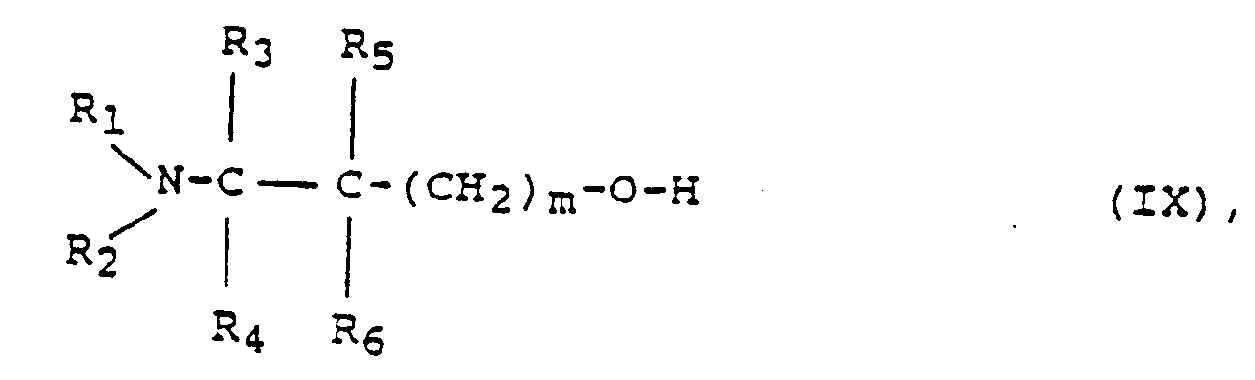

 III. dans le cas où X, dans la formule générale I, représente le groupe -NR₁₀R₁₁, on fait réagir un dérivé d'acide carboxylique de formule générale XII
PT₃ (XIII),
dans laquelle T représente un groupe halogène, OH ou OR′, R′ ayant la même signification que ci-dessus, et ensuite, on effectue éventuellement une saponification,
ouIV. dans le cas où X, dans la formule générale I, représente un atome d'hydrogène,a) on fait réagir un composé de formule XIV

oub) on effectue l'addition d'un composé de formule générale IX

ouc) on fait réagir un composé de formule XVII

ou
dans le cas où R₈ représente un atome d'hydrogène,d) on soumet un composé de formule générale XIX
et ensuite, on saponifie éventuellement le tétraester formé en diester ou en acide, un groupe acyle éventuellement présent pouvant être coupé également, et l'on transforme l'acide libre en sel pharmacologiquement acceptable. - Procédé pour la préparation de composés selon la revendication 3, où R₁ représente un atome d'hydrogène ou un groupe méthyle, R₂ représente un atome d'hydrogène ou un groupe méthyle, R₃ représente un atome d'hydrogène ou un groupe alkyle en C₁-C₅, R₄ représente un atome d'hydrogène ou un groupe méthyle, R₅ représente un atome d'hydrogène ou un groupe méthyle, R₆ représente un atome d'hydrogène, R₇ représente un atome d'hydrogène, R₈ représente un atome d'hydrogène, R₉ représente un atome d'hydrogène, m vaut 0 ou 1, n vaut 0 et X représente un groupe hydroxyle, R₄ et R₆ pouvant former, conjointement avec l'atome de C auquel ils sont liés, un noyau cyclohexyle et R₅ et R₆ pouvant former, conjointement avec l'atome de C auquel ils sont liés, un noyau spirocyclopentane.
- Composé selon la revendication 1 ou 2, choisi dans le groupe formé par l'acide R,S -5-amino-3-oxa-hexane-1-hydroxy-1, 1-diphosphonique, l'acide R-5-amino-3-oxa-hexane-1-hydroxy-1, 1-diphosphonique et l'acide S-5-amino-3-oxa-hexane-1-hydroxy-1, 1-diphosphonique.
- Médicament contenant un composé selon l'une quelconque des revendications 1, 2 et 5, en plus de supports et adjuvants usuels.
- Utilisation de composés selon l'une quelconque des revendications 1, 2 et 5, pour le traitement des troubles du métabolisme calcique.
Priority Applications (1)
| Application Number | Priority Date | Filing Date | Title |
|---|---|---|---|
| AT89112263T ATE84538T1 (de) | 1988-07-05 | 1989-07-05 | Neue diphosphonsaeurederivate, verfahren zu deren herstellung und diese verbindungen enthaltende arzneimittel. |
Applications Claiming Priority (2)
| Application Number | Priority Date | Filing Date | Title |
|---|---|---|---|
| DE3822650A DE3822650A1 (de) | 1988-07-05 | 1988-07-05 | Neue diphosphonsaeurederivate, verfahren zu deren herstellung und diese verbindungen enthaltende arzneimittel |
| DE3822650 | 1988-07-05 |
Publications (2)
| Publication Number | Publication Date |
|---|---|
| EP0350002A1 EP0350002A1 (fr) | 1990-01-10 |
| EP0350002B1 true EP0350002B1 (fr) | 1993-01-13 |
Family
ID=6357951
Family Applications (1)
| Application Number | Title | Priority Date | Filing Date |
|---|---|---|---|
| EP89112263A Expired - Lifetime EP0350002B1 (fr) | 1988-07-05 | 1989-07-05 | Dérivés d'acides diphosphoniques, procédé pour leur préparation et médicaments contenant ces composés |
Country Status (22)
| Country | Link |
|---|---|
| US (1) | US5002937A (fr) |
| EP (1) | EP0350002B1 (fr) |
| JP (1) | JPH0256492A (fr) |
| KR (1) | KR900001711A (fr) |
| CN (1) | CN1039248A (fr) |
| AT (1) | ATE84538T1 (fr) |
| AU (1) | AU616283B2 (fr) |
| CA (1) | CA1334409C (fr) |
| DD (1) | DD287508A5 (fr) |
| DE (2) | DE3822650A1 (fr) |
| DK (1) | DK327689A (fr) |
| ES (1) | ES2046383T3 (fr) |
| FI (1) | FI893262A7 (fr) |
| HU (1) | HU205127B (fr) |
| IL (1) | IL90804A (fr) |
| MX (1) | MX16658A (fr) |
| NO (1) | NO892762L (fr) |
| NZ (1) | NZ229787A (fr) |
| PL (1) | PL158956B1 (fr) |
| PT (1) | PT91053B (fr) |
| RU (1) | RU1823875C (fr) |
| ZA (1) | ZA895069B (fr) |
Families Citing this family (37)
| Publication number | Priority date | Publication date | Assignee | Title |
|---|---|---|---|---|
| US5157027A (en) * | 1991-05-13 | 1992-10-20 | E. R. Squibb & Sons, Inc. | Bisphosphonate squalene synthetase inhibitors and method |
| US5270365A (en) * | 1991-12-17 | 1993-12-14 | Merck & Co., Inc. | Prevention and treatment of periodontal disease with alendronate |
| JP3141053B2 (ja) * | 1991-12-26 | 2001-03-05 | アベンティス ファーマ株式会社 | ビスホスホン酸誘導体 |
| TW237386B (fr) * | 1992-04-15 | 1995-01-01 | Ciba Geigy | |
| US5283057A (en) * | 1992-04-24 | 1994-02-01 | The Procter & Gamble Company | Risedronate in oral compositions |
| EP0646119B1 (fr) * | 1992-05-29 | 1998-07-15 | PROCTER & GAMBLE PHARMACEUTICALS, INC. | Composes quaternaires de phosphonate contenant de l'azote et servant a traiter le metabolisme anormal du calcium et du phosphate ainsi que le tartre et la plaque dentaire |
| TW258729B (fr) * | 1992-06-22 | 1995-10-01 | Ciba Geigy | |
| AU6156494A (en) | 1993-03-08 | 1994-09-26 | Eisai Co. Ltd. | Phosphonic acid derivatives |
| JPH06298779A (ja) * | 1993-04-15 | 1994-10-25 | Hoechst Japan Ltd | ヘテロ環イミノビスメチレンビスホスホン酸誘導体 |
| US5462932A (en) * | 1994-05-17 | 1995-10-31 | Merck & Co., Inc. | Oral liquid alendronate formulations |
| DE19962924A1 (de) | 1999-12-24 | 2001-07-05 | Bayer Ag | Substituierte Oxazolidinone und ihre Verwendung |
| US6677320B2 (en) | 2000-01-20 | 2004-01-13 | Hoffmann-La Roches Inc. | Parenteral bisphosphonate composition with improved local tolerance |
| US6410520B2 (en) | 2000-02-01 | 2002-06-25 | The Procter & Gamble Company | Selective crystallization of 3-pyridyl-1-hydroxyethylidene-1, 1-bisphosphonic acid sodium as the hemipentahydrate or monohydrate |
| US6562974B2 (en) * | 2000-02-01 | 2003-05-13 | The Procter & Gamble Company | Process for making geminal bisphosphonates |
| JP3923800B2 (ja) | 2000-05-05 | 2007-06-06 | エフ.ホフマン−ラ ロシュ アーゲー | ビスホスホン酸またはそれらの塩を含む、皮下投与のためのゲル様医薬組成物 |
| DE10129725A1 (de) * | 2001-06-20 | 2003-01-02 | Bayer Ag | Kombinationstherapie substituierter Oxazolidinone |
| HUP0402267A3 (en) * | 2001-12-21 | 2007-05-29 | Procter & Gamble | Method for treatment of bone disorders |
| KR20140021045A (ko) | 2002-05-10 | 2014-02-19 | 에프. 호프만-라 로슈 아게 | 골다공증 치료 및 예방용 비스포스폰산 |
| NZ536273A (en) * | 2002-12-20 | 2007-08-31 | Hoffmann La Roche | High dose ibandronate formulation |
| DE10300111A1 (de) * | 2003-01-07 | 2004-07-15 | Bayer Healthcare Ag | Verfahren zur Herstellung von 5-Chlor-N-({(5S)-2-oxo-3-[4-(3-oxo-4-morpholinyl)-phenyl]-1,3-oxazolidin-5-yl}-methyl)-2-thiophencarboxamid |
| ATE451380T1 (de) * | 2003-08-21 | 2009-12-15 | Sun Pharmaceuticals Ind Ltd | Verfahren zur herstellung von bisphosphonsäureverbindungen |
| DE10355461A1 (de) | 2003-11-27 | 2005-06-23 | Bayer Healthcare Ag | Verfahren zur Herstellung einer festen, oral applizierbaren pharmazeutischen Zusammensetzung |
| US7214818B2 (en) | 2004-10-29 | 2007-05-08 | Hoffmann-La Roche Inc. | Method for synthesizing bisphosphonate |
| DE102004062475A1 (de) * | 2004-12-24 | 2006-07-06 | Bayer Healthcare Ag | Feste, oral applizierbare pharmazeutische Darreichungsformen mit modifizierter Freisetzung |
| EP1685841A1 (fr) * | 2005-01-31 | 2006-08-02 | Bayer Health Care Aktiengesellschaft | Prevention et traitement de troubles thromboemboliques |
| DE102005045518A1 (de) * | 2005-09-23 | 2007-03-29 | Bayer Healthcare Ag | 2-Aminoethoxyessigsäure-Derivate und ihre Verwendung |
| DE102005047558A1 (de) * | 2005-10-04 | 2008-02-07 | Bayer Healthcare Ag | Kombinationstherapie substituierter Oxazolidinone zur Prophylaxe und Behandlung von cerebralen Durchblutungsstörungen |
| PT1934208E (pt) | 2005-10-04 | 2011-06-01 | Bayer Schering Pharma Ag | Nova forma polimorfa de 5-cloro-n-({(5s)-2-oxo-3-[4-(3- oxo-4-morfolinil)-fenil]-1,3-oxazolidin-5-il}-metil)-2- tiofenocarboxamida |
| DE102005047561A1 (de) | 2005-10-04 | 2007-04-05 | Bayer Healthcare Ag | Feste, oral applizierbare pharmazeutische Darreichungsformen mit schneller Wirkstofffreisetzung |
| DE102005048824A1 (de) * | 2005-10-10 | 2007-04-12 | Bayer Healthcare Ag | Behandlung und Prophylaxe von Mikroangiopathien |
| DE102006051625A1 (de) * | 2006-11-02 | 2008-05-08 | Bayer Materialscience Ag | Kombinationstherapie substituierter Oxazolidinone |
| CN101679465B (zh) * | 2007-04-11 | 2013-08-21 | 霍夫曼-拉罗奇有限公司 | 伊班膦酸盐的制备方法 |
| US20130244995A1 (en) * | 2010-11-26 | 2013-09-19 | Leo Pharma A/S | Calcium-sensing receptor-active compounds |
| US8748097B1 (en) | 2011-12-02 | 2014-06-10 | President And Fellows Of Harvard College | Identification of agents for treating calcium disorders and uses thereof |
| PL407922A1 (pl) | 2014-04-16 | 2015-10-26 | Wrocławskie Centrum Badań Eit + Spółka Z Ograniczoną Odpowiedzialnością | Nowe bisfosfoniany i ich zastosowanie |
| CN114848656B (zh) | 2015-09-09 | 2024-09-27 | 清华大学 | 作为高效的疫苗佐剂的甲羟戊酸通路的抑制剂 |
| WO2019076269A1 (fr) | 2017-10-16 | 2019-04-25 | 清华大学 | Inhibiteur de la voie de l'acide mévalonique et composition pharmaceutique correspondante |
Family Cites Families (14)
| Publication number | Priority date | Publication date | Assignee | Title |
|---|---|---|---|---|
| DE3203308A1 (de) * | 1982-01-27 | 1983-07-28 | Schering Ag, 1000 Berlin Und 4619 Bergkamen | Diphosphonsaeure-derivate und diese enthaltende pharmazeutische praeparate |
| DE3365492D1 (en) * | 1982-01-27 | 1986-10-02 | Schering Ag | Diphosphonic acid derivatives and pharmaceutical preparations containing them |
| FR2531088B1 (fr) * | 1982-07-29 | 1987-08-28 | Sanofi Sa | Produits anti-inflammatoires derives de l'acide methylenediphosphonique et leur procede de preparation |
| GB8419489D0 (en) * | 1984-07-31 | 1984-09-05 | Leo Pharm Prod Ltd | Chemical compounds |
| DE3428524A1 (de) * | 1984-08-02 | 1986-02-13 | Boehringer Mannheim Gmbh, 6800 Mannheim | Neue diphosphonsaeurederivate, verfahren zu deren herstellung und diese verbindungen enthaltende arzneimittel |
| US4687768A (en) * | 1984-12-21 | 1987-08-18 | The Procter & Gamble Company | Certain hexahydroindan-2,2-diphosphonic acids useful in treating diseases associated with abnormal calcium and phosphate metabolism |
| IL77243A (en) * | 1984-12-21 | 1996-11-14 | Procter & Gamble | Pharmaceutical compositions containing geminal diphosphonic acid compounds and certain such novel compounds |
| DE3512536A1 (de) * | 1985-04-06 | 1986-10-16 | Boehringer Mannheim Gmbh, 6800 Mannheim | Neue diphosphonsaeure-derivate, verfahren zu deren herstellung und diese verbindungen enthaltende arzneimittel |
| GB8615916D0 (en) * | 1986-06-30 | 1986-08-06 | Amersham Int Plc | Bone-seeking complexes of technetium-99m |
| DE3623397A1 (de) * | 1986-07-11 | 1988-01-14 | Boehringer Mannheim Gmbh | Neue diphosphonsaeurederivate, verfahren zu deren herstellung und diese verbindungen enthaltende arzneimittel |
| DE3626058A1 (de) * | 1986-08-01 | 1988-02-11 | Boehringer Mannheim Gmbh | Neue diphosphonsaeurederivate, verfahren zu deren herstellung und diese verbindungen enthaltende arzneimittel |
| IL84731A0 (en) * | 1986-12-19 | 1988-05-31 | Norwich Eaton Pharma | Heterocycle-substituted diphosphonic acids and salts and esters and pharmaceutical compositions containing them |
| US4868164A (en) * | 1986-12-19 | 1989-09-19 | Norwich Eaton Pharmaceuticals, Inc. | Octahydro-pyridine diphosphonate compounds, pharmaceutical compositions, and methods for treating abnormal calcium and phosphate metabolism |
| EP0317505A1 (fr) * | 1987-11-13 | 1989-05-24 | Ciba-Geigy Ag | Acides azacycloalkylalcanediphosphoniques |
-
1988
- 1988-07-05 DE DE3822650A patent/DE3822650A1/de not_active Withdrawn
-
1989
- 1989-06-29 IL IL9080489A patent/IL90804A/en not_active IP Right Cessation
- 1989-06-30 DD DD89330232A patent/DD287508A5/de not_active IP Right Cessation
- 1989-06-30 NZ NZ229787A patent/NZ229787A/xx unknown
- 1989-06-30 DK DK327689A patent/DK327689A/da not_active Application Discontinuation
- 1989-06-30 MX MX1665889A patent/MX16658A/es unknown
- 1989-07-04 ZA ZA895069A patent/ZA895069B/xx unknown
- 1989-07-04 PT PT91053A patent/PT91053B/pt not_active IP Right Cessation
- 1989-07-04 PL PL1989280399A patent/PL158956B1/pl unknown
- 1989-07-04 HU HU893371A patent/HU205127B/hu not_active IP Right Cessation
- 1989-07-04 CA CA000604669A patent/CA1334409C/fr not_active Expired - Fee Related
- 1989-07-04 NO NO89892762A patent/NO892762L/no unknown
- 1989-07-04 FI FI893262A patent/FI893262A7/fi not_active Application Discontinuation
- 1989-07-04 AU AU37287/89A patent/AU616283B2/en not_active Ceased
- 1989-07-04 RU SU894614502A patent/RU1823875C/ru active
- 1989-07-05 DE DE8989112263T patent/DE58903263D1/de not_active Expired - Fee Related
- 1989-07-05 JP JP1172089A patent/JPH0256492A/ja active Pending
- 1989-07-05 ES ES198989112263T patent/ES2046383T3/es not_active Expired - Lifetime
- 1989-07-05 CN CN89104675A patent/CN1039248A/zh active Pending
- 1989-07-05 EP EP89112263A patent/EP0350002B1/fr not_active Expired - Lifetime
- 1989-07-05 KR KR1019890009525A patent/KR900001711A/ko not_active Withdrawn
- 1989-07-05 AT AT89112263T patent/ATE84538T1/de not_active IP Right Cessation
- 1989-07-05 US US07/375,747 patent/US5002937A/en not_active Expired - Fee Related
Also Published As
| Publication number | Publication date |
|---|---|
| JPH0256492A (ja) | 1990-02-26 |
| NO892762D0 (no) | 1989-07-04 |
| FI893262L (fi) | 1990-01-06 |
| NZ229787A (en) | 1991-09-25 |
| RU1823875C (ru) | 1993-06-23 |
| US5002937A (en) | 1991-03-26 |
| HU205127B (en) | 1992-03-30 |
| EP0350002A1 (fr) | 1990-01-10 |
| DD287508A5 (de) | 1991-02-28 |
| FI893262A7 (fi) | 1990-01-06 |
| ES2046383T3 (es) | 1994-02-01 |
| AU616283B2 (en) | 1991-10-24 |
| DE3822650A1 (de) | 1990-02-01 |
| HUT50842A (en) | 1990-03-28 |
| PL158956B1 (pl) | 1992-10-30 |
| DE58903263D1 (de) | 1993-02-25 |
| MX16658A (es) | 1993-11-01 |
| NO892762L (no) | 1990-01-08 |
| KR900001711A (ko) | 1990-02-27 |
| FI893262A0 (fi) | 1989-07-04 |
| CA1334409C (fr) | 1995-02-14 |
| CN1039248A (zh) | 1990-01-31 |
| PT91053B (pt) | 1995-01-31 |
| ATE84538T1 (de) | 1993-01-15 |
| PT91053A (pt) | 1990-02-08 |
| DK327689A (da) | 1990-01-06 |
| AU3728789A (en) | 1990-01-11 |
| DK327689D0 (da) | 1989-06-30 |
| IL90804A0 (en) | 1990-01-18 |
| IL90804A (en) | 1994-04-12 |
| ZA895069B (en) | 1990-04-25 |
Similar Documents
| Publication | Publication Date | Title |
|---|---|---|
| EP0350002A1 (fr) | Dérivés d'acides diphosphoniques, procédé pour leur préparation et médicaments contenant ces composés | |
| EP0224751B1 (fr) | Dérivés d'acides disphosphoniques, leur procédé de préparation et médicaments contenant lesdits composés | |
| EP0252504B1 (fr) | Dérivés d'acides diphosphoniques, procédé pour les préparer et médicaments contenant ces composés | |
| EP0170228B1 (fr) | Dérivés d'acides diphosphoniques, leur procédé de préparation et médicaments les contenant | |
| DE69108920T2 (de) | Verfahren zur herstellung von imidazo[4,5-c]chinolin-4-aminen. | |
| EP0273190B1 (fr) | Dérivés d'acides diphosphoniques, leur procédé de préparation et médicaments les contenant | |
| DE3626058A1 (de) | Neue diphosphonsaeurederivate, verfahren zu deren herstellung und diese verbindungen enthaltende arzneimittel | |
| EP0600371A1 (fr) | Dérivés d'acides guanidinyl alkyl bis-1,1- phosphoniques, procédé pour les préparer et leur utilisation | |
| CH640862A5 (de) | Verfahren zur herstellung neuer hydroxylamin-substituierter aliphatischer phosphonsaeuren. | |
| DE69026964T2 (de) | Gem-diphosphonsäuren, verfahren zu deren herstellung und diese verbindungen enthaltende arzneimittel | |
| EP0546548B1 (fr) | Dérivés d'acides guanidinyl alkyl bis-1,1-phosphoniques, procédé pour les préparer et leur utilisation | |
| EP0767174A1 (fr) | Nouveaux acides aminalcanephosphiniques et leurs sels | |
| EP0473626B1 (fr) | Nouveaux derives d'acide diphosphonique, procede pour leur fabrication et medicaments les contenant | |
| DE2522314A1 (de) | In 2-stellung substituierte dimethoxyindazole | |
| DE4138584A1 (de) | Carbocyclische phosphonat-nucleotidanaloge, deren herstellung und verwendung | |
| EP0579939B1 (fr) | Dérivés de phospholipide | |
| EP0004529B1 (fr) | Dérivés d'arylaminoimidazoline tantomères, procédé pour leur préparation et leur application comme analgésique dans des formulations pharmaceutiques | |
| DE19502209A1 (de) | Phosphonoessigsäure-Derivate und deren Verwendung zur Behandlung von degenerativen Gelenkserkrankungen | |
| DE69009765T2 (de) | Kynurensäurederivate, deren herstellung und diese enthaltende pharmazeutische zusammensetzungen. | |
| EP0584115B1 (fr) | Medicaments contenant des derives de l'acide azacyclodiphosphonique, nouveaux derives de l'acide azacyclodiphosphonique et leur procede de fabrication | |
| AT393505B (de) | Arzneimittel, welche alkylphosphoamine in kombination mit einem alkylglycerin enthalten | |
| EP0193066B1 (fr) | Cétosultames et leur procédé de préparation | |
| DE68904909T2 (de) | N-heterocyclische propyliden-1,1-biphosphonsaeuren, ihre herstellung und eine pharmazeutische verbindung. | |
| AT367429B (de) | Verfahren zur herstellung von neuen hydroxylamino-hydrocarbylphosphonsaeurederivaten | |
| EP0279458A1 (fr) | Dérivés de la propyl-2 amine, procédés pour leur préparation et leur application |
Legal Events
| Date | Code | Title | Description |
|---|---|---|---|
| PUAI | Public reference made under article 153(3) epc to a published international application that has entered the european phase |
Free format text: ORIGINAL CODE: 0009012 |
|
| 17P | Request for examination filed |
Effective date: 19890705 |
|
| AK | Designated contracting states |
Kind code of ref document: A1 Designated state(s): AT BE CH DE ES FR GB GR IT LI LU NL SE |
|
| 17Q | First examination report despatched |
Effective date: 19910614 |
|
| GRAA | (expected) grant |
Free format text: ORIGINAL CODE: 0009210 |
|
| AK | Designated contracting states |
Kind code of ref document: B1 Designated state(s): AT BE CH DE ES FR GB GR IT LI LU NL SE |
|
| PG25 | Lapsed in a contracting state [announced via postgrant information from national office to epo] |
Ref country code: SE Effective date: 19930113 Ref country code: GR Free format text: LAPSE BECAUSE OF FAILURE TO SUBMIT A TRANSLATION OF THE DESCRIPTION OR TO PAY THE FEE WITHIN THE PRESCRIBED TIME-LIMIT Effective date: 19930113 Ref country code: BE Effective date: 19930113 |
|
| REF | Corresponds to: |
Ref document number: 84538 Country of ref document: AT Date of ref document: 19930115 Kind code of ref document: T |
|
| REF | Corresponds to: |
Ref document number: 58903263 Country of ref document: DE Date of ref document: 19930225 |
|
| ET | Fr: translation filed | ||
| ITF | It: translation for a ep patent filed | ||
| GBT | Gb: translation of ep patent filed (gb section 77(6)(a)/1977) |
Effective date: 19930408 |
|
| PG25 | Lapsed in a contracting state [announced via postgrant information from national office to epo] |
Ref country code: LU Free format text: LAPSE BECAUSE OF NON-PAYMENT OF DUE FEES Effective date: 19930731 |
|
| PLBE | No opposition filed within time limit |
Free format text: ORIGINAL CODE: 0009261 |
|
| STAA | Information on the status of an ep patent application or granted ep patent |
Free format text: STATUS: NO OPPOSITION FILED WITHIN TIME LIMIT |
|
| 26N | No opposition filed | ||
| REG | Reference to a national code |
Ref country code: ES Ref legal event code: FG2A Ref document number: 2046383 Country of ref document: ES Kind code of ref document: T3 |
|
| PGFP | Annual fee paid to national office [announced via postgrant information from national office to epo] |
Ref country code: GB Payment date: 19990630 Year of fee payment: 11 |
|
| PGFP | Annual fee paid to national office [announced via postgrant information from national office to epo] |
Ref country code: FR Payment date: 19990709 Year of fee payment: 11 |
|
| PGFP | Annual fee paid to national office [announced via postgrant information from national office to epo] |
Ref country code: CH Payment date: 19990713 Year of fee payment: 11 Ref country code: AT Payment date: 19990713 Year of fee payment: 11 |
|
| PGFP | Annual fee paid to national office [announced via postgrant information from national office to epo] |
Ref country code: ES Payment date: 19990719 Year of fee payment: 11 |
|
| PGFP | Annual fee paid to national office [announced via postgrant information from national office to epo] |
Ref country code: NL Payment date: 19990730 Year of fee payment: 11 |
|
| PGFP | Annual fee paid to national office [announced via postgrant information from national office to epo] |
Ref country code: DE Payment date: 19990816 Year of fee payment: 11 |
|
| PG25 | Lapsed in a contracting state [announced via postgrant information from national office to epo] |
Ref country code: GB Free format text: LAPSE BECAUSE OF NON-PAYMENT OF DUE FEES Effective date: 20000705 Ref country code: AT Free format text: LAPSE BECAUSE OF NON-PAYMENT OF DUE FEES Effective date: 20000705 |
|
| PG25 | Lapsed in a contracting state [announced via postgrant information from national office to epo] |
Ref country code: ES Free format text: LAPSE BECAUSE OF NON-PAYMENT OF DUE FEES Effective date: 20000706 |
|
| PG25 | Lapsed in a contracting state [announced via postgrant information from national office to epo] |
Ref country code: LI Free format text: LAPSE BECAUSE OF NON-PAYMENT OF DUE FEES Effective date: 20000731 Ref country code: CH Free format text: LAPSE BECAUSE OF NON-PAYMENT OF DUE FEES Effective date: 20000731 |
|
| PG25 | Lapsed in a contracting state [announced via postgrant information from national office to epo] |
Ref country code: NL Free format text: LAPSE BECAUSE OF NON-PAYMENT OF DUE FEES Effective date: 20010201 |
|
| GBPC | Gb: european patent ceased through non-payment of renewal fee |
Effective date: 20000705 |
|
| REG | Reference to a national code |
Ref country code: CH Ref legal event code: PL |
|
| PG25 | Lapsed in a contracting state [announced via postgrant information from national office to epo] |
Ref country code: FR Free format text: LAPSE BECAUSE OF NON-PAYMENT OF DUE FEES Effective date: 20010330 |
|
| NLV4 | Nl: lapsed or anulled due to non-payment of the annual fee |
Effective date: 20010201 |
|
| REG | Reference to a national code |
Ref country code: FR Ref legal event code: ST |
|
| PG25 | Lapsed in a contracting state [announced via postgrant information from national office to epo] |
Ref country code: DE Free format text: LAPSE BECAUSE OF NON-PAYMENT OF DUE FEES Effective date: 20010501 |
|
| REG | Reference to a national code |
Ref country code: ES Ref legal event code: FD2A Effective date: 20010810 |
|
| PG25 | Lapsed in a contracting state [announced via postgrant information from national office to epo] |
Ref country code: IT Free format text: LAPSE BECAUSE OF NON-PAYMENT OF DUE FEES Effective date: 20050705 |