EP0350070A2 - Liant à céramiques - Google Patents
Liant à céramiques Download PDFInfo
- Publication number
- EP0350070A2 EP0350070A2 EP89112487A EP89112487A EP0350070A2 EP 0350070 A2 EP0350070 A2 EP 0350070A2 EP 89112487 A EP89112487 A EP 89112487A EP 89112487 A EP89112487 A EP 89112487A EP 0350070 A2 EP0350070 A2 EP 0350070A2
- Authority
- EP
- European Patent Office
- Prior art keywords
- ceramics
- binder
- molding
- raw material
- parts
- Prior art date
- Legal status (The legal status is an assumption and is not a legal conclusion. Google has not performed a legal analysis and makes no representation as to the accuracy of the status listed.)
- Withdrawn
Links
Images
Classifications
-
- C—CHEMISTRY; METALLURGY
- C04—CEMENTS; CONCRETE; ARTIFICIAL STONE; CERAMICS; REFRACTORIES
- C04B—LIME, MAGNESIA; SLAG; CEMENTS; COMPOSITIONS THEREOF, e.g. MORTARS, CONCRETE OR LIKE BUILDING MATERIALS; ARTIFICIAL STONE; CERAMICS; REFRACTORIES; TREATMENT OF NATURAL STONE
- C04B35/00—Shaped ceramic products characterised by their composition; Ceramics compositions; Processing powders of inorganic compounds preparatory to the manufacturing of ceramic products
- C04B35/622—Forming processes; Processing powders of inorganic compounds preparatory to the manufacturing of ceramic products
- C04B35/626—Preparing or treating the powders individually or as batches ; preparing or treating macroscopic reinforcing agents for ceramic products, e.g. fibres; mechanical aspects section B
- C04B35/63—Preparing or treating the powders individually or as batches ; preparing or treating macroscopic reinforcing agents for ceramic products, e.g. fibres; mechanical aspects section B using additives specially adapted for forming the products, e.g.. binder binders
- C04B35/632—Organic additives
- C04B35/634—Polymers
- C04B35/63404—Polymers obtained by reactions only involving carbon-to-carbon unsaturated bonds
- C04B35/63408—Polyalkenes
-
- C—CHEMISTRY; METALLURGY
- C04—CEMENTS; CONCRETE; ARTIFICIAL STONE; CERAMICS; REFRACTORIES
- C04B—LIME, MAGNESIA; SLAG; CEMENTS; COMPOSITIONS THEREOF, e.g. MORTARS, CONCRETE OR LIKE BUILDING MATERIALS; ARTIFICIAL STONE; CERAMICS; REFRACTORIES; TREATMENT OF NATURAL STONE
- C04B35/00—Shaped ceramic products characterised by their composition; Ceramics compositions; Processing powders of inorganic compounds preparatory to the manufacturing of ceramic products
- C04B35/622—Forming processes; Processing powders of inorganic compounds preparatory to the manufacturing of ceramic products
- C04B35/626—Preparing or treating the powders individually or as batches ; preparing or treating macroscopic reinforcing agents for ceramic products, e.g. fibres; mechanical aspects section B
- C04B35/63—Preparing or treating the powders individually or as batches ; preparing or treating macroscopic reinforcing agents for ceramic products, e.g. fibres; mechanical aspects section B using additives specially adapted for forming the products, e.g.. binder binders
- C04B35/632—Organic additives
-
- C—CHEMISTRY; METALLURGY
- C04—CEMENTS; CONCRETE; ARTIFICIAL STONE; CERAMICS; REFRACTORIES
- C04B—LIME, MAGNESIA; SLAG; CEMENTS; COMPOSITIONS THEREOF, e.g. MORTARS, CONCRETE OR LIKE BUILDING MATERIALS; ARTIFICIAL STONE; CERAMICS; REFRACTORIES; TREATMENT OF NATURAL STONE
- C04B35/00—Shaped ceramic products characterised by their composition; Ceramics compositions; Processing powders of inorganic compounds preparatory to the manufacturing of ceramic products
- C04B35/622—Forming processes; Processing powders of inorganic compounds preparatory to the manufacturing of ceramic products
- C04B35/626—Preparing or treating the powders individually or as batches ; preparing or treating macroscopic reinforcing agents for ceramic products, e.g. fibres; mechanical aspects section B
- C04B35/63—Preparing or treating the powders individually or as batches ; preparing or treating macroscopic reinforcing agents for ceramic products, e.g. fibres; mechanical aspects section B using additives specially adapted for forming the products, e.g.. binder binders
- C04B35/632—Organic additives
- C04B35/634—Polymers
Definitions
- the present invention relates to a ceramics binder and, more particularly, to a ceramics binder which causes no blocking in preparing a body by admixing a raw ceramics material with a binder and which can provide a molded article without getting out of shape during molding the body to molded articles.
- a process for preparing a body having a plasticity by admixing a powdery raw ceramics material with a binder, molding the body and then baking the resulting molded articles.
- thermoplastic resin such as an atactic polypropylene, a copolymer of ethylene with vinyl acetate or the like
- organic compound such as naphthalene, anthracene, camphor, phenanthrene or the like.
- binders may often cause blocking during preparation for a body and a molded article of the body may get out of shape. Even if the body is treated for cleaning or degreasing, a considerably large amount of the binder may remain and cracks or voids may be caused to occur on a surface of the molded article leading to a poor outlook.
- a body formulated with such binder is manufactured, for example, by injection molding, it is hard to carry out the molding under relatively mild conditions because a high molding pressure is required for injection molding and a decomposition of the binder is caused if a molding temperature is elevated in order to reduce the high molding pressure.
- Japanese Patent Publication (laid-open) No.3,064/1987 discloses an attempt using adamantane, trimethylene norbornane or the like as an auxiliary component.
- This process may produce shaped ceramics products, for example, by injection molding under relatively mild conditions, shorten a cleaning time, and reduce an amount of the binder.
- this process presents the advantage, however, it has been found that it poses the drawbacks that blocking is likely to occur in preparing a body obtained by admixing a ceramics raw material with the ceramics binder.
- ceramics binders with improved performance have been demanded for a long time.
- the present invention has the object to provide a ceramics binder which causes no blocking in preparing a body, which does not get out of shape in molding the body into shaped articles, which contains a small amount of residues of the binder remained in the body to be reduced to a lower level by cleaning or degreasing, which blocks cracking, voids or swelling from occurring when molding into shaped articles, and which permits a ready injection molding to thereby improve a manufacturing efficiency.
- the present invention consists of a ceramics binder characterized by containing a cyclododecane.
- the ceramics binder according to the present invention contains an organic binder as a major component and cyclododecane as an auxiliary component.
- the ceramics binder is conveniently formulated into a body and then subjected to injection molding.
- the ceramics binder according to the present invention is prepared from the organic binder as a major component and cyclododecane as an auxiliary component.
- the organic binder to be used as a major component for the ceramics binder according to the present invention is not restricted to a particular one and may include, for example, polyethylene, atactic polypropylene, polybutene, polystyrene, ethylene-vinyl acetate copolymer, polybutyl methacrylate, cellulose acetate, acrylic resin, polyvinyl alcohol, carboxymethyl cellulose, glucose, methyl cellulose, ethyl cellulose, acetyl cellulose, starch, dextrin, gelatin, molasses, pulp waste, peptone, polyvinyl ether, wax, liquid paraffin, heavy oil, machine oil, phenol resin, and ethyl silicate.
- Polyethylene, atactic polypropylene, polystyrene, ethylene-vinyl acetate copolymer, polybutyl methacrylate, cellulose acetate, wax and the like are preferred when the ceramics binder of the present invention is used for a body for injection molding.
- the ceramics binder according to the present invention is characterized in that the cyclododecane is contained as an auxiliary component.
- the cyclododecane to be used therefor is not restricted to any particular one and it has a melting point of 61°C, a boiling point of 240 °C, and d204 of 0.861-
- the cyclododecane obtainable by whichever processes may be conveniently used.
- the cyclododecane may be prepared generally by trimerizing butadiene to form cyclododeca-1,5,9-triene followed by hydrogenation.
- a catalyst for trimerization of butadiene, a catalyst is usually used and such may include, for example, a Ziegler catalyst, e.g., TiCl4 and Et2AlCl, Ni(O) complex, e.g., bis( ⁇ -allyl)nickel complex or a chrome complex.
- a catalyst system such as Al (C2H5)Cl2-Al(C2H5)Cl.
- Ni catalyst For hydrogenation of cyclododeca-1,5,9-triene, a catalyst such as Ni catalyst may be employed.
- Rates of the major component and the auxiliary component may vary with kinds of ceramics raw materials.
- a rate of the major component may be in the range usually from 0.5 parts to 50 parts by weight, preferably from 5 parts to 30 parts by weight, based on 100 parts by weight of the ceramics raw material
- a rate of the auxiliary component may be in the range usually from 0.5 parts to 15 parts by weight, preferably from 2 parts to 8 parts by weight, based on 100 parts by weight of the ceramics raw material.
- the ceramics binder according to the present invention may additionally contain an additive such as a plasticizer or a lubricant.
- the plasticizer may include, for example, diethyl phthalate, dibutyl phthalate, dioctyl phthalate or an aliphatic acid ester.
- the lubricant may include, for example, aluminium stearate, magnesium stearate, diglycolstearic acid, bread crumbs or mineral oil.
- the ceramics binder comprising the major component and the auxiliary component is then formulated with the ceramics raw material to form a body.
- the ceramics raw material to be used with the ceramics binder may include, for example, a non-plastic raw material such as silica, feldspar, porcelain stone, lithium ore, silimanite, alumina, zirconia, silicon carbonate or silicon nitride or a plastic raw material such as kaolin, plastic clay, vermiculite clay or fire clay.
- a non-plastic raw material such as silica, feldspar, porcelain stone, lithium ore, silimanite, alumina, zirconia, silicon carbonate or silicon nitride
- a plastic raw material such as kaolin, plastic clay, vermiculite clay or fire clay.
- the ceramics raw material are subjected to processing such as pulverization, wet admixing, screening and removal of impurities, prior to admixture with the ceramics binder, like manufacturing shaped ceramics products in a usual manner.
- Formulation of the ceramics raw material with the ceramics binder may be generally carried out by kneading at temperatures ranging from 80°C to 150°C, preferably from 100°C to 120°C for 0.5 to 3 hours, preferably from 0.5 to 1 hour.
- the kneading may be effected with a kneader which provides a shear force while heating, such as ball mill, blast mill, heating kneader or Kokneader.
- Procedures of formulation may be restricted to no particular one. They may preferably involve admixing the main component with the auxiliary component to yield a ceramics binder and then admixing the ceramics binder with the ceramics raw material although the ceramics raw material may be admixed with the main and auxiliary components simultaneously or one after another.
- the ceramics raw material is admixed with the ceramics binder as long as the ceramics binder can be dispersed in the body to a favorable extent. Particularly, this procedure does not cause any blocking during preparation for the body and permits a kneading of the ceramics binder with the raw material in a more uniform manner.
- the resulting body is then molded into a given shaped form by any conventional ceramics molding methods such as injection molding, soft mud process, semi-soft mud process, plastic pressure molding, jiggering, roller machine process, extrusion molding, hydrostatic molding/ rubber press method, tamping and high temperature pressure molding.
- any conventional ceramics molding methods such as injection molding, soft mud process, semi-soft mud process, plastic pressure molding, jiggering, roller machine process, extrusion molding, hydrostatic molding/ rubber press method, tamping and high temperature pressure molding.
- injection molding because the injection molding of the body in which the ceramics binder of the present invention is formulated can be effected in favorable and smooth manner under low molding pressures and cleaning or degreasing performance after injection molding can be improved.
- the body obtained by heating and kneading the ceramics raw material in admixture with the ceramics binder may be then formulated into given shaped products such as pellets or powders as molding material by granulation of the body by means of rolls, pelletizing by means of pelletizers, pulverization by means of cold grinding with a kneader or by means of cold extrusion into sheet by rolls.
- the molding material thus prepared is then subjected to injection molding of plunger type, or screw line type, yielding a primary shaped article.
- the injection molding may be effected at temperatures ranging from 80°C to 170°C under pressures ranging from 300 to 1,500 kg/cm2.
- the primary shaped article is then subjected to cleaning or degreasing process to remove the ceramics binder contained therein.
- This process may be carried out by heating it at temperatures in the range from 20°C to 450 °C for 15 to 40 hours.
- the ceramics binder according to the present invention can be removed in a time period extremely shorter and its amount of the binder left in the primary shaped article is considerably smaller than conventional ceramics binders.
- the primary shaped article is then fired or baked to yield ceramics shaped products.
- the ceramics binder according to the present invention using cyclododecane as the auxiliary component does not get out of shape during molding the body and can permit a ready provision of shaped articles and products having accurate dimensions.
- Ceramics raw material alumina, zirconia, silicon carbide or silicon nitride having physical characteristics as shown in Table 2 below.
- EVA ethylene-vinyl acetate copolymer
- PVA polybutyl methacrylate
- PS polystyrene
- PE polyethylene
- NB-793 Chukyo Yushi
- the ceramics raw material was formulated with the major and auxiliary components in a manner as shown in Table 1 below and the mixture was kneaded at a temperature of 100 ⁇ 10°C and under kneading torque of 150 kg/cm2 for 30 minutes with a blast mill. The body prepared by kneading was then measured for blocking. Results are shown in Table 1 below. As is apparent from Table 1 below, it has been found that no blocking is caused whatsoever and the body in each Example is in a state in which the ingredients are uniformly dispersed.
- the body thus prepared was then pulverized into powder which, in turn, was subjected to injection molding.
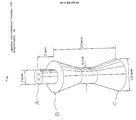
- the injection molding was effected to yield a shaped article in the form of a top as shown in FIGURE, using an injection molding machine of a vertical plunger type (Yamashiro Seiki K.K.) under molding conditions as shown in Table 1 below.
- the shaped article may be in the form of a drum having a lower surface and an upper surface with a small-diameter rod thereon. Visual observation was made on edge portion A of the small-diameter rod projecting from the upper surface, edge portion B of the upper surface, and edge portion C of the lower surface for a deformation of shape. As is apparent from Table 1 below, it has been found that the shaped article prepared in each of Examples did not cause any deformation of shape.
- the shaped article was then subjected to cleaning or degreasing under conditions as shown in Table 1 below. Thereafter, it was fired or baked with a furnace oven and the temperature was raised to 1,620 °C at the rate of 100 °C per hour, yielding a ceramics product.
- Comparative Examples were the same as used in Examples 1 to 6.
- the major components were the same as used in Examples 1 to 6 except atactic polypropylene (APP) ("polyOne”; Mitsubishi Yuka K.K.) and adamantane or endo-trimethylene norbornane (“Endo-TMN”) was used as the auxiliary component.
- APP atactic polypropylene
- PolyOne PolyOne
- Endo-TMN adamantane or endo-trimethylene norbornane
- the raw material was admixed with the major and auxiliary components under conditions as shown in Table 1 below using the same apparatus as used in Examples 1 to 6 and the mixture was kneaded into the body which, in turn, was formed to a shaped article in the form of a top. The shaped article was then subjected to cleaning or degreasing and baked yielding a ceramics product.
- the ceramics binder according to the present invention comprising mainly the organic binder as the major component and cyclododecane as the auxiliary component causes no blocking during preparation for the body by kneading the mixture of the binder with the ceramics raw material and permits a uniform kneading. It is further noted that it provides a shaped article which does not get out of shape and that it serves as shortening a time period for cleaning or degreasing. The resulting shaped article can yield a ceramics product free of cracks, voids and swelling and the product possesses a high mechanical strength and a high accuracy in shape dimensions, leading to an excellent surfacial outlook.
Landscapes
- Chemical & Material Sciences (AREA)
- Engineering & Computer Science (AREA)
- Manufacturing & Machinery (AREA)
- Ceramic Engineering (AREA)
- Inorganic Chemistry (AREA)
- Materials Engineering (AREA)
- Structural Engineering (AREA)
- Organic Chemistry (AREA)
- Chemical Kinetics & Catalysis (AREA)
- Compositions Of Oxide Ceramics (AREA)
Applications Claiming Priority (2)
| Application Number | Priority Date | Filing Date | Title |
|---|---|---|---|
| JP63170585A JPH0222165A (ja) | 1988-07-08 | 1988-07-08 | セラミックスバインダー |
| JP170585/88 | 1988-07-08 |
Publications (2)
| Publication Number | Publication Date |
|---|---|
| EP0350070A2 true EP0350070A2 (fr) | 1990-01-10 |
| EP0350070A3 EP0350070A3 (fr) | 1991-10-30 |
Family
ID=15907565
Family Applications (1)
| Application Number | Title | Priority Date | Filing Date |
|---|---|---|---|
| EP19890112487 Withdrawn EP0350070A3 (fr) | 1988-07-08 | 1989-07-07 | Liant à céramiques |
Country Status (2)
| Country | Link |
|---|---|
| EP (1) | EP0350070A3 (fr) |
| JP (1) | JPH0222165A (fr) |
Cited By (4)
| Publication number | Priority date | Publication date | Assignee | Title |
|---|---|---|---|---|
| WO1992007675A1 (fr) * | 1990-10-25 | 1992-05-14 | Robert Bosch Gmbh | Systeme liant et procede de traitement des poudres metalliques par moulage par injection |
| WO1996009998A1 (fr) * | 1994-09-27 | 1996-04-04 | Robert Bosch Gmbh | Procede de fabrication de corps formes en ferrites dures |
| EP2030957A1 (fr) * | 2007-08-28 | 2009-03-04 | Corning Incorporated | Structure poreuse fugitive pour articles poreux en céramique |
| WO2009027837A3 (fr) * | 2007-08-28 | 2009-04-30 | Corning Inc | Procédé pour produire des articles en céramique poreuse au moyen d'un agent de formation de pores fugitif |
Family Cites Families (3)
| Publication number | Priority date | Publication date | Assignee | Title |
|---|---|---|---|---|
| JPS5927743B2 (ja) * | 1979-02-28 | 1984-07-07 | 旭硝子株式会社 | セラミック紛未の成形品の処理方法 |
| JPS623064A (ja) * | 1985-06-27 | 1987-01-09 | 出光石油化学株式会社 | セラミツクスバインダ− |
| DE3881283T2 (de) * | 1987-06-25 | 1993-11-18 | Idemitsu Petrochemical Co | Metallbinder und Zusammensetzung für die Guss-Formung. |
-
1988
- 1988-07-08 JP JP63170585A patent/JPH0222165A/ja active Granted
-
1989
- 1989-07-07 EP EP19890112487 patent/EP0350070A3/fr not_active Withdrawn
Cited By (6)
| Publication number | Priority date | Publication date | Assignee | Title |
|---|---|---|---|---|
| WO1992007675A1 (fr) * | 1990-10-25 | 1992-05-14 | Robert Bosch Gmbh | Systeme liant et procede de traitement des poudres metalliques par moulage par injection |
| WO1996009998A1 (fr) * | 1994-09-27 | 1996-04-04 | Robert Bosch Gmbh | Procede de fabrication de corps formes en ferrites dures |
| KR100282317B1 (ko) * | 1994-09-27 | 2001-03-02 | 클라우스 포스, 게오르그 뮐러 | 경질의 페라이트로 이루어지는 성형체 제조 방법(Process for the manufacture of molded bodies from hard ferrites) |
| EP2030957A1 (fr) * | 2007-08-28 | 2009-03-04 | Corning Incorporated | Structure poreuse fugitive pour articles poreux en céramique |
| WO2009027837A3 (fr) * | 2007-08-28 | 2009-04-30 | Corning Inc | Procédé pour produire des articles en céramique poreuse au moyen d'un agent de formation de pores fugitif |
| US7914874B2 (en) | 2007-08-28 | 2011-03-29 | Corning Incorporated | Fugitive pore former for porous ceramic articles |
Also Published As
| Publication number | Publication date |
|---|---|
| JPH0222165A (ja) | 1990-01-25 |
| JPH0571535B2 (fr) | 1993-10-07 |
| EP0350070A3 (fr) | 1991-10-30 |
Similar Documents
| Publication | Publication Date | Title |
|---|---|---|
| US4784812A (en) | Ceramics binder and production of ceramics articles | |
| EP1093447B1 (fr) | Systeme de liant pour corps en ceramique en nid d'abeille et procede de production de ces corps en nid d'abeille | |
| US4028453A (en) | Process for making refractory shapes | |
| EP0116300B1 (fr) | Liant pour la fabrication de corps céramiques moulés | |
| CN108238785B (zh) | 一种薄壁蜂窝陶瓷载体的制备方法 | |
| US4902459A (en) | Method of making ceramic articles | |
| EP0296552A1 (fr) | Liant pour métaux et composition de moulage | |
| US3459566A (en) | Process for producing silicon carbide articles employing pyromellitic dianhydride-limonene dioxide mixture | |
| US4221596A (en) | Method for low pressure forming of fused silica compositions and resultant bodies | |
| JPH0339027B2 (fr) | ||
| US3238049A (en) | Dry grinding of ceramics | |
| CN108908648B (zh) | 一种陶瓷鄂板的制备方法及陶瓷鄂板 | |
| JPH0571535B2 (fr) | ||
| JP3734540B2 (ja) | 酸化インジウム−酸化亜鉛系焼結体ターゲットの製造方法 | |
| IL51108A (en) | Method of testing a sinterable material | |
| JPS6129907B2 (fr) | ||
| US2057349A (en) | Refractory | |
| US3246999A (en) | Method of producing porous carbon elements | |
| JPH0312353A (ja) | バインダー混合物 | |
| JPH0331661B2 (fr) | ||
| CN116619531A (zh) | 一种模造硅酸盐粉末制品成形的方法 | |
| JPH01226772A (ja) | 脱脂・焼結用支持体 | |
| JPH0457634B2 (fr) | ||
| CN116440813A (zh) | 用于流化床的高纯碳化硅内衬的制备方法及装置 | |
| USRE22648E (en) | Aluminous material |
Legal Events
| Date | Code | Title | Description |
|---|---|---|---|
| PUAI | Public reference made under article 153(3) epc to a published international application that has entered the european phase |
Free format text: ORIGINAL CODE: 0009012 |
|
| AK | Designated contracting states |
Kind code of ref document: A2 Designated state(s): BE CH DE FR GB IT LI NL SE |
|
| PUAL | Search report despatched |
Free format text: ORIGINAL CODE: 0009013 |
|
| AK | Designated contracting states |
Kind code of ref document: A3 Designated state(s): BE CH DE FR GB IT LI NL SE |
|
| 17P | Request for examination filed |
Effective date: 19920319 |
|
| 17Q | First examination report despatched |
Effective date: 19921218 |
|
| STAA | Information on the status of an ep patent application or granted ep patent |
Free format text: STATUS: THE APPLICATION IS DEEMED TO BE WITHDRAWN |
|
| 18D | Application deemed to be withdrawn |
Effective date: 19940310 |