EP0351782B1 - Optisch aktive Verbindungen, Flüssigkristallzusammensetzungen, welche diese Verbindungen enthalten, sowie optische Flüssigkristall-Modulatoren, in denen diese Zusammensetzungen verwendetsind - Google Patents
Optisch aktive Verbindungen, Flüssigkristallzusammensetzungen, welche diese Verbindungen enthalten, sowie optische Flüssigkristall-Modulatoren, in denen diese Zusammensetzungen verwendetsind Download PDFInfo
- Publication number
- EP0351782B1 EP0351782B1 EP89113158A EP89113158A EP0351782B1 EP 0351782 B1 EP0351782 B1 EP 0351782B1 EP 89113158 A EP89113158 A EP 89113158A EP 89113158 A EP89113158 A EP 89113158A EP 0351782 B1 EP0351782 B1 EP 0351782B1
- Authority
- EP
- European Patent Office
- Prior art keywords
- optically active
- liquid crystal
- group
- active compounds
- compound
- Prior art date
- Legal status (The legal status is an assumption and is not a legal conclusion. Google has not performed a legal analysis and makes no representation as to the accuracy of the status listed.)
- Expired - Lifetime
Links
- 150000001875 compounds Chemical class 0.000 title claims description 154
- 239000004973 liquid crystal related substance Substances 0.000 title claims description 68
- 239000000203 mixture Substances 0.000 title claims description 43
- 230000003287 optical effect Effects 0.000 title claims description 14
- -1 carbonyldioxy group Chemical group 0.000 claims description 43
- 125000004432 carbon atom Chemical group C* 0.000 claims description 41
- LFQSCWFLJHTTHZ-UHFFFAOYSA-N Ethanol Chemical compound CCO LFQSCWFLJHTTHZ-UHFFFAOYSA-N 0.000 claims description 20
- 230000010287 polarization Effects 0.000 claims description 18
- 230000002269 spontaneous effect Effects 0.000 claims description 18
- 150000001732 carboxylic acid derivatives Chemical class 0.000 claims description 15
- 239000002253 acid Substances 0.000 claims description 13
- 125000003262 carboxylic acid ester group Chemical group [H]C([H])([*:2])OC(=O)C([H])([H])[*:1] 0.000 claims description 13
- 125000001033 ether group Chemical group 0.000 claims description 13
- 239000011541 reaction mixture Substances 0.000 claims description 13
- RIOQSEWOXXDEQQ-UHFFFAOYSA-N triphenylphosphine Chemical compound C1=CC=CC=C1P(C=1C=CC=CC=1)C1=CC=CC=C1 RIOQSEWOXXDEQQ-UHFFFAOYSA-N 0.000 claims description 12
- 238000002360 preparation method Methods 0.000 claims description 10
- 238000000746 purification Methods 0.000 claims description 9
- 125000002915 carbonyl group Chemical group [*:2]C([*:1])=O 0.000 claims description 8
- FAMRKDQNMBBFBR-BQYQJAHWSA-N diethyl azodicarboxylate Substances CCOC(=O)\N=N\C(=O)OCC FAMRKDQNMBBFBR-BQYQJAHWSA-N 0.000 claims description 8
- FAMRKDQNMBBFBR-UHFFFAOYSA-N ethyl n-ethoxycarbonyliminocarbamate Chemical compound CCOC(=O)N=NC(=O)OCC FAMRKDQNMBBFBR-UHFFFAOYSA-N 0.000 claims description 8
- 150000004820 halides Chemical class 0.000 claims description 8
- 125000001140 1,4-phenylene group Chemical group [H]C1=C([H])C([*:2])=C([H])C([H])=C1[*:1] 0.000 claims description 6
- 239000003795 chemical substances by application Substances 0.000 claims description 5
- 125000002704 decyl group Chemical group [H]C([H])([H])C([H])([H])C([H])([H])C([H])([H])C([H])([H])C([H])([H])C([H])([H])C([H])([H])C([H])([H])C([H])([H])* 0.000 claims description 5
- 150000007530 organic bases Chemical class 0.000 claims description 5
- 150000003459 sulfonic acid esters Chemical class 0.000 claims description 5
- 230000002140 halogenating effect Effects 0.000 claims description 4
- 125000000623 heterocyclic group Chemical group 0.000 claims description 4
- 238000000926 separation method Methods 0.000 claims description 4
- 125000000008 (C1-C10) alkyl group Chemical group 0.000 claims description 3
- 125000006273 (C1-C3) alkyl group Chemical group 0.000 claims description 3
- QVGXLLKOCUKJST-UHFFFAOYSA-N atomic oxygen Chemical group [O] QVGXLLKOCUKJST-UHFFFAOYSA-N 0.000 claims description 3
- 238000005886 esterification reaction Methods 0.000 claims description 3
- 125000005699 methyleneoxy group Chemical group [H]C([H])([*:1])O[*:2] 0.000 claims description 3
- QJGQUHMNIGDVPM-UHFFFAOYSA-N nitrogen group Chemical group [N] QJGQUHMNIGDVPM-UHFFFAOYSA-N 0.000 claims description 3
- 229910052760 oxygen Inorganic materials 0.000 claims description 3
- 239000001301 oxygen Substances 0.000 claims description 3
- 125000004955 1,4-cyclohexylene group Chemical group [H]C1([H])C([H])([H])C([H])([*:1])C([H])([H])C([H])([H])C1([H])[*:2] 0.000 claims description 2
- 125000003178 carboxy group Chemical group [H]OC(*)=O 0.000 claims description 2
- 125000000816 ethylene group Chemical group [H]C([H])([*:1])C([H])([H])[*:2] 0.000 claims description 2
- 238000004519 manufacturing process Methods 0.000 claims 1
- 125000000217 alkyl group Chemical group 0.000 description 32
- 238000000034 method Methods 0.000 description 27
- 239000005262 ferroelectric liquid crystals (FLCs) Substances 0.000 description 23
- RTZKZFJDLAIYFH-UHFFFAOYSA-N Diethyl ether Chemical compound CCOCC RTZKZFJDLAIYFH-UHFFFAOYSA-N 0.000 description 21
- ZMXDDKWLCZADIW-UHFFFAOYSA-N N,N-Dimethylformamide Chemical compound CN(C)C=O ZMXDDKWLCZADIW-UHFFFAOYSA-N 0.000 description 18
- 239000004990 Smectic liquid crystal Substances 0.000 description 17
- 150000003333 secondary alcohols Chemical class 0.000 description 16
- XEKOWRVHYACXOJ-UHFFFAOYSA-N Ethyl acetate Chemical compound CCOC(C)=O XEKOWRVHYACXOJ-UHFFFAOYSA-N 0.000 description 15
- 125000002496 methyl group Chemical group [H]C([H])([H])* 0.000 description 15
- 238000001816 cooling Methods 0.000 description 13
- 125000004185 ester group Chemical group 0.000 description 13
- XLYOFNOQVPJJNP-UHFFFAOYSA-N water Substances O XLYOFNOQVPJJNP-UHFFFAOYSA-N 0.000 description 13
- HEDRZPFGACZZDS-UHFFFAOYSA-N Chloroform Chemical compound ClC(Cl)Cl HEDRZPFGACZZDS-UHFFFAOYSA-N 0.000 description 12
- OKKJLVBELUTLKV-UHFFFAOYSA-N Methanol Chemical compound OC OKKJLVBELUTLKV-UHFFFAOYSA-N 0.000 description 12
- HEDRZPFGACZZDS-MICDWDOJSA-N Trichloro(2H)methane Chemical compound [2H]C(Cl)(Cl)Cl HEDRZPFGACZZDS-MICDWDOJSA-N 0.000 description 12
- 230000004044 response Effects 0.000 description 12
- 239000000126 substance Substances 0.000 description 12
- 238000006482 condensation reaction Methods 0.000 description 11
- JUJWROOIHBZHMG-UHFFFAOYSA-N Pyridine Chemical compound C1=CC=NC=C1 JUJWROOIHBZHMG-UHFFFAOYSA-N 0.000 description 10
- 238000006243 chemical reaction Methods 0.000 description 10
- 238000005160 1H NMR spectroscopy Methods 0.000 description 9
- UHOVQNZJYSORNB-UHFFFAOYSA-N Benzene Chemical group C1=CC=CC=C1 UHOVQNZJYSORNB-UHFFFAOYSA-N 0.000 description 9
- 238000000921 elemental analysis Methods 0.000 description 9
- 239000000706 filtrate Substances 0.000 description 9
- 238000001914 filtration Methods 0.000 description 9
- 125000002887 hydroxy group Chemical group [H]O* 0.000 description 9
- QOSSAOTZNIDXMA-UHFFFAOYSA-N Dicylcohexylcarbodiimide Chemical compound C1CCCCC1N=C=NC1CCCCC1 QOSSAOTZNIDXMA-UHFFFAOYSA-N 0.000 description 8
- 239000004988 Nematic liquid crystal Substances 0.000 description 8
- AMIRSJQLIUABHL-WDSKDSINSA-N (2s,3s)-4-methoxy-3-methylbutan-2-ol Chemical compound COC[C@H](C)[C@H](C)O AMIRSJQLIUABHL-WDSKDSINSA-N 0.000 description 7
- JTGCXYYDAVPSFD-UHFFFAOYSA-N 4-(4-hydroxyphenyl)benzoic acid Chemical class C1=CC(C(=O)O)=CC=C1C1=CC=C(O)C=C1 JTGCXYYDAVPSFD-UHFFFAOYSA-N 0.000 description 7
- KEAYESYHFKHZAL-UHFFFAOYSA-N Sodium Chemical compound [Na] KEAYESYHFKHZAL-UHFFFAOYSA-N 0.000 description 7
- 150000007513 acids Chemical class 0.000 description 7
- 150000002148 esters Chemical class 0.000 description 7
- 239000000543 intermediate Substances 0.000 description 7
- 239000012312 sodium hydride Substances 0.000 description 7
- 229910000104 sodium hydride Inorganic materials 0.000 description 7
- 239000002904 solvent Substances 0.000 description 7
- WLBMKEUOVDMKIW-IUCAKERBSA-N (2s,3s)-4-butoxy-3-methylbutan-2-ol Chemical compound CCCCOC[C@H](C)[C@H](C)O WLBMKEUOVDMKIW-IUCAKERBSA-N 0.000 description 6
- FJKROLUGYXJWQN-UHFFFAOYSA-N 4-hydroxybenzoic acid Chemical compound OC(=O)C1=CC=C(O)C=C1 FJKROLUGYXJWQN-UHFFFAOYSA-N 0.000 description 6
- WEVYAHXRMPXWCK-UHFFFAOYSA-N Acetonitrile Chemical compound CC#N WEVYAHXRMPXWCK-UHFFFAOYSA-N 0.000 description 6
- FKLJPTJMIBLJAV-UHFFFAOYSA-N Compound IV Chemical compound O1N=C(C)C=C1CCCCCCCOC1=CC=C(C=2OCCN=2)C=C1 FKLJPTJMIBLJAV-UHFFFAOYSA-N 0.000 description 6
- IAZDPXIOMUYVGZ-UHFFFAOYSA-N Dimethylsulphoxide Chemical compound CS(C)=O IAZDPXIOMUYVGZ-UHFFFAOYSA-N 0.000 description 6
- WYURNTSHIVDZCO-UHFFFAOYSA-N Tetrahydrofuran Chemical compound C1CCOC1 WYURNTSHIVDZCO-UHFFFAOYSA-N 0.000 description 6
- YXFVVABEGXRONW-UHFFFAOYSA-N Toluene Chemical compound CC1=CC=CC=C1 YXFVVABEGXRONW-UHFFFAOYSA-N 0.000 description 6
- ZMANZCXQSJIPKH-UHFFFAOYSA-N Triethylamine Chemical compound CCN(CC)CC ZMANZCXQSJIPKH-UHFFFAOYSA-N 0.000 description 6
- 239000000463 material Substances 0.000 description 6
- 239000003960 organic solvent Substances 0.000 description 6
- 230000008569 process Effects 0.000 description 6
- FYSNRJHAOHDILO-UHFFFAOYSA-N thionyl chloride Chemical compound ClS(Cl)=O FYSNRJHAOHDILO-UHFFFAOYSA-N 0.000 description 6
- 0 CC(*)C(*)*C1CCC(*c2ccc(*c3ccc(*)cc3)cc2)CC1 Chemical compound CC(*)C(*)*C1CCC(*c2ccc(*c3ccc(*)cc3)cc2)CC1 0.000 description 5
- YMWUJEATGCHHMB-UHFFFAOYSA-N Dichloromethane Chemical compound ClCCl YMWUJEATGCHHMB-UHFFFAOYSA-N 0.000 description 5
- 238000000023 Kugelrohr distillation Methods 0.000 description 5
- 150000001298 alcohols Chemical class 0.000 description 5
- 238000004440 column chromatography Methods 0.000 description 5
- 125000004494 ethyl ester group Chemical group 0.000 description 5
- VLKZOEOYAKHREP-UHFFFAOYSA-N n-Hexane Chemical compound CCCCCC VLKZOEOYAKHREP-UHFFFAOYSA-N 0.000 description 5
- ISWSIDIOOBJBQZ-UHFFFAOYSA-N phenol group Chemical group C1(=CC=CC=C1)O ISWSIDIOOBJBQZ-UHFFFAOYSA-N 0.000 description 5
- UMJSCPRVCHMLSP-UHFFFAOYSA-N pyridine Natural products COC1=CC=CN=C1 UMJSCPRVCHMLSP-UHFFFAOYSA-N 0.000 description 5
- JOXIMZWYDAKGHI-UHFFFAOYSA-N toluene-4-sulfonic acid Chemical compound CC1=CC=C(S(O)(=O)=O)C=C1 JOXIMZWYDAKGHI-UHFFFAOYSA-N 0.000 description 5
- PQLRCOXRPYWNKF-XMCUXHSSSA-N (2s,3s)-2-methyl-3-(oxan-2-yloxy)butan-1-ol Chemical compound OC[C@H](C)[C@H](C)OC1CCCCO1 PQLRCOXRPYWNKF-XMCUXHSSSA-N 0.000 description 4
- NWUYHJFMYQTDRP-UHFFFAOYSA-N 1,2-bis(ethenyl)benzene;1-ethenyl-2-ethylbenzene;styrene Chemical compound C=CC1=CC=CC=C1.CCC1=CC=CC=C1C=C.C=CC1=CC=CC=C1C=C NWUYHJFMYQTDRP-UHFFFAOYSA-N 0.000 description 4
- YYROPELSRYBVMQ-UHFFFAOYSA-N 4-toluenesulfonyl chloride Chemical compound CC1=CC=C(S(Cl)(=O)=O)C=C1 YYROPELSRYBVMQ-UHFFFAOYSA-N 0.000 description 4
- VEXZGXHMUGYJMC-UHFFFAOYSA-N Hydrochloric acid Chemical compound Cl VEXZGXHMUGYJMC-UHFFFAOYSA-N 0.000 description 4
- CSNNHWWHGAXBCP-UHFFFAOYSA-L Magnesium sulfate Chemical compound [Mg+2].[O-][S+2]([O-])([O-])[O-] CSNNHWWHGAXBCP-UHFFFAOYSA-L 0.000 description 4
- UIIMBOGNXHQVGW-UHFFFAOYSA-M Sodium bicarbonate Chemical compound [Na+].OC([O-])=O UIIMBOGNXHQVGW-UHFFFAOYSA-M 0.000 description 4
- 239000003729 cation exchange resin Substances 0.000 description 4
- ZUOUZKKEUPVFJK-UHFFFAOYSA-N diphenyl Chemical compound C1=CC=CC=C1C1=CC=CC=C1 ZUOUZKKEUPVFJK-UHFFFAOYSA-N 0.000 description 4
- 125000003187 heptyl group Chemical group [H]C([*])([H])C([H])([H])C([H])([H])C([H])([H])C([H])([H])C([H])([H])C([H])([H])[H] 0.000 description 4
- 239000002198 insoluble material Substances 0.000 description 4
- 125000002347 octyl group Chemical group [H]C([*])([H])C([H])([H])C([H])([H])C([H])([H])C([H])([H])C([H])([H])C([H])([H])C([H])([H])[H] 0.000 description 4
- 239000012044 organic layer Substances 0.000 description 4
- BWHMMNNQKKPAPP-UHFFFAOYSA-L potassium carbonate Chemical compound [K+].[K+].[O-]C([O-])=O BWHMMNNQKKPAPP-UHFFFAOYSA-L 0.000 description 4
- 239000002243 precursor Substances 0.000 description 4
- 125000001436 propyl group Chemical group [H]C([*])([H])C([H])([H])C([H])([H])[H] 0.000 description 4
- 239000007858 starting material Substances 0.000 description 4
- VEXDRERIMPLZLU-IMJSIDKUSA-N (2S,3S)-3-hydroxy-2-methylbutanoic acid Chemical compound C[C@H](O)[C@H](C)C(O)=O VEXDRERIMPLZLU-IMJSIDKUSA-N 0.000 description 3
- 229940090248 4-hydroxybenzoic acid Drugs 0.000 description 3
- HEMHJVSKTPXQMS-UHFFFAOYSA-M Sodium hydroxide Chemical compound [OH-].[Na+] HEMHJVSKTPXQMS-UHFFFAOYSA-M 0.000 description 3
- 125000000484 butyl group Chemical group [H]C([*])([H])C([H])([H])C([H])([H])C([H])([H])[H] 0.000 description 3
- 229910052799 carbon Inorganic materials 0.000 description 3
- 239000003153 chemical reaction reagent Substances 0.000 description 3
- 230000000694 effects Effects 0.000 description 3
- 238000006266 etherification reaction Methods 0.000 description 3
- 150000002170 ethers Chemical class 0.000 description 3
- 125000001495 ethyl group Chemical group [H]C([H])([H])C([H])([H])* 0.000 description 3
- 125000004051 hexyl group Chemical group [H]C([H])([H])C([H])([H])C([H])([H])C([H])([H])C([H])([H])C([H])([H])* 0.000 description 3
- 150000007529 inorganic bases Chemical class 0.000 description 3
- 125000001449 isopropyl group Chemical group [H]C([H])([H])C([H])(*)C([H])([H])[H] 0.000 description 3
- 239000012280 lithium aluminium hydride Substances 0.000 description 3
- 125000001147 pentyl group Chemical group C(CCCC)* 0.000 description 3
- NLKNQRATVPKPDG-UHFFFAOYSA-M potassium iodide Chemical compound [K+].[I-] NLKNQRATVPKPDG-UHFFFAOYSA-M 0.000 description 3
- 238000001953 recrystallisation Methods 0.000 description 3
- 238000010898 silica gel chromatography Methods 0.000 description 3
- FVAUCKIRQBBSSJ-UHFFFAOYSA-M sodium iodide Chemical compound [Na+].[I-] FVAUCKIRQBBSSJ-UHFFFAOYSA-M 0.000 description 3
- 230000003595 spectral effect Effects 0.000 description 3
- YLQBMQCUIZJEEH-UHFFFAOYSA-N tetrahydrofuran Natural products C=1C=COC=1 YLQBMQCUIZJEEH-UHFFFAOYSA-N 0.000 description 3
- HFRXJVQOXRXOPP-UHFFFAOYSA-N thionyl bromide Chemical compound BrS(Br)=O HFRXJVQOXRXOPP-UHFFFAOYSA-N 0.000 description 3
- 230000007704 transition Effects 0.000 description 3
- PQLRCOXRPYWNKF-ZDGBYWQASA-N (2r,3s)-2-methyl-3-(oxan-2-yloxy)butan-1-ol Chemical compound OC[C@@H](C)[C@H](C)OC1CCCCO1 PQLRCOXRPYWNKF-ZDGBYWQASA-N 0.000 description 2
- WLBMKEUOVDMKIW-BDAKNGLRSA-N (2s,3r)-4-butoxy-3-methylbutan-2-ol Chemical compound CCCCOC[C@@H](C)[C@H](C)O WLBMKEUOVDMKIW-BDAKNGLRSA-N 0.000 description 2
- RYHBNJHYFVUHQT-UHFFFAOYSA-N 1,4-Dioxane Chemical compound C1COCCO1 RYHBNJHYFVUHQT-UHFFFAOYSA-N 0.000 description 2
- 125000005916 2-methylpentyl group Chemical group 0.000 description 2
- LQUPGWSYNAGART-UHFFFAOYSA-N 3-methyl-4-pentoxybutan-2-ol Chemical compound CCCCCOCC(C)C(C)O LQUPGWSYNAGART-UHFFFAOYSA-N 0.000 description 2
- RBBFVXLLXUNXMN-UHFFFAOYSA-N 3-methyl-4-propoxybutan-2-ol Chemical compound CCCOCC(C)C(C)O RBBFVXLLXUNXMN-UHFFFAOYSA-N 0.000 description 2
- WLBMKEUOVDMKIW-UHFFFAOYSA-N 4-butoxy-3-methylbutan-2-ol Chemical compound CCCCOCC(C)C(C)O WLBMKEUOVDMKIW-UHFFFAOYSA-N 0.000 description 2
- UQIGQLBIQNQLRP-UHFFFAOYSA-N 4-hexoxy-3-methylbutan-2-ol Chemical compound CCCCCCOCC(C)C(C)O UQIGQLBIQNQLRP-UHFFFAOYSA-N 0.000 description 2
- 125000004203 4-hydroxyphenyl group Chemical group [H]OC1=C([H])C([H])=C(*)C([H])=C1[H] 0.000 description 2
- 241001502050 Acis Species 0.000 description 2
- QRMPKOFEUHIBNM-UHFFFAOYSA-N CC1CCC(C)CC1 Chemical compound CC1CCC(C)CC1 QRMPKOFEUHIBNM-UHFFFAOYSA-N 0.000 description 2
- XDTMQSROBMDMFD-UHFFFAOYSA-N Cyclohexane Chemical compound C1CCCCC1 XDTMQSROBMDMFD-UHFFFAOYSA-N 0.000 description 2
- SNRUBQQJIBEYMU-UHFFFAOYSA-N Dodecane Natural products CCCCCCCCCCCC SNRUBQQJIBEYMU-UHFFFAOYSA-N 0.000 description 2
- VEXDRERIMPLZLU-DMTCNVIQSA-N Erythronilic acid Chemical compound C[C@H](O)[C@@H](C)C(O)=O VEXDRERIMPLZLU-DMTCNVIQSA-N 0.000 description 2
- VYPSYNLAJGMNEJ-UHFFFAOYSA-N Silicium dioxide Chemical compound O=[Si]=O VYPSYNLAJGMNEJ-UHFFFAOYSA-N 0.000 description 2
- DHTOFROCNDAOMZ-IRXDYDNUSA-N [(2s,3s)-2-methyl-3-phenylmethoxybutyl] 4-methylbenzenesulfonate Chemical compound C([C@H](C)[C@H](C)OCC=1C=CC=CC=1)OS(=O)(=O)C1=CC=C(C)C=C1 DHTOFROCNDAOMZ-IRXDYDNUSA-N 0.000 description 2
- 230000002378 acidificating effect Effects 0.000 description 2
- 238000011914 asymmetric synthesis Methods 0.000 description 2
- 235000010290 biphenyl Nutrition 0.000 description 2
- 239000004305 biphenyl Substances 0.000 description 2
- 238000009835 boiling Methods 0.000 description 2
- ATLNEKQUGFNGQV-UHFFFAOYSA-N butyl 4-hydroxy-3-methylpentanoate Chemical compound CCCCOC(=O)CC(C)C(C)O ATLNEKQUGFNGQV-UHFFFAOYSA-N 0.000 description 2
- KMGBZBJJOKUPIA-UHFFFAOYSA-N butyl iodide Chemical compound CCCCI KMGBZBJJOKUPIA-UHFFFAOYSA-N 0.000 description 2
- 239000012043 crude product Substances 0.000 description 2
- MWKFXSUHUHTGQN-UHFFFAOYSA-N decan-1-ol Chemical compound CCCCCCCCCCO MWKFXSUHUHTGQN-UHFFFAOYSA-N 0.000 description 2
- 230000001419 dependent effect Effects 0.000 description 2
- 238000004821 distillation Methods 0.000 description 2
- 125000003438 dodecyl group Chemical group [H]C([H])([H])C([H])([H])C([H])([H])C([H])([H])C([H])([H])C([H])([H])C([H])([H])C([H])([H])C([H])([H])C([H])([H])C([H])([H])C([H])([H])* 0.000 description 2
- OAYLNYINCPYISS-UHFFFAOYSA-N ethyl acetate;hexane Chemical compound CCCCCC.CCOC(C)=O OAYLNYINCPYISS-UHFFFAOYSA-N 0.000 description 2
- 238000000605 extraction Methods 0.000 description 2
- 239000011521 glass Substances 0.000 description 2
- 125000005843 halogen group Chemical group 0.000 description 2
- GNOIPBMMFNIUFM-UHFFFAOYSA-N hexamethylphosphoric triamide Chemical compound CN(C)P(=O)(N(C)C)N(C)C GNOIPBMMFNIUFM-UHFFFAOYSA-N 0.000 description 2
- PITFIRWBWTUPLL-UHFFFAOYSA-N hexyl 4-hydroxy-3-methylpentanoate Chemical compound CCCCCCOC(=O)CC(C)C(C)O PITFIRWBWTUPLL-UHFFFAOYSA-N 0.000 description 2
- 229930195733 hydrocarbon Natural products 0.000 description 2
- 150000002430 hydrocarbons Chemical class 0.000 description 2
- INQOMBQAUSQDDS-UHFFFAOYSA-N iodomethane Chemical compound IC INQOMBQAUSQDDS-UHFFFAOYSA-N 0.000 description 2
- 125000000959 isobutyl group Chemical group [H]C([H])([H])C([H])(C([H])([H])[H])C([H])([H])* 0.000 description 2
- 125000004491 isohexyl group Chemical group C(CCC(C)C)* 0.000 description 2
- 125000001972 isopentyl group Chemical group [H]C([H])([H])C([H])(C([H])([H])[H])C([H])([H])C([H])([H])* 0.000 description 2
- 239000010410 layer Substances 0.000 description 2
- 238000004811 liquid chromatography Methods 0.000 description 2
- 229910052943 magnesium sulfate Inorganic materials 0.000 description 2
- 235000019341 magnesium sulphate Nutrition 0.000 description 2
- KFOPKOFKGJJEBW-ZSSYTAEJSA-N methyl 2-[(1s,7r,8s,9s,10r,13r,14s,17r)-1,7-dihydroxy-10,13-dimethyl-3-oxo-1,2,6,7,8,9,11,12,14,15,16,17-dodecahydrocyclopenta[a]phenanthren-17-yl]acetate Chemical compound C([C@H]1O)C2=CC(=O)C[C@H](O)[C@]2(C)[C@@H]2[C@@H]1[C@@H]1CC[C@H](CC(=O)OC)[C@@]1(C)CC2 KFOPKOFKGJJEBW-ZSSYTAEJSA-N 0.000 description 2
- 150000004702 methyl esters Chemical class 0.000 description 2
- 125000001971 neopentyl group Chemical group [H]C([*])([H])C(C([H])([H])[H])(C([H])([H])[H])C([H])([H])[H] 0.000 description 2
- 125000001400 nonyl group Chemical group [H]C([*])([H])C([H])([H])C([H])([H])C([H])([H])C([H])([H])C([H])([H])C([H])([H])C([H])([H])C([H])([H])[H] 0.000 description 2
- LFJWCDCAQNLSOP-UHFFFAOYSA-N pentyl 4-hydroxy-3-methylpentanoate Chemical compound CCCCCOC(=O)CC(C)C(C)O LFJWCDCAQNLSOP-UHFFFAOYSA-N 0.000 description 2
- 125000001997 phenyl group Chemical group [H]C1=C([H])C([H])=C(*)C([H])=C1[H] 0.000 description 2
- 229910000027 potassium carbonate Inorganic materials 0.000 description 2
- 230000002265 prevention Effects 0.000 description 2
- ARZDXFOZUPRCCM-UHFFFAOYSA-N propyl 4-hydroxy-3-methylpentanoate Chemical compound CCCOC(=O)CC(C)C(C)O ARZDXFOZUPRCCM-UHFFFAOYSA-N 0.000 description 2
- 125000002914 sec-butyl group Chemical group [H]C([H])([H])C([H])([H])C([H])(*)C([H])([H])[H] 0.000 description 2
- 239000000741 silica gel Substances 0.000 description 2
- 229910002027 silica gel Inorganic materials 0.000 description 2
- 235000017557 sodium bicarbonate Nutrition 0.000 description 2
- 229910000030 sodium bicarbonate Inorganic materials 0.000 description 2
- 238000003756 stirring Methods 0.000 description 2
- YBBRCQOCSYXUOC-UHFFFAOYSA-N sulfuryl dichloride Chemical compound ClS(Cl)(=O)=O YBBRCQOCSYXUOC-UHFFFAOYSA-N 0.000 description 2
- 125000000999 tert-butyl group Chemical group [H]C([H])([H])C(*)(C([H])([H])[H])C([H])([H])[H] 0.000 description 2
- 125000001973 tert-pentyl group Chemical group [H]C([H])([H])C([H])([H])C(*)(C([H])([H])[H])C([H])([H])[H] 0.000 description 2
- VZGDMQKNWNREIO-UHFFFAOYSA-N tetrachloromethane Chemical compound ClC(Cl)(Cl)Cl VZGDMQKNWNREIO-UHFFFAOYSA-N 0.000 description 2
- 125000002948 undecyl group Chemical group [H]C([*])([H])C([H])([H])C([H])([H])C([H])([H])C([H])([H])C([H])([H])C([H])([H])C([H])([H])C([H])([H])C([H])([H])C([H])([H])[H] 0.000 description 2
- JIAARYAFYJHUJI-UHFFFAOYSA-L zinc dichloride Chemical compound [Cl-].[Cl-].[Zn+2] JIAARYAFYJHUJI-UHFFFAOYSA-L 0.000 description 2
- XZPXDUJHSIGEPF-FZNKQFQNSA-N (2S,3S)-2-chloro-3-methyl-4-[2-(4-octoxyphenyl)phenyl]pentanoic acid Chemical compound C1=CC(OCCCCCCCC)=CC=C1C1=CC=CC=C1C(C)[C@H](C)[C@H](Cl)C(O)=O XZPXDUJHSIGEPF-FZNKQFQNSA-N 0.000 description 1
- WRVXJAAVAATQTN-WGTSGOJVSA-N (2r,3s)-2-methyl-3-(oxan-2-yloxy)butanoic acid Chemical compound OC(=O)[C@H](C)[C@H](C)OC1CCCCO1 WRVXJAAVAATQTN-WGTSGOJVSA-N 0.000 description 1
- DNPDHGDCYRGQQJ-QWRGUYRKSA-N (2s,3s)-2-methyl-3-phenylmethoxybutan-1-ol Chemical compound OC[C@H](C)[C@H](C)OCC1=CC=CC=C1 DNPDHGDCYRGQQJ-QWRGUYRKSA-N 0.000 description 1
- RBBFVXLLXUNXMN-YUMQZZPRSA-N (2s,3s)-3-methyl-4-propoxybutan-2-ol Chemical compound CCCOC[C@H](C)[C@H](C)O RBBFVXLLXUNXMN-YUMQZZPRSA-N 0.000 description 1
- DPOTVWHUHNVVCW-GJZGRUSLSA-N (2s,3s)-4-decoxy-3-methylbutan-2-ol Chemical compound CCCCCCCCCCOC[C@H](C)[C@H](C)O DPOTVWHUHNVVCW-GJZGRUSLSA-N 0.000 description 1
- NRLZXOUCPAUONI-UHFFFAOYSA-N (3-hydroxy-2-methylbutyl) 2,2-dimethylpropanoate Chemical compound CC(O)C(C)COC(=O)C(C)(C)C NRLZXOUCPAUONI-UHFFFAOYSA-N 0.000 description 1
- KLILQAGAWBHYCK-UHFFFAOYSA-N (3-hydroxy-2-methylbutyl) 2-methylpropanoate Chemical compound CC(C)C(=O)OCC(C)C(C)O KLILQAGAWBHYCK-UHFFFAOYSA-N 0.000 description 1
- NDQPFGCQLXDUHJ-UHFFFAOYSA-N (3-hydroxy-2-methylbutyl) 3-methylbutanoate Chemical compound CC(C)CC(=O)OCC(C)C(C)O NDQPFGCQLXDUHJ-UHFFFAOYSA-N 0.000 description 1
- AEMICLVFJNYFLC-UHFFFAOYSA-N (3-hydroxy-2-methylbutyl) acetate Chemical compound CC(O)C(C)COC(C)=O AEMICLVFJNYFLC-UHFFFAOYSA-N 0.000 description 1
- PKAOVXBCWHDVKC-UHFFFAOYSA-N (3-hydroxy-2-methylbutyl) butanoate Chemical compound CCCC(=O)OCC(C)C(C)O PKAOVXBCWHDVKC-UHFFFAOYSA-N 0.000 description 1
- LJJDSNPMIVANPH-UHFFFAOYSA-N (3-hydroxy-2-methylbutyl) decanoate Chemical compound CCCCCCCCCC(=O)OCC(C)C(C)O LJJDSNPMIVANPH-UHFFFAOYSA-N 0.000 description 1
- PTYZMRONEFJDQN-UHFFFAOYSA-N (3-hydroxy-2-methylbutyl) heptanoate Chemical compound CCCCCCC(=O)OCC(C)C(C)O PTYZMRONEFJDQN-UHFFFAOYSA-N 0.000 description 1
- ZKRPHEBFWHSNBT-UHFFFAOYSA-N (3-hydroxy-2-methylbutyl) hexanoate Chemical compound CCCCCC(=O)OCC(C)C(C)O ZKRPHEBFWHSNBT-UHFFFAOYSA-N 0.000 description 1
- SASCUNOXDRNTHO-UHFFFAOYSA-N (3-hydroxy-2-methylbutyl) octanoate Chemical compound CCCCCCCC(=O)OCC(C)C(C)O SASCUNOXDRNTHO-UHFFFAOYSA-N 0.000 description 1
- BQRVTCFPICETAE-UHFFFAOYSA-N (3-hydroxy-2-methylbutyl) pentanoate Chemical compound CCCCC(=O)OCC(C)C(C)O BQRVTCFPICETAE-UHFFFAOYSA-N 0.000 description 1
- WTHCLYMHABQGOM-UHFFFAOYSA-N (3-hydroxy-2-methylbutyl) propanoate Chemical compound CCC(=O)OCC(C)C(C)O WTHCLYMHABQGOM-UHFFFAOYSA-N 0.000 description 1
- HOHAXZCQCBMXIC-UHFFFAOYSA-N (3-hydroxy-2-methylbutyl) undecanoate Chemical compound CCCCCCCCCCC(=O)OCC(C)C(C)O HOHAXZCQCBMXIC-UHFFFAOYSA-N 0.000 description 1
- WSLDOOZREJYCGB-UHFFFAOYSA-N 1,2-Dichloroethane Chemical compound ClCCCl WSLDOOZREJYCGB-UHFFFAOYSA-N 0.000 description 1
- HTSGKJQDMSTCGS-UHFFFAOYSA-N 1,4-bis(4-chlorophenyl)-2-(4-methylphenyl)sulfonylbutane-1,4-dione Chemical compound C1=CC(C)=CC=C1S(=O)(=O)C(C(=O)C=1C=CC(Cl)=CC=1)CC(=O)C1=CC=C(Cl)C=C1 HTSGKJQDMSTCGS-UHFFFAOYSA-N 0.000 description 1
- MQYMTJHYLDQMAB-UHFFFAOYSA-N 2-(4-butoxy-3-methylbutan-2-yl)oxyoxane Chemical compound CCCCOCC(C)C(C)OC1CCCCO1 MQYMTJHYLDQMAB-UHFFFAOYSA-N 0.000 description 1
- HUHXLHLWASNVDB-UHFFFAOYSA-N 2-(oxan-2-yloxy)oxane Chemical compound O1CCCCC1OC1OCCCC1 HUHXLHLWASNVDB-UHFFFAOYSA-N 0.000 description 1
- MQYMTJHYLDQMAB-RFHHWMCGSA-N 2-[(2s,3s)-4-butoxy-3-methylbutan-2-yl]oxyoxane Chemical compound CCCCOC[C@H](C)[C@H](C)OC1CCCCO1 MQYMTJHYLDQMAB-RFHHWMCGSA-N 0.000 description 1
- MIHCAFORQZEQGF-QRHSGQBVSA-N 2-[(2s,3s)-4-methoxy-3-methylbutan-2-yl]oxyoxane Chemical compound COC[C@H](C)[C@H](C)OC1CCCCO1 MIHCAFORQZEQGF-QRHSGQBVSA-N 0.000 description 1
- TVMWGHJYNFAWDI-UHFFFAOYSA-N 2-[[4-[(4-decoxyphenyl)methylideneamino]phenyl]methylidene]-4-methylhexanoic acid Chemical compound C1=CC(OCCCCCCCCCC)=CC=C1C=NC1=CC=C(C=C(CC(C)CC)C(O)=O)C=C1 TVMWGHJYNFAWDI-UHFFFAOYSA-N 0.000 description 1
- GCXJINGJZAOJHR-UHFFFAOYSA-N 2-methylacetoacetic acid Chemical compound CC(=O)C(C)C(O)=O GCXJINGJZAOJHR-UHFFFAOYSA-N 0.000 description 1
- HDECRAPHCDXMIJ-UHFFFAOYSA-N 2-methylbenzenesulfonyl chloride Chemical compound CC1=CC=CC=C1S(Cl)(=O)=O HDECRAPHCDXMIJ-UHFFFAOYSA-N 0.000 description 1
- QWGRWMMWNDWRQN-UHFFFAOYSA-N 2-methylpropane-1,3-diol Chemical class OCC(C)CO QWGRWMMWNDWRQN-UHFFFAOYSA-N 0.000 description 1
- SCSDXIFKQKLJGH-UHFFFAOYSA-N 3-methyl-4-(2-methylpentoxy)butan-2-ol Chemical compound CCCC(C)COCC(C)C(C)O SCSDXIFKQKLJGH-UHFFFAOYSA-N 0.000 description 1
- KDJGBBABRDHJGN-UHFFFAOYSA-N 3-methyl-4-(2-methylpropoxy)butan-2-ol Chemical compound CC(C)COCC(C)C(C)O KDJGBBABRDHJGN-UHFFFAOYSA-N 0.000 description 1
- FAPMPUCUVVZXQO-UHFFFAOYSA-N 3-methyl-4-(3-methylpentoxy)butan-2-ol Chemical compound CCC(C)CCOCC(C)C(C)O FAPMPUCUVVZXQO-UHFFFAOYSA-N 0.000 description 1
- IGLLDJNEHYXUSH-UHFFFAOYSA-N 3-methyl-4-[(2-methylpropan-2-yl)oxy]butan-2-ol Chemical compound CC(O)C(C)COC(C)(C)C IGLLDJNEHYXUSH-UHFFFAOYSA-N 0.000 description 1
- STIVQTSYUKKDMR-UHFFFAOYSA-N 3-methyl-4-nonoxybutan-2-ol Chemical compound CCCCCCCCCOCC(C)C(C)O STIVQTSYUKKDMR-UHFFFAOYSA-N 0.000 description 1
- HFELWWVGVWQZJY-UHFFFAOYSA-N 3-methyl-4-octoxybutan-2-ol Chemical compound CCCCCCCCOCC(C)C(C)O HFELWWVGVWQZJY-UHFFFAOYSA-N 0.000 description 1
- FUDNMPPGBCKUAW-UHFFFAOYSA-N 3-methyl-4-propan-2-yloxybutan-2-ol Chemical compound CC(C)OCC(C)C(C)O FUDNMPPGBCKUAW-UHFFFAOYSA-N 0.000 description 1
- IALWCYFULVHLEC-UHFFFAOYSA-N 4-(octyloxy)benzoic acid Chemical compound CCCCCCCCOC1=CC=C(C(O)=O)C=C1 IALWCYFULVHLEC-UHFFFAOYSA-N 0.000 description 1
- ZLYBFBAHAQEEQQ-UHFFFAOYSA-N 4-chlorobenzenesulfonyl chloride Chemical compound ClC1=CC=C(S(Cl)(=O)=O)C=C1 ZLYBFBAHAQEEQQ-UHFFFAOYSA-N 0.000 description 1
- DPOTVWHUHNVVCW-UHFFFAOYSA-N 4-decoxy-3-methylbutan-2-ol Chemical compound CCCCCCCCCCOCC(C)C(C)O DPOTVWHUHNVVCW-UHFFFAOYSA-N 0.000 description 1
- XSRLUMGWTFDJDZ-UHFFFAOYSA-N 4-ethoxy-3-methylbutan-2-ol Chemical compound CCOCC(C)C(C)O XSRLUMGWTFDJDZ-UHFFFAOYSA-N 0.000 description 1
- PEAGBUDACPFBDE-UHFFFAOYSA-N 4-heptoxy-3-methylbutan-2-ol Chemical compound CCCCCCCOCC(C)C(C)O PEAGBUDACPFBDE-UHFFFAOYSA-N 0.000 description 1
- BNTHHYUWQILHSA-UHFFFAOYSA-N 4-hydroxy-3-methylpentanoic acid Chemical class CC(O)C(C)CC(O)=O BNTHHYUWQILHSA-UHFFFAOYSA-N 0.000 description 1
- 150000005168 4-hydroxybenzoic acids Chemical class 0.000 description 1
- AMIRSJQLIUABHL-UHFFFAOYSA-N 4-methoxy-3-methylbutan-2-ol Chemical compound COCC(C)C(C)O AMIRSJQLIUABHL-UHFFFAOYSA-N 0.000 description 1
- OKTJSMMVPCPJKN-UHFFFAOYSA-N Carbon Chemical compound [C] OKTJSMMVPCPJKN-UHFFFAOYSA-N 0.000 description 1
- URLKBWYHVLBVBO-UHFFFAOYSA-N Cc1ccc(C)cc1 Chemical compound Cc1ccc(C)cc1 URLKBWYHVLBVBO-UHFFFAOYSA-N 0.000 description 1
- 239000004986 Cholesteric liquid crystals (ChLC) Substances 0.000 description 1
- 229910021591 Copper(I) chloride Inorganic materials 0.000 description 1
- 102000004190 Enzymes Human genes 0.000 description 1
- 108090000790 Enzymes Proteins 0.000 description 1
- 241000238631 Hexapoda Species 0.000 description 1
- 239000002841 Lewis acid Substances 0.000 description 1
- 239000012359 Methanesulfonyl chloride Substances 0.000 description 1
- 239000007832 Na2SO4 Substances 0.000 description 1
- KDLHZDBZIXYQEI-UHFFFAOYSA-N Palladium on carbon Substances [Pd] KDLHZDBZIXYQEI-UHFFFAOYSA-N 0.000 description 1
- 239000004642 Polyimide Substances 0.000 description 1
- CZPWVGJYEJSRLH-UHFFFAOYSA-N Pyrimidine Chemical compound C1=CN=CN=C1 CZPWVGJYEJSRLH-UHFFFAOYSA-N 0.000 description 1
- 240000004808 Saccharomyces cerevisiae Species 0.000 description 1
- 235000014680 Saccharomyces cerevisiae Nutrition 0.000 description 1
- 239000000877 Sex Attractant Substances 0.000 description 1
- PMZURENOXWZQFD-UHFFFAOYSA-L Sodium Sulfate Chemical compound [Na+].[Na+].[O-]S([O-])(=O)=O PMZURENOXWZQFD-UHFFFAOYSA-L 0.000 description 1
- PKAOVXBCWHDVKC-YUMQZZPRSA-N [(2s,3s)-3-hydroxy-2-methylbutyl] butanoate Chemical compound CCCC(=O)OC[C@H](C)[C@H](C)O PKAOVXBCWHDVKC-YUMQZZPRSA-N 0.000 description 1
- DOKMKSJIWBTLHN-SFTDATJTSA-N [(2s,3s)-4-decoxy-3-methylbutan-2-yl]oxymethylbenzene Chemical compound CCCCCCCCCCOC[C@H](C)[C@H](C)OCC1=CC=CC=C1 DOKMKSJIWBTLHN-SFTDATJTSA-N 0.000 description 1
- 238000010521 absorption reaction Methods 0.000 description 1
- 230000003213 activating effect Effects 0.000 description 1
- 230000004913 activation Effects 0.000 description 1
- 125000003545 alkoxy group Chemical group 0.000 description 1
- 125000005037 alkyl phenyl group Chemical group 0.000 description 1
- 125000002947 alkylene group Chemical group 0.000 description 1
- PYKYMHQGRFAEBM-UHFFFAOYSA-N anthraquinone Natural products CCC(=O)c1c(O)c2C(=O)C3C(C=CC=C3O)C(=O)c2cc1CC(=O)OC PYKYMHQGRFAEBM-UHFFFAOYSA-N 0.000 description 1
- 150000004056 anthraquinones Chemical class 0.000 description 1
- CSKNSYBAZOQPLR-UHFFFAOYSA-N benzenesulfonyl chloride Chemical compound ClS(=O)(=O)C1=CC=CC=C1 CSKNSYBAZOQPLR-UHFFFAOYSA-N 0.000 description 1
- FFBHFFJDDLITSX-UHFFFAOYSA-N benzyl N-[2-hydroxy-4-(3-oxomorpholin-4-yl)phenyl]carbamate Chemical compound OC1=C(NC(=O)OCC2=CC=CC=C2)C=CC(=C1)N1CCOCC1=O FFBHFFJDDLITSX-UHFFFAOYSA-N 0.000 description 1
- 125000001797 benzyl group Chemical group [H]C1=C([H])C([H])=C(C([H])=C1[H])C([H])([H])* 0.000 description 1
- 238000010170 biological method Methods 0.000 description 1
- 230000015572 biosynthetic process Effects 0.000 description 1
- DVECBJCOGJRVPX-UHFFFAOYSA-N butyryl chloride Chemical compound CCCC(Cl)=O DVECBJCOGJRVPX-UHFFFAOYSA-N 0.000 description 1
- 150000001721 carbon Chemical group 0.000 description 1
- 150000001735 carboxylic acids Chemical class 0.000 description 1
- 239000003054 catalyst Substances 0.000 description 1
- 230000003197 catalytic effect Effects 0.000 description 1
- 238000010531 catalytic reduction reaction Methods 0.000 description 1
- 210000004027 cell Anatomy 0.000 description 1
- 230000003098 cholesteric effect Effects 0.000 description 1
- 238000004587 chromatography analysis Methods 0.000 description 1
- 238000007796 conventional method Methods 0.000 description 1
- OXBLHERUFWYNTN-UHFFFAOYSA-M copper(I) chloride Chemical compound [Cu]Cl OXBLHERUFWYNTN-UHFFFAOYSA-M 0.000 description 1
- 210000002858 crystal cell Anatomy 0.000 description 1
- 229940045803 cuprous chloride Drugs 0.000 description 1
- IGARGHRYKHJQSM-UHFFFAOYSA-N cyclohexylbenzene Chemical compound C1CCCCC1C1=CC=CC=C1 IGARGHRYKHJQSM-UHFFFAOYSA-N 0.000 description 1
- 238000007405 data analysis Methods 0.000 description 1
- 238000010908 decantation Methods 0.000 description 1
- MBGJGLYMAKXIFP-UHFFFAOYSA-N decyl 4-hydroxy-3-methylpentanoate Chemical compound CCCCCCCCCCOC(=O)CC(C)C(C)O MBGJGLYMAKXIFP-UHFFFAOYSA-N 0.000 description 1
- 238000011161 development Methods 0.000 description 1
- OCXGTPDKNBIOTF-UHFFFAOYSA-N dibromo(triphenyl)-$l^{5}-phosphane Chemical compound C=1C=CC=CC=1P(Br)(C=1C=CC=CC=1)(Br)C1=CC=CC=C1 OCXGTPDKNBIOTF-UHFFFAOYSA-N 0.000 description 1
- 125000003700 epoxy group Chemical group 0.000 description 1
- 230000032050 esterification Effects 0.000 description 1
- DGBMZNOJZQWVPY-UHFFFAOYSA-N ethyl 4-hydroxy-3-methylpentanoate Chemical compound CCOC(=O)CC(C)C(C)O DGBMZNOJZQWVPY-UHFFFAOYSA-N 0.000 description 1
- UREBWPXBXRYXRJ-UHFFFAOYSA-N ethyl acetate;methanol Chemical compound OC.CCOC(C)=O UREBWPXBXRYXRJ-UHFFFAOYSA-N 0.000 description 1
- 239000010408 film Substances 0.000 description 1
- 239000012467 final product Substances 0.000 description 1
- 238000001640 fractional crystallisation Methods 0.000 description 1
- 150000008282 halocarbons Chemical class 0.000 description 1
- 229910052736 halogen Inorganic materials 0.000 description 1
- 150000002367 halogens Chemical class 0.000 description 1
- VHPILNAXNFHHMY-UHFFFAOYSA-N heptyl 4-hydroxy-3-methylpentanoate Chemical compound CCCCCCCOC(=O)CC(C)C(C)O VHPILNAXNFHHMY-UHFFFAOYSA-N 0.000 description 1
- UQEAIHBTYFGYIE-UHFFFAOYSA-N hexamethyldisiloxane Chemical class C[Si](C)(C)O[Si](C)(C)C UQEAIHBTYFGYIE-UHFFFAOYSA-N 0.000 description 1
- XMBWDFGMSWQBCA-UHFFFAOYSA-N hydrogen iodide Chemical compound I XMBWDFGMSWQBCA-UHFFFAOYSA-N 0.000 description 1
- 238000011835 investigation Methods 0.000 description 1
- 150000007517 lewis acids Chemical class 0.000 description 1
- 229910001507 metal halide Inorganic materials 0.000 description 1
- 150000005309 metal halides Chemical class 0.000 description 1
- QARBMVPHQWIHKH-UHFFFAOYSA-N methanesulfonyl chloride Chemical compound CS(Cl)(=O)=O QARBMVPHQWIHKH-UHFFFAOYSA-N 0.000 description 1
- 125000000956 methoxy group Chemical group [H]C([H])([H])O* 0.000 description 1
- LBRGGUAIZNMPSC-UHFFFAOYSA-N methyl 4-hydroxy-3-methylpentanoate Chemical compound COC(=O)CC(C)C(C)O LBRGGUAIZNMPSC-UHFFFAOYSA-N 0.000 description 1
- 244000005700 microbiome Species 0.000 description 1
- 125000001421 myristyl group Chemical group [H]C([*])([H])C([H])([H])C([H])([H])C([H])([H])C([H])([H])C([H])([H])C([H])([H])C([H])([H])C([H])([H])C([H])([H])C([H])([H])C([H])([H])C([H])([H])C([H])([H])[H] 0.000 description 1
- PVWOIHVRPOBWPI-UHFFFAOYSA-N n-propyl iodide Chemical compound CCCI PVWOIHVRPOBWPI-UHFFFAOYSA-N 0.000 description 1
- DASJFYAPNPUBGG-UHFFFAOYSA-N naphthalene-1-sulfonyl chloride Chemical compound C1=CC=C2C(S(=O)(=O)Cl)=CC=CC2=C1 DASJFYAPNPUBGG-UHFFFAOYSA-N 0.000 description 1
- OPECTNGATDYLSS-UHFFFAOYSA-N naphthalene-2-sulfonyl chloride Chemical compound C1=CC=CC2=CC(S(=O)(=O)Cl)=CC=C21 OPECTNGATDYLSS-UHFFFAOYSA-N 0.000 description 1
- JBMFBHTZGSRGFQ-UHFFFAOYSA-N nonyl 4-hydroxy-3-methylpentanoate Chemical compound CCCCCCCCCOC(=O)CC(C)C(C)O JBMFBHTZGSRGFQ-UHFFFAOYSA-N 0.000 description 1
- 238000010534 nucleophilic substitution reaction Methods 0.000 description 1
- NCOMPQRWOHGJQH-UHFFFAOYSA-N octyl 4-hydroxy-3-methylpentanoate Chemical compound CCCCCCCCOC(=O)CC(C)C(C)O NCOMPQRWOHGJQH-UHFFFAOYSA-N 0.000 description 1
- 238000013021 overheating Methods 0.000 description 1
- 229920000139 polyethylene terephthalate Polymers 0.000 description 1
- 239000005020 polyethylene terephthalate Substances 0.000 description 1
- 229920001721 polyimide Polymers 0.000 description 1
- 239000000047 product Substances 0.000 description 1
- 125000006239 protecting group Chemical group 0.000 description 1
- 125000004307 pyrazin-2-yl group Chemical group [H]C1=C([H])N=C(*)C([H])=N1 0.000 description 1
- 230000009467 reduction Effects 0.000 description 1
- 238000006722 reduction reaction Methods 0.000 description 1
- 229920006395 saturated elastomer Polymers 0.000 description 1
- 235000009518 sodium iodide Nutrition 0.000 description 1
- 229910052938 sodium sulfate Inorganic materials 0.000 description 1
- 235000011152 sodium sulphate Nutrition 0.000 description 1
- 125000006850 spacer group Chemical group 0.000 description 1
- 238000004528 spin coating Methods 0.000 description 1
- 239000000758 substrate Substances 0.000 description 1
- 239000000725 suspension Substances 0.000 description 1
- 238000003786 synthesis reaction Methods 0.000 description 1
- 239000010409 thin film Substances 0.000 description 1
- 125000002889 tridecyl group Chemical group [H]C([*])([H])C([H])([H])C([H])([H])C([H])([H])C([H])([H])C([H])([H])C([H])([H])C([H])([H])C([H])([H])C([H])([H])C([H])([H])C([H])([H])C([H])([H])[H] 0.000 description 1
- GRGCWBWNLSTIEN-UHFFFAOYSA-N trifluoromethanesulfonyl chloride Chemical compound FC(F)(F)S(Cl)(=O)=O GRGCWBWNLSTIEN-UHFFFAOYSA-N 0.000 description 1
- 239000011592 zinc chloride Substances 0.000 description 1
- 235000005074 zinc chloride Nutrition 0.000 description 1
Images

Classifications
-
- C—CHEMISTRY; METALLURGY
- C07—ORGANIC CHEMISTRY
- C07C—ACYCLIC OR CARBOCYCLIC COMPOUNDS
- C07C69/00—Esters of carboxylic acids; Esters of carbonic or haloformic acids
- C07C69/76—Esters of carboxylic acids having a carboxyl group bound to a carbon atom of a six-membered aromatic ring
-
- C—CHEMISTRY; METALLURGY
- C07—ORGANIC CHEMISTRY
- C07D—HETEROCYCLIC COMPOUNDS
- C07D239/00—Heterocyclic compounds containing 1,3-diazine or hydrogenated 1,3-diazine rings
- C07D239/02—Heterocyclic compounds containing 1,3-diazine or hydrogenated 1,3-diazine rings not condensed with other rings
- C07D239/24—Heterocyclic compounds containing 1,3-diazine or hydrogenated 1,3-diazine rings not condensed with other rings having three or more double bonds between ring members or between ring members and non-ring members
- C07D239/26—Heterocyclic compounds containing 1,3-diazine or hydrogenated 1,3-diazine rings not condensed with other rings having three or more double bonds between ring members or between ring members and non-ring members with only hydrogen atoms, hydrocarbon or substituted hydrocarbon radicals, directly attached to ring carbon atoms
-
- C—CHEMISTRY; METALLURGY
- C07—ORGANIC CHEMISTRY
- C07C—ACYCLIC OR CARBOCYCLIC COMPOUNDS
- C07C43/00—Ethers; Compounds having groups, groups or groups
- C07C43/02—Ethers
- C07C43/03—Ethers having all ether-oxygen atoms bound to acyclic carbon atoms
- C07C43/04—Saturated ethers
- C07C43/13—Saturated ethers containing hydroxy or O-metal groups
-
- C—CHEMISTRY; METALLURGY
- C07—ORGANIC CHEMISTRY
- C07C—ACYCLIC OR CARBOCYCLIC COMPOUNDS
- C07C43/00—Ethers; Compounds having groups, groups or groups
- C07C43/02—Ethers
- C07C43/20—Ethers having an ether-oxygen atom bound to a carbon atom of a six-membered aromatic ring
- C07C43/205—Ethers having an ether-oxygen atom bound to a carbon atom of a six-membered aromatic ring the aromatic ring being a non-condensed ring
- C07C43/2055—Ethers having an ether-oxygen atom bound to a carbon atom of a six-membered aromatic ring the aromatic ring being a non-condensed ring containing more than one ether bond
-
- C—CHEMISTRY; METALLURGY
- C09—DYES; PAINTS; POLISHES; NATURAL RESINS; ADHESIVES; COMPOSITIONS NOT OTHERWISE PROVIDED FOR; APPLICATIONS OF MATERIALS NOT OTHERWISE PROVIDED FOR
- C09K—MATERIALS FOR MISCELLANEOUS APPLICATIONS, NOT PROVIDED FOR ELSEWHERE
- C09K19/00—Liquid crystal materials
- C09K19/04—Liquid crystal materials characterised by the chemical structure of the liquid crystal components, e.g. by a specific unit
- C09K19/06—Non-steroidal liquid crystal compounds
- C09K19/08—Non-steroidal liquid crystal compounds containing at least two non-condensed rings
- C09K19/10—Non-steroidal liquid crystal compounds containing at least two non-condensed rings containing at least two benzene rings
- C09K19/12—Non-steroidal liquid crystal compounds containing at least two non-condensed rings containing at least two benzene rings at least two benzene rings directly linked, e.g. biphenyls
- C09K19/126—Compounds containing at least one asymmetric carbon atom
-
- C—CHEMISTRY; METALLURGY
- C09—DYES; PAINTS; POLISHES; NATURAL RESINS; ADHESIVES; COMPOSITIONS NOT OTHERWISE PROVIDED FOR; APPLICATIONS OF MATERIALS NOT OTHERWISE PROVIDED FOR
- C09K—MATERIALS FOR MISCELLANEOUS APPLICATIONS, NOT PROVIDED FOR ELSEWHERE
- C09K19/00—Liquid crystal materials
- C09K19/04—Liquid crystal materials characterised by the chemical structure of the liquid crystal components, e.g. by a specific unit
- C09K19/06—Non-steroidal liquid crystal compounds
- C09K19/08—Non-steroidal liquid crystal compounds containing at least two non-condensed rings
- C09K19/10—Non-steroidal liquid crystal compounds containing at least two non-condensed rings containing at least two benzene rings
- C09K19/20—Non-steroidal liquid crystal compounds containing at least two non-condensed rings containing at least two benzene rings linked by a chain containing carbon and oxygen atoms as chain links, e.g. esters or ethers
-
- C—CHEMISTRY; METALLURGY
- C09—DYES; PAINTS; POLISHES; NATURAL RESINS; ADHESIVES; COMPOSITIONS NOT OTHERWISE PROVIDED FOR; APPLICATIONS OF MATERIALS NOT OTHERWISE PROVIDED FOR
- C09K—MATERIALS FOR MISCELLANEOUS APPLICATIONS, NOT PROVIDED FOR ELSEWHERE
- C09K19/00—Liquid crystal materials
- C09K19/04—Liquid crystal materials characterised by the chemical structure of the liquid crystal components, e.g. by a specific unit
- C09K19/06—Non-steroidal liquid crystal compounds
- C09K19/08—Non-steroidal liquid crystal compounds containing at least two non-condensed rings
- C09K19/10—Non-steroidal liquid crystal compounds containing at least two non-condensed rings containing at least two benzene rings
- C09K19/20—Non-steroidal liquid crystal compounds containing at least two non-condensed rings containing at least two benzene rings linked by a chain containing carbon and oxygen atoms as chain links, e.g. esters or ethers
- C09K19/2007—Non-steroidal liquid crystal compounds containing at least two non-condensed rings containing at least two benzene rings linked by a chain containing carbon and oxygen atoms as chain links, e.g. esters or ethers the chain containing -COO- or -OCO- groups
- C09K19/2021—Compounds containing at least one asymmetric carbon atom
-
- C—CHEMISTRY; METALLURGY
- C09—DYES; PAINTS; POLISHES; NATURAL RESINS; ADHESIVES; COMPOSITIONS NOT OTHERWISE PROVIDED FOR; APPLICATIONS OF MATERIALS NOT OTHERWISE PROVIDED FOR
- C09K—MATERIALS FOR MISCELLANEOUS APPLICATIONS, NOT PROVIDED FOR ELSEWHERE
- C09K19/00—Liquid crystal materials
- C09K19/04—Liquid crystal materials characterised by the chemical structure of the liquid crystal components, e.g. by a specific unit
- C09K19/06—Non-steroidal liquid crystal compounds
- C09K19/08—Non-steroidal liquid crystal compounds containing at least two non-condensed rings
- C09K19/30—Non-steroidal liquid crystal compounds containing at least two non-condensed rings containing saturated or unsaturated non-aromatic rings, e.g. cyclohexane rings
- C09K19/3001—Cyclohexane rings
- C09K19/3003—Compounds containing at least two rings in which the different rings are directly linked (covalent bond)
-
- C—CHEMISTRY; METALLURGY
- C09—DYES; PAINTS; POLISHES; NATURAL RESINS; ADHESIVES; COMPOSITIONS NOT OTHERWISE PROVIDED FOR; APPLICATIONS OF MATERIALS NOT OTHERWISE PROVIDED FOR
- C09K—MATERIALS FOR MISCELLANEOUS APPLICATIONS, NOT PROVIDED FOR ELSEWHERE
- C09K19/00—Liquid crystal materials
- C09K19/04—Liquid crystal materials characterised by the chemical structure of the liquid crystal components, e.g. by a specific unit
- C09K19/06—Non-steroidal liquid crystal compounds
- C09K19/34—Non-steroidal liquid crystal compounds containing at least one heterocyclic ring
- C09K19/3441—Non-steroidal liquid crystal compounds containing at least one heterocyclic ring having nitrogen as hetero atom
-
- C—CHEMISTRY; METALLURGY
- C09—DYES; PAINTS; POLISHES; NATURAL RESINS; ADHESIVES; COMPOSITIONS NOT OTHERWISE PROVIDED FOR; APPLICATIONS OF MATERIALS NOT OTHERWISE PROVIDED FOR
- C09K—MATERIALS FOR MISCELLANEOUS APPLICATIONS, NOT PROVIDED FOR ELSEWHERE
- C09K19/00—Liquid crystal materials
- C09K19/04—Liquid crystal materials characterised by the chemical structure of the liquid crystal components, e.g. by a specific unit
- C09K19/06—Non-steroidal liquid crystal compounds
- C09K19/34—Non-steroidal liquid crystal compounds containing at least one heterocyclic ring
- C09K19/3441—Non-steroidal liquid crystal compounds containing at least one heterocyclic ring having nitrogen as hetero atom
- C09K19/345—Non-steroidal liquid crystal compounds containing at least one heterocyclic ring having nitrogen as hetero atom the heterocyclic ring being a six-membered aromatic ring containing two nitrogen atoms
- C09K19/3458—Uncondensed pyrimidines
- C09K19/3463—Pyrimidine with a carbon chain containing at least one asymmetric carbon atom, i.e. optically active pyrimidines
Definitions
- the present invention relates to optically active compounds and liquid crystal compositions comprising these compounds.
- the compounds and compositions of the present invention show a ferroelectric liquid crystal phase, and accordingly are useful as electrooptic switching elements such as liquid crystal display devices or the like, and can be used in liquid crystal optical modulators.
- Liquid crystal display devices have various excellent features such as low-voltage operability, low power consumption, small thickness, lightweight, emission-free operation, easy viewability, etc. Accordingly, they are in wide use as various display devices.
- Liquid crystal display devices using a nematic liquid crystal operating in the so-called twisted nematic mode are currently in use.
- display devices using this kind of nematic liquid crystals have the drawback of being very slow in response as compared to luminescent type display devices such as CRT, EL, and the like. Consequently, when such display elements are used in a display device, particularly a large scale display device capable of displaying a large amount of information, it is impossible to obtain a good display contrast.
- the liquid crystal display devices using a nematic liquid crystal have only a very limited applicability.
- Ferroelectric liquid crystals have memory characteristics and give a high speed response, and accordingly their application to large scale displays is highly expected.
- liquid crystals having ferroelectric properties there are known those showing a chiral smectic C phase, a chiral smectic H phase, a chiral smectic J phase, etc.
- those showing a chiral smectic C phase are thought to have highest practical utility.
- Ferroelectric liquid crystals showing a chiral smectic C phase were first synthesized in 1975 by R. B. Meyer et al.; one typical example thereof is 2-methyl-butyl-4-(4'-n-decyloxybenzylideneamino)-cinnamate (hereinafter abbreviated as DOBAMBC) [J. Physique, 36 , L69 (1975)].
- DOBAMBC 2-methyl-butyl-4-(4'-n-decyloxybenzylideneamino)-cinnamate
- Thin film liquid crystal cells prepared using DOBAMBC were found to have a high speed response in the order of ⁇ s [N.A. Clark et al., Appl. Phys. Lett., 36 , 89 (1980)]. Since that time, there was started the development of optical modulation devices (e.g. liquid crystal display devices, photo-printer heads) using ferroelectric liquid crystals showing a chiral smectic C phase (hereinafter may be referred to simply as "ferroelectric liquid crystals").
- optical modulation devices e.g. liquid crystal display devices, photo-printer heads
- ferroelectric liquid crystals showing a chiral smectic C phase
- ferroelectric liquid crystal compounds showing a chiral smectic C phase have been developed since then, and various ferroelectric liquid crystal compounds are already known.
- no ferroelectric liquid crystal compound is found yet which has satisfactory reliability and capability to be used in display devices, particularly large scale displays, etc.
- the liquid crystal In order for a ferroelectric liquid crystal to be practically used in a liquid crystal display device, etc., the liquid crystal must be superior in high speed response, orientation, memory characteristics, characteristics of threshold voltage, temperature dependences of these properties, etc. Also, the ferroelectric liquid crystal is required to show a chiral smectic C phase over a wide temperature range so that it can be operated within a sufficiently wide temperature range including room temperature, and further, to have excellent physical and chemical stabilities.
- the liquid crystal In order for a ferroelectric liquid crystal to have, in particular, excellent physical and chemical stabilities, good high speed response and good memory characteristics, the liquid crystal must have a large spontaneous polarization.
- the above mentioned DOBAMBC being a liquid crystal of Schiff's base type, is insufficient in chemical stability to water, light, etc., and moreover, has a small spontaneous polarization of 4 nC/cm2 or below.
- Ester type liquid crystals are reported as being ferroelectric liquid crystals which are chemically stable. However, these liquid crystals are not satisfactory because they have no sufficiently large spontaneous polarization and no sufficiently wide temperature range of the chiral smectic C phase.
- These compounds include, for example, liquid crystal compounds having a epoxide side chain comprising two asymmetric carbon atoms [David M. Walba et al., Journal of American Chemical Society, 108 , 7424 (1986)], and liquid crystal compounds comprising a halogen atom and a methyl group on two adjacent asymmetric carbon atoms [cf. e.g. JP-A-168780/1985, 218358/1985, 68449/1986, 40/1987, 46/1987, 103043/1987, 111950/1987, 142131/1987, 175443/1987].
- a typical example of the above liquid crystal compounds is (5)-2-chloro-3-methylbutyl-4'-octyl-carbonyloxy-4-biphenylcarboxylate [JP-A-68449/1986].
- This liquid crystal compound has a very large spontaneous polarization of 180 nC/cm2 but, being an aliphatic chloro compound, only poor chemical stability.
- 4'-octyloxy-4-biphenylyl-(2S,3S)-2-chloro-3-methylpentanoate [JP-A-218358/1985].
- This compound has excellent chemical stability but has an insufficient spontaneous polarization of 17 nC/cm2.
- liquid crystal compounds a chemically stable liquid crystal residue and an optically active group having two asymmetric carbon atoms are combined.
- optically active compounds of the present invention are of the general formula I, wherein are:
- optically active groups having two asymmetric carbon atoms are bonded to a structure containing no halogen-carbon bond of poor chemical stability, this structure being bonded to a 6-membered ring (e.g. a benzene ring) which is to constitute the skeleton of the liquid crystal compound to be obtained and to an alkyl group which is to become a terminal group of said compound, in a particular pattern.
- a 6-membered ring e.g. a benzene ring
- EP 257 457 discloses optically active 2-methyl-1,3-propanediol derivatives comprising one asymmetric carbon atom in the molecule and their use in ferroelectric liquid crystal compositions. These compounds have a low spontaneous polarization.
- EP 138 006 relates to liquid crystal phases which comprise at least one chiral compound containing two vicinal asymmetric carbon atoms and two side groups comprising six-membered ring structures bonded directly or through ester, ether, alkylene, alkoxy or nitrogen containing groups. These compounds do not comprise the structure element
- the first compound has been known from Tetrahedron Letters No. 6, pp. 419-422, 1976 (compound No. 14), the second from Tetrahedron Letters No. 12, pp. 2249-2254, 1981, both as intermediates for the synthesis of insect sex pheromones.
- the third aspect of the present invention relates to liquid crystal compositions comprising at least one of the above optically active compounds.
- the fourth aspect of the present invention relates to liquid crystal optical modulators comprising the above liquid crystal composition.
- the compounds I of the present invention can be classified into the following compounds I' and I'' depending upon the basic skeleton M:
- the alkyl group of 3-14 carbon atoms represented by R1 can be of straight chain or branched chain.
- straight chain alkyl groups such as propyl, butyl, pentyl, hexyl, heptyl, octyl, nonyl, decyl, undecyl, dodecyl, tridecyl, tetradecyl and the like, as well as branched chain alkyl groups such as isopropyl, isobutyl, sec-butyl, tert-butyl, isopentyl, neopentyl, tert-pentyl, isohexyl, 1-methylpentyl, 2-methylpentyl, 5-methylhexyl, 2,3,5-trimethylhexyl, 2,7,8-trimethyldecyl, 4-ethyl-5-methylnonyl and the like.
- straight chain alkyl groups such as propyl, butyl, pentyl, hexyl, heptyl, octyl, nonyl, dec
- straight chain alkyl groups of 6-12 carbon atoms such as hexyl, heptyl, octyl, decyl, undecyl, dodecyl and the like.
- the lower alkyl groups of 1-3 carbon atoms represented by R2 and R3 there can be mentioned straight or branched chain alkyl groups such as methyl, ethyl, propyl, isopropyl and the like. Of these, methyl is preferable.
- the alkyl group of 1-10 carbon atoms represented by R4 can be of straight chain or branched chain.
- straight chain alkyl groups such as methyl, ethyl, propyl, butyl, pentyl, hexyl, heptyl, octyl, nonyl, decyl and the like, as well as branched chain alkyl groups such as isopropyl, isobutyl, sec-butyl, tert-butyl, isopentyl, neopentyl, tert-pentyl, isohexyl, 1-methylpentyl, 2-methylpentyl, 5-methylhexyl, 4-ethylhexyl, 2,3,5-trimethylhexyl, 4-ethyl-5-methylhexyl and the like.
- the carboxylic acid ester groups represented by Q1, Q2 and Q3 can be an ester group represented by and an ester group represented by
- Q1 be a single bond or an ether group
- Q2 be an ether group
- Q3 be an ether group
- the carboxylic acid ester groups represented by X and Y can be a ester group and a ester group.
- the methyleneoxy group represented by X and Y can be -CH2-O- and -OCH2-.
- 2,5-(1,3-Dioxane)-diyl can be 2,5-pyridinediyl can be 2,5-pyrimidinediyl can be
- M is preferable combinations of A, B, C, X and Y include the case where one of X and Y is a single bond, the other of them is a carboxylic acid ester bond, and are all p-phenylene.
- M is preferable combinations of A, B and X include the case where X is a single bond or a carboxylic acid ester bond and are both p-phenylene.
- the compounds I have two asymmetric carbon atoms within the molecule and therefore have four different optical isomers, that is, (R,R) type, (R,S) type, (S,R) type and (S,S) type.
- the optically active compounds I of the present invention have a structure in which the structure element comprising the two asymmetric carbon atoms is bond to oxygen or carbonyl, and therefore the compounds generally show high spontaneous polarization.
- most of the compounds I show a chiral smectic C (Sc*) phase which is a liquid crystal phase suitable for display methods utilizing the ferroelectric properties of liquid crystals, and the temperature range of the chiral smectic C phase is low and wide.
- optically active compounds of the present invention are very stable to heat, light, water and air. Accordingly, in putting the compounds to practical use as liquid crystal materials, there can be eliminated inconveniences such as arrangements of an apparatus for prevention of overheating, a glass frit seal for prevention of moisture absorption or permeation, etc.
- optically active compounds I of the present invention have excellent compatibility with conventionally known liquid crystal compounds such as those of Schiff's base type, biphenyl type, phenylcyclohexane type, heterocyclic type, and the like. Therefore, the compounds can be made into liquid crystal compositions having excellent properties, by incorporating them into said liquid crystal compounds.
- ferroelectric liquid crystal compounds as well as liquid crystal compounds showing a smectic C phase.
- the ferroelectric liquid crystal compounds include, for example, biphenyl type liquid crystals described in JP-A-118744/1984 and 13729/1985, ester type liquid crystals described in JP-A-128357/1984, 51147/1985, 22051/1986 and 249953/1986, and pyrimidine type liquid crystals described in JP-A-260564/1985, 24756/1986, 85368/1986 and 215373/1986.
- the liquid crystal compounds showing a smectic C phase include, for example, ester type liquid crystal compounds described in JP-A-228036/1987, and cyclohexane type liquid crystals and heterocyclic type liquid crystals described in the materials of the 16th Freiburg Liquid Crystal Forum (Mar. 21, 1986) and the materials of the First International Symposium on Ferroelectric Liquid Crystals (Sept. 21, 1987).
- the ferroelectric liquid crystal compounds of the present invention can also be incorporated into the nematic or cholesteric liquid crystals described in "Flüssige Kristalle in Tabellen” I & II, VEB-Verlag, Leipzig, and further can be mixed with any commercially available nematic liquid crystal compound.
- the ferroelectric liquid crystal compounds of the present invention are incorporated into nematic liquid crystals to utilize the chirality of the former, the twisting direction of the cholesteric pitch and the pitch length of the nematic liquid crystal compositions obtained can be freely controlled via the amount added.
- optically active compounds I of the present invention can be produced by various processes shown below.
- the compound I can be obtained by subjecting a carboxylic acid II (which is to later constitute the basic skeleton of the compound I) and an optically active alcohol III comprising the two vicinal asymmetric carbon atoms to a condensation reaction.
- This condensation reaction can be effected according to a conventional method. That is, the carboxylic acid II and the optically active secondary alcohol III are subjected to a dehydrating condensation reaction in an organic solvent in the presence of a proton acid to obtain a compound I.
- organic solvent there can be mentioned, for example, hydrocarbons such as hexane, benzene, toluene and the like, halogenated hydrocrbons such as chloroform, methylene chloride, carbon tetrachloride, 1,2-dichloroethane and the like, ethers such as diethyl ether, tetrahydrofuran, dioxane and the like, ethyl acetate, acetonitrile and dimethylformamide.
- hydrocarbons such as hexane, benzene, toluene and the like
- halogenated hydrocrbons such as chloroform, methylene chloride, carbon tetrachloride, 1,2-dichloroethane and the like
- ethers such as diethyl ether, tetrahydrofuran, dioxane and the like, ethyl acetate, acetonitrile and dimethylformamide.
- optically active compound I can be isolated from the reaction mixture and purified according to ordinary separation and purification methods (e.g. extraction, solvent operation, column chromatography, liquid chromatography, recrystallization, fractional crystallization).
- the optically active compound I can also be produced at a high purity by converting the carboxylic acid II to an acid halide with a halogenating agent such as thionyl chloride, thionyl bromide or the like, subjecting the acid halide to an esterification reaction with the optically active secondary alchol III in an organic solvent in the presence of an organic base such as pyridine, triethylamine or the like at a low temperature, room temperature or an elevated temperature for several hours or, depending upon the case, several days, and subjecting the resulting esterification product to an ordinary separation and purification procedure.
- a halogenating agent such as thionyl chloride, thionyl bromide or the like
- the condensation reaction of the Process 1 can also be effected by appropriately selecting a method other than those mentioned above, such as a method using an activating agent [e.g. N,N'-dicyclohexylcarbodiimide (DCC), a Mukaiyama's reagent, i.e. a 1-methyl-2-halopyridimium iodide, diethyl azodicarboxylate (DEAD) and triphenylphosphine (Mitsunobu's reagent), triphenylphosphine dibromide] or a method comprising converting the carboxylic acid II to an acid halide with a halogenating agent (e.g.
- an activating agent e.g. N,N'-dicyclohexylcarbodiimide (DCC), a Mukaiyama's reagent, i.e. a 1-methyl-2-halopyridimium iodide, diethyl azodicarbox
- the processes for producing the liquid crystal compounds I of the present invention are not restricted to the above mentioned processes comprising condensing the compound II or IV (which is to later constitute the basic skeletal portion of the compound I obtained) with the optically active secondary alcohol III or the optically active derivative V.
- the compounds I can also be obtained by condensing a basic skeletal alcohol or phenolic hydroxyl compound having an optically active portion comprising the two vicinal asymmetric carbon atoms with other skeletal carboxylic acid or phenolic hydroxyl compounds, or by condensing a basic skeletal carboxylic acid or a basic skeletal phenolic hydroxyl compound both having an optically active portion comprising the two vicinal asymmetric carbon atoms with other skeletal alcohols or phenolic hydroxyl compounds.
- the optically active alcohol III and the optically active derivative V can be derived from optically active compounds comprising the two vicinal asymmetric carbon atoms which are easily commercially available as a reagent, and can also be obtained by a chemical asymmetric synthesis, a biological asymmetric synthesis using an enzyme or a microorganism, or an optical resolution.
- the thus obtained optically active secondary alcohol III can be subjected to inversion of configuration on the asymmetric carbon by a chemical or biological method to convert it into other optical isomer(s).
- the typical methods for inverting the hydroxyl group of the optically active secondary alcohol there are known, for example, a method in which the hydroxyl group is converted into an organic sulfonic acid ester and then subjected to an intermolecular nucleophilic substitution reaction to effect inversion, a method in which an optically active secondary alcohol is activated by N,N'-dicyclohexylcarbodiimide (DCC) in the presence of cuprous chloride and then reacted with an appropriate carboxylic acid to effect inversion, and a method in which an optically active secondary alcohol is reacted with diethyl azodicarboxylate (DEAD), triphenylphosphine (Ph3P) and an appropriate carboxylic acid to effect inversion.
- DCC N,N'-dicyclohexylcarbodiimide
- DEAD diethyl azodicarboxylate
- Ph3P triphenylphosphine
- optically active alcohols III which is an intermediate comprising the important two vicinal asymmetric carbon atoms of the optically active compounds I of the present invention, are novel compounds and may be classified into three types depending upon the definition of Q3.
- Q3 is an ether group: (R2 and R3 are independently a lower alkyl group of 1-3 carbon atoms and R4 is a straight chain or branched chain alkyl group of 1-10 carbon atoms.)
- Typical examples of the first type are compounds of the above formula wherein R2 and R3 are both CH3, i.e., optically active 4-alkyloxy-3-methyl-2-butanols.
- R4 is a straight chain alkyl group of 1-10 carbon atoms
- optically active 4-methoxy-3-methyl-2-butanol, 4-ethoxy-3-methyl-2-butanol, 4-propoxy-3-methyl-2-butanol, 4-butoxy-3-methyl-2-butanol, 4-pentyloxy-3-methyl-2-butanol, 4-hexyloxy-3-methyl-2-butanol, 4-heptyloxy-3-methyl-2-butanol, 4-octyloxy-3-methyl-2-butanol, 4-nonyloxy-3-methyl-2-butanol, 4-decyloxy-3-methyl-2-butanol, etc.
- R4 is a branched chain alkyl group of 1-10 carbon atoms
- specific examples are optically active 4-isopropoxy-3-methyl-2-butanol, 4-isobutoxy-3-methyl-2-butanol, 4-tert-butoxy-3-methyl-2-butanol, 4-(2-methylpentyloxy)-3-methyl-2-butanol, 4-(3-methylpentyloxy)-3-methyl-2-butanol, etc.
- R4 is a straight chain alkyl group of 3-6 carbon atoms, specifically, 4-propoxy-3-methyl-2-butanol, 4-butoxy-3-methyl-2-butanol, 4-pentyloxy-3-methyl-2-butanol and 4-hexyloxy-3-methyl-2-butanol.
- Typical examples of the second type are compounds of the above formula wherein R2 and R3 are both CH3, i.e., optically active 4-hydroxy-3-methylpentanoic acid esters.
- optically active methyl 4-hydroxy-3-methylpentanoate optically active ethyl 4-hydroxy-3-methylpentanoate, optically active propyl 4-hydroxy-3-methylpentanoate, optically active butyl 4-hydroxy-3-methylpentanoate, optically active pentyl 4-hydroxy-3-methylpentanoate, optically active hexyl 4-hydroxy-3-methylpentanoate, optically active heptyl 4-hydroxy-3-methylpentanoate, optically active octyl 4-hydroxy-3-methylpentanoate, optically active nonyl 4-hydroxy-3-methylpentanoate, optically active decyl 4-hydroxy-3-methylpentanoate and their corresponding esters of C3 ⁇ 10 branched chain alcohols.
- R4 is a straight chain alkyl group of 3-6 carbon atoms, i.e., optically active propyl 4-hydroxy-3-methylpentanoate, butyl 4-hydroxy-3-methylpentanoate, pentyl 4-hydroxy-3-methylpentanoate and hexyl 4-hydroxy-3-methylpentanoate.
- optically active secondary alcohols III wherein Q3 is a ester group; (R2 and R3 are independently a lower alkyl group of 1-3 carbon atoms and R4 is a straight chain or branched chain alkyl group of 1-10 carbon atoms.)
- Typical examples of the third type are compounds of the above formula wherein R2 and R3 are both CH3, i.e., optically active 3-hydroxy-2-methylbutyl esters.
- R4 is a straight chain alkyl group of 1-10 carbon atoms
- R4 specifically include optically active 3-hydroxy-2-methylbutyl acetate, optically active 3-hydroxy-2-methylbutyl propionate, optically active 3-hydroxy-2-methylbutyl butyrate, optically active 3-hydroxy-2-methylbutyl pentanoate, optically active 3-hydroxy-2-methylbutyl hexanoate, optically active 3-hydroxy-2-methylbutyl heptanoate, optically active 3-hydroxy-2-methylbutyl octanoate, optically active 3-hydroxy-2-methylbutyl 4-nonanoate, optically active 3-hydroxy-2-methylbutyl decanoate and optically active 3-hydroxy-2-methylbutyl undecanoate.
- R4 is a branched chain alkyl group of 1-10 carbon atoms
- optically active 3-hydroxy-2-methylbutyl 2-methylpropionate optically active 3-hydroxy-2-methylbutyl 3-methylbutyrate
- optically active 3-hydroxy-2-methylbutyl 2,2-dimethyl-propionate etc.
- the carboxylic acid which is a precursor of the skeletal portion of the optically active compounds I of the present invention, is represented by the general formula II, more specifically the general formulae II' and II'': R1 - Q1 - M - CO2H (II)
- R1 is a straight chain or branched chain alkyl group of 3-14 carbon atoms
- Q1 is a single bond or an ether group
- X and Y are independently a ester group, a ester group or a single bond, and all of are a phenyl ring
- the carboxylic acid II specifically includes 4-(4'-alkyloxy or alkyl-4-biphenylcarbonyloxy)-benzoic acids, 4-(4'-alkyloxy or alkyl-4-biphenyloxycarbonyl)-benzoic acids, 4'-(4-alkyloxy or alkylphenylcarbonyloxy)-4-biphenylcarboxylic acids, 4'-(4-alkyloxy or alkylphenyloxycarbonyl)-4-biphenylcarboxylic acids, 4- ⁇ 4-[4-(alkyloxy or alkyl)-phenylcarbonyloxy]-phenylcarbonyloxy ⁇
- R1 is a straight chain or branched chain alkyl group of 3-14 carbon atoms
- Q1 is a single bond or an ether group
- X is a ester group, a ester group or a single bond
- both of are a phenyl ring
- the carboxylic acid II specifically includes 4'-alkyloxy or alkyl-4-biphenylcarboxylic acids, 4-[4-(alkyloxy or alkyl)-phenylcarbonyloxy]-benzoic acids and 4-[4-(alkyloxy or alkyl)-phenyloxycarbonyl]-benzoic acids.
- the alcohol or phenolic hydroxyl compound which is another precursor of the skeletal portion of the liquid crystal compounds I of the present invention is represented by the general formula IV, more specifically the general formulae IV' and IV'': R1 - Q1 - M - CH (IV)
- the alcohol or phenolic hydroxyl compound is an alcohol or hydroxyl derivative of the above mentioned carboxylic acid II, obtained by substituting the carboxyl group of the carboxylic acid II with a hydroxyl group.
- the alcohol or phenolic hydroxyl compound IV there can be mentioned 4-hydroxyphenyl esters of 4'-alkyloxy or alkylbiphenyl-4-carboxylic acids, 4'-alkyloxy or alkyl-4-biphenyl esters of 4-hydroxybenzoic acids, 4'-hydroxy-4-biphenyl esters of 4-alkyloxy or alkylbenzoic acids, 4-alkyloxy or alkylphenyl esters of 4'-hydroxybiphenyl-4-carboxylic acids, 4'-hydroxy-4-biphenyl esters of trans-4-alkyloxy or alkylcyclohexanecarboxylic acids, trans-4-hydroxycyclohexyl esters of 4'-alkyloxy or alkyl-4-
- optically active compounds I of the present invention can be produced by appropriately combining one intermediate for the skeletal portion and one intermediate for the portion involving the optical activity.
- the properties of the optically active compounds I are dependent upon the dichiral portion comprising the two vicinal asymmetric carbon atoms, and the optically active alcohols III usable in the present invention are not restricted to those mentioned above.
- the ferroelectric liquid crystal compositions obtained by incorporating an optically active compound I of the present invention have a large spontaneous polarization. The reason is presumed to be that the optically active compound I has two adjacent asymmetric carbon atoms.
- This compound was prepared according to the following scheme: p-TSOH : p-toluene sulfonic acid.
- the starting material i.e., ethyl ester of (2R,3S)-3-hydroxy-2-methylbutyric acid
- ethyl ester of (2R,3S)-3-hydroxy-2-methylbutyric acid can be obtained by a known method [R. W. Hoffman et al., Chem. Ber., 114 , 2786 (1981)].
- the ethyl ester of 2-methyl-3-oxobutyric acid was subjected to asymmetric reduction using baker's yeast, whereby the desired compound and its diastereomer, i.e., the ethyl ester of (2S,3S)-3-hydroxy-2-methylbutyric acid, was obtained at a ratio of 82:18 to 87:13.
- Example 1 ii) The same procedure as in Example 1 ii) was carried out using 0.4 g of the (2S,3S)-4-methoxy-3-methyl-2-butanol obtained in Example 1 i) and 1.0 g of 4'-hydroxy-4-biphenyl ester of 4-octyloxybenzoic acid, to obtain 71 mg of the title compound. Elemental analysis: Calcd. for C33H42O5 C, 76.42; H, 8.16 Found C, 76.56; H, 8.26.
- Example 1 ii) The same procedure as in Example 1 ii) was carried out using 0.4 g of the (2S,3S)-4-methoxy-3-methyl-2-butanol prepared in Example 1 i) and 1.0 g of 4'-octyloxy-4-biphenyl ester of 4-hydroxybenzoic acid, to obtain 0.50 g of the title compound. Elemental analysis: Calcd. for C33H42O5 C, 76.42; H, 8.16 Found C, 76.39; H, 8.21.
- Example 1 ii) The same procedure as in Example 1 ii) was carried out using 0.45g of the (2S,3S)-4-methoxy-3-methyl-2-butanol obtained in Example 1 i) and 1.0 g of 4-octyloxyphenyl ester of 4-hydroxybenzoic acid, to obtain 0.34 g of the title compound. Elemental analysis : Calcd. for C27H3805 C, 73.27; H, 8.65 Found C, 73.55; H, 8.72.
- Example 1 ii) The same procedure as in Example 1 ii) was carried out using 0.28 g of the (2S,3S)-4-methoxy-3-methyl-2-butanol obtained in Example 1 i) and 0.8 g of 4-hydroxy-4'-(4-octyloxybenzyloxy-biphenyl, to obtain 70 mg of the title compound. Elemental analysis : Calcd. for C33H44C4 C, 78.53; H, 8.79 Found C, 78.49; H, 8.68.
- This compound can be prepared according to the following scheme: In 40 ml of N,N-dimethylformamide were dissolved 5.0 g of the (2S,3S)-2-methyl-3-(2-tetrahydropyranyloxy)butanol obtained in Example 1 i) and 24.5 g of butyl iodide. Thereto was added 1.22 g of oily sodium hydride (about 60%) in small portions with ice-cooling. The mixture was stirred for 2 hours with ice-cooling. The reaction mixture was poured into 300 ml of ethyl acetate, and the resulting mixture was stirred. The insoluble materials were removed by filtration. The filtrate was washed with water three times. The organic layer was dried and concentrated.
- Example 1 ii) The same procedure as in Example 1 ii) was carried out using 0.5 g of the (2S,3S)-4-butoxy-3-methyl-2-butanol obtained in i) above and 1.0 g of 4-octyloxy-phenyl ester of 4'-hydroxy-4-biphenylcarboxylic acid, to obtain 0.21 g of the title compound.
- Example 1 ii) The same procedure as in Example 1 ii) was carried out using 0 4 g of the (2S,3S)-4-butoxy-3-methyl-2-butanol obtained in Example 6 i) and 1.0 g of 4'-octyloxy-4-biphenyl ester of 4-hydroxybenzoic acid, to obtain 0.25 g of the title compound. Elemental analysis : Calcd. for C36H48O5 C, 77.11; H, 8.63 Found C, 77.15; H, 8.60.
- Example 1 ii) The same procedure as in Example 1 ii) was carried out using 0.55 g of the (2S,3S)-4-butoxy-3-methyl-2-butanol obtained in Example 6 i) and 1.0 g of 4'-(4-trans-pentylcyclohexyl)-4-biphenylcarboxylic acid, to obtain 0.18 g of the title compound.
- Example 9 The same reaction scheme as in Example 1 i) was repeated except that propyl iodide was used in place of methyl iodide, to obtain (2S,3S)-4-propoxy-3-methyl-2-butanol. Then, this compound and 4-octylphenyl ester of 4'-hydroxy-4-biphenylcarboxylic acid were subjected to a condensation reaction to obtain the compound of Example 9.
- optically active secondary alcohols obtained in Reference Examples 2 or 3 below and corresponding skeletal compounds, i.e., 4-octyloxyphenyl ester of 4-hydroxy-4'-biphenylcarboxylic acid, were subjected to a condensition reaction to obtain the compounds of Examples 19 and 20.
- the title compound was obtained by the following reaction scheme using, as a starting material, the methyl ester of (2S,3S)-3-hydroxy-2-methylbutyric acid synthesized by the method described in the literature [G. Frater et al., Tetrahedron, 40 , 1269 (1984)]: 6.5 g (49.2 mmol) of methyl ester of (2S,3S)-3-hydroxy-2-methylbutyric acid was dissolved in 20 ml of CHCl3. Thereto were added 9.2 g (0.109 mol) of 3,4-dihydro- ⁇ -pyran and 60 mg of p-TsOH ⁇ H2O. The mixture was stirred for 2 days at room temperature.
- the reaction mixture was mixed with 20 ml of CH2Cl2. The resulting mixture was washed with an aqueous NaHCO3 solution. The organic layer was dried over Na2SO4 and then concentrated under reduced pressure. The residue was subjected to a Kugelrohr distillation to obtain 8.64 g (yield: 81.2%) of the corresponding tetrahydropyranyl ether. 6.91 g of the compound was dissolved in 100 ml of ether, and the solution was added by small portions to a suspension containing 2.28 g (60 mmol) of lithium aluminum hydride, with ice cooling. The reaction mixture was stirred for about 1 hour at 5°C or below.
- the title compound was obtained by the following reaction scheme using, as a starting material, the (2S,3S)-2-methyl-3-tetrahydropyranyloxybutanol obtained in Example 1 as an intermediate: 3.76 g (0.02 mol) of (2S,3S)-2-methyl-3-tetrahydropyranyloxybutanol was dissolved in 30 ml of pyridine. Thereto was dropwise added 2.56 g (0.024 mol) of butyryl chloride at room temperature. The mixture was stirred for 30 minutes at room temperature. 2 N hydrochloric acid was added to the reaction mixture. The mixture was extracted with ether. The ether layer was washed with water, dried over MgSO4 and concentrated under reduced pressure.
- phase transition temperatures of the compounds synthesized in the above Examples are shown in Table 1.
- K denotes a crystalline phase
- Sc* denotes a chiral smectic C phase
- S A denotes a smectic A phase
- N* denotes a nematic phase
- Iso denotes an isotropic phase
- S denotes an unidentified smectic phase.
- the mark ⁇ denotes phase transition during cooling.
- the values of spontaneous polarization are those at a temperature lower by 10°C than the phase transition temperature of Sc*-S A (N*).
- the optically active compounds I of the present invention shown in Table 1 were incorporated into a mother liquid crystal shown in Table 2, and the resulting compositions were measured for their spontaneous polarization. The results are shown in Table 2.
- the values of spontaneous polarization are those at a temperature lower by 10°C than the upper limit temperature of the Sc* phase.
- Table 2 Mother liquid crystal Optically active compound I Spontaneous polarization (nC/cm2) Example No. Amount added (wt. %) A 1 10 8 A 1 20 17 A 1 30 25 A 6 10 7 A 6 20 15 A 6 30 22 A - - ⁇ 1
- the composition shown in the uppermost line was sealed in a cell constituted by (a) two glass substrates each with a transparent electrode, obtained by spin coating of a polyimide and subsequent rubbing and (b) a spacer consisting of a polyethylene terephthalate film of 6 ⁇ m in thickness, whereby a liquid crystal device was prepared.
- a rectangular wave (10 Hz, 40 Vp-p) was applied to the liquid crystal device at room temperature, and the optical response was observed by a polarizing microscope. A good optical response was obtained.
- no optical response was obtained even when a rectangular wave of a high voltage of 50 Vp-p was applied.
- liquid crystal compositions were prepared using the compound of Example 19 or the compound of Example 12. Using these compositions, liquid crystal devices as shown in Fig. 1 were prepared. All of these devices showed a good optical response when a rectangular wave (40 Vp-p, 10 Hz) was applied at room temperature. Further, each composition was mixed with 3% by weight of an anthraquinone type or azo type dichroic dye, and guest-host type liquid crystal devices were prepared in the same manner as above. All of these devices showed a good optical response of guest-host type. Thus, it was found that the compounds of the present invention are useful as components of liquid crystal compositions.
- the present invention provides ferroelectric liquid crystal compounds having a very large spontaneous polarization and physical and chemical stability. Further, the use of these compounds as components of liquid crystal compositions is effective to provide liquid crystal compositions with significantly improved spontaneous polarization.
Landscapes
- Chemical & Material Sciences (AREA)
- Organic Chemistry (AREA)
- Crystallography & Structural Chemistry (AREA)
- Engineering & Computer Science (AREA)
- Materials Engineering (AREA)
- Liquid Crystal Substances (AREA)
- Organic Low-Molecular-Weight Compounds And Preparation Thereof (AREA)
- Pyridine Compounds (AREA)
Claims (13)
- Optisch aktive und zur spontanen Polarisation befähigte Verbindungen der allgemeinen Formel I,
 R₁ C₃₋₁₄-Alkyl,R₂ und R₃ unabhängig C₁₋₃-Alkyl,R₄ C₁₋₁₀-Alkyl,Q₁ eine Einfachbindung, eine Etherbindung, eine Carbonsäureestergruppe, eine Carbonylgruppe oder eine Carbonyldioxygruppe,Q₂ und Q₃ unabhängig eine Ethergruppe, eine Carbonsäureestergruppe oder eine Carbonylgruppe,
undMwobei die mit (*) markierten Kohlenstoffatome asymmetrische Kohlenstoffatome bezeichnen. - eine Einfachbindung,- eine Carbonsäureestergruppe,- eine Methylenoxygruppe oder- eine Ethylengruppe und
bedeuten, - Optisch aktive Verbindungen nach Anspruch 1, wobei

- Optisch aktive Verbindungen nach Anspruch 1 oder 2, wobei M

- Optisch aktive Verbindungen nach Anspruch 3, wobei eines der Symbole X und Y in der Gruppe M eine Einfachbindung, und das jeweils andere eine Carbonsäureestergruppe, und

- Optisch aktive Verbindungen nach Anspruch 1 oder 2, wobei M

- Optisch aktive Verbindungen nach Anspruch 5, wobei X eine Einfachbindung, und

- Optisch aktive Verbindungen der allgemeinen Formel III,

R₂ und R₃ unabhängig C₁₋₃-Alkyl,
R₄ geradkettiges oder verzweigtes C₁₋₁₀-Alkyl,
und
Q₃ eine Ethergruppe, eine Carbonsäureestergruppe oder eine Carbonylgruppe,
wobei die Verbindungen mit R₂ = R₃ = CH₃, Q₃ = eine Carbonsäureestergruppe und R₄ = CH₃ sowie die Verbindungen mit R₂ = R₃CH₃, Q₃ = Carbonyl und R₄ = C₁₀H₂₁ ausgenommen sind. - Optisch aktive Verbindungen nach Anspruch 7, wobei R₂ und R₃ CH₃ darstellen.
- Optisch aktive Verbindungen nach Anspruch 7 oder 8, wobei Q₃ eine Ethergruppe oder eine Carbonsäureestergruppe darstellen.
- Optisch aktive Verbindungen nach einem der Ansprüche 7 bis 9, wobei Q₃ eine Ethergruppe darstellt.
- Verfahren zur Herstellung optisch aktiver Verbindungen der Formel I nach den Ansprüchen 1 bis 6, dadurch gekennzeichnet, daßa) zur Herstellung von Verbindungen der Formel I, in der Q₂ -COO- bedeutet,- eine Carbonsäure der Formel II
R₁-Q₁-M-CO₂H (II)
in an sich bekannter Weise mit einem Alkohol der Formel III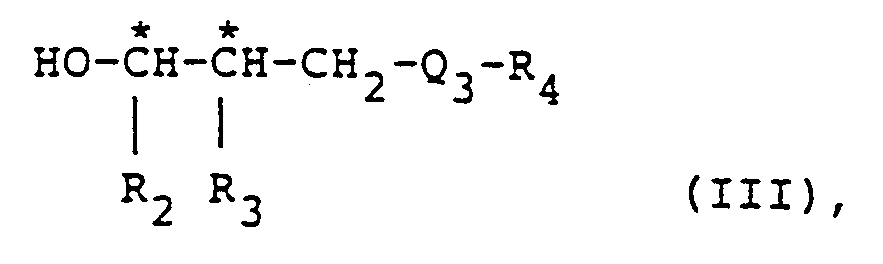
kondensiert wird, oder- eine Carbonsäure der Formel II mit einem Halogenierungsmittel zu einem Säurehalogenid umgesetzt wird, das anschließend mit einem Alkohol der Formel III in Gegenwart einer organischen Base verestert wird,undb) zur Herstellung von Verbindungen der Formel I, in der Q₂ -O- bedeutet,wobei die resultierenden Verbindungen der Formel I durch übliche Trenn- und Reinigungsmaßnahmen aus dem Reaktionsgemisch isoliert und gereinigt werden.- eine Verbindung der Formel IV
R₁-Q₁-M-OH (IV)
in an sich bekannter Weise unter Verwendung von Diethylazodicarboxylat und Triphenylphosphin mit einem Alkohol kondensiert wird, oder- eine Verbindung der Formel IV mit einem organischen Sulfonsäureester der Verbindung der Formel III in Gegenwart einer Base verethert wird, - Flüssigkristallzusammensetzungen, die eine oder mehrere optisch aktive Verbindungen nach den Ansprüchen 1 bis 6 enthalten.
- Optische Flüssigkristall-Modulatoren, bei denen eine Flüssigkristallzusammensetzung nach Anspruch 12 verwendet ist.
Applications Claiming Priority (2)
| Application Number | Priority Date | Filing Date | Title |
|---|---|---|---|
| JP17902988 | 1988-07-20 | ||
| JP179029/88 | 1988-07-20 |
Publications (3)
| Publication Number | Publication Date |
|---|---|
| EP0351782A2 EP0351782A2 (de) | 1990-01-24 |
| EP0351782A3 EP0351782A3 (en) | 1990-04-25 |
| EP0351782B1 true EP0351782B1 (de) | 1995-01-04 |
Family
ID=16058866
Family Applications (1)
| Application Number | Title | Priority Date | Filing Date |
|---|---|---|---|
| EP89113158A Expired - Lifetime EP0351782B1 (de) | 1988-07-20 | 1989-07-18 | Optisch aktive Verbindungen, Flüssigkristallzusammensetzungen, welche diese Verbindungen enthalten, sowie optische Flüssigkristall-Modulatoren, in denen diese Zusammensetzungen verwendetsind |
Country Status (5)
| Country | Link |
|---|---|
| US (1) | US5328643A (de) |
| EP (1) | EP0351782B1 (de) |
| JP (1) | JPH02138235A (de) |
| KR (1) | KR910002766A (de) |
| DE (1) | DE68920372T2 (de) |
Families Citing this family (6)
| Publication number | Priority date | Publication date | Assignee | Title |
|---|---|---|---|---|
| DE4423098A1 (de) * | 1994-07-01 | 1996-01-04 | Hoechst Ag | Verwendung von Pyrimidingruppen enthaltenden konjugierten Verbindungen als Elektrolumineszenzmaterialien |
| JP4264988B2 (ja) * | 1997-12-18 | 2009-05-20 | チッソ株式会社 | ピリジン化合物および液晶組成物 |
| JP3443534B2 (ja) | 1998-12-17 | 2003-09-02 | 日本電信電話株式会社 | 原子周波数標準レーザパルス発振器 |
| KR101617482B1 (ko) * | 2008-09-17 | 2016-05-02 | 제이엔씨 석유 화학 주식회사 | 액정 조성물 및 액정 표시 소자 |
| JP7133187B2 (ja) * | 2018-01-05 | 2022-09-08 | 国立大学法人東京工業大学 | 3-ヒドロキシ-2-メチルブタン酸の単一重合体、及び3-ヒドロキシ-2-メチルブタン酸を高分率で含むポリヒドロキシアルカン酸共重合体 |
| CN114525283B (zh) * | 2021-11-29 | 2023-08-29 | 江苏师范大学 | 红豆杉转录因子TcMYB29在调控红豆杉愈伤中紫杉醇生物合成中的应用 |
Family Cites Families (8)
| Publication number | Priority date | Publication date | Assignee | Title |
|---|---|---|---|---|
| DE3333677A1 (de) * | 1983-09-17 | 1985-04-04 | Merck Patent Gmbh, 6100 Darmstadt | Fluessigkristall-phase |
| DE3683062D1 (de) * | 1985-02-08 | 1992-02-06 | Ajinomoto Kk | Auf polyphenyl basierende esterverbindungen und sie enthaltende fluessigkristalline zusammensetzungen. |
| JPH0784411B2 (ja) * | 1986-08-12 | 1995-09-13 | チッソ株式会社 | 光学活性−2−メチル−1,3−プロパンジオ−ル誘導体 |
| US5167863A (en) * | 1987-12-24 | 1992-12-01 | Hitachi, Ltd. | Optically active compound, liquid crystal composition containing said compound, and liquid crystal optical modulator using said composition |
| US5167855A (en) * | 1988-03-04 | 1992-12-01 | University Research Corporation | Ferroelectric liquid crystal compositions chiral haloalkoxy tail units |
| US5130048A (en) * | 1988-03-04 | 1992-07-14 | Displaytech, Inc. | Ferroelectric liquid crystal compositions containing chiral haloalkoxy tails units |
| JP2732269B2 (ja) * | 1988-10-27 | 1998-03-25 | 旭電化工業株式会社 | 光学活性エステル化合物および該化合物を含有する液晶組成物 |
| KR900014300A (ko) * | 1989-03-22 | 1990-10-23 | 우메모토 요시마사 | 광학활성 화합물, 이 화합물을 함유한 액정 조성물 및 이조성물을 사용한 액정 광변조 장치 |
-
1989
- 1989-07-18 JP JP1184960A patent/JPH02138235A/ja active Pending
- 1989-07-18 EP EP89113158A patent/EP0351782B1/de not_active Expired - Lifetime
- 1989-07-18 DE DE68920372T patent/DE68920372T2/de not_active Expired - Fee Related
- 1989-07-18 KR KR1019890010147A patent/KR910002766A/ko not_active Ceased
-
1992
- 1992-02-26 US US07/841,467 patent/US5328643A/en not_active Expired - Fee Related
Also Published As
| Publication number | Publication date |
|---|---|
| EP0351782A3 (en) | 1990-04-25 |
| EP0351782A2 (de) | 1990-01-24 |
| US5328643A (en) | 1994-07-12 |
| JPH02138235A (ja) | 1990-05-28 |
| DE68920372D1 (de) | 1995-02-16 |
| KR910002766A (ko) | 1991-02-26 |
| DE68920372T2 (de) | 1995-05-11 |
Similar Documents
| Publication | Publication Date | Title |
|---|---|---|
| EP0255219B1 (de) | Omega-substituierte, optisch aktive 2-Alkanolesterabkömmlinge | |
| HK1007743B (en) | Achiral fluorine-containing liquid crystals | |
| HK1007743A1 (en) | Achiral fluorine-containing liquid crystals | |
| US4886623A (en) | Ferroelectric smectic liquid crystal compound and composition containing the same | |
| US6309561B1 (en) | Liquid crystal compounds having a chiral fluorinated terminal portion | |
| US5126071A (en) | Optically active compound, process for producing same and liquid crystal composition containing same | |
| JPH0533943B2 (de) | ||
| EP0257457B1 (de) | Optisch-aktive 2-Methyl-1,3-propandiol-Derivate, sie enthaltende flüssigkristalline Zusammensetzungen und optisches schaltendes Element | |
| US4985172A (en) | Chiral aryloxypropionates, and the use thereof as dopes in liquid-crystal phases | |
| EP0388960B1 (de) | Optisch aktive Verbindungen, ihre Herstellung und Verwendung | |
| EP0351782A2 (de) | Optisch aktive Verbindungen, Flüssigkristallzusammensetzungen, welche diese Verbindungen enthalten, sowie optische Flüssigkristall-Modulatoren, in denen diese Zusammensetzungen verwendetsind | |
| US4880561A (en) | Optically active compound and liquid crystalline composition | |
| EP0170082A2 (de) | Flüssigkristallisothiocyanate mit Dioxanring und diese enthaltende Flüssigkristallmischungen | |
| EP0376294B1 (de) | Optisch aktive Verbindungen, sie enthaltende flüssigkristalline Zusammensetzungen und optische Modulatoren auf Flüssigkristallbasis unter Verwendung dieser Zusammensetzungen | |
| EP0322862A2 (de) | Optisch aktive Verbindungen, ihre Herstellung und ihre Verwendung in flüssigkristallinen Zusammensetzungen und flüssigkristalline optische Modulatoren | |
| US6225479B1 (en) | Optically active bis-dioxane derivatives | |
| US5211879A (en) | Ester compounds and liquid crystal compositions containing the same | |
| US4826979A (en) | Liquid crystal compound | |
| US5225105A (en) | Optically active compound and ferroelectric liquid crystal composition produced therefrom | |
| EP0341713A2 (de) | Optisch aktive Verbindungen, diese Verbindungen enthaltende flüssigkristalline Zusammensetzungen und diese Zusammensetzungen benutzende flüssigkristalline optische Modulatoren | |
| KR900004395B1 (ko) | 광학 활성 화합물 및 액정 조성물 | |
| USRE34726E (en) | Ferroelectric liquid crystal compositions containing chiral haloalkoxy tail units | |
| JPH06239788A (ja) | 光学活性化合物、それらの製造法、該光学活性化合物を含む液晶組成物並びに該液晶組成物を用いた液晶光変調装置 | |
| JPH03109352A (ja) | ジキラル化合物 | |
| EP1482022B1 (de) | Pyranverbindungen als Flüssigkristalle |
Legal Events
| Date | Code | Title | Description |
|---|---|---|---|
| PUAI | Public reference made under article 153(3) epc to a published international application that has entered the european phase |
Free format text: ORIGINAL CODE: 0009012 |
|
| AK | Designated contracting states |
Kind code of ref document: A2 Designated state(s): CH DE FR GB LI |
|
| PUAL | Search report despatched |
Free format text: ORIGINAL CODE: 0009013 |
|
| AK | Designated contracting states |
Kind code of ref document: A3 Designated state(s): CH DE FR GB LI |
|
| 17P | Request for examination filed |
Effective date: 19900828 |
|
| 17Q | First examination report despatched |
Effective date: 19920212 |
|
| RAP3 | Party data changed (applicant data changed or rights of an application transferred) |
Owner name: TAKEDA CHEMICAL INDUSTRIES, LTD. Owner name: HITACHI, LTD. |
|
| RAP1 | Party data changed (applicant data changed or rights of an application transferred) |
Owner name: HITACHI, LTD. |
|
| GRAA | (expected) grant |
Free format text: ORIGINAL CODE: 0009210 |
|
| RBV | Designated contracting states (corrected) |
Designated state(s): CH DE GB LI |
|
| AK | Designated contracting states |
Kind code of ref document: B1 Designated state(s): CH DE GB LI |
|
| REF | Corresponds to: |
Ref document number: 68920372 Country of ref document: DE Date of ref document: 19950216 |
|
| PLBE | No opposition filed within time limit |
Free format text: ORIGINAL CODE: 0009261 |
|
| STAA | Information on the status of an ep patent application or granted ep patent |
Free format text: STATUS: NO OPPOSITION FILED WITHIN TIME LIMIT |
|
| 26N | No opposition filed | ||
| PGFP | Annual fee paid to national office [announced via postgrant information from national office to epo] |
Ref country code: GB Payment date: 19960708 Year of fee payment: 8 |
|
| PGFP | Annual fee paid to national office [announced via postgrant information from national office to epo] |
Ref country code: DE Payment date: 19960930 Year of fee payment: 8 |
|
| PGFP | Annual fee paid to national office [announced via postgrant information from national office to epo] |
Ref country code: CH Payment date: 19961001 Year of fee payment: 8 |
|
| PG25 | Lapsed in a contracting state [announced via postgrant information from national office to epo] |
Ref country code: GB Free format text: LAPSE BECAUSE OF NON-PAYMENT OF DUE FEES Effective date: 19970718 |
|
| PG25 | Lapsed in a contracting state [announced via postgrant information from national office to epo] |
Ref country code: LI Free format text: LAPSE BECAUSE OF NON-PAYMENT OF DUE FEES Effective date: 19970731 Ref country code: CH Free format text: LAPSE BECAUSE OF NON-PAYMENT OF DUE FEES Effective date: 19970731 |
|
| GBPC | Gb: european patent ceased through non-payment of renewal fee |
Effective date: 19970718 |
|
| REG | Reference to a national code |
Ref country code: CH Ref legal event code: PL |
|
| PG25 | Lapsed in a contracting state [announced via postgrant information from national office to epo] |
Ref country code: DE Free format text: LAPSE BECAUSE OF NON-PAYMENT OF DUE FEES Effective date: 19980401 |