EP0352582B2 - Verfahren zur Beschichtung laufender Bahnen aus Papier oder Karton - Google Patents
Verfahren zur Beschichtung laufender Bahnen aus Papier oder Karton Download PDFInfo
- Publication number
- EP0352582B2 EP0352582B2 EP89113032A EP89113032A EP0352582B2 EP 0352582 B2 EP0352582 B2 EP 0352582B2 EP 89113032 A EP89113032 A EP 89113032A EP 89113032 A EP89113032 A EP 89113032A EP 0352582 B2 EP0352582 B2 EP 0352582B2
- Authority
- EP
- European Patent Office
- Prior art keywords
- roll
- coating
- paper
- blade
- web
- Prior art date
- Legal status (The legal status is an assumption and is not a legal conclusion. Google has not performed a legal analysis and makes no representation as to the accuracy of the status listed.)
- Expired - Lifetime
Links
- 238000000576 coating method Methods 0.000 title claims abstract description 42
- 239000011248 coating agent Substances 0.000 title claims abstract description 39
- 238000000034 method Methods 0.000 title claims description 6
- 150000001875 compounds Chemical class 0.000 claims description 2
- 238000005470 impregnation Methods 0.000 claims description 2
- 230000002093 peripheral effect Effects 0.000 claims 7
- 238000010521 absorption reaction Methods 0.000 claims 1
- 238000009499 grossing Methods 0.000 claims 1
- 230000037303 wrinkles Effects 0.000 abstract description 2
- 239000011247 coating layer Substances 0.000 abstract 1
- 239000010410 layer Substances 0.000 abstract 1
- 239000000126 substance Substances 0.000 abstract 1
- 239000000123 paper Substances 0.000 description 7
- 239000000463 material Substances 0.000 description 3
- 238000010618 wire wrap Methods 0.000 description 3
- 239000011111 cardboard Substances 0.000 description 1
- 239000008199 coating composition Substances 0.000 description 1
- 238000001035 drying Methods 0.000 description 1
- 238000007689 inspection Methods 0.000 description 1
- 239000011087 paperboard Substances 0.000 description 1
- 230000035515 penetration Effects 0.000 description 1
- 238000003825 pressing Methods 0.000 description 1
- 238000007790 scraping Methods 0.000 description 1
- 239000002904 solvent Substances 0.000 description 1
Images
Classifications
-
- B—PERFORMING OPERATIONS; TRANSPORTING
- B05—SPRAYING OR ATOMISING IN GENERAL; APPLYING FLUENT MATERIALS TO SURFACES, IN GENERAL
- B05C—APPARATUS FOR APPLYING FLUENT MATERIALS TO SURFACES, IN GENERAL
- B05C1/00—Apparatus in which liquid or other fluent material is applied to the surface of the work by contact with a member carrying the liquid or other fluent material, e.g. a porous member loaded with a liquid to be applied as a coating
- B05C1/04—Apparatus in which liquid or other fluent material is applied to the surface of the work by contact with a member carrying the liquid or other fluent material, e.g. a porous member loaded with a liquid to be applied as a coating for applying liquid or other fluent material to work of indefinite length
- B05C1/08—Apparatus in which liquid or other fluent material is applied to the surface of the work by contact with a member carrying the liquid or other fluent material, e.g. a porous member loaded with a liquid to be applied as a coating for applying liquid or other fluent material to work of indefinite length using a roller or other rotating member which contacts the work along a generating line
-
- B—PERFORMING OPERATIONS; TRANSPORTING
- B05—SPRAYING OR ATOMISING IN GENERAL; APPLYING FLUENT MATERIALS TO SURFACES, IN GENERAL
- B05C—APPARATUS FOR APPLYING FLUENT MATERIALS TO SURFACES, IN GENERAL
- B05C1/00—Apparatus in which liquid or other fluent material is applied to the surface of the work by contact with a member carrying the liquid or other fluent material, e.g. a porous member loaded with a liquid to be applied as a coating
- B05C1/04—Apparatus in which liquid or other fluent material is applied to the surface of the work by contact with a member carrying the liquid or other fluent material, e.g. a porous member loaded with a liquid to be applied as a coating for applying liquid or other fluent material to work of indefinite length
- B05C1/08—Apparatus in which liquid or other fluent material is applied to the surface of the work by contact with a member carrying the liquid or other fluent material, e.g. a porous member loaded with a liquid to be applied as a coating for applying liquid or other fluent material to work of indefinite length using a roller or other rotating member which contacts the work along a generating line
- B05C1/0826—Apparatus in which liquid or other fluent material is applied to the surface of the work by contact with a member carrying the liquid or other fluent material, e.g. a porous member loaded with a liquid to be applied as a coating for applying liquid or other fluent material to work of indefinite length using a roller or other rotating member which contacts the work along a generating line the work being a web or sheets
- B05C1/083—Apparatus in which liquid or other fluent material is applied to the surface of the work by contact with a member carrying the liquid or other fluent material, e.g. a porous member loaded with a liquid to be applied as a coating for applying liquid or other fluent material to work of indefinite length using a roller or other rotating member which contacts the work along a generating line the work being a web or sheets being passed between the coating roller and one or more backing rollers
-
- B—PERFORMING OPERATIONS; TRANSPORTING
- B05—SPRAYING OR ATOMISING IN GENERAL; APPLYING FLUENT MATERIALS TO SURFACES, IN GENERAL
- B05C—APPARATUS FOR APPLYING FLUENT MATERIALS TO SURFACES, IN GENERAL
- B05C9/00—Apparatus or plant for applying liquid or other fluent material to surfaces by means not covered by any preceding group, or in which the means of applying the liquid or other fluent material is not important
- B05C9/06—Apparatus or plant for applying liquid or other fluent material to surfaces by means not covered by any preceding group, or in which the means of applying the liquid or other fluent material is not important for applying two different liquids or other fluent materials, or the same liquid or other fluent material twice, to the same side of the work
-
- B—PERFORMING OPERATIONS; TRANSPORTING
- B05—SPRAYING OR ATOMISING IN GENERAL; APPLYING FLUENT MATERIALS TO SURFACES, IN GENERAL
- B05D—PROCESSES FOR APPLYING FLUENT MATERIALS TO SURFACES, IN GENERAL
- B05D1/00—Processes for applying liquids or other fluent materials
- B05D1/28—Processes for applying liquids or other fluent materials performed by transfer from the surfaces of elements carrying the liquid or other fluent material, e.g. brushes, pads, rollers
-
- B—PERFORMING OPERATIONS; TRANSPORTING
- B05—SPRAYING OR ATOMISING IN GENERAL; APPLYING FLUENT MATERIALS TO SURFACES, IN GENERAL
- B05D—PROCESSES FOR APPLYING FLUENT MATERIALS TO SURFACES, IN GENERAL
- B05D1/00—Processes for applying liquids or other fluent materials
- B05D1/40—Distributing applied liquids or other fluent materials by members moving relatively to surface
-
- D—TEXTILES; PAPER
- D21—PAPER-MAKING; PRODUCTION OF CELLULOSE
- D21H—PULP COMPOSITIONS; PREPARATION THEREOF NOT COVERED BY SUBCLASSES D21C OR D21D; IMPREGNATING OR COATING OF PAPER; TREATMENT OF FINISHED PAPER NOT COVERED BY CLASS B31 OR SUBCLASS D21G; PAPER NOT OTHERWISE PROVIDED FOR
- D21H23/00—Processes or apparatus for adding material to the pulp or to the paper
- D21H23/02—Processes or apparatus for adding material to the pulp or to the paper characterised by the manner in which substances are added
- D21H23/22—Addition to the formed paper
- D21H23/52—Addition to the formed paper by contacting paper with a device carrying the material
- D21H23/56—Rolls
- D21H23/58—Details thereof, e.g. surface characteristics, peripheral speed
- D21H23/60—Details thereof, e.g. surface characteristics, peripheral speed the material on the applicator roll being subjected to a particular treatment before applying to the paper
-
- D—TEXTILES; PAPER
- D21—PAPER-MAKING; PRODUCTION OF CELLULOSE
- D21H—PULP COMPOSITIONS; PREPARATION THEREOF NOT COVERED BY SUBCLASSES D21C OR D21D; IMPREGNATING OR COATING OF PAPER; TREATMENT OF FINISHED PAPER NOT COVERED BY CLASS B31 OR SUBCLASS D21G; PAPER NOT OTHERWISE PROVIDED FOR
- D21H23/00—Processes or apparatus for adding material to the pulp or to the paper
- D21H23/02—Processes or apparatus for adding material to the pulp or to the paper characterised by the manner in which substances are added
- D21H23/22—Addition to the formed paper
- D21H23/70—Multistep processes; Apparatus for adding one or several substances in portions or in various ways to the paper, not covered by another single group of this main group
Definitions
- the invention relates to an application device according to the preamble of the claim 1 and corresponding procedure.
- the Process for coating running webs with the two successive coating processes, being the first applied Layer is still damp when the second layer is known from US 3,202,536.
- the two coating stations are both here on a single roller guiding the web arranged as well as on two successive Rollers.
- One of the latter corresponding
- the facility is also known from CA 882 640 the latter differs from the other in that in the first coating station the application takes place by means of an application roller.
- This first applied layer is then by means of Spreading blade smoothed out, taking the excess is scraped off.
- At the other facility takes place in the first coating station also scraping using a doctor blade.
- the object of the invention is a reliable Wet-on-wet coating process with the best Line quality and economical material consumption create.
- a new coating device according to the characterizing part of the claim 1 created.
- the coating initially in small Dimensions are applied to the web, being through the nip between the first Web guide roller and the press roller a uniform Press in the first coating amount he follows. So the web is practically impregnated, and it is easily possible, evenly the top layer with the second coating device to apply. None comes through the press nip high stress, especially tensile or Pinch stress on the web. The easily at the stage where there is web contact can come tending to compress the web or even scraper blade causing web breaks is avoided there. It is very advantageous for the even application of a dosed Amount to use a squeegee, its scope is grooved. These grooves can be very be fine, so that a special uniform order results.
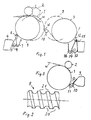
- FIG 1 is the first web guide roller, so that of the first coating device with 1, the associated press roll with 2 and the web guide roll the second coating device with 3 designated.
- the path is indicated by W.
- the first coating device has an application chamber 4 for the coating composition, in which this introduced through the feed pipe 5 becomes.
- the application chamber is included as a nozzle chamber formed an overflow so that excess Coating compound in the sump 7, the the application chamber 4 is attached, overflow can.
- the application chamber 4 is supported by a support beam 6 held.
- Am in the direction of rotation of the web guide roller 1 exit end of the order chamber 4 is the dosing element, one Roller doctor blade 8, preferably one with circumferential grooves provided surface.
- Application chamber 13 with feed tube 14 is provided.
- the second application layer smoothes.
- the press nip formed is dosed in a relatively precise manner Amount of coating mass in the web, preferably a paper or cardboard web pressed in and impregnated with it. Without further drying, the material web then becomes W fed to the second coating device. It can be passed over an spreader roller 18 to avoid wrinkles.
- the doctor blade 12 will of course be in everyone Case in a known manner by the pressing means pressed that they are evenly on the web guide roller 3 or the monitor lane and the Coating smoothens very evenly.
- the commissioned works with the commission chamber are known e.g. from US 4,250,211 and application squeegee with swamp and squeegee including holder US 2,970,564.
- a squeegee with the circumferential grooves forming wire wrap is provided e.g. known from US 3,387,585.
- a variant is shown in dashed lines in FIG. 1, in which the web guide rollers 1 and 3 are arranged directly next to each other. By doing Gap formed between the two rollers is, the path runs relatively smoothly, at least without major contact forces.
- a pressure in the nip between roller 1 and 3 is not possible due to web elongation and transverse stretching between the nip of roller 1 and 3 and the blade 12 can not be compensated.
- the basic principle of the application device according to the invention is to carry out the first coating only to such an extent that essentially only the paper is impregnated. Therefore, the amount of the coating slip applied in the first application device depends on the absorbency of the paper, which among other things is essentially a function of the basis weight of the paper. For example, basis weights of more than 80 g / m 2 are used for wood-free paper types. In the case of these papers, which are also equipped with greater absorbency because of their greater porosity, the basis weight applied in the first coating device is a maximum of about 7 g / m 2 , so that a total of 15 g / m 2 layering is applied in both coating devices.
- the corresponding groove size is a maximum of about 0.012 mm 2 in cross section. This applies essentially to those squeegees with wire wrapping. However, these squeegees do not have a very long service life.
- doctor blades are for the invention Order facility has been developed that it allow a flawless stroke over longer Establish operating periods.
- a squeegee is outlined in Figure 2, with between the Grooves 20 are webs 21, which are in cross section parallel to the central axis of the roll doctor rod seen, a surface parallel to this central axis exhibit.
- the value per meter working width of the doctor blade rod of a maximum of 34 mm 2 can be regarded as the upper limit.
- the cross section of the grooves of a roller doctor rod provided with wire wrapping is a maximum of approximately 0.006 mm 2 in order to apply an application layer of 3 g / m 2 by means of the first coating device.
- the total order is then about 10 g / m 2 .
- the total cross-sectional area for the doctor blade according to FIG. 2 is then a maximum of 24 mm 2 per meter of working width.
Landscapes
- Coating Apparatus (AREA)
- Application Of Or Painting With Fluid Materials (AREA)
- Paper (AREA)
- Photoreceptors In Electrophotography (AREA)
Description
Claims (5)
- Verfahren zur Beschichtung laufender Bahnen aus Papier oder Karton, wobei unmittelbar nacheinander zwei Schichten aufeinander gelegt werden, während die erste Schicht noch feucht ist und sowohl für den ersten als auch den zweiten Beschichtungsvorgang mindestens eine die Bahn führende, rotierbare Walze und eine dieser jeweils zugeordnete Beschichtungseinrichtung vorgesehen sind und die zweite Beschichtungseinrichtung einen Glättschaber aufweist, dadurch gekennzeichnet, daß von der ersten Beschichtungseinrichtung zuerst die Beschichtungsmasse für die erste Schicht in dosierter Menge auf den Mantel der ersten Walze aufgetragen wird und dann die aufgetragene Menge durch eine einen Preßspalt mit der ersten Walze (1) bildende Preßwalze (2) zur Erzielung einer Imprägnierung der Papier- oder Kartonbahn in dieselbe eingepreßt wird, wobei das Flächengewicht dieser ersten Schicht maximal 7 g/m2 beträgt, und wobei die aufgetragene Menge derart bemessen wird, daß sie maximal der Aufsaugkapazität des Papieres entspricht.
- Einrichtung zur Durchführung des Verfahrens, wobei unmittelbar nacheinander zwei Schichten aufeinander gelegt werden, während die erste Schicht noch feucht ist und sowohl für den ersten als auch den zweiten Beschichtungsvorgang mindestens eine die Bahn führende, rotierbare Walze (1,3) und eine dieser jeweils zugeordnete Beschichtungseinrichtung (4-8; 12-16) vorgesehen sind, dadurch gekennzeichnet, daß die erste Beschichtungseinrichtung einen Preßspalt aufweist, gebildet aus der ersten (1) und einer weiteren Walze (2), daß der ersten Walze (1) ein Auftragswerk (4) zugeordnet ist, vorzugsweise ein Düsenauftragswerk, mit einer Rollrakel (8), die mit Umfangsrillen versehen und am ablaufenden Ende des Düsenauftragswerks (4) als Dosierelement angeordnet ist, und daß die Umfangsrillen in einem Axialschnitt durch die Rakel (8) gesehen einen Querschnitt pro Rille von höchstens 0,012 mm2 aufweisen, wobei die die Streichmasse enthaltende Kammer des Auftragswerks an der Walze (1) durch die Rollrakel (8) bzw. deren Halter (11) begrenzt ist.
- Einrichtung nach Anspruch 2, dadurch gekennzeichnet, daß die Umfangsrillen je einen Querschnitt von höchstens 0,012 mm2 bei Papieren mit einem Flächengewicht von mehr als 80 g/m2 und höchstens von 0,006 mm2 bei Papieren mit einem Flächengewicht von höchstens 80 g/m2 haben.
- Einrichtung zur Durchführung des Verfahrens, dadurch gekennzeichnet, daß die erste Beschichtungseinrichtung einen Preßspalt aufweist, gebildet aus der ersten (1) und einer weiteren Walze (2), daß der ersten Walze (1) ein Düsenauftragswerk (4) zugeordnet ist, mit einer Rollrakel (8), die mit Umfangsrillen versehen und am ablaufenden Ende des Düsenauftragswerks (4) als Dosierelement angeordnet ist, und daß die Umfangsrillen in einem Axialschnitt durch die Rakel (8) gesehen einen Querschnitt insgesamt pro Meter Arbeitsbreite der Rollrakel (8) von höchstens 34 mm2 aufweisen.
- Einrichtung nach einem der Ansprüche 2 bis 4, dadurch gekennzeichnet, daß die Rollrakel mit Umfangsrillen (20) versehen ist, und die Stege (21) zwischen ihnen eine im wesentlichen in Mittelachsrichtung des Rollrakelstabes (8) gesehen zu dieser parallele Oberfläche aufweisen, wobei die Breite dieser Oberflächen in dieser Mittelachsrichtung gesehen höchstens gleich der maximalen Breite des Querschnitts der Umfangsrillen (20) beträgt.
Priority Applications (1)
| Application Number | Priority Date | Filing Date | Title |
|---|---|---|---|
| AT89113032T ATE87677T1 (de) | 1988-07-27 | 1989-07-15 | Auftragseinrichtung zur beschichtung laufender warenbahnen sowie verfahren zur beschichtung. |
Applications Claiming Priority (2)
| Application Number | Priority Date | Filing Date | Title |
|---|---|---|---|
| DE3825412 | 1988-07-27 | ||
| DE3825412 | 1988-07-27 |
Publications (4)
| Publication Number | Publication Date |
|---|---|
| EP0352582A2 EP0352582A2 (de) | 1990-01-31 |
| EP0352582A3 EP0352582A3 (de) | 1991-06-12 |
| EP0352582B1 EP0352582B1 (de) | 1993-03-31 |
| EP0352582B2 true EP0352582B2 (de) | 1999-02-24 |
Family
ID=6359608
Family Applications (2)
| Application Number | Title | Priority Date | Filing Date |
|---|---|---|---|
| EP19890110962 Withdrawn EP0352465A3 (de) | 1988-07-27 | 1989-06-16 | Auftragseinrichtung zur Beschichtung laufender Warenbahnen sowie Verfahren zur Beschichtung |
| EP89113032A Expired - Lifetime EP0352582B2 (de) | 1988-07-27 | 1989-07-15 | Verfahren zur Beschichtung laufender Bahnen aus Papier oder Karton |
Family Applications Before (1)
| Application Number | Title | Priority Date | Filing Date |
|---|---|---|---|
| EP19890110962 Withdrawn EP0352465A3 (de) | 1988-07-27 | 1989-06-16 | Auftragseinrichtung zur Beschichtung laufender Warenbahnen sowie Verfahren zur Beschichtung |
Country Status (9)
| Country | Link |
|---|---|
| US (3) | US4980207A (de) |
| EP (2) | EP0352465A3 (de) |
| JP (1) | JP2524641B2 (de) |
| AT (1) | ATE87677T1 (de) |
| CA (1) | CA1336374C (de) |
| DE (2) | DE3922535C3 (de) |
| ES (1) | ES2039766T3 (de) |
| FI (1) | FI94274C (de) |
| NO (1) | NO176008C (de) |
Families Citing this family (24)
| Publication number | Priority date | Publication date | Assignee | Title |
|---|---|---|---|---|
| EP0352465A3 (de) * | 1988-07-27 | 1990-10-10 | J.M. Voith GmbH | Auftragseinrichtung zur Beschichtung laufender Warenbahnen sowie Verfahren zur Beschichtung |
| DE4002256A1 (de) * | 1990-01-26 | 1991-08-01 | Voith Gmbh J M | Beschichtungsverfahren und auftragseinrichtung zur beschichtung laufender warenbahnen aus papier oder karton |
| US5340611A (en) * | 1989-07-25 | 1994-08-23 | J. M. Voith Gmbh | Process for coating travelling webs |
| DE4014647C2 (de) * | 1990-05-08 | 1995-03-30 | Voith Gmbh J M | Einrichtung zum Auftragen einer Beschichtung auf eine laufende Warenbahn |
| FI86318C (fi) * | 1990-06-26 | 1992-08-10 | Keskuslaboratorio | Foerfarande och anordning foer att reglera bladbestrykning. |
| DE4120141C2 (de) * | 1991-06-19 | 1995-06-08 | Voith Gmbh J M | Streichklinge |
| DE4211401A1 (de) * | 1992-04-04 | 1993-10-07 | Voith Gmbh J M | Beschichtungseinrichtung für Bahnen aus Papier oder Karton |
| FI93665C (fi) * | 1992-11-13 | 1995-05-10 | Valmet Paper Machinery Inc | Menetelmä ja laitteisto paperirainan päällystämiseksi |
| AU6430494A (en) * | 1993-04-06 | 1994-10-24 | Veitsiluoto Oy | A method of coating paper and an apparatus therefor |
| DE4340039C2 (de) * | 1993-11-24 | 1997-08-21 | Voith Gmbh J M | Beschichtungseinrichtung für laufende Bahnen aus Papier oder Karton |
| DE4414949A1 (de) * | 1994-04-28 | 1995-11-02 | Voith Gmbh J M | Vorrichtung zum Auftragen von mindestens einem flüssigen Medium auf eine laufende Materialbahn |
| FI95947C (fi) * | 1994-06-29 | 1996-04-10 | Valmet Paper Machinery Inc | Menetelmä ja sovitelma liikkuvan paperiradan päällystämiseksi |
| FI109216B (fi) | 1996-03-06 | 2002-06-14 | Metso Paper Inc | Menetelmä ja sovitelma liikkuvan radan päällystämiseksi |
| DE19623622A1 (de) * | 1996-06-13 | 1997-12-18 | Voith Sulzer Papiermasch Gmbh | Verfahren und Vorrichtung zur Beschichtung einer laufenden Materialbahn |
| DE29610395U1 (de) * | 1996-06-13 | 1996-08-22 | Voith Sulzer Papiermaschinen GmbH, 89522 Heidenheim | Vorrichtung zum aufeinanderfolgenden Auftragen von zwei Schichten von flüssigen oder pastösen Medien auf eine Seite einer laufenden Materialbahn |
| US5776546A (en) * | 1996-06-26 | 1998-07-07 | Miply Equipment, Inc. | Method and apparatus for impregnating a porous substrate with a solids-bearing saturant |
| DE19704858B4 (de) * | 1997-02-10 | 2005-07-21 | Voith Paper Gmbh & Co. Kg | Verfahren und Vorrichtung zum Herstellen beidseitig gestrichener Papierbahnen |
| US5843529A (en) * | 1997-02-13 | 1998-12-01 | Beloit Technologies, Inc. | Pre-metering rod |
| FI102200B1 (fi) * | 1997-02-24 | 1998-10-30 | Valmet Corp | Menetelmä kartongin tai paperin käsittelemiseksi, menetelmän toteuttamiseen tarkoitettu sovitelma sekä menetelmällä valmistettu tuote |
| DE19722117C2 (de) * | 1997-05-27 | 2000-09-07 | Bematec S A | Beschichtung poröser Träger |
| DE19958109A1 (de) * | 1999-12-02 | 2001-06-07 | Voith Paper Patent Gmbh | Vorrichtung zum indirekten Auftragen eines flüssigen oder pastösen Auftragsmediums auf eine laufende Materialbahn, insbesondere aus Papier oder Karton |
| JP4271501B2 (ja) | 2003-06-06 | 2009-06-03 | 愛三工業株式会社 | 燃料ポンプ |
| US9304415B2 (en) * | 2013-04-26 | 2016-04-05 | Hewlett-Packard Development Company, L.P. | Coating liquid dispensers |
| TWI740640B (zh) * | 2020-09-11 | 2021-09-21 | 全利機械股份有限公司 | 纖維製品的液體塗佈機台 |
Family Cites Families (21)
| Publication number | Priority date | Publication date | Assignee | Title |
|---|---|---|---|---|
| CA882640A (en) * | 1971-10-05 | D. Collins John | Doctoring double coating on substrate | |
| US2582407A (en) * | 1945-05-24 | 1952-01-15 | Minnesota & Ontario Paper Co | Process for coating paper |
| US2970564A (en) * | 1955-12-23 | 1961-02-07 | Champion Paper & Fibre Co | Apparatus for coating paper |
| US2870738A (en) * | 1957-02-28 | 1959-01-27 | Black Clawson Co | Paper coating machine |
| US2937955A (en) * | 1957-12-24 | 1960-05-24 | Continental Can Co | Coating process |
| US3202536A (en) * | 1961-11-08 | 1965-08-24 | Beloit Corp | Method and apparatus for coating paper |
| US3511696A (en) * | 1966-06-16 | 1970-05-12 | Stauffer Chem Co Of Canada Ltd | Reverse roll coating process and apparatus |
| US3387585A (en) * | 1967-03-21 | 1968-06-11 | Farrell John Jerome | Apparatus for metering a coated carrier |
| GB1337345A (en) * | 1970-11-30 | 1973-11-14 | Fuji Photo Film Co Ltd | Producing capsule-coated sheets |
| US4177304A (en) * | 1977-03-17 | 1979-12-04 | Beloit Corporation | Method of coating both sides of a travelling web |
| US4250211A (en) * | 1978-05-31 | 1981-02-10 | Consolidated Papers, Inc. | Paper coating method and apparatus |
| JPS5898166A (ja) * | 1981-12-07 | 1983-06-10 | Nisshin Steel Co Ltd | 金属帯への表面処理水溶液の塗布方法 |
| CH663362A5 (de) * | 1984-01-07 | 1987-12-15 | Jagenberg Ag | Vorrichtung zum beschichten von ueber eine stuetzwalze laufenden materialbahnen mit regelbarer auftragsstaerke. |
| GB8402190D0 (en) * | 1984-01-27 | 1984-02-29 | Wiggins Teape Group Ltd | Coating paper |
| DE3417487A1 (de) * | 1984-05-11 | 1985-11-21 | J.M. Voith Gmbh, 7920 Heidenheim | Vorrichtung zum auftragen einer fluessigkeit auf eine laufende bahn |
| JPS62106672U (de) * | 1985-12-24 | 1987-07-08 | ||
| DE3713278A1 (de) * | 1986-04-30 | 1987-11-05 | Will E C H Gmbh & Co | Verfahren und vorrichtung zum auftragen einer fliessfaehigen masse auf eine bahn |
| DE3633833C1 (de) * | 1986-10-04 | 1993-05-06 | Vits Maschinenbau Gmbh | Verfahren und Vorrichtung zum Auftragen einer fluessigen oder pastoesen Substanz auf eine Materialbahn |
| AT396437B (de) * | 1986-10-25 | 1993-09-27 | Voith Gmbh J M | Vordosiereinrichtung in einer streichanlage |
| DE3725893C1 (en) * | 1987-08-05 | 1988-12-15 | Voith Gmbh J M | Process and device for coating and for smoothing the coating |
| EP0352465A3 (de) * | 1988-07-27 | 1990-10-10 | J.M. Voith GmbH | Auftragseinrichtung zur Beschichtung laufender Warenbahnen sowie Verfahren zur Beschichtung |
-
1989
- 1989-06-16 EP EP19890110962 patent/EP0352465A3/de not_active Withdrawn
- 1989-07-08 DE DE3922535A patent/DE3922535C3/de not_active Expired - Fee Related
- 1989-07-15 ES ES198989113032T patent/ES2039766T3/es not_active Expired - Lifetime
- 1989-07-15 DE DE8989113032T patent/DE58903929D1/de not_active Expired - Fee Related
- 1989-07-15 AT AT89113032T patent/ATE87677T1/de not_active IP Right Cessation
- 1989-07-15 EP EP89113032A patent/EP0352582B2/de not_active Expired - Lifetime
- 1989-07-18 FI FI893468A patent/FI94274C/fi not_active IP Right Cessation
- 1989-07-25 US US07/385,212 patent/US4980207A/en not_active Expired - Fee Related
- 1989-07-26 NO NO893045A patent/NO176008C/no unknown
- 1989-07-27 JP JP1192801A patent/JP2524641B2/ja not_active Expired - Lifetime
- 1989-07-27 CA CA000606822A patent/CA1336374C/en not_active Expired - Fee Related
-
1990
- 1990-09-13 US US07/582,259 patent/US5101760A/en not_active Expired - Lifetime
-
1992
- 1992-01-07 US US07/818,746 patent/US5171612A/en not_active Expired - Fee Related
Also Published As
| Publication number | Publication date |
|---|---|
| EP0352465A3 (de) | 1990-10-10 |
| FI94274C (fi) | 1995-08-10 |
| EP0352582A3 (de) | 1991-06-12 |
| DE58903929D1 (de) | 1993-05-06 |
| US5101760A (en) | 1992-04-07 |
| DE3922535C2 (de) | 1994-07-14 |
| EP0352582B1 (de) | 1993-03-31 |
| ATE87677T1 (de) | 1993-04-15 |
| NO893045D0 (no) | 1989-07-26 |
| JPH0283063A (ja) | 1990-03-23 |
| CA1336374C (en) | 1995-07-25 |
| JP2524641B2 (ja) | 1996-08-14 |
| ES2039766T3 (es) | 1993-10-01 |
| US5171612A (en) | 1992-12-15 |
| DE3922535A1 (de) | 1990-02-01 |
| NO176008C (no) | 1995-01-18 |
| EP0352582A2 (de) | 1990-01-31 |
| FI893468A0 (fi) | 1989-07-18 |
| NO176008B (no) | 1994-10-10 |
| FI893468L (fi) | 1990-01-28 |
| FI94274B (fi) | 1995-04-28 |
| DE3922535C3 (de) | 1999-03-18 |
| EP0352465A2 (de) | 1990-01-31 |
| US4980207A (en) | 1990-12-25 |
| NO893045L (no) | 1990-01-29 |
Similar Documents
| Publication | Publication Date | Title |
|---|---|---|
| EP0352582B2 (de) | Verfahren zur Beschichtung laufender Bahnen aus Papier oder Karton | |
| AT392426B (de) | Leimpresse mit zwei zueinander parallelen presswalzen | |
| DE4131131C2 (de) | Vorrichtung zum Auftragen von Streichfarbe auf eine Faserstoffbahn | |
| DE2203482C3 (de) | Verfahren und Vorrichtung zum Beschichten einerMaterialbahn mit Bestrechmasse durch wenigstens zwei in Förderrichtung der Bahn in Abstand voneinander angeordnete Bestreichorgane | |
| DD152819A5 (de) | Verfahren und vorrichtung zum kontinuierlichen behandeln von textilen und aehnlichen warenbahnen | |
| EP1020560A2 (de) | Verfahren und Anlage zum Imprägnieren und Beschichten von Papier | |
| DE19704858B4 (de) | Verfahren und Vorrichtung zum Herstellen beidseitig gestrichener Papierbahnen | |
| AT396436B (de) | Einrichtung und verfahren zur beschichtung laufender warenbahnen | |
| EP0239835B1 (de) | Verfahren und Vorrichtung zum beidseitigen Auftragen von flüssigen, pastösen oder schaumigen Massen auf Materialbahnen | |
| DE19606459A1 (de) | Verfahren und Vorrichtungen zum Auftragen eines flüssigen oder pastösen Mediums auf eine laufende Materialbahn | |
| DE4014647C2 (de) | Einrichtung zum Auftragen einer Beschichtung auf eine laufende Warenbahn | |
| DE19714645A1 (de) | Walze für eine Vorrichtung zum Beschichten einer Materialbahn, insbesondere einer Papier- oder Kartonbahn | |
| DE3440634A1 (de) | Einrichtung zur beidseitigen beschichtung laufender warenbahnen | |
| EP0565979A1 (de) | Beschichtungseinrichtung für Bahnen aus Papier oder Karton | |
| DE8414413U1 (de) | Vorrichtung zum Auftragen einer Flüssigkeit auf eine laufende Bahn | |
| DE3735889C2 (de) | Streicheinrichtung | |
| DE9111669U1 (de) | Vorrichtung zum Auftragen von Streichfarbe auf eine Faserstoffbahn | |
| DE3423942C2 (de) | ||
| EP0609484B1 (de) | Vorrichtung zum Auftragen von Streichfarbe auf eine Faserstoffbahn | |
| WO1994015021A1 (de) | Vorrichtung zum gleichzeitigen auftrag von flüssigkkeit auf beide seiten einer materialbahn und verfahren zum auftrag einer flüssigkeit auf eine materialbahn mit dieser vorrichtung | |
| DE29610395U1 (de) | Vorrichtung zum aufeinanderfolgenden Auftragen von zwei Schichten von flüssigen oder pastösen Medien auf eine Seite einer laufenden Materialbahn | |
| DE10214392A1 (de) | Verfahren und Vorrichtung zum Betreiben einer Schaberklinge | |
| AT500687B1 (de) | Verfahren und vorrichtung zum beschichten von pappe | |
| DE19603861C1 (de) | Vorrichtung zum Beschichten einer Materialbahn, insbesondere einer Papier- oder Kartonbahn | |
| EP1614483A2 (de) | Rakelvorrichtung und Rakelverfahren |
Legal Events
| Date | Code | Title | Description |
|---|---|---|---|
| PUAI | Public reference made under article 153(3) epc to a published international application that has entered the european phase |
Free format text: ORIGINAL CODE: 0009012 |
|
| AK | Designated contracting states |
Kind code of ref document: A2 Designated state(s): AT CH DE ES FR GB IT LI SE |
|
| 17P | Request for examination filed |
Effective date: 19901220 |
|
| PUAL | Search report despatched |
Free format text: ORIGINAL CODE: 0009013 |
|
| AK | Designated contracting states |
Kind code of ref document: A3 Designated state(s): AT CH DE ES FR GB IT LI SE |
|
| 17Q | First examination report despatched |
Effective date: 19920213 |
|
| GRAA | (expected) grant |
Free format text: ORIGINAL CODE: 0009210 |
|
| AK | Designated contracting states |
Kind code of ref document: B1 Designated state(s): AT CH DE ES FR GB IT LI SE |
|
| REF | Corresponds to: |
Ref document number: 87677 Country of ref document: AT Date of ref document: 19930415 Kind code of ref document: T |
|
| REF | Corresponds to: |
Ref document number: 58903929 Country of ref document: DE Date of ref document: 19930506 |
|
| GBT | Gb: translation of ep patent filed (gb section 77(6)(a)/1977) |
Effective date: 19930408 |
|
| ET | Fr: translation filed | ||
| ITF | It: translation for a ep patent filed | ||
| REG | Reference to a national code |
Ref country code: ES Ref legal event code: FG2A Ref document number: 2039766 Country of ref document: ES Kind code of ref document: T3 |
|
| PLBI | Opposition filed |
Free format text: ORIGINAL CODE: 0009260 |
|
| 26 | Opposition filed |
Opponent name: JAGENBERG AG Effective date: 19931209 |
|
| EAL | Se: european patent in force in sweden |
Ref document number: 89113032.0 |
|
| APAC | Appeal dossier modified |
Free format text: ORIGINAL CODE: EPIDOS NOAPO |
|
| APAC | Appeal dossier modified |
Free format text: ORIGINAL CODE: EPIDOS NOAPO |
|
| PGFP | Annual fee paid to national office [announced via postgrant information from national office to epo] |
Ref country code: AT Payment date: 19970624 Year of fee payment: 9 |
|
| PGFP | Annual fee paid to national office [announced via postgrant information from national office to epo] |
Ref country code: ES Payment date: 19970718 Year of fee payment: 9 |
|
| PGFP | Annual fee paid to national office [announced via postgrant information from national office to epo] |
Ref country code: CH Payment date: 19970820 Year of fee payment: 9 |
|
| APAE | Appeal reference modified |
Free format text: ORIGINAL CODE: EPIDOS REFNO |
|
| PG25 | Lapsed in a contracting state [announced via postgrant information from national office to epo] |
Ref country code: AT Free format text: LAPSE BECAUSE OF NON-PAYMENT OF DUE FEES Effective date: 19980715 |
|
| PG25 | Lapsed in a contracting state [announced via postgrant information from national office to epo] |
Ref country code: ES Free format text: THE PATENT HAS BEEN ANNULLED BY A DECISION OF A NATIONAL AUTHORITY Effective date: 19980716 |
|
| PG25 | Lapsed in a contracting state [announced via postgrant information from national office to epo] |
Ref country code: LI Free format text: LAPSE BECAUSE OF NON-PAYMENT OF DUE FEES Effective date: 19980731 Ref country code: CH Free format text: LAPSE BECAUSE OF NON-PAYMENT OF DUE FEES Effective date: 19980731 |
|
| APAC | Appeal dossier modified |
Free format text: ORIGINAL CODE: EPIDOS NOAPO |
|
| PLAW | Interlocutory decision in opposition |
Free format text: ORIGINAL CODE: EPIDOS IDOP |
|
| PLAW | Interlocutory decision in opposition |
Free format text: ORIGINAL CODE: EPIDOS IDOP |
|
| PUAH | Patent maintained in amended form |
Free format text: ORIGINAL CODE: 0009272 |
|
| STAA | Information on the status of an ep patent application or granted ep patent |
Free format text: STATUS: PATENT MAINTAINED AS AMENDED |
|
| 27A | Patent maintained in amended form |
Effective date: 19990224 |
|
| AK | Designated contracting states |
Kind code of ref document: B2 Designated state(s): AT CH DE ES FR GB IT LI SE |
|
| REG | Reference to a national code |
Ref country code: CH Ref legal event code: PL Ref country code: CH Ref legal event code: AEN Free format text: AUFRECHTERHALTUNG DES PATENTES IN GEAENDERTER FORM |
|
| GBTA | Gb: translation of amended ep patent filed (gb section 77(6)(b)/1977) | ||
| ET3 | Fr: translation filed ** decision concerning opposition | ||
| ITF | It: translation for a ep patent filed | ||
| PGFP | Annual fee paid to national office [announced via postgrant information from national office to epo] |
Ref country code: GB Payment date: 19990621 Year of fee payment: 11 |
|
| PGFP | Annual fee paid to national office [announced via postgrant information from national office to epo] |
Ref country code: FR Payment date: 19990721 Year of fee payment: 11 |
|
| PG25 | Lapsed in a contracting state [announced via postgrant information from national office to epo] |
Ref country code: GB Free format text: LAPSE BECAUSE OF NON-PAYMENT OF DUE FEES Effective date: 20000715 |
|
| REG | Reference to a national code |
Ref country code: ES Ref legal event code: FD2A Effective date: 20001204 |
|
| GBPC | Gb: european patent ceased through non-payment of renewal fee |
Effective date: 20000715 |
|
| PG25 | Lapsed in a contracting state [announced via postgrant information from national office to epo] |
Ref country code: FR Free format text: LAPSE BECAUSE OF NON-PAYMENT OF DUE FEES Effective date: 20010330 |
|
| REG | Reference to a national code |
Ref country code: FR Ref legal event code: ST |
|
| PGFP | Annual fee paid to national office [announced via postgrant information from national office to epo] |
Ref country code: SE Payment date: 20030716 Year of fee payment: 15 |
|
| PGFP | Annual fee paid to national office [announced via postgrant information from national office to epo] |
Ref country code: DE Payment date: 20030804 Year of fee payment: 15 |
|
| PG25 | Lapsed in a contracting state [announced via postgrant information from national office to epo] |
Ref country code: SE Free format text: LAPSE BECAUSE OF NON-PAYMENT OF DUE FEES Effective date: 20040716 |
|
| PG25 | Lapsed in a contracting state [announced via postgrant information from national office to epo] |
Ref country code: DE Free format text: LAPSE BECAUSE OF NON-PAYMENT OF DUE FEES Effective date: 20050201 |
|
| EUG | Se: european patent has lapsed | ||
| PG25 | Lapsed in a contracting state [announced via postgrant information from national office to epo] |
Ref country code: IT Free format text: LAPSE BECAUSE OF NON-PAYMENT OF DUE FEES;WARNING: LAPSES OF ITALIAN PATENTS WITH EFFECTIVE DATE BEFORE 2007 MAY HAVE OCCURRED AT ANY TIME BEFORE 2007. THE CORRECT EFFECTIVE DATE MAY BE DIFFERENT FROM THE ONE RECORDED. Effective date: 20050715 |
|
| APAH | Appeal reference modified |
Free format text: ORIGINAL CODE: EPIDOSCREFNO |