EP0353668B1 - Verbessertes Verfahren zur Herstellung von N,N-Bis(alkoxyalkyl)-pyridin -2,4-dicarbonsäurediamiden - Google Patents
Verbessertes Verfahren zur Herstellung von N,N-Bis(alkoxyalkyl)-pyridin -2,4-dicarbonsäurediamiden Download PDFInfo
- Publication number
- EP0353668B1 EP0353668B1 EP89114031A EP89114031A EP0353668B1 EP 0353668 B1 EP0353668 B1 EP 0353668B1 EP 89114031 A EP89114031 A EP 89114031A EP 89114031 A EP89114031 A EP 89114031A EP 0353668 B1 EP0353668 B1 EP 0353668B1
- Authority
- EP
- European Patent Office
- Prior art keywords
- pyridine
- denotes
- dicarboxylic acid
- solution prepared
- alkyl
- Prior art date
- Legal status (The legal status is an assumption and is not a legal conclusion. Google has not performed a legal analysis and makes no representation as to the accuracy of the status listed.)
- Expired - Lifetime
Links
- 238000000034 method Methods 0.000 title claims abstract description 16
- MJIVRKPEXXHNJT-UHFFFAOYSA-N lutidinic acid Chemical compound OC(=O)C1=CC=NC(C(O)=O)=C1 MJIVRKPEXXHNJT-UHFFFAOYSA-N 0.000 title claims abstract description 13
- 238000002360 preparation method Methods 0.000 title claims abstract description 6
- 150000001470 diamides Chemical class 0.000 title abstract description 3
- 125000004183 alkoxy alkyl group Chemical group 0.000 title description 3
- YXFVVABEGXRONW-UHFFFAOYSA-N Toluene Chemical compound CC1=CC=CC=C1 YXFVVABEGXRONW-UHFFFAOYSA-N 0.000 claims abstract description 20
- FYSNRJHAOHDILO-UHFFFAOYSA-N thionyl chloride Chemical compound ClS(Cl)=O FYSNRJHAOHDILO-UHFFFAOYSA-N 0.000 claims abstract description 20
- RYHBNJHYFVUHQT-UHFFFAOYSA-N 1,4-Dioxane Chemical compound C1COCCO1 RYHBNJHYFVUHQT-UHFFFAOYSA-N 0.000 claims abstract description 12
- 125000004178 (C1-C4) alkyl group Chemical group 0.000 claims abstract description 10
- 229910006124 SOCl2 Inorganic materials 0.000 claims abstract description 10
- 125000000229 (C1-C4)alkoxy group Chemical group 0.000 claims abstract description 6
- 238000006243 chemical reaction Methods 0.000 claims abstract description 4
- 239000012074 organic phase Substances 0.000 claims description 5
- 239000002904 solvent Substances 0.000 claims description 5
- XLYOFNOQVPJJNP-UHFFFAOYSA-N water Substances O XLYOFNOQVPJJNP-UHFFFAOYSA-N 0.000 claims description 5
- 125000006273 (C1-C3) alkyl group Chemical group 0.000 claims description 4
- LBVLFXJMODAWMN-UHFFFAOYSA-N pyridine-2,4-dicarbonyl chloride Chemical compound ClC(=O)C1=CC=NC(C(Cl)=O)=C1 LBVLFXJMODAWMN-UHFFFAOYSA-N 0.000 claims description 4
- 239000007795 chemical reaction product Substances 0.000 claims description 3
- 125000006274 (C1-C3)alkoxy group Chemical group 0.000 claims description 2
- 125000004200 2-methoxyethyl group Chemical group [H]C([H])([H])OC([H])([H])C([H])([H])* 0.000 claims description 2
- VGGSQFUCUMXWEO-UHFFFAOYSA-N Ethene Chemical compound C=C VGGSQFUCUMXWEO-UHFFFAOYSA-N 0.000 claims description 2
- 239000005977 Ethylene Substances 0.000 claims description 2
- 125000002496 methyl group Chemical group [H]C([H])([H])* 0.000 claims description 2
- 239000000203 mixture Substances 0.000 claims 1
- 150000001875 compounds Chemical class 0.000 abstract description 12
- 239000003814 drug Substances 0.000 abstract description 3
- 229940079593 drug Drugs 0.000 abstract 1
- 239000000243 solution Substances 0.000 description 18
- JUCNGMPTCXPMNB-UHFFFAOYSA-N 2-n,4-n-bis(2-methoxyethyl)pyridine-2,4-dicarboxamide Chemical compound COCCNC(=O)C1=CC=NC(C(=O)NCCOC)=C1 JUCNGMPTCXPMNB-UHFFFAOYSA-N 0.000 description 7
- 102000008186 Collagen Human genes 0.000 description 6
- 108010035532 Collagen Proteins 0.000 description 6
- 102000004079 Prolyl Hydroxylases Human genes 0.000 description 6
- 108010043005 Prolyl Hydroxylases Proteins 0.000 description 6
- KRKNYBCHXYNGOX-UHFFFAOYSA-N citric acid Chemical compound OC(=O)CC(O)(C(O)=O)CC(O)=O KRKNYBCHXYNGOX-UHFFFAOYSA-N 0.000 description 6
- 229920001436 collagen Polymers 0.000 description 6
- 210000002966 serum Anatomy 0.000 description 5
- RTZKZFJDLAIYFH-UHFFFAOYSA-N Diethyl ether Chemical compound CCOCC RTZKZFJDLAIYFH-UHFFFAOYSA-N 0.000 description 4
- CSNNHWWHGAXBCP-UHFFFAOYSA-L Magnesium sulfate Chemical compound [Mg+2].[O-][S+2]([O-])([O-])[O-] CSNNHWWHGAXBCP-UHFFFAOYSA-L 0.000 description 4
- 239000003112 inhibitor Substances 0.000 description 4
- 239000000126 substance Substances 0.000 description 4
- 102000008490 2-Oxoglutarate 5-Dioxygenase Procollagen-Lysine Human genes 0.000 description 3
- 108010020504 2-Oxoglutarate 5-Dioxygenase Procollagen-Lysine Proteins 0.000 description 3
- ABKKZPBEHVFPTE-UHFFFAOYSA-N 2-n,4-n-bis(3-propan-2-yloxypropyl)pyridine-2,4-dicarboxamide Chemical compound CC(C)OCCCNC(=O)C1=CC=NC(C(=O)NCCCOC(C)C)=C1 ABKKZPBEHVFPTE-UHFFFAOYSA-N 0.000 description 3
- WEVYAHXRMPXWCK-UHFFFAOYSA-N Acetonitrile Chemical compound CC#N WEVYAHXRMPXWCK-UHFFFAOYSA-N 0.000 description 3
- ONIBWKKTOPOVIA-BYPYZUCNSA-N L-Proline Chemical compound OC(=O)[C@@H]1CCCN1 ONIBWKKTOPOVIA-BYPYZUCNSA-N 0.000 description 3
- ONIBWKKTOPOVIA-UHFFFAOYSA-N Proline Natural products OC(=O)C1CCCN1 ONIBWKKTOPOVIA-UHFFFAOYSA-N 0.000 description 3
- 125000002947 alkylene group Chemical group 0.000 description 3
- 230000015572 biosynthetic process Effects 0.000 description 3
- 230000005764 inhibitory process Effects 0.000 description 3
- 238000004519 manufacturing process Methods 0.000 description 3
- 239000000047 product Substances 0.000 description 3
- 239000011541 reaction mixture Substances 0.000 description 3
- 239000007787 solid Substances 0.000 description 3
- 238000003786 synthesis reaction Methods 0.000 description 3
- VXNZUUAINFGPBY-UHFFFAOYSA-N 1-Butene Chemical group CCC=C VXNZUUAINFGPBY-UHFFFAOYSA-N 0.000 description 2
- KPVLYKMCFXNPGX-UHFFFAOYSA-N 2-[2-(carboxymethyl)pyridin-4-yl]acetic acid Chemical compound OC(=O)CC1=CC=NC(CC(O)=O)=C1 KPVLYKMCFXNPGX-UHFFFAOYSA-N 0.000 description 2
- 241000700157 Rattus norvegicus Species 0.000 description 2
- 125000004432 carbon atom Chemical group C* 0.000 description 2
- 210000004027 cell Anatomy 0.000 description 2
- 238000011097 chromatography purification Methods 0.000 description 2
- 150000005690 diesters Chemical class 0.000 description 2
- 238000001035 drying Methods 0.000 description 2
- 229910052943 magnesium sulfate Inorganic materials 0.000 description 2
- 235000019341 magnesium sulphate Nutrition 0.000 description 2
- 239000012071 phase Substances 0.000 description 2
- OOXOXZVOZIURRD-UHFFFAOYSA-N pyridine-2,4-dicarboxamide Chemical class NC(=O)C1=CC=NC(C(N)=O)=C1 OOXOXZVOZIURRD-UHFFFAOYSA-N 0.000 description 2
- ASUDFOJKTJLAIK-UHFFFAOYSA-N 2-methoxyethanamine Chemical compound COCCN ASUDFOJKTJLAIK-UHFFFAOYSA-N 0.000 description 1
- ROFVEXUMMXZLPA-UHFFFAOYSA-N Bipyridyl Chemical group N1=CC=CC=C1C1=CC=CC=N1 ROFVEXUMMXZLPA-UHFFFAOYSA-N 0.000 description 1
- 0 C*C1=CCN*C1 Chemical compound C*C1=CCN*C1 0.000 description 1
- UJYXGJMGCXSLPG-UHFFFAOYSA-N CC=CC(C=CCC)C=C=CC=CCCC Chemical group CC=CC(C=CCC)C=C=CC=CCCC UJYXGJMGCXSLPG-UHFFFAOYSA-N 0.000 description 1
- 208000024781 Immune Complex disease Diseases 0.000 description 1
- KDXKERNSBIXSRK-UHFFFAOYSA-N Lysine Natural products NCCCCC(N)C(O)=O KDXKERNSBIXSRK-UHFFFAOYSA-N 0.000 description 1
- 239000004472 Lysine Substances 0.000 description 1
- UEZVMMHDMIWARA-UHFFFAOYSA-N Metaphosphoric acid Chemical compound OP(=O)=O UEZVMMHDMIWARA-UHFFFAOYSA-N 0.000 description 1
- YGYAWVDWMABLBF-UHFFFAOYSA-N Phosgene Chemical compound ClC(Cl)=O YGYAWVDWMABLBF-UHFFFAOYSA-N 0.000 description 1
- 241000700159 Rattus Species 0.000 description 1
- 239000002253 acid Substances 0.000 description 1
- 150000007513 acids Chemical class 0.000 description 1
- 125000000217 alkyl group Chemical group 0.000 description 1
- IYABWNGZIDDRAK-UHFFFAOYSA-N allene Chemical group C=C=C IYABWNGZIDDRAK-UHFFFAOYSA-N 0.000 description 1
- 150000001408 amides Chemical class 0.000 description 1
- 238000010171 animal model Methods 0.000 description 1
- 210000004369 blood Anatomy 0.000 description 1
- 239000008280 blood Substances 0.000 description 1
- 230000037396 body weight Effects 0.000 description 1
- 150000001732 carboxylic acid derivatives Chemical class 0.000 description 1
- 238000004113 cell culture Methods 0.000 description 1
- 230000036570 collagen biosynthesis Effects 0.000 description 1
- 230000024203 complement activation Effects 0.000 description 1
- 230000003247 decreasing effect Effects 0.000 description 1
- 238000001514 detection method Methods 0.000 description 1
- 230000000694 effects Effects 0.000 description 1
- 239000003480 eluent Substances 0.000 description 1
- 150000002148 esters Chemical class 0.000 description 1
- 210000001723 extracellular space Anatomy 0.000 description 1
- 238000004128 high performance liquid chromatography Methods 0.000 description 1
- 238000005805 hydroxylation reaction Methods 0.000 description 1
- 229960003444 immunosuppressant agent Drugs 0.000 description 1
- 239000003018 immunosuppressive agent Substances 0.000 description 1
- 230000002401 inhibitory effect Effects 0.000 description 1
- 239000013067 intermediate product Substances 0.000 description 1
- 210000002540 macrophage Anatomy 0.000 description 1
- 230000014759 maintenance of location Effects 0.000 description 1
- 239000011159 matrix material Substances 0.000 description 1
- 238000005259 measurement Methods 0.000 description 1
- 230000020477 pH reduction Effects 0.000 description 1
- 230000000144 pharmacologic effect Effects 0.000 description 1
- 102000004169 proteins and genes Human genes 0.000 description 1
- 108090000623 proteins and genes Proteins 0.000 description 1
- 230000000391 smoking effect Effects 0.000 description 1
- 238000003756 stirring Methods 0.000 description 1
- 125000000383 tetramethylene group Chemical group [H]C([H])([*:1])C([H])([H])C([H])([H])C([H])([H])[*:2] 0.000 description 1
- 238000005406 washing Methods 0.000 description 1
Classifications
-
- C—CHEMISTRY; METALLURGY
- C07—ORGANIC CHEMISTRY
- C07D—HETEROCYCLIC COMPOUNDS
- C07D213/00—Heterocyclic compounds containing six-membered rings, not condensed with other rings, with one nitrogen atom as the only ring hetero atom and three or more double bonds between ring members or between ring members and non-ring members
- C07D213/02—Heterocyclic compounds containing six-membered rings, not condensed with other rings, with one nitrogen atom as the only ring hetero atom and three or more double bonds between ring members or between ring members and non-ring members having three double bonds between ring members or between ring members and non-ring members
- C07D213/04—Heterocyclic compounds containing six-membered rings, not condensed with other rings, with one nitrogen atom as the only ring hetero atom and three or more double bonds between ring members or between ring members and non-ring members having three double bonds between ring members or between ring members and non-ring members having no bond between the ring nitrogen atom and a non-ring member or having only hydrogen or carbon atoms directly attached to the ring nitrogen atom
- C07D213/24—Heterocyclic compounds containing six-membered rings, not condensed with other rings, with one nitrogen atom as the only ring hetero atom and three or more double bonds between ring members or between ring members and non-ring members having three double bonds between ring members or between ring members and non-ring members having no bond between the ring nitrogen atom and a non-ring member or having only hydrogen or carbon atoms directly attached to the ring nitrogen atom with substituted hydrocarbon radicals attached to ring carbon atoms
- C07D213/36—Radicals substituted by singly-bound nitrogen atoms
- C07D213/40—Acylated substituent nitrogen atom
-
- C—CHEMISTRY; METALLURGY
- C07—ORGANIC CHEMISTRY
- C07D—HETEROCYCLIC COMPOUNDS
- C07D213/00—Heterocyclic compounds containing six-membered rings, not condensed with other rings, with one nitrogen atom as the only ring hetero atom and three or more double bonds between ring members or between ring members and non-ring members
- C07D213/02—Heterocyclic compounds containing six-membered rings, not condensed with other rings, with one nitrogen atom as the only ring hetero atom and three or more double bonds between ring members or between ring members and non-ring members having three double bonds between ring members or between ring members and non-ring members
- C07D213/04—Heterocyclic compounds containing six-membered rings, not condensed with other rings, with one nitrogen atom as the only ring hetero atom and three or more double bonds between ring members or between ring members and non-ring members having three double bonds between ring members or between ring members and non-ring members having no bond between the ring nitrogen atom and a non-ring member or having only hydrogen or carbon atoms directly attached to the ring nitrogen atom
- C07D213/60—Heterocyclic compounds containing six-membered rings, not condensed with other rings, with one nitrogen atom as the only ring hetero atom and three or more double bonds between ring members or between ring members and non-ring members having three double bonds between ring members or between ring members and non-ring members having no bond between the ring nitrogen atom and a non-ring member or having only hydrogen or carbon atoms directly attached to the ring nitrogen atom with hetero atoms or with carbon atoms having three bonds to hetero atoms with at the most one bond to halogen, e.g. ester or nitrile radicals, directly attached to ring carbon atoms
- C07D213/78—Carbon atoms having three bonds to hetero atoms, with at the most one bond to halogen, e.g. ester or nitrile radicals
- C07D213/81—Amides; Imides
-
- A—HUMAN NECESSITIES
- A61—MEDICAL OR VETERINARY SCIENCE; HYGIENE
- A61P—SPECIFIC THERAPEUTIC ACTIVITY OF CHEMICAL COMPOUNDS OR MEDICINAL PREPARATIONS
- A61P37/00—Drugs for immunological or allergic disorders
- A61P37/02—Immunomodulators
- A61P37/06—Immunosuppressants, e.g. drugs for graft rejection
Definitions
- proline and lysine hydroxylase cause a very selective inhibition of collagen biosynthesis by influencing the collagen-specific hydroxylation reactions.
- protein-bound proline or lysine is hydroxylated by the enzymes proline or lysine hydroxylase. If this reaction is prevented by inhibitors, a non-functional, under-hydroxylated collagen molecule arises that can only be released into the extracellular space in small amounts by the cells.
- the under-hydroxylated collagen also cannot be built into the collagen matrix and is very easily proteolytically broken down. As a result of these effects, the total amount of extracellularly deposited collagen is reduced.
- proline hydroxylase is effectively inhibited by pyridine-2,4- and -2,5-dicarboxylic acid (Majamaa, K. et al., Eur. J. Biochem. 138 (1984) 239-245).
- these compounds are only effective as inhibitors in cell culture in very high concentrations (Tschank, G. et al., Biochem. J. 238, 625-633, 1987).
- DE-A 34 32 094 describes pyridine-2,4- and -2,5-dicarboxylic acid diesters with 1-6 C atoms in the ester alkyl part as medicaments for inhibiting proline and lysine hydroxylase.
- alkyl and alkoxy radicals mentioned having 3 or more carbon atoms can be either straight-chain or branched.
- a C1-C4 alkylene radical means methylene, ethylene, n-propylene or n-butylene, as well as alkyl-substituted alkylenes. Examples include methylmethylene, ethylmethylene, n-propylmethylene, i-propylmethylene, methylethylene or ethylethylene.
- R1 is C1-C3-alkyl which is monosubstituted with C1-C3-alkoxy, in particular 2-methoxyethyl
- R2 represents C1-C3 alkylene, especially ethylene
- R3 is C1-C3-alkyl, especially methyl.
- the pyridine-2,4-dicarboxylic acid commercially available as starting substance is suspended in toluene and SOCl2 is added at room temperature. Based on the molar amount of pyridine-2,4-dicarboxylic acid used, 2-3 times molar amounts of SOCl2 are used, preferably 2 times molar amounts.
- the reaction mixture obtained is heated to 90-110 ° C., preferably 100 ° C., until no more HCl gas evolution can be observed and a clear solution has formed.
- the solution is then evaporated, preferably in a high vacuum (up to about 10 -3 Torr), and the carboxylic acid chloride obtained is then dissolved in dioxane.
- the 4-fold molar amount of commercially available alkoxyalkylamine (compound of the formula II) is now dissolved in dioxane.
- the alkoxyalkylamine is then preferably added dropwise to the dissolved pyridine-2,4-dicarboxylic acid chloride.
- the reaction mixture is then allowed to warm to room temperature and is stirred for a further 2-5 hours, preferably 3 hours.
- the product obtained is then acidified in order to separate excess alkoxyalkylamine from the desired product. Acidification can take place, for example, with 0.2 molar citric acid.
- the organic phase is then separated and washed with water.
- the organic phase is then dried, preferably over magnesium sulfate, and finally freed from the solvent.
- the solvent is removed, the product -N, N'-bis (alkoxyalkyl) pyridine-2,4-dicarboxylic acid diamide is precipitated as a white solid.
- mice of approx. 150 g body weight receive 50 mg / kg N, N'-bis (2-methoxyethyl) pyridine-2,4-dicarboxylic acid diamide by means of a pharyngeal tube. After 0; 0.25; 0.5; 1; 3; 4; 5; 6; 4 rats were anesthetized for 8 and 14 hours and bled via the vena cava.
- the blood is centrifuged immediately and N, N'-bis (2-methoxyethyl) pyridine-2,4-dicarboxylic acid diamide extracted from the serum with ether. After the ether has evaporated, the residue is taken up in 100 ml of mobile phase.
- the eluent consists of 0.05 M phosphoric acid and acetonitrile (4: 1). 50 ⁇ l of this sample are injected into an HPLC column. Detection takes place at UV 200 nm and a retention time of 2.2 min. The results are documented in Table 1 and Figure 1.
Landscapes
- Organic Chemistry (AREA)
- Chemical & Material Sciences (AREA)
- Health & Medical Sciences (AREA)
- Immunology (AREA)
- Engineering & Computer Science (AREA)
- Bioinformatics & Cheminformatics (AREA)
- Pharmacology & Pharmacy (AREA)
- Animal Behavior & Ethology (AREA)
- Nuclear Medicine, Radiotherapy & Molecular Imaging (AREA)
- Medicinal Chemistry (AREA)
- Life Sciences & Earth Sciences (AREA)
- Transplantation (AREA)
- Chemical Kinetics & Catalysis (AREA)
- General Chemical & Material Sciences (AREA)
- General Health & Medical Sciences (AREA)
- Public Health (AREA)
- Veterinary Medicine (AREA)
- Pyridine Compounds (AREA)
- Pharmaceuticals Containing Other Organic And Inorganic Compounds (AREA)
- Macromolecular Compounds Obtained By Forming Nitrogen-Containing Linkages In General (AREA)
Description
- Verbindungen, die die Prolin- und Lysinhydroxylase inhibieren, bewirken eine sehr selektive Hemmung der Kollagenbiosynthese durch Beeinflussung der kollagenspezifischen Hydroxylierungsreaktionen. In deren Verlauf wird Protein-gebundenes Prolin oder Lysin durch die Enzyme Prolin- bzw. Lysinhydroxylase hydroxyliert. Wird diese Reaktion durch Inhibitoren unterbunden, so entsteht ein nicht funktionsfähiges, unterhydroxyliertes Kollagenmolekül, das von den Zellen nur in geringer Menge in den extrazellulären Raum abgegeben werden kann. Das unterhydroxylierte Kollagen kann außerdem nicht in die Kollagenmatrix eingebaut werden und wird sehr leicht proteolytisch abgebaut. Als Folge dieser Effekte verringert sich insgesamt die Menge des extrazellulär abgelagerten Kollagens.
- Es ist bekannt, daß die Inhibierung der Prolinhydroxylase durch bekannte Inhibitoren, wie α,α'-Dipyridyl zu einer Hemmung der C1q-Biosythese von Makrophagen führt (W. Müller et al., FEBS Lett. 90 (1978), 218; Immunbiology 155 (1978) 47). Dadurch kommt es zu einem Ausfall des klassischen Weges der Komplementaktivierung. Inhibitoren der Prolinhydroxylase wirken daher auch als Immunsuppressiva, z.B. bei Immunkomplexkrankheiten.
- Es ist bekannt, daß Prolinhydroxylase durch Pyridin-2,4- und -2,5-dicarbonsäure effektiv gehemmt wird (K. Majamaa et al., Eur. J. Biochem. 138 (1984) 239-245). Diese Verbindungen sind in der Zellkultur allerdings nur in sehr hohen Konzentrationen als Hemmstoffe wirksam (Tschank, G. et al., Biochem. J. 238, 625-633, 1987).
- In der DE-A 34 32 094 werden Pyridin-2,4- und -2,5-dicarbonsäurediester mit 1-6 C-Atomen im Esteralkylteil als Arzneimittel zur Inhibierung der Prolin- und Lysinhydroxylase beschrieben.
- Diese niedrig-alkylierten Diester haben jedoch den Nachteil, daß sie zu schnell im Organismus zu den Säuren gespalten werden und nicht in genügend hoher Konzentration an ihren Wirkort in der Zelle gelangen und damit für eine eventuelle Verabreichung als Arzneimittel weniger geeignet sind.
- Es wurde bereits vorgeschlagen (in der älteren deutschen Patentanmeldungen P 37 03 959.8, P 37 03 962.8, P 37 03 963.6 und P 37 07 429.6) gemischte Ester/Amide, höher alkylierte Diester und Diamide der Pyridin-2,4- und -2,5-dicarbonsäure einzusetzten, um die Kollagenbisoynthese im Tiermodell wirksam zu hemmen.
- In der älteren deutschen Patentanmeldung P 37 03 959.8 wird unter anderem die Synthese von
N,N'-Bis(2-methoxyethyl)-pyridin-2,4-dicarbonsäurediamid (III)
und
N,N'-Bis(3-isopropoxypropyl)-pyridin-2,4-dicarbonsäurediamid (IV)
vorgeschlagen. Diese Verbindungen fallen jedoch entweder nur in sehr geringen Ausbeuten an (III ca. 5% und IV ca. 59% Ausbeute bezogen auf eingesetzte Pyridin-2,4-dicarbonsäure) oder die vorgeschlagenen Verfahren zu ihrer Herstellung sind verfahrenstechnisch für eine Massenproduktion wenig vorteilhaft, da die Herstellung der Verbindungen zum einen zu viele Syntheseschritte umfaßt und zum anderen die Produktion recht energieaufwendig ist (Abdestillieren von SOCl₂, Abrauchen mit Toluol, Zutropfen bei -30 bis -20°C) und schließlich auch noch ein chromatographischer Reinigungsschritt nötig ist. - Es wurde nun ein Verfahren gefunden, daß die Synthese von Verbindungen der Formel I

worin - R¹
- C₁-C₄-Alkyl bedeutet, welches mit C₁-C₄-Alkoxy monosubstituiert ist,
- Die Erfindung betrifft somit:
Ein Verfahren zur Herstellung von
N,N'-Bis-(alkoxyalkyl)-pyridin-2,4-dicarbonsäurediamiden der Formel I
worin - R¹
- C₁-C₄-Alkyl bedeutet, welches mit C₁-C₄-Alkoxy monosubstituiert ist,
- A) Pyridin-2,4-dicarbonsäure in Toluol suspendiert, bei Raumtemperatur mit einem 2-3-fach molaren Überschuß SOCl₂ versetzt, bis zur Beendigung der Gasentwicklung auf 90-110°C erhitzt, die klare Lösung eindampft und das erhaltene Zwischenprodukt in Dioxan löst und daß man
- B) die 4-fach molare Menge an Alkoxyalkylamin der Formel II
H₂N-(R²)-OR³ (II)
worin- R²
- C₁-C₄-Alkylen und
- R³
- C₁-C₄-Alkyl bedeutet
- Die genannten Alkyl-, und Alkoxy-Reste mit 3 und mehr Kohlenstoffatomen können sowohl geradkettig als auch verzweigt sein. Unter einem C₁-C₄-Alkylen-Rest werden Methylen, Ethylen, n-Propylen oder n-Butylen verstanden, als auch alkylsubstituierte Alkylene. Beispiele hierfür sind Methylmethylen, Ethylmethylen, n-Propylmethylen, i-Propylmethylen, Methylethylen oder Ethylethylen.
- Bevorzugt sind Verfahren, in denen mindestens eine der folgenden Bedingungen erfüllt ist: R¹ bedeutet C₁-C₃-Alkyl, welches mit C₁-C₃-Alkoxy monosubstituiert ist, insbesondere 2-Methoxyethyl; R² bedeutet C₁-C₃-Alkylen, insbesondere Ethylen; R³ bedeutet C₁-C₃-Alkyl, insbesondere Methyl.
- Bei dem erfindungsgemäßen Verfahren wird die als Ausgangssubstanz käuflich erhältliche Pyridin-2,4-dicarbonsäure in Toluol suspendiert und bei Raumtemperatur mit SOCl₂ versetzt. Bezogen auf die eingesetzte molare Menge an Pyridin-2,4-dicarbonsäure werden 2-3-fach molare Mengen an SOCl₂ eingesetzt, bevorzugt 2-fach molare Mengen. Die erhaltene Reaktionsmischung wird auf 90-110°C, vorzugsweise auf 100°C, solange erhitzt, bis keine HCl-Gasentwicklung mehr zu beobachten ist und eine klare Lösung entstanden ist. Anschließend wird die Lösung -vorzugsweise im Hochvakuum (bis ca. 10⁻³ Torr)-eingedampft, und das erhaltene Carbonsäurechlorid dann in Dioxan gelöst.
- Bezogen auf die eingesetzte molare Menge an Pyridin-2,4-dicarbonsäure wird nun die 4-fach molare Menge an käuflichem Alkoxyalkylamin (Verbindung der Formel II) in Dioxan gelöst. Bevorzugt wird dann das Alkoxyalkylamin zu dem gelösten Pyridin-2,4-dicarbonsäurechlorid getropft. Es ist jedoch auch möglich, die Lösung des Carbonäurechlorids zu der Lösung des Alkoxyalkylamins zu tropfen. In beiden Fällen erfolgt die Zugabe bei einer Temperatur von -5 bis +5°C, bevorzugt bei 0°C. Die Reaktionsmischung, läßt man dann auf Raumtemperatur erwärmen und rührt noch 2-5 Stunden bevorzugt 3 Stunden nach. Das erhaltene Produkt wird anschließend angesäuert, um überschüssiges Alkoxyalkylamin vom gewünschten Produkt abzutrennen. Das Ansäuern kann beispielsweise mit 0,2 molarer Citronensäure erfolgen. Die organische Phase wird dann abgetrennt und mit Wasser gewaschen. Anschließend wird die organischen Phase getrocknet -vorzugsweise über Magnesiumsulfat- und schließlich vom Lösungsmittel befreit. Beim Entfernen des Lösungsmittels fällt das Produkt -N,N'-Bis(alkoxyalkyl)-pyridin-2,4-dicarbonsäurediamid- als weißer Festkörper aus.
- Es wurde festgestellt, daß die Verbindungen der Formel I außergewöhnlich gute enterale Resorbierbarkeiten aufweisen. Die Resorbierbarkeit wurde an Wistarratten untersucht, denen N,N'-Bis-(2-methoxy ethyl)pyridin-2,4-dicarbonsäureamid intragastral verabreicht wurde. Der Serumspiegel sank in den ersten Stunden nach Verabreichung der Substanz ab und ereichte nach ca. 5 Stunden ein nur noch leicht abfallendes Platteau. Aus dem zunächst sehr hohen Serumspiegel direkt nach Verabreichung der Substanz läßt sich auf die gute Resorbierbarkeit der Substanz schließen.
- Im folgenden ist die Erfindung anhand von Beispielen näher erläutert.
- Weibliche Wistarratten von ca. 150 g Körpergewicht erhalten 50 mg/kg N,N'-Bis(2-methoxyethyl)pyridin-2,4-dicarbonsäurediamid mittels Schlundsonde intragastral verabreicht. Es werden nach 0; 0,25; 0,5; 1; 3; 4; 5; 6; 8 und 14 Stunden jeweils 4 Ratten narkotisiert und über die Vena Cava entblutet. Das Blut wird sofort zentrifugiert und N,N'-Bis(2-methoxyethyl)pyridin-2,4-dicarbonsäurediamid mit Ether aus dem Serum extrahiert. Nach Verdampfen des Ethers wird der Rückstand in 100 ml Fliessmittel aufgenommen. Das Fliessmittel besteht aus 0,05 M Phosphorsäure und Acetonitril (4:1).
Von dieser Probe werden 50 µl in eine HPLC-Säule injiziert. Die Detektion erfolgt bei UV 200 nm und einer Retentionszeit von 2,2 min. Die Ergebnisse sind in der Tabelle 1 und der Figur 1 dokumentiert.Tabelle 1 Serumspiegel von N,N'-Bis(2-methoxyethyl)pyridin-2,4-dicarbonsäurediamid nach Gabe von 50 mg/kg p.o. Zeit (h) Serumspiegel µg/ml x SD SEM 0.25 38.7 ± 2.2 1.6 0.5 32.4 ± 3.1 2.1 1 15.6 ± 1.5 1 3 0.7 ± 0.07 0.04 4 3.3 ± 2.2 1.6 5 0.5 ± 0.3 0.2 6 0.6 ± 0.1 0.1 8 0.5 ± 0.3 0.2 14 0.3 ± 0.2 0.1 x = Mittelwert aus 4 Messungen
SD = Standardabweichung
SEM = Standard error of the mean -
- 10 g Pyridin-2,4-dicarbonsäure werden in 150 ml Toluol suspendiert und mit 9,1 ml SOCl₂ bei Raumtemperatur versetzt. Das Reaktionsgemisch wird dann so lange auf 100 °C erhitzt, bis die Lösung klar ist und keine Gasentwicklung mehr zu beobachten ist. Die Lösung wird im Hochvakuum eingedampft, in 100 ml Dioxan gelöst und bei 0°C 21 ml 2-Methoxyethylamin in 100 ml Dioxan zugetropft. Nach 3 Stunden Rühren bei Raumtemperatur wird die Lösung mit 0,2 M Citronensäure versetzt (pH 4), die organische Phase abgetrennt und mit Wasser gewaschen. Nach Trocknen mit Magnesiumsulfat wird die Lösung vom Lösungsmittel befreit und ergibt 12,8 g (76 % Ausbeute bezogen auf Pyridin-2,4-dicarbonsäure) eines weißen Festkörpers.
Fp. 86 °C
Die ausgewählten Verbindungen zeigen eine sehr gute enterale Resorbierbarkeit, auf Grund derer sie sich besonders gut für eine orale Applikationsform eignen. Die pharmakologische Wirksamkeit der Verbindungen der Formel I entspricht den in der deutschen Patentanmeldung P 37 03 959.8 vorgeschlagenen Verbindungen.
Claims (7)
- Verfahren zur Herstellung von N,N'-Bis-(alkoxyalkyl)pyridin-2,4-dicarbonsäurediamiden der Formel I
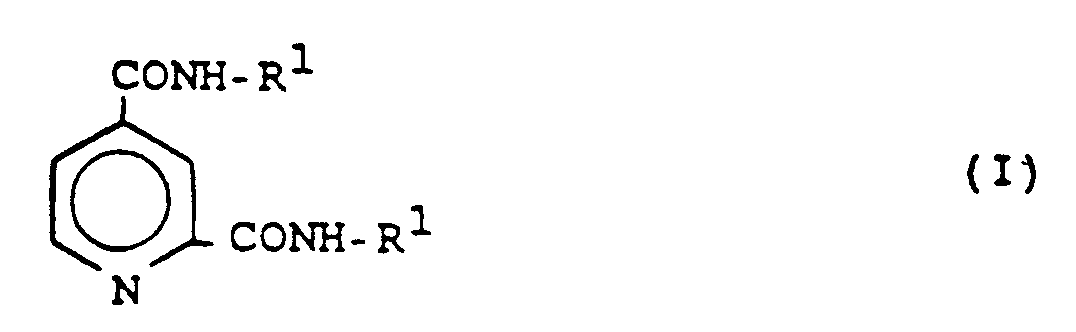 R¹ C₁-C₄-Alkyl bedeutet, welches mit C₁-C₄-Alkoxy monosubstituiert istwobei man Pyridin-2,4-dicarbonsäurechlorid mit einem Alkoxyalkylamin umsetzt, dadurch gekennzeichnet, daß man zunächstA) Pyridin-2,4-dicarbonsäure in Toluol suspendiert, bei Raumtemperatur mit einem 2-3-fach molaren Überschuß SOCl₂ versetzt, bis zur Beendigung der Gasentwicklung auf 90-110°C erhitzt, die klare Lösung eindampft und das erhaltene Zwischenprodukt in Dioxan löst und daß manB) die 4-fach molare Menge an Alkoxyalkylamin der Formel IIund daß man dann bei einer Temperatur von -5 bis +5°C entweder die gemäß A) hergestellte Lösung des Zwischenproduktes zu der gemäß B) hergestellten Lösung tropft oder die gemäß B) hergestellte Lösung zu der gemäß A) hergestellten Lösung des Zwischenproduktes tropft, anschließend bei Raumtemperatur nachreagieren läßt und dann das Reaktionsprodukt ansäuert und daß man anschließend die organische Phase abtrennt, mit Wasser wäscht, trocknet und dann vom Lösungsmittel befreit.
H₂N-(R²)-OR³ (II)
worinR² C₁-C₄-Alkylen undR³ C₁-C₄-Alkyl bedeutetmit Dioxan versetzt - Verfahren nach Anspruch 1, dadurch gekennzeichnet, daß man einen 2-fach molaren überschuß an SOCl₂ verwendet.
- Verfahren nach Anspruch 1 und/oder 2, dadurch gekennzeichnet, daß die Pyridin-2,4-dicarbonsäure und das SOCl₂ auf 100°C erhitzt werden.
- Verfahren nach einem oder mehreren der Ansprüche 1 bis 3, dadurch gekennzeichnet, daß die Lösung, hergestellt gemäß A) zu der Lösung, hergestellt gemäß B) oder die Lösung hergestellt gemäß B) zu der Lösung, hergestellt gemäß A) bei einer Temperatur von 0°C getropft wird.
- Verfahren nach einem oder mehreren der Ansprüche 1 bis 4, dadurch gekennzeichnet, daß man die beiden Lösungen, hergestellt gemäß A) und hergestellt gemäß B) 3 Stunden bei Raumtemperatur nachreagieren läßt.
- Verfahren nach einem oder mehreren der Ansprüche 1 bis 5, dadurch gekennzeichnet, daß mindestens eine der nachfolgenden Bedingungen erfüllt ist:R¹ bedeutet C₁-C₃-Alkyl, welches mit C₁-C₃-Alkoxy monosubstituiert istR² bedeutet C₁-C₃-Alkylen undR³ bedeutet C₁-C₃-Alkyl.
- Verfahren nach einem oder mehreren der Ansprüche 1 bis 6, dadurch gekennzeichnet, daß mindestens eine der nachfolgenden Bedingungen erfüllt ist:R¹ bedeutet 2-MethoxyethylR² bedeutet Ethylen undR³ bedeutet Methyl.
Applications Claiming Priority (4)
| Application Number | Priority Date | Filing Date | Title |
|---|---|---|---|
| DE3826471A DE3826471A1 (de) | 1988-08-04 | 1988-08-04 | Verbessertes verfahren zur herstellung von n,n'-bis(alkoxyalkyl)-pyridin-2,4-dicarbonsaeurediamiden |
| DE3826471 | 1988-08-04 | ||
| DE3828140 | 1988-08-19 | ||
| DE3828140A DE3828140A1 (de) | 1988-08-19 | 1988-08-19 | Verbessertes verfahren zur herstellung von n,n'-bis(alkoxyalkyl)-pyridin-2,4-dicarbonsaeurediamiden sowie verwendung dieser verbindungen zur herstellung oralverabreichbarer arzneimittel |
Publications (3)
| Publication Number | Publication Date |
|---|---|
| EP0353668A2 EP0353668A2 (de) | 1990-02-07 |
| EP0353668A3 EP0353668A3 (de) | 1991-03-27 |
| EP0353668B1 true EP0353668B1 (de) | 1994-10-19 |
Family
ID=25870814
Family Applications (1)
| Application Number | Title | Priority Date | Filing Date |
|---|---|---|---|
| EP89114031A Expired - Lifetime EP0353668B1 (de) | 1988-08-04 | 1989-07-29 | Verbessertes Verfahren zur Herstellung von N,N-Bis(alkoxyalkyl)-pyridin -2,4-dicarbonsäurediamiden |
Country Status (13)
| Country | Link |
|---|---|
| EP (1) | EP0353668B1 (de) |
| JP (1) | JP2683423B2 (de) |
| KR (1) | KR0137789B1 (de) |
| AT (1) | ATE113036T1 (de) |
| AU (1) | AU615324B2 (de) |
| CA (1) | CA1330802C (de) |
| DE (1) | DE58908519D1 (de) |
| DK (1) | DK170748B1 (de) |
| ES (1) | ES2065355T3 (de) |
| HU (1) | HU208423B (de) |
| IE (1) | IE64673B1 (de) |
| IL (1) | IL91185A (de) |
| PT (1) | PT91361B (de) |
Families Citing this family (10)
| Publication number | Priority date | Publication date | Assignee | Title |
|---|---|---|---|---|
| DE3703963A1 (de) * | 1987-02-10 | 1988-08-18 | Hoechst Ag | Pyridin-2,4- und 2,,5-dicarbonsaeure-derivate, verfahren zu ihrer herstellung, verwendung derselben, sowie arzneimittel auf basis dieser verbindungen |
| DE3703962A1 (de) * | 1987-02-10 | 1988-08-18 | Hoechst Ag | Pyridin-2,4- und 2,5-dicarbonsaeure-derivate, verfahren zu ihrer herstellung, verwendung derselben sowie arzneimittel auf basis dieser verbindungen |
| DE3703959A1 (de) * | 1987-02-10 | 1988-08-18 | Hoechst Ag | Pyridin-2,4- und 2,5-dicarbonsaeureamide, verfahren zu ihrer herstellung, verwendung derselben sowie arzneimittel auf basis dieser verbindungen |
| DE3707429A1 (de) * | 1987-03-07 | 1988-09-15 | Hoechst Ag | Substituierte pyridin-2,4-dicarbonsaeure-derivate, verfahren zu ihrer herstellung, verwendung derselben sowie arzneimittel auf basis dieser verbindungen |
| DE3924093A1 (de) * | 1989-07-20 | 1991-02-07 | Hoechst Ag | N,n'-bis(alkoxy-alkyl)-pyridin-2,4-dicarbonsaeurediamide, verfahren zu deren herstellung sowie deren verwendung |
| DE4031000A1 (de) * | 1990-10-01 | 1992-04-09 | Hoechst Ag | 4- oder 5-substituierte pyridin-2-carbonsaeuren, verfahren zu deren herstellung sowie deren verwendung als arzneimittel |
| YU9492A (sh) * | 1991-02-05 | 1995-03-27 | Hoechst Ag. | 2,4- i 2,5-bis-tetrazolilni piridini i postupak za njihovo dobijanje |
| TW199147B (de) * | 1991-03-18 | 1993-02-01 | Hoechst Ag | |
| EP0533130A1 (de) * | 1991-09-19 | 1993-03-24 | Hoechst Aktiengesellschaft | 2-Hydroxymethylpyridine, die entsprechenden Pyridin-N-oxide und ihre Derivate, Verfahren zu ihrer Herstellung sowie deren Verwendung |
| EP0541042A1 (de) * | 1991-11-05 | 1993-05-12 | Hoechst Aktiengesellschaft | Pyridin-2,4- und 2,5-dicarbonsäureamide und deren Derivate, Verfahren zu ihrer Herstellung sowie deren Verwendung als Arzneimittel |
Citations (1)
| Publication number | Priority date | Publication date | Assignee | Title |
|---|---|---|---|---|
| EP0278453A2 (de) * | 1987-02-10 | 1988-08-17 | Hoechst Aktiengesellschaft | Pyridin-2,4- und 2,5-dicarbonsäureamide, Verfahren zu ihrer Herstellung, Verwendung derselben sowie Arzneimittel auf Basis dieser Verbindungen |
Family Cites Families (2)
| Publication number | Priority date | Publication date | Assignee | Title |
|---|---|---|---|---|
| GB1235348A (en) * | 1968-12-16 | 1971-06-09 | Dufour Claude | Pyridine carboxylic acid amides |
| DE3924093A1 (de) * | 1989-07-20 | 1991-02-07 | Hoechst Ag | N,n'-bis(alkoxy-alkyl)-pyridin-2,4-dicarbonsaeurediamide, verfahren zu deren herstellung sowie deren verwendung |
-
1989
- 1989-07-29 DE DE58908519T patent/DE58908519D1/de not_active Expired - Fee Related
- 1989-07-29 ES ES89114031T patent/ES2065355T3/es not_active Expired - Lifetime
- 1989-07-29 EP EP89114031A patent/EP0353668B1/de not_active Expired - Lifetime
- 1989-07-29 AT AT89114031T patent/ATE113036T1/de not_active IP Right Cessation
- 1989-08-02 IL IL91185A patent/IL91185A/xx not_active IP Right Cessation
- 1989-08-03 PT PT91361A patent/PT91361B/pt active IP Right Grant
- 1989-08-03 KR KR1019890011072A patent/KR0137789B1/ko not_active Expired - Fee Related
- 1989-08-03 AU AU39263/89A patent/AU615324B2/en not_active Ceased
- 1989-08-03 IE IE252089A patent/IE64673B1/en not_active IP Right Cessation
- 1989-08-03 CA CA000607509A patent/CA1330802C/en not_active Expired - Fee Related
- 1989-08-03 JP JP1200441A patent/JP2683423B2/ja not_active Expired - Lifetime
- 1989-08-03 DK DK380989A patent/DK170748B1/da not_active IP Right Cessation
- 1989-08-04 HU HU893966A patent/HU208423B/hu not_active IP Right Cessation
Patent Citations (1)
| Publication number | Priority date | Publication date | Assignee | Title |
|---|---|---|---|---|
| EP0278453A2 (de) * | 1987-02-10 | 1988-08-17 | Hoechst Aktiengesellschaft | Pyridin-2,4- und 2,5-dicarbonsäureamide, Verfahren zu ihrer Herstellung, Verwendung derselben sowie Arzneimittel auf Basis dieser Verbindungen |
Also Published As
| Publication number | Publication date |
|---|---|
| HU208423B (en) | 1993-10-28 |
| DK380989A (da) | 1990-02-05 |
| IE64673B1 (en) | 1995-08-23 |
| KR900003125A (ko) | 1990-03-23 |
| ATE113036T1 (de) | 1994-11-15 |
| KR0137789B1 (ko) | 1998-05-15 |
| PT91361B (pt) | 1995-05-04 |
| IL91185A (en) | 1993-06-10 |
| DE58908519D1 (de) | 1994-11-24 |
| HUT52057A (en) | 1990-06-28 |
| JPH0283371A (ja) | 1990-03-23 |
| EP0353668A3 (de) | 1991-03-27 |
| PT91361A (pt) | 1990-03-08 |
| DK170748B1 (da) | 1996-01-08 |
| CA1330802C (en) | 1994-07-19 |
| AU3926389A (en) | 1990-02-08 |
| IE892520L (en) | 1990-02-04 |
| JP2683423B2 (ja) | 1997-11-26 |
| ES2065355T3 (es) | 1995-02-16 |
| IL91185A0 (en) | 1990-03-19 |
| AU615324B2 (en) | 1991-09-26 |
| EP0353668A2 (de) | 1990-02-07 |
| DK380989D0 (da) | 1989-08-03 |
Similar Documents
| Publication | Publication Date | Title |
|---|---|---|
| EP0418797B1 (de) | Pyrimidin-4,6-dicarbonsäurediamide, Verfahren zu deren Herstellung sowie Verwendung derselben sowie Arzneimittel auf Basis dieser Verbindungen | |
| EP0673932B1 (de) | Sulfonamidocarbonylpyridin-2-carbonsäureesteramide sowie ihre Pyridin-N-oxide, Verfahren zu ihrer Herstellung und ihre Verwendung als Arzneimittel | |
| DE69914854T2 (de) | Sulfoxidderivate und Acetonkomplexe und Verfahren zu ihrer Herstellung | |
| DE2516025A1 (de) | Neue pyridinderivate, ihre herstellung und verwendung | |
| EP0463592B1 (de) | y,4- und 2,5-substituierte Pyridin-N-oxide, Verfahren zu deren Herstellung sowie deren Verwendung | |
| DE2845496A1 (de) | N hoch 2 -substituierte phenyl-2,6- diaminonebularine und sie enthaltende arzneimittelzubereitungen | |
| EP0353668B1 (de) | Verbessertes Verfahren zur Herstellung von N,N-Bis(alkoxyalkyl)-pyridin -2,4-dicarbonsäurediamiden | |
| EP0088938A1 (de) | Verwendung von Pyridinverbindungen zur Herstellung von Arzneimitteln mit antihypoxischer und Ischämie-protektiver Wirkung | |
| EP0278452B1 (de) | Pyridin-2,4- und 2,5-dicarbonsäure-Derivate, Verfahren zu ihrer Herstellung, Verwendung derselben sowie Arzneimittel auf Basis dieser Verbindungen | |
| EP0409119B1 (de) | N,N'-Bis(alkoxy-alkyl)-pyridin-2,4-dicarbonsäurediamide, Verfahren zu deren Herstellung sowie deren Verwendung | |
| EP0288758A2 (de) | Dihydropyridinamide, Verfahren zu ihrer Herstellung und ihre Verwendung in Arzneimitteln | |
| EP0314275A2 (de) | 2-Pyrrolidone-5-Carbonsäure Verbindungen | |
| EP0479177A2 (de) | 4- Oder 5-substituierte Pyridin-2-carbonsäuren, Verfahren zu deren Herstellung sowie deren Verwendung als Arzneimittel | |
| EP0008652A1 (de) | Neue Zwischenprodukte und deren Verwendung zur Herstellung von neuen Oxadiazolopyrimidinderivaten | |
| DE3826471A1 (de) | Verbessertes verfahren zur herstellung von n,n'-bis(alkoxyalkyl)-pyridin-2,4-dicarbonsaeurediamiden | |
| DE3828140A1 (de) | Verbessertes verfahren zur herstellung von n,n'-bis(alkoxyalkyl)-pyridin-2,4-dicarbonsaeurediamiden sowie verwendung dieser verbindungen zur herstellung oralverabreichbarer arzneimittel | |
| DE2311240A1 (de) | Ester und amide von (3-trifluormethylphenoxy)-(4-chlorphenyl)-essigsaeure | |
| DE2716172C2 (de) | Bis(6-[(hexahydro-1H-azepin-1-yl)-methylenamino]-penicillanoyloxy)-methan, seine Herstellung und dieses enthaltendes Arzneimittel | |
| DE2054142A1 (de) | Pyridinsulfonsauren | |
| DD242406A5 (de) | 4-oxo-pyrido (2,3-d) pyrimidin-derivate, verfahren zu deren herstellung und diese enthaltende arzneimittel | |
| EP0438795A1 (de) | Pyridin-2,4- und 2,5-dicarbonsäuredi(nitroxyalkyl) amide, Verfahren zu deren Herstellung sowie deren Verwendung | |
| DE2520131A1 (de) | Stickstoffhaltige polycyclische verbindungen und verfahren zu deren herstellung | |
| EP4519248B1 (de) | Verfahren zur herstellung von 4-[5-[bis(2-chlorethyl)amino]-1-methyl-1h-benzo[d]imidazol-2-yl]butansäurealkylestern und formylierten derivaten | |
| DE3120954A1 (de) | "kardiotonische aminophenylpyridinderivate und verfahren zu deren herstellung" | |
| EP0414216A2 (de) | Zyklische Pyridin-2,4-und-2,5-dicarbonsäurediamide, Verfahren zu deren Herstellung sowie deren Verwendung |
Legal Events
| Date | Code | Title | Description |
|---|---|---|---|
| PUAI | Public reference made under article 153(3) epc to a published international application that has entered the european phase |
Free format text: ORIGINAL CODE: 0009012 |
|
| AK | Designated contracting states |
Kind code of ref document: A2 Designated state(s): AT BE CH DE ES FR GB GR IT LI LU NL SE |
|
| PUAL | Search report despatched |
Free format text: ORIGINAL CODE: 0009013 |
|
| 17P | Request for examination filed |
Effective date: 19901221 |
|
| AK | Designated contracting states |
Kind code of ref document: A3 Designated state(s): AT BE CH DE ES FR GB GR IT LI LU NL SE |
|
| 17Q | First examination report despatched |
Effective date: 19930916 |
|
| GRAA | (expected) grant |
Free format text: ORIGINAL CODE: 0009210 |
|
| AK | Designated contracting states |
Kind code of ref document: B1 Designated state(s): AT BE CH DE ES FR GB GR IT LI LU NL SE |
|
| REF | Corresponds to: |
Ref document number: 113036 Country of ref document: AT Date of ref document: 19941115 Kind code of ref document: T |
|
| REF | Corresponds to: |
Ref document number: 58908519 Country of ref document: DE Date of ref document: 19941124 |
|
| ITF | It: translation for a ep patent filed | ||
| ET | Fr: translation filed | ||
| EAL | Se: european patent in force in sweden |
Ref document number: 89114031.1 |
|
| REG | Reference to a national code |
Ref country code: GR Ref legal event code: FG4A Free format text: 3014020 |
|
| GBT | Gb: translation of ep patent filed (gb section 77(6)(a)/1977) |
Effective date: 19950109 |
|
| REG | Reference to a national code |
Ref country code: ES Ref legal event code: FG2A Ref document number: 2065355 Country of ref document: ES Kind code of ref document: T3 |
|
| PLBE | No opposition filed within time limit |
Free format text: ORIGINAL CODE: 0009261 |
|
| STAA | Information on the status of an ep patent application or granted ep patent |
Free format text: STATUS: NO OPPOSITION FILED WITHIN TIME LIMIT |
|
| 26N | No opposition filed | ||
| PGFP | Annual fee paid to national office [announced via postgrant information from national office to epo] |
Ref country code: DE Payment date: 20010613 Year of fee payment: 13 |
|
| PGFP | Annual fee paid to national office [announced via postgrant information from national office to epo] |
Ref country code: NL Payment date: 20010620 Year of fee payment: 13 Ref country code: FR Payment date: 20010620 Year of fee payment: 13 Ref country code: AT Payment date: 20010620 Year of fee payment: 13 |
|
| PGFP | Annual fee paid to national office [announced via postgrant information from national office to epo] |
Ref country code: GB Payment date: 20010621 Year of fee payment: 13 |
|
| PGFP | Annual fee paid to national office [announced via postgrant information from national office to epo] |
Ref country code: CH Payment date: 20010622 Year of fee payment: 13 |
|
| PGFP | Annual fee paid to national office [announced via postgrant information from national office to epo] |
Ref country code: SE Payment date: 20010625 Year of fee payment: 13 |
|
| PGFP | Annual fee paid to national office [announced via postgrant information from national office to epo] |
Ref country code: GR Payment date: 20010706 Year of fee payment: 13 |
|
| PGFP | Annual fee paid to national office [announced via postgrant information from national office to epo] |
Ref country code: LU Payment date: 20010718 Year of fee payment: 13 Ref country code: BE Payment date: 20010718 Year of fee payment: 13 |
|
| PGFP | Annual fee paid to national office [announced via postgrant information from national office to epo] |
Ref country code: ES Payment date: 20010730 Year of fee payment: 13 |
|
| REG | Reference to a national code |
Ref country code: GB Ref legal event code: IF02 |
|
| PG25 | Lapsed in a contracting state [announced via postgrant information from national office to epo] |
Ref country code: LU Free format text: LAPSE BECAUSE OF NON-PAYMENT OF DUE FEES Effective date: 20020729 Ref country code: GB Free format text: LAPSE BECAUSE OF NON-PAYMENT OF DUE FEES Effective date: 20020729 Ref country code: AT Free format text: LAPSE BECAUSE OF NON-PAYMENT OF DUE FEES Effective date: 20020729 |
|
| PG25 | Lapsed in a contracting state [announced via postgrant information from national office to epo] |
Ref country code: SE Free format text: LAPSE BECAUSE OF NON-PAYMENT OF DUE FEES Effective date: 20020730 Ref country code: ES Free format text: LAPSE BECAUSE OF NON-PAYMENT OF DUE FEES Effective date: 20020730 |
|
| PG25 | Lapsed in a contracting state [announced via postgrant information from national office to epo] |
Ref country code: LI Free format text: LAPSE BECAUSE OF NON-PAYMENT OF DUE FEES Effective date: 20020731 Ref country code: CH Free format text: LAPSE BECAUSE OF NON-PAYMENT OF DUE FEES Effective date: 20020731 Ref country code: BE Free format text: LAPSE BECAUSE OF NON-PAYMENT OF DUE FEES Effective date: 20020731 |
|
| BERE | Be: lapsed |
Owner name: *HOECHST A.G. Effective date: 20020731 |
|
| PG25 | Lapsed in a contracting state [announced via postgrant information from national office to epo] |
Ref country code: NL Free format text: LAPSE BECAUSE OF NON-PAYMENT OF DUE FEES Effective date: 20030201 Ref country code: DE Free format text: LAPSE BECAUSE OF NON-PAYMENT OF DUE FEES Effective date: 20030201 |
|
| PG25 | Lapsed in a contracting state [announced via postgrant information from national office to epo] |
Ref country code: GR Free format text: LAPSE BECAUSE OF NON-PAYMENT OF DUE FEES Effective date: 20030206 |
|
| EUG | Se: european patent has lapsed | ||
| REG | Reference to a national code |
Ref country code: CH Ref legal event code: PL |
|
| GBPC | Gb: european patent ceased through non-payment of renewal fee |
Effective date: 20020729 |
|
| PG25 | Lapsed in a contracting state [announced via postgrant information from national office to epo] |
Ref country code: FR Free format text: LAPSE BECAUSE OF NON-PAYMENT OF DUE FEES Effective date: 20030331 |
|
| NLV4 | Nl: lapsed or anulled due to non-payment of the annual fee |
Effective date: 20030201 |
|
| REG | Reference to a national code |
Ref country code: FR Ref legal event code: ST |
|
| REG | Reference to a national code |
Ref country code: ES Ref legal event code: FD2A Effective date: 20030811 |
|
| PG25 | Lapsed in a contracting state [announced via postgrant information from national office to epo] |
Ref country code: IT Free format text: LAPSE BECAUSE OF NON-PAYMENT OF DUE FEES;WARNING: LAPSES OF ITALIAN PATENTS WITH EFFECTIVE DATE BEFORE 2007 MAY HAVE OCCURRED AT ANY TIME BEFORE 2007. THE CORRECT EFFECTIVE DATE MAY BE DIFFERENT FROM THE ONE RECORDED. Effective date: 20050729 |