EP0353723A2 - Elektronisch kontrollierte Kamera - Google Patents
Elektronisch kontrollierte Kamera Download PDFInfo
- Publication number
- EP0353723A2 EP0353723A2 EP89114224A EP89114224A EP0353723A2 EP 0353723 A2 EP0353723 A2 EP 0353723A2 EP 89114224 A EP89114224 A EP 89114224A EP 89114224 A EP89114224 A EP 89114224A EP 0353723 A2 EP0353723 A2 EP 0353723A2
- Authority
- EP
- European Patent Office
- Prior art keywords
- data
- processing
- camera
- film
- code
- Prior art date
- Legal status (The legal status is an assumption and is not a legal conclusion. Google has not performed a legal analysis and makes no representation as to the accuracy of the status listed.)
- Withdrawn
Links
Images








Classifications
-
- G—PHYSICS
- G03—PHOTOGRAPHY; CINEMATOGRAPHY; ANALOGOUS TECHNIQUES USING WAVES OTHER THAN OPTICAL WAVES; ELECTROGRAPHY; HOLOGRAPHY
- G03B—APPARATUS OR ARRANGEMENTS FOR TAKING PHOTOGRAPHS OR FOR PROJECTING OR VIEWING THEM; APPARATUS OR ARRANGEMENTS EMPLOYING ANALOGOUS TECHNIQUES USING WAVES OTHER THAN OPTICAL WAVES; ACCESSORIES THEREFOR
- G03B43/00—Testing correct operation of photographic apparatus or parts thereof
-
- G—PHYSICS
- G03—PHOTOGRAPHY; CINEMATOGRAPHY; ANALOGOUS TECHNIQUES USING WAVES OTHER THAN OPTICAL WAVES; ELECTROGRAPHY; HOLOGRAPHY
- G03B—APPARATUS OR ARRANGEMENTS FOR TAKING PHOTOGRAPHS OR FOR PROJECTING OR VIEWING THEM; APPARATUS OR ARRANGEMENTS EMPLOYING ANALOGOUS TECHNIQUES USING WAVES OTHER THAN OPTICAL WAVES; ACCESSORIES THEREFOR
- G03B17/00—Details of cameras or camera bodies; Accessories therefor
- G03B17/18—Signals indicating condition of a camera member or suitability of light
-
- G—PHYSICS
- G03—PHOTOGRAPHY; CINEMATOGRAPHY; ANALOGOUS TECHNIQUES USING WAVES OTHER THAN OPTICAL WAVES; ELECTROGRAPHY; HOLOGRAPHY
- G03B—APPARATUS OR ARRANGEMENTS FOR TAKING PHOTOGRAPHS OR FOR PROJECTING OR VIEWING THEM; APPARATUS OR ARRANGEMENTS EMPLOYING ANALOGOUS TECHNIQUES USING WAVES OTHER THAN OPTICAL WAVES; ACCESSORIES THEREFOR
- G03B7/00—Control of exposure by setting shutters, diaphragms or filters, separately or conjointly
- G03B7/08—Control effected solely on the basis of the response, to the intensity of the light received by the camera, of a built-in light-sensitive device
- G03B7/091—Digital circuits
-
- G—PHYSICS
- G03—PHOTOGRAPHY; CINEMATOGRAPHY; ANALOGOUS TECHNIQUES USING WAVES OTHER THAN OPTICAL WAVES; ELECTROGRAPHY; HOLOGRAPHY
- G03B—APPARATUS OR ARRANGEMENTS FOR TAKING PHOTOGRAPHS OR FOR PROJECTING OR VIEWING THEM; APPARATUS OR ARRANGEMENTS EMPLOYING ANALOGOUS TECHNIQUES USING WAVES OTHER THAN OPTICAL WAVES; ACCESSORIES THEREFOR
- G03B7/00—Control of exposure by setting shutters, diaphragms or filters, separately or conjointly
- G03B7/08—Control effected solely on the basis of the response, to the intensity of the light received by the camera, of a built-in light-sensitive device
- G03B7/091—Digital circuits
- G03B7/097—Digital circuits for control of both exposure time and aperture
Definitions
- the present invention relates to an electronically controlled camera.
- zoom lens movement when a TELE switch is operated, a zoom motor is rotated forward to pull a zoom lens toward a TELE extremity, while with a WIDE switch operated, the zoom motor is rotated in reverse to withdraw the zoom lens to a WIDE extremity. Also, when a main switch is operated after a back cover is closed with a film cartridge seated inside the camera, automatic loading takes place as a black-shot film advancing operation.
- a film is automatically wound to be pulled out of the film cartridge.
- a wind-up motor is rotated in reverse to allow the film automatically to be wound up on the film cartridge.
- a viewfinder indicates a strobe flash mode with a red lamp turned on, a strobe charge on with the red lamp blinking, a focus lock with a green lamp turned on, and a short distance warning with the green lamp blinking.
- an electronically controlled camera comprising: control means for controlling camera function; input means for a inputting a control signal to said control means; and terminal means, to which an external controller is connected for inputting an external control signal to said control means; wherein said control means disables said input means when said external control signal is input through said terminal means and controls said camera function in accordance with said external control signal via said control means.
- an electronically controlled camera comprising: more than one control means; more than one signal lines interconnected between said control means for data exchange; and terminal means to which an external unit is connected, said terminal means being connected to one of said signal lines, wherein one of said control means sends at least one predetermined data to the other one of said control means through said one of the signal lines, said data being the data which is not required by said other one of the control means.
- an electronically controlled camera comprising: measuring means for measuring photographing data varying in dependence on external environments; Dx code input means reading a Dx code provided on a film cartridge. film detecting means for checking if a film is loaded with its front end drawn out of the film; indicator means for visibly indicating said photographing data; and control means for incicating said photographing data measured by said measuring means on said indicator means when said Dx code input means inputs a predetermined Dx code and said film detecting means detects that the film is not drawn out of the film catridge.
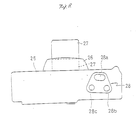
- the camera illustrated in Figs. 1 through 4 is a compact lens shutter camera in which a taking lens (zoom lens) 11 and a finder system 21 are installed independently. On the front, a strobe 22, a photometric AdS cell 23, and a distance measurement unit 24 are installed.
- the taking lens 11 is supported by a movable lens barrel 27, which will come out as required, installed in a fixed lens barrel 26 secured to a camera body 25.
- the position of the movable lens barrel 27 changes between its retracted position illustrated by the broken line and its extended position illustrated by the solid line in Fig. 2 to vary the focal length of the taking lens 11.
- a shutter button 28 which is also used as a zoom button is provided.
- This shutter button 28 has a triangular shape and the front of button 28a is a two-step switch incorporating a photometric switch and a shutter release switch which will be described later, one end of the rear of button 28b is a zoom-tele switch and the other end of the rear of button 28c is a zoom-wide switch.
- These three portions 28a, 28b and 28c can be operated independently so that, when one of them is in operation, the other two cannot be operated.
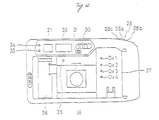
- a main switch 301 On the back of the body 25, as shown in Fig. 3, a main switch 301 a mode button 31 and a LCD panel 32 are provided on the upper portion of a back cover 29.
- the main switch 30 is a slide switch which has three positions and operates as a lock switch and a macro switch which are described later.
- a red indicator lamp 33 for indication of strobe information and a green indicator lamp 34 for indication of distance measurement information are arranged.
- an actuating member 35 to turn on and off a film switch to be described later which checks if a film exists or not, and a roller 36 which rotates upon running of the film are provided above an aperture.
- a film cassette chamber 37 in which a film cartridge is seated four sets of Dx contacts Dx1, Dx2, Dx3 and Dx4, each set of which comprises two electrodes, are provided.
- Dx1 is a ground contact, and ISO 25 through 3200 is detected by dividing it into 8 different zones with 3-bit signals from the other three sets of contacts.
- Reference numeral 38 indicates a spool axis to wind thereon a film drawn from the film cartridge.
- This camera automatically detects the variation of the focal length of the taking lens 11, the open F-value which changes according to the above variation and the position change of the lens 11 among the wide extremity, the tele extremity, the MACRO position for short-distance photography and the LOCK position, then carries out various controls according to these data.
- a code plate is attached around a cam cylinder for lens movement, and several brushes which contact the code plate is arranged on the camera body.
- the information detected by the conducting conditions of these terminals is output as a position code POS.
- the focal length and the F-number of the taking lens 11 are set to 38 mm F4.5 - 60 mm F6.7, and the lens position detected from the position code POS is devided into fifteen steps of OH - EH.
- "H” stands for hexadecimal and will be used for indication of the data to be described later.
- POS 0
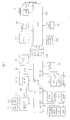
- a main CPU 100 is a core of this control unit and a sub CPU 200 is connected to the main CPU 100 via four signal lines, SPH, CLK, SIOA and SIOS, for shutter-related processings.
- Each signal line has a terminal which can input and output signals to and from exterior of the camera. Signals taken from each terminal during executing data transfer between the main CPU 100 and the sub CPU 200 have the following meanings.
- SPH is a signal for the main CPU 100 to enable the sub CPU 200. Operation will start with "L”.
- CLK is a clock signal for transferring serial data which the sub CPU 200 outputs.
- SIOA is a signal for transferring serial data from the main CPU 100 to the sub CPU 200 and SIOS is a signal for transferring serial data from the sub CPU 200 to the main CPU 100.
- the main CPU 100 operates all the time in synchronism with the clock from the clock generating circuit 101, and controls other circuits in dependence on the switch input detected or the state of the camera.
- a motor drive circuit 110 for driving a winding motor 111 and a zoom motor 112 When to be controlled are a motor drive circuit 110 for driving a winding motor 111 and a zoom motor 112, a date module 120 connected with PORT 5, a red indicator lamp 33 and a green indicator lamp 34 connected with PORT 4, the LCD panel 32, and the strobe 22.
- (1) is connected to PORT 0 of the main CPU 100 and, (2) through (4) to PORT 1, (5) and (6) to PORT 6 and (7) through (10) to PORT 7.
- Dx contact for input of Dx code is connected to PORT 2 of the main CPU 100, and the position code POS is sent to PORT 7 from the brushes in slide contact with a code plate 13.
- the sub CPU 200 when the power is supplied to the sub CPU 200 by the SPH "L" signal which is output from the main CPU 100, the sub CPU 200 will start operation in synchronism with the clock of a clock oscillation circuit 201 and performs the photometric, distance measurement and shutter-related processings while exchanging the signals with the main CPU 100.
- This sub CPU 200 controls a shutter block 210, a bettery check circuit 220, the photometric CdS cell 23 and the distance measurement unit 24, and also generates the trigger pulse TRG for the strobe 22 in synchronism with shutter release.
- the unit which carries out focusing and shutter release by the built-in pulse motor is employed.
- the distance measurement unit 24 has a well- known structure and is constructed with an infrared emitting diode IRED to emit light on a photographing subject and a position sensor PSD to receive light reflected from the accordance with a trigonometrical calculation.
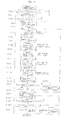
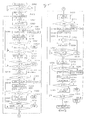
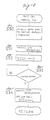
- Fig. 6 shows a main flow which provides basic operations of the camera. Other operations are those diverged from the main flow or those executed as called by the main flow according to various conditions.
- the main CPU 100 inputs the condition of each switch which was described before and stores the detected results in memory at step 1 (hereinafter referred as S.1).
- the condition of the lock switch SWL is checked according to the switch data input at S.2.
- the camera is held in an non-use state, when the lock switch SWL is ON. In this case, whether the position code POS is "0" or not is checked at S.4. This is to check if the taking lens 11 is in the lock position.
- the processing advences to Lck Flow.
- the lock switch SWL is in the state ON, in teh Lock Flow, the zooming, photometric measurement, distance measurement and release operations are inhibited.
- the lens retractomg process to retract the taking lens 11 in the lock position is executed at S.5.
- the condition of the macro switch SWMacro is checked at S.6.
- the macro switch SUMacro is ON, the taking lens 11 has to be at the macro position for short-distance photography. Accordingly, whether the value of the position code POS is EH or not is checked at S.7.
- POS EH, taking lens 11 is already in the macro position, therefore, the processing advances to S.19.
- Lens Macro Processing is executed to move the lens out at S.8, then the processing returns to the start of the main flow.
- the Tele Processing to move the lens to the tele extremity is exesuted at S.18.
- SIOS, CLK are "H” and SIOA is “L” when processing is executed according to the main flow. If CLK is now forcibly turned to "L” from outside, the camera is designed to recognize that this is an external control mode. It should be noted that 1 ms waiting is done to prevent error operation due to external noises.
- switch data in memory are rewritten to the data entered in S2 and, after stopping the processing for 125 ms in S25, processing loops to S2 for further execution.
- the main CPU 100 executes data input and output with an external controller to be described later via CLK and SIOS signal lines.
- Such input and output signals consist of two sets of 8-bit serial signals.
- the first 8 bit serial signal is a signal which the camera receives from the external controller, according to which it is determined whether the second 8 bit serial signal is defined as an output of the information owned by the camera to the external controller or as a control command from the external controller to the camera.
- the first and second serial signals are concretely shown in Table 2 and Table 3.
- Table 2 shows an output mode state where the second serial signal as an output from the camera, the first serial signal being SIO IN 1 and the second serial signal SIO OUT.
- Table 3 shows an input mode state with the second serial signal as a control command for the camera, the first serial signal being SIO IN 1 and the second serial signal SIO IN as in Table 2.
- the output mode and the input mode are distinguished by bit 7 of the first serial signal SIO IN 1 and the main CPU 100 of the camera executes processing in the output mode when bit 7 is 1 and in the input mode when bit 7 is 0.
- the CPU 100 examines whether or not CLK is "L” in S51 after stopping processing for 500 ⁇ s in S50. It determines that, when CLK is "H", the camera is not externally controlled and advances to the start of the main flow.
- the main CPU 100 defines SIOS as “L”n S52, then turning it to "H” again after 500 ⁇ s. It then examines whether or not CLK is "H” in S53. It determines as the camera is externally controlled when CLK is "L2" and goes to the main flow. If it is "H”, input of the first serial signal SIO IN 1 is effected subsequently.
- the external controller is allowed to perform camera control when this pulse is detected and CLK initially set at "L” level is shifted to "H” level.
- the camera accepts external control only when such synchronization is effected.
- the first serial signal SIO IN 1 is transferred from the external controller to the camera.
- the main CPU 100 stores the first serial signal in memory in S56 so that it can be used for later checking.
- the second serial signal is again input in S57. After this input processing, the processing is stopped for 1 ms in S58 and thereafter, processing goes to the command code processing to be described later via S59.
- this state corresponds to the output mode in which a data is sent from the camera to the external controller as a second serial signal.
- it is examined in S60 whether or not high nibbles, i.e., higher-order 4 bits of the first serial signal are 8H. 8H here is the binary code which corresponds to "1000".
- the case where the high nibbles of the first serial signal are 8 corresponds to the mode of PORT READ in Table 2.
- the data at a port specified by the lower-order 4 bits of the first serial signal are set to in S61 as the lower 4 bits of the second serial signal SIO OUT.
- the data at an address specified by the bit 6 - the bit 1 of the first serial signal are set as the lower 4 bits of the second serial signal SIO OUT, while the higher-order address data at the specified address are also set as higher-order 4 bits. This enables reading a RAM data at addresses 10H to 7FH.
- the data set in S61 and S62 is generated as the second serial signal.
- the external controller is allowed to detect the state of the camera by reading this data.
- the main CPU 100 stops the processing for 1 ms in S64 and advances to S50 after it finds SIOS turned to "H" in S65.
- Fig. 8 illustrates in more detail about the data input/output processing between the camera and the external controller executed in S54, S57 and S63 in the external control processing as mentioned above.
- serial output data is set to FFH in S67, and the main CPU 100 sets the 10 ms timer in S68 to permit (start) serial input/output operation.
- the main CPU 100 sets the 10 ms timer in S68 and permits output of the serial output data set in S51.
- S69 checks for time up of the timer set and if the timer is not up yet, it is examined in S70 whether or not the serial input/output has been finished. If input/output is finished before time up, the main CPU 100 stops the processing for 100 ⁇ s in S71 and inhibits the serial input/output, then returning to the External Control Flow for further processing.
- the serial input/output is inhibited in S72, while a stack pointer is cleared to restore the nesting level of the subroutine, the processing then returning to the main flow for further processing.
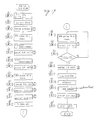
- Fig. 9 shows what processing is executed by the signal actually received from the external controller. This flow will be described with reference to Table 3.
- the higher order 4 bits being 1H indicates the case where Shutter Control Processing is requested.
- the lower order 4 bits of the first serial signal are to be stored in the STEST register in S74.
- the address in the RAM to which the data is to be written is represented by a three-digit hexadecimal indication and is determined by a 8 bit data of the second serial signal.
- the second serial signal SIO IN 2 is within the range between OOH and FFH. If the higher order 4 bits are O through B, that is OOH through BFH, the address in question is given within the range between OOOH and OBFH with the highest order digit set at 0.
- the higher order 4 bits of the second serial signal SIO IN 2 are CH through FH, the higher 2 digits are fixed at 1E, while the lowerst order digit is determined by the lower 4 bits of the second serial signal SIO IN 2, so that the address is specified within the range of 16, i.e., between 1EOH and 1EFH. This range is provided to store a data for driving the LCD panel.
- the processings in S81 through S83 represents specifying the address mentioned above. It is first examined in S81 whether or not the address specified by the higher order 4 bits of the second serial signal is within the data area for driving the LCD panel. If it is negative, the data sent by the lower order 4 bits of the first serial signal is written into the address specified by the 8 bit of the second serial signal. In S83, the data sent by the lower order 4 bits of the first serial signal is written into the address specified in the range between 1EOH to 1EFH.
- S84 it is first examined whether or not bit 3 of the first serial signal SIO IN 1 is 1. If it is 1, the main CPU 100 gives, in S85, outputs to its own PORTS 4 and 5 in accordance with the 4 bit data from the bit 4 to the bit 1 of the second serial signal. Thereafter, processing goes to S66 for External Control.
- the bit 4 is to control a date trigger output to the date module, the bit 3 turning ON and OFF the red lamp, the bit 2 turning ON and OFF the green lamp, the bit 1 output of the SPH signal representing operation start for the sub CPU 200.
- bit 3 of SIO IN 2 is determined to be 0 in S84
- the bit 4 of the second serial signal is set at 1 in S86 and data of the bit 7 - the bit 5 and the bit 3 - the bit 1 is set as a motor data shown in Table 2.
- S87 forward reverse rotation processing of the zoom motor and the wind motor is executed in accordance with the data set.
- POS moving processing "MOVE POS" is executed in S91. This processing is done to move the taking lens 11 to the position corresponding to POS specified by the lower order 4 bits of the second serial signal SIO IN 2.
- S93 executes the POS initializing processing "INT POS".
- POS POS's in 15 steps from OH to EH are to be detected by combination of 3 bit codes
- the configuration must be such that the same code is shared by multiple POS's.
- POS should be counted in response to changes in the codes, with the current POS being constantly held.
- the main CPU 100 is unable to recognize the current POS for some reason, the taking lens 11 must be moved to the position where the code and POS is in one-to-one correspondence or to the terminal end so that POS can be re-counted.
- POS initialization is a processing to be done for this purpose.
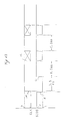
- Fig. 10 shows a block diagram with this inspection unit applied to inspection of an image plane exposure quantity.
- numeral 300 indicates a camera, 301 a controller, 302 an interface (I/F) circuit, 303 a prober unit, 304 a diffusion-surface luminous source of an image plane exposure meter, 305 a metering section of the image plane exposure meter, 305 a light-receiving section of the image plane exposure meter, and 307 operation input keys.
- the camera is placed in exact opposition to the diffusion-surface luminous source 304, with the light receiving section 306 located in the film plane of the camera 300.
- Light emission from the diffusion-surface luminous source 304 is controlled to offer a certain range of brightness from the lowest to highest level.
- the prober unit 303 is controlled by the controller 301 and interconnects the camera 300 and the controller 301 to perform exchange of information via the interface 302. Camera 300 thus carries out controls following the external control information.
- the light-receiving section 306 gives the output corresponding to the light received, to a metering section 305 which in turn gives the measurement result to the controller 30.
- the controller 301 starts, changes and terminates controls in response to operation of an operation input key set 307 which consists of a START key, a NEXT key and an END key.
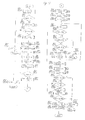
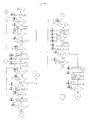
- This controller 301 executes the image plane exposure quantity inspection flow shown in Fig. 11 in response to operation of the input key set 307.
- the controller 301 gives an answer YES in S100, turning on a solenoid valve of the prober unit 303 (S101) and then checking whether or not the camera 300 is in connection with the controller 301 (S102). Processing for connecting the camera 300 with a power supply unit then takes place and waits for about 1 second until the camera starts normal operation (S103).
- FCONT is a flag to check if a data should be sent to the camera 300.
- SOUT 1 stands for the data to be sent to the camera 300 in SOI IN 1 processing and SOUT 2 a data to be sent to the camera 300 in SIO IN 2 processing.
- "40H” is "01000000”, and so represents the position move command MOVE POS as seen in Table 2
- serial IO call processing (SIO) takes place as shown in Fig. 14.
- CLK L setting processing is then executed in S2002 then going to S2003.
- the bit 7 data "1” or "0" is thus transferred.
- the processing then goes to camera control in S111 where ISO sensitivity information is written into the camera 300. The data corresponding to the lower bits 3 to 0 is written in this process.
- the controller 301 likewise goes to S113 to execute camera control processing. The data corresponding to the higher bits 7 to 4 is thus sent to the camera 300, and its contents are written into RAM of the camera 300.
- "1EH” is "00011110" that corresponds to an exposure quantity test command.
- the controller 301 then goes to S115.
- Camera control processing is executed in S115. Release command is thus set to the camera 300.
- S116 exposure quantity input processing takes place.
- the controller 301 compares the exposure quantity input data with an inspection standard and if it complies with the standard, executes the same processing with changing the settings of the light values and the ISO sensitivity.
- the controller 301 goes to S119 to turn off the power of the camera 300.
- the Pocessing then goes to S102 to turn off solenoid valve so that the prober unit 303 is separated from the camera 300.
- the address specified by this processing is "1E” and the data to be transferred is determined by the lower 4 bits specified in S205 and S206. These data are sent to the camera 300 in the camera control processing.
- the carry CY is a flag indicating shifting up from the highest order bit of the register, representing 0 if there is not shift-up, and 1 if any.
- S242 If answer YES is given in S242, the processing goes to S210 and if NO, to S243. Processing for reversing of FON is executed after waiting for 2 seconds in S243, then going to S244. S244 checks if the END key has been operated. If answer is NO in S44, the processing goes to S237 repeating the steps from S237 to S244. In case where the END key is not operated, the execution command to the camera 300 gives a data corresponding to forward and reverse rotation at an approximate interval of 2 seconds. If answer YES is given in S244 where the END key has been operated, the processing goes to S245 to turn off the power of the camera 300 to terminate the operation inspection.
- the camera can be controlled externally in the manner described above so that the main CPU operates in response to execution commands given externally, thereby facilitating inspection as well as changing the operation contents of the camera.
- the above camera has another inspection system addition to the one described above.
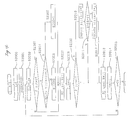
- Fig. 16 is a flow chart of the Main Flow disclosing the instructions relating to another inspection system. It should be noted that only one Main Flow is executed in the above camera 300, and the flow chart illustrated in Fig. 6 is also to disclose the instructions relating to the first inspection system.
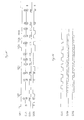
- Data transfer is carried out synchronized with clock CLK (1) - (9) output from the sub CPU 200 as shown in Fig. 21.
- the transferred data consists of 8-bit serial signals and their details are explained in Table 4.
- the signal output from the main CPU 100 to SIOA is referred as SA and the signal output from sub CPU 200 to SIOS is referred as SS.
- the main CPU 100 switches on the power of the sub CPU 200 by setting SPH to "L" at S.2050, and when the sub CPU 200 is switched on, the main CPU 100 stops processing for 10 ms to avoid superimposing noise on the CLK and SIOS signals.
- Main CPU 100 detects the level of SIOS at S.2051. When it is "L”, the processing goes to S.2052. When it is not "L”, main CPU 100 sets SPH to "H” at S.2054 to go to the error process.
- the main CPU 100 by synchronizing with (1) CLK, the main CPU 100 outputs an error code to SIOA signal line as serial output (1) SA, and also it inputs the result BCK of the battery check output from the sub CPU 200 from the SIOS signal line as a serial signal (1) SS.
- serial input/output processing is performed by hardware, so in the processing in the software of the main CPU, as shown in Fig. 18, an error code is set to the register for serial output at S.2090 first, and then serial input is enabled at S.2091 and clock generation of the sub CPU 200 is also enabled when SIOS is set to H at S.2092.
- Error codes include the various information shown in Table 5 which are not required to control the sub CPU 200, and by connecting the external unit described later, it can detect the kind of error caused in the camera without any special operation.
- Main CPU 100 judges the result of the battery check which is input at S.2053 and goes to error processing via S.2054 when the battery voltage is insufficient to continue processing.
- the main CPU 100 outputs SPH pulse NO.1 of 500 ⁇ s to SPH.
- This pulse has a function to transfer the signal to the sub CPU 200 to carry out the processing after battery checking.
- the DX code is input from the DX terminal and this code is converted into ISO sensitivity Sv (Apex display; hereinafter displayed in the same way) of the film.
- lens position code POS is input from the ZC terminal and then by converting this POS, the variation alpha ( ⁇ ) of the open F number of the focal length for taking photographs which is based on the open F number for wide is acquired.
- Main CPU 100 outpus EXP to SIOA as (2)SA at S.2058, and also inputs the distance measurement information AFDATA as (2)SS which the sub CPU 200 outputs to SIOS.
- EXP is data showing the accumulated number of photographs taken by the camera, and this data is not required for the sub CPU 200. For example, if the 10 frames is programmed as 1 bit, the data of each 10 frames between frame 0 and frame 2,560 can be output to be monitored outside the camera.
- the main CPU 100 outputs the zoom position code POS and Dx information as (3)SA, and also inputs the subject brightness information BvDATA as (3)SS.
- This (3)SA is also data which is not needed by the sub CPU 200, so it is not necessary to be transferred.
- AEFM auto exposure, Flashmatic
- SPH pulse NO.3 of 500 ⁇ s is output.
- S.2064 corresponds to transferring the signal to the sub CPU 200 to continue the process.
- the main CPU 100 After outputting SPH pulse NO.3, the main CPU 100 outputs lens latch data LLDATA as (4)SA at S.2065, exposure data AEDATA as (5)SA at S.66 and Flashmatic data as (6)SA at S.2067 to SIOA.
- switch data is input and according to this data, the following judgments are carried out.
- release switch SWR is ON at S.2069
- photometric switch SWS is ON at S.2070
- lock switch SWL is ON at S.2071
- main CPU 100 outputs SPH pulse NO.6 at S.2072 and also outputs command ANUL as (7)SA to SIOA at S.2073, then loops between S.2068 and S.2073 till the release switch is turned ON. In this case, sub CPU 200 will be in the waiting state.
- main CPU 100 While main CPU 100's processing goes into a loop, if photometric switch SWS is turned OFF or lock switch SWL is turned ON, main CPU 100 sets SPH to "H" at S.2074 and then, the processing goes to the main flow.
- main CPU 100 When the release switch is ON, main CPU 100 outputs SHP pulse NO.7 of 500 ⁇ s at S.75 and command REL as (7)SA which is a command for exposure, at S.2076.
- main CPU 100 outputs dummy data (8)SA which has no particular meaning, at S.2077, and also inputs (8)SS which is output from sub CPU 200, and then judges if (8)SS is a command RLEX to start release or not at S2078.
- the battery requirement flag F CHGRQ will be set to 1 to charge the battery at S.2080.
- main CPU 100 set SPH to "H" at S.2084, increments the accumulated number of taken photos which was described before, and flows to the winding process to wind the film by one picture.
- sub CPU 200 When main CPU 100 sets SPH to "L", sub CPU 200 performs power hold at S.100 and transfers the signal to inform main CPU 100 that the operation has started by setting SIOS to "L".
- the sub CPU 200 checks the voltage of the battery using battery check circuit 220, and outputs the checking results as data (1)SS to SIOS synchronized with the built-in clock (1) CLK at S.302.
- the timing of clock generation and data input/output is shown in the serial I/O flow in Fig. 20.
- n counter is set to 8 at S.350 and the processing flows to S.351.
- CLK is set to "L” and the processing flows to S.352.
- CLK is set to "L” from “H” as shown in Fig. 12.
- the processing goes to S.353 and checks if bit (8-n) of the serial output data is 1 or not.
- bit 8-n 8 therefore, bit 0 of the output data is checked first.
- bit 0 of the data is "0”
- the processing goes to S.354 to set SIOS to L.
- bit 0 of the data is 1, the processing goes to S.355 to set SIOS to H.
- Sub CPU 200 sets CLK to H at S.357 after discontinuing the processing for 50 ⁇ s at S.356.
- bit (8-n) of the serial input data is set to 0, and whether SIOA is "L" or not is checked at S.363.
- SIOA is L
- bit (8-n) of the serial input data is changed to 1 at S.364 and the processing goes to S.359.
- SIOA is H
- bit (8-n) is left as 0 and the processing goes to S.359.
- Sub CPU 200 measures the distance to the subject by controlling the distance measurement unit 24 at S.304, and outputs the distance measurement data AFDATA as (2)SS according to the above serial I/O flow synchronized with (2) CLK.
- sub CPU 200 measures the brightness of the subject with the output of CdS cell 23 at S.306, and also outputs brightness data BvDATA as (3)SS synchronized with (3) CLK at S.307.
- sub CPU 200 checks the SPH pulse NO.3.
- Sub CPU 200 outputs (4) CLK at S.309 and also inputs lens latch data LLDATA which is output from main CPU 100 as (4)SA. It also outputs (5) CLK at S.310 and inputs the exposure data AEDATA which is output from main CPU 100 as (5)SA. Moreover, it outputs (6)CLK at S.311 and inputs Flashmatic data FMDATA which is output from main CPU 100 as (6)SA.
- shutter speed or diaphragm data is set according to the above AEDATA or FMDATA and the processing goes to "C".
- sub CPU 200 outputs (7)CLK and inputs (7)SA which is output from main CPU 100.
- (7)SA is transferred as command ANUL until the release switch is turned ON, and when the release switch is ON, command REL is superimposed.
- the processing repeats between S.313 and S.315 while waiting for that this command REL is superimposed.
- sub CPU 200 When the command REL is transferred, sub CPU 200 outputs command RLEXC to (8)SS as well as (8)CLK at S.316, and moves out the lens to the focal position at S.317 according to the transferred lens latch data, and carries out the exposure control at S.318.
- sub CPU 200 moves back the lens to the initial position at S.319, and outputs the winding required command WIND as to (9)SS as well as (9)CLK at S.310.
- sub CPU 200 turns OFF the power hold at S.321 to finish the processing.
- the monitor unit is constructed with a data reading circuit which is equipped with terminals to connect to each of the SPH, SIOA SIOS and CLK contacts, and a display section such as a CRT, etc. which displays data through connection to the reading circuit.
- a data reading circuit which is equipped with terminals to connect to each of the SPH, SIOA SIOS and CLK contacts, and a display section such as a CRT, etc. which displays data through connection to the reading circuit.
- the leading edge of CLK shown in Fig. 22 is the point of the timing to read the data.
- Fig. 23 is a flow chart showing the operation of this monitor.
- monitor unit clears counter C which counts and displays the number of times reading data is communicated at S.400, and counter E is set to 8 to specify the number of times serial data is to be read.
- register A which stores the SA signal and register B which stores the SS signal are cleared, and counter D which counts down the SA and SS signals 1 bit at a time is set to 8.
- the data reading unit judges that the clock output for data transfer is started, and waits for CLK to be initialized and is set to "H” at S.416, and when CLK is set to "H", it inputs SIOA and SIOS from the lowest bit at S.417.
- this camera need not transfer data, but it outputs essential data to judge the condition of the camera to the interval of data transfer with respect to timing, therefore, without special controls, any data can be read by the simple monitor unit described above and operations for each check can be done easily.
- a data requiring transfer and a data requiring no transfer can be easily monitored by taking such data from signal lines of the camera with no extra control.
- operation abnormalities can be exactly classified to facilitate repairing failure products.
- the above camera has the third inspection system addition to the above two systems.
- Fig. 26 is an "AEAF" diverges from S21 of the Main Flow of Figs. 6 and 16. It should be noted that only one "AEAF" flow is executed in the above camera 300, and the flow chart illustrated in Fig. 24 is to disclose the instructions relating to the third inspection system third inspection system while Fig. 17 is to disclose those relating to the second inspection system.
- the processing judges it as the test mode and displays the AF step based on the distance measurement data on the LCD panel.
- the LCD panel does not display the focal length or film numbers in the normal mode which is not included in the test mode.
- the photometric data based on the output of the photometric CdS cell which measured the brightness of the subject is input.
- main CPU 100 reads the Dx code of the film cartridge loaded when the Dx contact is connected nd recognizes the code as the film ISO sensitivity according to Table 1 and also converts it into a film sensitivity value Sv (apex display).
- LL Longs Latch
- test flag F TSTBLB which shows the processing is in the test mode is cleared.
- AE data to control the shutter speed is set to the bulb exposure mode and the Flashmatic (FM) data is set to NFL which inhibits the flash.
- the bulb exposure mode is is to open the shutter when the shutter button is pressed and to close it when the shutter button is released.
- the shutter speed and diaphragm value are determined according to the AE calculation at S.511.
- Main CPU 100 transfers LL data, AE data and FM data calculated at S.512, S.513 and S.514 to sub CPU 200.
- test flag F TSTBLB is 1 or not is checked at S.518.
- the LCD panel display is changed over from the AF step to the normal display which is held in memory.
- the processing skips S.519 and goes to the main flow.
- main CPU 100 When release switch SWR is turned ON while photometric switch SWS is ON and lock switch SWL is OFF, main CPU 100 outputs an exposure start signal to sub CPU 200 at S.520.
- this signal is input to sub CPU 200, sub CPU 200 moves the lens to the focus position according to the LL data, and controls the diaphragm and shutter speed according to the AE data, or controls the diaphragm and strobe according to the FM data and opens the shutter.
- test flag F TSTBLB is 1 or not is checked.
- main CPU 100 inputs the exposure end signal at S.522 and checks if film is pulled out at S.523. When the film is pulled out, winding to wind the film by one frame is carried out at S.524.
- test flag F TSTBLB is 1 at S.521, that is when the processing is in the test mode, the judgment at S.525 is repeated until photometric switch SWS is turned OFF. During this processing, the shutter is in the open position. Therefore, by opening the rear cover and positioning the frosted glass at the aperture, you can see the picture directly.
- the bulb close signal is output at S.526, and the LCD panel display is changed over to the information backed up in the memory, and the processing goes to S.522.
- the distance measurement unit is only described concerning the distance measuring method, however, some other methods can be used; for example, displaying photometric unit data which measures the brightness of the subject can be described.
- measurement data such as light intensity and distance measured can be easily monitored by setting a test mode as part of normal operation of the camera with no need of using an external inspection unit etc.
- test mode is entered in dependence on the state of Dx code and film switch watched, testing can be accomplished without disturbing the user in photographing.
Landscapes
- Physics & Mathematics (AREA)
- General Physics & Mathematics (AREA)
- Exposure Control For Cameras (AREA)
- Stroboscope Apparatuses (AREA)
Priority Applications (2)
| Application Number | Priority Date | Filing Date | Title |
|---|---|---|---|
| EP95109831A EP0679931B1 (de) | 1988-08-01 | 1989-08-01 | Elektronisch gesteuerter Kamera |
| EP95109852A EP0679932B1 (de) | 1988-08-01 | 1989-08-01 | ylektronisch gesteuerte Kamera |
Applications Claiming Priority (6)
| Application Number | Priority Date | Filing Date | Title |
|---|---|---|---|
| JP102115/88 | 1988-08-01 | ||
| JP1988102115U JPH0722669Y2 (ja) | 1988-08-01 | 1988-08-01 | 検査機能を有するカメラ |
| JP1988108998U JP2547901Y2 (ja) | 1988-08-19 | 1988-08-19 | 外部制御可能なカメラ |
| JP108998/88 | 1988-08-19 | ||
| JP111412/88 | 1988-08-25 | ||
| JP1988111412U JPH0755554Y2 (ja) | 1988-08-25 | 1988-08-25 | 検査機能を有するカメラ |
Related Child Applications (3)
| Application Number | Title | Priority Date | Filing Date |
|---|---|---|---|
| EP95109852A Division EP0679932B1 (de) | 1988-08-01 | 1989-08-01 | ylektronisch gesteuerte Kamera |
| EP95109852.4 Division-Into | 1989-08-01 | ||
| EP95109831.8 Division-Into | 1989-08-01 |
Publications (2)
| Publication Number | Publication Date |
|---|---|
| EP0353723A2 true EP0353723A2 (de) | 1990-02-07 |
| EP0353723A3 EP0353723A3 (de) | 1991-05-02 |
Family
ID=27309614
Family Applications (3)
| Application Number | Title | Priority Date | Filing Date |
|---|---|---|---|
| EP19890114224 Withdrawn EP0353723A3 (de) | 1988-08-01 | 1989-08-01 | Elektronisch kontrollierte Kamera |
| EP95109831A Expired - Lifetime EP0679931B1 (de) | 1988-08-01 | 1989-08-01 | Elektronisch gesteuerter Kamera |
| EP95109852A Expired - Lifetime EP0679932B1 (de) | 1988-08-01 | 1989-08-01 | ylektronisch gesteuerte Kamera |
Family Applications After (2)
| Application Number | Title | Priority Date | Filing Date |
|---|---|---|---|
| EP95109831A Expired - Lifetime EP0679931B1 (de) | 1988-08-01 | 1989-08-01 | Elektronisch gesteuerter Kamera |
| EP95109852A Expired - Lifetime EP0679932B1 (de) | 1988-08-01 | 1989-08-01 | ylektronisch gesteuerte Kamera |
Country Status (3)
| Country | Link |
|---|---|
| US (1) | US5030979A (de) |
| EP (3) | EP0353723A3 (de) |
| DE (2) | DE68929345T2 (de) |
Families Citing this family (16)
| Publication number | Priority date | Publication date | Assignee | Title |
|---|---|---|---|---|
| JP2899023B2 (ja) * | 1989-09-28 | 1999-06-02 | キヤノン株式会社 | ビデオシステム |
| JPH03114032A (ja) * | 1989-09-28 | 1991-05-15 | Asahi Optical Co Ltd | カメラの演算装置 |
| JPH03236030A (ja) * | 1990-02-14 | 1991-10-22 | Asahi Optical Co Ltd | 電子制御カメラ |
| JPH03236020A (ja) * | 1990-02-14 | 1991-10-22 | Asahi Optical Co Ltd | ズームレンズ付カメラ |
| JP2817986B2 (ja) * | 1990-02-14 | 1998-10-30 | 旭光学工業株式会社 | カメラの自動撮影装置 |
| US5187517A (en) * | 1990-10-15 | 1993-02-16 | Olympus Optical Co., Ltd. | Camera controllable with use of a control program |
| JP3670932B2 (ja) | 2000-05-02 | 2005-07-13 | ペンタックス株式会社 | 回路基板検査システム及び回路基板 |
| US7446800B2 (en) * | 2002-10-08 | 2008-11-04 | Lifetouch, Inc. | Methods for linking photographs to data related to the subjects of the photographs |
| EP1628492A1 (de) | 2004-08-17 | 2006-02-22 | Dialog Semiconductor GmbH | Kameratestsystem |
| EP1628493A1 (de) | 2004-08-17 | 2006-02-22 | Dialog Semiconductor GmbH | Handhabungssystem für Kamera |
| EP1628495A1 (de) | 2004-08-17 | 2006-02-22 | Dialog Semiconductor GmbH | Mehrfachverarbeitung eines Bildes zur Beschleunigung der Berechnung für dieses Bild |
| EP1628494A1 (de) | 2004-08-17 | 2006-02-22 | Dialog Semiconductor GmbH | Intelligente Lichtquelle mit Synchronisation mit einer Digitalkamera |
| EP1628122A1 (de) | 2004-08-17 | 2006-02-22 | Dialog Semiconductor GmbH | Scharfstellverfahren mit verschiedenen Zielradvorrichtungsdistanzen |
| EP1628123A1 (de) | 2004-08-17 | 2006-02-22 | Dialog Semiconductor GmbH | Prüfung miniaturisierten Kameras mit optischen oder/und elektronischen Zoomfunktionen |
| EP1648181A1 (de) | 2004-10-12 | 2006-04-19 | Dialog Semiconductor GmbH | Einzelbildabspeichervorrichtung |
| US7714908B2 (en) | 2006-05-26 | 2010-05-11 | Lifetouch Inc. | Identifying and tracking digital images with customized metadata |
Family Cites Families (14)
| Publication number | Priority date | Publication date | Assignee | Title |
|---|---|---|---|---|
| DE2851026B2 (de) * | 1978-11-24 | 1981-04-09 | Rollei-Werke Franke & Heidecke Gmbh & Co Kg, 3300 Braunschweig | Kamera mit optischen Anzeigemitteln |
| US4423934A (en) * | 1982-04-02 | 1984-01-03 | Eastman Kodak Company | Photographic camera with digital controller and method of manufacture |
| JPH0610726B2 (ja) * | 1983-09-20 | 1994-02-09 | 株式会社ニコン | カメラ |
| JPS60225122A (ja) | 1984-04-23 | 1985-11-09 | Seiko Koki Kk | プログラムシヤツタ |
| JP2526539B2 (ja) * | 1985-01-21 | 1996-08-21 | ミノルタ株式会社 | カメラの露出制御装置及び露出制御用アダプタ− |
| US4816853A (en) * | 1985-01-21 | 1989-03-28 | Minolta Camera Kabushiki Kaisha | Camera system with plural interchangeable accessories sharing a common serial data bus |
| JPH0823646B2 (ja) * | 1985-02-13 | 1996-03-06 | ミノルタ株式会社 | 動作診断可能なカメラシステム |
| JPH07119868B2 (ja) * | 1985-06-20 | 1995-12-20 | オリンパス光学工業株式会社 | 交換レンズの距離情報出力装置 |
| JPH087392B2 (ja) * | 1985-07-04 | 1996-01-29 | ミノルタ株式会社 | カメラの情報入出力装置 |
| GB2180074B (en) * | 1985-09-06 | 1989-08-16 | Asahi Optical Co Ltd | Digital data output from a camera |
| JPH073546B2 (ja) * | 1985-10-08 | 1995-01-18 | キヤノン株式会社 | カメラ |
| US4841327A (en) * | 1987-01-12 | 1989-06-20 | Canon Kabushiki Kaisha | Camera system |
| JPH01287636A (ja) * | 1988-05-16 | 1989-11-20 | Minolta Camera Co Ltd | フィルム感度読取端子より情報入出力を行うカメラ |
| US4853733A (en) * | 1988-07-08 | 1989-08-01 | Olympus Optical Company Limited | Program rewritable camera |
-
1989
- 1989-08-01 US US07/387,980 patent/US5030979A/en not_active Expired - Lifetime
- 1989-08-01 DE DE68929345T patent/DE68929345T2/de not_active Expired - Fee Related
- 1989-08-01 EP EP19890114224 patent/EP0353723A3/de not_active Withdrawn
- 1989-08-01 EP EP95109831A patent/EP0679931B1/de not_active Expired - Lifetime
- 1989-08-01 DE DE68929308T patent/DE68929308T2/de not_active Expired - Fee Related
- 1989-08-01 EP EP95109852A patent/EP0679932B1/de not_active Expired - Lifetime
Also Published As
| Publication number | Publication date |
|---|---|
| DE68929308D1 (de) | 2001-07-26 |
| US5030979A (en) | 1991-07-09 |
| DE68929345D1 (de) | 2001-12-20 |
| EP0679931A1 (de) | 1995-11-02 |
| EP0679932B1 (de) | 2001-11-14 |
| EP0679931B1 (de) | 2001-06-20 |
| EP0353723A3 (de) | 1991-05-02 |
| DE68929308T2 (de) | 2002-04-25 |
| EP0679932A1 (de) | 1995-11-02 |
| DE68929345T2 (de) | 2002-07-11 |
Similar Documents
| Publication | Publication Date | Title |
|---|---|---|
| EP0679931B1 (de) | Elektronisch gesteuerter Kamera | |
| US4664496A (en) | Camera system | |
| US4525055A (en) | Photographic camera having battery remaining life indicating means | |
| US4544249A (en) | Incorrect lens setting detection device for wide-angle/telephotography convertible camera | |
| US5721987A (en) | Method of checking a battery of a camera and a device | |
| US4748468A (en) | Exposure display device | |
| US5713050A (en) | Method and apparatus for checking battery in camera | |
| EP0271083B1 (de) | Auswechselbare Blitzvorrichtung | |
| US3896460A (en) | Electric shutter for programmed exposure control | |
| JPH0424624A (ja) | 多焦点カメラのストロボ制御装置 | |
| US5099267A (en) | Exposure control apparatus of camera | |
| US5333030A (en) | Camera system | |
| US5223887A (en) | Autofocus camera | |
| JP2547901Y2 (ja) | 外部制御可能なカメラ | |
| JPH0755554Y2 (ja) | 検査機能を有するカメラ | |
| JPS59149334A (ja) | 自動カメラ | |
| JP2876067B2 (ja) | カメラの光学系制御装置 | |
| US5220368A (en) | Camera system | |
| JP3072377B2 (ja) | カメラ | |
| JP2547901Z (de) | ||
| US4878751A (en) | Camera system | |
| US5905920A (en) | Camera with monitoring and testing of camera shutter operations | |
| US5164758A (en) | Exposure control apparatus of camera having an automatic exposure bracket drive mode | |
| JP2545791B2 (ja) | カメラの表示装置 | |
| JPH0722669Y2 (ja) | 検査機能を有するカメラ |
Legal Events
| Date | Code | Title | Description |
|---|---|---|---|
| PUAI | Public reference made under article 153(3) epc to a published international application that has entered the european phase |
Free format text: ORIGINAL CODE: 0009012 |
|
| AK | Designated contracting states |
Kind code of ref document: A2 Designated state(s): AT BE CH DE ES FR GB GR IT LI LU NL SE |
|
| RIN1 | Information on inventor provided before grant (corrected) |
Inventor name: NAGAI, KATSUTOSHI C/O ASAHI KOGAKU KOGYO K. K. Inventor name: KOBAYASHI, TAKEO C/O ASAHI KOGAKU KOGYO K. K. Inventor name: NUMAKO, NORIO B-203, PARK-SIDE NAGASHIMA, Inventor name: TABATA, YASUSHI C/O ASAHI KOGAKU KOGYO K. K. |
|
| PUAL | Search report despatched |
Free format text: ORIGINAL CODE: 0009013 |
|
| AK | Designated contracting states |
Kind code of ref document: A3 Designated state(s): AT BE CH DE ES FR GB GR IT LI LU NL SE |
|
| 17P | Request for examination filed |
Effective date: 19910515 |
|
| RBV | Designated contracting states (corrected) |
Designated state(s): DE FR GB |
|
| 17Q | First examination report despatched |
Effective date: 19931022 |
|
| STAA | Information on the status of an ep patent application or granted ep patent |
Free format text: STATUS: THE APPLICATION HAS BEEN WITHDRAWN |
|
| 18W | Application withdrawn |
Withdrawal date: 19950728 |