EP0353926B1 - Procédés de préparation de fines particules d'yttrium-aluminium-grenat et de fines particules phosphorées d'yttrium-aluminium-grenat - Google Patents
Procédés de préparation de fines particules d'yttrium-aluminium-grenat et de fines particules phosphorées d'yttrium-aluminium-grenat Download PDFInfo
- Publication number
- EP0353926B1 EP0353926B1 EP89307521A EP89307521A EP0353926B1 EP 0353926 B1 EP0353926 B1 EP 0353926B1 EP 89307521 A EP89307521 A EP 89307521A EP 89307521 A EP89307521 A EP 89307521A EP 0353926 B1 EP0353926 B1 EP 0353926B1
- Authority
- EP
- European Patent Office
- Prior art keywords
- aluminium
- fine particles
- yttrium
- reaction
- solution
- Prior art date
- Legal status (The legal status is an assumption and is not a legal conclusion. Google has not performed a legal analysis and makes no representation as to the accuracy of the status listed.)
- Expired - Lifetime
Links
Images



Classifications
-
- C—CHEMISTRY; METALLURGY
- C09—DYES; PAINTS; POLISHES; NATURAL RESINS; ADHESIVES; COMPOSITIONS NOT OTHERWISE PROVIDED FOR; APPLICATIONS OF MATERIALS NOT OTHERWISE PROVIDED FOR
- C09K—MATERIALS FOR MISCELLANEOUS APPLICATIONS, NOT PROVIDED FOR ELSEWHERE
- C09K11/00—Luminescent materials, e.g. electroluminescent or chemiluminescent
- C09K11/08—Luminescent materials, e.g. electroluminescent or chemiluminescent containing inorganic luminescent materials
- C09K11/77—Luminescent materials, e.g. electroluminescent or chemiluminescent containing inorganic luminescent materials containing rare earth metals
- C09K11/7766—Luminescent materials, e.g. electroluminescent or chemiluminescent containing inorganic luminescent materials containing rare earth metals containing two or more rare earth metals
- C09K11/7774—Aluminates
-
- C—CHEMISTRY; METALLURGY
- C01—INORGANIC CHEMISTRY
- C01F—COMPOUNDS OF THE METALS BERYLLIUM, MAGNESIUM, ALUMINIUM, CALCIUM, STRONTIUM, BARIUM, RADIUM, THORIUM, OR OF THE RARE-EARTH METALS
- C01F17/00—Compounds of rare earth metals
- C01F17/30—Compounds containing rare earth metals and at least one element other than a rare earth metal, oxygen or hydrogen, e.g. La4S3Br6
- C01F17/32—Compounds containing rare earth metals and at least one element other than a rare earth metal, oxygen or hydrogen, e.g. La4S3Br6 oxide or hydroxide being the only anion, e.g. NaCeO2 or MgxCayEuO
- C01F17/34—Aluminates, e.g. YAlO3 or Y3-xGdxAl5O12
-
- C—CHEMISTRY; METALLURGY
- C22—METALLURGY; FERROUS OR NON-FERROUS ALLOYS; TREATMENT OF ALLOYS OR NON-FERROUS METALS
- C22B—PRODUCTION AND REFINING OF METALS; PRETREATMENT OF RAW MATERIALS
- C22B59/00—Obtaining rare earth metals
-
- C—CHEMISTRY; METALLURGY
- C30—CRYSTAL GROWTH
- C30B—SINGLE-CRYSTAL GROWTH; UNIDIRECTIONAL SOLIDIFICATION OF EUTECTIC MATERIAL OR UNIDIRECTIONAL DEMIXING OF EUTECTOID MATERIAL; REFINING BY ZONE-MELTING OF MATERIAL; PRODUCTION OF A HOMOGENEOUS POLYCRYSTALLINE MATERIAL WITH DEFINED STRUCTURE; SINGLE CRYSTALS OR HOMOGENEOUS POLYCRYSTALLINE MATERIAL WITH DEFINED STRUCTURE; AFTER-TREATMENT OF SINGLE CRYSTALS OR A HOMOGENEOUS POLYCRYSTALLINE MATERIAL WITH DEFINED STRUCTURE; APPARATUS THEREFOR
- C30B7/00—Single-crystal growth from solutions using solvents which are liquid at normal temperature, e.g. aqueous solutions
- C30B7/14—Single-crystal growth from solutions using solvents which are liquid at normal temperature, e.g. aqueous solutions the crystallising materials being formed by chemical reactions in the solution
-
- C—CHEMISTRY; METALLURGY
- C01—INORGANIC CHEMISTRY
- C01P—INDEXING SCHEME RELATING TO STRUCTURAL AND PHYSICAL ASPECTS OF SOLID INORGANIC COMPOUNDS
- C01P2002/00—Crystal-structural characteristics
- C01P2002/70—Crystal-structural characteristics defined by measured X-ray, neutron or electron diffraction data
- C01P2002/72—Crystal-structural characteristics defined by measured X-ray, neutron or electron diffraction data by d-values or two theta-values, e.g. as X-ray diagram
-
- C—CHEMISTRY; METALLURGY
- C01—INORGANIC CHEMISTRY
- C01P—INDEXING SCHEME RELATING TO STRUCTURAL AND PHYSICAL ASPECTS OF SOLID INORGANIC COMPOUNDS
- C01P2004/00—Particle morphology
- C01P2004/60—Particles characterised by their size
- C01P2004/61—Micrometer sized, i.e. from 1-100 micrometer
-
- C—CHEMISTRY; METALLURGY
- C01—INORGANIC CHEMISTRY
- C01P—INDEXING SCHEME RELATING TO STRUCTURAL AND PHYSICAL ASPECTS OF SOLID INORGANIC COMPOUNDS
- C01P2004/00—Particle morphology
- C01P2004/60—Particles characterised by their size
- C01P2004/62—Submicrometer sized, i.e. from 0.1-1 micrometer
-
- C—CHEMISTRY; METALLURGY
- C01—INORGANIC CHEMISTRY
- C01P—INDEXING SCHEME RELATING TO STRUCTURAL AND PHYSICAL ASPECTS OF SOLID INORGANIC COMPOUNDS
- C01P2006/00—Physical properties of inorganic compounds
- C01P2006/60—Optical properties, e.g. expressed in CIELAB-values
Definitions
- This invention relates to methods of producing yttrium-aluminium-garnet (YAG) fine particles and YAG base phosphor fine particles.
- YAG yttrium-aluminium-garnet
- YAG is an oxide having the compositional formula of Y3Al5O12 and is used as the starting material for a laser oscillator element or as an artificial jewel.
- the YAG solid solution system in which yttrium is partially replaced by terbium is a phosphor or luminophor material represented by the compositional formula Tb x Y 3-x Al5O12, where x is less than three and indicates the amount of substitution.
- the YAG material with terbium is known to emit fluorescence efficiently when x ⁇ 0.15. This material has a high light emission saturation level and is suitable for a high luminosity phosphor screen such as that for a projection type television receiver, beam index tube or a display for an aircraft instrumentation system.
- the particle size, uniformity, dispersibility and purity are factors influencing the properties of the YAG base phosphor materials. Since it is thought that by optimizing these factors a cathode ray tube having a fine phosphor pattern, such as that for the recently developed high definition television system, may be produced with high resolution and high image quality, studies are being conducted of the YAG base material as a promising phosphor material.
- the YAG material and the YAG base phosphor material may be synthesized by substantially identical procedures.
- One of the representative methods for synthesizing the YAG materials is a method comprising the steps of crushing and mixing yttrium oxide and aluminium oxide in a ball mill, together with a sintering assisting agent to form a mixture; subjecting the mixture to a solid-phase reaction for a predetermined time at 1500°C to form a reaction product; and then crushing the reaction product to a fine particle size by a ball mill and classifying by a sieve.
- An improved method is similar, except that a flux is added during the solid phase reaction to reduce the physical strain applied to the YAG fine particles.
- a method similar to that described above is used, but with the addition of terbium oxide to the yttrium oxide and aluminium oxide during the crushing and mixing step.
- a method of manufacturing yttrium-aluminium-garnet fine particles comprising: preparing a solution comprising a first material selected from yttrium salts and hydrolyzates of yttrium compounds and a second material selected from aluminium salts and hydrolyzates of aluminium compounds; and mixing said solution with an aqueous alkaline solution; characterized by: charging the mixed solution having a pH of not less than 10.0 into an autoclave, and heating said mixed solution therein at a temperature of not less than 270°C to produce a precipitate; and washing and drying said precipitate so as to obtain the yttrium-aluminium-garnet fine particles.
- a method of manufacturing yttrium-aluminium-garnet base phosphor fine particles comprising: preparing a solution comprising a first material selected from yttrium salts and hydrolyzates of yttrium compounds, a second material selected from aluminium salts and hydrolyzates of aluminium compounds, and a third material selected from terbium salts and hydrolyzates of terbium compounds; and mixing said solution with an aqueous alkaline solution; characterized by: charging the mixed solution having a pH of not less than 10.0 into an autoclave, and heating said mixed solution therein at a temperature of not less than 270°C to produce a precipitate; and washing and drying said precipitate so as to obtain the yttrium-aluminium-garnet base phosphor fine particles.
- YAG fine particles and YAG base phosphor fine particles are to be produced by liquid phase reaction in an aqueous solution system, it is necessary for yttrium, aluminium and terbium as the starting materials to be solubilized. For this reason, hydrolyzates of the compounds containing these elements or salts of these elements are employed.
- hydrolyzates For producing these hydrolyzates, it suffices to dissolve halogenides or various salts as later described of yttrium, aluminium or terbium in water, or to hydrolyze aqueous solutions thereof in an aqueous alkaline solution such as LiOH, NaOH, KOH or NH4OH.
- the above salts may include salts of oxoacids, such as nitrates or sulphates, or of organic acids, such as acetates.
- aqueous solutions of hydroxides of alkali metals such as Li, Na or K are employed.
- the pH is selected to be not lower than 10.0. With the pH less than 10.0, the single phase cannot be achieved sufficiently and the purity becomes insufficient. This purity may be ascertained by X-ray diffraction.
- the preferred pH range is 10.0 to 13.3 and, with a more preferred pH range of 11.0 to 12.6, a single phase product may be obtained at a high yield rate.
- the preferred pH range is 10.2 to 14.1 and, with a more preferred pH range of 11.0 to 13.5, a single phase product may be obtained at a high yield rate. Since the pH influences the particle size of the produced YAG fine particles and YAG base phosphor fine particles, it needs to be set suitably depending on the desired properties.
- a temperature not lower than 270 o C is employed. With the temperature lower than 270 o C, the intensity of the X-ray diffraction ascribable to products other than the desired product becomes higher while the purity is lowered. For reducing the reaction time and realizing more efficient synthesis, a temperature of not lower than 300 o C is more preferred. Although there is no limitation to the upper temperature limit, it is set to about 380 o C in consideration of the critical vapour pressure of the reaction system.
- reaction time interval is preferably not shorter than five minutes, and preferably not less than ten minutes.
- the YAG fine particles or YAG base phosphor fine particles, obtained as precipitates are washed with cold or lukewarm water by decantation, centrifugation or filtration.
- the metal ions in the alkaline solution, such as Li, Na, K ions, adsorbed to the precipitates, are removed in this manner, and the remaining product is then dried.
- the YAG base phosphor fine particles may be admixed further with Ga for improving the brightness or luminance.
- the YAG fine particles and YAG base phosphor fine particles obtained are extremely small in particles size and uniform in particle size distribution, while having such advantages that the particle size may be controlled by the pH of the reaction solution and that there is no risk of mixing in metal oxides in the course of the production process.
- the YAG base phosphor fine particles having these advantages are highly effective when used as the phosphor for a CRT for which high resolution is a requirement.
- This example is concerned with preparation of YAG fine particles from yttrium nitrate, Y(NO3)3.3.5H2O, and aluminium chloride, AlCl3.6H2O.
- reaction solution C was charged into an autoclave fitted with a platinum inner container and reacted with agitation at 360 o C for one hour. After termination of the reaction, decantation was repeatedly performed with pure water to remove alkali metal ions from the white-coloured precipitates produced during the above reaction. The resulting mass was subjected to filtration and washing with water and dried overnight at 100 o C in a dryer to produce a white-coloured solid product.
- the white-coloured solid product obtained with the pH value of the reaction solution C of 12.3 was subjected to an X-ray diffraction using CuK ⁇ -rays.
- the results are shown in Figure 1, in which the ordinate and the abscissa denote the intensity of diffraction by arbitrary units and the diffraction angle 2 ⁇ ( o ), respectively, since the X-ray diffraction pattern coincides with the cards 33-40 of JCPDS (Joint Committee on Powder Diffraction Standards), the product could be identified to be the cubic crystal YAG (Y3Al5O12).
- Figure 2 shows the photomicrograph of the white-coloured solid product, which was taken with a scanning type electron microscope. It is seen from this Figure that there have been produced YAG fine particles that are 2 to 3 ⁇ m in particle size and extremely uniform in particle size.
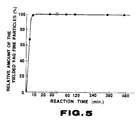
- reaction time was examined in the following manner. With the pH value of the reaction solution C of 12.3 and with the reaction temperature of 360 o C, the reaction was carried out for various reaction time intervals. Each white-coloured solid product was subjected to X-ray diffraction to find similarly the relative yield amount of YAG which was then plotted against the reaction time. The results are shown in Figure 5 in which the ordinate and the abscissa denote the relative yield amount of YAG in percentage and the reaction time interval in minutes, respectively. It is seen from this figure that YAG starts to be yielded in several minutes from the start of the reaction and the yield amount reaches saturation in about ten minutes.
- This example is concerned with the preparation of YAG fine particles from yttrium chloride, YCl3, and aluminium chloride, AlCl3.
- reaction solution C 36.6 g of yttrium chloride and 62.5 g of aluminium chloride were dissolved in 400 ml of pure water to produce a solution A. This solution was then added slowly drop-wise into 400 ml of an aqueous solution of sodium hydroxide with agitation to avoid gelation. Then, pure water was added to the reaction system to produce a reaction solution C. The pH value of the reaction solution C was 12.6.
- This reaction solution C was charged into an autoclave having a platinum inner container and reacted for six hours with agitation at 360 o C. After termination of the reaction, the white-coloured precipitates produced in the above reaction were washed by decantation, filtration and washing with water and dried in a dryer at 100 o C for 12 hours to a white-coloured solid product.
- the white-coloured product was identified to be YAG fine particles of high purity and fine uniform particle size.
- This example is concerned with the investigation of the change in results caused by the addition of aluminium to the reaction solution in the preparation of YAG fine particles from yttrium nitrate, Y(NO3)3.3.5H2O, and aluminium chloride, AlCl3.6H2O.
- reaction solution C0 contains a stoichiometrically required amount of aluminium and the solutions C1 to C9 contain aluminium in amounts of 10% to 90% in excess to the stoichiometrically required amount of aluminium.
- the pH value of each of these solutions was adjusted to 12.6 using aqueous solutions of sodium hydroxide.
- the white-coloured solid product obtained from the reaction solutions C3 to C9 showed approximately the same pattern as the X-ray diffraction shown in Figure 1 and, thus, could be identified to be the high-purity YAG.
- the X-ray diffraction pattern of the white-coloured solid product synthesized from the solutions C0 to C2 showed peaks indicating the co-existence of yttrium hydroxide, Y(OH)3. It is seen from this that an excess amount of aluminium by about 30% over the stoichiometrically necessary amount on the theoretical numbers of mols is required in the reaction with respect to yttrium.
- the white-coloured solid products obtained from the reaction solutions C I to C IV were found to be the high purity YAG, although they exhibited slightly different values of the diffraction strength.
- This example is concerned with the preparation of the YAG base phosphor fine particles from yttrium nitrate, Y(NO3)3.3.5H2O, and terbium chloride, TbCl3.
- This reaction solution was charged into an autoclave fitted with a platinum inner container and reacted with agitation at 370 o C for one hour. After termination of the reaction, decantation was repeatedly performed using pure water to remove alkali metal ions from the white-coloured precipitates produced in the above reaction. The resulting product was subjected to further filtration and washing with water and then dried overnight in a dryer at 100 o C to produce a white-coloured solid product.
- Figure 7 shows a photo of the white-coloured solid product, taken with a scanning type electron microscope. It is seen that there have been produced YAG base phosphor fine particles having an extremely uniform particle size.
- the resulting solution was divided into five equal parts into which aluminium chloride was added sequentially in amounts of 7.53 g, 15.1 g, ..., 37.7 g, thus, in amounts of 10%, 20%, ... 50% in excess to the initial amount of aluminium chloride. Finally, pure water was added to produce different 100 ml reaction solutions D1 to D5. The pH value of each of these reaction solutions D1 to D5 was adjusted to 13.3 with sodium hydroxide.
- reaction solutions D1 to D5 were reacted at 360 o C for one hour with agitation in an autoclave.
- the white-coloured solid products were obtained from the precipitates by the processes described above.
- These white-coloured solid products were analyzed by an X-ray diffraction, from which it was seen that the diffraction pattern of each of the white-coloured solid products obtained from the reaction solutions D3 to D5 was about the same as that shown in Figure 6 but each of the white-coloured solid products obtained from the reaction solutions D1 and D2 also contained small amounts of yttrium hydroxide, Y(OH)3.
- reaction solutions D6 to D12 having the pH values shown in Table 2 below were prepared.
- the particle size of the produced YAG base phosphor fine particles can be controlled by the pH of the reaction solution D.
Landscapes
- Chemical & Material Sciences (AREA)
- Organic Chemistry (AREA)
- Inorganic Chemistry (AREA)
- Engineering & Computer Science (AREA)
- Materials Engineering (AREA)
- Life Sciences & Earth Sciences (AREA)
- Geology (AREA)
- Metallurgy (AREA)
- General Life Sciences & Earth Sciences (AREA)
- Manufacturing & Machinery (AREA)
- Mechanical Engineering (AREA)
- Environmental & Geological Engineering (AREA)
- Chemical Kinetics & Catalysis (AREA)
- General Chemical & Material Sciences (AREA)
- Crystallography & Structural Chemistry (AREA)
- Luminescent Compositions (AREA)
- Compounds Of Alkaline-Earth Elements, Aluminum Or Rare-Earth Metals (AREA)
Claims (12)
- Procédé de fabrication de fines particules d'yttrium-aluminium-grenat, le procédé comprenant les étapes :
de préparation d'une solution comprenant un premier matériau choisi parmi des sels d'yttrium et des hydrolysats de composés d'yttrium et un second matériau choisi parmi des sels d'aluminium et des hydrolysats de composés d'aluminium ; et
de mélange de ladite solution avec une solution alcaline aqueuse ; caractérisé en ce que :
on charge la solution mélangée ayant un pH supérieur ou égal à 10,0 dans un autoclave, et on chauffe ladite solution mélangée à l'intérieur de celui-ci à une température supérieure ou égale à 270°C pour produire un précipité ; et
on lave et on sèche ledit précipité afin d'obtenir les fines particules d'yttrium-aluminium-grenat. - Procédé selon la revendication 1, dans lequel le pH de ladite solution mélangée se trouve dans l'intervalle de 10,6 à 13,3.
- Procédé selon la revendication 1, dans lequel le pH de ladite solution mélangée se trouve dans l'intervalle de 11,0 à 12,6.
- Procédé selon la revendication 1, la revendication 2 ou la revendication 3, dans lequel ladite température se trouve dans l'intervalle de 300°C à 390°C.
- Procédé selon l'une quelconque des revendications précédentes, dans lequel la quantité d'aluminium dans ladite solution mélangée est supérieure ou égale de 30 % par rapport à la quantité stoechiométrique nécessaire.
- Procédé selon la revendication 5, dans lequel le pH de ladite solution mélangée se trouve dans l'intervalle de 10,6 à 13,3 et ladite température se trouve dans l'intervalle de 300°C à 390°C.
- Procédé selon la revendication 1 qui comprend le remplacement d'une partie du premier matériau par un troisième matériau choisi parmi des sels de terbium et des hydrolysats de composés de terbium.
- Procédé de fabrication de fines particules de phosphore à base d'yttrium-aluminium-grenat, le procédé comprenant les étapes :
de préparation d'une solution comprenant un premier matériau choisi parmi des sels d'yttrium et des hydrolysats de composés d'yttrium, un second matériau choisi parmi des sels d'aluminium et des hydrolysats de composés d'aluminium et un troisième matériau choisi parmi des sels de terbium et des hydrolysats de composés de terbium ; et
de mélange de ladite solution avec une solution alcaline aqueuse ; caractérisé en ce que :
on charge la solution mélangée ayant un pH supérieur ou égal à 10,0 dans un autoclave, et on chauffe ladite solution mélangée à l'intérieur de celui-ci à une température supérieure ou égale à 270°C pour produire un précipité ; et
on lave et on sèche ledit précipité afin d'obtenir les fines particules de phosphore à base d'yttrium-aluminium-grenat. - Procédé selon la revendication 8, dans lequel le pH de ladite solution mélangée se trouve dans l'intervalle de 10,2 à 14,1.
- Procédé selon la revendication 8, dans lequel le pH de ladite solution mélangée se trouve dans l'intervalle de 11,0 à 13,5.
- Procédé selon la revendication 8, la revendication 9 ou la revendication 10, dans lequel ladite température se trouve dans l'intervalle de 300°C à 390°C.
- Procédé selon l'une quelconque des revendications 8 à 11, dans lequel la quantité d'aluminium dans ladite solution mélangée est supérieure ou égale de 30 % par rapport à la quantité stoechiométrique nécessaire.
Applications Claiming Priority (2)
| Application Number | Priority Date | Filing Date | Title |
|---|---|---|---|
| JP19147288 | 1988-07-30 | ||
| JP191472/88 | 1988-07-30 |
Publications (3)
| Publication Number | Publication Date |
|---|---|
| EP0353926A2 EP0353926A2 (fr) | 1990-02-07 |
| EP0353926A3 EP0353926A3 (fr) | 1991-09-04 |
| EP0353926B1 true EP0353926B1 (fr) | 1994-11-30 |
Family
ID=16275222
Family Applications (1)
| Application Number | Title | Priority Date | Filing Date |
|---|---|---|---|
| EP89307521A Expired - Lifetime EP0353926B1 (fr) | 1988-07-30 | 1989-07-24 | Procédés de préparation de fines particules d'yttrium-aluminium-grenat et de fines particules phosphorées d'yttrium-aluminium-grenat |
Country Status (4)
| Country | Link |
|---|---|
| US (1) | US5037577A (fr) |
| EP (1) | EP0353926B1 (fr) |
| KR (1) | KR920010085B1 (fr) |
| DE (1) | DE68919575T2 (fr) |
Cited By (3)
| Publication number | Priority date | Publication date | Assignee | Title |
|---|---|---|---|---|
| DE10223988A1 (de) * | 2002-05-29 | 2003-12-18 | Siemens Ag | Leuchtstoffpulver, Verfahren zum Herstellen des Leuchtstoffpulvers und Leuchtstoffkörper mit dem Leuchtstoffpulver |
| US7629621B2 (en) | 1996-06-26 | 2009-12-08 | Osram Gmbh | Light-radiating semiconductor component with a luminescence conversion element |
| US7709852B2 (en) | 1996-09-20 | 2010-05-04 | Osram Gmbh | Wavelength-converting casting composition and light-emitting semiconductor component |
Families Citing this family (26)
| Publication number | Priority date | Publication date | Assignee | Title |
|---|---|---|---|---|
| JP3047110B2 (ja) * | 1990-06-15 | 2000-05-29 | 株式会社東北テクノアーチ | 金属酸化物微粒子の製造方法 |
| US5531974A (en) * | 1992-07-08 | 1996-07-02 | Hughes Aircraft Company | Flux grown, monosize oxide particles |
| US5352642A (en) * | 1992-11-10 | 1994-10-04 | The Babcock & Wilcox Company | Fabrication of Y3 Al5 O12 fibers from water soluble polymers |
| US5437852A (en) * | 1993-05-13 | 1995-08-01 | The Babcock & Wilcox Company | Water-soluble pre-ceramic polymers and methods of their production |
| US5545360A (en) * | 1993-06-08 | 1996-08-13 | Industrial Technology Research Institute | Process for preparing powders with superior homogeneity from aqueous solutions of metal nitrates |
| US6875372B1 (en) * | 1997-02-24 | 2005-04-05 | Cabot Corporation | Cathodoluminescent phosphor powders, methods for making phosphor powders and devices incorporating same |
| US7476411B1 (en) | 1997-02-24 | 2009-01-13 | Cabot Corporation | Direct-write deposition of phosphor powders |
| AU6665598A (en) * | 1997-02-24 | 1998-09-09 | Superior Micropowders Llc | Sulfur-containing phosphor powders, methods for making phosphor powders and devices incorporating same |
| US6168731B1 (en) * | 1997-02-24 | 2001-01-02 | Superior Micropowders Llc | Cathodoluminescent phosphor powders, methods for making phosphor powders and devices incorporating same |
| US5981959A (en) * | 1997-12-05 | 1999-11-09 | Xerox Corporation | Pixelized scintillation layer and structures incorporating same |
| US6177236B1 (en) | 1997-12-05 | 2001-01-23 | Xerox Corporation | Method of making a pixelized scintillation layer and structures incorporating same |
| RU2137867C1 (ru) * | 1998-04-22 | 1999-09-20 | Химический факультет МГУ им.М.В.Ломоносова | Способ получения мелкокристаллического нелегированного и легированного иттрий-алюминиевого граната |
| AU6021299A (en) * | 1998-08-27 | 2000-03-21 | Superior Micropowders Llc | Phosphor powders, methods for making phosphor powders and devices incorporating same |
| US6315923B1 (en) * | 1998-11-12 | 2001-11-13 | Symyx Technologies, Inc | Storage phosphors |
| RU2195429C2 (ru) * | 2000-10-18 | 2002-12-27 | Кубанский государственный технологический университет | Способ получения шихты самарийалюминиевого граната |
| TWI282357B (en) * | 2001-05-29 | 2007-06-11 | Nantex Industry Co Ltd | Process for the preparation of pink light-emitting diode with high brightness |
| JP2006282447A (ja) * | 2005-03-31 | 2006-10-19 | Fuji Photo Film Co Ltd | 透光性材料およびその製造方法 |
| US7427577B2 (en) * | 2006-04-06 | 2008-09-23 | Nanocerox Inc | Sintered polycrystalline terbium aluminum garnet and use thereof in magneto-optical devices |
| JP2008013607A (ja) * | 2006-07-03 | 2008-01-24 | Fujifilm Corp | Tb含有発光性化合物、これを含む発光性組成物と発光体、発光素子、固体レーザ装置 |
| DE102006037730A1 (de) * | 2006-08-11 | 2008-02-14 | Merck Patent Gmbh | LED-Konversionsleuchtstoffe in Form von keramischen Körpern |
| CN100364894C (zh) * | 2006-08-16 | 2008-01-30 | 四川大学 | 制备钇铝石榴石纳米粉体的醇-水复合溶剂共沉淀法 |
| US9120975B2 (en) | 2006-10-20 | 2015-09-01 | Intematix Corporation | Yellow-green to yellow-emitting phosphors based on terbium-containing aluminates |
| US8475683B2 (en) | 2006-10-20 | 2013-07-02 | Intematix Corporation | Yellow-green to yellow-emitting phosphors based on halogenated-aluminates |
| US8133461B2 (en) * | 2006-10-20 | 2012-03-13 | Intematix Corporation | Nano-YAG:Ce phosphor compositions and their methods of preparation |
| US8529791B2 (en) | 2006-10-20 | 2013-09-10 | Intematix Corporation | Green-emitting, garnet-based phosphors in general and backlighting applications |
| GB201308473D0 (en) * | 2013-05-10 | 2013-06-19 | Authentix Inc | Plating of articles |
Family Cites Families (7)
| Publication number | Priority date | Publication date | Assignee | Title |
|---|---|---|---|---|
| US3496108A (en) * | 1966-11-15 | 1970-02-17 | Bell Telephone Labor Inc | Hydrothermal growth of magnetic garnets and materials so produced |
| GB1589964A (en) * | 1976-09-03 | 1981-05-20 | Johnson Matthey Co Ltd | Luminescent materials |
| GB1600492A (en) * | 1977-01-19 | 1981-10-14 | Johnson Matthey Co Ltd | Luminescent materials |
| NL7809555A (nl) * | 1978-09-20 | 1980-03-24 | Philips Nv | Werkwijze voor het bereiden van een luminescerend alu- minaat. |
| FR2469477A1 (fr) * | 1979-11-09 | 1981-05-22 | Rhone Poulenc Ind | Procede de fabrication de grenat polycristallin, grenat polycristallin et monocristal correspondant |
| JPS5857491A (ja) * | 1981-09-30 | 1983-04-05 | Sony Corp | 緑色螢光体の製造方法 |
| JPS60101175A (ja) * | 1983-11-05 | 1985-06-05 | Sony Corp | 投射型テレビ用緑色螢光体 |
-
1989
- 1989-07-13 KR KR1019890009969A patent/KR920010085B1/ko not_active Expired
- 1989-07-24 EP EP89307521A patent/EP0353926B1/fr not_active Expired - Lifetime
- 1989-07-24 US US07/384,660 patent/US5037577A/en not_active Expired - Lifetime
- 1989-07-24 DE DE68919575T patent/DE68919575T2/de not_active Expired - Fee Related
Cited By (6)
| Publication number | Priority date | Publication date | Assignee | Title |
|---|---|---|---|---|
| US7629621B2 (en) | 1996-06-26 | 2009-12-08 | Osram Gmbh | Light-radiating semiconductor component with a luminescence conversion element |
| US9196800B2 (en) | 1996-06-26 | 2015-11-24 | Osram Gmbh | Light-radiating semiconductor component with a luminescence conversion element |
| US7709852B2 (en) | 1996-09-20 | 2010-05-04 | Osram Gmbh | Wavelength-converting casting composition and light-emitting semiconductor component |
| US8071996B2 (en) | 1996-09-20 | 2011-12-06 | Osram Gmbh | Wavelength-converting casting composition and light-emitting semiconductor component |
| DE10223988A1 (de) * | 2002-05-29 | 2003-12-18 | Siemens Ag | Leuchtstoffpulver, Verfahren zum Herstellen des Leuchtstoffpulvers und Leuchtstoffkörper mit dem Leuchtstoffpulver |
| US7481951B2 (en) | 2002-05-29 | 2009-01-27 | Osram Opto Semiconductors Gmbh | Luminescent powder, method for producing the luminescent powder and luminescent body provided with luminescent powder |
Also Published As
| Publication number | Publication date |
|---|---|
| KR900001597A (ko) | 1990-02-27 |
| US5037577A (en) | 1991-08-06 |
| KR920010085B1 (ko) | 1992-11-14 |
| EP0353926A2 (fr) | 1990-02-07 |
| DE68919575D1 (de) | 1995-01-12 |
| DE68919575T2 (de) | 1995-04-20 |
| EP0353926A3 (fr) | 1991-09-04 |
Similar Documents
| Publication | Publication Date | Title |
|---|---|---|
| EP0353926B1 (fr) | Procédés de préparation de fines particules d'yttrium-aluminium-grenat et de fines particules phosphorées d'yttrium-aluminium-grenat | |
| DE69824038T2 (de) | Verfahren zur Herstellung eines ZinkorthosilikatLeuchtstoffs mit hoher Leuchtkraft und kürzerem Nachleuchten | |
| US4801398A (en) | Method of preparing fluorescent material of small particle size | |
| US6677262B2 (en) | Rare earth oxide, basic rare earth carbonate, making method, phosphor, and ceramic | |
| DE69909751T2 (de) | Verfahren zur herstellung rotstrahlenden phosphors von keinen partikeln mit hoher helligkeit und der phosphor | |
| EP0258545B1 (fr) | Matière luminescente aux UV à base de tétraborate de strontium activée à l'europium et procédé pour la fabriquer | |
| DE69908107T2 (de) | Mit kleiner partikelgrösse terbiumaktivierter yttrium-gadolinium-boratphosphor und verfahren zur herstellung | |
| US6419852B1 (en) | Use as phosphor dot in a plasma or x-ray system of a lanthanum phosphate comprising thulium | |
| KR19980077345A (ko) | 구형 형광체 제조방법 | |
| US4929385A (en) | Freon free process for preparing a niobium activated yttrium tantalate X-ray phosphor | |
| JP2705183B2 (ja) | イットリウム・アルミニウム・ガーネット微粒子およびイットリウム・アルミニウム・ガーネット系蛍光体微粒子の製造方法 | |
| US5068055A (en) | Europium activated strontium tetraborate UV phosphors | |
| KR20020022455A (ko) | 구상의 알루미네이트계 청색 형광체의 제조방법 | |
| EP0426106B1 (fr) | Méthode de préparation d'un matériau luminescent | |
| KR920010067B1 (ko) | 이트륨·알루미늄·가넷계 형광체 미립자의 제조방법 | |
| US6716524B2 (en) | Rare earth borate and making method | |
| EP0410350B1 (fr) | Méthode de fabrication d'un matériau fluorescent à base d'oxysulfure d'yttrium | |
| CA1096158A (fr) | Phosphate d'ittrium et d'indium phosphorescent aux rayons x | |
| EP0426032A2 (fr) | Procédé de préparation d'un matériau fluorescent à base de ZnS | |
| KR100424861B1 (ko) | 가수분해법을 이용한 구상의 붕소산화물계 적색형광체의제조방법 | |
| EP0277646B1 (fr) | Matériau luminescent de grande taille de particules base de silicate de calcium et procédé pour fabriquer celui-ci | |
| DE19843715A1 (de) | Mit Lithium dotierter und mit Terbium aktivierter Gadoliniumoxysulfid-Leuchtstoff | |
| JPH0841453A (ja) | 希土類酸硫化物蛍光体の製造方法 | |
| JPH0578660A (ja) | 希土類赤色蛍光体の製造方法 | |
| DD207213B1 (de) | Verfahren zur herstellung blau lumineszierender erdalkalialuminatleuchtstoffe fuer quecksilberniederdrucklampen |
Legal Events
| Date | Code | Title | Description |
|---|---|---|---|
| PUAI | Public reference made under article 153(3) epc to a published international application that has entered the european phase |
Free format text: ORIGINAL CODE: 0009012 |
|
| AK | Designated contracting states |
Kind code of ref document: A2 Designated state(s): DE FR GB NL |
|
| PUAL | Search report despatched |
Free format text: ORIGINAL CODE: 0009013 |
|
| AK | Designated contracting states |
Kind code of ref document: A3 Designated state(s): DE FR GB NL |
|
| 17P | Request for examination filed |
Effective date: 19920120 |
|
| 17Q | First examination report despatched |
Effective date: 19930317 |
|
| GRAA | (expected) grant |
Free format text: ORIGINAL CODE: 0009210 |
|
| AK | Designated contracting states |
Kind code of ref document: B1 Designated state(s): DE FR GB NL |
|
| REF | Corresponds to: |
Ref document number: 68919575 Country of ref document: DE Date of ref document: 19950112 |
|
| ET | Fr: translation filed | ||
| PLBE | No opposition filed within time limit |
Free format text: ORIGINAL CODE: 0009261 |
|
| STAA | Information on the status of an ep patent application or granted ep patent |
Free format text: STATUS: NO OPPOSITION FILED WITHIN TIME LIMIT |
|
| 26N | No opposition filed | ||
| PGFP | Annual fee paid to national office [announced via postgrant information from national office to epo] |
Ref country code: FR Payment date: 20010712 Year of fee payment: 13 |
|
| PGFP | Annual fee paid to national office [announced via postgrant information from national office to epo] |
Ref country code: DE Payment date: 20010716 Year of fee payment: 13 |
|
| PGFP | Annual fee paid to national office [announced via postgrant information from national office to epo] |
Ref country code: GB Payment date: 20010718 Year of fee payment: 13 |
|
| PGFP | Annual fee paid to national office [announced via postgrant information from national office to epo] |
Ref country code: NL Payment date: 20010730 Year of fee payment: 13 |
|
| REG | Reference to a national code |
Ref country code: GB Ref legal event code: IF02 |
|
| PG25 | Lapsed in a contracting state [announced via postgrant information from national office to epo] |
Ref country code: GB Free format text: LAPSE BECAUSE OF NON-PAYMENT OF DUE FEES Effective date: 20020724 |
|
| PG25 | Lapsed in a contracting state [announced via postgrant information from national office to epo] |
Ref country code: NL Free format text: LAPSE BECAUSE OF NON-PAYMENT OF DUE FEES Effective date: 20030201 Ref country code: DE Free format text: LAPSE BECAUSE OF NON-PAYMENT OF DUE FEES Effective date: 20030201 |
|
| GBPC | Gb: european patent ceased through non-payment of renewal fee |
Effective date: 20020724 |
|
| PG25 | Lapsed in a contracting state [announced via postgrant information from national office to epo] |
Ref country code: FR Free format text: LAPSE BECAUSE OF NON-PAYMENT OF DUE FEES Effective date: 20030331 |
|
| NLV4 | Nl: lapsed or anulled due to non-payment of the annual fee |
Effective date: 20030201 |
|
| REG | Reference to a national code |
Ref country code: FR Ref legal event code: ST |