EP0354078A2 - Nouveaux dérivés du benzocycloheptène, leur procédé de préparation et les compositions pharmaceutiques les renfermant - Google Patents
Nouveaux dérivés du benzocycloheptène, leur procédé de préparation et les compositions pharmaceutiques les renfermant Download PDFInfo
- Publication number
- EP0354078A2 EP0354078A2 EP19890401896 EP89401896A EP0354078A2 EP 0354078 A2 EP0354078 A2 EP 0354078A2 EP 19890401896 EP19890401896 EP 19890401896 EP 89401896 A EP89401896 A EP 89401896A EP 0354078 A2 EP0354078 A2 EP 0354078A2
- Authority
- EP
- European Patent Office
- Prior art keywords
- radical
- formula
- trifluoromethyl
- derivative
- benzocycloheptene
- Prior art date
- Legal status (The legal status is an assumption and is not a legal conclusion. Google has not performed a legal analysis and makes no representation as to the accuracy of the status listed.)
- Granted
Links
- 0 CC1(CN**)CCc2cc(C(F)(F)F)ccc2CC1 Chemical compound CC1(CN**)CCc2cc(C(F)(F)F)ccc2CC1 0.000 description 3
- HPBIHFUKUYBHQM-UHFFFAOYSA-N CC1(COC(C)=O)CCC2C=C(C(F)(F)F)C=CC2CC1 Chemical compound CC1(COC(C)=O)CCC2C=C(C(F)(F)F)C=CC2CC1 HPBIHFUKUYBHQM-UHFFFAOYSA-N 0.000 description 1
- WTYPFYPDEGMWTL-UHFFFAOYSA-N CNC1CCc2cc(C(F)(F)F)ccc2CC1 Chemical compound CNC1CCc2cc(C(F)(F)F)ccc2CC1 WTYPFYPDEGMWTL-UHFFFAOYSA-N 0.000 description 1
- QIAAKNVNRSZDEG-UHFFFAOYSA-N N#CC(CC1)(CCc2c1ccc(C(F)(F)F)c2)O Chemical compound N#CC(CC1)(CCc2c1ccc(C(F)(F)F)c2)O QIAAKNVNRSZDEG-UHFFFAOYSA-N 0.000 description 1
- KVXNGYZJNNSHAK-UHFFFAOYSA-N O=C1CCC2C=C(C(F)(F)F)C=CC2CC1 Chemical compound O=C1CCC2C=C(C(F)(F)F)C=CC2CC1 KVXNGYZJNNSHAK-UHFFFAOYSA-N 0.000 description 1
Classifications
-
- C—CHEMISTRY; METALLURGY
- C07—ORGANIC CHEMISTRY
- C07D—HETEROCYCLIC COMPOUNDS
- C07D295/00—Heterocyclic compounds containing polymethylene-imine rings with at least five ring members, 3-azabicyclo [3.2.2] nonane, piperazine, morpholine or thiomorpholine rings, having only hydrogen atoms directly attached to the ring carbon atoms
- C07D295/04—Heterocyclic compounds containing polymethylene-imine rings with at least five ring members, 3-azabicyclo [3.2.2] nonane, piperazine, morpholine or thiomorpholine rings, having only hydrogen atoms directly attached to the ring carbon atoms with substituted hydrocarbon radicals attached to ring nitrogen atoms
- C07D295/06—Heterocyclic compounds containing polymethylene-imine rings with at least five ring members, 3-azabicyclo [3.2.2] nonane, piperazine, morpholine or thiomorpholine rings, having only hydrogen atoms directly attached to the ring carbon atoms with substituted hydrocarbon radicals attached to ring nitrogen atoms substituted by halogen atoms or nitro radicals
- C07D295/073—Heterocyclic compounds containing polymethylene-imine rings with at least five ring members, 3-azabicyclo [3.2.2] nonane, piperazine, morpholine or thiomorpholine rings, having only hydrogen atoms directly attached to the ring carbon atoms with substituted hydrocarbon radicals attached to ring nitrogen atoms substituted by halogen atoms or nitro radicals with the ring nitrogen atoms and the substituents separated by carbocyclic rings or by carbon chains interrupted by carbocyclic rings
-
- A—HUMAN NECESSITIES
- A61—MEDICAL OR VETERINARY SCIENCE; HYGIENE
- A61P—SPECIFIC THERAPEUTIC ACTIVITY OF CHEMICAL COMPOUNDS OR MEDICINAL PREPARATIONS
- A61P3/00—Drugs for disorders of the metabolism
-
- A—HUMAN NECESSITIES
- A61—MEDICAL OR VETERINARY SCIENCE; HYGIENE
- A61P—SPECIFIC THERAPEUTIC ACTIVITY OF CHEMICAL COMPOUNDS OR MEDICINAL PREPARATIONS
- A61P3/00—Drugs for disorders of the metabolism
- A61P3/04—Anorexiants; Antiobesity agents
-
- A—HUMAN NECESSITIES
- A61—MEDICAL OR VETERINARY SCIENCE; HYGIENE
- A61P—SPECIFIC THERAPEUTIC ACTIVITY OF CHEMICAL COMPOUNDS OR MEDICINAL PREPARATIONS
- A61P3/00—Drugs for disorders of the metabolism
- A61P3/06—Antihyperlipidemics
-
- A—HUMAN NECESSITIES
- A61—MEDICAL OR VETERINARY SCIENCE; HYGIENE
- A61P—SPECIFIC THERAPEUTIC ACTIVITY OF CHEMICAL COMPOUNDS OR MEDICINAL PREPARATIONS
- A61P3/00—Drugs for disorders of the metabolism
- A61P3/08—Drugs for disorders of the metabolism for glucose homeostasis
-
- A—HUMAN NECESSITIES
- A61—MEDICAL OR VETERINARY SCIENCE; HYGIENE
- A61P—SPECIFIC THERAPEUTIC ACTIVITY OF CHEMICAL COMPOUNDS OR MEDICINAL PREPARATIONS
- A61P3/00—Drugs for disorders of the metabolism
- A61P3/08—Drugs for disorders of the metabolism for glucose homeostasis
- A61P3/10—Drugs for disorders of the metabolism for glucose homeostasis for hyperglycaemia, e.g. antidiabetics
-
- A—HUMAN NECESSITIES
- A61—MEDICAL OR VETERINARY SCIENCE; HYGIENE
- A61P—SPECIFIC THERAPEUTIC ACTIVITY OF CHEMICAL COMPOUNDS OR MEDICINAL PREPARATIONS
- A61P9/00—Drugs for disorders of the cardiovascular system
- A61P9/10—Drugs for disorders of the cardiovascular system for treating ischaemic or atherosclerotic diseases, e.g. antianginal drugs, coronary vasodilators, drugs for myocardial infarction, retinopathy, cerebrovascula insufficiency, renal arteriosclerosis
-
- C—CHEMISTRY; METALLURGY
- C07—ORGANIC CHEMISTRY
- C07C—ACYCLIC OR CARBOCYCLIC COMPOUNDS
- C07C211/00—Compounds containing amino groups bound to a carbon skeleton
- C07C211/01—Compounds containing amino groups bound to a carbon skeleton having amino groups bound to acyclic carbon atoms
- C07C211/26—Compounds containing amino groups bound to a carbon skeleton having amino groups bound to acyclic carbon atoms of an unsaturated carbon skeleton containing at least one six-membered aromatic ring
- C07C211/30—Compounds containing amino groups bound to a carbon skeleton having amino groups bound to acyclic carbon atoms of an unsaturated carbon skeleton containing at least one six-membered aromatic ring the six-membered aromatic ring being part of a condensed ring system formed by two rings
-
- C—CHEMISTRY; METALLURGY
- C07—ORGANIC CHEMISTRY
- C07C—ACYCLIC OR CARBOCYCLIC COMPOUNDS
- C07C211/00—Compounds containing amino groups bound to a carbon skeleton
- C07C211/33—Compounds containing amino groups bound to a carbon skeleton having amino groups bound to carbon atoms of rings other than six-membered aromatic rings
- C07C211/39—Compounds containing amino groups bound to a carbon skeleton having amino groups bound to carbon atoms of rings other than six-membered aromatic rings of an unsaturated carbon skeleton
- C07C211/41—Compounds containing amino groups bound to a carbon skeleton having amino groups bound to carbon atoms of rings other than six-membered aromatic rings of an unsaturated carbon skeleton containing condensed ring systems
- C07C211/42—Compounds containing amino groups bound to a carbon skeleton having amino groups bound to carbon atoms of rings other than six-membered aromatic rings of an unsaturated carbon skeleton containing condensed ring systems with six-membered aromatic rings being part of the condensed ring systems
-
- C—CHEMISTRY; METALLURGY
- C07—ORGANIC CHEMISTRY
- C07C—ACYCLIC OR CARBOCYCLIC COMPOUNDS
- C07C215/00—Compounds containing amino and hydroxy groups bound to the same carbon skeleton
- C07C215/02—Compounds containing amino and hydroxy groups bound to the same carbon skeleton having hydroxy groups and amino groups bound to acyclic carbon atoms of the same carbon skeleton
- C07C215/04—Compounds containing amino and hydroxy groups bound to the same carbon skeleton having hydroxy groups and amino groups bound to acyclic carbon atoms of the same carbon skeleton the carbon skeleton being saturated
- C07C215/06—Compounds containing amino and hydroxy groups bound to the same carbon skeleton having hydroxy groups and amino groups bound to acyclic carbon atoms of the same carbon skeleton the carbon skeleton being saturated and acyclic
- C07C215/08—Compounds containing amino and hydroxy groups bound to the same carbon skeleton having hydroxy groups and amino groups bound to acyclic carbon atoms of the same carbon skeleton the carbon skeleton being saturated and acyclic with only one hydroxy group and one amino group bound to the carbon skeleton
-
- C—CHEMISTRY; METALLURGY
- C07—ORGANIC CHEMISTRY
- C07C—ACYCLIC OR CARBOCYCLIC COMPOUNDS
- C07C215/00—Compounds containing amino and hydroxy groups bound to the same carbon skeleton
- C07C215/42—Compounds containing amino and hydroxy groups bound to the same carbon skeleton having amino groups or hydroxy groups bound to carbon atoms of rings other than six-membered aromatic rings of the same carbon skeleton
- C07C215/44—Compounds containing amino and hydroxy groups bound to the same carbon skeleton having amino groups or hydroxy groups bound to carbon atoms of rings other than six-membered aromatic rings of the same carbon skeleton bound to carbon atoms of the same ring or condensed ring system
-
- C—CHEMISTRY; METALLURGY
- C07—ORGANIC CHEMISTRY
- C07C—ACYCLIC OR CARBOCYCLIC COMPOUNDS
- C07C219/00—Compounds containing amino and esterified hydroxy groups bound to the same carbon skeleton
- C07C219/02—Compounds containing amino and esterified hydroxy groups bound to the same carbon skeleton having esterified hydroxy groups and amino groups bound to acyclic carbon atoms of the same carbon skeleton
- C07C219/04—Compounds containing amino and esterified hydroxy groups bound to the same carbon skeleton having esterified hydroxy groups and amino groups bound to acyclic carbon atoms of the same carbon skeleton the carbon skeleton being acyclic and saturated
- C07C219/14—Compounds containing amino and esterified hydroxy groups bound to the same carbon skeleton having esterified hydroxy groups and amino groups bound to acyclic carbon atoms of the same carbon skeleton the carbon skeleton being acyclic and saturated having at least one of the hydroxy groups esterified by a carboxylic acid having the esterifying carboxyl group bound to a carbon atom of a six-membered aromatic ring
-
- C—CHEMISTRY; METALLURGY
- C07—ORGANIC CHEMISTRY
- C07C—ACYCLIC OR CARBOCYCLIC COMPOUNDS
- C07C229/00—Compounds containing amino and carboxyl groups bound to the same carbon skeleton
- C07C229/02—Compounds containing amino and carboxyl groups bound to the same carbon skeleton having amino and carboxyl groups bound to acyclic carbon atoms of the same carbon skeleton
- C07C229/04—Compounds containing amino and carboxyl groups bound to the same carbon skeleton having amino and carboxyl groups bound to acyclic carbon atoms of the same carbon skeleton the carbon skeleton being acyclic and saturated
- C07C229/06—Compounds containing amino and carboxyl groups bound to the same carbon skeleton having amino and carboxyl groups bound to acyclic carbon atoms of the same carbon skeleton the carbon skeleton being acyclic and saturated having only one amino and one carboxyl group bound to the carbon skeleton
- C07C229/10—Compounds containing amino and carboxyl groups bound to the same carbon skeleton having amino and carboxyl groups bound to acyclic carbon atoms of the same carbon skeleton the carbon skeleton being acyclic and saturated having only one amino and one carboxyl group bound to the carbon skeleton the nitrogen atom of the amino group being further bound to acyclic carbon atoms or to carbon atoms of rings other than six-membered aromatic rings
- C07C229/14—Compounds containing amino and carboxyl groups bound to the same carbon skeleton having amino and carboxyl groups bound to acyclic carbon atoms of the same carbon skeleton the carbon skeleton being acyclic and saturated having only one amino and one carboxyl group bound to the carbon skeleton the nitrogen atom of the amino group being further bound to acyclic carbon atoms or to carbon atoms of rings other than six-membered aromatic rings to carbon atoms of carbon skeletons containing rings
-
- C—CHEMISTRY; METALLURGY
- C07—ORGANIC CHEMISTRY
- C07C—ACYCLIC OR CARBOCYCLIC COMPOUNDS
- C07C233/00—Carboxylic acid amides
- C07C233/01—Carboxylic acid amides having carbon atoms of carboxamide groups bound to hydrogen atoms or to acyclic carbon atoms
- C07C233/12—Carboxylic acid amides having carbon atoms of carboxamide groups bound to hydrogen atoms or to acyclic carbon atoms having the nitrogen atom of at least one of the carboxamide groups bound to a carbon atom of a hydrocarbon radical substituted by halogen atoms or by nitro or nitroso groups
- C07C233/14—Carboxylic acid amides having carbon atoms of carboxamide groups bound to hydrogen atoms or to acyclic carbon atoms having the nitrogen atom of at least one of the carboxamide groups bound to a carbon atom of a hydrocarbon radical substituted by halogen atoms or by nitro or nitroso groups with the substituted hydrocarbon radical bound to the nitrogen atom of the carboxamide group by a carbon atom of a ring other than a six-membered aromatic ring
-
- C—CHEMISTRY; METALLURGY
- C07—ORGANIC CHEMISTRY
- C07C—ACYCLIC OR CARBOCYCLIC COMPOUNDS
- C07C233/00—Carboxylic acid amides
- C07C233/01—Carboxylic acid amides having carbon atoms of carboxamide groups bound to hydrogen atoms or to acyclic carbon atoms
- C07C233/34—Carboxylic acid amides having carbon atoms of carboxamide groups bound to hydrogen atoms or to acyclic carbon atoms having the nitrogen atom of at least one of the carboxamide groups bound to a carbon atom of a hydrocarbon radical substituted by amino groups
- C07C233/35—Carboxylic acid amides having carbon atoms of carboxamide groups bound to hydrogen atoms or to acyclic carbon atoms having the nitrogen atom of at least one of the carboxamide groups bound to a carbon atom of a hydrocarbon radical substituted by amino groups with the substituted hydrocarbon radical bound to the nitrogen atom of the carboxamide group by an acyclic carbon atom
- C07C233/36—Carboxylic acid amides having carbon atoms of carboxamide groups bound to hydrogen atoms or to acyclic carbon atoms having the nitrogen atom of at least one of the carboxamide groups bound to a carbon atom of a hydrocarbon radical substituted by amino groups with the substituted hydrocarbon radical bound to the nitrogen atom of the carboxamide group by an acyclic carbon atom having the carbon atom of the carboxamide group bound to a hydrogen atom or to a carbon atom of an acyclic saturated carbon skeleton
-
- C—CHEMISTRY; METALLURGY
- C07—ORGANIC CHEMISTRY
- C07C—ACYCLIC OR CARBOCYCLIC COMPOUNDS
- C07C251/00—Compounds containing nitrogen atoms doubly-bound to a carbon skeleton
- C07C251/02—Compounds containing nitrogen atoms doubly-bound to a carbon skeleton containing imino groups
- C07C251/18—Compounds containing nitrogen atoms doubly-bound to a carbon skeleton containing imino groups having carbon atoms of imino groups bound to carbon atoms of rings other than six-membered aromatic rings
-
- C—CHEMISTRY; METALLURGY
- C07—ORGANIC CHEMISTRY
- C07D—HETEROCYCLIC COMPOUNDS
- C07D233/00—Heterocyclic compounds containing 1,3-diazole or hydrogenated 1,3-diazole rings, not condensed with other rings
- C07D233/04—Heterocyclic compounds containing 1,3-diazole or hydrogenated 1,3-diazole rings, not condensed with other rings having one double bond between ring members or between a ring member and a non-ring member
-
- C—CHEMISTRY; METALLURGY
- C07—ORGANIC CHEMISTRY
- C07C—ACYCLIC OR CARBOCYCLIC COMPOUNDS
- C07C2602/00—Systems containing two condensed rings
- C07C2602/02—Systems containing two condensed rings the rings having only two atoms in common
- C07C2602/04—One of the condensed rings being a six-membered aromatic ring
- C07C2602/12—One of the condensed rings being a six-membered aromatic ring the other ring being at least seven-membered
Definitions
- the present invention relates to new benzocycloheptene derivatives, their preparation process and the pharmaceutical compositions containing them.
- the derivatives I obtained in racemic form can be split, according to conventional methods, to obtain the corresponding enantiomers.
- the free bases of the compounds of type Ib, Ic and Id in which the nitrogen atom is not acylated give, with an optically active acid, a mixture of diastereoisomeric salts.
- This mixture of salts can be recrystallized.
- the diastereoisomer salt corresponding to this enantiomer is selectively precipitated.
- the preparation of such pure enantiomers is illustrated by Examples 32 to 37.
- the raw material called 2-trifluoromethyl-tetrahydro-6,7,8,9 [5H] benzocycloheptene-one-7, of formula II, is a new product, which is therefore part of the present invention. It finds its application as a raw material in the chemical and pharmaceutical industry and in particular in the synthesis of derivatives of 2-trifluoromethyl-tetrahydro-6,7,8,9 [5H] benzocycloheptene of general formula I, themselves used as medicament.
- the derivatives I containing a basic group can be converted into addition salts with acids, salts which are, as such, part of the present invention.
- acids which can be used for the formation of these salts mention may be made, in the mineral series: hydrochloric, hydrobromic, sulfuric, phosphoric acids, and in the organic series: acetic, propionic, maleic, fumaric, tratric, citric, benzoic and sulfonic methane.
- the derivatives of general formula I and their physiologically tolerable salts have advantageous pharmacological and therapeutic properties, in particular regulatory properties for the metabolism of carbohydrates and lipids which, therefore, allow their use as a medicament in particular in the treatment of metabolic diseases, in particular diabetes. , obesity and their complications: dyslipemias, arterial hypertension, atheroma etc ..., and in the treatment of other neuroendocrinological disorders whatever their origin (dietetic, genetic, traumatic or other).
- the present invention also relates to pharmaceutical compositions containing as active ingredient a compound of general formula I or one of its physiologically tolerable salts, mixed or associated with a suitable pharmaceutical excipient, such as, for example, distilled water, starch, talc, ethylcellulose or magnesium stearate.
- a suitable pharmaceutical excipient such as, for example, distilled water, starch, talc, ethylcellulose or magnesium stearate.
- compositions thus obtained are generally in dosage form and can contain from 10 to 100 mg of active principle. They can take, for example, the form of tablets, dragees, capsules, suppositories, injectable or oral solutions, and can be administered, as the case may be, orally, rectally or parenterally at a dose of 10 to 100 mg, 1 to 3 times a day .
- the melting points are determined using the Kofler heating plate.
- a mixture of 287 g of 2-amino-4-trifluoromethyl-iodobenzene and 417 ml of concentrated HCl is brought to 55 ° C.
- the mixture is cooled to a temperature maintained between -10 and -15 ° C and a solution of 38g of sodium nitrite in 70ml of water is added thereto while maintaining the temperature between -10 and -15 ° C.
- 158 ml of concentrated HCl are then added, followed by another 38 g of sodium nitrite in 70 ml of water. Then stirred at a temperature less than or equal to -10 ° C, for one hour.
- a solution of 250 g of potassium iodide in 400 ml of water is prepared; it is cooled to 0 ° C. and 54.3 ml of concentrated H2SO4 is added thereto while cooling. To this mixture is added the diazo derivative solution previously obtained while maintaining the temperature below 5 ° C. Once the addition is complete, the whole is kept at room temperature for 15 minutes, then brought to reflux for half an hour and finally allowed to cool.
- a mixture of 398g of 4-trifluoromethyl-1,2-iodo-1,2 benzene, 224ml of methyl acrylate, 24.3g of tri-o.tolyl phosphine, 4.5g of palladium acetate, 342ml of triethylamine and 1450ml of anhydrous xylene is kept, with stirring, at a temperature of about 80 ° C, for 36 hours. Then the heating is stopped and the mixture filtered. The residue is washed with 2 times 250 ml of xylene, then the xylene is distilled under vacuum.
- This base is purified in the form of a salt, in particular as follows in the form of the hydrochloride: 22.9 g of base previously obtained are dissolved in 200 ml of isopropanol. 25 ml of hydrochloric ether, 4N are added thereto, with stirring. The precipitate formed is filtered, redissolved hot in the minimum of the CH2Cl2 / CH3OH mixture (80/20).
- the catalyst After the end of absorption, the catalyst is drained and the filtrate drawn to dryness under vacuum.
- the reaction mixture is stirred for 24 hours at room temperature and then heated for 3 hours at reflux.
- the product thus obtained is dissolved in 150 ml of methanol and hydrogenated in the presence of 0.7 g of platinum oxide in a PARR flask at 60 lb / s inch.
- This solid is taken up in 16 ml of acetic anhydride and 0.8 ml of acetyl chloride.
Landscapes
- Chemical & Material Sciences (AREA)
- Organic Chemistry (AREA)
- Health & Medical Sciences (AREA)
- Diabetes (AREA)
- Engineering & Computer Science (AREA)
- Bioinformatics & Cheminformatics (AREA)
- Animal Behavior & Ethology (AREA)
- Veterinary Medicine (AREA)
- General Chemical & Material Sciences (AREA)
- Medicinal Chemistry (AREA)
- Nuclear Medicine, Radiotherapy & Molecular Imaging (AREA)
- Chemical Kinetics & Catalysis (AREA)
- Pharmacology & Pharmacy (AREA)
- Life Sciences & Earth Sciences (AREA)
- Public Health (AREA)
- General Health & Medical Sciences (AREA)
- Obesity (AREA)
- Hematology (AREA)
- Endocrinology (AREA)
- Emergency Medicine (AREA)
- Vascular Medicine (AREA)
- Urology & Nephrology (AREA)
- Child & Adolescent Psychology (AREA)
- Cardiology (AREA)
- Heart & Thoracic Surgery (AREA)
- Pharmaceuticals Containing Other Organic And Inorganic Compounds (AREA)
- Organic Low-Molecular-Weight Compounds And Preparation Thereof (AREA)
- Acyclic And Carbocyclic Compounds In Medicinal Compositions (AREA)
- Medicines That Contain Protein Lipid Enzymes And Other Medicines (AREA)
Abstract

- X est hydrogène, (C₁-C₅) alcoyle, cyano ou hydroxy, et
- X′ est : hydroxy, un radical OR, (R étant acyle ou (C₁-C₅) alcoyle éventuellement substitué), un radical

soit :
Rb : hydrogène, (C₁-C₅) alcoyle, phényle, phénylalcoyle.
. soit un radical hétérocyclique penta ou hexagonal renfermant éventuellement un autre hétéroatome] ; ou
- X et X′ représentent ensemble =N-R₃ [R₃ étant (C₁-C₅) alcoyle éventuellement substitué]
sous forme racémique et les énantiomères correspondants.
Description
- La présente invention a pour objet de nouveaux dérivés du benzocycloheptène, leur procédé de préparation et les compositions pharmaceutiques les renfermant.
- Elle concerne particulièrement les dérivés du benzocycloheptène de formule générale I :

- 1) X représente un atome d'hydrogène, un radical alcoyle ayant de 1 à 5 atomes de carbone en chaîne droite ou ramifiée, un radical cyano ou un radical hydroxy,
- 2) X′ représente :
- a) un radical hydroxy,
- b) un radical OR
dans lequel R représente :
α) un radical acyle -COR′ dans lequel R′ représente un radical alcoyle ayant de 1 à 5 atomes de carbone en chaîne droite ou ramifiée éventuellement substitué par un radical phényle, ou
un radical phényle éventuellement substitué par un ou plusieurs atomes d'halogène ou radicaux alcoyle ou alcoxy ayant chacun de 1 à 5 atomes de carbone ; ou
β) un radical alcoyle ayant de 1 à 5 atomes de carbone en chaîne droite ou ramifiée éventuellement substitué par un radical carboxy ou un radical phényle. - c) un radical de formule :

n représente 0, 1 ou 2, et
R₁ et R₂, identiques ou différents, représentent chacun :
un atome d'hydrogène ;
un radical alcoyle ayant de 1 à 5 atomes de carbone en chaîne droite ou ramifiée éventuellement substitué par un radical hydroxy, amino, carboxy, phényle, alcoxycarbonyle ayant de 1 à 6 atomes de carbone ou acyloxy de formule R′ CO-O- dans laquelle R′ a la signification précédemment définie ;
un radical alcényle ayant de 2 à 5 atomes de carbone ;
un radical alcynyle ayant de 2 à 5 atomes de carbone ;
un radical acyle de formule R˝CO dans laquelle R˝ représente un radical alcoyle ayant de 1 à 5 atomes de carbone en chaîne droite ou ramifiée, un radical phényle ou un radical phénylsulfonylamino dont la partie phényle est éventuellement substituée par un ou plusieurs atomes d'halogène ou radicaux trifluorométhyle, alcoyle ou alcoxy ayant chacun de 1 à 5 atomes de carbone. ou,
R₁ et R₂ représentent ensemble avec l'atome d'azote auquel ils sont liés :
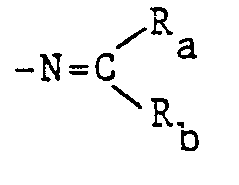
-soit un groupe de formule
Ra représente un atome d'hydrogène ou un radical alcoyle ayant de 1 à 5 atomes de carbone en chaîne droite ou ramifiée, et
Rb représente un atome d'hydrogène, un radical alcoyle ayant de 1 à 5 atomes de carbone en chaîne droite ou ramifiée, un radical phényle ou un radical phénylalcoyle;
-soit un radical hétérocyclique penta- ou hexagonal renfermant éventuellement un autre hétéroatome : oxygène ou azote ;
ou
- 3) X et X′ représentent ensemble un radical de formule :
=N-R₃
dans laquelle
R₃ représente un radical alcoyle ayant de 1 à 5 atomes de carbone en chaîne droite ou ramifiée éventuellement substitué par
un radical cyano,
un reste - COOR‴ dans lequel R‴ représente un atome d'hydrogène ou un radical alcoyle ayant de 1 à 5 atomes de carbone ; ou
un radical phényle, lui-même éventuellement substitué par un ou plusieurs atomes d'halogène ou radicaux alcoyle ou alcoxy ayant chacun de 1 à 5 atomes de carbone ;
sous forme racémique et les énantiomères correspondants. - L'état antérieur de la technique le plus proche de la présente invention est illustré notamment
par C.A. (1961) 21066d qui cite le 7-aminobenzocycloheptène, lequel produit fut testé comme antidépresseur, cf J. Pharm. Pharmacol. (1965), 17, 243 ;
par le brevet français 2.359.608 lequel concerne, entre autres, les amino-7 benzocycloheptènes de formule générale
-A₁ est hydrogène, (C₁-C₅) alcoyle ou (C₂-C₅) alcényle A₂ est (C₁-C₅) alcoyle, ou (C₂-C₅) alcényle ou
- A₁ et A₂ forment ensemble avec l'atome d'azote un hétérocycle saturé ayant de 4 à 6 atomes de carbone et éventuellement un autre hétéroatome ; et
- X est hydrogène ou halogène mais n'est jamais un radical trifluorométhyle ; ces dits dérivés sont décrits comme agents anti dépresseurs ; et
par le brevet U.S. 4.185.118 qui revendique les dérivés de formule générale :
ces dérivés sont décrits comme agents anti athérosclérotiques. - Il convient de remarquer que bien qu'inclus dans le formule générale, aucun dérivés de benzocycloheptène n'est exemplifié dans ce brevet ; seules les préparations des dérivés indanyle y sont décrites.
- L'introduction d'un substituant trifluorométhyle en position 2 du noyau benzénique des benzocycloheptènes, antérieurement connus, a conduit à l'obtention des dérivés de formule générale I, objet de la présente invention, et a permis de mettre en évidence pour ces dérivés (I) une remarquable activité dans le traitement des maladies métaboliques, nullement mentionnée pour les composés proches antérieurement connus.
- Les dérivés, objet de la présente demande, se différencient donc de ceux de l'état antérieur de la technique, à la fois par leur structure et par leur propriété, ce qui assure doublement l'originalité de la présente invention.
- La présente invention a également pour objet le procédé de préparation des dérivés de formule générale I, caractérisé en ce que l'on fait réagir :
la trifluorométhyl-2 tétrahydro-6,7,8,9 [5H] benzocycloheptène-one-7 de formule II :
- a) soit avec un dérivé carbonylé de formule générale III :
R′₁-CO-NH-R₁ (III)
dans laquelle R₁ a la signification énoncée précédemment et R′₁ représente :
un atome d'hydrogène ;
un radical alcoyle ayant de 1 à 4 atomes de carbone en chaîne droite ou ramifiée, en présence d'acide formique, pour obtenir un dérivé de formule générale Ia :
lequel dérivé (Ia) peut être :
soit réduit pour donner le dérivé de formule générale Ib:
soit hydrolysé pour donner le dérivé de formule générale Ic :
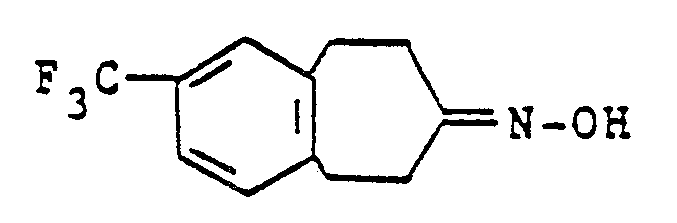
- (b) soit avec le chlorhydrate d'hydroxylamine pour obtenir l'oxime de formule :


- c) soit avec le dérivé de formule IV
R₁-NH₂ (IV)
dans laquelle R₁ a la signification précédemment définie, en milieu acide chlorhydrique en présence d'un cyanure alcalin,
pour obtenir le dérivé de formule :


- d) soit avec un dérivé de formule V :
R₄-Hal (V)
dans laquelle R₄ représente un radical alcoyle ayant de 1 à 5 atomes de carbone en chaîne droite ou ramifiée, en présence de magnésium pour obtenir le dérivé de formule

lequel est réduit en un dérivé de formule If :
- e) soit avec un dérivé de formule VI :
MCN (VI)
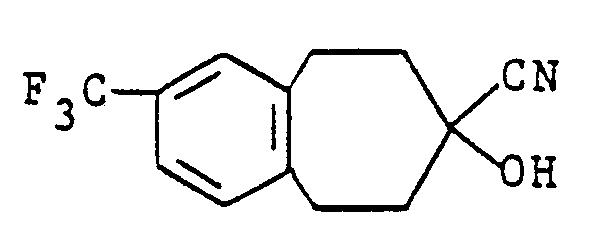
dans laquelle M représente un métal alcalin, en présence de CH₃CO OH et (CH₃CO)₂O,
pour donner le dérivé de formule :
soit traité par Li AlH₄ pour donner le dérivé de formule Ig :


- f) soit avec un dérivé de formule VII :
PO(OC₂H₅)₂-CH₂-CN (VII)
en présence d'une base pour donner le dérivé de formule ;

- L'ensemble des dérivés de formule Ia, Ib, Ic, Id, Ie, If, Ig, Ih, et Ii forment l'ensemble des dérivés de formule générale I.
- Si on le désire les dérivés I obtenus sous forme racémique peuvent être dédoublés, selon les méthodes classiques, pour obtenir les énantiomères correspondants.
- En effet, les bases libres des composés de type Ib, Ic et Id dans lesquels l'atome d'azote n'est pas acylé, donnent avec un acide optiquement actif, un mélange de sels diastéréoisomères.
Ce mélange de sels peut être recristallisé. En amorçant la cristallisation avec un échantillon de sel de l'un des énantiomères purs, on précipite sélectivement le sel diastéréoisomère correspondant à cet énantiomère. La préparation de tels énantiomères purs est illustrée par les exemples 32 à 37. - La matière première dénommée trifluorométhyl-2 tétrahydro-6,7,8,9 [5H] benzocycloheptène-one-7, de formule II, est un produit nouveau, qui fait à ce titre partie de la présente invention. Il trouve son application comme matière première dans l'industrie chimique et pharmaceutique et notamment dans la synthèse des dérivés du trifluorométhyl-2 tétrahydro-6,7,8,9 [5H] benzocycloheptène de formule générale I, eux-mêmes utilisés comme médicament.
- Ce dérivé de formule II a été obtenu à partir d'un produit commercial le p.trifluorométhyl iodobenzène, selon le mode opératoire ci-après exemplifié illustrant le schéma réactionnel suivant :

- Les dérivés I renfermant un groupe basique peuvent être transformés en sels d'addition avec les acides, sels qui font, à ce titre, partie de la présente invention. Comme acides utilisables pour la formation de ces sels on peut citer, dans la série minérale : les acides chlorhydrique, bromhydrique, sulfurique, phosphorique, et dans la série organique : les acides acétique, propionique, maléique, fumarique, tratrique, citrique, benzoïque et méthane sulfonique.
- Les dérivés de formule générale I et leurs sels physiologiquement tolérables possèdent des propriétés pharmacologiques et thérapeutiques intéressantes notamment des propriétés régulatrices du métabolisme de glucides et des lipides qui, de ce fait permettent leur utilisation comme médicament en particulier dans le traitement des maladies métaboliques notamment les diabètes, les obésités et leurs complications : dyslipémies, hypertension artérielle, athérome etc..., et dans le traitement d'autres désordres neuroendocrinologiques quelle que soit leur origine (diététique, génétique, traumatique ou autre).
- Ces dérivés I peuvent également être avantageusement prescrits en association avec d'autres traitements utilisés dans les pathologies ci-dessus mentionnées.
- En administration chronique chez des rats obèses présentant une intolérance au glucose et une hyperinsulinémie ou un diabète patent, les composés normalisent l'insulinémie et la tolérance au glucose dans le test de tolérance au glucose par voie veineuse (selon V. CONARD mesure de l'assimilation du glucose - bases théoriques et applications cliniques - Edition Acta Medica Belgica - Bruxelles 1955), à des doses de 0,1 à 10mg/kg,1 à 3 fois par jour.
- La présente invention a également pour objet les compositions pharmaceutiques contenant comme principe actif un composé de formule générale I ou un de ses sels physiologiquement tolérable, mélangé ou associé à un excipient pharmaceutique approprié, comme par exemple, l'eau distillée, l'amidon, le talc, l'éthylcellulose ou le stéarate de magnésium.
- Les compositions pharmaceutiques ainsi obtenues se présentent généralement sous forme dosée et peuvent contenir de 10 à 100mg de principe actif. Elles peuvent revêtir, par exemple, la forme de comprimés, dragées, gélules, suppositoires, solutions injectables ou buvables, et être selon les cas admninistrées par voie orale, rectale ou parentérale à la dose de 10 à 100mg, 1 à 3 fois par jour.
- Les exemples suivants illustrent l'invention. Les points de fusion sont déterminés à la platine chauffante de Kofler.
-

- On prépare à 0°C un mélange de 87,6ml d'acide sulfurique concentré et de 46,8ml d'acide nitrique concentré (d=1,52). On additionne ce mélange goutte à goutte à 272g de p.trifluorométhyl iodobenzène maintenu à 50°C ; ce qui dure environ 1 heure ; après quoi le chauffage est arrêté et l'agitation est maintenue pendant encore 30 minutes. Le mélange est ensuite hydrolysé en le versant sur 750ml d'eau. Puis on extrait le produit avec 3 fois 600ml de dichlorométhane, et lave la phase organique avec successivement de l'eau et une solution à 20% de bicarbonate de sodium. Le solvant est ensuite évaporé et après distillation on obtient 273g de nitro-2 trifluorométhyl-4 iodobenzène Eb/8mm=120-125°C (Rendement 86%).
- On porte à reflux un mélange de 225ml d'eau, 166g de fer et 10,03g de chlorure d'ammonium. On y ajoute, en 2 heures, 317g de nitro-2 trifluorométhyl-4 iodobenzène, puis on maintient le reflux pendant 3 heures 30 après la fin de l'addition. On laisse refroidir puis extrait le milieu au benzène avec 4 fois 250ml de benzène. Le mélange est ensuite filtré puis décanté. La couche organique est séchée et le solvant est évaporé. Après distillation, on recueille 256g d'amino-2 trifluorométhyl-4 iodobenzène, Eb:102à114°C, ind (25°C) : 1,556. (Rendement : 89,5%).
- On porte à 55°C un mélange de 287g d'amino-2 trifluorométhyl-4 iodobenzène et 417ml d'HCl concentré. On refroidit le mélange à une température maintenue entre -10 et -15°C et on y ajoute une solution de 38g de nitrite de sodium dans 70ml d'eau en maintenant la température entre -10 et -15°C. On ajoute alors 158ml d'HCl concentré puis une autre quantité de 38g de nitrite de sodium dans 70ml d'eau. On maintient ensuite sous agitation à une température inférieure ou égale à -10°C, pendant une heure. On prépare une solution de 250g d'iodure de potassium dans 400ml d'eau ; on refroidit à 0°C et y ajoute 54,3ml d'H₂SO₄ concentré en refroidissant. On ajoute à ce mélange, la solution de dérivé diazoïque précédemment obtenue en maintenant la température inférieure à 5°C. Une fois l'addition terminée, on maintient l'ensemble à température ambiante pendant 15 minutes, puis le porte à reflux pendant une demie heure et enfin le laisse refroidir. On extrait le mélange avec 3 fois 1600ml d'éther, lave l'extrait avec une solution à 12,5% de bisulfite de sodium puis à l'eau, sèche, puis distille l'éther. On obtient 377g de trifluorométhyl-4 di-iodo-1,2 benzène, P.F. : 62-64°C. (Rendement : 95%).
- Un mélange de 398g de trifluorométhyl-4 di-iodo-1,2 benzène, 224ml d'acrylate de méthyle, 24,3g de tri-o.tolyl phosphine, 4,5g d'acétate de palladium, 342ml de triéthylamine et 1450ml de xylène anhydre est maintenu, sous agitation, à une température d'environ 80°C, pendant 36 heures. Puis le chauffage est arrêté et le mélange filtré. Le résidu est lavé avec 2 fois 250ml de xylène, puis le xylène est distillé sous vide. Le résidu est lavé par un mélange de cyclohexane, éther de pétrole (25ml/25ml), repris par le minimum d'éther éthylique. La phase éthérée est lavée à l'eau, décantée, séchée, décolorée sur noir animal, puis l'éther est distillé. On obtient 236g de trifluorométhyl-4 di-(β-méthoxycarbonylvinyl)-1,2 benzène (Rendement 75%).
- 314g de trifluorométhyl-4 di-(β-méthoxycarbonylvinyl)-1,2 benzène dissous dans 2200ml de diméthylformamide et 1500ml de méthanol sont hydrogénés sous une pression de 80-90 P.S.I. en présence d'environ 300 ml d'une suspension de nickel de Raney. Le mélange est ensuite filtré, le solvant distillée et l'huile brute pratiquement pure recueillie est utilisée telle quelle. On obtient ainsi 305g de trifluorométhyl-4 di-(β-méthoxycarbonyléthyl)-1,2 benzène, (Rendement ≃ 96%).
- On ajoute 44g de suspension d'hydrure de sodium (à 60% dans l'huile) à 1000ml de xylène, et on porte le tout à 90°C. On y ajoute goutte à goutte un mélange de 318g de trifluorométhyl-4 di-(β-méthoxycarbonyléthyl)-1,2 benzène et 500ml de xylène, sous agitation. On porte à reflux (après la fin du dégagement gazeux) pendant environ 4 heures. La température est ramenée à 20°C. On ajoute au mélange 1000ml d'eau et extrait la couche organique. La couche aqueuse est lavée par 3 fois 500ml d'éther. Les couches organiques sont rassemblées et les solvants distillés. Le mélange résiduel est séché et utilisé tel quel. On obtient 242g de mélange (Rendement ≃ 85%).
- On porte à reflux pendant 15 minutes 285g du mélange d'esters cétoniques précédemment obtenu, 1000ml de solution normale de soude et 1000ml d'éthanol. Après quoi, l'éthanol est éliminé par distillation sous pression réduite et le mélange aqueux résiduel est extrait par 4 fois 1500ml d'éther éthylique. On sèche la couche organique, reprend par le minimum de dichlorométhane et purifie en filtrant sur environ 2000g de silice ou en recristallisant dans le cyclohexane. On obtient ainsi 168g de trifluorométhyl-2 tétrahydro-6,7,8,9 [5H] benzocycloheptène-one-7, P.F. : 78°C (Rendement 74%).
-

- On porte à reflux pendant 3 heures un mélange de 228g de trifluorométhyl-2 tétrahydro-6,7,8,9 [5H] benzocycloheptène-one-7, 69,5g de chlorhydrate d'hydroxylamine et 550ml de pyridine. On distille la pyridine sous pression réduite, reprend le résidu par 2200ml d'eau et extrait par 4 fois 4000ml d'éther.
- Les phases éthérées sont séchées, l'éther est distillé et le résidu brut obtenu (231g), P.F. 117-118°C est utilisé tel quel. (Rendement ≃ 95%). 243g de l'oxime ci-dessus obtenue sont mis en solution dans un mélange de 1200ml d'éthanol et 500ml d'éthanol ammoniacal puis hydrogénés sous une pression de 80-90 P.S.I., d'abord à température ambiante, puis à 40°C après 1 heure 30 et ce pendant 10 à 15 minutes. On filtre ensuite le mélange réactionnel et distille le solvant jusqu'à obtention d'une base huileuse brute. On obtient ainsi 222g de trifluorométhyl-2 amino-7 tétrahydro-6,7,8,9 [5H] benzocycloheptène (Rendement ≃ 97%).
- Cette base est purifiée sous forme de sel, notamment comme suit sous forme de chlorhydrate :
22,9g de base précédemment obtenue sont dissout dans 200ml d'isopropanol. On y ajoute, sous agitation, 25ml d'éther chlorhydrique, 4N. Le précipité formée est filtré, redissout à chaud dans le minimum du mélange CH₂Cl₂/CH₃OH (80/20). On concentre le mélange progressivement jusqu'à précipitation, filtre le précipité, le lave à l'éther, le sèche et on obtient ainsi avec un rendement de 80-85% le chlorhydrate de trifluorométhyl-2 amino-7 tétrahydro-6,7,8,9 [5H] benzocycloheptène, P.F. > 260°C avec sublimation vers 300°C. -

- Un mélange de 228,2g de trifluorométhyl-2 tétrahydro-6,7,8,9 [5H] benzocycloheptène-one-7, 219g de N-éthylformamide et 151g d'acide formique est chauffé à reflux pendant 14 heures. Après concentration sous vide, en chauffant au bain-marie, le résidu est repris par 2300ml de chlorure de méthylène. Après lavage par 2 fois 800ml d'eau, la couche organique est séchée sur sulfate de magnésium et après filtration, le solvant est éliminé sous vide. On obtient 283g de trifluorométhyl-2 (N-éthyl N-formyl amino)-7 tétrahydro-6,7,8,9 [5H] benzocycloheptène, sous forme d'huile.
-

- On chauffe à reflux pendant 12 heures sous agitation un mélange de 285,31g de trifluorométhyl-2 (N-éthyl N-formyl amino)-7 tétrahydro-6,7,8,9 [5H] benzocycloheptène, 1150ml d'éthanol, 270ml d'acide chlorhydrique concentré (d:1,19) et 215ml d'eau. Le mélange réactionnel est ensuite concentré sous vide, en chauffant au bain-marie.
- Le résidu est trituré avec 2000ml d'éther anhydre. Le précipité est filtré, séché à l'air. On obtient 235g de produit fondant à 190-200°C.
- Après recristallisation dans 400ml d'isopropanol bouillant on obtient 150g de trifluorométhyl-2 N-éthylamino-7 tétrahydro-6,7,8,9 [5H] benzocycloheptène. P.F. : 225°C.
-

- A une suspension de 56g d'hydrure de lithium-aluminium dans 4700ml d'éther anhydre, ou coule, sous agitation, en une heure, une solution de 285,3g de trifluorométhyl-2 (N-éthyl N-formylamino)-7 tétrahydro-6,7,8,9 [5H] benzocycloheptène dans 3700ml d'éther anhydre (on observe un léger reflux). On chauffe ensuite à ébullition pendant 5 heures. Après refroidissement, le mélange réactionnel est hydrolysé sucessivement par 56ml d'eau, 56ml d'une solution 4N de soude puis par 170ml d'eau. Après filtration et lavage à l'éther, la couche organique est concentrée sous vide et le résidu distillé. On obtient 150g de trifluorométhyl-2 (N-éthyl N-méthylamino)-7 tétrahydro-6,7,8,9 [5H] benzocycloheptène, Eb/10mm=135=140°C.
-

- On dissout 458,5g (2moles) de trifluorométhyl-2 amino-7 tétrahydro-6,7,8,9 [5H] benzocycloheptène dans 2000ml de benzène anhydre. On y ajoute une mole de bromo-acétate d'éthyle et on porte à reflux. Un précipité se forme. On maintient le reflux pendant 4 heures,puis laisse revenir le mélange à la température ambiante. On filtre le précipité de bromhydrate de l'amine de départ et on lave au benzène puis à l'éther.
- On distille le solvant du filtrat. L'huile obtenue est utilisée telle quelle pour la saponification ultérieure. On obtient finalement 271g de trifluorométhyl-2 (N-éthoxycarbonylméthylamino)-7 tétrahydro-6,7,8,9 [5H] benzocycloheptène. (Rendement 86%) dont un échantillon est purifié sous forme de chlorhydrate,qui se sublime vers 270-280°C.
-

- 315,34g (1 mole) de trifluorométhyl-2 (N-éthoxycarbonylméthylamino)-7 tétrahydro-6,7,8,9 [5H] benzocycloheptène sont portés à reflux pendant environ 25 minutes dans un mélange de 1000ml de soude normale et 2200ml d'éthanol. On distille ensuite l'éthanol en terminant sous pression réduite et lave la phase aqueuse avec 2 fois 4000ml d'éther éthylique. Les phases éthérées sont relavées à l'eau. Aux phases aqueuses rassemblées, on additionne 1000ml d'une solution normale d'acide chlorhydrique. Le précipité obtenu est recueilli,lavé. On obtient 250g de trifluorométhyl-2 (N-carboxyméthylamino)-7 tétrahydro-6,7,8,9 [5H] benzocycloheptène qui se sublime au dessus de 260°C. (Rendement 87%). Par addition d'une quantité stoechiométrique d'acide chlorhydrique et recristallisation dans l'eau on obtient le chlorhydrate de cet amino acide qui se sublime vers 220-222°C.
-

- On introduit 1 mole de trifluorométhyl-2 amino-7 tétrahydro-6,7,8,9 [5H] benzocycloheptène et 1 mole de triéthylamine dans 10000ml d'éther éthylique. On ajoute lentement à ce mélange 1 mole de CH₃ CO Cl, puis on porte l'ensemble à reflux sous agitation pendant 30 minutes. On laisse refroidir, distille l'éther sous pression réduite, reprend par l'eau et filtre le résidu obtenu. Après recristallisation dans l'acétate d'éthyle on obtient 250g de trifluorométhyl-2 N-acétylamino-7 tétrahydro-6,7,8,9 [5H] benzocycloheptène, fondant à 216-217°C avec légère sublimation. (Rendement 92%).
-

- A une suspension d'hydrure de sodium (0,05 mole) (lavé à l'éther de pétrole) dans 75ml de diméthylformamide anhydre, sont ajoutés, sous agitation, 8,85g de cyanométhylènephosphonate d'éthyle, en 30 minutes. La température est ensuite portée à 50°C jusqu'à fin du dégagement d'hydrogène. Après retour à température ambiante 11,4g de trifluorométhyl-2 benzocycloheptènone-7 en solution dans 25ml de diméthylformamide sont ajoutés en 10 minutes. La température s'élève jusqu'à 43°C. Le mélange réactionnel est ensuite chauffé à 80°C pendant 1 heure 30. Après refroidissement, on reprend par 50ml d'eau et 150ml d'éther. On agite, décante, sèche la couche organique sur MgSO₄ et évapore le solvant. On obtient 12,5g de trifluorométhyl-2 chlorométhylène-7 benzocycloheptène fondant à 70°C.
- 6g du produit ainsi obtenu sont hydrogénés en solution dans 150ml de diméthylformamide anhydre en présence de 2,5g de palladium sur noir à 5%, sous 60 lb/s inch.
- Après la fin de l'absorption, le catalyseur est essoré et le filtrat tiré à sec sous vide.
- On obtient 6g de trifluorométhyl-2 cyanométhyl-7 benzocycloheptène.
- Le produit précédemment obtenu en solution dans 20ml d'éther anhydre, est coulé, sous agitation, sur une suspension de 1g d'hydrure de lithium-aluminium dans 100ml d'éther anhydre en 30 minutes, à une température de -10.15°C. Après une heure d'agitation à température ambiante on hydrolyse par de la soude diluée, essore, et sèche le filtrat sur MgSO₄. Après évaporation du solvant, l'huile résultante (5,2g) est dissoute dans 25ml d'éther anhydre et après addition de 7ml d'éther chlorhydrique 3N le précipité formé est essoré et séché sous vide donnant ainsi 2,8g de chlorhydrate de trifluorométhyl-2 (β-aminoéthyl)-7 tétrahydro-6,7,8,9 [5H] benzocycloheptène, P.F.: 180-181°C.
-

- On ajoute en 5 minutes 1,95g de cyanure de potassium en solution dans 7,5ml d'eau, à une suspension de 6,8g de trifluorométhyl-2 benzocycloheptènone-7,3,25g de chlorhydrate de n.butylamine dans 6ml de méthanol. La suspension se fluidifie et la température s'élève à 29°C.
- Le mélange réactionnel est agité 24 heures à température ambiante puis chauffé 3 heures à reflux.
- Après refroidissement, on le reprend par 50ml de chlorure de méthylène, décante, lave par 2 fois 25ml d'eau, sèche sur MgSO₄ et concentre sous vide. On obtient 9,5g de trifluorométhyl-2 n.butylamino-7 cyano-7 benzocycloheptène. Le produit ainsi obtenu est dissous dans 200ml de benzène anhydre. On ajoute 6,7g de tertiobutylate de potassium et maintient à reflux sous agitation pendant 3 heures. Après refroidissement, la suspension est filtrée et le filtrat est concentré sous vide.
- On obtient 6,5g de trifluorométhyl-2 n.butylimino-7 benzocycloheptène.
- Le produit ainsi obtenu est dissous dans 150ml de méthanol on l'hydrogène en présence de 0,7g d'oxyde de platine dans une fiole de PARR sous 60 lb/s inch.
- Après 1 heure d'agitation, l'absorption étant terminée, le catalyseur est essoré et le filtrat tiré à sec sous vide. L'huile restant (6g) est reprise par 50ml d'isopropanol anhydre et après addition de 4,3ml d'éther chlorhydrique 3N, la solution est laissée au repos. Après 24 heures à température ambiante le précipité formé est essoré et séché. On obtient 3,8g de chlorhydrate de trifluorométhyl-2 n.butylamino-7 tétrahydro-6,7,8,9 [5H] benzocycloheptène, P.F.: 234°C.
-

- A une suspension agitée de trifluorométhyl-2 benzocycloheptènone-7 dans 5,6ml d'anhydride acétique, est ajoutée à 10°C, en 30 minutes, une solution de 3,9g de cyanure de potassium dissous dans 8ml d'eau. La température s'élève jusqu'à 25°C. Après 4 heures d'agitation à température ambiante, on verse le mélange réactionnel sur 50ml de bicarbonate de sodium à 10% dans l'eau, extrait à l'éther, lave à l'eau, sèche et concentre. On obtient 7,5g d'un produit solide, fondant à 110-113°C.
- Ce solide est repris par 16ml d'anhydride acétique et 0,8ml de chlorure d'acétyle.
- On agite, laisse reposer 24 heures, neutralise avec 250ml de bicarbonate de sodium à 10%, extrait à l'éther, lave à l'eau, sèche et évapore le solvant. On obtient 8,8g de trifluorométhyl-2 acétoxy-7 cyano-7 benzocycloheptène (huile) Le produit ainsi obtenu, mis en solution dans 30ml d'éther anhydre est coulé sous agitation dans une suspension de 2,5g d'hydrure de lithium aluminium..
- Après 4 heures de reflux, le milieu réactionnel est hydrolysé.
- Après, traitement, on obtient 7,2g d'huile qui reprise par 50ml d'acétate d'éthyle anhydre et traitée par 10ml d'éther chlorhydrique 3N, donne après essorage et séchage du précipité 6,7g de chlorhydrate de trifluorométhyl-2 hydroxy-7 aminométhyl-7 tétrahydro-6,7,8,9 [5H] benzocycloheptène, P.F.: 217°C.
-

- 11,4g de trifluorométhyl-2 benzocycloheptènone-7 en solution dans 90ml de tétrahydrofuranne anhydre sont ajoutés, en 30 minutes, sous agitation, à une solution d'iodure de méthylmagnésium préparée à partir de 9,2g d'iodure de méthyle et 1,6g de magnésium en tournures dans 90ml d'éther anhydre. Après 3 heures de reflux on hydrolyse par 25ml d'eau, décante la couche aqueuse, sèche la couche organique sur MgSO₄ et évapore le solvant sous vide. On obtient 13g de trifluorométhyl-2 hydroxy-7 méthyl-7 benzocycloheptène.
- A 10g d'acide sulfurique concentré sont ajoutés 40ml d'acide acétique glacial à température inférieure à 15°C, puis 2,2g d'acétonitrile et 13g du produit précédemment obtenu en solution dans 10ml d'acide acétique sont additionnés en 10 minutes à une température inférieure à 15°C. Après retour à température ambiante le mélange réactionnel est chauffé à 50-55°C pendant 2 heures. On le traite ensuite, après refroidissement, par 200g d'un mélange d'eau et glace et extrait à l'éther. Après séchage et évaporation du solvant sous vide, on obtient 8,7g de trifluorométhyl-2 méthyl-7 acétylamino-7 benzocycloheptène.
- Ce produit dissous dans 85ml de tétrahydrofuranne anhydre est coulé, sous agitation, dans une suspension de 1,5g d'hydrure de lithium aluminium dans 120ml d'éther anhydre. Après 7 heures de reflux, hydrolyse, et essorage, le filtrat est séché sur MgSO₄ et tiré à sec sous vide. On obtient 4,8g d'une huile qui reprise par 50ml d'isopropanol et traitée par 6ml d'éther chlorhydrique 4,3N donne un précipité qui essoré, lavé et séché sous vide donne 4,8g de chlorhydrate de trifluorométhyl-2 méthyl-7 éthylamino-7 tétrahydro-6,7,8,9 [5H] benzocycloheptène, P.F. > 260°C.
- Les dérivés suivants ont été préparés selon les méthodes ci-dessus exemplifiées.
- 13) Trifluorométhyl-2 N-méthylamino-7 tétrahydro-6,7,8,9 [5H] benzocycloheptène.
- 14) Trifluorométhyl-2 N-propylamino-7 tétrahydro-6,7,8,9 [5H] benzocycloheptène, P.F. du chlorhydrate correspondant: 231°C.
- 15) Trifluorométhyl-2 N-propionylamino-7 tétrahydro-6,7,8,9 [5H] benzocycloheptène.
- 16) Trifluorométhyl-2 N-butyrylamino-7 tétrahydro-6,7,8,9 [5H] benzocycloheptène.
- 17) Trifluorométhyl-2 N-hydroxyéthylamino-7 tétrahydro-6,7,8,9 [5H] benzocycloheptène, P.F. du chlorhydrate correspondant : 175°C.
- 18) Trifluorométhyl-2 N-diéthylamino-7 tétrahydro-6,7,8,9 [5H] benzocycloheptène.
- 19) Trifluorométhyl-2 N-dipropylamino-7 tétrahydro-6,7,8,9 [5H] benzocycloheptène, (huile).
- 20) Trifluorométhyl-2 N-diméthylamino-7 tétrahydro-6,7,8,9 [5H] benzocycloheptène.
- 21) Trifluorométhyl-2 (N-méthyl N-propylamino)-7 tétrahydro-6,7,8,9 [5H] benzocycloheptène, P.F. du chlorhydrate correspondant : 185°C.
- 22) Trifluorométhyl-2 pipéridino-7 tétrahydro-6,7,8,9 [5H] benzocycloheptène.
- 23) Trifluorométhyl-2 morpholino-7 tétrahydro-6,7,8,9 [5H] benzocycloheptène.
- 24) Trifluorométhyl-2 N-pipérazinyl-7 tétrahydro-6,7,8,9 [5H] benzocycloheptène.
- 25) Trifluorométhyl-2 N-imidazolidinyl-7 tétrahydro-6,7,8,9 [5H] benzocycloheptène.
- 26) Trifluorométhyl-2 N-propilydène amino-7 tétrahydro-6,7,8,9 [5H] benzocycloheptène.
- 27) Trifluorométhyl-2 N-benzoyloxyéthylamino-7 tétrahydro-6,7,8,9 [5H] benzocycloheptène, P.F. du chlorhydrate correspondant : 229-230°C avec sublimation.
- 28) Trifluorométhyl-2 hydroxy-7 tétrahydro-6,7,8,9 [5H] benzocycloheptène, P.F. : 80-85°C.
- 29) Trifluorométhyl-2 [N-éthyl N-(β-aminoéthyl) amino]-7 tétrahydro-6,7,8,9 [5H] benzocycloheptène, P.F. du dichlorhydrate correspondant > 260°C.
- 30) Trifluorométhyl-2 [N-éthyl N-(β-acétylaminoéthyl) amino]-7 tétrahydro-6,7,8,9 [5H] benzocycloheptène, P.F. du chlorhydrate correspondant : 167-168°C.
- 31) Trifluorométhyl-2 aminométhyl-7 tétrahydro-6,7,8,9 [5H] benzocycloheptène, P.F. du chlorhydrate correspondant : 198-199°C.
-
- 32) Diastéréoisomère α du trifluorométhyl-2 [N-formyl N-(α-méthylbenzyl) amino]-7 tétrahydro-6,7,8,9 [5H] benzocycloheptène.
Le trifluorométhyl-2 [N-formyl N-(α-méthylbenzyl) amino]-7 tétrahydro-6,7,8,9 [5H] benzocycloheptène a été préparé par réaction de la trifluorométhyl-2 tétrahydro-6,7,8,9 [5H] benzocycloheptène-one-7 avec le dérivé N-formylé de l'α-méthylbenzylamine, selon la mode opératoire général décrit en page 5.
Le diastéréoisomère α est séparé du diastéréoisomère β (objet de l'exemple 33) par chromatographie sur gel de silice en utilisant comme éluant un mélange cyclohexane-acétate d'éthyle (80-20). - 33) Diastéréoisomère β du trifluorométhyl-2 [N-formyl N-(α-méthylbenzyl) amino]-7 tétrahydro-6,7,8,9 [5H] benzocycloheptène, préparé selon la processus décrit dans l'exemple 32.
- 34) Diastéréoisomère α du trifluorométhyl-2 [N-(α-méthylbenzyl) amino]-7 tétrahydro-6,7,8,9 [5H] benzocycloheptène, obtenu par coupure du radical formyl, en milieu eau-éthanol-acide chlorhydrique, à partir du dérivé objet de l'exemple 32.
- 35) Diastéréoisomère β du trifluorométhyl-2 [N-(α-méthylbenzyl) amino]-7 tétrahydro-6,7,8,9 [5H] benzocycloheptène, obtenu par coupure du radical formyl, en milieu eau-éthanol-acide chlorhydrique, à partir du dérivé objet de l'exemple 33.
- 36) d. trifluorométhyl-2 amino-7 tétrahydro-6,7,8,9 [5H] benzocycloheptène, [dont les constantes physiques du chlorhydrate sont : P.F.>260°C (isopropanol) [α] (C=1%, CH₃OH) : 546 : + 4,9 ; 436 : + 6,3 ; 365 : + 5,7], obtenu par débenzylation catalytique (palladium/éthanol) du dérivé de l'exemple 34.
- 37. l. trifluorométhyl-2 amino-7 tétrahydro-6,7,8,9 [5H] benzocycloheptène, [dont les constantes physiques du chlor hydrate sont : P.F.>260°C (isopropanol) [α] (C=1%,CH₃,OH): 546 : - 4,9 ; 436 : - 6,3 ; 365 : - 5,7], obtenu par débenzylation catalytique (palladium/éthanol) du dérivé de l'exemple 35.
Claims (14)

b) un radical OR
dans lequel R représente :
α)un radical acyle -COR′ dans lequel R′ représente un radical alcoyle ayant de 1 à 5 atomes de carbone en chaîne droite ou ramifiée éventuellement substitué par un radical phényle, ou
un radical phényle éventuellement substitué par un ou plusieurs atomes d'halogène ou radicaux alcoyle ou alcoxy ayant chacun de 1 à 5 atomes de carbone ; ou
β)un radical alcoyle ayant de 1 à 5 atomes de carbone en chaîne droite ou ramifiée éventuellement substitué par un radical carboxy ou un radical phényle.
c) un radical de formule :

n représente 0, 1 ou 2, et
R₁ et R₂, identiques ou différents, représentent chacun :
un atome d'hydrogène ;
un radical alcoyle ayant de 1 à 5 atoms de carbone en chaîne droite ou ramifiée éventuellement substitué par un radical hydroxy, amino, carboxy, alcoxycarbonyle ayant de 1 à 6 atomes de carbone ou acyloxy de formule R′ CO-O- dans laquelle R′ a la signification précédemment définie ;
un radical alcényle ayant de 2 à 5 atomes de carbone ;
un radical alcynyle ayant de 2 à 5 atomes de carbone ;
un radical acyle de formule R˝CO dans laquelle R˝ représente un radical alcoyle ayant de 1 à 5 atomes de carbone en chaîne droite ou ramifiée, un radical phényle ou un radical phénylsulfonylamino dont la partie phényle est éventuellement substituée par un ou plusieurs atomes d'halogène ou radicaux trifluorméthyle, alcoyle ou alcoxy ayant chacun de 1 à 5 atomes de carbone. ou,
R₁ et R₂ représentent ensemble avec l'atome d'azote auquel ils sont liés :
-soit un groupe de formule

Ra représente un atome d'hydrogène ou un radical alcoyle ayant de 1 à 5 atomes de carbone en chaîne droite ou ramifiée, et
Rb représente un atome d'hydrogène, un radical alcoyle ayant de 1 à 5 atomes de carbone en chaîne droite ou ramifiée, un radical phényle ou un radical phénylalcoyle;
-soit un radical hétérocyclique penta- ou hexagonal renfermant éventuellement un autre hétéroatome : oxygène ou azote ;
ou
=N-R₃
dans laquelle
R₃ représente un radical alcoyle ayant 1 à 5 atomes de carbone en chaîne droite ou ramifiée éventuellement substitué par
un radical cyano,
un reste - COOR‴ dans lequel R‴ représente un atome d'hydrogène ou un radical alcoyle ayant de 1 à 5 atomes de carbone ; ou
un radical phényle, lui-même éventuellement substitué par un ou plusieurs atomes d'halogène ou radicaux alcoyle ou alcoxy ayant chacun de 1 à 5 atomes de carbone ;
sous forme racémique et les énantiomères correspondants.

la trifluorométhyl-2 tétrahydro-6,7,8,9 [5H] benzocycloheptène-one-7 de formule II :

R′₁-CO-NH-R₁ (III)
dans laquelle R₁ a la signification énoncée précédemment et R′₁ représente :
un atome d'hydrogène ;
un radical alcoyle ayant de 1 à 4 atomes de carbone en chaîne droite ou ramifiée, en présence d'acide formique, pour obtenir un dérivé de formule générale Ia :

lequel dérivé (Ia) peut être :
soit réduit pour donner le dérivé de formule générale Ib:

soit hydrolysé pour donner le dérivé de formule générale Ic :


R₁-NH₂ (IV)
dans laquelle R₁ a la signification précédemment définie, en milieu acide chlorhydrique en présence d'un cyanure alcalin,
pour obtenir le dérivé de formule :


R₄-Hal (V)
dans laquelle R₄ représente un radicale alcoyle ayant de 1 à 5 atomes de carbone en chaîne droite ou ramifiée, en présence de magnésium pour obtenir le dérivé de formule


lequel est réduit en un dérivé de formule If :

MCN (VI)
dans laquelle M représente un métal alcalin, en présence de CH₃CO OH et (CH₃CO)₂O,
pour donner le dérivé de formule :

soit traité par Li AlH₄ pour donner le dérivé de formule Ig :


PO(OC₂H₅)₂-CH₂-CN (VII)
en présence d'une base pour donner le dérivé de formule ;


- l'on nitre le p. trifluorométhyl iodobenzène pour obtenir le nitro-2 -trifluorométhyl-4 iodobenzène,
- l'on réduit ce dernier en amino-2 trifluorométhyl-4 iodobenzène,
- lequel est transformé, au moyen d'iodure de potassium, en trifluorométhyl-4 di-iodo-1,2 benzène.
- l'on fait réagir ce dernier avec l'acrylate de méthyle en présence de tri-o. tolyl phosphine, d'acétate de palladium, de triéthylamine, en chauffant dans un solvant adéquat, pour obtenir le trifluorométhyl-4 (di-(β-méthoxycarbonylvinyl)-1,2 benzène ;
- que l'on hydrogène sous pression, en présence de cataly seur dans un solvant aqéquat, pour obtenir le trifluorométhyl-4 di-(β-méthoxycarbonyléthyl)-1,2 benzène ;
- lequel est traité à reflux par une suspension d'hydrure de sodium dans un solvant adéquat pour donner un mélange de trifluorométhyl-2 méthoxycarbonyl-6 tétrahydro-6,7,8,9 [5H] benzocycloheptène-one 7 et de trifluorométhyl-2 méthoxycarbonyl-8 tétrahydro-6,7,8,9 [5H] benzocycloheptène-one 7 ;
- et l'on traite ce mélange ainsi obtenu par la soude en milieu hydro alcoolique pour obtenir le trifluorométhyl-2 tétrahydro-6,7,8,9 benzocycloheptene-one-7.
Priority Applications (1)
| Application Number | Priority Date | Filing Date | Title |
|---|---|---|---|
| AT89401896T ATE86603T1 (de) | 1988-07-04 | 1989-07-03 | Derivate von benzocyclohepten, verfahren zu ihrer herstellung und sie enthaltende arzneimittel. |
Applications Claiming Priority (2)
| Application Number | Priority Date | Filing Date | Title |
|---|---|---|---|
| FR8808989A FR2633617B1 (fr) | 1988-07-04 | 1988-07-04 | Nouveaux derives du benzocycloheptene, leur procede de preparation et les compositions pharmaceutiques les renfermant |
| FR8808989 | 1988-07-04 |
Publications (3)
| Publication Number | Publication Date |
|---|---|
| EP0354078A2 true EP0354078A2 (fr) | 1990-02-07 |
| EP0354078A3 EP0354078A3 (en) | 1990-05-23 |
| EP0354078B1 EP0354078B1 (fr) | 1993-03-10 |
Family
ID=9368020
Family Applications (1)
| Application Number | Title | Priority Date | Filing Date |
|---|---|---|---|
| EP89401896A Expired - Lifetime EP0354078B1 (fr) | 1988-07-04 | 1989-07-03 | Nouveaux dérivés du benzocycloheptène, leur procédé de préparation et les compositions pharmaceutiques les renfermant |
Country Status (15)
| Country | Link |
|---|---|
| US (1) | US5079245A (fr) |
| EP (1) | EP0354078B1 (fr) |
| JP (1) | JPH0296542A (fr) |
| AT (1) | ATE86603T1 (fr) |
| AU (1) | AU612047B2 (fr) |
| CA (1) | CA1334100C (fr) |
| DE (1) | DE68905259T2 (fr) |
| DK (1) | DK172604B1 (fr) |
| ES (1) | ES2055125T3 (fr) |
| FR (1) | FR2633617B1 (fr) |
| IE (1) | IE64195B1 (fr) |
| NZ (1) | NZ229796A (fr) |
| OA (1) | OA09423A (fr) |
| PT (1) | PT91050B (fr) |
| ZA (1) | ZA895093B (fr) |
Families Citing this family (2)
| Publication number | Priority date | Publication date | Assignee | Title |
|---|---|---|---|---|
| JPH0641539B2 (ja) * | 1988-07-21 | 1994-06-01 | 東海カーボン株式会社 | タイヤトレッドゴム配合用カーボンブラック |
| US5230878A (en) * | 1989-10-02 | 1993-07-27 | Tokai Carbon Co., Ltd. | Carbon black for tire tread rubber |
Family Cites Families (11)
| Publication number | Priority date | Publication date | Assignee | Title |
|---|---|---|---|---|
| US3836534A (en) * | 1969-05-01 | 1974-09-17 | Colgate Palmolive Co | 5-piperazino-6-hydroxy-5h-benzo-cycloheptenes |
| CA969955A (en) * | 1970-07-20 | 1975-06-24 | Rene Viterbo | Dihydronaphthalene derivatives |
| FR2319332A1 (fr) * | 1975-07-28 | 1977-02-25 | Roussel Uclaf | Nouveaux derives de l'aminobenzocycloheptene et leurs sels, procede de preparation et application a titre de medicaments desdits produits |
| US4237165A (en) * | 1976-06-04 | 1980-12-02 | Science Union Et Cie | Treatment of carbohydrate metabolism disorders |
| FR2359608A2 (fr) * | 1976-07-26 | 1978-02-24 | Roussel Uclaf | Nouveaux derives de l'aminobenzocycloheptene et leurs sels, procede de preparation et application a titre de medicaments desdits produits |
| US4128666A (en) * | 1977-08-18 | 1978-12-05 | Smithkline Corporation | 4 AND 5-Halo substituted 2-indanamine compounds |
| FR2409256A1 (fr) * | 1977-11-18 | 1979-06-15 | Roussel Uclaf | Nouveaux derives de la 5h-benzocycloepten-7-amine et leurs sels, procede de preparation et application a titre de medicament |
| DE2856856A1 (de) * | 1978-01-09 | 1979-07-12 | Sandoz Ag | Fettsaeure-amid-und-hydracid derivate, ihre herstellung und ihre verwendung als pharmazeutika |
| US4132737A (en) * | 1978-02-27 | 1979-01-02 | Eli Lilly And Company | Trifluoromethyl substituted 1-aminoindanes |
| EP0361577B1 (fr) * | 1988-09-19 | 1993-05-05 | Akzo N.V. | Dérivés de tétrahydronaphthalène et indane |
| DK0452390T3 (da) * | 1989-01-09 | 1995-04-03 | Upjohn Co | Halogensubstituerede aminotetraliner |
-
1988
- 1988-07-04 FR FR8808989A patent/FR2633617B1/fr not_active Expired - Lifetime
-
1989
- 1989-06-29 CA CA000604396A patent/CA1334100C/fr not_active Expired - Fee Related
- 1989-07-03 PT PT91050A patent/PT91050B/pt not_active IP Right Cessation
- 1989-07-03 EP EP89401896A patent/EP0354078B1/fr not_active Expired - Lifetime
- 1989-07-03 AT AT89401896T patent/ATE86603T1/de not_active IP Right Cessation
- 1989-07-03 IE IE214289A patent/IE64195B1/en not_active IP Right Cessation
- 1989-07-03 DE DE8989401896T patent/DE68905259T2/de not_active Expired - Fee Related
- 1989-07-03 ES ES89401896T patent/ES2055125T3/es not_active Expired - Lifetime
- 1989-07-03 NZ NZ229796A patent/NZ229796A/xx unknown
- 1989-07-04 OA OA59605A patent/OA09423A/fr unknown
- 1989-07-04 AU AU37814/89A patent/AU612047B2/en not_active Ceased
- 1989-07-04 ZA ZA895093A patent/ZA895093B/xx unknown
- 1989-07-04 DK DK198903326A patent/DK172604B1/da not_active IP Right Cessation
- 1989-07-04 JP JP1172828A patent/JPH0296542A/ja active Granted
- 1989-07-05 US US07/375,591 patent/US5079245A/en not_active Expired - Fee Related
Also Published As
| Publication number | Publication date |
|---|---|
| AU612047B2 (en) | 1991-06-27 |
| JPH0521898B2 (fr) | 1993-03-25 |
| PT91050B (pt) | 1995-01-31 |
| AU3781489A (en) | 1990-02-08 |
| NZ229796A (en) | 1991-11-26 |
| ES2055125T3 (es) | 1994-08-16 |
| IE64195B1 (en) | 1995-07-12 |
| DK332689D0 (da) | 1989-07-04 |
| DK332689A (da) | 1990-01-05 |
| ZA895093B (en) | 1990-03-28 |
| FR2633617B1 (fr) | 1991-02-08 |
| FR2633617A1 (fr) | 1990-01-05 |
| JPH0296542A (ja) | 1990-04-09 |
| DK172604B1 (da) | 1999-02-22 |
| ATE86603T1 (de) | 1993-03-15 |
| CA1334100C (fr) | 1995-01-24 |
| OA09423A (fr) | 1992-10-15 |
| US5079245A (en) | 1992-01-07 |
| DE68905259T2 (de) | 1993-09-23 |
| EP0354078A3 (en) | 1990-05-23 |
| IE892142L (en) | 1990-01-04 |
| PT91050A (pt) | 1990-02-08 |
| EP0354078B1 (fr) | 1993-03-10 |
| DE68905259D1 (de) | 1993-04-15 |
Similar Documents
| Publication | Publication Date | Title |
|---|---|---|
| EP0591057B1 (fr) | Arylalkyl(thio)amides ayant une affinité sélective pour les récepteurs de la mélatonine et leur procédé de préparation | |
| EP0576350B1 (fr) | Dérivés alkylamino ramifiés du thiazole, leurs procédés de préparation et les compositions pharmaceutiques qui les contiennent | |
| EP0202164B1 (fr) | Dérivés de (benzoyl-4 pipéridino)-2 phenyl-1 alcanols, leur préparation et leur application en thérapeutique | |
| EP0506532A1 (fr) | Nouveaux dérivés de l'indole, procédé de préparation et médicaments les contenant | |
| EP0515541B1 (fr) | PROCEDE DE PREPARATION DE L'ACIDE CIS-$g(b)-PHENYLGLYCIDIQUE-(2R,3R) | |
| MC2028A1 (fr) | Procede de preparation de thiazepine-4(5h)-ones optiquement actives,intermediaires de synthese,et procede de preparation de ces intermediaires | |
| EP0374041A1 (fr) | Médicaments à base de dérivés de la benzothiazolamine-2, dérivés et leur préparation | |
| EP0842148B1 (fr) | Derives de benzenesulfonamide, leur preparation et leurs applications en therapeutique | |
| EP0612716B1 (fr) | Procédé pour la préparation d'un aminoalcool optiquement pur | |
| EP0303545B1 (fr) | Procédé pour la préparation de phényléthanolaminotétralines | |
| EP0354078B1 (fr) | Nouveaux dérivés du benzocycloheptène, leur procédé de préparation et les compositions pharmaceutiques les renfermant | |
| EP0385848A1 (fr) | Nouveaux dérivés benzoxazolinoniques, leurs procédés de préparation et les compositions pharmaceutiques qui les contiennent | |
| EP0327455A1 (fr) | Ethers alkyliques ou benzyliques du phénol, leurs procédés de préparation et leur application en thérapeutique | |
| EP0173585B1 (fr) | Médicaments à base de dérivés de la pipéridine, nouveaux dérivés de la pipéridine et leurs procédés de préparation | |
| FR2562895A1 (fr) | Triazolopyridimidines nouvelles et procede pour leur fabrication | |
| EP0915867B1 (fr) | Derives du thienylcyclohexane pour la synthese de thienylcyclohexyles | |
| EP0534856B1 (fr) | Ethers d'oximes de thiénocyclopentanones, leur préparation et compositions pharmaceutiques les contenant | |
| FR3044311A1 (fr) | Procede de synthese de derives n-(pyridin-4-yl)-2-hydroxy-alkylamides enantiomeriquement purs | |
| MC1624A1 (fr) | Derives de phenethylamine | |
| CH623818A5 (en) | Process for producing derivatives of thiochroman | |
| FR2677477A1 (fr) | Nouveaux derives de l'oxazole leur preparation, leur utilisation et les compositions pharmaceutiques qui les contiennent. | |
| FR2741071A1 (fr) | Derives de 3-(benzofuran-5-yl)oxazolidin-2-one, leur preparation et leur application en therapeutique | |
| EP0068979A1 (fr) | Procédé de préparation de dérivés des (thiényl-2)- et (thiényl-3)-2 éthylamines et produits ainsi obtenus | |
| EP0837843B1 (fr) | Procede de preparation des formes enantiomeres de l'acide amino alkylaminophenyl propanoique | |
| CH392508A (fr) | Procédé de préparation d'esters de 3-phényl-3-pyrrolidinols |
Legal Events
| Date | Code | Title | Description |
|---|---|---|---|
| PUAI | Public reference made under article 153(3) epc to a published international application that has entered the european phase |
Free format text: ORIGINAL CODE: 0009012 |
|
| 17P | Request for examination filed |
Effective date: 19890708 |
|
| AK | Designated contracting states |
Kind code of ref document: A2 Designated state(s): AT BE CH DE ES FR GB GR IT LI LU NL SE |
|
| PUAL | Search report despatched |
Free format text: ORIGINAL CODE: 0009013 |
|
| AK | Designated contracting states |
Kind code of ref document: A3 Designated state(s): AT BE CH DE ES FR GB GR IT LI LU NL SE |
|
| RAP3 | Party data changed (applicant data changed or rights of an application transferred) |
Owner name: ADIR ET COMPAGNIE |
|
| 17Q | First examination report despatched |
Effective date: 19911118 |
|
| GRAA | (expected) grant |
Free format text: ORIGINAL CODE: 0009210 |
|
| AK | Designated contracting states |
Kind code of ref document: B1 Designated state(s): AT BE CH DE ES FR GB GR IT LI LU NL SE |
|
| REF | Corresponds to: |
Ref document number: 86603 Country of ref document: AT Date of ref document: 19930315 Kind code of ref document: T |
|
| ITF | It: translation for a ep patent filed | ||
| REF | Corresponds to: |
Ref document number: 68905259 Country of ref document: DE Date of ref document: 19930415 |
|
| GBT | Gb: translation of ep patent filed (gb section 77(6)(a)/1977) |
Effective date: 19930617 |
|
| REG | Reference to a national code |
Ref country code: GR Ref legal event code: FG4A Free format text: 3008100 |
|
| PLBE | No opposition filed within time limit |
Free format text: ORIGINAL CODE: 0009261 |
|
| STAA | Information on the status of an ep patent application or granted ep patent |
Free format text: STATUS: NO OPPOSITION FILED WITHIN TIME LIMIT |
|
| 26N | No opposition filed | ||
| ITTA | It: last paid annual fee | ||
| REG | Reference to a national code |
Ref country code: ES Ref legal event code: FG2A Ref document number: 2055125 Country of ref document: ES Kind code of ref document: T3 |
|
| EPTA | Lu: last paid annual fee | ||
| EAL | Se: european patent in force in sweden |
Ref document number: 89401896.9 |
|
| PGFP | Annual fee paid to national office [announced via postgrant information from national office to epo] |
Ref country code: AT Payment date: 20000508 Year of fee payment: 12 |
|
| PGFP | Annual fee paid to national office [announced via postgrant information from national office to epo] |
Ref country code: SE Payment date: 20000511 Year of fee payment: 12 |
|
| PGFP | Annual fee paid to national office [announced via postgrant information from national office to epo] |
Ref country code: LU Payment date: 20000518 Year of fee payment: 12 |
|
| PGFP | Annual fee paid to national office [announced via postgrant information from national office to epo] |
Ref country code: GR Payment date: 20000525 Year of fee payment: 12 |
|
| PGFP | Annual fee paid to national office [announced via postgrant information from national office to epo] |
Ref country code: CH Payment date: 20000615 Year of fee payment: 12 |
|
| PGFP | Annual fee paid to national office [announced via postgrant information from national office to epo] |
Ref country code: GB Payment date: 20000628 Year of fee payment: 12 |
|
| PGFP | Annual fee paid to national office [announced via postgrant information from national office to epo] |
Ref country code: ES Payment date: 20000713 Year of fee payment: 12 |
|
| PGFP | Annual fee paid to national office [announced via postgrant information from national office to epo] |
Ref country code: FR Payment date: 20000725 Year of fee payment: 12 |
|
| PGFP | Annual fee paid to national office [announced via postgrant information from national office to epo] |
Ref country code: NL Payment date: 20000727 Year of fee payment: 12 |
|
| PGFP | Annual fee paid to national office [announced via postgrant information from national office to epo] |
Ref country code: DE Payment date: 20000728 Year of fee payment: 12 |
|
| PGFP | Annual fee paid to national office [announced via postgrant information from national office to epo] |
Ref country code: BE Payment date: 20000801 Year of fee payment: 12 |
|
| PG25 | Lapsed in a contracting state [announced via postgrant information from national office to epo] |
Ref country code: LU Free format text: LAPSE BECAUSE OF NON-PAYMENT OF DUE FEES Effective date: 20010703 Ref country code: GB Free format text: LAPSE BECAUSE OF NON-PAYMENT OF DUE FEES Effective date: 20010703 Ref country code: AT Free format text: LAPSE BECAUSE OF NON-PAYMENT OF DUE FEES Effective date: 20010703 |
|
| PG25 | Lapsed in a contracting state [announced via postgrant information from national office to epo] |
Ref country code: SE Free format text: LAPSE BECAUSE OF NON-PAYMENT OF DUE FEES Effective date: 20010704 Ref country code: ES Free format text: LAPSE BECAUSE OF NON-PAYMENT OF DUE FEES Effective date: 20010704 |
|
| PG25 | Lapsed in a contracting state [announced via postgrant information from national office to epo] |
Ref country code: LI Free format text: LAPSE BECAUSE OF NON-PAYMENT OF DUE FEES Effective date: 20010731 Ref country code: GR Free format text: LAPSE BECAUSE OF NON-PAYMENT OF DUE FEES Effective date: 20010731 Ref country code: CH Free format text: LAPSE BECAUSE OF NON-PAYMENT OF DUE FEES Effective date: 20010731 Ref country code: BE Free format text: LAPSE BECAUSE OF NON-PAYMENT OF DUE FEES Effective date: 20010731 |
|
| BERE | Be: lapsed |
Owner name: ADIR ET CIE Effective date: 20010731 |
|
| PG25 | Lapsed in a contracting state [announced via postgrant information from national office to epo] |
Ref country code: NL Free format text: LAPSE BECAUSE OF NON-PAYMENT OF DUE FEES Effective date: 20020201 |
|
| GBPC | Gb: european patent ceased through non-payment of renewal fee |
Effective date: 20010703 |
|
| EUG | Se: european patent has lapsed |
Ref document number: 89401896.9 |
|
| REG | Reference to a national code |
Ref country code: CH Ref legal event code: PL |
|
| PG25 | Lapsed in a contracting state [announced via postgrant information from national office to epo] |
Ref country code: FR Free format text: LAPSE BECAUSE OF NON-PAYMENT OF DUE FEES Effective date: 20020329 |
|
| NLV4 | Nl: lapsed or anulled due to non-payment of the annual fee |
Effective date: 20020201 |
|
| PG25 | Lapsed in a contracting state [announced via postgrant information from national office to epo] |
Ref country code: DE Free format text: LAPSE BECAUSE OF NON-PAYMENT OF DUE FEES Effective date: 20020501 |
|
| REG | Reference to a national code |
Ref country code: FR Ref legal event code: ST |
|
| REG | Reference to a national code |
Ref country code: ES Ref legal event code: FD2A Effective date: 20020810 |
|
| PG25 | Lapsed in a contracting state [announced via postgrant information from national office to epo] |
Ref country code: IT Free format text: LAPSE BECAUSE OF NON-PAYMENT OF DUE FEES Effective date: 20050703 |