EP0354702A2 - Bildkommunikationsgerät - Google Patents
Bildkommunikationsgerät Download PDFInfo
- Publication number
- EP0354702A2 EP0354702A2 EP89307768A EP89307768A EP0354702A2 EP 0354702 A2 EP0354702 A2 EP 0354702A2 EP 89307768 A EP89307768 A EP 89307768A EP 89307768 A EP89307768 A EP 89307768A EP 0354702 A2 EP0354702 A2 EP 0354702A2
- Authority
- EP
- European Patent Office
- Prior art keywords
- address call
- destinations
- group
- address
- image data
- Prior art date
- Legal status (The legal status is an assumption and is not a legal conclusion. Google has not performed a legal analysis and makes no representation as to the accuracy of the status listed.)
- Ceased
Links
Images




Classifications
-
- H—ELECTRICITY
- H04—ELECTRIC COMMUNICATION TECHNIQUE
- H04N—PICTORIAL COMMUNICATION, e.g. TELEVISION
- H04N1/00—Scanning, transmission or reproduction of documents or the like, e.g. facsimile transmission; Details thereof
- H04N1/32—Circuits or arrangements for control or supervision between transmitter and receiver or between image input and image output device, e.g. between a still-image camera and its memory or between a still-image camera and a printer device
- H04N1/32037—Automation of particular transmitter jobs, e.g. multi-address calling, auto-dialing
- H04N1/32064—Multi-address calling
-
- H—ELECTRICITY
- H04—ELECTRIC COMMUNICATION TECHNIQUE
- H04N—PICTORIAL COMMUNICATION, e.g. TELEVISION
- H04N1/00—Scanning, transmission or reproduction of documents or the like, e.g. facsimile transmission; Details thereof
- H04N1/32—Circuits or arrangements for control or supervision between transmitter and receiver or between image input and image output device, e.g. between a still-image camera and its memory or between a still-image camera and a printer device
- H04N1/32037—Automation of particular transmitter jobs, e.g. multi-address calling, auto-dialing
-
- H—ELECTRICITY
- H04—ELECTRIC COMMUNICATION TECHNIQUE
- H04Q—SELECTING
- H04Q3/00—Selecting arrangements
Definitions
- the present invention relates to an image communication apparatus and, more particularly, to an image communication apparatus having a multi-address call function.
- a conventional facsimile apparatus having a multi-address call function is known, as disclosed in U.S. Patent Appln. Ser. No. 080,093 filed on July 31, 1987 and U.S. Patent Appln. Ser. No. 331,173 filed on March 31, 1989.
- the following three schemes are available to control selection orders of destinations.
- the first scheme is an all-destination multi-address call. All the destinations are sequentially addressed. A disconnected destination during sequential addressing is addressed again later.
- the second scheme is a one-destination multi-address call. When each designation is addressed and it is disconnected, it is addressed again without addressing the next destination.
- the third scheme is a group multi-address call.
- the destinations are divided into several groups, and any disconnected destinations are addressed again in units of groups.
- An image communication apparatus will be exemplified as a facsimile machine having a multi-address call function.
- Fig. 1 is a block diagram showing an arrangement of a facsimile apparatus according to the embodiment of the present invention.
- a main control unit 1 for controlling the overall operation of the facsimile apparatus comprises a microcomputer (CPU), and microcomputer peripheral devices such as a read-only memory (ROM) storing control programs for the CPU, and a random access memory (RAM) for storing various data.
- CPU central processing unit
- ROM read-only memory
- RAM random access memory
- a reader 2 reads an original image and outputs an image signal to the main control unit 1.
- the reader 2 comprises a reader used in a conventional facsimile apparatus.
- an image read by the reader 2 is encoded (e.g., MH, MR, or MMR coding) by the main control unit 1.
- the encoded data is stored in an image memory 33.
- a communication control unit 3 controls communication of image data.
- the communication control unit 3 includes a modem, an autodialer, and an NCU (Network Control Unit).
- NCU Network Control Unit
- a console/display unit 4 has functions for allowing an operator to input data and displaying various pieces of information.
- the console/display unit 4 includes a plurality of key input switches and a display such as an LCD (Liquid Crystal Display).
- the console/display unit 4 includes various mode keys for facsimile communication in addition to a ten-key pad including the "0" to "9” keys, the "#” key, the "*" key, a start key, a stop key, and 16 one-touch dial keys 41, i.e., the "A" to "P” keys.
- the facsimile apparatus also includes a telephone set 5 and a communication line 6.
- a recorder 7 records an image.
- the recorder 7 comprises, e.g., a thermal printer, an electrophotographic printer, or an ink-jet printer used in a conventional facsimile apparatus.
- a multi-address call control RAM 31 is used to control a multi-address call.
- a telephone (TEL) number storing RAM 32 stores telephone numbers for multi-addressing and one-touch dialing.
- the console/display unit 4 serves as a means for designating the number of elements of each group as the number of destinations included in one group.
- the main control unit 1 performs an all-destination multi-address call if the number of elements of the designated group is the same as the number of multi-address call destinations. If the number of elements of the designated group is one, the one-destination multi-address call is performed. If the number of elements of the designated group is neither one nor the same number of multi-address call destinations, the group multi-address call mode is set.
- Fig. 2 is a view showing a structure of the multi-address call control RAM 31 in this embodiment.
- the multi-address call control RAM 31 comprises a flag F.ASSIGN for storing a destination designated by one of the one-touch dial keys 41 on the console/display unit 4 in the form of a bit, a redial control counter register R.REDIAL, a group dial control queue register R.DIALQ, and its pointer P.DIALQ.
- Predetermined telephone numbers are registered in the telephone number storing RAM 32 in correspondence with the "A" to "P" one-touch dial keys. This registration is performed in a registration mode.
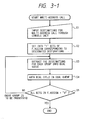
- Fig. 3-1 is a flow chart showing control operation of the main control unit 1.
- step S1 An operator inputs destinations for multi-address call upon continuous depression of the one-touch dial keys 41 in the console/display unit 4 (step S1). Bits corresponding to the destinations designated by the flag F/ASSIGN of the multi-address call control RAM 31 are sequentially set to be "1", and other bits are set to be "0" (step S2).
- the multi-address call destinations are divided into a predetermined number of groups, and multi-address call processing is performed in units of groups (steps S3 and S4).
- the main control unit 1 determines in step S5 whether a bit of "1" is still present in the flag F.ASSIGN. If YES in step S5, the flow returns to step S3 to perform processing for the next group. However, if NO in step S5, the control unit 1 determines that multi-address call processing for all the destinations is completed. This processing is thus completed in practice.
- the main control unit 1 reads out the telephone numbers of these destinations from the telephone number storing RAM 32 and outputs the readout telephone numbers to a dialer in the communication control unit 3, thereby performing dialing.
- the called destination responds, the multi-address call image data is transmitted from the image memory 33 to the destination in accordance with a facsimile communication protocol.
- the image data is transmitted to the next destination in accordance with the bit state of the flag F.ASSIGN.
- the destinations are divided into groups on the basis of the number of group elements input from the console/display unit 4 by the operator.
- the multi-address call scheme is set to be the all-destination multi-address call scheme (first multi-address call mode).
- the multi-address call scheme is set to be the one-destination multi-address call scheme (third multi-address call mode).
- the mode is set to be a group multi-address call mode (second multi-address mode).
- Fig. 3-2 is a flow chart showing a detailed control operation of division into groups and extraction to the dial queue (step S3).
- Fig. 4 is a view showing a multi-address call sequence of this embodiment.
- Bit data of "1" of the flag F.ASSIGN are transferred to the register R.DIALQ in an order from smaller bit numbers.
- the corresponding flag F.ASSIGN is set to be "0".
- the number of group elements is a value input from the console/display unit 4 and represents the number of destinations included in one group. This value is represented by C.
- step S32a If “1" is set in the flag F.ASSIGN (step S32a), the smallest bit number of the bits of "1" in the flag F.ASSIGN is obtained (step S33) and is set in an area of the register R.DIALQ designated by the pointer P.DIALQ (step S34). The bit of the corresponding bit number of the flag F.ASSIGN is cleared to zero (step S35), and the pointer P.DIALQ is incremented by one, while the number C of group elements is decremented by one (step S36).
- step S37 If the number C of group elements is not zero (step S37), the flow returns to step S32a. In step S32a, if no bit of "1" is present in the flag F.ASSIGN, the operation is ended. Therefore, one-touch dial numbers of one group are set in the register R.DIALQ.
- Fig. 3-3 is a flow chart showing a detailed control operation of the AD operation cycle (step S4) in the dial queue.
- bit numbers are sequentially read out from the register R.DIALQ, and the telephone numbers corresponding to these bit numbers are read out from the telephone number storing RAM 32. Dialing is performed using these telephone numbers. This operation is repeated until the number of redialing becomes zero.
- step S41 If redialing is performed twice, then the register R.REDIAL is set to be 3 (step S41) and the P.DIALQ is reset to zero (step S42).
- the bit number represented by the pointer P.DIALQ is read out from the register R.DIALQ (step S43). If the bit number does not represent a stop code (step S44), dialing is performed using the telephone number corresponding to this bit numbers (step S45). If the called destination is connected (step S46), the register R.DIALQ is scrolled (step S47). In this case, the bit number represented by the pointer P.DIALQ is deleted, and data from the pointer P.DIALQ+1 is shifted by one.
- step S46 If NO in step S46, the pointer P.DIALQ is incremented by one (step S48), and the flow returns to step S43.
- step S49 If the bit number is equal to the stop code in step S44 and the pointer P.DIALQ is set to be "0" (step S49), all the destinations have been connected to the facsimile machine, thereby completing the multi-address call of one group. However, if the pointer P.DIALQ in step S49 is not "0", the register R.DEDIAL is decremented by one (step S50). If the register R.DEDIAL is set to be "0" (step S51), the destinations left in the dial queue are destinations which were not connected to the facsimile apparatus. The multi-address call of one group is ended. If a bit of "1" is present in the register F.ASSIGN, the flow returns to step S3, and the above multi-address call processing is repeated.
- Fig. 5 is a view showing an operation represented by the flow chart of Fig. 3-3.
- Fig. 6 shows multi-address call patterns (1), (2), and (3) when the number of group elements is changed.
- the pattern (1) in Fig. 6 is obtained when the number of group elements is 4. In this case, since the number of group elements is neither 1 nor the same number as that of multi-address call destinations, the group multi-address call is performed.
- the pattern (2) in Fig. 6 is obtained when the number of group elements is 16. In this case, the number of group elements is the same as that of multi-address call destinations. Therefore, the mode is set to be the all-destination multi-address call mode.
- the pattern (3) in Fig. 6 is obtained when the number of group element is 1.
- the mode is set to be the one-destination multi-address call mode.
- the number of group elements can be changed by a user's operation or registration by a serviceman.
- Parameters of the next destination dialing interval within the same group, a dialing interval between the groups, the number of redialing operations, and a redialing interval can be updated by a user's operation or by registration by a serviceman. Therefore, complicated multi-address call control can be facilitated.
- the above embodiment exemplifies a facsimile apparatus.
- the present invention is also applicable to apparatuses having a multi-address call function as in a document communication apparatus such as a teletex.
- the number of one-touch dial keys is not limited to 16 but can be 17 or more, or 15 or less.
Landscapes
- Engineering & Computer Science (AREA)
- Automation & Control Theory (AREA)
- Multimedia (AREA)
- Signal Processing (AREA)
- Computer Networks & Wireless Communication (AREA)
- Facsimiles In General (AREA)
- Facsimile Transmission Control (AREA)
- Data Exchanges In Wide-Area Networks (AREA)
Applications Claiming Priority (2)
| Application Number | Priority Date | Filing Date | Title |
|---|---|---|---|
| JP201209/88 | 1988-08-12 | ||
| JP63201209A JP2805312B2 (ja) | 1988-08-12 | 1988-08-12 | ファクシミリ同報方式 |
Publications (2)
| Publication Number | Publication Date |
|---|---|
| EP0354702A2 true EP0354702A2 (de) | 1990-02-14 |
| EP0354702A3 EP0354702A3 (de) | 1991-11-06 |
Family
ID=16437160
Family Applications (1)
| Application Number | Title | Priority Date | Filing Date |
|---|---|---|---|
| EP19890307768 Ceased EP0354702A3 (de) | 1988-08-12 | 1989-07-31 | Bildkommunikationsgerät |
Country Status (3)
| Country | Link |
|---|---|
| US (1) | US5852500A (de) |
| EP (1) | EP0354702A3 (de) |
| JP (1) | JP2805312B2 (de) |
Cited By (1)
| Publication number | Priority date | Publication date | Assignee | Title |
|---|---|---|---|---|
| EP0510394A3 (en) * | 1991-04-26 | 1993-03-17 | Siemens Aktiengesellschaft | Method for transmitting a fascimile message |
Families Citing this family (7)
| Publication number | Priority date | Publication date | Assignee | Title |
|---|---|---|---|---|
| US5392133A (en) * | 1992-06-30 | 1995-02-21 | Canon Kabushiki Kaisha | Apparatus and method for transmitting image data in a format adapted to a condition of a destination |
| JP3329695B2 (ja) * | 1997-06-10 | 2002-09-30 | 松下電送システム株式会社 | 同報通信方法及び通信装置 |
| US6330080B1 (en) * | 1997-11-05 | 2001-12-11 | Canon Kabushiki Kaisha | Data communication apparatus, data communication method, and storage medium |
| US6813045B1 (en) * | 1998-10-19 | 2004-11-02 | Xerox Corporation | System and method for transmitting image information to a plurality of predetermined destinations |
| US6904051B1 (en) * | 1999-06-22 | 2005-06-07 | Canon Kabushiki Kaisha | Communication apparatus |
| JP3981225B2 (ja) * | 1999-11-29 | 2007-09-26 | シャープ株式会社 | ファクシミリ装置 |
| US20060199616A1 (en) * | 2005-03-03 | 2006-09-07 | Agere Systems Inc. | Mobile communication device having automatic scrolling capability and method of operation thereof |
Family Cites Families (7)
| Publication number | Priority date | Publication date | Assignee | Title |
|---|---|---|---|---|
| DE2912825C3 (de) * | 1979-03-30 | 1981-11-26 | SIEMENS AG AAAAA, 1000 Berlin und 8000 München | Schaltungsanordnung zur Abgabe von digitalen Nachrichtensignalen im Zuge von Rundschreibverbindungen über eine Datenvermittlungsanlage |
| GB2089618A (en) * | 1980-11-24 | 1982-06-23 | Am Int | Facsimile transmission system including bulk sorting |
| EP0117871B1 (de) * | 1982-08-30 | 1990-10-24 | Fujitsu Limited | Bildfunkmaschine |
| JPS61200770A (ja) * | 1985-03-04 | 1986-09-05 | Canon Inc | 通信装置 |
| JPS62261275A (ja) * | 1986-05-08 | 1987-11-13 | Tokyo Electric Co Ltd | フアクシミリ装置 |
| US4974097A (en) * | 1986-11-18 | 1990-11-27 | Canon Kabushiki Kaisha | Data communication apparatus |
| US5121221A (en) * | 1989-02-16 | 1992-06-09 | Minolta Camera Co. Ltd. | Facsimile apparatus |
-
1988
- 1988-08-12 JP JP63201209A patent/JP2805312B2/ja not_active Expired - Fee Related
-
1989
- 1989-07-31 EP EP19890307768 patent/EP0354702A3/de not_active Ceased
-
1994
- 1994-12-20 US US08/360,120 patent/US5852500A/en not_active Expired - Fee Related
Cited By (1)
| Publication number | Priority date | Publication date | Assignee | Title |
|---|---|---|---|---|
| EP0510394A3 (en) * | 1991-04-26 | 1993-03-17 | Siemens Aktiengesellschaft | Method for transmitting a fascimile message |
Also Published As
| Publication number | Publication date |
|---|---|
| EP0354702A3 (de) | 1991-11-06 |
| US5852500A (en) | 1998-12-22 |
| JP2805312B2 (ja) | 1998-09-30 |
| JPH0296441A (ja) | 1990-04-09 |
Similar Documents
| Publication | Publication Date | Title |
|---|---|---|
| US5301035A (en) | Facsimile apparatus having redialing function | |
| US7324223B1 (en) | Network facsimile device and a method of controlling the network facsimile device | |
| US5239576A (en) | Communication apparatus | |
| US5394462A (en) | Communication apparatus having a redial function and a simplified-dial-number registration function | |
| US5216706A (en) | Communication apparatus having remote control operation mode | |
| US5852500A (en) | Image communication apparatus | |
| EP0600466B1 (de) | Kommunikationsvorrichtung zum Verbinden von verschiedenen Kommunikationsleitungen | |
| US5357245A (en) | Communicant verifier | |
| JP2720912B2 (ja) | 通信装置 | |
| US6195428B1 (en) | Data transmission apparatus having abbreviated dialing function | |
| US5784009A (en) | Communication apparatus with programmable function keys | |
| EP0920187B1 (de) | Gebührenanzeige von Faksimileübertragungen | |
| JP3143129B2 (ja) | リダイヤル機能を備えた通信端末装置 | |
| JP2825003B2 (ja) | フアクシミリ装置 | |
| JPH0637929A (ja) | 通信用端末装置 | |
| JP3247403B2 (ja) | 通信装置 | |
| KR100240074B1 (ko) | 팩시밀리의 예약송신작업 관리방법 | |
| KR100248228B1 (ko) | 팩시밀리의 예약전송작업 관리방법 | |
| JP3096316B2 (ja) | 通信装置 | |
| KR100472432B1 (ko) | 팩스데이터저장및송신방법 | |
| JP2002314670A (ja) | 通信端末装置 | |
| JPH04307866A (ja) | フアクシミリ装置 | |
| JPH0530325A (ja) | フアクシミリの代行受信先指示方式 | |
| JPH0575822A (ja) | フアクシミリ通信装置 | |
| JPH06334722A (ja) | 公衆回線を用いる通信装置 |
Legal Events
| Date | Code | Title | Description |
|---|---|---|---|
| PUAI | Public reference made under article 153(3) epc to a published international application that has entered the european phase |
Free format text: ORIGINAL CODE: 0009012 |
|
| AK | Designated contracting states |
Kind code of ref document: A2 Designated state(s): DE ES FR GB IT NL |
|
| 17P | Request for examination filed |
Effective date: 19901231 |
|
| PUAL | Search report despatched |
Free format text: ORIGINAL CODE: 0009013 |
|
| AK | Designated contracting states |
Kind code of ref document: A3 Designated state(s): DE ES FR GB IT NL |
|
| 17Q | First examination report despatched |
Effective date: 19931014 |
|
| APAB | Appeal dossier modified |
Free format text: ORIGINAL CODE: EPIDOS NOAPE |
|
| APAD | Appeal reference recorded |
Free format text: ORIGINAL CODE: EPIDOS REFNE |
|
| APCB | Communication from the board of appeal sent |
Free format text: ORIGINAL CODE: EPIDOS OBAPE |
|
| APCB | Communication from the board of appeal sent |
Free format text: ORIGINAL CODE: EPIDOS OBAPE |
|
| APCB | Communication from the board of appeal sent |
Free format text: ORIGINAL CODE: EPIDOS OBAPE |
|
| STAA | Information on the status of an ep patent application or granted ep patent |
Free format text: STATUS: THE APPLICATION HAS BEEN REFUSED |
|
| 18R | Application refused |
Effective date: 20020218 |
|
| APAF | Appeal reference modified |
Free format text: ORIGINAL CODE: EPIDOSCREFNE |