EP0354703A2 - Informationsverarbeitungseinrichtung - Google Patents
Informationsverarbeitungseinrichtung Download PDFInfo
- Publication number
- EP0354703A2 EP0354703A2 EP89307770A EP89307770A EP0354703A2 EP 0354703 A2 EP0354703 A2 EP 0354703A2 EP 89307770 A EP89307770 A EP 89307770A EP 89307770 A EP89307770 A EP 89307770A EP 0354703 A2 EP0354703 A2 EP 0354703A2
- Authority
- EP
- European Patent Office
- Prior art keywords
- card
- data
- phone number
- telephone
- button
- Prior art date
- Legal status (The legal status is an assumption and is not a legal conclusion. Google has not performed a legal analysis and makes no representation as to the accuracy of the status listed.)
- Granted
Links
Images


















Classifications
-
- H—ELECTRICITY
- H04—ELECTRIC COMMUNICATION TECHNIQUE
- H04M—TELEPHONIC COMMUNICATION
- H04M1/00—Substation equipment, e.g. for use by subscribers
- H04M1/26—Devices for calling a subscriber
- H04M1/27—Devices whereby a plurality of signals may be stored simultaneously
- H04M1/274—Devices whereby a plurality of signals may be stored simultaneously with provision for storing more than one subscriber number at a time, e.g. using toothed disc
- H04M1/2745—Devices whereby a plurality of signals may be stored simultaneously with provision for storing more than one subscriber number at a time, e.g. using toothed disc using static electronic memories, e.g. chips
- H04M1/2753—Devices whereby a plurality of signals may be stored simultaneously with provision for storing more than one subscriber number at a time, e.g. using toothed disc using static electronic memories, e.g. chips providing data content
- H04M1/2755—Devices whereby a plurality of signals may be stored simultaneously with provision for storing more than one subscriber number at a time, e.g. using toothed disc using static electronic memories, e.g. chips providing data content by optical scanning
-
- H—ELECTRICITY
- H04—ELECTRIC COMMUNICATION TECHNIQUE
- H04M—TELEPHONIC COMMUNICATION
- H04M1/00—Substation equipment, e.g. for use by subscribers
- H04M1/26—Devices for calling a subscriber
- H04M1/27—Devices whereby a plurality of signals may be stored simultaneously
- H04M1/274—Devices whereby a plurality of signals may be stored simultaneously with provision for storing more than one subscriber number at a time, e.g. using toothed disc
- H04M1/2745—Devices whereby a plurality of signals may be stored simultaneously with provision for storing more than one subscriber number at a time, e.g. using toothed disc using static electronic memories, e.g. chips
- H04M1/27467—Methods of retrieving data
- H04M1/27475—Methods of retrieving data using interactive graphical means or pictorial representations
-
- G—PHYSICS
- G06—COMPUTING OR CALCULATING; COUNTING
- G06F—ELECTRIC DIGITAL DATA PROCESSING
- G06F40/00—Handling natural language data
- G06F40/10—Text processing
- G06F40/166—Editing, e.g. inserting or deleting
- G06F40/174—Form filling; Merging
-
- H—ELECTRICITY
- H04—ELECTRIC COMMUNICATION TECHNIQUE
- H04M—TELEPHONIC COMMUNICATION
- H04M2250/00—Details of telephonic subscriber devices
- H04M2250/22—Details of telephonic subscriber devices including a touch pad, a touch sensor or a touch detector
Definitions
- the present invention relates to an information processing apparatus and, more particularly, to an information processing apparatus having a telephone function or communication function and a character recognition function.
- a multi-functional information processing apparatus having, e.g., a personal computer function and a telephone function or facsimile function has been widely used.
- a keyboard and a display are used to input the data.
- customer information such as a "company name” and a "telephone number" registered as a data base are stored in units of indexes in the order of kana syllabary ( a , i , u , ..., o , n ) or in the alphabetical order.
- an index is designated, customer information belonging to the designated index is displayed on a display, and an item to be transmitted is designated from the displayed customer information.
- an index to which data of a required transmission customer belongs must be known. If an index is not known, indexes must be sequentially called and checked to result in a very cumbersome operation.
- the data processing function of a personal computer has not been sufficiently achieved also in this point of view.
- the present invention has been made to solve the above problems and has as its object to provide an image processing apparatus capable of reading image information and registering information obtained by character recognition as a data base.
- Fig. 1 is a block diagram showing an apparatus according to the present invention.
- a central processing unit (to be referred to as a CPU hereinafter) 1 controls the overall apparatus, and a memory 2 includes control programs 2a, a display icon font 2b, and a character font 2c.
- a touch panel 4 covers a display surface of a CRT display 3. When a user activates an icon displayed on the CRT display 3, an instruction is input to the apparatus.
- the CPU 1 is connected to a keyboard 5 for key input, an auxiliary storage 6 for storing the programs 2a or a large amount of data (document data or the like to be transmitted by a facsimile function), a speaker 7 for alarming a user of key input or occurrence of an error by a sound, an image scanner 8 for reading a card image, a facsimile 9, a printer 10 for printing, and a telephone set 11 including a processing device (not shown) for a telephone line and a handset 11a.
- Fig. 2 is a perspective view showing an outer appearance of the apparatus according to this embodiment.
- the touch panel 4 covers the CRT display 3 as described above.
- An overall apparatus 12 includes a floppy disk insertion port 13 constituting a part of the auxiliary storage 6, a card inlet 14, a card outlet 15, a card guide 16, a telephone line 17, and a power source 18.
- ports 14 and 15 and the guide 16 have a size suitable for any sheet used in reading of the facsimile, printing of the printer, or the like.
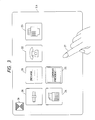
- Fig. 3 shows a main menu displayed on the CRT display 3 immediately after a power switch of the apparatus 12 is turned on.
- a user activates a portion on the touch panel 4 located in front of the screen by a finger 27, a program indicated by the touched icon is activated. Referring to Fig.
- an icon 20 is for an "environment” program for adjusting a speaker volume, screen brightness, and the like of the apparatus 12
- an icon 21 is for a "message” program for leaving a message in the apparatus 12
- an icon 22 is for a "telephone” program for setting a telephone menu
- an icon 23 is for a "fax” program for setting a fax menu
- an icon 24 is for a "wordprocessor” program
- an icon 25 is for a "card file” program for managing cards
- an "end” icon 26 is for performing an end operation.
- the auxiliary storage 6 stores a number of various programs in addition to the above programs. When a user aligns icons for programs to be activated on the main menu screen, the programs can be registered.
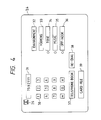
- Fig. 4 shows the telephone menu displayed when the "telephone" icon 22 on the main menu screen is activated by a user.
- the telephone menu includes push buttons 30, a display column 31 for displaying a number input from the push buttons 30, an "environment" program activating button 32 for setting a telephone number, a music, and the like of the apparatus 12, a hooking button 33, a tone switching button 34 for sending tones of the push buttons to a customer, a music start/end button 35, an off hook button 36 for setting an off hook state without picking up the handset, a telephone book button 37 for searching a telephone number from "telephone book” data, a re-dial button 38 for calling a customer of the same telephone number if the customer is busy, a card file button 39 for searching a telephone number from "card file” data, and an "end” button 26 for performing an end operation of the telephone program.
- Fig. 5 shows a telephone book menu displayed when a user activates the telephone book button 37 shown in Fig. 4.
- the telephone book menu includes an index 40 and a customer (name) 41.
- the telephone book menu also includes index buttons 42, a next page button 44 for displaying a next page when a plurality of customer data of the same index are present, and a preceding page button 43 for displaying a preceding page.
- a first page button 45 is for returning to a menu first displayed when the telephone book button 37 is activated.
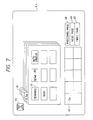
- Figs. 6 and 7 show menus displayed when a user activates "Sa” and "Se” of the index buttons 42 shown in Fig. 5, respectively.
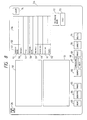
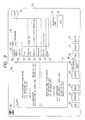
- Fig. 8 is a menu displayed when a user activates the card file button 39 shown in Fig. 4 or the "card file” icon 25 of the main menu shown in Fig. 3.
- the menu includes a frame 50 for displaying an image of a card read by the image scanner 8, a frame 51 for displaying characters obtained by analyzing the card image 50 by a pattern matching method of character recognition, and a frame 52 for registering data of a card displayed in the frame 51 as a data base in units of types.
- a section 53 indicates examples of items of card data
- a section 54 indicates examples of raw data of a card.
- These sections have columns of a company name 55, a division 56, a title 57, a personal name 58, an address 59, a phone number 60, a fax number 61, and a memo 62.
- the card data frame 52 is also used for data search. Buttons 63 to 74 indicate function menus for various processing tasks.
- a read button 63 is for performing automatic processing tasks such as reading of a card image into the image frame 50 performed by the image scanner 8, character recognition, determination of a type, and writing in the card data frame 52.
- a register button 64 is for newly registering data read in the card data frame 52 into a "card file”.
- An image button 65 is for newly registering data similar to the register button 64 and for additionally registering a card image.
- a next page button 68 is for displaying a next case, and a preceding page button 67 is for displaying a preceding case.
- a print button 69 is for printing all of searched data.
- a correct button 70 is for partially correcting a displayed case of data after searching and re-registering the data in the "card file”.
- a delete button 71 is for deleting a displayed case of data after searching from the "card file”.
- a telephone book button 72 is for registering a telephone number or fax number in the card data frame 52 into “telephone book” data.
- a call button 73 is for performing automatic calling by a telephone number in the card data frame 52. This internal operation is similar to automatic calling using the telephone book shown in Figs. 5, 6, and 7.
- a clear button 74 is for clearing all of unnecessary data on the screen. A user clears data by this button, inputs characters in a part of card data, and activates the search button 66, thereby searching data coincident with the input characters from the "card file”.
- Fig. 9 shows a state in which a user sets a card at the card inlet 14 from the state shown in Fig. 8 described above and activates the card read button 63 and card reading processing is completed.
- a card image read from the image scanner 8 is displayed in the image frame 50, character recognition is performed on the basis of the image, and the recognition result is displayed in the frame 51. Only card data whose types are determined in the frame 51 are set in the card data frame 52. Note that if the company name begins with katakanas (hiraganas), the kana part is automatically set in a column for data indicating how to read.
- a logo mark of the company name of the card image 50 is not displayed in the character recognition result frame 51 because it is not recognized as a character.
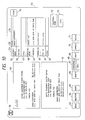
- Fig. 10 shows a state in which a user activates a telephone character line "(03)-ooo-xxxx" in the character recognition result frame 51 and immediately activates the type frame of the phone number column 60 which is blank in Fig. 9 in the card data frame, thereby automatically setting the telephone number in the phone number column 60.
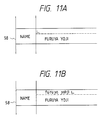
- Fig. 11A shows a state in which a user causes a character cursor to appear in the column of data indicating how to read which is blank in Fig. 10 of the personal name column 58
- Fig. 11B shows a state in which the user inputs data indicating how to read from the keyboard 5.
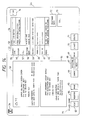
- Fig. 12 shows a state in which the user activates a return key after the operations shown in Figs. 11A and 11B, thereby completing input of the data indicating how to read in the personal name column 58.
- Fig. 13 shows a state in which a user inputs search characters " ⁇ Corporation" in the company name column 55 immediately before activating the search button 66.
- the search characters can be input by a method similar to that shown in Figs. 11A and 11B, i.e., can be input by the cursor.
- Fig. 14 shows a state of a menu obtained by activating the search button from the state shown in Fig. 13.
- a message 75 indicates that 11 cases of card data whose company names coincide with the " ⁇ Corporation" have been found from the "card file” data.
- Data of the first case is displayed from the company name column 55 to the memo column 62 in the card data frame 52. This data is registered with an image, and a card image is developed in the image frame 50. If a user wants to see all of the 11 data, he or she need only repeatedly activate the next page button 68 to sequentially display the card data in the frame 52.
- step S1 shown in Fig. 15 whether a user activates the "environment” icon is checked. If the "environment" icon is activated, in step S2, the environment menu is displayed to perform processing for setting environments such as a speaker volume or screen brightness by an input operation by the user. If the end button 26 is activated, the flow advances to step S13, and the screen is returned to the main menu. That is, the flow returns to the start of this program.
- step S3 whether the other icons are activated are checked in steps S3, S5, S7, S9, and S11. If any icon is activated, a program corresponding to the activated icon is activated to execute corresponding processing in step S4, S6, S8, S10, or S12. For example, if the "message” icon is activated, the message menu is displayed in step S4 to execute "message” processing for storing a message in the apparatus 12. If the "telephone” icon is activated, the "telephone” menu is displayed in step S6 to execute a telephone operation by the user. If the "fax" icon is activated, the "fax” menu is displayed in step S8 to execute a fax operation by the user.
- step S10 If the "wordprocessor” icon is activated, the wordprocessor menu is displayed in step S10 to execute word processing by the user. If the "card file” icon is activated, the "card file” menu is displayed in step S12 to execute card data addition and search by the user.
- the auxiliary storage 6 stores a number of various programs in addition to the above programs. Therefore, the user can align program icons on the main menu and add them as programs which can be immediately activated. In the flow chart of Fig. 15, programs are similarly added after steps S11 and S12.
- the "wordprocessor" program in step S10 of Fig. 15 includes a function of directly facsimile-transmitting a processed document in addition to a function of printing it on paper as an output.
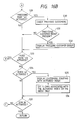
- Figs. 16A and 16B are flow charts for explaining programs corresponding to the "telephone book" icon described with reference to Figs. 5 to 7.
- step S20 the "telephone book” menu is displayed.
- step S21 "A” is set as the index 40, and customers 41 starting with “A” are displayed.
- “A, Ka, Sa, Ta, Na, Ha, Ma, Ya, Ra, and Wa” is set in the index buttons 42.
- step S22 whether the user activates the customer 41 is checked. If the customer 41 is activated, the flow advances to step S23, and whether the handset 11a is off-hooked is checked. If the handset 11a is off-hooked, the telephone set 11 is instructed to make a call by using a telephone number recorded in the customer 41 in step S24, and the flow advances to step S25.
- step S25 the flow advances to step S25, and whether the user activates the next page button 44 is checked. If “YES” in step S25, the flow advances to step S26, and whether a large number of customers 41 are currently present and subsequent customers 41 not displayed yet are present is checked. If it is determined in step S27 that a next customer group is present, the next customer group is displayed in the customer 41 in step S28. After this display, if "NO" is determined in step S25 or S27, the flow advances to step S29, and whether the user activates the preceding page button 43 is checked.
- step S30 If the preceding page button 43 is activated, whether a large number of customers 41 of the current index 40 are present and previous customers 41 not displayed yet are present is checked in step S30. If it is determined in step S31 that a preceding customer group is present, the preceding customer 41 group is displayed in step S32. After this display, if "NO"s are displayed in steps S29 and S31, the flow advances to step S33, and whether the user activates the first page button 45 is checked. If the first page button 45 is activated, processing from step S21 is repeated. If the first page button 45 is not activated, the flow advances to step S34, and whether the user activates the index button 42 is checked.
- step S36 the index buttons 42 are updated. That is, if the index 40 is any of "A, K, S, T, N, H, M, Y, R, and W", five characters associated with the activated index are set in the index buttons 42. For example, if “S” is the index 40, “Sa, Si, Su, Se, and So” are set in the index buttons 42. If the index 40 is other than "A, K, S, T, N, H, M, Y, R, and W", only the index 40 is set in the index button 42.
- step S34 the flow advances to step S37, and whether the user activates the end button 26 is checked. If the end button 26 is activated, the "telephone book” program is ended. If the end button 26 is not activated, the flow returns to step S22, and the program processing is repeated from step S22.
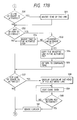
- step S40 the "card file” menu shown in Fig. 8 is displayed.
- step S41 whether the user activates the card read button 63 is checked. If the card read button 63 is activated, whether a card is set at the card inlet 14 is checked in step S42. If the card is set, the flow advances to step S43.
- step S43 an image of the card is read by the image scanner 8 and displayed in the card image frame 50.
- step S44 a character recognition program based on pattern matching is activated for the card image 50, and recognized characters are displayed in the character recognition result frame 51.
- step S45 the characters (a company name, a division, a title, a personal name, an address, a phone number, and a fax number) in the character recognition result frame 41 are checked in units of lines, and only determined characters are set in the columns 55 to 61 in the card data frame 52.
- step S46 the flow advances to step S46, and whether the user activates the register button 64 is checked. If the register button 64 is activated, a data group set in the card data frame 52 is newly registered in the "card file" as data of one card. If "NO” is determined in step S46, the flow advances to step S48, and whether the user activates the image register button 65 is checked.
- step S50 If the image register button 65 is activated, the data group set in the card data frame 52 and the card image 50 are newly registered in the "card file" as data of one card image in step S49, and the flow advances to step S50. If “NO” is determined in step S48, whether the user activates one of the character lines in the character recognition result frame 51 is checked in step S50. If a line is activated, a tone of the activated line is inverted. If the activated character line is already inverted, however, the line is returned to a standard tone. After this processing or if "NO" is determined in step S50, the flow advances to step S52, and whether the user activates any of the items 53 in the data frame 52 is checked.
- step S53 If any of the items 53 is activated, whether an inverted character line is present in the character recognition frame 51 is checked in step S53. If an inverted character line is present, the inverted line is copied in the activated item 53 of the card data frame 52 in step S54. In step S55, the inverted tone in the character recognition frame 51 is returned to the standard tone, and the flow advances to step S57.
- step S53 a tone of the item 53 activated by the user is inverted, and the flow advances to step S57. If “NO” is determined in step S52, whether the user activates any of the data lines 54 in the card data frame 52 is checked in step S57. If any of the data lines 54 is activated, a character cursor is displayed at the head of the activated line in step S58. In step S59, the user performs addition and correction of the card data by using the keyboard 5, and the processing in step S59 is continued until a return key is activated. If the return key is activated, the flow advances from step S60 to S61, and a character cursor is erased from the card data frame 52.
- step S57 whether the user activates the clear button 74 is checked in step S62. If the clear button 74 is activated, all the data in the card image frame 50, the character recognition result frame 51, and the card data frame 52 are cleared in step S63. If "NO" is determined in step S62, the flow advances to step S64, and whether the user activates the search button 66 is checked. If the search button 66 is not activated, the flow advances to step S68. If the search button 66 is activated, data in the "card file" coincident with characters set in a part of the card data frame 52 is searched.
- step S66 the number of searched cases is displayed in the message 75.
- step S67 the first case of the searched data is displayed in the card data frame 52.
- step S64 whether the user activates the next page button 68 is checked in step S68. If the next page button 68 is not pushed, the flow advances to step S70. If the next page button 68 is activated, however, next data is displayed in step S69 if a large number of searched data are present and subsequent data is present after the currently displayed data, and the flow advances to step S70. In step S70, whether the user activates the preceding page button 67 is checked. If the preceding page button 67 is activated, preceding data is displayed in step S71 if a large number of searched data are present and data already displayed is present preceding to the currently displayed data.
- step S70 determines whether the user activates the print button 69 is checked in step S72. If the print button 69 is activated, all of the searched data are printed out in step S73. In step S74, whether the user activates the correct button 70 is checked. If the correct button is activated, the flow advances to step S75, and whether the user corrects a part of the card data currently being searched and displayed is checked. If the card data is corrected, the corrected card data is registered in the "card file" in step S76. In this processing, the corrected data is overwritten on old data. If "NO"s are determined in steps S74 and S75, whether the user activates the delete button 71 is checked in step S77. If the delete button 71 is activated, one case of the currently searched and displayed card data is deleted from the "card file" in step S78.
- step S77 the flow advances to step S79, and whether the user activates the call button 73 is checked. If the call button 73 is activated, whether the handset 11a is off-hooked is checked in step S80. If the handset is off-hooked, the telephone set 11 is instructed to make a call by using the phone number 60 in the card data frame 52 in step S81. If "NO"s are determined in steps S79 and S80, whether the user activates the telephone book button 72 is checked in step S82. If the telephone book button 72 is not activated, the flow advances to step S92.
- step S83 If the telephone book button is activated, whether the company name 55 or the personal name 58 is set (both of the company and personal names 55 and 58 can be set) and the phone number 60 or the fax number 61 is set (both of the phone and fax numbers 60 and 61 can be set) in the card data frame 52 is checked in step S83. If this check is determined no good in step S84, the message 75 representing "data is insufficient" is output in step S85. If the above check is determined good, the flow advances to step S86, and whether a tone of only one of the company and personal names 55 and 58 of the items 53 is inverted and that of only one of the phone and fax numbers 60 and 61 thereof is inverted is checked. This result is checked in step S87.
- step S88 the flow advances to step S88, and the message 75 representing "which is to be registered ?" is output. If the result is determined good, whether the company or personal name 55 or 58 as an objected to be registered in the "telephone book" is accompanied with indication of how to read is checked in step S89. If the indication of how to read is not accompanied, the message 75 representing "indicate how to read” is output in step S90. If the indication of how to read is already accompanied, a data pair of the company or personal name 55 or 58 and the phone or fax name 60 and 61 is registered in the "telephone book” in step S91. For example, a pair of "a company name and a telephone number" is registered as one case in the "telephone book".
- step S92 whether the end button 26 is activated is checked in step S92. If the end button 26 is activated, the "card file" program is ended. If the end button 26 is not activated, the flow returns to step S41, and the processing from step S41 is repeatedly executed.
- Fig. 18 is a view showing an analyzing direction for each line of the image 50 obtained when the character recognition program based on pattern matching is executed in step S44 of the flow chart shown in Fig. 17.
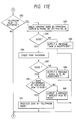
- step S45 of the flow chart shown in Fig. 17 will be described below with reference to a flow chart shown in Fig. 19.
- step S100 the number of character lines in the character recognition result frame 51 is counted to set a variable n .
- various variables are initialized. In this case, "1" is set in m representing the number of currently analyzed lines and "0" is set in a flag a representing a set state of the company name column 52 in the card data frame 52. Similarly, “0"s are set in a flag b for the division column 56, a flag c for the title column 57, a flag d for the personal name column 58, a flag e for the address column 59, a flag f for the phone number column 60, and a flag g for the fax number column 61.
- step S107 if the company name set in the company name column 55 starts with katakanas or hiraganas, the kana part is automatically set in the frame for data indicating how to read in the company name column 55.
- step S132 the currently analyzed line variable m is incremented by one, and the flow returns to step S102 of the program, thereby forming a loop for repeating the processing.
- step S108 If "NO”s are determined in steps S108 and S110, whether the division name can be set in the division column 56 (b ⁇ 3) is checked in step S112. Note that three division names can be set in this embodiment. This is because a division name printed on a card is often described over about three lines.
- step S112 If “YES” is determined in step S112, whether characters such as "department”, “section”, “room”, or “charge” are included on the line m is checked in step S113. If the characters are included, the flow advances from step S114 to S115. In step S115, the line m is set in the division column 56 of the card data frame 52, the variable b is incremented by one, and the flow advances to step S132.
- step S125 If the phone number column 60 is not set, whether a "telephone", "TEL” or a " " mark followed by numerals is included on the line m is checked in step S125. If followed, the flow advances from step S126 to S127. In step S127, only the numerals on the line m are set in the phone number column 60, and "1" is set in the variable f . The flow then advances to step S132.
- a card is laterally placed and character recognition for a laterally written card is performed.
- a card can be vertically placed and character recognition and analysis for a vertically written card can be performed.
- a card written in English can be analyzed.
- both the telephone book and the card file enable automatic calling of a "telephone number".
- a "facsimile number" can be similarly called in accordance with the telephone book and the card file.
- the telephone book is called in order to perform facsimile transmission, only a customer registered by a "facsimile number" can be displayed while a customer registered by a telephone number is highlighted, thereby alarming a user that the telephone number cannot be used.
- an edit document processed by a wordprocessor can be directly transmitted by a facsimile by performing automatic calling utilizing the telephone book or card file.
- Fig. 20 is a flow chart for explaining a transmission operation performed by a facsimile function utilizing the above data base.
- a file to be transmitted is designated (S151).
- a document to be transmitted is stored in the file to be transmitted, thereby forming a transmission data file.
- a search key word for the above telephone book file as a data base is input (S152).
- this search key word can be input by " ⁇ " as shown in Fig. 13.
- the telephone book file is searched by the search key word to call and display corresponding customer data on the CRT display 3 as shown in Fig. 14 (S153).
- a customer to which data is to be actually transmitted is designated from the customer data displayed on the CRT display 3, and a FAX transmission list file is formed (S154).
- the operator can select a plurality of customers.
- the contents of the transmission data file are transmitted to the designated customer (S155).
- Fig. 21 is a schematic view for explaining a relationship between the contents of a telephone book file 155, the search key word, and a FAX transmission list file 156.
- the telephone cook file 155 stores, in addition to a large number of customer data, customer data of a xx corporation and its associated companies such as "xx corporation”, “xx corporation ⁇ branch office", and "corporation xx service”. By inputting "xx" as the search key word, only customer data of the "xx corporation and its associated companies are searched from a large number of customer data and stored in the FAX transmission list file 156. If necessary, the contents of the FAX transmission data file 156 are deleted or added to select only data to be transmitted.
- a card is often printed such that its upper surface is printed in Japanese while its lower surface is printed in English. Therefore, two image scanners for upper and lower surfaces can be connected to perform image reading of both the surfaces at the same time to execute character recognition of both the surfaces, thereby forming both the surfaces into card data bases.
- pronunciations of English words are converted into kanas
- data indicating how to read a company name and a personal name written in Japanese on the upper surface can be automatically set, thereby reducing a load on a user.
- card file image registration effectively functions.
- a document of a fixed form having definite contents such as a postcard for invitation can be subjected to image reading, character recognition, and data base formation.
- card image registration can be performed in the "card file".
- processing can be performed such that a card image is corrected by an image editor program before registration, a simple map or the like is added, and then image registration is executed.
- the image editor program is stored in the auxiliary storage.
- the present invention has been described with reference to the information processing apparatus having a plurality of functions such as a personal computer function, a telephone function, a facsimile function, and a wordprocessor function.
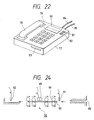
- telephone sets as shown in Figs. 22 and 28 can be made.
- a telephone set 77 includes a handset 78, push buttons 79, and a liquid crystal display 80 for displaying a phone number and a time. These parts are arranged similarly to those of a conventional telephone set.
- Display buttons 81 and 82 are located at the side of the liquid crystal display 80.
- the display buttons 81 and 82 are for selecting a phone number displayed on the liquid crystal display 80. That is, this embodiment optically reads a phone number of a card, recognizes it, and uses it for calling. However, a plurality of phone numbers of, e.g., a home, a main office, and a branch office are often described on a card. Therefore, two of the phone numbers are read, recognized, and displayed on the display 80, and one of the two numbers is selected by the display buttons 81 and 82.
- the telephone set 77 also has a card inlet (to be referred to as a slot hereinafter) 83.
- the slot 83 is for inserting a card whose phone number is to be read and has a mechanism for transporting and optically reading a card.
- the telephone set 77 has, at its rear portion, a telephone line 84 for communication and a power source cable 85 for supplying power to the telephone set.
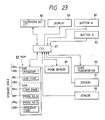
- Fig. 23 shows a control system incorporated in the telephone set shown in Fig. 22.
- a telephone set circuit 86 includes a voice signal amplifying section for the handset 78, an input circuit for the push buttons 79, a line controller, a power source circuit, and the like.
- An arrangement of the telephone set circuit 86 is similar to that of a conventional circuit. Note that the telephone set circuit 86 incorporates, in addition to the above circuits, a known dialing circuit for sending a dial signal corresponding to input phone number data onto a line.
- a central processing unit (to be referred as a CPU hereinafter) 87 for controlling the entire apparatus is connected to a control memory 88.
- the memory 88 is divided into two parts, a ROM 88a and a RAM 88d.
- the ROM 88a stores a control program 88b and a display character font 88c.
- the RAM 88d includes a storage area 88e for developing and storing a dot image of a card, storage areas 88f and 88g for recording a phone number, and a storage area 88h for storing data for programs.
- the CPU 87 is also connected to the following members to be controlled besides the memory 88.
- members 89 to 92 are for reading a phone number of a card.
- An image sensor 89 is constituted by a CCD line sensor or the like.
- a card transporter 90 accomodates a card into the apparatus or delivers it therefrom.
- a sensor 91 detects whether a card is inserted in the slot.
- a sensor 92 detects whether accomodation of a card into the apparatus is completed.
- the liquid crystal display 80 for displaying a phone number has a two-line width and is connected via a known display controller or the like (not shown).
- the display buttons 81 and 82 are for selecting a first or second one of two phone numbers displayed on two display lines of the display 80, thereby performing automatic calling.
- Fig. 24 shows an arrangement of the image sensor 89, the card transporter 90, and the like inside the slot 83 of the telephone set 77.
- the sensor 91 detects the leading edge of the card 93, and driving of eight transport rollers 90a (driven by a motor or the like (not shown) of the card transporter 90) constituting the card transporter 90 is started.
- the card 93 is accomodated to the left of Fig. 24 at a constant speed, while an image of the card 93 is read by the image sensor 89 located at a central portion of the rollers 90a and stored in the memory 88.
- the sensor 92 detects the leading edge of the card 93, and reverse rotation of the transport rollers 90a is started. Finally, the card 93 is delivered from the slot 83, and a read operation is completed.
- the sensors 91 and 92 are constituted by reflecting photosensors or the like.
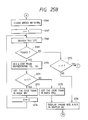
- the CPU 87 checks in step S160 of Fig. 25A whether the handset 78 is off-hooked. If the hand-set is not off-hooked, the flow loops and waits.
- step S161 If the hand-set 78 is off-hooked, the flow advances to step S161, and whether a card is inserted in the slot 83 is checked by detecting a change in ouput signal from the sensor 91. If the card 93 is not inserted, the flow returns to step S160 and loops. If the card is inserted, the flow advances to step S162, and the transporter 90 is instructed to accomodate the card.
- Figs. 26A and 26B an operator inserts the card in the slot 83 so that a surface on which a phone number is described or printed faces the image sensor 89.
- the card is inserted in the slot 83 such that the head of a line of the card is set toward a predetermined direction) in this case, coincident with an insertion direction) regardless of whether the card is laterally written (Fig. 26A) or vertically written (Fig. 26B).
- the transport rollers 90a start rotating at a constant speed in step S163, thereby accomodating the card 93.
- the image sensor 89 reads a printed image on the card with predetermined resolution, and read binary data is developed and stored in the card image storage area 88e on the RAM 88d of the memory 88. This operation is continuously executed until the sensor 92 detects the leading edge of the card 93 in step S164.
- step 165 the card transporter 90 is instructed to deliver the card.
- the transport rollers 90a start rotating in the reverse direction to deliver the card 93 from the slot 83.
- step S166 of Fig. 25B the storage area 88f for a phone No. A and the storage area 88g for a phone No. B of the RAM 88d are cleared.
- step 167 "1" is set in a counter variable "n".
- the counter variable "n" is for reading up to two phone numbers from the same card and takes two values "1" and "2" representing the number of reading times of a phone number.
- step S168 data in the storage area 88e for image data is searched in units of lines.
- a direction along which characters continue corresponding to the longitudinal direction of the card 93 is considered as a direction of "line” regardless of whether the card is laterally or vertically written.
- step S168 If a line including characters such as "telephone” or a mark is found in step S168, the flow advances from step S169 to S170. If a corresponding line is not found, the flow advances to step S172.
- step S172 an alphanumeric image following "telephone” or a kanji/numeral image following vertically written "telephone” is analyzed by the pattern matching method of OCR, thereby obtaining a code train (e.g., an ASCII code) representing a phone number.
- the pattern matching method of OCR is well known and a detailed described thereof will be omitted.
- the OCR processing may be performed by the CPU 87 or another recognition control system.
- step S176 the phone number data in the storage areas 88f and 88g are displayed on the display 80 by using the data stored in the character font storage area 88c of the ROM 88a.
- the dialing circuit of the telephone set circuit 86 transmits a dial signal corresponding to the input phone number represented by a character code such as an ASCII code or binary data to the telephone line.
- step S179 If it is determined that the display button 81 is not activated, the flow advances to step S179. If the display button 82 is activated, the telephone set circuit 86 is instructed to perform calling by using the phone number data stored in the storage area 88g in step S180, and the flow returns to the start of the program, thereby ending the processing.
- a trunk code of the telephone set 77 stored in a part of the memory 88 coincides with a trunk code of a customer, phone number data without the trunk code is supplied to the dialing circuit of the telephone set circuit 86, and dial processing is performed on the basis of this data.
- step S179 If it is determined in step S179 that the display button B 82 is not activated, the flow advances to step S181, and whether the new card 93 is inserted in the slot 83 is checked. If the card 93 is inserted, the flow returns to the start of the program to execute the reading processing for the card 93 again.
- step S182 If the card 93 is not inserted, the flow advances to step S182, and whether the handset 78 is returned to an ON hook state is checked. If the handset 78 is not returned to the ON hook state, the flow returns to step S177 to repeat determinations in steps S177, S179, S181, and S182. If it is determined that the handset 78 is returned, the flow returns to the start of the program and waits.
- character data following characters such as "telephone” is optically read, recognized, and used to perform calling. Therefore, unlike in a conventional apparatus, even if phone number data is not described nor printed on a predetermined position by a special recording system such as a bar code, phone number data can be read from any type of a card, and calling can be automatically performed on the basis of the read data, thereby simplifying a calling operation and preventing an operational error.
- the present invention since a phone number can be read and recognized regardless of whether it is laterally or vertically written, the present invention has high versatility.
- a plurality of phone numbers of a card can be read and recognized, and a desired one of the phone numbers can be selected by a simple button operation. Therefore, phone number information described on a card can be utilized substantially similarly to a case of manual calling.
- This embodiment is a telephone set for reading and recognizing a phone number on a document or printed matter not a card but various types of leaflets or pamphlets and using it to perform calling.
- a difference between telephone sets shown in Figs. 22 and 28 is that a display area of a display 80 has a size of three lines and therefore can display three phone numbers and three display buttons 94 to 96 are provided to select one of three phone numbers accordingly.
- the apparatus shown in Fig. 28 has an image sensor 97 on the upper surface of the apparatus as a reading mechanism.
- the image sensor 97 is constituted by a two-dimensional CCD sensor or the like and arranged to read image data on a portion corresponding to a hatched area shown in Fig. 28 of a document or printed matter placed to face downward on the image sensor 97.
- a read timing of the image sensor 97 is determined by activation of a read start button 98.
- Push buttons 79 and the display buttons 94 to 96 are embedded in the apparatus such that their upper end faces are set lower than the surface of the apparatus. Therefore, when a user sets a document or printed matter on the image sensor 97, erroneous activation of buttons by the user can be prevented.
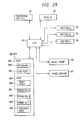
- Fig. 29 shows an arrangement of a control system of the apparatus shown in Fig. 28.
- the circuit shown in Fig. 29 has substantially the same arrangement as that of the circuit shown in Fig. 23 except that the image sensor 97 is of a fixed type; three display buttons 94 to 96 are used, and three data areas 881 to 883 for a phone number are formed in a RAM 88d accordingly; and the image sensor 97 of an original fixed type does not transport an original unlike in the above embodiment but reads image data in the two-dimensional read area and is constituted by an optical system, a two-dimensional image sensor, and the like.
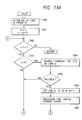
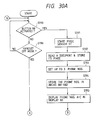
- step S190 of Fig. 30A whether the read start button 98 is activated is checked. If the read start button 98 is activated, a read/analysis routine of an original such as a document or printed matter is started from step S191. Note that an operator places the original on the image sensor 97 such that a line direction of characters coincides with the longitudinal direction (lateral direction in Fig. 28) of the image sensor 97 and activates the read start button 98 at a desired timing.
- step S191 the image sensor 97 is started.
- step S192 an image of the original placed on the image sensor 97 is read by the image sensor 97 and developed and stored as binary data in a printed image area 88e of the RAM 88d of the memory 88.
- step S193 the storage area 88e is searched and analyzed in units of lines by a pattern matching method of character recognition (OCR) as in the above embodiment, thereby obtaining a maximum of three phone numbers.
- OCR pattern matching method of character recognition
- step S194 the obtained phone number data are stored in the phone number storage areas 881 to 883 of the RAM 88d. If the number of the obtained phone numbers is less than three in step S193, phone Nos. A, B, and C are cleared accordingly.
- step S195 the areas 881 to 883 of the RAM 88d are displayed on the display 80, and the flow returns to the start of the program and waits until the user activates the display buttons 94 to 96.
- This state is similar to that in the above embodiment except that three phone numbers are displayed on the display 80.
- step S190 If it is determined in step S190 that the read start button 98 is not activated, the flow advances to step S196. If the handset 78 is not off-hooked in step S196, the flow loops and waits for another instruction from the user.
- step S196 If it is determined in step S196 that the handset 78 is off-hooked, the flow advances to step S197 in Fig. 30B.
- Step S197, S200, or S203 is for checking activation of a corresponding one of the display buttons 94 to 96. If any of the display buttons 94 to 96 is activated, the flow advances to a corresponding one of steps S198, S201, and S204.
- steps S198, S201, and S204 whether a phone number is stored in one of the storage areas 881 to 883 corresponding to the display buttons 94 to 96, respectively. If a phone number is not stored, the flow returns to step S190 in Fig. 30A.
- a phone number is stored in any of steps S198, S201, and S204, the flow advances to a corresponding one of steps S199, S202, and S205, and phone number data stored in a corresponding one of the ares 881 to 883 is supplied to the telephone set circuit 86, thereby performing calling as described above.
- a trunk code of the telephone set coincides with that of a customer, a phone number without the trunk code is used.
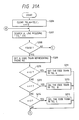
- Figs. 31A and 31B show in detail the read processing in step S193 of Fig. 30A.
- step S206 arrays TELA, TELB, and TELC set in a work area of a memory for temporarily registering a phone number are cleared, and "0" is set in a counter.
- step S207 binary image data in the storage area 88e is searched in units of lines by a pattern matching method of OCR to find a line including characters such as "telephone", “TEL”, vertically written "telephone” or a mark representing a telephone set.
- a search direction coincides with an arranging direction of characters of the original.
- the counter variable "n” is reset as described above. In this case, however, the counter variable "n" is controlled to extract three phone numbers.
- step S209 as in the above embodiment, an alphanumeric image following "telephone” or the like or a kanji/numeral image following vertically written "telephone” is analyzed by the pattern matching method of OCR, thereby obtaining a code train corresponding to the phone number.
- step S216 the flow advances to step S216 in Fig. 31B, and the counter n is counter up. If it is determined in step S217 that the counter n is two or less, the flow returns to step S121, and searching of a phone number is executed again. If the counter n is larger than two (i.e., three phone numbers are already read), the processing is ended, and the flow returns to the routine shown in Fig. 30A. Thereafter, data of the arrays TELA, TELB, and TELC are transferred to the storage areas 881 to 883, respectively.
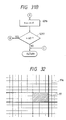
- an arranging direction of lines of an original must be aligned with the longitudinal direction of the image sensor 97.
- a matrix pattern 97a as shown in Fig. 32 may be printed or marked on the upper surface of the telephone set 77.
- the present invention can be applied not only to a telephone set but also to a facsimile apparatus.
Landscapes
- Engineering & Computer Science (AREA)
- Signal Processing (AREA)
- Theoretical Computer Science (AREA)
- Health & Medical Sciences (AREA)
- Artificial Intelligence (AREA)
- Audiology, Speech & Language Pathology (AREA)
- Computational Linguistics (AREA)
- General Health & Medical Sciences (AREA)
- Physics & Mathematics (AREA)
- General Engineering & Computer Science (AREA)
- General Physics & Mathematics (AREA)
- Facsimiles In General (AREA)
Applications Claiming Priority (6)
| Application Number | Priority Date | Filing Date | Title |
|---|---|---|---|
| JP63193299A JPH0242854A (ja) | 1988-08-02 | 1988-08-02 | ファクシミリ装置 |
| JP193299/88 | 1988-08-02 | ||
| JP63223626A JP2805764B2 (ja) | 1988-09-08 | 1988-09-08 | 情報処理方法 |
| JP223626/88 | 1988-09-08 | ||
| JP63312926A JPH02158875A (ja) | 1988-12-13 | 1988-12-13 | 情報処理装置 |
| JP312926/88 | 1988-12-13 |
Publications (3)
| Publication Number | Publication Date |
|---|---|
| EP0354703A2 true EP0354703A2 (de) | 1990-02-14 |
| EP0354703A3 EP0354703A3 (en) | 1990-12-27 |
| EP0354703B1 EP0354703B1 (de) | 1994-09-28 |
Family
ID=27326745
Family Applications (1)
| Application Number | Title | Priority Date | Filing Date |
|---|---|---|---|
| EP89307770A Expired - Lifetime EP0354703B1 (de) | 1988-08-02 | 1989-07-31 | Informationsverarbeitungseinrichtung |
Country Status (3)
| Country | Link |
|---|---|
| US (1) | US20030059032A1 (de) |
| EP (1) | EP0354703B1 (de) |
| DE (1) | DE68918534T2 (de) |
Cited By (17)
| Publication number | Priority date | Publication date | Assignee | Title |
|---|---|---|---|---|
| US5282052A (en) * | 1992-03-20 | 1994-01-25 | Xerox Corporation | Techniques for automatic form creation by combining partial operations |
| US5295181A (en) * | 1992-08-24 | 1994-03-15 | Xerox Corporation | Automatic facsimile output recipient telephoning system |
| US5422656A (en) * | 1993-11-01 | 1995-06-06 | International Business Machines Corp. | Personal communicator having improved contrast control for a liquid crystal, touch sensitive display |
| US5438433A (en) * | 1993-06-07 | 1995-08-01 | Microsoft Corporation | System and method for facsimile cover page storage and use |
| US5457738A (en) * | 1993-03-23 | 1995-10-10 | U S West Advanced Technologies, Inc. | Method and system for searching an on-line directory at a telephone station |
| EP0629076A3 (de) * | 1993-06-07 | 1996-03-06 | Microsoft Corp | Faksimile-Benutzerschnittstelle und Verwendungsverfahren. |
| US5513013A (en) * | 1992-08-24 | 1996-04-30 | Xerox Corporation | Facsimile output job sorting unit and system |
| US5539530A (en) * | 1993-06-07 | 1996-07-23 | Microsoft Corporation | Facsimile machine with custom operational parameters |
| US5604516A (en) * | 1994-06-30 | 1997-02-18 | Symbol Technologies, Inc. | Graphical user interface control for providing both automatic and manual data input |
| EP0633683A3 (de) * | 1993-07-09 | 1997-06-18 | Sony Corp | Telefonsystem und Datenverarbeitungsverfahren mit Fernsprechverzeichnis und Datenkommunikationsfunktion. |
| GB2315952A (en) * | 1996-08-01 | 1998-02-11 | Samsung Electronics Co Ltd | A facsimile apparatus in which scanned telephone numbers are stored to provide an automatic dialling facility |
| US5943055A (en) * | 1993-03-23 | 1999-08-24 | U S West, Inc. | Computer interface method and system |
| WO2000072577A1 (en) * | 1999-05-20 | 2000-11-30 | Pascal Co., Ltd. | Portable information terminal |
| US6173045B1 (en) * | 1991-06-27 | 2001-01-09 | Texas Instruments Incorporated | Electronic telephone book |
| US6366698B1 (en) * | 1997-03-11 | 2002-04-02 | Casio Computer Co., Ltd. | Portable terminal device for transmitting image data via network and image processing device for performing an image processing based on recognition result of received image data |
| WO2001020438A3 (en) * | 1999-09-17 | 2002-08-15 | Ericsson Inc | Device and method for displaying data |
| EP1122934A3 (de) * | 2000-02-02 | 2003-05-14 | Motorola, Inc. | Kommunikationsgerät und Verfahren zum Wählen einer Nummer mit optischen Zeichenerkennung |
Families Citing this family (7)
| Publication number | Priority date | Publication date | Assignee | Title |
|---|---|---|---|---|
| KR100346203B1 (ko) * | 1999-08-26 | 2002-07-26 | 삼성전자 주식회사 | 터치 패드를 구비하는 통신 단말기에서 심벌을 이용한 단축다이얼 방법 |
| US7711738B1 (en) * | 1999-11-15 | 2010-05-04 | West Services, Inc. | Method, system and computer-readable medium for accessing and retrieving court records, items and documents |
| US7180638B1 (en) | 2000-02-16 | 2007-02-20 | Ricoh Co., Ltd. | Network fax machine using a web page as a user interface |
| JP3707997B2 (ja) | 2000-05-31 | 2005-10-19 | 富士通株式会社 | 払込帳票判別方法及びその装置 |
| JP3880307B2 (ja) * | 2000-11-13 | 2007-02-14 | キヤノン株式会社 | 情報処理装置および方法 |
| JP2004040310A (ja) * | 2002-07-01 | 2004-02-05 | Nec Infrontia Corp | 電話システムにおける発信制御装置 |
| KR100664320B1 (ko) * | 2004-09-10 | 2007-01-04 | 삼성전자주식회사 | 화상형성장치 및 그의 제어방법 |
Family Cites Families (5)
| Publication number | Priority date | Publication date | Assignee | Title |
|---|---|---|---|---|
| US4113993A (en) * | 1977-05-03 | 1978-09-12 | Xerox Corporation | Automatic dialer having a recall memory |
| JPH0693738B2 (ja) * | 1981-10-09 | 1994-11-16 | 株式会社東芝 | 文書画像認識編集装置 |
| JPS59201579A (ja) * | 1983-04-29 | 1984-11-15 | Toshiba Corp | 複合フアクシミリ装置 |
| JPS59205678A (ja) * | 1983-05-09 | 1984-11-21 | Sharp Corp | 用紙情報入力装置 |
| JPS63184879A (ja) * | 1987-01-28 | 1988-07-30 | Toshiba Corp | 画像処理装置 |
-
1989
- 1989-07-31 DE DE68918534T patent/DE68918534T2/de not_active Expired - Fee Related
- 1989-07-31 EP EP89307770A patent/EP0354703B1/de not_active Expired - Lifetime
-
1993
- 1993-02-04 US US08/013,543 patent/US20030059032A1/en not_active Abandoned
Cited By (23)
| Publication number | Priority date | Publication date | Assignee | Title |
|---|---|---|---|---|
| US6173045B1 (en) * | 1991-06-27 | 2001-01-09 | Texas Instruments Incorporated | Electronic telephone book |
| EP0561605A3 (en) * | 1992-03-20 | 1994-11-09 | Xerox Corp | Techniques for automatic form creation by combining partial operations |
| US5282052A (en) * | 1992-03-20 | 1994-01-25 | Xerox Corporation | Techniques for automatic form creation by combining partial operations |
| US5513013A (en) * | 1992-08-24 | 1996-04-30 | Xerox Corporation | Facsimile output job sorting unit and system |
| US5295181A (en) * | 1992-08-24 | 1994-03-15 | Xerox Corporation | Automatic facsimile output recipient telephoning system |
| US5943055A (en) * | 1993-03-23 | 1999-08-24 | U S West, Inc. | Computer interface method and system |
| US5457738A (en) * | 1993-03-23 | 1995-10-10 | U S West Advanced Technologies, Inc. | Method and system for searching an on-line directory at a telephone station |
| EP0624965A3 (de) * | 1993-03-23 | 1996-01-31 | Us West Advanced Tech Inc | Methode und System zum Recherchieren in einem on-line Telephonbuch in einer Telephonstation. |
| US5917615A (en) * | 1993-06-07 | 1999-06-29 | Microsoft Corporation | System and method for facsimile load balancing |
| US5438433A (en) * | 1993-06-07 | 1995-08-01 | Microsoft Corporation | System and method for facsimile cover page storage and use |
| US5539530A (en) * | 1993-06-07 | 1996-07-23 | Microsoft Corporation | Facsimile machine with custom operational parameters |
| EP0629076A3 (de) * | 1993-06-07 | 1996-03-06 | Microsoft Corp | Faksimile-Benutzerschnittstelle und Verwendungsverfahren. |
| EP0633683A3 (de) * | 1993-07-09 | 1997-06-18 | Sony Corp | Telefonsystem und Datenverarbeitungsverfahren mit Fernsprechverzeichnis und Datenkommunikationsfunktion. |
| US5812645A (en) * | 1993-07-09 | 1998-09-22 | Sony Corporation | Telephone system and telecommunication method and apparatus automatically forming directory and indicating message and battery status |
| US5422656A (en) * | 1993-11-01 | 1995-06-06 | International Business Machines Corp. | Personal communicator having improved contrast control for a liquid crystal, touch sensitive display |
| US5604516A (en) * | 1994-06-30 | 1997-02-18 | Symbol Technologies, Inc. | Graphical user interface control for providing both automatic and manual data input |
| GB2315952A (en) * | 1996-08-01 | 1998-02-11 | Samsung Electronics Co Ltd | A facsimile apparatus in which scanned telephone numbers are stored to provide an automatic dialling facility |
| US5963623A (en) * | 1996-08-01 | 1999-10-05 | Samsung Electronics Co., Ltd. | Method of storing telephone numbers scanned from facsimile document in telephone directory of a facsimile system |
| GB2315952B (en) * | 1996-08-01 | 1999-03-17 | Samsung Electronics Co Ltd | Facsimile machine with telephone number store |
| US6366698B1 (en) * | 1997-03-11 | 2002-04-02 | Casio Computer Co., Ltd. | Portable terminal device for transmitting image data via network and image processing device for performing an image processing based on recognition result of received image data |
| WO2000072577A1 (en) * | 1999-05-20 | 2000-11-30 | Pascal Co., Ltd. | Portable information terminal |
| WO2001020438A3 (en) * | 1999-09-17 | 2002-08-15 | Ericsson Inc | Device and method for displaying data |
| EP1122934A3 (de) * | 2000-02-02 | 2003-05-14 | Motorola, Inc. | Kommunikationsgerät und Verfahren zum Wählen einer Nummer mit optischen Zeichenerkennung |
Also Published As
| Publication number | Publication date |
|---|---|
| DE68918534D1 (de) | 1994-11-03 |
| US20030059032A1 (en) | 2003-03-27 |
| EP0354703A3 (en) | 1990-12-27 |
| EP0354703B1 (de) | 1994-09-28 |
| DE68918534T2 (de) | 1995-03-23 |
Similar Documents
| Publication | Publication Date | Title |
|---|---|---|
| EP0354703B1 (de) | Informationsverarbeitungseinrichtung | |
| US7054487B2 (en) | Controlling and electronic device | |
| US4882582A (en) | Touch panel input device | |
| EP1225505A1 (de) | Tragbares kommunikationsendgerät | |
| EP1285329A1 (de) | Steuerung eines elektronischen bauelements | |
| US20100295791A1 (en) | Portable information terminal, character delivery method; and character temporary storage program product | |
| JPH04211565A (ja) | 画像蓄積機能付きファクシミリ装置 | |
| KR100217374B1 (ko) | 문자인식에 의한 전화번호를 등록하는 팩시밀리장치 및 그 전화번호 등록방법 | |
| EP0519713B1 (de) | Verfahren und Gerät zur Zeicheneingabe | |
| US5719960A (en) | System for dispatching task orders into a user network and method | |
| JPH02158875A (ja) | 情報処理装置 | |
| JPH07244657A (ja) | 文書編集装置 | |
| JP2805764B2 (ja) | 情報処理方法 | |
| JPH10334084A (ja) | 情報処理装置 | |
| JP2003208449A (ja) | 送付先リスト作成装置、これを用いた印刷システム及び送付先リスト作成方法 | |
| JP3606904B2 (ja) | 画像形成装置 | |
| JPH08317155A (ja) | ファイリング方法およびファイリング装置 | |
| JPH0660053A (ja) | 入力装置 | |
| JPH09160907A (ja) | 文書処理装置及び方法 | |
| JPH0662101A (ja) | 通信装置 | |
| JPS6257358A (ja) | フアクシミリ装置 | |
| JP3524572B2 (ja) | 自動ダイヤル装置 | |
| JPH06149976A (ja) | 画像ファイリング装置 | |
| KR970001922B1 (ko) | 우편물 자동 인쇄 처리 장치와 방법 | |
| JP3310063B2 (ja) | 文書処理装置 |
Legal Events
| Date | Code | Title | Description |
|---|---|---|---|
| PUAI | Public reference made under article 153(3) epc to a published international application that has entered the european phase |
Free format text: ORIGINAL CODE: 0009012 |
|
| AK | Designated contracting states |
Kind code of ref document: A2 Designated state(s): DE FR GB IT |
|
| PUAL | Search report despatched |
Free format text: ORIGINAL CODE: 0009013 |
|
| AK | Designated contracting states |
Kind code of ref document: A3 Designated state(s): DE FR GB IT |
|
| 17P | Request for examination filed |
Effective date: 19901231 |
|
| 17Q | First examination report despatched |
Effective date: 19930308 |
|
| GRAA | (expected) grant |
Free format text: ORIGINAL CODE: 0009210 |
|
| AK | Designated contracting states |
Kind code of ref document: B1 Designated state(s): DE FR GB IT |
|
| REF | Corresponds to: |
Ref document number: 68918534 Country of ref document: DE Date of ref document: 19941103 |
|
| ET | Fr: translation filed | ||
| ITF | It: translation for a ep patent filed | ||
| PLBE | No opposition filed within time limit |
Free format text: ORIGINAL CODE: 0009261 |
|
| STAA | Information on the status of an ep patent application or granted ep patent |
Free format text: STATUS: NO OPPOSITION FILED WITHIN TIME LIMIT |
|
| 26N | No opposition filed | ||
| REG | Reference to a national code |
Ref country code: GB Ref legal event code: IF02 |
|
| PGFP | Annual fee paid to national office [announced via postgrant information from national office to epo] |
Ref country code: GB Payment date: 20050718 Year of fee payment: 17 |
|
| PGFP | Annual fee paid to national office [announced via postgrant information from national office to epo] |
Ref country code: FR Payment date: 20050719 Year of fee payment: 17 |
|
| PGFP | Annual fee paid to national office [announced via postgrant information from national office to epo] |
Ref country code: DE Payment date: 20050912 Year of fee payment: 17 |
|
| PG25 | Lapsed in a contracting state [announced via postgrant information from national office to epo] |
Ref country code: GB Free format text: LAPSE BECAUSE OF NON-PAYMENT OF DUE FEES Effective date: 20060731 |
|
| PGFP | Annual fee paid to national office [announced via postgrant information from national office to epo] |
Ref country code: IT Payment date: 20060731 Year of fee payment: 18 |
|
| PG25 | Lapsed in a contracting state [announced via postgrant information from national office to epo] |
Ref country code: DE Free format text: LAPSE BECAUSE OF NON-PAYMENT OF DUE FEES Effective date: 20070201 |
|
| GBPC | Gb: european patent ceased through non-payment of renewal fee |
Effective date: 20060731 |
|
| REG | Reference to a national code |
Ref country code: FR Ref legal event code: ST Effective date: 20070330 |
|
| PG25 | Lapsed in a contracting state [announced via postgrant information from national office to epo] |
Ref country code: FR Free format text: LAPSE BECAUSE OF NON-PAYMENT OF DUE FEES Effective date: 20060731 |
|
| PG25 | Lapsed in a contracting state [announced via postgrant information from national office to epo] |
Ref country code: IT Free format text: LAPSE BECAUSE OF NON-PAYMENT OF DUE FEES Effective date: 20070731 |