EP0356077A2 - Matériau photographique avec latitude d'exposition accrue - Google Patents
Matériau photographique avec latitude d'exposition accrue Download PDFInfo
- Publication number
- EP0356077A2 EP0356077A2 EP89308145A EP89308145A EP0356077A2 EP 0356077 A2 EP0356077 A2 EP 0356077A2 EP 89308145 A EP89308145 A EP 89308145A EP 89308145 A EP89308145 A EP 89308145A EP 0356077 A2 EP0356077 A2 EP 0356077A2
- Authority
- EP
- European Patent Office
- Prior art keywords
- dye
- sensitive
- interlayer
- emulsion layer
- forming coupler
- Prior art date
- Legal status (The legal status is an assumption and is not a legal conclusion. Google has not performed a legal analysis and makes no representation as to the accuracy of the status listed.)
- Granted
Links
Images
Classifications
-
- G—PHYSICS
- G03—PHOTOGRAPHY; CINEMATOGRAPHY; ANALOGOUS TECHNIQUES USING WAVES OTHER THAN OPTICAL WAVES; ELECTROGRAPHY; HOLOGRAPHY
- G03C—PHOTOSENSITIVE MATERIALS FOR PHOTOGRAPHIC PURPOSES; PHOTOGRAPHIC PROCESSES, e.g. CINE, X-RAY, COLOUR, STEREO-PHOTOGRAPHIC PROCESSES; AUXILIARY PROCESSES IN PHOTOGRAPHY
- G03C7/00—Multicolour photographic processes or agents therefor; Regeneration of such processing agents; Photosensitive materials for multicolour processes
- G03C7/30—Colour processes using colour-coupling substances; Materials therefor; Preparing or processing such materials
- G03C7/32—Colour coupling substances
- G03C7/3225—Combination of couplers of different kinds, e.g. yellow and magenta couplers in a same layer or in different layers of the photographic material
-
- G—PHYSICS
- G03—PHOTOGRAPHY; CINEMATOGRAPHY; ANALOGOUS TECHNIQUES USING WAVES OTHER THAN OPTICAL WAVES; ELECTROGRAPHY; HOLOGRAPHY
- G03C—PHOTOSENSITIVE MATERIALS FOR PHOTOGRAPHIC PURPOSES; PHOTOGRAPHIC PROCESSES, e.g. CINE, X-RAY, COLOUR, STEREO-PHOTOGRAPHIC PROCESSES; AUXILIARY PROCESSES IN PHOTOGRAPHY
- G03C7/00—Multicolour photographic processes or agents therefor; Regeneration of such processing agents; Photosensitive materials for multicolour processes
- G03C7/30—Colour processes using colour-coupling substances; Materials therefor; Preparing or processing such materials
- G03C7/3029—Materials characterised by a specific arrangement of layers, e.g. unit layers, or layers having a specific function
-
- G—PHYSICS
- G03—PHOTOGRAPHY; CINEMATOGRAPHY; ANALOGOUS TECHNIQUES USING WAVES OTHER THAN OPTICAL WAVES; ELECTROGRAPHY; HOLOGRAPHY
- G03C—PHOTOSENSITIVE MATERIALS FOR PHOTOGRAPHIC PURPOSES; PHOTOGRAPHIC PROCESSES, e.g. CINE, X-RAY, COLOUR, STEREO-PHOTOGRAPHIC PROCESSES; AUXILIARY PROCESSES IN PHOTOGRAPHY
- G03C7/00—Multicolour photographic processes or agents therefor; Regeneration of such processing agents; Photosensitive materials for multicolour processes
- G03C7/30—Colour processes using colour-coupling substances; Materials therefor; Preparing or processing such materials
- G03C7/32—Colour coupling substances
Definitions
- This invention relates to color photographic materials with extended exposure latitude. In a particular aspect, it relates to such a material which yields a positive image that is directly viewable.
- Color positive photographic prints intended for direct viewing are typically made by imagewise exposing a support coated with layers sensitive to each of the blue, green and red regions of the visible spectrum and which yield yellow, magenta and cyan dye images, respectively. Exposure is commonly to a color negative film which contains a negative image of the original scene. If the exposure latitude of the color print material is less than the full range of densities recorded in the film, reproduction of detail in the print will be poor.
- Exposure latitude is a measure of the ability of a recording material to represent differences in intensity of exposure by differences in density. Thus, materials with a wide exposure latitude would respond to a wide range of exposure intensities by showing differences in image density, while materials with a narrow exposure latitude would, for the same range of exposure intensities, show fewer differences in density.
- exposure latitude typically has been modified by manipulation of the silver halide emulsion. For example, increasing the range of grain sizes in an emulsion is known to extend the exposure latitude, while narrowing the range of grain sizes is known to decrease exposure latitude.
- a color photographic element comprising a support and first and second silver halide emulsion layers.
- the first emulsion layer is sensitized to a first region of the spectrum and the second emulsion layer is sensitized to a second region of the spectrum and, to a limited degree, to the first region of the spectrum.
- Dye density formed in the second emulsion layer adds to the dye density formed in the first emulsion layer and thereby extends the exposure latitude. This is perceived as an increase in the degree of detail viewable in the image.
- a color photographic material comprising, a support, first and second silver halide emulsion layers each sensitive to a different region of the electromagnetic spectrum and each layer containing a coupler that forms a dye complementary in color to the principal spectral sensitivity of the emulsion, and a non-light sensitive interlayer between the two emulsion layers, wherein: the interlayer contains a coupler that forms, as a function of development of the first emulsion layer, a dye complementary in color to the principal sensitivity of the second emulsion layer.
- a cyan dye-forming coupler is in an interlayer between a green-sensitive silver halide emulsion layer and a red-sensitive silver halide emulsion layer, the relative proportions of materials being such that oxidized developing agent generated in the areas of the green-sensitive layer receiving maximum exposure migrates to the interlayer to couple to form cyan dye.
- a high density red image comprised of yellow and magenta dye, this would be seen in the viewable image as an increase in detail of the red image.
- detail of the high-density green image is increased, and exposure latitude of the red-sensitive emulsion extended, when the interlayer contains a magenta dye-forming coupler and forms magenta dye density as a function of red light exposure.
- Dye-forming couplers have been placed in non-light-sensitive layers adjacent image-forming layers. In some instances, these have been development inhibitor-releasing couplers which were not present for the image-forming character of the coupler itself, but rather as a carrier for a development inhibitor to be released.
- U.S. Patent 4,359,521 is illustrative of such patents. In other instances, the coupler forms a dye complementary to the sensitivity of the emulsion layer from which the oxidized developing agent migrates.
- German DAS 1,002,626 and U.S. Patent 4,186,011 are illustrative of such patents.
- the relative proportions and locations of the emulsions and couplers in the two light-sensitive layers and the interlayer should be such that oxidized developing agent is generated in the maximum density areas of the first emulsion layer in such an amount that there is excess oxidized developing agent available to migrate to the interlayer where it will couple.
- Such a condition can be assured by having less coupler in the first emulsion layer than is theoretically capable of reacting with all of the oxidized developing agent generated at maximum exposure. This condition has been referred to in the art as "coupler starvation.”
- some oxidized developing agent would be available for migration even under non-coupler starved conditions. Therefore, it is not necessary that the emulsion be coupler starved in order for the benefits of the invention to be observed.
- the amount of oxidized developing agent which migrates to the interlayer can be determined by measuring and plotting the density of dye generated in the interlayer as a function of exposure of the first emulsion layer.
- the slope of the resulting curve is referred to as contrast, or gamma( ⁇ ).
- Useful effects can be obtained when the contrast of the interlayer, measured in the region where the first emulsion layer is within 10% of maximum density, is in the range of 0.03 to 7.0, preferably in the range of 0.07 to 3.5.
- an interlayer contrast of 0.2 to 0.4 is especially preferred.
- the contrast of the interlayer can also be related to the secondary contrast of the first emulsion layer measured in the same region of the spectrum as is the interlayer. This is referred to herein as the corresponding contrast.
- Useful effects can be obtained when the contrast of the interlayer is in the range of 10% to 200% of the corresponding contrast of the first emulsion layer.
- Preferably the corresponding contrast is 40% to 200%.
- the corresponding contrast of each layer is measured as a function of exposure of the first emulsion layer.
- the corresponding contrast of the first emulsion layer is that of the straight line portion of the curve.
- the contrast of the interlayer is measured over the exposure region where the principal density of the first emulsion layer is within 10% of maximum density.
- the first emulsion layer is sensitive to the green region of the spectrum and contains a magenta dye-forming coupler, and, in the material of the invention, the interlayer contains a cyan dye-forming coupler.
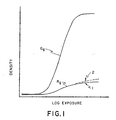
- the curve labeled Gg represents the green density, i.e. the principal density, generate in the element as a function of exposure of the green sensitive layer.
- the curve labelled Rg represents the red density generated in the element as a function of exposure of the green sensitive layer. It is composed of two parts.
- the first, labelled 1 is derived from absorption of red light by the magenta dye formed in the green layer.
- the second, dashed curve, labelled 2 represent the cyan dye formed in the interlayer as a function of development of the green sensitive layer.
- the additional red density, represented by the dashed curve labelled 2 adds to the green density in the maximum density region of the image thus extending exposure latitude and enhancing image detail.
- An additional or alternative means for controlling migration of oxidized color developing agent is by the use of a barrier layer.
- a barrier layer There can be located between the interlayer and the second emulsion layer a barrier layer containing a scavenger for oxidized developing agent.
- Suitable scavengers include ballasted reducing agents such as 2-(octadecyl)-5-sulfohydroquinone, diiso-octylhydroquinone, 2,5-didodecylhydroquinone, 4-benzenesulfonamido-1-hydroxy-2-(N,N-didodecyl) naphthamide.
- ballasted reducing agents such as 2-(octadecyl)-5-sulfohydroquinone, diiso-octylhydroquinone, 2,5-didodecylhydroquinone, 4-benzenesulfonamido-1-hydroxy-2-(N,N-
- the present invention is of primary use in materials intended for direct viewing, such as reflection prints.
- the contribution to maximum density from two different regions of the spectrum results in some desaturation of the color in the maximum density portions of the image. This is not a significant factor in reflection print materials.
- the invention also can be employed with color negative, and other intermediate materials, where desaturation of the color in maximum density regions is acceptable.
- Color photographic elements intended for direct viewing by reflection generally comprise an opaque support on which is coated, in order, a blue-sensitive, yellow dye-forming layer, a green-sensitive magenta dye-forming layer, and a red-sensitive cyan dye-forming layer.
- the non-light-sensitive interlayer containing the dye-forming coupler is coated between the red-sensitive and green-sensitive emulsion layers.
- any conventional silver halide emulsion can be employed.
- silver chloride, silver bromide and silver chlorobromide emulsions are commonly employed.
- the silver halide emulsions employed in positive print materials are in most applications negative working.
- Illustrative silver halide emulsion types in preparations are disclosed in Research Disclosure , Volume 176, January, 1978, Item 17643, paragraph I.
- Particularly preferred silver halide emulsions are high aspect ratio tabular grain emulsions such as those described in Research Disclosure , January, 1983, Item 22534.
- Research Disclosure is published by Kenneth Mason Publications, Ltd., The Old Harbourmaster's, 8 North Street, Emsworth, Hampshire P010 7DD, ENGLAND.
- Dye-forming couplers are chosen to form subtractive primary (i.e. yellow, magenta and cyan) image dyes and are non-diffusible colorless compounds such as 2- and 4-equivalent couplers of the open-chain ketomethylene, pyrazolone, pyrazolotriazole, phenol and naphthol types that are hydrophobically ballasted for incorporation in high-boiling organic solvents.
- Suitable types and classes of couplers, as well as methods for their incorporation in color photographic materials, are described in Research Disclosure , Item 17643, December, 1978, Section VII, Paragraphs C, D, E, F and G.
- Suitable yellow dye-forming couplers are:
- Suitable magenta dye-forming couplers are:
- Suitable cyan dye-forming couplers are:
- the photographic element can be comprised of any conventional photographic support.
- Typical photographic supports include wood fiber, e.g. paper, metallic sheets and foils, glass and ceramic supporting elements provide with one or more subbing layers to enhance the adhesive, antistatic, dimensional, abrasive hardness, frictional antihalation or other properties of the support services.
- useful supports are further disclosed in Research Disclosure , Item 17643, Paragraph XVII.
- the photographic elements can contain other conventional features known in the art, which can be illustrated by reference to Research Disclosure , Item 17643, cited above.
- the silver halide emulsions can be chemically sensitized, as described in Paragraph III; contain brighteners, as described in Paragraph V; contain antifoggants and stabilizers, as described in Paragraph VI; absorbing and scattering materials, as described in Paragraph III, the emulsion and other layers can contain vehicles, as described in Paragraph IX; the hydrophilic colloid and other hydrophilic colloid layers can contain hardeners, as described in Paragraph X; the layers can contain coating aids, as described in Paragraph XI; the layers can contain plasticizers and lubricants, as described in Paragraph XII; and the layers, particularly the layers farthest from the support, can contain matting agents, as described in Paragraph XVI.
- This exemplary listing of addenda and features is not intended to restrict or imply the absence of other conventional photographic
- multilayer color photographic elements of this invention can be processed by any conventional technique of producing a dye image by color development, whereafter the concurrently generated silver is removed by bleaching. Residual, undeveloped silver halide can be removed in a separate fixing step or concurrently with bleaching.
- a separate pH lowering solution referred to as a stop bath, may be employed to terminate development prior to bleaching.
- a stabilizer bath is commonly employed for final washing and hardening of the bleached and fixed photographic element prior to drying.
- Conventional techniques for processing are illustrated by Research Disclosure , Item 17643, cited above, Paragraph XIX.
- a control color photographic material was prepared by coating the following layers in sequence on a polyethylene laminated paper support. The coating was hardened with bis(vinylsulfonyl) methyl ether at 1.8% of the total gelatin weight. Except as noted, all coverages in parenthesis are in g/m2.
- a color photographic material according to this invention was prepared. It differed from the one described above in that layer 4 contained 100 mg/m2 of cyan dye-forming coupler C and an additional 0.69 g/m2 of gelatin.
- Each of these photographic materials was imagewise exposed through a green separation test object (Wratten 99 filter) and then processed at 35°C in a three-step process consisting of a 45-second development step, a 45-second bleach-fix step, and a 90-second stabilizing step, followed by a one-minute drying step at a temperature of 60°C.
- Color developing, bleach-fixing and stabilizing compositions used in the process were as follows: Color Developing Composition Lithium salt of sulfonated polystyrene (30% by wt) 0.25 mL Triethanolamine 11.0 mL N,N-diethylhydroxylamine (85% by wt) 6.0 mL Potassium sulfite (45% by wt) 0.5 mL Color developing agent* 5.0 g Stain reducing agent** 2.3 g Lithium sulfate 2.7 g Potassium chloride 2.3 g Potassium bromide 0.025g Kodak Anti-Calcium No.
- control material developed 11 visible steps while the invention material developed 15 visible steps.
- a similar increase in exposure latitude is obtained when the level of magenta dye forming coupler M in layer 3 is reduced to 0.38 g/m2 and the level of cyan dye forming coupler C in layer 4 is 0.32 mg/m2.
- Example 1 The control and invention color photographic print materials described in Example 1 were imagewise exposed to a color negative image and processed as in Example 1. Visual inspection of the resulting prints showed significantly greater detail in the red-image areas on the print materials of the invention compared to the control.
Landscapes
- Physics & Mathematics (AREA)
- General Physics & Mathematics (AREA)
- Silver Salt Photography Or Processing Solution Therefor (AREA)
- Non-Silver Salt Photosensitive Materials And Non-Silver Salt Photography (AREA)
Applications Claiming Priority (2)
| Application Number | Priority Date | Filing Date | Title |
|---|---|---|---|
| US07/232,259 US4946765A (en) | 1988-08-15 | 1988-08-15 | Photographic material with increased exposure latitude |
| US232259 | 1988-08-15 |
Publications (3)
| Publication Number | Publication Date |
|---|---|
| EP0356077A2 true EP0356077A2 (fr) | 1990-02-28 |
| EP0356077A3 EP0356077A3 (en) | 1990-10-03 |
| EP0356077B1 EP0356077B1 (fr) | 1995-01-18 |
Family
ID=22872435
Family Applications (1)
| Application Number | Title | Priority Date | Filing Date |
|---|---|---|---|
| EP89308145A Expired - Lifetime EP0356077B1 (fr) | 1988-08-15 | 1989-08-10 | Matériau photographique avec latitude d'exposition accrue |
Country Status (5)
| Country | Link |
|---|---|
| US (1) | US4946765A (fr) |
| EP (1) | EP0356077B1 (fr) |
| JP (1) | JP2874903B2 (fr) |
| AT (1) | ATE117442T1 (fr) |
| DE (1) | DE68920666T2 (fr) |
Cited By (2)
| Publication number | Priority date | Publication date | Assignee | Title |
|---|---|---|---|---|
| FR2664400A1 (fr) * | 1990-07-04 | 1992-01-10 | Kodak Pathe | Produit inversible pour la photographie en couleurs. |
| US5266451A (en) * | 1991-05-16 | 1993-11-30 | Agfa Gevaert Aktiengesellschaft | Color photographic recording material |
Families Citing this family (7)
| Publication number | Priority date | Publication date | Assignee | Title |
|---|---|---|---|---|
| US5190851A (en) * | 1990-12-21 | 1993-03-02 | Eastman Kodak Company | Color photographic element |
| JP2685111B2 (ja) * | 1992-02-14 | 1997-12-03 | 富士写真フイルム株式会社 | 画像形成方法 |
| US5364747A (en) * | 1992-11-25 | 1994-11-15 | Eastman Kodak Company | Color correcting layers consisting essentially of at least one dye-forming coupler and gelatin in chromogenic black-and-white photographic imaging systems |
| FR2754920B1 (fr) * | 1996-10-18 | 2003-07-25 | Kodak Pathe | Produit photographique inversible en couleurs comprenant un melange d'emulsions |
| FR2754919B1 (fr) * | 1996-10-18 | 2003-07-25 | Kodak Pathe | Produit photographique inversible en couleurs |
| WO2006022405A1 (fr) * | 2004-08-24 | 2006-03-02 | Fujifilm Corporation | Matériau photosensible photographique couleur à base d’halogénure d’argent et procédé de formation d’image |
| JP4876447B2 (ja) * | 2005-06-22 | 2012-02-15 | パナソニック株式会社 | ガスシステムとそのプログラム |
Family Cites Families (13)
| Publication number | Priority date | Publication date | Assignee | Title |
|---|---|---|---|---|
| US2350380A (en) * | 1940-08-01 | 1944-06-06 | Du Pont | Photography |
| BE543282A (fr) * | 1955-10-20 | |||
| GB818233A (en) * | 1955-11-17 | 1959-08-12 | Wolfen Filmfab Veb | Improvements in and relating to multi-layer colour photographic material |
| US4141730A (en) * | 1975-04-08 | 1979-02-27 | Fuji Photo Film Co., Ltd. | Multilayer color photographic materials |
| DE2650715A1 (de) * | 1976-11-05 | 1978-05-11 | Agfa Gevaert Ag | Farbphotographisches aufzeichnungsmaterial |
| DE2704797C2 (de) * | 1977-02-05 | 1982-05-27 | Agfa-Gevaert Ag, 5090 Leverkusen | Farbphotographisches Aufzeichnungsmaterial |
| CA1099559A (fr) * | 1977-09-29 | 1981-04-21 | Mario Fryberg | Derives de 1,2,4-triazole a substitution par un groupement thio ou seleno en position 5 |
| DE3113009A1 (de) * | 1981-04-01 | 1982-10-21 | Agfa-Gevaert Ag, 5090 Leverkusen | Fotografisches aufzeichnungsmaterial |
| JPS60128442A (ja) * | 1983-12-15 | 1985-07-09 | Fuji Photo Film Co Ltd | カラ−画像形成方法 |
| JPS6191657A (ja) * | 1984-10-11 | 1986-05-09 | Fuji Photo Film Co Ltd | 多層ハロゲン化銀カラ−感光材料 |
| JPH0751026B2 (ja) * | 1987-07-15 | 1995-06-05 | 東レ株式会社 | 生物付着防止性に優れた水産用資材 |
| US4902609A (en) * | 1987-08-20 | 1990-02-20 | Eastman Kodak Company | Photographic print material with increased exposure latitude |
| JPH045941A (ja) * | 1990-04-24 | 1992-01-09 | Matsushita Electric Ind Co Ltd | 電気掃除機 |
-
1988
- 1988-08-15 US US07/232,259 patent/US4946765A/en not_active Expired - Lifetime
-
1989
- 1989-08-10 AT AT89308145T patent/ATE117442T1/de not_active IP Right Cessation
- 1989-08-10 DE DE68920666T patent/DE68920666T2/de not_active Expired - Fee Related
- 1989-08-10 EP EP89308145A patent/EP0356077B1/fr not_active Expired - Lifetime
- 1989-08-14 JP JP1208024A patent/JP2874903B2/ja not_active Expired - Lifetime
Cited By (4)
| Publication number | Priority date | Publication date | Assignee | Title |
|---|---|---|---|---|
| FR2664400A1 (fr) * | 1990-07-04 | 1992-01-10 | Kodak Pathe | Produit inversible pour la photographie en couleurs. |
| WO1992001242A1 (fr) * | 1990-07-04 | 1992-01-23 | Kodak-Pathe | Materiau de support photographique de couleur inversible |
| US5378591A (en) * | 1990-07-04 | 1995-01-03 | Eastman Kodak Company | Reversal color photographic material |
| US5266451A (en) * | 1991-05-16 | 1993-11-30 | Agfa Gevaert Aktiengesellschaft | Color photographic recording material |
Also Published As
| Publication number | Publication date |
|---|---|
| EP0356077B1 (fr) | 1995-01-18 |
| US4946765A (en) | 1990-08-07 |
| EP0356077A3 (en) | 1990-10-03 |
| ATE117442T1 (de) | 1995-02-15 |
| JPH02100046A (ja) | 1990-04-12 |
| JP2874903B2 (ja) | 1999-03-24 |
| DE68920666D1 (de) | 1995-03-02 |
| DE68920666T2 (de) | 1995-09-07 |
Similar Documents
| Publication | Publication Date | Title |
|---|---|---|
| EP0080896B1 (fr) | Méthode pour la formation d'une image de colorant | |
| US4297437A (en) | Processing method of silver halide color photographic material | |
| US4902609A (en) | Photographic print material with increased exposure latitude | |
| EP0317951B1 (fr) | Eléments photographiques contenant un précurseur d'accélérateur de blanchiment | |
| EP0317950B1 (fr) | Eléments photographiques contenant un précurseur d'accélérateur de blanchiment | |
| EP0356077B1 (fr) | Matériau photographique avec latitude d'exposition accrue | |
| US5151344A (en) | Method for processing a silver halide color photographic material | |
| US4157916A (en) | Silver halide photographic light-sensitive material | |
| EP0573854B1 (fr) | Matériaux photographiques couleur et procédés avec émulsions au chlorure d'argent stabilisées | |
| US5629140A (en) | Photographic elements containing scavengers for oxidized developing agent | |
| EP0570109B1 (fr) | Matériau photographique à voile réduit | |
| US5804359A (en) | Photographic silver halide materials | |
| US4233389A (en) | Fluorinated 1-hydroxy-2-naphthamide coupler compositions and photographic elements suited to forming integral sound tracks | |
| EP0566416A1 (fr) | Matériau photographique ayant des couches adjacentes sensibles au vert | |
| EP0426805B1 (fr) | Beta-cetoamide photographique et elements photographiques contenant de tels amides | |
| US5264335A (en) | Photographic silver halide recording material | |
| EP0600561B1 (fr) | Copulants jaune ayant groupes libérés aryloxy ionisables et/ou solubilisants | |
| US5935767A (en) | Process of producing color negative image at shortened development times | |
| EP0250201A2 (fr) | Elément photographique à l'halogénure d'argent et procédé | |
| US5914225A (en) | Color photographic element with enhanced properties at reduced development times | |
| EP0566207A1 (fr) | Mélanges de copulants en matériaux photographiques couleur | |
| JPH0792597B2 (ja) | 多層構成ハロゲン化銀カラー写真感光材料 | |
| JPH04217242A (ja) | ハロゲン化銀カラー写真感光材料 | |
| GB2280276A (en) | Photographic colour element | |
| JPS6267537A (ja) | ハロゲン化銀カラ−写真材料 |
Legal Events
| Date | Code | Title | Description |
|---|---|---|---|
| PUAI | Public reference made under article 153(3) epc to a published international application that has entered the european phase |
Free format text: ORIGINAL CODE: 0009012 |
|
| AK | Designated contracting states |
Kind code of ref document: A2 Designated state(s): AT BE CH DE ES FR GB GR IT LI LU NL SE |
|
| PUAL | Search report despatched |
Free format text: ORIGINAL CODE: 0009013 |
|
| AK | Designated contracting states |
Kind code of ref document: A3 Designated state(s): AT BE CH DE ES FR GB GR IT LI LU NL SE |
|
| 17P | Request for examination filed |
Effective date: 19910314 |
|
| 17Q | First examination report despatched |
Effective date: 19931119 |
|
| GRAA | (expected) grant |
Free format text: ORIGINAL CODE: 0009210 |
|
| AK | Designated contracting states |
Kind code of ref document: B1 Designated state(s): AT BE CH DE ES FR GB GR IT LI LU NL SE |
|
| PG25 | Lapsed in a contracting state [announced via postgrant information from national office to epo] |
Ref country code: GR Free format text: LAPSE BECAUSE OF FAILURE TO SUBMIT A TRANSLATION OF THE DESCRIPTION OR TO PAY THE FEE WITHIN THE PRESCRIBED TIME-LIMIT Effective date: 19950118 Ref country code: ES Free format text: THE PATENT HAS BEEN ANNULLED BY A DECISION OF A NATIONAL AUTHORITY Effective date: 19950118 Ref country code: AT Effective date: 19950118 |
|
| REF | Corresponds to: |
Ref document number: 117442 Country of ref document: AT Date of ref document: 19950215 Kind code of ref document: T |
|
| REF | Corresponds to: |
Ref document number: 68920666 Country of ref document: DE Date of ref document: 19950302 |
|
| ET | Fr: translation filed | ||
| ITF | It: translation for a ep patent filed | ||
| PG25 | Lapsed in a contracting state [announced via postgrant information from national office to epo] |
Ref country code: SE Effective date: 19950418 |
|
| PGFP | Annual fee paid to national office [announced via postgrant information from national office to epo] |
Ref country code: CH Payment date: 19950814 Year of fee payment: 7 |
|
| PGFP | Annual fee paid to national office [announced via postgrant information from national office to epo] |
Ref country code: FR Payment date: 19950818 Year of fee payment: 7 |
|
| PGFP | Annual fee paid to national office [announced via postgrant information from national office to epo] |
Ref country code: BE Payment date: 19950829 Year of fee payment: 7 |
|
| PG25 | Lapsed in a contracting state [announced via postgrant information from national office to epo] |
Ref country code: LU Free format text: LAPSE BECAUSE OF NON-PAYMENT OF DUE FEES Effective date: 19950831 |
|
| PLBE | No opposition filed within time limit |
Free format text: ORIGINAL CODE: 0009261 |
|
| STAA | Information on the status of an ep patent application or granted ep patent |
Free format text: STATUS: NO OPPOSITION FILED WITHIN TIME LIMIT |
|
| 26N | No opposition filed | ||
| PG25 | Lapsed in a contracting state [announced via postgrant information from national office to epo] |
Ref country code: LI Effective date: 19960831 Ref country code: CH Effective date: 19960831 Ref country code: BE Effective date: 19960831 |
|
| BERE | Be: lapsed |
Owner name: EASTMAN KODAK CY (A NEW JERSEY CORP.) Effective date: 19960831 |
|
| REG | Reference to a national code |
Ref country code: CH Ref legal event code: PL |
|
| PG25 | Lapsed in a contracting state [announced via postgrant information from national office to epo] |
Ref country code: FR Effective date: 19970430 |
|
| REG | Reference to a national code |
Ref country code: FR Ref legal event code: ST |
|
| PGFP | Annual fee paid to national office [announced via postgrant information from national office to epo] |
Ref country code: NL Payment date: 19980623 Year of fee payment: 10 |
|
| PG25 | Lapsed in a contracting state [announced via postgrant information from national office to epo] |
Ref country code: NL Free format text: LAPSE BECAUSE OF NON-PAYMENT OF DUE FEES Effective date: 20000301 |
|
| NLV4 | Nl: lapsed or anulled due to non-payment of the annual fee |
Effective date: 20000301 |
|
| PGFP | Annual fee paid to national office [announced via postgrant information from national office to epo] |
Ref country code: GB Payment date: 20010629 Year of fee payment: 13 |
|
| PGFP | Annual fee paid to national office [announced via postgrant information from national office to epo] |
Ref country code: DE Payment date: 20010831 Year of fee payment: 13 |
|
| REG | Reference to a national code |
Ref country code: GB Ref legal event code: IF02 |
|
| PG25 | Lapsed in a contracting state [announced via postgrant information from national office to epo] |
Ref country code: GB Free format text: LAPSE BECAUSE OF NON-PAYMENT OF DUE FEES Effective date: 20020810 |
|
| PG25 | Lapsed in a contracting state [announced via postgrant information from national office to epo] |
Ref country code: DE Free format text: LAPSE BECAUSE OF NON-PAYMENT OF DUE FEES Effective date: 20030301 |
|
| GBPC | Gb: european patent ceased through non-payment of renewal fee |
Effective date: 20020810 |
|
| PG25 | Lapsed in a contracting state [announced via postgrant information from national office to epo] |
Ref country code: IT Free format text: LAPSE BECAUSE OF NON-PAYMENT OF DUE FEES;WARNING: LAPSES OF ITALIAN PATENTS WITH EFFECTIVE DATE BEFORE 2007 MAY HAVE OCCURRED AT ANY TIME BEFORE 2007. THE CORRECT EFFECTIVE DATE MAY BE DIFFERENT FROM THE ONE RECORDED. Effective date: 20050810 |