EP0356655A2 - Chemische Behandlung von Fasern und deren Verwendung zur Verstärkung von polymeren Matrizen - Google Patents
Chemische Behandlung von Fasern und deren Verwendung zur Verstärkung von polymeren Matrizen Download PDFInfo
- Publication number
- EP0356655A2 EP0356655A2 EP89112097A EP89112097A EP0356655A2 EP 0356655 A2 EP0356655 A2 EP 0356655A2 EP 89112097 A EP89112097 A EP 89112097A EP 89112097 A EP89112097 A EP 89112097A EP 0356655 A2 EP0356655 A2 EP 0356655A2
- Authority
- EP
- European Patent Office
- Prior art keywords
- treating composition
- chemical treating
- fibers
- group
- monomer
- Prior art date
- Legal status (The legal status is an assumption and is not a legal conclusion. Google has not performed a legal analysis and makes no representation as to the accuracy of the status listed.)
- Granted
Links
- 239000000126 substance Substances 0.000 title claims abstract description 114
- 229920000642 polymer Polymers 0.000 title claims abstract description 53
- 238000011282 treatment Methods 0.000 title claims abstract description 17
- 230000002787 reinforcement Effects 0.000 title claims description 23
- 239000000203 mixture Substances 0.000 claims abstract description 139
- 239000000835 fiber Substances 0.000 claims abstract description 80
- 239000000178 monomer Substances 0.000 claims abstract description 42
- 239000003963 antioxidant agent Substances 0.000 claims abstract description 40
- 239000004814 polyurethane Substances 0.000 claims abstract description 31
- 229920002635 polyurethane Polymers 0.000 claims abstract description 30
- XLYOFNOQVPJJNP-UHFFFAOYSA-N water Substances O XLYOFNOQVPJJNP-UHFFFAOYSA-N 0.000 claims abstract description 30
- 229910001868 water Inorganic materials 0.000 claims abstract description 26
- 230000003078 antioxidant effect Effects 0.000 claims abstract description 24
- -1 alkaline earth metal phenylphosphonates Chemical class 0.000 claims abstract description 20
- 239000003431 cross linking reagent Substances 0.000 claims abstract description 18
- 239000002657 fibrous material Substances 0.000 claims abstract description 14
- 239000011159 matrix material Substances 0.000 claims abstract description 13
- 239000004593 Epoxy Substances 0.000 claims abstract description 11
- 239000006057 Non-nutritive feed additive Substances 0.000 claims abstract description 7
- 239000006087 Silane Coupling Agent Substances 0.000 claims abstract description 7
- 229910052783 alkali metal Inorganic materials 0.000 claims abstract description 7
- OJMIONKXNSYLSR-UHFFFAOYSA-N phosphorous acid Chemical class OP(O)O OJMIONKXNSYLSR-UHFFFAOYSA-N 0.000 claims abstract description 7
- 229920000728 polyester Polymers 0.000 claims abstract description 7
- 229920005989 resin Polymers 0.000 claims abstract description 7
- 239000011347 resin Substances 0.000 claims abstract description 7
- 150000001340 alkali metals Chemical class 0.000 claims abstract description 5
- 229910052784 alkaline earth metal Inorganic materials 0.000 claims abstract description 5
- 239000010409 thin film Substances 0.000 claims abstract description 4
- 239000011324 bead Substances 0.000 claims abstract description 3
- 150000003568 thioethers Chemical class 0.000 claims abstract description 3
- 229920001577 copolymer Polymers 0.000 claims description 35
- 239000003365 glass fiber Substances 0.000 claims description 20
- 238000007792 addition Methods 0.000 claims description 15
- 239000000839 emulsion Substances 0.000 claims description 14
- 239000007787 solid Substances 0.000 claims description 14
- 238000001035 drying Methods 0.000 claims description 11
- 239000005056 polyisocyanate Substances 0.000 claims description 11
- 229920001228 polyisocyanate Polymers 0.000 claims description 11
- 239000006185 dispersion Substances 0.000 claims description 9
- 125000001931 aliphatic group Chemical group 0.000 claims description 8
- 239000000314 lubricant Substances 0.000 claims description 8
- KWSLGOVYXMQPPX-UHFFFAOYSA-N 5-[3-(trifluoromethyl)phenyl]-2h-tetrazole Chemical compound FC(F)(F)C1=CC=CC(C2=NNN=N2)=C1 KWSLGOVYXMQPPX-UHFFFAOYSA-N 0.000 claims description 7
- NIXOWILDQLNWCW-UHFFFAOYSA-N acrylic acid group Chemical group C(C=C)(=O)O NIXOWILDQLNWCW-UHFFFAOYSA-N 0.000 claims description 7
- 229920006264 polyurethane film Polymers 0.000 claims description 7
- 229910001379 sodium hypophosphite Inorganic materials 0.000 claims description 7
- 150000001875 compounds Chemical class 0.000 claims description 6
- 238000004132 cross linking Methods 0.000 claims description 5
- 150000002148 esters Chemical class 0.000 claims description 5
- 229910052751 metal Inorganic materials 0.000 claims description 5
- 239000002184 metal Substances 0.000 claims description 5
- 239000006078 metal deactivator Substances 0.000 claims description 5
- 150000002825 nitriles Chemical class 0.000 claims description 5
- 239000012779 reinforcing material Substances 0.000 claims description 5
- KAKZBPTYRLMSJV-UHFFFAOYSA-N Butadiene Chemical compound C=CC=C KAKZBPTYRLMSJV-UHFFFAOYSA-N 0.000 claims description 4
- PPBRXRYQALVLMV-UHFFFAOYSA-N Styrene Chemical compound C=CC1=CC=CC=C1 PPBRXRYQALVLMV-UHFFFAOYSA-N 0.000 claims description 4
- 239000004433 Thermoplastic polyurethane Substances 0.000 claims description 4
- 125000003178 carboxy group Chemical group [H]OC(*)=O 0.000 claims description 4
- 239000003638 chemical reducing agent Substances 0.000 claims description 4
- 230000007062 hydrolysis Effects 0.000 claims description 4
- 238000006460 hydrolysis reaction Methods 0.000 claims description 4
- 125000002887 hydroxy group Chemical group [H]O* 0.000 claims description 4
- 229920002803 thermoplastic polyurethane Polymers 0.000 claims description 4
- GYCMBHHDWRMZGG-UHFFFAOYSA-N Methylacrylonitrile Chemical compound CC(=C)C#N GYCMBHHDWRMZGG-UHFFFAOYSA-N 0.000 claims description 3
- 239000002981 blocking agent Substances 0.000 claims description 3
- 238000000576 coating method Methods 0.000 claims description 3
- 150000002170 ethers Chemical class 0.000 claims description 3
- 125000004435 hydrogen atom Chemical group [H]* 0.000 claims description 3
- 239000003446 ligand Substances 0.000 claims description 3
- 125000002496 methyl group Chemical group [H]C([H])([H])* 0.000 claims description 3
- 239000007764 o/w emulsion Substances 0.000 claims description 3
- 150000003839 salts Chemical class 0.000 claims description 3
- 150000003509 tertiary alcohols Chemical class 0.000 claims description 3
- AVWRKZWQTYIKIY-UHFFFAOYSA-N urea-1-carboxylic acid Chemical group NC(=O)NC(O)=O AVWRKZWQTYIKIY-UHFFFAOYSA-N 0.000 claims description 3
- WYTZZXDRDKSJID-UHFFFAOYSA-N (3-aminopropyl)triethoxysilane Chemical compound CCO[Si](OCC)(OCC)CCCN WYTZZXDRDKSJID-UHFFFAOYSA-N 0.000 claims description 2
- QXNVGIXVLWOKEQ-UHFFFAOYSA-N Disodium Chemical group [Na][Na] QXNVGIXVLWOKEQ-UHFFFAOYSA-N 0.000 claims description 2
- 150000008360 acrylonitriles Chemical class 0.000 claims description 2
- XYLMUPLGERFSHI-UHFFFAOYSA-N alpha-Methylstyrene Chemical compound CC(=C)C1=CC=CC=C1 XYLMUPLGERFSHI-UHFFFAOYSA-N 0.000 claims description 2
- 239000011248 coating agent Substances 0.000 claims description 2
- VOZRXNHHFUQHIL-UHFFFAOYSA-N glycidyl methacrylate Chemical compound CC(=C)C(=O)OCC1CO1 VOZRXNHHFUQHIL-UHFFFAOYSA-N 0.000 claims description 2
- RPQRDASANLAFCM-UHFFFAOYSA-N oxiran-2-ylmethyl prop-2-enoate Chemical compound C=CC(=O)OCC1CO1 RPQRDASANLAFCM-UHFFFAOYSA-N 0.000 claims description 2
- 229920005749 polyurethane resin Polymers 0.000 claims description 2
- HJWLCRVIBGQPNF-UHFFFAOYSA-N prop-2-enylbenzene Chemical compound C=CCC1=CC=CC=C1 HJWLCRVIBGQPNF-UHFFFAOYSA-N 0.000 claims description 2
- 150000003333 secondary alcohols Chemical class 0.000 claims description 2
- NLHHRLWOUZZQLW-UHFFFAOYSA-N Acrylonitrile Chemical compound C=CC#N NLHHRLWOUZZQLW-UHFFFAOYSA-N 0.000 claims 3
- 229920006397 acrylic thermoplastic Polymers 0.000 claims 2
- GJYJYFHBOBUTBY-UHFFFAOYSA-N alpha-camphorene Chemical compound CC(C)=CCCC(=C)C1CCC(CCC=C(C)C)=CC1 GJYJYFHBOBUTBY-UHFFFAOYSA-N 0.000 claims 2
- 229920003229 poly(methyl methacrylate) Polymers 0.000 claims 2
- LSNNMFCWUKXFEE-UHFFFAOYSA-M Bisulfite Chemical compound OS([O-])=O LSNNMFCWUKXFEE-UHFFFAOYSA-M 0.000 claims 1
- FEZXQNIRVPTEDF-UHFFFAOYSA-N [acetyloxy-[2-(diacetyloxyamino)ethyl]amino] acetate;dihydrate Chemical compound O.O.CC(=O)ON(OC(C)=O)CCN(OC(C)=O)OC(C)=O FEZXQNIRVPTEDF-UHFFFAOYSA-N 0.000 claims 1
- 150000001252 acrylic acid derivatives Chemical class 0.000 claims 1
- 125000005250 alkyl acrylate group Chemical group 0.000 claims 1
- 239000007822 coupling agent Substances 0.000 claims 1
- GRWZHXKQBITJKP-UHFFFAOYSA-L dithionite(2-) Chemical compound [O-]S(=O)S([O-])=O GRWZHXKQBITJKP-UHFFFAOYSA-L 0.000 claims 1
- BHEPBYXIRTUNPN-UHFFFAOYSA-N hydridophosphorus(.) (triplet) Chemical compound [PH] BHEPBYXIRTUNPN-UHFFFAOYSA-N 0.000 claims 1
- 125000001997 phenyl group Chemical group [H]C1=C([H])C([H])=C(*)C([H])=C1[H] 0.000 claims 1
- ACVYVLVWPXVTIT-UHFFFAOYSA-N phosphinic acid Chemical class O[PH2]=O ACVYVLVWPXVTIT-UHFFFAOYSA-N 0.000 claims 1
- 229910001380 potassium hypophosphite Inorganic materials 0.000 claims 1
- CRGPNLUFHHUKCM-UHFFFAOYSA-M potassium phosphinate Chemical compound [K+].[O-]P=O CRGPNLUFHHUKCM-UHFFFAOYSA-M 0.000 claims 1
- 239000002904 solvent Substances 0.000 abstract description 13
- 229920006243 acrylic copolymer Polymers 0.000 abstract description 3
- 239000003960 organic solvent Substances 0.000 abstract description 3
- 150000001342 alkaline earth metals Chemical class 0.000 abstract 1
- LYCAIKOWRPUZTN-UHFFFAOYSA-N Ethylene glycol Chemical compound OCCO LYCAIKOWRPUZTN-UHFFFAOYSA-N 0.000 description 21
- 239000000463 material Substances 0.000 description 19
- 239000010408 film Substances 0.000 description 13
- 230000015572 biosynthetic process Effects 0.000 description 11
- 238000012360 testing method Methods 0.000 description 10
- 239000004952 Polyamide Substances 0.000 description 9
- 229920002647 polyamide Polymers 0.000 description 9
- 229920000126 latex Polymers 0.000 description 8
- 239000000243 solution Substances 0.000 description 7
- 125000000129 anionic group Chemical group 0.000 description 6
- 239000011521 glass Substances 0.000 description 6
- 238000000034 method Methods 0.000 description 6
- KCXVZYZYPLLWCC-UHFFFAOYSA-N EDTA Chemical compound OC(=O)CN(CC(O)=O)CCN(CC(O)=O)CC(O)=O KCXVZYZYPLLWCC-UHFFFAOYSA-N 0.000 description 5
- 229920002430 Fibre-reinforced plastic Polymers 0.000 description 5
- 239000011151 fibre-reinforced plastic Substances 0.000 description 5
- 239000004816 latex Substances 0.000 description 5
- BLRPTPMANUNPDV-UHFFFAOYSA-N Silane Chemical compound [SiH4] BLRPTPMANUNPDV-UHFFFAOYSA-N 0.000 description 4
- 230000032683 aging Effects 0.000 description 4
- 230000008901 benefit Effects 0.000 description 4
- 239000008367 deionised water Substances 0.000 description 4
- 229910021641 deionized water Inorganic materials 0.000 description 4
- 239000006260 foam Substances 0.000 description 4
- 239000000499 gel Substances 0.000 description 4
- 238000004519 manufacturing process Methods 0.000 description 4
- 229910000077 silane Inorganic materials 0.000 description 4
- 238000002791 soaking Methods 0.000 description 4
- 238000003756 stirring Methods 0.000 description 4
- 238000001757 thermogravimetry curve Methods 0.000 description 4
- 229940008841 1,6-hexamethylene diisocyanate Drugs 0.000 description 3
- JOYRKODLDBILNP-UHFFFAOYSA-N Ethyl urethane Chemical compound CCOC(N)=O JOYRKODLDBILNP-UHFFFAOYSA-N 0.000 description 3
- ZMANZCXQSJIPKH-UHFFFAOYSA-N Triethylamine Chemical compound CCN(CC)CC ZMANZCXQSJIPKH-UHFFFAOYSA-N 0.000 description 3
- 238000012644 addition polymerization Methods 0.000 description 3
- 125000002091 cationic group Chemical group 0.000 description 3
- RRAMGCGOFNQTLD-UHFFFAOYSA-N hexamethylene diisocyanate Chemical compound O=C=NCCCCCCN=C=O RRAMGCGOFNQTLD-UHFFFAOYSA-N 0.000 description 3
- 230000007774 longterm Effects 0.000 description 3
- 238000000465 moulding Methods 0.000 description 3
- MZHULIWXRDLGRR-UHFFFAOYSA-N tridecyl 3-(3-oxo-3-tridecoxypropyl)sulfanylpropanoate Chemical group CCCCCCCCCCCCCOC(=O)CCSCCC(=O)OCCCCCCCCCCCCC MZHULIWXRDLGRR-UHFFFAOYSA-N 0.000 description 3
- QGZKDVFQNNGYKY-UHFFFAOYSA-O Ammonium Chemical compound [NH4+] QGZKDVFQNNGYKY-UHFFFAOYSA-O 0.000 description 2
- PNODHUVFEYBMIV-UHFFFAOYSA-L P([O-])([O-])=O.[Na+].C1=CC=CC=C1.[Na+] Chemical compound P([O-])([O-])=O.[Na+].C1=CC=CC=C1.[Na+] PNODHUVFEYBMIV-UHFFFAOYSA-L 0.000 description 2
- 230000003679 aging effect Effects 0.000 description 2
- 125000003118 aryl group Chemical group 0.000 description 2
- OHJMTUPIZMNBFR-UHFFFAOYSA-N biuret Chemical compound NC(=O)NC(N)=O OHJMTUPIZMNBFR-UHFFFAOYSA-N 0.000 description 2
- 239000003086 colorant Substances 0.000 description 2
- 239000002131 composite material Substances 0.000 description 2
- 238000010276 construction Methods 0.000 description 2
- 238000007334 copolymerization reaction Methods 0.000 description 2
- 125000005442 diisocyanate group Chemical group 0.000 description 2
- 239000002270 dispersing agent Substances 0.000 description 2
- 229960001484 edetic acid Drugs 0.000 description 2
- 230000001804 emulsifying effect Effects 0.000 description 2
- 229940071106 ethylenediaminetetraacetate Drugs 0.000 description 2
- 239000012530 fluid Substances 0.000 description 2
- 238000009472 formulation Methods 0.000 description 2
- 230000006872 improvement Effects 0.000 description 2
- 238000001746 injection moulding Methods 0.000 description 2
- 239000011256 inorganic filler Substances 0.000 description 2
- 229910003475 inorganic filler Inorganic materials 0.000 description 2
- 230000002452 interceptive effect Effects 0.000 description 2
- 239000012948 isocyanate Substances 0.000 description 2
- 239000007788 liquid Substances 0.000 description 2
- 238000005259 measurement Methods 0.000 description 2
- 150000002739 metals Chemical class 0.000 description 2
- 229920006122 polyamide resin Polymers 0.000 description 2
- 125000002924 primary amino group Chemical group [H]N([H])* 0.000 description 2
- 230000003014 reinforcing effect Effects 0.000 description 2
- 239000012783 reinforcing fiber Substances 0.000 description 2
- 150000004756 silanes Chemical class 0.000 description 2
- 239000000725 suspension Substances 0.000 description 2
- 229920001169 thermoplastic Polymers 0.000 description 2
- ZTNJGMFHJYGMDR-UHFFFAOYSA-N 1,2-diisocyanatoethane Chemical compound O=C=NCCN=C=O ZTNJGMFHJYGMDR-UHFFFAOYSA-N 0.000 description 1
- XNCSCQSQSGDGES-UHFFFAOYSA-N 2-[2-[bis(carboxymethyl)amino]propyl-(carboxymethyl)amino]acetic acid Chemical compound OC(=O)CN(CC(O)=O)C(C)CN(CC(O)=O)CC(O)=O XNCSCQSQSGDGES-UHFFFAOYSA-N 0.000 description 1
- ODJQKYXPKWQWNK-UHFFFAOYSA-L 3-(2-carboxylatoethylsulfanyl)propanoate Chemical compound [O-]C(=O)CCSCCC([O-])=O ODJQKYXPKWQWNK-UHFFFAOYSA-L 0.000 description 1
- ZOXJGFHDIHLPTG-UHFFFAOYSA-N Boron Chemical compound [B] ZOXJGFHDIHLPTG-UHFFFAOYSA-N 0.000 description 1
- DKPFZGUDAPQIHT-UHFFFAOYSA-N Butyl acetate Natural products CCCCOC(C)=O DKPFZGUDAPQIHT-UHFFFAOYSA-N 0.000 description 1
- 229920000049 Carbon (fiber) Polymers 0.000 description 1
- 239000004215 Carbon black (E152) Substances 0.000 description 1
- 239000004971 Cross linker Substances 0.000 description 1
- VGGSQFUCUMXWEO-UHFFFAOYSA-N Ethene Chemical compound C=C VGGSQFUCUMXWEO-UHFFFAOYSA-N 0.000 description 1
- 239000005977 Ethylene Substances 0.000 description 1
- AVXURJPOCDRRFD-UHFFFAOYSA-N Hydroxylamine Chemical class ON AVXURJPOCDRRFD-UHFFFAOYSA-N 0.000 description 1
- DGAQECJNVWCQMB-PUAWFVPOSA-M Ilexoside XXIX Chemical compound C[C@@H]1CC[C@@]2(CC[C@@]3(C(=CC[C@H]4[C@]3(CC[C@@H]5[C@@]4(CC[C@@H](C5(C)C)OS(=O)(=O)[O-])C)C)[C@@H]2[C@]1(C)O)C)C(=O)O[C@H]6[C@@H]([C@H]([C@@H]([C@H](O6)CO)O)O)O.[Na+] DGAQECJNVWCQMB-PUAWFVPOSA-M 0.000 description 1
- 101100412856 Mus musculus Rhod gene Proteins 0.000 description 1
- KWYHDKDOAIKMQN-UHFFFAOYSA-N N,N,N',N'-tetramethylethylenediamine Chemical compound CN(C)CCN(C)C KWYHDKDOAIKMQN-UHFFFAOYSA-N 0.000 description 1
- SECXISVLQFMRJM-UHFFFAOYSA-N N-Methylpyrrolidone Chemical compound CN1CCCC1=O SECXISVLQFMRJM-UHFFFAOYSA-N 0.000 description 1
- 229910021202 NaH2PO2.H2O Inorganic materials 0.000 description 1
- 229920002302 Nylon 6,6 Polymers 0.000 description 1
- OAICVXFJPJFONN-UHFFFAOYSA-N Phosphorus Chemical compound [P] OAICVXFJPJFONN-UHFFFAOYSA-N 0.000 description 1
- 229920001283 Polyalkylene terephthalate Polymers 0.000 description 1
- 239000004721 Polyphenylene oxide Substances 0.000 description 1
- ZLMJMSJWJFRBEC-UHFFFAOYSA-N Potassium Chemical compound [K] ZLMJMSJWJFRBEC-UHFFFAOYSA-N 0.000 description 1
- 239000004614 Process Aid Substances 0.000 description 1
- VYPSYNLAJGMNEJ-UHFFFAOYSA-N Silicium dioxide Chemical compound O=[Si]=O VYPSYNLAJGMNEJ-UHFFFAOYSA-N 0.000 description 1
- LSNNMFCWUKXFEE-UHFFFAOYSA-N Sulfurous acid Chemical class OS(O)=O LSNNMFCWUKXFEE-UHFFFAOYSA-N 0.000 description 1
- XSQUKJJJFZCRTK-UHFFFAOYSA-N Urea Chemical compound NC(N)=O XSQUKJJJFZCRTK-UHFFFAOYSA-N 0.000 description 1
- 239000004957 Zytel Substances 0.000 description 1
- 229920006102 Zytel® Polymers 0.000 description 1
- 238000005299 abrasion Methods 0.000 description 1
- 239000002253 acid Substances 0.000 description 1
- 125000000217 alkyl group Chemical group 0.000 description 1
- 125000005263 alkylenediamine group Chemical group 0.000 description 1
- 239000000956 alloy Substances 0.000 description 1
- 229910045601 alloy Inorganic materials 0.000 description 1
- 150000003863 ammonium salts Chemical class 0.000 description 1
- 238000004458 analytical method Methods 0.000 description 1
- 239000003945 anionic surfactant Substances 0.000 description 1
- 239000007864 aqueous solution Substances 0.000 description 1
- 229910052796 boron Inorganic materials 0.000 description 1
- 229940043232 butyl acetate Drugs 0.000 description 1
- 239000004202 carbamide Substances 0.000 description 1
- 125000004432 carbon atom Chemical group C* 0.000 description 1
- 239000004917 carbon fiber Substances 0.000 description 1
- 239000000969 carrier Substances 0.000 description 1
- 239000003054 catalyst Substances 0.000 description 1
- 238000006243 chemical reaction Methods 0.000 description 1
- 239000003795 chemical substances by application Substances 0.000 description 1
- 239000004927 clay Substances 0.000 description 1
- 229910052570 clay Inorganic materials 0.000 description 1
- 238000007906 compression Methods 0.000 description 1
- 230000006835 compression Effects 0.000 description 1
- 238000009833 condensation Methods 0.000 description 1
- 230000005494 condensation Effects 0.000 description 1
- 230000008878 coupling Effects 0.000 description 1
- 238000010168 coupling process Methods 0.000 description 1
- 238000005859 coupling reaction Methods 0.000 description 1
- 150000004985 diamines Chemical group 0.000 description 1
- 235000014113 dietary fatty acids Nutrition 0.000 description 1
- 150000004683 dihydrates Chemical class 0.000 description 1
- 238000007598 dipping method Methods 0.000 description 1
- GRWZHXKQBITJKP-UHFFFAOYSA-N dithionous acid Chemical class OS(=O)S(O)=O GRWZHXKQBITJKP-UHFFFAOYSA-N 0.000 description 1
- LQZZUXJYWNFBMV-UHFFFAOYSA-N dodecan-1-ol Chemical compound CCCCCCCCCCCCO LQZZUXJYWNFBMV-UHFFFAOYSA-N 0.000 description 1
- 238000005868 electrolysis reaction Methods 0.000 description 1
- 239000003995 emulsifying agent Substances 0.000 description 1
- RTZKZFJDLAIYFH-UHFFFAOYSA-N ether Substances CCOCC RTZKZFJDLAIYFH-UHFFFAOYSA-N 0.000 description 1
- 239000000194 fatty acid Substances 0.000 description 1
- 229930195729 fatty acid Natural products 0.000 description 1
- 239000000945 filler Substances 0.000 description 1
- 125000001153 fluoro group Chemical class F* 0.000 description 1
- 230000005484 gravity Effects 0.000 description 1
- FUZZWVXGSFPDMH-UHFFFAOYSA-N hexanoic acid Chemical compound CCCCCC(O)=O FUZZWVXGSFPDMH-UHFFFAOYSA-N 0.000 description 1
- 229920001519 homopolymer Polymers 0.000 description 1
- 229930195733 hydrocarbon Natural products 0.000 description 1
- 125000002768 hydroxyalkyl group Chemical group 0.000 description 1
- 125000004029 hydroxymethyl group Chemical group [H]OC([H])([H])* 0.000 description 1
- 238000002347 injection Methods 0.000 description 1
- 239000007924 injection Substances 0.000 description 1
- 239000003049 inorganic solvent Substances 0.000 description 1
- 150000002513 isocyanates Chemical class 0.000 description 1
- ZFSLODLOARCGLH-UHFFFAOYSA-N isocyanuric acid Chemical group OC1=NC(O)=NC(O)=N1 ZFSLODLOARCGLH-UHFFFAOYSA-N 0.000 description 1
- 230000001050 lubricating effect Effects 0.000 description 1
- 230000014759 maintenance of location Effects 0.000 description 1
- 230000007246 mechanism Effects 0.000 description 1
- 239000010445 mica Substances 0.000 description 1
- 229910052618 mica group Inorganic materials 0.000 description 1
- 239000002736 nonionic surfactant Substances 0.000 description 1
- 239000010449 novaculite Substances 0.000 description 1
- 229920000620 organic polymer Polymers 0.000 description 1
- 239000002245 particle Substances 0.000 description 1
- ACVYVLVWPXVTIT-UHFFFAOYSA-M phosphinate Chemical compound [O-][PH2]=O ACVYVLVWPXVTIT-UHFFFAOYSA-M 0.000 description 1
- AQSJGOWTSHOLKH-UHFFFAOYSA-N phosphite(3-) Chemical class [O-]P([O-])[O-] AQSJGOWTSHOLKH-UHFFFAOYSA-N 0.000 description 1
- 229910052698 phosphorus Inorganic materials 0.000 description 1
- 239000011574 phosphorus Substances 0.000 description 1
- 230000000704 physical effect Effects 0.000 description 1
- 229920003023 plastic Polymers 0.000 description 1
- 239000004033 plastic Substances 0.000 description 1
- 229920000058 polyacrylate Polymers 0.000 description 1
- 229920001281 polyalkylene Polymers 0.000 description 1
- 229920001707 polybutylene terephthalate Polymers 0.000 description 1
- 229920000139 polyethylene terephthalate Polymers 0.000 description 1
- 239000005020 polyethylene terephthalate Substances 0.000 description 1
- 238000010094 polymer processing Methods 0.000 description 1
- 239000002952 polymeric resin Substances 0.000 description 1
- 239000003505 polymerization initiator Substances 0.000 description 1
- 238000006116 polymerization reaction Methods 0.000 description 1
- 229920005862 polyol Polymers 0.000 description 1
- 229920006380 polyphenylene oxide Polymers 0.000 description 1
- 229920001451 polypropylene glycol Polymers 0.000 description 1
- 229910052700 potassium Inorganic materials 0.000 description 1
- 239000011591 potassium Substances 0.000 description 1
- RWPGFSMJFRPDDP-UHFFFAOYSA-L potassium metabisulfite Chemical compound [K+].[K+].[O-]S(=O)S([O-])(=O)=O RWPGFSMJFRPDDP-UHFFFAOYSA-L 0.000 description 1
- 229940043349 potassium metabisulfite Drugs 0.000 description 1
- 235000010263 potassium metabisulphite Nutrition 0.000 description 1
- USHAGKDGDHPEEY-UHFFFAOYSA-L potassium persulfate Chemical compound [K+].[K+].[O-]S(=O)(=O)OOS([O-])(=O)=O USHAGKDGDHPEEY-UHFFFAOYSA-L 0.000 description 1
- 239000000843 powder Substances 0.000 description 1
- 238000002360 preparation method Methods 0.000 description 1
- 230000008569 process Effects 0.000 description 1
- 150000003254 radicals Chemical class 0.000 description 1
- FZHAPNGMFPVSLP-UHFFFAOYSA-N silanamine Chemical compound [SiH3]N FZHAPNGMFPVSLP-UHFFFAOYSA-N 0.000 description 1
- 239000002002 slurry Substances 0.000 description 1
- 229910052708 sodium Inorganic materials 0.000 description 1
- 239000011734 sodium Substances 0.000 description 1
- 159000000000 sodium salts Chemical class 0.000 description 1
- AKHNMLFCWUSKQB-UHFFFAOYSA-L sodium thiosulfate Chemical compound [Na+].[Na+].[O-]S([O-])(=O)=S AKHNMLFCWUSKQB-UHFFFAOYSA-L 0.000 description 1
- 235000019345 sodium thiosulphate Nutrition 0.000 description 1
- 238000005507 spraying Methods 0.000 description 1
- 229920003002 synthetic resin Polymers 0.000 description 1
- 239000000454 talc Substances 0.000 description 1
- 229910052623 talc Inorganic materials 0.000 description 1
- 238000010998 test method Methods 0.000 description 1
- 229920002725 thermoplastic elastomer Polymers 0.000 description 1
- 239000004416 thermosoftening plastic Substances 0.000 description 1
- 239000013008 thixotropic agent Substances 0.000 description 1
- GVDONNJZZWVYRZ-UHFFFAOYSA-N trisodium;benzene;phosphite Chemical compound [Na+].[Na+].[Na+].[O-]P([O-])[O-].C1=CC=CC=C1 GVDONNJZZWVYRZ-UHFFFAOYSA-N 0.000 description 1
- 239000003039 volatile agent Substances 0.000 description 1
- 239000000080 wetting agent Substances 0.000 description 1
- 239000010456 wollastonite Substances 0.000 description 1
- 229910052882 wollastonite Inorganic materials 0.000 description 1
Images
Classifications
-
- C—CHEMISTRY; METALLURGY
- C08—ORGANIC MACROMOLECULAR COMPOUNDS; THEIR PREPARATION OR CHEMICAL WORKING-UP; COMPOSITIONS BASED THEREON
- C08J—WORKING-UP; GENERAL PROCESSES OF COMPOUNDING; AFTER-TREATMENT NOT COVERED BY SUBCLASSES C08B, C08C, C08F, C08G or C08H
- C08J5/00—Manufacture of articles or shaped materials containing macromolecular substances
- C08J5/04—Reinforcing macromolecular compounds with loose or coherent fibrous material
- C08J5/06—Reinforcing macromolecular compounds with loose or coherent fibrous material using pretreated fibrous materials
- C08J5/08—Reinforcing macromolecular compounds with loose or coherent fibrous material using pretreated fibrous materials glass fibres
-
- C—CHEMISTRY; METALLURGY
- C03—GLASS; MINERAL OR SLAG WOOL
- C03C—CHEMICAL COMPOSITION OF GLASSES, GLAZES OR VITREOUS ENAMELS; SURFACE TREATMENT OF GLASS; SURFACE TREATMENT OF FIBRES OR FILAMENTS MADE FROM GLASS, MINERALS OR SLAGS; JOINING GLASS TO GLASS OR OTHER MATERIALS
- C03C25/00—Surface treatment of fibres or filaments made from glass, minerals or slags
- C03C25/10—Coating
- C03C25/24—Coatings containing organic materials
- C03C25/26—Macromolecular compounds or prepolymers
-
- C—CHEMISTRY; METALLURGY
- C08—ORGANIC MACROMOLECULAR COMPOUNDS; THEIR PREPARATION OR CHEMICAL WORKING-UP; COMPOSITIONS BASED THEREON
- C08J—WORKING-UP; GENERAL PROCESSES OF COMPOUNDING; AFTER-TREATMENT NOT COVERED BY SUBCLASSES C08B, C08C, C08F, C08G or C08H
- C08J5/00—Manufacture of articles or shaped materials containing macromolecular substances
- C08J5/04—Reinforcing macromolecular compounds with loose or coherent fibrous material
- C08J5/06—Reinforcing macromolecular compounds with loose or coherent fibrous material using pretreated fibrous materials
-
- Y—GENERAL TAGGING OF NEW TECHNOLOGICAL DEVELOPMENTS; GENERAL TAGGING OF CROSS-SECTIONAL TECHNOLOGIES SPANNING OVER SEVERAL SECTIONS OF THE IPC; TECHNICAL SUBJECTS COVERED BY FORMER USPC CROSS-REFERENCE ART COLLECTIONS [XRACs] AND DIGESTS
- Y10—TECHNICAL SUBJECTS COVERED BY FORMER USPC
- Y10T—TECHNICAL SUBJECTS COVERED BY FORMER US CLASSIFICATION
- Y10T428/00—Stock material or miscellaneous articles
- Y10T428/29—Coated or structually defined flake, particle, cell, strand, strand portion, rod, filament, macroscopic fiber or mass thereof
- Y10T428/2913—Rod, strand, filament or fiber
- Y10T428/2933—Coated or with bond, impregnation or core
- Y10T428/2938—Coating on discrete and individual rods, strands or filaments
-
- Y—GENERAL TAGGING OF NEW TECHNOLOGICAL DEVELOPMENTS; GENERAL TAGGING OF CROSS-SECTIONAL TECHNOLOGIES SPANNING OVER SEVERAL SECTIONS OF THE IPC; TECHNICAL SUBJECTS COVERED BY FORMER USPC CROSS-REFERENCE ART COLLECTIONS [XRACs] AND DIGESTS
- Y10—TECHNICAL SUBJECTS COVERED BY FORMER USPC
- Y10T—TECHNICAL SUBJECTS COVERED BY FORMER US CLASSIFICATION
- Y10T428/00—Stock material or miscellaneous articles
- Y10T428/29—Coated or structually defined flake, particle, cell, strand, strand portion, rod, filament, macroscopic fiber or mass thereof
- Y10T428/2913—Rod, strand, filament or fiber
- Y10T428/2933—Coated or with bond, impregnation or core
- Y10T428/2962—Silane, silicone or siloxane in coating
-
- Y—GENERAL TAGGING OF NEW TECHNOLOGICAL DEVELOPMENTS; GENERAL TAGGING OF CROSS-SECTIONAL TECHNOLOGIES SPANNING OVER SEVERAL SECTIONS OF THE IPC; TECHNICAL SUBJECTS COVERED BY FORMER USPC CROSS-REFERENCE ART COLLECTIONS [XRACs] AND DIGESTS
- Y10—TECHNICAL SUBJECTS COVERED BY FORMER USPC
- Y10T—TECHNICAL SUBJECTS COVERED BY FORMER US CLASSIFICATION
- Y10T428/00—Stock material or miscellaneous articles
- Y10T428/29—Coated or structually defined flake, particle, cell, strand, strand portion, rod, filament, macroscopic fiber or mass thereof
- Y10T428/2913—Rod, strand, filament or fiber
- Y10T428/2933—Coated or with bond, impregnation or core
- Y10T428/2964—Artificial fiber or filament
-
- Y—GENERAL TAGGING OF NEW TECHNOLOGICAL DEVELOPMENTS; GENERAL TAGGING OF CROSS-SECTIONAL TECHNOLOGIES SPANNING OVER SEVERAL SECTIONS OF THE IPC; TECHNICAL SUBJECTS COVERED BY FORMER USPC CROSS-REFERENCE ART COLLECTIONS [XRACs] AND DIGESTS
- Y10—TECHNICAL SUBJECTS COVERED BY FORMER USPC
- Y10T—TECHNICAL SUBJECTS COVERED BY FORMER US CLASSIFICATION
- Y10T428/00—Stock material or miscellaneous articles
- Y10T428/29—Coated or structually defined flake, particle, cell, strand, strand portion, rod, filament, macroscopic fiber or mass thereof
- Y10T428/2982—Particulate matter [e.g., sphere, flake, etc.]
- Y10T428/2991—Coated
- Y10T428/2998—Coated including synthetic resin or polymer
Definitions
- the present invention is directed to a chemical treating composition for fibers, bundles of fibers, strands and roving and in general any shape of reinforcement material for polymers and the resulting chemically treated material.
- the chemically treated material is useful in forming reinforced polymers or plastics having little, if any, decrease in solvent resistance as a result of the presence of any fibers or reinforcement.
- Polymer reinforcement is a major use of many fibrous materials by the FRP (fiber reinforced plastics) industry.
- Glass fibers are a type of reinforcement for polymers in FRP.
- the production of glass fibers entails formation of a plurality of fibers from molten streams of glass at speeds up to around 4572 m/Min (15,000 feet per minute).
- the glass fibers require protection from intrafilament abrasion during their production and improved compatibility between their hydrophilic, smooth inorganic surface and the oleophilic organic polymers and resins that they reinforce.
- the use of chemical treatments applied to the fibers during their formation has provided some of this protection and compatibility.
- the chemical treatments are aqueous solutions, emulsions, dispersions, foams, or gels having film forming polymers, coupling or keying agents, lubricants and possibly emulsifiers, wetting agents or processing aids.
- reinforced polymeric parts find increasing utilization in the automotive industry in such applications as containers for various automotive fluids; for example, oil pans and radiator parts that encapsulate the core of the radiator.
- the fibers and reinforcement which are used in reinforced polymers contacting organic fluids and/or solvents in various applications, should not decrease to any great extent the solvent resistance of the matrix polymer.
- This object is achieved by a chemical treating composition for application to reinforcing materials for polymers capable to form a thin film on the reinforcing materials comprising:
- the chemical treating composition is applied to the fibers and/or reinforcement in a manner and in an amount to provide at least a thin discontinuous coating on the surface of the fibers and reinforcement when a substantial portion of the carrier is removed.
- film forming material By film forming material, it is meant that upon removal of any solvents present in the polymer emulsion, dispersion, suspension or solution, the polymer can coalesce to form a film on the surface of the fibrous material.
- fibrous material includes one fiber, fibers, a bundle of fibers, strands, rovings and other collections of strands and fibers and also includes other reinforcing materials such as fibrils, flakes, beads and the like.
- the crosslinkable polyurethane polymer is any aliphatic or aromatic or mixed aliphatic and aromatic polyurethane known to those skilled in the art to be a film forming polymer for utilization with fibrous materials.
- the preferred polyurethane is a thermoplastic aliphatic polyurethane utilized in the chemical treating composition as an oil-in-water emulsion. Suitable examples of such polyurethanes are given in US-A- 4,271,229 and 4,615,946 (Temple). Other suitable examples include chain extended thermoplastic polyurethanes derived from chain extension of an isocyanate-terminated prepolymer prepared by the reaction of an aliphatic or cycloaliphatic diisocyanate with a polyalkylene ether polyol.
- the amount of the polyurethane polymer is an effective film forming amount derived from the aqueous emulsion.
- a suitable polyurethane emulsion is Rucothane latex having a trade designation of 2011L available from Ruco Chemical Corp. from New York.
- This material along with other Rucothane polyurethane latices are thermoplastic polyurethane latices comprised of high molecular weight aliphatic isocyanate-based thermoplastic elastomers in a water dispersion with an anionic or nonionic surfactant, where the dispersion or latex has varying particle sizes.
- the latices typically have a polymer solids content ranging from around 55 to 65 percent by weight where the urethane polymer has an ester backbone.
- thermoplastic polyurethane latex present in the aqueous chemical treating composition ranges from a minor amount to a major amount of the solids in the composition so that in conjunction with the copolymer there is an effective film forming amount of the polymeric material in the composition.
- the polyurethane is present in an amount of 40 to 95 weight percent of the nonaqueous solids of the chemical treating composition and from 2 to 30 weight percent of the aqueous chemical treating composition.
- At least one organofunctional silane coupling agent or one or more of its hydrolysis products are used in the chemical treating composition.
- Any suitable organofunctional silanes known to those skilled in the art may be used and one particularly suitable silane is the amino organofunctional silanes.
- Different types of these silane coupling agents and their amounts are like those disclosed in US-A-4,271,229 (Temple).
- the amount of the aminofunctional silane is in the range about 0.05 to about 2 weight percent of the nonaqueous components of the chemical treating composition.
- one or more fiber lubricants and/or processing aids may be present in the chemical treating composition such as cationic, anionic, or nonionic lubricants or mixtures thereof.
- suitable lubricants are given in US-A-4,271,229 (Temple)
- the amount of the lubricant can range from 0 to 5 weight percent of the nonaqueous solids of the chemical treating composition.
- a nonexclusive example of a processing aid that is useful in the present invention is an epoxidized polyester disclosed in US-A-3,459,585 (Killmeyer et al)
- the amount of this epoxy polyester material which is available through PPG Industries, Inc. under the trade designation RD-1135B, is generally in the range of 2 to 15 weight percent based on the nonaqueous components of the chemical treating composition.
- the chemical treating composition also has present the additional polymerized copolymer of at least one acrylic-type monomer and an addition polymerizable monomer that is also matrix-resin miscible and reactable (hereinafter matrix resin interactive comonomer).
- matrix resin interactive comonomer matrix resin interactive comonomer
- acrylic-type copolymer refers to the addition polymerized copolymer.
- acrylic-type for the copolymer and for at least one type of monomer used in preparing the copolymer refers to acrylic monomers having the formula: wherein X is a hydrogen atom or a methyl or other lower alkyl group and Y is selected from one of the following groups: -COOH; -COOR; -COOROH wherein in both instances R represents a hydrocarbon radical and/or hydroxymethyl and/or hydroxyalkyl or alkoxyalkyl radicals having from about 1 to about 20 carbon atoms.
- the acrylic-type monomer can be a plurality of the aforementioned acrylic monomers to achieve a more thermally stable copolymer by using such a blend or mixture of the monomers to increase the critical temperature for the copolymer.
- the aqueous or oil-in-water emulsion or dispersion of the copolymer is formed by the copolymerization of a mixture of 10 to 99 parts by weight of at least one of the acrylic-type monomers and about 1 to about 90 parts by weight based on the total monomer mixture of the matrix resin interactive comonomer.
- the copolymer can be produced into an aqueous emulsion by any addition polymerization methods known to those skilled in the art such as bulk, emulsion, suspension, solution and slurry polymerization either by a free-radical or an anionic mechanism or by electrolysis preparation.
- a 75/25 methacrylate-acrylonitrile copolymer aqueous emulsion is prepared by the emulsion copolymerization by emulsifying the monomers with an anionic, cationic or nonionic dispersing agent of about 0.5 to about 6 percent.
- an anionic, cationic or nonionic dispersing agent of about 0.5 to about 6 percent.
- a polymerization initiator of the free radical type such as ammonium or potassium persulfate is introduced alone or in conjunction with an accelerator such as potassium metabisulfite or sodium thiosulfate.
- These catalysts may be used in proportions of 0.5 to 2 percent each based on the weight of the monomers to be copolymerized.
- Temperature may be from room temperature to 60°C or more.
- Suitable anionic dispersing agents including the sodium salts of the higher fatty acid sulfates such as that of lauryl alcohol and the like or any of the nonionic type such as ethylene oxide
- a suitable example of the copolymer is that available from Rhom & Haas Co., Philadelphia, Pennsylvania, under the trade designation Rhoplex E-693 material.
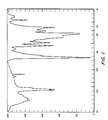
- Rhoplex E-693 material is a white emulsion having a solids content of 49.5 to 50.5 percent with a pH of 4.5 to 6.5 and a viscosity at LVT (1), 60 rpm 20-60 and having the infrared curve of Figure 1.
- This copolymer is a self-crosslinking acrylic-type copolymer of the anionic emulsifying type with a density at 20°C of 1.05469 cm3 (8.8 pounds per gallon) and a minimum film forming temperature of +12 o C and a temperature at which the torsional modulus of an air dried film is 300 kg/cm2 at 24 o C.
- the amount of the copolymer present in the chemical treating composition generally ranges from a minor to a major amount of the non-carrier solids of the composition. The amount should at least be that which, in conjunction with the polyurethane, provides for an effective film forming amount of polymer in the fibrous reinforcement.
- the amount of the copolymer is in a ratio of about 10:1 to 1:10 of copolymer to polyurethane or most preferably around 4:1 to 1:4, and to obtain the higher initial physical properties for a reinforced polymer an amount of around 1:1 to 1:4 copolymer to polyurethane, and the amount of the copolymer is in the range of about 5 to about 20 weight percent of the nonaqueous solids of the chemical treating composition.
- the chemical treating composition may optionally have present a polyurethane crosslinking agent to crosslink the curable or crosslinkable polyurethane.
- a polyurethane crosslinking agent to crosslink the curable or crosslinkable polyurethane.
- Any composition known to those skilled in the art for crosslinking polyurethanes is suitable.
- a nonexclusive example is a blocked aliphatic polyisocyanate for instance, a blocked 1,6-hexamethylene diisocyanate-based adduct.
- monomeric blocked polyisocyanates that are water dispersible may also be used. These materials can be prepared from organic diisocyanates and contain biuret, allophanate or urethane groups or isocyanurate rings.
- Suitable polyisocyanates usable in preparing adducts for use as the monomer are those known to those skilled in the art such as ethylene diisocyanate; 1,4-tetramethylene diisocyanate; 1,6-hexamethylene diisocyanate, and the like.
- polyisocyanate adducts containing biuret groups any method known to those skilled in the art may be utilized where coreactants such as water, tertiary alcohols, primary and secondary monoamines and primary and secondary diamines can be used.
- Polyisocyanate adducts containing allophanate groups may be prepared by methods known to those skilled in the art such as GB-A- 994,890 and DEA-2,040,645.
- polyisocyanate adducts containing urea and urethane groups can also be used.
- Suitable blocking agents for these polyisocyanate adducts are, for example, secondary or tertiary alcohols; C-H acid compounds and other blocking agents known to those skilled in the art.
- the amount of the crosslinking material that is used is generally a weight ratio of the crosslinking agent to the polyurethane resin of around 1:20 to 20:1.
- the crosslinking agent is present and in an amount that is effective in producing a reduced solvent swellable residue of the chemical treating composition upon removal of substantial quantities of the carrier when compared to uncrosslinked residues.
- the reduced swellability of residues or films can be measured in accordance with the polymer swellability test of ASTM (American Society of Testing Materials).
- a particularly suitable crosslinking agent for the polyurethane is that obtainable from Mobay Corp., Pittsburgh, Pennsylvania, under the product name Baybond® XW-116 Crosslinker, which is a blocked 1,6-hexamethylene diisocyanate-based adduct having components including butylacetate, triethylamine and N-methylpyrrolidone and which is a yellow liquid with a specific gravity of 1.1 at 25°C, a bulk density of 1,1025 g/cm3 (9.2 pounds per gallon) and a percent volatiles of 35 by weight.
- the amount of the crosslinking agent can be varied depending upon the application of the treated fibrous material.
- the fibrous material When the fibrous material is used in a dark pigmented polymer matrix, higher amounts of the crosslinking material can be used. Otherwise to achieve good color of the reinforced polymer with the chemically treated fibrous material, the amount of the crosslinking agent should not be too great to result in a yellow color upon production of the reinforced polymer.
- This amount of the crosslinking agent is variable also depending on the amount of the antioxidant present in the chemical treating composition. Higher amounts of antioxidants or more effective antioxidants allow for the use of higher amounts of crosslinking agent.
- Another optional component present in the chemical treating composition which is preferably present is a water soluble or dispersible metal deactivating agent such as the polydentate ligands including bi- to octa-dentates and/or compounds having the formula: wherein x is an integer having a value of from 1 to about 6, preferably 1 to 4, and R is a carboxyl group or hydroxyl group or the salts, ethers or esters thereof.
- a water soluble or dispersible metal deactivating agent such as the polydentate ligands including bi- to octa-dentates and/or compounds having the formula: wherein x is an integer having a value of from 1 to about 6, preferably 1 to 4, and R is a carboxyl group or hydroxyl group or the salts, ethers or esters thereof.
- Examples of these well known compounds are ethylene diamine tetraacetic acid (an alkylene diamine(penta)dentate), propylene diamine tetraacetic acid as well as the sodium or potassium or ammonium salts thereof and appropriate chemical mixtures thereof and N,N,N,'N'-tetrakis(2-hydroxypropyl)ethylenediamine.
- the amount of this material present in the chemical treating composition can be generally an effective metal chelating amount and preferably it is present in an amount of 0.01 to 2 percent of the nonaqueous solids of the chemical treating composition. These amounts depend on the quantity of metals present in the chemical treating composition. Higher amounts of metals translate into higher amounts of metal deactivators being useful in the composition.
- Another optional component of the chemical treating composition which is preferably present is one or more antioxidants. Any emulsifiable, dispersible, or soluble antioxidant may be used that is known to those skilled in the art. Any antioxidant known to those skilled in the art for use with coatings and films on discrete surfaces such as fibers can be used. For instance, the antioxidants of US-A- 4,483,948 may be used in the chemical treating composition and US-A- 4,483,948
- Another suitable antioxidant is one that is effective at the temperatures for drying chemically treated fibrous material to remove carriers such as water in forming the film or dried residue of the chemical treatment on the fibrous material.
- these antioxidants are referred to as "low temperature antioxidants”.
- Nonexclusive examples of such an antioxidant include: halogenized hydroxy ammonium compounds, hydrosulfites, bisulfites, phosphorus acid and/or phosphites and phosphite-containing reducing agents selected from alkali metal, alkaline earth metal hypophosphites or hydrogen phosphites and ammonium hypo or hydrogen phosphites.
- the amount of the phosphite-containing reducing agent type antioxidant ranges from 0.001 to 1 weight percent of the nonaqueous solids of the chemical treating composition of the above and from 1 weight percent or more for the other low temperature antioxidants.
- the preferred hypophosphite present is the sodium hypophosphite in an amount up to 1 and most preferably from 0.1 to 0.3 weight percent of the aqueous chemical treating composition.
- a suitable sodium hypophosphite is that available from Fisher Scientific Company as solid sodium hypophosphite having the formula NaH2PO2.H2O. This material is water soluble and when the carrier for the chemical treating composition is water, it is merely dissolved into the chemical treating composition or predissolved and added to the chemical treating composition.
- antioxidants are the "higher temperature antioxidants". These antioxidants are the alkali metal phenyl phosphonates, an example of which is the sodium benzene phosphonate. This material is present in an amount of 0.01 to 1 and most preferably 0.01 to 0.1 weight percent of the chemical treating composition, although greater amounts can be used if additional benefits are required.
- An example of sodium benzene phosphonate is that available from Stauffer Chemical Company having the formula C6H6 O2PNa with a formula weight of 164.
- suitable higher temperature antioxidants are the thioethers and polymers thereof.
- a nonexclusive example of these is di(tridecyl)thiodipropionate with a chemical formula of S(CH2CH2C00C13H27)2.
- a suitable thiodipropionate is that available from Grace from their Evans Chemetics Unit in Waterloo, New York, under the product name Evanstab® 13.
- the amount of this material is generally in the range of 1 to 15 weight percent of the chemical treating composition although higher amounts can be used to produce concominant increased advantages.
- the higher temperature antioxidants are referred to by this terminology because they are more effective at temperatures of molding reinforced polymers rather than the temperature of drying the reinforcing fibers. The former temperature is usually higher than the latter.
- mixtures of these antioxidants are useful in the chemical treating composition and preferably a mixture is used.
- the mixture is of at least one low temperature antioxidant with at least one high temperature antioxidant.
- the mixture of antioxidants can be incorporated into the chemical treating composition or added in a secondary treatment after the chemical treatment has first been applied to the fibers of reinforcement.
- one antioxidant either the low or high temperature antioxidant, can be added with the chemical treating composition with subsequent addition of the other type of antioxidant.
- the ratios of the low temperature antioxidant and the high temperature antioxidant in the mixture is generally in the ratio of 1:1 to 1:20.
- the amounts of the low and high temperature antioxidants used in the mixture are the same as those amounts used in their separate addition.
- the carrier for the chemical treating composition is any material known to those skilled in the art for applying the chemical treatment to fibers during their formation or after their formation or to other types of reinforcement during their formation.
- the carrier can be an organic solvent or water or a combination to produce foams and gels of the chemical treatment.
- water is the carrier to give an aqueous chemical treating composition.
- the water is present in effective amounts to give total solids (nonaqueous content) in the range sufficient for a viscosity of the chemical treatments for application to the fibers for reinforcement.
- the water is present in an amount sufficient to give a total solids in the range of 1 to 50 weight percent and preferably 5 to 20 weight percent.
- the amount of the various components and the amount of water should be balanced so that the viscosity of the solution is not greater than 150 mPa.s at 20°C.
- Solutions having viscosities greater than 150 150 mPa.s are difficult to apply as aqueous emulsion, dispersions or solutions to fibers during their formation, especially to glass fibers that are formed from molten streams of glass with standard type application equipment without causing the breakage of the continuity of the fibers.
- the viscosity of the aqueous chemical treating composition for application to glass fibers during their formation is in the range of 20 to 60 mPa.s at 20°C for best results. If the aqueous chemical treating composition is prepared with thixotropic agents to make it a foam or gel, then the viscosity will be that appropriate to such formulations and the application equipment will be appropriate for applying foams and gels to the fibers or reinforcement.
- the aqueous chemical treating composition can be prepared by addition of any of the components simultaneously or sequentially to each other, but it is preferred to predilute all of the components before they are combined and diluted with water into the aqueous chemical treating composition. This is to enhance their solubility, dispersibility or emulsifiability.
- the fibrous materials that are treated with the aqueous chemical treating composition are the high modulus fibers such as glass fibers, carbon fibers and polyaramide fibers. Suitable examples of glass fibers include "E-glass” or “621-glass” fibers and low or free boron or fluorine derivatives thereof.
- the aqueous chemical treating composition is applied to the fibers preferably in the forming operation of the fibers, and the fibers are formed into continuous strands and dried to remove water as the carrier, and the strands are subsequently chopped. Alternatively, the aqueous chemical treating composition is applied to the fibers in a wet chop forming operation.
- the amount of the dried residue of the aqueous chemical treating composition on the fibers is generally in the range of 0.1 to 2 percent LOI (loss on ignition).
- LOI leak on ignition
- the fibers can be dried in such a manner to avoid formation of undesirable colors, so the drying temperature should not be too high to produce non-white colors when any heat sensitive components are present in the aqueous chemical treating composition.
- the low temperature antioxidant is present in the chemical treating composition, higher temperatures of drying can be used to enhance the integrity of the fibers comprising the strand or strands of reinforcement.
- a moisture-reduced residue is formed on the fibers and these fibers are useful in reinforcing polymers especially polyamide homopolymers and copolymers.
- drying of the fibers occurs any time before the fibers contact the matrix polymer.
- the drying temperature is in the range of ambient to around less than(350°F) 177°C with lower temperatures requiring longer drying times.
- the treated glass fibers are dried at a temperature in the range of about (280°F to 290°F) 138°C to 143°C for a period of time from 10 to 12 hours to reduce the moisture content of the fibers to about 0.
- the fibers which include a plurality of fibers can have any secondary chemical treatment applied to them when they are chopped subsequently to their formation.
- chopped lengths vary from around less than 1.59 mm (1/16 ⁇ ) to greater than 50.8 mm (2 ⁇ ), but preferably in the range of 3,175 mm to 12,7 mm (1/2 ⁇ ).
- inorganic fillers include mica, wollastonite, talc, clay and novaculite.
- Contacting the fillers with the aqueous chemical treating composition is accomplished by spraying or dipping or the like as a convenient way of treating them.
- the dried fibers are used to reinforce polymeric matrices in any of the molding processes known to those skilled in the art utilizing either chopped strand, continuous strand or a mixture thereof.
- the chopped fiber strands are mixed with the matrix polymer resin in a dry powder mixture to produce a homogeneous batch of matrix polymer.
- the batch can be compression or injection molded to produce the fiber reinforced polymeric part or shaped device.
- fiber reinforced polymers such as fiber reinforced polyamides, and polyalkylene terephthalates, including poly(ethylene terephthalate) and poly(butylene terephthalate) and polyphenylene oxide, polystyrenics and other similar polar thermoplastic polymers, copolymers, blends and alloys.
- the preferred embodiment utilizes glass fibers that are dry chopped glass fibers having a dried residue of the chemical treating composition where the fibers have a length of 3,175 mm - 12,7 mm (1/8 ⁇ , to 1/2 ⁇ ). fibers have conventional filament diameters that can range from 1 micron to greater than 30 but are preferably in the diameter of 10 to 16
- the aqueous chemical treating composition preferably has the formulation with ranges of preferred amounts for the components as shown in Table A.
- the aqueous chemical treating composition is formulated by adding the polyurethane latex to a premix tank with slow stirring and the addition of about 1/5 of the total volume of water as deionized water. About 2/5 of the total volume of water is added to a main mix tank and the amino organofunctional silane is added to this deionized water with slow stirring.
- the polyurethane latex premix is added to the silane mixture in the main mix tank.
- a sufficient amount of deionized water is added to dissolve the ethylene diamine tetraacetic acid and the sodium hypophosphite with stirring. This solution is then transferred to the main mix tank.
- the epoxy polyester polymer is added to a tank with an Eppenbach mix with a small amount of water and the yellowish liquid di (tridecyl) thiodipropionate is added to this mixture and stirred for 5 minutes and added to the main mix tank.
- the polyisocyanate crosslinking agent is added to a premix tank and has added to it hot water with stirring. After the emulsion forms, it is stirred for 5 minutes and then added to the main mix tank.
- the acrylic copolymer is added to a premix tank with a small amount of water, around 1/30 of the total volume of water needed for the chemical treating composition and the mixture is stirred for 5 minutes and added to the main mix tank.
- the aqueous chemical treating composition is diluted with deionized water to its final desired volume.
- the aqueous chemical treating composition is applied to glass fibers during their formation, preferably those having a G-fiber diameter, and the treated fibers are formed into strands, but the strand formation can be anything ranging from DE-75 to around K-18, but preferably the strand construction is G-31 strands.
- the aqueous chemical treating composition is applied at such a rate to give an LOI on the strand of around 1 to 1.4 weight percent of the treated strand.
- a plurality of the packages are dried at a temperature around (285°F) 141°C for a period of around 11 hours. This drying removes water and crosslinks the polyurethane through the crosslinking agent to the reduced swellable residue.
- a plurality of the dried packages are located so that the strands can be removed from the packages and preferably treated with an antistat and alkali metal phenyl phosphonate antioxidant as a post treatment before the fibers are chopped into dry chopped strands.
- the dry chopped strands are preferably molded with polyamide resin in injection molding processes to produce fiber reinforced polyamide having good solvent resistance especially in solvents like ethylene glycol.
- the seven chemical treating compositions were applied to a plurality of G-fibers that were gathered into strands having a construction of G-15.
- the strands were dried in a manner similar to that of the preferred embodiment and were prepared into dry chopped strands of 3,175 mm(1/8 ⁇ ) without the addition of an additional antioxidant in a post treatment.
- These fibers were used in injection molding with polyamide resin, which was a nylon 6,6 having the trade designation Zytel 101 NC10, and molded into tensile bars and disks.
- polyamide resin which was a nylon 6,6 having the trade designation Zytel 101 NC10, and molded into tensile bars and disks.
- These reinforced polyamides were tested for tensile strength, flexural strength, flex modulus and Izod impact according to standard ASTM test methods, including respectively D-638, D-790 and D-256. These data are presented in Table 2.
- Table 2 presents data for a funnel flow test which qualifies glass fibers for handleability and processability in forming reinforced polymers.
- the funnel flow test was conducted by placing a given quantity of chopped glass fiber strands that were dry chopped in a funnel equipped for vibration. The time it took the total weight to pass through the funnel was recorded.
- the long term heat aging was conducted by placing the samples in a temperature environment of 180°C for various times: 400, 800 and 1200 hours, and tensile strength tests were conducted on the heat aged samples by the same ASTM tensile strength test as used for the initial and ethylene glycol-soaked tensile strength measurement. Also a QUV weatherometer test (accelerated weather test) was done at various times of 400 and 800 hours. Table 2 also lists the data for this test. This test was conducted in accordance with the QUV Weatherometer procedure where the cycle was 4 hours at 70°C, dry under UV light, and 4 hours at 50°C with condensation and dark for several hours. The percent glass in the fiber reinforced polyamides of Table 2 are also listed for purposes of comparison between the samples.
- Table 2 has two illustrative examples, the first of which is for fiber reinforced polyamides using fibers treated in accordance with US-A 4,271,229.
- the second illustrative example is a commercially available chemically treated glass fiber available from Nippon Sheet Glass Co. that has been used in reinforcing polyamides.
- Table 2 shows the chemically treated fibers of the present invention have comparable, initial, tensile strength, flexural strength and flexural modulus and Izod impact values to the fibers produced in accordance with US-A 4,271,229. Also, the fibers of the present invention have improved tensile properties after ethylene glycol soaking compared to the fibers produced in accordance with US-A-4,271,229. Also, the fibers of the present invention have comparable or improved heat aging properties to those of the fibers produced in US-A- 4,271,229. Also, the fibers of the present invention have improved initial tensile properties to the commercially available fibers of illustrative Example 2.
- the tensile properties of the fibers of the present invention are comparable after ethylene glycol soaking to the fibers of illustrative Example 2, and they have improved values after heat aging to the samples having the fibers of the commercially available illustrative Example 2. Therefore, Table 2 shows the chemically treated glass fibers enabling the production of fiber reinforced polymers having a marriage of properties of good initial strength and good solvent resistance for solvents like ethylene glycol and good heat aging properties and good weather stability.
- Figure 2 illustrates the improvement in thermal stability for the dried residue of the chemical treating composition.
- Figure 2 is a composite of three thermal gravimetric analyses (TGA) curves showing the improved thermal stability of dried residues having components of the present invention for curves A and B over curve E.
- Curve C is the TGA curve for a residue produced in accordance with US-A- 4,271,229.
- Curve B is the TGA curve of the residue having a polyurethane polymer, the acrylic copolymer and aminosilane, the epoxy polyester polymer processing aid and the crosslinking agent formed into a residue by drying the aqueous chemical treating composition.
- Curve A is a residue similar to that of the TGA curve of Curve B which also includes the sodium hypophosphite plus ethylenediamine tetraacetate and sodium benzene phosphite. Curves A and B are further to the right than Curve C showing the improvement in thermal stability from a material similar to US-A-4,271,229.
Landscapes
- Chemical & Material Sciences (AREA)
- Engineering & Computer Science (AREA)
- Materials Engineering (AREA)
- Chemical Kinetics & Catalysis (AREA)
- Organic Chemistry (AREA)
- Manufacturing & Machinery (AREA)
- Health & Medical Sciences (AREA)
- Medicinal Chemistry (AREA)
- Polymers & Plastics (AREA)
- Life Sciences & Earth Sciences (AREA)
- General Life Sciences & Earth Sciences (AREA)
- General Chemical & Material Sciences (AREA)
- Geochemistry & Mineralogy (AREA)
- Treatments For Attaching Organic Compounds To Fibrous Goods (AREA)
- Compositions Of Macromolecular Compounds (AREA)
- Reinforced Plastic Materials (AREA)
- Polyurethanes Or Polyureas (AREA)
- Paints Or Removers (AREA)
- Surface Treatment Of Glass Fibres Or Filaments (AREA)
- Chemical Or Physical Treatment Of Fibers (AREA)
Applications Claiming Priority (2)
| Application Number | Priority Date | Filing Date | Title |
|---|---|---|---|
| US21519088A | 1988-07-05 | 1988-07-05 | |
| US215190 | 1988-07-05 |
Publications (3)
| Publication Number | Publication Date |
|---|---|
| EP0356655A2 true EP0356655A2 (de) | 1990-03-07 |
| EP0356655A3 EP0356655A3 (de) | 1991-08-28 |
| EP0356655B1 EP0356655B1 (de) | 1995-12-13 |
Family
ID=22802033
Family Applications (1)
| Application Number | Title | Priority Date | Filing Date |
|---|---|---|---|
| EP89112097A Expired - Lifetime EP0356655B1 (de) | 1988-07-05 | 1989-07-03 | Chemische Behandlung von Fasern und deren Verwendung zur Verstärkung von polymeren Matrizen |
Country Status (7)
| Country | Link |
|---|---|
| US (1) | US5484656A (de) |
| EP (1) | EP0356655B1 (de) |
| JP (1) | JP2837444B2 (de) |
| KR (1) | KR940000793B1 (de) |
| CA (1) | CA1339475C (de) |
| DE (1) | DE68925082T2 (de) |
| ES (1) | ES2083370T3 (de) |
Cited By (12)
| Publication number | Priority date | Publication date | Assignee | Title |
|---|---|---|---|---|
| EP0381125A3 (de) * | 1989-02-03 | 1991-01-23 | Ppg Industries, Inc. | Polymerzusammensetzungen die verbesserte oxydative Stabilität aufweisen |
| WO1993002020A1 (en) * | 1991-07-19 | 1993-02-04 | Owens-Corning Fiberglas Corporation | Aqueous coating composition for fibers |
| US5236982A (en) * | 1992-07-13 | 1993-08-17 | Owens-Corning Fiberglas Technology, Inc. | Size composition |
| WO1995025074A1 (en) * | 1994-03-14 | 1995-09-21 | Ppg Industries, Inc. | Glass fiber sizing and sized glass fibers and polyolefin reinforcing articles |
| US5484656A (en) * | 1988-07-05 | 1996-01-16 | Ppg Industries, Inc. | Chemical treatment for fibers and reinforcement for polymer matrices resulting in good solvent resistance |
| US5925462A (en) * | 1992-06-17 | 1999-07-20 | Ppg Industries Ohio, Inc. | Aqueous coating compositions for glass fibers, fiber strands coated with such compositions and optical fiber cable assemblies including such fiber strands |
| US6051315A (en) * | 1992-06-17 | 2000-04-18 | Ppg Industries Ohio, Inc. | Optical fiber cable assembly and method of reducing water wicking in the same |
| US6379794B1 (en) | 1992-06-17 | 2002-04-30 | Ppg Industries Ohio, Inc. | Acrylic impregnant for fibers |
| FR2826359A1 (fr) * | 2001-06-21 | 2002-12-27 | Saint Gobain Vetrotex | Fils de verre ensimes, composition d'ensimage et composites comprenant lesdits fils |
| EP2554594A1 (de) * | 2011-08-02 | 2013-02-06 | 3B-Fibreglass SPRL | Schlichtezusammensetzung für Füllstoffe in thermoplastischer Polymermaterialverstärkung verwendeten Ladungen, verstärkte Polymermaterialien und Herstellungsverfahren |
| WO2020038994A1 (en) | 2018-08-24 | 2020-02-27 | Covestro Deutschland Ag | A composition, preparation method and application thereof |
| WO2020078604A1 (en) | 2018-08-24 | 2020-04-23 | Covestro Deutschland Ag | A polyurethane composition, preparation method and application thereof |
Families Citing this family (11)
| Publication number | Priority date | Publication date | Assignee | Title |
|---|---|---|---|---|
| JP3707332B2 (ja) * | 2000-02-15 | 2005-10-19 | 日本板硝子株式会社 | ガラス繊維およびゴム製品 |
| US7419721B2 (en) | 2003-12-19 | 2008-09-02 | Ppg Industries Ohio, Inc. | Sizing composition and glass fiber reinforced thermoplastic resin |
| BE1016107A3 (nl) * | 2004-07-01 | 2006-03-07 | Easy Hair Group Holding Ltd | Verbeterd kunsthaar. |
| US7910502B1 (en) * | 2006-03-31 | 2011-03-22 | Honeywell International Inc. | Liquid submersion ballistic performance through hybridization |
| CN108504078B (zh) * | 2017-02-28 | 2022-04-19 | 科思创聚合物(中国)有限公司 | 一种组合物及其制备方法和应用 |
| WO2018158278A1 (en) | 2017-02-28 | 2018-09-07 | Covestro Deutschland Ag | A composition, its production and use thereof |
| EP3640271A1 (de) | 2018-10-18 | 2020-04-22 | Covestro Deutschland AG | Polyurethanzusammensetzung, herstellungsverfahren und anwendung davon |
| EP3640272A1 (de) | 2018-10-18 | 2020-04-22 | Covestro Deutschland AG | Zusammensetzung, herstellungsverfahren und anwendung davon |
| CN113423770A (zh) * | 2019-02-15 | 2021-09-21 | 第一工业制药株式会社 | 树脂填充纤维基材、纤维强化复合材料及其制造方法 |
| KR20210126574A (ko) * | 2019-02-15 | 2021-10-20 | 다이이치 고교 세이야쿠 가부시키가이샤 | 수지 충전 섬유 기재, 섬유 강화 복합 재료 및 그 제조 방법 |
| JP2020186314A (ja) * | 2019-05-14 | 2020-11-19 | 旭化成株式会社 | 樹脂用充填材および熱可塑性樹脂組成物 |
Family Cites Families (51)
| Publication number | Priority date | Publication date | Assignee | Title |
|---|---|---|---|---|
| US2946762A (en) * | 1956-11-01 | 1960-07-26 | American Cyanamid Co | Aqueous solution containing a bisulfite and acrylonitrile polymer having basic amino groups |
| US3018262A (en) * | 1957-05-01 | 1962-01-23 | Shell Oil Co | Curing polyepoxides with certain metal salts of inorganic acids |
| DE1070377B (de) * | 1957-05-20 | 1959-12-03 | The Dow Chemical Company, Midland, Mich. (V. St. A.) | Verfahren zum Verringern des Monomcrenrestgehaltes eines Acrylsäureamidpolymerisats |
| US3108990A (en) * | 1958-05-22 | 1963-10-29 | Weyerhaeuser Co | Process of stabilizing phenol formaldehyde resin |
| US3157562A (en) * | 1959-07-27 | 1964-11-17 | Rohm & Haas | Bonded non-woven fibrous products and methods of making them |
| GB958390A (en) * | 1961-07-11 | 1964-05-21 | Ici Ltd | Purification and stabilisation of polyethers |
| US3298995A (en) * | 1964-01-21 | 1967-01-17 | Goodrich Co B F | Polyesterurethane elastomers having improved color characteristics |
| DE1241993B (de) * | 1964-01-31 | 1967-06-08 | Glanzstoff Ag | Verfahren zur Absaettigung von Doppelbindungen in Polyolefinen |
| US3414532A (en) * | 1965-04-19 | 1968-12-03 | Argus Chem | Stabilization of polypropylene against degradative deterioration on longterm exposure to elevated temperatures above 525deg. f |
| US3535249A (en) * | 1966-10-24 | 1970-10-20 | Goodyear Tire & Rubber | Antioxidant compositions,their use in polymers and products made therefrom |
| US3565840A (en) * | 1968-05-21 | 1971-02-23 | Allied Chem | Color stabilized oxidized polyethylene emulsions |
| DE2004676C3 (de) * | 1970-02-03 | 1982-05-19 | Basf Ag, 6700 Ludwigshafen | Verfahren zur Herstellung eines verbesserten Schlichtemittels |
| US3655828A (en) * | 1970-06-01 | 1972-04-11 | Cities Service Co | Process for preparing a polymer composition having improved gloss and color |
| US3933737A (en) * | 1970-08-22 | 1976-01-20 | Kabel-Und Metallwerke Gutehoffnungshutte Aktiengesellschaft | Polymer composition for bonding to copper |
| US3860558A (en) * | 1970-12-07 | 1975-01-14 | Ciba Geigy Corp | Stabilized polyamide compositions |
| US3901848A (en) * | 1971-12-21 | 1975-08-26 | Ciba Geigy Corp | Stabilizer system of metal hydroxyalkyl phosphonic acid, uv absorber and benzoate |
| US4009317A (en) * | 1973-11-14 | 1977-02-22 | Owens-Corning Fiberglas Corporation | Glass fiber coated with a size comprising emulsified clad particles of poly(methyl methacrylate) |
| US4052362A (en) * | 1976-01-30 | 1977-10-04 | Ube Industries, Ltd. | Olefin polymer composition |
| US4054695A (en) * | 1976-03-19 | 1977-10-18 | Union Carbide Corporation | Textile fiber having improved flame retardancy properties |
| JPS6016460B2 (ja) * | 1976-03-30 | 1985-04-25 | 宇部興産株式会社 | ポリオレフイン組成物 |
| FR2352761A1 (fr) * | 1976-05-26 | 1977-12-23 | Saint Gobain | Ensimage pour fibres de verre et fibres ainsi revetues |
| FR2377982A1 (fr) * | 1977-01-19 | 1978-08-18 | Saint Gobain | Compositions pour le revetement de fibres de verre et fibres ainsi obtenues |
| US4291095A (en) * | 1977-08-03 | 1981-09-22 | Owens-Corning Fiberglass Corporation | Coating composition for glass fibers |
| US4137209A (en) * | 1977-11-14 | 1979-01-30 | Owens-Corning Fiberglas Corporation | Glass fiber size composition |
| US4200707A (en) * | 1978-08-11 | 1980-04-29 | E. I. Du Pont De Nemours And Company | Polyamide nucleated with zinc phenyl phosphinate or zinc phenyl phosphonate |
| US4238575A (en) * | 1979-02-12 | 1980-12-09 | Ciba-Geigy Corporation | Stabilized compositions containing polymeric thiosynergists |
| US4507342A (en) * | 1979-05-08 | 1985-03-26 | Rohm And Haas Company | Polymers adherent to polyolefins |
| US4252852A (en) * | 1979-07-09 | 1981-02-24 | Rohm And Haas Company | Aqueous vinyl coatings |
| US4271229A (en) * | 1979-09-04 | 1981-06-02 | Ppg Industries, Inc. | Sizing composition to yield sized glass fibers with improved UV stability |
| US4382991A (en) * | 1979-09-04 | 1983-05-10 | Ppg Industries, Inc. | Sizing composition and sized strand useful as reinforcement |
| US4272294A (en) * | 1979-09-20 | 1981-06-09 | Johns-Manville Corporation | Alkali resistant glass article and method of preparation |
| US4341677A (en) * | 1980-04-03 | 1982-07-27 | Ppg Industries, Inc. | Antioxidants and reinforced polymers and oil-in-water emulsions of antioxidants |
| US4338234A (en) * | 1980-06-04 | 1982-07-06 | Ppg Industries, Inc. | Sizing composition and sized glass fibers and strands produced therewith |
| JPS5722144A (en) * | 1980-07-10 | 1982-02-05 | Asahi Fiber Glass Co Ltd | Sizing composition for glass fiber |
| US4483948A (en) * | 1980-09-24 | 1984-11-20 | Ppg Industries, Inc. | Antioxidants and reinforced polymers and oil-in-water emulsions of antioxidants |
| JPS5821837A (ja) * | 1981-07-31 | 1983-02-08 | Toshiba Corp | 集積回路 |
| JPS5879069A (ja) * | 1981-11-05 | 1983-05-12 | Kanebo N S C Kk | 防変色性接着組成物 |
| US4408005A (en) * | 1982-03-22 | 1983-10-04 | The Dow Chemical Company | Flame retardant polycarbonates |
| US4450197A (en) * | 1982-04-14 | 1984-05-22 | Owens-Corning Fiberglas Corporation | Polytetrafluoroethylene-impregnated bundles of sized glass fibers |
| US4423199A (en) * | 1982-09-30 | 1983-12-27 | Rohm And Haas Company | Acrylamide containing emulsion copolymers for thickening purposes |
| US4608304A (en) * | 1982-09-30 | 1986-08-26 | Mobay Corporation | Glass fibers coated with aqueously dispersed coating compositions |
| FR2541328A1 (fr) * | 1983-02-23 | 1984-08-24 | Rhone Poulenc Spec Chim | Nouvelle composition d'encollage, leur preparation et leur utilisation a l'encollage des fils textiles |
| DE3334226A1 (de) * | 1983-09-22 | 1985-04-11 | Basf Ag, 6700 Ludwigshafen | Verfahren zur stabilisierung verduennter waessriger polymerloesungen von hochmolekularen homo- und copolymerisaten auf basis wasserloeslicher ethylenisch ungesaettigter verbindungen |
| US4503175A (en) * | 1983-12-19 | 1985-03-05 | E. I. Du Pont De Nemours And Company | Acrylic polyurethane coating composition |
| US4636437A (en) * | 1984-11-05 | 1987-01-13 | Owens-Corning Fiberglas Corporation | Glass fiber size and impregnant compositions |
| US4863989A (en) * | 1986-06-04 | 1989-09-05 | Seitetsu Kagaku Co., Ltd. | Water-absorbent resin composition |
| DE3704147A1 (de) * | 1987-02-11 | 1988-08-25 | Basf Ag | Bindemittel zur herstellung von polyurethanlacken |
| CA1339475C (en) * | 1988-07-05 | 1997-09-23 | Ppg Industries Ohio, Inc. | Chemical treatment for fibers and reinforcement for polymer matrices resulting in good solvent resistance |
| US4888383A (en) * | 1988-08-03 | 1989-12-19 | E. I. Du Pont De Nemours And Company | Method for aqueous dispersion of polyurethane modified polyacrylics |
| CA1336110C (en) * | 1989-02-03 | 1995-06-27 | Robert Gregory Swisher | Polymeric-containing compositions with improved oxidative stability |
| US5247004A (en) * | 1989-02-03 | 1993-09-21 | Ppg Industries, Inc. | Polymeric-containing compositions with improved oxidative stability |
-
1989
- 1989-06-13 CA CA000602687A patent/CA1339475C/en not_active Expired - Fee Related
- 1989-07-03 EP EP89112097A patent/EP0356655B1/de not_active Expired - Lifetime
- 1989-07-03 ES ES89112097T patent/ES2083370T3/es not_active Expired - Lifetime
- 1989-07-03 DE DE68925082T patent/DE68925082T2/de not_active Expired - Fee Related
- 1989-07-04 JP JP1173884A patent/JP2837444B2/ja not_active Expired - Fee Related
- 1989-07-04 KR KR1019890009504A patent/KR940000793B1/ko not_active Expired - Fee Related
-
1993
- 1993-01-22 US US08/007,407 patent/US5484656A/en not_active Expired - Fee Related
Cited By (18)
| Publication number | Priority date | Publication date | Assignee | Title |
|---|---|---|---|---|
| US5484656A (en) * | 1988-07-05 | 1996-01-16 | Ppg Industries, Inc. | Chemical treatment for fibers and reinforcement for polymer matrices resulting in good solvent resistance |
| EP0381125A3 (de) * | 1989-02-03 | 1991-01-23 | Ppg Industries, Inc. | Polymerzusammensetzungen die verbesserte oxydative Stabilität aufweisen |
| WO1993002020A1 (en) * | 1991-07-19 | 1993-02-04 | Owens-Corning Fiberglas Corporation | Aqueous coating composition for fibers |
| US6051315A (en) * | 1992-06-17 | 2000-04-18 | Ppg Industries Ohio, Inc. | Optical fiber cable assembly and method of reducing water wicking in the same |
| US6379794B1 (en) | 1992-06-17 | 2002-04-30 | Ppg Industries Ohio, Inc. | Acrylic impregnant for fibers |
| US5925462A (en) * | 1992-06-17 | 1999-07-20 | Ppg Industries Ohio, Inc. | Aqueous coating compositions for glass fibers, fiber strands coated with such compositions and optical fiber cable assemblies including such fiber strands |
| US5236982A (en) * | 1992-07-13 | 1993-08-17 | Owens-Corning Fiberglas Technology, Inc. | Size composition |
| US6207737B1 (en) | 1994-03-14 | 2001-03-27 | Ppg Industries Ohio, Inc. | Glass fiber sizing, sized glass fibers and polyolefin reinforced articles |
| US5646207A (en) * | 1994-03-14 | 1997-07-08 | Ppg Industries, Inc. | Aqueous sizing compositions for glass fibers providing improved whiteness in glass fiber reinforced plastics |
| WO1995025074A1 (en) * | 1994-03-14 | 1995-09-21 | Ppg Industries, Inc. | Glass fiber sizing and sized glass fibers and polyolefin reinforcing articles |
| FR2826359A1 (fr) * | 2001-06-21 | 2002-12-27 | Saint Gobain Vetrotex | Fils de verre ensimes, composition d'ensimage et composites comprenant lesdits fils |
| WO2003000611A1 (fr) * | 2001-06-21 | 2003-01-03 | Saint-Gobain Vetrotex France S.A. | Fils de verre ensimes, composition d'ensimage et composites comprenant lesdits fils |
| CN1309671C (zh) * | 2001-06-21 | 2007-04-11 | 法国圣戈班韦特罗特斯有限公司 | 上浆玻璃纱和上浆组合物以及含有所述纱的复合材料 |
| EP2554594A1 (de) * | 2011-08-02 | 2013-02-06 | 3B-Fibreglass SPRL | Schlichtezusammensetzung für Füllstoffe in thermoplastischer Polymermaterialverstärkung verwendeten Ladungen, verstärkte Polymermaterialien und Herstellungsverfahren |
| WO2013017471A2 (en) | 2011-08-02 | 2013-02-07 | 3B-Fibreglass Sprl | Sizing composition for charges used in thermoplastic polymeric material reinforcement, reinforced polymeric materials and method of manufacture |
| WO2013017471A3 (en) * | 2011-08-02 | 2013-04-18 | 3B-Fibreglass Sprl | Sizing composition for charges used in thermoplastic polymeric material reinforcement, reinforced polymeric materials and method of manufacture |
| WO2020038994A1 (en) | 2018-08-24 | 2020-02-27 | Covestro Deutschland Ag | A composition, preparation method and application thereof |
| WO2020078604A1 (en) | 2018-08-24 | 2020-04-23 | Covestro Deutschland Ag | A polyurethane composition, preparation method and application thereof |
Also Published As
| Publication number | Publication date |
|---|---|
| ES2083370T3 (es) | 1996-04-16 |
| DE68925082D1 (de) | 1996-01-25 |
| EP0356655B1 (de) | 1995-12-13 |
| CA1339475C (en) | 1997-09-23 |
| KR900001791A (ko) | 1990-02-27 |
| EP0356655A3 (de) | 1991-08-28 |
| JP2837444B2 (ja) | 1998-12-16 |
| KR940000793B1 (ko) | 1994-01-31 |
| DE68925082T2 (de) | 1996-09-05 |
| US5484656A (en) | 1996-01-16 |
| JPH0267327A (ja) | 1990-03-07 |
Similar Documents
| Publication | Publication Date | Title |
|---|---|---|
| EP0356655B1 (de) | Chemische Behandlung von Fasern und deren Verwendung zur Verstärkung von polymeren Matrizen | |
| EP0381125B1 (de) | Polymerzusammensetzungen die verbesserte oxydative Stabilität aufweisen | |
| US5247004A (en) | Polymeric-containing compositions with improved oxidative stability | |
| JP3390441B2 (ja) | サイズ組成物 | |
| US5827612A (en) | Aqueous coating compositions for glass fibers, fiber strands coated with such compositions and optical fiber cable assemblies including such fiber strands | |
| EP0646063A1 (de) | Chemisch behamdelte glasfasern zur verstärkung polymerer materialien | |
| EP0991603A1 (de) | Glasfaserschlichte hoher lösbarkeit | |
| EP1247843A2 (de) | UV-härtbare Beschichtungszusammensetzung fur optische Glasfasern mit schneller Aushärtung und verbesserter Haftung am Glas | |
| EP0897376B1 (de) | Schlichtemittel mit hoher löslichkeit für fasern | |
| US4382991A (en) | Sizing composition and sized strand useful as reinforcement | |
| EP1641724A1 (de) | Schlichtezusammensetzung für thermoplastische verstärkung | |
| US6322888B1 (en) | Method for producing sized glass fibers and resulting products | |
| US4927869A (en) | Chemically treated glass fibers for reinforcing polymers | |
| JP2002512585A (ja) | 硬化性液状樹脂組成物 | |
| US20070072989A1 (en) | Two-part sizing composition for reinforcement fibers | |
| CA2635451A1 (en) | Two-part sizing composition for reinforcement fibers | |
| EP0374593A1 (de) | Chemisch behandelte inorganische Oxidfaser mit thermisch beständigen Polymeren | |
| US7087302B2 (en) | Glass sizing composition | |
| EP0656079B1 (de) | Mit polyurethan beschichtete fasern | |
| KR19980066933A (ko) | 유리섬유용 양이온성 폴리우레탄 수분산체의 제조방법 | |
| HK1008013B (en) | Size composition | |
| MXPA98009257A (en) | Composition of apresto for fibers, of alta solubili |
Legal Events
| Date | Code | Title | Description |
|---|---|---|---|
| PUAI | Public reference made under article 153(3) epc to a published international application that has entered the european phase |
Free format text: ORIGINAL CODE: 0009012 |
|
| AK | Designated contracting states |
Kind code of ref document: A2 Designated state(s): BE CH DE ES FR GB IT LI NL SE |
|
| PUAL | Search report despatched |
Free format text: ORIGINAL CODE: 0009013 |
|
| AK | Designated contracting states |
Kind code of ref document: A3 Designated state(s): BE CH DE ES FR GB IT LI NL SE |
|
| 17P | Request for examination filed |
Effective date: 19911014 |
|
| 17Q | First examination report despatched |
Effective date: 19940211 |
|
| GRAA | (expected) grant |
Free format text: ORIGINAL CODE: 0009210 |
|
| AK | Designated contracting states |
Kind code of ref document: B1 Designated state(s): BE CH DE ES FR GB IT LI NL SE |
|
| REF | Corresponds to: |
Ref document number: 68925082 Country of ref document: DE Date of ref document: 19960125 |
|
| ITF | It: translation for a ep patent filed | ||
| REG | Reference to a national code |
Ref country code: CH Ref legal event code: NV Representative=s name: ISLER & PEDRAZZINI AG PATENTANWAELTE |
|
| ET | Fr: translation filed | ||
| REG | Reference to a national code |
Ref country code: ES Ref legal event code: FG2A Ref document number: 2083370 Country of ref document: ES Kind code of ref document: T3 |
|
| PLBE | No opposition filed within time limit |
Free format text: ORIGINAL CODE: 0009261 |
|
| STAA | Information on the status of an ep patent application or granted ep patent |
Free format text: STATUS: NO OPPOSITION FILED WITHIN TIME LIMIT |
|
| 26N | No opposition filed | ||
| REG | Reference to a national code |
Ref country code: CH Ref legal event code: PUE Owner name: PPG INDUSTRIES, INC. TRANSFER- PPG INDUSTRIES OHIO |
|
| REG | Reference to a national code |
Ref country code: CH Ref legal event code: NV Representative=s name: ISLER & PEDRAZZINI AG |
|
| REG | Reference to a national code |
Ref country code: FR Ref legal event code: TP |
|
| NLS | Nl: assignments of ep-patents |
Owner name: PPG INDUSTRIES OHIO, INC. |
|
| REG | Reference to a national code |
Ref country code: GB Ref legal event code: 732E |
|
| PGFP | Annual fee paid to national office [announced via postgrant information from national office to epo] |
Ref country code: SE Payment date: 20000620 Year of fee payment: 12 |
|
| PGFP | Annual fee paid to national office [announced via postgrant information from national office to epo] |
Ref country code: CH Payment date: 20010621 Year of fee payment: 13 |
|
| PG25 | Lapsed in a contracting state [announced via postgrant information from national office to epo] |
Ref country code: SE Free format text: LAPSE BECAUSE OF NON-PAYMENT OF DUE FEES Effective date: 20010704 |
|
| REG | Reference to a national code |
Ref country code: GB Ref legal event code: IF02 |
|
| EUG | Se: european patent has lapsed |
Ref document number: 89112097.4 |
|
| PGFP | Annual fee paid to national office [announced via postgrant information from national office to epo] |
Ref country code: FR Payment date: 20020619 Year of fee payment: 14 |
|
| PGFP | Annual fee paid to national office [announced via postgrant information from national office to epo] |
Ref country code: NL Payment date: 20020620 Year of fee payment: 14 |
|
| PGFP | Annual fee paid to national office [announced via postgrant information from national office to epo] |
Ref country code: GB Payment date: 20020626 Year of fee payment: 14 |
|
| PGFP | Annual fee paid to national office [announced via postgrant information from national office to epo] |
Ref country code: BE Payment date: 20020724 Year of fee payment: 14 |
|
| PGFP | Annual fee paid to national office [announced via postgrant information from national office to epo] |
Ref country code: DE Payment date: 20020730 Year of fee payment: 14 |
|
| PG25 | Lapsed in a contracting state [announced via postgrant information from national office to epo] |
Ref country code: LI Free format text: LAPSE BECAUSE OF NON-PAYMENT OF DUE FEES Effective date: 20020731 Ref country code: CH Free format text: LAPSE BECAUSE OF NON-PAYMENT OF DUE FEES Effective date: 20020731 |
|
| PGFP | Annual fee paid to national office [announced via postgrant information from national office to epo] |
Ref country code: ES Payment date: 20020807 Year of fee payment: 14 |
|
| REG | Reference to a national code |
Ref country code: CH Ref legal event code: PL |
|
| PG25 | Lapsed in a contracting state [announced via postgrant information from national office to epo] |
Ref country code: GB Free format text: LAPSE BECAUSE OF NON-PAYMENT OF DUE FEES Effective date: 20030703 |
|
| PG25 | Lapsed in a contracting state [announced via postgrant information from national office to epo] |
Ref country code: ES Free format text: LAPSE BECAUSE OF NON-PAYMENT OF DUE FEES Effective date: 20030704 |
|
| PG25 | Lapsed in a contracting state [announced via postgrant information from national office to epo] |
Ref country code: BE Free format text: LAPSE BECAUSE OF NON-PAYMENT OF DUE FEES Effective date: 20030731 |
|
| BERE | Be: lapsed |
Owner name: *PPG INDUSTRIES OHIO INC. UNE SOCIETE DE L'ETAT DE Effective date: 20030731 |
|
| PG25 | Lapsed in a contracting state [announced via postgrant information from national office to epo] |
Ref country code: NL Free format text: LAPSE BECAUSE OF NON-PAYMENT OF DUE FEES Effective date: 20040201 |
|
| PG25 | Lapsed in a contracting state [announced via postgrant information from national office to epo] |
Ref country code: DE Free format text: LAPSE BECAUSE OF NON-PAYMENT OF DUE FEES Effective date: 20040203 |
|
| GBPC | Gb: european patent ceased through non-payment of renewal fee |
Effective date: 20030703 |
|
| PG25 | Lapsed in a contracting state [announced via postgrant information from national office to epo] |
Ref country code: FR Free format text: LAPSE BECAUSE OF NON-PAYMENT OF DUE FEES Effective date: 20040331 |
|
| NLV4 | Nl: lapsed or anulled due to non-payment of the annual fee |
Effective date: 20040201 |
|
| REG | Reference to a national code |
Ref country code: FR Ref legal event code: ST |
|
| REG | Reference to a national code |
Ref country code: ES Ref legal event code: FD2A Effective date: 20030704 |
|
| PG25 | Lapsed in a contracting state [announced via postgrant information from national office to epo] |
Ref country code: IT Free format text: LAPSE BECAUSE OF NON-PAYMENT OF DUE FEES;WARNING: LAPSES OF ITALIAN PATENTS WITH EFFECTIVE DATE BEFORE 2007 MAY HAVE OCCURRED AT ANY TIME BEFORE 2007. THE CORRECT EFFECTIVE DATE MAY BE DIFFERENT FROM THE ONE RECORDED. Effective date: 20050703 |