EP0357068A2 - Verfahren zur Herstellung von hochreinem Lactulosesirup - Google Patents
Verfahren zur Herstellung von hochreinem Lactulosesirup Download PDFInfo
- Publication number
- EP0357068A2 EP0357068A2 EP89116112A EP89116112A EP0357068A2 EP 0357068 A2 EP0357068 A2 EP 0357068A2 EP 89116112 A EP89116112 A EP 89116112A EP 89116112 A EP89116112 A EP 89116112A EP 0357068 A2 EP0357068 A2 EP 0357068A2
- Authority
- EP
- European Patent Office
- Prior art keywords
- lactulose
- lactose
- exchange resin
- beads
- reaction mixture
- Prior art date
- Legal status (The legal status is an assumption and is not a legal conclusion. Google has not performed a legal analysis and makes no representation as to the accuracy of the status listed.)
- Withdrawn
Links
- JCQLYHFGKNRPGE-FCVZTGTOSA-N lactulose Chemical compound OC[C@H]1O[C@](O)(CO)[C@@H](O)[C@@H]1O[C@H]1[C@H](O)[C@@H](O)[C@@H](O)[C@@H](CO)O1 JCQLYHFGKNRPGE-FCVZTGTOSA-N 0.000 title claims abstract description 77
- 229960000511 lactulose Drugs 0.000 title claims abstract description 77
- PFCRQPBOOFTZGQ-UHFFFAOYSA-N lactulose keto form Natural products OCC(=O)C(O)C(C(O)CO)OC1OC(CO)C(O)C(O)C1O PFCRQPBOOFTZGQ-UHFFFAOYSA-N 0.000 title claims abstract description 77
- 239000006188 syrup Substances 0.000 title claims abstract description 18
- 235000020357 syrup Nutrition 0.000 title claims abstract description 18
- 238000004519 manufacturing process Methods 0.000 title claims abstract description 10
- GUBGYTABKSRVRQ-QKKXKWKRSA-N Lactose Natural products OC[C@H]1O[C@@H](O[C@H]2[C@H](O)[C@@H](O)C(O)O[C@@H]2CO)[C@H](O)[C@@H](O)[C@H]1O GUBGYTABKSRVRQ-QKKXKWKRSA-N 0.000 claims abstract description 63
- 239000008101 lactose Substances 0.000 claims abstract description 63
- NWUYHJFMYQTDRP-UHFFFAOYSA-N 1,2-bis(ethenyl)benzene;1-ethenyl-2-ethylbenzene;styrene Chemical compound C=CC1=CC=CC=C1.CCC1=CC=CC=C1C=C.C=CC1=CC=CC=C1C=C NWUYHJFMYQTDRP-UHFFFAOYSA-N 0.000 claims abstract description 38
- 239000003729 cation exchange resin Substances 0.000 claims abstract description 32
- 238000006317 isomerization reaction Methods 0.000 claims abstract description 30
- 239000011541 reaction mixture Substances 0.000 claims abstract description 28
- 239000011324 bead Substances 0.000 claims abstract description 25
- 238000000034 method Methods 0.000 claims abstract description 24
- 238000004132 cross linking Methods 0.000 claims abstract description 12
- 239000003513 alkali Substances 0.000 claims abstract description 4
- HEMHJVSKTPXQMS-UHFFFAOYSA-M Sodium hydroxide Chemical compound [OH-].[Na+] HEMHJVSKTPXQMS-UHFFFAOYSA-M 0.000 claims description 21
- 229910052784 alkaline earth metal Inorganic materials 0.000 claims description 12
- 150000001342 alkaline earth metals Chemical class 0.000 claims description 12
- 235000011121 sodium hydroxide Nutrition 0.000 claims description 7
- 239000007864 aqueous solution Substances 0.000 claims description 4
- 238000010438 heat treatment Methods 0.000 claims description 3
- 239000011369 resultant mixture Substances 0.000 claims description 3
- 150000002772 monosaccharides Chemical class 0.000 abstract description 25
- 229930182830 galactose Natural products 0.000 abstract description 14
- 230000008030 elimination Effects 0.000 abstract description 3
- 238000003379 elimination reaction Methods 0.000 abstract description 3
- 229940079593 drug Drugs 0.000 abstract description 2
- 239000003814 drug Substances 0.000 abstract description 2
- 235000013305 food Nutrition 0.000 abstract description 2
- 238000009776 industrial production Methods 0.000 abstract 1
- 239000006227 byproduct Substances 0.000 description 15
- 238000006243 chemical reaction Methods 0.000 description 11
- 239000011347 resin Substances 0.000 description 11
- 229920005989 resin Polymers 0.000 description 11
- 239000007787 solid Substances 0.000 description 11
- 230000003113 alkalizing effect Effects 0.000 description 10
- 239000003795 chemical substances by application Substances 0.000 description 10
- 230000015572 biosynthetic process Effects 0.000 description 9
- 239000000203 mixture Substances 0.000 description 9
- 238000005342 ion exchange Methods 0.000 description 8
- 239000000126 substance Substances 0.000 description 8
- 230000000694 effects Effects 0.000 description 7
- 239000000243 solution Substances 0.000 description 7
- 150000001720 carbohydrates Chemical class 0.000 description 6
- 238000002425 crystallisation Methods 0.000 description 6
- 230000008025 crystallization Effects 0.000 description 6
- 239000003456 ion exchange resin Substances 0.000 description 6
- 229920003303 ion-exchange polymer Polymers 0.000 description 6
- 230000000977 initiatory effect Effects 0.000 description 5
- MYRTYDVEIRVNKP-UHFFFAOYSA-N 1,2-Divinylbenzene Chemical compound C=CC1=CC=CC=C1C=C MYRTYDVEIRVNKP-UHFFFAOYSA-N 0.000 description 4
- 229920006026 co-polymeric resin Polymers 0.000 description 4
- 238000010828 elution Methods 0.000 description 4
- 239000000706 filtrate Substances 0.000 description 4
- 239000012535 impurity Substances 0.000 description 4
- 239000002808 molecular sieve Substances 0.000 description 4
- 239000000047 product Substances 0.000 description 4
- URGAHOPLAPQHLN-UHFFFAOYSA-N sodium aluminosilicate Chemical compound [Na+].[Al+3].[O-][Si]([O-])=O.[O-][Si]([O-])=O URGAHOPLAPQHLN-UHFFFAOYSA-N 0.000 description 4
- GUBGYTABKSRVRQ-XLOQQCSPSA-N Alpha-Lactose Chemical compound O[C@@H]1[C@@H](O)[C@@H](O)[C@@H](CO)O[C@H]1O[C@@H]1[C@@H](CO)O[C@H](O)[C@H](O)[C@H]1O GUBGYTABKSRVRQ-XLOQQCSPSA-N 0.000 description 3
- 235000008504 concentrate Nutrition 0.000 description 3
- 239000012141 concentrate Substances 0.000 description 3
- 238000001914 filtration Methods 0.000 description 3
- 238000006386 neutralization reaction Methods 0.000 description 3
- 230000000704 physical effect Effects 0.000 description 3
- LFQSCWFLJHTTHZ-UHFFFAOYSA-N Ethanol Chemical compound CCO LFQSCWFLJHTTHZ-UHFFFAOYSA-N 0.000 description 2
- ZLMJMSJWJFRBEC-UHFFFAOYSA-N Potassium Chemical compound [K] ZLMJMSJWJFRBEC-UHFFFAOYSA-N 0.000 description 2
- PPBRXRYQALVLMV-UHFFFAOYSA-N Styrene Chemical compound C=CC1=CC=CC=C1 PPBRXRYQALVLMV-UHFFFAOYSA-N 0.000 description 2
- 230000002378 acidificating effect Effects 0.000 description 2
- AXCZMVOFGPJBDE-UHFFFAOYSA-L calcium dihydroxide Chemical compound [OH-].[OH-].[Ca+2] AXCZMVOFGPJBDE-UHFFFAOYSA-L 0.000 description 2
- 239000000920 calcium hydroxide Substances 0.000 description 2
- 229910001861 calcium hydroxide Inorganic materials 0.000 description 2
- 239000003518 caustics Substances 0.000 description 2
- 238000004587 chromatography analysis Methods 0.000 description 2
- 150000001875 compounds Chemical class 0.000 description 2
- 238000012986 modification Methods 0.000 description 2
- 230000004048 modification Effects 0.000 description 2
- 229910052700 potassium Inorganic materials 0.000 description 2
- 239000011591 potassium Substances 0.000 description 2
- 238000000926 separation method Methods 0.000 description 2
- 230000008961 swelling Effects 0.000 description 2
- XLYOFNOQVPJJNP-UHFFFAOYSA-N water Substances O XLYOFNOQVPJJNP-UHFFFAOYSA-N 0.000 description 2
- DPEYHNFHDIXMNV-UHFFFAOYSA-N (9-amino-3-bicyclo[3.3.1]nonanyl)-(4-benzyl-5-methyl-1,4-diazepan-1-yl)methanone dihydrochloride Chemical compound Cl.Cl.CC1CCN(CCN1Cc1ccccc1)C(=O)C1CC2CCCC(C1)C2N DPEYHNFHDIXMNV-UHFFFAOYSA-N 0.000 description 1
- CHRJZRDFSQHIFI-UHFFFAOYSA-N 1,2-bis(ethenyl)benzene;styrene Chemical compound C=CC1=CC=CC=C1.C=CC1=CC=CC=C1C=C CHRJZRDFSQHIFI-UHFFFAOYSA-N 0.000 description 1
- LSNNMFCWUKXFEE-UHFFFAOYSA-M Bisulfite Chemical compound OS([O-])=O LSNNMFCWUKXFEE-UHFFFAOYSA-M 0.000 description 1
- UXVMQQNJUSDDNG-UHFFFAOYSA-L Calcium chloride Chemical compound [Cl-].[Cl-].[Ca+2] UXVMQQNJUSDDNG-UHFFFAOYSA-L 0.000 description 1
- 206010010774 Constipation Diseases 0.000 description 1
- 230000009102 absorption Effects 0.000 description 1
- 238000010521 absorption reaction Methods 0.000 description 1
- 229910001420 alkaline earth metal ion Inorganic materials 0.000 description 1
- 239000002585 base Substances 0.000 description 1
- 238000005119 centrifugation Methods 0.000 description 1
- 229920001429 chelating resin Polymers 0.000 description 1
- 229920001577 copolymer Polymers 0.000 description 1
- 239000013078 crystal Substances 0.000 description 1
- 125000000600 disaccharide group Chemical group 0.000 description 1
- 238000009826 distribution Methods 0.000 description 1
- 238000005868 electrolysis reaction Methods 0.000 description 1
- 239000012467 final product Substances 0.000 description 1
- 235000013350 formula milk Nutrition 0.000 description 1
- 238000005194 fractionation Methods 0.000 description 1
- -1 galactose Chemical class 0.000 description 1
- 239000003102 growth factor Substances 0.000 description 1
- 238000011835 investigation Methods 0.000 description 1
- 238000004255 ion exchange chromatography Methods 0.000 description 1
- 238000010979 pH adjustment Methods 0.000 description 1
- 239000002245 particle Substances 0.000 description 1
- 239000000843 powder Substances 0.000 description 1
- 238000000746 purification Methods 0.000 description 1
- 239000012492 regenerant Substances 0.000 description 1
- 230000001172 regenerating effect Effects 0.000 description 1
- 239000012266 salt solution Substances 0.000 description 1
- 238000007086 side reaction Methods 0.000 description 1
- 239000007858 starting material Substances 0.000 description 1
Images
Classifications
-
- C—CHEMISTRY; METALLURGY
- C07—ORGANIC CHEMISTRY
- C07H—SUGARS; DERIVATIVES THEREOF; NUCLEOSIDES; NUCLEOTIDES; NUCLEIC ACIDS
- C07H3/00—Compounds containing only hydrogen atoms and saccharide radicals having only carbon, hydrogen, and oxygen atoms
- C07H3/04—Disaccharides
Definitions
- the present invention relates to a process for the production of a high-purity lactulose syrup on an industrial scale.
- Lactulose is used as a bifidus growth factor in foods such as infant formulas and also as a senile constipation improver in drugs.
- Japanese Patent Publication No. 2984/1977 proposes the process for the production of lactulose, in which in order to minimize the formation of monosaccharides - such as galactose - as byproducts, a solution of lactose is added with caustic soda in an amount of 0.27-0.53% based on the lactose, the resultant mixture is heated to a temperature of at least 70°C to form lactulose, and removal of unreacted lactose by crystallization is repeated three times.
- the alkali isomerization reaction is however conducted under mild conditions to suppress the formation of monosaccharides - such as galactose - as byproducts, leading to a drawback that the yield of lactulose is as low as about 20% based on the weight of the initial lactose. It is another drawback that a great deal of time and labor is required for the removal of the unreacted lactose.
- the elimination of monosaccharides can be achieved with extreme ease. It is hence possible to conduct the isomerization reaction under conditions such that the amount of lactulose formed in the reaction mixture may become the largest in spite of the formation of monosaccharides upon the isomerization reaction. Namely, byproducts are formed in a relatively high yield under the reaction conditions which allow the formation of lactulose in a largest yield. Therefore, it has conventionally been difficult to achieve a high overall yield for lactulose.
- the present invention has made it possible to efficiently recover lactulose, which has been formed in the reaction mixture, at a high level of purity by a simple procedure.
- lactose-containing eluate fractions can continuously be collected by simply passing a lactulose-containing reaction mixture, which is obtained by the isomerization reaction of lactose, through a column packed with beads of the cation-exchange resin without separately removing lactose from the mixture in advance.
- the mechanism of this invention is basically ascribable to the molecular sieve effect potentially exhibited by the strongly-acidic chromatographic cation-exchange resin, i.e., because of differences in molecular size, not molecular weight.
- the present invention provides a process for producing a high-purity lactulose syrup from lactose by adding an alkalizing agent to an aqueous solution of the lactose to conduct an isomerization reaction.
- the process comprises the following consecutive steps:
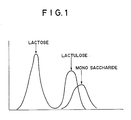
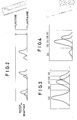
- fractions (a), (b), (c), (d) and (e) indicate a lactose fraction, a lactulose fraction, a lactulose-rich fraction, a monosaccharide-rich fraction and a monosaccharide fraction, respectively.
- the invention will now be further illustrated by means of preferred embodiments.
- byproducts such as monosaccharides are separated from a lactulose-containing reaction mixture obtained by the isomerization reaction of lactose by using beads of a strongly-acidic chromatographic cation-exchange resin, said beads having substantially the same crosslinking degree, so as to obtain a high-purity lactulose syrup.
- This process can be applied to conventional production processes of lactulose.
- the yield of lactulose can be easily improved by simply incorporating the process of the present invention in the conventional processes.
- This invention is hereinafter be described on the basis of a process according to a working mode of this invention, which contains the process described above and is suitable for use in the production of a high-purity lactulose syrup.
- the aqueous lactose solution subjected to the isomerization reaction is an aqueous solution of purified lactose (purity: 99% min.).
- the concentration of lactose is from about 40 wt.% to about 60 wt.%.
- a conventional alkalizing agent such as caustic soda, calcium hydroxide or caustic potassium can be used. It may preferably be added in a n amount of from about 1 wt.% to about 30 wt.% based on the lactose. If the concentration of the aqueous lactose solution is too low, the efficiency is lowered in the subsequent concentration step.
- the efficiency of the next step i.e., the neutralization step is lowered.
- the alkalizing agent is added in an unduly small amount, the isomerization reaction is allowed to proceed only at a low velocity, resulting in a low degree of lactose isomerization.
- any unduly large amount of the alkalizing agent causes the isomerization reaction to proceed too fast, resulting in the formation of more byproducts such as galactose and also in the formation of less lactulose.
- the isomerization reaction can be conducted preferably at about 60°C or higher, at which the isomerization reaction is conducted sufficiently for about 30 minutes or longer.
- the lactose-based yield of lactulose in the isomerization reaction varies depending on the lactose concentrations, the kind and amount of the alkalizing agent added, heating conditions, facilities employed, etc. It is thus preferable to conduct a preliminary test on the conditions for the isomerization reaction in a laboratory and then to conduct the reaction under conditions capable for affording lactulose in a highest yield.
- caustic soda is preferred as the alkalizing agent.
- the cation-exchange resin is preferably of the H+-type.
- An H+-type cation-exchange resin can effectively catch Na+, Ca2+, K+ and the like, which have higher selectivity than H+. So long as such a neutralization reaction can be performed, the cation-exchange resin may be strongly acidic or weakly acidic. For example, "Amberlite IRC-50" (trade name; product of Rohm & Haas Co.) can be used.
- the neutralization reaction relying upon the cation-exchange resin does not induce unnecessary side reactions in the reaction solution so that byproducts are not formed and impurities are not mixed.
- the reaction mixture is concentrated to a total solids content of at least about 70% and is then allowed to stand overnight at 25°C to crystallize lactose. If the concentrate is left over at a temperature lower than 25°C, resulting crystals of lactose are small so that their removal is difficult. It is thus preferred to allow the concentrate to stand at 25°C.
- the lactose thus crystallized is then filtered off by a vacuum filter or the like. This crystallization and removal of lactose are repeated if necessary, whereby the content of lactose is lowered to from about 90 wt.% to about 3.9 wt.% based on the whole solids.
- the amount of lactose still remaining in the lactulose syrup as the final product is practically determined in this stage. Therefore, the crystallization and removal of lactose are conducted to a desired extent.
- the content of lactulose in the reaction solution from which lactose has been removed by filtration generally ranges from about 50 wt.% to about 80 wt.% based on the whole solids.
- the reaction mixture still contains monosaccharides such as galactose and colored substances at relatively high levels.
- the strongly-acidic chromatographic cation-exchange resin which is used in the next step for separating lactulose from impurities, e.g., monosaccharides, is of the alkaline earth metal type, e.g., the Ca2+-type or Mg2+-type
- the above-described step of crystallization and removal of lactose can be skipped because the cation-exchange resin exhibits a molecular sieve effect on lactose, as well as on monosacchararides and colored substances.
- the resultant filtrate is next passed through a column packed with beads of a strongly-acidic chromatographic cation-exchange resin, said beads having substantially the same crosslinking degree, whereby lactulose is separated from byproducts such as monosaccharides and colored substances.
- strongly-acidic chromatographic cation-exchange resin means a strongly-acidic cation-exchange resin useful in ion-exchange chromatography.
- This resin is formed of a copolymer resin of a compound having one or more ion-exchanging groups, such as sulfonic acid, and a polymerizable compound such as divinylbenzene or a base resin such as a styrene-divinylbenzene copolymer resin and ion-exchanging groups introduced in the copolymer resin.
- the crosslinking degree of the copolymer resin or the like, which constitute individual beads, falls within a specific range, so that the individual beads have similar porosities of network and physical properties and contain a predetermined constant number of ion-exchanging groups.
- the column may be regarded as homogeneous as a whole.
- the crosslinking degree may therefore range from about 0.4% to about 0.8%.
- a gel-type resin is preferred. It is preferable that individual beads are substantially in the same gel state and have similar ion-exchange capacity.
- an ion-exchange resin in which individual beads have similar physical properties and ion-exchange capacity and have a narrow bead size distribution makes it possible to narrow down the peak widths of impurities such as monosaccharides and colored substances in the reaction mixture, so that monosaccharides and colored substances can be removed efficiently.
- Examples of the strongly-acidic cation-exchange resin usable in the present invention include those containing sulfonic groups as ion-exchanging groups, for instance, Amberlite CG-60 (trade name; product of Japan Organo Co., Ltd.). They may be either of the H+ type or of the Na+ type.
- reaction mixture from which lactose has been removed by filtration as described above if necessary, through a column or columns having a predetermined volume and packed with beads of a strongly-acidic cation-exchange resin
- monosaccharides such as galactose can be separated from lactulose owing to the differences in molecular size.
- sufficient fractionation is infeasible unless the individual beads of the ion-exchange resin have substantially the same physical properties, namely, substantially the same crosslinking degree.
- the strongly-acidic cation-exchange resin can also be of the alkaline earth metal type, e.g., the Ca2+-type or Mg2+-type.
- lactulose-containing eluate fractions can continuously be collected by simply passing the reaction mixture through a column or columns packed with beads of the resin without separately removing lactose from the mixture in advance.
- the alkaline earth metal type may be prepared by bringing an H+-type or an Na+-type in contact with alkaline earth metal ions to convert the H+-type or the Na+-type into said alkaline earth metal type, or by regenerating a used H+-type or a used Na+-type using an alkaline earth metal salt solution as a regenerant, whereby the degree of swelling of the cation-exchange resin goes down, so that the network size of the resin becomes larger accordingly.
- the alkaline earth metal type can preferentially catch lactose as well as other impurities, rather than lactulose, because of differences in molecular size, even though lactose has the same molecular weight as lactulose does.
- the network size of the resin which is related to the molecular sieve effect, is based, first, on the degree of crosslinking and, second, on the degree of swelling.
- lactose is separated from lactulose by both molecular sieve and ionic affinity effects.
- the lactulose-containing eluate fractions are substantially the same as lactose-containing eluate fractions if an H+-type or an Na+-type is used.
- eluate fractions of mono-saccharides are generally obtained after the above-mentioned fractions. Collection of the lactulose-containing eluate fractions hence leads to separation of the monosaccharides and also to simultaneous capture of colored substances.
- ion-exchange it is necessary to optimize the amount of the resin to be packed in the column and the amount of the reaction mixture to be charged into the column.
- the reaction mixture may be passed at a flow rate of about 20%/hr of the column volume.
- the content of lactulose in the lactulose-containing fractions collected reaches close to 90 wt.% of the whole solids, so that monosaccharides and other byproducts can be removed almost completely.
- the fractions collected above are concentrated to a desired extent so that a high-purity lactulose syrup is obtained.
- the yield of lactulose based on the lactose as the starting material can be increased to from about 10% to about 90%.
- this invention may additionally comprises centrifugation and/or addition of ethanol upon crystallization and removal of lactose, and/or pH adjustment upon passing the reaction mixture through the column as needed, thereby making it possible to increase the purity of lactulose further.
- the lactulose-containing eluate fractions may be concentrated and then dried to obtain lactulose in the form of powder.
- the reaction mixture had the following saccharide composition: 15.2 wt.% of lactose, 53.1 wt.% of lactulose and 31.7 wt.% of galactose, all based on the whole solids. Thereafter, the reaction mixture was concentrated to a total solids content of 70% in a concentrator manufactured by Wiegand Inc. The resultant concentrate was allowed to stand overnight at 25°C. Lactose thus crystallized was filtered off by a vacuum filter.
- the filtrate had the following saccharide composition: 5.1 wt.% of lactose, 59 wt.% of lactulose and 35.2 wt.% of galactose, all based on the whole solids.
- the filtrate was then subjected to chromatography through a column having a diameter of 2 m and a length of 10 m and packed with "CG-60 Cation-Exchange Resin (Na+-Type)" (trade name; product of Japan Organo Co., Ltd.).
- the strongly-acidic cation-exchange resin was composed of a copolymer of styrene and divinylbenzene and contained sulfonic groups as ion-exchanging groups.
- the beads had a particle size in a range of from 0.2 mm to 0.4 mm and substantially the same crosslinking degree (about 0.6%). It was of the gel type.
- the filtrate was passed at 6,200 l/hr. Upon an elapsed time of 118 minutes after the initiation of charging, collection of eluate was started as lactulose-containing fractions. About 6,090 l was collected (peak: 136 minutes from the initiation of charging). Incidentally, fractions containing monosaccharides such as galactose began to occur about 160 minutes after the initiation of charging. Further, colored substances and the like were substantially captured on the ion-exchange resin.
- the thus-eluted lactulose-containing fractions were concentrated to prepare a syrup whose water content was 30%.
- the syrup prepared as described above had the following saccharide composition: 89.2 wt.% of lactulose and 8.3 wt.% of lactose, both based on the whole solids.
- the solid weight of lactulose was 203.6 kg, and its yield was 50.9% based on the starting lactose.
- a lactulose syrup was prepared in a manner similar to Example 1 except that the chromatography was practiced using XT-1007 (product of Tokyo Organic Chemical Industry Co., Ltd.) (crosslinking degree: 0.6%) as an ion-exchange resin.
- the peak of lactulose-containing fractions occurred about 123 minutes after the initiation of charging, while the peak of fractions containing monosaccharides such as galactose appeared about 167 minutes after the initiation of charging.
- the lactulose-containing fractions were collected and concentrated into a syrup, which had the following saccharide composition: 94.3 wt.% of lactulose and 4.2 wt.% of lactose, both based on the whole solids.
- the solid weight of lactulose was 201.5 kg, and its yield was 50.4% based on the starting lactose.
- the thus-obtained syrup had the following saccharide composition: 90.8 wt.% of lactulose, 0.6 wt.% of lactose and 8.6 wt.% of monosaccharides.
Landscapes
- Chemical & Material Sciences (AREA)
- Organic Chemistry (AREA)
- Health & Medical Sciences (AREA)
- Life Sciences & Earth Sciences (AREA)
- Engineering & Computer Science (AREA)
- Biochemistry (AREA)
- Biotechnology (AREA)
- General Health & Medical Sciences (AREA)
- Genetics & Genomics (AREA)
- Molecular Biology (AREA)
- Saccharide Compounds (AREA)
Applications Claiming Priority (2)
| Application Number | Priority Date | Filing Date | Title |
|---|---|---|---|
| JP216235/88 | 1988-09-01 | ||
| JP21623588 | 1988-09-01 |
Publications (2)
| Publication Number | Publication Date |
|---|---|
| EP0357068A2 true EP0357068A2 (de) | 1990-03-07 |
| EP0357068A3 EP0357068A3 (de) | 1991-07-24 |
Family
ID=16685394
Family Applications (1)
| Application Number | Title | Priority Date | Filing Date |
|---|---|---|---|
| EP19890116112 Withdrawn EP0357068A3 (de) | 1988-09-01 | 1989-08-31 | Verfahren zur Herstellung von hochreinem Lactulosesirup |
Country Status (3)
| Country | Link |
|---|---|
| US (1) | US5034064A (de) |
| EP (1) | EP0357068A3 (de) |
| CA (1) | CA1321583C (de) |
Cited By (2)
| Publication number | Priority date | Publication date | Assignee | Title |
|---|---|---|---|---|
| AU615600B2 (en) * | 1988-12-21 | 1991-10-03 | Duphar International Research B.V. | Method of manufacturing lactulose |
| CN107573389A (zh) * | 2017-08-03 | 2018-01-12 | 江苏汉斯通药业有限公司 | 高纯度乳果糖的制备方法 |
Families Citing this family (6)
| Publication number | Priority date | Publication date | Assignee | Title |
|---|---|---|---|---|
| JP3124409B2 (ja) * | 1993-03-24 | 2001-01-15 | 松谷化学工業株式会社 | 鶏飼料 |
| IT1271449B (it) * | 1993-04-28 | 1997-05-28 | Inalco Spa | Procedimento per la preparazione di lattulosio cristallino da sciroppi commerciali |
| RU2125611C1 (ru) * | 1997-12-11 | 1999-01-27 | Общество с ограниченной ответственностью "Ярославская научно-исследовательская лаборатория молочного сырья" | Способ получения лактулозы |
| RU2123050C1 (ru) * | 1998-01-12 | 1998-12-10 | Общество с ограниченной ответственностью Ярославская научно-исследовательская лаборатория молочного сырья | Способ получения лактулозы |
| GB9827423D0 (en) * | 1998-12-11 | 1999-02-03 | Relax Limited | Method of drying a solution |
| RU2169775C1 (ru) * | 2000-01-20 | 2001-06-27 | Закрытое акционерное общество "ФЕЛИЦАТА" | Способ получения концентрата лактулозы |
Family Cites Families (6)
| Publication number | Priority date | Publication date | Assignee | Title |
|---|---|---|---|---|
| AT288595B (de) * | 1969-02-07 | 1971-03-10 | Laevosan Gmbh & Co Kg | Verfahren zur Herstellung von Lactulose-Konzentrat |
| US4536221A (en) * | 1982-12-17 | 1985-08-20 | Sirac Spa | Process for preparing lactulose from lactose, in the form of a syrup or a crystalline product |
| IT1163540B (it) * | 1983-06-20 | 1987-04-08 | Sirac Srl | Procedimento per la purificazione dello sciroppo di lattulosio |
| JPH0631285B2 (ja) * | 1984-02-09 | 1994-04-27 | 株式会社林原生物化学研究所 | 高純度オリゴグルコシルフラクトシドの製造方法 |
| FR2601385B1 (fr) * | 1986-07-09 | 1989-09-29 | Sucre Rech & Dev | Procede de preparation a partir de saccharose d'un melange de sucres a haute teneur en isomaltose par voie enzymatique et produits obtenus |
| IL90388A (en) * | 1988-05-26 | 1993-08-18 | Duphar Int Res | Pharmaceutical compositions having anti- endotoxic activity containing a novel active fraction from lactulose syrup, and a method for its preparation |
-
1989
- 1989-08-31 US US07/401,300 patent/US5034064A/en not_active Expired - Lifetime
- 1989-08-31 EP EP19890116112 patent/EP0357068A3/de not_active Withdrawn
- 1989-08-31 CA CA000610065A patent/CA1321583C/en not_active Expired - Lifetime
Cited By (2)
| Publication number | Priority date | Publication date | Assignee | Title |
|---|---|---|---|---|
| AU615600B2 (en) * | 1988-12-21 | 1991-10-03 | Duphar International Research B.V. | Method of manufacturing lactulose |
| CN107573389A (zh) * | 2017-08-03 | 2018-01-12 | 江苏汉斯通药业有限公司 | 高纯度乳果糖的制备方法 |
Also Published As
| Publication number | Publication date |
|---|---|
| US5034064A (en) | 1991-07-23 |
| CA1321583C (en) | 1993-08-24 |
| EP0357068A3 (de) | 1991-07-24 |
Similar Documents
| Publication | Publication Date | Title |
|---|---|---|
| JP3018201B2 (ja) | キシロースの回収方法 | |
| EP0756511B1 (de) | Methode zum fraktionieren einer lösung | |
| CA1152501A (en) | Separation of fructose from a mixture of sugars | |
| CA1249812A (en) | Production of pure sugars and ligno-sulphonates from sulphite spent liquor | |
| EP0115631B1 (de) | Trennung von Mannose durch selektive Adsorption über zeolitische Molekularsiebe | |
| JP2004509932A (ja) | 弱酸カチオン交換樹脂を使用するプロセス溶液からベタイン、エリトリトール、イノシトール、スクロース、マンニトール、グリセロール及びアミノ酸を回収するための多段階プロセス | |
| US5034064A (en) | Production process of high-purity lactulose syrup | |
| WO1981002420A1 (en) | Betaine recovery process | |
| CA1333779C (en) | Method for producing galactooligosaccharide | |
| US3471329A (en) | Process for the technical separation of sugar mixtures | |
| JPS6130543A (ja) | 超高純度ソルビトールの製造法 | |
| SU1391494A3 (ru) | Способ получени ксилита | |
| RU2124496C1 (ru) | Способ получения цитрата щелочного металла | |
| KR900006229B1 (ko) | 락투로오즈의 정제방법 | |
| JPH02275835A (ja) | クエン酸含有液からのクエン酸の回収方法 | |
| WO2000042225A1 (en) | Process for the separation of sugars | |
| JP2979442B2 (ja) | マンニット及びマンノースの製造方法 | |
| CA1242710A (en) | Crystalline maltopentaose and process for producing the same | |
| GB2054577A (en) | Purification of pentaerythritol | |
| JPH11501328A (ja) | パラチニトールの新規な製法 | |
| JP2834807B2 (ja) | 精製ラクチュロースの製造法 | |
| JPH02286695A (ja) | オリゴ糖の分離方法 | |
| JP3566485B2 (ja) | 甜菜浸出液の精製方法 | |
| JPH06107611A (ja) | ベタインの製造方法 | |
| JPS6313438B2 (de) |
Legal Events
| Date | Code | Title | Description |
|---|---|---|---|
| PUAI | Public reference made under article 153(3) epc to a published international application that has entered the european phase |
Free format text: ORIGINAL CODE: 0009012 |
|
| AK | Designated contracting states |
Kind code of ref document: A2 Designated state(s): AT FR IT NL |
|
| 17P | Request for examination filed |
Effective date: 19901221 |
|
| PUAL | Search report despatched |
Free format text: ORIGINAL CODE: 0009013 |
|
| AK | Designated contracting states |
Kind code of ref document: A3 Designated state(s): AT FR IT NL |
|
| RAP1 | Party data changed (applicant data changed or rights of an application transferred) |
Owner name: AULT FOODS LIMITED |
|
| 17Q | First examination report despatched |
Effective date: 19920701 |
|
| STAA | Information on the status of an ep patent application or granted ep patent |
Free format text: STATUS: THE APPLICATION IS DEEMED TO BE WITHDRAWN |
|
| 18D | Application deemed to be withdrawn |
Effective date: 19940620 |