EP0357936A1 - Dynamische Selektion der Abtastrichtung der Zuteilung von Aufzugzielrufen - Google Patents
Dynamische Selektion der Abtastrichtung der Zuteilung von Aufzugzielrufen Download PDFInfo
- Publication number
- EP0357936A1 EP0357936A1 EP89113853A EP89113853A EP0357936A1 EP 0357936 A1 EP0357936 A1 EP 0357936A1 EP 89113853 A EP89113853 A EP 89113853A EP 89113853 A EP89113853 A EP 89113853A EP 0357936 A1 EP0357936 A1 EP 0357936A1
- Authority
- EP
- European Patent Office
- Prior art keywords
- hall
- hall calls
- calls
- elevator
- assigning
- Prior art date
- Legal status (The legal status is an assumption and is not a legal conclusion. Google has not performed a legal analysis and makes no representation as to the accuracy of the status listed.)
- Granted
Links
- 238000000034 method Methods 0.000 claims abstract description 35
- 238000009826 distribution Methods 0.000 claims description 8
- SAZUGELZHZOXHB-UHFFFAOYSA-N acecarbromal Chemical compound CCC(Br)(CC)C(=O)NC(=O)NC(C)=O SAZUGELZHZOXHB-UHFFFAOYSA-N 0.000 claims 2
- 230000001174 ascending effect Effects 0.000 claims 2
- 230000000737 periodic effect Effects 0.000 claims 1
- 101100153586 Caenorhabditis elegans top-1 gene Proteins 0.000 description 1
- 241000712893 Impatiens necrotic spot virus Species 0.000 description 1
- 101100370075 Mus musculus Top1 gene Proteins 0.000 description 1
- 238000003491 array Methods 0.000 description 1
- 238000012423 maintenance Methods 0.000 description 1
- 238000012986 modification Methods 0.000 description 1
- 230000004048 modification Effects 0.000 description 1
- 238000005457 optimization Methods 0.000 description 1
Images


Classifications
-
- B—PERFORMING OPERATIONS; TRANSPORTING
- B66—HOISTING; LIFTING; HAULING
- B66B—ELEVATORS; ESCALATORS OR MOVING WALKWAYS
- B66B1/00—Control systems of elevators in general
- B66B1/24—Control systems with regulation, i.e. with retroactive action, for influencing travelling speed, acceleration, or deceleration
- B66B1/2408—Control systems with regulation, i.e. with retroactive action, for influencing travelling speed, acceleration, or deceleration where the allocation of a call to an elevator car is of importance, i.e. by means of a supervisory or group controller
- B66B1/2458—For elevator systems with multiple shafts and a single car per shaft
-
- B—PERFORMING OPERATIONS; TRANSPORTING
- B66—HOISTING; LIFTING; HAULING
- B66B—ELEVATORS; ESCALATORS OR MOVING WALKWAYS
- B66B2201/00—Aspects of control systems of elevators
- B66B2201/10—Details with respect to the type of call input
- B66B2201/102—Up or down call input
-
- B—PERFORMING OPERATIONS; TRANSPORTING
- B66—HOISTING; LIFTING; HAULING
- B66B—ELEVATORS; ESCALATORS OR MOVING WALKWAYS
- B66B2201/00—Aspects of control systems of elevators
- B66B2201/20—Details of the evaluation method for the allocation of a call to an elevator car
- B66B2201/211—Waiting time, i.e. response time
-
- B—PERFORMING OPERATIONS; TRANSPORTING
- B66—HOISTING; LIFTING; HAULING
- B66B—ELEVATORS; ESCALATORS OR MOVING WALKWAYS
- B66B2201/00—Aspects of control systems of elevators
- B66B2201/20—Details of the evaluation method for the allocation of a call to an elevator car
- B66B2201/226—Taking into account the distribution of elevator cars within the elevator system, e.g. to prevent clustering of elevator cars
Definitions
- the invention relates in general to dispatching strategies for elevator systems of the hydraulic and traction type, and more specifically to a method of efficiently assigning up and down hall calls registered from the floors of a building to a group of elevator cars which provide elevator service for the building.
- AWT average waiting time
- Spotting is inefficient, as the cars are doing no useful work during their travel to the preselected floors. In addition, they are wasting energy are creating unnecessary wear and tear which increases maintenance costs.
- a dispatching strategy which is attractive because of its simplicity, and which would at first appear to be a very efficient strategy, estimates the time of arrival (ETA) of each elevator car at the floor of a specific hall call to be assigned.
- the hall call assign ment is given to the elevator car having the lowest ETA.
- the call assignments are continuously reevaluated, and when a previously assigned hall call is being reconsidered, reassignment to another car is only made to another car having a lower ETA when the lower ETA is lower by T seconds.
- the ETA strategy can lead to car distribution problems. Cars can bunch or cluster and race one another to answer hall calls. This leads to leap frogging and "no-call stops" in which a car stops only to find another car has just arrived to serve the same call.
- the present invention relates to improving elevator dispatching strategies in general, and to improving the ETA strategy in particular, and it is an object of the invention to improve car distribution in a building by incorporating the improvement in the assignment process itself, reducing the need to artificially spot cars throughout a building.
- the present invention is a method for balancing the number of elevator cars serving up demands, ie., car and hall calls, in a building, with the number of cars serving down demands, to achieve an improved distribution of cars in the building and a lower average waiting time (AWT) while the cars are busy, and also while they are waiting for elevator traffic to build.
- the invention determines the number of cars serving up demands (UPCOUNT), and the number of cars serving down demands (DNCOUNT), and an initial hall call assignment direction is dynamically selected for each assignment update based upon a predetermined relationship between UPCOUNT AND DNCOUNT.
- this relationship includes the steps of determining if UPCOUNT exceeds DNCOUNT, and if UPCOUNT exceeds DNCOUNT, the assignment sequence starts by initially scanning for down hall calls.
- Up and down hall calls are stored in a call table, in the same order as the floors of the building to which they relate.
- the down call assignment procedure starts the scanning process at the "top floor” of the call table and it proceeds downwardly through the floors of the building until reaching the next to the bottom floor, ie., the bottom floor +1.
- the assignment process continues by scanning for up hall calls.
- the up call assignment procedure starts the scanning process at the "bottom floor" of the call table and it proceeds upwardly through the floors of the building until reaching the next to the top floor, ie., the top floor -1.
- the determining step finds that UPCOUNT does not exceed DNCOUNT, then the sequence of scanning the building represented by the call table is reversed, starting the scanning procedure at the bottom floor and scanning upwardly for up hall calls, and upon reaching the top floor -1, the procedure starts at the top floor and scans down, assigning down hall calls until reaching the bottom floor +1.
- the invention will be described relative to an ETA dispatching system, because of the ability of the invention to reduce car bunching problems, to which such systems are susceptible.
- the invention may be applied to any dispatching system in which up and down hall call tables are scanned and sequentially assigned to elevator cars based upon some type of strategy.
- Elevator system 20 includes a plurality of elevator cars #0 through #N mounted for guided up and down travel in hatchways 22 of a building 24 to serve the floors therein numbered 0 through N, with floor 0 being the bottom floor and floor N being the top floor.
- Elevator cars #0 through #N which cars may be of the hydraulic type, or of the traction type, as desired, each have a car controller, such as car controller 26 associated with car #0.
- the plurality of elevator cars #0 through #N are placed under group control by a system processor 28.
- a car controller which may be used for car controller 26 is shown in U.S.
- Patent 3,750,850 with modifications thereof for group control by a system processor, including data links, being shown in U.S. Patent 3,804,209.
- U.S. Patents 3,750,850 and 3,804,209 which are assigned to the same assignee as the present application, are hereby incorporated into the specification of the present application by reference.
- An elevator system which may also be used in set forth in co-pending Application Serial No. 109,638 filed October 16, 1987, entitled “Elevator System Master Car Switching", which is assigned to the same assignee as the present application.
- the car controller of each car is capable of being the dispatcher for the group, with one car always being automatically selected as the dispatcher.
- Car calls are registered in the elevator cars #0 through #N via suitable push button arrays, such as push button array 30 in car #0.
- Hall calls are registered from suitable push buttons located at the various floors of building 24, such as an up hall call push button 32 located at the bottom floor (floor #0), a down hall call push button 34 located at the top floor (floor #N), and up and down hall call buttons 36 located at each of the intermediate floors.
- the up and down hall calls may be serialized and transmitted to an input interface 38 of system processor 28 as signals 1Z and 2Z.
- the car calls registered in each of the cars may be serialized and transmitted to input interface 38 along with other per-car related information as signal 3Z.
- the per-car information includes car status signals, such as a signal INSV which is true when the associated car is in service; a signal UPTR which is a logic one when the associated car is set for up travel and a logic zero when it is set for down travel; a signal AVAS when an in-service elevator car is stationary, not busy and available for assignment, ie., the car has no car calls and no assigned hall calls; a signal AVP which gives the advanced position of the associated elevator car in binary.
- the per-car information also includes floor enable signals FEN which indicate which floors of the building 24 the associated car is enabled to serve. The floor enable signals may be set in memory tracks in the car controllers, or at a traffic director's station (not shown), as desired
- System processor 28 in addition to input interface 38, includes a central processing unit (CPU) 40, a read-only memory 42 (ROM), a random-access memory 44 (RAM), and an output port 46.
- CPU central processing unit
- ROM read-only memory
- RAM random-access memory
- System processor 28 prepares a hall call table 48 shown in Figure 2, a car table 50 shown in Figure 3, and an assignment register 52 shown in Figure 4.
- the hall call table 48 may be integrated into the assignment register 52 if desired, by adding a "call" bit next to the assignment bit in both the up and down call portions of the register.
- Figure 5 is a ROM map 54 which includes a list of constants stored in ROM which pertain to the specific elevator system 20.
- the constants include the time T in seconds by which the lowest ETA for a hall call must be lower than the ETA of a different car which was previously assigned to serve the hall call being considered, before the assignment will be switched to the different car.
- the constants also include the car number, or car numbers, of cars preselected to serve calls placed from an inconspicuous riser, if any.
- the constants also include the floor numbers which are associated with the top and lobby floors of the building, and the number of cars (MXCAR) in the elevator system which are under group control.
- FIG 6 is a RAM map 56 illustrating certain variables used by the programs of Figures 7-9.
- T is listed as a variable, in the event the teachings of the incorporated patent application Serial No. 168,817 are utilized, which dynamically determines T to minimize AWT.
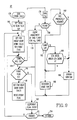
- FIGs 7, 8 and 9 are flow charts of programs 58, 60 and 62, respectively, which are stored in ROM 42, and which are run along with other programs stored in ROM 42 which are not pertinent to the teachings of the invention. Such other programs include programs set forth in (AVAS will be true).
- step 84 increments the car table
- step 86 checks to see if the table is finished, ie., whether or not all cars under group control have been considered. If step 86 finds that the car number has not been incremented beyond the maximum car number MXCAR, the program returns to step 72 to process the next car. When all cars have been considered, the program advances to step 88.
- Step 88 determines if a predetermined relationship exists between UPCOUNT and DNCOUNT.
- this predetermined relation involves the determination of whether UPCOUNT exceeds DNCOUNT, which favors the up travel direction in the event of a tie.
- step 88 could favor the down travel direction by determining whether DNCOUNT exceeds UPCOUNT.
- step 90 calls the subroutine SCNDNCALLS, which is the program 62 set forth in Figure 9.
- SCNDNCALLS which is the program 62 set forth in Figure 9.
- Step 90 also sets a flag SCANFLAG, set forth in RAM map 56 of Figure 6.
- Step 90 after assigning down calls, then proceeds to step 92 which calls the subroutine SCNUPCALLS, which is the program 60 set forth in Figure 8.
- Step 92 thus completes the assignment update on this running of program 58.
- Step 94 determines if flag SCANFLAG is set. If it is, it indicates that both up and down hall calls have been assigned, and step 94 proceeds to step 98 which resets SCANFLAG, UPCOUNT and DNCOUNT, and the program exits at 100.
- step 88 proceeds to step 92 which calls the subroutine SCNUPCALLS, to process up hall calls before down hall calls.
- step 94 will find that the flag SCANFLAG is not set, indicating that down hall calls have not yet been processed, and step 94 proceeds to step 96 which calls the subroutine SCNDNCALLS. Step 96 then proceeds to the resetting steps performed by step 98, and the program exits at 100.
- step 92 of program 58 The subroutine SCNUPCALLS called by step 92 of program 58 is entered at 102 of program 60 shown in Figure 8, and step 104 sets pointer 105 to floor #0 of the hall call table 48, as shown in Figure 2.
- the highest floor which could have an up hall call would be floor # 18, when assigning #0 to the lowest floor.
- the lowest floor which can have a down hall call is the bottom floor +1, or floor #1.
- step 106 determines if the floor being considered is the lobby floor, which can be determined from ROM map 54 of Figure 5. If the floor being considered is not the lobby floor, the next step would normally be to check for a hall call.
- step 108 first sets the scan of the hall call table to detect an up hall call from the front hall way door, and then sets a flag FRONT. For example, each scan slot of the call table may have two bits of information, with one bit being used for front door hall calls (F) and the other for rear door hall calls (R). Step 108 sets the scan to look at the proper bit for front door hall calls.
- Step 110 checks for an up hall call. If none is found, step 112 checks the flag FRONT, to see if it is set. If it is set, it indicates that rear door up hall calls have not been processed, and step 114 sets the scan to look for a rear door up hall call in the same scan slot being considered. Step 114 also resets the flag FRONT and returns to step 110. If step 110 finds no up hall call from the rear door, step 112 will now find the flag FRONT reset, indicating both front and. rear up hall calls have been checked, and step 116 increments the hall call table, ie., pointer 105. Step 118 checks to see if all hall table scan slots or building floors have been considered, 0 through N-1 (Top-1), and when they have all been considered, the program exits at 124.
- step 112 checks the flag FRONT, to see if it is set. If it is set, it indicates that rear door up hall calls have not been processed, and step 114 sets the scan to look for a rear door
- step 106 finds that the floor being considered is the lobby floor, it branches to step 120 which determines if a NEXT car is required.
- a NEXT car is the car designated as the next car to leave the lobby.
- a NEXT car will wait at the lobby floor with its doors open for a predetermined period of time. In certain instances more than one car will be required to be at the main floor. If one or more cars are required at the lobby floor, step 122 selects a car, or cars, and gives them an assignment to travel to the lobby floor, if they are not already located there. Step 122 proceeds to step 116, as does step 120 when it finds that a NEXT car is not required.
- step 110 finds an up hall call associated with the floor being considered, it branches to step 126 which calls a subroutine ETA, which may be the same as the subroutine COMPUTE disclosed in the incorporated patent application Serial No. 168,817, and this subroutine will thus not be described in detail.
- Subroutine ETA includes the steps of selecting a travel path for each elevator car relative to a floor having a registered hall call to be assigned, preparing a trip list for each elevator car using the travel path selected, determining the estimated time of arrival (ETA) at the call floor in question for each elevator car, and determining which car has the lowest ETA.
- ETA estimated time of arrival
- Step 128 determines if the subroutine ETA was able to find a car to serve the call in question, and if so, step 129 checks to see if this call was previously assigned to a car. If so, step 130 determines if the car found is the same one which was previously assigned to this call. If so, step 132 reassigns the call to the same car. If step 130 finds that the lowest ETA for the call in question is associated with a different car than the one previously assigned to serve the call, then step 130 proceeds to step 134 which checks to see how much lower the ETA of the new car is than the ETA of the previously assigned car.
- step 134 proceeds to step 136 which assigns the call to the newly found car, and removes the assignment from the assignment register of the prior assigned car. If step 134 finds that the new ETA is not lower than the old ETA by T seconds, then step 134 proceeds to step 132, which reassigns the call to the same car. Step 132 could be eliminated, since the same car is getting the assignment and it should already have the call in its assignment register, but step 132 makes sure that something has not occurred that may have resulted in the call no longer being in the assignment register of the car. When step 129 finds that the call had not been previously assigned, step 129 proceeds directly to step 136, to assign the call to the new car. When step 128 finds that the subroutine ETA failed to find a suitable car for the call in question for some reason, then step 137 clears the assignment of this floor for all cars. Steps 132, 136 and 137 all proceed to step 112.
- Step 140 sets the pointer 105 of call table 48 shown in Figure 2 to the start of the down calls. In the previous example this would be floor #19 for a 20 floor building, or, in general, floor #N.
- Step 142 sets pointer 105 to pick out calls from the front door, and sets the flag FRONT.
- Step 144 checks for a down hall call from the front hall way door. If there is no hall call, step 146 checks the flag FRONT.
- Step 148 finding the flag FRONT set, sets pointer 105 to detect a down hall call registered from a rear hall way door, if any, and step 148 also resets the flag FRONT.
- Step 144 checks to see if a down hall call from the rear door is present, and if no call is found, step 146, upon detecting the flag FRONT reset, advances to step 150 which decrements the hall call table 48.
- Step 152 checks to see if all floors which can register down hall calls have been checked, returning to step 142 when they have not, and exiting at 154 when they have.
- step 156 calls subroutine ETA to find a car with the lowest ETA relative to the call being considered, as hereinbefore described relative to step 126 of program 62.
- Step 158 determines if a suitable car was found for the call. If a car was found, step 160 determines if the call is new, or a previously assigned call. If previously assigned, step 162 checks to see if the assignment was made to the car just found to have the lowest ETA. If the car with the lowest ETA is a different car than the car previously assigned to the call, step 164 determines if the difference between the ETA'S of the two cars exceeds T seconds. If it does, step 166 assigns the call to the newly found car and returns to step 146.
- step 162 finds that the new car is the same as the previously assigned car
- step 168 reassigns the same car and returns to step 146.
- Step 164 upon finding that the difference in ETA'S does not exceed T seconds, branches to step 168 to reassign the same car.
- Step 158 when no suitable car has been found for a call, proceeds to step 170 which clears the call from the assignment registers of all cars and returns to step 146.
Landscapes
- Engineering & Computer Science (AREA)
- Automation & Control Theory (AREA)
- Elevator Control (AREA)
- Fire-Detection Mechanisms (AREA)
- Indicating And Signalling Devices For Elevators (AREA)
Priority Applications (1)
| Application Number | Priority Date | Filing Date | Title |
|---|---|---|---|
| AT89113853T ATE86225T1 (de) | 1988-08-31 | 1989-07-27 | Dynamische selektion der abtastrichtung der zuteilung von aufzugzielrufen. |
Applications Claiming Priority (2)
| Application Number | Priority Date | Filing Date | Title |
|---|---|---|---|
| US238941 | 1988-08-31 | ||
| US07/238,941 US4875554A (en) | 1988-08-31 | 1988-08-31 | Dynamic selection of elevator call assignment scan direction |
Publications (2)
| Publication Number | Publication Date |
|---|---|
| EP0357936A1 true EP0357936A1 (de) | 1990-03-14 |
| EP0357936B1 EP0357936B1 (de) | 1993-03-03 |
Family
ID=22899950
Family Applications (1)
| Application Number | Title | Priority Date | Filing Date |
|---|---|---|---|
| EP89113853A Expired - Lifetime EP0357936B1 (de) | 1988-08-31 | 1989-07-27 | Dynamische Selektion der Abtastrichtung der Zuteilung von Aufzugzielrufen |
Country Status (6)
| Country | Link |
|---|---|
| US (1) | US4875554A (de) |
| EP (1) | EP0357936B1 (de) |
| AT (1) | ATE86225T1 (de) |
| CA (1) | CA1300770C (de) |
| DE (1) | DE68905116T2 (de) |
| ES (1) | ES2040420T3 (de) |
Cited By (1)
| Publication number | Priority date | Publication date | Assignee | Title |
|---|---|---|---|---|
| EP0572229A1 (de) * | 1992-05-26 | 1993-12-01 | Otis Elevator Company | Zyklisch veränderliche Aufzugsgruppe |
Families Citing this family (5)
| Publication number | Priority date | Publication date | Assignee | Title |
|---|---|---|---|---|
| JPH0712891B2 (ja) * | 1988-02-17 | 1995-02-15 | 三菱電機株式会社 | エレベータの群管理装置 |
| JPH0725491B2 (ja) * | 1989-04-06 | 1995-03-22 | 三菱電機株式会社 | エレベータの群管理装置 |
| US5274202A (en) * | 1992-08-10 | 1993-12-28 | Otis Elevator Company | Elevator dispatching accommodating interfloor traffic and employing a variable number of elevator cars in up-peak |
| US6481535B1 (en) * | 2000-05-16 | 2002-11-19 | Otis Elevator Company | Dispatching algorithm for piston-type passenger conveying system |
| US6976560B2 (en) * | 2003-04-12 | 2005-12-20 | William Newby | Service/equipment equalization destination system for elevators |
Citations (4)
| Publication number | Priority date | Publication date | Assignee | Title |
|---|---|---|---|---|
| US3589473A (en) * | 1968-12-17 | 1971-06-29 | Westinghouse Electric Corp | Pulse-supervised multivehicle transportation |
| US3739880A (en) * | 1971-06-10 | 1973-06-19 | Reliance Electric Co | Elevator control for optimizing allotment of individual hall calls to individual cars |
| US4058187A (en) * | 1975-09-04 | 1977-11-15 | United Technologies Corporation | Limited stop elevator dispatching system |
| GB2077954A (en) * | 1980-06-04 | 1981-12-23 | Hitachi Ltd | Lift control system |
Family Cites Families (8)
| Publication number | Priority date | Publication date | Assignee | Title |
|---|---|---|---|---|
| US3614997A (en) * | 1969-12-16 | 1971-10-26 | Otis Elevator Co | Plural car conveyor system controlled by performance times between cars |
| US3750850A (en) * | 1972-05-17 | 1973-08-07 | Westinghouse Electric Corp | Floor selector for an elevator car |
| US3804209A (en) * | 1973-03-12 | 1974-04-16 | Westinghouse Electric Corp | Elevator system |
| US4037688A (en) * | 1974-09-04 | 1977-07-26 | Westinghouse Electric Corporation | Elevator system |
| US4029175A (en) * | 1975-05-05 | 1977-06-14 | Westinghouse Electric Corporation | Elevator system |
| US4401190A (en) * | 1979-12-03 | 1983-08-30 | Otis Elevator Company | Cars/floors and calls/cars elevator assignments |
| US4463834A (en) * | 1982-09-13 | 1984-08-07 | Westinghouse Electric Corp. | Elevator system |
| US4638889A (en) * | 1985-06-10 | 1987-01-27 | Westinghouse Electric Corp. | Elevator system |
-
1988
- 1988-08-31 US US07/238,941 patent/US4875554A/en not_active Expired - Lifetime
-
1989
- 1989-07-27 EP EP89113853A patent/EP0357936B1/de not_active Expired - Lifetime
- 1989-07-27 DE DE8989113853T patent/DE68905116T2/de not_active Expired - Fee Related
- 1989-07-27 AT AT89113853T patent/ATE86225T1/de not_active IP Right Cessation
- 1989-07-27 ES ES198989113853T patent/ES2040420T3/es not_active Expired - Lifetime
- 1989-08-18 CA CA000608788A patent/CA1300770C/en not_active Expired - Lifetime
Patent Citations (4)
| Publication number | Priority date | Publication date | Assignee | Title |
|---|---|---|---|---|
| US3589473A (en) * | 1968-12-17 | 1971-06-29 | Westinghouse Electric Corp | Pulse-supervised multivehicle transportation |
| US3739880A (en) * | 1971-06-10 | 1973-06-19 | Reliance Electric Co | Elevator control for optimizing allotment of individual hall calls to individual cars |
| US4058187A (en) * | 1975-09-04 | 1977-11-15 | United Technologies Corporation | Limited stop elevator dispatching system |
| GB2077954A (en) * | 1980-06-04 | 1981-12-23 | Hitachi Ltd | Lift control system |
Cited By (1)
| Publication number | Priority date | Publication date | Assignee | Title |
|---|---|---|---|---|
| EP0572229A1 (de) * | 1992-05-26 | 1993-12-01 | Otis Elevator Company | Zyklisch veränderliche Aufzugsgruppe |
Also Published As
| Publication number | Publication date |
|---|---|
| CA1300770C (en) | 1992-05-12 |
| ES2040420T3 (es) | 1993-10-16 |
| US4875554A (en) | 1989-10-24 |
| DE68905116D1 (de) | 1993-04-08 |
| ATE86225T1 (de) | 1993-03-15 |
| EP0357936B1 (de) | 1993-03-03 |
| DE68905116T2 (de) | 1993-07-15 |
Similar Documents
| Publication | Publication Date | Title |
|---|---|---|
| EP0348151B1 (de) | Optimiertes System für die Rufzuteilung von Aufzügen für aufsteigenden Spitzenverkehr | |
| US4792019A (en) | Contiguous floor channeling with up hall call elevator dispatching | |
| JP3920946B2 (ja) | マルチ−デッキ・エレベータにおける人混みへのサービスの向上 | |
| JPH04317966A (ja) | 残り応答時間に基づくエレベータ運行方法 | |
| JPH01271380A (ja) | 隣接階呼び出し指定式エレベータ並びに該エレベータに用いる群制御装置及びそのエレベータかごの優先割り当て方法 | |
| EP0357936A1 (de) | Dynamische Selektion der Abtastrichtung der Zuteilung von Aufzugzielrufen | |
| KR940021400A (ko) | 엘리베이터의 군 관리 제어 장치 | |
| US4869348A (en) | Group control for elevators with immediate allocation of calls of destination | |
| US4790412A (en) | Anti-bunching method for dispatching elevator cars | |
| CA1313431C (en) | Method for using door cycle time in dispatching elevator cars | |
| CA1185715A (en) | Method of operating an elevator system | |
| JPH07117941A (ja) | エレベータの群管理制御装置 | |
| US4782921A (en) | Coincident call optimization in an elevator dispatching system | |
| JPH0735228B2 (ja) | エレベ−タ装置 | |
| US4638889A (en) | Elevator system | |
| JPS61136883A (ja) | エレベ−タの群管理装置 | |
| EP0328423B1 (de) | Aufzugsverteilung durch Sektoren von benachbarten Stockwerken | |
| CA1199133A (en) | Elevator system | |
| CN100491223C (zh) | 具有长呼梯应答的电梯下行高峰分段 | |
| US7434665B2 (en) | Elevator down peak sectoring with long call response | |
| US7475757B2 (en) | Elevator dispatching with balanced passenger perception of waiting | |
| JP3986132B2 (ja) | ダブルデッキエレベータ群管理制御装置 | |
| GB2290885A (en) | Express elevator system | |
| JP2874533B2 (ja) | エレベータの群管理装置 | |
| JP4417330B2 (ja) | 長いコールに対応するエレベーターの下りピーク時のセクタ分け |
Legal Events
| Date | Code | Title | Description |
|---|---|---|---|
| PUAI | Public reference made under article 153(3) epc to a published international application that has entered the european phase |
Free format text: ORIGINAL CODE: 0009012 |
|
| AK | Designated contracting states |
Kind code of ref document: A1 Designated state(s): AT CH DE ES FR GB IT LI |
|
| 17P | Request for examination filed |
Effective date: 19900716 |
|
| 17Q | First examination report despatched |
Effective date: 19910926 |
|
| GRAA | (expected) grant |
Free format text: ORIGINAL CODE: 0009210 |
|
| AK | Designated contracting states |
Kind code of ref document: B1 Designated state(s): AT CH DE ES FR GB IT LI |
|
| REF | Corresponds to: |
Ref document number: 86225 Country of ref document: AT Date of ref document: 19930315 Kind code of ref document: T |
|
| REF | Corresponds to: |
Ref document number: 68905116 Country of ref document: DE Date of ref document: 19930408 |
|
| ET | Fr: translation filed | ||
| ITF | It: translation for a ep patent filed | ||
| REG | Reference to a national code |
Ref country code: ES Ref legal event code: FG2A Ref document number: 2040420 Country of ref document: ES Kind code of ref document: T3 |
|
| PLBE | No opposition filed within time limit |
Free format text: ORIGINAL CODE: 0009261 |
|
| STAA | Information on the status of an ep patent application or granted ep patent |
Free format text: STATUS: NO OPPOSITION FILED WITHIN TIME LIMIT |
|
| 26N | No opposition filed | ||
| PGFP | Annual fee paid to national office [announced via postgrant information from national office to epo] |
Ref country code: GB Payment date: 20010614 Year of fee payment: 13 |
|
| PGFP | Annual fee paid to national office [announced via postgrant information from national office to epo] |
Ref country code: AT Payment date: 20010704 Year of fee payment: 13 |
|
| PGFP | Annual fee paid to national office [announced via postgrant information from national office to epo] |
Ref country code: FR Payment date: 20010709 Year of fee payment: 13 |
|
| PGFP | Annual fee paid to national office [announced via postgrant information from national office to epo] |
Ref country code: DE Payment date: 20010713 Year of fee payment: 13 |
|
| PGFP | Annual fee paid to national office [announced via postgrant information from national office to epo] |
Ref country code: ES Payment date: 20010716 Year of fee payment: 13 |
|
| PGFP | Annual fee paid to national office [announced via postgrant information from national office to epo] |
Ref country code: CH Payment date: 20011017 Year of fee payment: 13 |
|
| REG | Reference to a national code |
Ref country code: GB Ref legal event code: IF02 |
|
| PG25 | Lapsed in a contracting state [announced via postgrant information from national office to epo] |
Ref country code: GB Free format text: LAPSE BECAUSE OF NON-PAYMENT OF DUE FEES Effective date: 20020727 Ref country code: AT Free format text: LAPSE BECAUSE OF NON-PAYMENT OF DUE FEES Effective date: 20020727 |
|
| PG25 | Lapsed in a contracting state [announced via postgrant information from national office to epo] |
Ref country code: ES Free format text: LAPSE BECAUSE OF NON-PAYMENT OF DUE FEES Effective date: 20020728 |
|
| PG25 | Lapsed in a contracting state [announced via postgrant information from national office to epo] |
Ref country code: LI Free format text: LAPSE BECAUSE OF NON-PAYMENT OF DUE FEES Effective date: 20020731 Ref country code: CH Free format text: LAPSE BECAUSE OF NON-PAYMENT OF DUE FEES Effective date: 20020731 |
|
| PG25 | Lapsed in a contracting state [announced via postgrant information from national office to epo] |
Ref country code: DE Free format text: LAPSE BECAUSE OF NON-PAYMENT OF DUE FEES Effective date: 20030201 |
|
| REG | Reference to a national code |
Ref country code: CH Ref legal event code: PL |
|
| GBPC | Gb: european patent ceased through non-payment of renewal fee |
Effective date: 20020727 |
|
| PG25 | Lapsed in a contracting state [announced via postgrant information from national office to epo] |
Ref country code: FR Free format text: LAPSE BECAUSE OF NON-PAYMENT OF DUE FEES Effective date: 20030331 |
|
| REG | Reference to a national code |
Ref country code: FR Ref legal event code: ST |
|
| REG | Reference to a national code |
Ref country code: ES Ref legal event code: FD2A Effective date: 20030811 |
|
| PG25 | Lapsed in a contracting state [announced via postgrant information from national office to epo] |
Ref country code: IT Free format text: LAPSE BECAUSE OF NON-PAYMENT OF DUE FEES;WARNING: LAPSES OF ITALIAN PATENTS WITH EFFECTIVE DATE BEFORE 2007 MAY HAVE OCCURRED AT ANY TIME BEFORE 2007. THE CORRECT EFFECTIVE DATE MAY BE DIFFERENT FROM THE ONE RECORDED. Effective date: 20050727 |