EP0358031B1 - Oberflächenmaterial für Sanitärartikel und deren Herstellungsverfahren - Google Patents
Oberflächenmaterial für Sanitärartikel und deren Herstellungsverfahren Download PDFInfo
- Publication number
- EP0358031B1 EP0358031B1 EP89115407A EP89115407A EP0358031B1 EP 0358031 B1 EP0358031 B1 EP 0358031B1 EP 89115407 A EP89115407 A EP 89115407A EP 89115407 A EP89115407 A EP 89115407A EP 0358031 B1 EP0358031 B1 EP 0358031B1
- Authority
- EP
- European Patent Office
- Prior art keywords
- layer
- section
- surface material
- fibers
- fiber
- Prior art date
- Legal status (The legal status is an assumption and is not a legal conclusion. Google has not performed a legal analysis and makes no representation as to the accuracy of the status listed.)
- Expired - Lifetime
Links
Images


Classifications
-
- A—HUMAN NECESSITIES
- A61—MEDICAL OR VETERINARY SCIENCE; HYGIENE
- A61F—FILTERS IMPLANTABLE INTO BLOOD VESSELS; PROSTHESES; DEVICES PROVIDING PATENCY TO, OR PREVENTING COLLAPSING OF, TUBULAR STRUCTURES OF THE BODY, e.g. STENTS; ORTHOPAEDIC, NURSING OR CONTRACEPTIVE DEVICES; FOMENTATION; TREATMENT OR PROTECTION OF EYES OR EARS; BANDAGES, DRESSINGS OR ABSORBENT PADS; FIRST-AID KITS
- A61F13/00—Bandages or dressings; Absorbent pads
- A61F13/15—Absorbent pads, e.g. sanitary towels, swabs or tampons for external or internal application to the body; Supporting or fastening means therefor; Tampon applicators
- A61F13/51—Absorbent pads, e.g. sanitary towels, swabs or tampons for external or internal application to the body; Supporting or fastening means therefor; Tampon applicators characterised by the outer layers of the pads
- A61F13/511—Topsheet, i.e. the permeable cover or layer facing the skin
- A61F13/513—Topsheet, i.e. the permeable cover or layer facing the skin characterised by its function or properties, e.g. stretchability, breathability, rewet, visual effect; having areas of different permeability
- A61F13/51305—Topsheet, i.e. the permeable cover or layer facing the skin characterised by its function or properties, e.g. stretchability, breathability, rewet, visual effect; having areas of different permeability having areas of different permeability
-
- A—HUMAN NECESSITIES
- A61—MEDICAL OR VETERINARY SCIENCE; HYGIENE
- A61F—FILTERS IMPLANTABLE INTO BLOOD VESSELS; PROSTHESES; DEVICES PROVIDING PATENCY TO, OR PREVENTING COLLAPSING OF, TUBULAR STRUCTURES OF THE BODY, e.g. STENTS; ORTHOPAEDIC, NURSING OR CONTRACEPTIVE DEVICES; FOMENTATION; TREATMENT OR PROTECTION OF EYES OR EARS; BANDAGES, DRESSINGS OR ABSORBENT PADS; FIRST-AID KITS
- A61F13/00—Bandages or dressings; Absorbent pads
- A61F13/15—Absorbent pads, e.g. sanitary towels, swabs or tampons for external or internal application to the body; Supporting or fastening means therefor; Tampon applicators
- A61F13/51—Absorbent pads, e.g. sanitary towels, swabs or tampons for external or internal application to the body; Supporting or fastening means therefor; Tampon applicators characterised by the outer layers of the pads
- A61F13/511—Topsheet, i.e. the permeable cover or layer facing the skin
- A61F13/51104—Topsheet, i.e. the permeable cover or layer facing the skin the top sheet having a three-dimensional cross-section, e.g. corrugations, embossments, recesses or projections
-
- A—HUMAN NECESSITIES
- A61—MEDICAL OR VETERINARY SCIENCE; HYGIENE
- A61F—FILTERS IMPLANTABLE INTO BLOOD VESSELS; PROSTHESES; DEVICES PROVIDING PATENCY TO, OR PREVENTING COLLAPSING OF, TUBULAR STRUCTURES OF THE BODY, e.g. STENTS; ORTHOPAEDIC, NURSING OR CONTRACEPTIVE DEVICES; FOMENTATION; TREATMENT OR PROTECTION OF EYES OR EARS; BANDAGES, DRESSINGS OR ABSORBENT PADS; FIRST-AID KITS
- A61F13/00—Bandages or dressings; Absorbent pads
- A61F13/15—Absorbent pads, e.g. sanitary towels, swabs or tampons for external or internal application to the body; Supporting or fastening means therefor; Tampon applicators
- A61F13/51—Absorbent pads, e.g. sanitary towels, swabs or tampons for external or internal application to the body; Supporting or fastening means therefor; Tampon applicators characterised by the outer layers of the pads
- A61F13/511—Topsheet, i.e. the permeable cover or layer facing the skin
- A61F13/5116—Topsheet, i.e. the permeable cover or layer facing the skin being formed of multiple layers
-
- A—HUMAN NECESSITIES
- A61—MEDICAL OR VETERINARY SCIENCE; HYGIENE
- A61F—FILTERS IMPLANTABLE INTO BLOOD VESSELS; PROSTHESES; DEVICES PROVIDING PATENCY TO, OR PREVENTING COLLAPSING OF, TUBULAR STRUCTURES OF THE BODY, e.g. STENTS; ORTHOPAEDIC, NURSING OR CONTRACEPTIVE DEVICES; FOMENTATION; TREATMENT OR PROTECTION OF EYES OR EARS; BANDAGES, DRESSINGS OR ABSORBENT PADS; FIRST-AID KITS
- A61F13/00—Bandages or dressings; Absorbent pads
- A61F13/15—Absorbent pads, e.g. sanitary towels, swabs or tampons for external or internal application to the body; Supporting or fastening means therefor; Tampon applicators
- A61F13/15577—Apparatus or processes for manufacturing
- A61F2013/15821—Apparatus or processes for manufacturing characterized by the apparatus for manufacturing
- A61F2013/15861—Apparatus or processes for manufacturing characterized by the apparatus for manufacturing for bonding
- A61F2013/15869—Apparatus or processes for manufacturing characterized by the apparatus for manufacturing for bonding with ultrasonic energy
-
- A—HUMAN NECESSITIES
- A61—MEDICAL OR VETERINARY SCIENCE; HYGIENE
- A61F—FILTERS IMPLANTABLE INTO BLOOD VESSELS; PROSTHESES; DEVICES PROVIDING PATENCY TO, OR PREVENTING COLLAPSING OF, TUBULAR STRUCTURES OF THE BODY, e.g. STENTS; ORTHOPAEDIC, NURSING OR CONTRACEPTIVE DEVICES; FOMENTATION; TREATMENT OR PROTECTION OF EYES OR EARS; BANDAGES, DRESSINGS OR ABSORBENT PADS; FIRST-AID KITS
- A61F13/00—Bandages or dressings; Absorbent pads
- A61F13/15—Absorbent pads, e.g. sanitary towels, swabs or tampons for external or internal application to the body; Supporting or fastening means therefor; Tampon applicators
- A61F13/15577—Apparatus or processes for manufacturing
- A61F2013/15821—Apparatus or processes for manufacturing characterized by the apparatus for manufacturing
- A61F2013/15861—Apparatus or processes for manufacturing characterized by the apparatus for manufacturing for bonding
- A61F2013/15878—Apparatus or processes for manufacturing characterized by the apparatus for manufacturing for bonding by thermal bonding
-
- A—HUMAN NECESSITIES
- A61—MEDICAL OR VETERINARY SCIENCE; HYGIENE
- A61F—FILTERS IMPLANTABLE INTO BLOOD VESSELS; PROSTHESES; DEVICES PROVIDING PATENCY TO, OR PREVENTING COLLAPSING OF, TUBULAR STRUCTURES OF THE BODY, e.g. STENTS; ORTHOPAEDIC, NURSING OR CONTRACEPTIVE DEVICES; FOMENTATION; TREATMENT OR PROTECTION OF EYES OR EARS; BANDAGES, DRESSINGS OR ABSORBENT PADS; FIRST-AID KITS
- A61F13/00—Bandages or dressings; Absorbent pads
- A61F13/15—Absorbent pads, e.g. sanitary towels, swabs or tampons for external or internal application to the body; Supporting or fastening means therefor; Tampon applicators
- A61F13/51—Absorbent pads, e.g. sanitary towels, swabs or tampons for external or internal application to the body; Supporting or fastening means therefor; Tampon applicators characterised by the outer layers of the pads
- A61F2013/51002—Absorbent pads, e.g. sanitary towels, swabs or tampons for external or internal application to the body; Supporting or fastening means therefor; Tampon applicators characterised by the outer layers of the pads with special fibres
- A61F2013/51014—Absorbent pads, e.g. sanitary towels, swabs or tampons for external or internal application to the body; Supporting or fastening means therefor; Tampon applicators characterised by the outer layers of the pads with special fibres characterized by the connection between the fibres
-
- A—HUMAN NECESSITIES
- A61—MEDICAL OR VETERINARY SCIENCE; HYGIENE
- A61F—FILTERS IMPLANTABLE INTO BLOOD VESSELS; PROSTHESES; DEVICES PROVIDING PATENCY TO, OR PREVENTING COLLAPSING OF, TUBULAR STRUCTURES OF THE BODY, e.g. STENTS; ORTHOPAEDIC, NURSING OR CONTRACEPTIVE DEVICES; FOMENTATION; TREATMENT OR PROTECTION OF EYES OR EARS; BANDAGES, DRESSINGS OR ABSORBENT PADS; FIRST-AID KITS
- A61F13/00—Bandages or dressings; Absorbent pads
- A61F13/15—Absorbent pads, e.g. sanitary towels, swabs or tampons for external or internal application to the body; Supporting or fastening means therefor; Tampon applicators
- A61F13/51—Absorbent pads, e.g. sanitary towels, swabs or tampons for external or internal application to the body; Supporting or fastening means therefor; Tampon applicators characterised by the outer layers of the pads
- A61F2013/51002—Absorbent pads, e.g. sanitary towels, swabs or tampons for external or internal application to the body; Supporting or fastening means therefor; Tampon applicators characterised by the outer layers of the pads with special fibres
- A61F2013/51038—Absorbent pads, e.g. sanitary towels, swabs or tampons for external or internal application to the body; Supporting or fastening means therefor; Tampon applicators characterised by the outer layers of the pads with special fibres being a mixture of fibres
- A61F2013/51042—Absorbent pads, e.g. sanitary towels, swabs or tampons for external or internal application to the body; Supporting or fastening means therefor; Tampon applicators characterised by the outer layers of the pads with special fibres being a mixture of fibres with hydrophobic and hydrophilic fibres
-
- A—HUMAN NECESSITIES
- A61—MEDICAL OR VETERINARY SCIENCE; HYGIENE
- A61F—FILTERS IMPLANTABLE INTO BLOOD VESSELS; PROSTHESES; DEVICES PROVIDING PATENCY TO, OR PREVENTING COLLAPSING OF, TUBULAR STRUCTURES OF THE BODY, e.g. STENTS; ORTHOPAEDIC, NURSING OR CONTRACEPTIVE DEVICES; FOMENTATION; TREATMENT OR PROTECTION OF EYES OR EARS; BANDAGES, DRESSINGS OR ABSORBENT PADS; FIRST-AID KITS
- A61F13/00—Bandages or dressings; Absorbent pads
- A61F13/15—Absorbent pads, e.g. sanitary towels, swabs or tampons for external or internal application to the body; Supporting or fastening means therefor; Tampon applicators
- A61F13/51—Absorbent pads, e.g. sanitary towels, swabs or tampons for external or internal application to the body; Supporting or fastening means therefor; Tampon applicators characterised by the outer layers of the pads
- A61F2013/51002—Absorbent pads, e.g. sanitary towels, swabs or tampons for external or internal application to the body; Supporting or fastening means therefor; Tampon applicators characterised by the outer layers of the pads with special fibres
- A61F2013/51038—Absorbent pads, e.g. sanitary towels, swabs or tampons for external or internal application to the body; Supporting or fastening means therefor; Tampon applicators characterised by the outer layers of the pads with special fibres being a mixture of fibres
- A61F2013/51054—Absorbent pads, e.g. sanitary towels, swabs or tampons for external or internal application to the body; Supporting or fastening means therefor; Tampon applicators characterised by the outer layers of the pads with special fibres being a mixture of fibres having different densities
-
- A—HUMAN NECESSITIES
- A61—MEDICAL OR VETERINARY SCIENCE; HYGIENE
- A61F—FILTERS IMPLANTABLE INTO BLOOD VESSELS; PROSTHESES; DEVICES PROVIDING PATENCY TO, OR PREVENTING COLLAPSING OF, TUBULAR STRUCTURES OF THE BODY, e.g. STENTS; ORTHOPAEDIC, NURSING OR CONTRACEPTIVE DEVICES; FOMENTATION; TREATMENT OR PROTECTION OF EYES OR EARS; BANDAGES, DRESSINGS OR ABSORBENT PADS; FIRST-AID KITS
- A61F13/00—Bandages or dressings; Absorbent pads
- A61F13/15—Absorbent pads, e.g. sanitary towels, swabs or tampons for external or internal application to the body; Supporting or fastening means therefor; Tampon applicators
- A61F13/51—Absorbent pads, e.g. sanitary towels, swabs or tampons for external or internal application to the body; Supporting or fastening means therefor; Tampon applicators characterised by the outer layers of the pads
- A61F2013/51078—Absorbent pads, e.g. sanitary towels, swabs or tampons for external or internal application to the body; Supporting or fastening means therefor; Tampon applicators characterised by the outer layers of the pads being embossed
Definitions
- This invention relates to a surface material in accordance with the preamble of claim 1.
- US-A-4,214,582 discloses a surgical dressing comprising a surface sheet consisting of three layers. A surface layer of substantially hydrophilic fibers is placed between two layers of predominantly hydrophobic fibers. The surface sheet should have a good permeability in order to improve the absorbent characteristics, but should be relatively nonadherent to the wound.
- EP-A-0 059 498 describes an absorptive device including a facing element consisting of hydrophobic fibers which is backed up by a support element which may also consist of hydrophobic filaments.
- absorbent products which are used in order to absorb and retain liquids that are produced from the body involves an absorber, which absorbs and retains liquids, interposed between a surface material, which is permeable to liquids, and a leak-proof material, which is impermeable to liquids.
- the liquid-permeable surface material (which is also sometimes referred to as the outer wrapping, covering, top sheet or cover stock) not give an unpleasant feeling to the user by not allowing backflow of the liquid that has moved into the absorber (to be referred to as backflow prevention), not give an unpleasant feeling to the user by not allowing the surface to become stained when absorbing colored liquids such as fecal material or blood (to be referred to as stain prevention), not allow the liquid that has been absorbed into the absorber to leak from the ends of the sanitary article through the surface material, and also provide adequate ventilation.
- the underlying problem is therefore to provide a surface material having both superior liquid permeability and backflow prevention, and an improved method for preparing this material.
- the present invention provides a surface material for sanitary articles according to the preamble of claim 1 wherein at least the portion of the first layer covering the second layer has an embossed structure and possesses a first section having a given fiber density, a second section of which the fiber density is higher than said given fiber density of the first section, and a third section which is located at a boundery between said first and second sections, where the area of the third section occupies 2 to 50 % of the area of the entire surface material.
- this invention provides a nonwoven fabric to function as a surface material of a sanitary article in which the surface material quickly absorbs excreted liquids, suppresses the phenomenon of backflow of the absorbed liquid, and moreover, restricts any oozing or leaking of absorbed liquid from the edges of the sanitary article.
- the present invention provides a preparing method according to the preamble fo claim 2 wherein with respect to the direction of flow of the fiber aggregate, the web of the second layer is suctioned and removed at fixed intervals with respect to the horizontal direction prior to lamination of the first layer and the second layer, and following lamination, the central portion of the portion that is essentially the first layer only is slit and wound so that the second layer does not exist at a fixed width on both ends in the horizontal direction of the sanitary article.
- the main component of the first layer is heat-fusing short fibers and comprises 50% or more hydrophobic fibers. Said fibers are formed into a web with a carding machine.
- the second layer minimally contains heat-fusing short fibers where 50% or more are hydrophilic fibers. Said fibers are also formed into a web with a carding machine.
- the webs of the first layer and the second layer that have been obtained in this manner are either laminated after forming fiber aggregates by fusing with separate heating rollers or heating fluids, or the webs of the first layer and the second layer are laminated and then simultaneously formed into fiber aggregates by fusing using a heating roll or heating fluid.
- embossing an arbitrary embossed pattern is formed which possesses section A of which fiber density is comparatively low, section B of which fiber density is comparatively high and section C which is located at the boundary of portions A and B, where the surface area ratio of section C is 2-50% with respect to the total surface area of the embossing.
- embossing is performed on the first layer for at least the portion which covers the second layer.
- embossing may or may not be performed.
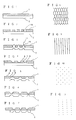
- Fig. 1 shows a conventional surface material comprising a first layer 1, which is composed of hydrophobic fibers that are located on the surface in contact with the skin, and a second layer 2, which is composed of hydrophilic fibers lying beneath the first layer 1.
- the layers 1, 2 are formed into a single unit, and the fiber density of layer 1 is essentially uniform.
- this type of composition although there is a high degree of backflow prevention when the thickness of layer 1 is comparatively large, it has poor liquid permeability. In the case the thickness of layer 1 is comparatively small, in contrast, although it has ample liquid permeability, backflow prevention is poor. If the thickness of layer 1 is of an intermediate thickness, both liquid permeability and backflow prevention become inadequate, and in either case, the co-existence of both liquid permeability and backflow prevention is fundamentally impossible.
- Fig. 2 shows a conventional surface material which is also composed by forming a hydrophobic first layer 1, which is located on the surface in contact with the skin, into a single unit with a hydrophilic second layer 2 beneath layer 1.
- the hydrophobic layer 1 is provided with holes 10.
- the hydrophilic layer 2 comprises portions 11 which penetrate to the surface through the holes 10.
- the surface material of this invention is composed of a first layer 1, which is located on the surface in contact with the skin, and a second layer 2, which is formed into a single unit with layer 1 located beneath layer 1 such that its entire surface is essentially covered by layer 1.
- Layer 2 is composed of 50% or more hydrophilic fibers.
- the first layer 1 comprises a section A where the fiber density is comparatively low, a section B where the fiber density is comparatively high, and a section C which is located at their boundary.
- the surface layer of section A is at a considerable distance from the hydrophilic layer 2 and has superior backflow prevention, since its fiber density is low and it has ample porosity, it possesses some degree of liquid permeability.
- section B has extremely superior backflow prevention due to it having high fiber density with the fibers existing close to one another resulting in low porosity, it essentially has no liquid permeability.
- Section C is located at the boundary between section A and section B, and since the fiber density is intermediate while its surface layer is at a small distance from the hydrophilic layer 2, although it has extremely superior liquid permeability, it has poor backflow prevention.
- the surface ratio of the section C refers to the embodiments for the method of measurement
- the desirable value for the surface area of section C varies according the planar form, etc. of the surface material.
- a value of 2-20% is preferable with a value of 2-10% being more preferable.
- a value of 10-40% is preferable with a value of 20-35% being more preferable.
- section B is in the form of lines as indicated in Figs. 8 and 9 with the surface material having a planar form, in consideration of ventilation, it is preferable that section B be in the form of dots as indicated in Figs. 10 and 11.
- the fiber density of layer 1 is uniquely controlled by the thickness of the surface material.
- a thickness of 0.01-0.30mm for section B is generally preferable, with 0.02-0.20mm being more preferable, and 0.03-0.06mm being even more preferable.
- a thickness that is intermediate to the thicknesses indicated above is preferable for section C. If sections A and B are too thin, backflow prevention will be reduced and conversely, if they are too thick, liquid permeability will be poor. Thus, either of these conditions is not preferable. In addition, if section A is too thin, since parts of layer 2 will be exposed to the surface, backflow prevention will be lowered. Conversely, if section A is too thick, since the liquid permeability of section C will be decreased, both of these conditions also are not preferable.
- layer 1 requires that it contain at least 50% hydrophobic fibers, in consideration of backflow prevention, it is more preferable that it be composed only of hydrophobic fibers. In the case the amount of hydrophobic fibers is less than 50%, although layer 1 will have increased wetness and favorable moisture absorption, when used as the surface material of a sanitary article, the sense of dryness of the surface will be impaired.
- hydrophobic fiber that is used is not subject to any particular limitations allowing selection to be made freely from commonly known types such as polyolefine, polyester, acrylic and polyamide fibers, in consideration of heat processing properties and ventilation, polypropylene, polyester, polyethylene-polypropylene compound fibers, polyethylene-polyester compound fibers, and low melting point polyester-polyester compound fibers are preferable.
- hydrophobic fibers can be used as is without treating, in consideration of ease of processing, it is preferable that for example, such fibers be treated with antistatic substances such as fluoride compounds having water repelling capability, paraffin-based waxes, or alkylphosphate metal salts, etc.
- antistatic substances may be of slight hydrophilic nature, it is necessary to determine the composition and amount applied so that the hydrophilic nature of layer 1 does not exceed that of layer 2.
- fiber width of 0.3-10d is generally preferable, with 2-4d being more preferable.
- section A may be such that the surface layer is flat, if it is depressed at sections B and C as in Figs. 4, 6 and 7, since contact of the skin of the user with section B, which has high rigidity and is a factor causing poor ventilation, as well as section C, which has poor backflow prevention, is prevented, this is extremely desirable.
- Weighting of layer 1 should be established giving consideration to liquid permeability and backflow prevention. In general, weighting of 5-50g/m2 is preferable, and more preferable if 10-25g/m2.
- the fibers of layer 1 be opaque. If the fibers are opaque, the surface material of this invention will also be opaque. Since this will allow the surface material to effectively cover up the colors of adhered liquids such as blood or fecal material, stain prevention will be improved.
- the opaqueness of this surface material is quantified in terms of whiteness (see embodiments), it is preferable that such whiteness be 20% or more, with 30% or more being more preferable.
- various methods can be considered for giving the desired degree of opaqueness. An example of such method involves adding white pigment to resin in the fiber manufacturing process. However, as long as it is possible to give the desired degree of opaqueness, any method may be used without being limited to methods like that above.
- compound fibers such as polyethylene-polypropylene compound fibers or polyethylene-polyester compound fibers, it is preferable to make the white pigment ubiquitous in high melting temperature resin within the fibers since this effectively improves stain prevention.
- the fibers of layer 1 be sufficiently intertwined, or depending on the case, adhered to each other in the same manner as nonwoven fabric of conventional absorbent products.
- intertwining can be performed by high pressure fluids and adhesion performed using an adhesive or thermal adhesion, thermal adhesion is more preferable in consideration of liquid permeability and ventilation.
- adhesion may be performed uniformly within layer 1 or distributed regularly or irregularly.
- layer 2 requires that it contain at least 50% hydrophilic fibers, in consideration of liquid permeability, it is preferable that it consist of hydrophilic fibers only.
- fibers composed of hydrophilic substances such as pulp or rayon as well as fibers in which the surfaces of fibers composed of hydrophobic substances such as polyolefine, polyester, acrylic or polyamide fibers which have undergone hydrophilic treatment using suitable methods, can be used for the hydrophilic fibers, in consideration of backflow prevention and ventilation, the latter are preferable. From among these, in consideration of ease of heat processing and ventilation, those in which the surface of polypropylene, polyester, polyethylene-propylene compound fibers, polyethylene-polyester compound fibers or low melting point polyester-polyester compound fibers have undergone hydrophilic treatment similar to those of layer 1 are more preferable.
- hydrophilic fibers refers to fibers in which a surface active agent possessing hydrophilic function, such as the ethylene oxide adduct of sulfonic acid chloride or the ethylene oxide addition product of sulfuric ester chloride, is added to said thermoplastic fiber, or fibers which are hydrophilic by nature such as rayon or cotton.
- a surface active agent possessing hydrophilic function such as the ethylene oxide adduct of sulfonic acid chloride or the ethylene oxide addition product of sulfuric ester chloride
- the amount of hydrophilic fibers is less than 50%, the wetting and absorption properties of layer 2 will be reduced excessively such that when used as the surface material of a sanitary article, liquid absorption will be decreased remarkably due to layer 1 being composed of 50% or more hydrophilic fibers.
- a fiber width of 0.3-10d is preferable, with 2-4d being more preferable.
- the weighting of layer 2 also should be established in consideration of liquid permeability and backflow prevention. In general, 10-50g/m2 is preferable, with 15-40g/m2 being more preferable.
- the thickness of layer 2 may be essentially uniform as in Figs. 4 and 5, it is more preferable if the thickness of layer 2 is made thinner beneath sections A and C of layer 1 as in Figs. 6 and 7 since this results in increased liquid diffusivity thereby improving the liquid permeability of the surface material.
- the thickness of layer 2 may be made thinner beneath sections A and C of layer 1 as in Figs. 6 and 7 since this results in increased liquid diffusivity thereby improving the liquid permeability of the surface material.
- layers 1 and 2 be formed into a single unit, it is preferable that they be formed into a single unit to a degree such that they at least do not come apart during use.
- methods to accomplish this include thermal adhesion by hot air treatment, etc., thermocompression bonding by thermal embossing or ultrasonic embossing, etc., adhesion using an adhesive and intertwining using an air flow or high pressure water flow, in consideration of ventilation and productivity, etc.
- the purpose of performing so-called embossing by laminating layers 1 and 2 and passing them through an ultrasonic wave type or heating roll type of engraving roll followed by partial compression bonding and/or fusing is that liquid absorption would be low or completely absent if the layers were simply laminated only due to layer 1 being essentially hydrophobic and layer 2 being essentially hydrophilic.
- the inventors discovered that liquid absorption would be exhibited by making the layers thinner in parts by embossing in a laminated state.
- a pattern is selected and used which possesses section A, which has comparatively low fiber density, section B, which has comparatively high fiber density, and section C, which is at the boundary between them, by compression bonding and/or fusing so that the surface area ratio of section C is 2-50% with respect to the total surface area of the embossing.
- said surface area ratio is less than 2%, liquid absorbing portions are too few causing liquid absorption to become extremely poor.
- said surface area is greater than 50%, although liquid absorption is favorable, since the thickness of the surface material becomes extremely thin and moreover, due to reduced ventilation, on the contrary, liquid backflow becomes worse.
- embossing methods include a method in which one or both rolls pass through an opposing heating roll having an engraving pattern which satisfies the above surface area ratio, and a method in which one or both rolls pass between a non-heating engraving roll having the above pattern and an ultrasonic oscillation horn.
- the web of layer 2 is suctioned and removed at fixed intervals with respect to the horizontal direction prior to lamination of layer 1 and layer 2 with respect to the direction of flow of the fiber aggregates.
- a slit is made in the center of the formed portion which is essentially layer 1 only followed by winding.
- the nonwoven fabric that is prepared in this manner following slitting is able to inhibit and prevent staining and leakage in the horizontal direction when using in the surface materials of sanitary articles since layer 2 does not exist at a fixed width on both ends in the horizontal direction and both ends are essentially formed from hydrophobic fibers.
- the web width of ordinary nonwoven fabric production machines being on the order of 1-2.5m
- the width when used in the surface materials of sanitary articles is on the order of 0.1-0.5m
- a multiple number of rolls are produced as surface materials of sanitary articles. Therefore, the web of layer 2 is removed at a multiple number of locations at fixed intervals with respect to the horizontal direction.
- Examples of methods which can be used for the above web removal method for layer 2 include a method in which a metallic wire wound onto a carding roller is wound at fixed intervals in the horizontal direction, a method in which following forming of the web over the entire width of the carding, the web is removed by suctioning while simultaneously cutting at fixed intervals with a slitter, and a method in which while holding down the web at fixed intervals with a plate on a roller at the outlet of the carding machine, the portions of the web that are not being held down are removed by suctioning.
- Fig. 18 shows a web which forms layer 1 coming out of a carding machine 22 and moves onto conveyor 3 .
- the web of layer 2 is formed from carding machine 4 .
- the portions of the web which are not being held down with said plates are suctioned and removed with suction nozzles 6 . It is preferable that the web that has been suctioned and removed be returned again to the entrance of carding machine 4 from the viewpoint of reducing loss of raw stock.
- web which forms layer 1, and web 7 which is remaining after suction and removal and forms layer 2, are laminated to form sheet 9 by passing through hot air chamber 8 to fuse the fibers.
- embossing is performed by passing through calender rollers 10 and between ultrasonic wave generator horn 11 and engraving roll 12 .
- the center of the portion of layer 1 only is cut with slitter 13 after which the laminated material is wound into roll form 14 .
- this invention is not limited to these embodiments, but can also be applied for use in other sanitary articles such as sanitary napkins and sanitary pads.
- the surface materials indicated in Table 1 and Table 2 were prepared with the specified methods using the component materials indicated in Table 1. The following describes the measurement methods for shape and performance of each of the surface materials. Furthermore, the values indicated in Table 1 and Table 2 are the average values of 10 measured values.
- Photographs of the flat and cross-sectional surfaces of the surface materials were taken using a scanning electron microscope.
- the length p of the embossed portion in the photographs as well as the length q of the periphery of the embossed portions were measured (Top View: Fig. 15).
- straight lines l1 and l2 in cross-sectional diagrams Figs. 16 and 17 essentially define the thickness t1 of the embossed portion (fiber compression bonding portion).
- the thickness t2 of the fiber non-compression bonding portion is determined according to straight lines l7 and l8 which are essentially tangent to the flat portion.
- straight lines l3 and l4 are erected from both ends of the fiber compression bonding portion in a direction perpendicular to straight line l2, and similarly, straight lines l5 and l6 are erected from both ends of the fiber non-compression bonding portion in a direction perpendicular to straight line l7.
- the distance between lines l3 and l4 expresses the dimensions of b
- the distance between lines l4 and l5 expresses the dimensions of c
- the distance between lines l5 and l6 expresses the dimensions of a.
- the surface area ratio of Section C is calculated using the following equations using the values of each of the portions obtained from i) above.
- section B and section C were formed by superimposing layer 2 on the central portion of layer 1 in the horizontal direction and performing ultrasonic wave embossing on the portions where layer 2 was present as indicated in Fig. 12.
- section B and section C were formed by superimposing layer in the central portion of layer 1 in both the horizontal and vertical directions and performing ultrasonic wave embossing on the portion where layer 2 was present as indicated in Fig. 13.
- test liquid was injected under pressure onto the hypothetical disposable diaper sample.
- the amount of time required to absorb the liquid was taken to be the absorption time. In general, the shorter this absorption time, the more superior the liquid permeability of the surface material. Further, the amount of test liquid that flows back from the inside of the sample through the surface material applying high pressure after a fixed amount of time was taken to be the liquid backflow volume. The smaller the liquid backflow volume, the smaller the degree of stickiness of the surface indicating a more pleasant feel when used.
- the state of the hypothetical disposable diaper sample was divided into the three ranks indicated below following the absorption of a colored test liquid.
- the maximum absorption volume was taken to be the amount of test liquid injected at the point leakage is observed by placing an infant model 16 horizontally, putting the hypothetical disposable diaper sample 17 on the model and injecting the test liquid from tube 18. The greater this maximum absorption volume, the more superior the stain prevention.
- Layer 1 was formed by adding 0.3 wt.% hydrophobic surface activating agent of which the main component is alkylphosphate K salt to the surface of 51mm of 2 denier heat-fusing short fiber of polypropylene-polyethylene core sheath structure (ES Fiber, Chisso Co., Ltd.) and forming a hydrophobic web having a weighting of 20g/m2 with 100% of said fiber using the carding machine 22.
- hydrophobic surface activating agent of which the main component is alkylphosphate K salt
- Layer 2 was formed by adding 0.3 wt.% hydrophilic surface activating agent of which the main component is the polyethylene glycol addition product of lauryl ether sodium sulfate to 38mm of 3 denier heat-fusing short fiber of polyester-polyethylene core sheath structure (NBF Fiber, Daiwa Spinning Co., Ltd.) and forming a hydrophilic web having a weighting of 20g/m2 with 100% of said fiber using the carding machine 4. Following this, the fibers were fused together by laminating the webs of layer 1 and layer 2 and passing through a hot air type, heat treatment machine.
- the main component is the polyethylene glycol addition product of lauryl ether sodium sulfate
- polyester-polyethylene core sheath structure NBF Fiber, Daiwa Spinning Co., Ltd.
- embossing was performed with an ultrasonic wave generation horn and engraving roll in which the surface area ratio of section C becomes 20% to obtain the nonwoven fabric of the surface material for the disposable diaper.
- the performance of said nonwoven fabric was evaluated as a surface material using the absorber of a commercially available disposable diaper (Mary's, Kao Co., Ltd.), the results indicated in Table 3 were obtained.
- Layer 1 was formed by adding 0.3 wt.% hydrophobic surface activating agent of which the main component is alkylphosphate K salt to the surface of 38mm of 2 denier heat-fusing short fiber of polyester-polypropylene core sheath structure (NBF Fiber, Daiwa Spinning Co., Ltd.) and forming a hydrophobic web having a weighting of 23g/m2 with 100% of said fiber using the carding machine 22.
- Layer 2 was formed by adding 0.3 wt.% hydrophilic surface activating agent of which the main component is the polyethylene glycol addition product of lauryl ether sodium sulfate to 51mm of 3 denier heat-fusing short fiber of polyester-polyethylene core sheath structure (NBF Fiber, Daiwa Spinning Co., Ltd.) and forming a hydrophilic web having a weighting of 20g/m2 with 100% of said fiber using the carding machine 4. Following this, cutting was performed with a web slitter at a pitch of 17cm of the portion which was not suctioned and removed of the hydrophilic web only and 16cm of the portion which was suctioned and removed followed by suction and removal.
- the main component is the polyethylene glycol addition product of lauryl ether sodium sulfate
- the fibers were fused together by laminating the webs of the portions of layer 1 and layer 2 that were not suctioned and removed and passing through a hot air type, heat treatment machine. Embossing was performed with an ultrasonic wave generation horn and engraving roll in which the surface area ratio of section C becomes 15%. The central portion of layer 1 only was then slit and wound.
- the performance of said nonwoven fabric was evaluated as a surface material using the absorber of a commercially available disposable diaper (Mary's, Kao Co., Ltd.), the results indicated in Table 4 were obtained.
- the surface material of this invention has both superior liquid permeability and backflow prevention.
- Embodiments 6 and 7 in which layer 2 is not present on both ends in the horizontal direction of layer 1 since diffusion of liquid on the ends is inhibited, leakage prevention is improved phenomenally making it truly an ideal surface material.
- Comparative Example 1 since the surface material does not have a double-layer structure, liquid backflow prevention is inferior.
- Comparative Example 2 although the surface material has a double-layer structure consisting of hydrophobic and hydrophilic materials, since fiber density is essentially uniform, liquid permeability is inferior.
- Comparative Example 3 since holes are provided in the upper hydrophobic layer, backflow prevention is inferior.
- Comparative Example 4 since the surface area ratio of section C is less than 2%, liquid permeability is inferior.
- Comparative Example 5 since the surface area ratio of section C is 50% or more, ventilation is poor and backflow prevention cannot be said to be adequate.
- the nonwoven fabric that is provided by the method of this invention as the surface material of sanitary articles, together with realizing rapid absorption of body liquids, there is hardly any backflow of those absorbed body liquids to the surface of the surface material even when pressure is applied to the sanitary article.
- a feeling of dryness is maintained at all times and further, oozing and leaking of body liquids which have been absorbed in the horizontal direction of the nonwoven fabric can be inhibited.
- This allows inhibition and prevention of staining of clothing by body liquids that have been excreted as well as chafing of the skin, thereby resulting in reduction or elimination of the unpleasant feeling that is caused by the use of sanitary articles.
Landscapes
- Health & Medical Sciences (AREA)
- Epidemiology (AREA)
- Engineering & Computer Science (AREA)
- Biomedical Technology (AREA)
- Heart & Thoracic Surgery (AREA)
- Vascular Medicine (AREA)
- Life Sciences & Earth Sciences (AREA)
- Animal Behavior & Ethology (AREA)
- General Health & Medical Sciences (AREA)
- Public Health (AREA)
- Veterinary Medicine (AREA)
- Absorbent Articles And Supports Therefor (AREA)
Claims (5)
- Oberflächenmaterial für Sanitärartikel, bestehend aus einer ersten Lage (1), die auf der Oberfläche angeordnet ist, die in Kontakt mit der Haut steht, und einer zweiten Lage (2), die mit der ersten Lage (1) auf der Oberfläche, die derjenigen, die in Kontakt mit der Haut ist, gegenüberliegt, zu einer einzigen Einheit gebildet ist, wobei ihre gesamte Oberfläche im wesentlichen von der ersten Lage (1) bedeckt ist, und wobei die erste Lage (1) 50 - 100 % hydrophobe Fasern und die zweite Lage (2) 50 - 100 % hydrophile Fasern aufweist,
dadurch gekennzeichnet,
daß wenigstens der Bereich der ersten Lage (1), der die zweite Lage (2) bedeckt, eine geprägte Struktur hat und einen ersten Abschnitt (A) mit einer gegebenen Faserdichte, einen zweiten Abschnitt (B), dessen Faserdichte höher ist als die gegebene Faserdichte des ersten Abschnitts (A), und einen dritten Abschnitt (C) besitzt, der in einem Grenzbereich zwischen dem ersten und zweiten Abschnitt angeordnet ist, wobei die Fläche des dritten Abschnitts (C) 2 - 50 % der Fläche des gesamten Oberflächenmaterials einnimmt. - Herstellungsverfahren für ein Oberflächenmaterial für Sanitärartikel, das die Schritte umfaßt: Hindurchführen einer ersten Lage (1), die auf der Oberfläche angeordnet ist, die in Kontakt mit der Haut steht, und die 50 - 100 % hydrophobe Fasern aufweist, und einer zweiten Lage (2), die auf der Oberfläche der ersten Lage (1) angeordnet ist, die derjenigen, die in Kontakt mit der Haut steht, gegenüberliegt, und 50 - 100 % hydrophile Fasern aufweist, durch eine Eindrückwalze hindurch in der Form einer laminierten Struktur, gefolgt von einem teilweisen Druckverbinden und/oder Verschmelzen, um ihm ein Prägemuster zu verleihen,
dadurch gekennzeichnet,
daß hinsichtlich der Flußrichtung der Faseransammlung das Gewebe der zweiten Lage (2) in feststehenden Intervallen bezüglich der horizontalen Richtung vor dem Laminieren der ersten Lage (1) und der zweiten Lage (2) angesaugt und entfernt wird, und nach dem Laminieren der mittlere Bereich desjenigen Bereichs, der im wesentlichen aus der ersten Lage (1) besteht, lediglich geschlitzt und gewickelt wird, so daß die zweite Lage (2) in einer festgelegten Breite an beiden Enden in horizontaler Richtung des Sanitärartikels nicht vorhanden ist. - Herstellungsverfahren für ein Oberflächenmaterial für Sanitärartikel nach Anspruch 2, das aus einer Faseransammlung besteht, bei der die Lage (1) mittels einer Kardiermaschine zu einem Gewebe aus Fasern geformt wird, deren Hauptkomponente aus wärmeschmelzenden kurzen Fasern besteht, und das durch Verschmelzen mit einer Wärmewalze oder einem Wärmefluid hergestellt wird.
- Herstellungsverfahren für ein Oberflächenmaterial für Sanitärartikel nach Anspruch 2, das aus einer Faseransammlung besteht, bei der die Lage (2) mittels einer Kardiermaschine zu einem Gewebe aus Fasern geformt wird, deren Hauptkomponente aus wärmeschmelzenden kurzen Fasern besteht, und das durch Verschmelzen mit einer Wärmewalze oder einem Wärmefluid hergestellt wird.
- Herstellungsverfahren für ein Oberflächenmaterial für Sanitärartikel nach Anspruch 3, bei dem mittels Druckverbinden und/oder Verschmelzen ein Prägemuster gebildet wird, das einen ersten Abschnitt (A) besitzt, der eine vergleichsweise niedrige Faserdichte aufweist, und einen zweiten Abschnitt (B), der eine vergleichsweise hohe Faserdichte aufweist, und einen dritten Abschnitt (C), der im Grenzbereich des ersten und zweiten Abschnitts (A, B) angeordnet ist, so daß das Oberflächenverhältnis des dritten Abschnitts (C) 2 - 50 % hinsichtlich der Gesamtoberfläche der Prägung beträgt.
Applications Claiming Priority (2)
| Application Number | Priority Date | Filing Date | Title |
|---|---|---|---|
| JP22328288 | 1988-09-06 | ||
| JP223282/88 | 1988-09-06 |
Publications (3)
| Publication Number | Publication Date |
|---|---|
| EP0358031A2 EP0358031A2 (de) | 1990-03-14 |
| EP0358031A3 EP0358031A3 (de) | 1991-05-02 |
| EP0358031B1 true EP0358031B1 (de) | 1995-01-25 |
Family
ID=16795686
Family Applications (1)
| Application Number | Title | Priority Date | Filing Date |
|---|---|---|---|
| EP89115407A Expired - Lifetime EP0358031B1 (de) | 1988-09-06 | 1989-08-21 | Oberflächenmaterial für Sanitärartikel und deren Herstellungsverfahren |
Country Status (6)
| Country | Link |
|---|---|
| US (1) | US5009651A (de) |
| EP (1) | EP0358031B1 (de) |
| DE (1) | DE68920802T2 (de) |
| ES (1) | ES2066812T3 (de) |
| HK (1) | HK201696A (de) |
| MY (1) | MY104653A (de) |
Cited By (6)
| Publication number | Priority date | Publication date | Assignee | Title |
|---|---|---|---|---|
| US5580418A (en) | 1992-11-06 | 1996-12-03 | Kimberly-Clark Corporation | Apparatus for making film laminated material |
| US5667619A (en) | 1992-11-06 | 1997-09-16 | Kimberly-Clark Worldwide, Inc. | Method for making a fibrous laminated web |
| US5817394A (en) | 1993-11-08 | 1998-10-06 | Kimberly-Clark Corporation | Fibrous laminated web and method and apparatus for making the same and absorbent articles incorporating the same |
| US7105716B2 (en) | 2003-12-31 | 2006-09-12 | Kimberly-Clark Worldwide, Inc. | Absorbent articles |
| EP1078621B2 (de) † | 1999-08-27 | 2011-11-30 | Uni-Charm Corporation | Absorbierender Artikel |
| US9598861B2 (en) | 2005-02-18 | 2017-03-21 | George Kalogridis Davis | Fire-resistant ultra-lightweight panel with three-dimensional surface design |
Families Citing this family (31)
| Publication number | Priority date | Publication date | Assignee | Title |
|---|---|---|---|---|
| BR8902476A (pt) * | 1989-05-02 | 1990-11-13 | Johnson & Johnson Ind Com | Estrutura absorvente e produto absorvente |
| CA2053930C (en) * | 1991-07-17 | 1997-01-07 | Robert Emmet Kirby | Bodyside cover for an absorbent article |
| JP2633763B2 (ja) * | 1991-10-01 | 1997-07-23 | 大和紡績株式会社 | セメント補強用ポリプロピレン繊維 |
| ATE137107T1 (de) * | 1991-11-11 | 1996-05-15 | Procter & Gamble | Absorbierender artikel mit schnellverteilender und komfortabler oberschicht |
| JP2963289B2 (ja) * | 1992-11-30 | 1999-10-18 | ユニ・チャーム株式会社 | 体液吸収性物品の表面シート |
| JP3131062B2 (ja) * | 1993-02-12 | 2001-01-31 | ユニ・チャーム株式会社 | 体液吸収性物品 |
| US6986761B1 (en) | 1993-09-16 | 2006-01-17 | The Procter & Gamble Company | Sanitary napkin having core predisposed to a convex upward configuration |
| DE69420043T2 (de) * | 1993-10-28 | 2000-03-16 | Kobs Houlberg, Vibeke | Methode zum herstellen von flüssigkeitsleitungen für einen sanitären gegenstand |
| CA2183238C (en) * | 1994-03-01 | 2001-02-20 | Ralph Robert Emenaker | Trisection sanitary napkin |
| US5562650A (en) * | 1994-03-04 | 1996-10-08 | Kimberly-Clark Corporation | Absorbent article having an improved surge management |
| BR9609747A (pt) * | 1995-06-30 | 2002-07-16 | Kimberly Clark Co | Laminados corrugados não tecidos e em filme |
| FR2738845B1 (fr) * | 1995-09-15 | 1999-06-18 | Peaudouce | Materiau non-tisse composite, son procede de fabrication et son application a tout article d'hygiene absorbant |
| US5925026A (en) * | 1997-03-10 | 1999-07-20 | Kimberly-Clark Worldwide, Inc. | Apertured absorbent pads for use in absorbent articles |
| DE69730123T2 (de) | 1997-06-25 | 2005-08-18 | The Procter & Gamble Company, Cincinnati | Bewertungsmethode für wegwerfbare absorbierende Artikel |
| US6440115B1 (en) | 1998-04-03 | 2002-08-27 | Kimberly-Clark Worldwide, Inc. | Absorbent article having channels for receiving the edges of an undergarment |
| US6416502B1 (en) | 1998-04-03 | 2002-07-09 | Kimberly-Clark Worldwide, Inc. | Absorbent article having channels for receiving the edges of an undergarment |
| US6582817B2 (en) | 1999-11-19 | 2003-06-24 | Wellman, Inc. | Nonwoven fabrics formed from polyethylene glycol modified polyester fibers and method for making the same |
| US6623853B2 (en) | 1998-08-28 | 2003-09-23 | Wellman, Inc. | Polyethylene glycol modified polyester fibers and method for making the same |
| US6673418B1 (en) * | 1998-12-23 | 2004-01-06 | Mcneil-Ppc, Inc. | Absorbent product having a non-woven fabric cover with a three-dimensional profile region |
| US6663611B2 (en) * | 1999-09-28 | 2003-12-16 | Kimberly-Clark Worldwide, Inc. | Breathable diaper with low to moderately breathable inner laminate and more breathable outer cover |
| US6509091B2 (en) | 1999-11-19 | 2003-01-21 | Wellman, Inc. | Polyethylene glycol modified polyester fibers |
| JP3734407B2 (ja) * | 2000-06-19 | 2006-01-11 | ユニ・チャーム株式会社 | 吸収性物品 |
| US7174774B2 (en) * | 2002-08-30 | 2007-02-13 | Kimberly-Clark Worldwide, Inc. | Method and apparatus of detecting pooling of fluid in disposable or non-disposable absorbent articles |
| US20040127873A1 (en) * | 2002-12-31 | 2004-07-01 | Varona Eugenio Go | Absorbent article including porous separation layer with capillary gradient |
| JP4410022B2 (ja) * | 2004-04-27 | 2010-02-03 | ユニ・チャーム株式会社 | 吸収性物品 |
| JP6612328B2 (ja) * | 2014-09-10 | 2019-11-27 | ザ プロクター アンド ギャンブル カンパニー | 不織布ウェブ |
| US10828209B2 (en) * | 2015-12-16 | 2020-11-10 | Avintiv Specialty Materials Inc. | Soft nonwoven fabric and method of manufacturing thereof |
| JP6001207B1 (ja) * | 2016-06-30 | 2016-10-05 | ユニ・チャーム株式会社 | 吸収性物品 |
| MX2021009794A (es) | 2019-02-15 | 2021-09-08 | Essity Hygiene & Health Ab | Articulo absorbente. |
| MY209865A (en) | 2019-02-15 | 2025-08-08 | Essity Hygiene & Health Ab | Absorbent article with embossed surface layer |
| CN113017990A (zh) * | 2021-02-26 | 2021-06-25 | 福建省明辉机械制造有限公司 | 一种非经期专用卫生护垫制备方法 |
Family Cites Families (20)
| Publication number | Priority date | Publication date | Assignee | Title |
|---|---|---|---|---|
| US1092082A (en) * | 1912-02-03 | 1914-03-31 | Werner I Staaf | Liquid-meter. |
| US3409012A (en) * | 1964-01-10 | 1968-11-05 | Riegel Textile Corp | Diaper with interwoven hydrophobic yarns |
| DE2922992A1 (de) * | 1978-06-08 | 1979-12-20 | Colgate Palmolive Co | Wegwerf-hygieneartikel mit verbesserter oberflaechenschicht |
| US4585449A (en) * | 1978-06-08 | 1986-04-29 | Colgate-Palmolive Co. | Disposable diaper with improved top sheet |
| ZA792723B (en) * | 1978-06-09 | 1981-01-28 | Colgate Palmolive Co | Disposable product with fluid penetrating top sheet |
| JPS5568367A (en) * | 1978-11-19 | 1980-05-23 | Uni Charm Corp | Sanitary material and its preparation |
| US4214582A (en) * | 1979-02-07 | 1980-07-29 | The Kendall Company | Surgical dressing |
| GR74804B (de) * | 1980-05-12 | 1984-07-12 | Procter & Gamble | |
| JPS6029488B2 (ja) * | 1981-02-16 | 1985-07-11 | アンネ株式会社 | 生理用ナプキン |
| US4392862A (en) * | 1981-03-02 | 1983-07-12 | The Procter & Gamble Company | Absorptive device |
| DE3200701A1 (de) * | 1982-01-13 | 1983-07-28 | Durst, Franz J., Prof.Dr., 7507 Pfinztal | Verfahren und vorrichtung zum begasen und umwaelzen von fluessigkeiten |
| JPS58180602A (ja) * | 1982-04-19 | 1983-10-22 | ジヨンソン・エンド・ジヨンソン・ベイビ−・プロダクツ・カンパニ− | 吸収構成体 |
| JPS5932456A (ja) * | 1982-08-17 | 1984-02-21 | 株式会社クラレ | 衛生用品のフエ−シングおよびその製造方法 |
| US4670011A (en) * | 1983-12-01 | 1987-06-02 | Personal Products Company | Disposable diaper with folded absorbent batt |
| US4883480A (en) * | 1984-08-17 | 1989-11-28 | Mcneil-Ppc, Inc. | Infant diaper with improved fit |
| JPS6220194A (ja) * | 1985-07-19 | 1987-01-28 | Fujitsu Ltd | デコ−ダ回路 |
| FR2592896B1 (fr) * | 1986-01-15 | 1988-04-22 | Boussac Saint Freres Bsf | Matelas absorbant perfectionne, notamment pour des articles d'hygiene. |
| JPH0687874B2 (ja) * | 1986-05-07 | 1994-11-09 | 花王株式会社 | 吸収性物品 |
| SE453557C (sv) * | 1986-05-27 | 1990-04-23 | Moelnlycke Ab | For engangsanvendning avsett vetskeabsorberande alster, sasom en bloja, en dambinda eller liknande |
| US4865597A (en) * | 1987-07-06 | 1989-09-12 | Kimberly-Clark Corporation | Absorbent product with reinforcing member to resist deformation |
-
1989
- 1989-08-18 US US07/395,579 patent/US5009651A/en not_active Expired - Lifetime
- 1989-08-21 DE DE68920802T patent/DE68920802T2/de not_active Expired - Fee Related
- 1989-08-21 EP EP89115407A patent/EP0358031B1/de not_active Expired - Lifetime
- 1989-08-21 ES ES89115407T patent/ES2066812T3/es not_active Expired - Lifetime
- 1989-08-22 MY MYPI89001151A patent/MY104653A/en unknown
-
1996
- 1996-11-07 HK HK201696A patent/HK201696A/en not_active IP Right Cessation
Cited By (7)
| Publication number | Priority date | Publication date | Assignee | Title |
|---|---|---|---|---|
| US5580418A (en) | 1992-11-06 | 1996-12-03 | Kimberly-Clark Corporation | Apparatus for making film laminated material |
| US5667619A (en) | 1992-11-06 | 1997-09-16 | Kimberly-Clark Worldwide, Inc. | Method for making a fibrous laminated web |
| US5667625A (en) | 1992-11-06 | 1997-09-16 | Kimberly-Clark Worldwide, Inc. | Apparatus for forming a fibrous laminated material |
| US5817394A (en) | 1993-11-08 | 1998-10-06 | Kimberly-Clark Corporation | Fibrous laminated web and method and apparatus for making the same and absorbent articles incorporating the same |
| EP1078621B2 (de) † | 1999-08-27 | 2011-11-30 | Uni-Charm Corporation | Absorbierender Artikel |
| US7105716B2 (en) | 2003-12-31 | 2006-09-12 | Kimberly-Clark Worldwide, Inc. | Absorbent articles |
| US9598861B2 (en) | 2005-02-18 | 2017-03-21 | George Kalogridis Davis | Fire-resistant ultra-lightweight panel with three-dimensional surface design |
Also Published As
| Publication number | Publication date |
|---|---|
| DE68920802T2 (de) | 1995-05-24 |
| DE68920802D1 (de) | 1995-03-09 |
| EP0358031A2 (de) | 1990-03-14 |
| MY104653A (en) | 1994-05-31 |
| EP0358031A3 (de) | 1991-05-02 |
| HK201696A (en) | 1996-11-15 |
| US5009651A (en) | 1991-04-23 |
| ES2066812T3 (es) | 1995-03-16 |
Similar Documents
| Publication | Publication Date | Title |
|---|---|---|
| EP0358031B1 (de) | Oberflächenmaterial für Sanitärartikel und deren Herstellungsverfahren | |
| US3987792A (en) | Disposable diaper having improved liquid retention | |
| US5437653A (en) | Absorbent article having two coapertured layers and a method of making the article | |
| US7628777B2 (en) | Absorbent article having passage holes in a central region | |
| JP3319603B2 (ja) | 高吸引及び高容量を示す吸収性製品用液体分配部材 | |
| JP3481238B2 (ja) | 液体不透過性領域を有する不織トップシートを備えた吸収材 | |
| KR100245352B1 (ko) | 신속한분배스트립을갖는흡수제품 | |
| KR0132208B1 (ko) | 유체 처리능이 개선된 흡수 용품 | |
| JP4070804B2 (ja) | 毛管積層材料 | |
| EP1016396B1 (de) | Hygienischer, saugfähiger Gegenstand versehen mit einem Auftreffbereich | |
| CA1306857C (en) | Absorbent body having hydrophobic insert | |
| US4307721A (en) | Non-woven fabric for sanitary napkin | |
| JP3408078B2 (ja) | 吸収性物品 | |
| CA1306832C (en) | Absorbent article including hydrophobic microfilament aggregate | |
| KR20000053514A (ko) | 체액 흡수성 물품 | |
| SK37993A3 (en) | Method of making curved, shaped absorbent article | |
| JPS5939136B2 (ja) | 生理用ナプキン | |
| GB2266465A (en) | Thermobonded absorbent article | |
| JPH05237150A (ja) | 吸収性物品用身体側カバー | |
| JP3759609B2 (ja) | 流体透過性周囲マスキング部材を備えた衛生ナプキン | |
| US8317769B2 (en) | Absorbing article with folded side barriers | |
| JP2809491B2 (ja) | 吸収性物品の表面シート | |
| CA1149101A (en) | Disposable diaper with improved top sheet | |
| JPS62170565A (ja) | 吸収性物品の表面材およびその製法 | |
| JPH0436703B2 (de) |
Legal Events
| Date | Code | Title | Description |
|---|---|---|---|
| PUAI | Public reference made under article 153(3) epc to a published international application that has entered the european phase |
Free format text: ORIGINAL CODE: 0009012 |
|
| AK | Designated contracting states |
Kind code of ref document: A2 Designated state(s): DE ES FR GB |
|
| PUAL | Search report despatched |
Free format text: ORIGINAL CODE: 0009013 |
|
| AK | Designated contracting states |
Kind code of ref document: A3 Designated state(s): DE ES FR GB |
|
| 17P | Request for examination filed |
Effective date: 19910514 |
|
| 17Q | First examination report despatched |
Effective date: 19930310 |
|
| GRAA | (expected) grant |
Free format text: ORIGINAL CODE: 0009210 |
|
| AK | Designated contracting states |
Kind code of ref document: B1 Designated state(s): DE ES FR GB |
|
| RAP1 | Party data changed (applicant data changed or rights of an application transferred) |
Owner name: KAO CORPORATION |
|
| REF | Corresponds to: |
Ref document number: 68920802 Country of ref document: DE Date of ref document: 19950309 |
|
| ET | Fr: translation filed | ||
| REG | Reference to a national code |
Ref country code: ES Ref legal event code: FG2A Ref document number: 2066812 Country of ref document: ES Kind code of ref document: T3 |
|
| PG25 | Lapsed in a contracting state [announced via postgrant information from national office to epo] |
Ref country code: ES Free format text: LAPSE BECAUSE OF NON-PAYMENT OF DUE FEES Effective date: 19950822 |
|
| PLBE | No opposition filed within time limit |
Free format text: ORIGINAL CODE: 0009261 |
|
| STAA | Information on the status of an ep patent application or granted ep patent |
Free format text: STATUS: NO OPPOSITION FILED WITHIN TIME LIMIT |
|
| 26N | No opposition filed | ||
| PG25 | Lapsed in a contracting state [announced via postgrant information from national office to epo] |
Ref country code: FR Effective date: 19960430 |
|
| PG25 | Lapsed in a contracting state [announced via postgrant information from national office to epo] |
Ref country code: DE Effective date: 19960501 |
|
| REG | Reference to a national code |
Ref country code: FR Ref legal event code: ST |
|
| REG | Reference to a national code |
Ref country code: GB Ref legal event code: IF02 |
|
| REG | Reference to a national code |
Ref country code: ES Ref legal event code: FD2A Effective date: 19960911 |
|
| PGFP | Annual fee paid to national office [announced via postgrant information from national office to epo] |
Ref country code: GB Payment date: 20070815 Year of fee payment: 19 |
|
| GBPC | Gb: european patent ceased through non-payment of renewal fee |
Effective date: 20080821 |
|
| PG25 | Lapsed in a contracting state [announced via postgrant information from national office to epo] |
Ref country code: GB Free format text: LAPSE BECAUSE OF NON-PAYMENT OF DUE FEES Effective date: 20080821 |