EP0358236A2 - Verfahren zur Messung der Periode eines Oberflächenfehlers - Google Patents
Verfahren zur Messung der Periode eines Oberflächenfehlers Download PDFInfo
- Publication number
- EP0358236A2 EP0358236A2 EP89116688A EP89116688A EP0358236A2 EP 0358236 A2 EP0358236 A2 EP 0358236A2 EP 89116688 A EP89116688 A EP 89116688A EP 89116688 A EP89116688 A EP 89116688A EP 0358236 A2 EP0358236 A2 EP 0358236A2
- Authority
- EP
- European Patent Office
- Prior art keywords
- period
- data
- web
- base material
- distance
- Prior art date
- Legal status (The legal status is an assumption and is not a legal conclusion. Google has not performed a legal analysis and makes no representation as to the accuracy of the status listed.)
- Granted
Links
- 238000000034 method Methods 0.000 title claims abstract description 12
- 230000007547 defect Effects 0.000 title abstract description 64
- 230000000737 periodic effect Effects 0.000 claims abstract description 18
- 230000002950 deficient Effects 0.000 claims description 29
- 239000000463 material Substances 0.000 abstract description 43
- 238000005259 measurement Methods 0.000 description 10
- 238000001514 detection method Methods 0.000 description 4
- 238000004519 manufacturing process Methods 0.000 description 4
- 238000012986 modification Methods 0.000 description 2
- 230000004048 modification Effects 0.000 description 2
- 229910052782 aluminium Inorganic materials 0.000 description 1
- XAGFODPZIPBFFR-UHFFFAOYSA-N aluminium Chemical compound [Al] XAGFODPZIPBFFR-UHFFFAOYSA-N 0.000 description 1
- 229910052751 metal Inorganic materials 0.000 description 1
- 239000002184 metal Substances 0.000 description 1
- 238000005498 polishing Methods 0.000 description 1
- 238000003908 quality control method Methods 0.000 description 1
Images

Classifications
-
- G—PHYSICS
- G01—MEASURING; TESTING
- G01N—INVESTIGATING OR ANALYSING MATERIALS BY DETERMINING THEIR CHEMICAL OR PHYSICAL PROPERTIES
- G01N21/00—Investigating or analysing materials by the use of optical means, i.e. using sub-millimetre waves, infrared, visible or ultraviolet light
- G01N21/84—Systems specially adapted for particular applications
- G01N21/88—Investigating the presence of flaws or contamination
- G01N21/89—Investigating the presence of flaws or contamination in moving material, e.g. running paper or textiles
- G01N21/892—Investigating the presence of flaws or contamination in moving material, e.g. running paper or textiles characterised by the flaw, defect or object feature examined
- G01N21/8922—Periodic flaws
-
- G—PHYSICS
- G01—MEASURING; TESTING
- G01N—INVESTIGATING OR ANALYSING MATERIALS BY DETERMINING THEIR CHEMICAL OR PHYSICAL PROPERTIES
- G01N21/00—Investigating or analysing materials by the use of optical means, i.e. using sub-millimetre waves, infrared, visible or ultraviolet light
- G01N21/84—Systems specially adapted for particular applications
- G01N21/88—Investigating the presence of flaws or contamination
- G01N21/8851—Scan or image signal processing specially adapted therefor, e.g. for scan signal adjustment, for detecting different kinds of defects, for compensating for structures, markings, edges
- G01N2021/8854—Grading and classifying of flaws
- G01N2021/8858—Flaw counting
-
- G—PHYSICS
- G01—MEASURING; TESTING
- G01N—INVESTIGATING OR ANALYSING MATERIALS BY DETERMINING THEIR CHEMICAL OR PHYSICAL PROPERTIES
- G01N21/00—Investigating or analysing materials by the use of optical means, i.e. using sub-millimetre waves, infrared, visible or ultraviolet light
- G01N21/84—Systems specially adapted for particular applications
- G01N21/88—Investigating the presence of flaws or contamination
- G01N21/89—Investigating the presence of flaws or contamination in moving material, e.g. running paper or textiles
- G01N2021/8909—Scan signal processing specially adapted for inspection of running sheets
- G01N2021/8912—Processing using lane subdivision
Definitions
- the present invention relates to a method of measuring a period on which a surface defect appears in a traveling web.
- Such a surface inspecting apparatus is used to detect surface defects, such as scratches and pin holes, of a surface of a traveling web appearing not only at random but also periodically.
- Such type of periodic surface detecting apparatus is known from, for example, Japanese Unexamined Patent Publication No.49-35091.
- surface defects are counted by opening a time gate at an elapse of a predetermined time period from a time a first surface defect is detected. After several times of this periodic detections, if more than a predetermined number of surface defects are detected every periodic detection, the web is estimated to have periodic surface defects.
- a surface of a traveling web is divided into a plurality of data cells in a direction in which the web moves and each data cell is graded defective or non-defective.
- the defective data cell is signified by a binary data "1”
- the non-defective data cell is signified by a binary data "0”.
- the number of pairs of defects at a regular distance of j is calculated for a data row consisting of binary data for the number of n of data cells by the use of the following autocorrelation: wherein j is an integer between zero (0) to (n - 1).
- (d i ⁇ d i + j ) is a product of a binary data d i for an i-th data cell and a binary data d i + j for a (i + j)-th data cell. That is, the product is "1" only when both of the binary data d i and d i+j are "1" indicating both of the i-th data cell and (i + j)-th data cell are defective. Accordingly, the autocorrelation I expresses the number of pairs of defects at a regular distance of j for a data row consisting of binary data for the number of n of data cells. Then, the following discrimination condition is used to determine a basic period of surface defect: AC(kf o ) > 0 II wherein k is an integer from 1 to l.
- a time required to performing the calculation is proportional to n ⁇ (n - 1). That is, multiplication and addition have to be repeated n ⁇ (n - 1) times for the number of n of data.
- the number n is a value of a length L of the web for measurement divided by a unit length s .
- Time necessary to perform calculation of elemental period of surface defects which depends upon given hardware and program, is heretofore long and a high processing capacity of computer or a special hardware is needed to perform such a calculation in a real time manner.
- an object of the present invention to provide a novel method of measuring a period of surface defect in which an improved algorismic autocorrelation is used to calculate a fundamental period of surface defect.
- the objects of the present invention is achieved by providing a method of measuring a period on which a surface defect appears in a surface of a web moving in a lengthwise direction.
- surface defects distributed in the surface of the traveling web are detected in the lengthwise direction of the web-like material, and positional data and distance data of the plurality of surface defects relative to one another are collected for a predetermined length of the web.
- the web is decided to have a periodic surface defect appearing on a period between predetermined maximum and minimum periods when the distance data includes a distance equivalent to an elemental period that is integer multiples of a fundamental period.
- the surface of the traveling web is divided into a number of data cells and data of each data cell is expressed by means of a binary data "1" indicating a defective surface or a binary data "0" indicating non-defective or normal surface.
- the periodicity of these surface defects is decided by the use of an autocorrelation expressing a frequency of appearance of these distance.
- time needed to calculate a period of surface defect is greately shortened in comparison with a manner using an autocorrelation resulting from performing a multiplication and an addition for all of the binary data. Therefore, the measurement of a period of surface defect can be effected in a real time manner without using a large computer or a specially provided hardware.
- the collection of positional data is preferably effected every predetermined distance of movement of the web and the positional data of each surface defect is expressed in integer multiples of the predetermined distance.
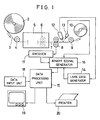
- FIG. 1 the method of measuring a period of surface defect according to a preferred embodiment of the present invention which is applied to a lithographic plate manufacturing line is shown.
- a aluminum web 3 (which is hereinafter referred to as a base material) from which lithographic plates are made is rolled on a reel 2.
- the base material 3 is continuously withdrawn and transported towards a processing apparatus 5 by means of a drive roller 4.
- the processing apparatus 5 is provided with rollers 6 for polishing surfaces of the base material 3 so as to make them smooth.
- the base material 3 thus smoothed is transported by means of drive rollers 8 and a guide roller 9 and wound around a reel 10.
- a flying spot type of surface scanning device 7, which is disposed between the drive roller 8 and guide roller 9, consists of a scanner 12 and a light detector 13.
- the scanner 12 scans a surface of the base material 3 in a transverse direction perpendicular to the moving direction of the base material with a small diameter of flying spot.
- the light modulated by surface defect is reflected from the surface of the base material 3 and directed towards the light detector 13.
- the light detector 13 detects the modulated light to provide a surface signal.
- the lane data generator 14 generates scanning lane signals SL indicating transverse positions or lanes of the surface of the base material 3 correspondingly to the surface signals SS from the scanner 12.
- the scanning lane signals SL are sent to a binary signal generator 16.
- the light detector 13 extends in parallel to the transverse direction of the base material 3 to receive the light modulated by and reflected from surface defects of the base material 3. Accordingly, if the surface of the base material 3 has no surface defects, surface signals SS produced by the light detector 13 are at levels lower than a certain signal level. On the other hand, if the base material 3 has surface defects, the light detector 13 produces surface signals SS at levels greater than the certain signal level.
- a rotary encoder 17 is connected to the drive roller 8 to produce scanning cell position signals SC indicating cells on the base material 3 in the moving direction and send them to the binary signal generator 16.
- the surface signals SS are sent to a binary signal generating circuit 16 and converted to binary signals BS, "0" or “1", according to their signal levels thereby. That is, if a surface signal SS from the light detector 13 is at a signal level lower than the certain signal level, the binary signal generator 16 produces a binary signal BS of "0" indicating a standard or normal surface of the base material 3 (which is referred to as a standard surface) and if a surface signal SS from the light detector 13 is at a signal level greater than the certain signal level, the binary signal generator 16 produces a binary signal BS of "1" indicating a significant defective surface of the base material 3 (which is referred to as a defective surface).
- the binary signal BS is sent as a surface data signal to the data processing unit 15.
- Data processing unit 15 is connected to a data input unit 18, such as a keyboard, through which various data are input to set initial data necessary for measuring a period of surface defect.
- the initial data and the result of measurement are displayed on a display 19, such as a CRT and, if necessary, printed out by means of a printer 20.
- a display 19 and printer 20 can take any well known type and need not be described in detail herein.
- a length L of the base material 3 to be measured (which is referred to as a measuring length) is also initially set in accordance with a period of surface defect to be measured. It is to be noted in this embodiment that the measuring length L is set six times as long as an expected maximum period of surface defect.
- the surface scanning unit 7 is actuated to scan the surface of the base material 3.
- Surface signals SS from the light detector 13 of the surface scanning unit 7 are converted into binary signals BS; normal surface signals "0” or defective surface signals "1", which in turn are sent to the data processing unit 15.
- Fig. 2 conceptionally showing a distribution of binary signals BS corresponding to data cells of the base material 3
- the base material 3 of the measuring length L is divided into a number of lanes, #1, #2, #3, « (three of which are shown in Fig. 2) in the transverse direction and each lane is divided into a number of, for example 29, data cells having a width of a unit distance s in the measuring length L.
- each data cell of the base material 3 is assigned one binary signal BS.
- a period of surface defect in the No. 1 lane #1 will be exemplarily described with reference to Fig. 2.
- Fig. 2 there are a number m of, for example 9, defective surface signals "1" in the No. 1 lane #1 in the measuring length L of the base material 3, which defective surface signals are correspondingly given to data of locations in the moving direction of cells having surface defects.
- a distance l ij between every two defective surface signals "1" which must be integral multiples of the width of s of a data cell, can be obtained.
- An autocorrelation AC(ij) which indicates a frequency on which two defective surface signals "1" at a same distance l ij appear, is given in accordance with the obtained distances l ij .
- a maximum time necessary to calculate the autocorrelation AC(l ij ) for the number of m of defective surface signals "1" is proportional to m (m - 1) and, therefore, has a correlation to the number of defective surface signals.
- the autocorrelation AC(l ij ) thus obtained is equivalent to the conventional autocorrelation AC(j) as was previously described.
- the periodicity of this autocorrelation AC(l ij ) is discriminated by the following conditions: AC(f0) > 0, AC(2 ⁇ f0) > 0, . «, and AC(l ⁇ f0) > 0 where l is a preset multiplicative value for indicating a maximum elemental period (l ⁇ f0) for discriminating the periodicity of the autocorrelation AC(l ij ) and is less than the number m .
- the conditions are based on the fact that elemental periods for the number m of periodic surface defects include a fundamental period f o and periods two to (m - 1) times as long as the fundamental period f o . According to the conditions, a fundamental period f o is obtained.
- a necessary time for calculating the autocorrelation AC(l ij ) depends upon the number m of defective surface signals "1" included in the number n of binary signals BS, the usage of the autocorrelation AC(l ij ) develops one hundredth of the total calculation time as short as that achieved by the usage of the conventional autocorrelation AC(j) even in the case of the longest total calculation time.
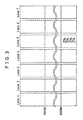
- Detection of periodic surface defects is performed in the above described manner. If periodic surface defects are detected, the printer 20 is actuated to print out data of the detected periodic surface defects as shown in Fig. 3.
- a period (minimum period X min - maximum period X max ) and the unit distance s are set to 100-8472mm, and 15mm, respectively.
- the base material 3, which usually has a maximum width of approximately 1,500mm, is divided into 15 lanes having a width of 100mm so as to form data collecting areas of 15 x 100mm in the base material 3. Accordingly, 15 bits of binary data is collected every 15mm of movement of the base material 3.
- a measured result is output every 100m movement of the base material 3 as shown in Fig. 3. Because periodic surface defects of the base material 3 in the lithographic plate manufacturing line are often caused by surface irregularities of the rollers 4, 8, 9 and/or 6, the measured result is, in this example shown in Fig. 3, numerically indicated by a value of a measured period of surface defect divided by the ratio of the circumferential to the diameter of a roller. In Fig.
- the indication "274" indicates that the base material 3 has a periodic surface defect caused by a roller having a diameter of 274mm in the fifth lane (an area ranging from 400 to 500mm from the side edge of the base material 3) at a distance of 3000 to 3400m from the leading end of the base material 3.
Landscapes
- Analytical Chemistry (AREA)
- Immunology (AREA)
- Physics & Mathematics (AREA)
- Health & Medical Sciences (AREA)
- Life Sciences & Earth Sciences (AREA)
- Chemical & Material Sciences (AREA)
- General Health & Medical Sciences (AREA)
- Biochemistry (AREA)
- Textile Engineering (AREA)
- General Physics & Mathematics (AREA)
- Engineering & Computer Science (AREA)
- Pathology (AREA)
- Investigating Materials By The Use Of Optical Means Adapted For Particular Applications (AREA)
- Length Measuring Devices By Optical Means (AREA)
Applications Claiming Priority (2)
| Application Number | Priority Date | Filing Date | Title |
|---|---|---|---|
| JP63226190A JPH0786474B2 (ja) | 1988-09-09 | 1988-09-09 | 欠陥周期の測定方法 |
| JP226190/88 | 1988-09-09 |
Publications (3)
| Publication Number | Publication Date |
|---|---|
| EP0358236A2 true EP0358236A2 (de) | 1990-03-14 |
| EP0358236A3 EP0358236A3 (de) | 1991-05-29 |
| EP0358236B1 EP0358236B1 (de) | 1997-12-29 |
Family
ID=16841298
Family Applications (1)
| Application Number | Title | Priority Date | Filing Date |
|---|---|---|---|
| EP89116688A Expired - Lifetime EP0358236B1 (de) | 1988-09-09 | 1989-09-08 | Verfahren zur Messung der Periode eines Oberflächenfehlers |
Country Status (4)
| Country | Link |
|---|---|
| US (1) | US4982600A (de) |
| EP (1) | EP0358236B1 (de) |
| JP (1) | JPH0786474B2 (de) |
| DE (1) | DE68928510T2 (de) |
Cited By (6)
| Publication number | Priority date | Publication date | Assignee | Title |
|---|---|---|---|---|
| EP0475454A3 (en) * | 1990-09-14 | 1992-10-14 | Fuji Photo Film Co., Ltd. | Defect inspection system |
| FR2770646A1 (fr) * | 1997-11-06 | 1999-05-07 | Eastman Kodak Co | Procede d'identification de defauts d'une enduction |
| EP0927887A1 (de) * | 1997-12-17 | 1999-07-07 | Zellweger Luwa Ag | Verfahren zur Erkennung periodischer Fehler in einem längsbewegten Prüfgut |
| WO1999028730A3 (en) * | 1997-11-27 | 1999-10-07 | Hoogovens Staal Bv | Process and device for producing a strip-like material avoiding repeated surface defects |
| EP2340224A4 (de) * | 2008-09-10 | 2013-02-20 | 3M Innovative Properties Co | Registrierte mehrrollen-wiederholungsfehlererfassung einer bahnverarbeitungslinie |
| EP3392172A1 (de) * | 2017-04-21 | 2018-10-24 | Windmöller & Hölscher KG | Überwachungsverfahren zur überwachung eines abwickelprozesses, abwickelvorrichtung sowie abwickelsystem |
Families Citing this family (24)
| Publication number | Priority date | Publication date | Assignee | Title |
|---|---|---|---|---|
| JP2535257B2 (ja) * | 1991-05-07 | 1996-09-18 | 新日本製鐵株式会社 | ストリップの表面欠陥検査装置 |
| US5508622A (en) * | 1994-12-14 | 1996-04-16 | Gatzlaff; Harold | Coating defect detector system |
| US5678447A (en) * | 1996-04-17 | 1997-10-21 | Eastman Kodak Company | On-line web planarity measurement apparatus and method |
| US6895811B2 (en) * | 2001-12-14 | 2005-05-24 | Shawmut Corporation | Detection of small holes in laminates |
| US7623699B2 (en) * | 2004-04-19 | 2009-11-24 | 3M Innovative Properties Company | Apparatus and method for the automated marking of defects on webs of material |
| US7176475B2 (en) | 2004-11-16 | 2007-02-13 | Omron Corporation | Adjusting apparatus, production processing system, and method of controlling adjusting apparatus |
| US7748259B2 (en) * | 2006-12-15 | 2010-07-06 | General Electric Company | Systems and methods for solid oxide fuel cell surface analysis |
| US8175739B2 (en) * | 2007-07-26 | 2012-05-08 | 3M Innovative Properties Company | Multi-unit process spatial synchronization |
| US20090028417A1 (en) * | 2007-07-26 | 2009-01-29 | 3M Innovative Properties Company | Fiducial marking for multi-unit process spatial synchronization |
| US7542821B2 (en) * | 2007-07-26 | 2009-06-02 | 3M Innovative Properties Company | Multi-unit process spatial synchronization of image inspection systems |
| US7493678B1 (en) * | 2007-09-13 | 2009-02-24 | Ming-Tse Chen | Method of inspecting cloth |
| US7781622B2 (en) * | 2008-01-25 | 2010-08-24 | Council Of Scientific & Industrial Research | Process for direct hydroxylation of aromatic hydrocarbons |
| JP5453861B2 (ja) * | 2008-03-31 | 2014-03-26 | Jfeスチール株式会社 | 周期性欠陥検出装置及びその方法 |
| US7937233B2 (en) * | 2008-04-17 | 2011-05-03 | 3M Innovative Properties Company | Preferential defect marking on a web |
| TWI420098B (zh) * | 2008-07-18 | 2013-12-21 | Asahi Glass Co Ltd | A defect inspection apparatus and method using the image data for defect inspection, a method for manufacturing the same, and a recording medium |
| KR100905519B1 (ko) * | 2009-03-11 | 2009-07-01 | 와이즈플래닛(주) | 비쥬얼 엔코더를 이용하여 컨베이어상에서 이동하는 패널의결함 위치 정합성을 제공하는 방법 |
| KR101774074B1 (ko) * | 2010-03-10 | 2017-09-01 | 쓰리엠 이노베이티브 프로퍼티즈 컴파니 | 웨브 제조 공정에서의 응용-특정된 반복 결함 검출 시스템 |
| DE102011083405A1 (de) * | 2010-12-21 | 2012-06-21 | Sms Siemag Ag | Verfahren und Vorrichtung zur Oberflächeninspektion von Bandstücken |
| CN103507408A (zh) * | 2013-09-19 | 2014-01-15 | 安庆市康明纳包装有限公司 | 一种印刷机的自动检测装置 |
| JP6062396B2 (ja) * | 2014-06-16 | 2017-01-18 | Ckd株式会社 | 検査システム及びptp包装機 |
| US10501274B2 (en) | 2017-07-06 | 2019-12-10 | Honeywell International Inc. | Continuous web sheet defect analytics, classification and remediation for enhancing equipment efficiency and throughput |
| US20230122383A1 (en) * | 2021-10-18 | 2023-04-20 | Edwin J. Lightfoot | Method and apparatus for the real time quantification of subtle variations in a planar material and identification of a corresponding source of the identified subtle variation |
| CN116148431B (zh) * | 2023-03-02 | 2025-08-05 | 北京首钢股份有限公司 | 带钢质量判断方法及装置 |
| JP7723785B1 (ja) * | 2024-03-25 | 2025-08-14 | Ckd株式会社 | シール手段異常検出システム及びブリスタ包装機 |
Family Cites Families (17)
| Publication number | Priority date | Publication date | Assignee | Title |
|---|---|---|---|---|
| FR1150424A (fr) * | 1956-05-03 | 1958-01-13 | Procédé et appareil pour le contrôle de l'irrégularité de courants de matières textiles ou similaires | |
| US3112642A (en) * | 1960-05-06 | 1963-12-03 | Republic Steel Corp | Apparatus for measuring surface roughness |
| US3971272A (en) * | 1963-10-01 | 1976-07-27 | Zellweger, Ltd. | Regulation of electronically operated quality control equipment |
| US3377828A (en) * | 1963-12-02 | 1968-04-16 | Republic Steel Corp | Method of rolling metal strip to control surface roughness |
| DE1245605B (de) * | 1964-10-20 | 1967-07-27 | Janez Peklenik Dr Ing | Verfahren und Vorrichtung zur Kenngroessenermittlung bei stochastischen Prozessen |
| GB1207241A (en) * | 1967-03-30 | 1970-09-30 | Sumitomo Metal Ind | Method of and apparatus for detecting local irregularities in strip and for controlling the evenness of strip |
| US3633211A (en) * | 1969-10-17 | 1972-01-04 | American Electronic Lab | Inspection recorder means |
| JPS4935091A (de) * | 1972-08-01 | 1974-04-01 | ||
| US3835332A (en) * | 1973-06-04 | 1974-09-10 | Eastman Kodak Co | Inspection apparatus for detecting defects in a web |
| JPS5112154A (en) * | 1974-07-22 | 1976-01-30 | Nippon Kokan Kk | Hyomenheitandosokuteihoho |
| DE2525560C2 (de) * | 1975-06-07 | 1991-04-18 | Fritz 7347 Bad Überkingen Stahlecker | Wartungseinrichtung die längs einer eine Vielzahl von nebeneinander angeordneten Spinnstellen aufweisenden Offenend-Spinnmaschine verfahrbar ist |
| DE2550814C3 (de) * | 1975-11-12 | 1979-08-09 | Erwin Sick Gmbh Optik-Elektronik, 7808 Waldkirch | Zeilentastvorrichtung für Materialbahnen zur Fehlstellenermittlung |
| US4134684A (en) * | 1977-01-18 | 1979-01-16 | Intex Corp. | Repeat defect detector system |
| US4348114A (en) * | 1979-12-07 | 1982-09-07 | Ciba-Geigy Ag | Method of inspecting coated web material to detect the presence of downlines thereon |
| SU939929A1 (ru) * | 1980-04-08 | 1982-06-30 | Калининский филиал Всесоюзного научно-исследовательского института вагоностроения | Устройство дл измерени волнистости |
| SE459013B (sv) * | 1987-09-22 | 1989-05-29 | Svenska Traeforskningsinst | Saett foer maetning av variationer i egenskaper hos en kontinuerligt loepande pappersbana |
| US4958307A (en) * | 1987-11-20 | 1990-09-18 | Kabushiki Kaisha Toshiba | Roll mark inspection apparatus |
-
1988
- 1988-09-09 JP JP63226190A patent/JPH0786474B2/ja not_active Expired - Fee Related
-
1989
- 1989-09-08 EP EP89116688A patent/EP0358236B1/de not_active Expired - Lifetime
- 1989-09-08 DE DE68928510T patent/DE68928510T2/de not_active Expired - Fee Related
- 1989-09-11 US US07/405,215 patent/US4982600A/en not_active Expired - Lifetime
Cited By (8)
| Publication number | Priority date | Publication date | Assignee | Title |
|---|---|---|---|---|
| EP0475454A3 (en) * | 1990-09-14 | 1992-10-14 | Fuji Photo Film Co., Ltd. | Defect inspection system |
| FR2770646A1 (fr) * | 1997-11-06 | 1999-05-07 | Eastman Kodak Co | Procede d'identification de defauts d'une enduction |
| WO1999028730A3 (en) * | 1997-11-27 | 1999-10-07 | Hoogovens Staal Bv | Process and device for producing a strip-like material avoiding repeated surface defects |
| EP0927887A1 (de) * | 1997-12-17 | 1999-07-07 | Zellweger Luwa Ag | Verfahren zur Erkennung periodischer Fehler in einem längsbewegten Prüfgut |
| US6062074A (en) * | 1997-12-17 | 2000-05-16 | Zellweger Luwa Ag | Method for detecting periodic defects in a test material moved longitudinally |
| EP2340224A4 (de) * | 2008-09-10 | 2013-02-20 | 3M Innovative Properties Co | Registrierte mehrrollen-wiederholungsfehlererfassung einer bahnverarbeitungslinie |
| EP3392172A1 (de) * | 2017-04-21 | 2018-10-24 | Windmöller & Hölscher KG | Überwachungsverfahren zur überwachung eines abwickelprozesses, abwickelvorrichtung sowie abwickelsystem |
| US11078041B2 (en) | 2017-04-21 | 2021-08-03 | Windmöller & Hölscher Kg | Monitoring method for monitoring an unwinding process, unwinding device and unwinding system |
Also Published As
| Publication number | Publication date |
|---|---|
| DE68928510D1 (de) | 1998-02-05 |
| EP0358236A3 (de) | 1991-05-29 |
| US4982600A (en) | 1991-01-08 |
| JPH0274852A (ja) | 1990-03-14 |
| EP0358236B1 (de) | 1997-12-29 |
| DE68928510T2 (de) | 1998-04-16 |
| JPH0786474B2 (ja) | 1995-09-20 |
Similar Documents
| Publication | Publication Date | Title |
|---|---|---|
| EP0358236A2 (de) | Verfahren zur Messung der Periode eines Oberflächenfehlers | |
| EP0594220B1 (de) | Gerät zur inspektion von Walzzeichen | |
| JPS62500959A (ja) | 紙葉の状態検知装置 | |
| DE69705517T2 (de) | Gerät und Verfahren zur Feststellung der Anwesenheit und der Ausdehnung eines Objekts | |
| US4110048A (en) | Method of and an apparatus for inspecting a traveling sheet material | |
| JP4414658B2 (ja) | 欠陥検査装置および欠陥検査方法 | |
| JP3845958B2 (ja) | 周期欠陥検出方法および装置 | |
| JP2000283932A (ja) | 帯状体エッジ部の欠陥検出方法 | |
| US20250091833A1 (en) | Web position tracking | |
| JP2005241356A (ja) | 周期性疵検出方法および装置 | |
| JPS63222244A (ja) | 表面検査装置 | |
| JPH02298840A (ja) | 神経回路網による鋼板表面疵検査方法 | |
| US6304314B1 (en) | Determination of the speed of movement of an image-bearing sheet | |
| JP2000035321A (ja) | 金属帯の表面検査装置 | |
| JPH03188357A (ja) | 印字品質評価方法 | |
| JPH10221059A (ja) | 長尺鋼材の表面疵検出方法 | |
| JPH0573585B2 (de) | ||
| JPH0531101B2 (de) | ||
| JPS5936051A (ja) | 紙葉類の穴検知装置 | |
| JPH0290046A (ja) | 表面検査装置 | |
| JPH0695076B2 (ja) | 神経回路網による鋼板表面疵検査方法 | |
| JP2000321214A (ja) | 欠陥検出方法および装置 | |
| JPH04332855A (ja) | 鋼板の表面欠陥検査装置 | |
| JPH04332856A (ja) | ストリップの表面欠陥検査装置 | |
| JPS63172945A (ja) | 周期性欠陥弁別処理回路 |
Legal Events
| Date | Code | Title | Description |
|---|---|---|---|
| PUAI | Public reference made under article 153(3) epc to a published international application that has entered the european phase |
Free format text: ORIGINAL CODE: 0009012 |
|
| AK | Designated contracting states |
Kind code of ref document: A2 Designated state(s): DE GB NL |
|
| PUAL | Search report despatched |
Free format text: ORIGINAL CODE: 0009013 |
|
| AK | Designated contracting states |
Kind code of ref document: A3 Designated state(s): DE GB NL |
|
| 17P | Request for examination filed |
Effective date: 19910718 |
|
| 17Q | First examination report despatched |
Effective date: 19940504 |
|
| GRAG | Despatch of communication of intention to grant |
Free format text: ORIGINAL CODE: EPIDOS AGRA |
|
| GRAH | Despatch of communication of intention to grant a patent |
Free format text: ORIGINAL CODE: EPIDOS IGRA |
|
| GRAH | Despatch of communication of intention to grant a patent |
Free format text: ORIGINAL CODE: EPIDOS IGRA |
|
| GRAA | (expected) grant |
Free format text: ORIGINAL CODE: 0009210 |
|
| AK | Designated contracting states |
Kind code of ref document: B1 Designated state(s): DE GB NL |
|
| PG25 | Lapsed in a contracting state [announced via postgrant information from national office to epo] |
Ref country code: NL Free format text: LAPSE BECAUSE OF FAILURE TO SUBMIT A TRANSLATION OF THE DESCRIPTION OR TO PAY THE FEE WITHIN THE PRESCRIBED TIME-LIMIT Effective date: 19971229 |
|
| REF | Corresponds to: |
Ref document number: 68928510 Country of ref document: DE Date of ref document: 19980205 |
|
| NLV1 | Nl: lapsed or annulled due to failure to fulfill the requirements of art. 29p and 29m of the patents act | ||
| PLBE | No opposition filed within time limit |
Free format text: ORIGINAL CODE: 0009261 |
|
| STAA | Information on the status of an ep patent application or granted ep patent |
Free format text: STATUS: NO OPPOSITION FILED WITHIN TIME LIMIT |
|
| 26N | No opposition filed | ||
| REG | Reference to a national code |
Ref country code: GB Ref legal event code: IF02 |
|
| PGFP | Annual fee paid to national office [announced via postgrant information from national office to epo] |
Ref country code: GB Payment date: 20040827 Year of fee payment: 16 |
|
| PGFP | Annual fee paid to national office [announced via postgrant information from national office to epo] |
Ref country code: DE Payment date: 20041027 Year of fee payment: 16 |
|
| PG25 | Lapsed in a contracting state [announced via postgrant information from national office to epo] |
Ref country code: GB Free format text: LAPSE BECAUSE OF NON-PAYMENT OF DUE FEES Effective date: 20050908 |
|
| PG25 | Lapsed in a contracting state [announced via postgrant information from national office to epo] |
Ref country code: DE Free format text: LAPSE BECAUSE OF NON-PAYMENT OF DUE FEES Effective date: 20060401 |
|
| GBPC | Gb: european patent ceased through non-payment of renewal fee |
Effective date: 20050908 |
|
| REG | Reference to a national code |
Ref country code: GB Ref legal event code: 732E |