EP0358580A1 - Polyorganosiloxane à fonction propanaldéhyde et son procédé de préparation par hydroformylation - Google Patents
Polyorganosiloxane à fonction propanaldéhyde et son procédé de préparation par hydroformylation Download PDFInfo
- Publication number
- EP0358580A1 EP0358580A1 EP89420318A EP89420318A EP0358580A1 EP 0358580 A1 EP0358580 A1 EP 0358580A1 EP 89420318 A EP89420318 A EP 89420318A EP 89420318 A EP89420318 A EP 89420318A EP 0358580 A1 EP0358580 A1 EP 0358580A1
- Authority
- EP
- European Patent Office
- Prior art keywords
- chosen
- radical
- radicals
- inclusive
- formula
- Prior art date
- Legal status (The legal status is an assumption and is not a legal conclusion. Google has not performed a legal analysis and makes no representation as to the accuracy of the status listed.)
- Withdrawn
Links
- 238000000034 method Methods 0.000 title claims description 17
- 238000002360 preparation method Methods 0.000 title claims description 13
- 239000010948 rhodium Substances 0.000 claims abstract description 28
- 229910052703 rhodium Inorganic materials 0.000 claims abstract description 20
- MHOVAHRLVXNVSD-UHFFFAOYSA-N rhodium atom Chemical compound [Rh] MHOVAHRLVXNVSD-UHFFFAOYSA-N 0.000 claims abstract description 20
- NBBJYMSMWIIQGU-UHFFFAOYSA-N Propionic aldehyde Chemical group CCC=O NBBJYMSMWIIQGU-UHFFFAOYSA-N 0.000 claims abstract description 18
- 230000003197 catalytic effect Effects 0.000 claims abstract description 11
- 125000004432 carbon atom Chemical group C* 0.000 claims abstract description 9
- 239000012074 organic phase Substances 0.000 claims abstract description 9
- 239000008346 aqueous phase Substances 0.000 claims abstract description 6
- 229920001971 elastomer Polymers 0.000 claims abstract description 6
- 239000000806 elastomer Substances 0.000 claims abstract description 6
- 150000003839 salts Chemical class 0.000 claims abstract description 5
- -1 alkyl radical Chemical class 0.000 claims description 23
- 150000003254 radicals Chemical class 0.000 claims description 22
- 239000003054 catalyst Substances 0.000 claims description 16
- 125000002496 methyl group Chemical group [H]C([H])([H])* 0.000 claims description 13
- 125000004469 siloxy group Chemical group [SiH3]O* 0.000 claims description 10
- 238000006243 chemical reaction Methods 0.000 claims description 8
- XLYOFNOQVPJJNP-UHFFFAOYSA-N water Substances O XLYOFNOQVPJJNP-UHFFFAOYSA-N 0.000 claims description 7
- 239000000203 mixture Substances 0.000 claims description 6
- 239000003960 organic solvent Substances 0.000 claims description 6
- 229920001296 polysiloxane Polymers 0.000 claims description 5
- 229920005645 diorganopolysiloxane polymer Polymers 0.000 claims description 4
- RIOQSEWOXXDEQQ-UHFFFAOYSA-N triphenylphosphine Chemical compound C1=CC=CC=C1P(C=1C=CC=CC=1)C1=CC=CC=C1 RIOQSEWOXXDEQQ-UHFFFAOYSA-N 0.000 claims description 4
- ORGHESHFQPYLAO-UHFFFAOYSA-N vinyl radical Chemical compound C=[CH] ORGHESHFQPYLAO-UHFFFAOYSA-N 0.000 claims description 4
- 239000007864 aqueous solution Substances 0.000 claims description 3
- 125000001997 phenyl group Chemical group [H]C1=C([H])C([H])=C(*)C([H])=C1[H] 0.000 claims description 3
- 239000004215 Carbon black (E152) Substances 0.000 claims description 2
- UGFAIRIUMAVXCW-UHFFFAOYSA-N Carbon monoxide Chemical compound [O+]#[C-] UGFAIRIUMAVXCW-UHFFFAOYSA-N 0.000 claims description 2
- UFHFLCQGNIYNRP-UHFFFAOYSA-N Hydrogen Chemical compound [H][H] UFHFLCQGNIYNRP-UHFFFAOYSA-N 0.000 claims description 2
- OCBFFGCSTGGPSQ-UHFFFAOYSA-N [CH2]CC Chemical compound [CH2]CC OCBFFGCSTGGPSQ-UHFFFAOYSA-N 0.000 claims description 2
- 150000005840 aryl radicals Chemical class 0.000 claims description 2
- 229910002091 carbon monoxide Inorganic materials 0.000 claims description 2
- 239000008240 homogeneous mixture Substances 0.000 claims description 2
- 229930195733 hydrocarbon Natural products 0.000 claims description 2
- 239000001257 hydrogen Substances 0.000 claims description 2
- 229910052739 hydrogen Inorganic materials 0.000 claims description 2
- 239000002904 solvent Substances 0.000 claims description 2
- 238000007037 hydroformylation reaction Methods 0.000 abstract description 14
- QVGXLLKOCUKJST-UHFFFAOYSA-N atomic oxygen Chemical compound [O] QVGXLLKOCUKJST-UHFFFAOYSA-N 0.000 abstract description 7
- 239000001301 oxygen Substances 0.000 abstract description 7
- 229910052760 oxygen Inorganic materials 0.000 abstract description 7
- 125000001183 hydrocarbyl group Chemical group 0.000 abstract 1
- 125000005401 siloxanyl group Chemical group 0.000 abstract 1
- YXFVVABEGXRONW-UHFFFAOYSA-N Toluene Chemical compound CC1=CC=CC=C1 YXFVVABEGXRONW-UHFFFAOYSA-N 0.000 description 18
- 239000000945 filler Substances 0.000 description 9
- 125000000391 vinyl group Chemical group [H]C([*])=C([H])[H] 0.000 description 9
- XEEYBQQBJWHFJM-UHFFFAOYSA-N Iron Chemical compound [Fe] XEEYBQQBJWHFJM-UHFFFAOYSA-N 0.000 description 6
- 229920000642 polymer Polymers 0.000 description 6
- 229920002554 vinyl polymer Polymers 0.000 description 5
- IJGRMHOSHXDMSA-UHFFFAOYSA-N Atomic nitrogen Chemical compound N#N IJGRMHOSHXDMSA-UHFFFAOYSA-N 0.000 description 4
- 229910052751 metal Inorganic materials 0.000 description 4
- 239000002184 metal Substances 0.000 description 4
- 239000003921 oil Substances 0.000 description 4
- XYFCBTPGUUZFHI-UHFFFAOYSA-N Phosphine Chemical compound P XYFCBTPGUUZFHI-UHFFFAOYSA-N 0.000 description 3
- HEMHJVSKTPXQMS-UHFFFAOYSA-M Sodium hydroxide Chemical compound [OH-].[Na+] HEMHJVSKTPXQMS-UHFFFAOYSA-M 0.000 description 3
- 229910017052 cobalt Inorganic materials 0.000 description 3
- 239000010941 cobalt Substances 0.000 description 3
- GUTLYIVDDKVIGB-UHFFFAOYSA-N cobalt atom Chemical compound [Co] GUTLYIVDDKVIGB-UHFFFAOYSA-N 0.000 description 3
- KPUWHANPEXNPJT-UHFFFAOYSA-N disiloxane Chemical compound [SiH3]O[SiH3] KPUWHANPEXNPJT-UHFFFAOYSA-N 0.000 description 3
- 239000007789 gas Substances 0.000 description 3
- 229910052742 iron Inorganic materials 0.000 description 3
- 239000003446 ligand Substances 0.000 description 3
- 150000002739 metals Chemical class 0.000 description 3
- 150000003961 organosilicon compounds Chemical class 0.000 description 3
- 239000002245 particle Substances 0.000 description 3
- 150000003003 phosphines Chemical class 0.000 description 3
- 239000000243 solution Substances 0.000 description 3
- 238000003860 storage Methods 0.000 description 3
- 230000009466 transformation Effects 0.000 description 3
- VTYYLEPIZMXCLO-UHFFFAOYSA-L Calcium carbonate Chemical compound [Ca+2].[O-]C([O-])=O VTYYLEPIZMXCLO-UHFFFAOYSA-L 0.000 description 2
- VYZAMTAEIAYCRO-UHFFFAOYSA-N Chromium Chemical compound [Cr] VYZAMTAEIAYCRO-UHFFFAOYSA-N 0.000 description 2
- FYYHWMGAXLPEAU-UHFFFAOYSA-N Magnesium Chemical compound [Mg] FYYHWMGAXLPEAU-UHFFFAOYSA-N 0.000 description 2
- PXHVJJICTQNCMI-UHFFFAOYSA-N Nickel Chemical compound [Ni] PXHVJJICTQNCMI-UHFFFAOYSA-N 0.000 description 2
- OAICVXFJPJFONN-UHFFFAOYSA-N Phosphorus Chemical compound [P] OAICVXFJPJFONN-UHFFFAOYSA-N 0.000 description 2
- ATUOYWHBWRKTHZ-UHFFFAOYSA-N Propane Chemical compound CCC ATUOYWHBWRKTHZ-UHFFFAOYSA-N 0.000 description 2
- CDBYLPFSWZWCQE-UHFFFAOYSA-L Sodium Carbonate Chemical compound [Na+].[Na+].[O-]C([O-])=O CDBYLPFSWZWCQE-UHFFFAOYSA-L 0.000 description 2
- GWEVSGVZZGPLCZ-UHFFFAOYSA-N Titan oxide Chemical compound O=[Ti]=O GWEVSGVZZGPLCZ-UHFFFAOYSA-N 0.000 description 2
- HCHKCACWOHOZIP-UHFFFAOYSA-N Zinc Chemical compound [Zn] HCHKCACWOHOZIP-UHFFFAOYSA-N 0.000 description 2
- PNEYBMLMFCGWSK-UHFFFAOYSA-N aluminium oxide Inorganic materials [O-2].[O-2].[O-2].[Al+3].[Al+3] PNEYBMLMFCGWSK-UHFFFAOYSA-N 0.000 description 2
- TZCXTZWJZNENPQ-UHFFFAOYSA-L barium sulfate Chemical compound [Ba+2].[O-]S([O-])(=O)=O TZCXTZWJZNENPQ-UHFFFAOYSA-L 0.000 description 2
- 229910052804 chromium Inorganic materials 0.000 description 2
- 239000011651 chromium Substances 0.000 description 2
- 125000004122 cyclic group Chemical group 0.000 description 2
- 229910052749 magnesium Inorganic materials 0.000 description 2
- 239000011777 magnesium Substances 0.000 description 2
- 238000003760 magnetic stirring Methods 0.000 description 2
- 238000004519 manufacturing process Methods 0.000 description 2
- 229910052757 nitrogen Inorganic materials 0.000 description 2
- 229910052698 phosphorus Inorganic materials 0.000 description 2
- 239000011574 phosphorus Substances 0.000 description 2
- 229910000073 phosphorus hydride Inorganic materials 0.000 description 2
- 239000011541 reaction mixture Substances 0.000 description 2
- 229910001220 stainless steel Inorganic materials 0.000 description 2
- 239000010935 stainless steel Substances 0.000 description 2
- 238000003756 stirring Methods 0.000 description 2
- UKRDPEFKFJNXQM-UHFFFAOYSA-N vinylsilane Chemical compound [SiH3]C=C UKRDPEFKFJNXQM-UHFFFAOYSA-N 0.000 description 2
- 229910052725 zinc Inorganic materials 0.000 description 2
- 239000011701 zinc Substances 0.000 description 2
- IIVWHGMLFGNMOW-UHFFFAOYSA-N 2-methylpropane Chemical compound C[C](C)C IIVWHGMLFGNMOW-UHFFFAOYSA-N 0.000 description 1
- 238000005133 29Si NMR spectroscopy Methods 0.000 description 1
- 229910052582 BN Inorganic materials 0.000 description 1
- PZNSFCLAULLKQX-UHFFFAOYSA-N Boron nitride Chemical compound N#B PZNSFCLAULLKQX-UHFFFAOYSA-N 0.000 description 1
- OYPRJOBELJOOCE-UHFFFAOYSA-N Calcium Chemical class [Ca] OYPRJOBELJOOCE-UHFFFAOYSA-N 0.000 description 1
- 229910052684 Cerium Inorganic materials 0.000 description 1
- RYGMFSIKBFXOCR-UHFFFAOYSA-N Copper Chemical class [Cu] RYGMFSIKBFXOCR-UHFFFAOYSA-N 0.000 description 1
- SNRUBQQJIBEYMU-UHFFFAOYSA-N Dodecane Natural products CCCCCCCCCCCC SNRUBQQJIBEYMU-UHFFFAOYSA-N 0.000 description 1
- AVXURJPOCDRRFD-UHFFFAOYSA-N Hydroxylamine Chemical compound ON AVXURJPOCDRRFD-UHFFFAOYSA-N 0.000 description 1
- ZOKXTWBITQBERF-UHFFFAOYSA-N Molybdenum Chemical compound [Mo] ZOKXTWBITQBERF-UHFFFAOYSA-N 0.000 description 1
- 229910003849 O-Si Inorganic materials 0.000 description 1
- 229910003872 O—Si Inorganic materials 0.000 description 1
- BLRPTPMANUNPDV-UHFFFAOYSA-N Silane Chemical compound [SiH4] BLRPTPMANUNPDV-UHFFFAOYSA-N 0.000 description 1
- QAOWNCQODCNURD-UHFFFAOYSA-N Sulfuric acid Chemical compound OS(O)(=O)=O QAOWNCQODCNURD-UHFFFAOYSA-N 0.000 description 1
- ATJFFYVFTNAWJD-UHFFFAOYSA-N Tin Chemical compound [Sn] ATJFFYVFTNAWJD-UHFFFAOYSA-N 0.000 description 1
- GSEJCLTVZPLZKY-UHFFFAOYSA-N Triethanolamine Chemical compound OCCN(CCO)CCO GSEJCLTVZPLZKY-UHFFFAOYSA-N 0.000 description 1
- QCWXUUIWCKQGHC-UHFFFAOYSA-N Zirconium Chemical compound [Zr] QCWXUUIWCKQGHC-UHFFFAOYSA-N 0.000 description 1
- 238000010521 absorption reaction Methods 0.000 description 1
- 125000005595 acetylacetonate group Chemical group 0.000 description 1
- 150000001299 aldehydes Chemical class 0.000 description 1
- 150000001336 alkenes Chemical class 0.000 description 1
- 125000003545 alkoxy group Chemical group 0.000 description 1
- 229910052782 aluminium Inorganic materials 0.000 description 1
- XAGFODPZIPBFFR-UHFFFAOYSA-N aluminium Chemical compound [Al] XAGFODPZIPBFFR-UHFFFAOYSA-N 0.000 description 1
- 238000004458 analytical method Methods 0.000 description 1
- 238000003556 assay Methods 0.000 description 1
- 125000004429 atom Chemical group 0.000 description 1
- 229910052788 barium Inorganic materials 0.000 description 1
- DSAJWYNOEDNPEQ-UHFFFAOYSA-N barium atom Chemical class [Ba] DSAJWYNOEDNPEQ-UHFFFAOYSA-N 0.000 description 1
- QBLDFAIABQKINO-UHFFFAOYSA-N barium borate Chemical compound [Ba+2].[O-]B=O.[O-]B=O QBLDFAIABQKINO-UHFFFAOYSA-N 0.000 description 1
- 229910052797 bismuth Inorganic materials 0.000 description 1
- JCXGWMGPZLAOME-UHFFFAOYSA-N bismuth atom Chemical class [Bi] JCXGWMGPZLAOME-UHFFFAOYSA-N 0.000 description 1
- 229910052791 calcium Inorganic materials 0.000 description 1
- 239000011575 calcium Chemical class 0.000 description 1
- 229910000019 calcium carbonate Inorganic materials 0.000 description 1
- 229910052799 carbon Inorganic materials 0.000 description 1
- 150000001735 carboxylic acids Chemical class 0.000 description 1
- 150000001768 cations Chemical class 0.000 description 1
- 238000005119 centrifugation Methods 0.000 description 1
- GWXLDORMOJMVQZ-UHFFFAOYSA-N cerium Chemical class [Ce] GWXLDORMOJMVQZ-UHFFFAOYSA-N 0.000 description 1
- 239000004927 clay Substances 0.000 description 1
- 239000011248 coating agent Substances 0.000 description 1
- 238000000576 coating method Methods 0.000 description 1
- 238000002485 combustion reaction Methods 0.000 description 1
- 239000000470 constituent Substances 0.000 description 1
- 238000001816 cooling Methods 0.000 description 1
- 229910052802 copper Inorganic materials 0.000 description 1
- 239000010949 copper Chemical class 0.000 description 1
- 238000004132 cross linking Methods 0.000 description 1
- 239000000839 emulsion Substances 0.000 description 1
- 238000005538 encapsulation Methods 0.000 description 1
- 125000001495 ethyl group Chemical group [H]C([H])([H])C([H])([H])* 0.000 description 1
- 125000002485 formyl group Chemical group [H]C(*)=O 0.000 description 1
- 239000011521 glass Substances 0.000 description 1
- 238000010438 heat treatment Methods 0.000 description 1
- 125000004051 hexyl group Chemical group [H]C([H])([H])C([H])([H])C([H])([H])C([H])([H])C([H])([H])C([H])([H])* 0.000 description 1
- 230000007062 hydrolysis Effects 0.000 description 1
- 238000006460 hydrolysis reaction Methods 0.000 description 1
- 125000002887 hydroxy group Chemical group [H]O* 0.000 description 1
- 238000007654 immersion Methods 0.000 description 1
- 238000002329 infrared spectrum Methods 0.000 description 1
- 239000011133 lead Chemical class 0.000 description 1
- 229910052748 manganese Inorganic materials 0.000 description 1
- 239000011572 manganese Substances 0.000 description 1
- WPBNNNQJVZRUHP-UHFFFAOYSA-L manganese(2+);methyl n-[[2-(methoxycarbonylcarbamothioylamino)phenyl]carbamothioyl]carbamate;n-[2-(sulfidocarbothioylamino)ethyl]carbamodithioate Chemical class [Mn+2].[S-]C(=S)NCCNC([S-])=S.COC(=O)NC(=S)NC1=CC=CC=C1NC(=S)NC(=O)OC WPBNNNQJVZRUHP-UHFFFAOYSA-L 0.000 description 1
- 239000011325 microbead Substances 0.000 description 1
- 238000002156 mixing Methods 0.000 description 1
- 229910052750 molybdenum Inorganic materials 0.000 description 1
- 239000011733 molybdenum Substances 0.000 description 1
- XTAZYLNFDRKIHJ-UHFFFAOYSA-N n,n-dioctyloctan-1-amine Chemical compound CCCCCCCCN(CCCCCCCC)CCCCCCCC XTAZYLNFDRKIHJ-UHFFFAOYSA-N 0.000 description 1
- 229910052759 nickel Inorganic materials 0.000 description 1
- 239000012299 nitrogen atmosphere Substances 0.000 description 1
- 150000001367 organochlorosilanes Chemical class 0.000 description 1
- 229920006137 organovinylpolysiloxane Polymers 0.000 description 1
- RVTZCBVAJQQJTK-UHFFFAOYSA-N oxygen(2-);zirconium(4+) Chemical class [O-2].[O-2].[Zr+4] RVTZCBVAJQQJTK-UHFFFAOYSA-N 0.000 description 1
- 239000012071 phase Substances 0.000 description 1
- 238000001556 precipitation Methods 0.000 description 1
- 239000002243 precursor Substances 0.000 description 1
- 239000001294 propane Substances 0.000 description 1
- 125000001436 propyl group Chemical group [H]C([*])([H])C([H])([H])C([H])([H])[H] 0.000 description 1
- 239000010453 quartz Substances 0.000 description 1
- 239000000376 reactant Substances 0.000 description 1
- 230000035484 reaction time Effects 0.000 description 1
- 238000000926 separation method Methods 0.000 description 1
- 229910000077 silane Inorganic materials 0.000 description 1
- VYPSYNLAJGMNEJ-UHFFFAOYSA-N silicon dioxide Inorganic materials O=[Si]=O VYPSYNLAJGMNEJ-UHFFFAOYSA-N 0.000 description 1
- 229920002545 silicone oil Polymers 0.000 description 1
- 238000001228 spectrum Methods 0.000 description 1
- 235000011149 sulphuric acid Nutrition 0.000 description 1
- 229910052718 tin Inorganic materials 0.000 description 1
- OGIDPMRJRNCKJF-UHFFFAOYSA-N titanium oxide Inorganic materials [Ti]=O OGIDPMRJRNCKJF-UHFFFAOYSA-N 0.000 description 1
- 230000001131 transforming effect Effects 0.000 description 1
- 229910052726 zirconium Inorganic materials 0.000 description 1
- 229910001928 zirconium oxide Inorganic materials 0.000 description 1
Classifications
-
- C—CHEMISTRY; METALLURGY
- C08—ORGANIC MACROMOLECULAR COMPOUNDS; THEIR PREPARATION OR CHEMICAL WORKING-UP; COMPOSITIONS BASED THEREON
- C08G—MACROMOLECULAR COMPOUNDS OBTAINED OTHERWISE THAN BY REACTIONS ONLY INVOLVING UNSATURATED CARBON-TO-CARBON BONDS
- C08G77/00—Macromolecular compounds obtained by reactions forming a linkage containing silicon with or without sulfur, nitrogen, oxygen or carbon in the main chain of the macromolecule
- C08G77/04—Polysiloxanes
- C08G77/14—Polysiloxanes containing silicon bound to oxygen-containing groups
-
- C—CHEMISTRY; METALLURGY
- C08—ORGANIC MACROMOLECULAR COMPOUNDS; THEIR PREPARATION OR CHEMICAL WORKING-UP; COMPOSITIONS BASED THEREON
- C08G—MACROMOLECULAR COMPOUNDS OBTAINED OTHERWISE THAN BY REACTIONS ONLY INVOLVING UNSATURATED CARBON-TO-CARBON BONDS
- C08G77/00—Macromolecular compounds obtained by reactions forming a linkage containing silicon with or without sulfur, nitrogen, oxygen or carbon in the main chain of the macromolecule
- C08G77/04—Polysiloxanes
- C08G77/38—Polysiloxanes modified by chemical after-treatment
Definitions
- the present invention relates to a polyorganosiloxane having a propanaldehyde function and to its process for preparation by hydroformylation.
- An object of the present invention is to provide polyorganosiloxanes having a propanaldehyde function, having at least three siloxyl units per molecule.
- Another object of the present invention is to provide polyorganosiloxanes, in particular linear or cyclic diorganopolysiloxanes, with a propanaldehyde function that are stable on storage away from oxygen from the air, but crosslinkable to oxygen from the air into an elastomer.
- Another object of the present invention is to provide a process for the preparation, by hydroformylation, of polyorganosiloxane with propanaldehyde function from the corresponding polyorganovinylsiloxanes, such a process having to lead to the desired products with a good degree of conversion of the vinyl groups into propanaldehyde groups, with easy separation of the catalytic system.
- a polyorganosiloxane having per molecule at least three siloxyl units of which at least one unit corresponds to the general formula: in which : - X is chosen from the radicals -CH2-CH2-CHO and the radicals R, which are identical or different, are chosen from the phenyl, trifluoro-3,3,3 propyl radical and an alkyl radical having from 1 to 12 carbon atoms, - a is chosen from 0.1 and 2.
- radicals R mention may be made of methyl, ethyl, propyl, hexyl and dodecyl radicals. Preferably, at least 50% by number of the radicals R are methyl radicals.
- the other siloxyl units preferably correspond to the formula: in which : the radicals R ′, which are identical or different, are chosen from the radicals R, vinyl, hydroxyl and alkoxy having from 1 to 3 carbon atoms and, - x is chosen from 0.1, 2 and 3.
- R ′ is chosen from methyl, phenyl and vinyl radicals, at least 50% by number of the radicals R ′ being methyl.
- the polyorganosiloxanes according to the invention can have a linear, cyclic or branched structure.
- the present invention relates more specifically to random, block or block diorganopolysiloxane copolymers with propanaldehyde function of formula: in which : - X and R, identical or different, have the meaning given above, - Y, identical or different, are chosen from the radicals R and X, - a is an integer between 0 and 1000 inclusive, - b is an integer between 0 and 50 inclusive, - c is an integer between 0 and 100 inclusive and, if c is 0, at least one of the two radicals Y is X and, - a + b + c is at least equal to 1 and those of formula: in which : - R, X have the above meaning, - r is an integer between 0 and 9 inclusive, - s is an integer between 0 and 9 inclusive, - t is an integer between 1 and 10 inclusive.
- the polymers of formula (2) are those for which: - a is an integer between 1 and 400 inclusive, - b is an integer between 0 and 20 inclusive, - it is an integer between 2 and 60 inclusive, - R is chosen from methyl and phenyl radicals, at least 50% by number of radicals R being methyl.
- the polymers of formula (3) are those for which: - r is an integer between 0 and 5 inclusive, - s is an integer between 0 and 5 inclusive, - t is an integer between 1 and 6 inclusive, - r + s + t is between 3 and 6 inclusive, - R is chosen from methyl and phenyl radicals, at least 50% by number of radicals R being methyl.
- the polyorganosiloxanes according to the invention can be prepared by hydroformylation in a single-phase medium, the starting polyorganovinylsiloxane preferably being in solution in an organic solvent.
- This process using the usual hydroformylation catalysts generally results in the desired oils.
- the catalyst used is not supported, there is the problem of recovering rhodium.
- the process described in FR-A-2 314 910 above does not lead to the desired polymer.
- the present invention therefore relates to a process for the preparation of polyorganosiloxane having at least three siloxyl groups of which at least one siloxyl group corresponds to formula (1) above, characterized in that the at least partial reaction of a polyorganosiloxane is carried out having at least three siloxyl units per molecule of which at least one siloxyl unit corresponds to the general formula: in which R and a have the meaning given above, in an organic solvent, with hydrogen and carbon monoxide in the presence of a catalyst system containing rhodium and salts of sulfonated or carboxylated triarylphosphines soluble in solvents organic and insoluble in water; the homogeneous mixture obtained is then brought into contact with an aqueous solution of a base in order to separate an organic phase containing the organopolysiloxane containing a propanaldehyde group and an aqueous phase containing the rhodium-based catalyst.
- the phosphine salts preferably contain, as cations ⁇ NR ⁇ 2H2 ⁇ + and / or ⁇ NR ⁇ 3H ⁇ +, R ⁇ being an alkyl radical having from 4 to 12 carbon atoms, an aryl radical, or a cycloalkyl radical having 6 to 12 carbon atoms.
- the hydroformylation reaction can be carried out at a temperature between 80 and 180 ° C, at a pressure between 10 and 35 bar.
- the amount of rhodium used is generally between 5 and 100 ppm based on the starting organopolysiloxane.
- the preferred phosphine is the trisulfonated triphenylphosphine of formula:
- the preferred rhodium complex associated with a molar excess of this phosphine is the dinuclear rhodium complex of formula: ⁇ Rh ( ⁇ -SZ) (CO) 2 ⁇ 2
- radicals Z identical or different, being a monovalent hydrocarbon radical, in particular an alkyl radical of 1 to 6 carbon atoms, in particular the tert-butyl radical, the preparation process of which is described in EP-A-179 004 cited as reference .
- the starting polyorganovinylsiloxane is preferably in solution in an organic solvent such as toluene.
- the polymers according to the invention are stable on storage in the absence of oxygen and crosslink to an elastomer by simple exposure to oxygen in the air without using or using a metal curing catalyst. They can therefore be used to coat various supports with an elastomer layer, the thickness of which can vary from 0.1 to 5 mm. They can thus be used for the encapsulation of electronic circuits.
- the polymers according to the present invention can also be used for the preparation of compositions stable on storage, comprising in particular fillers and catalysts, said compositions transforming into elastomers by crosslinking under the action of oxygen from the air.
- fillers can be in the form of very finely divided products whose average particle diameter is less than 0.1 micrometer.
- these fillers are combustion silicas and precipitation silicas; their BET specific surface area is generally greater than 40 m2 / g.
- fillers can also be in the form of more roughly divided products, with an average particle diameter greater than 0.1 micrometer.
- examples of such fillers include ground quartz, diatomic silicas, calcium carbonate, calcined clay, titanium oxide of the rutile type, iron, zinc, chromium, zirconium oxides. , magnesium, the different forms of alumina (hydrated or not), boron nitride, lithopone, barium metaborate, barium sulfate, glass microbeads; their specific surface is generally less than 30 m2 / g.
- organosilicon compounds can be organochlorosilanes, diorganocyclopolysiloxanes, hexaorganodisiloxanes, hexaorganodisilazanes or diorganocyclopolysiloxanes (French patents 1,126,884, 1,136,885, 1,236,505; English patent 1,024,234).
- the treated fillers contain, in most cases, from 3 to 30% of their weight of organosilicon compounds.
- the fillers can consist of a mixture of several types of fillers of different particle size; thus, for example, they can consist of 30 to 70% of finely divided silicas with BET specific surface area greater than 40 m2 / g and from 70 to 30% more roughly divided silicas with specific surface area less than 30 m2 / g.
- fillers are generally used in a proportion of 0 to 250 parts, preferably from 5 to 150 parts, per 100 parts (by weight) of polyorganosiloxane with propanaldehyde function.
- salts of carboxylic acids and metals such as, for example, barium, bismuth, calcium, cerium, chromium, copper, iron, lead, magnesium, manganese, can be used.
- Oroganic ligands with these metals can also be used, such as for example the acetylacetonates of these metals.
- the preferred catalysts are the cobalt, iron and manganese carboxylates.
- the amount of catalyst used is generally less than 1 part (by weight) per 100 parts of the propanaldehyde-functional polysiloxane.
- the mixture is kept under vigorous stirring for 60 minutes at room temperature (20 ° C) and under nitrogen and the upper organic phase (35 g) and the aqueous phase (23.72 g) are allowed to settle.
- the organic phase is preserved; it titers 4.6 meq P (III) and it contains 13.4 meq of tris-octylamine fixed or not fixed to phosphorus and 27 g of toluene.
- the phosphorus titer is determined by iodometry.
- variable quantities Q in mg of “butterfly” complex of dinuclear rhodium of formula: ⁇ Rh ( ⁇ -StBu) (CO) 2 ⁇ 2 which is di ( ⁇ -sulphotertiobutyle) tetracarbonyledirhodium, the preparation process of which is described in J. Organomet. Chem., 73 , C36, 1974 on variable quantities Q ′ in g of toluene solution of the ligand obtained in Example 1.a. above.
- Three catalytic systems S3, S5 and S6 are prepared in an analogous manner, however modifying the quantities of each of the constituents.
- the autoclave is filled with nitrogen and an H2 / CO mixture (1/1 molar ratio) is introduced at temperature ⁇ between 100 and 110 ° C at a constant pressure of 21 bars.
- a system of pressure sensors makes it possible to monitor the consumption of H2 / CO gas in a reserve of 500 cm3 pressurized to 100 bars before the reaction.
- the reaction is optionally stopped after a calculated introduction of H2 / CO gas corresponding to the desired conversion rate TT (in%) of the vinyl groups introduced, by isolating the autoclave from the introduction system and abruptly cooling the autoclave.
- the reaction time t (in min) is measured.
- the isolated autoclave is purged by means of a gas evacuation system.
- the reaction mixture obtained is treated with 100 g of soda water containing 0.3% NaOH in a one-liter flask for 60 minutes at 20 ° C with magnetic stirring.
- the emulsion obtained is separated by centrifugation for 20 minutes at 7,000 rpm.
- the upper organic phase is clear and colorless.
- the rhodium-containing aqueous phase was tinted yellow.
- the toluene is evaporated from the organic phase to isolate the silicone oil on which the vinyl functions as well as the propanaldehyde functions are assayed by reaction with H2N-OH / HCl in the presence of triethanolamine.
- the number of rotations A is determined, which is equal to the number of moles of reactants transformed per gram atom of rhodium and per minute of reaction, as well as the Vi / Rh molar ratio.
- the quantity of residual rhodium is measured by atomic absorption assay.
- Examples 2 to 7 there is less than 1% by weight of residual rhodium relative to the weight of rhodium introduced at the start.
- oils obtained in Examples 2, 3 and 4 are applied to a support using a film (film) 0.1 to 5 mm thick.
- the films form a smooth, transparent and crosslinked coating in the presence of oxygen and without catalyst.
- a 2 mm thick film deposited on an aluminum or stainless steel plate can be removed from the mold in 72 hours.
Landscapes
- Chemical & Material Sciences (AREA)
- Health & Medical Sciences (AREA)
- Chemical Kinetics & Catalysis (AREA)
- Medicinal Chemistry (AREA)
- Polymers & Plastics (AREA)
- Organic Chemistry (AREA)
- General Chemical & Material Sciences (AREA)
- Silicon Polymers (AREA)
Abstract
L'invention concerne un polyorganosiloxane linéaire ou ramifié à fonction propanaldéhyde présentant par molécule au moins trois motifs siloxanyle dont au moins un motif répond à la formule générale : <IMAGE> dans laquelle X est choisi parmi le radical -CH2-CH2-CHO et le radical <IMAGE> et R est un reste hydrocarboné monovoalent ayant de 1 à 12 atomes de carbone. Le polyorganosiloxane selon l'invention peut être préparé par hydroformylation du polyorganosiloxane correspondant en phase organique au moyen d'un système catalitique : soluble dans la phase organique mais insoluble en phase aqueuse, renfermant le complexe Rhodium/sels de triarylphosphines sulfonés ou carboxylés. Le polyorganosiloxane selon l'invention est réticulable en un élastomère en présence de l'oxygène de l'air.
Description
- La présente invention concerne un polyorganosiloxane à fonction propanaldéhyde et son procédé de préparation par hydroformylation.
- L'obtention de silane à fonction propanaldéhyde, c'est-à-dire du type ≡Si-CH₂-CH₂-CHO, ou
≡Si-CH₃ par réaction d'hydroformylation sur le vinylsilane correspondant avec divers catalyseurs a déjà été décrite dans la littérature scientifique. Ainsi :
- dans "J. Org. Chem." Vol. 17, p. 1107-1109, le catalyseur d'hydroformylation est à base de cobalt,
- dans "Journal of General Chemistry" d'URSS (traduction du "Zhurnal Obshchei Khimi", p. 1395-1397 du 20 décembre 1977), Vol. 47, numéro 7, partie1, Juillet 1977, le catalyseur est à base de rhodium,
- dans EP-A-89 690, le catalyseur est de préférence du rhodium déposé sur alumine. - A la connaissance de la Demanderesse, la littérature de chimie ne décrit pas l'obtention de polyorganopolysiloxane à fonction propanaldéhyde par un procédé d'hydroformylation ou par tout autre procédé d'obtention. Seul le disiloxane de formule :
(OHCCH₂CH₂)(CH₃)₂Si-O-Si(CH₃)₂(CH₂CH₂CHO)
est décrit dans "J. Org. Chem.", Vol. 35, numéro 12, p. 4180-4183 (1970) par un procédé faisant intervenir l'hydrolyse d'un précurseur disiloxane. - En outre, à la connaissance de la Demanderesse il n'a jamais été décrit un procédé d'hydroformylation de vinylsilane en présence d'un système catalytique contenant du rhodium et des sels de triarylphosphines sulfonés ou carboxylés.
- Un tel procédé d'hydroformylation appliqué aux oléfines organiques est décrit dans FR-A-2 314 910 dans le cas où les sels de phosphines sont solubles dans l'eau, et dans US-A-4 740 626 dans le cas où les sels de phosphines sont solubles dans les solvants organiques, insolubles dans l'eau mais solubles dans une solution aqueuse d'une base.
- Dans le cas de FR-A-2 314 910, la réaction d'hydroformylation s'effectue en phase aqueuse. Dans le cas de US-A-4 740 626 elle s'effectue en phase organique.
- Un but de la présente invention est de proposer des polyorganosiloxanes à fonction propanaldéhyde, présentant au moins trois motifs siloxyle par molécule.
- Un autre but de la présente invention est de proposer des polyorganosiloxanes, en particulier des diorganopolysiloxanes linéaires ou cycliques, à fonction propanaldéhyde stables au stockage à l'abri de l'oxygène de l'air, mais réticulable à l'oxygène de l'air en un élastomère.
- Un autre but de la présente invention est de proposer un procédé de préparation, par hydroformylation, de polyorganosiloxane à fonction propanaldéhyde à partir des polyorganovinylsiloxanes correspondants, un tel procédé devant aboutir aux produits désirés avec un bon taux de transformation des groupes vinyle en groupes propanaldéhyde, avec une séparation aisée du système catalytique.
- Ces buts et d'autres sont atteints par la présente invention qui concerne en effet un polyorganosiloxane présentant par molécule au moins trois motifs siloxyle dont au moins un motif répond à la formule générale :

- X est choisi parmi les radicaux -CH₂-CH₂-CHO et
- a est choisi parmi 0,1 et 2. - Comme exemples de radicaux R on peut citer les radicaux méthyle, éthyle, propyle, héxyle et dodécyle. De préférence, au moins 50 % en nombre des radicaux R sont des radicaux méthyle.
- Les autres motifs siloxyle répondent de préférence à la formule :

- les radicaux R′, identiques ou différents, sont choisis parmi les radicaux R, vinyle, hydroxyle et alcoxy ayant de 1 à 3 atomes de carbone et,
- x est choisi parmi 0,1, 2 et 3. - De préférence R′ est choisi parmi les radicaux méthyle, phényle et vinyle, au moins 50 % en nombres des radicaux R′ étant méthyle.
- Les polyorganosiloxanes selon l'invention peuvent présenter une structure linéaire, cyclique ou ramifiée.
- La présente invention vise plus spécifiquement les copolymères diorganopolysiloxanes statistiques, séquencés ou à blocs, à fonction propanaldéhyde de formule :

- X et R, identiques ou différents, ont la signification donnée ci-dessus,
- Y, identiques ou différents, sont choisis parmi les radicaux R et X,
- a est un nombre entier compris entre 0 et 1 000 inclusivement,
- b est un nombre entier compris entre 0 et 50 inclusivement,
- c est un nombre entier compris entre 0 et 100 inclusivement et, si c est 0, au moins un des deux radicaux Y est X et,
- a + b + c est au moins égal à 1
et ceux de formule :
- R, X ont la signification ci-dessus,
- r est un nombre entier compris entre 0 et 9 inclus,
- s est un nombre entier compris entre 0 et 9 inclus,
- t est un nombre entier compris entre 1 et 10 inlcus. - Il est souhaitable pour les polymères de formules (1), (2) et (3) que plus de 80 % en nombre des radicaux X soient des radicaux de formule -CH₂-CH₂-CHO.
- En effet le groupe ≡Si-CH(CHO)-CH₃ peut éventuellement s'isomériser en groupement énoxy ≡Si - O - CH = CH - CH₃.
- De préférence les polymères de formule (2) sont ceux pour lesquels :
- a est un nombre entier compris entre 1 et 400 inclus,
- b est un nombre entier compris entre 0 et 20 inclus,
- c est un nombre entier compris entre 2 et 60 inclus,
- R est choisi parmi les radicaux méthyle et phényle, au moins 50 % en nombre de radicaux R étant méthyle. - De préférence les polymères de formule (3) sont ceux pour lesquels :
- r est un nombre entier compris entre 0 et 5 inclus,
- s est un nombre entier compris entre 0 et 5 inclus,
- t est un nombre entier compris entre 1 et 6 inclus,
- r + s + t est compris entre 3 et 6 inclus,
- R est choisi parmi les radicaux méthyle et phényle, 50 % au moins en nombre de radicaux R étant méthyle. - Les polyorganosiloxanes selon l'invention peuvent être préparés par hydroformylation en milieu monophasique, le polyorganovinylsiloxane de départ étant de préférence en solution dans un solvant organique. Ce procédé mettant en oeuvre les catalyseurs usuels d'hydroformylation conduit généralement aux huiles désirées. Toutefois, quand le catalyseur utilisé n'est pas supporté il se pose le problème de la récupération du rhodium. Le procédé décrit dans FR-A-2 314 910 précité ne conduit pas au polymère souhaité.
- Selon la présente invention on a pu mettre en évidence que le procédé d'hydroformylation, objet de US-A-4 740 626 précité convenait particulièrement pour la préparation des polyorganosiloxanes à fonction propanaldéhyde.
- La présente invention vise donc un procédé de préparation de polyorganosiloxane présentant au moins trois groupes siloxyle dont au moins un groupe siloxyle répond à la formule (1) ci-dessus, caractérisé en ce qu'on effectue la réaction au moins partielle d'un polyorganosiloxane présentant par molécule au moins trois motifs siloxyle dont au moins un motif siloxyle répond à la formule générale :

- Les diorganopolysiloxanes de formules (2) et (3) sont respectivement préparés par ce même procédé, le polyorganivinylsiloxane de départ étant choisi parmi ceux de formule :

- R et a ont la signification ci-dessus,
- d est égal à b + c, et
- Y′ est choisi parmi un radical vinyle et le radical R et quand d = 0, au moins un des deux Y′est un radical vinyle,
et de formule :
- Les sels de phosphine comportent de préférence comme cations {NR˝₂H₂}⁺ et/ou {NR˝₃H}⁺, R˝ étant un radical alkyle ayant de 4 à 12 atomes de carbone, un radical aryle, ou un radical cycloalkyle ayant de 6 à 12 atomes de carbone.
- La réaction d'hydroformylation peut être mise en oeuvre à une température comprise entre 80 et 180 °C, à une pression comprise entre 10 et 35 bars.
- La quantité de rhodium engagée est généralement comprise entre 5 et 100 ppm basée sur l'organopolysiloxane de départ.
- Le procédé et le système catalytique sont décrits en détail dans le brevet US-A-4 740 626 cité comme référence.
- La phosphine préférée est la triphénylphosphine trisulfonée de formule :

- Le complexe de rhodium préféré associé à un excès molaire de cette phosphine est le complexe rhodié dinucléaire de formule :
{Rh(µ-SZ)(CO)₂}₂ - Les radicaux Z, identiques ou différents, étant un radical hydrocarboné monovalent, en particulier un radical alkyle de 1 à 6 atomes de carbone, en particulier le radical tertiobutyle, dont le procédé de préparation est décrit dans EP-A-179 004 cité comme référence.
- Le polyorganovinylsiloxane de départ est de préférence en solution dans un solvant organique tel que le toluène.
- Les polymères selon l'invention sont stables au stockage en absence d'oxygène et réticulent en un élastomère par simple exposition à l'oxygène de l'air sans utiliser ou en utilisant un catalyseur de durcissement métallique. Ils sont donc utilisables pour revêtir divers supports par une couche élastomère dont l'épaisseur peut varier de 0,1 à 5 mm. Ils sont ainsi utilisables pour l'encapsulation de circuits électroniques.
- Les polymères selon la présente invention peuvent être utilisés également pour la préparation de compositions stables au stockage, comprenant notamment des charges et des catalyseurs, lesdites compositions se transformant en élastomères par réticulation sous l'action de l'oxygène de l'air.
- Ces charges peuvent se présenter sous la forme de produits très finement divisés dont le diamètre particulaire moyen est inférieur à 0,1 micromètre. Parmi ces charges figurent les silices de combustion et les silices de précipitation ; leur surface spécifique BET est généralement supérieure à 40 m²/g.
- Ces charges peuvent également se présenter sous la forme de produits plus grossièrement divisés, de diamètre particulaire moyen supérieur à 0,1 micromètre. Comme exemples de telles charges, on peut citer le quartz broyé, les silices de diatomées, le carbonate de calcium, l'argile calcinée, l'oxyde de titane du type rutile, les oxydes de fer, de zinc, de chrome, de zirconium, de magnésium, les différentes formes d'alumine (hydratée ou non), le nitrure de bore, le lithopone, le métaborate de baryum, le sulfate de baryum, les microbilles de verre ; leur surface spécifique est généralement inférieure à 30 m²/g.
- Ces charges peuvent avoir été modifiées en surface par traitement avec les divers composés organosiliciques habituellement employés pour cet usage. Ainsi ces composés organosiliciques peuvent être des organochlorosilanes, des diorganocyclopolysiloxanes, des hexaorganodisiloxanes, des hexaorganodisilazanes ou des diorganocyclopolysiloxanes (brevets français 1 126 884, 1 136 885, 1 236 505 ; brevet anglais 1 024 234). Les charges traitées renferment, dans la plupart des cas, de 3 à 30 % de leur poids de composés organosiliciques.
- Les charges peuvent être constituées d'un mélange de plusieurs types de charges de granulométrie différente ; ainsi par exemple, elles peuvent être constituées de 30 à 70 % de silices finement divisées de surface spécifique BET supérieure à 40 m²/g et de 70 à 30 % de silices plus grossièrement divisées de surface spécifique inférieure à 30 m²/g.
- Ces charges sont généralement utilisées à raison de 0 à 250 parties, de préférence de 5 à 150 parties, pour 100 parties (en poids) de polyorganosiloxane à fonction propanaldéhyde.
- En tant que catalyseurs on peut utiliser des sels d'acides carboxyliques et de métaux tels que par exemple le baryum, le bismuth, le calcium, le cérium, le chrome, le cuivre, le fer, le plomb, le magnésium, le manganèse, le molybdène, le nickel, le cobalt, les terres rares, l'étain, le zinc, le zirconium. Des ligands oroganiques avec ces métaux peuvent également être utilisés, comme par exemple les acétylacétonates de ces métaux. Les catalyseurs préférés sont les carboxylates de cobalt, de fer et de manganèse. La quantité de catalyseur utilisée est généralement inférieure à 1 partie (en poids) pour 100 parties du polysiloxane à fonction propanaldéhyde.
- Les exemples suivants illustrent l'invention.
-

- On mélange sous agitation et sous atmosphère d'azote 5,9 g de triphénylphosphine trisulfonée en position méta titrant 9,26 meq (milliéquivalent) de P (III), avec 19 g d'eau et 1,2 g d'H₂SO₄ titrant 25 meq H⁺.
- On maintient sous agitation magnétique 30 minutes, puis on ajoute 31,3 g de toluène et 13,5 g de tris-n-octyl amine.
- On maintient le mélange sous agitation vigoureuse durant 60 minutes à température ambiante (20 °C) et sous azote et on laisse décanter la phase organique supérieure (35 g) et la phase aqueuse (23,72 g).
- La phase organique est conservée ; elle titre 4,6 meq P (III) et elle comporte 13,4 meq de tris-octylamine fixée ou non fixée au phosphore et 27 g de toluène.
- Le titre en phosphore est déterminé par iodométrie.
- Ils sont préparés par simple mélange de quantités variables Q en mg de complexe "papillon" du rhodium dinucléaire de formule :
{Rh (µ-StBu)(CO)₂}₂
qui est le di(µ-sulphotertiobutyle)tétracarbonyledirhodium dont le procédé de préparation est décrit dans J. Organomet. Chem., 73, C36, 1974 sur des quantités variables Q′ en g de solution dans le toluène du ligand obtenu dans l'exemple 1.a. ci-dessus. - On prépare ainsi 3 systèmes catalytiques S₁, S₂ et S₄ dont les caractéristiques Q, Q′titre en rhodium en milliatome-gramme (m.atg), titre en P (III) en meq et rapport molaire P/Rh sont indiqués dans le tableau 1 ci-après.
- On prépare de façon analogue 3 systèmes catalytiques S₃, S₅ et S₆ en modifiant cependant les quantités de chacun des constituants.
- Les caractéristiques de ces systèmes sont indiquées dans le tableau 1 ci-après.
TABLEAU 1 S : Système catalytique Q (mg) Rh m.atg Q′ (g) P (III) meg P/Rh S₁ 23,30 9,40 10⁻² 3,85 0,5 5,3 S₂ 4,00 1,60 10⁻² 4,6 0,6 37 S₃ 4,10 1,66 10⁻² 3,5 2,3 140 S₄ 3,00 1,21 10⁻² 3,85 0,5 41 S₅ 48,00 1,93 10⁻² 15 1,57 8 S₆ 3,72 1,50 10⁻² 22,45 1,5 100 - Mode opératoire : dans un autoclave en acier inoxydable de 500 cm³, muni d'un système de chauffage, on introduit un système catalytique S, une huile H polyorganovinyl siloxane définie par son poids p₁, son titre en groupe vinyle Tvi en milliéquivalent et une certaine quantité p₂ (en g) de toluène.
- L'autoclave est rempli d'azote et on introduit à température ϑ comprise entre 100 et 110 °C un mélange H₂/CO (rapport molaire 1/1) à une pression constante de 21 bars.
- Un système de capteurs de pression permet de suivre la consommation de gaz H₂/CO dans une réserve de 500 cm³ mise en pression à 100 bars avant la réaction.
- On arrête éventuellement la réaction après une introduction calculée de gaz H₂/CO correspondant au taux désiré de transformation TT (en %) des groupes vinyles introduits, en isolant l'autoclave du système d'introduction et en refroidissant brusquement l'autoclave. On mesure le temps de réaction t (en mn).
- L'autoclave isolé est purgé au moyen d'un système d'évacuation des gaz. Le mélange réactionnel obtenu est traité par 100 g d'eau sodée à 0,3 % de NaOH dans un ballon d'un litre pendant 60 minutes à 20 °C sous agitation magnétique.
- L'émulsion obtenue est séparée par centrifugation durant 20 minutes à 7 000 tours/mn.
- La phase organique supérieure est limpide et incolore. La phase aqueuse contenant le rhodium s'est teintée de jaune.
- On évapore le toluène de la phase organique pour isoler l'huile silicone sur laquelle on dose les fonctions vinyle ainsi que les fonctions propanaldéhyde par réaction avec H₂N-OH/HCl en présence de triéthanolamine.
- A partir des spectres RMN¹H et ²⁹Si et infra-rouge, on détermine : le taux de transformation des motifs vinyle (TT en %), le taux de transformation des motifs vinyle en bout de chaîne (TT₁ en %), le taux de transformation des motifs vinyle dans la chaîne (TT₂ en %), le rendement en groupes propanaldéhyde linéaire obtenu en bout de chaîne (RRl₁ en %), le rendement en propanaldéhyde linéaire obtenu dans la chaîne (RRl₂ en %), le rendement en propanaldéhyde ramifié dans la chaîne (RRb₂) et en bout de chaîne (RRb₁) isomérisé en enoxysilane.
- On détermine le nombre de rotations A qui est égal au nombre de moles de réactifs transformés par atome gramme de rhodium et par minute de réaction, ainsi que le rapport molaire Vi/Rh.
- Les huiles H utilisées présentent les formules moyennes suivantes (Vi = vinyle, Me = méthyle) :
- H₁ : (exemples 2 et 3) :
Vi Me₂SiO(Me₂SiO)₁₅₃(MeViSiO)₁₀SiMe₂Vi - H₂ : (exemple 4) :
Me₃SiO(Me₂SiO)₂₃₈(MeViSiO)₄₆SiMe₃ - H₃ : (exemples 5 à 7) :
Me₂ViSiO(Me₂SiO)22,3SiMe₂Vi - Les conditions opératoires et les résultats obtenus sont rassemblés respectivement dans les tableaux 2 et 3 ci-après.
- De plus après traitement à l'eau sodée du mélange réactionnel, on dose la quantité de rhodium résiduelle par dosage d'absorption atomique.
- Dans les exemples 2 à 7 on trouve moins de 1 % en poids de rhodium résiduel par rapport au poids de rhodium introduit au départ.
TABLEAU 2 Exemples S H p1 (g) Tvi p2 Vi/Rh ϑ (°C) 2 S1 H1 159,3 147,5 117,0 1 568 110 3 S2 H1 160,0 148,0 110,0 9 174 105 4 S3 H2 71,9 106,5 182,3 6 415 110 5 S4 H3 122,2 126,7 67,0 10 471 100 6 S5 H3 100,2 105,0 170,0 542 100 7 S6 H3 116,2 134,7 135,0 8 980 100 TABLEAU 3 Ex. TT t (mn) A TT1 (%) RRl1 (%) RRb1 (%) RRl2 (%) RRb2 (%) TT2 (%) 2 56 9 110 85 70 - 53 11 68 3 52 39 120 83 75 - 47 8 58 4 50 90 35 - - - 35 6 45 5 100 60 - 100 82 14 - - - 6 94 7 90 94 68 15 - - - 7 95 50 160 96 74 20 - - - - On applique sur un support les huiles obtenues aux exemples 2, 3 et 4 suivant une pellicule (film) de 0,1 à 5 mm d'épaisseur.
- Les pellicules forment un revêtement lisse, transparent et réticulé en présence d'oxygène et sans catalyseur.
- Une pellicule de 2 mm d'épaisseur déposée sur une plaque d'aluminium ou d'acier inoxydable est démoulable en 72 heures.
- L'analyse du spectre RMN ²⁹Si du gel obtenu par immersion de la pellicule dans un solvant organique indique que les motifs RXSiO2/2 ne sont pas transformés en motifs RSiO3/2.
Claims (7)
1. - Polyorganosiloxane présentant par molécule au moins trois motifs siloxyle dont au moins un motif répond à la formule générale :

dans laquelle :
- X est choisi parmi les radicaux -CH₂-CH₂-CHO et 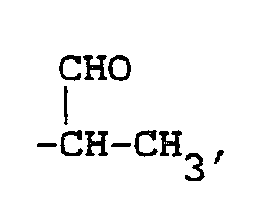
- les radicaux R, identiques ou différents, sont choisis parmi le radical phényle, trifluoro-3,3,3 propyle et un radical alkyle ayant de 1 à 12 atomes de carbone,
- a est choisi parmi 0,1 et 2.
- X est choisi parmi les radicaux -CH₂-CH₂-CHO et
- a est choisi parmi 0,1 et 2.
2. - Polyorganosiloxane selon la revendication 1, caractérisé en ce qu'il est choisi parmi les diorganopolysiloxanes de formule :

dans laquelle :
- X et R, identiques ou différents, ont la signification donnée à la revendication 1,
- Y, identiques ou différents, sont choisis parmi les radicaux R et X,
- a est un nombre entier compris entre 0 et 1 000 inclusivement,
- b est un nombre entier compris entre 0 et 50 inclusivement,
- c est un nombre entier compris entre 0 et 100 inclusivement et, si c est 0, au moins un des deux radicaux Y est X,
- a + b + c est au moins égal à 1
et ceux de formule : 
dans laquelle :
- R, X ont la signification ci-dessus,
- r est un nombre entier compris entre 0 et 9 inclus,
- s est un nombre entier compris entre 0 et 9 inclus,
- t est un nombre entier compris entre 1 et 10 inlcus.
- X et R, identiques ou différents, ont la signification donnée à la revendication 1,
- Y, identiques ou différents, sont choisis parmi les radicaux R et X,
- a est un nombre entier compris entre 0 et 1 000 inclusivement,
- b est un nombre entier compris entre 0 et 50 inclusivement,
- c est un nombre entier compris entre 0 et 100 inclusivement et, si c est 0, au moins un des deux radicaux Y est X,
- a + b + c est au moins égal à 1
et ceux de formule :
- R, X ont la signification ci-dessus,
- r est un nombre entier compris entre 0 et 9 inclus,
- s est un nombre entier compris entre 0 et 9 inclus,
- t est un nombre entier compris entre 1 et 10 inlcus.
3. - Polyorganopolysiloxane selon la revendication 1 ou 2, caractérisé en ce que les radicaux R, identiques ou différents, sont choisis parmi les radicaux méthyle et phényle, au moins 50 % en nombre des radicaux R étant méthyle.
4. - Procédé de préparation d'un polyorganopolysilane tel que défini à l'une quelconque des revendications 1 à 3, caractérisé en ce que :
a) - l'on effectue la réaction au moins partielle d'un polyorganosiloxane présentant par molécule au moins 3 motifs siloxyle dont au moins un motif siloxyle répondant à la formule générale :

dans laquelle R et a ont la signification donnée ci-dessus, dans un solvant organique, avec de l'hydrogène et du monoxyde de carbone en présence d'un système catalytique contenant du rhodium et des sels de triarylphosphines sulfonées ou carboxylées solubles dans les solvants organiques et insolubles dans l'eau, le mélange homogène obtenu étant ensuite mis en contact avec une solution aqueuse d'une base en vue de séparer ledit mélange en une phase organique renfermant l'organopolysiloxane à groupe propanaldéhyde et une phase aqueuse renfermant le catalyseur à base de rhodium.
a) - l'on effectue la réaction au moins partielle d'un polyorganosiloxane présentant par molécule au moins 3 motifs siloxyle dont au moins un motif siloxyle répondant à la formule générale :
5. - Procédé de préparation selon la revendication 4, caractérisé en ce que le polyorganosiloxane de départ est choisi parmi ceux de formule :

dans laquelle :
- R et a ont la signification ci-dessus,
- d est égal à b + c, et
- Y′ est choisi parmi un radical vinyle et le radical R et, quand d = 0 au moins un des deux Y′ est un radical vinyle,
et de formule : 
dans laquelle R a la signification donnée ci-dessus et u est égal à s + t, r + u étant compris entre 3 et 10 inclus.
- R et a ont la signification ci-dessus,
- d est égal à b + c, et
- Y′ est choisi parmi un radical vinyle et le radical R et, quand d = 0 au moins un des deux Y′ est un radical vinyle,
et de formule :
6. - Procédé selon une quelconque des revendications précédentes, caractérisé en ce que le système catalytique est formé de l'association d'un complexe de rhodium dinucléaire de formule :
{Rh(µ-SZ)(CO)₂}₂
Z étant un radical hydrocarboné monovalent avec un excès molaire d'une triphénylphosphine trisulfphonée de formule : 
dans laquelle R˝ est choisi parmi un radical alkyle ayant de 4 à 12 atomes de carbone, un radical aryle ou un radical cycloalkyle ayant de 6 à 12 atomes de carbone.
{Rh(µ-SZ)(CO)₂}₂
Z étant un radical hydrocarboné monovalent avec un excès molaire d'une triphénylphosphine trisulfphonée de formule :
7. - Elastomères obtenus avec un polysiloxane selon la présente invention.
Applications Claiming Priority (2)
| Application Number | Priority Date | Filing Date | Title |
|---|---|---|---|
| FR8811768A FR2636067B1 (fr) | 1988-09-05 | 1988-09-05 | Polyorganosiloxane a fonction propanaldehyde et son procede de preparation par hydroformylation |
| FR8811768 | 1988-09-05 |
Publications (1)
| Publication Number | Publication Date |
|---|---|
| EP0358580A1 true EP0358580A1 (fr) | 1990-03-14 |
Family
ID=9369841
Family Applications (1)
| Application Number | Title | Priority Date | Filing Date |
|---|---|---|---|
| EP89420318A Withdrawn EP0358580A1 (fr) | 1988-09-05 | 1989-08-29 | Polyorganosiloxane à fonction propanaldéhyde et son procédé de préparation par hydroformylation |
Country Status (5)
| Country | Link |
|---|---|
| US (1) | US5021601A (fr) |
| EP (1) | EP0358580A1 (fr) |
| JP (1) | JPH02107640A (fr) |
| BR (1) | BR8904404A (fr) |
| FR (1) | FR2636067B1 (fr) |
Cited By (2)
| Publication number | Priority date | Publication date | Assignee | Title |
|---|---|---|---|---|
| FR2686611A1 (fr) * | 1992-01-27 | 1993-07-30 | Rhone Poulenc Fibres | Copolymeres polyamides-polyorganosiloxane, procede d'obtention de ces polymeres et compositions contenant ces copolymeres. |
| EP0807636A1 (fr) * | 1996-05-15 | 1997-11-19 | Hoechst Aktiengesellschaft | Diphosphines substituées et procédé pour leur préparation |
Families Citing this family (20)
| Publication number | Priority date | Publication date | Assignee | Title |
|---|---|---|---|---|
| FR2645867B1 (fr) * | 1989-04-13 | 1991-06-14 | Rhone Poulenc Chimie | Procede de preparation, par hydroformylation, de polyorganosiloxane a fonction propanaldehyde |
| US5739246A (en) * | 1997-03-06 | 1998-04-14 | Dow Corning Corporation | Preparation of carbonyl functional polysiloxanes |
| DE10354259A1 (de) * | 2003-11-20 | 2005-06-09 | Wacker-Chemie Gmbh | Verfahren zur Herstellung von Carbonylreste-aufweisenden Organosiliciumverbindungen |
| CN101218282B (zh) * | 2005-07-18 | 2012-03-28 | 陶氏康宁公司 | 醛官能的硅氧烷 |
| CA2659400A1 (fr) * | 2006-08-02 | 2008-02-07 | Honeywell International Inc. | Copolymeres comprenant une unite de siloxane et un deuxieme monomere ou unite comprenant des sucres, des saccharides et des polysaccharides et leurs utilisations |
| US7696294B2 (en) * | 2006-08-02 | 2010-04-13 | Honeywell International Inc. | Siloxane polymers and uses thereof |
| FR2925514A1 (fr) * | 2007-12-20 | 2009-06-26 | Bluestar Silicones France Soc | Composition organopolysiloxanique vulcanisable a temperature ambiante en elastomere et nouveaux catalyseurs de polycondensation d'organopolysiloxanes. |
| KR20230087523A (ko) * | 2020-10-13 | 2023-06-16 | 다우 실리콘즈 코포레이션 | 알데히드 작용기를 갖는 유기규소 화합물의 제조 |
| WO2023060155A1 (fr) | 2021-10-06 | 2023-04-13 | Dow Global Technologies Llc | Préparation de composés d'organosilicium à fonction propylimine et de composés d'organosilicium à fonction aminopropyle primaire |
| WO2023060153A1 (fr) | 2021-10-06 | 2023-04-13 | Dow Global Technologies Llc | Préparation de composés d'organosilicium amino-fonctionnels |
| JP2024543086A (ja) | 2021-11-22 | 2024-11-19 | ダウ グローバル テクノロジーズ エルエルシー | カルビノール官能基を有する有機ケイ素化合物の調製 |
| JP2025509182A (ja) | 2022-03-21 | 2025-04-11 | ダウ グローバル テクノロジーズ エルエルシー | カルボキシ官能性を有する有機ケイ素化合物の調製 |
| EP4508054A1 (fr) | 2022-04-13 | 2025-02-19 | Dow Global Technologies LLC | Préparation de composés organosiliciés à fonction ester vinylique |
| JP2025512331A (ja) | 2022-04-13 | 2025-04-17 | ダウ グローバル テクノロジーズ エルエルシー | ポリエーテル官能性有機ケイ素化合物の製造 |
| JPWO2023204136A1 (fr) * | 2022-04-21 | 2023-10-26 | ||
| WO2025193391A1 (fr) | 2024-03-12 | 2025-09-18 | Dow Global Technologies Llc | Composition d'ester d'aldéhyde-aminosiloxane durcissable et son procédé de préparation |
| WO2025254798A1 (fr) | 2024-06-04 | 2025-12-11 | Dow Global Technologies Llc | Composition de polyorganosiloxane durcissable par aldéhyde-amine et ses procédés de préparation et d'utilisation |
| WO2025254796A1 (fr) | 2024-06-04 | 2025-12-11 | Dow Global Technologies Llc | Composés d'organosilicium à fonction amine cyclique et leur synthèse |
| WO2026049885A1 (fr) | 2024-08-29 | 2026-03-05 | Dow Global Technologies Llc | Composition de polyorganosiloxane durcissable et ses procédés de préparation et d'utilisation |
| WO2026049886A1 (fr) | 2024-08-29 | 2026-03-05 | Dow Global Technologies Llc | Émulsion de polyorganosiloxane et ses procédés de préparation et d'utilisation |
Citations (2)
| Publication number | Priority date | Publication date | Assignee | Title |
|---|---|---|---|---|
| EP0089690A1 (fr) * | 1982-03-24 | 1983-09-28 | Union Carbide Corporation | Silanes hydrolysables contenant un groupement aldéhyde |
| DE3632869A1 (de) * | 1986-09-26 | 1988-03-31 | Bayer Ag | Polysiloxane |
Family Cites Families (2)
| Publication number | Priority date | Publication date | Assignee | Title |
|---|---|---|---|---|
| US2588083A (en) * | 1950-06-01 | 1952-03-04 | Gen Electric | Organosilicon aldehydes and methods of preparing the same |
| US2803637A (en) * | 1954-01-18 | 1957-08-20 | Dow Corning | Organosiloxane aldehydes |
-
1988
- 1988-09-05 FR FR8811768A patent/FR2636067B1/fr not_active Expired - Lifetime
-
1989
- 1989-08-29 EP EP89420318A patent/EP0358580A1/fr not_active Withdrawn
- 1989-08-31 BR BR898904404A patent/BR8904404A/pt unknown
- 1989-09-05 US US07/402,768 patent/US5021601A/en not_active Expired - Fee Related
- 1989-09-05 JP JP1228463A patent/JPH02107640A/ja active Pending
Patent Citations (3)
| Publication number | Priority date | Publication date | Assignee | Title |
|---|---|---|---|---|
| EP0089690A1 (fr) * | 1982-03-24 | 1983-09-28 | Union Carbide Corporation | Silanes hydrolysables contenant un groupement aldéhyde |
| EP0183280A2 (fr) * | 1982-03-24 | 1986-06-04 | Union Carbide Corporation | Composés siloxa-cycliques |
| DE3632869A1 (de) * | 1986-09-26 | 1988-03-31 | Bayer Ag | Polysiloxane |
Cited By (2)
| Publication number | Priority date | Publication date | Assignee | Title |
|---|---|---|---|---|
| FR2686611A1 (fr) * | 1992-01-27 | 1993-07-30 | Rhone Poulenc Fibres | Copolymeres polyamides-polyorganosiloxane, procede d'obtention de ces polymeres et compositions contenant ces copolymeres. |
| EP0807636A1 (fr) * | 1996-05-15 | 1997-11-19 | Hoechst Aktiengesellschaft | Diphosphines substituées et procédé pour leur préparation |
Also Published As
| Publication number | Publication date |
|---|---|
| JPH02107640A (ja) | 1990-04-19 |
| BR8904404A (pt) | 1990-04-17 |
| US5021601A (en) | 1991-06-04 |
| FR2636067A1 (fr) | 1990-03-09 |
| FR2636067B1 (fr) | 1990-05-18 |
Similar Documents
| Publication | Publication Date | Title |
|---|---|---|
| US5021601A (en) | Novel polyorganosiloxanes comprising propanaldehyde functional groups | |
| EP3215555B1 (fr) | Nouveaux catalyseurs de réticulation de compositions silicones | |
| FR2611729A1 (fr) | Procede de preparation d'un organopolysiloxane a fonction acrylate et/ou methacrylate | |
| US4946818A (en) | Rhodium colloid, method of making, and use | |
| JPH0784475B2 (ja) | 結晶ジメチルシランジオールの製造方法 | |
| FR2634768A1 (fr) | Procede de preparation de diorganopolysiloxanes a groupements terminaux alcoxy | |
| FR3131918A1 (fr) | Procédé d’hydrosilylation photocatalysé par un complexe de manganèse | |
| FR2661680A1 (fr) | Procede de preparation de diorganopolysiloxanes a groupements terminaux alcoxy. | |
| EP1472264B1 (fr) | Procedes de preparation de composes de silicium | |
| EP0698632B1 (fr) | Procédé pour préparer un organosiloxane terminé par un groupe silanol | |
| FR2735135A1 (fr) | Fluides silicone substitues par des groupes aryle presentant des indices de refraction eleves et leur procede de fabrication | |
| US5488125A (en) | Method for manufacturing organosilanes having silanol groups | |
| FR2550540A1 (fr) | Procede de preparation de polydiorganosiloxanes a groupements terminaux alcoxy | |
| JP3962898B2 (ja) | 線状オルガノシロキサンポリマーの製造方法 | |
| EP1309647A1 (fr) | Procede de preparation d'huiles silicones par hydrosilylation de synthons contenant au moins un cycle hydrocarbone dans lequel est inclus un atome d'oxygene en presence d'un complexe metallique catalytique | |
| CA1333835C (fr) | Procede de preparation de polydiorganosiloxane a extremites silanol | |
| EP0039299B1 (fr) | Procédé d'obtention de polysiloxanes de masses moléculaires élevées par polymérisation et réarrangement de polysiloxanes en présence de catalyseur alcalin et de tris (oxaalkyl)amine | |
| EP0717757B1 (fr) | Procede de preparation de polyorganosiloxane a fonctions insaturees par deshydrogenocondensation en presence de complexes de titane, zirkonium ou hafnium | |
| WO2000020425A1 (fr) | Silanes et polyorganosiloxanes a fonction(s) boronate | |
| EP0846139A1 (fr) | Support hydroxyle d'oxyde inorganique, fonctionnalise, et procede pour sa preparation | |
| US4992573A (en) | Rhodium colloid, method of making, and use | |
| CN1085670C (zh) | 应用再分配反应的改进的有机硅烷制备方法 | |
| FR2731227A1 (fr) | Catalyseur d'equilibrage des silicones et procede de polycondensation et/ou de rearrangement utilisant un tel catalyseur | |
| EP0023187A1 (fr) | Procédé de polycondensation des polysiloxanes comportant des groupements hydroxysilyles en présence d'un métal alcalin ou alcalino-terreux et d'un composé polyhétéromacropolycyclique | |
| CN1875053A (zh) | 制造用膦酸酯改性的有机硅氧烷的方法 |
Legal Events
| Date | Code | Title | Description |
|---|---|---|---|
| PUAI | Public reference made under article 153(3) epc to a published international application that has entered the european phase |
Free format text: ORIGINAL CODE: 0009012 |
|
| AK | Designated contracting states |
Kind code of ref document: A1 Designated state(s): AT BE CH DE ES FR GB GR IT LI LU NL SE |
|
| 17P | Request for examination filed |
Effective date: 19900403 |
|
| STAA | Information on the status of an ep patent application or granted ep patent |
Free format text: STATUS: THE APPLICATION IS DEEMED TO BE WITHDRAWN |
|
| 18D | Application deemed to be withdrawn |
Effective date: 19920302 |