EP0698632B1 - Procédé pour préparer un organosiloxane terminé par un groupe silanol - Google Patents
Procédé pour préparer un organosiloxane terminé par un groupe silanol Download PDFInfo
- Publication number
- EP0698632B1 EP0698632B1 EP95305948A EP95305948A EP0698632B1 EP 0698632 B1 EP0698632 B1 EP 0698632B1 EP 95305948 A EP95305948 A EP 95305948A EP 95305948 A EP95305948 A EP 95305948A EP 0698632 B1 EP0698632 B1 EP 0698632B1
- Authority
- EP
- European Patent Office
- Prior art keywords
- hydrolysis
- formula
- dialkoxysilane
- exchange resin
- water
- Prior art date
- Legal status (The legal status is an assumption and is not a legal conclusion. Google has not performed a legal analysis and makes no representation as to the accuracy of the status listed.)
- Expired - Lifetime
Links
Classifications
-
- C—CHEMISTRY; METALLURGY
- C08—ORGANIC MACROMOLECULAR COMPOUNDS; THEIR PREPARATION OR CHEMICAL WORKING-UP; COMPOSITIONS BASED THEREON
- C08G—MACROMOLECULAR COMPOUNDS OBTAINED OTHERWISE THAN BY REACTIONS ONLY INVOLVING UNSATURATED CARBON-TO-CARBON BONDS
- C08G77/00—Macromolecular compounds obtained by reactions forming a linkage containing silicon with or without sulfur, nitrogen, oxygen or carbon in the main chain of the macromolecule
- C08G77/04—Polysiloxanes
- C08G77/045—Polysiloxanes containing less than 25 silicon atoms
-
- C—CHEMISTRY; METALLURGY
- C07—ORGANIC CHEMISTRY
- C07F—ACYCLIC, CARBOCYCLIC OR HETEROCYCLIC COMPOUNDS CONTAINING ELEMENTS OTHER THAN CARBON, HYDROGEN, HALOGEN, OXYGEN, NITROGEN, SULFUR, SELENIUM OR TELLURIUM
- C07F7/00—Compounds containing elements of Groups 4 or 14 of the Periodic Table
- C07F7/02—Silicon compounds
- C07F7/08—Compounds having one or more C—Si linkages
- C07F7/0834—Compounds having one or more O-Si linkage
- C07F7/0838—Compounds with one or more Si-O-Si sequences
- C07F7/0872—Preparation and treatment thereof
- C07F7/0876—Reactions involving the formation of bonds to a Si atom of a Si-O-Si sequence other than a bond of the Si-O-Si linkage
Definitions
- This invention relates to a process for preparing organosiloxane having silanol group.
- Linear organopolysiloxanes having a hydroxyl group at either end are dispersants useful in preparing silicone rubber compounds.
- Various dispersants are used, their dispersing function being proportional to the content of hydroxyl group.
- Polysiloxanes having a higher content of hydroxyl group, that is, low molecular weight linear organosiloxanes terminated with a hydroxyl group are effective in smaller amounts, which is advantageous for the subsequent processing of silicone rubber compounds.
- currently commercially available dispersants are linear organopolysiloxanes of not less than organotetrasiloxanes. For preparing potentially more effective organosilanes and siloxanes having a silanol group such as monomer diols, dimer diols and trimer diols, few processes are industrially practical.
- Low molecular weight linear organopolysiloxanes terminated with a hydroxyl group are industrially prepared by effecting hydrolysis of linear organochlorosiloxanes having a chlorine atom at each end or chlorosilanes in a weakly alkaline aqueous solution under controlled conditions to avoid formation of cyclics.
- This method has the problem that since the silanol group is unstable to acid or alkali, HCl resulting from hydrolysis can induce condensation reaction to form higher molecular weight organopolysiloxanes and cyclic polysiloxanes as well as the desired organopolysiloxanes. Therefore, this method is difficult to synthesize the desired linear organopolysiloxanes unless a strict control is made to maintain hydrolyzing water neutral.
- organochlorosiloxanes are reacted with acetic acid to convert into acetoxy form which is hydrolyzed. Since hydrolysis does not proceed to completion, the end product contains some residual acetoxy groups and is thus unsuitable as a dispersant to be used in silicone rubber.
- USP No. 3,925,285 discloses a method for synthesizing a low molecular weight linear organopolysiloxane having a silanol terminal group by reacting hexamethylcyclotrisiloxane, methanol, formic acid and water, the resulting organopolysiloxane having some methoxy groups left therein.
- This method is costly since the starting reactant, hexamethylcyclotrisiloxane is relatively expensive.
- the content of hydroxyl group has a certain limit.
- USP No. 5,057,620 discloses that a chlorosiloxane is added dropwise to a water-containing epoxy solvent such as propylene oxide and butylene oxide. This method also uses relatively expensive hexamethylcyclotrisiloxane and low boiling solvents have the safety problem of electrostatic ignition.
- JP-B Japanese Patent Publication (JP-B) No. 5604/1989 discloses a method for synthesizing a short chain silanol by hydrolyzing an alkoxysilane in the presence of a solid acid catalyst such as activated clay. This method requires complex operation since the solid acid must be neutralized.
- the product of this method is a mixture of short chain silanols with the yield of dimer diol being about 50%. With respect to monomer diol, it is obtained at a purity of 84 mol% in a yield of less than 10% as reported in Example 29.
- an object of the present invention is to provide a simple process for preparing a low molecular weight organosiloxane having a silanol group, preferably in high yields and at low cost.
- R 1 is independently selected from substituted or unsubstituted monovalent hydrocarbon group
- R 2 is independently selected from alkyl groups having 1 to 4 carbon atoms
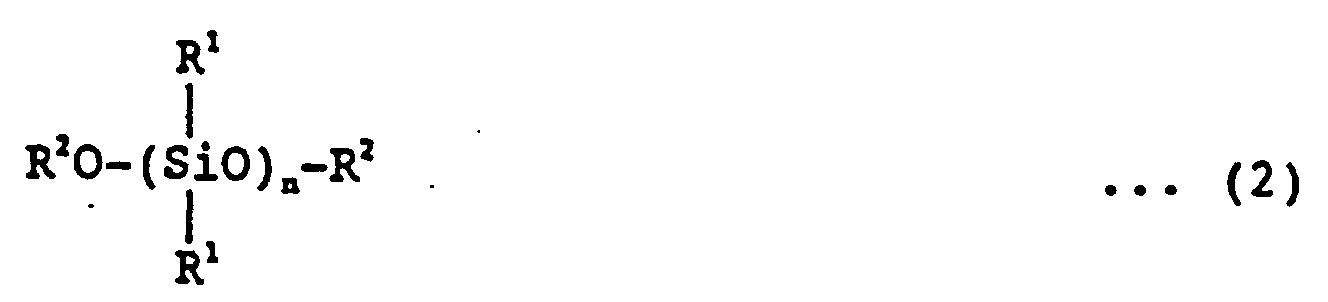
- letter n is an integer of 2 to 5.
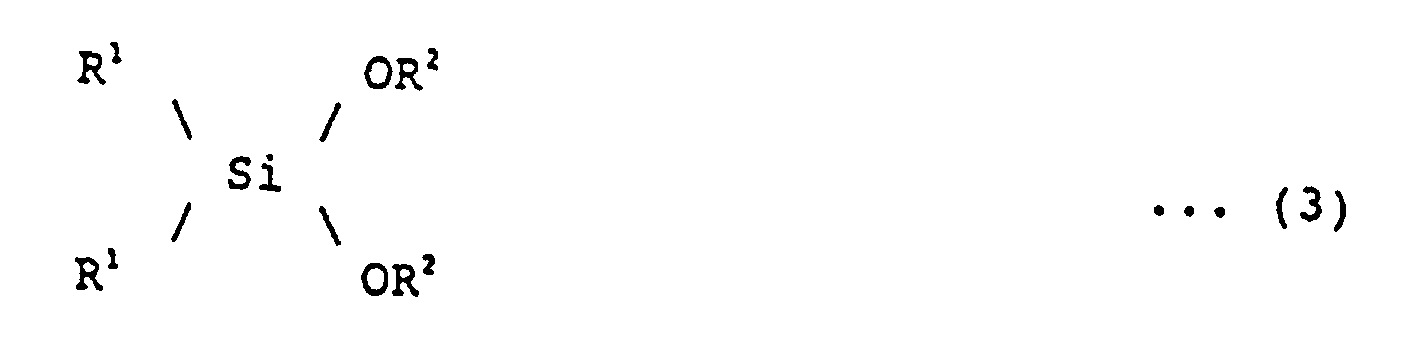
- Dialkoxysiloxane of formula (2) may be obtained with ease by adding water to a dialkoxysilane of the general formula (3) : R 1 2 Si(OR 2 ) 2 wherein R 1 and R 2 are as defined above in the presence of a cation exchange resin and agitating the mixture to effect hydrolysis in one stage.
- the dialkoxysiloxane of formula (2) is then hydrolyzed as mentioned above.
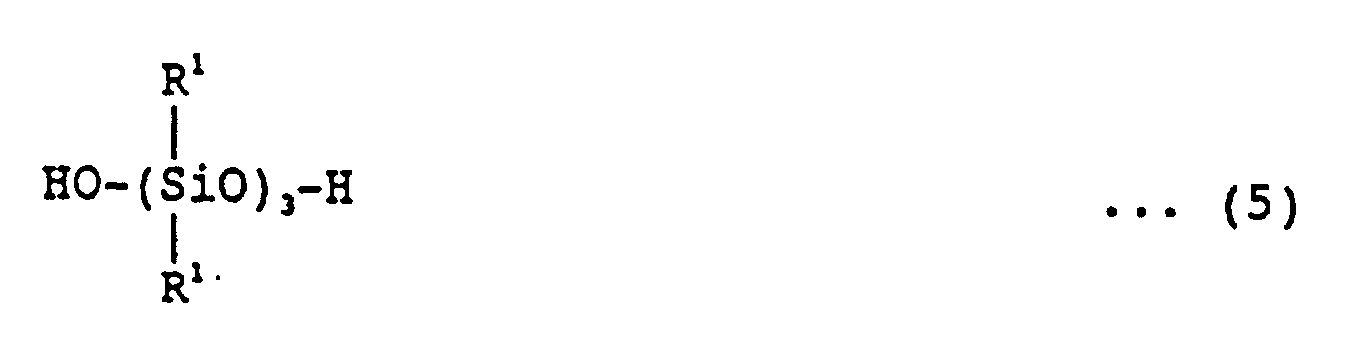
- a low molecular weight organosiloxane e.g. as shown by the general formula (4) or (5) below can be produced from relatively inexpensive dialkoxysilanes such as dimethoxy-dimethylsilane.
- R 1 is as defined above.
- the present invention provides a process for preparing a low molecular weight organosiloxane having a silanol group comprising the steps of effecting hydrolysis of dialkoxysilane of the following general formula (3): wherein R 1 is independently selected from substituted or unsubstituted monovalent hydrocarbon groups and R 2 is independently selected from alkyl groups having 1 to 4 carbon atoms, in the presence of a cation exchange resin by adding water thereto in an amount of 0.1 mol to less than 1 mol per mol of alkoxy group in the dialkoxysilane and agitating the resulting mixture, thereby forming dialkoxysiloxane of the general formula (2) wherein R 1 and R 2 are as defined above and n is an integer from 2 to 5, and effecting hydrolysis of the resulting dialkoxysiloxane of formula (2) in the presence of a cation exchange resin by adding water thereto in an amount of at least 1.0 mol per mol of the alkoxy group in said alkoxysi
- a process for preparing a low molecular weight organosiloxane having a silanol group involves the hydrolysis of alkoxysiloxane in the presence of a cation exchange resin. While suppressing undesirable condensation reaction of silanol, a low molecular weight organosiloxane bearing a silanol group which has a minimized content of cyclic polysiloxanes or chain extended polyorganosiloxanes can be produced.
- the present invention provides a process of hydrolyzing an alkoxysiloxane as a starting material to produce a corresponding hydroxysiloxane.
- the dialkoxysiloxanes are of the general formula (2).
- R 1 which may be identical or different, is a substituted or unsubstituted monovalent hydrocarbon group.
- R 2 which may be identical or different, is an alkyl group having 1 to 4 carbon atoms.
- Letter n is an integer of 2 to 5.
- R 1 is a substituted or unsubstituted monovalent hydrocarbon group, preferably having 1 to 10 carbon atoms, more preferably 1 to 6 carbon atoms.
- alkyl groups such as methyl, propyl, butyl, pentyl, hexyl, octyl, decyl, and dodecyl; alkenyl groups such as vinyl; aryl groups such as phenyl and tolyl; aralkyl groups such as ⁇ -phenylethyl; and substituted ones of these wherein, following options well-known in the art, some or all H atoms on carbon atoms are replaced e.g.
- R 1 's are methyl, vinyl, and phenyl groups.
- R 2 is an alkyl group having 1 to 4 carbon atoms, preferably methyl and ethyl. It is acceptable that both methyl and ethyl groups are co-present as R 2 in one molecule.
- alkoxysiloxane examples include 1,3-dimethoxytetramethyldisiloxane, 1,1-dimethoxytetramethyldisiloxane, 1-methoxypentamethyldisiloxane, 1,5-dimethoxyhexamethyltrisiloxane, 1,7-dimethoxyoctamethyltetrasiloxane, 3-methoxyheptamethyltrisiloxane, 1,3-dimethoxy-1,3-divinyl-1,3-dimethyldisiloxane and 1,3-dimethoxy-1,3-diphenyl-1,1-dimethyldisiloxane.
- alkoxysiloxanes may be used alone or in admixture. Where a mixture of alkoxysiloxanes is used, reaction conditions must be carefully controlled so as to avoid uneven reaction because the alkoxysiloxanes have different rates of hydrolysis.
- Dialkoxysiloxane of formula (2) is obtained by effecting hydrolysis of dialkoxysilane of the general formula (3) : R 1 2 Si(OR 2 ) 2 wherein R 1 and R 2 are as defined above in the presence of a cation exchange resin.
- dialkoxysiloxane of formula (2) by hydrolysis of dialkoxysilane of formula (3) is illustrated in detail.
- Illustrative examples of the dialkoxysilane of formula (3) include dimethyldimethoxysilane, phenylmethyldimethoxysilane, methylvinyldimethoxy-silane, dimethyldiethoxysilane, and phenylmethylmethoxy-ethoxysilane, with the dimethyldimethoxysilane being preferred.
- These dialkoxysiloxanes may be used alone or in admixture. Where a mixture of dialkoxysilanes is used, reaction conditions must be carefully controlled so as to avoid uneven reaction because the dialkoxysilanes have different rates of hydrolysis.
- the dialkoxysilane of formula (3) should preferably have a low chlorine content. Since a short chain silanol which is the desired end product is unstable under acidic or alkaline conditions, the system should be maintained neutral during reaction and during vacuum distillation to ensure formation of a short chain silanol. Since the alkoxysilane is generally synthesized from a corresponding chlorosilane, the alkoxysilane reactant contains chlorosilane, which quickly reacts with water to produce hydrochloric acid to render the action system acidic, allowing undesirable condensation of silanol to occur. Therefore, in order to produce a short chain silanol, it is recommended to use a dialkoxysilane reactant having a minimal content of chlorosilane. The dialkoxysilane of formula (3) should desirably have a chlorine content not above 100 ppm, especially not above 10 ppm.
- Water is used for hydrolysis of the dialkoxysilane. Since water is an essential component for allowing hydrolysis to take place in a relatively silanol excess condition at a relatively low temperature, it is desirable to remove Na, Ca, Mg and other ions from water through an ion exchange resin. More illustratively, deionized water having an electrical conductivity of at least 10 10 M ⁇ , more preferably at least 10 12 M ⁇ , especially at least 10 15 M ⁇ is preferably used. If water has an electrical conductivity of less than 10 10 M ⁇ , undesirable ion exchange may occur between ions in the cation exchange resin and ions in the hydrolyzing water to render the hydrolyzing water acidic.
- the cation exchange resin to be added to a mixture of the dialkoxysilane and deionized water is an essential component for allowing mild hydrolysis to take place while maintaining the hydrolyzing water at a nearly neutral pH level.
- the cation exchange resin should preferably be a suspension polymerized polymer having a polystyrene or divinylbenzene skeleton. While cation exchange resins are generally classified into two types, gel type and macroporous type, the present technique favors a macroporous cation exchange resin having a pore volume of at least 0.1 ml/g as measured by mercury porosimetry.
- the resin is of H + type or possesses a sulfone or acryl group as an acidic group, with the sulfone group being most preferred.
- commercially available examples of the cation exchange resin satisfying these requirements include Amberlyst® 15 (Rohm & Haas Co.), Diaion ® PK-208H, PK-216H and PK-228H (Mitsubishi Chemicals K.K), and Purolyte ® CT-175, CT-171 and CT-169 (Purolyte Co.), with Purolyte CT-175 being especially preferred.
- the amount of water used is 0.1 mol to less than 1 mol, preferably 0.2 to 0.6 mol per mol of the alkoxy group in a molecule of the dialkoxysilane of formula (3).
- less than 0.1 mol of water is insufficient for hydrolysis to take place to a full extent, so that a substantial proportion of the starting reactant or alkoxysilane is left unreacted.
- the dialkoxysiloxane of formula (2) is not obtained, but hydroxysilanes and hydroxysiloxanes are produced and as a consequence, a low molecular weight organosiloxane having a silanol group is not effectively produced.
- the amount of the cation exchange resin added is preferably 0.0001 to 30 parts, especially 0.01 to 1 part by weight per 100 parts by weight of the dialkoxysilane of formula (3) and hydrolyzing water combined. On this basis, more than 30 parts of the cation exchange resin may cause the once formed silanol group to condense, failing to produce a short chain silanol. Less than 0.0001 part of the cation exchange resin may not provide sufficient activity to promote hydrolysis.
- the time for hydrolysis of the dialkoxysilane is not critical. With too long a time, a siloxane bond of a dialkoxysiloxane resulting from hydrolysis can be severed to produce undesirable cyclics and long chain siloxanes. A reaction time within 50 hours is thus recommended in order to obtain a short chain dialkoxysiloxane.
- the reaction temperature is generally room temperature. Since similar reaction can take place at higher temperature, the reaction temperature is preferably lower than 50°C, especially lower than 25°C.
- the hydrolysis reaction of the dialkoxysilane of formula (3) is further discussed. Since hydrolysis of the dialkoxysilane with water is promoted by the cation exchange resin, the reaction system separates into a dialkoxysilane phase and a water phase at an initial stage. As hydrolysis proceeds, water is consumed to produce an alcohol so that the system becomes uniform. Since the ion exchange resin is solid and is not dissolved in the solution, reaction takes place at the solid surface. If agitation and mixing is insufficient, there is a likelihood that reaction does not proceed uniformly. It is thus necessary to fully agitate and mix the mixture during reaction.
- dialkoxysilane of formula (3) As mentioned above, by reacting the dialkoxysilane of formula (3) with 0.1 to less than 1 mol per mol of the alkoxy group therein of water in the presence of a cation exchange resin, there is obtained a dialkoxysiloxane of formula (2) terminated with an alkoxy group and having a chain length of 2 to 5 in admixture with by-products resulting from hydrolysis such as alcohol.
- a dialkoxysiloxane of a desired chain length may be readily separated e.g by a suitable technique such as distillation.
- a reaction mixture obtained from dimethoxydimethylsilane as a raw material and 0.3 mol water per mol of the alkoxy group, as described herein may contain 50% of 1,3-dimethoxytetramethyldisiloxane, 25% of 1,5-dimethoxyhexamethyltrisiloxane, 6% of 1,7-dimethoxyoctamethyltetrasiloxane, 2% of 1,9-dimethoxydecamethylpentasiloxane, and the remainder of unreacted dimethoxy-dimethylsilane although the proportion varies with reaction conditions.
- These dialkoxysiloxanes of different chain lengths can be separated by distillation. It is understood that the hydrolysis catalyst or cation exchange resin may be readily removed at the end of reaction by filtration or the like.
- the alkoxysiloxane of formula (1) is hydrolyzed in the presence of a cation exchange resin to produce a low molecular weight organosiloxane having a silanol group.
- the alkoxysiloxane used herein should preferably have a chlorine content not more than 100 ppm, especially not more than 10 ppm in a molecule.
- Water used in hydrolysis is preferably deionized water, that is, water from which Na, Ca, Mg and other ions have been removed by an ion exchange resin or distilled water which is free from such undesirable ions because it is desirable to suppress formation of undesirable cyclic siloxanes and organosiloxanes having an extended chain length.
- ionic materials are contained in the hydrolyzing water, they may give rise to ion exchange with H + of a sulfonyl group (for example) of the cation exchange resin as the hydrolyzing catalyst, turning the hydrolyzing water to be acidic. Then short chain silanols resulting from hydrolysis cannot stay stable, yielding undesirable cyclic siloxanes and organosiloxanes having an extended chain length.
- the hydrolyzing water should preferably have an electrical conductivity of at least 10 10 M ⁇ , more preferably at least 10 12 M ⁇ , especially at least 10 15 M ⁇ .
- the cation exchange resin is an essential component for allowing mild hydrolysis to take place while maintaining the hydrolyzing water at a nearly neutral pH level.
- the use of a cation exchange resin as a hydrolyzing catalyst ensures conversion of a dialkoxysiloxane to a corresponding dihydroxysiloxane while suppressing formation of condensed products such as cyclics.
- the resin in this stage may be selected from the same options and may be the same as, that proposed for the hydrolysis of dialkoxysilanes.
- the amount of water used is at least 1 mol, preferably a stoichiometrically excessive amount of 1 to 10 mol, more preferably 1 to 5 mol per mol of the alkoxy group in a molecule of the alkoxysiloxane.
- a lesser amount of water is insufficient for complete hydrolysis of the alkoxy group in an alkoxysiloxane molecule, resulting in short formation of a hydroxyl group.
- With more than 10 mol of water the amount of residual alkoxy group is fully reduced, but it becomes necessary to remove excess water from the reaction mixture at the end of reaction, which is uneconomical.
- the amount of the cation exchange resin added is preferably 0.0001 to 30 parts, especially 0.01 to 1 part by weight per 100 parts by weight of the alkoxysiloxane and water combined. On this basis, more than 30 parts of the cation exchange resin would cause the once formed silanol group to condense, failing to produce a short chain silanol. Less than 0.0001 part of the cation exchange resin fails to provide sufficient activity to promote hydrolysis.
- the reaction time is not critical and varies with the alkoxysiloxane used and the amount of catalyst. With too long a time, severing of a siloxane bond of a siloxane resulting from hydrolysis or condensation reaction of a silanol group can occur to produce undesirable cyclics and long chain organosiloxanes. A reaction time within 50 hours is thus recommended in order to obtain a short chain silanolsiloxane.
- the reaction temperature is not critical. Since similar reaction can take place at higher temperature, the reaction temperature is preferably lower than 80°C, especially lower than 50°C.
- a silanol-bearing organosiloxane is produced by hydrolyzing a dialkoxysilane of formula (3) and hydrolyzing the resulting dialkoxysiloxane of formula (2) as mentioned above
- the second stage of hydrolysis of dialkoxysiloxane of formula (2) can be done directly on the dialkoxysiloxane of formula (2) resulting from hydrolysis of dialkoxysilane of formula (3) without separating or purifying the hydrolysis product. That is, a mixture of the dialkoxysiloxane of formula (2) and by-products can be hydrolyzed as such to produce a siloxane terminated with a hydroxyl group and having a chain length n of 2 to 5.
- 1,3-dimethoxytetramethyldisiloxane obtained by hydrolysis of dimethoxydimethylsilane as a raw material and containing 50% of 1,3-dimethoxytetramethyldisiloxane and then hydrolyzing the isolated siloxane, 1,3-dihydroxytetramethyldisiloxane can be produced in high purity as a white crystal.
- the cation exchange resin is removed.
- the cation exchange resin as the hydrolyzing catalyst can be readily removed from the reaction mixture as by filtration. Simply by removing the cation exchange resin from the reaction system, both hydrolysis and silanol condensation reactions are terminated. It is usually unnecessary to add neutralizing agent such as alkali.
- a styrene or divinylbenzene copolymer having a sulfonyl group introduced in its benzene ring is used as the cation exchange resin. Since the sulfonyl group is chemically bonded to the benzene ring, the sulfonyl group is not dissolved in the reaction solution and the reaction solution is maintained neutral during reaction.
- the hydrolysis reaction can be terminated by removing the cation exchange resin as by filtration. Therefore, the reaction mixture after filtration contains no acidic material.
- the cation exchange resin separated from the reaction mixture can be reused as a hydrolyzing catalyst without special treatment, for example, regeneration.
- reaction mixture is then stripped to remove the volatile components including alcohol and residual water. Conditions are selected such that the desired silanol is not stripped off. Any desired stripping pressure may be used while the temperature should preferably be less than 80°C for stability of the silanol.
- Cation exchange resin treatment may be conducted continuously by filling the cation exchange resin in a filling vessel or tower and passing the mixture of the alkoxysiloxane of formula (1) or (2) or the alkoxysilane of formula (3) with water through the cation exchange resin-packed vessel or tower.
- a low molecular weight organosiloxane having a silanol terminal group, typically including a dimer diol and trimer diol can be produced in high yields.
- the resulting organosiloxane is useful as a dispersant in preparing silicone rubber compounds.
- a 2000-ml flask equipped with a thermometer and stirrer and purged with nitrogen was charged with 200 g of dimethoxydimethylsilane having a chlorine content of 5 ppm and 17.8 g (corresponding to 0.30 mol per mol of the alkoxy group) of deionized water having an electrical conductivity of 10 15 M ⁇ to form a two phase system.
- To the flask was added 1.0 g (0.46% by weight) of a cation exchange resin (CT-175 manufactured by Purolite Co.). The mixture was agitated at 20°C for 40 minutes whereupon the solution phase became homogeneous. Agitation was continued for a further 4 hours.
- CT-175 cation exchange resin manufactured by Purolite Co.
- the reaction mixture contained 11.1% of unreacted dimethoxydimethylsilane, 50.0% of 1,3-dimethoxytetramethyldisiloxane, 25.1% of 1,5-dimethoxyhexamethyltrisiloxane, 6.1% of 1,7-dimethoxyocatamethyltetrasiloxane, and 1.7% of 1,9-dimethoxydecamethylpentasiloxane.
- a 200-ml flask equipped with a thermometer and stirrer and purged with nitrogen was charged with 20.0 g of dimethoxymethylvinylsilane having a chlorine content of 5 ppm and 1.62 g (corresponding to 0.30 mol per mol of the alkoxy group) of deionized water having an electrical conductivity of 10 15 M ⁇ to form a two phase system.
- To the flask was added 0.10 g (0.46% by weight) of a cation exchange resin (Purolite CT-175). The mixture was agitated at 20°C for 40 minutes whereupon the solution phase became homogeneous. Agitation was continued for a further 4 hours.
- the reaction mixture contained 8.1% of unreacted dimethoxymethylvinylsilane, 45.9% of 1,3-dimethoxy-1,3-divinyl-1,3-dimethyldisiloxane, 28.8% of 1,5-dimethoxy-1,3,5-trivinyl-1,3,5-trimethyltrisiloxane, 7.9% of 1,7-dimethoxy-1,3,5,7-tetravinyl-1,3,5,7-tetramethyltetrasiloxane, and 2.9% of 1,9-dimethoxy-1,3,5,7,9-pentamethyl-1,3,5,7,9-pentamethylpentasiloxane.
- a first stage of hydrolysis was carried out in accordance with the procedure of Example 1. At the end of the first stage, the reaction mixture was distilled to separate 1,3-dimethoxytetramethyldisiloxane therefrom. The separated siloxane was subjected to a second stage of hydrolysis as follows.
- a first stage of hydrolysis was carried out in accordance with the procedure of Example 1. At the end of the first stage, the reaction mixture was distilled to separate 1,5-dimethoxyhexamethyltrisiloxane therefrom. The separated siloxane was subjected to a second stage of hydrolysis as follows.
- Example 1 The ion exchange resin separated by filtration in Example 1 was reused as a hydrolyzing catalyst without a further treatment. Hydrolysis was carried out as in Example 1.
- the hydrolyzate contained 2.5% of dihydroxydimethylsilane, 44.0% of 1,3-dihydroxytetramethyldisiloxane, 20.1% of 1,5-dihydroxyhexamethyltrisiloxane, 4.4% of 1,7-dihydroxyoctamethyltetrasiloxane, and 1.3% of 1,9-dihydroxydecamethylpentasiloxane.
- the oily product contained 15.7% of 1,3-dihydroxytetramethyldisiloxane, 24.4% of 1,5-dihydroxyhexamethyltrisiloxane, 15.1% of 1,7-dihydroxyoctamethyltetrasiloxane, and 9.3% of 1,9-dihydroxydecamethylpentasiloxane.
- the oily product contained 16.3% of 1,3-dihydroxytetramethyldisiloxane, 25.5% of 1,5-dihydroxyhexamethyltrisiloxane, 23.8% of 1,7-dihydroxyoctamethyltetrasiloxane, and 8.6% of 1,9-dihydroxydecamethylpentasiloxane.
- a 200-ml flask equipped with a thermometer and stirrer and purged with nitrogen was charged with 20.0 g of dimethoxydimethylsilane having a chlorine content of 5 ppm and 1.19 g (corresponding to 0.2 mol per mol of the alkoxy group) of deionized water having an electrical conductivity of 10 15 M ⁇ to form a two phase system.
- To the flask was added 0.10 g (0.46% by weight) of a cation exchange resin (Purolite CT-175). The mixture was agitated at 20°C for 40 minutes whereupon the solution phase became homogeneous. Agitation was continued for a further 4 hours.
- the reaction mixture contained 33.2% of unreacted dimethoxydimethylsilane, 45.4% of 1,3-dimethoxytetramethyldisiloxane, 12.8% of 1,5-dimethoxyhexamethyltrisiloxane, 2.5% of 1,7-dimethoxyocatamethyltetrasiloxane, and 0.6% of 1,9-dimethoxydecamethylpentasiloxane.
- the first stage of hydrolysis in Example 6 was repeated except that the amount of deionized water was 3.0 g (corresponding to 0.5 mol per mol of the alkoxy group).
- the resulting reaction mixture contained 2.1% of dimethoxy-dimethylsilane, 48.9% of 1,3-dimethoxytetramethyldisiloxane, 29.1% of 1,5-dimethoxyhexamethyltrisiloxane, 8.8% of 1,7-dimethoxyocatamethyltetrasiloxane, and 2.2% of 1,9-dimethoxydecamethylpentasiloxane.
- the reaction mixture was subject to a second stage of hydrolysis as in Example 6. There was obtained 11.6 g of a colorless clear liquid which contained 0.9% of dihydroxydimethylsilane, 46.3% of 1,3-dihydroxytetramethyldisiloxane, 28.0% of 1,5-dihydroxyhexamethyltrisiloxane, 9.1% of 1,7-dihydroxyoctamethyltetrasiloxane, and 3.0% of 1,9-dihydroxydecamethylpentasiloxane.
- the first stage of hydrolysis in Example 6 was repeated except that the amount of deionized water was 8.9 g (corresponding to 1.5 mol per mol of the alkoxy group).
- the resulting reaction mixture contained 70.1% of dihydroxydimethylsilane, 8.5% of 1,3-dimethoxytetramethyldisiloxane, 3.2% of 1,5-dimethoxyhexamethyltrisiloxane, 2.5% of hydroxymethoxydimethylsilane, and 3.0% of 1-hydroxy-3-methoxytetramethyldisiloxane.
- reaction mixture was agitated for 40 minutes. After the solid ion exchange resin was removed by filtration, the residual water, methanol and other by-products were stripped off at 5 mmHg and 50°C, yielding 16.7 g of a colorless clear liquid. On analysis by gas chromatography, it contained the following.
- dihydroxymethylvinylsilane 2.0% 1,3-dihydroxy-1,3-divinyl-1,3-dimethyldisiloxane 42.4% 1,5-dihydroxy-1,3,5-trivinyl-1,3,5-trimethyltrisiloxane 24.5% 1,7-dihydroxy-1,3,5,7-tetravinyl-1,3,5,7-tetramethyltetrasiloxane 7.5% 1,9-dihydroxy-1,3,5,7,9-pentavinyl-1,3,5,7,9-pentamethylpentasiloxane 2.9%
Landscapes
- Chemical & Material Sciences (AREA)
- Organic Chemistry (AREA)
- Chemical Kinetics & Catalysis (AREA)
- Health & Medical Sciences (AREA)
- Medicinal Chemistry (AREA)
- Polymers & Plastics (AREA)
- Silicon Polymers (AREA)
Claims (16)
- Procédé de préparation d'un organosiloxane ayant un groupe silanol, comprenant les étapes de :effectuer l'hydrolyse du dialcoxysilane de la formule générale (3) qui suit:où R1 est indépendamment sélectionné parmi un groupe hydrocarbure monovalent substitué ou non substitué et R2 est indépendamment sélectionné parmi des groupes alkyle ayant 1 à 4 atomes de carbone,
 en présence d'une résine échangeuse de cations, par addition d'eau à celle-ci en une quantité de 0,1 mole à moins de 1 mole par mole du groupe alcoxy dans le dialcoxysilane et en soumettant le mélange résultant à agitation, pour ainsi former un dialcoxysilane de la formule générale (2)où R1 et R2 sont tels que définis ci-dessus et n est un entier de 2 à 5, et
 effectuer l'hydrolyse du dialcoxysilane de formule (2) résultant en présence d'une résine échangeuse de cations en y ajoutant de l'eau en une quantité d'au moins 1,0 mole par mole du groupe alcoxy dans le dialcoxysilane et en soumettant le mélange résultant à agitation.
- Procédé- de la revendication 1 où le dialcoxysilane de la formule (2) comprend un dialcoxysilane ayant n = 2 ou 3 et l'organosiloxane produit ayant un groupe silanol comprend un organosiloxane de la formule générale (4) ou (5) qui suit:
 où R1 est tel que défini ci-dessus.
- Procédé de la revendication 1 ou de la revendication 2 où la résine échangeuse de cations est une résine échangeuse de cations macroporeuse ayant un volume des pores d'au moins 0,1 ml/g en mesurant par porosimétrie de mercure.
- Procédé selon l'une quelconque des revendications précédentes où l'eau ajoutée est de l'eau désionisée ayant une conductivité électrique d'au moins 1010 MΩ.
- Procédé de la revendication 4 où l'eau ajoutée est de l'eau désionisée ayant une conductivité électrique d'au moins 1012Ω.
- Procédé selon l'une quelconque des revendications précédentes où le dialcoxysilane de formule (3) contient jusqu'à 100 ppm de chlore résiduel.
- Procédé selon l'une quelconque des revendications précédentes où la quantité d'eau utilisée dans l'hydrolyse du dialcoxysilane de la formule (3) est de 0,2 à 0,6 mole par mole du groupe alcoxy dans la molécule de dialcoxysilane.
- Procédé selon l'une quelconque des revendications précédentes où la quantité d'eau utilisée dans l'hydrolyse du dialcoxysilane de la formule (2) est de 1 à 10 moles par mole du groupe alcoxy dans ledit alcoxysilane.
- Procédé selon l'une quelconque des revendications précédentes où la quantité de la résine échangeuse de cations utilisée dans l'hydrolyse du dialcoxysilane de la formule (3) est de 0,001 à 30 parties en poids pour 100 parties en poids du dialcoxysilane de la formule (3) et de l'eau combinés.
- Procédé selon l'une quelconque des revendications précédentes où la quantité de la résine échangeuse cationique utilisée dans l'hydrolyse du dialcoxysilane de la formule (2) est de 0,0001 à 30 parties en poids pour 100 parties de l'alcoxysilane et de l'eau combinés.
- Procédé selon l'une quelconque des revendications précédentes où l'hydrolyse du dialcoxysilane de la formule (3) est entreprise à une température plus faible que 50°C.
- Procédé selon l'une quelconque des revendications précédentes où l'hydrolyse du dialcoxysilane de la formule (3) est entreprise à une température plus faible que 25°C.
- Procédé selon l'une quelconque des revendications précédentes où l'hydrolyse du dialcoxysilane de la formule (2) est entreprise à une température plus faible que 80°C.
- Procédé selon l'une quelconque des revendications précédentes où ladite résine échangeuse de cations en est une qui permet à une hydrolyse modérée d'avoir lieu tout en maintenant l'eau d'hydrolyse à un niveau de pH presque neutre.
- Procédé selon l'une quelconque des revendications précédentes où le dialcoxysilane de la formule (2) est sélectionné dans le groupe consistant en 1,3-diméthoxytétraméthyldisiloxane, 1,1-diméthoxytétraméthyldisiloxane, 1-méthoxypentaméthyldisiloxane, 1,5-diméthoxyhexaméthyltrisiloxane, 1,7-diméthoxyoctaméthyltétrasiloxane, 3-méthoxyheptaméthyltrisiloxane, 1,3-diméthoxy-1,3-divinyl-1,3-diméthyldisiloxane, et 1,3-diméthoxy-1,3-diphényl-1,3-diméthyldisiloxane.
- Procédé selon l'une quelconque des revendications précédentes où le dialcoxysilane de la formule (3) est sélectionné dans le groupe consistant en diméthyldiméthoxysilane, phénylméthyldiméthoxysilane, méthylvinyldiméthoxysilane, diméthyldiéthoxysilane, et phénylméthylméthoxyéthoxysilane.
Applications Claiming Priority (6)
| Application Number | Priority Date | Filing Date | Title |
|---|---|---|---|
| JP224158/94 | 1994-08-25 | ||
| JP22415894 | 1994-08-25 | ||
| JP22415894 | 1994-08-25 | ||
| JP81706/95 | 1995-03-14 | ||
| JP07081706A JP3079939B2 (ja) | 1994-08-25 | 1995-03-14 | シラノール基を有する低分子量のオルガノシロキサンの製造方法 |
| JP8170695 | 1995-03-14 |
Publications (2)
| Publication Number | Publication Date |
|---|---|
| EP0698632A1 EP0698632A1 (fr) | 1996-02-28 |
| EP0698632B1 true EP0698632B1 (fr) | 2001-11-21 |
Family
ID=26422708
Family Applications (1)
| Application Number | Title | Priority Date | Filing Date |
|---|---|---|---|
| EP95305948A Expired - Lifetime EP0698632B1 (fr) | 1994-08-25 | 1995-08-25 | Procédé pour préparer un organosiloxane terminé par un groupe silanol |
Country Status (4)
| Country | Link |
|---|---|
| US (1) | US5576408A (fr) |
| EP (1) | EP0698632B1 (fr) |
| JP (1) | JP3079939B2 (fr) |
| DE (1) | DE69524007T2 (fr) |
Cited By (2)
| Publication number | Priority date | Publication date | Assignee | Title |
|---|---|---|---|---|
| RU2484103C1 (ru) * | 2012-04-24 | 2013-06-10 | Открытое акционерное общество "Казанский завод синтетического каучука" (ОАО "КЗСК") | Способ получения органосилоксандиолов |
| EP4524178A1 (fr) | 2023-09-13 | 2025-03-19 | PolyU GmbH | Additifs modifiant la viscosité pour polymères silylés |
Families Citing this family (11)
| Publication number | Priority date | Publication date | Assignee | Title |
|---|---|---|---|---|
| US6316655B1 (en) | 2001-02-20 | 2001-11-13 | Dow Corning Corporation | Method of making hydroxy end-terminated linear siloxanes |
| DE10301355A1 (de) * | 2003-01-16 | 2004-07-29 | Goldschmidt Ag | Äquilibrierung von Siloxanen |
| JP2007326848A (ja) * | 2006-05-09 | 2007-12-20 | Hitachi Chem Co Ltd | シリコーンオリゴマーの製造法 |
| WO2008037468A2 (fr) * | 2006-09-28 | 2008-04-03 | Huntsman Textile Effects (Germany) Gmbh | Silanes dimères et oligomères et leurs produits de réaction avec des organosiloxanes |
| EP1905794A1 (fr) * | 2006-09-28 | 2008-04-02 | Huntsman Textile Effects (Germany) GmbH | Siloxanes dimériques et oligomériques et leurs produits de réaction avec des organosiloxanes |
| KR101203032B1 (ko) * | 2008-02-22 | 2012-11-20 | 닛뽕소다 가부시키가이샤 | 유기 박막 형성용 용액 및 그 제조 방법 |
| JP2011219647A (ja) * | 2010-04-12 | 2011-11-04 | Shin-Etsu Chemical Co Ltd | シラノール基を有するオルガノシラン及び低分子量オルガノポリシロキサンの製造方法 |
| RU2456308C2 (ru) * | 2010-07-23 | 2012-07-20 | Учреждение Российской академии наук Институт синтетических полимерных материалов им. Н.С. Ениколопова (ИСПМ РАН) | Способ получения линейных полидиметилсилоксанов с концевыми гидроксильными группами поликонденсацией диметилдиалкоксисиланов в активной среде |
| CN103917580B (zh) * | 2011-11-08 | 2016-06-08 | 日产化学工业株式会社 | 含硅烷醇基的聚硅氧烷溶液的稳定化方法、稳定化的含硅烷醇基的聚硅氧烷溶液的制造方法和稳定化的含硅烷醇基的聚硅氧烷溶液 |
| JP6131575B2 (ja) * | 2011-12-22 | 2017-05-24 | 東ソー株式会社 | 環状シロキサン化合物の製造方法およびジシロキサン化合物 |
| DE102016201633A1 (de) * | 2016-02-03 | 2017-08-03 | Wacker Chemie Ag | Verfahren zur Herstellung von Aminogruppen aufweisenden Organopolysiloxanen |
Family Cites Families (12)
| Publication number | Priority date | Publication date | Assignee | Title |
|---|---|---|---|---|
| US3304318A (en) * | 1962-08-27 | 1967-02-14 | Dow Corning | Method for hydrolyzing alkoxysilanes |
| US3925285A (en) | 1974-06-20 | 1975-12-09 | Sws Silicones Corp | Antistructure agent |
| GB1533158A (en) * | 1975-03-11 | 1978-11-22 | Gen Electric | Diorganopolysiloxanes |
| US4066680A (en) * | 1976-10-18 | 1978-01-03 | Sws Silicones Corporation | Process for making alpha,omega-siloxanediols |
| US4395563A (en) * | 1981-10-29 | 1983-07-26 | General Electric Company | Hydrolysis of alkoxysilanes |
| US4929703A (en) * | 1989-03-30 | 1990-05-29 | Dow Corning Corporation | Solventless silicone coating composition |
| JPH0751582B2 (ja) | 1989-08-08 | 1995-06-05 | 信越化学工業株式会社 | 両末端にシラノール基を有する直鎖状オルガノテトラシロキサンの製造方法 |
| US4977290A (en) * | 1989-11-20 | 1990-12-11 | General Electric Company | Polar aprotic catalysts for formation of fluorosilicone fluids |
| JP2718231B2 (ja) * | 1990-01-10 | 1998-02-25 | 三菱電機株式会社 | 高純度末端ヒドロキシフェニルラダーシロキサンプレポリマーの製造方法および高純度末端ヒドロキシフェニルラダーポリシロキサンの製造方法 |
| JP2652307B2 (ja) * | 1992-07-16 | 1997-09-10 | 信越化学工業株式会社 | 分子鎖末端に水酸基を有する直鎖状オルガノポリシロキサンの製造方法 |
| JPH06224158A (ja) | 1993-01-26 | 1994-08-12 | Sony Corp | ドライエッチング方法 |
| JPH0781706A (ja) | 1993-09-16 | 1995-03-28 | Nippon Filing Co Ltd | 図書保管管理装置 |
-
1995
- 1995-03-14 JP JP07081706A patent/JP3079939B2/ja not_active Expired - Fee Related
- 1995-08-24 US US08/518,881 patent/US5576408A/en not_active Expired - Fee Related
- 1995-08-25 DE DE69524007T patent/DE69524007T2/de not_active Expired - Fee Related
- 1995-08-25 EP EP95305948A patent/EP0698632B1/fr not_active Expired - Lifetime
Cited By (2)
| Publication number | Priority date | Publication date | Assignee | Title |
|---|---|---|---|---|
| RU2484103C1 (ru) * | 2012-04-24 | 2013-06-10 | Открытое акционерное общество "Казанский завод синтетического каучука" (ОАО "КЗСК") | Способ получения органосилоксандиолов |
| EP4524178A1 (fr) | 2023-09-13 | 2025-03-19 | PolyU GmbH | Additifs modifiant la viscosité pour polymères silylés |
Also Published As
| Publication number | Publication date |
|---|---|
| DE69524007T2 (de) | 2002-07-11 |
| JP3079939B2 (ja) | 2000-08-21 |
| EP0698632A1 (fr) | 1996-02-28 |
| US5576408A (en) | 1996-11-19 |
| DE69524007D1 (de) | 2002-01-03 |
| JPH08113649A (ja) | 1996-05-07 |
Similar Documents
| Publication | Publication Date | Title |
|---|---|---|
| US5576408A (en) | Process for preparing low molecular weight organosiloxane terminated with silanol group | |
| GB2108984A (en) | Hydrolysis of alkoxysilanes | |
| US4855381A (en) | Method for the preparation of an organopolysiloxane | |
| US5488125A (en) | Method for manufacturing organosilanes having silanol groups | |
| JP3705333B2 (ja) | シラノール基を有する有機けい素化合物の製造方法 | |
| KR100249446B1 (ko) | 분자쇄말단에 수산기를 갖는 직쇄상 오르가노폴리실록산의 제조방법 | |
| EP1319680B1 (fr) | Procédé de préparation de polyorganosiloxanes linéaires | |
| US4260715A (en) | Process for the production of siliconfunctional polyorganosiloxanes | |
| CA1121369A (fr) | Polysiloxanes hydro-carbonoxyles, prepares par un procede de reflux en continu | |
| US7683198B2 (en) | Process for preparing diorganopolysiloxanes | |
| EP0992527A1 (fr) | Procédé de préparation de organopolysiloxanes ou organosilanes contenant des groupes époxy | |
| JP5440381B2 (ja) | 両末端にシラノール基を有する低分子量直鎖状オルガノポリシロキサンの製造方法 | |
| EP1247811B1 (fr) | Procédé de préparation des organohydrosiloxanes linéaires | |
| JP3206384B2 (ja) | アルコキシシロキサンの製造方法 | |
| JPH05320179A (ja) | オルガノクロロシランの加水分解方法 | |
| JP3252642B2 (ja) | シラノール基を有する低分子量のオルガノシラン又はシロキサンの製造方法 | |
| US4348532A (en) | Monoorganosiloxy containing siloxane fluids | |
| JP2668496B2 (ja) | ケイ素系粉末物質の新規な製造方法 | |
| JP3063554B2 (ja) | ポリオルガノシロキサン樹脂の製造方法 | |
| JPH08151445A (ja) | シラノール基を有するオルガノシラン又はシロキサンの製造方法 | |
| KR0134564B1 (ko) | 알릴알킬실록산과 디오르가노실록산 공중합 형태의 실리콘 오일 및 그 제조 방법 | |
| JP2010270027A (ja) | 水酸基を有する低重合度ジオルガノシロキサンの製造方法 | |
| JP2657454B2 (ja) | オルガノポリシロキサンの製造方法 | |
| TW420685B (en) | Process for preparing organosiloxane terminated with silanol group | |
| JP2668495B2 (ja) | ケイ素系粉末物質の製造方法 |
Legal Events
| Date | Code | Title | Description |
|---|---|---|---|
| PUAI | Public reference made under article 153(3) epc to a published international application that has entered the european phase |
Free format text: ORIGINAL CODE: 0009012 |
|
| AK | Designated contracting states |
Kind code of ref document: A1 Designated state(s): DE FR GB |
|
| 17P | Request for examination filed |
Effective date: 19960402 |
|
| 17Q | First examination report despatched |
Effective date: 19990216 |
|
| GRAG | Despatch of communication of intention to grant |
Free format text: ORIGINAL CODE: EPIDOS AGRA |
|
| RIC1 | Information provided on ipc code assigned before grant |
Free format text: 7C 08G 77/04 A, 7C 07F 7/08 B |
|
| GRAG | Despatch of communication of intention to grant |
Free format text: ORIGINAL CODE: EPIDOS AGRA |
|
| GRAG | Despatch of communication of intention to grant |
Free format text: ORIGINAL CODE: EPIDOS AGRA |
|
| GRAH | Despatch of communication of intention to grant a patent |
Free format text: ORIGINAL CODE: EPIDOS IGRA |
|
| GRAH | Despatch of communication of intention to grant a patent |
Free format text: ORIGINAL CODE: EPIDOS IGRA |
|
| GRAA | (expected) grant |
Free format text: ORIGINAL CODE: 0009210 |
|
| AK | Designated contracting states |
Kind code of ref document: B1 Designated state(s): DE FR GB |
|
| REG | Reference to a national code |
Ref country code: GB Ref legal event code: IF02 |
|
| REF | Corresponds to: |
Ref document number: 69524007 Country of ref document: DE Date of ref document: 20020103 |
|
| ET | Fr: translation filed | ||
| PGFP | Annual fee paid to national office [announced via postgrant information from national office to epo] |
Ref country code: GB Payment date: 20020821 Year of fee payment: 8 |
|
| PLBE | No opposition filed within time limit |
Free format text: ORIGINAL CODE: 0009261 |
|
| STAA | Information on the status of an ep patent application or granted ep patent |
Free format text: STATUS: NO OPPOSITION FILED WITHIN TIME LIMIT |
|
| 26N | No opposition filed | ||
| PG25 | Lapsed in a contracting state [announced via postgrant information from national office to epo] |
Ref country code: GB Free format text: LAPSE BECAUSE OF NON-PAYMENT OF DUE FEES Effective date: 20030825 |
|
| GBPC | Gb: european patent ceased through non-payment of renewal fee | ||
| PGFP | Annual fee paid to national office [announced via postgrant information from national office to epo] |
Ref country code: FR Payment date: 20040810 Year of fee payment: 10 |
|
| PGFP | Annual fee paid to national office [announced via postgrant information from national office to epo] |
Ref country code: DE Payment date: 20040902 Year of fee payment: 10 |
|
| PG25 | Lapsed in a contracting state [announced via postgrant information from national office to epo] |
Ref country code: DE Free format text: LAPSE BECAUSE OF NON-PAYMENT OF DUE FEES Effective date: 20060301 |
|
| PG25 | Lapsed in a contracting state [announced via postgrant information from national office to epo] |
Ref country code: FR Free format text: LAPSE BECAUSE OF NON-PAYMENT OF DUE FEES Effective date: 20060428 |
|
| REG | Reference to a national code |
Ref country code: FR Ref legal event code: ST Effective date: 20060428 |