EP0360074A2 - Zur Herstellung transparenter thermoplastischer Formmassen geeignete Pfropfpolymerisate - Google Patents
Zur Herstellung transparenter thermoplastischer Formmassen geeignete Pfropfpolymerisate Download PDFInfo
- Publication number
- EP0360074A2 EP0360074A2 EP89116493A EP89116493A EP0360074A2 EP 0360074 A2 EP0360074 A2 EP 0360074A2 EP 89116493 A EP89116493 A EP 89116493A EP 89116493 A EP89116493 A EP 89116493A EP 0360074 A2 EP0360074 A2 EP 0360074A2
- Authority
- EP
- European Patent Office
- Prior art keywords
- weight
- graft
- gew
- acrylonitrile
- der
- Prior art date
- Legal status (The legal status is an assumption and is not a legal conclusion. Google has not performed a legal analysis and makes no representation as to the accuracy of the status listed.)
- Granted
Links
Classifications
-
- C—CHEMISTRY; METALLURGY
- C08—ORGANIC MACROMOLECULAR COMPOUNDS; THEIR PREPARATION OR CHEMICAL WORKING-UP; COMPOSITIONS BASED THEREON
- C08L—COMPOSITIONS OF MACROMOLECULAR COMPOUNDS
- C08L51/00—Compositions of graft polymers in which the grafted component is obtained by reactions only involving carbon-to-carbon unsaturated bonds; Compositions of derivatives of such polymers
- C08L51/06—Compositions of graft polymers in which the grafted component is obtained by reactions only involving carbon-to-carbon unsaturated bonds; Compositions of derivatives of such polymers grafted on to homopolymers or copolymers of aliphatic hydrocarbons containing only one carbon-to-carbon double bond
-
- C—CHEMISTRY; METALLURGY
- C08—ORGANIC MACROMOLECULAR COMPOUNDS; THEIR PREPARATION OR CHEMICAL WORKING-UP; COMPOSITIONS BASED THEREON
- C08F—MACROMOLECULAR COMPOUNDS OBTAINED BY REACTIONS ONLY INVOLVING CARBON-TO-CARBON UNSATURATED BONDS
- C08F279/00—Macromolecular compounds obtained by polymerising monomers on to polymers of monomers having two or more carbon-to-carbon double bonds as defined in group C08F36/00
- C08F279/02—Macromolecular compounds obtained by polymerising monomers on to polymers of monomers having two or more carbon-to-carbon double bonds as defined in group C08F36/00 on to polymers of conjugated dienes
- C08F279/04—Vinyl aromatic monomers and nitriles as the only monomers
-
- C—CHEMISTRY; METALLURGY
- C08—ORGANIC MACROMOLECULAR COMPOUNDS; THEIR PREPARATION OR CHEMICAL WORKING-UP; COMPOSITIONS BASED THEREON
- C08L—COMPOSITIONS OF MACROMOLECULAR COMPOUNDS
- C08L27/00—Compositions of homopolymers or copolymers of compounds having one or more unsaturated aliphatic radicals, each having only one carbon-to-carbon double bond, and at least one being terminated by a halogen; Compositions of derivatives of such polymers
- C08L27/02—Compositions of homopolymers or copolymers of compounds having one or more unsaturated aliphatic radicals, each having only one carbon-to-carbon double bond, and at least one being terminated by a halogen; Compositions of derivatives of such polymers not modified by chemical after-treatment
- C08L27/04—Compositions of homopolymers or copolymers of compounds having one or more unsaturated aliphatic radicals, each having only one carbon-to-carbon double bond, and at least one being terminated by a halogen; Compositions of derivatives of such polymers not modified by chemical after-treatment containing chlorine atoms
- C08L27/06—Homopolymers or copolymers of vinyl chloride
-
- C—CHEMISTRY; METALLURGY
- C08—ORGANIC MACROMOLECULAR COMPOUNDS; THEIR PREPARATION OR CHEMICAL WORKING-UP; COMPOSITIONS BASED THEREON
- C08L—COMPOSITIONS OF MACROMOLECULAR COMPOUNDS
- C08L69/00—Compositions of polycarbonates; Compositions of derivatives of polycarbonates
-
- C—CHEMISTRY; METALLURGY
- C08—ORGANIC MACROMOLECULAR COMPOUNDS; THEIR PREPARATION OR CHEMICAL WORKING-UP; COMPOSITIONS BASED THEREON
- C08L—COMPOSITIONS OF MACROMOLECULAR COMPOUNDS
- C08L55/00—Compositions of homopolymers or copolymers, obtained by polymerisation reactions only involving carbon-to-carbon unsaturated bonds, not provided for in groups C08L23/00 - C08L53/00
- C08L55/02—ABS [Acrylonitrile-Butadiene-Styrene] polymers
Definitions
- Transparent thermoplastic molding compositions made from graft polymers of resin-forming monomers on rubbers and polyvinyl chloride are known. Suitable are e.g. Graft polymers of methyl methacrylate and styrene on polybutadiene, so-called MBS graft polymers to improve the toughness of hard polyvinyl chloride. Transparent impact-resistant molding compounds of this type are used for the production of bottles, profiles and plates.
- copolymers of butadiene and other monomers are used as their rubber bases, the type and amount of the other monomers being chosen such that the refractive index of the rubber is that of the polyvinyl chloride matches.
- Methyl methacrylate optionally combined with, is also used as the grafting monomer Styrene. It is necessary for the transparency of the molding compound that either the graft shell is completely miscible with polyvinyl chloride (as in the case of polymethyl methacrylate) or by incorporating styrene in the graft shell whose refractive index is adjusted to that of PVC.
- graft rubbers with the composition necessary for transparency have fundamental disadvantages.
- the glass transition temperature (softening temperature) of the rubber base (due to the copolymerized styrene) is considerably higher than that of conventional polybutadiene rubbers. This is why these graft rubbers have low toughness at low temperatures ( ⁇ 0 ° C).
- Graft polymers with graft shells made predominantly of methyl methacrylate are adapted to polyvinyl chloride, but are often not suitable for other thermoplastics due to their insufficient compatibility.
- the rubber base and the graft shell of the graft rubbers according to the invention are not isorefractive with polyvinyl chloride and the graft shell contains no methyl methacrylate. Nevertheless, these graft rubbers with polyvinyl chloride result in highly transparent molding compounds with improved toughness especially at low temperatures. Transparent molding compositions are also obtained with other thermoplastics.
- thermoplastic molding compositions according to the invention contain 1 to 70, in particular 10 to 50% by weight of graft polymers and 99 to 30, in particular 50 to 90% by weight, polyvinyl chloride or tetraalkyl bisphenol A polycarbonate.
- the graft rubbers according to the invention can preferably be prepared by polymerizing styrene and acrylonitrile in an aqueous emulsion in the presence of the polybutadiene at temperatures from 30 to 75 ° C., preferably 40 to 70 ° C.
- the polymerization can be carried out in such a way that the largest possible proportion of the monomers is graft-polymerized onto the rubber, ie is chemically bound.
- the graft polymerization is never complete.
- the extent of the grafting can be described by the grafting yield, the weight ratio of the monomers actually grafted to the total amount of the monomers used for the grafting.
- the graft yield in the production of the graft rubbers A) according to the invention must be at least 65%, preferably 75% or more. This is achieved by using redox initiators, for example hydroperoxides combined with water-soluble reducing agents such as hydrogen sulfate, formaldehyde sulfoxylate, formamidine sulfinic acid, dithionite, sugar (dextrose), amines (tetraethylene triamine). Graft rubbers which have been prepared with an initiator from water-insoluble organic hydroperoxides (I) and ascorbic acid (II) are particularly suitable.
- the butadiene rubber used as the graft base is a homopolymer which, if appropriate, may contain copolymerized polyfunctional monomers in amounts of ⁇ 2% by weight for crosslinking.
- the polybutadiene is at least partially crosslinked and has gel contents of 20 to 95% by weight, in particular 50 to 90% by weight, and consists of particles with average diameters (d50 values) of 50 to 600 nm, in particular 50 to 400 nm, particularly preferably 50 to 200 nm, in particular 60 to 100 nm.
- d50 values average diameters
- Such particulate rubbers are known. They can be produced by emulsion polymerization of butadiene and are present as latices (emulsions).
- the graft polymers are prepared in an aqueous emulsion by polymerizing styrene and acrylonitrile in the presence of rubber latex.
- Surface-active auxiliaries are usually used, emulsifiers or dispersants and, if appropriate, additives in order to adjust certain pH values and electrolyte contents in the graft polymerization.
- the emulsion polymerization can also be carried out without the addition of an emulsifier, in particular if one works with little monomer in relation to the rubber, or if the amount of emulsifier present in the rubber emulsion (latex) itself is already sufficient to contribute to the graft polymerization of the monomers in the emulsion to ensure sufficient emulsion stability.
- Anionic emulsifiers preferably alkali salts of fatty acids, resin acids, disproportionated resin acids, alkyl sulfonic acids, aryl sulfonic acids are particularly suitable. They are used in amounts of up to 5% by weight, preferably up to 2.5% by weight, based on the monomers to be polymerized.
- Suitable hydroperoxides are, for example, cumene hydroperoxide, tert-butyl hydroperoxide, hydrogen peroxide, preferably cumene hydroperoxide and tert-butyl hydroperoxide, ie hydroperoxides with long half-lives in the temperature range below 70 ° C.
- the graft polymers according to the invention can preferably be prepared as follows:
- An aqueous emulsion of a partially crosslinked butadiene rubber is grafted discontinuously or continuously in an aqueous emulsion; at polymerization temperatures of 30 to 75 ° C, in particular 40 to 70 ° C, the graft monomer and optionally additional emulsifier and hydroperoxide and ascorbic acid solutions are added to the rubber emulsion in the amounts specified above.
- catalytic amounts of heavy metal cations, in particular Fe can be added, especially if the rubber latices contain large amounts of complexing agents. Normally, no iron ions are added, since traces of metal can have a negative effect on the application properties of the products.
- Not enough water-soluble hydroperoxides such as cumene hydroperoxide can also be used as an aqueous emulsion which advantageously contains the same emulsifier as the polymerization batch.
- the hydroperoxide and the reducing agent, in particular ascorbic acid, can be metered into the graft polymerization in portions or continuously.
- the hydroperoxide is preferably used proportionately with the rubber latex submitted and separately added the graft monomers, residual reducing agent, hydroperoxide and optionally emulsifier with progressive polymerization of the graft monomers.
- the amounts of hydroperoxide and reducing agent are critical. If hydroperoxide and / or reducing agent are overdosed, the graft polymerization is impaired. The grafting yield decreases; the molecular weight of the grafted and free resin decreases; Exceeding or exceeding the amounts of hydroperoxide and ascorbic acid can also have a noticeable effect on monomer conversion and emulsion stability, so that the technical implementation of the graft polymerization becomes impossible.
- a temperature of 30 to 75 ° C. and the hydroperoxide / ascorbic acid amounts given above must be observed during the graft polymerization.
- the graft shell of the graft rubber polymers according to the invention is produced by grafting a mixture of styrene and acrylonitrile onto the rubber base.
- the acrylonitrile content of the graft shell is between 0 and 30% by weight, preferably between 0 and 25% by weight, particularly preferably between 5 and 15% by weight.
- Graft rubbers according to the invention which yield transparent and (notch) impact-resistant molding compositions with thermoplastics such as polyvinyl chloride are obtained if the rubber content of the graft polymer is in% by weight: where A is an empirically determined number according to 57.5 ⁇ A ⁇ 65, preferably 60 ⁇ A ⁇ 62.5 and a denotes the acrylonitrile content in% by weight of the graft shell.
- the rubber content X relates to the entire product obtained in the graft polymerization.
- the rubber content must be high if there is little acrylonitrile and small if there is much acrylonitrile.
- the rubber content can only be between 39% and 65% by weight due to the limits for a and A. With smaller or larger rubber contents, molding compositions with disturbed transparency are obtained.
- the graft polymers according to the invention can be obtained from the resulting emulsions by known precipitation methods (e.g. using acids or salts) or by spray drying in solid form. If you want to mix the graft polymers with thermoplastic resins, which are themselves in the form of an emulsion, the graft polymer emulsion can be mixed with the resin emulsion and co-precipitated. Phenolic antioxidants can be added before stabilization.
- Graft polymers worked up into powder and thermoplastics in powder form or in the form of granules can be mixed on conventional devices by melt compounding or homogenization, optionally with the addition of additives such as stabilizers, plasticizers.
- the molding compositions according to the invention are suitable for many applications where hardness, toughness even at low temperatures and transparency are required, in particular for the production of profiles, plates, tubes or bottles.
- the masses differ in their performance properties, so that the optimum thermoplastic must be selected for each application.
- the graft polymers according to the invention After mixing with certain thermoplastics, the graft polymers according to the invention give molding compositions with good transparency and good application properties. On the one hand, the transparency of the Molding compositions good despite the use of a pure polybutadiene rubber and, on the other hand, improved the mechanical properties despite the special graft polymer structure (especially compared to known so-called MBS graft rubbers). Furthermore, the graft polymers according to the invention can be used not only in polyvinyl chloride but also in special polycarbonates.
- the graft yield was determined by fractionation with segregating liquids (cf. M. Hoffmann et al., "Polymer Analytics I and II", Georg Thieme Verlag, Stuttgart, 1977).
- the particle diameters are d50 values and determined by ultracentrifuge measurement (cf. W. Scholtan et al., Kolloidz. And Z. Polymer 250 (1972)).
- Notched impact strength Heat resistance HDTA ° C Transmission% Turbidity% at 25 ° C Kh / m2 at -20 ° C KJ / m2 4.1 16 7 73 82 8th 4.2 22 8th 71 80 10th 4.3 13 7 73 77 8th 4.4 (comparison) 14 4th 72 80 7 4.5 (comparison) 24th 8th 71 64 35 4.6 (comparison) - - - not measurable -: Not determined due to insufficient transparency of the moldings 4.2.
- the graft rubber components 2.6 and 2.1 are mixed with the polycarbonate 3.2 at 320 ° C. and processed to test specimens.
Landscapes
- Chemical & Material Sciences (AREA)
- Health & Medical Sciences (AREA)
- Chemical Kinetics & Catalysis (AREA)
- Medicinal Chemistry (AREA)
- Polymers & Plastics (AREA)
- Organic Chemistry (AREA)
- Graft Or Block Polymers (AREA)
- Compositions Of Macromolecular Compounds (AREA)
Abstract
- 1. die mittleren Durchmesser der Dienkautschukteilchen 50 bis 600 nm betragen
- 2. der Dienkautschuk Polybutadien ist, das bis zu 2 Gew.-% eines mehrfunktionellen vernetzenden Monomeren einpolymerisiert enthalten kann
- 3. das Styrol/Acrylnitrilgemisch 0 bis 30 Gew.-% Acrylnitril enthält
- 4. die Pfropfausbeute der Pfropfpolymerisation mindestens 65 % ist
- 5. der Gesamtkautschukgehalt X der Pfropfpolymerisation in Gew.-% entspricht
X =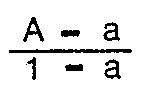
worin A eine Zahl ist gemäß 57,5 < A < 65 und a den Gehalt der Pfropfhülle an Acrylnitril in Gew.-% bedeutet
Description
- Transparente thermoplastische Formmassen aus Pfropfpolymerisaten harzbildender Monomere auf Kautschuke und Polyvinylchlorid sind bekannt. Geeignet sind z.B. Pfropfpolymerisate von Methylmethacrylat und Styrol auf Polybutadien, sogenannte MBS-Pfropfpolymerisate zur Verbesserung der Zähigkeit von Hart-Polyvinylchlorid. Transparente schlagzähe Formmassen dieser Art sind zur Herstellung von Flaschen, Profilen und Platten gebräuchlich.
- Um Transparenz der Pfropfpolymerisate auch in Kombination mit Polyvinylchlorid-Matrizes zu erzielen, werden als deren Kautschukgrundlagen Copolymerisate aus Butadien und anderen Monomeren (häufig Styrol) verwendet, wobei Art und Menge des anderen Monomeren so gewählt sind, daß der Brechungsindex des Kautschuks mit dem des Polyvinylchlorids übereinstimmt. Als Pfropfmonomer wird auch Methylmethacrylat, gegebenenfalls kombiniert mit Styrol, eingesetzt. Dabei ist es für die Transparenz der Formmasse notwendig, daß entweder die Pfropfhülle vollständig mit Polyvinylchlorid mischbar ist (wie im Falle von Polymethylmethacrylat) oder durch Einbau von Styrol in die Pfropfhülle deren Brechungsindex dem von PVC angeglichen wird.
- Bekannte Pfropfkautschuke mit der für die Transparenz notwendigen Zusammensetzung haben grundlegende Nachteile. So liegt die Glasübergangstemperatur (Erweichungstemperatur) der Kautschukgrundlage (aufgrund des einpolymerisierten Styrols) erheblich höher als die üblicher Polybutadienkautschuke. Deshalb besitzen diese Pfropfkautschuke die tiefen Temperaturen (<0°C) nur geringe Zähigkeit. Pfropfpolymerisate mi Pfropfhüllen aus überwiegend Methylmethacrylat sind zwar dem Polyvinylchlorid angepaßt, für andere Thermoplaste jedoch aufgrund nicht ausreichender Verträglichkeit häufig nicht verwendbar.
- Es besteht daher Bedarf an Pfropfkautschuken mit verbesserter Tieftemperaturzähigkeit, die transparente Mischungen mit Thermoplasten ergeben.
- Gegenstand der Erfindung sind Pfropfpolymerisate aus
einem teilchenförmigen wenigstens partiell vernetzten Dienkautschuk (Pfropfgrundlage) und
einem in Gegenwart des Dienkautschuks polymerisierten Styrol/Acrylnitrilgemisch wobei - 1. die mittleren Durchmesser (d₅₀-Werte) der Dienkautschukteilchen 50 bis 600 nm, bevorzugt 50 bis 400 nm, besonders bevorzugt 50 bis 200 nm and insbesondere 60 bis 100 nm betragen,
- 2. Der Dienkautschuk Polybutadien ist, das bis zu 2 Gew.-% eines mehrfunktionellen vernetzenden Monomers einpolymerisiert enthalten kann,
- 3. das Styrol/Acrylnitrilgemisch 30 bis 0, bevorzugt 25 bis 0 und besonders bevorzugt 5 bis 15 Gew.-% Acrylnitril enthält,
- 4. die Pfropfausbeute der Pfropfpolymerisation mindestens 65 %, bevorzugt mindestens 75 % ist,
- 5. der Gesamtkautschukgehalt X des Pfropfpolymerisats in Gew.-% entspricht

- Die Kautschukgrundlage und die Pfropfhülle der erfindungsgemäßen Pfropfkautschuke sind nicht isorefraktiv mit Polyvinylchlorid und die Pfropfhülle enthält kein Methylmethacrylat. Dennoch ergeben diese Pfropfkautschuke mit Polyvinylchlorid hochtransparente Formmassen mit verbesserter Zähigkeit insbesondere bei tiefen Temperaturen. Auch mit anderen Thermoplasten werden transparente Formmassen erhalten.
- Ein weiterer Gegenstand der Erfindung sind deshalb thermoplastische, transparente Formmassen aus einem der oben definierten Pfropfpolymerisate und Polyvinylchlorid oder Tetraalkylbisphenol-A-Polycarbonaten mit der wiederkehrenden Struktureinheit der Formel (I)
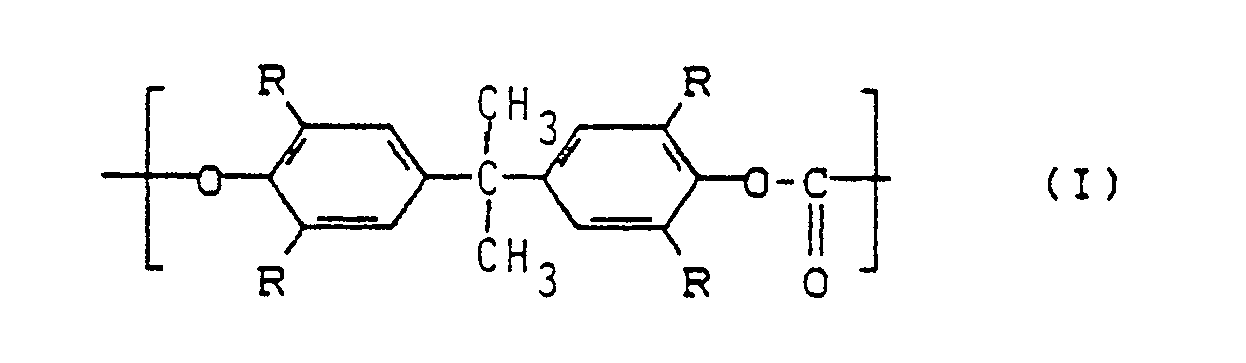
- Bevorzugte thermoplastische Formmassen gemäß der Erfindung enthalten 1 bis 70, insbesondere 10 bis 50 Gew.-% Pfropfpolymerisate und 99 bis 30, insbesondere 50 bis 90 Gew.-% Polyvinylchlorid bzw. Tetraalkylbisphenol-A-Polycarbonat.
- Die erfindungsgemäßen Pfropfkautschuke können bevorzugt durch Polymerisation von Styrol und Acrylnitril in wäßriger Emulsion in Gegenwart des Polybutadiens bei Temperaturen von 30 bis 75°C, bevorzugt 40 bis 70°C hergestellt werden. Die Polymerisation mit so durchgeführt werden, daß ein möglichst großer Teil der Monomere auf den Kautschuk pfropfpolymerisiert wird, d.h. chemisch gebunden wird. Vollständig ist die Pfropfpolymerisation nie. Das Ausmaß der Pfropfung läßt sich durch die Pfropfausbeute beschreiben, das Gewichtsverhältnis der tatsächlich gepfropften Monomere zu der Gesamtmenge der für die Pfropfung eingesetzten Monomere. Die Pfropfausbeute bei der Herstellung der erfindungsgemäßen Pfropfkautschuke A) muß mindestens 65 %, bevorzugt 75 % oder mehr sein. Dies wird durch Verwendung von Redox-Initiatoren erreicht, z.B. Hydroperoxiden kombiniert mit wasserlöslichen Reduktionsmitteln wie Hydrogensulfat, Formaldehydsulfoxylat, Formamidinsulfinsäure, Dithionit, Zucker (Dextrose), Amine (Tetraethylentriamin). Insbesondere eignen sich Pfropfkautschuke, die mit einem Initiator aus in Wasser schwerlöslichen organischen Hydroperoxiden (I) und Ascorbinsäure (II) hergestellt wurden. In besonders bevorzugten Herstellverfahren werden 0,4 bis 1,8 Gew.-% Hydroperoxid (I) und 0,15 bis 1,2 Gew.-% Ascorbinsäure (II), jeweils bezogen auf zu pfropfende Monomere eingesetzt, wobei das Gewichtsverhältnis (I)/(II) 0,5 bis 10, vorzugsweise 1 bis 7 beträgt.
- Der als Pfropfgrundlage benutzte Butadienkautschuk ist ein Homopolymerisat, das gegebenenfalls zur Vernetzung mehrfunktionelle Monomere in Mengen <2 Gew.-% einpolymerisiert enthalten kann.
- Das Polybutadien ist wenigstens partiell vernetzt und besitzt Gelgehalte von 20 bis 95 Gew.-%, insbesondere von 50 bis 90 Gew.-% und besteht aus Teilchen mit mittleren Durchmessern (d₅₀-Werte) von 50 bis 600 nm, insbesondere 50 bis 400 nm, besonders bevorzugt 50 bis 200 nm, insbesondere 60 bis 100 nm. Solche teilchenförmigen Kautschuke sind bekannt. Sie können durch Emulsionspolymerisation von Butadien hergestellt werden und liegen als Latices (Emulsionen) vor.
- Erfindungsgemäß werden die Pfropfpolymerisate in wäßriger Emulsion durch Polymerisation von Styrol und Acrylnitril in Gegenwart von Kautschuk-Latex hergestellt. Dabei werden üblicherweise oberflächenaktive Hilfsmittel eingesetzt, Emulgatoren oder Dispergatoren sowie gegebenenfalls Zusätze, um bestimmte pH-Werte und Elektrolytgehalte bei der Pfropfpolymerisation einzustellen. Unter Umständen kann man die Emulsions-Polymerisation auch ohne Emulgatorzusatz durchführen, insbesondere, wenn man mit wenig Monomer im Verhältnis zum Kautschuk arbeitet, oder wenn die in der Kautschukemulsion (Latex) selbst vorliegende Emulgatormenge bereits ausreicht, um die Pfropfpolymerisation der Monomeren in der Emulsion bei genügender Emulsionsstabilität zu gewährleisten.
- Besonders geeignet sind anionische Emulgatoren, vorzugsweise Alkali-Salze von Fettsäuren, Harzsäuren, disproportionierten Harzsäuren, Alkylsulfonsäuren, Arylsulfonsäuren. Sie werden in Mengen bis zu 5 Gew.-%, vorzugsweise bis zu 2,5 Gew.-%, bezogen auf die zu polymerisierenden Monomere, eingesetzt.
- Geeignete Hydroperoxide sind beispielsweise Cumolhydroperoxid, tert.-Butylhydroperoxid, Wasserstoffperoxid, vorzugsweise Cumolhydroperoxid und tert.-Butylhydroperoxid, also Hydroperoxide mit großen Halbwertszeiten im Temperaturbereich unterhalb 70°C.
- Die erfindungsgemäßen Pfropfpolymerisate können bevorzugt wie folgt hergestellt werden:
- Eine wäßrige Emulsion eines partiell vernetzten Butadienkautschuks wird diskontinuierlich oder kontinuierlich in wäßriger Emulsion bepfropft; bei Polymerisationstemperaturen von 30 bis 75°C, insbesondere 40 bis 70°C wird die Kautschukemulsion mit dem Pfropfmonomer sowie gegebenenfalls zusätzlichem Emulgator und Hydroperoxid sowie Ascorbinsäurelösungen in den oben angegebenen Mengen versetzt. Als weitere Komponente des Startersystems können katalytische Mengen Schwermetallkationen, insbesondere Fe, zugefügt werden, insbesondere wenn die Kautschuklatices größere Mengen Komplexierungsagenzien enthalten. Normalerweise werden keine Eisenionen zugesetzt, da sich Metallspuren nachteilig auf die anwendungstechnischen Eigenschaften der Produkte auswirken können. Nicht genügend wasserlösliche Hydroperoxide wie Cumolhydroperoxid können auch als wäßrige Emulsion verwendet werden, die vorteilhaft den gleichen Emulgator enthält wie der Polymerisationsansatz.
- Das Hydroperoxid und das Reduktionsmittel, insbesondere Ascorbinsäure, können portionsweise oder kontinuierlich in die Pfropfpolymerisation eindosiert werden. Bevorzugt wird das Hydroperoxid anteilmäßig mit dem Kautschuklatex vorgelegt und die Pfropfmonomere, restliches Reduktionsmittel, Hydroperoxid und gegebenenfalls Emulgator mit fortschreitender Polymerisation der Pfropfmonomere separat zugefügt.
- Die Mengen Hydroperoxid und Reduktionsmittel sind kritisch. Bei Überdosierung von Hydroperoxid und/oder Reduktionsmittel wird die Pfropfpolymerisation beeinträchtigt. Die Pfropfausbeute geht zurück; das Molekulargewicht des gepfropften und des freien Harzes wird geringer; Unter- oder Überschreitung der Mengen an Hydroperoxid und Ascorbinsäure können sich außerdem emfindlich auf Monomerumsatz und Emulsionsstabilität auswirken, so daß die technische Realisierung der Pfropfpolymerisation unmöglich wird. Um das Verfahren, die Struktur der Pfropfpolymerisate und deren physikalische Eigenschaften, insbesondere in Kombination mit weiteren Thermoplasten, zu optimieren, sind bei der Pfropfpolymerisation eine Temperatur von 30 bis 75°C und die oben angegebenen Hydroperoxid/Ascorbinsäuremengen unbedingt einzuhalten.
- Die Pfropfhülle der erfindungsgemäßen Pfropfkautschukpolymerisate wird durch Pfropfung eines Gemisches aus Styrol und Acrylnitril auf die Kautschukgrundlage hergestellt. Der Acrylnitrilgehalt der Pfropfhülle liegt zwischen 0 und 30 Gew.-%, bevorzugt zwischen 0 und 25 Gew.-%, besonders bevorzugt zwischen 5 und 15 Gew.-%. Erfindungsgemäße Pfropfkautschuke, die mit Thermoplasten wie Polyvinylchlorid transparente und (kerb)schlagzähe Formmassen ergeben, werden erhalten, wenn der Kautschukgehalt des Pfropfpolymerisats in Gew.-% ist:

- Der Kautschukgehalt X bezieht sich dabei auf das gesamte bei der Pfropfpolymerisation erhaltene Produkt.
- Im Prinzip muß der Kautschukgehalt groß sein, wenn wenig Acrylnitril vorhanden ist und klein, wenn viel Acrylnitril vorhanden ist.
- Insgesamt kann der Kautschukgehalt aufgrund der Grenzen für a und A nur zwischen 39 Gew.-% und 65 Gew.-% betragen. Mit kleineren bzw. größeren Kautschukgehalten werden Formmassen mit gestörter Transparenz erhalten. Die in den erfindungsgemäßen Formmassen gegebenenfalls enthaltenen Polycarbonate enthalten wiederkehrende Struktureinheiten der Formel (I)

- Solche Polycarbonate sind bekannt.
- Die erfindungsgemäßen Pfropfpolymerisate können aus den anfallenden Emulsionen durch bekannte Fällmethoden (z.B. mit Säuren oder Salzen) oder durch Sprühtrocknung in fester Form gewonnen werden. Will man die Pfropfpolymerisate mit thermoplastischen Harzen mischen, die selbst als Emulsion vorliegen, so kann man die Pfropfpolymerisatemulsion mit der Harzemulsion mischen und gemeinsam fällen. Vor der Fällung können zur Stabilisierung phenolische Antioxidantien zugesetzt werden.
- Zu Pulver aufgearbeitete Pfropfpolymerisate und pulverförmige oder als Granulat vorliegende Thermoplaste können durch Schmelzcompoundieren oder Homogenisieren gegebenenfalls unter Zusatz von Additiven wie Stabilisatoren, Weichmachern, auf üblichen Vorrichtungen gemischt werden.
- Die erfindungsgemäßen Formmassen eignen sich für viele Anwendungen wo Härte, Zähigkeit auch bei tiefen Temperaturen und gleichzeitig Transparenz gefordert werden, insbesondere zur Herstellung von Profilen, Platten, Rohren oder Flaschen. Je nach Art der zugesetzten Thermoplaste unterscheiden sich die Massen in ihren Gebrauchseigenschaften, so daß man für jeden Anwendungszweck die jeweils optimalen Thermoplaste auswählen muß.
- Die erfindungsgemäßen Pfropfpolymerisate ergeben nach Mischung mit bestimmten Thermoplasten Formmassen mit guter Transparenz und guten anwendungstechnischen Eigenschaften. Dabei sind einerseits die Transparenz der Formmassen trotz der Verwendung eines reinen Polybutadienkautschuks gut und andererseits trotz der speziellen Pfropfpolymerisatstruktur die mechanischen Eigenschaften verbessert (besonders gegenüber bekannten sogenannten MBS-Pfropfkautschuken). Weiterhin können die erfindungsgemäßen Pfropfpolymerisate nicht nur in Polyvinylchlorid, sondern auch in speziellen Polycarbonaten eingesetzt werden.
- Die Pfropfausbeute wurde durch Fraktionierung mit entmischenden Flüssigkeiten bestimmt (vgl. dazu M. Hoffmann et al., "Polymeranalytik I und II", Georg Thieme Verlag, Stuttgart, 1977).
- Die Teilchendurchmesser sind d₅₀-Werte und durch Ultrazentrifugenmessung ermittelt (vgl. dazu W. Scholtan et al., Kolloidz. und Z. Polymere 250 (1972)).
-
- 1.1.
Emulsion eines partiell vernetzten, feinteiligen Polybutadiens mit einem mittleren Teilchendurchmesser von 100 nm (d₅₀-Wert) und einem Gelgehalt von 92 Gew.-%. Die Emulsion enthält 41 Gew.-% Polybutadien. - 1.2. (zum Vergleich)
Emulsion eines partiell vernetzten feinteiligen Copolymerisats aus 70 Gew.-Teilen Butadien und 30 Gew.-Teilen Styrol mit einem mittleren Teilchendurchmesser (d₅₀-Wert) von 110 nm und einem Gelgehalt von 90 Gew.-%. Die Emulsion enthält 32 Gew.-% Copolymerisat. -
2.1.
Eine Mischung aus 1912 Gew.-Teilen des Latex 1.1. und 701 Gew.-Teilen Wasser wird in einem Reaktor vorgelegt und auf 61°C aufgeheizt. Bei dieser Temperatur werden folgende zwei Lösungen bzw. Emulsionen in nachfolgender Reihenfolge in den Reaktor eingegeben: - a) 0,70 Gew.-Teile Cumolhydroperoxid
50 Gew.-Teile Wasser
- b) 0,40 Gew.-Teile Ascorbinsäure
50 Gew.-Teile Wasser - Z1) 350 Gew.-Teile Wasser
33 Gew.-Teile Na-Salz disproportionierter Abietinsäure
25 Gew.-Teile in-Natronlauge
5,50 Gew.-Teile Cumolhydroperoxid - Z2) 554,4 Gew.-Teile Styrol
61,6 Gew.-Teile Acrylnitril - Z3) 300 Gew.-Teile Wasser
0,80 Gew.-Teile Ascorbinsäure - a) 1,0 Gew.-Teile Cumolhydroperoxid
90 Gew.-Teile Wasser - b) 0,1 Gew.-Teile Ascorbinsäure
50 Gew.-Teile Wasser - Z1) 400 Gew.-Teile Wasser
30 Gew.-Teile Na-Salz disproportionierter Abietinsäure
24 Gew.-Teile 4n Natronlauge
4 Gew.-Teile Cumolhydroperoxid - Z2) 180 Gew.-Teile Styrol
180 Gew.-Teile Methylmethacrylat - Z3) 300 Gew.-Teile Wasser
2,0 Gew.-Teile Ascorbinsäure - a) 1,5 Gew.-Teile Cumolhydroperoxid
100 Gew.-Teile Wasser - b) 0,80 Gew.-Teile Ascorbinsäure
100 Gew.-Teile Wasser - Z1) 450 Gew.-Teile Wasser
50 Gew.Teile Na-Salz disproportionierter Abietinsäure
38 Gew.-Teile 1n-Natronlauge
7 Gew.-Teile Cumolhydroperoxid - Z2) 774 Gew.-Teile Styrol
86 Gew.-Teile Acrylnitril - Z3) 550 Gew.-Teile Wasser
1,0 Gew.-Teile Ascorbinsäure - 3.1. PVC
Polyvinylchlorid mit einem K-Wert von 70 - 3.2. Tetramethylbisphenol-A-Polycarbonat der relativen Lösungsviskosität 1,30 (gemessen bei 25°C in CH₂Cl₂ bei 0,5 g pro 100 ml Lösung)
-
4.1. Zur Herstellung der PVC-Formmassen werden die in nachstehender Tabelle 1) aufgeführten Komponenten in den angegebenen Mengen vermischt; als Stabilisator- und Gleitmittelzusatz werden 1,5 Gew.-% Octylzinnmercaptid und 0,3 Gew.-% Esterwachs zugesetzt. Die Formmassen werden auf einem Mischwalzwerk (bei 180°C) homogenisiert und bei 190°C zu Prüfkörpern verarbeitet.Tabelle 1 Zuammensetzung der PVC-Formmassen (in Gew.-Teilen) Beispiel Nr. Anteile der Komponenten 2.1. 2.2. 2.3. 2.4. 2.5. 2.6. 3.1 4.1 10 90 4.2 10 90 4.3 10 90 4.4 (Vergleich) 10 90 4.5 (Vergleich) 10 90 4.6 (Vergleich) 10 90
Prüfung der Formmassen:
Die Prüfkörper wurden mit folgenden Methoden untersucht:
Kerbschlagzähigkeit: DIN 53 453
Wärmeformbeständigkeit: ISO 75, Methode A
Lichttransmission bzw. -trübung: DIN 5036
(an 4 mm-Platten)
Die Prüfergebnisse sind in Tabelle 2 zusammengestellt. Man erkennt, daß die erfindungsgemäßen Formmassen eine verbesserte Tieftemperaturkerbschlagzähigkeit und hohe Transparenz aufweisen, während Formmassen, die nicht erfindungsgemäße Pfropfpolymerisate enthalten, entweder eine hohe Trübung oder geringe Kerbschlagzähigkeit bei -20°C besitzen.Tabelle 2 Prüfung der Formmassen (Zusammensetzung siehe Tabelle 1) Beispiel Nr. Kerbschlagzähigkeit Wärmeformbeständigkeit HDTA °C Transmission % Trübung % bei 25°C Kh/m² bei -20°C KJ/m² 4.1 16 7 73 82 8 4.2 22 8 71 80 10 4.3 13 7 73 77 8 4.4 (Vergleich) 14 4 72 80 7 4.5 (Vergleich) 24 8 71 64 35 4.6 (Vergleich) - - - nicht meßbar -: wegen nicht ausreichender Transparenz der Formkörper nicht bestimmt
4.2.
Zur Herstellung der Tetramethylbisphenol-A-polycarbonat-Formmassen werden die Pfropfkautschukkomponenten 2.6 und 2.1 mit dem Polycarbonat 3.2 bei 320°C vermischt und zu Prüfkörpern verarbeitet.Tabelle 3 Zusammensetzung der PC-Formmassen (in Gew.-Tl.) Beispiel Nr. Anteile der Komponenten 2.1 2.6 3.2 4.7 10 90 4.8 10 90 Tabelle 4 Aussehen der Mischungen 4.7/4.8 Beispiel Nr. Transparenzbeurteilung 4.7 ++ 4.8 +- ++ = Transparent +- = gestörte Transparenz (Trübung)
Die Pfropfpolymerisation verlief mit einer Pfropfausbeute von 85 %. Der Acrylnitrilgehalt a = 10 % erfüllt Gleichung (1) mit dem Kautschukanteil des Pfropfproduktes X = 56 % und A = 60,4.
2.2.
Man verfährt wie in Beispiel 2.1. Es wird eine Mischung aus 2049 Gew.-Teilen des Latex 1.1. und 688 Gew.-Teilen Wasser vorgelegt. Der Zulauf Z2) setzt sich aus 33,6 Gew.-Teilen Acrylnitril und 526,4 Gew.-Teilen Styrol zusammen. Es wird ein Latex mit einem Feststoffgehalt von 35 % erhalten. Die Pfropfpolymerisation verlief mit einer Pfropfausbeute von 91 %. Der Acrylnitrilanteil a = 6 % genügt mit dem Kautschukanteil X = 60 % Gleichung 1 für A = 62,4.
2.3.
Man verfährt wie in Beispiel 2.1. Es wird eine Mischung aus 1707 Gew.-Teilen des Latex 1.1 und 1000 Gew.-Teilen Wasser vorgelegt. Der Zulauf Z2) setzt sich aus 196 Gew.-Teilen Acrylnitril und 504 Gew.-Teilen Styrol zusammen. Es wird ein Latex mit einem Feststoffgehalt von 33 % erhalten. Die Pfropfausbeute beträgt 83 Gew.-%. Der Parameter A zur Erfüllung von Gleichung (1) bei dem Acrylnitrilanteil a = 28 % und dem Kautschukanteil X = 50 % beträgt A = 64.
2.4. Vergleichspfropfpolymerisat
Eine Mischung aus 2625 Gew.-Teilen des Latex 1.2. und 138 Gew.-Teilen Wasser werden in einem Reaktor vorgelegt und auf 61°C aufgeheizt. Bei dieser Temperatur werden folgende zwei Lösungen bzw. Emulsionen in nachfolgender Reihenfolge in den Reaktor eingegeben:
2.5. Vergleichspfropfpolymerisat
Eine Mischung aus 4870 Gew.-Teilen des Latex 1.1. und 970 Gew.-Teilen Wasser werden in einem Reaktor vorgelegt und auf 61°C aufgeheizt. Bei dieser Temperatur werden folgende zwei Lösungen bzw. Emulsionen in nachfolgender Reihenfolge in den Reaktor eingegeben:
Die SAN-Pfropfung verlief mit einer Ausbeute von 92 Gew.-%. Bei einem Acrylnitrilanteil a = 10 % und einem Kautschukanteil X = 70 % liegt der Parameter A aus Gleichung 1 mit A = 75 außerhalb des/deren Gültigkeitsbereiches
2.6. Vergleichspfropfpolymerisat
In einem Reaktor werde vorgelegt:
1 873 Gew.-Teile der Emulsion 1.1. und 657 Gew.-Teile Wasser. Nach Aufheizen auf 65° C wird eine Starterlösung aus 3 Gew.-Teilen Kaliumperoxodisulfat in 50 Gew.-Teilen Wasser eingespeist. Anschließend werden folgende zwei Lösungen innerhalb von 6 Stunden bei 65°C in den Reaktor eingespeist:
| 1. Styrol | 567 Gew.-Teile |
| Acrylnitril | 65 Gew.-Teile |
| 2. Wasser | 1000 Gew.-Teile |
| Na-Salz der disproportionierten Abietinsäure | 13 Gew.-Teile |
| 1n-Natronlauge | 10 Gew.-Teile |
Claims (5)

Applications Claiming Priority (2)
| Application Number | Priority Date | Filing Date | Title |
|---|---|---|---|
| DE3831853 | 1988-09-20 | ||
| DE3831853A DE3831853A1 (de) | 1988-09-20 | 1988-09-20 | Zur herstellung transparenter thermoplastischer formmassen geeignete pfropfpolymerisate |
Publications (3)
| Publication Number | Publication Date |
|---|---|
| EP0360074A2 true EP0360074A2 (de) | 1990-03-28 |
| EP0360074A3 EP0360074A3 (de) | 1991-10-09 |
| EP0360074B1 EP0360074B1 (de) | 1994-03-16 |
Family
ID=6363287
Family Applications (1)
| Application Number | Title | Priority Date | Filing Date |
|---|---|---|---|
| EP89116493A Revoked EP0360074B1 (de) | 1988-09-20 | 1989-09-07 | Zur Herstellung transparenter thermoplastischer Formmassen geeignete Pfropfpolymerisate |
Country Status (3)
| Country | Link |
|---|---|
| EP (1) | EP0360074B1 (de) |
| JP (1) | JPH02115206A (de) |
| DE (2) | DE3831853A1 (de) |
Cited By (6)
| Publication number | Priority date | Publication date | Assignee | Title |
|---|---|---|---|---|
| EP0535908A1 (de) * | 1991-10-01 | 1993-04-07 | General Electric Company | Polyester-Polycarbonatformmassen |
| WO1993022489A1 (en) * | 1992-05-01 | 1993-11-11 | The Amtico Company Limited | Floor coverings |
| EP0606558A1 (de) * | 1993-01-14 | 1994-07-20 | General Electric Company | Polymermischung aus einem aromatischen Polycarbonat, einem Polyalkylenterephthalat und einem Pfropfcopolymer |
| US5367021A (en) * | 1993-01-14 | 1994-11-22 | General Electric Company | Polymer mixture composed of an aromatic polycarbonate, optionally a polyalkyleneterephthalate and a graft copolymer |
| WO1998020057A1 (en) * | 1996-11-04 | 1998-05-14 | Lg Chemical Limited | A process for producing thermoplastic resins having high impact strength |
| WO1999054406A1 (de) * | 1998-04-21 | 1999-10-28 | Bayer Aktiengesellschaft | Thermoplastische polyketon-formmassen mit verbesserten eigenschaften |
Families Citing this family (2)
| Publication number | Priority date | Publication date | Assignee | Title |
|---|---|---|---|---|
| EP1337586B1 (de) * | 2000-10-17 | 2006-11-22 | General Electric Company | Durchscheinende und durchsichtige thermoplastische polycarbonatlegierungen und verfahren zu ihrer herstellung |
| JP2003064233A (ja) * | 2001-08-27 | 2003-03-05 | C I Kasei Co Ltd | 農業用塩化ビニル系樹脂フィルム及び塩化ビニル系樹脂組成物 |
Family Cites Families (6)
| Publication number | Priority date | Publication date | Assignee | Title |
|---|---|---|---|---|
| GB886343A (en) * | 1957-07-15 | 1962-01-03 | Monsanto Chemicals | Thermoplastic compositions |
| GB1013393A (en) * | 1962-12-27 | 1965-12-15 | Nitto Chemical Industry Co Ltd | Method for producing plastics having superior processability |
| NL6907397A (de) * | 1968-05-15 | 1969-11-18 | ||
| BR7904871A (pt) * | 1978-07-31 | 1980-05-06 | Monsanto Co | Processo para preparar latices estaveis de grandes particulas de borracha de dieno enxertadas |
| US4385157A (en) * | 1981-11-27 | 1983-05-24 | Monsanto Company | Emulsion polymerization process for ABS polyblends |
| CA1315906C (en) * | 1985-11-04 | 1993-04-06 | Lewis Ellis Ferguson, Iii | Clear impact modifier for pvc |
-
1988
- 1988-09-20 DE DE3831853A patent/DE3831853A1/de not_active Withdrawn
-
1989
- 1989-09-07 EP EP89116493A patent/EP0360074B1/de not_active Revoked
- 1989-09-07 DE DE89116493T patent/DE58907221D1/de not_active Revoked
- 1989-09-20 JP JP1242414A patent/JPH02115206A/ja active Pending
Cited By (7)
| Publication number | Priority date | Publication date | Assignee | Title |
|---|---|---|---|---|
| EP0535908A1 (de) * | 1991-10-01 | 1993-04-07 | General Electric Company | Polyester-Polycarbonatformmassen |
| WO1993022489A1 (en) * | 1992-05-01 | 1993-11-11 | The Amtico Company Limited | Floor coverings |
| EP0606558A1 (de) * | 1993-01-14 | 1994-07-20 | General Electric Company | Polymermischung aus einem aromatischen Polycarbonat, einem Polyalkylenterephthalat und einem Pfropfcopolymer |
| US5367021A (en) * | 1993-01-14 | 1994-11-22 | General Electric Company | Polymer mixture composed of an aromatic polycarbonate, optionally a polyalkyleneterephthalate and a graft copolymer |
| US6080815A (en) * | 1996-04-11 | 2000-06-27 | Lg Chemical Limited | Process for producing thermoplastic resins having high impact strength |
| WO1998020057A1 (en) * | 1996-11-04 | 1998-05-14 | Lg Chemical Limited | A process for producing thermoplastic resins having high impact strength |
| WO1999054406A1 (de) * | 1998-04-21 | 1999-10-28 | Bayer Aktiengesellschaft | Thermoplastische polyketon-formmassen mit verbesserten eigenschaften |
Also Published As
| Publication number | Publication date |
|---|---|
| DE58907221D1 (de) | 1994-04-21 |
| EP0360074B1 (de) | 1994-03-16 |
| DE3831853A1 (de) | 1990-03-29 |
| JPH02115206A (ja) | 1990-04-27 |
| EP0360074A3 (de) | 1991-10-09 |
Similar Documents
| Publication | Publication Date | Title |
|---|---|---|
| EP0034748B1 (de) | Kerbschlagzähe Polymerisate mit verbesserter Witterungsbeständigkeit | |
| EP0429957A2 (de) | Thermoplastische Formmassen mit hoher Kältezähigkeit | |
| DE69219112T2 (de) | Verfahren zur Herstellung von thermoplastischen Harzen mit ausgezeichneter Beständigkeit gegen Chlorfluorkohlenwasserstoffen | |
| EP0678531A1 (de) | ABS-Formmassen mit verbesserter Zähigkeit | |
| EP0337187B1 (de) | Polymerisatmischung für flexible Folien | |
| DE2256612A1 (de) | Polymerisate aus acrylnitril und aromatischen olefinen, die gegebenenfalls gepfropften kautschuk enthalten | |
| EP0360074B1 (de) | Zur Herstellung transparenter thermoplastischer Formmassen geeignete Pfropfpolymerisate | |
| EP0526813B1 (de) | Ethylenpolymerisate enthaltende Polymerlegierungen für flexible Folien | |
| EP0507117B1 (de) | ABS-Formmassen mit bimodaler Kautschukpartikelgrössenverteilung | |
| EP0173812B1 (de) | Transparente Formmassen | |
| EP0282854A2 (de) | Verfahren zur Herstellung kautschukreicher Propfpolymerisate | |
| EP0129796B1 (de) | Thermoplastische Formmasse | |
| EP0062838B1 (de) | Thermoplastische Formmassen | |
| EP0074051A1 (de) | Thermoplastische Formmasse | |
| EP0129815B1 (de) | Thermoplastische Formmasse | |
| DE3149812A1 (de) | Thermoplastische formmassen | |
| EP0306806A2 (de) | Verfahren zur Herstellung von Pfropfpolymerisaten | |
| EP0378863B1 (de) | Oxetanylgruppen enthaltende thermoplastische Formmassen | |
| DE3640337C2 (de) | ||
| EP0505799B1 (de) | ABS-Formmassen mit bimodaler Kautschukpartikelgrössenverteilung | |
| EP0401628A2 (de) | Polymerisatmischungen für flexible Folien | |
| DE3819722A1 (de) | Verstaerkte thermoplastische formmassen | |
| DE2658075C2 (de) | ||
| DE4010511A1 (de) | Schlagzaehe, chemikalien- und waermeformbestaendige thermoplastische formmasse | |
| EP0356979A2 (de) | Thermoplastische Formmasse, nämlich Mischung aus einem Polycarbonat, einem Styrol-Acrylnitrilcopoly-merisat und einem eine Pfropfhülle aufweisenden Kautschuk |
Legal Events
| Date | Code | Title | Description |
|---|---|---|---|
| PUAI | Public reference made under article 153(3) epc to a published international application that has entered the european phase |
Free format text: ORIGINAL CODE: 0009012 |
|
| 17P | Request for examination filed |
Effective date: 19890907 |
|
| AK | Designated contracting states |
Kind code of ref document: A2 Designated state(s): BE DE ES FR GB IT |
|
| PUAL | Search report despatched |
Free format text: ORIGINAL CODE: 0009013 |
|
| AK | Designated contracting states |
Kind code of ref document: A3 Designated state(s): BE DE ES FR GB IT |
|
| 17Q | First examination report despatched |
Effective date: 19930430 |
|
| GRAA | (expected) grant |
Free format text: ORIGINAL CODE: 0009210 |
|
| AK | Designated contracting states |
Kind code of ref document: B1 Designated state(s): BE DE ES FR GB IT |
|
| PG25 | Lapsed in a contracting state [announced via postgrant information from national office to epo] |
Ref country code: BE Effective date: 19940316 |
|
| ITF | It: translation for a ep patent filed | ||
| REF | Corresponds to: |
Ref document number: 58907221 Country of ref document: DE Date of ref document: 19940421 |
|
| PG25 | Lapsed in a contracting state [announced via postgrant information from national office to epo] |
Ref country code: ES Free format text: LAPSE BECAUSE OF FAILURE TO SUBMIT A TRANSLATION OF THE DESCRIPTION OR TO PAY THE FEE WITHIN THE PRESCRIBED TIME-LIMIT Effective date: 19940617 |
|
| ET | Fr: translation filed | ||
| GBT | Gb: translation of ep patent filed (gb section 77(6)(a)/1977) |
Effective date: 19940615 |
|
| PLBI | Opposition filed |
Free format text: ORIGINAL CODE: 0009260 |
|
| 26 | Opposition filed |
Opponent name: DSM N.V Effective date: 19941213 |
|
| PGFP | Annual fee paid to national office [announced via postgrant information from national office to epo] |
Ref country code: DE Payment date: 19950811 Year of fee payment: 7 |
|
| PGFP | Annual fee paid to national office [announced via postgrant information from national office to epo] |
Ref country code: GB Payment date: 19950829 Year of fee payment: 7 |
|
| PGFP | Annual fee paid to national office [announced via postgrant information from national office to epo] |
Ref country code: FR Payment date: 19950831 Year of fee payment: 7 |
|
| RDAG | Patent revoked |
Free format text: ORIGINAL CODE: 0009271 |
|
| STAA | Information on the status of an ep patent application or granted ep patent |
Free format text: STATUS: PATENT REVOKED |
|
| 27W | Patent revoked |
Effective date: 19951002 |
|
| GBPR | Gb: patent revoked under art. 102 of the ep convention designating the uk as contracting state |
Free format text: 951002 |