EP0360184B1 - Procédé de fabrication de préparations pigmentaires de la série des anthanthrones - Google Patents
Procédé de fabrication de préparations pigmentaires de la série des anthanthrones Download PDFInfo
- Publication number
- EP0360184B1 EP0360184B1 EP89117203A EP89117203A EP0360184B1 EP 0360184 B1 EP0360184 B1 EP 0360184B1 EP 89117203 A EP89117203 A EP 89117203A EP 89117203 A EP89117203 A EP 89117203A EP 0360184 B1 EP0360184 B1 EP 0360184B1
- Authority
- EP
- European Patent Office
- Prior art keywords
- pigment
- anthanthrone
- formula
- radical
- water
- Prior art date
- Legal status (The legal status is an assumption and is not a legal conclusion. Google has not performed a legal analysis and makes no representation as to the accuracy of the status listed.)
- Expired - Lifetime
Links
Classifications
-
- C—CHEMISTRY; METALLURGY
- C09—DYES; PAINTS; POLISHES; NATURAL RESINS; ADHESIVES; COMPOSITIONS NOT OTHERWISE PROVIDED FOR; APPLICATIONS OF MATERIALS NOT OTHERWISE PROVIDED FOR
- C09B—ORGANIC DYES OR CLOSELY-RELATED COMPOUNDS FOR PRODUCING DYES, e.g. PIGMENTS; MORDANTS; LAKES
- C09B67/00—Influencing the physical, e.g. the dyeing or printing properties of dyestuffs without chemical reactions, e.g. by treating with solvents grinding or grinding assistants, coating of pigments or dyes; Process features in the making of dyestuff preparations; Dyestuff preparations of a special physical nature, e.g. tablets, films
- C09B67/0033—Blends of pigments; Mixtured crystals; Solid solutions
Definitions
- the present invention relates to a particularly environmentally friendly and economical method for producing pigment preparations which are distinguished by their outstanding coloristic and rheological properties, such as dispersibility, flocculation stability, rheology, gloss behavior and color strength. They are used to pigment high-molecular materials, especially paint systems.
- anthanthrone derivatives 4,10-dibromo-anthanthron in particular has achieved great technical importance as a pigment.
- the production of the raw pigment is described in the Fiat Final Report 1313 Vol II.
- 8,8'-dicarboxy-1,1'-dinaphthyl in sulfuric acid monohydrate is cyclized to the anthanthrone and then brominated.
- the 4,10-dibromoanthanthrone thus obtained is precipitated as sulfate by adding small amounts of water and isolated.
- the 4,10-dibromoanthanthrone crude pigment is released therefrom by hydrolysis.
- pigment preparations of the anthanthrone series can be produced without ecological problems and at low cost by adding the raw anthanthrone pigments obtained after synthesis to an aqueous pearl milling in the presence of pigment dispersants of the general formulas subjects, in formula (I) Q1 the rest of an anthanthrone, azo, isoindolinone, diketopyrrolopyrrole or perinone compound, A1 a direct bond or a divalent group from the series -O-, -S-, -NR3-, -CO-, -SO2-, -CR4R5- and arylene, for example phenylene or naphthylene or a chemically meaningful combination of these bivalent groups, X is a group or a heterocyclic radical having at least one nitrogen atom, for example an imidazole or piperazine radical, and R3, R4, R5, R6 and R7 are hydrogen atoms or saturated or unsaturated alkyl (C1-C4)
- the pigment preparations obtained in this way are distinguished by excellent coloristics and rheology.
- crude pigments produced with oxonium sulfate and having an average particle size of> 5 ⁇ are particularly suitable.
- the moist, coarse-crystalline raw pigments obtained after the synthesis according to the Fiat Report are preferred.
- the grinding medium is preferably water. However, it can also contain water-miscible solvents.
- the pigment dispersants mentioned are used in amounts of about 0.1 to 25% by weight, preferably about 1 to about 10% by weight, based on the crude pigment. Mixtures of pigment dispersants of the general formula (I) and / or (II) mentioned can also be used. Anionic, cationic or nonionic surfactants can also be added.
- Discontinuous or, in particular, continuous agitator ball mills with horizontal, vertical, cylindrical or annular grinding space are suitable for grinding.
- the grinding is usually carried out at 0 to 100 ° C, preferably 10 to 50 ° C.
- Balls with a diameter of 0.3 to 3 mm made of quartz, aluminum oxide, zirconium oxide or mixed oxides are preferably used as grinding media.
- the finely divided prepigment preparation present after grinding is thermally treated in an aqueous suspension or after addition of organic solvents (finish).
- Alkanols C1-C10
- methanol ethanol
- propanol n- or i-butanol
- dialkyl C1-C6 or cyclic ketones such as, for example, dimethyl ketone, diethyl ketone, methyl ethyl ketone, cyclohexanone
- ether and glycol ether such as, for example, monomethyl - Or monoethyl ether of glycol, ethyl diglycol, methoxybutanol
- aromatic hydrocarbons such as.
- toluene xylenes or Ethylbenzene
- aromatic chlorinated hydrocarbons such as. B.
- Preferred organic solvents are alkanols, such as. As ethanol, propanol, butanols and pentanols or aromatic hydrocarbons, such as. B. xylene, ethylbenzene and cumene.
- the solvent finish can vary within wide limits according to the desired properties of the pigment preparation.
- the suspension of the prepigment preparation is normally treated at a temperature of from about 50 to about 200 ° C. for 24 hours.
- the amount of solvent can vary within wide limits. The same to 5 times the amount by weight of solvent, based on the prepigment preparation, is preferably used.
- the treatment in the aqueous-organic medium is preferably carried out at about 80 to about 150 ° C. for 1 to 6 hours. After the finish, the solvents are recovered and used again.
- the suspension of the prepigment preparation obtained after grinding is preferably used without intermediate insulation. Depending on the intended use, those obtained by the process of the invention can be used Convert prepigment preparations into a more opaque or transparent form, which can be controlled via the solvent's solvent power, the concentration, the temperature and the duration of the treatment.
- the pigment preparations of the invention are suitable for pigmenting high molecular weight natural or synthetic organic materials, such as cellulose ethers and esters, such as ethyl cellulose, nitrocellulose, cellulose acetate, cellulose butyrate, natural resins or synthetic resins, such as polymerization resins or condensation resins, e.g. B.
- cellulose ethers and esters such as ethyl cellulose, nitrocellulose, cellulose acetate, cellulose butyrate
- natural resins or synthetic resins such as polymerization resins or condensation resins, e.g. B.
- aminoplasts especially urea and melamine-formaldehyde resins, alkyd resins, acrylic resins, phenoplasts, polycarbonates, polyolefins such as polystyrene, polyvinyl chloride, polyethylene, polypropylene, polyacrylonitrile, polyacrylic acid esters, polyamides, polyurethanes or polyesters, rubber, casein, silicone and silicone resins, individually or in mixtures. It does not matter whether the high-molecular organic compounds mentioned are present as plastic masses, melts or in the form of spinning solutions, lacquers, paints or printing inks.
- the pigments to be used according to the invention are used as toners or in the form of preparations or dispersions.
- the pigments produced according to the invention are used in an amount of preferably 0.1 to 10% by weight.
- the pigment preparations produced by the process according to the invention are particularly suitable for use in stoving lacquer systems, for. B. in alkyd melamine resin paints and acrylic melamine resin paints, two-component paint systems based on polyisocyanate-crosslinkable acrylic resins and aqueous Paint systems. After incorporation, strong, pure and shiny paintwork with very good weather fastness is obtained.
- the pigment preparations produced in this way have a very good flow behavior in modern coating systems, even at high pigment concentrations with excellent flocculation stability.
- pigment dispersants based on naphthoylenbenzimidazole dicarboxylic acid and bis (3-aminopropyl) piperazine pigment preparations with perfect fastness to overcoating are obtained in all common coating systems.
- pigment preparations are produced by the claimed process without waste products, with few chemicals and with solvents that are processed further or that are completely regenerated again. For these reasons, this process is particularly economical and environmentally friendly.
- an alkyd-melamine resin paint (AM6) based on a medium-oil, non-drying alkyd resin made of synthetic fatty acids and phthalic anhydride and a butanol-etherified melamine resin and proportions of a non-drying alkyd resin based on ricinic acid were used from the large number of known systems (short oil) and an acrylic baked enamel based on a non-aqueous dispersion (TSA-NAD). In the following examples this is referred to as AM6 or TSA-NAD.
- isobutanol 100% isobutanol are added and the mixture is heated to boiling for 3 hours.
- the isobutanol is then distilled off at the transition up to 100 ° C., filtered off at 50 ° C., washed with water and dried at 80 ° C.
- a pigment is obtained whose millbase viscosity is rated 1 and has a gloss of 64.
- the pigment is 13% weaker in color than the pigment preparation.
- the pigment obtained from the same crude pigment according to US Pat. No. 4,018,791, Example 9, has a mill base rheology of 1.
- the gloss is rated 8.
- isobutanol 100% isobutanol are added and the mixture is heated to boiling for 3 hours.
- the isobutanol is then distilled off at the transition up to 100 ° C., suction filtered at 50 ° C., washed with water and dried at 80 ° C.
- the viscosity of the 5% full-tone paint is 2.6 ⁇ . Without pigment dispersant, the viscosity is 4.1 ⁇ . The pigment has a stronger color than the pigment obtained according to Example 1.
- isobutanol 100% isobutanol are added and the mixture is heated to boiling for 3 hours.
- the isobutanol is then distilled off at the transition up to 100 ° C., filtered off at 50 ° C., washed with water and dried at 80 ° C.
- isobutanol 100% isobutanol are added and the mixture is heated to boiling for 3 hours.
- the isobutanol is then distilled off at the transition up to 100 ° C., filtered off at 50 ° C., washed with water and dried at 80 ° C.
- isobutanol 100% isobutanol are added and the mixture is heated to boiling for 3 hours.
- the isobutanol is then distilled off at the transition up to 100 ° C., suction filtered at 50 ° C., washed with water and dried at 80 ° C.
- isobutanol 100% isobutanol are added and the mixture is heated to boiling for 3 hours.
- the isobutanol is then distilled off at the transition up to 100 ° C., filtered off at 50 ° C., washed with water and dried at 80 ° C.
- the pigment has a stronger color than the pigment obtained according to Example 1.
- isobutanol 100% isobutanol are added and the mixture is heated to boiling for 3 hours.
- the isobutanol is then distilled off at the transition up to 100 ° C., filtered off at 50 ° C., washed with water and dried at 80 ° C.
- the pigment is more transparent and stronger in color than the pigment obtained according to Example 2.
- the pigment is somewhat more opaque than the pigment obtained according to Example 1.
- the pigment is more opaque than the pigment obtained according to Example 1.
Landscapes
- Chemical & Material Sciences (AREA)
- Chemical Kinetics & Catalysis (AREA)
- Organic Chemistry (AREA)
- Pigments, Carbon Blacks, Or Wood Stains (AREA)
- Nitrogen Condensed Heterocyclic Rings (AREA)
- Compositions Of Macromolecular Compounds (AREA)
- Paints Or Removers (AREA)
Claims (11)
- Procédé pour fabriquer des préparations pigmentaires de la série des anthanthrones, caractérisé en ce qu'on soumet les pigments bruts d'anthanthrone obtenus lors de la synthèse à un broyage aqueux au broyeur à billes en présence de dispersants pigmentaires ayant les formules générales suivantes :
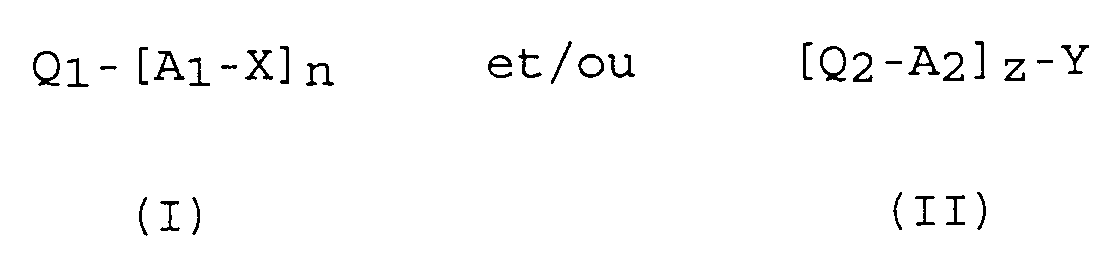
X est un groupe

- Procédé selon la revendication 1, caractérisé en ce qu'on utilise des pigments rouges d'anthanthrone ayant une granulométrie supérieure à 5 µm.
- Procédé selon au moins l'une des revendications 1 et 2, caractérisé en ce qu'on utilise comme pigments bruts des pigments bruts d'anthanthrone préparés par l'intermédiaire du sulfate d'oxonium.
- Procédé selon au moins l'une des revendications 1 à 3, caractérisé en ce qu'on utilise des dispersants pigmentaires ayant la formule générale (II) donnée dans la revendication 1, dans laquelle Q₂ est le radical

- Procédé selon au moins l'une des revendications 1 à 3, caractérisé en ce qu'on utilise des dispersants pigmentaires de formule
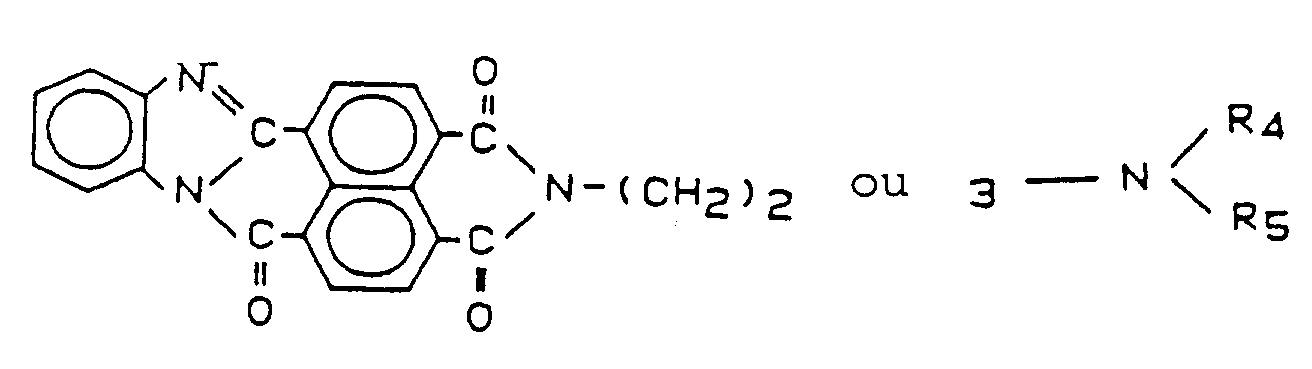
- Procédé selon au moins l'une des revendications 1 à 3, caractérisé en ce qu'on utilise des dispersants pigmentaires de formule

- Procédé selon au moins l'une des revendications 1 à 3, caractérisé en ce qu'on utilise des mélanges de dispersants pigmentaires ayant les formules données dans les revendications 5 et 6.
- Procédé selon au moins l'une des revendications 1 à 6, caractérisé en ce que les dispersants sont ajoutés en une quantité d'environ 1 à environ 10 % en poids par rapport au pigment brut d'anthanthrone.
- Procédé selon au moins l'une des revendications 1 à 8, caractérisé en ce qu'on utilise comme solvant organique pour le traitement thermique des suspensions de préparations prépigmentaires des alcools aliphatiques ayant de 1 à 6 atomes de carbone.
- Procédé selon au moins l'une des revendications 1 à 9, caractérisé en ce qu'on soumet les suspensions de préparations prépigmentaires obtenues, avec ou sans isolement intermédiaire, à un traitement thermique en présence ou en l'absence d'un solvant organique, à des températures d'environ 80 à environ 150°C.
- Procédé selon au moins l'une des revendications 1 à 10, caractérisé en ce qu'on soumet à un traitement thermique en présence de solvants organiques, sans isolement intermédiaire, les suspensions de préparations prépigmentaires obtenues en présence de dispersants pigmentaires, après le broyage, au broyeur à billes, des pigments bruts d'anthanthrone.
Applications Claiming Priority (2)
| Application Number | Priority Date | Filing Date | Title |
|---|---|---|---|
| DE3832064A DE3832064A1 (de) | 1988-09-21 | 1988-09-21 | Verfahren zur herstellung von pigmentzubereitungen der anthanthronreihe |
| DE3832064 | 1988-09-21 |
Publications (3)
| Publication Number | Publication Date |
|---|---|
| EP0360184A2 EP0360184A2 (fr) | 1990-03-28 |
| EP0360184A3 EP0360184A3 (fr) | 1991-09-18 |
| EP0360184B1 true EP0360184B1 (fr) | 1994-01-12 |
Family
ID=6363414
Family Applications (1)
| Application Number | Title | Priority Date | Filing Date |
|---|---|---|---|
| EP89117203A Expired - Lifetime EP0360184B1 (fr) | 1988-09-21 | 1989-09-18 | Procédé de fabrication de préparations pigmentaires de la série des anthanthrones |
Country Status (4)
| Country | Link |
|---|---|
| US (1) | US5071483A (fr) |
| EP (1) | EP0360184B1 (fr) |
| JP (1) | JP2886567B2 (fr) |
| DE (2) | DE3832064A1 (fr) |
Families Citing this family (12)
| Publication number | Priority date | Publication date | Assignee | Title |
|---|---|---|---|---|
| EP0511165B1 (fr) * | 1991-04-26 | 1996-08-14 | Ciba-Geigy Ag | Dicetopyrrolopyrroles |
| EP0538784B2 (fr) * | 1991-10-23 | 2000-12-27 | Clariant GmbH | Préparations pigmentaires |
| EP0604895A1 (fr) * | 1992-12-25 | 1994-07-06 | Sumitomo Chemical Company, Limited | Pigments |
| EP0606632A1 (fr) * | 1992-12-25 | 1994-07-20 | Sumitomo Chemical Company, Limited | Pigments et leur utilisation |
| US5476544A (en) * | 1993-02-26 | 1995-12-19 | Toyo Ink Manufacturing Co., Ltd. | Water-based pigment dispersion |
| EP0702060B1 (fr) | 1994-09-16 | 1998-10-21 | Clariant GmbH | Procédé pour la préparation du pigment 4,10-dibromoanthantrone |
| US6037414A (en) * | 1998-09-02 | 2000-03-14 | E. I. Du Pont Nemours And Company | Polymeric pigment dispersant having an acrylic backbone, polyester side chains, cyclic imide groups and quaternary ammonium groups |
| DE19958181A1 (de) * | 1999-12-02 | 2001-06-07 | Clariant Gmbh | Pigmentdispergatoren auf Basis von Diketopyrrolopyrrolverbindungen und Pigmentzubereitungen |
| UA36514C2 (uk) * | 1999-12-28 | 2003-12-15 | Інститут Монокристалів Науково-Технологічного Концерну "Інститут Монокристалів" Нан України | Спосіб одержання похідних піразолінілнафталевої кислоти |
| BR122013017189B1 (pt) * | 2001-02-13 | 2017-02-07 | Ajinomoto Kk | bactéria produtora de l-aminoácido pertencente ao gênero escherichia, e, método para produzir l-aminoácido |
| US7488767B1 (en) | 2003-12-17 | 2009-02-10 | Abb Technical Coatings, Ltd | Pigment dispersant system and method for pigment grinding |
| JP4745794B2 (ja) * | 2005-11-02 | 2011-08-10 | Hoya株式会社 | 電子内視鏡用小型コネクタ |
Family Cites Families (10)
| Publication number | Priority date | Publication date | Assignee | Title |
|---|---|---|---|---|
| CH595428A5 (fr) * | 1972-12-22 | 1978-02-15 | Hoechst Ag | |
| JPS5828303B2 (ja) * | 1974-08-07 | 1983-06-15 | トウヨウインキセイゾウ カブシキガイシヤ | ガンリヨウソセイブツ |
| GB1463141A (en) * | 1974-09-26 | 1977-02-02 | Ici Ltd | Process for converting colouring matters to pigmentary form |
| DE2905114C2 (de) * | 1979-02-10 | 1981-03-19 | Basf Ag, 6700 Ludwigshafen | Pigmentzubereitungen |
| JPS56118462A (en) * | 1980-02-25 | 1981-09-17 | Toyo Ink Mfg Co Ltd | Pigment composition |
| US4432796A (en) * | 1981-09-21 | 1984-02-21 | Mobay Chemical Corporation | Process for the conditioning of an organic pigment |
| DE3520806A1 (de) * | 1985-06-11 | 1986-12-11 | Hoechst Ag, 6230 Frankfurt | Verfahren zur herstellung von pigmenten der anthanthronreihe |
| ES2058327T3 (es) * | 1987-02-02 | 1994-11-01 | Ciba Geigy Ag | Soluciones solidas de pirrolo-(3,4-c)-pirroles con quinacridonas. |
| US4762569A (en) * | 1987-08-07 | 1988-08-09 | Sanyo Color Works, Ltd. | Easily dispersible pigment composition and dispersing method |
| JPH02197461A (ja) * | 1989-01-27 | 1990-08-06 | Shikoku Riyokaku Tetsudo Kk | 踏切監視装置 |
-
1988
- 1988-09-21 DE DE3832064A patent/DE3832064A1/de not_active Withdrawn
-
1989
- 1989-09-18 EP EP89117203A patent/EP0360184B1/fr not_active Expired - Lifetime
- 1989-09-18 DE DE89117203T patent/DE58906693D1/de not_active Expired - Fee Related
- 1989-09-19 US US07/409,522 patent/US5071483A/en not_active Expired - Fee Related
- 1989-09-20 JP JP1242369A patent/JP2886567B2/ja not_active Expired - Lifetime
Also Published As
| Publication number | Publication date |
|---|---|
| DE58906693D1 (de) | 1994-02-24 |
| JPH02115277A (ja) | 1990-04-27 |
| US5071483A (en) | 1991-12-10 |
| JP2886567B2 (ja) | 1999-04-26 |
| EP0360184A2 (fr) | 1990-03-28 |
| DE3832064A1 (de) | 1990-03-29 |
| EP0360184A3 (fr) | 1991-09-18 |
Similar Documents
| Publication | Publication Date | Title |
|---|---|---|
| EP0504872B1 (fr) | Sels internes de pérylènes, méthode pour leur préparation et leur utilisation | |
| EP0504923B1 (fr) | Procédé pour la préparation des préparations de pigment à base de C.I. pigment violet 23 | |
| EP0864613B1 (fr) | Composition pigmentaire et son procédé de fabrication | |
| EP0799862B1 (fr) | Procédé de fabrication de pigments de quinacridone | |
| EP0666288B1 (fr) | Procédé de fabrication de pigments de quinacridone | |
| US5296034A (en) | Process for the production of copper phthalocyanine pigment preparations of the α phase | |
| EP1020497B1 (fr) | Cristaux mixtes de pigments de quinacridones dans la phase gamma | |
| EP0574790B1 (fr) | Procédé de fabrication de compositions pigmentaires à base de pigments de phtalocyanine | |
| EP0979846B1 (fr) | Procédé pour la préparation de diimides d'acide N,N'-dialkyleperylene-3,4,9,10-tetracarboxylique dans une forme pigmentaire transparente | |
| EP0360184A2 (fr) | Procédé de fabrication de préparations pigmentaires de la série des anthanthrones | |
| EP0971001B1 (fr) | Procédé de fabrication de pigments de quinacridone | |
| DE19733642A1 (de) | Mischkristallpigmente der Chinacridonreihe | |
| DE69517277T2 (de) | Verfahren zur Herstellung von Diaryldiketopyrrolopyrrolpigmenten | |
| EP0662497A1 (fr) | Utilisation de taurides d'acide gras pour la dispersion de pigments polycycliques | |
| EP0655485A2 (fr) | Procédé de fabrication de pigments de quinacridone linéaire non sustituée de la phase béta | |
| EP1130062B1 (fr) | Procédé pour la préparation de diimides d'acide pérylène -3,4,9,10-tétracarboxylique dans une forme pigmentaire transparente | |
| EP0376158B1 (fr) | Solution solide cristalline de pigments du type anthanthrone, leurs procédés de préparation et leur application | |
| EP0803544A2 (fr) | Pigments de quinacridone et de dioxazine à surface traitée | |
| EP0702060B1 (fr) | Procédé pour la préparation du pigment 4,10-dibromoanthantrone | |
| EP1706459B1 (fr) | Pigments de triphene dioxazine | |
| DE2400561A1 (de) | Iminoisoindolinonfarbstoffe und verfahren zu deren herstellung | |
| EP0015570A1 (fr) | Pigments isoindoliniques et leur utilisation | |
| CH693853A5 (de) | Organische Pigmentzusammensetzungen. | |
| DE19510668A1 (de) | Verfahren zur Herstellung von 4,10-Dibrom-anthanthron-Pigment |
Legal Events
| Date | Code | Title | Description |
|---|---|---|---|
| PUAI | Public reference made under article 153(3) epc to a published international application that has entered the european phase |
Free format text: ORIGINAL CODE: 0009012 |
|
| AK | Designated contracting states |
Kind code of ref document: A2 Designated state(s): CH DE FR GB IT LI |
|
| 17P | Request for examination filed |
Effective date: 19901221 |
|
| PUAL | Search report despatched |
Free format text: ORIGINAL CODE: 0009013 |
|
| AK | Designated contracting states |
Kind code of ref document: A3 Designated state(s): CH DE FR GB IT LI |
|
| 17Q | First examination report despatched |
Effective date: 19930524 |
|
| GRAA | (expected) grant |
Free format text: ORIGINAL CODE: 0009210 |
|
| AK | Designated contracting states |
Kind code of ref document: B1 Designated state(s): CH DE FR GB IT LI |
|
| REF | Corresponds to: |
Ref document number: 58906693 Country of ref document: DE Date of ref document: 19940224 |
|
| ITF | It: translation for a ep patent filed | ||
| GBT | Gb: translation of ep patent filed (gb section 77(6)(a)/1977) |
Effective date: 19940321 |
|
| ET | Fr: translation filed | ||
| PLBE | No opposition filed within time limit |
Free format text: ORIGINAL CODE: 0009261 |
|
| STAA | Information on the status of an ep patent application or granted ep patent |
Free format text: STATUS: NO OPPOSITION FILED WITHIN TIME LIMIT |
|
| 26N | No opposition filed | ||
| REG | Reference to a national code |
Ref country code: CH Ref legal event code: PUE Owner name: HOECHST AKTIENGESELLSCHAFT TRANSFER- CLARIANT GMBH |
|
| REG | Reference to a national code |
Ref country code: FR Ref legal event code: TP |
|
| PGFP | Annual fee paid to national office [announced via postgrant information from national office to epo] |
Ref country code: DE Payment date: 20000713 Year of fee payment: 12 |
|
| PGFP | Annual fee paid to national office [announced via postgrant information from national office to epo] |
Ref country code: FR Payment date: 20000720 Year of fee payment: 12 Ref country code: CH Payment date: 20000720 Year of fee payment: 12 |
|
| PGFP | Annual fee paid to national office [announced via postgrant information from national office to epo] |
Ref country code: GB Payment date: 20000721 Year of fee payment: 12 |
|
| REG | Reference to a national code |
Ref country code: GB Ref legal event code: 732E |
|
| PG25 | Lapsed in a contracting state [announced via postgrant information from national office to epo] |
Ref country code: GB Free format text: LAPSE BECAUSE OF NON-PAYMENT OF DUE FEES Effective date: 20010918 |
|
| PG25 | Lapsed in a contracting state [announced via postgrant information from national office to epo] |
Ref country code: LI Free format text: LAPSE BECAUSE OF NON-PAYMENT OF DUE FEES Effective date: 20010930 Ref country code: CH Free format text: LAPSE BECAUSE OF NON-PAYMENT OF DUE FEES Effective date: 20010930 |
|
| REG | Reference to a national code |
Ref country code: GB Ref legal event code: IF02 |
|
| PG25 | Lapsed in a contracting state [announced via postgrant information from national office to epo] |
Ref country code: DE Free format text: LAPSE BECAUSE OF NON-PAYMENT OF DUE FEES Effective date: 20020501 |
|
| GBPC | Gb: european patent ceased through non-payment of renewal fee |
Effective date: 20010918 |
|
| REG | Reference to a national code |
Ref country code: CH Ref legal event code: PL |
|
| PG25 | Lapsed in a contracting state [announced via postgrant information from national office to epo] |
Ref country code: FR Free format text: LAPSE BECAUSE OF NON-PAYMENT OF DUE FEES Effective date: 20020531 |
|
| REG | Reference to a national code |
Ref country code: FR Ref legal event code: ST |
|
| PG25 | Lapsed in a contracting state [announced via postgrant information from national office to epo] |
Ref country code: IT Free format text: LAPSE BECAUSE OF NON-PAYMENT OF DUE FEES;WARNING: LAPSES OF ITALIAN PATENTS WITH EFFECTIVE DATE BEFORE 2007 MAY HAVE OCCURRED AT ANY TIME BEFORE 2007. THE CORRECT EFFECTIVE DATE MAY BE DIFFERENT FROM THE ONE RECORDED. Effective date: 20050918 |