EP0360291A2 - Wärmeübertragungsbildempfangspapier - Google Patents
Wärmeübertragungsbildempfangspapier Download PDFInfo
- Publication number
- EP0360291A2 EP0360291A2 EP89117588A EP89117588A EP0360291A2 EP 0360291 A2 EP0360291 A2 EP 0360291A2 EP 89117588 A EP89117588 A EP 89117588A EP 89117588 A EP89117588 A EP 89117588A EP 0360291 A2 EP0360291 A2 EP 0360291A2
- Authority
- EP
- European Patent Office
- Prior art keywords
- paper
- layer
- image reception
- synthetic paper
- synthetic
- Prior art date
- Legal status (The legal status is an assumption and is not a legal conclusion. Google has not performed a legal analysis and makes no representation as to the accuracy of the status listed.)
- Withdrawn
Links
Images

Classifications
-
- G—PHYSICS
- G03—PHOTOGRAPHY; CINEMATOGRAPHY; ANALOGOUS TECHNIQUES USING WAVES OTHER THAN OPTICAL WAVES; ELECTROGRAPHY; HOLOGRAPHY
- G03C—PHOTOSENSITIVE MATERIALS FOR PHOTOGRAPHIC PURPOSES; PHOTOGRAPHIC PROCESSES, e.g. CINE, X-RAY, COLOUR, STEREO-PHOTOGRAPHIC PROCESSES; AUXILIARY PROCESSES IN PHOTOGRAPHY
- G03C7/00—Multicolour photographic processes or agents therefor; Regeneration of such processing agents; Photosensitive materials for multicolour processes
-
- B—PERFORMING OPERATIONS; TRANSPORTING
- B41—PRINTING; LINING MACHINES; TYPEWRITERS; STAMPS
- B41M—PRINTING, DUPLICATING, MARKING, OR COPYING PROCESSES; COLOUR PRINTING
- B41M5/00—Duplicating or marking methods; Sheet materials for use therein
- B41M5/26—Thermography ; Marking by high energetic means, e.g. laser otherwise than by burning, and characterised by the material used
- B41M5/40—Thermography ; Marking by high energetic means, e.g. laser otherwise than by burning, and characterised by the material used characterised by the base backcoat, intermediate, or covering layers, e.g. for thermal transfer dye-donor or dye-receiver sheets; Heat, radiation filtering or absorbing means or layers; combined with other image registration layers or compositions; Special originals for reproduction by thermography
- B41M5/42—Intermediate, backcoat, or covering layers
-
- B—PERFORMING OPERATIONS; TRANSPORTING
- B41—PRINTING; LINING MACHINES; TYPEWRITERS; STAMPS
- B41M—PRINTING, DUPLICATING, MARKING, OR COPYING PROCESSES; COLOUR PRINTING
- B41M5/00—Duplicating or marking methods; Sheet materials for use therein
- B41M5/26—Thermography ; Marking by high energetic means, e.g. laser otherwise than by burning, and characterised by the material used
- B41M5/382—Contact thermal transfer or sublimation processes
- B41M5/38207—Contact thermal transfer or sublimation processes characterised by aspects not provided for in groups B41M5/385 - B41M5/395
- B41M5/38214—Structural details, e.g. multilayer systems
-
- B—PERFORMING OPERATIONS; TRANSPORTING
- B41—PRINTING; LINING MACHINES; TYPEWRITERS; STAMPS
- B41M—PRINTING, DUPLICATING, MARKING, OR COPYING PROCESSES; COLOUR PRINTING
- B41M5/00—Duplicating or marking methods; Sheet materials for use therein
- B41M5/26—Thermography ; Marking by high energetic means, e.g. laser otherwise than by burning, and characterised by the material used
- B41M5/40—Thermography ; Marking by high energetic means, e.g. laser otherwise than by burning, and characterised by the material used characterised by the base backcoat, intermediate, or covering layers, e.g. for thermal transfer dye-donor or dye-receiver sheets; Heat, radiation filtering or absorbing means or layers; combined with other image registration layers or compositions; Special originals for reproduction by thermography
- B41M5/41—Base layers supports or substrates
-
- B—PERFORMING OPERATIONS; TRANSPORTING
- B41—PRINTING; LINING MACHINES; TYPEWRITERS; STAMPS
- B41M—PRINTING, DUPLICATING, MARKING, OR COPYING PROCESSES; COLOUR PRINTING
- B41M2205/00—Printing methods or features related to printing methods; Location or type of the layers
- B41M2205/02—Dye diffusion thermal transfer printing (D2T2)
-
- B—PERFORMING OPERATIONS; TRANSPORTING
- B41—PRINTING; LINING MACHINES; TYPEWRITERS; STAMPS
- B41M—PRINTING, DUPLICATING, MARKING, OR COPYING PROCESSES; COLOUR PRINTING
- B41M2205/00—Printing methods or features related to printing methods; Location or type of the layers
- B41M2205/32—Thermal receivers
-
- Y—GENERAL TAGGING OF NEW TECHNOLOGICAL DEVELOPMENTS; GENERAL TAGGING OF CROSS-SECTIONAL TECHNOLOGIES SPANNING OVER SEVERAL SECTIONS OF THE IPC; TECHNICAL SUBJECTS COVERED BY FORMER USPC CROSS-REFERENCE ART COLLECTIONS [XRACs] AND DIGESTS
- Y10—TECHNICAL SUBJECTS COVERED BY FORMER USPC
- Y10S—TECHNICAL SUBJECTS COVERED BY FORMER USPC CROSS-REFERENCE ART COLLECTIONS [XRACs] AND DIGESTS
- Y10S428/00—Stock material or miscellaneous articles
- Y10S428/91—Product with molecular orientation
-
- Y—GENERAL TAGGING OF NEW TECHNOLOGICAL DEVELOPMENTS; GENERAL TAGGING OF CROSS-SECTIONAL TECHNOLOGIES SPANNING OVER SEVERAL SECTIONS OF THE IPC; TECHNICAL SUBJECTS COVERED BY FORMER USPC CROSS-REFERENCE ART COLLECTIONS [XRACs] AND DIGESTS
- Y10—TECHNICAL SUBJECTS COVERED BY FORMER USPC
- Y10S—TECHNICAL SUBJECTS COVERED BY FORMER USPC CROSS-REFERENCE ART COLLECTIONS [XRACs] AND DIGESTS
- Y10S428/00—Stock material or miscellaneous articles
- Y10S428/913—Material designed to be responsive to temperature, light, moisture
-
- Y—GENERAL TAGGING OF NEW TECHNOLOGICAL DEVELOPMENTS; GENERAL TAGGING OF CROSS-SECTIONAL TECHNOLOGIES SPANNING OVER SEVERAL SECTIONS OF THE IPC; TECHNICAL SUBJECTS COVERED BY FORMER USPC CROSS-REFERENCE ART COLLECTIONS [XRACs] AND DIGESTS
- Y10—TECHNICAL SUBJECTS COVERED BY FORMER USPC
- Y10S—TECHNICAL SUBJECTS COVERED BY FORMER USPC CROSS-REFERENCE ART COLLECTIONS [XRACs] AND DIGESTS
- Y10S428/00—Stock material or miscellaneous articles
- Y10S428/914—Transfer or decalcomania
-
- Y—GENERAL TAGGING OF NEW TECHNOLOGICAL DEVELOPMENTS; GENERAL TAGGING OF CROSS-SECTIONAL TECHNOLOGIES SPANNING OVER SEVERAL SECTIONS OF THE IPC; TECHNICAL SUBJECTS COVERED BY FORMER USPC CROSS-REFERENCE ART COLLECTIONS [XRACs] AND DIGESTS
- Y10—TECHNICAL SUBJECTS COVERED BY FORMER USPC
- Y10T—TECHNICAL SUBJECTS COVERED BY FORMER US CLASSIFICATION
- Y10T428/00—Stock material or miscellaneous articles
- Y10T428/24—Structurally defined web or sheet [e.g., overall dimension, etc.]
- Y10T428/24802—Discontinuous or differential coating, impregnation or bond [e.g., artwork, printing, retouched photograph, etc.]
- Y10T428/24934—Discontinuous or differential coating, impregnation or bond [e.g., artwork, printing, retouched photograph, etc.] including paper layer
-
- Y—GENERAL TAGGING OF NEW TECHNOLOGICAL DEVELOPMENTS; GENERAL TAGGING OF CROSS-SECTIONAL TECHNOLOGIES SPANNING OVER SEVERAL SECTIONS OF THE IPC; TECHNICAL SUBJECTS COVERED BY FORMER USPC CROSS-REFERENCE ART COLLECTIONS [XRACs] AND DIGESTS
- Y10—TECHNICAL SUBJECTS COVERED BY FORMER USPC
- Y10T—TECHNICAL SUBJECTS COVERED BY FORMER US CLASSIFICATION
- Y10T428/00—Stock material or miscellaneous articles
- Y10T428/24—Structurally defined web or sheet [e.g., overall dimension, etc.]
- Y10T428/24942—Structurally defined web or sheet [e.g., overall dimension, etc.] including components having same physical characteristic in differing degree
- Y10T428/2495—Thickness [relative or absolute]
- Y10T428/24967—Absolute thicknesses specified
-
- Y—GENERAL TAGGING OF NEW TECHNOLOGICAL DEVELOPMENTS; GENERAL TAGGING OF CROSS-SECTIONAL TECHNOLOGIES SPANNING OVER SEVERAL SECTIONS OF THE IPC; TECHNICAL SUBJECTS COVERED BY FORMER USPC CROSS-REFERENCE ART COLLECTIONS [XRACs] AND DIGESTS
- Y10—TECHNICAL SUBJECTS COVERED BY FORMER USPC
- Y10T—TECHNICAL SUBJECTS COVERED BY FORMER US CLASSIFICATION
- Y10T428/00—Stock material or miscellaneous articles
- Y10T428/24—Structurally defined web or sheet [e.g., overall dimension, etc.]
- Y10T428/24942—Structurally defined web or sheet [e.g., overall dimension, etc.] including components having same physical characteristic in differing degree
- Y10T428/2495—Thickness [relative or absolute]
- Y10T428/24967—Absolute thicknesses specified
- Y10T428/24975—No layer or component greater than 5 mils thick
-
- Y—GENERAL TAGGING OF NEW TECHNOLOGICAL DEVELOPMENTS; GENERAL TAGGING OF CROSS-SECTIONAL TECHNOLOGIES SPANNING OVER SEVERAL SECTIONS OF THE IPC; TECHNICAL SUBJECTS COVERED BY FORMER USPC CROSS-REFERENCE ART COLLECTIONS [XRACs] AND DIGESTS
- Y10—TECHNICAL SUBJECTS COVERED BY FORMER USPC
- Y10T—TECHNICAL SUBJECTS COVERED BY FORMER US CLASSIFICATION
- Y10T428/00—Stock material or miscellaneous articles
- Y10T428/249921—Web or sheet containing structurally defined element or component
- Y10T428/249953—Composite having voids in a component [e.g., porous, cellular, etc.]
- Y10T428/249987—With nonvoid component of specified composition
-
- Y—GENERAL TAGGING OF NEW TECHNOLOGICAL DEVELOPMENTS; GENERAL TAGGING OF CROSS-SECTIONAL TECHNOLOGIES SPANNING OVER SEVERAL SECTIONS OF THE IPC; TECHNICAL SUBJECTS COVERED BY FORMER USPC CROSS-REFERENCE ART COLLECTIONS [XRACs] AND DIGESTS
- Y10—TECHNICAL SUBJECTS COVERED BY FORMER USPC
- Y10T—TECHNICAL SUBJECTS COVERED BY FORMER US CLASSIFICATION
- Y10T428/00—Stock material or miscellaneous articles
- Y10T428/249921—Web or sheet containing structurally defined element or component
- Y10T428/249953—Composite having voids in a component [e.g., porous, cellular, etc.]
- Y10T428/249987—With nonvoid component of specified composition
- Y10T428/249991—Synthetic resin or natural rubbers
-
- Y—GENERAL TAGGING OF NEW TECHNOLOGICAL DEVELOPMENTS; GENERAL TAGGING OF CROSS-SECTIONAL TECHNOLOGIES SPANNING OVER SEVERAL SECTIONS OF THE IPC; TECHNICAL SUBJECTS COVERED BY FORMER USPC CROSS-REFERENCE ART COLLECTIONS [XRACs] AND DIGESTS
- Y10—TECHNICAL SUBJECTS COVERED BY FORMER USPC
- Y10T—TECHNICAL SUBJECTS COVERED BY FORMER US CLASSIFICATION
- Y10T428/00—Stock material or miscellaneous articles
- Y10T428/26—Web or sheet containing structurally defined element or component, the element or component having a specified physical dimension
- Y10T428/263—Coating layer not in excess of 5 mils thick or equivalent
-
- Y—GENERAL TAGGING OF NEW TECHNOLOGICAL DEVELOPMENTS; GENERAL TAGGING OF CROSS-SECTIONAL TECHNOLOGIES SPANNING OVER SEVERAL SECTIONS OF THE IPC; TECHNICAL SUBJECTS COVERED BY FORMER USPC CROSS-REFERENCE ART COLLECTIONS [XRACs] AND DIGESTS
- Y10—TECHNICAL SUBJECTS COVERED BY FORMER USPC
- Y10T—TECHNICAL SUBJECTS COVERED BY FORMER US CLASSIFICATION
- Y10T428/00—Stock material or miscellaneous articles
- Y10T428/26—Web or sheet containing structurally defined element or component, the element or component having a specified physical dimension
- Y10T428/263—Coating layer not in excess of 5 mils thick or equivalent
- Y10T428/264—Up to 3 mils
-
- Y—GENERAL TAGGING OF NEW TECHNOLOGICAL DEVELOPMENTS; GENERAL TAGGING OF CROSS-SECTIONAL TECHNOLOGIES SPANNING OVER SEVERAL SECTIONS OF THE IPC; TECHNICAL SUBJECTS COVERED BY FORMER USPC CROSS-REFERENCE ART COLLECTIONS [XRACs] AND DIGESTS
- Y10—TECHNICAL SUBJECTS COVERED BY FORMER USPC
- Y10T—TECHNICAL SUBJECTS COVERED BY FORMER US CLASSIFICATION
- Y10T428/00—Stock material or miscellaneous articles
- Y10T428/26—Web or sheet containing structurally defined element or component, the element or component having a specified physical dimension
- Y10T428/263—Coating layer not in excess of 5 mils thick or equivalent
- Y10T428/264—Up to 3 mils
- Y10T428/265—1 mil or less
-
- Y—GENERAL TAGGING OF NEW TECHNOLOGICAL DEVELOPMENTS; GENERAL TAGGING OF CROSS-SECTIONAL TECHNOLOGIES SPANNING OVER SEVERAL SECTIONS OF THE IPC; TECHNICAL SUBJECTS COVERED BY FORMER USPC CROSS-REFERENCE ART COLLECTIONS [XRACs] AND DIGESTS
- Y10—TECHNICAL SUBJECTS COVERED BY FORMER USPC
- Y10T—TECHNICAL SUBJECTS COVERED BY FORMER US CLASSIFICATION
- Y10T428/00—Stock material or miscellaneous articles
- Y10T428/26—Web or sheet containing structurally defined element or component, the element or component having a specified physical dimension
- Y10T428/266—Web or sheet containing structurally defined element or component, the element or component having a specified physical dimension of base or substrate
-
- Y—GENERAL TAGGING OF NEW TECHNOLOGICAL DEVELOPMENTS; GENERAL TAGGING OF CROSS-SECTIONAL TECHNOLOGIES SPANNING OVER SEVERAL SECTIONS OF THE IPC; TECHNICAL SUBJECTS COVERED BY FORMER USPC CROSS-REFERENCE ART COLLECTIONS [XRACs] AND DIGESTS
- Y10—TECHNICAL SUBJECTS COVERED BY FORMER USPC
- Y10T—TECHNICAL SUBJECTS COVERED BY FORMER US CLASSIFICATION
- Y10T428/00—Stock material or miscellaneous articles
- Y10T428/31504—Composite [nonstructural laminate]
- Y10T428/31855—Of addition polymer from unsaturated monomers
- Y10T428/3188—Next to cellulosic
- Y10T428/31895—Paper or wood
-
- Y—GENERAL TAGGING OF NEW TECHNOLOGICAL DEVELOPMENTS; GENERAL TAGGING OF CROSS-SECTIONAL TECHNOLOGIES SPANNING OVER SEVERAL SECTIONS OF THE IPC; TECHNICAL SUBJECTS COVERED BY FORMER USPC CROSS-REFERENCE ART COLLECTIONS [XRACs] AND DIGESTS
- Y10—TECHNICAL SUBJECTS COVERED BY FORMER USPC
- Y10T—TECHNICAL SUBJECTS COVERED BY FORMER US CLASSIFICATION
- Y10T428/00—Stock material or miscellaneous articles
- Y10T428/31504—Composite [nonstructural laminate]
- Y10T428/31855—Of addition polymer from unsaturated monomers
- Y10T428/3188—Next to cellulosic
- Y10T428/31895—Paper or wood
- Y10T428/31899—Addition polymer of hydrocarbon[s] only
- Y10T428/31902—Monoethylenically unsaturated
Definitions
- the present invention relates to thermal transfer image reception paper.
- the present invention relates to a thermal transfer image reception paper for use in a thermal recording system in which the thermal transfer image reception paper and a thermo-sensitive transfer paper having a color material layer containing a sublimation dye are superimposed to each other, and the lamination of the two sheets of paper is heated by a thermal head or the like whereby the sublimation dye in the thermo-sensitive transfer paper is sublimated, and then migrated to the image reception paper so as to perform color recording.
- thermo-sensitive transfer system has been widely used because it generate little noise and can easily be maintained.
- thermo-sensitive transfer system a thermo-sensitive transfer paper in which color ink is fixed and a sheet of image reception paper are used, and recording is made in a manner so that the ink is fusion-transferred or sublimation-transferred onto the image reception paper by controlled thermal energy of a laser, a thermal head or the like in accordance with electric signals.
- thermo-sensitive transfer system may be grouped into a system of the thermal-fusing transfer type and a system of the sublimation-transfer type using sublimation dyes.
- thermo-fusible wax In the system of the heat-fusing transfer type, an ink sheet carrying pigment or dye bound thereon with thermo-fusible wax is used. When the pigment or dye is transferred onto the image reception paper, the wax fused by the thermal energy of the thermal head is also transferred together with the ink.
- This system of the thermal-fusing transfer type therefore has a disadvantage that it is difficult to obtain half tone required for the required image quality and that it is impossible to obtain good hue because of the presence of the transferred wax.
- the system of the sublimation-transfer using sublimation dyes is an application of the conventional sublimation-transfer textile printing technique.
- a sheet having thereon a dispersed dye which can be relatively easily sublimated bound with a binder is used, so that the dye is sublimated and transferred onto the image reception paper to thereby obtain an image thereon by thermal energy of a thermal head.
- the sublimation dye is sublimated in accordance with the thermal energy of the thermal head. Accordingly, this system has advantages in that it is possible to obtain half tone easily and it is possible to control graduation desirably. It is considered that the sublimation-transfer system is the most suitable for a full-color printer.
- thermoplastic resin which may be effectively dyed by the sublimation dye, such as polyester resins, polyamide resins, epoxy resins, or the like (hereinafter the layer being simply referred to "a dyeable resin layer”) is provided on printing base paper as a base material of image reception paper, as disclosed, e.g., in JP-A-57-107885 (the term "JP-A" as used herein means an unexamined published Japanese patent applicaiton).
- thermo transfer image reception paper provided with such a dyeable resin layer formed on a base material
- ordinary paper in the case where ordinary paper is used as the base material, there are defects that it is necessary to make the voltage to be applied to a thermal head high because the color density is generally low in comparison with synthetic paper, and that the color density becomes irregular because of large surface unevenness of ordinary paper.
- synthetic paper having a single layer structure that is, synthetic paper made of polyolefin, polystyrene, or the like, is used as the base material, there is an advantage in that it is possible to obtain sufficient color density as well as considerably excellent image quality.
- an image reception paper base material constituted by two layers of synthetic paper and a backing material (backing layer). That is, a dyeable resin layer is formed on one surface of synthetic paper, and a plastic film or cellulose type fibrous paper is provided as a backing layer on the other surface of the synthetic paper, so that shrinkage of the synthetic paper due to heat upon printing is prevented by the transformation restricting action due to the rigidity of the backing layer to thereby prevent the occurence of curl.
- the curl amount ( ⁇ ) occurring in the image reception paper base material having such a two-layer structure upon printing may be obtained based on the bimetal theory as follows.
- E1 and E2 represent Young's moduli of the backing material and the synthetic paper, respectively; ⁇ 1 and ⁇ 2 represent coefficients of thermal expansion of the backing material and the synthetic paper, respectively; h represents the total thickness of the synthetic paper and the backing material; l represents 2/1 of the length of the image reception paper base material in the longitudinal direction; h represents the thickness of the backing layer which is the same as that of the synthetic paper for convenience; T1 represents the temperature of the backing layer upon printing; and T2 represents the temperature of the synthetic paper upon printing.
- polyolefin type synthetic paper generally includes fine pores inside, it has Young's modulus E2 of about 108 to 109 dye/cm2 which is smaller than the Young's modulus of other plastic films of 109 to 1010 dye/cm2.
- the backing material a so-called high-rigid material having a large thickness, a high modulus of elasticity, and a low coefficient of thermal expansion is highly effective in preventing curl upon printing.
- the base material of the image reception paper has a single layer structure or, in the case of a multi-layer structure, has a symmetrical structure as possible in the direction perpendicular to the layers. That is, curl hardly occurs if transformation is balanced between the opposite sides of the image reception paper base material when the image reception paper is returned from the state under the preserving condition to the ordinary state.
- the present inventors have found that the above objects of the present invention can be achieved when a material, in which two sheets of synthetic paper each having a paper-like layer having fine pores formed only on one side thereof are bonded on the both sides of a core material, is used as an image reception paper base material.
- the present invention relates to thermal transfer image reception paper comprising: an image reception paper base material constituted by a core material and two sheets of synthetic paper provided on the both sides of the core material, respectively; a dyeable resin layer provided on at least one surface of the image reception paper base material directly or through an intermediate layer; each sheet of the synthetic paper having a composite structure including at least two layers; one of the at least two layers located on the resin layer side being a paper-like layer having fine pores.
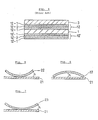
- Fig. 1 is an embodiment of a basic structure of the thermal transfer image reception paper according to the present invention.
- An image reception paper base material has a three-layer structure of a core material 1 and two sheets of synthetic paper 2 and 2′.
- the synthetic paper 2 is constituted by a paper-like layer 2-1 having fine pores, a synthetic paper core layer 2-2 and a synthetic paper backing layer 2-3.
- the synthetic paper 2′ is constituted by a paper-like layer 2′-1 having fine pores, a synthetic paper core layer 2′-2 and a synthetic paper backing layer 2′-3.
- the image reception base material has an asymmetrical structure relative to the core material 1.
- a dyeable resin layer 3 is provided on the paper-like layer 2-1 of the synthetic paper 2 directly.
- the dyeable layer may be provided through an intermediate layer 4 as shown in Fig. 2.
- Fig. 3 is a view for explaining the state in which printing is performed by use of the thermal transfer image reception paper according to the present invention and a thermo-sensitive transfer paper.
- the termo-sensitive transfer paper is composed of an ink layer 5 and a thermo-sensitive transfer base film 6.
- a thermal head for printing is represented by 7, and a platen roll is represented by 8.
- Fig. 4 shows an example of the conventional image reception paper in which a synthetic paper core layer provided with paper-like layers on the both sides thereof is used as the synthetic paper which is provided on both sides of a core material.
- the conventional image reception paper is constituted by a base material having a three-layer structure in which a core material 1 is disposed in the center and two sheets of synthetic paper 12 and 12′ having paper-like layers 12-1 and 12′-1, and synthetic paper core layers 12-2 and 12′-2, respectively, are bonded on the both sides of the core material 1 respectively.
- a dyeable resin layer 3 is provided on the paper-like layer 12-1.
- the thickness ratio of (fine porous layer)/(core layer)/(fine porous layer) is about 1/2/1.
- the image printed by use of the dyeable resin layer provided on the fine porous layer of the PP synthetic paper has a high image density and low unevenness of density because the adiabatic effect and cushioning property of the fine porous layer. These characteristics are originally brought by the fine porous layer made contact with the dyeable resin layer, and it has been confirmed that even if the fine porous layer is extremely thin as about 10 to 30 ⁇ m, the high image density and the low unevenness of density can be realized.
- the thickness of the fine porous layer is preferably from 10 to 30 ⁇ m.
- the thickness of the synthetic paper core layer is from 20 to 60 ⁇ m.
- the fine porous layer is indispensable in order to obtain an image having high image density and low unevenness of density.
- the synthetic paper has a multi-layer structure in which only the layer on one side of the synthetic paper is a paper-like layer having fine pores, not only the transformation of the synthetic paper per on the front surface side on which the dyeable resin layer is provided is small, but also the transformation restricting effect for the synthetic paper bonded on the back side of the core material is large. Accordingly, the curl caused by printing can totally be made extremely small. Further, since the sheets of synthetic paper having the same structure are bonded onto the both sides of the core material respectively, the curl before printing is extremely small.
- the effect on the curl before printing is substantially the same between the case where the synthetic paper 2′ is bonded at the paper-like layer 2′-1 side onto the core material 1 and the case where the synthetic paper 2′ is bonded at the backing layer 2′-3 side onto the core material 1.
- the restricting effect for the transformation of the synthetic paper on the back side of the core material 1 is large so that the curl is made small when the synthetic paper 2′ is bonded onto the core material 1 in the order of the present invention as shown in Fig. 1.
- the core material 1 used in the present invention may be generally used ordinary paper or plastic films. Further, a lamination of the ordinary paper and plastic films bonded on each other may be used.
- the ordinary paper include high grade or woodfree paper, middle grade paper, art paper, coat paper, wall paper, backing paper, paper impregnated with synthetic resins, emulsions thereof, synthetic rubber latex, or the like, paper including synthetic resins therein, and the like.
- plastic film examples include films of PET, polyolefin, poly(vinyl chloride), polystyrene, polymethacrylate, polycarbonate, polyamide, a copolymer of ethylene-vinyl acetate, a copolymer of ethylene-vinyl alcohol-vinyl acetate, and the like.
- the thickness of the core material 1 is preferably from 30 to 300 ⁇ m, and more preferably from 40 to 100 ⁇ m.
- the core material 1 and the synthetic paper 2 and 2′ may be bonded with each other by use of an adhesive or a tackifier, or by an extrusion lamination method.
- an adhesive or a tackifier or by an extrusion lamination method.
- the adhesive and the tackifier may be an organic solvent inclusive type such as an acrylic resin, a polyurethane resin, an epoxy resin, a polybutylal resin, etc.; an emulsion type such as polyvinyl acetate, a copolymer of ethylene-vinyl acetate; of a water inclusive type such as polyvinyl alcohol, etc.; or the like.
- the dyeable resin layer various kinds of materials which have sufficient coloring property for a sublimation dye can be widely used (as described, e.g., in JP-A-57-107885).
- a polyester resin, an epoxy resin, a polyurethane resin, a polyamide resin, an acrylic resin, a cellulose acetate resin, a butylal resin, a vinyl acetate resin, or the like, or any mixtures or copolymers of them may be used.
- the dyeable resin layer may be partially cross-linked if necessary.
- a filler such as silica, talc, potassium carbonate, titanium oxide, zinc oxide, or the like may be added if necessary.
- the thickness of the dyeable resin layers is preferably from 5 to 15 ⁇ m.
- the dyeable resin layer may be formed any of coating method such as gravure coating, roll coating including reverse roll coating, wire bar coating, fountain coating, etc.
- the dyeable resin layer 3 may be provided directly on the paper-like layer 2-1 including fine pores as shown in Fig. 1, or may be provided through an intermediate layer 4 as shown in Fig. 2.
- the intermediate layer 4 is provided for improving the tightness between the dyeable layer and ink layer of the thermo-sensitive transfer paper to thereby prevent lowering of color density and occurrence of unevenness in color density which may be caused by poor tightness.
- the material of the intermediate layer 4 may be a covalent cross-liking type elastomer (generally called valcanized rubber) such as natural rubber, isobutylene-isoprene rubber, nitrile rubber, or the like; a polyurethane resin; an acrylic resin; a polyester resin; a polyolefin resin; or the like.
- An inorganic vulcanizing agent, an organic vulcanizing agent, a vulcanization accelerator, an activator, an aging inhibitor, a peptizer, a softener, a reinforcer, a filler, a weather-resistance improving agent, or the like, which has been conventionally known, may be added to the intermediate layer 4 if necessary.
- the thickness of the intermediate layer 4 is preferably from about 1 to 50 ⁇ m, more preferably from about 3 to 15 ⁇ m.
- the aforementioned ingredients for the intermediate layer are applied by any application means such as a roll coater, a kiss coater, a gravure coater, an air knife coater, or the like and dried to be the intermediate layer.
- the thermo-plastic materials may be coated by extrusion coating such as an accumulator, or the like.
- two sheets of synthetic paper each having a multi-layer structure including only on one-side a paper-like layer containing fine pores are bonded on the both sides of a core material in a manner so that the paper-like layer of at least one of the two sheets of synthetic paper is disposed outside, and a dyeable resin layer is provided on the outside-disposed paper-like layer directly or through an intermediate layer so that not only the curl after printing can be made small but also the curl caused by the preservation before printing can be made small.
- part means “part by weight”
- curl after being left under the preserving conditions before printing and the curl after printing were measured by following manners, respectively.
- Two sheet of image reception paper 22 each having a width of 100 mm and a length of 128 mm were left in the atmosphere of 40°C and 95 % RH and in the atmosphere of 60°C (the humidity was not controlled), respectively, for 24 hours. Then, after the sheets of image reception paper 22 were taken out and left in the ordinary state for 6 hours, they were put on flat horizontal plates 21 with their dyeable layers faced downward as shown in Fig. 5 or 6. The maximum values of heights h or h′ showing the degree of curl were measured.
- Printing was performed by use of a sheet image reception paper 23 having a width of 100 mm and a length of 128 mm so that the highest image density can be obtained under the thermal head recording conditions of 6 dots/mm with an applied voltage of 0.4 W/dot, and then the image reception paper 23 was put on a flat horizontal plate 21 with the printed surface faced upward. The maximum value of the height h" showing the degree of curl was measured.
- thermo-sensitive transfer paper An ink composition composed of 10 parts of a sublimating dispersed dye (KAYASET RED 126 made by Nippon Kayaku Co., Ltd.), 10 parts of a polyamide resin (VERSALON 1140 made by Henkel Hakusui Corp.), 40 parts of toluene, and 40 parts of isopropyl alcohol was dispersed by ultrasonic waves for 6 hours.
- the dispersed ink composition was applied onto a polyester film of 6 ⁇ m thick by means of a gravure coater and dried so that the dried coating amount was 2 g/m2, thereby producing thermo-sensitive transfer paper.
- a dyeable resin composition composed of 20 parts of a saturated polyester resin (VYLON #200 made by Toyobo Co., Ltd.), 3 parts of a polyisocyanurate compound (CORONATE made by Nippon Urethane Co., Ltd.), 1 part of amino-modified silicone (KF-393 made by Shin-etsu Chemical Co., Ltd.), 1 part of epoxy-modified silicone (X-22-343 made by Shin-etsu Chemical Co., Ltd.), 40 parts of methyl ethyl ketone, and 40 parts of toluene was prepared by mixing and dissolving these ingredients.
- a first sheet of 60 ⁇ m thick polypropylene synthetic paper having a multi-layer structure constituted by three layers (each consisting of polypropylene resins) was prepared, the three layers including a biaxially oriented middle layer provided on one side with a layer having fine pores and on the other side with a layer having no fine pores.
- a polystyrene aqueous emulsion (concentration of 20 wt%) was applied onto the layer of the synthetic paper having no fine pores and then dried.
- a sheet of high grade paper (grammage of 52 g/m2) as a core material was put on the aforementioned layer having no fine pores of the first sheet of synthetic paper and bonded thereon by means of heat rolls at a temperature of 85°C.
- the polystyrene aqueous solution was further applied onto the other surface of the high grade paper on which no synthetic paper was bonded. Then, after the coating of the polystyrene aqueous solution had been dried, a second sheet of synthetic paper having the same structure as the first sheet was bonded, under the aforementioned bonding conditions, onto the above-mentioned other surface of the high grade paper such a manner that the layer having fine pores of the second sheet of synthetic paper was made contact with the high grade paper. Thus, an image reception paper base material was prepared.
- thermohygrostat 40°C and 95 %RH and in a thermostat of 60°C, respectively, for 24 hours. Then, the two sheets were taken out, and left in the ordinary state for 6 hours. Then, the curl after the preservation before printing was measured. Table 1 shows the result of the measurement.
- a first sheet of 60 ⁇ m thick polypropylene synthetic paper having a multi-layer structure constituted by three layers (each consisting of polypropylene resins) was prepared, the three layers including a biaxially oriented middle layer provided on one side with a layer having fine pores and on the other side with a layer having no fine pores.
- a solution of polypropylene chloride dissolved in a mixed solvent of toluene and methyl ethyl ketone (mixing ratio: 1/1 by weight) was applied onto the surface of the layer of the first sheet of synthetic paper having no fine pores, and then the coating was dried.
- the first sheet of synthetic paper was dry-laminated on a polyethylene terephthalate film as a core material having a thickness of 60 ⁇ m through a urethane adhesive. Further, the solution of polypropylene chloride dissolved in a mixed solvent of toluene and methyl ethyl ketone (mixture ratio: 1:1 by weight rate) was applied onto the surface of the layer having fine pores of a second sheet of polypropylene synthetic paper having the same structure as that of the first sheet of synthetic paper, and then the coating was dried. The second synthetic paper was dry-laminated on the polyethylene terephthalate film on the surface thereof opposite to the surface on which the first sheet of synthetic paper had been already bonded, by using the urethane adhesive.
- the image reception paper base material was prepared.
- a dyeable resin layer was provided on the outside-located layer having fine pores of the image reception paper base material.
- the curl after preserving before printing and the curl after printing were measured in the same manner as in the Example 1. The result of measurement is shown also in the Table 1.
- the surface of the outside-located layer having fine pores of the first sheet of synthetic paper of the image reception paper base material prepared in Example 1 was coated with a solution of 20 parts of a thermoplastic elastomer (CARIFLEX TR1007 made by Shell Chemical Co., Ltd.) and 80 parts of toluene by means of a roll coater a dried amount of 10 g/m2.
- the coating was dried so as to form an intermediate layer.
- a dyeable resin layer was provided on the intermediate layer in the same manner as Example 1.
- the curl after preserving before printing and the curl after printing were measured in the same manner as in the Example 1. The result of measurement is shown also in the Table 1.
- a first sheet of 60 ⁇ m thick polypropylene synthetic paper having a multi-layer structure constituted by three layers (each consisting of polypropylene resins) was prepared, the three layers including a biaxially oriented middle layer provided on the both sides thereof with layers having fine pores.
- a polystyrene aqueous emulsion was applied onto the surface of the first sheet of synthetic paper in the same manner as in the Example 1 and then the coating was dried.
- a sheet of high grade paper (grammage of 52 g/m2) was put on the coated surface of the first sheet of synthetic paper and bonded thereon by means of heat rolls.
- a second sheet of polypropylene synthetic paper of the same structure as the first sheet was bonded in the same manner as above so as to prepare an image reception paper base material.
- a dyeable resin layer was provided on one side of the image reception paper base material in the same manner as Example 1. Then, the curl after preserving before printing and the curl after printing were measured in the same manner as in the Example 1. The result of measurement is shown also
- a sheet of 60 ⁇ m thick polypropylene synthetic paper having a multi-layer structure constituted by three layers (each consisting of polypropylene resins) was prepared, the three layers including a biaxially oriented middle layer provided on one side with a layer having fine pores and on the other side with a layer having nor fine pores.
- a polystyrene aqueous emulsion was applied onto the surface of the layer having no fine pores of the sheet of synthetic paper and then the coating was dried. Then, a sheet of coat paper (grammage of 105 g/m2) was bonded by a heat roll onto the polystyrene aqueous solution coated surface of the layer having no fine pores of the sheet of synthetic paper.
- a dyeable resin layer was provided on the porous layer side of the base material in the same manner as Example 1.
Landscapes
- Physics & Mathematics (AREA)
- Optics & Photonics (AREA)
- General Physics & Mathematics (AREA)
- Thermal Transfer Or Thermal Recording In General (AREA)
- Laminated Bodies (AREA)
Applications Claiming Priority (2)
| Application Number | Priority Date | Filing Date | Title |
|---|---|---|---|
| JP63238115A JP2840630B2 (ja) | 1988-09-22 | 1988-09-22 | 熱転写用受像紙 |
| JP238115/88 | 1988-09-22 |
Publications (2)
| Publication Number | Publication Date |
|---|---|
| EP0360291A2 true EP0360291A2 (de) | 1990-03-28 |
| EP0360291A3 EP0360291A3 (de) | 1991-03-13 |
Family
ID=17025402
Family Applications (1)
| Application Number | Title | Priority Date | Filing Date |
|---|---|---|---|
| EP19890117588 Withdrawn EP0360291A3 (de) | 1988-09-22 | 1989-09-22 | Wärmeübertragungsbildempfangspapier |
Country Status (4)
| Country | Link |
|---|---|
| US (2) | US5141916A (de) |
| EP (1) | EP0360291A3 (de) |
| JP (1) | JP2840630B2 (de) |
| KR (1) | KR900005235A (de) |
Cited By (1)
| Publication number | Priority date | Publication date | Assignee | Title |
|---|---|---|---|---|
| EP1314575A3 (de) * | 1990-09-07 | 2003-09-17 | Dai Nippon Printing Co., Ltd. | Bildempfangsblatt für thermische Übertragung und thermisches Übertragungsblatt |
Families Citing this family (10)
| Publication number | Priority date | Publication date | Assignee | Title |
|---|---|---|---|---|
| JPH03239595A (ja) * | 1990-02-16 | 1991-10-25 | Dainippon Printing Co Ltd | カード製造方法 |
| US5418026A (en) * | 1991-10-10 | 1995-05-23 | Peter J. Dronzek, Jr. | Curl-resistant printing sheet for labels and tags |
| US5536560A (en) * | 1992-09-25 | 1996-07-16 | Minolta Camera Kabushiki Kaisha | Films for electrophotographic recording and image forming method for use with same |
| JP3071465B2 (ja) * | 1993-04-02 | 2000-07-31 | レグザム グラフィックス インコーポレイテッド | 電子写真エレメントおよびプロセス |
| US5363179A (en) * | 1993-04-02 | 1994-11-08 | Rexham Graphics Inc. | Electrographic imaging process |
| JP2727410B2 (ja) * | 1993-04-23 | 1998-03-11 | 日本製紙株式会社 | 転写紙及びその製造方法 |
| US5393099A (en) * | 1993-05-21 | 1995-02-28 | American Bank Note Holographics, Inc. | Anti-counterfeiting laminated currency and method of making the same |
| JPH0743904A (ja) * | 1993-07-27 | 1995-02-14 | Diafoil Co Ltd | 画像形成転写材料用ポリエステルフィルム |
| US5888643A (en) * | 1997-05-23 | 1999-03-30 | Eastman Kodak Company | Controlling bending stiffness in photographic paper |
| US20080029720A1 (en) * | 2006-08-03 | 2008-02-07 | Intematix Corporation | LED lighting arrangement including light emitting phosphor |
Family Cites Families (9)
| Publication number | Priority date | Publication date | Assignee | Title |
|---|---|---|---|---|
| US4720480A (en) * | 1985-02-28 | 1988-01-19 | Dai Nippon Insatsu Kabushiki Kaisha | Sheet for heat transference |
| JPH0777597B2 (ja) * | 1985-07-12 | 1995-08-23 | 蛇の目ミシン工業株式会社 | 電動ミシンの定位置停止装置 |
| JPS62174190A (ja) * | 1985-07-18 | 1987-07-30 | Matsushita Electric Ind Co Ltd | 転写型感熱記録用受像体 |
| JPH0720739B2 (ja) * | 1985-12-23 | 1995-03-08 | 王子油化合成紙株式会社 | 熱転写記録用画像受容シ−ト |
| JP2565866B2 (ja) * | 1986-02-25 | 1996-12-18 | 大日本印刷株式会社 | 被熱転写シ−ト |
| US4908345A (en) * | 1986-06-30 | 1990-03-13 | Dai Nippon Insatsu Kabushiki Kaisha | Dye receiving |
| JPS63290790A (ja) * | 1987-05-22 | 1988-11-28 | Oji Yuka Gouseishi Kk | 熱転写記録用画像受容シ−ト |
| JP2569051B2 (ja) * | 1987-06-18 | 1997-01-08 | 王子油化合成紙株式会社 | 熱転写記録用画像受容シ−ト |
| JP2942782B2 (ja) * | 1987-08-13 | 1999-08-30 | 大日本印刷株式会社 | 被熱転写シート |
-
1988
- 1988-09-22 JP JP63238115A patent/JP2840630B2/ja not_active Expired - Fee Related
-
1989
- 1989-09-22 KR KR1019890013624A patent/KR900005235A/ko not_active Withdrawn
- 1989-09-22 EP EP19890117588 patent/EP0360291A3/de not_active Withdrawn
-
1990
- 1990-08-09 US US07/564,660 patent/US5141916A/en not_active Expired - Fee Related
- 1990-08-09 US US07/564,943 patent/US5110788A/en not_active Expired - Fee Related
Cited By (1)
| Publication number | Priority date | Publication date | Assignee | Title |
|---|---|---|---|---|
| EP1314575A3 (de) * | 1990-09-07 | 2003-09-17 | Dai Nippon Printing Co., Ltd. | Bildempfangsblatt für thermische Übertragung und thermisches Übertragungsblatt |
Also Published As
| Publication number | Publication date |
|---|---|
| EP0360291A3 (de) | 1991-03-13 |
| US5110788A (en) | 1992-05-05 |
| JP2840630B2 (ja) | 1998-12-24 |
| JPH0286493A (ja) | 1990-03-27 |
| US5141916A (en) | 1992-08-25 |
| KR900005235A (ko) | 1990-04-13 |
Similar Documents
| Publication | Publication Date | Title |
|---|---|---|
| EP0516370B1 (de) | Bildempfangsschicht für thermische Farbstoffübertragung | |
| EP0316926B1 (de) | Harzbeschichteter Papierträger für ein Empfangselement, das bei der thermischen Farbstoffübertragung verwendet wird | |
| EP0452121A1 (de) | Thermische Übertragungsbildempfangsschicht | |
| EP0751005B1 (de) | Bildempfangsschicht für thermische Übertragung | |
| EP0495617A1 (de) | Bildempfangsschicht für Übertragung durch Wärme | |
| EP0578271A1 (de) | Bildempfang-Substrat | |
| EP0360291A2 (de) | Wärmeübertragungsbildempfangspapier | |
| EP0678397B1 (de) | Bildempfangsschicht für thermische Übertragung | |
| EP0409598A2 (de) | Thermische Farbbildübertragungsempfangsschicht | |
| EP0318945B1 (de) | Material für die Erhöhung der Farbstoff-Übertragungseffektivität in Farbstoff-Donorelementen, die bei Wärme-Farbstoffübertragung verwendet werden | |
| EP0656264A1 (de) | Bildempfangsschicht für thermischen Übertragungsdruck | |
| JPS63114687A (ja) | 熱的染料転写に使用される染料供与体要素用のシリコーンおよびリン酸エステル滑り層 | |
| EP0603569B1 (de) | Farbstoffempfangselement für thermische Übertragung | |
| EP0767070B1 (de) | Bildempfangsschicht für thermische Übertragung, die ein Äthylenterpolymer enthält | |
| JPH0519475B2 (de) | ||
| US6656881B2 (en) | Thermal Transfer image-receiving sheet | |
| JP3057926B2 (ja) | 昇華性染料熱転写受像シートの製造方法 | |
| EP0812700A1 (de) | Farbstoffempfangselement mit einer Unterschicht für eine antistatische Schicht zur Farbstoffübertragung durch Wärme | |
| JPH1086534A (ja) | 熱転写受像シート | |
| JPH02198894A (ja) | 熱転写用受像体 | |
| JPH0825812A (ja) | 熱転写受像シートの製造方法 | |
| JPH03234588A (ja) | 熱転写プリンター用受像シート | |
| JPH0295891A (ja) | 昇華転写記録方法 | |
| JPH07125455A (ja) | 熱転写用受像シート | |
| JPH04142984A (ja) | 熱転写用受像体 |
Legal Events
| Date | Code | Title | Description |
|---|---|---|---|
| PUAI | Public reference made under article 153(3) epc to a published international application that has entered the european phase |
Free format text: ORIGINAL CODE: 0009012 |
|
| AK | Designated contracting states |
Kind code of ref document: A2 Designated state(s): DE FR GB |
|
| PUAL | Search report despatched |
Free format text: ORIGINAL CODE: 0009013 |
|
| AK | Designated contracting states |
Kind code of ref document: A3 Designated state(s): DE FR GB |
|
| 17P | Request for examination filed |
Effective date: 19910524 |
|
| 17Q | First examination report despatched |
Effective date: 19931011 |
|
| STAA | Information on the status of an ep patent application or granted ep patent |
Free format text: STATUS: THE APPLICATION IS DEEMED TO BE WITHDRAWN |
|
| 18D | Application deemed to be withdrawn |
Effective date: 19950401 |