EP0360719A1 - Verfahren zum Aufzeichnen auf einem magnetischen Band und Wiedergabe von D2-MAC/Paket-Signalen und entsprechende Vorrichtungen - Google Patents
Verfahren zum Aufzeichnen auf einem magnetischen Band und Wiedergabe von D2-MAC/Paket-Signalen und entsprechende Vorrichtungen Download PDFInfo
- Publication number
- EP0360719A1 EP0360719A1 EP89460028A EP89460028A EP0360719A1 EP 0360719 A1 EP0360719 A1 EP 0360719A1 EP 89460028 A EP89460028 A EP 89460028A EP 89460028 A EP89460028 A EP 89460028A EP 0360719 A1 EP0360719 A1 EP 0360719A1
- Authority
- EP
- European Patent Office
- Prior art keywords
- outputs
- inputs
- chrominance
- data
- signal
- Prior art date
- Legal status (The legal status is an assumption and is not a legal conclusion. Google has not performed a legal analysis and makes no representation as to the accuracy of the status listed.)
- Withdrawn
Links
Images








Classifications
-
- H—ELECTRICITY
- H04—ELECTRIC COMMUNICATION TECHNIQUE
- H04N—PICTORIAL COMMUNICATION, e.g. TELEVISION
- H04N9/00—Details of colour television systems
- H04N9/79—Processing of colour television signals in connection with recording
- H04N9/80—Transformation of the television signal for recording, e.g. modulation, frequency changing; Inverse transformation for playback
- H04N9/81—Transformation of the television signal for recording, e.g. modulation, frequency changing; Inverse transformation for playback the individual colour picture signal components being recorded sequentially only
-
- H—ELECTRICITY
- H04—ELECTRIC COMMUNICATION TECHNIQUE
- H04N—PICTORIAL COMMUNICATION, e.g. TELEVISION
- H04N9/00—Details of colour television systems
- H04N9/79—Processing of colour television signals in connection with recording
- H04N9/797—Processing of colour television signals in connection with recording for recording the signal in a plurality of channels, the bandwidth of each channel being less than the bandwidth of the signal
- H04N9/7973—Processing of colour television signals in connection with recording for recording the signal in a plurality of channels, the bandwidth of each channel being less than the bandwidth of the signal by dividing the luminance or colour component signal samples or frequency bands among a plurality of recording channels
-
- H—ELECTRICITY
- H04—ELECTRIC COMMUNICATION TECHNIQUE
- H04N—PICTORIAL COMMUNICATION, e.g. TELEVISION
- H04N9/00—Details of colour television systems
- H04N9/79—Processing of colour television signals in connection with recording
- H04N9/80—Transformation of the television signal for recording, e.g. modulation, frequency changing; Inverse transformation for playback
- H04N9/82—Transformation of the television signal for recording, e.g. modulation, frequency changing; Inverse transformation for playback the individual colour picture signal components being recorded simultaneously only
- H04N9/8205—Transformation of the television signal for recording, e.g. modulation, frequency changing; Inverse transformation for playback the individual colour picture signal components being recorded simultaneously only involving the multiplexing of an additional signal and the colour video signal
- H04N9/8233—Transformation of the television signal for recording, e.g. modulation, frequency changing; Inverse transformation for playback the individual colour picture signal components being recorded simultaneously only involving the multiplexing of an additional signal and the colour video signal the additional signal being a character code signal
Definitions
- the present invention relates to a method for recording and playback of D2-MAC / PACKET television signals using slightly modified consumer video recorders.
- the invention also relates to the means for implementing the method.
- the D2-MAC / PACKET television signals are signals which comply with a new international standard and which are intended to be transmitted and broadcast from television and telecommunications satellites.
- the width of the frequency band occupied by these signals is 8.4 MHz.
- the bandwidth of consumer VCRs is currently less than 4.0 MHz, less than half that of the signal band, making these devices unsuitable for directly recording D2-MAC / PACKET signals. .
- the value 4.0 MHz was mentioned above because it will be the bandwidth of the next consumer video recorders called super-VHS or S.VHS.
- One solution consists in processing the broadband analog signal by digitizing it, by temporally demultiplexing the digital train obtained in order to create two digital trains which are each decompressed in time, then transmitted on two channels whose bandwidth is at least half signal bandwidth to be applied after conversion digital-analog, with two sets of recording heads for consumer video recorders. Both sets of heads record simultaneously on pairs of parallel oblique tracks.
- the analog signals read simultaneously by the two sets of read heads are transmitted on two channels to be each digitized, compressed in time, then multiplexed in time, the single train obtained then being reconverted into analog D2-MAC / PACKET signal reconstructed .
- the message contained in the data burst of a D2-MAC / PACKET signal contains many such protections, but disturbances occurring when playing a recording on a magnetic tape of a consumer tape often make them ineffective. Indeed, the codes used allow the correction of isolated errors or on a few consecutive bits, while the faults on a tape cause losses of sequences of bits much more important.
- a method of recording on magnetic tape and of reading D2-MAC / PACKET signals in which, upon recording, in each D2-MAC / PACKET video signal, on the one hand, the chrominance and luminance components are decompressed in time to be recorded on a magnetic tape by two channels, the two channels serving to record practically simultaneously the decompressed components of an odd line and those of the even line which follows it, and , on the other hand, the burst of duobinary coded data is digitized, converted into a digital train with NRZ coding, then stored, each digital train relating to an even line video signal being thus memorized in series with the digital train relating to the previous odd line video signal to form a packet which is time decompressed to be recorded, after duobinary recoding, at both with the chrominance and luminance components relative to said odd line and those relating to said even line, and, on reading, the chrominance and luminance components of a pair of odd and even
- a method of recording and reading D2-MAC / PACKET signals in which, in recording mode, each incident D2-MAC / PACKET video signal is digitized, then the digital signal obtained is temporally demultiplexed , the digital samples corresponding to the chrominance and luminance components being further demultiplexed, at line frequency, on two channels, then respectively decompressed in time, then converted into decompressed analog components to be selectively transmitted by two channels, and the samples corresponding to the burst of data being decoded, and then processed so that the decoded data carried by an even line incident signal is put in series with the decoded data carried by the previous odd line incident signal to form a data packet which, after conversion to analog signal duobi is multiplexed with the samples of the chrominance and luminance components of the even and odd lines carrying said data, the signals transmitted by the two channels being recorded simultaneously on two separate tracks of a magnetic tape, and, in read mode, the signals read simultaneously on the tracks of the magnetic tape being respectively processed,
- the decoding of the duobinary coded data packets provides indications of errors concerning the odd and even line data separately which are associated with the drop-out information to selectively multiplex the data with the chrominance and luminance components.
- the means for implementing the recording method include an analog / digital converter at the input of which the incident D2-MAC / PACKET signal is applied and the output of which is connected to the input of a multiplexer of which two outputs are respectively connected to the inputs of time decompression units of chrominance and luminance components, and a third output is connected to the time decompression input of data burst having two outputs, the outputs of the units and of the circuit of time decompression being respectively connected to the inputs of two multiplexers whose outputs are connected by two channels to the sets of recording heads of the video recorder, the circuit for decompressing the bursts of data comprising a Viterbi decoder whose output is connected to a memory assembly capable of memorizing two successive bursts of data carried by a line im pair and the even line immediately following it, the output of the assembly memory being connected to the input of a demultiplexer with two pairs of outputs, the first outputs of the pairs being connected to first time decom
- the means for implementing the reading method comprise two analog / digital converters to the inputs of which the decompressed signals read by two sets of read heads are applied, the outputs of the analog / digital converters being respectively connected to the inputs of two multiplexers, the first outputs of which are connected to the inputs of two time compression units of the chrominance and luminance components, and the two second outputs of which are respectively connected to the two inputs of a time data compression circuit, which comprises two Viterbi decoders respectively connected to said inputs and whose outputs are respectively connected to the inputs of two demultiplexers whose outputs are connected to time decompression memories whose outputs are connected to the inputs of a selection multiplexer with as many inputs as time compression memories, the control input of which is connected to the output of a logic control circuit, and the output of which is connected to a buffer memory the output of which is connected, by a duobinary encoder, to an input a multiplexer with three inputs, the other inputs
- the two analog / digital converters are preceded by drop-out decoders whose outputs are connected to the logic control circuit.
- the Viterbi decoders respectively comprise error information outputs which are connected to the logic control circuit.
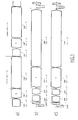
- curve a) represents the video signals of the D2-MAC / PACKAGE system of two consecutive lines (2i + 1) and 2 (i + 1), where i is a positive or zero integer.
- each video signal of curve a) there are three zones: a first DON area carrying a binary message coded in duobinary, the message consisting of a synchronization word (6 bits), followed by data and sound signals (99 bits), a CHR zone carrying the chrominance component, that is to say alternately the signal U in the odd lines and the signal V in the even lines, this signal being compressed in time, and - the LUM zone carrying the luminance component which is also compressed in time, but less than the chrominance component, the entire video signal for 64 microseconds.
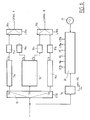
- the video signal D2-MAC / PACKAGE is transmitted to the input of an analog / digital converter 2, the eight-wire output of which is connected to a time expansion circuit 3 comprising two outputs which deliver extended video signals to two channels A and B, respectively.
- a sampling clock signal He is connected to the control input of converter 2.
- the frequency of the sampling clock He is 20.25 MHz, which corresponds to 1296 times the line frequency of the video signal from the D2-MAC / PACKAGE system.
- the samples are coded on eight bits.
- Channels A and B are respectively connected to the inputs of two conventional recording circuits 4a and 4b, the outputs of which are connected to recording / reading switches 5a and 5b, the common contacts of which are respectively connected to a set of recording heads and reading 6a and 6b.
- Elements 4a, 4b, 5a, 5b, and 6a, 6b are, for example, part of an MG VCR of the consumer type, such as a VHS high fidelity VCR. In Fig. 2, switches 5a and 5b are shown in the registered state is lying.
- switches 5a and 5b When the switches 5a and 5b are in the read state, they respectively connect the assemblies 6a and 6b to the inputs of two demodulators 7a and 7b whose signal outputs are respectively connected to the inputs of two analog digital converters 8a and 8b, and the control outputs to a time compression circuit 9.
- the outputs of the converters 8a and 8b are connected to the respective inputs of a time compression circuit 9, the three outputs of which are respectively connected to the corresponding inputs of a multiplexer 10, the output of which is connected to the input of a digital converter / analog 11 which delivers a D2-MAC / PACKET video signal, which is available on output terminal 12.
- the set of heads 6a, 6b, Fig.-3 comprises two pairs of heads, the first pair Ka1, Ka2 being associated with channel A and the other pair Kb1, Kb2 with channel B. As shown in Fig. 3, the four heads are carried by a drum T and are organized so that, in each pair, the heads are opposite at 180 °.
- the diametral line joining the heads of the first pair and the one joining the heads of the second pair make an angle of 5.66 ° between them, which corresponds to ten lines of the incident video signal, i.e. a time shift of 640 microseconds.
- each track recorded on the magnetic tape of the MG VCR is 25 micrometers, which is half the track width in the VHS system, which allows to maintain the longitudinal speed of the VHS system.
- the azimuth angle of the directions of the heads is chosen to ensure compatibility in reading with VHS cassettes.
- the two channels A and B are recorded simultaneously.
- a complete image is made up of four tracks, which corresponds to one turn of the drum T.
- the temporal processing of the video signal is provided to deliver to channels A and B an extended signal whose duration is slightly shorter than that which corresponds to the scanning time of a track, i.e. 20 ms.
- the space thus created or gap is used for switching the heads.
- the average duration of the gap is, in the example described, chosen equal to 177 microseconds.
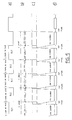
- Curve a) of FIG. 5 shows the succession of times during which the heads Ka1 and Ka2 are successively used for recording the information of channel A. During a half-turn of the drum T, the head Ka1 is active; during the next U-turn, it is the Ka2 head.
- Curve b) shows that, for each image, 156 lines must be recorded twice, plus a quarter line, on each channel.
- Curve c) shows the write times of the memories of channel A.
- Curve d) shows the read times of the memories of channel A. We would have equivalent curves for channel B.
- the time expansion circuit 3 of FIG. 2, shown in FIG. 6, has its input connected, on the one hand, to the input of a demultiplexer 13 and, on the other hand, to that of a synchronization extractor 14.
- the demultiplexer 13, FIG. 6, has three outputs Sa, Sb and Sc, and a control input E13.
- the outputs Sa and Sb are respectively connected to two units 15a and 15b of temporal decompression of the zones CHR and LUM of the signal of FIG. 1.
- the output Sc is connected to the input of a digital data processing circuit 16.
- the respective outputs S′a and S′b of the units 15a and 15b are connected to the inputs of two digital / analog converters 17a and 17b .
- the processing circuit 16 has two outputs S ⁇ a and S ⁇ b which are respectively connected to two other digital / analog converters 18a and 18b.
- the outputs of converters 17a and 18a are respectively connected to the inputs of a multiplexer 19a, the output of which is connected to channel A, Fig. 2.
- the outputs of converters 17b and 18b are respectively connected to the inputs of a multiplexer 19b, the output of which is connected to channel B, Fig. 2.
- the control inputs of the multiplexers 19a and 19b have been noted L19a and L19b.
- An output of the synchronization extractor circuit 14 is connected to the input of a main time base 20, the clock input of which is connected to the output of a stabilized oscillator 21.
- the main time base 20 delivers signals He, Hl and Hl ′, as well as logic control signals E13, L19a and L19b to circuits 13, 19a and 19b.
- Another output of the synchronization extractor circuit 14 is connected to a corresponding input, not shown, of the video recorder MG in order to apply to it a synchronization signal Sw. The corresponding connection is also shown in FIG. 2.
- the signal Sw is a synchronization signal which corresponds to the start of each complete writing sequence on the two channels A and B. This sequence, as will be better understood below, at a duration of 4 frames of the incident D2-MAC / PACKET signal, after which a new cycle begins again.
- the signal Sw in the form of a bit, is produced by decoding, in line 625 of the signal D2-MAC / PACKET of the word LSW, and counting of every two odd frames.
- the signal Sw is intended to be recorded on a particular track of the magnetic tape of the video tape recorder MG, ie the track "control-track", with the normal signal of piloting of the servo-mechanisms regulating the speed of progression Of the band.
- the recording of the signal Sw on the "control-track” can be carried out using a system such as that described in the document FR-A-2 458 874.
- the signal E13 is a two-bit word which, applied to the control input of the demultiplexer 13, causes: - during 216 clock periods He at 20.25 MHz, the routing of the digital signal delivered by the analog / digital converter 2, by the output Sc, to the processing circuit 16 which thus receives the samples corresponding to the DON area of each video signal shown in curve a) of FIG. 1, - then, during the following 1080 clock periods, the routing of the digital signal alternately to unit 15a or unit 15b, two consecutive lines out of four.
- the signal L19a controls the multiplexer 19a so that, for 168 clock periods Hl ′, it lets the analog signal coming from the converter 17a pass to channel A, then, for 436 clock periods Hl ′, the analog signal delivered by the convert sseur 18a, then until the end of the line, the signal delivered by the converter 17a.
- the signal L19b likewise controls the multiplexer 19b.
- the decompression unit 15a of FIG. 6, the block diagram of which is shown in FIG. 7, comprises a demultiplexer 22 with four outputs whose input is connected to the output Sa of the demultiplexer 13 and whose outputs are respectively connected to the inputs of four random access memories RAM1 to RAM4.
- the outputs of the memories RAM1 to RAM4 are respectively connected to four inputs of a multiplexer with five inputs 23, the fifth input of which is connected to the output of a synthesis circuit of synchronization top and frequency burst 24 and of which the output Sa is connected to the digital / analog converter 17a, Fig. 6.
- Unit 15a is completed by an annex time base 25.
- the structure of unit 15b is identical to that of unit 15a.
- the annex time base 25 delivers the following control or clock signals: the signal E22 used to select, in the demultiplexer 22, the output to which the chrominance and luminance components received from the demultiplexer 13 are to be transmitted in order to save them in one of the memories RAM1 to RAM4, the write clock He for the memories RAM1 to RAM4, ie here a clock signal at 20.25 MHz, the recording control signal w used to select and switch one of the memories RAM1 to RAM4 in write mode, the addressing signal ad in the memories RAM1 to RAM4, the read control signal r used to select and switch to one of the memories RAM1 to RAM4 or the synthesis circuit 24 in reading mode, the reading clock H1 of the memories RAM1 to RAM4, that is to say here at 11.6875 MHz, and - The control signal L23 used to select, for each line read, the input connected to circuit 24, then the input connected to memory RAM1 to RAM4 to be read.
- the frequency of the reading clock H1 being of the order of half that of the writing clock He, the areas CHR and LUM are found, after reading, to be extended with a length almost twice as long.
- the frequency of the clock Hl is slightly larger than half that of the clock He to accommodate the SYNC part extracted from circuit 24 and provide the space necessary for the constitution of the gap.
- the operation of the unit 15a, FIG. 7, will now be described with reference to curves b) and c) of FIG. 1.
- Each of these curves is broken down into three parts: a first SYNC part, a second DON + DON and a third CHR + LUM.
- the SYNC part includes a negative synchronization pulse followed by a reference frequency burst.
- the negative pulse is intended to be recognized in the MG video recorder which uses it for its own operation in a conventional manner.
- the frequency of the reference burst is equal to 187 times the line frequency and is intended to be used in the reading chain.
- the content of this SYNC part is extracted, in recording mode, from circuit 24 at the start of each line extended at the rate of the clock H1.
- the content of the second part DON + DON will be described below.
- the content of the third part CHR + LUM is extracted from one of the memories RAM1 to RAM4, selected by the time base 25 and also at the rate of the clock Hl. It also appears that the selection of the inputs in the multiplexer 23 is controlled as a function of the time position of the parts in the extended line and of a program which is recorded in the time base 25 and which results, for the skilled person. , from the examination of the diagrams of FIG. 8.
- the operation of circuit 15b is identical to that of circuit 15a.
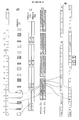
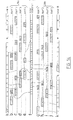
- diagram f shows the incident D2-MAC / PACKET signal at the end of one image and at the start of the next.
- Diagram b) shows that the memory RAM1 of circuit 15a receives the areas CHR and LUM of line 1. The content 1 ′ of this memory is read later with a clock almost twice as slow to be inserted in channel A, diagram a).
- This RAM1 memory of 15a again becomes available to store the content of line 9 and this content 9 ′ is read later.
- Arrows have been drawn to illustrate the transfers of the contents of the successive lines. The different reads and writes are controlled by the time bases 20 and 25 through the signals E13, E22, L23, w , r and ad. Examination of the other diagrams makes it possible to immediately understand the operation of the units 15a and 15b, which make it possible to insert the extended parts of CHR and LUM into channels A and B.
- Fig. 8 also showing the gaps necessary for the system two-head recording for each channel also helps to understand the usefulness of the four memories per unit.
- the data processing circuit 16 of FIG. 6 is shown in detail in FIG. 9. It includes a Viterbi decoder 26 whose input is connected to the output Sc of the demultiplexer 13 and whose output is connected to the input of a random access memory 27 whose output is connected to the input d a demultiplexer 28 with two pairs of outputs S ⁇ a1, S ⁇ a2 and S ⁇ b1, S ⁇ b2, which are respectively connected to the inputs of two pairs of random access memories 29a, 30a and 29b, 30b.
- the outputs of memories 29a and 30a are respectively connected to the two inputs of a multiplexer 31a, the output of which is connected to the input of an NRZ / duobinary encoder 32a.
- the outputs of memories 29b and 30b are respectively connected to the two inputs of a multiplexer 31b, the output of which is connected to the input of an NRZ / duobinary encoder 32b.
- the outputs of the encoders 32a and 32b are respectively connected to the outputs S ⁇ a and S ⁇ b, Fig. 6.
- the processing circuit 16 is completed by an annex time base 33.
- the annex time base 33 delivers the following control and clock signals: the write / read clock signal He for memory 27, and for writing to memories 29a, 30a, 29b and 30b, the reading clock Hl ′ of the memory 27 and of the memories 29a, 30a and 29b, 30b, the recording control signal w used to select and switch into writing mode one of the memories 29a to 30b, the read control signal r used to select and switch one of the memories 29a to 30b in read mode, the signal E28 used to select, in the demultiplexer 28, the output to which the data read from the memory 27 are to be transmitted in order to write them in one of the memories 29a, 30a, 29b and 30b, the input selection control signals L31a and L31b of the multiplexers 31a and 31b, respectively, - a reset signal.
- the Viterbi decoder 26 receives from the demultiplexer 13 the digital signal from the DON area, curve a) of FIG. 1, in which data is coded in duobinary form and delivers these same data in NRZ code, using the Viterbi algorithm which verifies the criterion of "maximum true blance a posteriori ", ie the search for the most probable path between two successive states of the system.
- the duobinary code is a partial response code which introduces a certain correlation into the transmitted signal. In particular, duobinary coding prohibits certain transitions.
- the latter resets the decoding processing and, moreover, delivers a error signal.
- the error signal is not used; on the other hand, it will be seen that, in the Viterbi decoders used in the reading chain, the error signals are counted and used to to take decisions.
- the random access memory or RAM 27 has a capacity of 512 bits.
- a line of the incident video signal for example the line "3”
- the memory 27 is put into write mode for 216 write clock periods He , after which the decoder 26 no longer receives signals.
- the time base 33 then advances the addresses by four additional steps. This offset of the address has the effect of adding four bits to zero in the memory 27.
- Each DON + DON set is transferred, during the time corresponding to the CHR + LUM area, by the demultiplexer 28, in the two memories 29a and 29b or in two memories 30a and 30b. As soon as this transfer is complete, the memory 27 is reset to zero by the reset signal of the time base 33.
- the reading clock Hl ′ of the pairs of memories 29a, 29b and 30a, 30b is slower than the writing clock He, This was 20.25 MHz while the reading clock Hl ′ is 17.53 MHz.
- the spectrum of the duobinary signal which will be reconstituted after conversion in the encoders 32a or 32b, will therefore be reduced from 5.06 MHz to 4.38 MHz. This reduction in the congestion in frequency of the data encoded in duobinary allows their recording on a channel whose bandwidth is of the order of 4.5 MHz.
- curve a) shows the incident D2-MAC / PACKET video signal and curve b) shows how the content of memory 27 evolves. This content being that of an odd line DON data packet (2i + 1) , to which, to the next line is added that of a pair line 2 (i + 1) and, finally, being reset to zero upon transfer to one of the pairs of memories 29a, 30a or 29b, 30b, and so right now.
- Curve c) Fig. 10, shows the succession of DON + DON contents of memories 29a and 29b while curve d) shows the evolution of DON + DON contents of memories 30a and 30b.
- curves e) show the contents of channels A and B, with regard to the data.
- the signals of the annexed time base L31a and L31b, FIG. 9, serve respectively to direct the contents of the memories 29a, 30a and 29b, 30b to the encoders 32a and 32b according to a program which corresponds to the diagrams of FIG. 10 and which is recorded in the time base 33.
- the converters 17a and 18a, FIG. 6, transform the signals coming from the outputs S′a and S ⁇ a into analog signals and the multiplexer 19a performs the nesting of the DON + DON part delivered by the converter 18a between the SYNC and CHR + LUM parts delivered by the converter 17a .
- the multiplexer 19a, FIG. 6, therefore delivers the content of channel A which is formed by a series of extended lines conforming to the signals either of curve b) or of curve c).
- the process is the same.
- Fig. 11 shows the arrangement of the current extended lines in channels A and B, each extended line symbolically comprising the sequence of the parts SYNC, DON + DON and CHR + LUM. Note that this arrangement corresponds to a sort of Greek, with 12 13 14 15 16 17 18 ...
- the demodulators 7a and 7b, FIG. 12, are part of the MG VCR where they fulfill conventional functions, namely the amplification and correction of the signals read by the heads Ka1, Ka2 and Kb1, Kb2, then the demodulation, filtering and de-emphasis these signals. As shown in Fig. 12, they each comprise an actual demodulator 34a or 34b, a synchronization separator circuit 35a or 35b, and a conventional drop-out detector 36a or 36b. The inputs of 34a and 36a, and of 34b and 36b are respectively connected in parallel to channel A and to channel B. A conventional output of each demodulator 34a or 34b is connected to the input of the corresponding separator 35a or 35b.
- the synchronization separator circuits detect the negative pulses of the SYNC parts of the extended lines read and orient them respectively, with the reference bursts which follow them, towards their outputs SVa and SVb.
- the drop-out detectors 36a and 36b respectively deliver on their outputs DOa and DOb a bit "1" or a bit "0" depending on whether the extended line being read is affected by a sudden and lasting drop in amplitude, for example exceeding a few microseconds, of the signal read.
- the signal outputs of the demodulators 34a and 34b are respectively connected to the inputs of the associated analog / digital converters 8a and 8b.
- Each analog / digital converter 8a or 8b converts the analog signal applied to samples coded on eight bits; it operates successively with different sampling clocks, i.e. 748 times the line frequency for the SYNC and CHR + LUM parts, Fig. 1, or 1122 times the extended line frequency for the DON + DON part.
- sampling clocks i.e. 748 times the line frequency for the SYNC and CHR + LUM parts, Fig. 1, or 1122 times the extended line frequency for the DON + DON part.
- These frequencies are practically equal to the frequencies Hl and Hl ′ used in the recording chain and we will see below how they are obtained.
- the commutations of these clocks are carried out at instants which, in the extended signal correspond to gray or black steps. Since these switches are made during stages, it becomes possible to create, during recording, a slight redundancy around these switching moments to eliminate a risk of loss of information.
- the clock input is connected to the output of a switch Xa or Xb which receives the two sampling clocks associated with channel A or B.
- These clocks are synthesized from the burst of reference added in the SYNC part during the recording.
- the value of the frequency of the reference burst is 187 times the line frequency and is therefore theoretically in a simple ratio either 1/4 with Hl, or 1/6 with Hl ′.
- there are two pairs of sampling clocks Hla *, Hl′a * and Hlb *, Hl′b * which are synthesized separately from of the bursts delivered to the outputs SVa and SVb, respectively.
- the time compression circuit 9, shown in FIG. 12, has two signal inputs Ea and Eb respectively connected to the outputs of the converters 8a and 8b and two pairs of control inputs respectively connected to the outputs DOa, DOb and SVa, SVb.
- the input Ea is connected to the input of a demultiplexer 37a with two outputs, one of which is connected to a time compression unit 38a of the CHR + LUM parts of the extended lines read.
- the input Eb is connected to a demultiplexer 37b with two outputs, one of which is connected to the input of a time compression unit 38b of the CHR + LUM parts of the extended lines read.
- the second outputs of the demultiplexers 37a and 37b are respectively connected to two inputs E′a and E′b of a processing circuit 39 for the digital data DON + DON of the extended lines read.
- the outputs of the units 38a and 38b, and of the processing circuit 39 are respectively connected to the inputs E ⁇ a, E ⁇ and E ⁇ c of the multiplexer 10 with three inputs whose output is connected to the converter 11, FIG. 2.
- the signals delivered by the outputs DOa, DOb, SVa and SVa are applied to corresponding inputs of a main time base 40.
- This comprises two memories Qa and Qb whose inputs receive the signals of DOa and DOb, and two burst separators SEPa and SEPb which receive the signals from SVa and SVb respectively.
- the outputs of the memories Qa and Qb are connected to two corresponding outputs qa and qb of the time base 40.
- the output of the separator SEPa is connected to two frequency multipliers MULa and MUL′a whose outputs deliver the reconstituted clocks Hla * and Hl′a *.
- the time base 40 also comprises a stabilized oscillator 41 providing a read clock He *, which is equal to the clock He used in the recording chain, and a logic circuit 42 which supplies switching signals E37a, E37b and L10 to the various circuits concerned.
- the main time base 40 also has an input to which a signal Sw * emitted by the video recorder MG is applied on reading the bit Sw on the "control-track” track.
- the signal Sw * makes it possible, in read mode, to initialize, in the time base 40, the processing process in the two channels A and B, the instant, "zero” corresponding to the beginning of the line "1", on channel A, after a gap and a line "625".
- the clock inputs of the converters 8a and 8b are connected to the outputs of switches Xa and Xb, which receive the corresponding sampling clocks.
- the frequency multipliers of the time base 40 are, for example, well-known phase-locked loop oscillators.
- the logic circuit 42 symbolically represented comprises in particular counters capable, for each channel A or B, from the detection of the negative synchronization pulse and synthesized clocks to form the signals E37a, E37b which respectively control the simultaneous operation of the switch Xa and the demultiplexer 37a, or the simultaneous operation of the switch Xb and the demultiplexer 37b.
- the compression unit 38a comprises a demultiplexer 43 with four outputs, the input of which is connected to the first output of the demultiplexer 37a and the outputs of which are respectively connected to the inputs of four random access memories RAM′1 to RAM′4.
- the outputs of the memories RAM′1 to RAM′4 are respectively connected to the four inputs of a multiplexer 44 whose output is connected to the input E ⁇ a of the multiplexer 10, FIG. 12.
- Unit 38a is completed by an annex time base 45.
- the structure of unit 38b is identical to that of unit 38a.
- the annex 45 time base delivers the following control or clock signals: the signal E43 used to select, in the demultiplexer 43, the output to which the CHR + LUM part is to be transmitted for writing to one of the memories RAM′1 to RAM′4, the write clock Hla * in the memories RAM′1 to RAM′4, the clock Hla * being received from the main time base 40, the write command signal w used to select and switch one of the memories RAM′1 to RAM′4 in write mode, - the addressing signal ad in the memories RAM′1 to RAM′4, the read control signal r used to select and switch one of the memories RAm′1 to RAM′4 in reading mode, the read clock He * of the memories RAM′1 to RAM′4, the clock He * being received from the main time base 40, and -
- the control signal L44 used to select, at each reconstructed line, the input connected to the memory RAM′1 to RAM′4 which is to be read.
- the annex 45 time base receives from the main time 40 the signal qa which is at "1" when the CHR + LUM part being written in one of the memories RAM′1 to RAM′4 is affected by a drop-out.
- the time base 45 comprises, on the one hand, a counter 46 which contains the position of the samples in each line and, on the other hand, a line counter 47. It is supplemented by a logic circuit 48, which depending on the count in 46 delivers the signal E43 and, depending on the count in 47 and the qa information, delivers the signal L44.
- FIG. 14 show that the CHR + LUM parts of the extended lines 1, 4, 5, 8, 9, etc., of channel A, diagram a), are sequentially written in the memories RAM′1, RAM′2, RAM ′ 3, RAM′4, as shown by the long hatched rectangles in diagrams b), c), d) and e).
- the small hatched rectangles represent the same compressed information when they are read in order to be multiplexed with the information coming from the unit 38b in order to reconstruct the analog zones of the reconstructed D2-MAC / PACKET signal, diagram f) .
- the content of the extended line 12 is affected by a drop-out, it is written in the memory RAM′2, but at the time of its instant of reading the signal L44 will direct the multiplexer 44 towards the memory RAM′4 so that the old extended line 8 will be read and will take the place of the extended line 12. This is shown by the arrow in dashed lines in FIG. 14.
- the digital data processing circuit 39 of FIG. 12, shown in detail in FIG. 15, comprises two duobinary Viterbi decoders 49a and 49b, the inputs of which are respectively connected to the inputs E′a and E′b and the signal outputs of which are respectively connected to the inputs of two demultiplexers 50a and 50b.
- Each demultiplexer 50a or 50b has two outputs which are respectively connected to the inputs of two random access memories RAMa1 and RAMa2 or RAMb1 and RAMb2.
- Each of these memories has a capacity of 512 bits, that is to say capable of memorizing a burst of data DON + DON, curve b) and c), FIG. 2.
- the outputs of the memories RAMa1 and RAMa2 are respectively connected to the inputs of a multiplexer 51a while the outputs of the memories RAMb1 and RAMb2 are respectively connected to the inputs of a multiplexer 51b.
- the outputs of the multiplexers 51a and 51b are respectively connected to the inputs a multiplexer 52, the output of which is connected to the input of a buffer memory 53, the capacity of which is also 512 bits.
- the output of the buffer memory 53 is connected to the input of a duobinary coder 54 whose output E ⁇ c is connected to the multiplexer 10, FIG. 12.
- Each Viterbi duobinary decoder 49a or 49b also has an output Va or Vb, respectively, which delivers a "1" bit each time an erroneous configuration has been encountered during decoding.
- the outputs va and vb are respectively connected, inside an annex time base 55, to the inputs of two counters 56a and 56b.
- the counter 56a counts the number of bits "1" delivered by the output Va and stores this number in an associated memory 57a whose capacity is equal to two words.
- the counter 56b also works in relation to a memory 57b.
- the outputs of memories 57a and 57b are connected to the two inputs of a comparator 58, the output of which is connected to an input of a memory selection circuit 59.
- the memory selection circuit 59 still has two inputs which receive the information qa and qb of logic circuit 40, Fig. 12.
- the output of the memory selection circuit 59 is connected to a logic circuit 60 comprising, inter alia, a sample counter and a row counter, not shown.
- the clock input of memory 53 is connected to the output of a switch 61 which receives the two clocks Hl′a * and Hl′b * and which is controlled in the same way as the multiplexer 52.
- the time base 55 delivers the following control or clock signals: the signals E50a and E50b used to select, in the demultiplexers 50a and 50b, the respective outputs to which the bursts of data DON + DON are to be transmitted in order to save them in the memories RAMa1 or RAMa2, for those which come from channel A, and RAMb1 or RAMb2, for those coming from channel B.
- the recording control signal w used to select and switch to write mode one of the memories RAMa1 to RAMb2 or the memory 53, the addressing signal ad in the memories RAMa1 to RAMb2 and the memory 53, the read control signal r used to select and switch one of the memories RAMa1 to RAMb2 or the memory 53 in reading mode, - the reading clock He * from memory 53, the signals L51a, L51b and L52 used to select in the demultiplexers 51a, 51b and 52, the input concerned, the signal L52 also serving to control the switch 61 in order to supply the memory 53 with the adequate write clock Hl ′ A * or Hl′b *, and - the reset signal used to reset memory 53.
- Diagrams a) and b) show the bursts respectively read in channels A and B.
- the extended line “12" of channel A carries the data of the incident lines “11” and “12” and the line range "11” of channel B carries the same data.
- the data of the extended line “12” are shown routed to the memory RAMa2 by the multiplexer 50a while the data of the extended line "11” is routed by the demutliplexer 50b to the memory RAMb2.
- the two bursts of data were, for example, considered as error free by the decoders of 49a and 49b.
- the content of the memory RAMa2 is read and written in the memory 53.
- the reading of the memory 53 is then triggered at the rate of the clock He *, faster, to transmit the data of the line "11” to the duobinary coder 54 in order to find them at the beginning of the reconstructed line "11", as shown in diagram j) of FIG. 16.
- the memory 53 is still read after 64 microseconds to transmit the data belonging to the line "12” and to be placed at the head of the reconstructed line "12". Once this reading made, the memory 53 is reset to zero by the signal RESET, to be ready to receive the data the extended lines "13" and "14".
- the data "13" carried by the channel A and received in the memory RAMa1 have comprised more of errors than those which were carried by the channel B and which are recorded in the memory RAMb1.
- the first part of the memory 53 will be filled with the first part of the content of the memory RAMb1.
- the second part received in the memory RAMa1 being good, it is used to fill the second part of the memory 53. The reading of the latter is done under the same conditions as above.
- the corresponding content of the memory associated with the other channel is selected to fill the memory 53.
- the comparator 58 delivers the information indicating the extended line whose data contains the least number of errors, and the logic circuit 59, as a function of this information plus the drop-out information qa and qb , chooses, to fill the memory 53, the RAM memories to be read as well as in these memories which part, first or second, must be read.
- circuit diagrams comprising separate well-differentiated members, such as memories, demultiplexers, multiplexers, etc. It is obvious that one could achieve the same functions using one or more microprocessors with associated memories.
Landscapes
- Engineering & Computer Science (AREA)
- Multimedia (AREA)
- Signal Processing (AREA)
- Signal Processing For Digital Recording And Reproducing (AREA)
- Television Signal Processing For Recording (AREA)
Applications Claiming Priority (2)
| Application Number | Priority Date | Filing Date | Title |
|---|---|---|---|
| FR8812512 | 1988-09-21 | ||
| FR8812512A FR2636801B1 (fr) | 1988-09-21 | 1988-09-21 | Procede d'enregistrement sur bande magnetique et de lecture de signaux d2-mac/paquet |
Publications (1)
| Publication Number | Publication Date |
|---|---|
| EP0360719A1 true EP0360719A1 (de) | 1990-03-28 |
Family
ID=9370362
Family Applications (1)
| Application Number | Title | Priority Date | Filing Date |
|---|---|---|---|
| EP89460028A Withdrawn EP0360719A1 (de) | 1988-09-21 | 1989-09-13 | Verfahren zum Aufzeichnen auf einem magnetischen Band und Wiedergabe von D2-MAC/Paket-Signalen und entsprechende Vorrichtungen |
Country Status (2)
| Country | Link |
|---|---|
| EP (1) | EP0360719A1 (de) |
| FR (1) | FR2636801B1 (de) |
Cited By (1)
| Publication number | Priority date | Publication date | Assignee | Title |
|---|---|---|---|---|
| EP0470815A1 (de) * | 1990-08-08 | 1992-02-12 | Sony Corporation | Verfahren und Gerät zur Aufzeichnung von Video- und Informationssignalen |
Citations (3)
| Publication number | Priority date | Publication date | Assignee | Title |
|---|---|---|---|---|
| EP0190919A2 (de) * | 1985-02-05 | 1986-08-13 | Sony Corporation | Aufzeichnungssystem |
| EP0243739A2 (de) * | 1986-04-24 | 1987-11-04 | GRUNDIG E.M.V. Elektro-Mechanische Versuchsanstalt Max Grundig holländ. Stiftung & Co. KG. | Verfahren zur Aufbereitung von Fernsehsignalen |
| EP0260045A2 (de) * | 1986-09-01 | 1988-03-16 | Matsushita Electric Industrial Co., Ltd. | Verfahren zum Aufzeichnen eines Videosignals und das assoziierende Aufzeichnungs-/Wiedergabegerät |
-
1988
- 1988-09-21 FR FR8812512A patent/FR2636801B1/fr not_active Expired - Lifetime
-
1989
- 1989-09-13 EP EP89460028A patent/EP0360719A1/de not_active Withdrawn
Patent Citations (3)
| Publication number | Priority date | Publication date | Assignee | Title |
|---|---|---|---|---|
| EP0190919A2 (de) * | 1985-02-05 | 1986-08-13 | Sony Corporation | Aufzeichnungssystem |
| EP0243739A2 (de) * | 1986-04-24 | 1987-11-04 | GRUNDIG E.M.V. Elektro-Mechanische Versuchsanstalt Max Grundig holländ. Stiftung & Co. KG. | Verfahren zur Aufbereitung von Fernsehsignalen |
| EP0260045A2 (de) * | 1986-09-01 | 1988-03-16 | Matsushita Electric Industrial Co., Ltd. | Verfahren zum Aufzeichnen eines Videosignals und das assoziierende Aufzeichnungs-/Wiedergabegerät |
Cited By (1)
| Publication number | Priority date | Publication date | Assignee | Title |
|---|---|---|---|---|
| EP0470815A1 (de) * | 1990-08-08 | 1992-02-12 | Sony Corporation | Verfahren und Gerät zur Aufzeichnung von Video- und Informationssignalen |
Also Published As
| Publication number | Publication date |
|---|---|
| FR2636801A1 (fr) | 1990-03-23 |
| FR2636801B1 (fr) | 1990-10-26 |
Similar Documents
| Publication | Publication Date | Title |
|---|---|---|
| CH638356A5 (fr) | Procede et dispositif de correction d'erreur dans un signal numerique. | |
| FR2546348A1 (fr) | Procede de codage de correction d'erreur | |
| FR2480542A1 (fr) | Appareil d'enregistrement et/ou de reproduction de signaux numeriques video et audio | |
| FR2475339A1 (fr) | Appareil et procede d'enregistrement et de reproduction numerique | |
| CH646825A5 (fr) | Procedes et dispositifs d'emission et de reception d'une sequence de mots d'information numerique. | |
| FR2475341A1 (fr) | Procede et appareil de dephasage a action rapide, destines a etre utilises dans des systemes d'echantillonnage numerique | |
| FR2466925A1 (fr) | Magnetoscope a bande a balayage helicoidal | |
| CH652523A5 (fr) | Procede et appareils d'enregistrement et de reproduction d'informations sous forme numerique moyennant un support d'enregistrement. | |
| CH648141A5 (fr) | Procede et appareil de detection d'un point de montage sur un support d'enregistrement. | |
| FR2499798A1 (fr) | Systeme d'enregistrement et de reproduction magnetique | |
| CH638355A5 (fr) | Procede et appareil de traitement de signaux d'images en couleurs. | |
| FR2481038A1 (fr) | Appareil d'enregistrement et de reproduction de donnees video sous forme numerique | |
| FR2481027A1 (fr) | Procede et appareil de traitement de signaux numeriques | |
| JPH04358358A (ja) | 映像データ記録装置、映像データ再生装置及び映像データ記録再生装置 | |
| CH653165A5 (fr) | Procede et appareil de montage de signaux numeriques enregistres sur un support d'enregistrement. | |
| CH638359A5 (fr) | Procede et dispositif de traitement d'un signal video en couleur. | |
| US4768108A (en) | Magnetic recording and reproducing system | |
| FR2475342A1 (fr) | Appareil destine a realiser une compensation de defauts dans des systemes d'enregistrement et de reproduction | |
| EP0840958A1 (de) | Ver- und entschachtelung von datenelementen | |
| FR2514588A1 (fr) | Dispositif pour l'enregistrement de manifestations numeriques d'un signal analogique continu dans le temps et dispositif pour le traitement de sa manifestation numerique enregistree | |
| EP0360719A1 (de) | Verfahren zum Aufzeichnen auf einem magnetischen Band und Wiedergabe von D2-MAC/Paket-Signalen und entsprechende Vorrichtungen | |
| JP3041184B2 (ja) | ディジタル情報記録装置及び記録再生装置 | |
| FR2475317A1 (fr) | Procede et appareil pour eviter des erreurs dans une installation de traitement de signaux pcm | |
| EP0418180A1 (de) | Verfahren zum Aufzeichnen und Wiedergeben von Fernsehsignalen mit hoher Auflösung | |
| EP0318374B1 (de) | Verfahren und Vorrichtungen zur Aufzeichnung und/oder Übertragung hoher Datenraten von binären Signalen mit bekannten Mitteln für Aufzeichnung und/oder Übertragung von Videosignalen und zum wiederholten Lesen digitaler Informationen |
Legal Events
| Date | Code | Title | Description |
|---|---|---|---|
| PUAI | Public reference made under article 153(3) epc to a published international application that has entered the european phase |
Free format text: ORIGINAL CODE: 0009012 |
|
| AK | Designated contracting states |
Kind code of ref document: A1 Designated state(s): DE ES GB IT NL |
|
| 17P | Request for examination filed |
Effective date: 19900910 |
|
| 17Q | First examination report despatched |
Effective date: 19920807 |
|
| STAA | Information on the status of an ep patent application or granted ep patent |
Free format text: STATUS: THE APPLICATION IS DEEMED TO BE WITHDRAWN |
|
| 18D | Application deemed to be withdrawn |
Effective date: 19940310 |