EP0361092B1 - Aminhaltige, grenzflächensynthetisierte Umkehrosmose-Membran und Verfahren zu ihrer Herstellung - Google Patents
Aminhaltige, grenzflächensynthetisierte Umkehrosmose-Membran und Verfahren zu ihrer Herstellung Download PDFInfo
- Publication number
- EP0361092B1 EP0361092B1 EP89115704A EP89115704A EP0361092B1 EP 0361092 B1 EP0361092 B1 EP 0361092B1 EP 89115704 A EP89115704 A EP 89115704A EP 89115704 A EP89115704 A EP 89115704A EP 0361092 B1 EP0361092 B1 EP 0361092B1
- Authority
- EP
- European Patent Office
- Prior art keywords
- amine
- monomeric
- permeable membrane
- water permeable
- reactant
- Prior art date
- Legal status (The legal status is an assumption and is not a legal conclusion. Google has not performed a legal analysis and makes no representation as to the accuracy of the status listed.)
- Expired - Lifetime
Links
- -1 amine salt Chemical class 0.000 title claims description 76
- 239000012528 membrane Substances 0.000 title claims description 74
- 238000000034 method Methods 0.000 title claims description 39
- 238000001223 reverse osmosis Methods 0.000 title description 7
- 239000000376 reactant Substances 0.000 claims description 75
- XLYOFNOQVPJJNP-UHFFFAOYSA-N water Substances O XLYOFNOQVPJJNP-UHFFFAOYSA-N 0.000 claims description 62
- 239000007864 aqueous solution Substances 0.000 claims description 46
- 239000000203 mixture Substances 0.000 claims description 39
- 125000003118 aryl group Chemical group 0.000 claims description 36
- 229920000768 polyamine Polymers 0.000 claims description 33
- 239000000243 solution Substances 0.000 claims description 31
- 239000003960 organic solvent Substances 0.000 claims description 24
- 150000003839 salts Chemical class 0.000 claims description 23
- 239000011248 coating agent Substances 0.000 claims description 20
- 238000000576 coating method Methods 0.000 claims description 20
- 239000002253 acid Substances 0.000 claims description 19
- 239000007788 liquid Substances 0.000 claims description 16
- ZMANZCXQSJIPKH-UHFFFAOYSA-N Triethylamine Chemical compound CCN(CC)CC ZMANZCXQSJIPKH-UHFFFAOYSA-N 0.000 claims description 15
- 150000001412 amines Chemical class 0.000 claims description 15
- 125000003277 amino group Chemical group 0.000 claims description 15
- 150000001266 acyl halides Chemical class 0.000 claims description 12
- 125000000777 acyl halide group Chemical group 0.000 claims description 11
- LSNNMFCWUKXFEE-UHFFFAOYSA-M Bisulfite Chemical compound OS([O-])=O LSNNMFCWUKXFEE-UHFFFAOYSA-M 0.000 claims description 9
- 150000004985 diamines Chemical group 0.000 claims description 9
- 150000004820 halides Chemical class 0.000 claims description 9
- 238000001035 drying Methods 0.000 claims description 7
- VEXZGXHMUGYJMC-UHFFFAOYSA-N Hydrochloric acid Chemical compound Cl VEXZGXHMUGYJMC-UHFFFAOYSA-N 0.000 claims description 6
- QAOWNCQODCNURD-UHFFFAOYSA-N Sulfuric acid Chemical compound OS(O)(=O)=O QAOWNCQODCNURD-UHFFFAOYSA-N 0.000 claims description 6
- DTQVDTLACAAQTR-UHFFFAOYSA-N Trifluoroacetic acid Chemical compound OC(=O)C(F)(F)F DTQVDTLACAAQTR-UHFFFAOYSA-N 0.000 claims description 6
- 150000007942 carboxylates Chemical class 0.000 claims description 6
- 229930195733 hydrocarbon Natural products 0.000 claims description 6
- 150000002430 hydrocarbons Chemical class 0.000 claims description 6
- 239000004215 Carbon black (E152) Substances 0.000 claims description 4
- 125000001931 aliphatic group Chemical group 0.000 claims description 4
- 150000003141 primary amines Chemical group 0.000 claims description 4
- 150000003512 tertiary amines Chemical class 0.000 claims description 4
- 229910002651 NO3 Inorganic materials 0.000 claims description 3
- NHNBFGGVMKEFGY-UHFFFAOYSA-N Nitrate Chemical compound [O-][N+]([O-])=O NHNBFGGVMKEFGY-UHFFFAOYSA-N 0.000 claims description 3
- GRYLNZFGIOXLOG-UHFFFAOYSA-N Nitric acid Chemical compound O[N+]([O-])=O GRYLNZFGIOXLOG-UHFFFAOYSA-N 0.000 claims description 3
- 229910019142 PO4 Inorganic materials 0.000 claims description 3
- QAOWNCQODCNURD-UHFFFAOYSA-L Sulfate Chemical compound [O-]S([O-])(=O)=O QAOWNCQODCNURD-UHFFFAOYSA-L 0.000 claims description 3
- GKXVJHDEWHKBFH-UHFFFAOYSA-N [2-(aminomethyl)phenyl]methanamine Chemical group NCC1=CC=CC=C1CN GKXVJHDEWHKBFH-UHFFFAOYSA-N 0.000 claims description 3
- XLYOFNOQVPJJNP-UHFFFAOYSA-M hydroxide Chemical compound [OH-] XLYOFNOQVPJJNP-UHFFFAOYSA-M 0.000 claims description 3
- 229910017604 nitric acid Inorganic materials 0.000 claims description 3
- NBIIXXVUZAFLBC-UHFFFAOYSA-K phosphate Chemical compound [O-]P([O-])([O-])=O NBIIXXVUZAFLBC-UHFFFAOYSA-K 0.000 claims description 3
- 239000010452 phosphate Substances 0.000 claims description 3
- 230000000379 polymerizing effect Effects 0.000 claims description 3
- BDHFUVZGWQCTTF-UHFFFAOYSA-M sulfonate Chemical compound [O-]S(=O)=O BDHFUVZGWQCTTF-UHFFFAOYSA-M 0.000 claims description 3
- 150000005622 tetraalkylammonium hydroxides Chemical class 0.000 claims description 3
- 125000005270 trialkylamine group Chemical group 0.000 claims description 3
- 125000001797 benzyl group Chemical group [H]C1=C([H])C([H])=C(C([H])=C1[H])C([H])([H])* 0.000 claims description 2
- RTWNYYOXLSILQN-UHFFFAOYSA-N methanediamine Chemical compound NCN RTWNYYOXLSILQN-UHFFFAOYSA-N 0.000 claims 4
- 125000005208 trialkylammonium group Chemical group 0.000 claims 1
- UWCPYKQBIPYOLX-UHFFFAOYSA-N benzene-1,3,5-tricarbonyl chloride Chemical compound ClC(=O)C1=CC(C(Cl)=O)=CC(C(Cl)=O)=C1 UWCPYKQBIPYOLX-UHFFFAOYSA-N 0.000 description 13
- 230000004907 flux Effects 0.000 description 13
- QTBSBXVTEAMEQO-UHFFFAOYSA-N Acetic acid Chemical compound CC(O)=O QTBSBXVTEAMEQO-UHFFFAOYSA-N 0.000 description 9
- 229920002492 poly(sulfone) Polymers 0.000 description 8
- WGTYBPLFGIVFAS-UHFFFAOYSA-M tetramethylammonium hydroxide Chemical compound [OH-].C[N+](C)(C)C WGTYBPLFGIVFAS-UHFFFAOYSA-M 0.000 description 8
- FDQSRULYDNDXQB-UHFFFAOYSA-N benzene-1,3-dicarbonyl chloride Chemical compound ClC(=O)C1=CC=CC(C(Cl)=O)=C1 FDQSRULYDNDXQB-UHFFFAOYSA-N 0.000 description 7
- WZCQRUWWHSTZEM-UHFFFAOYSA-N 1,3-phenylenediamine Chemical compound NC1=CC=CC(N)=C1 WZCQRUWWHSTZEM-UHFFFAOYSA-N 0.000 description 5
- 239000004952 Polyamide Substances 0.000 description 5
- 239000004760 aramid Substances 0.000 description 5
- 229920003235 aromatic polyamide Polymers 0.000 description 5
- 238000010612 desalination reaction Methods 0.000 description 5
- 229940018564 m-phenylenediamine Drugs 0.000 description 5
- 229920002647 polyamide Polymers 0.000 description 5
- MIOPJNTWMNEORI-GMSGAONNSA-N (S)-camphorsulfonic acid Chemical compound C1C[C@@]2(CS(O)(=O)=O)C(=O)C[C@@H]1C2(C)C MIOPJNTWMNEORI-GMSGAONNSA-N 0.000 description 4
- DBMJMQXJHONAFJ-UHFFFAOYSA-M Sodium laurylsulphate Chemical compound [Na+].CCCCCCCCCCCCOS([O-])(=O)=O DBMJMQXJHONAFJ-UHFFFAOYSA-M 0.000 description 4
- GVGUFUZHNYFZLC-UHFFFAOYSA-N dodecyl benzenesulfonate;sodium Chemical compound [Na].CCCCCCCCCCCCOS(=O)(=O)C1=CC=CC=C1 GVGUFUZHNYFZLC-UHFFFAOYSA-N 0.000 description 4
- 239000000047 product Substances 0.000 description 4
- 229940080264 sodium dodecylbenzenesulfonate Drugs 0.000 description 4
- 239000004094 surface-active agent Substances 0.000 description 4
- 125000003545 alkoxy group Chemical group 0.000 description 3
- 125000004432 carbon atom Chemical group C* 0.000 description 3
- 238000004132 cross linking Methods 0.000 description 3
- VLKZOEOYAKHREP-UHFFFAOYSA-N n-Hexane Chemical compound CCCCCC VLKZOEOYAKHREP-UHFFFAOYSA-N 0.000 description 3
- 235000019333 sodium laurylsulphate Nutrition 0.000 description 3
- PAMIQIKDUOTOBW-UHFFFAOYSA-N 1-methylpiperidine Chemical compound CN1CCCCC1 PAMIQIKDUOTOBW-UHFFFAOYSA-N 0.000 description 2
- HZAXFHJVJLSVMW-UHFFFAOYSA-N 2-Aminoethan-1-ol Chemical compound NCCO HZAXFHJVJLSVMW-UHFFFAOYSA-N 0.000 description 2
- NGNBDVOYPDDBFK-UHFFFAOYSA-N 2-[2,4-di(pentan-2-yl)phenoxy]acetyl chloride Chemical compound CCCC(C)C1=CC=C(OCC(Cl)=O)C(C(C)CCC)=C1 NGNBDVOYPDDBFK-UHFFFAOYSA-N 0.000 description 2
- 238000012695 Interfacial polymerization Methods 0.000 description 2
- FAPWRFPIFSIZLT-UHFFFAOYSA-M Sodium chloride Chemical compound [Na+].[Cl-] FAPWRFPIFSIZLT-UHFFFAOYSA-M 0.000 description 2
- 150000007513 acids Chemical class 0.000 description 2
- 230000002411 adverse Effects 0.000 description 2
- 150000001335 aliphatic alkanes Chemical class 0.000 description 2
- 125000000217 alkyl group Chemical group 0.000 description 2
- 230000000052 comparative effect Effects 0.000 description 2
- 238000007598 dipping method Methods 0.000 description 2
- BKIMMITUMNQMOS-UHFFFAOYSA-N nonane Chemical compound CCCCCCCCC BKIMMITUMNQMOS-UHFFFAOYSA-N 0.000 description 2
- 229920000110 poly(aryl ether sulfone) Polymers 0.000 description 2
- 239000013535 sea water Substances 0.000 description 2
- 239000002904 solvent Substances 0.000 description 2
- 238000005507 spraying Methods 0.000 description 2
- GETQZCLCWQTVFV-UHFFFAOYSA-N trimethylamine Chemical compound CN(C)C GETQZCLCWQTVFV-UHFFFAOYSA-N 0.000 description 2
- AJDIZQLSFPQPEY-UHFFFAOYSA-N 1,1,2-Trichlorotrifluoroethane Chemical compound FC(F)(Cl)C(F)(Cl)Cl AJDIZQLSFPQPEY-UHFFFAOYSA-N 0.000 description 1
- CBCKQZAAMUWICA-UHFFFAOYSA-N 1,4-phenylenediamine Chemical compound NC1=CC=C(N)C=C1 CBCKQZAAMUWICA-UHFFFAOYSA-N 0.000 description 1
- AMBFNDRKYCJLNH-UHFFFAOYSA-N 1-(3-piperidin-1-ylpropyl)piperidine Chemical compound C1CCCCN1CCCN1CCCCC1 AMBFNDRKYCJLNH-UHFFFAOYSA-N 0.000 description 1
- IVLICPVPXWEGCA-UHFFFAOYSA-N 3-quinuclidinol Chemical compound C1C[C@@H]2C(O)C[N@]1CC2 IVLICPVPXWEGCA-UHFFFAOYSA-N 0.000 description 1
- XDTMQSROBMDMFD-UHFFFAOYSA-N Cyclohexane Chemical compound C1CCCCC1 XDTMQSROBMDMFD-UHFFFAOYSA-N 0.000 description 1
- UEEJHVSXFDXPFK-UHFFFAOYSA-N N-dimethylaminoethanol Chemical compound CN(C)CCO UEEJHVSXFDXPFK-UHFFFAOYSA-N 0.000 description 1
- 239000002033 PVDF binder Substances 0.000 description 1
- GLUUGHFHXGJENI-UHFFFAOYSA-N Piperazine Chemical compound C1CNCCN1 GLUUGHFHXGJENI-UHFFFAOYSA-N 0.000 description 1
- 239000004695 Polyether sulfone Substances 0.000 description 1
- 239000004642 Polyimide Substances 0.000 description 1
- 239000003125 aqueous solvent Substances 0.000 description 1
- WPYMKLBDIGXBTP-UHFFFAOYSA-N benzoic acid Chemical compound OC(=O)C1=CC=CC=C1 WPYMKLBDIGXBTP-UHFFFAOYSA-N 0.000 description 1
- FKPSBYZGRQJIMO-UHFFFAOYSA-M benzyl(triethyl)azanium;hydroxide Chemical compound [OH-].CC[N+](CC)(CC)CC1=CC=CC=C1 FKPSBYZGRQJIMO-UHFFFAOYSA-M 0.000 description 1
- QEABVDWVSDSQRO-UHFFFAOYSA-M benzyl(tripropyl)azanium;hydroxide Chemical compound [OH-].CCC[N+](CCC)(CCC)CC1=CC=CC=C1 QEABVDWVSDSQRO-UHFFFAOYSA-M 0.000 description 1
- NDKBVBUGCNGSJJ-UHFFFAOYSA-M benzyltrimethylammonium hydroxide Chemical compound [OH-].C[N+](C)(C)CC1=CC=CC=C1 NDKBVBUGCNGSJJ-UHFFFAOYSA-M 0.000 description 1
- 235000012206 bottled water Nutrition 0.000 description 1
- 125000003178 carboxy group Chemical group [H]OC(*)=O 0.000 description 1
- 239000007795 chemical reaction product Substances 0.000 description 1
- 150000001805 chlorine compounds Chemical class 0.000 description 1
- 239000002131 composite material Substances 0.000 description 1
- 239000003431 cross linking reagent Substances 0.000 description 1
- 150000001924 cycloalkanes Chemical class 0.000 description 1
- YMHQVDAATAEZLO-UHFFFAOYSA-N cyclohexane-1,1-diamine Chemical compound NC1(N)CCCCC1 YMHQVDAATAEZLO-UHFFFAOYSA-N 0.000 description 1
- HIZMBMVNMBMUEE-UHFFFAOYSA-N cyclohexane-1,3,5-tricarbonyl chloride Chemical compound ClC(=O)C1CC(C(Cl)=O)CC(C(Cl)=O)C1 HIZMBMVNMBMUEE-UHFFFAOYSA-N 0.000 description 1
- COHIUILBPQNABR-UHFFFAOYSA-N dodecyl phenylmethanesulfonate;sodium Chemical compound [Na].CCCCCCCCCCCCOS(=O)(=O)CC1=CC=CC=C1 COHIUILBPQNABR-UHFFFAOYSA-N 0.000 description 1
- 239000003651 drinking water Substances 0.000 description 1
- 125000001301 ethoxy group Chemical group [H]C([H])([H])C([H])([H])O* 0.000 description 1
- 125000001495 ethyl group Chemical group [H]C([H])([H])C([H])([H])* 0.000 description 1
- 239000012530 fluid Substances 0.000 description 1
- 125000005843 halogen group Chemical group 0.000 description 1
- 125000000623 heterocyclic group Chemical group 0.000 description 1
- 125000002887 hydroxy group Chemical group [H]O* 0.000 description 1
- 125000002768 hydroxyalkyl group Chemical group 0.000 description 1
- 238000010406 interfacial reaction Methods 0.000 description 1
- 238000004519 manufacturing process Methods 0.000 description 1
- 125000000956 methoxy group Chemical group [H]C([H])([H])O* 0.000 description 1
- 125000002496 methyl group Chemical group [H]C([H])([H])* 0.000 description 1
- NOUUUQMKVOUUNR-UHFFFAOYSA-N n,n'-diphenylethane-1,2-diamine Chemical compound C=1C=CC=CC=1NCCNC1=CC=CC=C1 NOUUUQMKVOUUNR-UHFFFAOYSA-N 0.000 description 1
- DAZXVJBJRMWXJP-UHFFFAOYSA-N n,n-dimethylethylamine Chemical compound CCN(C)C DAZXVJBJRMWXJP-UHFFFAOYSA-N 0.000 description 1
- GNVRJGIVDSQCOP-UHFFFAOYSA-N n-ethyl-n-methylethanamine Chemical compound CCN(C)CC GNVRJGIVDSQCOP-UHFFFAOYSA-N 0.000 description 1
- XLYOFNOQVPJJNP-UHFFFAOYSA-O oxonium Chemical compound [OH3+] XLYOFNOQVPJJNP-UHFFFAOYSA-O 0.000 description 1
- 229920006393 polyether sulfone Polymers 0.000 description 1
- 229920001721 polyimide Polymers 0.000 description 1
- 229920002981 polyvinylidene fluoride Polymers 0.000 description 1
- 125000002924 primary amino group Chemical group [H]N([H])* 0.000 description 1
- 238000012827 research and development Methods 0.000 description 1
- 238000007761 roller coating Methods 0.000 description 1
- 239000012266 salt solution Substances 0.000 description 1
- 150000003335 secondary amines Chemical group 0.000 description 1
- 238000000926 separation method Methods 0.000 description 1
- 239000011780 sodium chloride Substances 0.000 description 1
- 239000007787 solid Substances 0.000 description 1
- 239000000126 substance Substances 0.000 description 1
- 125000001424 substituent group Chemical group 0.000 description 1
- 229940073455 tetraethylammonium hydroxide Drugs 0.000 description 1
- LRGJRHZIDJQFCL-UHFFFAOYSA-M tetraethylazanium;hydroxide Chemical compound [OH-].CC[N+](CC)(CC)CC LRGJRHZIDJQFCL-UHFFFAOYSA-M 0.000 description 1
- LPSKDVINWQNWFE-UHFFFAOYSA-M tetrapropylazanium;hydroxide Chemical compound [OH-].CCC[N+](CCC)(CCC)CCC LPSKDVINWQNWFE-UHFFFAOYSA-M 0.000 description 1
- YFTHZRPMJXBUME-UHFFFAOYSA-N tripropylamine Chemical compound CCCN(CCC)CCC YFTHZRPMJXBUME-UHFFFAOYSA-N 0.000 description 1
Classifications
-
- B—PERFORMING OPERATIONS; TRANSPORTING
- B01—PHYSICAL OR CHEMICAL PROCESSES OR APPARATUS IN GENERAL
- B01D—SEPARATION
- B01D69/00—Semi-permeable membranes for separation processes or apparatus characterised by their form, structure or properties; Manufacturing processes specially adapted therefor
- B01D69/12—Composite membranes; Ultra-thin membranes
- B01D69/125—In situ manufacturing by polymerisation, polycondensation, cross-linking or chemical reaction
- B01D69/1251—In situ manufacturing by polymerisation, polycondensation, cross-linking or chemical reaction by interfacial polymerisation
-
- B—PERFORMING OPERATIONS; TRANSPORTING
- B01—PHYSICAL OR CHEMICAL PROCESSES OR APPARATUS IN GENERAL
- B01D—SEPARATION
- B01D71/00—Semi-permeable membranes for separation processes or apparatus characterised by the material; Manufacturing processes specially adapted therefor
- B01D71/06—Organic material
- B01D71/58—Other polymers having nitrogen in the main chain, with or without oxygen or carbon only
- B01D71/60—Polyamines
Definitions
- the present invention relates to an interfacially synthesized reverse osmosis membrane useful for the separation of fluid mixtures and solutions.
- the present invention relates to an aromatic polyamide water permeable membrane containing an amine salt therein, which is useful for desalination of an aqueous solution.
- the present invention also relates to processes for preparing the membrane.
- dissolved substances can be separated from their solvents by use of selective membranes.
- selective membranes For example, of great practical interest is the removal of salt from water by reverse osmosis. The efficiency and economy of such removal is of tremendous economic significance in order to provide potable water from brackish or sea water for household or agricultural use.
- a critical factor in desalination is the performance of the membrane in terms of salt rejection, i.e., the reduction in salt concentration across the membrane, and flux, i.e., the flow rate across the membrane.
- the flux should be on the order of greater than about 4.72 ⁇ 10 ⁇ 6 m/s (10 gallons/ft2-day (gfd)) at a pressure of about 5.5 MPa (55 atmospheres) for sea water and about 7.07 ⁇ 10 ⁇ 6 m/s (15 gfd) at a pressure of about 1.5 MPa (15 atmospheres) for brackish water.
- the continuing goal of research and development in this area is to develop membranes having increased flux and/or salt rejection which are useful in desalination.
- crosslinked aromatic polyamide membranes include, for example, those disclosed in the following U.S. Patents.
- US-A-3 904 519 issued to McKinney et al, discloses reverse osmosis membranes of improved flux prepared by crosslinking aromatic polyamide membranes using crosslinking agents and/or irradiation.
- the polyamides are prepared, for example, by the interfacial polymerization of amine groups and carboxyl groups followed by crosslinking.
- US-A-4 277 344 issued to Cadotte, describes a reverse osmosis membrane which is the interfacial reaction product of an aromatic polyamine having at least two primary amine substituents with an aromatic acyl halide having at least three acyl halide substituents.
- the preferred membrane is made of a poly(phenylenediamine trimesamide) film on a porous polysulfone support.
- US-A-4 529 646, issued to Sundet shows a similar membrane in which all or a portion of the trifunctional aromatic acyl halide is replaced by cyclohexane - 1,3,5-tricarbonyl chloride. Similar membranes are disclosed in US-A-4 520 044, US-A-4 544 484 and US-A-4 626 468, each issued to Sundet.
- US-A-4 661 254 issued to Zupanic et al, discloses a reverse osmosis composite membrane formed by the interfacial polymerization of a triaryl triamine with an aromatic carboxylic acid chloride.
- an object of the present invention is to provide an interfacially synthesized reverse osmosis membrane which has high salt rejection and excellent flux.
- a water permeable membrane prepared by interfacially polymerizing, on a microporous support, (1) an essentially monomeric, aromatic polyamine reactant having at least two amine functional groups, and (2) an essentially monomeric, aromatic, amine-reactive reactant comprising a polyfunctional acyl halide or mixture thereof, wherein the amine-reactive reactant has, on the average, at least 2.2 acyl halide groups per reactant molecule, in the presence of (3) an amine salt.
- a solution containing an amine salt and an aromatic polyamine is coated on a microporous support prior to coating with a solution of an aromatic polyfunctional acyl halide.
- an amine salt solution is coated on a microporous support prior to coating with an aromatic polyamine solution and an aromatic polyfunctional acyl halide solution.
- the resulting membrane consists of an ultrathin membrane on the microporous support. This membrane has excellent salt rejection and flux and is suitable for desalination applications.
- the objects of the present invention have been met by a water permeable membrane produced by the process comprising the steps of:
- the water permeable membrane is produced by the process comprising the steps of:
- microporous support employed in the present invention is not critical thereto.
- microporous supports useful in the present invention include those made of a polyarylether sulfone, such as a polysulfone and a polyether sulfone; a polyimide; and a polyvinylidene fluoride.
- the microporous support is preferably made of a polyarylether sulfone.
- the thickness of the microporous support is not critical to the present invention. Generally, the thickness of the microporous support is about 25 to 125 ⁇ m, preferably about 40 to 75 ⁇ m.
- the essentially monomeric, aromatic, polyamine reactant employed in the present invention has at least two amine functional groups, preferably 2 to 3 amine functional groups.
- the amine functional group is a primary or secondary amine functional group, preferably a primary amine functional group.
- the particular polyamine reactant employed in the present invention is not critical thereto.
- examples of such polyamine reactants include aromatic primary diamines, such as m-phenylenediamine and p-phenylenediamine and substituted derivatives thereof, wherein the substituent includes, e.g., an alkyl group, such as a methyl group or an ethyl group; an alkoxy group, such as a methoxy group or an ethoxy group; a hydroxy alkyl group; a hydroxy group or a halogen atom; cycloaliphatic primary diamines, such as cyclohexane diamine; cycloaliphatic secondary diamines, such as piperizine and trimethylene dipiperidine; aromatic secondary diamines, such as N,N′-diphenylethylene diamine; and xylylene diamine.
- the preferred polyamine reactants employed in the present invention are aromatic primary diamines, more preferably m-phenylenediamine.
- the essentially monomeric, aromatic, amine-reactive reactant has, on the average, at least 2.2 polyfunctional acyl halide groups, preferably 2.2 to 3.0 polyfunctional acyl halide groups per reactant molecule.
- the particular amine-reactive reactant employed in the present invention is not critical thereto.
- examples of such amine-reactive reactants include isophthaloyl halide, trimesoyl halide, terephthaloyl halide and mixtures thereof.
- the preferred amine-reactive reactants employed in the present invention are isophthaloyl chloride (IPC) and trimesoyl chloride (TMC).
- the amine salt employed in the present invention maybe a salt of an amine and an acid, and is preferably a salt of a tertiary amine and a strong acid.
- a strong acid is an acid which reacts essentially completely with water to give a hydronium ion.
- Such strong acids include an aromatic sulfonic acid; an aliphatic sulfonic acid; a cycloaliphatic sulfonic acid, such as camphorsulfonic acid; trifluoroacetic acid; nitric acid; hydrochloric acid; and sulfuric acid.
- the particular amine salt employed in the present invention is not critical thereto and may be any aliphatic, alkoxy, cycloaliphatic, heterocyclic or alkanol amine salt.
- Preferred amine salts employed in the invention are represented by formula (I) and (II) below: wherein R1, R2, R3 and R4, which may be the same or different, each represents a hydrocarbon; X represents a member selected from the group consisting of a halide, a nitrate, a sulfate, a phosphate, a sulfonate, a carboxylate, a halogenated carboxylate and an oxygenated haloacid derivative; and HX represents a strong acid which forms a water soluble salt with
- the hydrocarbons represented by R1, R2 and R3 preferably have a total number of carbon atoms of 3 to 9, more preferably, 3 to 6.
- the hydrocarbons represented by R1, R2, R3 and R4 preferably have a total number of carbon atoms of 4 to 16, more preferably, 4 to 13.
- the hydrocarbon may be, e.g., a straight or branched chain substituted or unsubstituted alkyl group, alkoxy group, alkanol group or benzyl group.
- two or more of R1, R2 and R3 may combine together to form a ring.
- the amine salt employed in the present invention is a water soluble salt of a strong acid and a tertiary amine selected from the group consisting of a trialkylamine, such as trimethylamine, triethylamine, tripropylamine; an N-alkylcycloaliphatic amine, such as 1-methylpiperidine; an N,N-dialkylamine, such as N,N-dimethylethylamine and N,N-diethylmethylamine; an N,N-dialkyl ethanolamine, such as N,N-dimethylethanolamine; a bicyclic tertiary amine, such as 3-quinuclidinol and mixtures thereof, or a quaternary amine selected from at least one member of the group consisting of a tetraalkylammonium hydroxide, such as, tetramethylammonium hydroxide, tetraethylammonium hydroxide, and tetrapropylammoni
- the amine salt is employed either as a solid, which is water soluble, or as an aqueous solution having dissolved therein the amine salt.
- the amine salt is preferably employed as an aqueous solution thereof.
- the amine used to prepare the amine salt preferably has a pKa of more than about 8, more preferably about 8 to 13, most preferably about 9 to 13.
- the microporous support is coated with a first aqueous solution containing generally about 0.25 to 10.0 wt% of an amine salt, preferably about 1.0 to 8.0 wt% of an amine salt.
- the first aqueous solution is preferably adjusted to a pH of about 5.5 to 9, more preferably about 7 to 8, by controlling the concentration of the acid or the amine salt.
- the second aqueous solution containing the polyamine reactant generally has a pH of about 5 to 10, preferably about 7 to 9.
- the coating amount is generally adjusted so that the molar ratio of the amine salt to the polyamine reactant is about 0.1 to 4.0, preferably about 0.6 to 1.4.
- the above aqueous solution of the amine salt can also contain the polyamine reactant.
- the aqueous solution is generally adjusted to a pH of about 5.5 to 9, preferably about 7 to 8.
- the molar ratio of the amine salt to the polyamine reactant is also generally adjusted to about 0.1 to 4.0, preferably about 0.6 to 1.4.
- aqueous solutions are coated by any well known means, such as dipping, spraying, roller coating or rod coating, and allowed to remain in place generally for about 5 seconds to 10 minutes, preferably about 20 seconds to 4 minutes.
- the aqueous solutions may contain a surfactant for more improved results.
- the particular surfactant employed in the present invention is not critical thereto.
- examples of such surfactants include sodium dodecyl benzene sulfonate (SDBS), sodium dodecyl sulfate (SDS), sodium lauryl sulfate (SLS) or mixtures thereof.
- SDBS sodium dodecyl benzene sulfonate
- SDS sodium dodecyl sulfate
- SLS sodium lauryl sulfate
- the surfactants are generally employed at a concentration of about 0.01 to 0.5 wt%, preferably about 0.1 to 0.25 wt%.
- a second layer of an organic solvent solution containing the essentially monomeric, aromatic, amine-reactive reactant is coated thereon.
- the organic solvent solution contains about 0.05 to 5.0 wt/vol%, preferably about 0.1 to 0.5 wt/vol% of the amine-reactive reactant.
- the organic solvent employed in the present invention is one which is non-miscible with water.
- the particular organic solvent employed in the present invention is not critical thereto.
- examples of such organic solvents include alkanes, such as hexane and nonane; cycloalkanes, such as cyclohexane; and halogenated derivatives thereof, such as Freon® (DuPont deNemours), including 1,1,2-trichlorotrifluoroethane; and mixtures thereof.
- the preferred organic solvents employed in the present invention are alkanes having from 8 to 12 carbon atoms.
- the organic solvent containing the amine-reactive reactant is coated by any well known means, such as dipping or spraying and allowed to remain in place generally for about 5 seconds to 10 minutes, preferably about 20 seconds to 4 minutes.
- the resulting product is dried to form a water permeable membrane.
- the resulting product is generally dried in an oven at about 60 to 110°C, preferably about 70 to 100°C for about 1 to 10 minutes, preferably about 2 to 8 minutes.
- a polyamide layer is formed on the microporous support.
- the thickness of the resulting polyamide layer is generally about 0.05 to 1.0 ⁇ m, preferably about 0.15 to 0.5 ⁇ m.
- An aqueous solution containing, at a final concentration, 2.0 wt% of m-phenylenediamine (MPD), 2.0 wt% of tetramethylammonium hydroxide (TMAH), and 0.1 wt% of sodium dodecyl benzyl sulfonate (SDBS) in water was prepared.
- the pH of the final solution was adjusted to 5.7 with acetic acid.
- the solution was coated on a 60-70 ⁇ m thick microporous polysulfone support by pouring the aqueous solution on the microporous polysulfone support to form a liquid layer thereon.
- the performance of the resulting water permeable membrane was measured by passing an aqueous solution containing 2,000 ppm of NaCl, pH 7.0, through the membrane at 1.55 MPa (225 psig).
- the salt rejection was 99.69% and the flux was 9.48 ⁇ 10 ⁇ 6 m/s (20.1 gfd).
- Example 1 The procedure of Example 1 was repeated, except that the pH of the final solution was adjusted to 8.0 with acetic acid.
- the salt rejection was 99.84% and the flux was 9.34 ⁇ 10 ⁇ 6 m/s (19.8 gfd) under the same test conditions as in Example 1.
- Example 1 The procedure of Example 1 was repeated, except that the amine salt was omitted or the amine salts set forth in Table 1 below were substituted for TMAH in the amounts indicated in Table 1 and the strong acids in Table 1 were substituted for acetic acid so as to achieve the final pH shown in Table 1.
- Examples 1 and 2 are also shown in Table 1.
- An aqueous solution was prepared containing, at a final concentration, 2.0 wt% of MPD, 6.6 wt% of amine salt of triethylamine and camphorsulfonic acid and 0.1 wt% of SDBS in water.
- a similar solution was prepared without the amine salt.
- the pH of the final solutions was adjusted to the values as indicated in Table 3 below with camphorsulfonic acid.
- aqueous solutions were coated on a 60-70 ⁇ m thick microporous polysulfone supports by pouring and allowing such to remain for 2 minutes before draining off the excess aqueous solutions.
- Mixture A a mixture of 70wt% IPC and 30wt% TMC.
- Mixture B a mixture of 60wt% IPC and 40wt% TMC.
- Mixture C a mixture of 50wt% IPC and 50wt% TMC.
Landscapes
- Chemical & Material Sciences (AREA)
- Chemical Kinetics & Catalysis (AREA)
- Separation Using Semi-Permeable Membranes (AREA)
Claims (54)
- Wasserdurchlässige Membran, hergestellt durch Grenzflächenpolymerisierung auf einem mikroporösen Träger (1) eines im wesentlichen monomeren aromatischen Polyaminreaktanten mit mindestens zwei funktionellen Amingruppen und (2) eines im wesentlichen monomeren aromatischen, gegenüber Amin reaktionsfähigen Reaktanten mit einem polyfunktionellen Acylhalogenid oder einer Mischung davon, bei der der gegenüber Amin reaktionsfähige Reaktant durchschnittlich mindestens 2,2 Acylhalogenidgruppen pro Reaktantmolekül in dar Gegenwart von (3) einem momomeren Aminsalz aufweist.
- Wasserdurchlässige Membran nach Anspruch 1, wobei die wasserdurchlässige Membran durch das die folgenden Schritte umfassende Verfahren hergestellt wird:(a) Beschichten eines mikroporösen Trägers mit einer wässrigen Lösung, die (i) einen im wesentlichen momoneren aromatischen Polyaminreaktant mit mindestens zwei funktionellen Amingruppen und (ii) ein monomeres Aminsalz aufweist, um eine flüssige Schicht auf dem mikroporösen Träger zu bilden;(b) In Berührungbringen der flüssigen Schicht mit einer Lösung eines im wesentlichen monomeren aromatischen, gegenüber Amin reaktionsfähigen Reaktanten enthaltend ein polyfunktionelles Acylhalogenid oder eine Mischung davon in einem organischen Lösungsmittel, wobei der gegenüber Amin reaktionsfähige Reaktant durchschnittlich mindestens 2,2 Acylhalogenidgruppen pro Reaktantmolekül aufweist; und(c) Trocknen des Produkts aus Schritt (b) zur Bildung der wasserdurchlässigen Membran.
- Wasserdurchlässige Membran nach Anspruch 1, wobei die wasserdurchlässige Membran durch das die folgenden Schritte umfassende Verfahren hergestellt wird:(a) Beschichten eines mikroporösen Trägers mit einer ersten wässrigen Lösung, die ein monomeres Aminsalz enthält, zur Bildung einer Aminsalzschicht auf dem mikroporösen Träger;(b) Beschichten der monomeren Aminsalzschicht mit einer zweiten wässrigen Lösung, die einen im wesentlichen monomeren aromatischen Polyaminreaktant mit mindestens zwei funktionellen Amingruppen enthalt, zur Bildung einer flüssigen Schicht auf der monomeren Aminsalzschicht;(c) Beschichten der flüssigen Schicht mit einer Lösung eines im wesentlichen monomeren aromatischen, gegenüber Amin reaktionsfähigen Reaktanten enthaltend ein polyfunktionelles Acylhalogenid oder eine Mischung davon in einem organischem Lösungsmittel, wobei der gegenüber Amin reaktionsfähige Reaktant durchschnittlich mindestens 2,2 Acylhalogenidgruppen pro Molekül aufweist; und(d) Trocknen des Produkts aus Schritt (c) zur Bildung der wasserdurchlässigen Membran.
- Wasserdurchlässige Membran nach Anspruch 1, wobei das zur Herstellung des monomeren Aminsalzes benötigte Amin einen pKa-Wert von mindestens etwa 8 aufweist.
- Wasserdurchlässige Membran nach Anspruch 4, wobei das zur Herstellung des monomeren Aminsalzes benötigte Amin einen pKa-Wert von mindestens etwa 8 bis 13 aufweist.
- Wasserdurchlässige Membran nach Anspruch 5, wobei das zur Herstellung des monomeren Aminsalzes benötigte Amin einen pKa-Wert von mindestens 9 bis 13 aufweist.
- Wasserdurchlässige Membran nach Anspruch 1, wobei das monomere Aminsalz durch die Formel (I) oder (II) dargestellt ist:


- Wasserdurchlässige Membran nach Anspruch 7, wobei die starke Säure aus der Gruppe bestehend aus einer aromatischen Sulfonsäure, einer aliphatischen Sulfonsäure, einer cycloaliphatischen Sulfonsäure, Trifluoressigsäure, Salpetersäure, Salzsäure und Schwefelsäure ausgewählt ist.
- Wasserdurchlässige Membran nach Anspruch 1, wobei das monomere Aminsalz ein wasserlösliches Salz einer starken Säure und eines tertiären eins ausgewählt aus mindestens einem Element der Gruppe bestehend aus einem Trialkylamin, einem N-alkylcycloaliphatischen Amin, einem N,N-Dialkylamin, N,N-Dialkylethanolamin und einem bicyclischen tertiären Amin, oder einem quartären Amin ausgewählt aus mindestens einem Element der Gruppe bestehend aus einem Tetraalkylammoniumhydroxid und einem Benzyltrialkylammoniumhydroxid, und Mischungen davon, ist.
- Wasserdurchlässige Membran nach Anspruch 9, wobei das monomere Aminsalz ein lösliches Salz einer starken Säure und Triethylamin ist.
- Wasserdurchlässige Membran nach Anspruch 1, wobei der gegenüber Amin reaktionsfähige Reaktant mindestens ein Element ausgewählt aus der Gruppe bestehend aus Isophthaloylhalogenid, Trimesoylhalogenid und Terephthaloylhalogenid ist.
- Wasserdurchlässige Membran nach Anspruch 1, wobei die funktionellen Amingruppen funktionelle primäre Amingruppen sind.
- Wasserdurchlässige Membran nach Anspruch 1, wobei der Polyaminreaktant mindestens ein Element ausgewählt aus der Gruppe bestehend aus einem aromatischen primären Diamin und substituierten Derivaten davon, einem cycloaliphatischen primären Diamin, einem cycloaliphatischen sekundären Diamin, einem aromatischen sekundären Diamin und Xylylendiamin ist.
- Wasserdurchlässige Membran nach Anspruch 2, wobei die wässrige Lösung einen pH-Wert von etwa 5,5 bis 9 hat.
- Wasserdurchlässige Membran nach Anspruch 14, wobei die wässrige Lösung einen pH-wert von etwa 7 bis 8 hat.
- Wasserdurchlässige Membran nach Anspruch 3, wobei die erste wässrige Lösung einen pH-wert von etwa 5,5 bis 9 hat.
- Wasserdurchlässige Membran nach Anspruch 16, wobei die zweite wässrige Lösung einen pH-Wert von etwa 7 bis 8 hat.
- Wasserdurchlässige Membran nach Anspruch 3, wobei die zweite wässrige Lösung einen pH-wert von etwa 5 bis 10 hat.
- Wasserdurchlässige Membran nach Anspruch 18, wobei die zweite wässrige Lösung einen pH-Wert von etwa 7 bis 9 hat.
- Wasserdurchlässige Membran nach Anspruch 3, wobei die erste wässrige Lösung etwa 0,25 bis 10,0 Gew.-% des monomeren Aminsalzes enthält.
- Wasserdurchlässige Membran nach Anspruch 20, wobei die erste wässrige Lösung etwa 1,0 bis 8,0 Gew.-% des monomeren Aminsalzes enthält.
- Wasserdurchlässige Membran nach Anspruch 1, wobei das Molverhältnis des monomeren Aminsalzes zu dem Polyaminreaktant etwa 0,1 bis 4,0 beträgt.
- Wasserdurchlässige Membran nach Anspruch 22, wobei das Molverhältnis des monomeren Aminsalzes zu dem Polyaminreaktant etwa 0,6 bis 1,4 beträgt.
- Wasserdurchlässige Membran nach Anspruch 2 oder 3, wobei die Konzentration des gegenüber Amin reaktionsfähigen Reaktanten in der Lösung aus organischem Lösungsmittel etwa 0,05 bis 5 Gew./Vol.-% beträgt.
- Wasserdurchlässige Membran nach Anspruch 24, wobei die Konzentration des gegenüber Amin reaktionsfähigen Reaktanten in der Lösung aus organischem Lösungsmittel etwa 0,1 bis 0,5 Gew./Vol.-% beträgt.
- Wasserdurchlässige Membran nach Anspruch 1, wobei ein etwa 5- bis 50-facher molarer Überschuß des Polyaminreaktanten zu dem gegenüber Amin reaktionsfähigen Reaktanten eingesetzt wird.
- Wasserdurchlässige Membran nach Anspruch 26, wobei ein etwa 10- bis 30-facher molarer Überschuß des Polyaminreaktanten zu dem gegenüber Amin reaktionsfähigen Reaktanten eingesetzt wird.
- Verfahren zur Herstellung einer wasserdurchlässigen Membran mittels Grenzflächenpolymerisation auf einem mikroporösen Träger (1) eines im wesentlichen monomeren aromatischen Polyaminreaktanten mit mindestens zwei funktionellen Amingruppen und (2) eines im wesentlichen monomeren aromatischen, gegenüber Amin reaktionsfähigen Reaktanten mit einem polyfunktionellen Acylhalogenid oder einer Mischung davon, wobei der gegenüber Amin reaktionsfähige Reaktant durchschnittlich 2,2 Acylhalogenidgruppen pro Reaktantmolekul in der Gegenwart von (3) einem monomeren Aminsalz aufweist.
- Verfahren nach Anspruch 28, bei dem die wasserdurchlässige Membran durch das die folgenden Schritte Umfassende verfahren hergestellt wird:(a) Beschichten eines mikroporösen Trägers mit einer wässrigen Lösung, die (i) einen im wesentlichen monomeren aromatischen Polyaminreaktanten mit mindestens zwei funktionellen Amingruppen und (ii) ein monomeres Aminsalz aufweist, um eine flüssige Schicht auf dem mikroporösen Träger zu bilden;(b) In Berührungbringen der flüssigen Schicht mit einer Lösung eines im wesentlichen monomeren aromatischen, gegenüber Amin reaktionsfähigen Reaktanten enthaltend ein polyfunktionelles Acylhalogenid oder eine Mischung davon in einem organischem Lösungsmittel, wobei der gegenüber Amin reaktionsfähige Reaktant durchschnittlich mindestens 2,2 Acylhalogenidgruppen pro Reaktantmolekül aufweist; und(c) Trocknen des Produkts aus Schritt (b) zur Bildung der wasserdurchlässigen Membran.
- Verfahren nach Anspruch 28, bei dem die wasserdurchlässige Membran durch das die folgenden Schritte umfassende Verfahren hergestellt wird:(a) Beschichten eines mikroporösen Trägers mit einer ersten wässrigen Lösung, die ein monomeres Aminsalz enthält, zur Bildung einer monomeren Aminsalzschicht auf den mikroporösen Träger;(b) Beschichten der monomeren Aminsalzschicht mit einer zweiten wässrigen Lösung, die einen im wesentlichen monomeren aromatischen Polyaminreaktant mit mindestens zwei funktionellen Amingruppen enthält, zur Bildung einer flüssigen Schicht auf der monomeren Aminsalzschicht;(c) Beschichten der flüssigen Schicht mit einer Lösung eines im wesentlichen monomeren aromatischen, gegenüber Amin reaktionsfähigen Reaktanten enthaltend ein polyfunktionelles Acylhalogenid oder eine Mischung davon in einem organischen Lösungsmittel, wobei der gegenüber Amin reaktionsfähige Reaktant durchschnittlich mindestens 2,2 Acylhalogenidgruppen pro Molekül aufweist; und(d) Trocknen des Produkts aus Schritt (c) zur Bildung der wasserdurchlässigen Membran.
- Verfahren nach Anspruch 28, bei dem das zur Herstellung des monomeren Aminsalzes verwendete bin einen pKa-Wert von mindestens etwa 8 hat.
- Verfahren nach Anspruch 31, bei dem das zur Herstellung des monomeren Aminsalzes verwendete Amin einen pKa-Wert von mindestens etwa 8 bis 13 hat.
- Verfahren nach Anspruch 32, bei dem das zur Herstellung des monomeren Aminsalzes verwendete Amin einen pKa-Wert von mindestens etwa 9 bis 13 hat.
- Verfahren nach Anspruch 28, bei dem das monomere Aminsalz durch die Formel (I) oder (II) dargestellt ist:
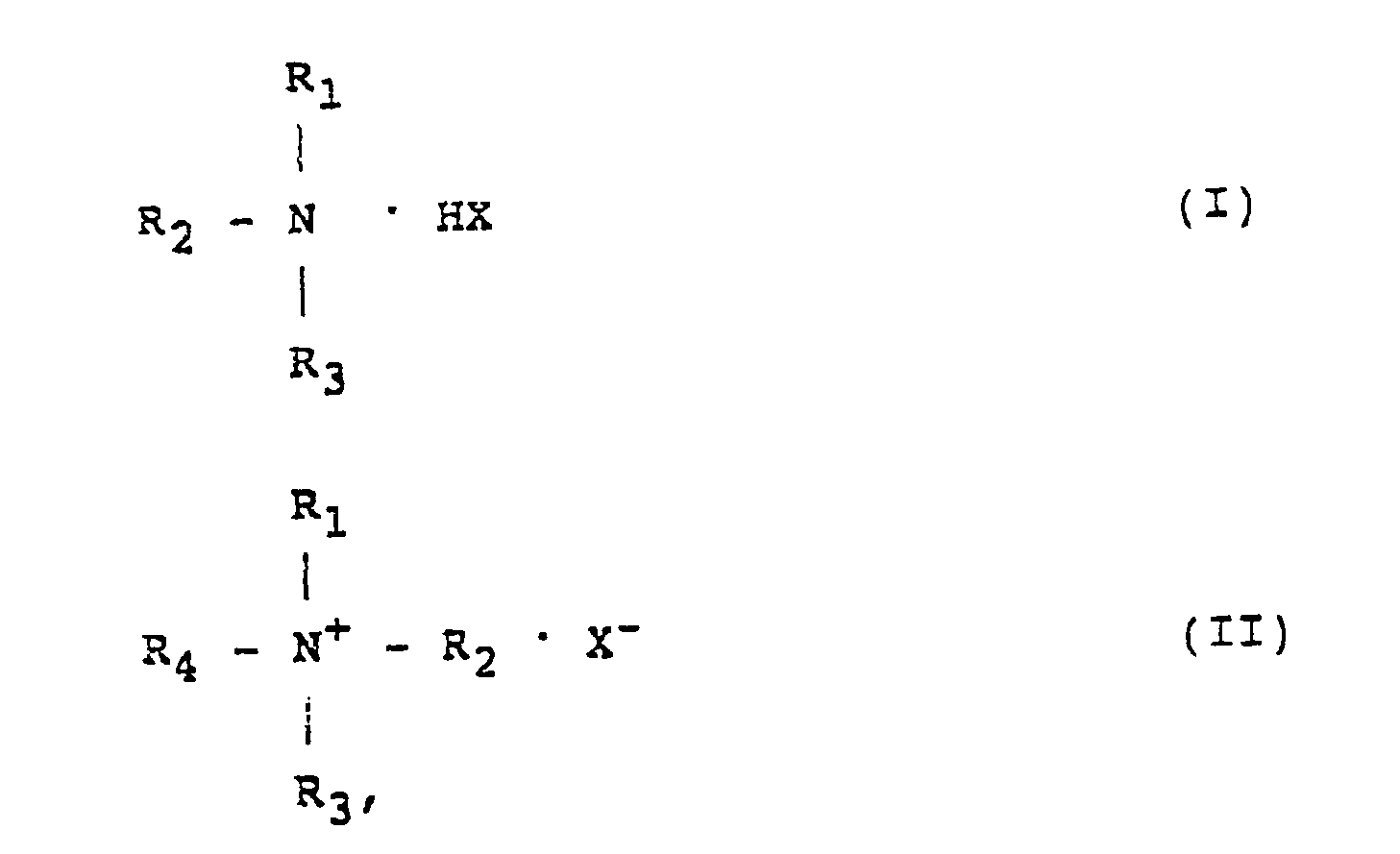

- Verfahren nach Anspruch 34, bei dem die starke Säure aus der Gruppe bestehend aus einer aromatischen Sulfonsäure, einer aliphatischen Sulfonsäure, einer cycloaliphatischen Sulfonsäure, Trifluoressigsäure, Salpetersäure, Salzsäure und Schwefelsäure ausgewählt ist,
- Verfahren nach Anspruch 28, bei dem das monomere Aminsalz ein wasserlösliches Salz einer starken Säure und eines tertiären Amins ausgewählt aus mindestens einem Element der Gruppe bestehend aus einem Trialkylamin, einem N-alkylcycloaliphatischen Amin, einem N,N-Dialkylamin, N,N-Dialkylethanolamin und einem bicyclischen tertiären Amin, oder einem guartären Amin ausgewählt aus mindestens einem Element der Gruppe bestehend aus einem Tetraalkylammoniumhydroxid und einem Benzyltrialkylammoniumhydroxid, und Mischungen davon, ist.
- Verfahren nach Anspruch 36, bei dem das monomere Aminsalz ein wasserlösliches Salz einer starken Säure und Triethylamin ist.
- Verfahren nach Anspruch 28, bei dem der gegenüber Amin reaktionsfähige Reaktant mindestens ein Element ausgewählt aus der Gruppe bestehend aus Isophthaloylhalogenid, Trimesoylhalogenid und Terephthaloylhalogenid ist.
- Verfahren nach Anspruch 28, bei dem die funktionellen Amingruppen funktionelle primäre Amingruppen sind.
- Verfahren nach Anspruch 28, bei dem der Polyaminreaktant mindestens ein Element ausgewählt aus der Gruppe bestehend aus einem aromatischen primären Diamin und substituierten Derivaten davon, einem cycloaliphatischen primären Diamin, einem cycloaliphatischen sekundären Diamin, einem aromatischen sekundären Diamin und Xylylendiamin ist.
- Verfahren nach Anspruch 29, bei dem die wässrige Lösung einen pH-Wert von etwa 5,5 bis 9 hat.
- Verfahren nach Anspruch 41, bei dem die wässrige Lösung einen pH-Wert von etwa 7 bis 8 hat.
- Verfahren nach Anspruch 30, bei dem die erste wässrige Lösung einen pH-wert von etwa 5,5 bis 9 hat.
- Verfahren nach Anspruch 43, bei dem die zweite wässrige Lösung einen pH-Wert von etwa 7 bis 8 hat.
- Verfahren nach Anspruch 30, bei dem die zweite wässrige Lösung einen pH-wert von etwa 5 bis 10 hat.
- Verfahren nach Anspruch 45, bei dem die zweite wässrige Lösung einen pH-Wert von etwa 7 bis 9 hat.
- Verfahren nach Anspruch 30, bei dem die erste wässrige Lösung etwa 0,25 bis 10,0 Gew.-% des monomeren Aminsalzes enthält.
- Verfahren nach Anspruch 47, bei dem die erste wässrige Lösung etwa 1,0 bis 8,0 Gew.-% des monomeren Aminsalzes enthält.
- Verfahren nach Anspruch 28, bei dem das Molverhältnis des monomeren Aminsalzes zu dem Polyaminreaktant etwa 0,1 bis 4,0 beträgt.
- Verfahren nach Anspruch 49, bei dem das Molverhältnis des monomeren Aminsalzes zu dem Polyaminreaktant etwa 0,6 bis 1,4 beträgt.
- Verfahren nach Anspruch 29 oder 30, bei dem die Konzentration des gegenüber bin reaktionsfähigen Reaktanten in der Lösung aus organischem Lösungsmittel etwa 0,05 bis 5 Gew./Vol.-% beträgt.
- Verfahren nach Anspruch 51, bei dem die Konzentration des gegenüber Amin reaktionsfähigen Reaktanten in der Lösung aus organischem Lösungsmittel etwa 0,1 bis 0,5 Gew./Vol.-% beträgt.
- Verfahren nach Anspruch 28, bei dem ein etwa 5- bis 50-facher molarer Überschuß des Polyaminreaktanten zu dem gegenüber Amin reaktionsfähigen Reaktanten eingesetzt wird.
- Verfahren nach Anspruch 53, bei dem ein etwa 10- bis 30-facher molarer Überschuß des Polyaminreaktanten zu dem gegenüber Amin reaktionsfähigen Reaktanten eingesetzt wird.
Applications Claiming Priority (2)
| Application Number | Priority Date | Filing Date | Title |
|---|---|---|---|
| US07/250,190 US4872984A (en) | 1988-09-28 | 1988-09-28 | Interfacially synthesized reverse osmosis membrane containing an amine salt and processes for preparing the same |
| US250190 | 1988-09-28 |
Publications (3)
| Publication Number | Publication Date |
|---|---|
| EP0361092A2 EP0361092A2 (de) | 1990-04-04 |
| EP0361092A3 EP0361092A3 (de) | 1991-07-24 |
| EP0361092B1 true EP0361092B1 (de) | 1993-10-20 |
Family
ID=22946674
Family Applications (1)
| Application Number | Title | Priority Date | Filing Date |
|---|---|---|---|
| EP89115704A Expired - Lifetime EP0361092B1 (de) | 1988-09-28 | 1989-08-25 | Aminhaltige, grenzflächensynthetisierte Umkehrosmose-Membran und Verfahren zu ihrer Herstellung |
Country Status (8)
| Country | Link |
|---|---|
| US (1) | US4872984A (de) |
| EP (1) | EP0361092B1 (de) |
| JP (1) | JPH0673617B2 (de) |
| KR (1) | KR0142678B1 (de) |
| AU (1) | AU613781B2 (de) |
| CA (1) | CA1338335C (de) |
| DE (1) | DE68910067T2 (de) |
| DK (1) | DK169097B1 (de) |
Families Citing this family (118)
| Publication number | Priority date | Publication date | Assignee | Title |
|---|---|---|---|---|
| US4948507A (en) * | 1988-09-28 | 1990-08-14 | Hydranautics Corporation | Interfacially synthesized reverse osmosis membrane containing an amine salt and processes for preparing the same |
| US5015380A (en) * | 1989-04-20 | 1991-05-14 | E. I. Du Pont De Nemours And Company | Microporous support layer with interfacially polymerized copolyamide membrane thereon |
| JP3031763B2 (ja) * | 1990-09-14 | 2000-04-10 | 日東電工株式会社 | 複合逆浸透膜およびその製造方法 |
| US5254261A (en) * | 1991-08-12 | 1993-10-19 | Hydranautics | Interfacially synthesized reverse osmosis membranes and processes for preparing the same |
| US5158683A (en) * | 1991-09-03 | 1992-10-27 | Ethyl Corporation | Bromide separation and concentration using semipermeable membranes |
| US5246587A (en) * | 1991-12-23 | 1993-09-21 | Hydranautics | Interfacially synthesized reverse osmosis membranes and processes for preparing the same |
| CA2087421A1 (en) * | 1992-01-22 | 1993-07-23 | Hisao Hachisuka | Composite reverse osmosis membrane and novel acid chloride |
| US5234598A (en) * | 1992-05-13 | 1993-08-10 | Allied-Signal Inc. | Thin-film composite membrane |
| ES2050606B1 (es) * | 1992-09-02 | 1994-12-01 | Toray Industries | Un procedimiento para la produccion de una membrana semipermeable. |
| JP3006976B2 (ja) * | 1993-06-24 | 2000-02-07 | 日東電工株式会社 | 高透過性複合逆浸透膜の製造方法 |
| JPH07178327A (ja) * | 1993-11-12 | 1995-07-18 | Nitto Denko Corp | 複合半透膜及びその製造方法 |
| US5693227A (en) * | 1994-11-17 | 1997-12-02 | Ionics, Incorporated | Catalyst mediated method of interfacial polymerization on a microporous support, and polymers, fibers, films and membranes made by such method |
| US5614099A (en) * | 1994-12-22 | 1997-03-25 | Nitto Denko Corporation | Highly permeable composite reverse osmosis membrane, method of producing the same, and method of using the same |
| JP3489922B2 (ja) | 1994-12-22 | 2004-01-26 | 日東電工株式会社 | 高透過性複合逆浸透膜の製造方法 |
| US5989426A (en) * | 1995-07-05 | 1999-11-23 | Nitto Denko Corp. | Osmosis membrane |
| US6171497B1 (en) | 1996-01-24 | 2001-01-09 | Nitto Denko Corporation | Highly permeable composite reverse osmosis membrane |
| CN1213985A (zh) | 1996-03-18 | 1999-04-14 | 日东电工株式会社 | 反渗透复合膜以及用它进行反渗透处理水的方法 |
| JP3681214B2 (ja) * | 1996-03-21 | 2005-08-10 | 日東電工株式会社 | 高透過性複合逆浸透膜 |
| US5658460A (en) * | 1996-05-07 | 1997-08-19 | The Dow Chemical Company | Use of inorganic ammonium cation salts to maintain the flux and salt rejection characteristics of reverse osmosis and nanofiltration membranes during drying |
| US6026968A (en) * | 1996-05-13 | 2000-02-22 | Nitto Denko Corporation | Reverse osmosis composite membrane |
| US6413425B1 (en) | 1997-04-10 | 2002-07-02 | Nitto Denko Corporation | Reverse osmosis composite membrane and reverse osmosis treatment method for water using the same |
| KR100618550B1 (ko) * | 1997-07-02 | 2006-08-31 | 닛토덴코 가부시키가이샤 | 복합 역침투막 및 그 제조방법 |
| KR100506537B1 (ko) * | 1997-08-28 | 2005-11-08 | 주식회사 새 한 | 가교 폴리아미드계 역삼투 분리막의 제조방법 |
| US5922203A (en) * | 1997-10-07 | 1999-07-13 | Hydranautics | Amine monomers and their use in preparing interfacially synthesized membranes for reverse osmosis and nanofiltration |
| US6015495A (en) * | 1998-02-18 | 2000-01-18 | Saehan Industries Incorporation | Composite polyamide reverse osmosis membrane and method of producing the same |
| US6063278A (en) * | 1998-04-28 | 2000-05-16 | Saehan Industries Inc. | Composite polyamide reverse osmosis membrane and method of producing the same |
| US6162358A (en) * | 1998-06-05 | 2000-12-19 | Nl Chemicals Technologies, Inc. | High flux reverse osmosis membrane |
| US6368507B1 (en) | 1998-10-14 | 2002-04-09 | Saekan Industries Incorporation | Composite polyamide reverse osmosis membrane and method of producing the same |
| KR100477589B1 (ko) * | 1998-11-09 | 2005-07-08 | 주식회사 새 한 | 폴리아미드 역삼투 복합막의 제조방법 |
| KR20000051527A (ko) * | 1999-01-22 | 2000-08-16 | 한형수 | 고유량 반투과 역삼투막의 제조방법 |
| US6245234B1 (en) | 1999-06-03 | 2001-06-12 | Saehan Industries Incorporation | Composite polyamide reverse osmosis membrane and method of producing the same |
| US6464873B1 (en) * | 1999-06-15 | 2002-10-15 | Hydranautics | Interfacially polymerized, bipiperidine-polyamide membranes for reverse osmosis and/or nanofiltration and process for making the same |
| DE19934737C2 (de) * | 1999-07-23 | 2001-11-29 | Saehan Ind Inc | Polyamid-Umkehrosmosemembran |
| DE19934734C2 (de) * | 1999-07-23 | 2002-03-07 | Saehan Ind Inc | Polyamid-Umkehrosmosemembran |
| GB2352719B (en) * | 1999-08-03 | 2003-05-28 | Saehan Ind Inc | Composite polyamide reverse osmosis membrane and method of producing the same |
| KR100506538B1 (ko) * | 1999-08-17 | 2005-08-05 | 주식회사 새 한 | 폴리아마이드 역삼투 복합막 및 이의 제조방법 |
| CN1114472C (zh) * | 1999-12-28 | 2003-07-16 | 世韩工业株式会社 | 聚酰胺反渗透复合膜的制造方法 |
| CN1110355C (zh) * | 1999-12-28 | 2003-06-04 | 世韩工业株式会社 | 聚酰胺反渗透复合膜的制造方法 |
| JP4289757B2 (ja) | 2000-03-23 | 2009-07-01 | 日東電工株式会社 | 複合逆浸透膜の製造方法 |
| US6837996B2 (en) * | 2000-05-23 | 2005-01-04 | Ge Osmonics, Inc. | Polysulfonamide matrices |
| US6783711B2 (en) * | 2000-05-23 | 2004-08-31 | Ge Osmonics, Inc. | Process for preparing a sulfonamide polymer matrix |
| RU2002134476A (ru) * | 2000-05-23 | 2004-04-10 | Осмоникс, Инк. (Us) | Кислостойкие мембраны для нанофильтрации |
| EP1301559B1 (de) * | 2000-05-23 | 2008-01-23 | GE Osmonics, Inc. | Modifizierte sulfonamidpolymere |
| US7001518B1 (en) | 2000-11-28 | 2006-02-21 | Hydranautics | Low pressure reverse osmosis and nanofiltration membranes and method for the production thereof |
| KR100477591B1 (ko) * | 2001-01-17 | 2005-03-18 | 주식회사 새 한 | 폴리아마이드 역삼투 복합막 및 그 제조방법 |
| KR100477592B1 (ko) * | 2001-02-07 | 2005-03-18 | 주식회사 새 한 | 폴리아마이드 역삼투 복합막 및 그 제조방법 |
| US6805796B2 (en) | 2001-02-13 | 2004-10-19 | Nitto Denko Corporation | Water treatment apparatus |
| US7081202B2 (en) | 2001-03-19 | 2006-07-25 | Nitto Denko Corporation | Composite semipermeable membrane, production method thereof, and water treatment method using the same |
| EP2014350A3 (de) | 2001-03-19 | 2009-07-22 | Nitto Denko Corporation | Wasserbehandlungsverfahren |
| JP2003088730A (ja) | 2001-09-20 | 2003-03-25 | Nitto Denko Corp | 逆浸透膜エレメントの処理方法、および逆浸透膜モジュール |
| DE10228148B4 (de) * | 2002-06-24 | 2006-08-24 | Saehan Industries Inc. | Selektive Membran mit hoher Fouling-Beständigkeit |
| JP4500002B2 (ja) | 2003-05-06 | 2010-07-14 | 日東電工株式会社 | 複合半透膜及びその製造方法 |
| US7279097B2 (en) | 2003-06-18 | 2007-10-09 | Toray Industries, Inc. | Composite semipermeable membrane, and production process thereof |
| US7490725B2 (en) * | 2003-10-09 | 2009-02-17 | Membrane Technology & Research | Reverse osmosis membrane and process |
| JP4484635B2 (ja) * | 2004-09-02 | 2010-06-16 | 日東電工株式会社 | スパイラル型逆浸透膜エレメント、およびその製造方法 |
| JP4656502B2 (ja) * | 2004-10-01 | 2011-03-23 | 日東電工株式会社 | 複合半透膜及びその製造方法 |
| JP2006102594A (ja) * | 2004-10-01 | 2006-04-20 | Nitto Denko Corp | 複合半透膜の製造方法 |
| JP4656503B2 (ja) * | 2004-10-01 | 2011-03-23 | 日東電工株式会社 | 複合半透膜及びその製造方法 |
| JP4656511B2 (ja) * | 2004-10-04 | 2011-03-23 | 日東電工株式会社 | 複合逆浸透膜の製造方法 |
| KR20080003789A (ko) * | 2005-03-09 | 2008-01-08 | 더 리전츠 오브 더 유니버시티 오브 캘리포니아 | 나노복합체막 및 이의 제조 및 사용 방법 |
| US7479300B2 (en) * | 2005-03-30 | 2009-01-20 | Woongjin Chemical Co., Ltd. | Composite polyamide reverse osmosis membrane and method of producing the same |
| KR100680109B1 (ko) * | 2005-07-27 | 2007-02-07 | 웅진코웨이주식회사 | 폴리아미드 역삼투 복합막 및 그 제조방법 |
| US7537697B2 (en) * | 2006-02-01 | 2009-05-26 | Woongjin Chemical Co., Ltd. | Selective membrane having a high fouling resistance |
| US7913857B2 (en) * | 2006-02-01 | 2011-03-29 | Woongjin Chemical Co., Ltd. | Selective membrane having a high fouling resistance |
| US20070227966A1 (en) | 2006-03-31 | 2007-10-04 | Koo Ja-Young | Composite polyamide reverse osmosis membrane showing high boron rejection and method of producing the same |
| WO2007133362A1 (en) * | 2006-05-12 | 2007-11-22 | Dow Global Technologies Inc. | Modified membrane |
| KR100905901B1 (ko) * | 2006-09-07 | 2009-07-02 | 웅진코웨이주식회사 | 폴리아미드 역삼투 복합막 활성층 형성용 아민 수용액,이를 이용한 폴리아미드 역삼투 복합막, 및 이의 제조방법 |
| JP2008093544A (ja) * | 2006-10-10 | 2008-04-24 | Nitto Denko Corp | 複合半透膜及びその製造方法 |
| JP4936438B2 (ja) * | 2006-10-10 | 2012-05-23 | 日東電工株式会社 | 乾燥複合半透膜の製造方法 |
| AU2007317516B2 (en) * | 2006-10-27 | 2013-04-04 | The Regents Of The University Of California | Micro-and nanocomposite support structures for reverse osmosis thin film membranes |
| US8196754B2 (en) * | 2007-01-17 | 2012-06-12 | The Ohio States University Research Foundation | Water permeable membranes and methods of making water permeable membranes |
| KR100868028B1 (ko) * | 2007-02-23 | 2008-11-10 | 웅진케미칼 주식회사 | 내염소성 폴리아미드 복합막 및 그 제조방법 |
| JP2008246419A (ja) * | 2007-03-30 | 2008-10-16 | Nitto Denko Corp | 複合半透膜の製造方法 |
| CA2700333A1 (en) * | 2007-09-21 | 2009-03-26 | The Regents Of The University Of California | Nanocomposite membranes and methods of making and using same |
| DE102007060525A1 (de) * | 2007-12-13 | 2009-06-18 | Aksys Gmbh | Schalldämpfungs-Luftführungskanal und Verfahren zur Herstellung eines Schalldämpfungs-Luftführungskanals |
| US20090188861A1 (en) * | 2007-12-13 | 2009-07-30 | Stc. Unm | Preventing and cleaning fouling on reverse osmosis membranes |
| US8177978B2 (en) * | 2008-04-15 | 2012-05-15 | Nanoh20, Inc. | Reverse osmosis membranes |
| KR20100003799A (ko) | 2008-07-02 | 2010-01-12 | 웅진케미칼 주식회사 | 높은 안티파울링성을 가지는 선택적 분리막 및 그의제조방법 |
| US8147735B2 (en) * | 2008-07-09 | 2012-04-03 | Eltron Research & Development, Inc. | Semipermeable polymers and method for producing same |
| US9504966B2 (en) * | 2008-09-26 | 2016-11-29 | Nitto Denko Corporation | Composite semi-permeable membrane and method for producing same |
| JP5925409B2 (ja) * | 2008-10-23 | 2016-05-25 | 日東電工株式会社 | 熱硬化性樹脂多孔シートの製造方法、熱硬化性樹脂多孔シート、及びそれを用いた複合半透膜 |
| US7815987B2 (en) * | 2008-12-04 | 2010-10-19 | Dow Global Technologies Inc. | Polyamide membrane with coating of polyalkylene oxide and polyacrylamide compounds |
| JP5745512B2 (ja) | 2009-06-29 | 2015-07-08 | ナノエイチツーオー・インコーポレーテッド | 窒素添加剤を含む改良された混成tfcro膜 |
| JP5633517B2 (ja) * | 2009-09-29 | 2014-12-03 | 栗田工業株式会社 | 透過膜の阻止率向上方法及び透過膜 |
| CN102791365B (zh) * | 2010-03-10 | 2014-12-24 | 陶氏环球技术有限责任公司 | 具有包含聚环氧烷和苯乙酮化合物的涂层的聚酰胺膜 |
| WO2011136865A1 (en) | 2010-04-26 | 2011-11-03 | Dow Global Technologies Llc | Polyamide membrane with a coating comprising polyalkylene oxide and triazine compounds |
| WO2011149571A1 (en) | 2010-05-24 | 2011-12-01 | Dow Global Technologies Llc | Polyamide membrane with coating comprising polyalkylene oxide and biguanide compounds |
| US8646616B2 (en) | 2010-05-24 | 2014-02-11 | Dow Global Technologies Llc | Composite membrane with coating comprising polyalkylene oxide and imidazol compounds |
| US8757396B2 (en) | 2010-05-24 | 2014-06-24 | Dow Global Technologies Llc | Composite membrane with coating comprising polyalkylene oxide and oxy-substituted phenyl compounds |
| PL2615665T3 (pl) * | 2010-09-06 | 2019-09-30 | Lg Chem, Ltd. | Separator, sposób jego wytwarzania i zawierające go urządzenie elektrochemiczne |
| JP5968328B2 (ja) | 2010-11-10 | 2016-08-10 | ナノエイチツーオー・インコーポレーテッド | 非金属添加剤を含む改良された混成tfcro膜 |
| JP2012121943A (ja) | 2010-12-06 | 2012-06-28 | Nitto Denko Corp | エポキシ樹脂多孔シートの製造方法 |
| EP2659956A4 (de) | 2010-12-28 | 2017-04-12 | Toray Industries, Inc. | Halbdurchlässige verbundmembran |
| US8820540B2 (en) | 2011-01-28 | 2014-09-02 | Woongjin Chemical Co., Ltd. | Method for preparing a filtration membrane and filtration membrane prepared by said method |
| KR101240956B1 (ko) | 2011-02-18 | 2013-03-11 | 웅진케미칼 주식회사 | 내오염성능이 우수한 역삼투 복합막 및 그의 제조방법 |
| WO2014014669A1 (en) | 2012-07-19 | 2014-01-23 | Dow Global Technologies Llc | Composite polyamide membrane with improved structure |
| US9211507B2 (en) * | 2012-11-21 | 2015-12-15 | Lg Chem, Ltd. | Water-treatment separating membrane of high flux having good chlorine resistance and method of manufacturing the same |
| WO2014109946A1 (en) | 2013-01-14 | 2014-07-17 | Dow Global Technologies Llc | Composite polyamide membrane |
| US9895666B2 (en) | 2013-01-14 | 2018-02-20 | Dow Global Technologies Llc | Composite polyamide membrane made using substituted benzamide monomer |
| US9289729B2 (en) | 2013-03-16 | 2016-03-22 | Dow Global Technologies Llc | Composite polyamide membrane derived from carboxylic acid containing acyl halide monomer |
| WO2014179024A1 (en) * | 2013-05-03 | 2014-11-06 | Dow Global Technologies Llc | Composite polyamide membrane derived from an aliphatic acyclic tertiary amine compound |
| JP6577468B2 (ja) | 2013-12-02 | 2019-09-18 | ダウ グローバル テクノロジーズ エルエルシー | 亜硝酸で後処理される複合ポリアミド膜 |
| CN106170333B (zh) | 2013-12-02 | 2019-02-15 | 陶氏环球技术有限责任公司 | 用二羟基芳基化合物和亚硝酸处理的复合聚酰胺膜 |
| JP6535010B2 (ja) | 2014-01-09 | 2019-06-26 | ダウ グローバル テクノロジーズ エルエルシー | 好ましいアゾ含有量を有する複合ポリアミド皮膜 |
| EP3092061B1 (de) | 2014-01-09 | 2020-02-05 | Dow Global Technologies LLC | Polyamidverbundmembran mit hohem säuregehalt und niedrigem azogehalt |
| US9981227B2 (en) | 2014-01-09 | 2018-05-29 | Dow Global Technologies Llc | Composite polyamide membrane having azo content and high acid content |
| US9776141B2 (en) | 2014-04-28 | 2017-10-03 | Dow Global Technologies Llc | Composite polyamide membrane post-treated with nitrous acid |
| KR102359211B1 (ko) | 2014-05-14 | 2022-02-07 | 다우 글로벌 테크놀로지스 엘엘씨 | 아질산으로 후처리된 복합 폴리아미드 막 |
| CN106385798B (zh) | 2014-05-23 | 2019-10-11 | 朗盛德国有限责任公司 | 用于生产具有<1000g/mol的平均分子量截留值的滤膜的方法 |
| US9795928B2 (en) | 2014-06-24 | 2017-10-24 | Nano And Advanced Materials Institute Limited | Stepwise interfacial polymerization technique with different reagent solution designs to prepare hollow fiber nanofiltration membrane composites |
| US9861940B2 (en) | 2015-08-31 | 2018-01-09 | Lg Baboh2O, Inc. | Additives for salt rejection enhancement of a membrane |
| US9737859B2 (en) | 2016-01-11 | 2017-08-22 | Lg Nanoh2O, Inc. | Process for improved water flux through a TFC membrane |
| US10155203B2 (en) | 2016-03-03 | 2018-12-18 | Lg Nanoh2O, Inc. | Methods of enhancing water flux of a TFC membrane using oxidizing and reducing agents |
| KR102089123B1 (ko) * | 2016-11-04 | 2020-03-13 | 주식회사 엘지화학 | 수처리 분리막의 제조방법 및 이에 의하여 제조된 수처리 분리막 및 수처리 분리막을 포함하는 수처리 모듈 |
| CN108079806B (zh) | 2018-02-07 | 2020-09-08 | 浙江大学 | 一种聚酰胺半透膜、制备方法及其应用 |
| EP3778711A1 (de) * | 2019-08-13 | 2021-02-17 | Technische Universität Dresden | Verfahren zur synthese eines zwei- oder quasi-zweidimensionalen polymerfilms, zwei- oder quasi-zweidimensionaler polymerfilm und verwendung |
| KR20230116012A (ko) | 2020-11-30 | 2023-08-03 | 멤스타 유에스에이 아이엔씨. | 역삼투막 및 이의 제조방법 |
| CN119488812A (zh) * | 2023-08-18 | 2025-02-21 | 中国石油化工股份有限公司 | 荷正电耐酸复合膜及其制备方法与应用 |
Family Cites Families (6)
| Publication number | Priority date | Publication date | Assignee | Title |
|---|---|---|---|---|
| US4259183A (en) * | 1978-11-07 | 1981-03-31 | Midwest Research Institute | Reverse osmosis membrane |
| US4277344A (en) * | 1979-02-22 | 1981-07-07 | Filmtec Corporation | Interfacially synthesized reverse osmosis membrane |
| EP0179474A3 (de) * | 1984-10-24 | 1988-07-13 | E.I. Du Pont De Nemours And Company | Membran für Gastrennung und Verfahren zu ihrer Herstellung |
| US4761234A (en) * | 1985-08-05 | 1988-08-02 | Toray Industries, Inc. | Interfacially synthesized reverse osmosis membrane |
| US4812238A (en) * | 1987-01-15 | 1989-03-14 | The Dow Chemical Company | Membranes prepared via reaction of diazonium compounds or precursors |
| US4769148A (en) * | 1987-11-18 | 1988-09-06 | The Dow Chemical Company | Novel polyamide reverse osmosis membranes |
-
1988
- 1988-09-28 US US07/250,190 patent/US4872984A/en not_active Expired - Lifetime
-
1989
- 1989-08-10 AU AU39483/89A patent/AU613781B2/en not_active Ceased
- 1989-08-14 CA CA000608266A patent/CA1338335C/en not_active Expired - Fee Related
- 1989-08-25 EP EP89115704A patent/EP0361092B1/de not_active Expired - Lifetime
- 1989-08-25 DE DE89115704T patent/DE68910067T2/de not_active Expired - Fee Related
- 1989-08-28 KR KR1019890012270A patent/KR0142678B1/ko not_active Expired - Fee Related
- 1989-08-31 DK DK430089A patent/DK169097B1/da not_active IP Right Cessation
- 1989-09-26 JP JP1248214A patent/JPH0673617B2/ja not_active Expired - Lifetime
Also Published As
| Publication number | Publication date |
|---|---|
| CA1338335C (en) | 1996-05-21 |
| KR0142678B1 (ko) | 1998-07-15 |
| EP0361092A3 (de) | 1991-07-24 |
| DK169097B1 (da) | 1994-08-15 |
| DE68910067D1 (de) | 1993-11-25 |
| KR900004811A (ko) | 1990-04-13 |
| DK430089A (da) | 1990-03-29 |
| JPH02187135A (ja) | 1990-07-23 |
| AU3948389A (en) | 1990-04-05 |
| AU613781B2 (en) | 1991-08-08 |
| US4872984A (en) | 1989-10-10 |
| EP0361092A2 (de) | 1990-04-04 |
| DE68910067T2 (de) | 1994-02-10 |
| DK430089D0 (da) | 1989-08-31 |
| JPH0673617B2 (ja) | 1994-09-21 |
Similar Documents
| Publication | Publication Date | Title |
|---|---|---|
| US4872984A (en) | Interfacially synthesized reverse osmosis membrane containing an amine salt and processes for preparing the same | |
| US4948507A (en) | Interfacially synthesized reverse osmosis membrane containing an amine salt and processes for preparing the same | |
| US5246587A (en) | Interfacially synthesized reverse osmosis membranes and processes for preparing the same | |
| EP1060785B1 (de) | Über Grenzflächenpolymerisation erhaltene Bipiperidin-Polyamid-Membranen für Umkehrosmose und/oder Nanofiltration und Verfahren zu ihrer Herstellung | |
| EP0527348B1 (de) | Grenzflächensynthetisierte Umkehrosmosemembrane und Verfahren zu ihrer Herstellung | |
| US5160619A (en) | Composite reverse osmosis membrane and production thereof | |
| JP3006976B2 (ja) | 高透過性複合逆浸透膜の製造方法 | |
| US6833073B2 (en) | Composite nanofiltration and reverse osmosis membranes and method for producing the same | |
| EP1926544B1 (de) | Herstellungsverfahren für eine polyamiddünnfilm-kompositmembran für umkehrosmose und damit hergestellte polyamiddünnfilm-kompositmembran | |
| US5658460A (en) | Use of inorganic ammonium cation salts to maintain the flux and salt rejection characteristics of reverse osmosis and nanofiltration membranes during drying | |
| DE69530468T2 (de) | Verfahren zur Herstellung einer hochdurchlässigen zusammengesetzten Umkehrosmosemembran | |
| KR20010013740A (ko) | 복합 역침투막 및 그 제조방법 | |
| CA2014802A1 (en) | Microporous support layer with interfacially polymerized copolyamide membrane thereon | |
| EP1894614A1 (de) | Oxidationsresistente Kompositmembran für Umkehrosmose | |
| EP1500425B1 (de) | Semipermeable Verbundmembran und Verfahren zu ihrer Herstellung | |
| EP1806174B1 (de) | Verfahren zur herstellung einer semipermeablen verbundmembran | |
| EP1825905A1 (de) | Halbdurchlässige verbundmembran und verfahren zur herstellung derselben | |
| EP0311912B1 (de) | Verbundmembran mit einem Überzug aus Poly-Meta-Phenylen Tetrahydrofuran-2,3,4,5-Tetracarboxylamid zur Umkehrosmose | |
| US7708150B2 (en) | Process for preparing semipermeable membranes | |
| JPH05146654A (ja) | 複合逆浸透膜 | |
| EP1230971B1 (de) | Zusammengesetzte Polyamid-Umkehrosmosemembran und Verfahren zu ihrer Herstellung | |
| JP3849263B2 (ja) | 複合半透膜及びその製造方法 | |
| JP3071919B2 (ja) | 複合逆浸透膜 | |
| JPH0910566A (ja) | 半透性複合膜 | |
| JPS59173186A (ja) | 選択的分離方法 |
Legal Events
| Date | Code | Title | Description |
|---|---|---|---|
| PUAI | Public reference made under article 153(3) epc to a published international application that has entered the european phase |
Free format text: ORIGINAL CODE: 0009012 |
|
| AK | Designated contracting states |
Kind code of ref document: A2 Designated state(s): DE FR GB IT |
|
| PUAL | Search report despatched |
Free format text: ORIGINAL CODE: 0009013 |
|
| RHK1 | Main classification (correction) |
Ipc: B01D 69/12 |
|
| AK | Designated contracting states |
Kind code of ref document: A3 Designated state(s): DE FR GB IT |
|
| 17P | Request for examination filed |
Effective date: 19920113 |
|
| 17Q | First examination report despatched |
Effective date: 19921012 |
|
| GRAA | (expected) grant |
Free format text: ORIGINAL CODE: 0009210 |
|
| AK | Designated contracting states |
Kind code of ref document: B1 Designated state(s): DE FR GB IT |
|
| ITF | It: translation for a ep patent filed | ||
| REF | Corresponds to: |
Ref document number: 68910067 Country of ref document: DE Date of ref document: 19931125 |
|
| ET | Fr: translation filed | ||
| PLBE | No opposition filed within time limit |
Free format text: ORIGINAL CODE: 0009261 |
|
| STAA | Information on the status of an ep patent application or granted ep patent |
Free format text: STATUS: NO OPPOSITION FILED WITHIN TIME LIMIT |
|
| 26N | No opposition filed | ||
| REG | Reference to a national code |
Ref country code: GB Ref legal event code: IF02 |
|
| PGFP | Annual fee paid to national office [announced via postgrant information from national office to epo] |
Ref country code: DE Payment date: 20040902 Year of fee payment: 16 |
|
| PG25 | Lapsed in a contracting state [announced via postgrant information from national office to epo] |
Ref country code: IT Free format text: LAPSE BECAUSE OF NON-PAYMENT OF DUE FEES;WARNING: LAPSES OF ITALIAN PATENTS WITH EFFECTIVE DATE BEFORE 2007 MAY HAVE OCCURRED AT ANY TIME BEFORE 2007. THE CORRECT EFFECTIVE DATE MAY BE DIFFERENT FROM THE ONE RECORDED. Effective date: 20050825 |
|
| PG25 | Lapsed in a contracting state [announced via postgrant information from national office to epo] |
Ref country code: DE Free format text: LAPSE BECAUSE OF NON-PAYMENT OF DUE FEES Effective date: 20060301 |
|
| PGFP | Annual fee paid to national office [announced via postgrant information from national office to epo] |
Ref country code: FR Payment date: 20060808 Year of fee payment: 18 |
|
| PGFP | Annual fee paid to national office [announced via postgrant information from national office to epo] |
Ref country code: GB Payment date: 20060823 Year of fee payment: 18 |
|
| GBPC | Gb: european patent ceased through non-payment of renewal fee |
Effective date: 20070825 |
|
| REG | Reference to a national code |
Ref country code: FR Ref legal event code: ST Effective date: 20080430 |
|
| PG25 | Lapsed in a contracting state [announced via postgrant information from national office to epo] |
Ref country code: FR Free format text: LAPSE BECAUSE OF NON-PAYMENT OF DUE FEES Effective date: 20070831 |
|
| PG25 | Lapsed in a contracting state [announced via postgrant information from national office to epo] |
Ref country code: GB Free format text: LAPSE BECAUSE OF NON-PAYMENT OF DUE FEES Effective date: 20070825 |