EP0361750A2 - Kapillares elektrophoretisches System - Google Patents
Kapillares elektrophoretisches System Download PDFInfo
- Publication number
- EP0361750A2 EP0361750A2 EP89309467A EP89309467A EP0361750A2 EP 0361750 A2 EP0361750 A2 EP 0361750A2 EP 89309467 A EP89309467 A EP 89309467A EP 89309467 A EP89309467 A EP 89309467A EP 0361750 A2 EP0361750 A2 EP 0361750A2
- Authority
- EP
- European Patent Office
- Prior art keywords
- tube
- sample
- substance
- electrolyte
- detector
- Prior art date
- Legal status (The legal status is an assumption and is not a legal conclusion. Google has not performed a legal analysis and makes no representation as to the accuracy of the status listed.)
- Withdrawn
Links
Images

Classifications
-
- G—PHYSICS
- G01—MEASURING; TESTING
- G01N—INVESTIGATING OR ANALYSING MATERIALS BY DETERMINING THEIR CHEMICAL OR PHYSICAL PROPERTIES
- G01N27/00—Investigating or analysing materials by the use of electric, electrochemical, or magnetic means
- G01N27/26—Investigating or analysing materials by the use of electric, electrochemical, or magnetic means by investigating electrochemical variables; by using electrolysis or electrophoresis
- G01N27/416—Systems
- G01N27/447—Systems using electrophoresis
- G01N27/44704—Details; Accessories
- G01N27/44717—Arrangements for investigating the separated zones, e.g. localising zones
-
- G—PHYSICS
- G01—MEASURING; TESTING
- G01N—INVESTIGATING OR ANALYSING MATERIALS BY DETERMINING THEIR CHEMICAL OR PHYSICAL PROPERTIES
- G01N27/00—Investigating or analysing materials by the use of electric, electrochemical, or magnetic means
- G01N27/26—Investigating or analysing materials by the use of electric, electrochemical, or magnetic means by investigating electrochemical variables; by using electrolysis or electrophoresis
- G01N27/416—Systems
- G01N27/447—Systems using electrophoresis
- G01N27/44704—Details; Accessories
- G01N27/44713—Particularly adapted electric power supply
Definitions
- This invention relates in general to capillary electrophoretic systems and in particular to an improved capillary zone electrophoretic system for detection of substances.
- Capillary zone electrophoresis (CZE) in small capillaries has proven useful as an efficient method for the separation of solutes.
- An electric field is applied between the two ends of a capillary tube into which an electrolyte containing the solutes is introduced. The electric field causes the electrolyte to flow through the tube.
- Some solutes will have higher electrokinetic mobilities than other solutes so that the sample components are resolved into zones in the capillary tube during the flow of the electrolytes through the capillary.
- CZE is advantageous since it requires only very small sample volumes such as the contents of a cell or cellular subcompartments. For these and other reasons, CZE has shown great promise as a separation and detection technique.
- CZE One of the major challenges in CZE is to improve selectivity and sensitivity of detection.
- To improve selectivity of detection it is desirable to employ detectors which respond only to certain sample components but not to others; this permits detection of the origin of certain sample components despite chemical changes and the presence of other components and substances. Since the amounts of materials used in CZE are so minute, detectors used must have high sensitivity.
- One way to increase detection selectivity and detection sensitivity is to use radio-labels. In "Presentations on High Performance Electrophoresis at the 1988 Pittsburgh Conference", LC.GC, Vol. 6, No. 6, pp.
- a radioactive detection technique designed for capillary electrophoresis for detecting pharmaceuticals labelled by a radio-label containing technetium, a gamma emitter with a six hour half life.
- a capillary tube containing the radio-labelled pharmaceutical is passed through a hole drilled in a scintillation crystal. The latter emits light when gamma rays strike it.
- activation of the scintillation crystal oy radiation is permitted from all sides of the capillary.
- One aspect of the invention is directed towards an electrophoretic apparatus for detecting the presence of a substance in a sample introduced into an electrolyte in a capillary tube having two ends.
- the apparatus comprises means for applying a voltage to the capillary tube to move the electrolyte from one end of the tube to the other for separating the sample into its component; and a radioactive material which is attached to or incorporated into the substance.
- the radioactive mater ial emits gamma rays or beta particles with energy high enough to penetrate the medium and the tube.
- the apparatus further comprises a semiconductor detector outside the tube and placed adjacent to the tube for detecting the gamma rays or beta particles emitted by the radioactive material in order to detect the presence of the substance.
- Another aspect of the invention is directed towards an electrophoretic apparatus for detecting the presence of a substance in a sample introduced into an electrolyte in a capillary tube having two ends where the tube contains an electrolyte.
- the apparatus comprises means for applying a voltage to the capillary tube to move the electrolyte from one end of the tube to the other for separating the sample into its components and a radioactive material which is attached to or incorporated in the substance.
- the material emits alpha, beta or gamma particles.
- the apparatus also comprises a scintillating material inside the tube or incorporated as part of the tube which emits electromagnetic radiation in response to alpha, beta or gamma particles; and a photodetector outside the tube for detecting the electromagnetic radiation emitted by the scintillaring material in order to detect the presence of the substance.
- Yet another aspect of the invention is directed towards an electrophoretic apparatus for detecting the presence in the sample introduced into an electrolyte in a capillary tube having two ends.
- the apparatus comprises means for applying a voltage to the capillary tube to move the electrolyte from one end of the tube to the other for separating the sample into its components; and a detector for detecting the presence of the substance.
- the detector provides a signal when said substance is detected by the detector.
- the apparatus also comprises means responsive to the signal for adjusting the voltage applied by the voltage applying means to decrease the speed of movement of the sample in the tube to increase sensitivity of detection.
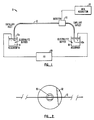
- Fig. 1 is a block diagram of an electrophoretic system 10 to illustrate the invention.
- apparatus 10 includes a capillary tube 12 with an inlet end 12a and an outlet end 12b.
- An electrolyte buffer 14 is supplied to the tube to end 12a from a reservoir 16.
- the electrolyte buffer which exits from outlet end 12b is collected in reservoir 18.
- a high voltage is applied between the two reservoirs, causing the electrolyte to move from reservoir 16 through inlet end 12a, capillary tube 12, and end 12b into reservoir 18.
- the high voltage is applied by a power supply 20.
- a sample is introduced into the inlet end 12a, such as by dipping end 12a for a short time into a sample and applying a voltage across the tube ro move a small portion of the sample into the tube.
- the end 12a is then dipped into reservoir 16, where the portion of the sample is then carried under the influence of the electric field through tube 12 towards end 12b.
- different components of the sample may move with different speeds in tube 12, causing the components to separate along the length of the tube. These components are detected by detector 22 when the components pass the detector. Signals from detector 22 are sent to a data acquisition system 24 for analysis and recording.
- Fig. 2 is a diagram illustrating in more detail one implementation of detector 22 which detects directly the radioactive emission from components in the sample introduced in tube 12 of Fig. 1.
- the detector may comprise a cadmium telluride (CdTe) wafer 50 mounted in an aluminum housing 52.
- CdTe cadmium telluride
- a sample containing a component which has been radio- labeled is injected into end 12a of tube 12.
- the radioactive emission from the component is detected by the CdTe wafer, which generates a signal which is supplied to data acquisition block 24 to indicate the presence of such component.
- a suitable radio-label may include the isotope 32P, or the isotope 125I.
- radioactive elements or substances may be used as long as the radioactive emission from such material is strong enough to penetrate the electrolyte buffer 14 in the tube and the wall of tube 12. Any such radioactive material may be used and are within the scope of the invention. Since the radioactive emission of the radio-label must be capable of penetrating the electrolyte buffer as well as the tube wall, the present state of the technology may limit the radio-labels used to gamma ray emitters and hard beta ray emitters. Semiconductors other than CdTe in the form of wafers or other forms may also be used. Examples are silicon and germanium.
- samples with components which are radio-labelled may be prepared using radio-labeled chemicals as the starting material.
- radio-labeled chemicals are available from, for example, Amersham Corporation in Arlington Heights, Illinois or ICN Biomedicals, Inc. in Costa Mesa, California.
- the detector detects the radioactive emission directly without requiring any scintillation materials.
- the radioactive emission must be strong enough to penetrate the electrolyte buffer as well as the tube wall.
- the radioactive emission from such less energetic radio-labels may be incapable of penetrating the electrolyte or the tube wall.
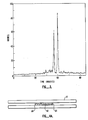
- Fig. 3 is a capillary electropherogram of quanosine 5′[ ⁇ -32P] triphosphate (peak 1) and adenosine 5′[ ⁇ -32P] triphosphate (peak 2), to illustrate the invention.
- the electropherogram of Fig. 3 is obtained using 32P as radiolabel and a CdTe detector described above in reference to Figs. 1 and 2.
- Figs. 4A and 4B show a section of the capillary tube 12 equipped with scintillating material to aid the detection of such weak radio-labels.
- tube 12 contains scintillating beads 62 contained within frits 64 to keep the beads in place in the capillary and to prevent them from being dislodged by the movement of the electrolyte.
- the scintillating beads are placed adjacent to detector 22 in reference ro Fig. 1.
- the radioactive emission from the radio-label causes the beads to fluoresce.
- Such fluorescent light will penetrate tube 12 to be detected by detector 22. Since such light is able to travel to locations away from the tube 12, detector 22 may be placed at locations away from the tube.
- Fig. 4B shows a section of tube 12 where a portion of the tube is made of a scintillating wall material 72. Similar to the embodiment of Fig. 4A, the portion 72 is placed adjacent to derector 22 in reference to Fig. 1 for the detection of the weak radio-label in a similar manner as an embodiment of Fig. 4A.
- Fig. 5 is a diagram of a portion tube 12 connected to a portion of a second tube 90 to permit a flowing stream of scintillating material to be introduced into tube 12 from the second tube 90.
- the scintillating material will then emit light in response to radiation from the radio-label on components of the sample.
- detector 22 detects the presence of components of a sample when such components actually pass the portion of tube 12 next to detector 22.
- the time interval during which a sample or a component of a sample spends in the vicinity of the detector is known as the residence time.
- the residence time When voltages on the order of 20,000 or 30,000 volts are applied, the residence times of the components of a sample are short, typically a few seconds. Such short residence times would limit the sensitivity of detection of the system.
- the control system 100 of Fig. 6 in conjunction with the programmable high voltage power supply 20, enable the sensitivity of detection to be improved compared to conventional systems with only slightly degraded speed performance of the system.
- Fig. 6 is a block diagram of electrophoretic system 10 and a control system 100 for adjusting the voltage applied by power supply 20 of Fig. 1 ro increase the sensitivity of detection to illustrare the preferred embodiment of the invention.
- control system 100 includes a computer 102 and an interface 104.
- the electrophoretic system 10 is shown in more detail in Fig. 1.
- detector 22 is of a type which generates pulses in response to the detection of radio-activity or light.
- Interface 104 counts the number of pulses received from detector 22 and supplies the number of pulses counted over a pre-selected time interval to computer 102.
- interface 104 may simply be a counter with a digital output. In such embodiment, the counter is simply reset to zero at the expiration of the time period, at which point the counter starts counting for the next pre-selected time period.
- Detector 22 provides pulses in response to background noise such as electronic noise, ambient radioactivity or light.
- the threshold value set in the computer is higher than the digital output of the counter caused by background noise.
- the threshold value in computer 102 is set several times that of the count corresponding to background noise to prevent undesired triggering of the control system 100.
- a high voltage is applied to the tube since it is desirable to move electrolyte through the tube at a relatively high speed until the components reach the detector 22. Therefore, upon injection of the sample into tube 12, a high voltage is applied to tube 12 as described above in reference to Fig. 1. While the electrolyte and the sample are moved through the tube, detector 22 provides pulses to interface 104, and interface 104 in turn counts the pulses and provides an output count to computer 102. Computer 102 compares the count from interface 104 to the threshold value. When such count is below the threshold, this indicates that detector 22 has not detected any components of the sample.
- computer 102 takes no action and a high voltage continues to be applied to tube 12 so that the electrolyte buffer containing the sample would continue to flow through tube 12 ar a relatively high speed.
- computer 102 determines that the count from interface 104 exceeds the set threshold value, this indicates that the detector 22 nas detected a component of the sample; in such event, computer 102 causes power supply 20 to supply a lower voltage to tube 12, thereby slowing down the flow of the sample and the electrolyte buffer through tube 12. This will result in an increase in the residence time of the particular component which is passing detector 22, thereby increasing the sensitivity of detection.
- the count rate sensed by detector 22 and computer 102 will fall below the threshold value and computer 102 will cause power supply 20 to return to the original higher voltage until such time as the threshold is again exceeded by additional radio-labelled samples. In this manner, the residence time of each sample component is increased without unnecessarily lengthening the overall analysis time.
- computer 102 can cause power supply 20 to be turned off, so that the particular component detected will stay in the vicinity of det5ector 22 and can be detected or measured for a longer time period, where such time period is limited only by the time during which the already separated components of the sample will remain separated and not become mixed as a result of diffusion.
- the voltage of opposite polarity applied by power supply 20 can be selected so that the residence time of the component of such sample will be of a desired value to increase the sensitivity of detection during the second pass.
- computer 102 can cause power supply 20 to again revert polarity so that a component of the sample will pass the detector a third time. In such manner the component of the sample can be detected for three or more times.
- the signals from the detector during the two or more passes may be cross-correlated to increase the signal to noise ratio.
- detector 22 provides a digital signal train corresponding to the amplitude variation of the radiation received by the detector during a pass by the component.
- signal is correlated with other digital signal trains from the detector during other passes.
Landscapes
- Health & Medical Sciences (AREA)
- Life Sciences & Earth Sciences (AREA)
- Molecular Biology (AREA)
- Chemical & Material Sciences (AREA)
- Physics & Mathematics (AREA)
- Chemical Kinetics & Catalysis (AREA)
- Electrochemistry (AREA)
- Analytical Chemistry (AREA)
- Biochemistry (AREA)
- General Health & Medical Sciences (AREA)
- General Physics & Mathematics (AREA)
- Immunology (AREA)
- Pathology (AREA)
- Power Engineering (AREA)
- Engineering & Computer Science (AREA)
- Measurement Of Radiation (AREA)
Applications Claiming Priority (2)
| Application Number | Priority Date | Filing Date | Title |
|---|---|---|---|
| US24999988A | 1988-09-27 | 1988-09-27 | |
| US249999 | 1988-09-27 |
Publications (2)
| Publication Number | Publication Date |
|---|---|
| EP0361750A2 true EP0361750A2 (de) | 1990-04-04 |
| EP0361750A3 EP0361750A3 (de) | 1991-11-27 |
Family
ID=22945888
Family Applications (1)
| Application Number | Title | Priority Date | Filing Date |
|---|---|---|---|
| EP19890309467 Withdrawn EP0361750A3 (de) | 1988-09-27 | 1989-09-18 | Kapillares elektrophoretisches System |
Country Status (3)
| Country | Link |
|---|---|
| EP (1) | EP0361750A3 (de) |
| JP (1) | JPH02120656A (de) |
| DE (1) | DE361750T1 (de) |
Cited By (5)
| Publication number | Priority date | Publication date | Assignee | Title |
|---|---|---|---|---|
| EP0468692A1 (de) * | 1990-07-23 | 1992-01-29 | Beckman Instruments, Inc. | Detektion von mit Radioisotopen markierten Komponenten in einem Kapillar |
| US5089099A (en) * | 1990-11-30 | 1992-02-18 | Varian Associates, Inc. | Field amplified polarity switching sample injection in capillary zone electrophoresis |
| EP0497468A3 (en) * | 1991-02-01 | 1993-08-11 | Beckman Instruments, Inc. | Method of improving signal-to-noise in electropherogram |
| EP0607833A1 (de) * | 1993-01-21 | 1994-07-27 | Millipore Corporation | Verfahren zur Probenanalyse mittels Kapillarelektroforese |
| EP3631005A4 (de) * | 2017-05-22 | 2021-01-20 | Integenx Inc. | Serielle elektrophorese |
Family Cites Families (4)
| Publication number | Priority date | Publication date | Assignee | Title |
|---|---|---|---|---|
| US4459198A (en) * | 1981-07-27 | 1984-07-10 | Shimadzu Corporation | Electrophoretic apparatus |
| JPS61194363A (ja) * | 1985-02-25 | 1986-08-28 | Hitachi Ltd | 核酸断片検出装置 |
| DE3620235A1 (de) * | 1985-06-17 | 1986-12-18 | EG & G., Inc., Wellesley, Mass. | System zur bestimmung der groessen von biologischen makromolekuelen |
| EP0271440A3 (de) * | 1986-12-05 | 1990-05-02 | Genofit S.A. | Verfahren und Vorrichtung zur sequenziellen Untersuchung von sehr komplexen Molekülen, wie Nukleinsäuren |
-
1989
- 1989-09-18 DE DE1989309467 patent/DE361750T1/de active Pending
- 1989-09-18 EP EP19890309467 patent/EP0361750A3/de not_active Withdrawn
- 1989-09-22 JP JP1247856A patent/JPH02120656A/ja active Pending
Cited By (8)
| Publication number | Priority date | Publication date | Assignee | Title |
|---|---|---|---|---|
| EP0468692A1 (de) * | 1990-07-23 | 1992-01-29 | Beckman Instruments, Inc. | Detektion von mit Radioisotopen markierten Komponenten in einem Kapillar |
| US5143850A (en) * | 1990-07-23 | 1992-09-01 | Beckman Instruments, Inc. | Detection of radioisotope labeled components in a capillary |
| US5089099A (en) * | 1990-11-30 | 1992-02-18 | Varian Associates, Inc. | Field amplified polarity switching sample injection in capillary zone electrophoresis |
| EP0497468A3 (en) * | 1991-02-01 | 1993-08-11 | Beckman Instruments, Inc. | Method of improving signal-to-noise in electropherogram |
| EP0607833A1 (de) * | 1993-01-21 | 1994-07-27 | Millipore Corporation | Verfahren zur Probenanalyse mittels Kapillarelektroforese |
| EP3631005A4 (de) * | 2017-05-22 | 2021-01-20 | Integenx Inc. | Serielle elektrophorese |
| US11592421B2 (en) | 2017-05-22 | 2023-02-28 | IntegenX, Inc. | Serial electrophoresis |
| US12135309B2 (en) | 2017-05-22 | 2024-11-05 | IntegenX, Inc. | Serial electrophoresis |
Also Published As
| Publication number | Publication date |
|---|---|
| DE361750T1 (de) | 1990-09-27 |
| JPH02120656A (ja) | 1990-05-08 |
| EP0361750A3 (de) | 1991-11-27 |
Similar Documents
| Publication | Publication Date | Title |
|---|---|---|
| Manz et al. | Electroosmotic pumping and electrophoretic separations for miniaturized chemical analysis systems | |
| EP0386925B1 (de) | Zelle für Kapillar-Elektrophorese | |
| Lu et al. | End-column electrochemical detection for inorganic and organic species in high-voltage capillary electrophoresis | |
| Harrison et al. | Towards miniaturized electrophoresis and chemical analysis systems on silicon: an alternative to chemical sensors | |
| US5318680A (en) | On-column derivatization in capillary electrophoresis | |
| EP0216600A2 (de) | Fluoreszenz durch Laseranregung zur Bestimmung einer elektrokinetischen Trennung | |
| WO1999000649A1 (en) | Method and apparatus for detecting low light levels | |
| US5232565A (en) | Capillary electrophoretic system | |
| US5378334A (en) | System for measuring and controlling electroosmosis in separation techniques | |
| Gilman et al. | Electrogenerated chemiluminescence detection for capillary electrophoresis | |
| US20200147548A1 (en) | Microscale device and method for purification of radiopharmaceuticals | |
| US5310463A (en) | On-column junction for capillary columns | |
| Pentoney Jr et al. | Semiconductor radioisotope detector for capillary electrophoresis | |
| JPH08327594A (ja) | キャピラリ電気泳動チップ | |
| Rodriguez et al. | Conventional capillary electrophoresis in comparison with short-capillary capillary electrophoresis and microfabricated glass chip capillary electrophoresis for the analysis of fluorescein isothiocyanate anti-human immunoglobulin G | |
| WO2001068225A1 (en) | Micropreparative isoelectric focussing | |
| EP0357255A2 (de) | Scheidung der Zonenerzeugung vom elektroosmotischen Impuls in Kapillarelektroforesesystemen | |
| JPH02120656A (ja) | 毛細管電気泳動方法および装置 | |
| EP1044716A1 (de) | Mikropräparative isoelektrischen Fokussierung | |
| Nelson et al. | Performace of an Instrument for Simultaneous Gas Chromatographic and Radioactivity Analysis. | |
| US5342492A (en) | System for electrokinetic separation and detection where detection is performed at other than separation electric field | |
| CA1300683C (en) | Pulsed coulometric detection with automatic rejection of background signal in surface-oxide catalyzed anodic detections at gold electrodes in flow-through cells | |
| US5143850A (en) | Detection of radioisotope labeled components in a capillary | |
| AU658453B2 (en) | Electrophoresis with chemically suppressed buffer | |
| WO2011028552A1 (en) | Liquid chromatography detection unit, system, and method |
Legal Events
| Date | Code | Title | Description |
|---|---|---|---|
| PUAI | Public reference made under article 153(3) epc to a published international application that has entered the european phase |
Free format text: ORIGINAL CODE: 0009012 |
|
| AK | Designated contracting states |
Kind code of ref document: A2 Designated state(s): CH DE FR GB LI SE |
|
| EL | Fr: translation of claims filed | ||
| DET | De: translation of patent claims | ||
| PUAL | Search report despatched |
Free format text: ORIGINAL CODE: 0009013 |
|
| AK | Designated contracting states |
Kind code of ref document: A3 Designated state(s): CH DE FR GB LI SE |
|
| 17P | Request for examination filed |
Effective date: 19920519 |
|
| 17Q | First examination report despatched |
Effective date: 19920722 |
|
| STAA | Information on the status of an ep patent application or granted ep patent |
Free format text: STATUS: THE APPLICATION IS DEEMED TO BE WITHDRAWN |
|
| 18D | Application deemed to be withdrawn |
Effective date: 19941130 |