EP0362142A2 - Antistatische und elektrisch leitende Zusammensetzung - Google Patents
Antistatische und elektrisch leitende Zusammensetzung Download PDFInfo
- Publication number
- EP0362142A2 EP0362142A2 EP89810719A EP89810719A EP0362142A2 EP 0362142 A2 EP0362142 A2 EP 0362142A2 EP 89810719 A EP89810719 A EP 89810719A EP 89810719 A EP89810719 A EP 89810719A EP 0362142 A2 EP0362142 A2 EP 0362142A2
- Authority
- EP
- European Patent Office
- Prior art keywords
- alkyl
- phenyl
- substituted
- ccl
- composition according
- Prior art date
- Legal status (The legal status is an assumption and is not a legal conclusion. Google has not performed a legal analysis and makes no representation as to the accuracy of the status listed.)
- Granted
Links
- 239000000203 mixture Substances 0.000 title claims abstract description 80
- 229920000642 polymer Polymers 0.000 claims abstract description 101
- 229910052801 chlorine Inorganic materials 0.000 claims abstract description 47
- 229910052794 bromium Inorganic materials 0.000 claims abstract description 35
- 229920001169 thermoplastic Polymers 0.000 claims abstract description 32
- 238000000576 coating method Methods 0.000 claims abstract description 8
- 239000002131 composite material Substances 0.000 claims abstract description 6
- 229920001577 copolymer Polymers 0.000 claims description 106
- -1 benzylene Chemical group 0.000 claims description 95
- 125000001997 phenyl group Chemical group [H]C1=C([H])C([H])=C(*)C([H])=C1[H] 0.000 claims description 73
- 125000000217 alkyl group Chemical group 0.000 claims description 72
- 239000000460 chlorine Substances 0.000 claims description 65
- PPBRXRYQALVLMV-UHFFFAOYSA-N Styrene Chemical compound C=CC1=CC=CC=C1 PPBRXRYQALVLMV-UHFFFAOYSA-N 0.000 claims description 61
- 229910052739 hydrogen Inorganic materials 0.000 claims description 48
- 229910052731 fluorine Inorganic materials 0.000 claims description 44
- 125000001797 benzyl group Chemical group [H]C1=C([H])C([H])=C(C([H])=C1[H])C([H])([H])* 0.000 claims description 38
- 150000001875 compounds Chemical class 0.000 claims description 27
- HEDRZPFGACZZDS-UHFFFAOYSA-N Chloroform Chemical compound ClC(Cl)Cl HEDRZPFGACZZDS-UHFFFAOYSA-N 0.000 claims description 26
- 125000002993 cycloalkylene group Chemical group 0.000 claims description 25
- 229910052740 iodine Inorganic materials 0.000 claims description 25
- 230000009021 linear effect Effects 0.000 claims description 25
- 125000002496 methyl group Chemical group [H]C([H])([H])* 0.000 claims description 24
- 125000000753 cycloalkyl group Chemical group 0.000 claims description 23
- 125000001931 aliphatic group Chemical group 0.000 claims description 22
- 150000002009 diols Chemical class 0.000 claims description 22
- 229910052736 halogen Inorganic materials 0.000 claims description 18
- 150000002367 halogens Chemical class 0.000 claims description 18
- 150000003254 radicals Chemical class 0.000 claims description 18
- 125000002887 hydroxy group Chemical group [H]O* 0.000 claims description 17
- 229910052799 carbon Inorganic materials 0.000 claims description 15
- 125000004435 hydrogen atom Chemical group [H]* 0.000 claims description 14
- 229920006324 polyoxymethylene Polymers 0.000 claims description 14
- 150000003141 primary amines Chemical class 0.000 claims description 14
- 125000002947 alkylene group Chemical group 0.000 claims description 13
- 238000000034 method Methods 0.000 claims description 13
- 229910052717 sulfur Inorganic materials 0.000 claims description 13
- 239000002904 solvent Substances 0.000 claims description 12
- OFOBLEOULBTSOW-UHFFFAOYSA-N Malonic acid Chemical compound OC(=O)CC(O)=O OFOBLEOULBTSOW-UHFFFAOYSA-N 0.000 claims description 11
- 125000003118 aryl group Chemical group 0.000 claims description 11
- 125000004956 cyclohexylene group Chemical group 0.000 claims description 11
- 150000001993 dienes Chemical class 0.000 claims description 11
- 239000004417 polycarbonate Substances 0.000 claims description 11
- 125000006839 xylylene group Chemical group 0.000 claims description 11
- XYLMUPLGERFSHI-UHFFFAOYSA-N alpha-Methylstyrene Chemical compound CC(=C)C1=CC=CC=C1 XYLMUPLGERFSHI-UHFFFAOYSA-N 0.000 claims description 10
- 125000003700 epoxy group Chemical group 0.000 claims description 10
- 229920000728 polyester Polymers 0.000 claims description 10
- LFQSCWFLJHTTHZ-UHFFFAOYSA-N Ethanol Chemical compound CCO LFQSCWFLJHTTHZ-UHFFFAOYSA-N 0.000 claims description 9
- 239000004642 Polyimide Substances 0.000 claims description 9
- 229920001721 polyimide Polymers 0.000 claims description 9
- 239000004814 polyurethane Substances 0.000 claims description 9
- 229910052711 selenium Inorganic materials 0.000 claims description 9
- ZAMOUSCENKQFHK-UHFFFAOYSA-N Chlorine atom Chemical compound [Cl] ZAMOUSCENKQFHK-UHFFFAOYSA-N 0.000 claims description 8
- 125000003356 phenylsulfanyl group Chemical group [*]SC1=C([H])C([H])=C([H])C([H])=C1[H] 0.000 claims description 8
- 239000004416 thermosoftening plastic Substances 0.000 claims description 8
- 229920002396 Polyurea Polymers 0.000 claims description 7
- 150000001768 cations Chemical class 0.000 claims description 7
- 150000004985 diamines Chemical class 0.000 claims description 7
- 125000004185 ester group Chemical group 0.000 claims description 7
- 125000002346 iodo group Chemical group I* 0.000 claims description 7
- 239000003960 organic solvent Substances 0.000 claims description 7
- 150000001298 alcohols Chemical class 0.000 claims description 6
- 125000003178 carboxy group Chemical group [H]OC(*)=O 0.000 claims description 6
- 229920001519 homopolymer Polymers 0.000 claims description 6
- 150000005673 monoalkenes Chemical class 0.000 claims description 6
- 229920000515 polycarbonate Polymers 0.000 claims description 6
- 239000004215 Carbon black (E152) Substances 0.000 claims description 5
- 239000004593 Epoxy Substances 0.000 claims description 5
- IMROMDMJAWUWLK-UHFFFAOYSA-N Ethenol Chemical compound OC=C IMROMDMJAWUWLK-UHFFFAOYSA-N 0.000 claims description 5
- 239000004721 Polyphenylene oxide Substances 0.000 claims description 5
- NINIDFKCEFEMDL-UHFFFAOYSA-N Sulfur Chemical compound [S] NINIDFKCEFEMDL-UHFFFAOYSA-N 0.000 claims description 5
- 239000002253 acid Substances 0.000 claims description 5
- NIXOWILDQLNWCW-UHFFFAOYSA-N acrylic acid group Chemical group C(C=C)(=O)O NIXOWILDQLNWCW-UHFFFAOYSA-N 0.000 claims description 5
- 125000001246 bromo group Chemical group Br* 0.000 claims description 5
- 125000004979 cyclopentylene group Chemical group 0.000 claims description 5
- 150000001991 dicarboxylic acids Chemical class 0.000 claims description 5
- 238000004519 manufacturing process Methods 0.000 claims description 5
- 229920002492 poly(sulfone) Polymers 0.000 claims description 5
- 229920006393 polyether sulfone Polymers 0.000 claims description 5
- 229920006380 polyphenylene oxide Polymers 0.000 claims description 5
- 229920002223 polystyrene Polymers 0.000 claims description 5
- 229920002635 polyurethane Polymers 0.000 claims description 5
- 239000011593 sulfur Substances 0.000 claims description 5
- OAKJQQAXSVQMHS-UHFFFAOYSA-N Hydrazine Chemical compound NN OAKJQQAXSVQMHS-UHFFFAOYSA-N 0.000 claims description 4
- 239000004793 Polystyrene Substances 0.000 claims description 4
- 125000002252 acyl group Chemical group 0.000 claims description 4
- 125000001118 alkylidene group Chemical group 0.000 claims description 4
- 229920002678 cellulose Polymers 0.000 claims description 4
- 239000001913 cellulose Substances 0.000 claims description 4
- 239000013078 crystal Substances 0.000 claims description 4
- 125000004122 cyclic group Chemical group 0.000 claims description 4
- 238000001704 evaporation Methods 0.000 claims description 4
- 229930195733 hydrocarbon Natural products 0.000 claims description 4
- 125000005397 methacrylic acid ester group Chemical group 0.000 claims description 4
- 229920003227 poly(N-vinyl carbazole) Polymers 0.000 claims description 4
- 229920001643 poly(ether ketone) Polymers 0.000 claims description 4
- 229920002480 polybenzimidazole Polymers 0.000 claims description 4
- 239000004734 Polyphenylene sulfide Substances 0.000 claims description 3
- 150000007513 acids Chemical class 0.000 claims description 3
- 125000004429 atom Chemical group 0.000 claims description 3
- 150000004649 carbonic acid derivatives Chemical class 0.000 claims description 3
- 150000004292 cyclic ethers Chemical class 0.000 claims description 3
- 229920000578 graft copolymer Polymers 0.000 claims description 3
- 238000010438 heat treatment Methods 0.000 claims description 3
- 229920001627 poly(4-methyl styrene) Polymers 0.000 claims description 3
- 229920000069 polyphenylene sulfide Polymers 0.000 claims description 3
- 150000003568 thioethers Chemical class 0.000 claims description 3
- ZCYVEMRRCGMTRW-UHFFFAOYSA-N 7553-56-2 Chemical compound [I] ZCYVEMRRCGMTRW-UHFFFAOYSA-N 0.000 claims description 2
- WKBOTKDWSSQWDR-UHFFFAOYSA-N Bromine atom Chemical compound [Br] WKBOTKDWSSQWDR-UHFFFAOYSA-N 0.000 claims description 2
- 150000001242 acetic acid derivatives Chemical class 0.000 claims description 2
- GDTBXPJZTBHREO-UHFFFAOYSA-N bromine Substances BrBr GDTBXPJZTBHREO-UHFFFAOYSA-N 0.000 claims description 2
- 239000011630 iodine Substances 0.000 claims description 2
- 125000000467 secondary amino group Chemical class [H]N([*:1])[*:2] 0.000 claims 4
- SMZOUWXMTYCWNB-UHFFFAOYSA-N 2-(2-methoxy-5-methylphenyl)ethanamine Chemical compound COC1=CC=C(C)C=C1CCN SMZOUWXMTYCWNB-UHFFFAOYSA-N 0.000 claims 1
- 230000003247 decreasing effect Effects 0.000 claims 1
- 238000000465 moulding Methods 0.000 abstract description 5
- 230000015572 biosynthetic process Effects 0.000 abstract 1
- PNDPGZBMCMUPRI-UHFFFAOYSA-N iodine Chemical compound II PNDPGZBMCMUPRI-UHFFFAOYSA-N 0.000 abstract 1
- 229910052757 nitrogen Inorganic materials 0.000 description 24
- ZMXDDKWLCZADIW-UHFFFAOYSA-N N,N-Dimethylformamide Chemical compound CN(C)C=O ZMXDDKWLCZADIW-UHFFFAOYSA-N 0.000 description 18
- 229920002857 polybutadiene Polymers 0.000 description 18
- 125000004400 (C1-C12) alkyl group Chemical group 0.000 description 17
- VGGSQFUCUMXWEO-UHFFFAOYSA-N Ethene Chemical compound C=C VGGSQFUCUMXWEO-UHFFFAOYSA-N 0.000 description 14
- NLHHRLWOUZZQLW-UHFFFAOYSA-N Acrylonitrile Chemical compound C=CC#N NLHHRLWOUZZQLW-UHFFFAOYSA-N 0.000 description 13
- 229920001684 low density polyethylene Polymers 0.000 description 11
- 239000004702 low-density polyethylene Substances 0.000 description 11
- 229920000915 polyvinyl chloride Polymers 0.000 description 11
- 239000004743 Polypropylene Substances 0.000 description 10
- 238000006243 chemical reaction Methods 0.000 description 10
- 239000004800 polyvinyl chloride Substances 0.000 description 10
- 125000004169 (C1-C6) alkyl group Chemical group 0.000 description 9
- 239000005062 Polybutadiene Substances 0.000 description 9
- 229920000573 polyethylene Polymers 0.000 description 9
- 125000004432 carbon atom Chemical group C* 0.000 description 8
- 229920001155 polypropylene Polymers 0.000 description 8
- 239000005977 Ethylene Substances 0.000 description 7
- 229920001903 high density polyethylene Polymers 0.000 description 7
- 239000004700 high-density polyethylene Substances 0.000 description 7
- 150000003335 secondary amines Chemical class 0.000 description 7
- IJGRMHOSHXDMSA-UHFFFAOYSA-N Atomic nitrogen Chemical compound N#N IJGRMHOSHXDMSA-UHFFFAOYSA-N 0.000 description 6
- 125000001495 ethyl group Chemical group [H]C([H])([H])C([H])([H])* 0.000 description 6
- 125000003055 glycidyl group Chemical group C(C1CO1)* 0.000 description 6
- 229920000058 polyacrylate Polymers 0.000 description 6
- 239000000243 solution Substances 0.000 description 6
- RTZKZFJDLAIYFH-UHFFFAOYSA-N Diethyl ether Chemical compound CCOCC RTZKZFJDLAIYFH-UHFFFAOYSA-N 0.000 description 5
- 125000000113 cyclohexyl group Chemical group [H]C1([H])C([H])([H])C([H])([H])C([H])(*)C([H])([H])C1([H])[H] 0.000 description 5
- 125000001511 cyclopentyl group Chemical group [H]C1([H])C([H])([H])C([H])([H])C([H])(*)C1([H])[H] 0.000 description 5
- 229920000092 linear low density polyethylene Polymers 0.000 description 5
- 239000004707 linear low-density polyethylene Substances 0.000 description 5
- 125000006702 (C1-C18) alkyl group Chemical group 0.000 description 4
- RYHBNJHYFVUHQT-UHFFFAOYSA-N 1,4-Dioxane Chemical compound C1COCCO1 RYHBNJHYFVUHQT-UHFFFAOYSA-N 0.000 description 4
- 229920002943 EPDM rubber Polymers 0.000 description 4
- 229920002845 Poly(methacrylic acid) Polymers 0.000 description 4
- JUJWROOIHBZHMG-UHFFFAOYSA-N Pyridine Chemical compound C1=CC=NC=C1 JUJWROOIHBZHMG-UHFFFAOYSA-N 0.000 description 4
- KKEYFWRCBNTPAC-UHFFFAOYSA-N Terephthalic acid Chemical compound OC(=O)C1=CC=C(C(O)=O)C=C1 KKEYFWRCBNTPAC-UHFFFAOYSA-N 0.000 description 4
- WYURNTSHIVDZCO-UHFFFAOYSA-N Tetrahydrofuran Chemical compound C1CCOC1 WYURNTSHIVDZCO-UHFFFAOYSA-N 0.000 description 4
- 150000001252 acrylic acid derivatives Chemical class 0.000 description 4
- GYZLOYUZLJXAJU-UHFFFAOYSA-N diglycidyl ether Chemical class C1OC1COCC1CO1 GYZLOYUZLJXAJU-UHFFFAOYSA-N 0.000 description 4
- 239000011888 foil Substances 0.000 description 4
- 150000004820 halides Chemical class 0.000 description 4
- 239000000178 monomer Substances 0.000 description 4
- 150000002790 naphthalenes Chemical class 0.000 description 4
- XNGIFLGASWRNHJ-UHFFFAOYSA-N phthalic acid Chemical compound OC(=O)C1=CC=CC=C1C(O)=O XNGIFLGASWRNHJ-UHFFFAOYSA-N 0.000 description 4
- 229920000193 polymethacrylate Polymers 0.000 description 4
- 238000002360 preparation method Methods 0.000 description 4
- 239000011734 sodium Substances 0.000 description 4
- 150000003518 tetracenes Chemical class 0.000 description 4
- 229920001187 thermosetting polymer Polymers 0.000 description 4
- VZCYOOQTPOCHFL-UHFFFAOYSA-N trans-butenedioic acid Natural products OC(=O)C=CC(O)=O VZCYOOQTPOCHFL-UHFFFAOYSA-N 0.000 description 4
- PBKONEOXTCPAFI-UHFFFAOYSA-N 1,2,4-trichlorobenzene Chemical compound ClC1=CC=C(Cl)C(Cl)=C1 PBKONEOXTCPAFI-UHFFFAOYSA-N 0.000 description 3
- VGCXGMAHQTYDJK-UHFFFAOYSA-N Chloroacetyl chloride Chemical compound ClCC(Cl)=O VGCXGMAHQTYDJK-UHFFFAOYSA-N 0.000 description 3
- YMWUJEATGCHHMB-UHFFFAOYSA-N Dichloromethane Chemical compound ClCCl YMWUJEATGCHHMB-UHFFFAOYSA-N 0.000 description 3
- XEKOWRVHYACXOJ-UHFFFAOYSA-N Ethyl acetate Chemical compound CCOC(C)=O XEKOWRVHYACXOJ-UHFFFAOYSA-N 0.000 description 3
- 239000004698 Polyethylene Substances 0.000 description 3
- YXFVVABEGXRONW-UHFFFAOYSA-N Toluene Chemical compound CC1=CC=CC=C1 YXFVVABEGXRONW-UHFFFAOYSA-N 0.000 description 3
- 239000000370 acceptor Substances 0.000 description 3
- IISBACLAFKSPIT-UHFFFAOYSA-N bisphenol A Chemical compound C=1C=C(O)C=CC=1C(C)(C)C1=CC=C(O)C=C1 IISBACLAFKSPIT-UHFFFAOYSA-N 0.000 description 3
- 125000003917 carbamoyl group Chemical group [H]N([H])C(*)=O 0.000 description 3
- 238000005266 casting Methods 0.000 description 3
- LPIQUOYDBNQMRZ-UHFFFAOYSA-N cyclopentene Chemical compound C1CC=CC1 LPIQUOYDBNQMRZ-UHFFFAOYSA-N 0.000 description 3
- 150000002148 esters Chemical class 0.000 description 3
- 238000001125 extrusion Methods 0.000 description 3
- 239000000835 fiber Substances 0.000 description 3
- VZCYOOQTPOCHFL-UPHRSURJSA-N maleic acid Chemical compound OC(=O)\C=C/C(O)=O VZCYOOQTPOCHFL-UPHRSURJSA-N 0.000 description 3
- 239000011976 maleic acid Substances 0.000 description 3
- FPYJFEHAWHCUMM-UHFFFAOYSA-N maleic anhydride Chemical compound O=C1OC(=O)C=C1 FPYJFEHAWHCUMM-UHFFFAOYSA-N 0.000 description 3
- 239000011159 matrix material Substances 0.000 description 3
- 229910052751 metal Inorganic materials 0.000 description 3
- 239000002184 metal Substances 0.000 description 3
- 229920001200 poly(ethylene-vinyl acetate) Polymers 0.000 description 3
- 229920001195 polyisoprene Polymers 0.000 description 3
- 229920002981 polyvinylidene fluoride Polymers 0.000 description 3
- 238000001556 precipitation Methods 0.000 description 3
- 239000000047 product Substances 0.000 description 3
- 238000007493 shaping process Methods 0.000 description 3
- 229920000638 styrene acrylonitrile Polymers 0.000 description 3
- KDYFGRWQOYBRFD-UHFFFAOYSA-N succinic acid Chemical compound OC(=O)CCC(O)=O KDYFGRWQOYBRFD-UHFFFAOYSA-N 0.000 description 3
- RMVRSNDYEFQCLF-UHFFFAOYSA-N thiophenol Chemical class SC1=CC=CC=C1 RMVRSNDYEFQCLF-UHFFFAOYSA-N 0.000 description 3
- 125000000391 vinyl group Chemical group [H]C([*])=C([H])[H] 0.000 description 3
- 229920002554 vinyl polymer Polymers 0.000 description 3
- 125000003837 (C1-C20) alkyl group Chemical group 0.000 description 2
- QPFMBZIOSGYJDE-UHFFFAOYSA-N 1,1,2,2-tetrachloroethane Chemical compound ClC(Cl)C(Cl)Cl QPFMBZIOSGYJDE-UHFFFAOYSA-N 0.000 description 2
- RFFLAFLAYFXFSW-UHFFFAOYSA-N 1,2-dichlorobenzene Chemical compound ClC1=CC=CC=C1Cl RFFLAFLAYFXFSW-UHFFFAOYSA-N 0.000 description 2
- GKFWNPPZHDYVLI-UHFFFAOYSA-N 2,3-dichloropropanoic acid Chemical compound OC(=O)C(Cl)CCl GKFWNPPZHDYVLI-UHFFFAOYSA-N 0.000 description 2
- XLLIQLLCWZCATF-UHFFFAOYSA-N 2-methoxyethyl acetate Chemical compound COCCOC(C)=O XLLIQLLCWZCATF-UHFFFAOYSA-N 0.000 description 2
- NYYNAVMKBFRKHB-UHFFFAOYSA-N 2-methyltetracene Chemical class C1=CC=CC2=CC3=CC4=CC(C)=CC=C4C=C3C=C21 NYYNAVMKBFRKHB-UHFFFAOYSA-N 0.000 description 2
- YEJRWHAVMIAJKC-UHFFFAOYSA-N 4-Butyrolactone Chemical compound O=C1CCCO1 YEJRWHAVMIAJKC-UHFFFAOYSA-N 0.000 description 2
- NEZSETOWNOWGDJ-UHFFFAOYSA-N 4-methyl-3-phenyl-1h-pyridin-2-one Chemical compound C1=CNC(=O)C(C=2C=CC=CC=2)=C1C NEZSETOWNOWGDJ-UHFFFAOYSA-N 0.000 description 2
- RZJKZTPKSRPUFJ-UHFFFAOYSA-N 5,5-dimethyl-1,3-bis(oxiran-2-ylmethyl)imidazolidine-2,4-dione Chemical compound O=C1N(CC2OC2)C(=O)C(C)(C)N1CC1CO1 RZJKZTPKSRPUFJ-UHFFFAOYSA-N 0.000 description 2
- OZJPLYNZGCXSJM-UHFFFAOYSA-N 5-valerolactone Chemical compound O=C1CCCCO1 OZJPLYNZGCXSJM-UHFFFAOYSA-N 0.000 description 2
- NIXOWILDQLNWCW-UHFFFAOYSA-M Acrylate Chemical compound [O-]C(=O)C=C NIXOWILDQLNWCW-UHFFFAOYSA-M 0.000 description 2
- PAYRUJLWNCNPSJ-UHFFFAOYSA-N Aniline Chemical compound NC1=CC=CC=C1 PAYRUJLWNCNPSJ-UHFFFAOYSA-N 0.000 description 2
- KAKZBPTYRLMSJV-UHFFFAOYSA-N Butadiene Chemical compound C=CC=C KAKZBPTYRLMSJV-UHFFFAOYSA-N 0.000 description 2
- IAZDPXIOMUYVGZ-UHFFFAOYSA-N Dimethylsulphoxide Chemical compound CS(C)=O IAZDPXIOMUYVGZ-UHFFFAOYSA-N 0.000 description 2
- SNRUBQQJIBEYMU-UHFFFAOYSA-N Dodecane Natural products CCCCCCCCCCCC SNRUBQQJIBEYMU-UHFFFAOYSA-N 0.000 description 2
- LYCAIKOWRPUZTN-UHFFFAOYSA-N Ethylene glycol Chemical compound OCCO LYCAIKOWRPUZTN-UHFFFAOYSA-N 0.000 description 2
- IAYPIBMASNFSPL-UHFFFAOYSA-N Ethylene oxide Chemical compound C1CO1 IAYPIBMASNFSPL-UHFFFAOYSA-N 0.000 description 2
- RRHGJUQNOFWUDK-UHFFFAOYSA-N Isoprene Chemical compound CC(=C)C=C RRHGJUQNOFWUDK-UHFFFAOYSA-N 0.000 description 2
- PEEHTFAAVSWFBL-UHFFFAOYSA-N Maleimide Chemical compound O=C1NC(=O)C=C1 PEEHTFAAVSWFBL-UHFFFAOYSA-N 0.000 description 2
- VVQNEPGJFQJSBK-UHFFFAOYSA-N Methyl methacrylate Chemical compound COC(=O)C(C)=C VVQNEPGJFQJSBK-UHFFFAOYSA-N 0.000 description 2
- GYCMBHHDWRMZGG-UHFFFAOYSA-N Methylacrylonitrile Chemical compound CC(=C)C#N GYCMBHHDWRMZGG-UHFFFAOYSA-N 0.000 description 2
- YNAVUWVOSKDBBP-UHFFFAOYSA-N Morpholine Chemical compound C1COCCN1 YNAVUWVOSKDBBP-UHFFFAOYSA-N 0.000 description 2
- SECXISVLQFMRJM-UHFFFAOYSA-N N-Methylpyrrolidone Chemical compound CN1CCCC1=O SECXISVLQFMRJM-UHFFFAOYSA-N 0.000 description 2
- 239000002033 PVDF binder Substances 0.000 description 2
- 229930040373 Paraformaldehyde Natural products 0.000 description 2
- NQRYJNQNLNOLGT-UHFFFAOYSA-N Piperidine Chemical compound C1CCNCC1 NQRYJNQNLNOLGT-UHFFFAOYSA-N 0.000 description 2
- 229920002367 Polyisobutene Polymers 0.000 description 2
- 229920001328 Polyvinylidene chloride Polymers 0.000 description 2
- ATUOYWHBWRKTHZ-UHFFFAOYSA-N Propane Chemical compound CCC ATUOYWHBWRKTHZ-UHFFFAOYSA-N 0.000 description 2
- QQONPFPTGQHPMA-UHFFFAOYSA-N Propene Chemical compound CC=C QQONPFPTGQHPMA-UHFFFAOYSA-N 0.000 description 2
- KAESVJOAVNADME-UHFFFAOYSA-N Pyrrole Chemical compound C=1C=CNC=1 KAESVJOAVNADME-UHFFFAOYSA-N 0.000 description 2
- QYKIQEUNHZKYBP-UHFFFAOYSA-N Vinyl ether Chemical compound C=COC=C QYKIQEUNHZKYBP-UHFFFAOYSA-N 0.000 description 2
- QROGIFZRVHSFLM-QHHAFSJGSA-N [(e)-prop-1-enyl]benzene Chemical compound C\C=C\C1=CC=CC=C1 QROGIFZRVHSFLM-QHHAFSJGSA-N 0.000 description 2
- 229920000800 acrylic rubber Polymers 0.000 description 2
- WNLRTRBMVRJNCN-UHFFFAOYSA-N adipic acid Chemical compound OC(=O)CCCCC(O)=O WNLRTRBMVRJNCN-UHFFFAOYSA-N 0.000 description 2
- 229910052784 alkaline earth metal Inorganic materials 0.000 description 2
- 150000001336 alkenes Chemical class 0.000 description 2
- 125000005250 alkyl acrylate group Chemical group 0.000 description 2
- 125000005037 alkyl phenyl group Chemical group 0.000 description 2
- PXKLMJQFEQBVLD-UHFFFAOYSA-N bisphenol F Chemical compound C1=CC(O)=CC=C1CC1=CC=C(O)C=C1 PXKLMJQFEQBVLD-UHFFFAOYSA-N 0.000 description 2
- 244000309464 bull Species 0.000 description 2
- WERYXYBDKMZEQL-UHFFFAOYSA-N butane-1,4-diol Chemical compound OCCCCO WERYXYBDKMZEQL-UHFFFAOYSA-N 0.000 description 2
- 238000003490 calendering Methods 0.000 description 2
- 150000001732 carboxylic acid derivatives Chemical class 0.000 description 2
- 150000001735 carboxylic acids Chemical class 0.000 description 2
- 229920002301 cellulose acetate Polymers 0.000 description 2
- 229920003086 cellulose ether Polymers 0.000 description 2
- 238000005660 chlorination reaction Methods 0.000 description 2
- MVPPADPHJFYWMZ-UHFFFAOYSA-N chlorobenzene Chemical compound ClC1=CC=CC=C1 MVPPADPHJFYWMZ-UHFFFAOYSA-N 0.000 description 2
- DHZSIQDUYCWNSB-UHFFFAOYSA-N chloroethene;1,1-dichloroethene Chemical compound ClC=C.ClC(Cl)=C DHZSIQDUYCWNSB-UHFFFAOYSA-N 0.000 description 2
- 229920001940 conductive polymer Polymers 0.000 description 2
- 239000000470 constituent Substances 0.000 description 2
- ILUAAIDVFMVTAU-UHFFFAOYSA-N cyclohex-4-ene-1,2-dicarboxylic acid Chemical compound OC(=O)C1CC=CCC1C(O)=O ILUAAIDVFMVTAU-UHFFFAOYSA-N 0.000 description 2
- QSAWQNUELGIYBC-UHFFFAOYSA-N cyclohexane-1,2-dicarboxylic acid Chemical compound OC(=O)C1CCCCC1C(O)=O QSAWQNUELGIYBC-UHFFFAOYSA-N 0.000 description 2
- 125000002704 decyl group Chemical group [H]C([H])([H])C([H])([H])C([H])([H])C([H])([H])C([H])([H])C([H])([H])C([H])([H])C([H])([H])C([H])([H])C([H])([H])* 0.000 description 2
- 125000003438 dodecyl group Chemical group [H]C([H])([H])C([H])([H])C([H])([H])C([H])([H])C([H])([H])C([H])([H])C([H])([H])C([H])([H])C([H])([H])C([H])([H])C([H])([H])C([H])([H])* 0.000 description 2
- 229920001971 elastomer Polymers 0.000 description 2
- 150000002118 epoxides Chemical group 0.000 description 2
- 150000002170 ethers Chemical class 0.000 description 2
- MTZQAGJQAFMTAQ-UHFFFAOYSA-N ethyl benzoate Chemical compound CCOC(=O)C1=CC=CC=C1 MTZQAGJQAFMTAQ-UHFFFAOYSA-N 0.000 description 2
- 239000011521 glass Substances 0.000 description 2
- 125000003187 heptyl group Chemical group [H]C([*])([H])C([H])([H])C([H])([H])C([H])([H])C([H])([H])C([H])([H])C([H])([H])[H] 0.000 description 2
- 125000000623 heterocyclic group Chemical group 0.000 description 2
- AHAREKHAZNPPMI-UHFFFAOYSA-N hexa-1,3-diene Chemical compound CCC=CC=C AHAREKHAZNPPMI-UHFFFAOYSA-N 0.000 description 2
- NAQMVNRVTILPCV-UHFFFAOYSA-N hexane-1,6-diamine Chemical compound NCCCCCCN NAQMVNRVTILPCV-UHFFFAOYSA-N 0.000 description 2
- 125000004051 hexyl group Chemical group [H]C([H])([H])C([H])([H])C([H])([H])C([H])([H])C([H])([H])C([H])([H])* 0.000 description 2
- 229920005669 high impact polystyrene Polymers 0.000 description 2
- 239000004797 high-impact polystyrene Substances 0.000 description 2
- 239000005457 ice water Substances 0.000 description 2
- 238000001746 injection moulding Methods 0.000 description 2
- 150000002734 metacrylic acid derivatives Chemical class 0.000 description 2
- CKFGINPQOCXMAZ-UHFFFAOYSA-N methanediol Chemical compound OCO CKFGINPQOCXMAZ-UHFFFAOYSA-N 0.000 description 2
- 229920000609 methyl cellulose Polymers 0.000 description 2
- 239000001923 methylcellulose Substances 0.000 description 2
- 235000010981 methylcellulose Nutrition 0.000 description 2
- 238000002156 mixing Methods 0.000 description 2
- 125000004108 n-butyl group Chemical group [H]C([H])([H])C([H])([H])C([H])([H])C([H])([H])* 0.000 description 2
- 125000004123 n-propyl group Chemical group [H]C([H])([H])C([H])([H])C([H])([H])* 0.000 description 2
- LQNUZADURLCDLV-UHFFFAOYSA-N nitrobenzene Chemical compound [O-][N+](=O)C1=CC=CC=C1 LQNUZADURLCDLV-UHFFFAOYSA-N 0.000 description 2
- BDJRBEYXGGNYIS-UHFFFAOYSA-N nonanedioic acid Chemical compound OC(=O)CCCCCCCC(O)=O BDJRBEYXGGNYIS-UHFFFAOYSA-N 0.000 description 2
- 125000001400 nonyl group Chemical group [H]C([*])([H])C([H])([H])C([H])([H])C([H])([H])C([H])([H])C([H])([H])C([H])([H])C([H])([H])C([H])([H])[H] 0.000 description 2
- 125000002347 octyl group Chemical group [H]C([*])([H])C([H])([H])C([H])([H])C([H])([H])C([H])([H])C([H])([H])C([H])([H])C([H])([H])[H] 0.000 description 2
- 125000001147 pentyl group Chemical group C(CCCC)* 0.000 description 2
- ISWSIDIOOBJBQZ-UHFFFAOYSA-N phenol group Chemical group C1(=CC=CC=C1)O ISWSIDIOOBJBQZ-UHFFFAOYSA-N 0.000 description 2
- 150000002989 phenols Chemical class 0.000 description 2
- RLOWWWKZYUNIDI-UHFFFAOYSA-N phosphinic chloride Chemical compound ClP=O RLOWWWKZYUNIDI-UHFFFAOYSA-N 0.000 description 2
- 239000012994 photoredox catalyst Substances 0.000 description 2
- 229920002037 poly(vinyl butyral) polymer Polymers 0.000 description 2
- 229920002239 polyacrylonitrile Polymers 0.000 description 2
- 229920001515 polyalkylene glycol Polymers 0.000 description 2
- 229920001748 polybutylene Polymers 0.000 description 2
- 229920000647 polyepoxide Polymers 0.000 description 2
- 229920000570 polyether Polymers 0.000 description 2
- 229920001451 polypropylene glycol Polymers 0.000 description 2
- 229920002689 polyvinyl acetate Polymers 0.000 description 2
- 229920002620 polyvinyl fluoride Polymers 0.000 description 2
- 239000005033 polyvinylidene chloride Substances 0.000 description 2
- UMJSCPRVCHMLSP-UHFFFAOYSA-N pyridine Natural products COC1=CC=CN=C1 UMJSCPRVCHMLSP-UHFFFAOYSA-N 0.000 description 2
- GHMLBKRAJCXXBS-UHFFFAOYSA-N resorcinol Chemical compound OC1=CC=CC(O)=C1 GHMLBKRAJCXXBS-UHFFFAOYSA-N 0.000 description 2
- CXMXRPHRNRROMY-UHFFFAOYSA-N sebacic acid Chemical compound OC(=O)CCCCCCCCC(O)=O CXMXRPHRNRROMY-UHFFFAOYSA-N 0.000 description 2
- 239000007858 starting material Substances 0.000 description 2
- 238000003756 stirring Methods 0.000 description 2
- 150000003457 sulfones Chemical class 0.000 description 2
- HHVIBTZHLRERCL-UHFFFAOYSA-N sulfonyldimethane Chemical compound CS(C)(=O)=O HHVIBTZHLRERCL-UHFFFAOYSA-N 0.000 description 2
- UGNWTBMOAKPKBL-UHFFFAOYSA-N tetrachloro-1,4-benzoquinone Chemical compound ClC1=C(Cl)C(=O)C(Cl)=C(Cl)C1=O UGNWTBMOAKPKBL-UHFFFAOYSA-N 0.000 description 2
- PCCVSPMFGIFTHU-UHFFFAOYSA-N tetracyanoquinodimethane Chemical compound N#CC(C#N)=C1C=CC(=C(C#N)C#N)C=C1 PCCVSPMFGIFTHU-UHFFFAOYSA-N 0.000 description 2
- YLQBMQCUIZJEEH-UHFFFAOYSA-N tetrahydrofuran Natural products C=1C=COC=1 YLQBMQCUIZJEEH-UHFFFAOYSA-N 0.000 description 2
- 125000002948 undecyl group Chemical group [H]C([*])([H])C([H])([H])C([H])([H])C([H])([H])C([H])([H])C([H])([H])C([H])([H])C([H])([H])C([H])([H])C([H])([H])C([H])([H])[H] 0.000 description 2
- XLYOFNOQVPJJNP-UHFFFAOYSA-N water Substances O XLYOFNOQVPJJNP-UHFFFAOYSA-N 0.000 description 2
- PUPZLCDOIYMWBV-UHFFFAOYSA-N (+/-)-1,3-Butanediol Chemical group CC(O)CCO PUPZLCDOIYMWBV-UHFFFAOYSA-N 0.000 description 1
- NIDNOXCRFUCAKQ-UMRXKNAASA-N (1s,2r,3s,4r)-bicyclo[2.2.1]hept-5-ene-2,3-dicarboxylic acid Chemical compound C1[C@H]2C=C[C@@H]1[C@H](C(=O)O)[C@@H]2C(O)=O NIDNOXCRFUCAKQ-UMRXKNAASA-N 0.000 description 1
- OJOWICOBYCXEKR-KRXBUXKQSA-N (5e)-5-ethylidenebicyclo[2.2.1]hept-2-ene Chemical compound C1C2C(=C/C)/CC1C=C2 OJOWICOBYCXEKR-KRXBUXKQSA-N 0.000 description 1
- UOCLXMDMGBRAIB-UHFFFAOYSA-N 1,1,1-trichloroethane Chemical compound CC(Cl)(Cl)Cl UOCLXMDMGBRAIB-UHFFFAOYSA-N 0.000 description 1
- AVQQQNCBBIEMEU-UHFFFAOYSA-N 1,1,3,3-tetramethylurea Chemical compound CN(C)C(=O)N(C)C AVQQQNCBBIEMEU-UHFFFAOYSA-N 0.000 description 1
- BQCIDUSAKPWEOX-UHFFFAOYSA-N 1,1-Difluoroethene Chemical compound FC(F)=C BQCIDUSAKPWEOX-UHFFFAOYSA-N 0.000 description 1
- RMCLVYNUTRHDDI-UHFFFAOYSA-N 1,1-dichloroethene;ethenyl acetate Chemical compound ClC(Cl)=C.CC(=O)OC=C RMCLVYNUTRHDDI-UHFFFAOYSA-N 0.000 description 1
- WSLDOOZREJYCGB-UHFFFAOYSA-N 1,2-Dichloroethane Chemical compound ClCCCl WSLDOOZREJYCGB-UHFFFAOYSA-N 0.000 description 1
- JHHIIVZIQDVYSP-UHFFFAOYSA-N 1,2-dichlorotetracene Chemical class C1=CC=CC2=CC3=CC4=C(Cl)C(Cl)=CC=C4C=C3C=C21 JHHIIVZIQDVYSP-UHFFFAOYSA-N 0.000 description 1
- LYHOXXIAOMFHBS-UHFFFAOYSA-N 1,3-bis(oxiran-2-ylmethyl)-5-propan-2-ylimidazolidine-2,4-dione Chemical compound O=C1N(CC2OC2)C(=O)C(C(C)C)N1CC1CO1 LYHOXXIAOMFHBS-UHFFFAOYSA-N 0.000 description 1
- 125000005838 1,3-cyclopentylene group Chemical group [H]C1([H])C([H])([H])C([H])([*:2])C([H])([H])C1([H])[*:1] 0.000 description 1
- WZCQRUWWHSTZEM-UHFFFAOYSA-N 1,3-phenylenediamine Chemical compound NC1=CC=CC(N)=C1 WZCQRUWWHSTZEM-UHFFFAOYSA-N 0.000 description 1
- 125000004955 1,4-cyclohexylene group Chemical group [H]C1([H])C([H])([H])C([H])([*:1])C([H])([H])C([H])([H])C1([H])[*:2] 0.000 description 1
- XUNLTYLWCMUZFO-UHFFFAOYSA-N 1,4-dihydropyrazine-2,3-dithione Chemical class S=C1NC=CNC1=S XUNLTYLWCMUZFO-UHFFFAOYSA-N 0.000 description 1
- CBCKQZAAMUWICA-UHFFFAOYSA-N 1,4-phenylenediamine Chemical compound NC1=CC=C(N)C=C1 CBCKQZAAMUWICA-UHFFFAOYSA-N 0.000 description 1
- NIOYEYDJTAEDFH-UHFFFAOYSA-N 1-(2-hydroxyethoxy)-2-methylpropan-2-ol Chemical compound CC(C)(O)COCCO NIOYEYDJTAEDFH-UHFFFAOYSA-N 0.000 description 1
- LIRNFNXOTBZTPP-UHFFFAOYSA-N 1-[2-(2-hydroxyethoxy)ethoxy]-2-methylpropan-2-ol Chemical compound CC(C)(O)COCCOCCO LIRNFNXOTBZTPP-UHFFFAOYSA-N 0.000 description 1
- YLHUPYSUKYAIBW-UHFFFAOYSA-N 1-acetylpyrrolidin-2-one Chemical compound CC(=O)N1CCCC1=O YLHUPYSUKYAIBW-UHFFFAOYSA-N 0.000 description 1
- DURPTKYDGMDSBL-UHFFFAOYSA-N 1-butoxybutane Chemical compound CCCCOCCCC DURPTKYDGMDSBL-UHFFFAOYSA-N 0.000 description 1
- CRSBERNSMYQZNG-UHFFFAOYSA-N 1-dodecene Chemical class CCCCCCCCCCC=C CRSBERNSMYQZNG-UHFFFAOYSA-N 0.000 description 1
- RRQYJINTUHWNHW-UHFFFAOYSA-N 1-ethoxy-2-(2-ethoxyethoxy)ethane Chemical compound CCOCCOCCOCC RRQYJINTUHWNHW-UHFFFAOYSA-N 0.000 description 1
- MBDUIEKYVPVZJH-UHFFFAOYSA-N 1-ethylsulfonylethane Chemical compound CCS(=O)(=O)CC MBDUIEKYVPVZJH-UHFFFAOYSA-N 0.000 description 1
- HECLRDQVFMWTQS-RGOKHQFPSA-N 1755-01-7 Chemical compound C1[C@H]2[C@@H]3CC=C[C@@H]3[C@@H]1C=C2 HECLRDQVFMWTQS-RGOKHQFPSA-N 0.000 description 1
- FHTDDANQIMVWKZ-UHFFFAOYSA-N 1h-pyridine-4-thione Chemical class SC1=CC=NC=C1 FHTDDANQIMVWKZ-UHFFFAOYSA-N 0.000 description 1
- HPRNMZAQFRJVCM-UHFFFAOYSA-N 2,3,8,9-tetrafluorotetracene Chemical compound FC1=C(F)C=C2C=C(C=C3C(C=C(C(=C3)F)F)=C3)C3=CC2=C1 HPRNMZAQFRJVCM-UHFFFAOYSA-N 0.000 description 1
- OEPOKWHJYJXUGD-UHFFFAOYSA-N 2-(3-phenylmethoxyphenyl)-1,3-thiazole-4-carbaldehyde Chemical compound O=CC1=CSC(C=2C=C(OCC=3C=CC=CC=3)C=CC=2)=N1 OEPOKWHJYJXUGD-UHFFFAOYSA-N 0.000 description 1
- YLAXZGYLWOGCBF-UHFFFAOYSA-N 2-dodecylbutanedioic acid Chemical compound CCCCCCCCCCCCC(C(O)=O)CC(O)=O YLAXZGYLWOGCBF-UHFFFAOYSA-N 0.000 description 1
- KQOJSYWAVQSKRJ-UHFFFAOYSA-N 2-methyl-1,2-dihydrotetracene-5,12-dione Chemical compound C1=CC=C2C=C(C(C=3CC(C=CC=3C3=O)C)=O)C3=CC2=C1 KQOJSYWAVQSKRJ-UHFFFAOYSA-N 0.000 description 1
- OVEUFHOBGCSKSH-UHFFFAOYSA-N 2-methyl-n,n-bis(oxiran-2-ylmethyl)aniline Chemical compound CC1=CC=CC=C1N(CC1OC1)CC1OC1 OVEUFHOBGCSKSH-UHFFFAOYSA-N 0.000 description 1
- VSKJLJHPAFKHBX-UHFFFAOYSA-N 2-methylbuta-1,3-diene;styrene Chemical compound CC(=C)C=C.C=CC1=CC=CC=C1.C=CC1=CC=CC=C1 VSKJLJHPAFKHBX-UHFFFAOYSA-N 0.000 description 1
- ULKFLOVGORAZDI-UHFFFAOYSA-N 3,3-dimethyloxetan-2-one Chemical compound CC1(C)COC1=O ULKFLOVGORAZDI-UHFFFAOYSA-N 0.000 description 1
- PYSRRFNXTXNWCD-UHFFFAOYSA-N 3-(2-phenylethenyl)furan-2,5-dione Chemical compound O=C1OC(=O)C(C=CC=2C=CC=CC=2)=C1 PYSRRFNXTXNWCD-UHFFFAOYSA-N 0.000 description 1
- ZAMLGGRVTAXBHI-UHFFFAOYSA-N 3-(4-bromophenyl)-3-[(2-methylpropan-2-yl)oxycarbonylamino]propanoic acid Chemical compound CC(C)(C)OC(=O)NC(CC(O)=O)C1=CC=C(Br)C=C1 ZAMLGGRVTAXBHI-UHFFFAOYSA-N 0.000 description 1
- WHGMHGPIJZTKTI-UHFFFAOYSA-N 3h-1,2-benzodithiole Chemical class C1=CC=C2CSSC2=C1 WHGMHGPIJZTKTI-UHFFFAOYSA-N 0.000 description 1
- YBRVSVVVWCFQMG-UHFFFAOYSA-N 4,4'-diaminodiphenylmethane Chemical compound C1=CC(N)=CC=C1CC1=CC=C(N)C=C1 YBRVSVVVWCFQMG-UHFFFAOYSA-N 0.000 description 1
- ZYEDGEXYGKWJPB-UHFFFAOYSA-N 4-[2-(4-aminophenyl)propan-2-yl]aniline Chemical compound C=1C=C(N)C=CC=1C(C)(C)C1=CC=C(N)C=C1 ZYEDGEXYGKWJPB-UHFFFAOYSA-N 0.000 description 1
- CDBAMNGURPMUTG-UHFFFAOYSA-N 4-[2-(4-hydroxycyclohexyl)propan-2-yl]cyclohexan-1-ol Chemical compound C1CC(O)CCC1C(C)(C)C1CCC(O)CC1 CDBAMNGURPMUTG-UHFFFAOYSA-N 0.000 description 1
- YKGQQPWBCPLNSE-UHFFFAOYSA-N 4-[[4-[bis(oxiran-2-ylmethyl)amino]phenyl]methoxymethyl]-n,n-bis(oxiran-2-ylmethyl)aniline Chemical compound C=1C=C(N(CC2OC2)CC2OC2)C=CC=1COCC(C=C1)=CC=C1N(CC1OC1)CC1CO1 YKGQQPWBCPLNSE-UHFFFAOYSA-N 0.000 description 1
- KJBUGNUGYMJHOQ-UHFFFAOYSA-N 4-ethenylpyridine;styrene Chemical compound C=CC1=CC=CC=C1.C=CC1=CC=CC=C1.C=CC1=CC=NC=C1 KJBUGNUGYMJHOQ-UHFFFAOYSA-N 0.000 description 1
- HXDOZKJGKXYMEW-UHFFFAOYSA-N 4-ethylphenol Chemical compound CCC1=CC=C(O)C=C1 HXDOZKJGKXYMEW-UHFFFAOYSA-N 0.000 description 1
- NIFAOMSJMGEFTQ-UHFFFAOYSA-N 4-methoxybenzenethiol Chemical class COC1=CC=C(S)C=C1 NIFAOMSJMGEFTQ-UHFFFAOYSA-N 0.000 description 1
- WLHCBQAPPJAULW-UHFFFAOYSA-N 4-methylbenzenethiol Chemical class CC1=CC=C(S)C=C1 WLHCBQAPPJAULW-UHFFFAOYSA-N 0.000 description 1
- YWVFNWVZBAWOOY-UHFFFAOYSA-N 4-methylcyclohexane-1,2-dicarboxylic acid Chemical compound CC1CCC(C(O)=O)C(C(O)=O)C1 YWVFNWVZBAWOOY-UHFFFAOYSA-N 0.000 description 1
- 125000002373 5 membered heterocyclic group Chemical group 0.000 description 1
- QSBCFGBFOZFHQO-UHFFFAOYSA-N 5,5,6,11,12,12-hexachloro-2,3,8,9-tetramethyl-1,2-dihydrotetracene Chemical compound CC1=C(C)C=C2C(Cl)=C(C(C=3CC(C(=CC=3C3(Cl)Cl)C)C)(Cl)Cl)C3=C(Cl)C2=C1 QSBCFGBFOZFHQO-UHFFFAOYSA-N 0.000 description 1
- YIROYDNZEPTFOL-UHFFFAOYSA-N 5,5-Dimethylhydantoin Chemical compound CC1(C)NC(=O)NC1=O YIROYDNZEPTFOL-UHFFFAOYSA-N 0.000 description 1
- NICRLTKXEAUXOD-UHFFFAOYSA-N 5,6,11,12-tetrachloro-2,3,8,9-tetrafluorotetracene Chemical compound FC1=C(F)C=C2C(Cl)=C(C(Cl)=C3C(C=C(C(=C3)F)F)=C3Cl)C3=C(Cl)C2=C1 NICRLTKXEAUXOD-UHFFFAOYSA-N 0.000 description 1
- FJTUWIHRHXZPPL-UHFFFAOYSA-N 5,6,11,12-tetrachloro-2-methyltetracene Chemical compound C1=CC=CC2=C(Cl)C3=C(Cl)C4=CC(C)=CC=C4C(Cl)=C3C(Cl)=C21 FJTUWIHRHXZPPL-UHFFFAOYSA-N 0.000 description 1
- ULSOWUBMELTORB-UHFFFAOYSA-N 5,6-dichloro-2-benzofuran-1,3-dione Chemical compound C1=C(Cl)C(Cl)=CC2=C1C(=O)OC2=O ULSOWUBMELTORB-UHFFFAOYSA-N 0.000 description 1
- CMQYISATYUYSAC-UHFFFAOYSA-N 5,6-dimethyl-2-benzofuran-1,3-dione Chemical compound C1=C(C)C(C)=CC2=C1C(=O)OC2=O CMQYISATYUYSAC-UHFFFAOYSA-N 0.000 description 1
- OJOWICOBYCXEKR-UHFFFAOYSA-N 5-ethylidenebicyclo[2.2.1]hept-2-ene Chemical compound C1C2C(=CC)CC1C=C2 OJOWICOBYCXEKR-UHFFFAOYSA-N 0.000 description 1
- JDCCCHBBXRQRGU-UHFFFAOYSA-N 5-phenylpenta-2,4-dienenitrile Chemical compound N#CC=CC=CC1=CC=CC=C1 JDCCCHBBXRQRGU-UHFFFAOYSA-N 0.000 description 1
- PBNUQCWZHRMSMS-UHFFFAOYSA-N 5-propan-2-ylimidazolidine-2,4-dione Chemical compound CC(C)C1NC(=O)NC1=O PBNUQCWZHRMSMS-UHFFFAOYSA-N 0.000 description 1
- WOBZMIAQEOHSNW-UHFFFAOYSA-N 6,11-dihydroxy-2,3,8,9-tetramethyltetracene-5,12-dione Chemical compound CC1=C(C)C=C2C(O)=C(C(=O)C3=C(C=C(C(=C3)C)C)C3=O)C3=C(O)C2=C1 WOBZMIAQEOHSNW-UHFFFAOYSA-N 0.000 description 1
- IZNGNOPGQYPSNI-UHFFFAOYSA-N 6,7-dimethylnaphthalene-2,3-diol Chemical compound OC1=C(O)C=C2C=C(C)C(C)=CC2=C1 IZNGNOPGQYPSNI-UHFFFAOYSA-N 0.000 description 1
- OLVDOUNOZRQVGQ-UHFFFAOYSA-N 7,7a-difluoro-3ah-2-benzofuran-1,3-dione Chemical compound FC1=CC=CC2C(=O)OC(=O)C12F OLVDOUNOZRQVGQ-UHFFFAOYSA-N 0.000 description 1
- 229920003026 Acene Polymers 0.000 description 1
- QGZKDVFQNNGYKY-UHFFFAOYSA-O Ammonium Chemical compound [NH4+] QGZKDVFQNNGYKY-UHFFFAOYSA-O 0.000 description 1
- ADAHGVUHKDNLEB-UHFFFAOYSA-N Bis(2,3-epoxycyclopentyl)ether Chemical compound C1CC2OC2C1OC1CCC2OC21 ADAHGVUHKDNLEB-UHFFFAOYSA-N 0.000 description 1
- LCFVJGUPQDGYKZ-UHFFFAOYSA-N Bisphenol A diglycidyl ether Chemical compound C=1C=C(OCC2OC2)C=CC=1C(C)(C)C(C=C1)=CC=C1OCC1CO1 LCFVJGUPQDGYKZ-UHFFFAOYSA-N 0.000 description 1
- 125000004406 C3-C8 cycloalkylene group Chemical group 0.000 description 1
- VEXZGXHMUGYJMC-UHFFFAOYSA-M Chloride anion Chemical compound [Cl-] VEXZGXHMUGYJMC-UHFFFAOYSA-M 0.000 description 1
- 229940126062 Compound A Drugs 0.000 description 1
- RPNUMPOLZDHAAY-UHFFFAOYSA-N Diethylenetriamine Chemical compound NCCNCCN RPNUMPOLZDHAAY-UHFFFAOYSA-N 0.000 description 1
- BRLQWZUYTZBJKN-UHFFFAOYSA-N Epichlorohydrin Chemical compound ClCC1CO1 BRLQWZUYTZBJKN-UHFFFAOYSA-N 0.000 description 1
- NLDMNSXOCDLTTB-UHFFFAOYSA-N Heterophylliin A Natural products O1C2COC(=O)C3=CC(O)=C(O)C(O)=C3C3=C(O)C(O)=C(O)C=C3C(=O)OC2C(OC(=O)C=2C=C(O)C(O)=C(O)C=2)C(O)C1OC(=O)C1=CC(O)=C(O)C(O)=C1 NLDMNSXOCDLTTB-UHFFFAOYSA-N 0.000 description 1
- 244000043261 Hevea brasiliensis Species 0.000 description 1
- 102000006835 Lamins Human genes 0.000 description 1
- 108010047294 Lamins Proteins 0.000 description 1
- 229920010126 Linear Low Density Polyethylene (LLDPE) Polymers 0.000 description 1
- RJUFJBKOKNCXHH-UHFFFAOYSA-N Methyl propionate Chemical compound CCC(=O)OC RJUFJBKOKNCXHH-UHFFFAOYSA-N 0.000 description 1
- FXHOOIRPVKKKFG-UHFFFAOYSA-N N,N-Dimethylacetamide Chemical compound CN(C)C(C)=O FXHOOIRPVKKKFG-UHFFFAOYSA-N 0.000 description 1
- ZWXPDGCFMMFNRW-UHFFFAOYSA-N N-methylcaprolactam Chemical compound CN1CCCCCC1=O ZWXPDGCFMMFNRW-UHFFFAOYSA-N 0.000 description 1
- 125000000520 N-substituted aminocarbonyl group Chemical group [*]NC(=O)* 0.000 description 1
- CTQNGGLPUBDAKN-UHFFFAOYSA-N O-Xylene Chemical compound CC1=CC=CC=C1C CTQNGGLPUBDAKN-UHFFFAOYSA-N 0.000 description 1
- CNCIXUSUQGQNKZ-UHFFFAOYSA-N OC(C)C.CC1(C(NC(N1)=O)=O)C Chemical compound OC(C)C.CC1(C(NC(N1)=O)=O)C CNCIXUSUQGQNKZ-UHFFFAOYSA-N 0.000 description 1
- 229920007019 PC/ABS Polymers 0.000 description 1
- 229920006778 PC/PBT Polymers 0.000 description 1
- 229920003171 Poly (ethylene oxide) Polymers 0.000 description 1
- 229920001283 Polyalkylene terephthalate Polymers 0.000 description 1
- 239000004952 Polyamide Substances 0.000 description 1
- 239000004693 Polybenzimidazole Substances 0.000 description 1
- 229920003006 Polybutadiene acrylonitrile Polymers 0.000 description 1
- 239000004695 Polyether sulfone Substances 0.000 description 1
- XBDQKXXYIPTUBI-UHFFFAOYSA-N Propionic acid Chemical class CCC(O)=O XBDQKXXYIPTUBI-UHFFFAOYSA-N 0.000 description 1
- 229920002125 Sokalan® Polymers 0.000 description 1
- 229920000147 Styrene maleic anhydride Polymers 0.000 description 1
- 239000002174 Styrene-butadiene Substances 0.000 description 1
- XBDYBAVJXHJMNQ-UHFFFAOYSA-N Tetrahydroanthracene Natural products C1=CC=C2C=C(CCCC3)C3=CC2=C1 XBDYBAVJXHJMNQ-UHFFFAOYSA-N 0.000 description 1
- 239000004433 Thermoplastic polyurethane Substances 0.000 description 1
- BZHJMEDXRYGGRV-UHFFFAOYSA-N Vinyl chloride Chemical compound ClC=C BZHJMEDXRYGGRV-UHFFFAOYSA-N 0.000 description 1
- VOVDYPSBXVIIAH-UHFFFAOYSA-N [3-[(dimethylamino)methyl]phenyl]methanamine Chemical compound CN(C)CC1=CC=CC(CN)=C1 VOVDYPSBXVIIAH-UHFFFAOYSA-N 0.000 description 1
- 150000001241 acetals Chemical class 0.000 description 1
- 229940081735 acetylcellulose Drugs 0.000 description 1
- 230000002378 acidificating effect Effects 0.000 description 1
- 150000001253 acrylic acids Chemical class 0.000 description 1
- 239000000853 adhesive Substances 0.000 description 1
- 230000001070 adhesive effect Effects 0.000 description 1
- 239000001361 adipic acid Substances 0.000 description 1
- 235000011037 adipic acid Nutrition 0.000 description 1
- 239000003513 alkali Substances 0.000 description 1
- 150000001342 alkaline earth metals Chemical class 0.000 description 1
- 239000012670 alkaline solution Substances 0.000 description 1
- 125000003545 alkoxy group Chemical group 0.000 description 1
- 150000003973 alkyl amines Chemical class 0.000 description 1
- 125000006177 alkyl benzyl group Chemical group 0.000 description 1
- IYABWNGZIDDRAK-UHFFFAOYSA-N allene Chemical group C=C=C IYABWNGZIDDRAK-UHFFFAOYSA-N 0.000 description 1
- 150000001408 amides Chemical class 0.000 description 1
- 150000008064 anhydrides Chemical class 0.000 description 1
- 239000003963 antioxidant agent Substances 0.000 description 1
- 239000000010 aprotic solvent Substances 0.000 description 1
- 150000004984 aromatic diamines Chemical class 0.000 description 1
- QVGXLLKOCUKJST-UHFFFAOYSA-N atomic oxygen Chemical compound [O] QVGXLLKOCUKJST-UHFFFAOYSA-N 0.000 description 1
- 239000002585 base Substances 0.000 description 1
- WPYMKLBDIGXBTP-UHFFFAOYSA-N benzoic acid Chemical compound OC(=O)C1=CC=CC=C1 WPYMKLBDIGXBTP-UHFFFAOYSA-N 0.000 description 1
- PASDCCFISLVPSO-UHFFFAOYSA-N benzoyl chloride Chemical compound ClC(=O)C1=CC=CC=C1 PASDCCFISLVPSO-UHFFFAOYSA-N 0.000 description 1
- KXHPPCXNWTUNSB-UHFFFAOYSA-M benzyl(trimethyl)azanium;chloride Chemical compound [Cl-].C[N+](C)(C)CC1=CC=CC=C1 KXHPPCXNWTUNSB-UHFFFAOYSA-M 0.000 description 1
- 229920001400 block copolymer Polymers 0.000 description 1
- KFJIKMQQWOUHGU-UHFFFAOYSA-N but-3-enoic acid;1,1-dichloroethene Chemical compound ClC(Cl)=C.OC(=O)CC=C KFJIKMQQWOUHGU-UHFFFAOYSA-N 0.000 description 1
- WMFJYFYTNMFICM-UHFFFAOYSA-N but-3-enoic acid;chloroethene Chemical compound ClC=C.OC(=O)CC=C WMFJYFYTNMFICM-UHFFFAOYSA-N 0.000 description 1
- FACXGONDLDSNOE-UHFFFAOYSA-N buta-1,3-diene;styrene Chemical compound C=CC=C.C=CC1=CC=CC=C1.C=CC1=CC=CC=C1 FACXGONDLDSNOE-UHFFFAOYSA-N 0.000 description 1
- MTAZNLWOLGHBHU-UHFFFAOYSA-N butadiene-styrene rubber Chemical compound C=CC=C.C=CC1=CC=CC=C1 MTAZNLWOLGHBHU-UHFFFAOYSA-N 0.000 description 1
- OWBTYPJTUOEWEK-UHFFFAOYSA-N butane-2,3-diol Chemical compound CC(O)C(C)O OWBTYPJTUOEWEK-UHFFFAOYSA-N 0.000 description 1
- KDYFGRWQOYBRFD-NUQCWPJISA-N butanedioic acid Chemical compound O[14C](=O)CC[14C](O)=O KDYFGRWQOYBRFD-NUQCWPJISA-N 0.000 description 1
- 150000004648 butanoic acid derivatives Chemical class 0.000 description 1
- 125000000484 butyl group Chemical class [H]C([*])([H])C([H])([H])C([H])([H])C([H])([H])[H] 0.000 description 1
- 150000003857 carboxamides Chemical class 0.000 description 1
- 150000001733 carboxylic acid esters Chemical class 0.000 description 1
- 239000003054 catalyst Substances 0.000 description 1
- 229920001727 cellulose butyrate Polymers 0.000 description 1
- 229920006218 cellulose propionate Polymers 0.000 description 1
- 239000003795 chemical substances by application Substances 0.000 description 1
- FOCAUTSVDIKZOP-UHFFFAOYSA-N chloroacetic acid Chemical compound OC(=O)CCl FOCAUTSVDIKZOP-UHFFFAOYSA-N 0.000 description 1
- 229940106681 chloroacetic acid Drugs 0.000 description 1
- HGAZMNJKRQFZKS-UHFFFAOYSA-N chloroethene;ethenyl acetate Chemical compound ClC=C.CC(=O)OC=C HGAZMNJKRQFZKS-UHFFFAOYSA-N 0.000 description 1
- 239000007859 condensation product Substances 0.000 description 1
- 239000004020 conductor Substances 0.000 description 1
- 150000001925 cycloalkenes Chemical class 0.000 description 1
- HPXRVTGHNJAIIH-UHFFFAOYSA-N cyclohexanol Chemical compound OC1CCCCC1 HPXRVTGHNJAIIH-UHFFFAOYSA-N 0.000 description 1
- 125000002933 cyclohexyloxy group Chemical group C1(CCCCC1)O* 0.000 description 1
- 150000001470 diamides Chemical group 0.000 description 1
- 125000000118 dimethyl group Chemical group [H]C([H])([H])* 0.000 description 1
- VAYGXNSJCAHWJZ-UHFFFAOYSA-N dimethyl sulfate Chemical compound COS(=O)(=O)OC VAYGXNSJCAHWJZ-UHFFFAOYSA-N 0.000 description 1
- BTVWZWFKMIUSGS-UHFFFAOYSA-N dimethylethyleneglycol Natural products CC(C)(O)CO BTVWZWFKMIUSGS-UHFFFAOYSA-N 0.000 description 1
- 238000001035 drying Methods 0.000 description 1
- 239000000975 dye Substances 0.000 description 1
- 239000000806 elastomer Substances 0.000 description 1
- 230000008030 elimination Effects 0.000 description 1
- 238000003379 elimination reaction Methods 0.000 description 1
- 239000003822 epoxy resin Substances 0.000 description 1
- JBKVHLHDHHXQEQ-UHFFFAOYSA-N epsilon-caprolactam Chemical compound O=C1CCCCCN1 JBKVHLHDHHXQEQ-UHFFFAOYSA-N 0.000 description 1
- BXOUVIIITJXIKB-UHFFFAOYSA-N ethene;styrene Chemical group C=C.C=CC1=CC=CC=C1 BXOUVIIITJXIKB-UHFFFAOYSA-N 0.000 description 1
- SUPCQIBBMFXVTL-UHFFFAOYSA-N ethyl 2-methylprop-2-enoate Chemical compound CCOC(=O)C(C)=C SUPCQIBBMFXVTL-UHFFFAOYSA-N 0.000 description 1
- QKOLFQJJJLBVDZ-UHFFFAOYSA-N ethyl 2-methylprop-2-enoate;oxiran-2-ylmethyl 2-methylprop-2-enoate Chemical compound CCOC(=O)C(C)=C.CC(=C)C(=O)OCC1CO1 QKOLFQJJJLBVDZ-UHFFFAOYSA-N 0.000 description 1
- 229920006226 ethylene-acrylic acid Polymers 0.000 description 1
- 230000008020 evaporation Effects 0.000 description 1
- 230000007717 exclusion Effects 0.000 description 1
- 239000000945 filler Substances 0.000 description 1
- 239000003063 flame retardant Substances 0.000 description 1
- XUCNUKMRBVNAPB-UHFFFAOYSA-N fluoroethene Chemical compound FC=C XUCNUKMRBVNAPB-UHFFFAOYSA-N 0.000 description 1
- 235000019256 formaldehyde Nutrition 0.000 description 1
- VOZRXNHHFUQHIL-UHFFFAOYSA-N glycidyl methacrylate Chemical compound CC(=C)C(=O)OCC1CO1 VOZRXNHHFUQHIL-UHFFFAOYSA-N 0.000 description 1
- 150000008282 halocarbons Chemical class 0.000 description 1
- 230000026030 halogenation Effects 0.000 description 1
- 238000005658 halogenation reaction Methods 0.000 description 1
- LNEPOXFFQSENCJ-UHFFFAOYSA-N haloperidol Chemical compound C1CC(O)(C=2C=CC(Cl)=CC=2)CCN1CCCC(=O)C1=CC=C(F)C=C1 LNEPOXFFQSENCJ-UHFFFAOYSA-N 0.000 description 1
- 125000005842 heteroatom Chemical group 0.000 description 1
- GNOIPBMMFNIUFM-UHFFFAOYSA-N hexamethylphosphoric triamide Chemical compound CN(C)P(=O)(N(C)C)N(C)C GNOIPBMMFNIUFM-UHFFFAOYSA-N 0.000 description 1
- 230000007062 hydrolysis Effects 0.000 description 1
- 238000006460 hydrolysis reaction Methods 0.000 description 1
- WGCNASOHLSPBMP-UHFFFAOYSA-N hydroxyacetaldehyde Natural products OCC=O WGCNASOHLSPBMP-UHFFFAOYSA-N 0.000 description 1
- 125000005113 hydroxyalkoxy group Chemical group 0.000 description 1
- 125000002768 hydroxyalkyl group Chemical group 0.000 description 1
- 229920002681 hypalon Polymers 0.000 description 1
- YAMHXTCMCPHKLN-UHFFFAOYSA-N imidazolidin-2-one Chemical compound O=C1NCCN1 YAMHXTCMCPHKLN-UHFFFAOYSA-N 0.000 description 1
- 125000000959 isobutyl group Chemical group [H]C([H])([H])C([H])(C([H])([H])[H])C([H])([H])* 0.000 description 1
- 125000001449 isopropyl group Chemical group [H]C([H])([H])C([H])(*)C([H])([H])[H] 0.000 description 1
- 150000003951 lactams Chemical class 0.000 description 1
- 150000002596 lactones Chemical class 0.000 description 1
- 210000005053 lamin Anatomy 0.000 description 1
- 239000004611 light stabiliser Substances 0.000 description 1
- 238000002844 melting Methods 0.000 description 1
- 230000008018 melting Effects 0.000 description 1
- 150000002739 metals Chemical class 0.000 description 1
- 125000005395 methacrylic acid group Chemical class 0.000 description 1
- 125000006533 methyl amino methyl group Chemical group [H]N(C([H])([H])[H])C([H])([H])* 0.000 description 1
- NYBDEQVBEYXMHK-UHFFFAOYSA-N methyl prop-2-enoate;5-phenylpenta-2,4-dienenitrile Chemical compound COC(=O)C=C.N#CC=CC=CC1=CC=CC=C1 NYBDEQVBEYXMHK-UHFFFAOYSA-N 0.000 description 1
- 238000013508 migration Methods 0.000 description 1
- 230000005012 migration Effects 0.000 description 1
- 239000006082 mold release agent Substances 0.000 description 1
- KVKFRMCSXWQSNT-UHFFFAOYSA-N n,n'-dimethylethane-1,2-diamine Chemical compound CNCCNC KVKFRMCSXWQSNT-UHFFFAOYSA-N 0.000 description 1
- MDKQJOKKKZNQDG-UHFFFAOYSA-N n,n'-dimethylhexane-1,6-diamine Chemical compound CNCCCCCCNC MDKQJOKKKZNQDG-UHFFFAOYSA-N 0.000 description 1
- JAYXSROKFZAHRQ-UHFFFAOYSA-N n,n-bis(oxiran-2-ylmethyl)aniline Chemical compound C1OC1CN(C=1C=CC=CC=1)CC1CO1 JAYXSROKFZAHRQ-UHFFFAOYSA-N 0.000 description 1
- AJFDBNQQDYLMJN-UHFFFAOYSA-N n,n-diethylacetamide Chemical compound CCN(CC)C(C)=O AJFDBNQQDYLMJN-UHFFFAOYSA-N 0.000 description 1
- JRNGUTKWMSBIBF-UHFFFAOYSA-N naphthalene-2,3-diol Chemical compound C1=CC=C2C=C(O)C(O)=CC2=C1 JRNGUTKWMSBIBF-UHFFFAOYSA-N 0.000 description 1
- 229920003052 natural elastomer Polymers 0.000 description 1
- 229920001194 natural rubber Polymers 0.000 description 1
- 125000004433 nitrogen atom Chemical group N* 0.000 description 1
- JFNLZVQOOSMTJK-KNVOCYPGSA-N norbornene Chemical compound C1[C@@H]2CC[C@H]1C=C2 JFNLZVQOOSMTJK-KNVOCYPGSA-N 0.000 description 1
- QIQXTHQIDYTFRH-UHFFFAOYSA-N octadecanoic acid Chemical compound CCCCCCCCCCCCCCCCCC(O)=O QIQXTHQIDYTFRH-UHFFFAOYSA-N 0.000 description 1
- 125000002524 organometallic group Chemical group 0.000 description 1
- 230000003647 oxidation Effects 0.000 description 1
- 238000007254 oxidation reaction Methods 0.000 description 1
- 229910052760 oxygen Inorganic materials 0.000 description 1
- 239000001301 oxygen Substances 0.000 description 1
- 239000002245 particle Substances 0.000 description 1
- RGSFGYAAUTVSQA-UHFFFAOYSA-N pentamethylene Natural products C1CCCC1 RGSFGYAAUTVSQA-UHFFFAOYSA-N 0.000 description 1
- 125000006187 phenyl benzyl group Chemical group 0.000 description 1
- XNGIFLGASWRNHJ-UHFFFAOYSA-L phthalate(2-) Chemical compound [O-]C(=O)C1=CC=CC=C1C([O-])=O XNGIFLGASWRNHJ-UHFFFAOYSA-L 0.000 description 1
- 239000000049 pigment Substances 0.000 description 1
- 229920003023 plastic Polymers 0.000 description 1
- 239000004033 plastic Substances 0.000 description 1
- 239000004014 plasticizer Substances 0.000 description 1
- 229920001084 poly(chloroprene) Polymers 0.000 description 1
- 229920002647 polyamide Polymers 0.000 description 1
- 229920006149 polyester-amide block copolymer Polymers 0.000 description 1
- 229920001228 polyisocyanate Polymers 0.000 description 1
- 239000005056 polyisocyanate Substances 0.000 description 1
- 229920002959 polymer blend Polymers 0.000 description 1
- 238000006116 polymerization reaction Methods 0.000 description 1
- 229920005862 polyol Polymers 0.000 description 1
- 229920000098 polyolefin Polymers 0.000 description 1
- 150000003077 polyols Chemical class 0.000 description 1
- 229920005996 polystyrene-poly(ethylene-butylene)-polystyrene Polymers 0.000 description 1
- 239000011118 polyvinyl acetate Substances 0.000 description 1
- 229920002451 polyvinyl alcohol Polymers 0.000 description 1
- 235000019422 polyvinyl alcohol Nutrition 0.000 description 1
- 159000000001 potassium salts Chemical class 0.000 description 1
- 239000000843 powder Substances 0.000 description 1
- 230000001376 precipitating effect Effects 0.000 description 1
- 239000002243 precursor Substances 0.000 description 1
- 125000002924 primary amino group Chemical group [H]N([H])* 0.000 description 1
- SCUZVMOVTVSBLE-UHFFFAOYSA-N prop-2-enenitrile;styrene Chemical compound C=CC#N.C=CC1=CC=CC=C1 SCUZVMOVTVSBLE-UHFFFAOYSA-N 0.000 description 1
- 239000001294 propane Substances 0.000 description 1
- 125000001436 propyl group Chemical class [H]C([*])([H])C([H])([H])C([H])([H])[H] 0.000 description 1
- 125000004805 propylene group Chemical group [H]C([H])([H])C([H])([*:1])C([H])([H])[*:2] 0.000 description 1
- 125000001453 quaternary ammonium group Chemical group 0.000 description 1
- 230000005855 radiation Effects 0.000 description 1
- 238000010992 reflux Methods 0.000 description 1
- 239000005060 rubber Substances 0.000 description 1
- 150000003839 salts Chemical class 0.000 description 1
- 125000003198 secondary alcohol group Chemical group 0.000 description 1
- 150000003859 secondary carboxamides Chemical class 0.000 description 1
- 239000011265 semifinished product Substances 0.000 description 1
- QDRKDTQENPPHOJ-UHFFFAOYSA-N sodium ethoxide Chemical compound [Na+].CC[O-] QDRKDTQENPPHOJ-UHFFFAOYSA-N 0.000 description 1
- 239000003381 stabilizer Substances 0.000 description 1
- 239000011115 styrene butadiene Substances 0.000 description 1
- 229920003048 styrene butadiene rubber Polymers 0.000 description 1
- 229920000468 styrene butadiene styrene block copolymer Polymers 0.000 description 1
- 239000000126 substance Substances 0.000 description 1
- 238000006467 substitution reaction Methods 0.000 description 1
- 239000000758 substrate Substances 0.000 description 1
- 239000001384 succinic acid Substances 0.000 description 1
- HXJUTPCZVOIRIF-UHFFFAOYSA-N sulfolane Chemical compound O=S1(=O)CCCC1 HXJUTPCZVOIRIF-UHFFFAOYSA-N 0.000 description 1
- 150000003462 sulfoxides Chemical class 0.000 description 1
- 229920003051 synthetic elastomer Polymers 0.000 description 1
- 239000005061 synthetic rubber Substances 0.000 description 1
- 229920001897 terpolymer Polymers 0.000 description 1
- 125000000999 tert-butyl group Chemical group [H]C([H])([H])C(*)(C([H])([H])[H])C([H])([H])[H] 0.000 description 1
- IFLREYGFSNHWGE-UHFFFAOYSA-N tetracene Chemical compound C1=CC=CC2=CC3=CC4=CC=CC=C4C=C3C=C21 IFLREYGFSNHWGE-UHFFFAOYSA-N 0.000 description 1
- NLDYACGHTUPAQU-UHFFFAOYSA-N tetracyanoethylene Chemical group N#CC(C#N)=C(C#N)C#N NLDYACGHTUPAQU-UHFFFAOYSA-N 0.000 description 1
- UFDHBDMSHIXOKF-UHFFFAOYSA-N tetrahydrophthalic acid Natural products OC(=O)C1=C(C(O)=O)CCCC1 UFDHBDMSHIXOKF-UHFFFAOYSA-N 0.000 description 1
- 229920002803 thermoplastic polyurethane Polymers 0.000 description 1
- 239000004634 thermosetting polymer Substances 0.000 description 1
- FCFMKFHUNDYKEG-UHFFFAOYSA-N thietane 1,1-dioxide Chemical compound O=S1(=O)CCC1 FCFMKFHUNDYKEG-UHFFFAOYSA-N 0.000 description 1
- 150000004992 toluidines Chemical class 0.000 description 1
- 229920006305 unsaturated polyester Polymers 0.000 description 1
- 229920001567 vinyl ester resin Polymers 0.000 description 1
- 239000002023 wood Substances 0.000 description 1
- 239000008096 xylene Substances 0.000 description 1
Classifications
-
- C—CHEMISTRY; METALLURGY
- C08—ORGANIC MACROMOLECULAR COMPOUNDS; THEIR PREPARATION OR CHEMICAL WORKING-UP; COMPOSITIONS BASED THEREON
- C08K—Use of inorganic or non-macromolecular organic substances as compounding ingredients
- C08K5/00—Use of organic ingredients
- C08K5/36—Sulfur-, selenium-, or tellurium-containing compounds
- C08K5/45—Heterocyclic compounds having sulfur in the ring
- C08K5/46—Heterocyclic compounds having sulfur in the ring with oxygen or nitrogen in the ring
-
- C—CHEMISTRY; METALLURGY
- C08—ORGANIC MACROMOLECULAR COMPOUNDS; THEIR PREPARATION OR CHEMICAL WORKING-UP; COMPOSITIONS BASED THEREON
- C08F—MACROMOLECULAR COMPOUNDS OBTAINED BY REACTIONS ONLY INVOLVING CARBON-TO-CARBON UNSATURATED BONDS
- C08F20/00—Homopolymers and copolymers of compounds having one or more unsaturated aliphatic radicals, each having only one carbon-to-carbon double bond, and only one being terminated by only one carboxyl radical or a salt, anhydride, ester, amide, imide or nitrile thereof
- C08F20/02—Monocarboxylic acids having less than ten carbon atoms, Derivatives thereof
- C08F20/10—Esters
- C08F20/22—Esters containing halogen
-
- C—CHEMISTRY; METALLURGY
- C08—ORGANIC MACROMOLECULAR COMPOUNDS; THEIR PREPARATION OR CHEMICAL WORKING-UP; COMPOSITIONS BASED THEREON
- C08F—MACROMOLECULAR COMPOUNDS OBTAINED BY REACTIONS ONLY INVOLVING CARBON-TO-CARBON UNSATURATED BONDS
- C08F20/00—Homopolymers and copolymers of compounds having one or more unsaturated aliphatic radicals, each having only one carbon-to-carbon double bond, and only one being terminated by only one carboxyl radical or a salt, anhydride, ester, amide, imide or nitrile thereof
- C08F20/02—Monocarboxylic acids having less than ten carbon atoms, Derivatives thereof
- C08F20/10—Esters
- C08F20/26—Esters containing oxygen in addition to the carboxy oxygen
-
- C—CHEMISTRY; METALLURGY
- C08—ORGANIC MACROMOLECULAR COMPOUNDS; THEIR PREPARATION OR CHEMICAL WORKING-UP; COMPOSITIONS BASED THEREON
- C08K—Use of inorganic or non-macromolecular organic substances as compounding ingredients
- C08K5/00—Use of organic ingredients
- C08K5/36—Sulfur-, selenium-, or tellurium-containing compounds
- C08K5/48—Selenium- or tellurium-containing compounds
-
- C—CHEMISTRY; METALLURGY
- C09—DYES; PAINTS; POLISHES; NATURAL RESINS; ADHESIVES; COMPOSITIONS NOT OTHERWISE PROVIDED FOR; APPLICATIONS OF MATERIALS NOT OTHERWISE PROVIDED FOR
- C09D—COATING COMPOSITIONS, e.g. PAINTS, VARNISHES OR LACQUERS; FILLING PASTES; CHEMICAL PAINT OR INK REMOVERS; INKS; CORRECTING FLUIDS; WOODSTAINS; PASTES OR SOLIDS FOR COLOURING OR PRINTING; USE OF MATERIALS THEREFOR
- C09D5/00—Coating compositions, e.g. paints, varnishes or lacquers, characterised by their physical nature or the effects produced; Filling pastes
- C09D5/24—Electrically-conducting paints
-
- C—CHEMISTRY; METALLURGY
- C09—DYES; PAINTS; POLISHES; NATURAL RESINS; ADHESIVES; COMPOSITIONS NOT OTHERWISE PROVIDED FOR; APPLICATIONS OF MATERIALS NOT OTHERWISE PROVIDED FOR
- C09K—MATERIALS FOR MISCELLANEOUS APPLICATIONS, NOT PROVIDED FOR ELSEWHERE
- C09K3/00—Materials not provided for elsewhere
- C09K3/16—Anti-static materials
-
- H—ELECTRICITY
- H01—ELECTRIC ELEMENTS
- H01B—CABLES; CONDUCTORS; INSULATORS; SELECTION OF MATERIALS FOR THEIR CONDUCTIVE, INSULATING OR DIELECTRIC PROPERTIES
- H01B1/00—Conductors or conductive bodies characterised by the conductive materials; Selection of materials as conductors
- H01B1/06—Conductors or conductive bodies characterised by the conductive materials; Selection of materials as conductors mainly consisting of other non-metallic substances
- H01B1/12—Conductors or conductive bodies characterised by the conductive materials; Selection of materials as conductors mainly consisting of other non-metallic substances organic substances
- H01B1/121—Charge-transfer complexes
Definitions
- the invention relates to a composition of a) a thermoplastic polymer with active CI, Br and or or I atoms, and b) an optionally substituted tetrathio, tetraseleno or tetratelluronaphthalene or tetracene or mixtures thereof, a composition which said Contains polymer and a charge transfer complex (CT complex) from these naphthalenes and tetracenes and CI, Br and or I, a process for the preparation of this composition and its use for the production of antistatically equipped or electrically conductive moldings. Threads, fibers, foils, coatings and composites.
- CT complex charge transfer complex
- DE-A-3005849 describes electrically conductive molding compositions made from a thermoplastic and a CT complex, these CT complexes being fibrous or needle-shaped.
- Compounds containing N, 0 and / or S are used as electron donors and polycyan compounds are used as electron acceptors.
- the molding compositions can be prepared by adding the acceptor to a polymer solution in which the donor is dissolved and then evaporating the solvent.
- M. Kryszewski et al. describe in Pure and Applied Chemistry, Vol. 56, No.
- electrically conductive polymer compositions which contain, as CT complexes, those of tetrathiotetracene as electron donor and tetracyanoquinodimethane, tetracyanoethylene or chloranil as electron acceptor.
- CT complexes those of tetrathiotetracene as electron donor and tetracyanoquinodimethane, tetracyanoethylene or chloranil as electron acceptor.
- the electrical conductivity of these systems is low due to the relatively low conductivity of the pure CT complexes.
- the present invention relates to a composition
- a composition comprising a) a thermoplastic polymer which is soluble in an inert organic solvent and which is attached to a polymer backbone via a group -0-, -O-CO-, -CO-OR 22- OCO- or -CO- Contains 0- bonded aliphatic or cycloaliphatic side groups which contain at least one Cl, Br or 1 atom in the ⁇ , ⁇ , y or ⁇ position, where R 22 is unsubstituted or substituted by OH, Cl, Br or phenyl C 2 -C 12 alkylene, C 4 -C 12 cycloalkylene, C 4 -C 12 cycloalkylene-CH 2 -, C 4 -C 12 cycloalkylene ( ⁇ CH 2 ) ⁇ 2 , benzylene or xylylene, and b) a charge transfer complex (CT complex) which is formed from chlorine, bromine or iodine and a compound
- Component b) is preferably present in an amount of 0.01 to 20% by weight, particularly 0.05 to 10% by weight and in particular 0.1 to 5% by weight, based on polymer a).
- CT complexes of component b) are those which are formed from compounds of the formula Ia and which are formed in particular from tetrathiotetracene, tetraselenotetracene, 2-fluoro- or 2,3-difluorotetraselenotetracene.
- the CT complex is particularly preferably formed from CI and a compound of the formula Ia.
- the CT complex of component b) is (tetraselenotetracene) 2 Cl.
- the CT complex of component b) is in the form of a needle network made of crystal needles.
- R 15 and R 16 each phenylthio, 4-methyl- or 4-methoxyphenylthio or 4-pyridylthio or wo.rin R 15 and R 16 together mean R "for -CH 3 and R 12 , R 13 and R 14 for H, R" and R 12 for CI or CH 3 and R 13 and R 14 for H or R 11 , R 12 , R 13 and R ' 4 stands for -CH 3 or F, and represents XS, Se or Te, can be produced, for example, as described below:
- the 2,3,8,9-tetramethyl-5,5,6,11,12,12-hexachlorodihydrotetracene (which is obtained in the chlorination with PCI 5 POCl 3 ) with 1 Val Na 2 Se 2 and 2 Val Na 2 Se are converted directly to the corresponding tetraselenotetracene.
- the compound A can also be alkylated with dimethyl sulfate to give the 5,12-dimethoxy derivative [cf. Chem. Pharm. Bull. 20 (4), 827 (1972)].
- 2-methyl-5,12-dioxodihydrotetracene is obtained.
- the reduction with Zn in alkaline solution leads to 2-methyl-5,12-tetrahydrotetracene, which can be dehydrated with chloranil to 2-methyltetracene.
- the reaction with S gives the 2-methyl-5,6,11,12-tetrathiotetracene.
- the 2-methyl-5,6,11,12-tetrachlorotetracene can also be prepared as described in a) and reacted with Na 2 X 2 .
- 2,3,8,9-tetrafluoro-5,12-dihydroxy-6 is obtained by condensing 2,3-difluorophthalic anhydride with succinic acid and then treating the condensation product with sodium ethylate in ethanol , 11-dioxotetracene (B) obtained.
- the further reaction with PCI 5 and then with SnCl 2 -CH 3 COOH to 2,3,8,9-tetrafluoro-5,6,11,12-tetrachlorotetracene is carried out analogously to the instructions in Zhuv. Org. Kim. 15 (2), 391 (1979).
- X preferably represents S or Se.
- R 9 is especially chlorine as halogen.
- M can be a metal or ammonium cation.
- Suitable metal cations are, in particular, those of the alkali and alkaline earth metals, for example Li ⁇ , Na ⁇ , K ⁇ , Mg2 ⁇ , Ca2 ⁇ , Sr 2 ⁇ and Ba 2 ⁇ . Zn 29 and Cd 2 ⁇ are also suitable.
- suitable ammonium cations are NH 4 ⁇ and primary, secondary, tertiary or quaternary ammonium, which may preferably contain C 1 -C 12 alkyl, cyclohexyl, cyclopentyl, phenyl or benzyl groups.
- the ammonium cations can also be derived from 5- or 6-membered heterocyclic amines, for example piperidine, pyrrole and morpholine.
- R 9 as the residue of an alcohol is preferably C 1 -C 6 alkoxy or C 2 -C 6 hydroxyalkoxy, benzyloxy, phenoxy, cyclopentyloxy or cyclohexyloxy.
- R 9 as the residue of a primary or secondary amine is preferably derived from alkyl amines with one or 2 C 1 -C 6 alkyl groups.
- R 10 preferably represents H, C 1 -C 18 alkyl, phenyl or benzyl.
- R 10 preferably contains 1 to 12 and in particular 1 to 6 carbon atoms.
- alkyl which can be linear or branched, are: methyl, ethyl, n- or i-propyl, n-, i- or t-butyl. Pentyl, hexyl, 2-ethylhexyl, heptyl, octyl, nonyl, decyl, undecyl and dodecyl.
- alkoxy and hydroxyalkoxy are: methoxy, ethoxy. Propoxy, butoxy, pentoxy, hexoxy, ß-hydroxyethoxy. ⁇ -hydroxypropoxy, ⁇ -hydroxybutoxy and ⁇ -hydroxyhexoxy.
- the composition contains up to 95% by weight. based on the polymer a), at least one thermoplastic or elastomeric polymer different from component a). In particular, up to 80% by weight of the additional polymer is contained.
- the additional polymers are advantageously inert towards the compounds of component b).
- the polymers therefore preferably contain essentially no strongly acidic groups, e.g. Carboxy groups or strongly basic groups, e.g. primary or secondary amine groups.
- the polymers can e.g. are thermoplastics or elastomers.
- thermoplastic polymer is a polymer of mono- and diolefins; Copolymers of mono- and / or diolefins; Polystyrene, poly- (p-methylstyrene), poly- (a-methylstyrene); Copolymers of styrene or ⁇ -methylstyrene; Graft copolymers of styrene or ⁇ -methylstyrene; halogen-containing polymers; Polymers and copolymers of derivatives a, ⁇ -unsaturated acids: Polymers derived from acyl derivatives or acetates from unsaturated alcohols; Homopolymers and copolymers of cyclic ethers; Polyacetals; Polyphenylene oxides and sulfides and their Blends with styrene polymers; Polyurethanes; Polyureas; Polyimides; Polybenzimidazoles; Polycarbonates; Polyester; Polyester
- thermoplastic polymers are polyolefins, polystyrene, polyvinyl chloride, polyvinylidene chloride, polyvinylidene fluoride, polyacrylates, polymethacrylates, polycarbonates, aromatic polysulfones, aromatic polyethers, aromatic polyether sulfones and polyimides and polyvinyl carbazole.
- thermoplastic polymers of component a) can have a degree of polymerization of 5 to 10,000, preferably 10 to 5000 and in particular 10 to 1000.
- the aliphatic and cycloaliphatic side groups of component a) are substituted with Cl, Br or I, especially in the a, ⁇ or ⁇ position, especially in the a and / or ⁇ position.
- the aliphatic group preferably contains 1 to 4 C atoms, which is partially or completely substituted by Cl, Br or I. The substitution with CI is particularly preferred.
- the aliphatic side group can be, for example, linear or branched C 1 -C 12 -, especially C 1 -C 6 - and in particular C 1 -C 4 alkyl.
- Examples are methyl, ethyl and the isomers of propyl, butyl, pentyl, hexyl, heptyl, octyl, nonyl, decyl, undecyl and dodecyl.
- Examples of cycloaliphatic groups are especially cyclopentyl and cyclohexyl.
- methyl or ethyl which is mono- or polysubstituted with CI, Br or I, in particular with CI, for example —CH 2 CI, —CHCl 2 , —CCI3, —CHClCH 3 , —CCl 2 CH 3 , -CHCl-CH 2 Cl, -CCl 2 -CH 2 Cl, -CHCI-CHCI 2 , -CCl 2 -CHCl 2 , -CCl 2 -CCl 3 , -CH 2 -CH 2 Cl, -CH 2 -CHCl 2 or -CH 2 -CCl 3rd
- thermoplastic polymers can be based on different hydroxyl groups or carboxyl-containing polymers or mixtures thereof, for example polyesters, polyester amides, polyurethanes.
- the polyadducts are preferably based on glycidyl compounds with an average of two epoxy groups in the molecule.
- the glycidyl compounds can be reacted with aliphatic, cycloaliphatic or aromatic diols to give the preferred polyadducts, a secondary alcohol group being formed by addition to the glycidyl group and which can be esterified with carboxylic acids containing CI, Br and / or I.
- the glycidyl compounds can also be reacted with primary, aliphatic, cycloaliphatic or aromatic monoamines (for example aniline, toluidine, C 1 -C 12 -alkylamines, C 2 -C 12 -hydroxyalkylamines), aliphatic, cycloaliphatic or aromatic dicarboxylic acids (for example maleic acid, adipic acid, trimic acid , Sebacic acid, azelaic acid, succinic acid, dodecylsuccinic acid, phthalic acid, terephthalic acid, ⁇ 4 -tetrahydrophthalic acid, hexahydrophthalic acid, 4-methylhexahydrophthalic acid, 3,6-endomethylene- ⁇ 4 -tetrahydrophthalic acid, 4-methyl-3,6-endomethylene-o- 4- tetrahydrophthalic acid or aliphatic, cycloaliphatic, heterocyclic or aromatic bite secondary amines or bite secondary
- R 24 and R 25 represent identical radicals.
- R 24 and R 25, as a radical with aliphatic diol groups preferably contain 2 to 12, especially 2 to 8, carbon atoms.
- the hydroxyl groups can be bound to open-chain or cyclic aliphatic radicals.
- Suitable aliphatic radicals are, for example, linear or branched C 2 -C 12 alkylene, C 3 -C 8 cycloalkylene, C 1 -C 4 alkyl-C 5 -C 8 cycloalkyl, cyclohexylmethylene or cyclohexyldimethylene.
- Examples are ethylene, 1,2- or 1,3-propylene, 1,2-, 1,3- or 1,4-butylene, 1,2-, 1,3-, 1,4- or 1,5- Pentylene, 1,2-, 1,3-, 1,4-. 1,5- or 1,6-hexylene, heptylene, octylene, nonylene, decylene, undecylene, dodecylene, 1,3-cyclopentylene, 1,3- or 1,4-cyclohexylene, 2-methyl-1,4-cyclohexylene and Cyclohexyl-1,4-dimethylene.
- the aromatic diol groups of the diols used for the polyadducts are especially phenolic groups.
- the diol residues with phenolic groups preferably contain 6-30, especially 6-20, carbon atoms.
- a preferred embodiment are compositions in which R 24 and R 25 independently of one another are a radical of the formula represent in which X 1 is a direct bond, C 1 -C 4 alkylene, C 2 -C 12 alkylidene, C 5 -C 8 cycloalkylidene, -0-, -S-, -SO-, -S0 2 -, -CO-, -C0 2 -, -N (C 1 -C 4 alkyl) - or -Si (CH 3 ) 2 - means, R 27 and R 28 independently of one another H, halogen, C 1 -C 4 alkyl or are C 1 -C 4 alkoxy, and x is 0, 1 or 2 and y is 0 or 1.
- X ' preferably represents a direct bond, methylene, ethylene, C 2 -C 6 -alkylidene, cyclohexylidene, cyclopentylidene, -0- or -S-.
- R 27 and R 28 are preferably H or methyl and y is preferably 1 .
- R 24 and R 25 represent the rest R 26 as ethylene substituted with alkyl preferably contains C 1 -C 4 - and especially C ⁇ - or C 2 -alkyl. Ethylene, 1,2-propylene and 1,2- or 2,3-butylene are particularly preferred.
- R in the meaning of C 1 -C 20 alkyl can be linear or branched.
- R in the meaning of acyl can be, for example, C 1 -C 20 -alkyl-CO, C 5 -C 8 -cycloalkyl-CO-, C 1 -C 5 -alkyl-C 5 -C 8 -cycloalkyl-CO-, C 5 -C 8 -cycloalkyl-CH 2 -CO-, C 1 -C 4 -alkyl-C 5 -C 8 -cycloalkyl-CH 2 -CO-, phenyl-CO-, benzyl-CO-, C 1 -C 4 - Be alkylphenyl-CO- or -benzyl-CO-.
- the hydrocarbon radical in the aminocarbonyl can be, for example, C 1 -C 20 alkyl, C 5 -C 8 cycloalkyl, C 1 -C 15 alkyl C 5 -C 8 cycloalkyl, C 5 -C 8 -Cycloalkyl-CH 2 -, C 1 -C 14 -alkyl-C 5 -C 8 -cycloalkyl-CH 2 -.
- R preferably represents H.
- thermoplastic polymer of component a) is a homo- or copolymer of an acrylic or methacrylic acid ester which contains chlorinated, brominated and / or iodinated aliphatic or cycloaliphatic groups in the ester group.
- R 17 preferably represents methyl.
- the preferences given above apply to X 2 , m, n and o and z preferably denotes 1.
- R 22 is preferably unsubstituted or substituted with OH or CI.
- R 22 preferably contains 2 to 6 C atoms as alkylene.
- the alkylene can be linear or branched. Examples are ethylene and the isomers of propylene, butylene, pentylene, hexylene, heptylene, octylene, nonylene, decylene, undecylene and dodecylene.
- R 22 as cycloalkylene is especially cyclohexylene and cyclohexylene in the radicals containing cycloalkylene is preferred.
- R 23 can be linear or branched C 1 -C 18 -, preferably C 1 -C 12 - and especially C 1 -C 6 alkyl.
- R 23 as cycloalkyl is especially cyclopentyl or cyclohexyl.
- the cycloalkyl is especially cyclopentyl or cyclohexyl and the alkyl group can be linear or branched and preferably contains 1 to 6, particularly 1 up to 4 carbon atoms.
- R 23 is alkylphenyl or alkylbenzyl, the alkyl group can be linear or branched and preferably contains 1 to 6, especially 1 to 4, carbon atoms.
- R ' 9 is preferably H. If R' 9 is alkyl, it is preferably methyl or ethyl. If R 19 is -COOR 23 , then R 23 is preferably C 1 -C 12 -, especially C 1 -C 6 -alkyl.
- R 20 is alkyl, it is preferably C 1 -C 4 alkyl, for example methyl, ethyl, n-propyl and n-butyl.
- R 20 preferably represents H, Cl or C 1 -C 4 alkyl.
- R 21 represents the group R 23 -O-, then R 23 preferably represents C 1 -C 12 -, especially C 1 -C 6 -alkyl.
- R 21 alkyl it preferably contains 1 to 6, especially 1 to 4 carbon atoms.
- R 21 represents the group -COOR 23 , then R 23 preferably represents C 1 -C 12 -, especially C 1 -C 6 -alkyl, cyclopentyl or cyclohexyl.
- R 2 'represents the group -OCO-R 23 R represents 23 is preferably C 1 -C 12 -, especially C 1 -C 6 alkyl, phenyl or benzyl.
- R 19 is H
- R 20 is H, F, CI, methyl or ethyl
- R 21 is F, Cl, CN, C 1 -C 4 alkyl, C 1 -C 6 alkoxy, COO-C 1 -C 6 alkyl, -COO-R 22 -OH, -OOC-C 1 -C 6 alkyl or phenyl.
- X 2 is Is CI and R 22 is unsubstituted or substituted by OH or CI C 2 -C 6 alkylene, cyclopentylene, cyclohexylene, cyclopentylene-CH 2 -, cyclohexylene-CH 2 - or cyclohexylene ( ⁇ CH 2 ) ⁇ 2 ;
- R ' 9 represents H; R 20 H, F, CI or is C 1 -C 4 alkyl; and R 21 H, F, Cl, CN, R 23 -O-, C 1 -C 6 alkyl, -COOR 23 , -O-
- R 17 is methyl
- R 22 represents linear C 2 -C 6 alkylene or -CH 2 CHOHCH 2 -;
- R 19 and R 20 are H;
- R 2 '-COOR 22 is OH or -COOR 23 , in which R 22 has the meaning given above and R 23 is C 1 -C 6 -alkyl.
- compositions are particularly preferred in which in formula III R 17 is H or CH 3 and R 22 is linear or branched C 2 -C 6 -alkylene, cyclopentylene or cyclohexylene, and in formula IV R 19 is H, R 20 H or methyl represents, and R 21 -COOR 23 or -COOR 22 OH, and R 22 and R 23 have the meanings given above, including the preferred meanings.
- Copolymers are preferably included.
- R 29 preferably represents H, F, Cl, CN, OH, R 23 -O-, C 1 -C 4 -alkyl, -COOR 23 , -O-CO-R 23 , phenyl, -OCH 2 CH 2 0H or -OCH 2 CH (CH 3 ) OH, where R 23 is C 1 -C 6 alkyl.
- compositions are preferred in which R ' 9 and R 20 are H and R 29 is -OCOR 23 , in which R 23 is C 1 -C 18 alkyl, C 5 -C 7 cycloalkyl, (C 1 -C 12 alkyl 5 -C 7 cycloalkyl, benzyl, (Ci-C 12 alkyl) phenyl, or (C 1 -C 12 alkyl)) -C phenyl benzyl.
- the composition according to the invention can additionally contain a solvent for a soluble polymer and component b).
- Suitable solvents are e.g. polar, aprotic solvents that can be used alone or in mixtures of at least two solvents. Examples are: ethers such as dibutyl ether, tetrahydrofuran, dioxane, methylene glycol, dimethylethylene glycol, dimethyldiethylene glycol, diethyldiethylene glycol, dimethyltriethylene glycol, halogenated hydrocarbons such as methylene chloride, chloroform, 1,2-dichloroethane, 1,1,1-trichloroethane, 1,1,2,2- Tetrachloroethane, carboxylic acid esters and lactones such as ethyl acetate, propionic acid methyl ester, benzoic acid ethyl ester, 2-methoxyethyl acetate, ⁇ -butyrolactone, ⁇ -valerolactone and
- e-caprolactam N-methylpyrrolidone, N-acetylpyrrolidone, N-methylcaprolactam, tetramethylurea, hexamethylphosphoric acid triamide, sulfoxides such as dimethylsulfoxide, sulfones such as dimethylsulfone, diethylsulfone, trimethylene sulfone, tetramethylene sulfone, N-methylphenylphenol, methylphenylpyridone, N-methylpyrenoliphenol, methylphenylpyridone, N-methylpyrrolidone , Chlorobenzene, o-dichlorobenzene, 1,2,4-trichlorobenzene, nitrobenzene, toluene and xylene.
- sulfoxides such as dimethylsulfoxide
- sulfones such as dimethylsulfone, diethylsulfone, trimethylene sulfone
- composition according to the invention can additionally contain auxiliaries required for processing and use, e.g. Plasticizers, leveling agents, mold release agents, fillers, flame retardants, antioxidants and light stabilizers, stabilizers, dyes and pigments.
- auxiliaries e.g. Plasticizers, leveling agents, mold release agents, fillers, flame retardants, antioxidants and light stabilizers, stabilizers, dyes and pigments.
- the composition according to the invention particularly preferably additionally contains a thermoplastic polymer different from component a).
- a thermoplastic polymer different from component a examples of additional polymers have been previously described. With the addition of these polymers, an excessive proportion of the halogenated polymer of component a) can be avoided.
- the proportion of the thermoplastic polymer can e.g. up to 95 wt .-%, preferably up to 80 wt .-%, based on the halogenated polymer of component a).
- the halogenated polymer of component a) is expediently contained at least in an amount such that it is sufficient to form CT complexes from the compounds of component b).
- the amount to be used depends essentially on the degree of halogenation of the side groups of the polymer a) and the proportion of such side groups in the polymer a).
- the amount can be selected such that 0.5 to 2, especially 1 to 2, mol of halogen (CI, Br. I) are contained in the side groups of the polymer of component a) per mole of compound of the formula I or Ia. Excess polymer a) is advantageously used.
- Component b) is preferably present in an amount of 0.01 to 20% by weight, particularly 0.05 to 10% by weight and in particular 0.1 to 5% by weight, based on the polymer of component a).
- composition according to the invention is prepared by simply mixing the components, if appropriate with the use of a solvent. Mixing may also involve shaping using known methods such as e.g. Casting, injection molding, calendering or extrusion.
- Another object of the invention is a process for the preparation of the compositions containing CT complexes according to the invention, which is characterized in that a) a thermoplastic polymer attached to a polymer backbone via a group -O-, -O-CO-, -CO Contains -OR 22- OCO- or -CO-O- linked aliphatic or cycloaliphatic side groups which contain at least one CI, Br or I atom in the a, ⁇ , y or ⁇ position, on a compound of Formula I and.
- Formula la wherein X is S, Se or Te, R 1 , R 2 , R 3 and R 4 independently of one another represent a hydrogen atom or CI or R 1 and R 2 and R 3 and R 4 together each or
- R 1 , R 2 , R 3 and R 4 each represent phenylthio, 4-methyl- or 4-methoxyphenylthio or 4-pyridylthio, R 5 , R 6 , R 7 and R 8 independently of one another are H or F, R 5 is CH 3 and R 6 , R 7 and R 8 are H or R S , R 6 , R 7 and R 8 are CH 3 , R 5 and R 6 are CH 3 or CI and R 7 and R 8 are H or R 5 and R 6 for H, R 7 for -COR 9 and R 8 for H or -COR 9 , or R 5 and R 6 for H and R 7 and R 8 together for -CO-O-CO-or -CO- Are NR 10 -CO-, wherein R 9 is halogen, -OH, -NH 2 , or the remainder of an alcohol, primary or secondary amine, or -OM, where M is a cation, and R 10 is H or the NH 2 group is reduced residue of a primary
- the method is advantageously carried out with the supply of energy.
- the energy can e.g. is thermal energy or radiation energy.
- radiant energy e.g. be irradiated image-wise through a mask or by means of image-wise control of a light beam or area-wise.
- thermal energy means increased temperature such as from 25 to 350 ° C, especially 50 to 200 ° C. If thermosetting constituents are also used, thermal hardening can be carried out at the same time.
- a preferred embodiment is characterized in that it is carried out in the presence of an inert organic solvent which evaporates at elevated temperature.
- Another preferred embodiment is characterized in that more of component a) is used than is required to form the CT complex.
- the halogen-containing polymer a) can be mixed, for example, with a compound of the formula I and or la, and, if appropriate, solvents and additional polymers. Simultaneously with the Vermi Forming can be associated, for example by casting, injection molding, extrusion and calendering.
- the temperature required to form CT complexes can be achieved, for example, during shaping. The heating can also be carried out after shaping. If solvents are also used, the solvent is advantageously removed with the heating.
- the invention further relates to electrically conductive or antistatic compositions which can be obtained by the process according to the invention.
- compositions according to the invention containing a CT complex are valuable semi-finished products or shaped articles, molded parts, e.g. Films, films, threads, fibers, composites or coatings that have an antistatic finish or are electrically conductive.
- Another object of the invention is the use of the composition according to the invention containing a compound of the formulas I or Ia for the production of a) antistatically finished and / or b) electrically conductive moldings, foils, threads, fibers, coatings or composites.
- Another object is shaped objects, films, coatings and composites from a composition according to the invention containing a CT complex.
- a preferred area of application is the production of coatings or foils by e.g. Extrusion or by casting or coating processes. They can be used for the electrostatic shielding of components.
- the foils represent flexible electrical conductors from which electrodes e.g. can be produced for display elements. Depending on the polymer or polymer mixture used, transparent embodiments are also possible.
- compositions according to the invention which contain a CT complex are distinguished by high chemical stability and temperature resistance and low migration of the CT complexes. Furthermore, surprisingly high conductivities are achieved, which can be up to 25% of the conductivity of the pure CT complexes.
- the CT complexes form a network of electrically conductive crystal needles in the polymer matrix. The high stability causes little or no loss of electrical conductivity during use.
- thermoplastic polymers of component a) can be prepared in a manner known per se by esterifying a polymer containing carboxyl groups or its ester-forming derivatives (for example polymethacrylic acid or esters thereof) with a CI-, Br- and / or I-substituted alcohol , or a polymer containing hydroxyl groups (eg polyadducts of compounds with 2 epoxy groups or their hydroxyalkylated derivatives, polymethacrylic acid hydroxyalkyl esters, polyvinyl alcohols or their hydroxyalkylated derivatives) etherified with a Ci-, Br- or I-substituted alcohol, or a CI-, Br- or I.
- a polymer containing carboxyl groups or its ester-forming derivatives for example polymethacrylic acid or esters thereof
- a polymethacrylic acid or esters thereof for example polymethacrylic acid or esters thereof
- a polymethacrylic acid hydroxyalkyl esters for
- the reaction is conveniently carried out in a solvent and at temperatures from -20 C to 100 C.
- the desired polymer can e.g. can be isolated by evaporating the volatile constituents, if appropriate in vacuo, or by precipitating the polymer from the reaction solution with water and drying it. In this case, however, halogenated carboxylic acid residues can in part be split off again by hydrolysis.
- Another object of the invention is a homo- or copolymer of acrylic or methacrylic acid esters which contains chlorinated, brominated and / or iodinated aliphatic or cycloaliphatic groups in the ester group in the ⁇ -, p-, y- or w-position.
- X 2 is Cl, Br or I
- R 22 is unsubstituted or substituted by OH, CI, Br or phenyl, C 2 -C 12 alkylene, C 4 -C 12 cycloalkylene, C 4 -C 12 cycloalkylene CH 2 -, C 2 -C 12 cycloalkylene ( ⁇ CH 2 ) ⁇ 2 , benzylene or xylylene.
- R 17 is methyl;
- X 2 is Is CI and R 22 is unsubstituted or substituted by OH or CI C 2 -C 6 alkylene, cyclopentylene, cyclohexylene, cyclopentylene-CH 2 -, cyclohexylene-CH 2 - or cyclohexylene ( ⁇ CH 2 ) ⁇ 2
- R 19 represents H;
- R 20 is H, F, CI or C 1 -C 4 alkyl; and
- R 2 ' is H, F, Cl, CN, R 23- 0-, C 1 -C 6 alkyl, -COOR 23, -0-CO-R 23, -CO
- the group -C m H n stands especially for -CH 2 Cl, -CHCl 2 , -CCl 3 , -CHCICH 3 , -CCL 2 CH 3 , -CHCI-CH 2 CI, -CCl 2 -CH 2 Cl, -CHCl-CHCl 2 , -CCl 2 -CHCl 2 , -CCl 2 CCl 3 , -CH 2 -CH 2 Cl, -CH 2 CHCl 2 or -CH 2 -CCl 3 .
- R 24 and R 25 are independently of one another a radical of the formula wherein X 'is a direct bond, C 1 -C 4 alkylene, C 2 -C 12 alkylidene, C 5 -C 8 cycloalkylidene, -0-, -S-, -SO-, -S0 2 -, -CO -, -C0 2 -, -N (C 1 -C 4 alkyl) - or -Si (CH 3 ) 2 - means, R 27 and R 28 independently of one another H, halogen, C 1 -C 4 alkyl or C. 1 -C 4 alkoxy, and x represents 0, 1 or 2 and y represents 0 or 1.
- R 21 and R 25 mean particularly the rest
- a particularly preferred embodiment is characterized in that the group -C m H n -CH 2 CI, -CHCl 2 , -CCl 3 , -CHCICH 3 , -CCl 2 CH 3 , -CHCI-CH 2 Ci, -CCl 2 -CH 2 Cl, -CHCl-CHCl 2 , -CCl 2 CHCl 2 , -CCl 2 -CCl 3 , -CH 2 -CH 2 CI, -CH 2 -CHCl 2 or -CH 2 -CCl 3 .
- the group -C m H n X 2 o represents -CH 2 CI, -CHCl 2 , -CCl 3 , -CHCICH 3 , -CCI 2 CH 3 , -CHCl-CH 2 Cl, -CCl 2 -CH 2 Cl , -CHCI-CHCI 2 , -CCl 2 CHCl 2 , -CCl 2 -CCl 3 , -CH 2 -CH 2 CI, -CH 2 -CHCl 2 or -CH 2 -CC1 3 .
- the preferences given above for the compositions according to the invention apply to the polymers according to the invention. It has been found that the polymers, in addition to their property for forming CT complexes with the compounds of the formulas I and la in the case of thermoplastics and thermosets, have the adhesive strength on substrates such as e.g. Metals, wood, glass and plastics, can significantly improve, the polymers according to the invention the thermoplastic or thermosetting plastic only in small amounts, e.g. up to 5 wt .-%, can be incorporated.
- the polymers in Table 1 are prepared in an analogous manner.
- poly (methacrylic acid ethyl ester-methacrylic acid glycidyl ester -85 15) prepared according to the procedure of Example 8 are dissolved in 100 ml dioxane and with 1.71 g 0.01 mol) 2,3-dichloropropionic acid and 96 mg Benzyltrimethylammoniumchlorid added. After 10 h of reflux, the mixture is allowed to cool and the reacted polymer is isolated by precipitation in ice water.
- TeT tetraselenotetracene
- DMF dimethylformamide
Landscapes
- Chemical & Material Sciences (AREA)
- Organic Chemistry (AREA)
- Health & Medical Sciences (AREA)
- Chemical Kinetics & Catalysis (AREA)
- Medicinal Chemistry (AREA)
- Polymers & Plastics (AREA)
- Materials Engineering (AREA)
- Engineering & Computer Science (AREA)
- Life Sciences & Earth Sciences (AREA)
- Wood Science & Technology (AREA)
- Physics & Mathematics (AREA)
- Spectroscopy & Molecular Physics (AREA)
- Compositions Of Macromolecular Compounds (AREA)
- Elimination Of Static Electricity (AREA)
- Conductive Materials (AREA)
- Polyesters Or Polycarbonates (AREA)
Abstract
Description
- Die Erfindung betrifft eine Zusammensetzung aus a) einem thermoplastischen Polymer mit aktiven CI-, Br- und oder I-Atomen, und b) einem gegebenenfalls substituierten Tetrathio-, Tetraseleno- oder Tetratelluronaphthalin oder -tetracen oder Mischungen davon, eine Zusammensetzung, die das besagte Polymer und einen Charge-Transfer-Komplex (CT-Komplex) aus diesen Naphthalinen und Tetracenen und CI, Br und oder I enthält, ein Verfahren zur Herstellung dieser Zusammensetzung und deren Verwendung zur Herstellung antistatisch ausgerüsteter bzw. elektrisch leitender Formteile. Fäden, Fasern, Folien, Beschichtungen und Verbundstoffen.
- In der DE-A-3005849 sind elektrisch leitende Formmassen aus einem thermoplastischen Kunststoff und einem CT-Komplex beschrieben, wobei diese CT-Komplexe faser- oder nadelförmig sind. Als Elektronendonator werden N, 0 und/oder S enthaltende Verbindungen und als Elektronenacceptor Polycyanverbindungen verwendet. Die Formmassen können durch Zugabe des Akzeptors zu einer Polymerlösung, in der der Donator gelöst ist, und anschliessendes Verdampfen des Lösungsmittels hergestellt werden. M. Kryszewski et al. beschreiben in Pure and Applied Chemistry, Vol. 56, No. 3, Seiten 355-368 (1984) elektrisch leitende Polymerzusammensetzungen, die als CT-Komplexe solche aus Tetrathiotetracen als Elektronendonator und Tetracyanochinodimethan, Tetracyanoethylen oder Chloranil als Elektronenacceptor enthalten. Die elektrische Leitfähigkeit dieser Systeme ist auf Grund der relativ niedrigen Leitfähigkeit der reinen CT-Komplexe gering.
- Die Stabilität der CT-Komplexe mit Tetracyanochinodimethan ist gering. Es ist bekannt, dass diese CT-Komplexe gegen eine HCN-Abspaltung stabilisiert werden müssen, vgl. DE-A-3335513.
- J.C. Stark et al. beschreiben in Organometallics, 3, S. 732-735 (1984), peri-dichalkogenierte Polyacene, von denen bestimmte Salze eine hohe elektrische Leitfähigkeit besitzen. In US-PS 4 384 025, US-PS 4 522 754, DE-OS 3 510 072, DE-OS 3 635 124 und EP-A-0 153 905 sind solche Halogenide beschrieben. Diese Halogenide weisen im allgemeinen einen Schmelzpunkt über 300 °C auf. Ferner sind sie in organischen Lösungsmitteln praktisch unlöslich. Wegen dieser Eigenschaften können die Halogenide nur in Form von Pulvern in Polymere eingearbeitet werden. Solche Polymerzusammensetzungen weisen eine sehr geringe elektrische Leitfähigkeit auf, da die leitenden Teilchen in der Polymermatrix isoliert sind.
- Ein Gegenstand vorliegender Erfindung ist eine Zusammensetzung, enthaltend a) ein in einem inerten organischen Lösungsmittel lösliches thermoplastisches Polymer, das an ein Polymerrückgrat über eine Gruppe -0-, -O-CO-, -CO-OR22-OCO- oder -CO-0- gebundene aliphatische oder cycloaliphatische Seitengruppen enthält, die in α-, β-, y- oder ω-Stellung mindestens ein Cl-, Br- oder 1-Atom enthalten, wobei R22 unsubstituiertes oder mit OH, Cl, Br oder Phenyl substituiertes C2-C12-Alkylen, C4-C12-Cycloalkylen, C4-C12-Cycloalkylen-CH2-, C4-C12-Cycloalkylen(̵CH2)̵2, Benzylen oder Xylylen darstellt, und b) einen Charge-Transfer-Komplex (CT-Komplex), der aus Chlor, Brom oder lod und einer Verbindung der Formel I oder la oder Mischungen davon gebildet ist,


- Die Komponente b) ist bevorzugt in einer Menge von 0,01 bis 20 Gew.-%, besonders 0,05 bis 10 Gew.- % und insbesondere 0,1 bis 5 Gew.-% enthalten, bezogen auf das Polymer a).
- Einige Verbindungen der Komponente b) und ihre Herstellung sind in den zuvor erwähnten Publikationen beschrieben. Bevorzugte CT-Komplexe der Komponente b) sind solche, die aus Verbindungen der Formel la gebildet und die besonders aus Tetrathiotetracen, Tetraselenotetracen, 2-Fluor-oder 2,3-Difluortetraselenotetracen gebildet sind.
- Besonders bevorzugt ist der CT-Komplex aus CI und einer Verbindung der Formel la gebildet. Insbesondere handelt es sich bei dem CT-Komplex der Komponente b) um (Tetraselenotetracen)2Cl.
- In einer bevorzugten Ausführungsform ist der CT-Komplex der Komponente b) in Form eines Nadelnetzwerkes aus Kristallnadeln ausgebildet.
- Die neuen Verbindungen der Formeln II oder lla

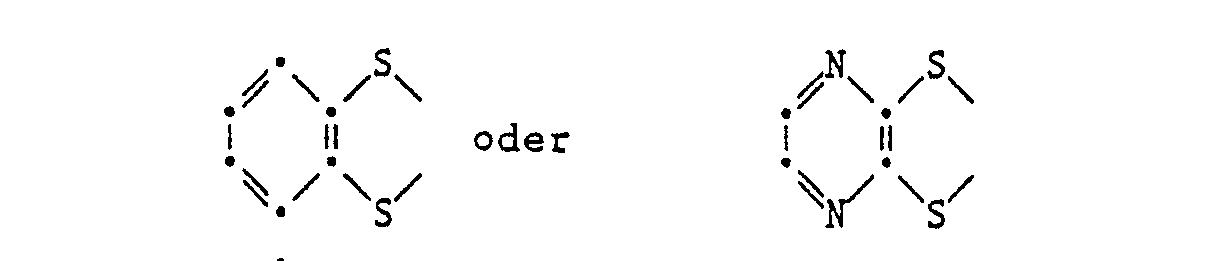
- Man setzt die bekannten Ausgangsverbindungen 4,5-Dimethylphthalsäureanhydrid und 2,3-Dimethyl-6,7-dihydroxynaphthalin in Gegenwart von B203 zu 2,3,8,9-Tetramethyl-5,12-dihydroxy-6,11-dioxo-tetracen (A) um. Diese Reaktion und die weitere Chlorierung und Reduktion zum in 5,6,11,12-Stellung tetrachlorierten Produkt sind in der DE-OS 3635124 beschrieben. Die Umsetzung mit Na2X2 führt zum entsprechenden tetrachalkogenierten Tetracen. In einer Variante kann das 2,3,8,9-Tetramethyl-5,5,6,11,12,12-hexachlordih- ydrotetracen (das bei der Chlorierung mit PCI5 POCl3 erhalten wird) mit 1 Val Na2Se2 und 2 Val Na2Se direkt zum entsprechenden Tetraselenotetracen umgesetzt werden. Die Verbindung A kann auch mit Dimethylsulfat zum 5,12-Dimethoxyderivat alkyliert werden [vgl. Chem. Pharm. Bull. 20(4), 827 (1972)]. Die Umsetzung dieses Derivates mit P4S10 in Tetrahydrofuran, die nachfolgende Oxidation mit Br2 und anschliessende Reduktion mit TiCl3 führt zum 2,3,8,9-Tetramethyl-5,6,11,12-tetrathiotetracen.
- Entsprechend der Vorschrift in Chem. Ber. 64, 1713 (1931) wird 2-Methyl-5,12-dioxo-dihydrotetracen erhalten. Die Reduktion mit Zn in alkalischer Lösung führt zum 2-Methyl-5,12-tetrahydrotetracen, das mit Chloranil zum 2-Methyltetracen dehydriert werden kann. Die Umsetzung mit S (siehe US-PS 3 723 417) ergibt das 2-Methyl-5,6,11,12-tetrathiotetracen. Man kann auch wie in a) beschrieben das 2-Methyl-5,6,11,12-tetrachlortetracen herstellen und mit Na2X2 umsetzen.
- Gemäss der Vorschrift in Chem. Ber 31, 1159 und 1272 (1898) wird durch Kondensation von 2.3-Difluorphthalsäureanhydrid mit Bernsteinsäure und anschliessende Behandlung des Kondensationsproduktes mit Natriumethylat in Ethanol 2,3,8,9-Tetrafluor-5,12-dihydroxy-6,11-dioxo-tetracen (B) erhalten. Die weitere Umsetzung mit PCI5 und anschliessend mit SnCl2-CH3COOH zum 2,3,8,9-Tetrafluor-5,6,11,12-tetrachlortetracen erfolgt analog der Vorschrift in Zhuv. Org. Kim. 15(2), 391 (1979). Die Umsetzung mit Na2X2 ergibt die entsprechenden 2,3,8,9-Tetrafluortetrachalkogentetracene. Die Reduktion von Verbindung B mit AI in Cyclohexanol führt zum 2,3,8,9-Tetrafluortetracen, das mit Schwefel [siehe Bull. Soc. Chim. 15, 27 (1948)] zum 2,3,8,9-Tetrafluor-5,6,11,12-tetrathiotetracen reagiert.
- Ausgehend von bekannten (siehe US-PS 3 769 276) 2,3,6,7-Tetrachlortetrachalkogennaphthalinen können durch die Umsetzung mit den Kaliumsalzen von Thiophenol, 4-Methylthiophenol, 4-Methoxythiophenol, 4-Mercaptopyridin, 1,2-Benzodithiol bzw. Pyrazin-2,3-dithiol die entsprechenden 2,3,6,7-substituierten Tetrachalkogennaphthaline erhalten werden.
- Man verfährt analog wie unter a) beschrieben, setzt aber als Ausgangsverbindungen 4,5-Dimethyl- bzw. 4,5-Dichlorphthalsäureanhydrid mit 6,7-Dihydroxynaphthalin um und chloriert mit PCI5/POCl3.
- In den Formeln I, la, II und IIa stellt X bevorzugt S oder Se dar. R9 ist als Halogen besonders Chlor.
- In dem Rest -OM kann M ein Metall- oder Ammoniumkation sein. Als Metallkation kommen insbesondere solche der Alkali- und Erdalkalimetalle in Frage, z.B. Li⊕, Na⊕, K⊕, Mg2⊕, Ca2⊕, Sr2⊕ und Ba2⊕. Ferner sind Zn29 und Cd2⊕ geeignet. Als Ammoniumkationen kommen z.B. NH4⊕ und primäres, sekundäres, tertiäres oder quaternäres Ammonium in Frage, die vorzugsweise C1-C12-Alkyl-, Cyclohexyl-, Cyclopentyl-, Phenyl- oder Benzylgruppen enthalten kann. Die Ammoniumkationen können sich auch von 5- oder 6- gliedrigen heterocyclischen Aminen ableiten, z.B. Piperidin, Pyrrol und Morpholin.
- Bei R9 als Rest eines Alkoholes handelt es sich bevorzugt um C1-C6-Alkoxy oder C2-C6-Hydroxyalkoxy, Benzyloxy, Phenoxy, Cyclopentyloxy oder Cyclohexyloxy.
- R9 als Rest eines primären oder sekundären Amins leitet sich bevorzugt von Alkylaminen mit einer bzw. 2 C1-C6-Alkylgruppen ab.
- R10 stellt bevorzugt H, C1-C18-Alkyl, Phenyl oder Benzyl dar.
- R10 enthält als Alkyl bevorzugt 1 bis 12 und besonders 1 bis 6 C-Atome.
- Beispiele für Alkyl, das linear oder verzweigt sein kann, sind: Methyl, Ethyl, n- oder i-Propyl, n-, i- oder t-Butyi. Pentyl, Hexyl, 2-Ethylhexyl, Heptyl, Octyl, Nonyl, Decyl, Undecyl und Dodecyl.
- Beispiele für Alkoxy und Hydroxyalkoxy sind: Methoxy, Ethoxy. Propoxy, Butoxy, Pentoxy, Hexoxy, ß-Hydroxyethoxy. γ-Hydroxypropoxy, δ-Hydroxybutoxy und ω-Hydroxyhexoxy.
- In einer bevorzugten Ausführungsform enthält die Zusammensetzung bis zu 95 Gew.-%. bezogen auf das Polymer a), mindestens eines von Komponente a) verschiedenen thermoplastischen oder elastomeren Polymeren. Insbesondere sind bis zu 80 Gew.-% des zusätzlichen Polymeren enthalten.
- Die zusätzlichen Polymeren sind vorteilhaft gegenüber den Verbindungen der Komponente b) inert. Die Polymeren enthalten daher bevorzugt im wesentlichen keine stark sauren Gruppen, z.B. Carboxygruppen, bzw. stark basische Gruppen, z.B. primäre oder sekundäre Amingruppen. Bei den Polymeren kann es sich z.B. um Thermoplaste oder Elastomere handeln.
- Eine bevorzugte Ausführungsform ist dadurch gekennzeichnet, dass es sich bei dem thermoplastischen Polymer um Polymere von Mono- und Diolefinen; Copolymere von Mono- und/oder Diolefinen; Polystyrol, Poly-(p-methylstyrol), Poly-(a-methylstyrol); Copolymere von Styrol oder α-Methylstyrol; Pfropfcopolymere von Styrol oder α-Methylstyrol; halogenhaltige Polymere; Polymere und Copolymere von Derivaten a,ß- ungesättigter Säuren: Polymere, die sich von Acylderivaten oder Acetaten ungesättigter Alkohole ableiten; Homo- und Copolymere von cyclischen Ethern; Polyacetale; Polyphenylenoxide und -sulfide und deren Mischungen mit Styrolpolymeren; Polyurethane; Polyharnstoffe; Polyimide; Polybenzimidazole; Polycarbonate; Polyester; Polyestercarbonate; Polysulfone; Polyethersulfone; Polyetherketone; Polyvinylcarbazol; Polyaddukte von gegebenenfalls hydroxyalkylierten Epoxidverbindungen mit durchschnittlich mehr als einer Epoxidgruppe im Molekül und Diolen, primären Monoaminen, disekundären Diaminen, disekundären linearen oder cyclischen Dicarbonsäurediamiden oder Dicarbonsäuren; Derivate von Cellulose; mit Schwefel vernetzte Produkte aus Doppelbindungen enthaltenden Polymeren; und Mischungen der vorgenannten Polymeren handelt.
- Beispiele für Polymere sind:
- 1. Polymere von Mono- und Diolefinen, beispielsweise Polypropylen, Polyisobutylen, Polybuten-1, Polymethylpenten-1, Polyisopren oder Polybutadien sowie Polymerisate von Cycloolefinen wie z.B. von Cyclopenten oder Norbornen; ferner Polyethylen, z.B. Polyethylen hoher Dichte (HDPE), Polyethylen niederer Dichte (LDPE), lineares Polyethylen niederer Dichte (LLDPE).
- 2. Mischungen der unter 1) genannten Polymeren, z.B. Mischungen von Polypropylen mit Polyisobutylen, Polypropylen mit Polyethylen (z.B. PP/HDPE, PP/LDPE) und Mischungen verschiedener Polyethylentypen (z.B. LDPE/HDPE).
- 3. Copolymere von Mono- und Diolefinen untereinander oder mit anderen Vinylmonomeren, wie z.B. Ethylen-Propylen-Copolymere, Propylen-Buten-1 Copolymere, Propylen-Isobutylen-Copolymere, Ethylen-Buten-1-Copolymere, Ethylen-Hexen-Copolymere, Ethylen-Methylpenten-Copolymere, Ethylen-Hepten-Copolymere, Ethylen-Octen-Copolymere, Propylen-Butadien-Copolymere, Isobutylen-Isopren-Copolymere, Ethylen-Alkylacrylat-Copolymere, Ethylen-Alkylmethacrylat-Copolymere, Ethylen-Vinylacetat-Copolymere, sowie Terpolymere von Ethylen mit Propylen und einem Dien, wie Hexadien, Dicyclopentadien oder Ethylidennorbornen; ferner Mischungen solcher Copolymere untereinander und mit unter 1) genannten Polymeren, z.B. Polypropylen/Ethylen-Propylen-Copolymere, LDPE/Ethylen-Vinylacetat-Copolymere, LDPE/Ethylen-Acrylsäureester-Copolymere, LLDPE/Ethylen-Vinylacetat-Copolymere und LLDPE.Ethylen-Acryisäureester-Copoiymere.
- 4. Polystyrol, Poly-(p-methylstyrol), Poly-(a-methylstyrol).
- 5. Copolymere von Styrol oder a-Methylstyrol mit Dienen oder Acrylderivaten, wie z.B. Styrol-Butadien, Styrol-Acrylnitril, Styrol-Alkylmethacrylat, Styrol-Butadien-Alkylacrylat, Styrol-Maleinsäureanhydrid, Styrol-Acrylnitril-Methylacrylat; Mischungen von hoher Schlagzähigkeit aus Styrol-Copolymeren und einem anderen Polymer, wie z.B. einem Polyacrylat, einem Dien-Polymeren oder einem Ethylen-Propylen-Dien-Terpolymeren; sowie Block-Copolymere des Styrols, wie z.B. Styrol-Butadien-Styrol, Styrol-Isopren-Styrol, Styrol-Ethylen/Butylen-Styrol, Styrol-Ethylen/Propylen-Styrol oder Styrol-4-Vinylpyridin-Styrol.
- 6. Pfropfcopolymere von Styrol oder a-Methylstyrol, wie z.B. Styrol auf Polybutadien, Styrol auf Polybutad.ien-Styrol- oder Polybutadien-Acrylnitril-Copolymere, Styrol und Acrylnitril (bzw. Methacrylnitril) auf Polybutadien; Styrol, Acrylnitril und Methylmethacrylat auf Polybutadien; Styrol und Maleinsäureanhydrid auf Polybutadien; Styrol, Acrylnitril und Maleinsäureanhydrid oder Maleinsäureimid auf Polybutadien; Styrol und Maleinsäureimid auf Polybutadien, Styrol und Alkylacrylate bzw. Alkylmethacrylate auf Polybutadien, Styrol und Acrylnitril auf Ethylen-Propylen-Dien-Terpolymeren, Styrol und Acrylnitril auf Polyalkylacrylaten oder Polyalkylmethacrylaten, Styrol und Acrylnitril auf Acrylat-Butadien-Copolymeren, sowie deren Mischungen mit den unter 5) genannten Copolymeren, wie sie z.B. als sogenannte ABS-, MBS-, ASA- oder AES-Polymere bekannt sind.
- 7. Halogenhaltige Polymere, wie z.B. Polychloropren, Chlorkautschuk, chloriertes oder chlorsulfoniertes Polyethylen, Epichlorhydrinhomo- und -copolymere, insbesondere Polymere aus halogenhaltigen Vinylverbindungen, wie z.B. Polyvinylchlorid, Polyvinylidenchlorid, Polyvinylfluorid, Polyvinylidenfluorid; sowie deren Copolymere, wie Vinylchlorid-Vinylidenchlorid, Vinylchlorid-Vinylacetat oder Vinylidenchlorid-Vinylacetat.
- 8. Polymere, die sich von Derivaten a,ß-ungesättigter Säuren ableiten, wie Polyacrylate, Polymethacrylate und Polyacrylnitrile.
- 9. Copolymere der unter 8) genannten Monomeren untereinander oder mit anderen ungesättigten Monomeren, wie z.B. Acrylnitril-Butadien-Copolymere, Acrylnitril-Alkylacrylat-Copolymere, Acrylnitril-Alkoxyalkylacrylat-Copolymere, Acrylnitril-Vinylhalogenid-Copolymere, Acrylnitril-Alkylmethacrylat-Butadien-Terpolymere oder Alkylmethacrylat-4-Vinylpyridin-Copolymere.
- 10. Polymere, die sich von Acylderivaten oder Acetalen ungesättigter Alkohole ableiten, wie Polyvinylacetat, -stearat, -benzoat, -maleat, Polyvinylbutyral, Polyallylphthalat; sowie deren Copolymere mit in Punkt 1 genannten Olefinen.
- 11. Homo- und Copolymere von cyclischen Ethern, wie Polyalkylenglykole, Polyethylenoxyd, Polypropylenoxyd oder Polybutylenglykol.
- 12. Polyacetale, wie Polyoxymethylen, sowie solche Polyoxymethylene, die Comonomere, wie z.B. Ethylenoxid, enthalten; Polyacetale, die mit thermoplastischen Polyurethanen, Acrylaten oder MBS modifiziert sind.
- 13. Polyphenylenoxide und -sulfide und deren Mischungen mit Styrolpolymeren.
- 14. Polyurethane, die sich von Polyethern, Polyestern und Polybutadienen mit endständigen Hydroxylgruppen einerseits und aliphatischen oder aromatischen Polyisocyanaten andererseits ableiten, sowie deren Vorprodukte.
- 15. Polyharnstoffe, Polyimide und Polybenzimidazole. Unter den Polyimiden sind besonders lösliche Polyimide bevorzugt wie sie z.B. in DE-AS 1962588, EP-A-132221, EP-A-134752, EP-A-162017, EP-A-181837 und EP-A-182745 beschrieben sind.
- 16. Polycarbonate, Polyester, z.B. Polyalkylenterephthalate, und Polyestercarbonate.
- 17. Polysulfone, Polyethersulfone und Polyetherketone.
- 18. Polyvinylcarbazol.
- 19. Polyaddukte von gegebenenfalls hydroxyalkylierten Epoxidverbindungen mit durchschnittlich mehr als einer Epoxidgruppe im Molekül und Diolen, primären Monoaminen, disekundären Diaminen, disekundären linearen oder cyclischen Dicarbonsäurediamiden oder Dicarbonsäuren.
- 20. Polymerhomolog chemisch abgewandelte Derivate von Cellulose, wie Celluloseacetate, - propionate und -butyrate, bzw. die Celluloseether, wie Methylcellulose.
- 21. Mit Schwefel vernetzte (vulkanisierte) Produkte aus Doppelbindungen enthaltenden Polymeren wie z.B Naturkautschuk, Synthesekautschuk, Butadien- bzw. Isoprenpolymerisate oder -copolymerisate.
- 22. Mischungen (Polyblends) der vorgenannten Polymeren, wie z.B. PP EPDM, PVC. EVA, PVC/ABS, PVC/MBS, PC/ABS, PC/ASA, PC/PBT, PVC/CPE, PVC/Acrylate, POM/thermoplastisches PUR, PC/thermoplastisches PUR, POM/Acrylat, POM/MBS, PPO/HIPS.
- Eine bevorzugte Gruppe von thermoplastischen Polymeren sind Polyolefine, Polystyrol, Polyvinylchlorid, Polyvinylidenchlorid, Polyvinylidenfluorid, Polyacrylate, Polymethacrylate, Polycarbonate, aromatische Polysulfone, aromatische Polyether, aromatische Polyethersulfone und Polyimide sowie Polyvinylcarbazol.
- Die thermoplastischen Polymeren der Komponente a) können einen Polymerisationsgrad von 5 bis 10 000, bevorzugt 10 bis 5000 und insbesondere 10 bis 1000 aufweisen.
- Die erfindungsgemässe Zusammensetzung kann auch duroplastische Polymere enthalten, z.B. bis zu 95 Gew.-%, besonders bis zu 80 Gew.-%. Beispiele sind:
- 1. Vernetzte ungesättigte Polyester aus z.B. Maleinsäure und Diolen und gegebenenfalls Comonomeren wie z.B. Styrol.
- 2. Vernetzte Epoxidharze, die sich von Polyepoxiden ableiten, z.B. von Bis-glycidylethern oder von cycloaliphatischen Diepoxiden. Sie können z.B. mit Anhydriden oder unter Verwendung von Härtungskatalysatoren thermisch vernetzt werden.
- Die aliphatischen und cycloaliphatischen Seitengruppen der Komponente a) sind besonders in a-, β-oder γ-Stellung, besonders in a- und/oder ß-Stellung mit Cl, Br oder I substituiert. Die aliphatische Gruppe enthält bevorzugt 1 bis 4C-Atome, die teilweise oder vollständig mit Cl, Br oder I substituiert ist. Die Substitution mit CI ist besonders bevorzugt.
- Bei der aliphatischen Seitengruppe kann es sich z.B. um lineares oder verzweigtes C1-C12-, besonders C1-C6- und insbesondere C1-C4-Alkyl handeln. Beispiele sind Methyl, Ethyl und die Isomeren von Propyl, Butyl, Pentyl, Hexyl, Heptyl, Octyl, Nonyl, Decyl, Undecyl und Dodecyl. Beispiele für cycloaliphatische Gruppen sind besonders Cyclopentyl und Cyclohexyl. Besonders bevorzugt sind mit CI, Br oder I, besonders mit CI ein- oder mehrfach substituiertes Methyl oder Ethyl, z.B. -CH2CI, -CHCI2, -CCI3, -CHClCH3, -CCl2CH3, -CHCl-CH2Cl, -CCl2-CH2Cl, -CHCI-CHCI2, -CCl2-CHCl2, -CCl2-CCl3, -CH2-CH2Cl, -CH2-CHCl2 oder -CH2-CCl3.
- An die Gruppen -O-, -O-CO-, -CO-OR22-O-CO- oder -CO-O- sind bevorzugt Gruppen der Formel -CmHn

- Den thermoplastischen Polymeren können unterschiedliche Hydroxylgruppen bzw. Carboxylgruppen enthaltende Polymere oder Mischungen davon zu Grunde liegen, z.B. Polyester, Polyesteramide, Polyurethane. Polyamide, Polycarbonate und Polyimide aus Hydroxylgruppen enthaltenden Monomeren, verseifte und gegebenenfalls hydroxyalkylierte Polymerisate von Vinylestern oder -ethern, hydroxylierte Polydiolefine wie z.B. Polybutadien oder Polyisopren, Polyacrylate oder Polymethacrylate mit Hydroxyalkylresten in der Estergruppe, Polyacryl- oder Polymethacrylsäuren, oder reduzierte Polyketone oder Copolymere davon; sowie Copolymerisate von gegebenenfalls hydroxyalkyliertem Vinylalkohol, Acrylaten oder Methacrylaten bzw. Acrylsäuren oder Methacrylsäuren oder Diolefinen mit Comonomeren wie z.B. Acrylnitril, Olefinen, Diolefinen, Vinylchlorid, Vinylidenchlorid, Vinylfluorid, Vinylidenfluorid, Styrol, α-Methylstyrol, Maleinsäureanhydrid, Maleinsäureimid, Vinylethern und Vinylestern; und Polyaddukte von gegebenenfalls hydroxyalkylierten Epoxidverbindungen mit durchschnittlich mehr als einer Epoxidgruppe im Molekül und Diolen, primären Monoaminen, disekundären Diaminen, disekundären linearen oder cyclischen Dicarbonsäurediamiden oder Dicarbonsäuren.
- Eine bevorzugte Ausführungsform ist dadurch gekennzeichnet, dass es sich bei dem thermoplastischen Polymer der Komponente a) um ein lineares Polyaddukt aus einer Glycidylverbindung mit durchschnittlich mehr als einer Epoxidgruppe und einem Diol, primären Monoamin, disekundären Diamin, disekundären linearen oder cyclischen Dicarbonsäurediamid oder einer Dicarbonsäure handelt, in dem das H-Atom der sekundären OH-Gruppen mindestens teilweise durch eine Gruppe -CO-CmHn

- Den Polyaddukten liegen bevorzugt Glycidylverbindungen mit durchschnittlich zwei Epoxidgruppen im Molekül zu Grunde.
- Als Glycidylverbindungen kommen vor allem solche mit zwei an ein Heteroatom (z.B. Schwefel, vorzugsweise Sauerstoff oder Stickstoff) gebundenen Glycidylgruppen, β-Methylglycidylgruppen oder 2,3-Epoxycyclopentylgruppen in Frage; genannt seien insbesondere Bis-(2,3-epoxycyclopentyl)-ether; Diglycidylether von mehrwertigen aliphatischen Alkoholen, wie 1,4-Butandiol, oder Polyalkylenglykolen, wie Polypropylenglykole; Diglycidylether von cycloaliphatischen Polyolen, wie 2,2-Bis-(4-hydroxycyclohexyl)-propan; Diglycidylether von mehrwertigen Phenolen, wie Resorcin, Bis-(p-hydroxyphenyl)-methan, 2,2-Bis-(p-hydroxyphenyl)-propan (= Diomethan), 2,2-Bis-(4'-hydroxy-3',5'-dibromphenyl)-propan, 1,3-Di-(p-hydroxyphenyl)-ethan; Di-(ß-methylglycidyl)-ether der oben angeführten zweiwertigen Alkohole oder zweiwertigen Phenole; Diglycidylester von Dicarbonsäuren, wie Phthalsäure, Terephthalsäure, Δ4-Tetrahydrophthalsäure und Hexahydrophthalsäure; N,N-Diglycidylderivate von primären Aminen und Amiden und heterocyclischen, zwei N-Atome enthaltenden Stickstoffbasen, und N,N'-Diglycidylderivate von disekundären Diamiden und Diaminen, wie N,N-Diglycidylanilin, N,N-Diglycidyltoluidin, N,N-Diglycidyl-p-aminophenyl-methyl-ether, N,N - Dimethyl-N,N'-diglycidyl-bis-(p-aminophenyl)-methan; N',N"-Diglycidyl-N-phenyl-isocyanurat; N,N'-Diglycidylethylenharnstoff; N,N'-Diglycidyl-5,5-dimethyl-hydantoin, N,N'-Diglycidyl-5-isopropyl-hydantoin, N,N-Methylen-bis-(N',N -diglycidyl-5,5-dimethylhydantoin), 1,3-Bis-(N-glycidyl-5,5-dimethylhydantoin)-2-hydroxypropan; N,N -Diglycidyl-5,5-dimethyl-6-isopropyl5, 6-dihydro-uracil.
- Die Glycidylverbindungen können mit aliphatischen, cycloaliphatischen oder aromatischen Diolen zu den bevorzugten Polyaddukten umgesetzt werden, wobei durch Addition an der Glycidylgruppe eine sekundäre Alkoholgruppe gebildet wird, die mit CI-, Br- und/oder I-haltigen Carbonsäuren verestert werden kann.
- Die Glycidylverbindungen können aber auch mit primären, aliphatischen, cycloaliphatischen oder aromatischen Monoaminen (z.B. Anilin, Toluidin, C1-C12-Alkylaminen, C2-C12-Hydroxyalkylaminen), aliphatischen, cycloaliphatischen oder aromatischen Dicarbonsäuren (z.B. Maleinsäure, Adipinsäure, Trimethyladipinsäure, Sebacinsäure, Azelainsäure, Bernsteinsäure, Dodecylbernsteinsäure, Phthalsäure, Terephthalsäure, Δ4-Tetrahydrophthalsäure, Hexahydrophthalsäure, 4-Methylhexahydrophthalsäure, 3,6-Endomethylen-Δ4-tetrahydrophthalsäure, 4-Methyl-3,6-endomethylen-o4-tetrahydrophthalsäure) oder aliphatischen, cycloaliphatischen, heterocyclischen oder aromatischen Bissekundäraminen oder Bissekundärcarbonsäureamiden (z.B. N,N'-Dimethylethylendiamin, N,N'-Dimethylpropylen-1,3-diamin, N,N'-Dimethylhexamethylendiamin, N,N'-Dicyclohexylhexamethylendiamin, N,N',N"-Trimethyldiethylentriamin, N,N -Diethylpropylen-1,3-diamin, N-Methyl-3,5,5-trimethyl-3-(methylaminomethyl)cyclohexylamin, N,N'-dimethylierte oder -diethylierte aromatische Diamine, z.B. m- oder p-Phenylendiamin, Bis-(4-aminophenyl)-methan oder -sulfon, 2,2-Bis-(4-aminophenyl)-propan, N,N-Dimethyl-m-xylylendiamin, sowie Ethylenharnstoff, 5,5-Dimethylhydantoin, 5-Isopropylhydantoin, N,N-Methylen-bis-5,5-dimethylhydantoin, 1,3-Bis-(5,5-dimethylhydantoin)2-hydroxypropan, 5,S-Dimethyl-6-isopropyl-5,6-dihydrouracil), durch Polyaddition zu linearen Polyaddukten umgesetzt werden.
- Bevorzugt ist eine erfindungsgemässe Zusammensetzung, worin das Polyaddukt
- a) 100 bis 0,1 Mol-% gleiche oder verschiedene Struktureinheiten der Formel V

- b) 99,9 bis 0 Mol-% gleiche oder verschiedene Struktureinheiten der Formel VI

- Bevorzugt sind 100 bis 20, besonders 30 bis 100 Mol% Struktureinheiten der Formel V. und 80 bis 0, besonders 70 bis 0 Mol% Struktureinheiten der Formel VI enthalten.
- In einer bevorzugten Ausführungsform stellen R24 und R25 gleiche Reste dar. R24 und R25 in der Bedeutung als Rest mit aliphatischen Diolgruppen enthalten bevorzugt 2 bis 12, besonders 2 bis 8 C-Atome. Die Hydroxylgruppen können an offenkettige oder cyclische aliphatische Reste gebunden sein. Als aliphatischer Rest kommt z.B. lineares oder verzweigtes C2-C12-Alkylen, C3-C8-Cycloalkylen, C1-C4-Alkyl-C5-C8-cycloalkyl, Cyclohexylmethylen oder Cyclohexyldimethylen in Frage. Beispiele sind Ethylen, 1,2-oder 1,3-Propylen, 1,2-, 1,3- oder 1,4-Butylen, 1,2-, 1,3-, 1,4- oder 1,5-Pentylen, 1,2-, 1,3-, 1,4-. 1,5- oder 1,6-Hexylen, Heptylen, Octylen, Nonylen, Decylen, Undecylen, Dodecylen, 1,3-Cyclopentylen, 1,3-oder 1,4-Cyclohexylen, 2-Methyl-1,4-cyclohexylen und Cyclohexyl-1,4-dimethylen.
- Die aromatischen Diolgruppen der für die Polyaddukte verwendeten Diole sind insbesondere phenolische Gruppen. Die Diolreste mit phenolischen Gruppen enthalten bevorzugt 6-30, besonders 6-20 C-Atome. Eine bevorzugte Ausführungsform sind Zusammensetzungen, worin R24 und R25 unabhängig voneinander einen Rest der Formel

- X' stellt bevorzugt eine direkte Bindung, Methylen, Ethylen, C2-C6-Alkyiiden, Cyclohexyliden, Cyclopentyliden, -0- oder -S- dar. R27 und R28 stehen vorzugsweise für H oder Methyl und y steht bevorzugt für 1.
- Insbesondere bedeuten R24 und R25 den Rest

- R in der Bedeutung von C1-C20-Alkyl kann linear oder verzweigt sein. R in der Bedeutung von Acyl kann z.B. Cl-C2o-Alkyl-CO, C5-C8-Cycloalkyl-CO-, C1-C5-Alkyl-C5-C8-cycloalkyl-CO-, C5-C8-Cycloalkyl-CH2-CO-, C1-C4-Alkyl-C5-C8-cycloalkyl-CH2-CO-, Phenyl-CO-, Benzyl-CO-, C1-C4-Alkylphenyl-CO- oder -benzyl-CO- sein. Bei dem Kohlenwasserstoffrest im Aminocarbonyl kann es sich z.B. um C1-C20-Alkyl-, C5-C8-Cycloalkyl-, C1-C15-Alkyl-C5-C8-cycloalkyl-, C5-C8-Cycloalkyl-CH2-, C1-C14-Alkyl-C5-C8-cycloalkyl-CH2-. Phenyl-, Benzyl-, C1-C14-Alkylphenyl- oder -benzyl- handeln. R steht bevorzugt für H.
- Eine andere bevorzugte Ausführungsform ist dadurch gekennzeichnet, dass das thermoplastische Polymer der Komponente a) ein Homo- oder Copolymer eines Acrylsäure- oder Methacrylsäureesters ist, das chlorierte, bromierte und/oder iodierte aliphatische oder cycloaliphatische Gruppen in der Estergruppe enthält.
- Eine besonders bevorzugte Ausführungsform ist dadurch gekennzeichnet, dass das Polymer
- a) 0,1 bis 100 Mol-% mindestens eines Strukturelements der Formel III

- b) 0 bis 99,9 Mol-% mindestens eines Strukturelements der Formel IV


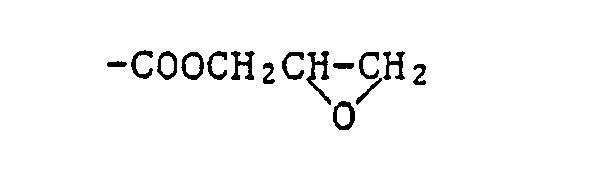
- Bevorzugt sind 100 bis 20, besonders 100 bis 30 Mol% Struktureinheiten der Formel III und 80 bis 0, besonders 70 bis 0 Mol% Struktureinheiten der Formel IV enthalten.
- R17 steht bevorzugt für Methyl. Für X2, m, n und o gelten die zuvor angegebenen Bevorzugungen und z bedeutet bevorzugt 1.
- R22 ist bevorzugt unsubstituiert oder mit OH oder CI substituiert. R22 enthält als Alkylen bevorzugt 2 bis 6 C-Atome. Das Alkylen kann linear oder verzweigt sein. Beispiele sind Ethylen und die Isomeren von Pro pylen, Butylen, Pentylen, Hexylen, Heptylen, Octylen, Nonylen, Decylen, Undecylen und Dodecylen. R22 ist als Cycloalkylen besonders Cyclohexylen und in den Cycloalkylen enthaltenden Resten bevorzugt Cyclohexylen.
- R23 kann lineares oder verzweigtes C1-C18-, bevorzugt C1-C12- und besonders C1-C6-Alkyl sein. R23 stellt als Cycloalkyl besonders Cyclopentyl oder Cyclohexyl dar. Bei R23 als (C1-C12-Alkyl)-cycloalkyl ist das Cycloalkyl besonders Cyclopentyl oder Cyclohexyl und die Alkylgruppe kann linear oder verzweigt sein und enthält bevorzugt 1 bis 6, besonders 1 bis 4 C-Atome. Bedeutet R23 Alkylphenyl oder Alkylbenzyl, so kann die Alkylgruppe linear oder verzweigt sein und enthält bevorzugt 1 bis 6, besonders 1 bis 4 C-Atome.
- R'9 steht bevorzugt für H. Bedeutet R'9 Alkyl, so handelt es sich bevorzugt um Methyl oder Ethyl. Bedeutet R19 -COOR23, so stellt R23 bevorzugt C1-C12-, besonders Ci-C6-Alkyl dar.
- Bedeutet R20 Alkyl, so handelt es sich bevorzugt um C1-C4-Alkyl, z.B. Methyl, Ethyl, n-Propyl und n-Butyl. R20 steht bevorzugt für H, Cl oder C1-C4-Alkyl.
- Bedeutet R21 die Gruppe R23-O-, so stellt R23 bevorzugt C1-C12-, besonders C1-C6-Alkyl dar. Bedeutet . R21 Alkyl, so enthält es bevorzugt 1 bis 6, besonders 1 bis 4 C-Atome. Bedeutet R21 die Gruppe -COOR23, so stellt R23 bevorzugt C1-C12-, besonders C1-C6-Alkyl, Cyclopentyl oder Cyclohexyl dar. Bedeutet R2' die Gruppe -OCO-R23, so stellt R23 bevorzugt C1-C12-, besonders C1-C6-Alkyl, Phenyl oder Benzyl dar.
- In der Gruppe -COOR220H für R21 gelten die zuvor für R22 angegebenen Bevorzugungen.
- In einer bevorzugten Ausführungsform stehen R19 für H, R20 für H, F, CI, Methyl oder Ethyl, und R21 für F, Cl, CN, C1-C4-Alkyl, C1-C6-Alkoxy, -COO-C1-C6-Alkyl, -COO-R22-OH, -OOC-C1-C6-Alkyl oder Phenyl.
- Eine bevorzugte Zusammensetzung ist dadurch gekennzeichnet, dass R17 für Methyl steht; R'8 einen Rest -R22-O-CO-CmHn


- Eine andere bevorzugte Zusammensetzung ist dadurch gekennzeichnet, dass R17 Methyl ist; R18 einen Rest -R22-0-CO-CmHnX; darstellt, worin m für eine Zahl von 1 bis 4, n für 0 oder eine Zahl von 1 bis 8 und o für eine Zahl von 1 bis 13 stehen , und die Summe von n + o = 2 m + 1 ist, X2 Cl bedeutet; R22 lineares C2-C6-Alkylen oder -CH2CHOHCH2- darstellt; R19 und R20 H bedeuten; und R2' -COOR22OH oder -COOR23 bedeuten, worin R22 die zuvor angegebene Bedeutung hat und R23 C1-C6-Alkyl ist.
- Besonders bevorzugt sind Zusammensetzungen, worin in Formel III R17 für H oder CH3 und R22 für lineares oder verzweigtes C2-C6-Alkylen, Cyclopentylen oder Cyclohexylen stehen, und in Formel IV R19 H bedeutet, R20 H oder Methyl darstellt, und R21 -COOR23 oder -COOR22OH bedeutet, und R22 und R23 die zuvor angegebenen Bedeutungen haben, einschliesslich der bevorzugten Bedeutungen.
- Eine weitere bevorzugte Ausführungsform ist dadurch gekennzeichnet, dass es sich bei dem thermoplastischen Polymer der Komponente a) um ein Homo- oder Copolymer des Vinylalkohols handelt, in dem das H-Atom der sekundären OH-Gruppe mindestens teilweise mit einer Gruppe -Y-CmHn

- Bevorzugt sind Copolymere enthalten.
- Bevorzugt sind solche Zusammensetzungen, worin das Copolymer
- a) 90 bis 0,1 Mol% Struktureinheiten der Formel VII

- b) 99,9 bis 10 Mol% gleiche oder verschiedene Struktureinheiten der Formel VIII

- Bevorzugt sind 70 bis 10. besonders 60 bis 20 Mol% Struktureinheiten der Formel VII. und 30 bis 90, besonders 40 bis 80 Mol% Strukturelemente der Formel VIII enthalten.
- Für die Bedeutungen von R'9 und R20 in Formel VIII gelten die zuvor angegebenen Bevorzugungen. Für die Bedeutungen von R22 und R23 gelten ebenfalls die zuvor angegebenen Bevorzugungen.
- R29 steht bevorzugt für H, F, Cl, CN, OH, R23-O-, C1-C4-Alkyl, -COOR23, -O-CO-R23, Phenyl, -OCH2CH20H oder -OCH2CH(CH3)OH, wobei R23 C1-C6-Alkyl ist.
- Insbesondere sind solche Zusammensetzungen bevorzugt, worin R'9 und R20 H sind und R29 -OCOR23 darstellt, worin R23 C1-C18-Alkyl, C5-C7-Cycloalkyl, (C1-C12-Alkyl)-C5-C7-cycloalkyl, Phenyl, Benzyl, (Ci-C12-Alkyl)phenyl oder (C1 -C12-Alkyl)benzyl darstellt.
- Eine bevorzugte Ausführungsform ist dadurch gekennzeichnet, dass Y eine direkte Bindung, -CO-, -CH2CH2O-CO- oder -CH2CH(CH3)0-CO- ist, X2 CI bedeutet, m eine Zahl von 1 bis 6, n 0 oder eine Zahl von 1 bis 12 und o eine Zahl von 1 bis 13 sind und die Summe von n + o = 2 m + 1 ist; R19 und R20 H bedeuten; und R29 H, F, Cl, CN, OH, R23O-, C1-C4-Alkyl, -COOR23, -O-CO-R23, Phenyl, -OCH2CH2OH oder -OCH2CH(CH3)OH darstellt; und R23 C1-C6-Alkyl, Cs- oder C6-Cycloalkyl, Phenyl oder Benzyl ist.
- Ein weiterer Gegenstand der Erfindung ist eine Zusammensetzung, enthaltend
- a) eine thermoplastisches Polymer, das an ein Polymerrückgrat über eine Gruppe -O-, -O-CO-, -CO-OR22-OCO- oder -CO-0- gebundene aliphatische oder cycloaliphatische Seitengruppen enthält, die in a-, β-, γ- oder ω-Stellung mindestens ein CI-, Br- oder I-Atom enthalten, wobei R22 unsubstituiertes oder mit OH, CI, Br oder Phenyl substituiertes C2-C12-Alkylen, C4-C12-Cycloalkylen, C4-C12-Cycloalkylen-CH2-, C4-C12-Cycloalkylen (̵CH2)̵2, Benzylen oder Xylylen darstellt, und
- b) eine Verbindung der Formel I und/oder der Formel la


- c) gegebenenfalls ein inertes organisches Lösungsmittel.
- Die erfindungsgemässe Zusammensetzung kann zusätzlich ein Lösungsmittel für ein lösliches Polymer und die Komponente b) enthalten. Geeignete Lösungsmittel sind z.B. polare, aprotische Lösungsmittel, die alleine oder in Mischungen aus mindestens zwei Lösungsmitteln verwendet werden können. Beispiele sind: Ether wie Dibutylether, Tetrahydrofuran, Dioxan, Methylenglykol, Dimethylethylenglykol, Dimethyldiethylenglykol, Diethyldiethylenglykol, Dimethyltriethylenglykol, halogenierte Kohlenwasserstoffe wie Methylenchlorid, Chloroform, 1,2-Dichlorethan, 1,1,1-Trichlorethan, 1,1,2,2-Tetrachlorethan, Carbonsäureester und Lactone wie Essigsäureethylester, Propionsäuremethylester, Benzoesäureethylester, 2-Methoxyethylacetat, γ-Butyrolacton, δ-Valerolacton und Pivalolacton, Carbonsäureamide und Lactame wie N-Methyiformamid, N.N-Dimethylformamid, N,N-Diethylformamid, N,N-Dimethylacetamid, N,N-Diethylacetamid, y-Butyrolactam. e-Caprolactam, N-Methylpyrrolidon, N-Acetylpyrrolidon, N-Methylcaprolactam, Tetramethylharnstoff, Hexamethylphosphorsäuretriamid, Sulfoxide wie Dimethylsulfoxid, Sulfone wie Dimethylsulfon, Diethylsulfon, Trimethylensulfon, Tetramethylensulfon, N-Methylpyrrolidin, N-Methylpiperidin, N-Methylmorpholin, substituierte Benzole wie Benzonitril, Chlorbenzol, o-Dichlorbenzol, 1,2,4-Trichlorbenzol, Nitrobenzol, Toluol und Xylol.
- Die erfindungsgemässe Zusammensetzung kann zusätzlich für die Verarbeitung und Anwendung benötigte Hilfsmittel enthalten, z.B. Weichmacher, Verlaufmittel, Formtrennmittel, Füllstoffe, Flammschutzmittel, Antioxidantien und Lichtschutzmittel, Stabilisatoren, Farbstoffe und Pigmente.
- Besonders bevorzugt enthält die erfindungsgemässe Zusammensetzung zusätzlich ein von Komponente a) verschiedenes thermoplastisches Polymer. Beispiele für zusätzliche Polymere sind zuvor beschrieben worden. Mit dem Zusatz dieser Polymeren kann ein zu hoher Anteil des halogenierten Polymers der Komponente a) vermieden werden. Der Anteil des thermoplastischen Polymers kann z.B. bis zu 95 Gew.-%, bevorzugt bis zu 80 Gew.-% betragen, bezogen auf das halogenierte Polymer der Komponente a).
- Das halogenierte Polymer der Komponente a) ist zweckmässig mindestens in einer solchen Menge enthalten, dass sie zur Bildung von CT-Komplexen aus den Verbindungen der Komponente b) genügt. Die zu verwendende Menge hängt im wesentlichen vom Halogenierungsgrad der Seitengruppen des Polymeren a) und dem Anteil solcher Seitengruppen im Polymeren a) ab. Die Menge kann so gewählt werden, dass pro Mol Verbindung der Formel I oder la 0,5 bis 2, besonders 1 bis 2 Mol Halogen (CI, Br. I) in den Seitengruppen des Polymers der Komponente a) enthalten sind. Vorteilhaft wird ein Ueberschuss des Polymeren a) verwendet.
- Die Komponente b) ist bevorzugt in einer Menge von 0,01 bis 20 Gew.-%, besonders 0.05 bis 10 Gew.- % und insbesondere 0,1 bis 5 Gew.-% enthalten, bezogen auf das Polymer der Komponente a).
- Im übrigen gelten für diese erfindungsgemässe Zusammensetzung die zuvor angegebenen Bevorzugungen.
- Die Herstellung dieser erfindungsgemässen Zusammensetzung erfolgt durch einfaches Vermischen der Komponenten, gegebenenfalls unter Mitverwendung eines Lösungsmittels. Mit dem Vermischen kann auch eine Formgebung verbunden sein, unter Anwendung bekannter Methoden wie z.B. Giessen, Spritzgiessen, Kalandrieren oder Extrusion.
- Ein weiterer Gegenstand der Erfindung ist ein Verfahren zur Herstellung der erfindungsgemässen CT-Komplexe enthaltenden Zusammensetzungen, das dadurch gekennzeichnet ist, dass man a) ein thermoplastisches Polymer, das an ein Polymerrückgrat über eine Gruppe -O-, -O-CO-, -CO-OR22- OCO- oder -CO-O- gebundene aliphatische oder cycloaliphatische Seitengruppen enthält, die in a-, β-, y-oder ω-Stellung mindestens ein CI-, Br- oder I-Atom enthalten, auf eine Verbindung der Formel I und.oder der Formel la


- R1, R2, R3 und R4 je Phenylthio, 4-Methyl- oder 4-Methoxyphenylthio oder 4-Pyridylthio darstellen, R5, R6, R7 und R8 unabhängig voneinander H oder F bedeuten, R5 für CH3 und R6, R7 und R8 für H oder RS, R6, R7 und R8 für CH3 stehen, R5 und R6 für CH3 oder CI und R7 und R8 für H stehen oder R5 und R6 für H, R7 für -COR9 und R8 für H oder -COR9, oder R5 und R6 für H und R7 und R8 zusammen für -CO-O-CO-oder -CO-NR10-CO- stehen, worin R9 Halogen, -OH, -NH2, oder den Rest eines Alkohols, primären oder sekundären Amins darstellt, oder -OM ist, wobei M ein Kation bedeutet, und R10 H oder der um die NH2-Gruppe verminderte Rest eines primären Amins ist, einwirken lässt.
- Das Verfahren wird vorteilhaft unter Zufuhr von Energie durchgeführt. Bei der Energie kann es sich z.B. um thermische Energie oder Strahlungsenergie handeln. Im Fall von Strahlungsenergie kann z.B. bildmässig durch eine Maske oder mittels bildmässiger Steuerung eines Lichtstrahls oder flächenmässig bestrahlt werden. Thermische Energie bedeutet zum Beispiel erhöhte Temperatur wie z.B. von 25 bis 350° C, insbesondere 50 bis 200°C. Bei der Mitverwendung von Duroplaste bildenden Bestandteilen kann gleichzeitig thermisch gehärtet werden.
- Eine bevorzugte Ausführungsform ist dadurch gekennzeichnet, dass man es in Gegenwart eines inerten organischen Lösungsmittels durchführt, das bei erhöhter Temperatur verdampft.
- Eine andere bevorzugte Ausführungsform ist dadurch gekennzeichnet, dass von der Komponente a) mehr eingesetzt wird, als zur Bildung des CT-Komplexes benötigt wird.
- Das halogenhaltige Polymer a) kann z.B. mit einer Verbindung der Formel I und oder la, und gegebenenfalls Lösungsmitteln und zusätzlichen Polymeren vermischt werden. Gleichzeitig mit dem Vermischen kann eine Formgebung verbunden sein, z.B. durch Giessen, Spritzgiessen, Extrudieren und Kalandrieren. Die zur Bildung von CT-Komplexen notwendige Temperatur kann z.B. bei der Formgebung erzielt werden. Die Erwärmung kann aber auch nach der Formgebung vorgenommen werden. Bei der Mitverwendung von Lösungsmitteln wird vorteilhaft mit dem Erwärmen das Lösungsmittel entfernt.
- Ein weiterer Gegenstand der Erfindung sind elektrisch leitende oder antistatisch ausgerüstete Zusammensetzungen, die nach dem erfindungsgemässen Verfahren erhältlich sind.
- Die erfindungsgemässen, einen CT-Komplex enthaltenden Zusammensetzungen stellen wertvolle Halbzeuge oder geformte Gegenstände, Formteile dar, z.B. Folien, Filme, Fäden, Fasern, Verbundstoffe oder Beschichtungen, die antistatisch ausgerüstet oder elektrisch leitend sind.
- Ein weiterer Gegenstand der Erfindung ist die Verwendung der erfindungsgemässen eine Verbindung der Formeln I oder la enthaltenden Zusammensetzung zur Herstellung von a) antistatisch ausgerüsteten und/oder b) elektrisch leitenden Formteilen, Folien, Fäden, Fasern, Beschichtungen oder Verbundstoffen.
- Ein weiterer Gegenstand sind geformte Gegenstände, Filme, Beschichtungen und Verbundstoffe aus einer erfindungsgemässen, einen CT-Komplex enthaltenden Zusammensetzung.
- Ein bevorzugter Anwendungsbereich ist die Herstellung von Beschichtungen oder Folien durch z.B. Extrusion oder nach Giess- bzw. Streichverfahren. Sie können für die elektrostatische Abschirmung von Bauteilen verwendet werden. Die Folien stellen flexible elektrische Leiter dar, aus denen Elektroden z.B. für Displayelemente hergestellt werden können. Je nach verwendetem Polymer bzw. Polymergemisch sind auch transparente Ausführungsformen möglich.
- Die erfindungsgemässen, einen CT-Komplex enthaltenden Zusammensetzungen zeichnen sich durch eine hohe chemische Stabilität und Temperaturbeständigkeit und eine geringe Migration der CT-Komplexe aus. Ferner werden überraschend hohe Leitfähigkeiten erzielt, die bis zu 25 % der Leitfähigkeit der reinen CT-Komplexe betragen können. Die CT-Komplexe bilden ein Netzwerk aus elektrisch leitenden Kristallnadeln in der Polymermatrix. Die hohe Stabilität bedingt nur einen geringen oder keinen Verlust der elektrischen Leitfähigkeit beim Gebrauch.
- Die Herstellung der thermoplastischen Polymeren der Komponente a) kann in an sich bekannter Weise dergestalt erfolgen, dass man ein Carboxylgruppen enthaltendes Polymer oder seine esterbildenden Derivate (z.B. Polymethacrylsäure oder Ester davon) mit einem CI-, Br- und/oder I-substituierten Alkohol verestert, oder ein Hydroxylgruppen enthaltendes Polymer (z.B. Polyaddukte aus Verbindungen mit 2 Epoxidgruppen oder deren hydroxyalkylierten Derivate, Polymethacrylsäurehydroxyalkylester, Polyvinylalkohole oder deren hydroxyalkylierten Derivate) mit einem Ci-, Br- oder I-substituierten Alkohol verethert, oder einer CI-, Br- oder I-substituierten Carbonsäure oder ihrer esterbildenden Derivate wie z.B. Ester oder Säurehalogenide, verestert. Die Reaktion wird zweckmässig in einem Lösungsmittel und bei Temperaturen von -20 C bis 100 C durchgeführt. Das gewünschte Polymer kann z.B. isoliert werden, indem man die flüchtigen Bestandteile gegebenenfalls im Vakuum verdampft, oder das Polymer aus der Reaktionslösung mit Wasser fällt und trocknet. Hierbei können jedoch durch Hydrolyse halogenierte Carbonsäurereste teilweise wieder abgespalten werden.
- Ein weiterer Gegenstand der Erfindung ist ein Homo- oder Copolymer aus Acrylsäure- oder Methacrylsäureestern, das in α-, p-, y- oder w-Stellung chlorierte, bromierte und/oder iodierte aliphatische oder cycloaliphatische Gruppen in der Estergruppe enthält.
- Bevorzugt sind solche Homo- und Copolymere, worin die Estergruppe an das 0-Atom der Carboxylgruppe gebundene Gruppen (̵R22-O-CO)̵z CmHn

- Eine bevorzugte Ausführungsform ist dadurch gekennzeichnet, dass das Homo- oder Copolymer
- a) 0,1 bis 100 Mol-% mindestens eines Strukturelements der Formel III

- b) 0 bis 99,9 Mol-% mindestens eines Strukturelements der Formel IV


- Eine besonders bevorzugte Ausführungsform ist dadurch gekennzeichnet, dass R17 für Methyl steht; R'8 einen Rest -R22-O-CO-CmHn


- R18 entspricht insbesondere einem Rest -R22-O-CO-CmHn

- Die Gruppe -CmHn

- Ein Gegenstand der Erfindung ist auch ein Homo- oder Copolymer, dadurch gekennzeichnet, dass es sich um ein lineares Polyaddukt aus einer Glycidylverbindung mit durchschnittlich mehr als einer Epoxidgruppe und einem Diol, primären Monoamin, disekundären Diamin, disekundären linearen oder cyclischen Dicarbonsäurediamid oder einer Dicarbonsäure handelt, in dem das H-Atom der sekundären OH-Gruppen mindestens teilweise durch eine Gruppe -CO-CmHn

- Eine bevorzugte Ausführungsform ist dadurch gekennzeichnet, dass das Polyaddukt
- a) 100 bis 0,1 Mol-% gleiche oder verschiedene Struktureinheiten der Formel V

- b) 99,9 bis 0 Mol-% gleiche oder verschiedene Struktureinheiten der Formel VI

- Insbesondere sind R24 und R25 unabhängig voneinander ein Rest der Formel
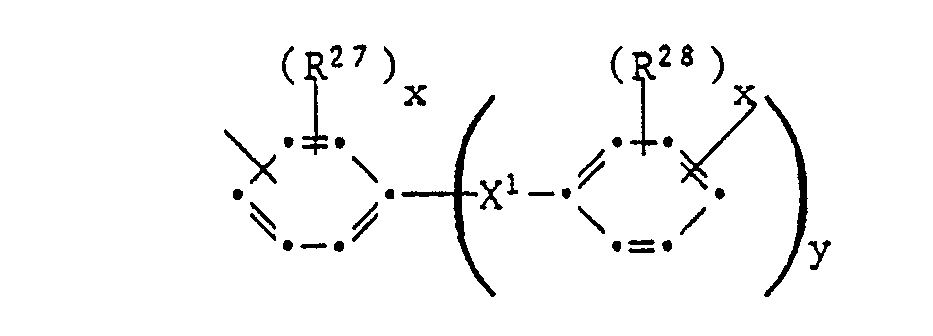
- Ganz besonders bedeuten R21 und R25 den Rest

- Eine bevorzugte Ausführungsform ist dadurch gekennzeichnet, dass -OR26-eine direkte Bindung darstellt, X2 für CI steht und m eine Zahl von 1 bis 4, n 0 oder eine Zahl von 1 bis 8 und o eine Zahl von 1 bis 9 darstellen, und die Summe von n + o = 2 m + 1 ist.
- Eine besonders bevorzugte Ausführungsform ist dadurch gekennzeichnet, dass die Gruppe -CmHn

- Ein weiterer Gegenstand der Erfindung ist ein Homo- oder Copolymer, dadurch gekennzeichnet, dass es sich um eine Homo- oder Copolymer des Vinylalkohols handelt, in dem das H-Atom der sekundären OH-Gruppe mindestens teilweise mit einer Gruppe -Y1-CmHn

- Bevorzugt ist eine Homo- oder Copolymer, das dadurch gekennzeichnet ist, dass das Copolymer
- a) 90 bis 0,1 Mol% Struktureinheiten der Formel VII

- b) 99,9 bis 10 Mol% gleiche oder verschiedene Struktureinheiten der Formel VIII

- Eine bevorzugte Ausführungsform ist dadurch gekennzeichnet, dass Y1 -CO-, -CH2CH2O-CO- oder -CH2CH(CH3)0-CO- ist, X2 CI bedeutet, m eine Zahl von 1 bis 6, n 0 oder eine Zahl von 1 bis 12 und o eine Zahl von 1 bis 13 sind und die Summe von n + o = 2 m + 1 ist; R'9 und R20 H bedeuten; und R29 H. F. CI, CN, OH, R23O-, C1-C4-Alkyl, -COOR23, -O-CO-R23, Phenyl, -OCH2CH2OH oder -OCH2CH(CH3)OH darstellt; und R23 C1-C6-Alkyl, Cs- oder C6-Cycloalkyl, Phenyl oder Benzyl ist.
- Bevorzugt ist, dass X2 für CI steht und m eine Zahl von 1 bis 4, n 0 oder eine Zahl von 1 bis 8 und o eine Zahl von 1 bis 9 darstellen, und die Summe von n + o = 2 m + 1 ist.
- Insbesondere steht die Gruppe -CmHnX2 o für -CH2CI, -CHCl2, -CCl3, -CHCICH3, -CCI2CH3, -CHCl-CH2Cl, -CCl2-CH2Cl, -CHCI-CHCI2, -CCl2CHCl2, -CCl2-CCl3, -CH2-CH2CI, -CH2-CHCl2 oder -CH2-CC13.
- Im übrigen gelten für die erfindungsgemässen Polymeren die zuvor für die erfindungsgemässen Zusammensetzungen angegebenen Bevorzugungen. Es wurde gefunden, dass die Polymeren neben ihrer Eigenschaft zur Bildung von CT-Komplexen mit den Verbindungen der Formeln I und la bei Thermoplasten und Duroplasten die Haftfestigkeit auf Substraten wie z.B. Metallen, Holz, Glas und Kunststoffen, wesentlich verbessern können, wobei die erfindungsgemässen Polymeren den Thermoplasten bzw. Duroplasten nur in geringen Mengen, z.B. bis zu 5 Gew.-%, einverleibt werden können.
- Die nachfolgenden Beispiele erläutern die Erfindung näher.
-
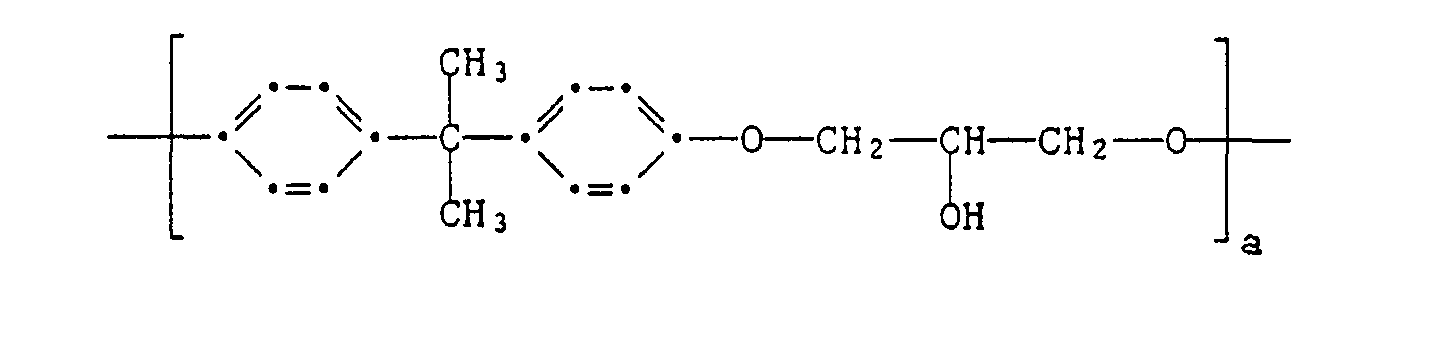

- 28,4 g eines Polyadditionspolymeren aus Bisphenol-A und Bisphenol-A-diglycidylether (Mw = 20000) wird in 200 ml Dimethylformamid und 60 ml Pyridin gelöst. Bei 0°C werden unter Rühren und Feuchtigkeitsausschluss 12,1 g Chloressigsäurechlorid zugetropft. Man lässt noch 8 h bei Raumtemperatur rühren und fällt anschliessend in Wasser. Das isolierte Polymer des Beispiels 3 wird bei 80°C im Hochvakuum getrocknet. Der Gehalt an eingebauten Chloressigesterresten wird aus der Elementaranalyse bestimmt.
- In analoger Weise werden die Polymeren in Tabelle 1 hergestellt.

- 27,8 g (0,19 Mol) Methacrylsäureglycidylester und 122,92 g (1,08 Mol) Methacrylsäureethylester werden in 600 ml Dioxan unter Stickstoff und Rühren auf 70°C erhitzt und mit 750 mg AiBN versetzt. Nach 26 h wird das entstandene Polymer durch Ausfällen in Eiswasser isoliert.
- Ausbeute: 130,57 g (87 %), Epoxydgehalt: 1,27 mÄq/g (theor. 1,267 mÄq/g), M = 86'000.
- 7,87 g Polymer (10 mMol Epoxydgruppen) werden in 80 ml Dioxan gelöst und bei Raumtemperatur tropfenweise mit 0,8 ml (0,01 Moi) Chloracetylchlorid und 2,4 ml Pyridin versetzt. Nach beendeter Zugabe erwärmt man für 1 h auf 50°C, lässt dann abkühlen und isoliert das Polymere durch Fällung in Diethylether.
-
M w = 32'700, Tg: 78° C, Chlorgehalt: 6,54 % (berechnet: 7,86 %). - Es wird wie in Beispiel 8 verfahren, aber 0,005 mol Benzoylchlorid anstelle von Chloracetylchlorid verwendet.
-
M w = 17'300, Tg: 92°C, Chlorgehalt: 1,2 % (berechnet: 2,1 %). - 7,87 g (0,01 Mol Epoxidgruppen) Poly(methacrylsäureethylester-methacrylsäureglycidylester -85 15) hergestellt nach dem Verfahren gemäss Beispiel 8 werden in 100 ml Dioxan gelöst und mit 1,71 g 0.01 Mol) 2,3-Dichlorpropionsäure und 96 mg Benzyltrimethylammoniumchlorid versetzt. Nach 10 h Rückfluss lässt man abkühlen und isoliert das umgesetzte Polymer durch Fällen in Eiswasser.
- Ausbeute: 87,6 %, Tg: 93°C, Chlorgehalt: 4,33 % (berechnet: 7,74 %).
- Es wird wie in Beispiel 10 verfahren, aber 0,01 mol Chloressigsäure anstelle von 2,3-Dichlorpropionsäure verwendet.
-
M w = 127'000, Tg: 88° C, Chlorgehalt: 1,6 % (berechnet: 4,02 %). - 1,6 mg Tetraselenotetracen (TSeT) werden in 9 ml Dimethylformamid (DMF) bei 120°C gelöst und zu einer Lösung von 100 mg Polymer nach Beispiel 1 in 1 ml DMF gegeben. Dann giesst man die Lösung auf eine vorgeheizte Glasplatte. Nach Abdampfen des Lösungsmittels bei Temperaturen zwischen 90-130°C verbleibt ein transparenter Film mit einem Nadelnetzwerk aus Kristallnadeln von elektrisch leitendem (TSeT)2-Chlorid in einer Polymermatrix. Die Filme nach Beispielen 13 bis 23 in den Tabellen 2 und 3 werden in gleicher Weise hergestellt, wobei gemäss Beispielen 16 bis 23 ein zusätzliches Polymer (Polymer 2) mitverwendet wird. Die Leitfähigkeit der Filme liegt zwischen 0,1 bis 1 S/cm.


- 100 mg Polymer werden in 2 ml DMF bei 120°C gelöst. Diese Lösung gibt man unter kräftigem Rühren zu einer 120°C heissen Lösung von 1,6 mg 2-Fluortetraselenotetracen in DMF und giesst sie in 100-140°C warme Petrischalen. Nach Abdampfen des Lösungsmittels verbleiben elektrisch leitende Polymerfilme. Die elektrische Leitfähigkeit wird nach der 4-Punktemethode bestimmt (siehe Tabelle 4).

Claims (48)


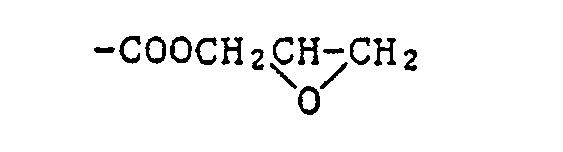


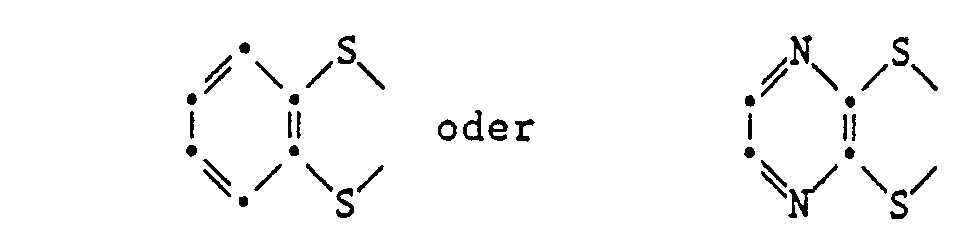







Applications Claiming Priority (2)
| Application Number | Priority Date | Filing Date | Title |
|---|---|---|---|
| CH363988 | 1988-09-30 | ||
| CH3639/88 | 1988-09-30 |
Publications (3)
| Publication Number | Publication Date |
|---|---|
| EP0362142A2 true EP0362142A2 (de) | 1990-04-04 |
| EP0362142A3 EP0362142A3 (en) | 1990-11-07 |
| EP0362142B1 EP0362142B1 (de) | 1994-04-27 |
Family
ID=4260309
Family Applications (1)
| Application Number | Title | Priority Date | Filing Date |
|---|---|---|---|
| EP89810719A Expired - Lifetime EP0362142B1 (de) | 1988-09-30 | 1989-09-21 | Antistatische und elektrisch leitende Zusammensetzung |
Country Status (5)
| Country | Link |
|---|---|
| US (4) | US5200113A (de) |
| EP (1) | EP0362142B1 (de) |
| JP (1) | JP2837463B2 (de) |
| CA (1) | CA1334238C (de) |
| DE (1) | DE58907567D1 (de) |
Cited By (3)
| Publication number | Priority date | Publication date | Assignee | Title |
|---|---|---|---|---|
| FR2696470A1 (fr) * | 1992-10-07 | 1994-04-08 | Rhone Poulenc Films | Compositions de polymères contenant des composés organiques amphiphiles électroactifs de la famille des complexes à transfert de charge et/ou des sels d'ions radicaux, leur obtention et leur utilisation. |
| US5348762A (en) * | 1991-07-02 | 1994-09-20 | Ciba-Geigy Corporation | Process for the production of conductive layers |
| US5492652A (en) * | 1992-08-20 | 1996-02-20 | Ciba-Geigy Corporation | Dithiopentacene derivatives, their preparation and the use thereof as electron acceptors in charge transfer complexes |
Families Citing this family (7)
| Publication number | Priority date | Publication date | Assignee | Title |
|---|---|---|---|---|
| DE4404840A1 (de) * | 1994-02-16 | 1995-08-17 | Wolff Walsrode Ag | Thermoplastische biologisch abbaubare Polysaccharidderivate, Verfahren zu ihrer Herstellung und ihre Verwendung |
| US5519026A (en) * | 1994-06-27 | 1996-05-21 | Ciba-Geigy Corporation | Microbicides |
| US5852127A (en) * | 1996-07-09 | 1998-12-22 | Rensselner Polytechnic Institute | Modification of porous and non-porous materials using self-assembled monolayers |
| GB2355729A (en) | 1998-03-24 | 2001-05-02 | Nano Tex Llc | Modified textile and other materials and methods for their preparation |
| US6380336B1 (en) * | 1998-03-24 | 2002-04-30 | Nano-Tex, Llc | Copolymers and oil-and water-repellent compositions containing them |
| US7141817B2 (en) * | 2001-11-30 | 2006-11-28 | Semiconductor Energy Laboratory Co., Ltd. | Light emitting device |
| US9153353B2 (en) | 2009-05-18 | 2015-10-06 | The Regents Of The University Of California | Electronically conductive polymer binder for lithium-ion battery electrode |
Family Cites Families (17)
| Publication number | Priority date | Publication date | Assignee | Title |
|---|---|---|---|---|
| FR750873A (fr) * | 1932-02-24 | 1933-08-21 | Rohm & Haas Ag | Matière artificielle et procédé pour sa fabrication |
| US2325513A (en) * | 1939-05-27 | 1943-07-27 | Willy O Herrmann | Halides of polyvinyl compounds |
| US2511424A (en) * | 1945-09-15 | 1950-06-13 | Pierce Lab Inc | Chlorinated acrylic esters |
| US3403165A (en) * | 1963-11-19 | 1968-09-24 | American Cyanamid Co | Tetrathiotetracene ion-radical salts |
| US3636048A (en) * | 1970-07-15 | 1972-01-18 | American Cyanamid Co | Chloronaphtho dithiole compounds and a method for their preparatio |
| CH612964A5 (de) * | 1975-09-19 | 1979-08-31 | Ciba Geigy Ag | |
| DE3005849A1 (de) * | 1980-02-16 | 1981-09-03 | Bayer Ag, 5090 Leverkusen | Elektrisch leitende und antistatische formmassen |
| US4522754A (en) * | 1982-11-12 | 1985-06-11 | Ciba Geigy Corporation | Metallically conducting (2-fluoro-5,6,11,12-tetraselenotetracene)2 -bromide |
| US4554326A (en) * | 1983-04-01 | 1985-11-19 | Exxon Research & Engineering Co. | Process for the manufacture of halogenated polymers |
| DE3335513A1 (de) * | 1983-09-30 | 1985-04-18 | Bayer Ag, 5090 Leverkusen | Gegen hcn-abspaltung stabilisierte, tcnq-komplexe enthaltende organische polymere |
| US4601853A (en) * | 1984-02-13 | 1986-07-22 | Ciba-Geigy Corporation | (2-fluoro-5,6,11,12-tetraselenotetracene)2 chloride |
| CH662567A5 (de) * | 1984-03-23 | 1987-10-15 | Ciba Geigy Ag | In 2-stellung substituiertes 5,6,11,12-tetrathio- und 5,6,11,12-tetraselenotetracene, verfahren zu ihrer herstellung und ihre verwendung. |
| US4594393A (en) * | 1984-10-29 | 1986-06-10 | National Distillers And Chemical Corporation | Halogenated ethylene/vinyl acetate/isobutylene terpolymers |
| CH664963A5 (de) * | 1985-10-18 | 1988-04-15 | Ciba Geigy Ag | Difluorierte (5,6,11,12-tetraselenotetracen)2-halogenide, verfahren zu deren herstellung und deren verwendung. |
| ATE74923T1 (de) * | 1987-04-03 | 1992-05-15 | Ciba Geigy Ag | Antistatische und elektrisch leitende polymere und formmassen. |
| US4874823A (en) * | 1987-11-25 | 1989-10-17 | The B. F. Goodrich Company | Chlorinated polyvinyl chloride-vinyl acetate copolymers having good low and high temperature stability |
| JPH0249011A (ja) * | 1988-08-11 | 1990-02-19 | Somar Corp | 高エネルギー線加工用レジスト |
-
1989
- 1989-09-21 EP EP89810719A patent/EP0362142B1/de not_active Expired - Lifetime
- 1989-09-21 DE DE58907567T patent/DE58907567D1/de not_active Expired - Fee Related
- 1989-09-25 CA CA000612781A patent/CA1334238C/en not_active Expired - Fee Related
- 1989-09-25 US US07/411,950 patent/US5200113A/en not_active Expired - Fee Related
- 1989-09-29 JP JP1252524A patent/JP2837463B2/ja not_active Expired - Fee Related
-
1992
- 1992-12-16 US US07/991,678 patent/US5324791A/en not_active Expired - Fee Related
-
1994
- 1994-03-11 US US08/212,522 patent/US5424372A/en not_active Expired - Fee Related
-
1995
- 1995-03-28 US US08/412,041 patent/US5616287A/en not_active Expired - Fee Related
Cited By (7)
| Publication number | Priority date | Publication date | Assignee | Title |
|---|---|---|---|---|
| US5783643A (en) * | 1991-05-21 | 1998-07-21 | Rhone-Poulenc Films | Polymer compositions comprising electroactive amphiphilic organic compounds and electroconductive shaped articles produced therefrom |
| US5348762A (en) * | 1991-07-02 | 1994-09-20 | Ciba-Geigy Corporation | Process for the production of conductive layers |
| US5492652A (en) * | 1992-08-20 | 1996-02-20 | Ciba-Geigy Corporation | Dithiopentacene derivatives, their preparation and the use thereof as electron acceptors in charge transfer complexes |
| FR2696470A1 (fr) * | 1992-10-07 | 1994-04-08 | Rhone Poulenc Films | Compositions de polymères contenant des composés organiques amphiphiles électroactifs de la famille des complexes à transfert de charge et/ou des sels d'ions radicaux, leur obtention et leur utilisation. |
| EP0592333A1 (de) * | 1992-10-07 | 1994-04-13 | Rhone-Poulenc Films | Polymerzusammensetzungen, enthaltend organische amphiphile elektro-aktive Charge-Transfer-Komplexe und/oder Radikalionensalze, Herstellung und Verwendung davon |
| US5753728A (en) * | 1992-10-07 | 1998-05-19 | Rhone-Poulenc Chimie | Polymer compositions comprising electroactive amphiphilic organic compounds and electroconductive shaped articles produced therefrom |
| US5783112A (en) * | 1992-10-07 | 1998-07-21 | Rhone-Poulenc Chimie | Polymer compositions comprising electroactive amphiphil organic compounds and electroconductive shaped articles produced therefrom |
Also Published As
| Publication number | Publication date |
|---|---|
| JPH02127474A (ja) | 1990-05-16 |
| US5200113A (en) | 1993-04-06 |
| EP0362142B1 (de) | 1994-04-27 |
| JP2837463B2 (ja) | 1998-12-16 |
| US5324791A (en) | 1994-06-28 |
| US5424372A (en) | 1995-06-13 |
| US5616287A (en) | 1997-04-01 |
| DE58907567D1 (de) | 1994-06-01 |
| CA1334238C (en) | 1995-01-31 |
| EP0362142A3 (en) | 1990-11-07 |
Similar Documents
| Publication | Publication Date | Title |
|---|---|---|
| EP0285564B1 (de) | Antistatische und elektrisch leitende Polymere und Formmassen | |
| EP0010164B1 (de) | Verfahren zur Herstellung von modifizierten Polycarbonat-Formkörpern | |
| EP0575291A2 (de) | Elektrisch leitende Kunststoffzusammensetzungen und deren Verwendung | |
| EP0023650B1 (de) | Verwendung von Alkali- und Erdalkalisalzen alkylsubstituierter aromatischer Sulfonsäuren, Phosphonsäuren und saurer Phosphorsäureester als interne Antistatika für Polycarbonatfolien | |
| DE60208649T2 (de) | Verwendung von Sulfon-, Phosphon- und Phosphor-Säuren als Dotierstoffe von Polyanilinen und aus Polyanilinen leitfähigen Verbundmaterialien | |
| EP0362142B1 (de) | Antistatische und elektrisch leitende Zusammensetzung | |
| EP0358188B1 (de) | Elektrisch leitende Zusammensetzung mit Polyheteroaromaten und polymeren Sulfaten | |
| EP0000141A1 (de) | Selbstverlöschende thermoplastische Formmassen | |
| DE69828573T2 (de) | Transparente leitfähige Polymere | |
| US4769177A (en) | Electrically conductive and antistatic moulding compositions | |
| DE69624478T2 (de) | Thermisch stabile antistatische agenzien | |
| EP0446172A2 (de) | Elektrisch leitende Pressmassen und Füllstoffe aus Polyheteroaromaten und polymeren Sulfaten | |
| EP0523003B1 (de) | Radikalkationensalze von Tetrathiotetracen und Kupferchlorid, deren Herstellung und deren Verwendung | |
| DE2734618A1 (de) | Ungesaettigte hydantoinverbindungen und haertbare, ungesaettigte hydantoinverbindungen enthaltende polymere | |
| EP0566536A1 (de) | Elektrisch leitende Kunststoffzusammensetzungen und deren Verwendung | |
| DE69228915T2 (de) | Wasserlösliches leitfähiges Polymer und Verfahren zu seiner Herstellung | |
| EP0588759A1 (de) | Dithiopentacenderivate, deren Herstellung und deren Verwendung als Elektronenakzeptoren in Charge-Transfer Komplexen | |
| EP0362143B1 (de) | Antistatische und elektrisch leitende Reliefbilder, Verfahren zu deren Herstellung, Beschichtungsmittel und strahlungsempfindliche Polymere | |
| EP0554220A1 (de) | Charge-Transfer Komplexe mit Ferrocenen, deren Herstellung und deren Verwendung | |
| EP0521826B1 (de) | Verfahren zur Herstellung von elektrisch leitenden Schichten | |
| EP0554219A1 (de) | Kunststoffzusammensetzung mit Charge-Transfer Komplexen, deren Herstellung und deren Verwendung | |
| DE60010263T2 (de) | Verwendung von sulfon- und phosphonsäuren als dotierstoffe von polyanilinfilmen und aus polyanilin leitende verbundwerkstoffe | |
| DE2500315A1 (de) | Antistatika | |
| DE69329917T2 (de) | Polymerzusammensetzungen, enthaltend organische amphiphile elektro-aktive Charge-Transfer-Komplexe und/oder Radikalionensalze, Herstellung und Verwendung davon | |
| EP0566533A1 (de) | Sulfatierte Polyvinylphenole, Zusammensetzung mit sulfatierten Polyvinylphenolen und deren Verwendung |
Legal Events
| Date | Code | Title | Description |
|---|---|---|---|
| PUAI | Public reference made under article 153(3) epc to a published international application that has entered the european phase |
Free format text: ORIGINAL CODE: 0009012 |
|
| 17P | Request for examination filed |
Effective date: 19890923 |
|
| AK | Designated contracting states |
Kind code of ref document: A2 Designated state(s): BE CH DE FR GB IT LI NL |
|
| PUAL | Search report despatched |
Free format text: ORIGINAL CODE: 0009013 |
|
| AK | Designated contracting states |
Kind code of ref document: A3 Designated state(s): BE CH DE FR GB IT LI NL |
|
| 17Q | First examination report despatched |
Effective date: 19930430 |
|
| GRAA | (expected) grant |
Free format text: ORIGINAL CODE: 0009210 |
|
| AK | Designated contracting states |
Kind code of ref document: B1 Designated state(s): BE CH DE FR GB IT LI NL |
|
| REF | Corresponds to: |
Ref document number: 58907567 Country of ref document: DE Date of ref document: 19940601 |
|
| ITF | It: translation for a ep patent filed | ||
| GBT | Gb: translation of ep patent filed (gb section 77(6)(a)/1977) |
Effective date: 19940627 |
|
| ET | Fr: translation filed | ||
| PLBE | No opposition filed within time limit |
Free format text: ORIGINAL CODE: 0009261 |
|
| STAA | Information on the status of an ep patent application or granted ep patent |
Free format text: STATUS: NO OPPOSITION FILED WITHIN TIME LIMIT |
|
| 26N | No opposition filed | ||
| REG | Reference to a national code |
Ref country code: CH Ref legal event code: PUE Owner name: CIBA-GEIGY AG TRANSFER- CIBA SC HOLDING AG |
|
| BECN | Be: change of holder's name |
Effective date: 19961129 |
|
| NLS | Nl: assignments of ep-patents |
Owner name: CIBA SC HOLDING AG |
|
| REG | Reference to a national code |
Ref country code: CH Ref legal event code: PFA Free format text: CIBA SC HOLDING AG TRANSFER- CIBA SPECIALTY CHEMICALS HOLDING INC. |
|
| REG | Reference to a national code |
Ref country code: GB Ref legal event code: 732E |
|
| NLT1 | Nl: modifications of names registered in virtue of documents presented to the patent office pursuant to art. 16 a, paragraph 1 |
Owner name: CIBA SPECIALTY CHEMICALS HOLDING INC. |
|
| REG | Reference to a national code |
Ref country code: FR Ref legal event code: TP |
|
| REG | Reference to a national code |
Ref country code: GB Ref legal event code: IF02 |
|
| PGFP | Annual fee paid to national office [announced via postgrant information from national office to epo] |
Ref country code: FR Payment date: 20020820 Year of fee payment: 14 Ref country code: CH Payment date: 20020820 Year of fee payment: 14 |
|
| PGFP | Annual fee paid to national office [announced via postgrant information from national office to epo] |
Ref country code: NL Payment date: 20020821 Year of fee payment: 14 |
|
| PGFP | Annual fee paid to national office [announced via postgrant information from national office to epo] |
Ref country code: DE Payment date: 20020826 Year of fee payment: 14 |
|
| PGFP | Annual fee paid to national office [announced via postgrant information from national office to epo] |
Ref country code: GB Payment date: 20020903 Year of fee payment: 14 |
|
| PGFP | Annual fee paid to national office [announced via postgrant information from national office to epo] |
Ref country code: BE Payment date: 20021028 Year of fee payment: 14 |
|
| PG25 | Lapsed in a contracting state [announced via postgrant information from national office to epo] |
Ref country code: GB Free format text: LAPSE BECAUSE OF NON-PAYMENT OF DUE FEES Effective date: 20030921 |
|
| PG25 | Lapsed in a contracting state [announced via postgrant information from national office to epo] |
Ref country code: LI Free format text: LAPSE BECAUSE OF NON-PAYMENT OF DUE FEES Effective date: 20030930 Ref country code: CH Free format text: LAPSE BECAUSE OF NON-PAYMENT OF DUE FEES Effective date: 20030930 Ref country code: BE Free format text: LAPSE BECAUSE OF NON-PAYMENT OF DUE FEES Effective date: 20030930 |
|
| BERE | Be: lapsed |
Owner name: *CIBA SPECIALTY CHEMICALS HOLDING INC. Effective date: 20030930 |
|
| PG25 | Lapsed in a contracting state [announced via postgrant information from national office to epo] |
Ref country code: NL Free format text: LAPSE BECAUSE OF NON-PAYMENT OF DUE FEES Effective date: 20040401 Ref country code: DE Free format text: LAPSE BECAUSE OF NON-PAYMENT OF DUE FEES Effective date: 20040401 |
|
| GBPC | Gb: european patent ceased through non-payment of renewal fee |
Effective date: 20030921 |
|
| REG | Reference to a national code |
Ref country code: CH Ref legal event code: PL |
|
| PG25 | Lapsed in a contracting state [announced via postgrant information from national office to epo] |
Ref country code: FR Free format text: LAPSE BECAUSE OF NON-PAYMENT OF DUE FEES Effective date: 20040528 |
|
| NLV4 | Nl: lapsed or anulled due to non-payment of the annual fee |
Effective date: 20040401 |
|
| REG | Reference to a national code |
Ref country code: FR Ref legal event code: ST |
|
| PG25 | Lapsed in a contracting state [announced via postgrant information from national office to epo] |
Ref country code: IT Free format text: LAPSE BECAUSE OF NON-PAYMENT OF DUE FEES;WARNING: LAPSES OF ITALIAN PATENTS WITH EFFECTIVE DATE BEFORE 2007 MAY HAVE OCCURRED AT ANY TIME BEFORE 2007. THE CORRECT EFFECTIVE DATE MAY BE DIFFERENT FROM THE ONE RECORDED. Effective date: 20050921 |