EP0363123A1 - Porous anodic aluminium oxide membranes - Google Patents
Porous anodic aluminium oxide membranes Download PDFInfo
- Publication number
- EP0363123A1 EP0363123A1 EP89310052A EP89310052A EP0363123A1 EP 0363123 A1 EP0363123 A1 EP 0363123A1 EP 89310052 A EP89310052 A EP 89310052A EP 89310052 A EP89310052 A EP 89310052A EP 0363123 A1 EP0363123 A1 EP 0363123A1
- Authority
- EP
- European Patent Office
- Prior art keywords
- membrane
- oxide
- voltage reduction
- metal
- voltage
- Prior art date
- Legal status (The legal status is an assumption and is not a legal conclusion. Google has not performed a legal analysis and makes no representation as to the accuracy of the status listed.)
- Withdrawn
Links
- 239000012528 membrane Substances 0.000 title claims abstract description 70
- PNEYBMLMFCGWSK-UHFFFAOYSA-N Alumina Chemical compound [O-2].[O-2].[O-2].[Al+3].[Al+3] PNEYBMLMFCGWSK-UHFFFAOYSA-N 0.000 title claims abstract description 40
- 239000011148 porous material Substances 0.000 claims abstract description 77
- 229910052751 metal Inorganic materials 0.000 claims abstract description 52
- 239000002184 metal Substances 0.000 claims abstract description 52
- 230000009467 reduction Effects 0.000 claims abstract description 27
- 239000000758 substrate Substances 0.000 claims abstract description 24
- 238000000034 method Methods 0.000 claims abstract description 22
- 241000204031 Mycoplasma Species 0.000 claims abstract description 10
- 239000004411 aluminium Substances 0.000 claims description 21
- 229910052782 aluminium Inorganic materials 0.000 claims description 21
- XAGFODPZIPBFFR-UHFFFAOYSA-N aluminium Chemical compound [Al] XAGFODPZIPBFFR-UHFFFAOYSA-N 0.000 claims description 21
- 238000007743 anodising Methods 0.000 claims description 16
- 230000007547 defect Effects 0.000 claims description 14
- 239000000706 filtrate Substances 0.000 claims description 6
- 238000001914 filtration Methods 0.000 claims description 6
- 239000000725 suspension Substances 0.000 claims description 5
- 239000007788 liquid Substances 0.000 claims description 4
- 238000004519 manufacturing process Methods 0.000 claims description 4
- 238000011084 recovery Methods 0.000 claims description 4
- 238000005266 casting Methods 0.000 claims description 3
- 238000000265 homogenisation Methods 0.000 claims description 2
- 230000008719 thickening Effects 0.000 abstract 1
- 239000003792 electrolyte Substances 0.000 description 13
- NBIIXXVUZAFLBC-UHFFFAOYSA-N Phosphoric acid Chemical compound OP(O)(O)=O NBIIXXVUZAFLBC-UHFFFAOYSA-N 0.000 description 12
- 239000010407 anodic oxide Substances 0.000 description 12
- 230000004888 barrier function Effects 0.000 description 12
- 230000004907 flux Effects 0.000 description 7
- 239000012535 impurity Substances 0.000 description 6
- 229910000147 aluminium phosphate Inorganic materials 0.000 description 5
- 241000588724 Escherichia coli Species 0.000 description 4
- MUBZPKHOEPUJKR-UHFFFAOYSA-N Oxalic acid Chemical compound OC(=O)C(O)=O MUBZPKHOEPUJKR-UHFFFAOYSA-N 0.000 description 4
- 241000700605 Viruses Species 0.000 description 4
- 239000002245 particle Substances 0.000 description 4
- 239000000243 solution Substances 0.000 description 4
- 238000002048 anodisation reaction Methods 0.000 description 3
- 230000015572 biosynthetic process Effects 0.000 description 3
- 238000004090 dissolution Methods 0.000 description 3
- 238000002203 pretreatment Methods 0.000 description 3
- 238000000926 separation method Methods 0.000 description 3
- QAOWNCQODCNURD-UHFFFAOYSA-N Sulfuric acid Chemical compound OS(O)(=O)=O QAOWNCQODCNURD-UHFFFAOYSA-N 0.000 description 2
- 230000001580 bacterial effect Effects 0.000 description 2
- 238000006243 chemical reaction Methods 0.000 description 2
- 239000000463 material Substances 0.000 description 2
- 235000006408 oxalic acid Nutrition 0.000 description 2
- 239000007858 starting material Substances 0.000 description 2
- 239000000126 substance Substances 0.000 description 2
- 239000001117 sulphuric acid Substances 0.000 description 2
- 235000011149 sulphuric acid Nutrition 0.000 description 2
- 230000003612 virological effect Effects 0.000 description 2
- 229920001817 Agar Polymers 0.000 description 1
- 241000894006 Bacteria Species 0.000 description 1
- 241000202894 Mycoplasma orale Species 0.000 description 1
- 241000204003 Mycoplasmatales Species 0.000 description 1
- 241000293869 Salmonella enterica subsp. enterica serovar Typhimurium Species 0.000 description 1
- 229910000831 Steel Inorganic materials 0.000 description 1
- 238000010521 absorption reaction Methods 0.000 description 1
- 239000002253 acid Substances 0.000 description 1
- 239000008272 agar Substances 0.000 description 1
- 238000000137 annealing Methods 0.000 description 1
- 238000004113 cell culture Methods 0.000 description 1
- 210000002421 cell wall Anatomy 0.000 description 1
- 238000005253 cladding Methods 0.000 description 1
- 238000005097 cold rolling Methods 0.000 description 1
- 238000011109 contamination Methods 0.000 description 1
- 238000001816 cooling Methods 0.000 description 1
- 230000001419 dependent effect Effects 0.000 description 1
- 238000001514 detection method Methods 0.000 description 1
- 238000010790 dilution Methods 0.000 description 1
- 239000012895 dilution Substances 0.000 description 1
- LOKCTEFSRHRXRJ-UHFFFAOYSA-I dipotassium trisodium dihydrogen phosphate hydrogen phosphate dichloride Chemical compound P(=O)(O)(O)[O-].[K+].P(=O)(O)([O-])[O-].[Na+].[Na+].[Cl-].[K+].[Cl-].[Na+] LOKCTEFSRHRXRJ-UHFFFAOYSA-I 0.000 description 1
- 238000009826 distribution Methods 0.000 description 1
- 230000000694 effects Effects 0.000 description 1
- 238000002474 experimental method Methods 0.000 description 1
- 239000012527 feed solution Substances 0.000 description 1
- 238000000855 fermentation Methods 0.000 description 1
- 230000004151 fermentation Effects 0.000 description 1
- 239000001963 growth medium Substances 0.000 description 1
- 238000010438 heat treatment Methods 0.000 description 1
- 238000005098 hot rolling Methods 0.000 description 1
- 238000011534 incubation Methods 0.000 description 1
- 150000002605 large molecules Chemical class 0.000 description 1
- 238000002844 melting Methods 0.000 description 1
- 230000008018 melting Effects 0.000 description 1
- 229910044991 metal oxide Inorganic materials 0.000 description 1
- 150000004706 metal oxides Chemical class 0.000 description 1
- 239000000203 mixture Substances 0.000 description 1
- 230000003647 oxidation Effects 0.000 description 1
- 238000007254 oxidation reaction Methods 0.000 description 1
- 239000012466 permeate Substances 0.000 description 1
- 239000002953 phosphate buffered saline Substances 0.000 description 1
- 238000001556 precipitation Methods 0.000 description 1
- 238000002360 preparation method Methods 0.000 description 1
- 239000000047 product Substances 0.000 description 1
- 230000002035 prolonged effect Effects 0.000 description 1
- 230000035945 sensitivity Effects 0.000 description 1
- 210000002966 serum Anatomy 0.000 description 1
- 150000003384 small molecules Chemical group 0.000 description 1
- 239000010959 steel Substances 0.000 description 1
- 229920001059 synthetic polymer Polymers 0.000 description 1
- 210000003813 thumb Anatomy 0.000 description 1
- 241001515965 unidentified phage Species 0.000 description 1
- 238000011144 upstream manufacturing Methods 0.000 description 1
- XLYOFNOQVPJJNP-UHFFFAOYSA-N water Substances O XLYOFNOQVPJJNP-UHFFFAOYSA-N 0.000 description 1
Images
Classifications
-
- C—CHEMISTRY; METALLURGY
- C25—ELECTROLYTIC OR ELECTROPHORETIC PROCESSES; APPARATUS THEREFOR
- C25D—PROCESSES FOR THE ELECTROLYTIC OR ELECTROPHORETIC PRODUCTION OF COATINGS; ELECTROFORMING; APPARATUS THEREFOR
- C25D3/00—Electroplating: Baths therefor
- C25D3/02—Electroplating: Baths therefor from solutions
- C25D3/42—Electroplating: Baths therefor from solutions of light metals
- C25D3/44—Aluminium
-
- B—PERFORMING OPERATIONS; TRANSPORTING
- B01—PHYSICAL OR CHEMICAL PROCESSES OR APPARATUS IN GENERAL
- B01D—SEPARATION
- B01D71/00—Semi-permeable membranes for separation processes or apparatus characterised by the material; Manufacturing processes specially adapted therefor
- B01D71/02—Inorganic material
- B01D71/024—Oxides
- B01D71/025—Aluminium oxide
-
- B—PERFORMING OPERATIONS; TRANSPORTING
- B01—PHYSICAL OR CHEMICAL PROCESSES OR APPARATUS IN GENERAL
- B01D—SEPARATION
- B01D67/00—Processes specially adapted for manufacturing semi-permeable membranes for separation processes or apparatus
- B01D67/0039—Inorganic membrane manufacture
- B01D67/0053—Inorganic membrane manufacture by inducing porosity into non porous precursor membranes
- B01D67/006—Inorganic membrane manufacture by inducing porosity into non porous precursor membranes by elimination of segments of the precursor, e.g. nucleation-track membranes, lithography or laser methods
- B01D67/0065—Inorganic membrane manufacture by inducing porosity into non porous precursor membranes by elimination of segments of the precursor, e.g. nucleation-track membranes, lithography or laser methods by anodic oxidation
-
- C—CHEMISTRY; METALLURGY
- C25—ELECTROLYTIC OR ELECTROPHORETIC PROCESSES; APPARATUS THEREFOR
- C25D—PROCESSES FOR THE ELECTROLYTIC OR ELECTROPHORETIC PRODUCTION OF COATINGS; ELECTROFORMING; APPARATUS THEREFOR
- C25D11/00—Electrolytic coating by surface reaction, i.e. forming conversion layers
- C25D11/02—Anodisation
- C25D11/04—Anodisation of aluminium or alloys based thereon
- C25D11/045—Anodisation of aluminium or alloys based thereon for forming AAO templates
Definitions
- This invention is concerned with porous anodic aluminium oxide membranes, and more particularly with membranes of the asymmetric type, that is to say membranes having two major surfaces with a system of larger pores extending in from a first surface and communicating with a system of smaller pores extending in from a second surface.
- EPA 178831 describes membranes of this kind, and also a method of making them.
- that method involves anodising an aluminium metal substrate in an electrolyte, such as phosphoric, oxalic or sulphuric acid, which shows some dissolving power for aluminium oxide. This results in the formation of a porous anodic oxide film, whose thickness increases with time.
- the pores extend in from the outer surface of the film as far as a relatively thin barrier layer overlying the metal/oxide interface. As anodization proceeds, conversion of metal to oxide takes place at this metal/oxide interface. Both the thickness of the barrier layer and the diameter and spacing of the pores in the overlying porous region of the membrane are generally proportional to anodising voltage.
- the anodic oxide membrane adheres tenaciously to its metal substrate.
- EPA 178831 describes a technique for separating the two by continuing anodising with a slowly reducing voltage. This has the effect of thinning the barrier layer by forming in it a system of smaller more closely spaced pores. Eventually, any residual barrier layer is dissolved away and the desired asymmetric porous anodic aluminium oxide membrane is lifted off the substrate.
- these asymmetric membranes have a unique combination of properties, uniform controlled fine minimum pore size together with high flux.
- flux is inversely proportional to the depth of the small pore region (i.e. the length of the smaller pores). Where high flux is vital, this can be made very small, down to 0.3 microns or even less.
- EPA 178831 envisages the small pore region having a depth in the range 10 nm to 1.0 microns.
- An object of this invention is to provide anodic oxide membranes in which occasional defects do not result in loss of performance.
- a subsidiary object is to reduce the incidence of defects by pretreating the aluminium metal.
- the invention provides an anodic aluminium oxide membrane having two major surfaces with a system of larger pores extending in from a first surface and communicating with a system of smaller pores extending a distance s in from a second surface, characterized in that the distance s is greater than 1 micron.
- the invention provides a method of making an anodic aluminium oxide membrane having two major surfaces with a system of larger pores extending in from a first surface and communicating with a system of smaller pores entending in from a second surface, by the steps of anodising an aluminium metal substrate to form theron an oxide membrane, subjecting the oxide membrane to voltage reduction at a rate sufficiently slow that partial or complete recovery of the oxide membrane keeps step with the voltage reduction, and recovering the oxide membrane from the substrate, characterized in that the voltage reduction is interrupted at a voltage and for a time sufficient to increase the distance s, by which the system of smaller pores extends in from the second surface, by at least 0.05 microns.
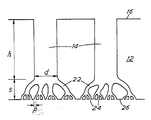
- the film 12 has two major faces 16, 26.
- a system of larger pores 14 extends in from one face 16 a distance h into the film, these larger pores having a diameter d near their inner ends.
- a system of smaller pores 22, 24 extends in from the other face 26 a distance s into the film, the smaller pores having a substantially uniform minimum diameter p.
- Typical dimensions are as follows: d is 10 nm to 2 microns h is 0.1 to 100 microns p is 2 nm to 100 nm but less than 0.5 d. s is greater than 1 micron, up to 5 microns but more usually up to 2 microns.
- a porous anodic oxide film is formed.
- This comprises a non-porous barrier layer adjacent the metal, whose thickness is approximately 1 nm per volt.
- the pores have a diameter of approximately 1 nm per volt and are spaced apart approximately 2.5 nm per volt, these figures being largely independent of electrolyte, temperature and whether AC or DC is used.
- a voltage reduction is followed by a temporary recovery phase, during which the barrier layer is thinned by the formation of new pores branching out form the bases of the old ones.
- the barrier layer has reached a thinner value appropriate to the new voltage, recovery is complete, and anodising continues by oxidation at the metal/alumina interface.
- the applied voltage is reduced from the anodising voltage down to a value preferably no more than 15V.
- each incremental reduction is preferably by an amount not more than the greater of 5V and 50% of the existing voltage.
- the minimum small pore diameter p is determined by the minimum voltage at which significant new pore formation is effected during this voltage reduction procedure.
- the voltage reduction procedure is interrupted at least once at a voltage intermediate the starting and finishing voltages.
- the metal substrate with the anodic oxide membrane thereon is held at that intermediate voltage for a time sufficient to increase, by further anodization of the substrate, the depth of the small pore region by at least 0.05 microns.
- the voltage reduction may be interrupted more than once, and the small pore growth of at least 0.05 microns preferably at least 0.1 microns is specified as the aggregate result of all the interruptions.
- the rate of anodic membrane growth depends to some extent on the nature of the electrolyte, but is typically 0.5 microns per minute for each mA/cm2 of applied current.
- the voltage reduction procedure is likely to be interrupted at a voltage of from 5 to 150 volts for a time of from 1 minute to 3 hours, preferably 10 to 60 minutes, shorter times being generally appropriate to higher voltages and vice versa.
- the metal substrate with the anodic membrane on it may remain in the electrolyte being used for voltage reduction or may be transferred to another electrolyte.
- An advantage of moving the substrate is that the new electrolyte can be chosen to minimize chemical dissolution, which is generally not desired as it enlarges pore diameters.
- the electrolyte used during interruptions at less than 30 volts is dilute sulphuric acid, which has a relatively low dissolving power for anodic aluminium oxide and permits the use of relatively high current densities so as to cause relatively rapid film growth at low voltage.
- An electrolyte containing phosphoric acid is preferred for interruption at more than 30 volts.
- An upper limit on the interruption time is set by the need to avoid dissolving so much of the large pore region that it becomes weakened.
- the minimum pore diameter which is determined by the lowest voltage at which significant anodization takes place, occurs at the metal/oxide interface and hence (after separation of the oxide membrane from the metal substrate) at one surface of the membrane. Sometimes, the minimum pore diameter may be smaller than is actually desired. In these circumstances, the membrane can be immersed for a suitable time in a liquid, e.g. phosphoric acid, which dissolves the anodic aluminium oxide. The small pore region is dissolved more quickly than the large pore region, on account of its higher specific surface area. This technique can be used to increase the minimum pore diameter of the separated membrane in a controlled manner.
- a liquid e.g. phosphoric acid
- any increase in the thickness of the small pore region is likely to reduce the flux of the anodic oxide membrane, which may not be desired when the membrane is to be used as a filter.
- the membranes may nevertheless be advantageous if they are more reliable.
- Aluminium metal necessarily contains secondary phase particles resulting from the presence of impurities, and these give rise to defects, generally voids, in the anodic oxide membrane. Provided that the largest dimension of any defect is smaller than the length of pores of less than specified diameter in the small pore region of the membrane, the presence of defects need not damage the properties of the membrane as a filter.
- the thickness of the small pore region of the membrane needs to be chosen, in the light of the expected size and frequency of defects, to achieve the combination: - minimum loss of performance (specified as small pores at least as long as the likely size of any defects), and - minimum loss of flux (small pores as short as possible consistent with the above).
- virus and mycoplasma free liquids eg. for growth media, serum suppliments etc.
- cell culture and fermentation are especially susceptible to contamination by virus and mycoplasma.
- existing liquid filtration systems are far from ideal for this function. Either the variation in pore size is too great to permit a sufficient degree of confidence in the separation; the problem being that existing commercial filtration membranes constructed from regenerated cellulosic materials or from synthetic polymers possess wide pore size distribution with some pores even being of 'pin-hole' size; or the membrane is tight that the flux is low and high molecular weight compounds are to some degree rejected.
- Membranes of the present invention should when challenged in a filtration test of an aqueous phage or mycoplasma suspension, yield a filtrate in which the concentration of the phage or mycoplasma being tested is no more than 0.1%, preferably no more than 0.01% more preferably no more than .001% and desirably 0%, of that of the starting suspension.
- Phages are virus which require bacteria in which to replicate, and are typically about 25-65 nm diameter. Mycoplasma removal from plasma is difficult because the mycoplasma lack a rigid cell wall and can therefore deform under pressure and squeeze through a conventional polymeric 0.2 microns bacterial membrane.
- aluminium metal can be controlled or pre-treated to minimize the incidence of defects.
- metal of at least 99.98%, preferably at least 99.995%, purity.
- the metal pre-treatments described below may permit the use of aluminium metal of somewhat lower purity than would otherwise be necessary.
- the aluminium metal to be pre-treated should preferably be at least 99.5% pure, desirably at least 99.9% pure.
- One way of pre-treating the aluminium metal is to cast it by means of a roll casting technique.
- the molten metal is solidified in the nip of a pair of heavily chilled steel rolls which draw the molten metal out of an insultated injector nozzle in close proximity to the rolls, the cast material being in the form of a slab e.g. in a thickness range of up to 25 mm and being typically cast at a speed of 60 to 200 cm/min.
- the metal is cooled at a rate of at least 100's and generally 1000's of o C per second and essentially fully solidified when it passes the centre line of the caster rolls.
- the roll cast product may be subsequently treated under conventional conditions, e.g. annealing and cold rolling, which do not result in precipitation of impurities.
- Another preferred pre-treatment which can be applied to aluminium cast by any technique, is homogenisation.
- the aluminium metal is heated to a temperature in the range 500 o C to its melting point and held there for a sufficient time to cause secondary phase impurities to go into solution.
- the temperature may be raised to 600 o C or more, subject to the requirement that the metal does not become too limp or soft to handle without damage.
- the metal should preferably not be cold worked, and certainly not hot worked, after homogenising.
- homogenising is the last step performed on the metal prior to surface preparation for anodising.
- Yet another pre-treatment involves cladding a sheet of higher purity Al metal on a substrate of lower purity Al metal.
- the purity of the aluminium at the metal/oxide interface determines the quality of the anodic metal oxide layer.
- Anodising at 150 Volts was carried out in a mixed oxalic/phosphoric acid electrolyte at 25 o C until an anodic film 60 microns thick had been formed, with a barrier layer 0.15 microns thick.
- Voltage reduction was carried out in the anodising acid; using the following conditions: % Voltage Step - 5 Minimum Voltage Step - 0.3 % di/dt - 0.5 until the voltage was reduced to 20 Volts whereupon the film was allowed to recover and the anodising continued for sixty-six (66) minutes. Voltage reduction was then continued down to 0.3 volts.
- the sheet carrying the anodic film was then transferred to a solution containing 33 vol % phosphoric acid in water at 22 o C and allowed to soak for 15 minutes to detach the anodic film.
- the resulting asymmetric layer was 1.2 microns thick and the pore size 0.05 ⁇ m.
- Expected pore size was 0.02 ⁇ m; the increase in diameter being brought about by dissolution of the pore walls during the prolonged soak required to detach the film.
- anodic oxide membranes were also made from the same starting materials using the same procedure except that the voltage reduction was not interrupted.
- the expected and actual minimum pore size was 0.02 microns and the depth of the small pore layer was approximately 0.15 microns.
- a viral challenge experiment was performed using anodic oxide membranes prepared according to Example 1 and designated as follows:-
- Controls were run in which phage suspensions were passed through membrane holders without membranes present to account for the absorption of phages by the holders.
- the PFUs from these filtrates were used as the 100% passage reference value. Suitable dilutions of phage were taken up in 20cm3 syringes and filtration proceeded using thumb pressure.
- the membrane was made up into filters. A total of 239 filters, which had been shown to be capable of withstanding a pressure of 700 kPA, were tested against a challenge of 1.9 x 10⁵ CFU/ml Mycoplasma orale suspended in 10 ml of phosphate buffered saline. Filtrates were centrifuged, resuspended in mycoplasma broth, incubated and subcultured after 7 days to agar plates. Plates were observed after 6 days 5% CO2:95% H2 anaerobic incubation at 37 o C. All 239 filters had excluded mycoplasma from the filtrate.
Landscapes
- Chemical & Material Sciences (AREA)
- Chemical Kinetics & Catalysis (AREA)
- Engineering & Computer Science (AREA)
- Organic Chemistry (AREA)
- Materials Engineering (AREA)
- Metallurgy (AREA)
- Electrochemistry (AREA)
- Inorganic Chemistry (AREA)
- Physics & Mathematics (AREA)
- Optics & Photonics (AREA)
- Manufacturing & Machinery (AREA)
- Separation Using Semi-Permeable Membranes (AREA)
- Micro-Organisms Or Cultivation Processes Thereof (AREA)
- Apparatus Associated With Microorganisms And Enzymes (AREA)
Applications Claiming Priority (2)
| Application Number | Priority Date | Filing Date | Title |
|---|---|---|---|
| GB888823145A GB8823145D0 (en) | 1988-10-03 | 1988-10-03 | Porous anodic aluminium oxide membranes |
| GB8823145 | 1988-10-03 |
Publications (1)
| Publication Number | Publication Date |
|---|---|
| EP0363123A1 true EP0363123A1 (en) | 1990-04-11 |
Family
ID=10644617
Family Applications (1)
| Application Number | Title | Priority Date | Filing Date |
|---|---|---|---|
| EP89310052A Withdrawn EP0363123A1 (en) | 1988-10-03 | 1989-10-02 | Porous anodic aluminium oxide membranes |
Country Status (10)
| Country | Link |
|---|---|
| EP (1) | EP0363123A1 (da) |
| JP (1) | JPH02218422A (da) |
| KR (1) | KR900006562A (da) |
| CN (1) | CN1041708A (da) |
| AU (1) | AU614186B2 (da) |
| BR (1) | BR8905000A (da) |
| CA (1) | CA2000056A1 (da) |
| DK (1) | DK483589A (da) |
| GB (1) | GB8823145D0 (da) |
| NO (1) | NO893919L (da) |
Cited By (6)
| Publication number | Priority date | Publication date | Assignee | Title |
|---|---|---|---|---|
| EP1884578A1 (en) * | 2006-07-31 | 2008-02-06 | MPG Max-Planck-Gesellschaft zur Förderung der Wissenschaften e.V. | A method of manufacturing a self-ordered porous structure of aluminium oxide, a nanoporous article and a nano object |
| RU2350380C1 (ru) * | 2007-05-31 | 2009-03-27 | Институт проблем технологии микроэлектроники и особочистых материалов Российской Академии Наук (ИПТМ РАН) | Способ получения пористых мембран на основе алюминия |
| EP2853585A1 (en) * | 2013-09-30 | 2015-04-01 | Fujifilm Corporation | Cell culture carrier and cell culture vessel |
| EP2857558A4 (en) * | 2012-05-30 | 2015-11-25 | Mitsubishi Rayon Co | METHOD FOR THE PRODUCTION OF A FORM AND METHOD FOR PRODUCING A FORM PART WITH A TINY UNBLE STRUCTURE ON THE SURFACE |
| CN112007522A (zh) * | 2020-07-31 | 2020-12-01 | 常州费曼生物科技有限公司 | 自支撑双面氧化铝多孔输液器滤膜及其制备方法 |
| CN112513339A (zh) * | 2018-07-31 | 2021-03-16 | 株式会社Uacj | 铝部件及其制造方法 |
Families Citing this family (9)
| Publication number | Priority date | Publication date | Assignee | Title |
|---|---|---|---|---|
| GB8922069D0 (en) * | 1989-09-29 | 1989-11-15 | Alcan Int Ltd | Separation devices incorporating porous anodic films |
| JP4027218B2 (ja) | 2002-12-13 | 2007-12-26 | キヤノン株式会社 | 濾過膜の製造方法 |
| CN100528941C (zh) * | 2004-07-02 | 2009-08-19 | 中国科学院上海应用物理研究所 | 一种医用高分子超疏水膜的制备方法 |
| CN100412237C (zh) * | 2005-03-18 | 2008-08-20 | 武汉大学 | 一种三维氧化铝纳米模板的制备方法 |
| JP5157246B2 (ja) * | 2007-05-16 | 2013-03-06 | 富士通株式会社 | 小径細胞体捕捉チップ及びその製造方法 |
| CN101520525B (zh) * | 2008-02-25 | 2010-11-17 | 中国科学院合肥物质科学研究院 | 带有分叉孔的多孔氧化铝薄膜滤光片及其制备方法 |
| CN102560650B (zh) * | 2010-12-29 | 2014-10-22 | 中国科学院合肥物质科学研究院 | 多孔氧化铝光子晶体及其制备方法和用途 |
| JP6782081B2 (ja) * | 2016-03-11 | 2020-11-11 | オルガノ株式会社 | 微粒子捕捉用ろ過膜及びその製造方法並びに多孔質膜及びその製造方法 |
| CN108865971A (zh) * | 2018-03-14 | 2018-11-23 | 深圳拓扑精膜科技有限公司 | 一种外泌体的分离方法及其分离装置 |
Citations (1)
| Publication number | Priority date | Publication date | Assignee | Title |
|---|---|---|---|---|
| EP0178831A1 (en) * | 1984-10-17 | 1986-04-23 | Alcan International Limited | Porous films and method of forming them |
-
1988
- 1988-10-03 GB GB888823145A patent/GB8823145D0/en active Pending
-
1989
- 1989-09-29 AU AU42382/89A patent/AU614186B2/en not_active Ceased
- 1989-09-29 KR KR1019890013992A patent/KR900006562A/ko not_active Withdrawn
- 1989-10-02 JP JP1257629A patent/JPH02218422A/ja active Pending
- 1989-10-02 NO NO89893919A patent/NO893919L/no unknown
- 1989-10-02 DK DK483589A patent/DK483589A/da not_active Application Discontinuation
- 1989-10-02 EP EP89310052A patent/EP0363123A1/en not_active Withdrawn
- 1989-10-02 CN CN89107724A patent/CN1041708A/zh active Pending
- 1989-10-02 CA CA002000056A patent/CA2000056A1/en not_active Abandoned
- 1989-10-03 BR BR898905000A patent/BR8905000A/pt unknown
Patent Citations (1)
| Publication number | Priority date | Publication date | Assignee | Title |
|---|---|---|---|---|
| EP0178831A1 (en) * | 1984-10-17 | 1986-04-23 | Alcan International Limited | Porous films and method of forming them |
Cited By (10)
| Publication number | Priority date | Publication date | Assignee | Title |
|---|---|---|---|---|
| EP1884578A1 (en) * | 2006-07-31 | 2008-02-06 | MPG Max-Planck-Gesellschaft zur Förderung der Wissenschaften e.V. | A method of manufacturing a self-ordered porous structure of aluminium oxide, a nanoporous article and a nano object |
| WO2008014977A3 (en) * | 2006-07-31 | 2008-05-08 | Max Planck Gesellschaft | A method of manufacturing a self-ordered porous structure of aluminium oxide, a nanoporous article and a nano object |
| RU2350380C1 (ru) * | 2007-05-31 | 2009-03-27 | Институт проблем технологии микроэлектроники и особочистых материалов Российской Академии Наук (ИПТМ РАН) | Способ получения пористых мембран на основе алюминия |
| EP2857558A4 (en) * | 2012-05-30 | 2015-11-25 | Mitsubishi Rayon Co | METHOD FOR THE PRODUCTION OF A FORM AND METHOD FOR PRODUCING A FORM PART WITH A TINY UNBLE STRUCTURE ON THE SURFACE |
| US9797059B2 (en) | 2012-05-30 | 2017-10-24 | Mitsubishi Chemical Corporation | Method for manufacturing mold and method for manufacturing molded article having fine uneven structure on surface |
| EP2853585A1 (en) * | 2013-09-30 | 2015-04-01 | Fujifilm Corporation | Cell culture carrier and cell culture vessel |
| US9677037B2 (en) | 2013-09-30 | 2017-06-13 | Fujifilm Corporation | Cell culture carrier and cell culture vessel |
| CN112513339A (zh) * | 2018-07-31 | 2021-03-16 | 株式会社Uacj | 铝部件及其制造方法 |
| CN112513339B (zh) * | 2018-07-31 | 2023-10-20 | 株式会社Uacj | 铝部件及其制造方法 |
| CN112007522A (zh) * | 2020-07-31 | 2020-12-01 | 常州费曼生物科技有限公司 | 自支撑双面氧化铝多孔输液器滤膜及其制备方法 |
Also Published As
| Publication number | Publication date |
|---|---|
| NO893919D0 (no) | 1989-10-02 |
| JPH02218422A (ja) | 1990-08-31 |
| GB8823145D0 (en) | 1988-11-09 |
| KR900006562A (ko) | 1990-05-08 |
| DK483589A (da) | 1990-04-04 |
| BR8905000A (pt) | 1990-05-08 |
| CA2000056A1 (en) | 1990-04-03 |
| NO893919L (no) | 1990-04-04 |
| DK483589D0 (da) | 1989-10-02 |
| CN1041708A (zh) | 1990-05-02 |
| AU4238289A (en) | 1990-04-05 |
| AU614186B2 (en) | 1991-08-22 |
Similar Documents
| Publication | Publication Date | Title |
|---|---|---|
| EP0363123A1 (en) | Porous anodic aluminium oxide membranes | |
| US5221479A (en) | Filtration system | |
| CA1266251A (en) | Formation of aluminium oxide film by anodization, voltage reduction and separation | |
| JP5277471B2 (ja) | ポリエーテルスルホンからなる分離膜、その製造方法および製膜原液 | |
| US5510176A (en) | Polytetrafluoroethylene porous film | |
| KR101742134B1 (ko) | 중공사막 및 그 제조방법 | |
| NL9301653A (nl) | Werkwijze voor het verwijderen van troebelheid veroorzakende bestanddelen uit een vloeistof met behulp van microfiltratie. | |
| US5693210A (en) | Method of manufacturing porous alumina tube | |
| CN110652875B (zh) | 一种耐磨损陶瓷微滤膜的制备方法 | |
| US4078112A (en) | Coating modification process for ultrafiltration systems | |
| JP2961629B2 (ja) | 精密濾過膜の製法 | |
| JPH02258620A (ja) | 両表面微細孔形アルミナ多孔質膜及びその製造方法 | |
| US5358678A (en) | Polytetrafluoroethylene porous film and process for preparing the same | |
| AU779345B2 (en) | Method for the removal of particulate matter from aqueous suspension | |
| CA1315731C (en) | Process for manufacturing a microfilter | |
| JPH04250834A (ja) | 精密ろ過膜 | |
| Maul et al. | Time sequence and morphological evaluations of cells fused by polyethylene glycol 6000 | |
| JPH0549877A (ja) | 複合濾過膜の製法 | |
| EP0671466A1 (fr) | Microfiltration de la biere | |
| JPH0637290B2 (ja) | 中央部微細孔形アルミナ多孔質膜およびその製造方法 | |
| JPH0412169B2 (da) | ||
| KR100444127B1 (ko) | 폴리올레핀계 중공사 분리막의 제조방법 | |
| Santos et al. | Recovery of alkaline proteases by membrane filtration: effect of membrane type and addition of submicron sized charged particles | |
| KR960012027B1 (ko) | 새로운 중공사막의 제조방법 | |
| DE10118243A1 (de) | Verfahren, Anordnungen, Werkstoffe und Anwendungen von Hybrid-Filtermodulen ausoffen porösen elektrisch leitfähigen festen Substratelektroden und gasförmigen Membranschichten mit besonderen Funktionseigenschaften |
Legal Events
| Date | Code | Title | Description |
|---|---|---|---|
| PUAI | Public reference made under article 153(3) epc to a published international application that has entered the european phase |
Free format text: ORIGINAL CODE: 0009012 |
|
| AK | Designated contracting states |
Kind code of ref document: A1 Designated state(s): BE CH DE ES FR GB GR IT LI NL SE |
|
| 17P | Request for examination filed |
Effective date: 19900519 |
|
| 17Q | First examination report despatched |
Effective date: 19920127 |
|
| STAA | Information on the status of an ep patent application or granted ep patent |
Free format text: STATUS: THE APPLICATION IS DEEMED TO BE WITHDRAWN |
|
| 18D | Application deemed to be withdrawn |
Effective date: 19920610 |