EP0363490B1 - Coussin absorbant les chocs et production de ce coussin - Google Patents
Coussin absorbant les chocs et production de ce coussin Download PDFInfo
- Publication number
- EP0363490B1 EP0363490B1 EP19890900314 EP89900314A EP0363490B1 EP 0363490 B1 EP0363490 B1 EP 0363490B1 EP 19890900314 EP19890900314 EP 19890900314 EP 89900314 A EP89900314 A EP 89900314A EP 0363490 B1 EP0363490 B1 EP 0363490B1
- Authority
- EP
- European Patent Office
- Prior art keywords
- bag
- fabric
- hollow
- impact absorbing
- tubular
- Prior art date
- Legal status (The legal status is an assumption and is not a legal conclusion. Google has not performed a legal analysis and makes no representation as to the accuracy of the status listed.)
- Expired - Lifetime
Links
- 238000004519 manufacturing process Methods 0.000 title claims description 13
- 238000005520 cutting process Methods 0.000 claims abstract description 11
- 239000004744 fabric Substances 0.000 claims description 49
- 229920000642 polymer Polymers 0.000 claims description 30
- 238000000034 method Methods 0.000 claims description 15
- 238000009941 weaving Methods 0.000 claims description 14
- 235000004879 dioscorea Nutrition 0.000 claims 1
- 239000002759 woven fabric Substances 0.000 abstract description 20
- 229920006254 polymer film Polymers 0.000 abstract 1
- 239000007789 gas Substances 0.000 description 22
- 239000000835 fiber Substances 0.000 description 12
- 229920003225 polyurethane elastomer Polymers 0.000 description 5
- 238000009958 sewing Methods 0.000 description 5
- 229920000728 polyester Polymers 0.000 description 3
- 229920005989 resin Polymers 0.000 description 3
- 239000011347 resin Substances 0.000 description 3
- 239000004952 Polyamide Substances 0.000 description 2
- 239000004721 Polyphenylene oxide Substances 0.000 description 2
- 229920001328 Polyvinylidene chloride Polymers 0.000 description 2
- -1 adipate ester Chemical class 0.000 description 2
- 229920001971 elastomer Polymers 0.000 description 2
- 239000000806 elastomer Substances 0.000 description 2
- 238000004880 explosion Methods 0.000 description 2
- 238000010438 heat treatment Methods 0.000 description 2
- 238000007689 inspection Methods 0.000 description 2
- 238000002844 melting Methods 0.000 description 2
- 230000008018 melting Effects 0.000 description 2
- 229920002647 polyamide Polymers 0.000 description 2
- 229920000570 polyether Polymers 0.000 description 2
- 239000005033 polyvinylidene chloride Substances 0.000 description 2
- 230000002787 reinforcement Effects 0.000 description 2
- 229920002972 Acrylic fiber Polymers 0.000 description 1
- 241000531908 Aramides Species 0.000 description 1
- 229920000049 Carbon (fiber) Polymers 0.000 description 1
- YCKRFDGAMUMZLT-UHFFFAOYSA-N Fluorine atom Chemical compound [F] YCKRFDGAMUMZLT-UHFFFAOYSA-N 0.000 description 1
- 244000043261 Hevea brasiliensis Species 0.000 description 1
- 239000004677 Nylon Substances 0.000 description 1
- 239000004372 Polyvinyl alcohol Substances 0.000 description 1
- 208000027418 Wounds and injury Diseases 0.000 description 1
- 230000004913 activation Effects 0.000 description 1
- 229920003235 aromatic polyamide Polymers 0.000 description 1
- 239000004917 carbon fiber Substances 0.000 description 1
- 229920002678 cellulose Polymers 0.000 description 1
- 239000001913 cellulose Substances 0.000 description 1
- 239000000919 ceramic Substances 0.000 description 1
- 239000002131 composite material Substances 0.000 description 1
- 238000007796 conventional method Methods 0.000 description 1
- 238000001816 cooling Methods 0.000 description 1
- 230000006378 damage Effects 0.000 description 1
- 230000003247 decreasing effect Effects 0.000 description 1
- 239000006185 dispersion Substances 0.000 description 1
- 238000001035 drying Methods 0.000 description 1
- 230000000694 effects Effects 0.000 description 1
- 238000005516 engineering process Methods 0.000 description 1
- 229910052731 fluorine Inorganic materials 0.000 description 1
- 239000011737 fluorine Substances 0.000 description 1
- 229920002313 fluoropolymer Polymers 0.000 description 1
- 239000011521 glass Substances 0.000 description 1
- 239000003365 glass fiber Substances 0.000 description 1
- 208000014674 injury Diseases 0.000 description 1
- 238000003780 insertion Methods 0.000 description 1
- 230000037431 insertion Effects 0.000 description 1
- 238000003475 lamination Methods 0.000 description 1
- 239000007788 liquid Substances 0.000 description 1
- 239000000463 material Substances 0.000 description 1
- 239000002184 metal Substances 0.000 description 1
- VNWKTOKETHGBQD-UHFFFAOYSA-N methane Chemical compound C VNWKTOKETHGBQD-UHFFFAOYSA-N 0.000 description 1
- 229920003052 natural elastomer Polymers 0.000 description 1
- 229920001194 natural rubber Polymers 0.000 description 1
- 229920001778 nylon Polymers 0.000 description 1
- 230000035699 permeability Effects 0.000 description 1
- 229920006122 polyamide resin Polymers 0.000 description 1
- 239000004417 polycarbonate Substances 0.000 description 1
- 229920000515 polycarbonate Polymers 0.000 description 1
- 229920001225 polyester resin Polymers 0.000 description 1
- 239000004645 polyester resin Substances 0.000 description 1
- 229920000098 polyolefin Polymers 0.000 description 1
- 229920006124 polyolefin elastomer Polymers 0.000 description 1
- 229920005672 polyolefin resin Polymers 0.000 description 1
- 229920005990 polystyrene resin Polymers 0.000 description 1
- 229920006306 polyurethane fiber Polymers 0.000 description 1
- 229920005749 polyurethane resin Polymers 0.000 description 1
- 229920002451 polyvinyl alcohol Polymers 0.000 description 1
- 239000004800 polyvinyl chloride Substances 0.000 description 1
- 229920000915 polyvinyl chloride Polymers 0.000 description 1
- 229920002050 silicone resin Polymers 0.000 description 1
- 229920003051 synthetic elastomer Polymers 0.000 description 1
- 239000005061 synthetic rubber Substances 0.000 description 1
- PAPBSGBWRJIAAV-UHFFFAOYSA-N ε-Caprolactone Chemical compound O=C1CCCCCO1 PAPBSGBWRJIAAV-UHFFFAOYSA-N 0.000 description 1
Images

Classifications
-
- B—PERFORMING OPERATIONS; TRANSPORTING
- B32—LAYERED PRODUCTS
- B32B—LAYERED PRODUCTS, i.e. PRODUCTS BUILT-UP OF STRATA OF FLAT OR NON-FLAT, e.g. CELLULAR OR HONEYCOMB, FORM
- B32B5/00—Layered products characterised by the non- homogeneity or physical structure, i.e. comprising a fibrous, filamentary, particulate or foam layer; Layered products characterised by having a layer differing constitutionally or physically in different parts
- B32B5/22—Layered products characterised by the non- homogeneity or physical structure, i.e. comprising a fibrous, filamentary, particulate or foam layer; Layered products characterised by having a layer differing constitutionally or physically in different parts characterised by the presence of two or more layers which are next to each other and are fibrous, filamentary, formed of particles or foamed
- B32B5/24—Layered products characterised by the non- homogeneity or physical structure, i.e. comprising a fibrous, filamentary, particulate or foam layer; Layered products characterised by having a layer differing constitutionally or physically in different parts characterised by the presence of two or more layers which are next to each other and are fibrous, filamentary, formed of particles or foamed one layer being a fibrous or filamentary layer
- B32B5/26—Layered products characterised by the non- homogeneity or physical structure, i.e. comprising a fibrous, filamentary, particulate or foam layer; Layered products characterised by having a layer differing constitutionally or physically in different parts characterised by the presence of two or more layers which are next to each other and are fibrous, filamentary, formed of particles or foamed one layer being a fibrous or filamentary layer another layer next to it also being fibrous or filamentary
-
- B—PERFORMING OPERATIONS; TRANSPORTING
- B32—LAYERED PRODUCTS
- B32B—LAYERED PRODUCTS, i.e. PRODUCTS BUILT-UP OF STRATA OF FLAT OR NON-FLAT, e.g. CELLULAR OR HONEYCOMB, FORM
- B32B1/00—Layered products having a non-planar shape
- B32B1/08—Tubular products
-
- B—PERFORMING OPERATIONS; TRANSPORTING
- B32—LAYERED PRODUCTS
- B32B—LAYERED PRODUCTS, i.e. PRODUCTS BUILT-UP OF STRATA OF FLAT OR NON-FLAT, e.g. CELLULAR OR HONEYCOMB, FORM
- B32B5/00—Layered products characterised by the non- homogeneity or physical structure, i.e. comprising a fibrous, filamentary, particulate or foam layer; Layered products characterised by having a layer differing constitutionally or physically in different parts
- B32B5/02—Layered products characterised by the non- homogeneity or physical structure, i.e. comprising a fibrous, filamentary, particulate or foam layer; Layered products characterised by having a layer differing constitutionally or physically in different parts characterised by structural features of a fibrous or filamentary layer
- B32B5/024—Woven fabric
-
- B—PERFORMING OPERATIONS; TRANSPORTING
- B60—VEHICLES IN GENERAL
- B60R—VEHICLES, VEHICLE FITTINGS, OR VEHICLE PARTS, NOT OTHERWISE PROVIDED FOR
- B60R21/00—Arrangements or fittings on vehicles for protecting or preventing injuries to occupants or pedestrians in case of accidents or other traffic risks
- B60R21/02—Occupant safety arrangements or fittings, e.g. crash pads
- B60R21/16—Inflatable occupant restraints or confinements designed to inflate upon impact or impending impact, e.g. air bags
- B60R21/23—Inflatable members
- B60R21/235—Inflatable members characterised by their material
-
- D—TEXTILES; PAPER
- D03—WEAVING
- D03D—WOVEN FABRICS; METHODS OF WEAVING; LOOMS
- D03D1/00—Woven fabrics designed to make specified articles
- D03D1/02—Inflatable articles
-
- D—TEXTILES; PAPER
- D03—WEAVING
- D03D—WOVEN FABRICS; METHODS OF WEAVING; LOOMS
- D03D1/00—Woven fabrics designed to make specified articles
- D03D1/04—Sack- or bag-like articles
-
- D—TEXTILES; PAPER
- D03—WEAVING
- D03D—WOVEN FABRICS; METHODS OF WEAVING; LOOMS
- D03D11/00—Double or multi-ply fabrics not otherwise provided for
- D03D11/02—Fabrics formed with pockets, tubes, loops, folds, tucks or flaps
-
- B—PERFORMING OPERATIONS; TRANSPORTING
- B32—LAYERED PRODUCTS
- B32B—LAYERED PRODUCTS, i.e. PRODUCTS BUILT-UP OF STRATA OF FLAT OR NON-FLAT, e.g. CELLULAR OR HONEYCOMB, FORM
- B32B2307/00—Properties of the layers or laminate
- B32B2307/50—Properties of the layers or laminate having particular mechanical properties
- B32B2307/56—Damping, energy absorption
-
- B—PERFORMING OPERATIONS; TRANSPORTING
- B32—LAYERED PRODUCTS
- B32B—LAYERED PRODUCTS, i.e. PRODUCTS BUILT-UP OF STRATA OF FLAT OR NON-FLAT, e.g. CELLULAR OR HONEYCOMB, FORM
- B32B2597/00—Tubular articles, e.g. hoses, pipes
-
- B—PERFORMING OPERATIONS; TRANSPORTING
- B32—LAYERED PRODUCTS
- B32B—LAYERED PRODUCTS, i.e. PRODUCTS BUILT-UP OF STRATA OF FLAT OR NON-FLAT, e.g. CELLULAR OR HONEYCOMB, FORM
- B32B2605/00—Vehicles
- B32B2605/003—Interior finishings
-
- B—PERFORMING OPERATIONS; TRANSPORTING
- B60—VEHICLES IN GENERAL
- B60R—VEHICLES, VEHICLE FITTINGS, OR VEHICLE PARTS, NOT OTHERWISE PROVIDED FOR
- B60R21/00—Arrangements or fittings on vehicles for protecting or preventing injuries to occupants or pedestrians in case of accidents or other traffic risks
- B60R21/02—Occupant safety arrangements or fittings, e.g. crash pads
- B60R21/16—Inflatable occupant restraints or confinements designed to inflate upon impact or impending impact, e.g. air bags
- B60R21/23—Inflatable members
- B60R21/235—Inflatable members characterised by their material
- B60R2021/23504—Inflatable members characterised by their material characterised by material
- B60R2021/23509—Fabric
- B60R2021/23514—Fabric coated fabric
-
- B—PERFORMING OPERATIONS; TRANSPORTING
- B60—VEHICLES IN GENERAL
- B60R—VEHICLES, VEHICLE FITTINGS, OR VEHICLE PARTS, NOT OTHERWISE PROVIDED FOR
- B60R21/00—Arrangements or fittings on vehicles for protecting or preventing injuries to occupants or pedestrians in case of accidents or other traffic risks
- B60R21/02—Occupant safety arrangements or fittings, e.g. crash pads
- B60R21/16—Inflatable occupant restraints or confinements designed to inflate upon impact or impending impact, e.g. air bags
- B60R21/23—Inflatable members
- B60R21/235—Inflatable members characterised by their material
- B60R2021/23504—Inflatable members characterised by their material characterised by material
- B60R2021/23523—Composite
-
- B—PERFORMING OPERATIONS; TRANSPORTING
- B60—VEHICLES IN GENERAL
- B60R—VEHICLES, VEHICLE FITTINGS, OR VEHICLE PARTS, NOT OTHERWISE PROVIDED FOR
- B60R21/00—Arrangements or fittings on vehicles for protecting or preventing injuries to occupants or pedestrians in case of accidents or other traffic risks
- B60R21/02—Occupant safety arrangements or fittings, e.g. crash pads
- B60R21/16—Inflatable occupant restraints or confinements designed to inflate upon impact or impending impact, e.g. air bags
- B60R21/23—Inflatable members
- B60R21/235—Inflatable members characterised by their material
- B60R2021/23533—Inflatable members characterised by their material characterised by the manufacturing process
- B60R2021/23542—Weaving
- B60R2021/23547—Weaving one piece weaving
-
- B—PERFORMING OPERATIONS; TRANSPORTING
- B60—VEHICLES IN GENERAL
- B60R—VEHICLES, VEHICLE FITTINGS, OR VEHICLE PARTS, NOT OTHERWISE PROVIDED FOR
- B60R21/00—Arrangements or fittings on vehicles for protecting or preventing injuries to occupants or pedestrians in case of accidents or other traffic risks
- B60R21/02—Occupant safety arrangements or fittings, e.g. crash pads
- B60R21/16—Inflatable occupant restraints or confinements designed to inflate upon impact or impending impact, e.g. air bags
- B60R21/23—Inflatable members
- B60R21/231—Inflatable members characterised by their shape, construction or spatial configuration
- B60R21/233—Inflatable members characterised by their shape, construction or spatial configuration comprising a plurality of individual compartments; comprising two or more bag-like members, one within the other
-
- B—PERFORMING OPERATIONS; TRANSPORTING
- B60—VEHICLES IN GENERAL
- B60Y—INDEXING SCHEME RELATING TO ASPECTS CROSS-CUTTING VEHICLE TECHNOLOGY
- B60Y2410/00—Constructional features of vehicle sub-units
- B60Y2410/12—Production or manufacturing of vehicle parts
-
- Y—GENERAL TAGGING OF NEW TECHNOLOGICAL DEVELOPMENTS; GENERAL TAGGING OF CROSS-SECTIONAL TECHNOLOGIES SPANNING OVER SEVERAL SECTIONS OF THE IPC; TECHNICAL SUBJECTS COVERED BY FORMER USPC CROSS-REFERENCE ART COLLECTIONS [XRACs] AND DIGESTS
- Y10—TECHNICAL SUBJECTS COVERED BY FORMER USPC
- Y10T—TECHNICAL SUBJECTS COVERED BY FORMER US CLASSIFICATION
- Y10T428/00—Stock material or miscellaneous articles
- Y10T428/13—Hollow or container type article [e.g., tube, vase, etc.]
- Y10T428/1334—Nonself-supporting tubular film or bag [e.g., pouch, envelope, packet, etc.]
-
- Y—GENERAL TAGGING OF NEW TECHNOLOGICAL DEVELOPMENTS; GENERAL TAGGING OF CROSS-SECTIONAL TECHNOLOGIES SPANNING OVER SEVERAL SECTIONS OF THE IPC; TECHNICAL SUBJECTS COVERED BY FORMER USPC CROSS-REFERENCE ART COLLECTIONS [XRACs] AND DIGESTS
- Y10—TECHNICAL SUBJECTS COVERED BY FORMER USPC
- Y10T—TECHNICAL SUBJECTS COVERED BY FORMER US CLASSIFICATION
- Y10T428/00—Stock material or miscellaneous articles
- Y10T428/13—Hollow or container type article [e.g., tube, vase, etc.]
- Y10T428/1334—Nonself-supporting tubular film or bag [e.g., pouch, envelope, packet, etc.]
- Y10T428/1345—Single layer [continuous layer]
-
- Y—GENERAL TAGGING OF NEW TECHNOLOGICAL DEVELOPMENTS; GENERAL TAGGING OF CROSS-SECTIONAL TECHNOLOGIES SPANNING OVER SEVERAL SECTIONS OF THE IPC; TECHNICAL SUBJECTS COVERED BY FORMER USPC CROSS-REFERENCE ART COLLECTIONS [XRACs] AND DIGESTS
- Y10—TECHNICAL SUBJECTS COVERED BY FORMER USPC
- Y10T—TECHNICAL SUBJECTS COVERED BY FORMER US CLASSIFICATION
- Y10T428/00—Stock material or miscellaneous articles
- Y10T428/13—Hollow or container type article [e.g., tube, vase, etc.]
- Y10T428/1352—Polymer or resin containing [i.e., natural or synthetic]
- Y10T428/1362—Textile, fabric, cloth, or pile containing [e.g., web, net, woven, knitted, mesh, nonwoven, matted, etc.]
-
- Y—GENERAL TAGGING OF NEW TECHNOLOGICAL DEVELOPMENTS; GENERAL TAGGING OF CROSS-SECTIONAL TECHNOLOGIES SPANNING OVER SEVERAL SECTIONS OF THE IPC; TECHNICAL SUBJECTS COVERED BY FORMER USPC CROSS-REFERENCE ART COLLECTIONS [XRACs] AND DIGESTS
- Y10—TECHNICAL SUBJECTS COVERED BY FORMER USPC
- Y10T—TECHNICAL SUBJECTS COVERED BY FORMER US CLASSIFICATION
- Y10T428/00—Stock material or miscellaneous articles
- Y10T428/24—Structurally defined web or sheet [e.g., overall dimension, etc.]
- Y10T428/24777—Edge feature
-
- Y—GENERAL TAGGING OF NEW TECHNOLOGICAL DEVELOPMENTS; GENERAL TAGGING OF CROSS-SECTIONAL TECHNOLOGIES SPANNING OVER SEVERAL SECTIONS OF THE IPC; TECHNICAL SUBJECTS COVERED BY FORMER USPC CROSS-REFERENCE ART COLLECTIONS [XRACs] AND DIGESTS
- Y10—TECHNICAL SUBJECTS COVERED BY FORMER USPC
- Y10T—TECHNICAL SUBJECTS COVERED BY FORMER US CLASSIFICATION
- Y10T428/00—Stock material or miscellaneous articles
- Y10T428/24—Structurally defined web or sheet [e.g., overall dimension, etc.]
- Y10T428/24777—Edge feature
- Y10T428/24785—Edge feature including layer embodying mechanically interengaged strands, strand portions or strand-like strips [e.g., weave, knit, etc.]
-
- Y—GENERAL TAGGING OF NEW TECHNOLOGICAL DEVELOPMENTS; GENERAL TAGGING OF CROSS-SECTIONAL TECHNOLOGIES SPANNING OVER SEVERAL SECTIONS OF THE IPC; TECHNICAL SUBJECTS COVERED BY FORMER USPC CROSS-REFERENCE ART COLLECTIONS [XRACs] AND DIGESTS
- Y10—TECHNICAL SUBJECTS COVERED BY FORMER USPC
- Y10T—TECHNICAL SUBJECTS COVERED BY FORMER US CLASSIFICATION
- Y10T428/00—Stock material or miscellaneous articles
- Y10T428/24—Structurally defined web or sheet [e.g., overall dimension, etc.]
- Y10T428/24802—Discontinuous or differential coating, impregnation or bond [e.g., artwork, printing, retouched photograph, etc.]
- Y10T428/2481—Discontinuous or differential coating, impregnation or bond [e.g., artwork, printing, retouched photograph, etc.] including layer of mechanically interengaged strands, strand-portions or strand-like strips
-
- Y—GENERAL TAGGING OF NEW TECHNOLOGICAL DEVELOPMENTS; GENERAL TAGGING OF CROSS-SECTIONAL TECHNOLOGIES SPANNING OVER SEVERAL SECTIONS OF THE IPC; TECHNICAL SUBJECTS COVERED BY FORMER USPC CROSS-REFERENCE ART COLLECTIONS [XRACs] AND DIGESTS
- Y10—TECHNICAL SUBJECTS COVERED BY FORMER USPC
- Y10T—TECHNICAL SUBJECTS COVERED BY FORMER US CLASSIFICATION
- Y10T442/00—Fabric [woven, knitted, or nonwoven textile or cloth, etc.]
- Y10T442/30—Woven fabric [i.e., woven strand or strip material]
- Y10T442/3472—Woven fabric including an additional woven fabric layer
Definitions
- the present invention relates to an air bag and a method of manufacturing the same. More particularly, the present invention relates to an impact absorbing bag housed in a center portion of a steering wheel which is capable of sensing impact caused when a car collides with some object and instantaneously inflating to ensure the safety of a driver or the like and to a method for manufacturing the impact absorbing bag.
- an air bag system i.e., a system capable of sensing an impact caused when a car collides with an object and instantaneously inflating a bag housed in a center portion of a steering wheel or the like to ensure the safety of the driver or the like is now being considered in many countries as a more reliable safety measure.
- One conventional air bag has been manufactured by forming a polymer layer on a plain woven fabric, providing a gas introducing hole in one of the woven fabrics, superimposing two woven fabrics with polymer layers in a state with the polymer layer sides facing each other, and sewing together circumferential edges of the two woven fabric.
- Japanese Unexamined Patent Publication JP-A-4742/76 corresponding to DE-A-2528636 in one portion explaining the conventional air bags, describes that conventional air bags are obtained by cutting two circular pieces of woven fabrics from two regular square pieces of woven fabrics and sewing together the circumferential edges of the two circular pieces.
- Japanese Examined Utility Model Publication JP-U-58228/82 corresponding to Japanese Unexamined Utility Model Publication No. 49-56352, discloses an impact absorbing tubular woven fabric having bag portions formed by alternately folding two woven up and down at a middle portion.
- a bag portion A and a bag portion B having a connecting portion C which consists of the upper woven fabric and lower woven fabric woven together in a jointed weave, are alternately provided.
- the bag portion B is smaller than the bag portion A.
- Japanese Examined Patent Publication JP-A-576/79 corresponding to Japenese Unexamined Patent Publication No. 50-7232 disclose an impact absorbing bag having an upper connecting portion and a lower connecting portion having weft threads with larger shrinkage ratios than their warp threads.
- an air bag having a square shape in plan view, provided at the outer layer thereof with a covering layer.
- US-A-3991249 describes a fabric material for manufacturing woven air bags.
- the fabric described is composed of a plurality of tubular weave portions formed along the warp direction and a stitched portion formed between two adjacent tubular weave portions.
- An object of the present invention is to provide an impact absorbing bag having superior uniformity, appearance and reliability and having the ability to be easily manufactured.
- an impact absorbing bag formed from a flat, seamless tubular fabric comprising warp and weft yarns, the fabric being obtained by segment cut of a continuous body having a plurality of large, hollow portions circumferentially surrounded by a stitched portion and periodically formed along the warp yarn direction, a polymer covering layer provided on at least one portion of a surface of the fabric before or after segment cut of the continuous body, and a gas introducing hole formed in the hollow portion at one side of the fabric (Bag of the type disclosed e.g. in US-A-3 991 249); characterised in that the fabric is constituted with a hollow and substantially circular-shaped central zone and a ring-like, stitched circumferential zone around the central zone.
- the impact absorbing bag may be used in practice by turning inside-out the bag described above. This is achieved by pulling the inside of the above-mentioned impact absorbing bag out through the gas introducing hole.
- the invention also provides a method of manufacturing an impact absorbing bag comprising
- a base woven fabric As a base woven fabric, it is used a flat, seamless tubular fabric (1) which comprises warp and weft yarns.
- the fabric (1) is obtained by segment cut of a continuous body having a plurality of large, hollow portions periodically formed along the warp yarn direction and a stitched portion formed between two adjacent large, hollow portions.
- the above fabric (1) is constituted with a hollow and substantially circular-shaped central zone and a ring-like, stitched circumferential zone around the central zone.
- the flat, seamless tubular fabric (1) as described hereinbefore can be obtained by conducting tubular weaving using a plurality of warp threads with a weft thread according to a tubular weave method to form a continuous body, followed by segment cutting of the continuous body.
- the tubular weaving is conducted in a manner that the length in the widthwise direction of a non-connecting portion B2 of a tubular weave structure is gradually changing, to form rows of plurality of large, hollow and substantially circular-shaped portions periodically along the warp yarn direction and a stitched portion formed between two adjacent large, hollow portions.
- the segment cutting of the continuous body is conducted in a manner that the circular-shaped portions are cut along a position slightly apart from the circumferential edge of the circular-shaped portions to form the fabric (1) constituted with a hollow and substantially circular-shaped central zone and a ring-like, stitched circumferential zone around the central zone.
- the non-tubular weave structure A is formed by repeating a non-tubular weave until the predetermined length is obtained and then the tubular weave structure B having the connection portion B1 and the non-connecting portion B2 of a substantially ring-like shape is manufactured by performing a tubular weave operation, i.e., a warp and weft double weaving weave in which a front layer and a back layer are connected to each other at both edge portions, in such a manner that the longer the length in the widthwise direction of the non-connecting portion B2 and then the shorter the length in the widthwise direction of the non-connecting portion B2.
- a continuous body in which a plurality of large, hollow and substantially circular-shaped portions are aligned in a row periodically along the warp direction as illustrated in Fig. 1.
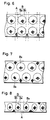
- a continuous body when a connecting portion B1 or non-tubular weave structure A having some width is further arranged on a middle portion in the widthwise direction of the continuous body, a continuous body can be obtained in which a plurality of the large, hollow portions are arranged in two rows as illustrated in Fig. 6.
- a continuous body in which a plurality of large, hollow portions are arranged in rows of three or more can be easily obtained in the same manner as that of the previous case.
- a continuous body in which a plurality of large, hollow portions are arranged in a zigzag state as illustrated in Fig. 7 can be obtained.
- the above weaving can be performed by using a jacquard loom, or the like.
- the shape of the non-connecting portion B2 in the tubular weave structure B is generally circular or nearly circular, but it is possible to make a deformed circle as illustrated in Fig. 8.
- the impact absorbing bag including the non-connection portion B2 of the deformed circle seat be usefully used as an air bag in the front passenger seat or the rear passenger seats.
- a plain weave, twill weave, satin weave or the like can be used as the weave in the non-connecting portion and the connecting portion.
- a thread produced from a polyester fiber, polyamide fiber, including aramide fibers, acrylic fiber, polyvinyl alcohol fiber, polyvinylidene chloride fiber, polyolefin fiber, polyurethane fiber, fluoroplastic fiber, semisynthetic fiber, regenerated fiber, natural fiber, carbon fiber, glass fiber, ceramic fiber, metal fiber or the like can be used.
- a thread having a suitable elasticity can be used.
- a polymer layer 2 is provided on at least one portion of a surface of the flat, seamless tubular fabric 1 to prevent permeation of gases through the fabric 1.
- the polymer layer 2 is provided on the entire surface of both sides of the fabric 1, but the polymer layer 2 may also be provided on just the surface of the side facing the driver when the air bag is mounted in a steering wheel.
- polymer layer 2 As examples of the polymer layer 2, mention may be made of film produced from a polyurethane resin, polyester resin, polyamide resin, polyvinylidene chloride resin, polyvinyl chloride resin, polyolefin resin, fluorine resin, silicone resin, polystyrene resin, cellulose polymer, natural rubber, synthetic rubber, or the like.
- a polymer capable of forming an elastic film is useful.
- a polyurethane elastomer, a polyester elastomer, a polyamide elastomer, a polyolefin elastomer, or the like can be used as typical elastic polymers.
- a polyurethane elastomer is particularly preferable.
- polyurethane elastomer denotes a rubber-like elastic polymer having a urethane radical in its molecular structure and includes an adipate ester type, a polyether type, a caprolactone type, and a polycarbonate type.
- the polymer is generally applied in a film state, liquid state, solution state, dispersion state, or a molten state on the outer surface of both sides of the fabric 1 and then is made into a laminate or covering by heating, drying, cooling, irradiation by activation energy or the like.
- the warp thread and/or weft thread is previously coated with the polymer, a fabric is made by the above warp threads and weft threads, and the woven fabric is heated to increase the flowability of the polymer on the surface of the thread so that gaps in the woven fabric structure are filled with the polymer.
- the polymer layer 2 may be formed on the flat, seamless tubular fabric 1 for individual units of the fabric 1. However, it is more efficient to form the polymer layer 2 on a continuous body having a plurality of large, hollow portions. It is possible to apply the polymer layer to a segment cut from a continuous body, for example, a segment including two hollow portions, a segment including three hollow portions, or a segment having the shape of a square.
- a gas introducing hole 3 is arranged on the central zone at one side of the flat, seamless woven fabric 1.
- the gas introducing holes 3 may be made in the continuous body, the segments, or the individual units.
- the connecting portion B1 of the tubular weave structure B and/or the non-tubular weave structure A may be cut in a circular shape along a position slightly apart from the circumferential edge of the non-connecting portion B2 having a substantially circular shape in the tubular weave structure B. It is advantageous to use melting rather than mechanical cutting as a cutting method, thus, individual units including a hollow and substantially circular shaped central zone and a ring-like stitched circumferential zone around the central zone is obtained.
- the polymer layer 2 is generally formed on the seamless, tubular fabric 1 from the outside of the fabric 1. Therefore, the bag obtained by this method has a slightly inferior feeling. Further, since the circumferential zone is present in a circumferential portion of the bag, the appearance of the bag is not always good. If the bag is turned inside-out by pulling out the inside of the air bag through the gas introducing hole 3, the feeling and the appearance of the obtained air bag are remarkably improved. Therefore, it is advantageous to use an inside-out air bag in terms of the merchandiseability.
- the impact absorbing bag in accordance with the present invention is housed in the central portion of the steering wheel with the gas introducing hole 3 connected to a gas generator.
- a gas generator When an impact of a predetermined value or more, for example, an impact generated when a car having a speed of 16 km/hr or 25 km/hr collides head on with an object, is sensed by a mechanical sensor or an electrical sensor, gas generated by a pyrotechnic is suddenly fed into the bag, and the bag is simultaneovsly inflated.
- the bag is inflated in 0.06 seconds after sensing of the impact. It is also possible to feed a gas having a high pressure from a gas cylinder.
- portions capable of housing the impact absorbing bags may be suitably arranged inside the car.
- the impact absorbing bag according to the present invention uses as a base woven structure a flat, seamless tubular fabric 1 constituted with a hollow and substantially circular-shaped central zone and a ring-like stitched circumferential zone around the central zone. Due to this, it is superior in terms of uniformity, strength, and adjustment of the air-permeability compared with the conventional method of forming a bag by cutting out circular pieces of fabric from two square pieces of fabric and sewing together the circumferences of the same. Therefore, a high degree of reliability can be ensured as an impact absorbing bag. Further, the manufacturing steps are streamlined and inspection time can be reduced, so it is advantageous in terms of productivity as well.
- the impact absorbing bag of the present invention is far superior in the overall uniformity of application of the air pressure, the external appearance and the capability of housing within a steering wheel.
- the reference numeral 1 represents a flat seamless tubular fabric
- 2 represents a polymer covering layer
- 3 represents a gas introducing hole
- 4 represents a strand or strip for limiting the information of the bag
- 5 represents a reinforcement piece
- A represents a non-tubular weave structure
- B represents a tubular weave structure
- B1 represents a connecting portion
- B2 represents a non-connecting portion.
- Figures 1 to 4 show an example of the steps for manufacturing an impact absorbing bag according to the present invention.
- this individual unit was turned inside out from the gas introducing hole 3 to prepare the desired impact absorbing bag - (see Fig. 4).
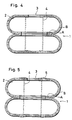
- (4) in Fig. 4 is a strip for limiting the inflation of the bag, which is provided according to need. It is attached to inside the bag between the top surface and bottom surface.
- This inflation limiting strip 4, as shown in Fig. 5, may be attached inside the bag between the top surface and bottom surface by tearing a portion of the top surface and bottom surface of the bag, adhering the two ends of the strip 4 so that they stick outside, then adhering a reinforcement piece 5 over the attached portion.
- Example 1 Use was made of nylon multifilament yarn as the warp and weft and weaving was performed using a loom. Except for this, the same procedure was followed as in Example 1 so as to prepare a continuous body of a seamless tubular fabric 1.
- a film of an adipate ester type polyurethane elastomer was laid over the two surfaces of the continuous body.
- the composite was passed between heating rollers for lamination, thereby forming a polymer covering layer 2.
- a hole was made in the center portion of the central zone on one side, along with the polymer layer 2, to form the gas introducing hole 3.
- Figures 6 to 8 are plan views showing other examples of the continuous body of the impact absorbing bag of the present invention.
- Examples 1 and 2 a single row of continuous bodies of a seamless tubular woven fabric 1 was obtained and the impact absorbing bag prepared from the same, but by providing a connecting portion B1 at not only the two edges, but also the width at the intermediate portion with the two edges in the tubular weaving step, it is possible to obtain two rows of continuous bodies as shown in Fig. 6. It is also possible to prepare impact absorbing bags similarly from such two rows of continuous bodies.
- the two rows of continuous bodies in Fig. 7 are prepared by just repeating a necessary number of times just the step of tubular weaving wherein the length is changed in the widthwise direction of the non-connecting portion B2.
- the continuous body of Fig. 8 was prepared by making the non-connecting portion B2 of the tubular weave structure B a deformed circle in shape.
- the impact absorbing bag of the present invention housed in the center portion of the steering wheel, is useful for the object of instantaneous inflation when sensing an impact of collision of the car and ensuring driver safety. It may be used not only for the object of ensuring driver safety, but also for the object of ensuring the safety of the passengers in the front passenger seat and rear passenger seats.
Landscapes
- Engineering & Computer Science (AREA)
- Textile Engineering (AREA)
- Mechanical Engineering (AREA)
- Air Bags (AREA)
- Woven Fabrics (AREA)
- Laminated Bodies (AREA)
Abstract
Claims (6)
- Un coussin d'absorption de choc constitué par
un tissu tubulaire plat sans couture (1) comprenant des fils de chaîne et de trame, ce tissu (1) étant obtenu par le découpage en segments d'une étendue continue comportant un ensemble de grandes parties creuses entourées de façon périphérique par une partie liée, et formées périodiquement dans la direction des fils de chaîne,
une couche de recouvrement en polymère (2) formée sur au moins une partie d'une surface du tissu (1), avant ou après le découpage en segments de l'étendue continue, et
un trou d'introduction de gaz (3) formé dans la partie creuse, d'un côté du tissu (1);
caractérisé en ce que le tissu (1) est constitué par une zone centrale creuse et de forme pratiquement circulaire, et par une zone périphérique annulaire liée, autour de la zone centrale. - Un coussin d'absorption de choc selon la revendication 1, dans lequel au moins un cordon ou une bande capable de limiter le gonflage du coussin est placé à l'intérieur du coussin d'absorption de choc, entre l'avant du coussin, vu de la position du conducteur ou du passager, et le côté arrière du coussin.
- Un coussin d'absorption de choc qui est formé en retournant le coussin d'absorption de choc selon la revendication 1 ou la revendication 2, en tirant l'intérieur du coussin pour le faire passer à l'extérieur à travers l'ouverture d'introduction de gaz (3).
- Un procédé de fabrication d'un coussin d'absorption de choc, comprenant :(i) une étape d'obtention d'un tissu tubulaire plat sans couture (1) qui comprend :
l'accomplissement d'un tissage tubulaire en utilisant un ensemble de fils de chaîne avec un fil de trame, conformément à un procédé de tissage tubulaire, pour former une étendue continue comportant des rangées d'un ensemble de grandes parties creuses, entourées de façon périphérique par une partie liée, et disposées périodiquement dans la direction des fils de chaîne, suivi par le découpage en segments de l'étendue continue,(ii) une étape de formation d'une couche de polymère (2) sur au moins une partie d'une surface du tissu (1), avant ou après le découpage de segments de l'étendue continue, et(iii) une étape de formation d'un trou d'introduction de gaz (3) dans la partie creuse, d'un côté du tissu (1), avant ou après l'étape (ii),
caractérisé en ce que le tissage tubulaire à l'étape (1) est effectué d'une manière telle que la longueur dans la direction latérale d'une partie de non-liaison (B2) d'une structure tissée tubulaire change progressivement, pour former des rangées d'un ensemble de grandes parties creuses et de forme pratiquement circulaire, disposées périodiquement dans la direction des fils de chaîne, et une partie liée est formée entre deux grandes parties creuses adjacentes, et le découpage en segments de l'étendue continue à l'étape (i) est effectué d'une manière telle que les parties de forme circulaire soient découpées le long d'une partie qui est légèrement espacée du bord périphérique des parties de forme circulaire, pour former le tissu (1) constitué par une zone centrale creuse et de forme pratiquement circulaire, et par une zone périphérique annulaire liée, autour de la zone centrale. - Un procédé de fabrication d'un coussin d'absorption de choc, comprenant une étape qui consiste à retourner le coussin obtenu conformément à la revendication 4, en tirant un côté intérieur du coussin pour le faire passer à l'extérieur à travers le trou d'introduction de gaz (3).
- Utilisation dans la fabrication d'un coussin d'absorption de choc, d'un tissu tubulaire plat sans couture (1) comprenant des fils de chaîne et de trame, ce tissu étant obtenu par découpage en segments d'une étendue continue comprenant un ensemble de grandes parties creuses qui sont entourées de façon périphérique par une partie liée, et qui sont formées périodiquement dans la direction des fils de chaîne, et
un trou d'introduction de gaz (3) qui est formé dans la partie creuse, d'un côté du tissu (1);
caractérisée en ce que le tissu (1) est constitué par une zone centrale creuse et de forme pratiquement circulaire, et par une zone périphérique annulaire liée, autour de la zone centrale.
Applications Claiming Priority (2)
| Application Number | Priority Date | Filing Date | Title |
|---|---|---|---|
| JP31493487 | 1987-12-11 | ||
| JP314934/87 | 1987-12-11 |
Related Child Applications (2)
| Application Number | Title | Priority Date | Filing Date |
|---|---|---|---|
| EP19910109376 Division-Into EP0459526A1 (fr) | 1987-12-11 | 1988-12-10 | Coussin absorbant les chocs |
| EP91109376.3 Division-Into | 1991-06-06 |
Publications (3)
| Publication Number | Publication Date |
|---|---|
| EP0363490A1 EP0363490A1 (fr) | 1990-04-18 |
| EP0363490A4 EP0363490A4 (fr) | 1990-05-14 |
| EP0363490B1 true EP0363490B1 (fr) | 1993-01-27 |
Family
ID=18059407
Family Applications (2)
| Application Number | Title | Priority Date | Filing Date |
|---|---|---|---|
| EP19890900314 Expired - Lifetime EP0363490B1 (fr) | 1987-12-11 | 1988-12-10 | Coussin absorbant les chocs et production de ce coussin |
| EP19910109376 Withdrawn EP0459526A1 (fr) | 1987-12-11 | 1988-12-10 | Coussin absorbant les chocs |
Family Applications After (1)
| Application Number | Title | Priority Date | Filing Date |
|---|---|---|---|
| EP19910109376 Withdrawn EP0459526A1 (fr) | 1987-12-11 | 1988-12-10 | Coussin absorbant les chocs |
Country Status (8)
| Country | Link |
|---|---|
| US (2) | US5336538A (fr) |
| EP (2) | EP0363490B1 (fr) |
| JP (1) | JPH0692218B2 (fr) |
| KR (1) | KR940010715B1 (fr) |
| AU (2) | AU614009B2 (fr) |
| DE (1) | DE3877961T2 (fr) |
| GB (2) | GB2226339B (fr) |
| WO (1) | WO1989005250A1 (fr) |
Families Citing this family (90)
| Publication number | Priority date | Publication date | Assignee | Title |
|---|---|---|---|---|
| JPH0692218B2 (ja) * | 1987-12-11 | 1994-11-16 | 旭化成工業株式会社 | 衝撃吸収用バッグおよびその製造法 |
| EP0380699B2 (fr) * | 1988-08-03 | 1997-12-03 | Asahi Kasei Kogyo Kabushiki Kaisha | Coussin d'air |
| US6344251B1 (en) * | 1988-12-01 | 2002-02-05 | Milliken & Company | Welded airbag structure |
| DE69026933T2 (de) * | 1989-02-16 | 1996-09-19 | Airbags Int Ltd | Luftsack |
| US5312132A (en) * | 1990-01-26 | 1994-05-17 | Pillet Jean Francois | Gas cushion and method and apparatus for its manufacture |
| WO1991018764A1 (fr) * | 1990-05-30 | 1991-12-12 | Takata Kabushiki Kaisha | Coussin pneumatique gonflable pour installation de securite anti-collision |
| JPH0443143A (ja) * | 1990-06-08 | 1992-02-13 | Asahi Chem Ind Co Ltd | 異形袋織エアーバッグ |
| DE59103786D1 (de) * | 1990-09-08 | 1995-01-19 | Akzo Nobel Nv | Verfahren zur Herstellung eines Airbag-Gewebes. |
| JP3222158B2 (ja) * | 1990-09-08 | 2001-10-22 | アクゾ ノーベル ナムローゼ フェンノートシャップ | エアーバッグのフィルタ部分用の織布を製造する方法 |
| DE4038910A1 (de) * | 1990-12-06 | 1992-06-11 | Basf Ag | Aufblasbarer prallschutzsack fuer kraftfahrzeuge |
| JPH04228648A (ja) * | 1990-12-27 | 1992-08-18 | Bridgestone Corp | エアバッグ |
| GB2251253A (en) * | 1990-12-28 | 1992-07-01 | Airbags Int Ltd | Woven airbag |
| US5653464A (en) * | 1995-10-05 | 1997-08-05 | Automotive Technologies International Inc. | Airbag system with self shaping airbag |
| JPH05156545A (ja) * | 1991-12-10 | 1993-06-22 | Takata Kk | ノンコート織布及びその製造方法 |
| US5618629A (en) * | 1991-12-27 | 1997-04-08 | Tokai Rubber Industries, Inc. | Flexible partition member for hydraulic accumulator, including ethylene-vinyl alcohol copolymer gas-barrier layer and polyamide resin elastic layer |
| US5393092A (en) * | 1992-02-10 | 1995-02-28 | Trw Inc. | Air bag for a vehicle air bag assembly and method of making the same |
| HUT62347A (en) * | 1992-05-13 | 1993-04-28 | Andras Siveri | Production method of bio-bag suitable for storing and transporting and decoration ornamental purposes fruits and vegetables |
| GB2267466A (en) * | 1992-06-06 | 1993-12-08 | Booth & Son Limited L | Dunnage bag |
| DE4324487B4 (de) * | 1993-07-21 | 2006-03-30 | Bst Safety Textiles Gmbh | Textiler Hohlkörper und Verfahren zu seiner Herstellung |
| BR9306900A (pt) * | 1992-08-14 | 1998-12-08 | Johann Berger | Corpo oco têxtil e processo para sua fabricação |
| DE4232658A1 (de) * | 1992-09-29 | 1994-03-31 | Trw Repa Gmbh | Aufblasbarer Gassack für ein Rückhaltesystem in Fahrzeugen |
| DE4343738A1 (de) * | 1993-12-21 | 1995-06-22 | Johann Berger | Airbag und Verfahren zu seiner Herstellung |
| DE4302904A1 (de) * | 1993-02-02 | 1994-08-04 | Johann Berger | Verfahren und Vorrichtung zur Herstellung eines textilen Hohlkörpers |
| JPH0740798A (ja) * | 1993-07-30 | 1995-02-10 | Ikeda Bussan Co Ltd | エアバッグ本体 |
| US5865464A (en) * | 1994-01-28 | 1999-02-02 | Asahi Kasei Kogyo Kabushiki Kaisha | Air bag |
| US20060202452A1 (en) * | 1994-05-23 | 2006-09-14 | Automotive Technologies International, Inc. | Side curtain and multi-compartment vehicular airbags |
| US7338069B2 (en) * | 2004-04-02 | 2008-03-04 | Automotive Technologies International, Inc. | Airbags with internal valves |
| US20080147278A1 (en) * | 1994-05-23 | 2008-06-19 | Automotive Technologies International, Inc. | Knee Airbags Including Film |
| CN1183123A (zh) * | 1995-04-06 | 1998-05-27 | 亚历山大·比斯根 | 织造三维成型织物区的方法 |
| EP0763621B1 (fr) * | 1995-09-18 | 2002-11-27 | Toray Industries, Inc. | Tissu de base pour airbags, son procédé de fabrication et airbag le comprenant |
| US5763330A (en) * | 1995-09-29 | 1998-06-09 | Highland Industries, Inc. | Extrusion coated fabric |
| US7744122B2 (en) * | 1995-12-12 | 2010-06-29 | Automotive Technologies International, Inc. | Driver side aspirated airbags |
| DE19713812C2 (de) * | 1997-04-03 | 2000-10-19 | Krall & Roth Weberei Gmbh & Co | Textilgebilde |
| EP0961717B1 (fr) * | 1997-12-19 | 2006-08-16 | Milliken & Company | Airbag tisse dote de barrieres de flux |
| US6112634A (en) * | 1998-01-08 | 2000-09-05 | A&P Technology, Inc. | High coverage area braiding material for braided structures |
| USD573352S1 (en) | 1998-12-17 | 2008-07-22 | Milliken & Company | Inflatable airbag with closely spaced joints |
| US6145872A (en) * | 1999-01-13 | 2000-11-14 | Autoliv Asp, Inc. | Airbag cushion attachment |
| US6189915B1 (en) | 1999-01-13 | 2001-02-20 | Autoliv Asp, Inc. | Airbag cushion attachment |
| DE29906538U1 (de) * | 1999-04-13 | 1999-09-30 | Trw Repa Gmbh | Textiles Gassack-Material |
| US6695346B1 (en) * | 1999-04-23 | 2004-02-24 | Milliken & Company | Polygon-shaped air bag with lapping seam area |
| US6455449B1 (en) | 1999-09-03 | 2002-09-24 | Bradford Industries, Inc. | Coated multi-denier mixed fabrics for use in inflatable vehicle restraint systems |
| US6734123B2 (en) | 1999-06-07 | 2004-05-11 | Bradford Industries, Inc. | Polyurethane coated fabrics for use in air-holding vehicle restraint systems |
| US6239046B1 (en) | 1999-06-07 | 2001-05-29 | Bradford Industries, Inc. | Polysiloxane coated fabrics for use in air bags |
| US6458724B1 (en) | 1999-06-07 | 2002-10-01 | Bradford Industries, Inc. | Coated multi-layered woven textile fabrics for use in air-holding vehicle restraint system |
| US6753275B2 (en) * | 1999-06-07 | 2004-06-22 | Bradford Industries, Inc. | Laminated multi-layered woven textile fabrics for use in air holding vehicle restraint systems |
| US6740607B2 (en) * | 1999-06-07 | 2004-05-25 | Bradford Industries, Inc. | Substrate with stretch and heat sealing properties to make a multidirectional restraint module design |
| US6770578B2 (en) | 1999-06-07 | 2004-08-03 | Bradford Industries, Inc. | Laminated textile fabrics for use in air holding vehicle restraint systems |
| US6734125B2 (en) | 1999-06-07 | 2004-05-11 | Bradford Industries, Inc. | Laminated multi-denier mixed fabrics for use in inflatable vehicle restraint systems |
| US6698458B1 (en) | 1999-06-17 | 2004-03-02 | Milliken & Company | Low permeability airbag cushions having film coatings of extremely low thickness |
| MXPA01001742A (es) * | 1999-06-17 | 2004-12-06 | Milliken & Co | Sistema de recubrimiento de dos capas para telas de bolsa de aire. |
| US6220309B1 (en) | 1999-09-24 | 2001-04-24 | Milliken & Company | Inflatable fabrics comprising basket-woven attachment points between fabric panels |
| US6429155B1 (en) | 1999-06-17 | 2002-08-06 | Milliken & Company | Low permeability airbag cushions having film coatings of extremely low thickness |
| US6701971B1 (en) | 1999-06-17 | 2004-03-09 | Mililken & Company | Low permeability side curtain airbag cushions having extremely low coating levels |
| US6892767B2 (en) * | 1999-07-19 | 2005-05-17 | Toyo Boseki Kabushiki Kaisha | Uncoated air bag fabric |
| US6294487B1 (en) † | 1999-09-24 | 2001-09-25 | Milliken & Company | Airbag fabric processing very low cover factor |
| JP2001097170A (ja) | 1999-09-30 | 2001-04-10 | Nippon Plast Co Ltd | 側部用エアバッグ |
| JP3286787B2 (ja) * | 1999-10-04 | 2002-05-27 | 株式会社三宅デザイン事務所 | 長尺布帛よりの衣類の形成方法 |
| US6264234B1 (en) | 1999-11-08 | 2001-07-24 | Trw Vehicle Safety Systems Inc./ Trw Inc. | Inflatable vehicle occupant protection device |
| US6350709B1 (en) | 1999-11-30 | 2002-02-26 | Bradford Industries, Inc. | Heat sealable coated textile fabric for inflatable vehicle restraint systems |
| ES2237179T3 (es) | 1999-12-16 | 2005-07-16 | Textilma Ag | Dispositivo para la fabricacion de al menos dos cintas tejidas invertibles en forma de tubo flexible. |
| US6630220B1 (en) | 2000-01-28 | 2003-10-07 | Bradford Industries, Inc. | Sewn fusion seal process for producing air-holding vehicle restraint systems |
| JP3785301B2 (ja) * | 2000-02-22 | 2006-06-14 | トヨタ紡織株式会社 | 袋織エアバッグ |
| US6632753B1 (en) | 2000-04-26 | 2003-10-14 | Safety Components Fabric Technologies, Inc. | Motor vehicle air bag and fabric for use in same |
| SE523328C2 (sv) * | 2001-02-06 | 2004-04-13 | Fov Fabrics Ab | Uppblåsbar luftsäck och förfarande att tillverka sådan |
| US20020140218A1 (en) * | 2001-03-29 | 2002-10-03 | Beasley Alonzo W. | One-piece woven airbag |
| EP1379407A1 (fr) * | 2001-04-20 | 2004-01-14 | Eduard Capdevila | Dispositif pour retourner un sac |
| JP2003072505A (ja) * | 2001-08-30 | 2003-03-12 | Takata Corp | 自動車乗員頭部の保護バッグ |
| DE10142130A1 (de) | 2001-08-30 | 2003-03-20 | Berger Seiba Technotex Verwaltungs Gmbh & Co | Fertigung von Airbag-Gewebe |
| JP2003072500A (ja) * | 2001-09-07 | 2003-03-12 | Takata Corp | 自動車乗員頭部の保護バッグ |
| US7871480B1 (en) | 2001-11-21 | 2011-01-18 | Toney Wayne H | Apparatus and method for making motor vehicle air bags, and air bags made by same |
| GB2383303A (en) * | 2001-12-19 | 2003-06-25 | Autoliv Dev | Material for an air-bag |
| US6886858B2 (en) | 2002-07-26 | 2005-05-03 | Key Safety Systems, Inc. | Air bag assembly with tethers in a woven cushion and method of construction |
| DE10326757A1 (de) * | 2003-06-13 | 2005-01-13 | Bst Berger Safety Textiles Gmbh & Co. Kg | Verfahren zur Herstellung eines Luftsacks |
| DE102005061351A1 (de) * | 2005-12-21 | 2007-07-05 | Bst Safety Textiles Gmbh | Gewebe und Verfahren zum Herstellen desselben |
| DE102006021082A1 (de) * | 2006-05-05 | 2007-11-15 | Bst Safety Textiles Gmbh | Nahtkonstruktion für ein Gewebe |
| US20070284864A1 (en) * | 2006-06-08 | 2007-12-13 | Trw Vehicle Safety Systems Inc. | Inflatable vehicle occupant protection device construction |
| US20080026657A1 (en) * | 2006-07-26 | 2008-01-31 | Sollars John A | Fabric for manufacture of automotive airbags, airbags and method for making airbags |
| US7770607B2 (en) * | 2006-08-21 | 2010-08-10 | Autoliv Asp, Inc. | Double weft/warp airbag fabric and related airbags and manufacturing methods |
| US7951437B2 (en) * | 2006-09-22 | 2011-05-31 | Milliken & Company | Multilayer film dry lamination of airbag fabrics |
| RU2346092C1 (ru) * | 2007-11-26 | 2009-02-10 | Государственное образовательное учреждение высшего профессионального образования Московский государственный университет дизайна и технологии (МГУДТ) | Цельнотканая оболочка с комбинацией двухниточных и трехниточных переплетений |
| JP4992785B2 (ja) * | 2008-03-24 | 2012-08-08 | 豊田合成株式会社 | エアバッグ |
| US20100129575A1 (en) * | 2008-08-30 | 2010-05-27 | Veiga Manuel J | Polyvinyl chloride coated fabrics for use in air bags |
| US7651118B1 (en) | 2008-08-30 | 2010-01-26 | Bradford Industries, Inc. | Polyvinyl chloride coated fabrics for use in air bags |
| JP5201090B2 (ja) * | 2008-09-30 | 2013-06-05 | 豊田合成株式会社 | エアバッグ |
| SE532148C2 (sv) * | 2008-11-07 | 2009-11-03 | Anders Westerlind Ab | Vävt krockkuddetyg |
| JP5382571B2 (ja) * | 2009-01-07 | 2014-01-08 | 株式会社片山商店 | 無縫製織物およびその製造方法 |
| US9079558B2 (en) * | 2009-01-16 | 2015-07-14 | Global Safety Textiles, Llc | Coated airbag |
| JP5831665B1 (ja) * | 2015-08-12 | 2015-12-09 | 日東紡績株式会社 | ガラスクロス |
| DE102021118314A1 (de) * | 2020-11-25 | 2022-05-25 | Zf Automotive Germany Gmbh | Gassackgewebe |
| CN113832593A (zh) * | 2021-07-19 | 2021-12-24 | 信泰(福建)科技有限公司 | 一种多层针织鞋面 |
Citations (5)
| Publication number | Priority date | Publication date | Assignee | Title |
|---|---|---|---|---|
| JPS514742A (en) * | 1974-06-28 | 1976-01-16 | Nissan Motor | Eaapatsukusochino patsuku oyobi sonoseizohoho |
| US3991249A (en) * | 1975-01-17 | 1976-11-09 | Toray Industries, Inc. | Fabric material for producing woven air bags utilized for protecting riders in vehicles |
| JPS5152108Y2 (fr) * | 1972-03-04 | 1976-12-14 | ||
| JPS54576B2 (fr) * | 1973-05-26 | 1979-01-12 | ||
| JPS5758228Y2 (fr) * | 1974-05-20 | 1982-12-13 |
Family Cites Families (16)
| Publication number | Priority date | Publication date | Assignee | Title |
|---|---|---|---|---|
| US3286739A (en) * | 1962-10-25 | 1966-11-22 | Itakura Masaji | Process of manufacturing a textile fabric for pocket materials having no stitched seam |
| US3575776A (en) * | 1968-11-19 | 1971-04-20 | U S Plush Mills Inc | Inflatable fabric |
| US4025684A (en) * | 1971-09-02 | 1977-05-24 | Helmut Neidhardt | Tubular fabric coated with plastics or synthetic rubbers |
| GB1500967A (en) * | 1974-06-28 | 1978-02-15 | Ikeda Bussan Co | Inflatable protector bag for vehicle safety device and method of producing same |
| JPS54576A (en) * | 1977-06-03 | 1979-01-05 | Hitachi Ltd | Electronic parts |
| US4178344A (en) * | 1978-08-15 | 1979-12-11 | General Motors Corporation | Method and apparatus for reversing and flattening a driver's restraint cushion |
| JPS5643890A (en) * | 1979-09-17 | 1981-04-22 | Sony Corp | Recording and reproducing device for pal video signal |
| JPS5758228A (en) * | 1980-09-24 | 1982-04-07 | Sekisui Chem Co Ltd | Bonding agent magnetic recording body |
| DE8714595U1 (de) * | 1987-11-03 | 1988-01-28 | Bloch, Klaus, 5205 St Augustin | Airbag für Kraftfahrzeuge |
| JPH0692218B2 (ja) * | 1987-12-11 | 1994-11-16 | 旭化成工業株式会社 | 衝撃吸収用バッグおよびその製造法 |
| DE3818185C1 (fr) * | 1988-05-28 | 1989-08-17 | Daimler-Benz Aktiengesellschaft, 7000 Stuttgart, De | |
| EP0380699B2 (fr) * | 1988-08-03 | 1997-12-03 | Asahi Kasei Kogyo Kabushiki Kaisha | Coussin d'air |
| JP2945039B2 (ja) * | 1989-10-24 | 1999-09-06 | タカタ株式会社 | エアバッグ |
| JP2524534B2 (ja) * | 1989-12-27 | 1996-08-14 | 池田物産株式会社 | エアバッグ装置 |
| JPH0419252A (ja) * | 1990-04-06 | 1992-01-23 | Toyoda Gosei Co Ltd | 車両用エアバツグ |
| US5011183A (en) * | 1990-06-08 | 1991-04-30 | Stern & Stern Industries, Inc. | Bag, airbag, and method of making the same |
-
1988
- 1988-12-09 JP JP31240488A patent/JPH0692218B2/ja not_active Expired - Lifetime
- 1988-12-10 US US07/423,449 patent/US5336538A/en not_active Expired - Lifetime
- 1988-12-10 WO PCT/JP1988/001253 patent/WO1989005250A1/fr not_active Ceased
- 1988-12-10 GB GB8918251A patent/GB2226339B/en not_active Expired - Lifetime
- 1988-12-10 KR KR1019890701518A patent/KR940010715B1/ko not_active Expired - Lifetime
- 1988-12-10 EP EP19890900314 patent/EP0363490B1/fr not_active Expired - Lifetime
- 1988-12-10 EP EP19910109376 patent/EP0459526A1/fr not_active Withdrawn
- 1988-12-10 AU AU27951/89A patent/AU614009B2/en not_active Expired
- 1988-12-10 DE DE8989900314T patent/DE3877961T2/de not_active Expired - Lifetime
-
1991
- 1991-05-16 AU AU77068/91A patent/AU634656B2/en not_active Expired
- 1991-05-29 GB GB9111531A patent/GB2244496B/en not_active Expired - Lifetime
-
1995
- 1995-06-06 US US08/468,668 patent/US5707711A/en not_active Expired - Lifetime
Patent Citations (5)
| Publication number | Priority date | Publication date | Assignee | Title |
|---|---|---|---|---|
| JPS5152108Y2 (fr) * | 1972-03-04 | 1976-12-14 | ||
| JPS54576B2 (fr) * | 1973-05-26 | 1979-01-12 | ||
| JPS5758228Y2 (fr) * | 1974-05-20 | 1982-12-13 | ||
| JPS514742A (en) * | 1974-06-28 | 1976-01-16 | Nissan Motor | Eaapatsukusochino patsuku oyobi sonoseizohoho |
| US3991249A (en) * | 1975-01-17 | 1976-11-09 | Toray Industries, Inc. | Fabric material for producing woven air bags utilized for protecting riders in vehicles |
Also Published As
| Publication number | Publication date |
|---|---|
| GB2244496A (en) | 1991-12-04 |
| AU2795189A (en) | 1989-07-05 |
| JPH0692218B2 (ja) | 1994-11-16 |
| US5336538A (en) | 1994-08-09 |
| GB8918251D0 (en) | 1990-03-21 |
| AU614009B2 (en) | 1991-08-15 |
| DE3877961T2 (de) | 1993-06-03 |
| WO1989005250A1 (fr) | 1989-06-15 |
| GB9111531D0 (en) | 1991-07-17 |
| GB2226339B (en) | 1992-08-12 |
| EP0363490A4 (fr) | 1990-05-14 |
| US5707711A (en) | 1998-01-13 |
| AU634656B2 (en) | 1993-02-25 |
| KR900700321A (ko) | 1990-08-13 |
| EP0363490A1 (fr) | 1990-04-18 |
| DE3877961D1 (de) | 1993-03-11 |
| EP0459526A1 (fr) | 1991-12-04 |
| JPH01254446A (ja) | 1989-10-11 |
| GB2244496B (en) | 1992-08-05 |
| KR940010715B1 (ko) | 1994-10-24 |
| AU7706891A (en) | 1991-08-29 |
| GB2226339A (en) | 1990-06-27 |
Similar Documents
| Publication | Publication Date | Title |
|---|---|---|
| EP0363490B1 (fr) | Coussin absorbant les chocs et production de ce coussin | |
| EP0458838B1 (fr) | Coussin pneumatique de securite | |
| US5685347A (en) | Circular air bag made of two simultaneously woven fabrics | |
| US5011183A (en) | Bag, airbag, and method of making the same | |
| US5865464A (en) | Air bag | |
| KR950008145B1 (ko) | 에어백 | |
| AU650619B2 (en) | Seamless fabric confinements | |
| JPH04281038A (ja) | エアーバッグのフィルタ部分用の織布を製造する方法 | |
| EP2769885B1 (fr) | Airbag | |
| EP0687596B1 (fr) | Sac gonflable | |
| CA1337944C (fr) | Sac anti-choc; methode de sa fabrication | |
| CA1337207C (fr) | Sac amortisseur et methode pour sa fabrication | |
| JPH0692217B2 (ja) | エアバック | |
| EP0585271B1 (fr) | Tissu permeable aux gaz | |
| JP3085790B2 (ja) | 基布排気式エアバッグ | |
| EP0564518B1 (fr) | Coussin pneumatique de securite | |
| JPH0382645A (ja) | エアバッグ装置 | |
| JPH045145A (ja) | エアバッグ | |
| JPH04163254A (ja) | エアバッグ装置のエアバッグ本体 | |
| JPH04193644A (ja) | 乗員保護用エアーバッグ | |
| JPH0325051A (ja) | 衝撃吸収用バッグ |
Legal Events
| Date | Code | Title | Description |
|---|---|---|---|
| PUAI | Public reference made under article 153(3) epc to a published international application that has entered the european phase |
Free format text: ORIGINAL CODE: 0009012 |
|
| 17P | Request for examination filed |
Effective date: 19890809 |
|
| AK | Designated contracting states |
Kind code of ref document: A1 Designated state(s): BE DE FR IT SE |
|
| A4 | Supplementary search report drawn up and despatched |
Effective date: 19900514 |
|
| 17Q | First examination report despatched |
Effective date: 19910903 |
|
| 111L | Licence recorded |
Free format text: 0100 AIRBAGS INTERNATIONAL LIMITED |
|
| GRAA | (expected) grant |
Free format text: ORIGINAL CODE: 0009210 |
|
| AK | Designated contracting states |
Kind code of ref document: B1 Designated state(s): BE DE FR IT SE |
|
| XX | Miscellaneous (additional remarks) |
Free format text: TEILANMELDUNG 91109376.3 EINGEREICHT AM 10/12/88. |
|
| ITF | It: translation for a ep patent filed | ||
| REF | Corresponds to: |
Ref document number: 3877961 Country of ref document: DE Date of ref document: 19930311 |
|
| ET | Fr: translation filed | ||
| PLBE | No opposition filed within time limit |
Free format text: ORIGINAL CODE: 0009261 |
|
| STAA | Information on the status of an ep patent application or granted ep patent |
Free format text: STATUS: NO OPPOSITION FILED WITHIN TIME LIMIT |
|
| 26N | No opposition filed | ||
| EAL | Se: european patent in force in sweden |
Ref document number: 89900314.9 |
|
| REG | Reference to a national code |
Ref country code: FR Ref legal event code: TP |
|
| PGFP | Annual fee paid to national office [announced via postgrant information from national office to epo] |
Ref country code: SE Payment date: 20041206 Year of fee payment: 17 |
|
| PGFP | Annual fee paid to national office [announced via postgrant information from national office to epo] |
Ref country code: BE Payment date: 20050701 Year of fee payment: 17 |
|
| PG25 | Lapsed in a contracting state [announced via postgrant information from national office to epo] |
Ref country code: SE Free format text: LAPSE BECAUSE OF NON-PAYMENT OF DUE FEES Effective date: 20051211 |
|
| PG25 | Lapsed in a contracting state [announced via postgrant information from national office to epo] |
Ref country code: BE Free format text: LAPSE BECAUSE OF NON-PAYMENT OF DUE FEES Effective date: 20051231 |
|
| EUG | Se: european patent has lapsed | ||
| BERE | Be: lapsed |
Owner name: *AIRBAGS INTERNATIONAL LTD Effective date: 20051231 |
|
| PGFP | Annual fee paid to national office [announced via postgrant information from national office to epo] |
Ref country code: IT Payment date: 20071023 Year of fee payment: 20 |
|
| PGFP | Annual fee paid to national office [announced via postgrant information from national office to epo] |
Ref country code: FR Payment date: 20070919 Year of fee payment: 20 |
|
| PGFP | Annual fee paid to national office [announced via postgrant information from national office to epo] |
Ref country code: DE Payment date: 20070914 Year of fee payment: 20 |